VISUAL
SYMBOLS
VISUAL SYMBOLS
 Visual symbols – are representation of direct reality,
which comes in the form of signs and
symbols.
Rules of thumbs in using visuals
1. Visuals must be directly relevant to the audio content .
2. Redundancy between visual and audio must be avoided. If
words are displayed, viewers must given time to read.
3. Visual displays should be big enough to be seen by the
farthest pupil.
4. Visual displays must be attractive.
5. Visual displays must be aesthetically presented to maintain
good taste.
KINDS OF VISUAL SYMBOLS
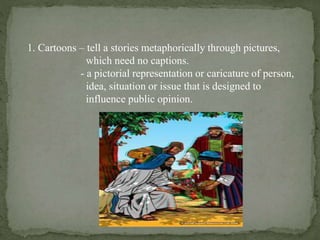
1. Cartoons – tell a stories metaphorically through pictures,
which need no captions.
- a pictorial representation or caricature of person,
idea, situation or issue that is designed to
influence public opinion.
2. Photographs – are also still a pictures, which can be mounted
or un-mounted, photographic reproductions
taken from the magazine or books. They appear in
black and white in full color.
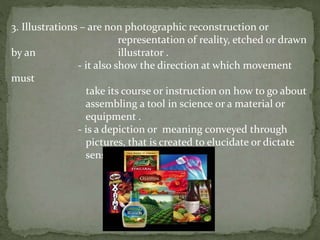
3. Illustrations – are non photographic reconstruction or
representation of reality, etched or drawn
by an illustrator .
- it also show the direction at which movement
must
take its course or instruction on how to go about
assembling a tool in science or a material or
equipment .
- is a depiction or meaning conveyed through
pictures, that is created to elucidate or dictate
sensual information.
Purpose on Where the flat picture, photographs and illustration
can be used for teaching;
1. To concretize words and symbols.
2. To lend meaning to what one reads.
3. To introduce or motivate.
4. To correct misconceptions.
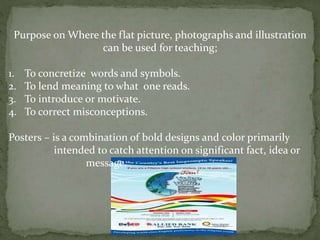
Posters – is a combination of bold designs and color primarily
intended to catch attention on significant fact, idea or
message.
Characteristics of a good Poster
1. It must be hold an simple but dramatizes features.
2. It must be appropriate to the grade level and to subject and
purpose/s.
3. It must have only limited text; few words are generally used
and key words are made to standout by means of type size or
position.
4. It must be attractive, pleasing to the eyes.
5. Design and color must be given consideration.
6. It must have elements of dynamism and shock.
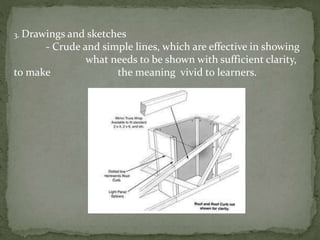
3. Drawings and sketches
- Crude and simple lines, which are effective in showing
what needs to be shown with sufficient clarity,
to make the meaning vivid to learners.
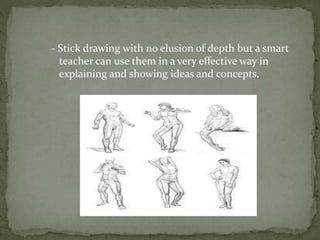
- Stick drawing with no elusion of depth but a smart
teacher can use them in a very effective way in
explaining and showing ideas and concepts.
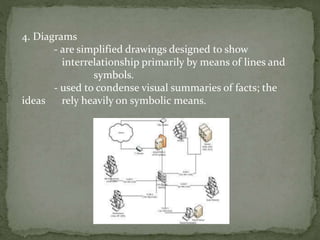
4. Diagrams
- are simplified drawings designed to show
interrelationship primarily by means of lines and
symbols.
- used to condense visual summaries of facts; the
ideas rely heavily on symbolic means.
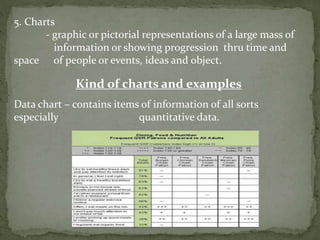
5. Charts
- graphic or pictorial representations of a large mass of
information or showing progression thru time and
space of people or events, ideas and object.
Kind of charts and examples
Data chart – contains items of information of all sorts
especially quantitative data.
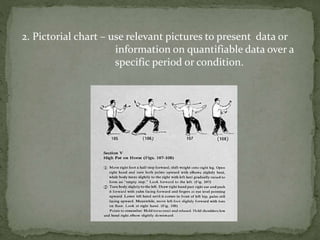
2. Pictorial chart – use relevant pictures to present data or
information on quantifiable data over a
specific period or condition.
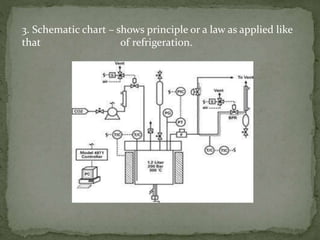
3. Schematic chart – shows principle or a law as applied like
that of refrigeration.
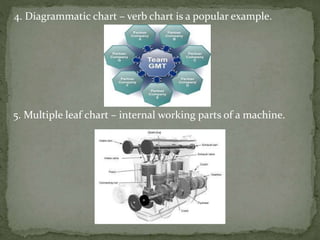
4. Diagrammatic chart – verb chart is a popular example.
5. Multiple leaf chart – internal working parts of a machine.
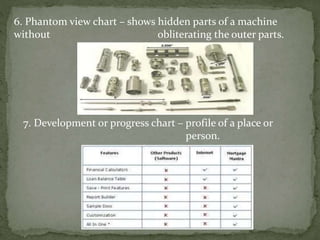
7. Development or progress chart – profile of a place or
person.
6. Phantom view chart – shows hidden parts of a machine
without obliterating the outer parts.
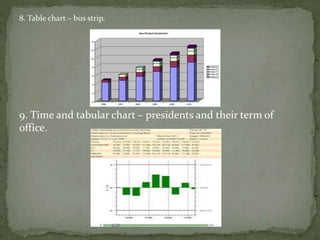
9. Time and tabular chart – presidents and their term of
office.
8. Table chart – bus strip.
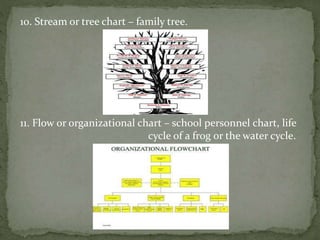
11. Flow or organizational chart – school personnel chart, life
cycle of a frog or the water cycle.
10. Stream or tree chart – family tree.
6. Graphs
- presents quantitative data for easier analysis and
interpretation.
- shows comparative relationship of data involve in size,
trends and growth.
Kinds of Graphs
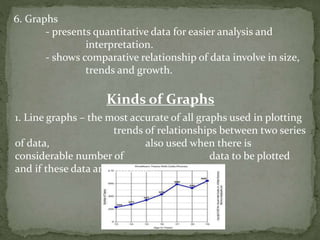
1. Line graphs – the most accurate of all graphs used in plotting
trends of relationships between two series
of data, also used when there is
considerable number of data to be plotted
and if these data are continues.
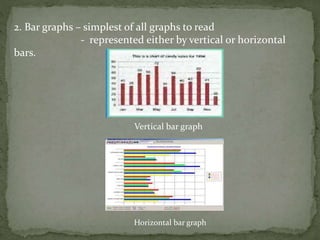
2. Bar graphs – simplest of all graphs to read
- represented either by vertical or horizontal
bars.
Vertical bar graph
Horizontal bar graph
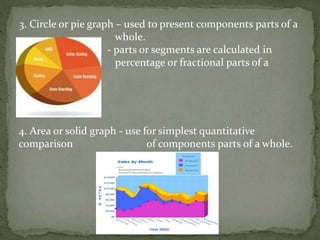
3. Circle or pie graph – used to present components parts of a
whole.
- parts or segments are calculated in
percentage or fractional parts of a
whole.
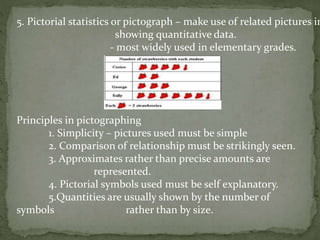
4. Area or solid graph - use for simplest quantitative
comparison of components parts of a whole.
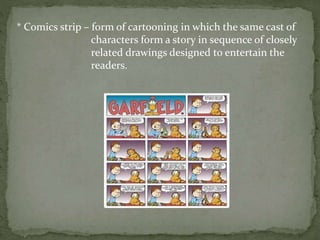
5. Pictorial statistics or pictograph – make use of related pictures in
showing quantitative data.
- most widely used in elementary grades.
Principles in pictographing
1. Simplicity – pictures used must be simple
2. Comparison of relationship must be strikingly seen.
3. Approximates rather than precise amounts are
represented.
4. Pictorial symbols used must be self explanatory.
5.Quantities are usually shown by the number of
symbols rather than by size.
7. Strip drawing
- recommended for their story value in adaptation of
the classic.
- effective instruction not only because they are simple,
clear and easy to read but because they deal with
materials that made personal.
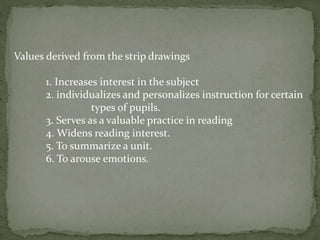
* Comics strip – form of cartooning in which the same cast of
characters form a story in sequence of closely
related drawings designed to entertain the
readers.
Values derived from the strip drawings
1. Increases interest in the subject
2. individualizes and personalizes instruction for certain
types of pupils.
3. Serves as a valuable practice in reading
4. Widens reading interest.
5. To summarize a unit.
6. To arouse emotions.
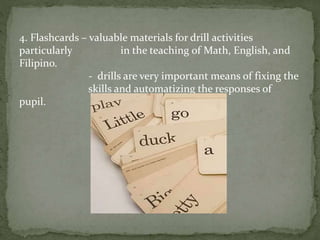
4. Flashcards – valuable materials for drill activities
particularly in the teaching of Math, English, and
Filipino.
- drills are very important means of fixing the
skills and automatizing the responses of
pupil.
Consideration in using Flashcards.
1. Must be bold and big enough to be seen by everybody.
2. Flash the cards in a fast or snappy manner to develop fast
thinking or response.
3. Flash the cards from back to front.
4. Hold the flashcards firmly at your chest level.

Educational Technology Visual Symbols

  • 1.
  • 2.
    VISUAL SYMBOLS  Visualsymbols – are representation of direct reality, which comes in the form of signs and symbols. Rules of thumbs in using visuals 1. Visuals must be directly relevant to the audio content . 2. Redundancy between visual and audio must be avoided. If words are displayed, viewers must given time to read. 3. Visual displays should be big enough to be seen by the farthest pupil. 4. Visual displays must be attractive. 5. Visual displays must be aesthetically presented to maintain good taste.
  • 3.
  • 4.
    1. Cartoons –tell a stories metaphorically through pictures, which need no captions. - a pictorial representation or caricature of person, idea, situation or issue that is designed to influence public opinion.
  • 5.
    2. Photographs –are also still a pictures, which can be mounted or un-mounted, photographic reproductions taken from the magazine or books. They appear in black and white in full color.
  • 6.
    3. Illustrations –are non photographic reconstruction or representation of reality, etched or drawn by an illustrator . - it also show the direction at which movement must take its course or instruction on how to go about assembling a tool in science or a material or equipment . - is a depiction or meaning conveyed through pictures, that is created to elucidate or dictate sensual information.
  • 7.
    Purpose on Wherethe flat picture, photographs and illustration can be used for teaching; 1. To concretize words and symbols. 2. To lend meaning to what one reads. 3. To introduce or motivate. 4. To correct misconceptions. Posters – is a combination of bold designs and color primarily intended to catch attention on significant fact, idea or message.
  • 8.
    Characteristics of agood Poster 1. It must be hold an simple but dramatizes features. 2. It must be appropriate to the grade level and to subject and purpose/s. 3. It must have only limited text; few words are generally used and key words are made to standout by means of type size or position. 4. It must be attractive, pleasing to the eyes. 5. Design and color must be given consideration. 6. It must have elements of dynamism and shock.
  • 9.
    3. Drawings andsketches - Crude and simple lines, which are effective in showing what needs to be shown with sufficient clarity, to make the meaning vivid to learners.
  • 10.
    - Stick drawingwith no elusion of depth but a smart teacher can use them in a very effective way in explaining and showing ideas and concepts.
  • 11.
    4. Diagrams - aresimplified drawings designed to show interrelationship primarily by means of lines and symbols. - used to condense visual summaries of facts; the ideas rely heavily on symbolic means.
  • 12.
    5. Charts - graphicor pictorial representations of a large mass of information or showing progression thru time and space of people or events, ideas and object. Kind of charts and examples Data chart – contains items of information of all sorts especially quantitative data.
  • 13.
    2. Pictorial chart– use relevant pictures to present data or information on quantifiable data over a specific period or condition.
  • 14.
    3. Schematic chart– shows principle or a law as applied like that of refrigeration.
  • 15.
    4. Diagrammatic chart– verb chart is a popular example. 5. Multiple leaf chart – internal working parts of a machine.
  • 16.
    7. Development orprogress chart – profile of a place or person. 6. Phantom view chart – shows hidden parts of a machine without obliterating the outer parts.
  • 17.
    9. Time andtabular chart – presidents and their term of office. 8. Table chart – bus strip.
  • 18.
    11. Flow ororganizational chart – school personnel chart, life cycle of a frog or the water cycle. 10. Stream or tree chart – family tree.
  • 19.
    6. Graphs - presentsquantitative data for easier analysis and interpretation. - shows comparative relationship of data involve in size, trends and growth. Kinds of Graphs 1. Line graphs – the most accurate of all graphs used in plotting trends of relationships between two series of data, also used when there is considerable number of data to be plotted and if these data are continues.
  • 20.
    2. Bar graphs– simplest of all graphs to read - represented either by vertical or horizontal bars. Vertical bar graph Horizontal bar graph
  • 21.
    3. Circle orpie graph – used to present components parts of a whole. - parts or segments are calculated in percentage or fractional parts of a whole. 4. Area or solid graph - use for simplest quantitative comparison of components parts of a whole.
  • 22.
    5. Pictorial statisticsor pictograph – make use of related pictures in showing quantitative data. - most widely used in elementary grades. Principles in pictographing 1. Simplicity – pictures used must be simple 2. Comparison of relationship must be strikingly seen. 3. Approximates rather than precise amounts are represented. 4. Pictorial symbols used must be self explanatory. 5.Quantities are usually shown by the number of symbols rather than by size.
  • 23.
    7. Strip drawing -recommended for their story value in adaptation of the classic. - effective instruction not only because they are simple, clear and easy to read but because they deal with materials that made personal.
  • 24.
    * Comics strip– form of cartooning in which the same cast of characters form a story in sequence of closely related drawings designed to entertain the readers.
  • 25.
    Values derived fromthe strip drawings 1. Increases interest in the subject 2. individualizes and personalizes instruction for certain types of pupils. 3. Serves as a valuable practice in reading 4. Widens reading interest. 5. To summarize a unit. 6. To arouse emotions.
  • 26.
    4. Flashcards –valuable materials for drill activities particularly in the teaching of Math, English, and Filipino. - drills are very important means of fixing the skills and automatizing the responses of pupil.
  • 27.
    Consideration in usingFlashcards. 1. Must be bold and big enough to be seen by everybody. 2. Flash the cards in a fast or snappy manner to develop fast thinking or response. 3. Flash the cards from back to front. 4. Hold the flashcards firmly at your chest level.