Reported by:
Kevin Castro & Kathleen Ching
WHAT IS TOTAL PHYSICAL RESPONSE?

 TPR is a language teaching method in which
  learners listen to instructions in the target
  language, and carry out a sequence of physical
  actions.
 This is based on the belief that second
  language is learned most effectively in the early
  stages if the pressure for production is taken
  off the learners.
PRINCIPLES IN WHICH TPR WAS BASED

   James Asher, the proponent of
    this method, derived three
    principles from his beliefs about
    the nature of first language
    acquisition.
    1.   Stress comprehension rather
         than production
    2.   Obey the “here and now” principle
    3.   Comprehension by listening to
         and carrying out instructions
         couched in the imperative
CRITICAL ELEMENTS IN LANGUAGE ACQUISITION

1.   Listening skill is far in advance of speaking.
2.   Children acquire listening skill in a particular
     way
3.   Listening skill may produce a “readiness” for
     the child to speak.
CLAIMS IN WHICH TPR WAS BASED

   Asher claimed that the fastest and least
    stressful way to achieve understanding of any
    target language is to follow directions uttered
    by the instructor (without native language
    translation).
KEY COMPONENTS OF TPR

 Movement as memory enhancer
 Use of imperatives as the method of instruction
MAIN PRINCIPLES OF TPR

 Meaning in the target language can often be
  conveyed through actions. Memory is activated
  through learner response. The target language
  should be presented in chunks, not just word
  by word.
 The students’ understanding of the target
  language should be developed before
  speaking.
MAIN PRINCIPLES OF TPR

 Students can initially learn one part of the
  language rapidly by moving their bodies.
 Imperatives are powerful linguistic device
  through which the teacher can direct student
  behavior.
 Students can learn through observing actions
  as well as by performing the actions
  themselves.
MAIN PRINCIPLES OF TPR
 It is very important that students feel
  successful.
 Students should not be made to memorize
  fixed routines.
 Corrections should be carried out in an
  unobtrusive manner.
 Students must develop flexibility in
  understanding novel combinations of target
  language chunks.
MAIN PRINCIPLES OF TPR

 Language learning is more effective when it is
  fun.
 Spoken language should be emphasized over
  written language.
 Students will begin to speak when they are
  ready.
MAIN PRINCIPLES OF TPR

   Students are expected to make errors when
    they first begin speaking. Teachers should be
    tolerant of them. Work on the fine details of the
    language should be postponed until students
    have become somewhat proficient.
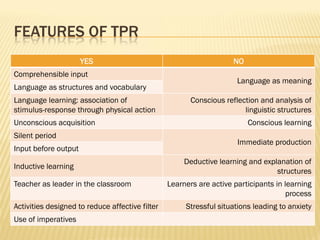
FEATURES OF TPR
                      YES                                            NO
Comprehensible input
                                                                      Language as meaning
Language as structures and vocabulary
Language learning: association of                       Conscious reflection and analysis of
stimulus-response through physical action                               linguistic structures
Unconscious acquisition                                                   Conscious learning
Silent period
                                                                      Immediate production
Input before output
                                                      Deductive learning and explanation of
Inductive learning
                                                                                 structures
Teacher as leader in the classroom               Learners are active participants in learning
                                                                                      process
Activities designed to reduce affective filter        Stressful situations leading to anxiety
Use of imperatives
THEORIES INCORPORATED IN THE METHOD

 Childhood language acquisition theories
 Natural order hypothesis

 The right brain – left brain divide (“brain
  switching”)
 Lowering stress and affective filter
PHASES OF TPR INSTRUCTION

Modeling by the instructor
   T. says command and performs action
   T. says command; students and T. perform action
Demonstration by the learner
   T. says command, students perform action
   T. says commands in a random order and random combination,
    students perform action
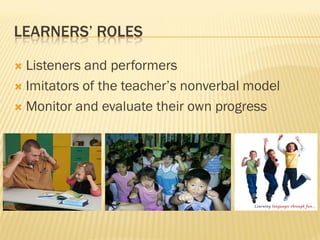
LEARNERS’ ROLES

 Listeners and performers
 Imitators of the teacher’s nonverbal model

 Monitor and evaluate their own progress
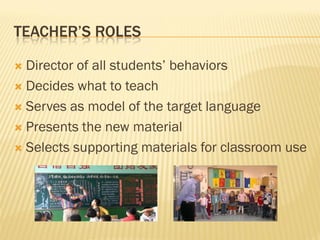
TEACHER’S ROLES

 Director of all students’ behaviors
 Decides what to teach

 Serves as model of the target language

 Presents the new material

 Selects supporting materials for classroom use
SOME STRATEGIES IN USING TPR

   Role Reversal
     Students  command their teacher and classmates to
      perform some actions.
     Asher says that students will want to speak after
      ten to twenty hours of instruction, although some
      students may take longer.
     Students should not be encouraged to speak until
      they are ready.
SOME STRATEGIES IN USING TPR

   Action Sequence (or Operation)
     The teacher gives three connected commands.
      Example: The teacher tells the students to point to
      the door, walk to the door, and touch the door.
     As the students learn more and more of the target
      language, a longer series of connected commands
      can be given, which together comprise a whole
      procedure.
SOME STRATEGIES IN USING TPR
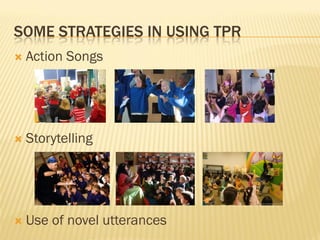
   Action Songs


   Storytelling


   Use of novel utterances
FREQUENTLY ASKED QUESTIONS

How do you cope with abstraction without using translation?
A: Abstractions are simply vocabulary items that can
  be incorporated in several different ways. It is
  recommended to delay first the teaching of
  abstraction until a large amount of structure in the
  TL has been assimilated with concrete vocabulary
  items.
FREQUENTLY ASKED QUESTIONS

Is any homework assigned?
A: Usually not, but this does not mean that it is
   inadvisable. Through trial-and-error, each instructor
   discovers what mix of activities produces the best
   results.
FREQUENTLY ASKED QUESTIONS

Are there any teacher preconceptions which could block the
  successful application of this strategy?
A: There are three: (1) illusion of simplicity, (2)
  tendency to be over-ambitious for students, and
  (3) narrow tolerance for errors in speaking
FREQUENTLY ASKED QUESTIONS

What about the transfer of learning from listening
 understanding to reading for people who cannot read in
 their native language?
A: The transfer will probably be zero. Apparently it is
  necessary to have prior skill in the orthography of
  one’s native language before there is transport
  from listening skill in the second language to
  reading and writing.
FREQUENTLY ASKED QUESTIONS

How can imperative improve pronunciation?
A: The students, during a long time period of silent
  acting when the teacher utters a command, are
  internalizing a model of the target language which
  helps the students monitor and self-correct the
  individual’s own speech.
FREQUENTLY ASKED QUESTIONS
Can production be taught?
A: Production can be shaped, but not directly taught.
  There are three reasons for the radical conclusion
  that production cannot be taught:
      1. In first language acquisition, speech always
         lags behind listening comprehension
      2. Puberty is a critical factor which determines
         whether one will achieve near-native
         pronunciation in L2
      3. Individual differences
FREQUENTLY ASKED QUESTIONS

Do you correct mistakes that students make in production?
A: Yes, but since we operate on a developmental
  theory to explain production, our feedback is
  modeled after the feedback which parents give to
  children learning their first language.
FREQUENTLY ASKED QUESTIONS

How does this method compare and contrast with the Silent
 Way?
A: Both methods use commands to manipulate the
  students’ behavior. One difference is the point in
  training when students produce spoken language.
  In the Silent Way, an attempt is made to fine tune
  pronunciation immediately. In TPR, there is a delay
  in production until students indicate readiness to
  speak.
ASSESSING TPR: ADVANTAGES

 It is a lot of fun. Learners enjoy it, and this
  method can be a real stirrer in the class. It lifts
  the mood of the class.
 It is very memorable. It does assist students to
  recognize phrases or words.
 It is good for kinesthetic learners who are
  required to be active in the class. It also taps
  the visual and auditory skills of the learners.
ASSESSING TPR: ADVANTAGES

 It can be used both in large or small classes. In
  this case, the class size does not matter that
  much. As long as you are prepared to take the
  lead, the learners will follow.
 It works well with mixed-ability classes. The
  physical actions get across the meaning
  effectively so that all the learners are able to
  comprehend and apply the target language.
ASSESSING TPR: ADVANTAGES

 There is no need to exert a lot of time for the
  preparation of materials using the TPR.
 It involves the use of both left and right brain in
  learning.
ASSESSING TPR: LIMITATIONS

 Students who are not used to such things might
  find it embarrassing.
 It is only suitable for beginner levels. This method
  holds stronger in teaching non-abstract vocabulary
  items and is unsuccessful in teaching abstracts
  which are acquired at advanced levels.
 It gives priority to receptive skills, mainly listening,
  at the expense of productive skills.
 Very less effort is expected from the learner.
ASSESSING TPR: LIMITATIONS
 It assumes that stress hinders the process of
  language acquisition denying the fact that positive
  stress, as explained in some literature, is
  considered sometimes crucial in learning
  processes.
 Grammatical features and vocabulary items are
  selected not according to their frequency of need
  or use in the target language situations, but
  according to the situations in which they can be
  used in the classroom and the ease with which
  they can be learned.
ASSESSING TPR: LIMITATIONS

   The method is time consuming. Learning a
    single vocabulary item, for example, would
    require the demand or imperative of the
    teacher, the students' demonstration, and
    teacher's feedback. It usually involves the
    whole class participating in learning one single
    item. Yet, the results would be expected to be
    more fruitful and lasting than it is with other
    methods.
REFERENCES
Asher, J. (1979). Learning Another Language through Actions. Los Galos, CA:
   Sky Oaks Productions.
Neupane, G. (2008). Act, Don’t Explain: Total Physical Response at Work.
   Journal of NELTA, 13 (1-2), 80-86.
Nunan, D. (2009). Second Language Teaching and Learning. Pasig City:
   Cengage Learning.
Adelman, B., Price, E., and Silver, M. (2003). Total Physical Response: A
   Curriculum for Adults. St. Louis, MO: English Language and Literacy Center.
Widodo, H. (2005). Teaching Children Using a Total Physical Response (TPR)
   Method: Rethinking. Bahasa Dan Seni, 33 (2), 236-248

Total Physical Response (TPR)

  • 1.
    Reported by: Kevin Castro& Kathleen Ching
  • 2.
    WHAT IS TOTALPHYSICAL RESPONSE?  TPR is a language teaching method in which learners listen to instructions in the target language, and carry out a sequence of physical actions.  This is based on the belief that second language is learned most effectively in the early stages if the pressure for production is taken off the learners.
  • 3.
    PRINCIPLES IN WHICHTPR WAS BASED  James Asher, the proponent of this method, derived three principles from his beliefs about the nature of first language acquisition. 1. Stress comprehension rather than production 2. Obey the “here and now” principle 3. Comprehension by listening to and carrying out instructions couched in the imperative
  • 4.
    CRITICAL ELEMENTS INLANGUAGE ACQUISITION 1. Listening skill is far in advance of speaking. 2. Children acquire listening skill in a particular way 3. Listening skill may produce a “readiness” for the child to speak.
  • 5.
    CLAIMS IN WHICHTPR WAS BASED  Asher claimed that the fastest and least stressful way to achieve understanding of any target language is to follow directions uttered by the instructor (without native language translation).
  • 6.
    KEY COMPONENTS OFTPR  Movement as memory enhancer  Use of imperatives as the method of instruction
  • 7.
    MAIN PRINCIPLES OFTPR  Meaning in the target language can often be conveyed through actions. Memory is activated through learner response. The target language should be presented in chunks, not just word by word.  The students’ understanding of the target language should be developed before speaking.
  • 8.
    MAIN PRINCIPLES OFTPR  Students can initially learn one part of the language rapidly by moving their bodies.  Imperatives are powerful linguistic device through which the teacher can direct student behavior.  Students can learn through observing actions as well as by performing the actions themselves.
  • 9.
    MAIN PRINCIPLES OFTPR  It is very important that students feel successful.  Students should not be made to memorize fixed routines.  Corrections should be carried out in an unobtrusive manner.  Students must develop flexibility in understanding novel combinations of target language chunks.
  • 10.
    MAIN PRINCIPLES OFTPR  Language learning is more effective when it is fun.  Spoken language should be emphasized over written language.  Students will begin to speak when they are ready.
  • 11.
    MAIN PRINCIPLES OFTPR  Students are expected to make errors when they first begin speaking. Teachers should be tolerant of them. Work on the fine details of the language should be postponed until students have become somewhat proficient.
  • 12.
    FEATURES OF TPR YES NO Comprehensible input Language as meaning Language as structures and vocabulary Language learning: association of Conscious reflection and analysis of stimulus-response through physical action linguistic structures Unconscious acquisition Conscious learning Silent period Immediate production Input before output Deductive learning and explanation of Inductive learning structures Teacher as leader in the classroom Learners are active participants in learning process Activities designed to reduce affective filter Stressful situations leading to anxiety Use of imperatives
  • 13.
    THEORIES INCORPORATED INTHE METHOD  Childhood language acquisition theories  Natural order hypothesis  The right brain – left brain divide (“brain switching”)  Lowering stress and affective filter
  • 14.
    PHASES OF TPRINSTRUCTION Modeling by the instructor  T. says command and performs action  T. says command; students and T. perform action Demonstration by the learner  T. says command, students perform action  T. says commands in a random order and random combination, students perform action
  • 15.
    LEARNERS’ ROLES  Listenersand performers  Imitators of the teacher’s nonverbal model  Monitor and evaluate their own progress
  • 16.
    TEACHER’S ROLES  Directorof all students’ behaviors  Decides what to teach  Serves as model of the target language  Presents the new material  Selects supporting materials for classroom use
  • 17.
    SOME STRATEGIES INUSING TPR  Role Reversal  Students command their teacher and classmates to perform some actions.  Asher says that students will want to speak after ten to twenty hours of instruction, although some students may take longer.  Students should not be encouraged to speak until they are ready.
  • 18.
    SOME STRATEGIES INUSING TPR  Action Sequence (or Operation)  The teacher gives three connected commands. Example: The teacher tells the students to point to the door, walk to the door, and touch the door.  As the students learn more and more of the target language, a longer series of connected commands can be given, which together comprise a whole procedure.
  • 19.
    SOME STRATEGIES INUSING TPR  Action Songs  Storytelling  Use of novel utterances
  • 20.
    FREQUENTLY ASKED QUESTIONS Howdo you cope with abstraction without using translation? A: Abstractions are simply vocabulary items that can be incorporated in several different ways. It is recommended to delay first the teaching of abstraction until a large amount of structure in the TL has been assimilated with concrete vocabulary items.
  • 21.
    FREQUENTLY ASKED QUESTIONS Isany homework assigned? A: Usually not, but this does not mean that it is inadvisable. Through trial-and-error, each instructor discovers what mix of activities produces the best results.
  • 22.
    FREQUENTLY ASKED QUESTIONS Arethere any teacher preconceptions which could block the successful application of this strategy? A: There are three: (1) illusion of simplicity, (2) tendency to be over-ambitious for students, and (3) narrow tolerance for errors in speaking
  • 23.
    FREQUENTLY ASKED QUESTIONS Whatabout the transfer of learning from listening understanding to reading for people who cannot read in their native language? A: The transfer will probably be zero. Apparently it is necessary to have prior skill in the orthography of one’s native language before there is transport from listening skill in the second language to reading and writing.
  • 24.
    FREQUENTLY ASKED QUESTIONS Howcan imperative improve pronunciation? A: The students, during a long time period of silent acting when the teacher utters a command, are internalizing a model of the target language which helps the students monitor and self-correct the individual’s own speech.
  • 25.
    FREQUENTLY ASKED QUESTIONS Canproduction be taught? A: Production can be shaped, but not directly taught. There are three reasons for the radical conclusion that production cannot be taught: 1. In first language acquisition, speech always lags behind listening comprehension 2. Puberty is a critical factor which determines whether one will achieve near-native pronunciation in L2 3. Individual differences
  • 26.
    FREQUENTLY ASKED QUESTIONS Doyou correct mistakes that students make in production? A: Yes, but since we operate on a developmental theory to explain production, our feedback is modeled after the feedback which parents give to children learning their first language.
  • 27.
    FREQUENTLY ASKED QUESTIONS Howdoes this method compare and contrast with the Silent Way? A: Both methods use commands to manipulate the students’ behavior. One difference is the point in training when students produce spoken language. In the Silent Way, an attempt is made to fine tune pronunciation immediately. In TPR, there is a delay in production until students indicate readiness to speak.
  • 28.
    ASSESSING TPR: ADVANTAGES It is a lot of fun. Learners enjoy it, and this method can be a real stirrer in the class. It lifts the mood of the class.  It is very memorable. It does assist students to recognize phrases or words.  It is good for kinesthetic learners who are required to be active in the class. It also taps the visual and auditory skills of the learners.
  • 29.
    ASSESSING TPR: ADVANTAGES It can be used both in large or small classes. In this case, the class size does not matter that much. As long as you are prepared to take the lead, the learners will follow.  It works well with mixed-ability classes. The physical actions get across the meaning effectively so that all the learners are able to comprehend and apply the target language.
  • 30.
    ASSESSING TPR: ADVANTAGES There is no need to exert a lot of time for the preparation of materials using the TPR.  It involves the use of both left and right brain in learning.
  • 31.
    ASSESSING TPR: LIMITATIONS Students who are not used to such things might find it embarrassing.  It is only suitable for beginner levels. This method holds stronger in teaching non-abstract vocabulary items and is unsuccessful in teaching abstracts which are acquired at advanced levels.  It gives priority to receptive skills, mainly listening, at the expense of productive skills.  Very less effort is expected from the learner.
  • 32.
    ASSESSING TPR: LIMITATIONS It assumes that stress hinders the process of language acquisition denying the fact that positive stress, as explained in some literature, is considered sometimes crucial in learning processes.  Grammatical features and vocabulary items are selected not according to their frequency of need or use in the target language situations, but according to the situations in which they can be used in the classroom and the ease with which they can be learned.
  • 33.
    ASSESSING TPR: LIMITATIONS  The method is time consuming. Learning a single vocabulary item, for example, would require the demand or imperative of the teacher, the students' demonstration, and teacher's feedback. It usually involves the whole class participating in learning one single item. Yet, the results would be expected to be more fruitful and lasting than it is with other methods.
  • 34.
    REFERENCES Asher, J. (1979).Learning Another Language through Actions. Los Galos, CA: Sky Oaks Productions. Neupane, G. (2008). Act, Don’t Explain: Total Physical Response at Work. Journal of NELTA, 13 (1-2), 80-86. Nunan, D. (2009). Second Language Teaching and Learning. Pasig City: Cengage Learning. Adelman, B., Price, E., and Silver, M. (2003). Total Physical Response: A Curriculum for Adults. St. Louis, MO: English Language and Literacy Center. Widodo, H. (2005). Teaching Children Using a Total Physical Response (TPR) Method: Rethinking. Bahasa Dan Seni, 33 (2), 236-248