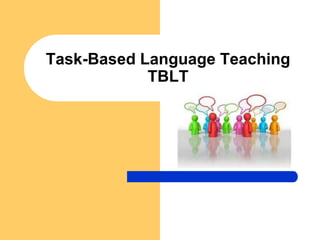
Task-Based Language Teaching
            TBLT
What is TBLT?


 It is an approach based
 on the use of tasks as
 the core unit of
 planning and instruction
 in language teaching.
What is a task?


 A task is an activity or goal that is carried out
 using language.
Examples
Main points of TBL

  Process


  Communication and meaning


  Purposeful activities and tasks
Theory of language


   Language is primarily a means of making meaning
   Multiple models of language inform TBI: structural,
    functional and interactional models of language.
   Lexical units are central in language use and
    language learning
   “Conversation” is the central focus of language and
    the keystone of language acquisition
Theory of learning

   Tasks provide both the input and output
    processing necessary for language
    acquisition
   Task activity and achievement are
    motivational
   Learning difficulty can be negotiated and
    fine-tuned for particular pedagogical
    purposes
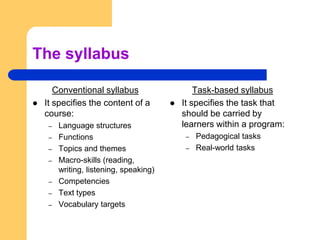
The syllabus

       Conventional syllabus                     Task-based syllabus
   It specifies the content of a           It specifies the task that
    course:                                  should be carried by
     –   Language structures                 learners within a program:
     –   Functions                            –   Pedagogical tasks
     –   Topics and themes                    –   Real-world tasks
     –   Macro-skills (reading,
         writing, listening, speaking)
     –   Competencies
     –   Text types
     –   Vocabulary targets
The syllabus


    Conventional syllabus        Task-based syllabus
   It specifies learning      It is more concerned
    outcomes.                   with the process of
                                learning.
Learner roles
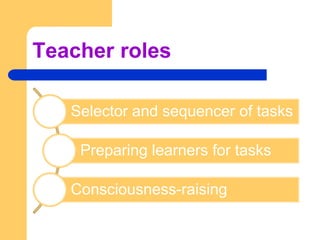
Teacher roles

   Selector and sequencer of tasks

    Preparing learners for tasks

   Consciousness-raising
The role of instructional materials


   Pedagogic Materials: They are limited only
    by the imagination of the task designer.
   Realia: TBI proponents favor the use of
    authentic tasks supported by authentic
    materials wherever possible.
• Students examine a newspaper,
                determine its sections, and suggest
Newspapers      three new sections that might go in the
                newspaper.


              • After watching an episode of an
                unknown soap opera, students list the
                characters (with know or made-up
 Television     names) and their possible
                relationship to other characters in the
                episode.

              • Seeking to find an inexpensive hotel in
                Tokyo, students search with three
                different search engines (e.g., Google,
  Internet      Yahoo), comparing search times and
                analyzing the first ten hits to determine
                most useful seach engine for their
                purpose.
Procedure

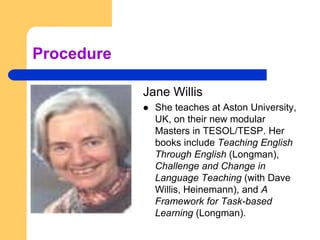
            Jane Willis
               She teaches at Aston University,
                UK, on their new modular
                Masters in TESOL/TESP. Her
                books include Teaching English
                Through English (Longman),
                Challenge and Change in
                Language Teaching (with Dave
                Willis, Heinemann), and A
                Framework for Task-based
                Learning (Longman).
Sequence of activities
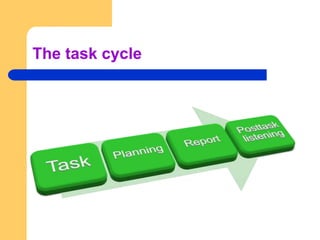
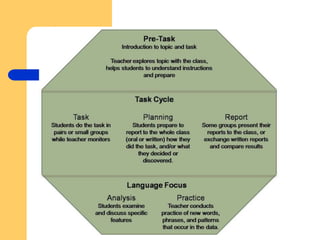
Pretask
The task cycle
The language focus

           • Students are given an opportunity to reflect and
             analyse the new language which has emerged
             through the task.
Analysis


           • Students put the language acquired into practice.
Practice
Task based language teaching (formato 2010)

Task based language teaching (formato 2010)

  • 1.
  • 2.
    What is TBLT? It is an approach based on the use of tasks as the core unit of planning and instruction in language teaching.
  • 3.
    What is atask? A task is an activity or goal that is carried out using language.
  • 4.
  • 5.
    Main points ofTBL Process Communication and meaning Purposeful activities and tasks
  • 6.
    Theory of language  Language is primarily a means of making meaning  Multiple models of language inform TBI: structural, functional and interactional models of language.  Lexical units are central in language use and language learning  “Conversation” is the central focus of language and the keystone of language acquisition
  • 7.
    Theory of learning  Tasks provide both the input and output processing necessary for language acquisition  Task activity and achievement are motivational  Learning difficulty can be negotiated and fine-tuned for particular pedagogical purposes
  • 8.
    The syllabus Conventional syllabus Task-based syllabus  It specifies the content of a  It specifies the task that course: should be carried by – Language structures learners within a program: – Functions – Pedagogical tasks – Topics and themes – Real-world tasks – Macro-skills (reading, writing, listening, speaking) – Competencies – Text types – Vocabulary targets
  • 9.
    The syllabus Conventional syllabus Task-based syllabus  It specifies learning  It is more concerned outcomes. with the process of learning.
  • 10.
  • 11.
    Teacher roles Selector and sequencer of tasks Preparing learners for tasks Consciousness-raising
  • 12.
    The role ofinstructional materials  Pedagogic Materials: They are limited only by the imagination of the task designer.  Realia: TBI proponents favor the use of authentic tasks supported by authentic materials wherever possible.
  • 13.
    • Students examinea newspaper, determine its sections, and suggest Newspapers three new sections that might go in the newspaper. • After watching an episode of an unknown soap opera, students list the characters (with know or made-up Television names) and their possible relationship to other characters in the episode. • Seeking to find an inexpensive hotel in Tokyo, students search with three different search engines (e.g., Google, Internet Yahoo), comparing search times and analyzing the first ten hits to determine most useful seach engine for their purpose.
  • 14.
    Procedure Jane Willis  She teaches at Aston University, UK, on their new modular Masters in TESOL/TESP. Her books include Teaching English Through English (Longman), Challenge and Change in Language Teaching (with Dave Willis, Heinemann), and A Framework for Task-based Learning (Longman).
  • 15.
  • 16.
  • 17.
  • 18.
    The language focus • Students are given an opportunity to reflect and analyse the new language which has emerged through the task. Analysis • Students put the language acquired into practice. Practice