Communicative Language Teaching (CLT): Practical Understandings
Author(s): Kazuyoshi Sato and Robert C. Kleinsasser
Reviewed work(s):
Source: The Modern Language Journal, Vol. 83, No. 4 (Winter, 1999), pp. 494-517
Published by: Wiley-Blackwell on behalf of the National Federation of Modern Language Teachers
Associations
Stable URL: http://www.jstor.org/stable/330522 .
Accessed: 23/10/2012 02:53

Your use of the JSTOR archive indicates your acceptance of the Terms & Conditions of Use, available at .
http://www.jstor.org/page/info/about/policies/terms.jsp

.
JSTOR is a not-for-profit service that helps scholars, researchers, and students discover, use, and build upon a wide range of
content in a trusted digital archive. We use information technology and tools to increase productivity and facilitate new forms
of scholarship. For more information about JSTOR, please contact support@jstor.org.

.


                Wiley-Blackwell and National Federation of Modern Language Teachers Associations are collaborating with
                JSTOR to digitize, preserve and extend access to The Modern Language Journal.


http://www.jstor.org
Communicative    Language Teaching
(CLT): Practical Understandings
KAZUYOSHISATO                                         ROBERT C. KLEINSASSER
Centre Language Teachingand Research
      for                                             Centre Language Teachingand Research
                                                            for
The University Queensland
             of                                       The University Queensland
                                                                    of
BrisbaneQLD 4072                                      BrisbaneQLD 4072
Australia                                             Australia
Email:yoshis@usiwakamaru.
                        or.jp                         Email: robertk@lingua. uq.edu.au
                                                                          arts.


    The aim of this article is to report on a study that documented the views and practices of
    communicative language teaching (CLT) by Japanese second language inservice teachers.
    Compared to theoretical developments of CLT (e.g., see Savignon, 1991), little is known
    about what second language teachers actually understand by CLT and how they implement
    CLT in classrooms. Using multiple data sources including interviews, observations, and sur-
    veys, the article reports how teachers defined CLT and implemented it in their classrooms.
    The study identified how teachers actually dealt with CLT in their classrooms teaching Japa-
    nese. It is interesting to note that their views and actions dealt little with the academic
    literature pertaining to CLT or their education (be it preservice or inservice) in learning
    about CLT. Instead, teachers resorted to their personal ideas and experiences, solidifying
    their notions of foreign language (L2) teaching in further pursuing their evolving concep-
    tions of CLT.


EVER SINCE HYMES (1971) DISCUSSED THE                 tion, we begin by defining CLT by using various
idea of communicative competence and Canale           sources from academia and government policy to
and Swain (1980) considered its implications for      highlight some of the numerous views from these
language teaching, communicative language             particular perspectives. We further include an
teaching (CLT) (Savignon, 1991) has achieved          Australian context to help define CLT from a
prominence. Conference papers, articles, and          policy perspective, while also allowing such infor-
books abound that support and promote CLT.In          mation to situate our study. We then explore the
the main, scholars advance CLT by exploring its       relevance of teacher beliefs, knowledge, and
meaning and use in classrooms. Writers consider       practices. Here we review CLT investigations and
various facets and mutations of CLT, providing        highlight the complexity of understanding rela-
valuable codification of CLT elements (e.g.,          tionships among beliefs, knowledge, and prac-
Berns, 1990; Brown, 1994; Howatt, 1984; Little-       tices. Inherent in such a presentation is the need
wood, 1981; Mitchell, 1988; Richards & Rodgers,       to explore change. This we do briefly, with the
1986; Savignon, 1983, 1997; Savignon & Berns,         discussion culminating in offering the research
 1984, 1987; Schulz & Bartz, 1975). Even within       questions. Our intent here is to argue for a theo-
the expanding literature concerning CLT, how-         retical base from language teachers' perspectives.
ever, its meaning for practitioners receives scant    We next outline the research methodology for
attention.                                            the project. This combined information positions
   In this research project, we document second       the presentation of our findings, followed by a
language (Japanese) teachers' CLT using their         discussion of issues.
perspectives.1 To set the stage for this investiga-
                                                      COMMUNICATIVELANGUAGE TEACHING
TheModernLanguage
                Journal, 83, iv, (1999)
0026-7902/99/494-517 $1.50/0                            Savignon (1983, 1997) suggested that a class-
?1999 TheModernLanguageJournal                        room model of communicative competence in-
Sato and RobertC. Kleinsasser
Kazuyoshi                                                                                                495

cludes Canale and Swain's (1980, later refined in         and receptively" (Brown, 1994, p. 245, italics
Canale, 1983) four components that are gram-              original). Richards and Rogers (1986) concluded
matical competence, sociolinguistic competence,           that
discourse competence, and strategic compe-
tence. She further proposed five components of              Communicative   LanguageTeaching is best consid-
a communicative curriculum that include lan-                ered an approachrather than a method. Thus al-
                                                            though a reasonabledegree of theoreticalconsis-
guage arts, language for a purpose, personal sec-
ond language (L2) use, theater arts, and beyond             tencycan be discernedat the levelsof languageand
the classroom (Savignon, 1983, 1997). These ele-            learningtheory,at the levelsof designand procedure
                                                            there is muchgreaterroomfor individual  interpreta-
ments together help support both theoretical                tion and variationthanmostmethodspermit.(p. 83)
and practical foundations for CLT.Yet, it is clear
that Savignon (1997) did not rely on these as the         These perspectives, among others, offer possibili-
sole arbitrator of CLT. In particular, with regard        ties of what CLT is, and their various authors give
to the four competences she concluded,                    ideas of what can transpire in a L2 classroom. Yet,
                                                          not all views of CLT are necessarily the domain of
  Whatever relative
             the                    of
                        importance the various   com-
                                                          academicians. As will be discussed next, national
  ponents at any given level of overallproficiency,
                                                  one
                                                          and state initiatives give an additional view of
  must keep in mind the interactivenature of their
                 The whole of communicative               CLT.
  relationships.                               compe-
  tence is always  somethingother than the simplesum         To understand CLT in Australia better, we offer
  of its parts.(p. 50)                                    an overview of this country's recent (second) lan-
                                                          guage initiatives. The past 20 years in Australia
The same could also be said about the five cur-           have been supportive of and exciting for the
riculum components. Moreover, Savignon (1991)
                                                          teaching of foreign languages or Languages
cast an even wider net over what influences and           Other Than English (LOTE), as they are pres-
challenges the promotion of CLT:                          ently called. Clyne, Jenkins, Chen, Tsokalidou,
  CLTthus can be seen to derivefrom a multidiscipli-      and Wallner (1995) overviewed the latest initial
  nary perspectivethat includes, at least, linguistics,   push regarding languages in Australia. They re-
  psychology,philosophy,sociology,and educational         ported that in 1976 the Committee on the Teach-
  research.The focus has been the elaborationand          ing of Migrant Languages in Schools (CTMLS)
                    of
  implementation programand methodologiesthat             recommended that, starting in their primary
  promote the development of functional language          years, children be given opportunities to learn
  abilitythroughlearnerparticipation communica-
                                      in                  other languages and understand other cultures.
  tive events. Centralto CLTis the understanding   of
                                                          They further relayed that a Senate report (1984)
  languagelearningas both an educationaland politi-       on national language policy advocated principles
  cal issue. (p. 265)
                                                          such as competence in English, maintenance and
    To be sure, there are other conceptualizations        development of languages other than English,
of communicative competence and CLT. For in-              and opportunities for learning L2s. This report
stance, Bachman (1990) charted a theoretical              eventually led to the National Policy on Lan-
framework for communicative language ability              guages (Lo Bianco, 1987) "which actually recom-
that includes knowledge structures, strategic             mended implementation strategies and govern-
competence, psychophysiological mechanisms,               ment spending in innovative areas which were
context of situation, and language competence.            accepted by the federal government" (Clyne et
Language competence is further divided into or-           al., 1995, p. 6).
ganizational competence (grammatical and tex-                The development of students' communicative
tual competences) and pragmatic competence                skills in L2s was emphasized around the same
 (illocutionary and sociolinguistic competences).         time. The Australian Language Levels (ALL) Proj-
Brown (1994) proposed a definition of CLT to              ect responded to the Senate (1984) and Lo Bi-
include the following issues: (a) "Classroomgoals         anco (1987) policies on languages and developed
are focused on all of the components of commu-            curriculum ideas for the teaching of L2. Austra-
nicative competence"; (b) "Language techniques            lian Language Levels (ALL) Guidelines (Scarino,
are designed to engage learners in the pragmatic,         Vale, McKay,& Clark, 1988) were published and
authentic, functional use of language for mean-           subsequently Pocket  ALL (Vale, Scarino, & McKay,
ingful purposes"; (c) "Fluency and accuracy are           1991) was published as a handy teacher's guide.
seen as complementary principles underlying               These guidelines included topics such as the eight
communicative techniques"; and (d) "students              principles of language learning, the goals of lan-
ultimately have to use the language, productively         guage learning, the table of language use, devel-
496                                                               The ModernLanguageJournal83 (1999)

oping modules for a syllabus, resources, and as-       LOTE teachers in L2 learning and teaching envi-
sessment. Each state followed ALL Guidelines  and      ronments.
developed    and wrote language syllabi. The
Queensland Department of Education (1989),             SKETCHINGA THEORETICALBASE
for instance, promoted the five ALL goals for lan-
guage learning: a communication goal, a so-               We highlight the importance of teacher beliefs
ciocultural goal, a learning-how-to-learn goal, a      in this project, for as Pajares (1992) acknowl-
language and cultural awareness goal, and a            edged in his synthesis of 35 empirical educational
knowledge goal. Among these goals, emphasis was        investigations, "Allteachers hold beliefs, however
placed upon communication: "Language-learn-            defined and labeled, about their work, their stu-
ing programs are aimed at the development of           dents, their subject matter, and their roles and
communicative competency in a particular lan-          responsibilities" (p. 314). However, a variety of
guage" (p. v). As a result, various LOTE syllabi       conceptions of educational beliefs appears in the
followed these general guidelines. The Japanese        literature.2 Citing Nespor's (1987) influential
Senior Syllabus, for example, referred to the pri-     work, Pajares suggested that "beliefs are far more
mary objective by stating that "bythe end of Year      influential than knowledge in determining how
12, learners should be able to communicate in          individuals organize and define tasks and prob-
standard Japanese" (Board of Senior School Sec-        lems and are stronger predictors of behavior" (p.
ondary Studies, 1995, p. 4). In addition, the six      311). Pajares promoted 16 "fundamental assump-
assessment criteria tasks that LOTE teachers were      tions that may reasonably be made when initiat-
to implement included:                                 ing a study of teachers' educational beliefs" (p.
                                                       324). These assumptions include, among others,
   1. Assess the students' ability to communicatein    the notions that (a) beliefs are formed early and
the language.                                          tend to self-perpetuate; (b) some beliefs are more
   2. Use authentictexts.                              incontrovertible than others; (c) beliefs about
   3. Give students the opportunity to speak and       teaching are well established by the time a stu-
write from their own experience.                       dent gets to college; (d) changes in beliefs during
   4. Call for unrehearsedresponses   from the stu-    adulthood are rare; (e) beliefs are instrumental
dent.                                                  in defining tasks and selecting the cognitive tools
   5. Allow students' responses to be matched to       with which to interpret, plan, and make decisions
criteriaand standards.                                 regarding such tasks; (f) individuals' beliefs
   6. Provide informative feedbackto students to       strongly affect their behavior; and (g) knowledge
allow them to manage their own learning. (Board        and beliefs are inextricably intertwined (for com-
of Senior Secondary School Studies, 1996, p. 1,        plete discussion of all 16 assumptions, see Pajares,
italics original)                                      1992, pp. 324-326).
                                                          The tenuous relationship between beliefs and
These criteria follow the ALL Guidelines(Scarino       knowledge creates a possible tension. Although
et al., 1988). In short, over the past 2 decades the   Pajares (1992) readily admitted that it is difficult
promotion of LOTE learning and the develop-            to distinguish knowledge from beliefs, he argued
ment of LOTE students' communicative skills            Nespor's (1987) point "that beliefs have stronger
have been promoted vigorously in national and          affective and evaluative components than knowl-
state policy documents. LOTE teachers in schools       edge and that affect typically operates inde-
during the past decade have received either train-     pendently of the cognition associated with knowl-
ing or inservices in CLT because of the national       edge" (p. 309). Richardson (1996) seemingly
and state initiatives to develop students' commu-      agreed that although the distinction between be-
nicative abilities in LOTE. There is little insight,   liefs and knowledge remains fuzzy, beliefs influ-
however, into how LOTE (Japanese) teachers             ence teaching practice more directly than knowl-
perceive these views and implement these ideas.        edge and that the "relationship between beliefs
There is also a dearth of information concerning       and actions is interactive" (p. 104). Moreover,
how LOTE teachers perceive the views of the            Richardson (1994) assigned the teacher the role
academicians. LOTE teachers' beliefs, knowl-           of one who mediates ideas, constructs meaning
edge, and practice of CLT remain somewhat of a         and knowledge, and acts upon those construc-
mystery in the CLT literature. Yet, as we will see     tions. She maintained that, in order to under-
next, it is precisely teachers' beliefs, knowledge,    stand how teachers make sense of teaching and
and practice that need to be reviewed in order to      learning, one should focus on teachers' beliefs
understand better just how CLT is understood by        and practices. (Such a view appears to contrast
Sato and RobertC. Kleinsasser
Kazuyoshi                                                                                               497

slightly with the view that teachers' decision-mak-    classrooms, they offered students few opportuni-
ing is based upon knowledge and skills [e.g.,          ties for genuine communicative language use in
Shulman, 1986, 1987]).                                 the class sessions that he recorded. Although the
   Regardless of theoretical stance, empirical         lesson plans of these teachers might have con-
studies consistently reveal the difficulties of pro-   formed to the sorts of communicative principles
moting knowledge and skills that challenge or          advocated in the CLT literature, the actual pat-
contradict currently held beliefs and practices        terns of classroom interaction resembled tradi-
 (see, e.g., the reviews by Richardson, 1996, and      tional patterns rather than what he identified as
Wideen, Mayer-Smith, & Moon, 1998). In L2              genuine interaction. Karavas-Doukas (1996) re-
teacher studies in general, there is definitely a      ported similar findings in the responses of 14
tendency for those studied to rely on their pre-       Greek teachers of English to an attitude survey
conceived beliefs, and there appears to be little      and in the observations she made of their class-
alteration in traditionally (form focus, teacher-      rooms. She found that the survey results leaned
led) held images of L2 teaching (see, e.g,             toward agreement with CLT principles, but when
Johnson, 1994; Lamb, 1995; Neustupny, 1981).           she observed the classroom teaching environ-
Nonetheless, studies that specifically single out      ments, "classroom practices (with very few excep-
typical CLT also reveal glimpses of links among        tions) deviated considerably from the principles
beliefs, knowledge, and practices. On the one          of the communicative approach" (p. 193). Al-
hand, a few studies show little change in teacher      though she acknowledged that there were
beliefs, knowledge, or practice, whereas, on the       glimpses of communicative approaches, the
other hand, a few studies reveal the possibility for   teachers in her sample favored traditional ones.
change in teacher beliefs, knowledge, or practice.     In this case, traditional meant, "Mostlessons were
Thus, these studies provide evidence that the          teacher-fronted and exhibited an explicit focus
challenges found in L2 teaching literature are         on form" (p. 193).
little different from the controversy in the wider        As indicated earlier, not all of the news is bleak.
teaching literature. The extent to which teachers      Okazaki (1996) completed a longitudinal study
can or will actually change is an issue within         using surveys to find out whether preservice
teacher education, regardless of discipline.           teachers changed their beliefs concerning CLT
   For example, Thompson (1996) discovered             after a 1-year methodology course. She con-
four misconceptions that were common among             cluded that although beliefs of preservice teach-
his colleagues concerning the meaning of CLT:          ers were not easily swayed, some of them were
 (a) not teaching grammar, (b) teaching only           influenced in the desired direction by what Wen-
speaking, (c) completing pair work (i.e., role         den (1991) called persuasive communication,
play), and (d) expecting too much from teachers.       which aims at changing participants' beliefs by
Thompson mentioned that a surprisingly large           reflective teaching. For example, she reported
number of teachers invoke erroneous reasoning          that the teachers' emphasis increased on such
for criticizing or rejecting CLT. He concluded         items as the learner's role and decreased on such
that the future development of CLT depended            items as pronunciation and error corrections. Ku-
upon correcting these misconceptions. Fox              maravadivelu (1993) studied two teachers whom
 (1993) surveyed first-yearFrench graduate teach-      he identified as "'believers' in the CLT move-
ing assistants at 20 universities in the U.S. and      ment" (p. 14), and who both had masters degrees
analyzed their responses according to the defini-      in ESL. With one teacher he promoted the effec-
tions of communicative competence (CC) set             tiveness of five macrostrategies for successful CLT
forth by Canale and Swain (1980). She reported         (see also Kumaravadivelu, 1992). He then tran-
that teaching assistants did not conceptualize lan-    scribed the two teachers' classes and concluded
guage according to this particular model of CC.        that the episodes showed "different kinds of class-
Instead, the participants relied on grammar at         room input and interaction" (p. 18). One group
the expense of communicative activities. She con-      was motivated, enthusiastic, and active. The same
cluded that their beliefs about language teaching      group in the second session was less motivated,
and learning should be exposed so that they            less enthusiastic, and much less active. Although
could develop their beliefs and knowledge about        he identified session one as a speaking class, and
CLT.                                                   session two as a grammar class, he believed that
   Even teachers committed to CLT often seem to        the use of the macrostrategies given to the
show a very superficial adherence to CLT princi-       teacher in session one "contributed to this re-
ples. As Nunan (1987) discovered, although the         markable variation in the communicative nature
teachers in his study had goals for communicative      of the two episodes" (p. 18). Regardless of the
498                                                                The ModernLanguageJournal83 (1999)
theoretical and practical problems of such a              featurein this literature that someone outside the
                                                                                   is
study, Kumaravadivelu (1993) claimed effective-           classroomdecides what changes teacherswill make.
ness for strategy training with regard to teachers'       (p. 11, italicsoriginal)
uses of CLT.In a study concerning L2 teaching in           It is interesting to note that Nunan (1987) and
more general terms, Freeman (1993) maintained           Kamaravadivelu (1992, 1993, 1994) offered evi-
that four foreign language teachers (citing two         dence (from "someone outside the classroom")
illustrations) changed their ideas about teaching       that highlighted this specific issue within the L2
when they were introduced to the discourse of
                                                        teaching profession. For instance, Nunan identi-
current professional issues and notions.                fied strategies, such as using referential questions
   In summary, the controversy in the teacher           that could be used to increase the opportunities
change literature about teachers' beliefs and           for genuine communication, and Kumaravadi-
practices continues. As Richardson (1996) com-          velu increased from 5 to 10 the number of
mented:
                                                        macrostrategies that might now come to influ-
                                                        ence the ideas of a principled communicative
  Perhaps the greatest controversyin the teacher
  change literature relatesto the difficulty changing
                                           in           approach (see Celce-Murcia, Dornyei, & Thur-
  beliefs and practices.For some scholars,beliefs are   rell, 1997). However, neither of the authors ex-
  thoughtto be extremelydifficult,if not impossibleto   plained how the teachers adapted the referential
  change. This apparentdifficultyis often used as an    questions or macrostrategies into situation-spe-
  explanation the sense thatteachersarerecalcitrant
               of                                       cific problems or how the teachers developed
  and do not like to change.Anothergroupof scholars     their beliefs, knowledge, and practice with regard
  and educators,however,are optimisticthat teachers
                                                        to CLT. In other words, the authors seemed to
  and teacher education studentscan change and, in
                                                 and    have ignored the teachers' actual developmental
  fact,often do change theirbeliefsand practices,
  thatprograms help them do so in significant
                  can                            and    processes and stages, or else they neglected to
  worthwhile  directions.(p. 110)                       uncover and document how the teachers actually
                                                        dealt with an innovation such as CLT.
   Such a comment may be a bit shortsighted, if            In short, these studies, reviews, and narratives
not overgeneralized. Many of the studies cited
                                                        portray the complexity of the issues pertaining to
above neither integrate information from a vari-        beliefs, knowledge, and practices and focus on the
ety of data sources nor give a complete picture of      interplay among them. Despite the theoretical de-
the interaction among beliefs, knowledge, and
                                                        velopments and policy acceptance of CLT for nu-
practice. Some relied on scales or interviews           merous L2 learning environments, many ques-
alone, others completed only observations, while        tions linger concerning how teachers think about
still others tried surveys and observations but         and use CLTin classrooms. It seems worthwhile to
omitted interviews. Most of the studies concern-
                                                        investigate further the perspectives of L2 teach-
ing CLT mentioned the fact that multiple data           ers, that is, how they view, learn about, and imple-
sources would eventually help address the limita-       ment CLT.In addition, within the Australian con-
tions of the work already completed. Moreover,          text of teachingJapanese in high schools, there is
many of the L2 teacher studies concerning CLT           little known about inservice LOTE teachers' per-
seemed to rely on the extent to which the prac-
                                                        spectives about CLT. These teachers of Japanese
tice of CLT notions adhered to CLT principles as        in Australia have identified such problems in their
put forth in the professional literature. Richard-      teaching as articulation, low proficiency level, and
son (1990) pointed out in more global terms the         lack of quality inservices, good materials, and
difficulties educational change issues bring to         school support (Kawagoe, 1989; Koide, 1976).
classrooms:                                             Nonetheless these inservice LOTE (Japanese)
                 however, note that change,
  It is important,       to                 research-   teachers have not been studied in any great
  based or otherwise,is defined in this literatureas    depth, especially regarding their ideas about CLT
  teachersdoing somethingthat othersare suggesting      and practice. This omission triggers several
  they do. Thus, the change is deemed as good or        broader questions: How is teachers' knowledge
  appropriate, resistanceis viewedas bad or inap-
               and                                      about CLT developed or understood in light of
  propriate. Eventhe recentworkthatis more sensitive    the fact that national and state directives urge the
  to teachers'norms and beliefs fails to question the
  reformsthemselves(Donmoyer,1987). Further,the         acquisition of communicative LOTE abilities?
  constantchanges that teachersmakewhen meeting         How are teachers implementing CLT ideas at the
  the changingneeds of the studentsin the classroom     classroom level? How do teachers actually teach in
  or tryingout ideasthattheyhearfromother teachers      language classrooms in a country and state that
  is not recognized in these formulations.A critical    promote communicative competence? These un-
KazuyoshiSato and RobertC. Kleinsasser                                                                       499
answered questions guided this investigation and             1 male). Three teachers had less than 3 years
promoted the analysis undertaken for this article.           experience teaching Japanese, 3 teachers had 3
Our overall goal was to uncover teachers' beliefs            to 6 years teaching experience, 2 teachers had 6
and knowledge about CLT in connection with                   to 10 years teaching experience, and 2 teachers
their practices in an Australian context-a goal              had 10 to 13 years teaching experience.3 Their
overlooked and understudied by both researchers              professional preparation also varied. Four teach-
and policy-makers. The following questions pro-              ers (including the nativeJapanese speaker) com-
vided focus:                                                 pleted a Postgraduate Diploma in Education-a
   1. What are Japanese LOTE teachers' beliefs               1-year course-and 1 holds a Master of Arts in
and knowledge about (communicative) language                Applied Linguistics. Three teachers holding the
                                                             Postgraduate Diploma in Education degree ma-
teaching?
  2. How do they implement CLT in their class-              jored in Japanese for their undergraduate stud-
rooms?                                                       ies, while the native Japanese speaker majored in
                                                            French. The rest of the teachers started to teach
  3. How are their beliefs and knowledge about
(communicative) language teaching acquired                  Japanese without any formal academic prepara-
                                                            tion in Japanese LOTE teaching. Their majors
and developed?
                                                            variously represented the disciplines of biology,
                                                            commerce, economics, English, and music. Some
                     DATA
OVERVIEW,PARTICIPANTS,                                      of the teachers finished short-term inservice pro-
COLLECTION, AND DATAANALYSIS
                                                            grams on Japanese language and LOTE instruc-
   In order to reveal teachers' beliefs, knowledge,         tion after they had already begun teaching.
and practices about CLT,we employed triangula-              Among the 9 native Australian English speakers,
tion that included qualitative and quantitative             7 teachers experienced living in Japan for 1 to 2
data sources (or multiple data sources) of LOTE             years, 1 teacher stayed for 6 years, and 1 teacher
teachers' perspectives. Mathison (1988) argued              made four trips to Japan, lasting 2 to 3 weeks per
that "the use of any single method, just like the           visit. In other words, most of the teachers who did
view of any single individual, will necessarily be          not receive formal academic preparation had ex-
subjective and therefore biased" (p. 14). There-            periences overseas in the target language culture
fore, she valued triangulation where one con-               before they began teaching Japanese. In addi-
structs meaningful explanations from multiple               tion, 8 of the 10 teachers also taught such other
data sources-sources that may appear inconsis-              subjects as English (3), mathematics (1), social
tent or contradictory rather than cohering                  sciences (1), history and social education (1),
around a single proposition. This use of multiple           music (1), and sports (table tennis, 1). Pseudo-
sources is especially important in exploring be-            nyms for the 10 teachers are used throughout the
liefs, practices, and mandates. Pajares (1992)              data presentation (see Table 1).
reminded researchers of the dimensions in re-
searching beliefs:                                          Interview
  It is also clear that, if reasonableinferences about         As researchers, we developed an open-ended
  beliefs require assessmentsof what individualssay,         interview protocol. After an initial pilot interview,
  intend, and do, then teachers' verbal expressions,        we made several modifications. For example,
  predispositions to action, and teaching behaviors
  must all be included in assessments of beliefs. Not to     background questions were separated from the
  do so calls into question the validity of the findings     major interview questions so that the interview
  and the value of the study. Traditional belief invento-   could focus on specific questions (e.g., under-
  ries provide limited information with which to make       standings of CLT,use of the textbook, the role of
  inferences, and it is at this step in the measurement     grammar, communicative activities, and teacher
  process that understanding the context-specific na-       development). Ultimately, we developed and re-
  ture of beliefs becomes critical. (p. 327)                fined 20 questions following Spradley's (1979)
                                                            descriptive questions so that the respondent
Participants                                                would display "perspectives and moral forms"
                                                             (p. 107). A standardized protocol was established
   Ten state (public) school teachers ofJapanese            to focus on certain issues following Spradley's
(including 9 native Australian English speakers             recommendations. Twelve major questions were
and 1 native Japanese speaker) in 10 different              then agreed upon, and two more pilot interviews
state high schools in a large Australian metropoli-         were conducted to test their efficiency. The final
tan area participated in this study (9 female and           interview protocol was completed, with minor
500                                                               TheModernLanguageJournal 83 (1999)

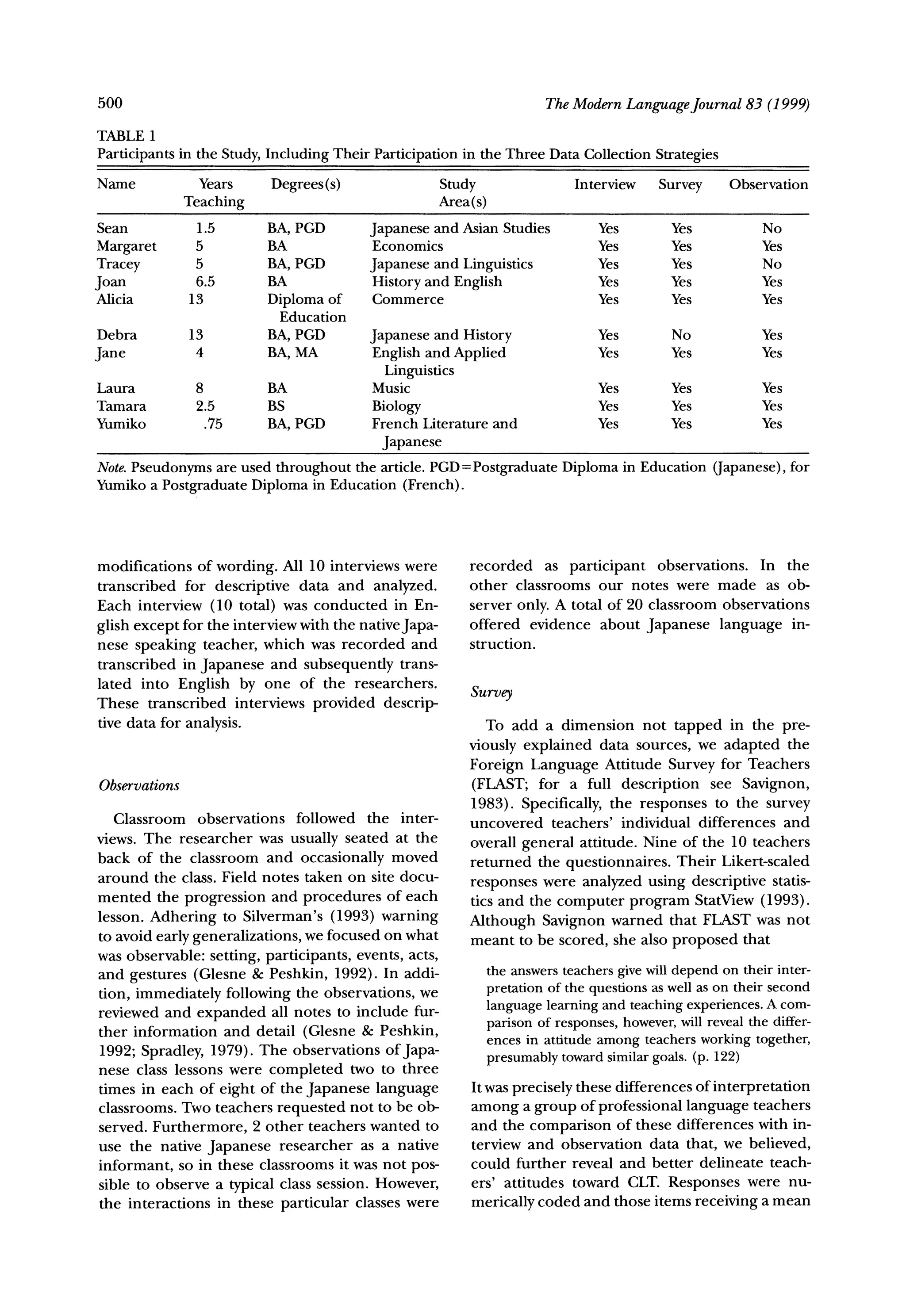
TABLE1
Participantsin the Study,Including Their Participationin the Three Data Collection Strategies
Name           Years      Degrees(s)               Study               Interview     Survey      Observation
             Teaching                              Area(s)
Sean           1.5       BA, PGD         Japanese and Asian Studies        Yes         Yes            No
Margaret       5         BA              Economics                         Yes         Yes            Yes
Tracey         5         BA, PGD         Japanese and Linguistics          Yes         Yes            No
Joan           6.5       BA              History and English               Yes         Yes            Yes
Alicia        13         Diploma of      Commerce                          Yes         Yes            Yes
                          Education
Debra        13          BA, PGD     Japanese and History            Yes      No           Yes
Jane          4          BA, MA      English and Applied             Yes      Yes          Yes
                                       Linguistics
Laura        8        BA             Music                           Yes      Yes          Yes
Tamara       2.5      BS             Biology                         Yes      Yes          Yes
Yumiko         .75    BA, PGD        French Literatureand            Yes      Yes          Yes
                                       Japanese
Note.Pseudonymsare used throughout the article. PGD=PostgraduateDiploma in Education (apanese), for
Yumikoa PostgraduateDiploma in Education (French).


modifications of wording. All 10 interviews were       recorded as participant observations. In the
transcribed for descriptive data and analyzed.         other classrooms our notes were made as ob-
Each interview (10 total) was conducted in En-         server only. A total of 20 classroom observations
glish except for the interview with the nativeJapa-    offered evidence about Japanese language in-
nese speaking teacher, which was recorded and          struction.
transcribed in Japanese and subsequently trans-
lated into English by one of the researchers.
These transcribed interviews provided descrip-         Survey
tive data for analysis.                                   To add a dimension not tapped in the pre-
                                                       viously explained data sources, we adapted the
                                                       Foreign Language Attitude Survey for Teachers
Observations                                           (FLAST; for a full description see Savignon,
                                                       1983). Specifically, the responses to the survey
   Classroom observations followed the inter-          uncovered teachers' individual differences and
views. The researcher was usually seated at the        overall general attitude. Nine of the 10 teachers
back of the classroom and occasionally moved           returned the questionnaires. Their Likert-scaled
around the class. Field notes taken on site docu-      responses were analyzed using descriptive statis-
mented the progression and procedures of each          tics and the computer program StatView (1993).
lesson. Adhering to Silverman's (1993) warning         Although Savignon warned that FLAST was not
to avoid early generalizations, we focused on what     meant to be scored, she also proposed that
was observable: setting, participants, events, acts,
and gestures (Glesne & Peshkin, 1992). In addi-          the answers teachers give will depend on their inter-
tion, immediately following the observations, we         pretation of the questions as well as on their second
reviewed and expanded all notes to include fur-          language learning and teaching experiences. A com-
ther information and detail (Glesne & Peshkin,           parison of responses, however, will reveal the differ-
                                                         ences in attitude among teachers working together,
1992; Spradley, 1979). The observations of Japa-         presumably toward similar goals. (p. 122)
nese class lessons were completed two to three
times in each of eight of the Japanese language        It was precisely these differences of interpretation
classrooms. Two teachers requested not to be ob-       among a group of professional language teachers
served. Furthermore, 2 other teachers wanted to        and the comparison of these differences with in-
use the native Japanese researcher as a native         terview and observation data that, we believed,
informant, so in these classrooms it was not pos-      could further reveal and better delineate teach-
sible to observe a typical class session. However,     ers' attitudes toward CLT. Responses were nu-
the interactions in these particular classes were      merically coded and those items receiving a mean
Sato and RobertC. Kleinsasser
 Kazuyoshi                                                                                               501
of 3.6 or higher were those with which teachers         veys, while also offering a glimpse of what actually
agreed (the closer to 5, the more strongly teach-       happened in Japanese language teachers' class-
ers agreed with it). Those items receiving a mean       rooms. Their conceptions of CLT serve as a cata-
of 2.4 or lower were those with which teachers          lyst to promote their understandings. We hope to
disagreed. Items falling between 2.4 and 3.6 were       show that the challenges they face help clarify, in
those with which teachers neither agreed nor dis-       part, why they understand CLT the way they do.
agreed, perhaps giving evidence of some uncer-          In the second part, we uncover where these teach-
tainty among the participants as a group.               ers think they learned about CLT. We acknowl-
                                                        edge how teachers situate their own under-
Analysis                                                standings about CLT (and L2 teaching, in
                                                        general). The three data sources help articulate
   In the main, qualitative inductive approaches        how these LOTE teachers view (communicative)
were used to analyze the data for this article (for     language teaching as an evolving enterprise, a
complete introductory discussion see Glesne &           phenomenon that continually challenges them in
Peshkin, 1992). In this instance, data were pe-         their hourly, daily, monthly, and yearly L2 teach-
rused and trends, categories, and classifications       ing and learning experiences.
were developed using the constant comparative
method, suggested by Glaser and Strauss (1967),         Towarda Definition of (Practical)CLT
and other similar procedure descriptions or
analysis suggestions from more recent publica-            The teachers gave few complete descriptions
tions (e.g., Foss & Kleinsasser, 1996; Kleinsasser,     about what CLT was and held varying, even frag-
1993). Themes that emerged from the various             mented, views. Yet, these fragmented views can be
data sources were identified, compared, and de-         explained by the challenges these teachers faced.
veloped into the analysis presented below for the       The 10 participants revealed their beliefs about
L2 profession. In addition, the act of writing itself   CLT in broad terms and many concurred that
was also part of the analysis. As Krathwohl (1993)      CLT was neither fully articulated nor necessarily
suggested,                                              an integral part of their instructional repertoires.
  Writingenforces a discipline that helps articulate
  half-formed ideas. Somethinghappens between the                  Language Teachers
                                                        WhatJapanese               Said, Responded,
  formationof an idea and its appearance paper,a
                                         on             and Did
  latencythat somehowresultsin the clarificationand
  untanglingof our thinking.Writinghelps bring un-        One teacher eloquently overviewed the notion
  conscious processingto light as articulatedsynthe-    that CLT was not yet established, giving valuable
  sizedstatements.(p. 81)
                                                        insight into many of the teachers' feelings. A sen-
Glesne and Peshkin (1992) reminded that: "The           timent that CLT was a "work in progress" fore-
act of writing also stimulates new thoughts, new        shadowed evolving understandings of CLT by the
connections. Writing is rewarding in that it cre-       participants in this study. When asked, "How do
ates the product, the housing for the meaning           you define CLT?"she replied:
that you and others have made of your research
                                                          It'sa difficultquestion.Well,I supposethe definition
adventure. Writing is about constructing a text"          of [a] CLT method has not been establishedyet.
(p. 151). Moreover, the researchers sought to de-         There are some varietiessuch as task-based some
                                                                                                     ...
velop this particular presentation so that readers        rigid scholarssuggestnot [even] using Englishin a
could enter into the events studied and vicari-           class.So, I am at a loss whatCLTis. I thinklanguage
ously participate in creating text (Eisner, 1991).        teachingshould be related to students'experiences
Instead of talking about qualitative data, here it is     and interests whichcreatenaturalsituations them
                                                                                                      for
actually presented.4                                      to speak.I supposeit is important,but I don't know
                                                          whetherit is communicative not. (Yumiko)
                                                                                       or
CLT:PRACTICALUNDERSTANDINGS                               Four main conceptions about CLT were dis-
                                                        cussed by the teachers: (a) CLT is learning to
   In this section, we bring together data from         communicate in the L2, (b) CLT uses mainly
interviews, surveys, and observations to describe       speaking and listening, (c) CLT involves little
teachers' beliefs, knowledge,         and prac-         grammar instruction, (d) CLT uses (time-con-
tices-their understandings-of CLT. In the first         suming) activities. How teachers talked about and
part, we outline the salient issues they conveyed       defined their notions of CLT were developed
in the interviews and responded to on their sur-        through these four main conceptions that were
502                                                                         The ModernLanguageJournal83 (1999)
revealed through LOTE (Japanese)                 teachers'      1989; Koide, 1976; Lange, 1982] and became par-
voices, responses, and actions.                                 ticularly highlighted when foreign language or
                                                                LOTE instruction spread to primary schools
   CLTIsLearningto Communicate theL2. Almost
                             in
                                                                [Clyne, 1977; Heining-Boynton,      1990]). The
all teachers globally defined CLT as learning to
                                                                teachers relayed their frustrations when discuss-
communicate with other people using the L2. A
few specifically added to that definition the idea              ing these problems with (communicative)      lan-

of using language for real purposes. Participants               guage teaching.
                                                                   As Japanese language teaching and learning
relayed their sentiments as the following teachers              became popular (and required)        in primary
did.
                                                                schools, these high school teachers faced articu-
  I would hope that I would, ought to teach students            lation problems. Alicia described how the teach-
  how to communicate both orally and in a written               ers did not necessarily welcome previous lan-
  form so that I would expect them to hold a conversa-          guage learning experiences by their students in
  tion at the best of their ability. (Debra)                    primary schools. Tracey maintained that LOTE
  It's teaching language that can be used by students in
                                                                teaching needed to be accepted and supported
  real life, in real life-like situations. It's used for real   within the school and wider community, and Yu-
  purposes. There must be some need to communicate              miko yearned for collegiality.
  in order to be able to challenge the students to use
  language communicatively. (Joan)                                I think the most difficult thing is [the] students com-
   Learning to communicate was an important                       ing from [the] primary school. Some of them maybe
attribute of CLT, and, through the survey, these                  have 3 years, and some of them maybe have 1 year in
teachers agreed that the students' motivation to                  primary school, some of them have nothing. Then,
continue language study was directly related to                   they're coming to Year 8. And it's very difficult to
                                                                  have the mixed classes. Then, when you're getting to
their success in actually learning to speak the
                                                                  Year 9, you have students who are coming to doJapa-
language. They also suggested that students did                   nese in Year 9, who have no Japanese, who have
not have to answer a question posed in Japanese                   various experiences [and you start] all over again.
with a complete sentence and strongly agreed                      (Alicia)
that one could not teach language without cul-                    Another issue is at the moment, we're in [a] real
ture, while concurring that cultural information                  transition period in the community with acceptance
should be given in the L2 as much as possible.                    and nonacceptance of LOTE teaching as valuable.
These teachers were clearly aware that simulated                  Some people value it, some people don't value it at
                                                                  all. And some of the people in the community don't
real-life situations should be used to teach conver-
                                                                  value it, or colleagues [within the school don't value
sational skills, yet were ultimately realistic in
                                                                  it either]. So that's very difficult until we have a cul-
agreeing that most language classes did not pro-                  ture of, no, not a culture of, uh, a mindset, where
vide enough opportunity for the development of
                                                                  having a second language is valuable. That's the be-
such conversational skills. It is clear that teachers             ginning and the end. Learning all languages is valu-
saw the value in what CLT offered; nonetheless,                   able. That's it. So you learn it all through primary
their scepticism about attaining communicative                    [school], secondary [school]. It's exactly the same,
skills surfaced. The participants neither agreed                  science, English, math you do it. It's just part of what
nor disagreed that the ability to speak a language                you do. But we are not there yet. So until we get to
was innate; therefore, they believed that everyone                that point, this transition is very difficult. We have an
                                                                  opposition from others. (Tracey)
capable of speaking a first language should be                    I also feel it's difficult to receive support from the
capable of learning to speak a L2. Although there                 school just because I'm not Australian. I think it's
was the potential for communication          in their
                                                                  true. We don't usually communicate with other col-
classrooms, the teachers were unsure about the                    leagues. We talk to each other only within close
extent to which they had the time to promote it                   friends. Though it's not related to language teaching
and whether or not all students were capable of                   directly, I think it is a problem. (Yumiko)
learning it.
   Three challenges created further tensions for                   On the survey the LOTE teachers as a group
teachers in promoting communication in the L2.                  neither agreed nor disagreed that they needed to
These included subject matter articulation, lack                be fluent themselves to begin to teach communi-
of institutional support, and their own lack of                 catively. Nonetheless, during the interviews, the
proficiency in the L2. (These three issues have                 teachers commented on their own (inadequate)
plagued the language professions in both Austra-                language proficiency; however, many reported
lia and the U.S. [e.g., Ariew, 1982; Australian Lan-            that they tried to use the L2 as much as possible.
guage and Literacy Council, 1996; Kawagoe,                      Tamara felt insecure about her language profi-
Sato and RobertC. Kleinsasser
Kazuyoshi                                                                                                             503

ciency. Joan responded that, as she became more                ing. In short, her L2 learning experiences
confident with her L2 proficiency and ability to               seemed to have formed a belief that CLT used
meet students' needs, she moved further away                   only speaking and listening.
from the textbook. Tamara was not afraid to be                    The survey results reinforced the significance
honest. Joan decided to go back to university to               of speaking and listening skills, or at least sug-
finish her 3rd year of Japanese study.                         gested that there might be an order to how skills
                                                               were learned. The teachers agreed that the in-
  Also, my ability to speak Japanese. Sometimes I feel         struction of such skills preceded the teaching of
  like my language is not sufficient to challenge the
  students, to push them. I don't think I give them            reading and writing, that L2 acquisition was most
                                                               successful when based on an oral approach, and
  enough listening experience, because I am insecure
  of my ownJapanese. (Tamara)                                  that students could still be successful in learning
  In terms of the daily use of textbook, I am surprised        to communicate in a L2 even if they did not read
  to find that I am moving further and further away            well. The teachers did not attribute weak oral
  from [the] use of the regular textbook. Every year           competence to a lack of objective means in teach-
  level has one, but I find as I become more confident         ing it. Nonetheless, assessment of students' lan-
  with my language, and as I become more confident to
                                                               guage abilities caused some concern.
  meet the needs or interest of the students and differ-          The LOTE teachers found that assessment
  ent topics, I want real Japanese language, not the
                                                               tasks that were focused on the four skills offered
  textbook. (oan)
                                                               another slight obstacle. It is interesting to note
   The teachers reported that CLT meant learn-                 that the LOTE teachers emphasized that CLT
ing to communicate in the L2. The interview and                meant speaking and listening; however, the gov-
survey data showed how they coped with what this               ernment guidelines for communicative          assess-
meant to them. The challenges, however, seemed                 ment included all four skills, each seemingly
sometimes to outweigh the benefits of making                   given equal weighting. The teachers' concerns
communication      in the L2 a reality. Nonetheless,           dealt with the number of tests and the lack of
the first conception served as a general reminder              cohesion among the skill examinations.
about the global purpose of CLT. This focus on
                                                                  And we have four tests at the end of each semester,
communication       led to the second conception
                                                                  reading, writing, listening, and speaking. And the
that these teachers think writing and reading are                 middle of each semester, we have two tests. In the
not as prevalent (important) as listening and                     middle of [the] first semester, if we test reading and
speaking.                                                         writing, then, in the middle of [the] second semester,
                                                                  we test speaking and listening. So by the end of the
   CLT Uses Mainly Speakingand Listening.A sec-                   year we've tested four skills, three times. (Margaret)
ond trend from the data revealed that several                     Well, according to the senior curriculum, I am re-
teachers viewed CLT as focusing extensively on                    quired to give them a certain number of tests in what
speaking and listening skills. The following                      they call the four macro skills-reading, writing,
quotes represented this general view.                             speaking, and listening. They all have to be separate
                                                                  tests. So I have to give them one of each kind of tests
  The goal of the teaching is that at the end of learning         each term. I basicallyjust give them tests, you know. I
  the language, people can actually talk in the language          will have a passage written in Japanese on a topic that
  with the native speakers understand [ing] what                  we've studied. And they have to read it and they have
  they're saying and be [ing] able to communicate their           questions in English and they have to answer in En-
  ideas rather than just being able to read and write.            glish. So it's just as a comprehensive test. Listening,
   (Margaret)                                                     well, I'll have [a] passage in Japanese. I'll read it and
  My understanding of CLT is that you teach so that               then they'll have questions in English. So they don't
   [the] students hear it and so that they speak it. I            see it. Theyjust think they read it. Then, they have to
  would try where it's possible to teach something new            answer in English. And speaking, I just give them
  by actually speaking. [...] I think writing needs a little      some topics to talk about and they have to talk. (Role
  explanation to teach the pattern and get them to                play or interview?) Oh, both. So, that's how I evalu-
  write the pattern. [. . .] And perhaps because I                ate, just standard, four micro skills tests. I'm not par-
  learned Japanese as an adult and learned it commu-              ticularly looking for communicative skills as such, but
  nicatively, I didn't learn a lot of writing at the time.       just as four micro skills, which is the prescribed way
  Writing was the neglected skill. So I suppose I've been        of testing. (Sean)
  very aware of CLT. (Alicia)
                                                                  The tension between CLT and skills became
  At the completion of her interview, Alicia re-               apparent. The teachers saw two completely differ-
vealed again that she learnedJapanese communi-                 ent issues and proceeded with what they per-
catively in speaking and listening, but not in writ-           ceived they had to do in their classrooms for their
504                                                                          The Modern Language Journal 83 (1999)

students. It is interesting to note that many of                  nation. So that's why I like [a] combination of both
them did not see, or present, how the competing                   systems. (Jane)
conceptions could be reconciled. They allowed                      Debra was in a dilemma, because she was not
their understanding of skills (through policy) to
                                                                allowed to offer a grammar test according to the
outweigh their promotion of CLT (especially in                  government's    guidelines of communicative   as-
using speaking and listening). Items from the                   sessment.
survey further revealed that the group thought
that dialogue memorization was an effective tech-                 I think that [the] writing test is the main worry. It is
                                                                  the big worry, because it takes us a lot of time. Actu-
nique in the process of learning a L2 but dis-
agreed over the belief that mastering L2 gram-                    ally this is the big problem with CLT,because our tests
                                                                  have to be communicative, too. So we can't have a
mar was a prerequisite         to developing   oral
communication     skills. This disagreement could                 grammar test. We can't have a test where you have to
                                                                  do multiple choice. No, we can't. We can't do it at all.
be why some teachers saw these other skills (read-                So what we have to do is trying authentic material for
ing and writing) as a means to focus on grammar.                  students to read. (Debra)
These issues and challenges only seemed to rein-
force the third conception       about the role of                 The participants were challenged over what to
           in CLT.                                              do with grammar in their learning environments.
grammar
                                                                Most teachers did not discuss the role of gram-
                                                                mar in CLT because they thought grammar was
   CLT Involves Little Grammar Instruction. Quite a
                                                                not part of CLT. Neither did they understand
few teachers understood CLT as not involving
                                                                completely the guidelines for not allowing gram-
grammar, or any type of language structure. Al-
                                                                mar to be included in their testing. Yet they re-
though some teachers did not directly mention
                                                                layed difficulties in teaching it when it came to
grammar usage, many alluded to the problem of
how, if at all, to include it.                                  discussing what went on with language teaching
                                                                in their classrooms. Although some did not know
  Another issue in LOTE learning and teaching is that           the role of grammar in CLT as revealed in the
  "Is communicative teaching good?" Because people              definitions above, others blamed English teach-
  have taken it so far to the point of the banning of           ers for not teaching grammar or felt it difficult to
  grammar teaching or of the banning of drilling, of            present grammar in an interesting way, or both.
  the banning of all little parts. You have to do at some
  points, to learn Hiragana [apanese syllabary], you              Uh, these are difficult questions. What's the role of
  have to write out over and over after practice. But in          grammar? Uh, I think grammar is important so that
  communicative language, you think, "Ican't do it. It's          meaning is not lost, but I try not to correct the stu-
  not communicative." So that's the burden. ... So                dents' grammar too much, when they speak, because
  when I [was] first teaching grammar, it had very little,        I don't want to inhibit them. I don't think it is [a] very
  very little place. We did lots of talking, lots of reading      important thing. I treat it as a building block, and
  and writing and listening, but not so much grammar.             then, hopefully that will make students practice what-
  Which is the mistake of, I think, part of the flow in           ever language they've learned before. And if there
  communicative teaching. I almost expected that stu-             are many minor mistakes on grammar, I don't fix
  dents would pick it up. They would somehow work it              them up on it. Yeah, I can't answer that question very
  out without me saying "'wo' is the object....            It     well. (Tamara)
  would work if you guess. Sometimes I still do that.             For a number of years now, they haven't really been
  (Tracey)                                                        teaching even in English very much. I found a lot of
  It's using Japanese whenever possible in the class-             my students at high school don't really know much
  room. But I'm not particularly a communicative lan-             about the technical aspects of English language. So it
                                                                  was discouraged for some years. The teaching of En-
  guage teacher, because I love teaching grammar....
  While I like some aspects of it, I very much dislike            glish grammar was discouraged. So a lot of the stu-
  some ... aspects of it... while I was studying inJapan,         dents have gone through the high school system not
  I had a teacher who was studying [the] communica-               really learning English grammar. So then, you know,
  tive method. And she believed that she did not ex-              I think it's unfortunate. So it's hard to teach them
  plain grammatical points in the text. She believed you          Japanese grammar if they don't understand English
  should get to understand them from the atmosphere.              grammar. (Sean)
  And that was very frustrating as a student. So that's
                                                                  The conundrum       of grammar's place within
  why I don't like it so much, because I love to under-         CLT (or language teaching in general, for that
  stand the grammar. And I think many of the best
  students do. And students we have doing Japanese              matter) was further highlighted in the survey re-
  are often very analytical thinkers. AndJapanese to me         sults. As a group, these teachers were uncertain
  is a little bit like math. And students thought of it like    about the importance of having students learn
  math. So sometimes it's possible to have a little expla-      rules of grammar (they neither agreed nor dis-
Sato and RobertC. Kleinsasser
Kazuyoshi                                                                                                             505

agreed) but were adamant that the grammar-                       Then, we give them ... extrathingsthey can add to
translation approach to L2 learning was not effec-               it. Then, theymustlearnand presentit in a class.Do
tive in developing oral communication skills. On                 role-play or so. And in Year9 [it is] similar, but there's
                                                                 more freedom. By the time you get to Year 12, just
the one hand, these LOTE teachers accepted that
                                                                 talk. (Laura)
student responses in the L2 did not have to be
linguistically accurate. They further agreed that
when a student made syntactical errors, the er-                  WhatJapanese  LanguageTeachers   Did: Traditional
rors should be accepted as a natural and inevita-              Practices.Regardless of the role grammar had ac-
ble part of language acquisition and that ideas                cording to the individual teachers or what teach-
can be exchanged spontaneously in a foreign lan-               ers said about accommodating learning styles,
guage without having linguistic accuracy. On the               many findings from classroom observations con-
other hand, the LOTE teachers agreed that if first             founded the information given by the teachers in
language (L1) teachers taught grammar the way                  their interviews and on their surveys. Grammar
they should, it would be easier for them to teach              was more central in their language teaching than
a L2. The participants further agreed that when                these LOTE teachers admitted. The teachers
the foreign language structure differed from that              were more didactic in their instruction than they
of the LI, sometimes extensive repetitions, sim-               related and less concerned with individuals than
ple and varied, were needed to form the new                    with the class as a group entity. Whether or not
habit. They agreed that pattern practice was an                they were teaching communicatively, grammar
effective learning technique and that the estab-               was a central focus in the observed classrooms.
lishment of new language habits required exten-                For example, although most teachers said that
sive, well-planned practice on a limited body of               they used role-play, games, simulations,           and so
vocabulary and sentence patterns.                              on, classes observed for this study were heavily
   It is interesting to note that puzzlement over              teacher-fronted, grammar was presented without
issues surrounding grammar also manifested it-                 any context clues, and there were few interactions
self within another challenge teachers had with                seen among students in the classrooms (this de-
learning styles. Most teachers acknowledged that               scribes what we mean by "traditional practices").
they had to be aware of students' learning styles,             Most Japanese teachers used English extensively
especially different styles between year levels.               to explain grammatical points and give instruc-
They tended to agree with the survey item that all             tions; L2 communicative use and speaking in the
students, regardless of previous academic success              L2 by students, in particular, were not as preva-
and preparation, should be encouraged and                      lent as one might assume from listening to the
given the opportunity to study a foreign lan-                  interviews or reading the survey results. TheJapa-
guage. Nonetheless, learning styles offered an ad-             nese teachers readily allowed students to answer
ditional focus that some felt was not at all part of           in English. A few teachers tried to integrate cul-
CLT. Moreover, here teachers related that some                 ture into their lessons. In short, most teachers
students wanted a grammar focus.
                                                               displayed traditional practice tendencies. The fol-
  All Grade11 and 12 wantto studyin a formalway.So             lowing selected examples typicallyportrayed what
                                                               was seen in the Japanese language classrooms.
  even though I introduce a communicative      activity,         For instance, Tamara started her lesson for
  they don't want to get involvedin it. They are more
  interestedin grammatical                                     Year 12 with a Kanji (Chinese characters) quiz.
                            explanations.But, for ex-
  ample,Grade10 get along well with me. They really
  like interestingtopics and start to speak. So I feel           At the beginning, she handed out quiz sheets to eve-
  more comfortable juniors.Seniorsseem to have
                    with                                         ryone. She gave students 10 minutes to complete the
  acquireda formalwayof studyinglikeJapanesestu-                 quiz. While students were working on the quiz, she
  dents .. .This is where the difficulty lies, I feel. (Yu-      wrote grammatical points on the board. After the
  miko)                                                          quiz, she started to explain the grammar (passive
  Uh, Year 8, they learn patterns. We teach them, you            form) by using English sentences as examples. Then,
  know, 'This is the pattern." If you want to say, I like        she explained it with Japanese sentences. While she
  French and I like math, and I hate science. Then, we           explained verb conjugations, students wrote them
  teach them to say, ". . . ga suki," ". . . ga kirai desu."     down in their notebooks. After that, she showed verb
  Then, we give them a list of subjects. And we get them         cards and made students say passive forms. It was like
  to talk. So they can express their own feeling inJapa-         drills. Then, she asked students to open the text-
  nese. We did the same things with sports and hobbies           books, and they did exercises that transformed active
  and families.... And then, if we are doing something           sentences into passive ones. She called on each stu-
  like [the topic of] restaurant, then, we give them a           dent individually and let him or her answer. Finally,
  dialogue. We get them to learn the basic dialogue.             she asked students to create their own sentences by
506                                                                   TheModernLanguageJournal 83 (1999)

  using passive forms. After a few minutes, the bell        Students came in the classroom in a line. First, she
  rang. (Observation of Tamara)                             reviewed the grammar structure (potential form) on
                                                            the blackboard. She asked a yes-no question to indi-
   This was her lesson. There was little interaction        vidual students. Then, she reviewed Kanji using
between the teacher and the students, and little            cards. Students read several cards, each time the
among the students. Moreover, this lesson pro-              teacher showed the card to them several times. After
vided little evidence of attention to varying learn-        that, she told the students to open the textbook. They
ing styles. Grammar points were explained de-               did translation exercises. She asked individual stu-
ductively without any context clues and were                dents to answer them. Then, she asked two students
followed by mechanical exercises in textbooks.              to read the short model conversation. She asked an-
   Yumiko is a native Japanese teacher. She just            other pair to read it. She gave the students five min-
                                                            utes to practice the skit in pairs. After that, she asked
started teaching in the academic year after she
                                                            for volunteers. Students were shy. So she asked two
finished her Postgraduate Diploma of Education.
                                                            pairs to perform the skit without looking at the text-
The following is her Year 12 lesson. She said in            book. The rest of the class helped the performers
her interview that communicative       activities did       when they got stuck. The bell rang, and she told the
not work for Years 11 and 12, because these stu-            students that they would practice the skit more next
dents liked a more formal way of study, especially          time. (Observation of Margaret)
grammatical explanations.
                                                             Margaret related in her interview that she had
  She spent most of her lesson speaking Japanese.
                                                          difficulty motivating Year 8 and 9 students and
  First, she gave an example to introduce a new sen-
  tence pattern in context. She kept on giving other      managing their discipline. Although she stated
                                                          that "in Year 10 and 11 and 12 by the students
  examples in Japanese. Each student was checking
  the new function with the handout the teacher had       who have chosen to do the subject, my teaching
                                                          method is totally different. I do lots of question-
  given them previously. Then, after several examples,
  she asked yes-no questions to students. But students    naires, lots of games, and lot of more discussion,
  answered in English. Sometimes students asked           role-play ... ," she actually relied here on tradi-
  questions in English about the content of the topic     tional practices. As our interview, survey, and ob-
  or examples. There were no interactions among stu-      servation data coalesced, it became clear that ten-
  dents. Then, she started to give another example to     sions abounded       over grammar       instruction,
  introduce another grammatical point. They re-
                                                          learning styles, and CLT. The challenges of meet-
  peated the same process. Finally, she introduced
  three new Kanji words. She wrote them on the black-     ing students' needs continued to give focus to the
                                                          teachers' daily instruction, while their idea of
  board and she made sure of the meaning of each
                                                          CLT as minimal grammar instruction was mud-
  word by asking individual students. Students an-
  swered in English. There were no exercises with         dled in the quagmire of what they did or thought
  Kanji in sentences. The lesson stopped here. (Ob-       they had to do.
  servation of Yumiko)
                                                                                     Activities.The final
                                                             CLT Uses (Time-Consuming)
   This native-speaking Japanese teacher took              conception evidenced in the interview data was
pride in her approach to introducing grammar in            that CLT used activities that must be fun, and
contexts. In her interview, she stated, "I often use       almost all teachers admitted that preparing such
many examples in Japanese to explain a new                jovial activities was time intensive. Although the
word. I keep on saying it until students can guess         survey showed that teachers disagreed with the
what it is. I like it that way." Nevertheless, students    statement that a good foreign language teacher
answered in English during this lesson. No inter-          did not need audiovisuals to build an effective
action among students could be seen, and it                program, they agreed that if language teachers
needs to be remembered that this teacher men-              used all the audiovisual equipment, materials,
tioned that she relied little on communicative             and techniques the experts say they should, there
activities because "they don't want to get involved       would be no time for eating and sleeping, much
in it." At this stage, she seemed to give up even          less teaching. TheseJapanese teachers also nearly
trying to get them involved. She believed that             agreed (mean 3.4) that individualizing instruc-
certain students' learning styles outweighed us-           tion was really not feasible in L2 classes (which,
ing communicative activities.                              in a surprising way, ties in with their issues regard-
   Margaret did a lesson for Year 10. Although she         ing their reports of learning styles). Tracey com-
attempted to use role-play, it was in reality a dia-       mented that teachers felt they were failing if the
logue memorization. Overall, she relied heavily            class did not include fun elements, and Sean dis-
on traditional practices.                                  cussed how he coped with the issue.
Kazuyoshi Sato and Robert C. Kleinsasser                                                                             507

  It's from CLT or I'm not sure where it comes from.              exercise. But I don't teach from the textbook, usually
  But there is an understanding that as LOTE teachers             I teach something new, before they look at the text-
  we must have our classes, [they] must be fun, they              book. So we need more time to prepare our own
  must be entertaining, and so [we] play lots of games            materials. It's quite hard. It's not like Japan where
  and kill ourselves trying to entertain our students. If         they use, everybody uses the same, and same day,
  they are not, if it is not entertaining, we feel like we're     same page....     I think I need time to prepare the
  failing. And students also [say], 'That's boring, Miss."        resources for the students. I think that's really impor-
  And you think, of course, everything has some bor-              tant. To make flash cards, to make the lesson interest-
  ing, bad, some not interesting parts, right? So that's          ing, we need to have really more time. (Debra)
  another part. (Tracey)                                          The time to reflect as a teacher. [... ] And I teach 27
  My understanding of communicative teaching is, I                out of 35 lessons a week. [... ] I might have three or
  suppose, teaching in a way rather than just learn [ing]         four lessons a week at most of my own preparation
  grammar or translat[ing] from one language to an-               and correction time. What I would really love is the
  other. It involves using learning activities where the          luxury of something like a position, a head of Depart-
  students are actually engaged in communicating with             ment, where you have [a] half time table, half teach-
  other people, of course, usually within [a] class               ing, half managing, where you would have time to
  group.... In that way, I suppose, they are supposed             look at resource materials available and slowly and
  to learn how to use the language more easily than just          carefully put together a course. (Joan)
  to try [the] grammatical translation [way] to learn-
  ing.... But I have not really used them very much.               Another major challenge to CLT and its activi-
  Well, it's time-consuming. Of course, it's so much            ties was discipline. Margaret revealed in her inter-
  easier to use [a] textbook. I mean it would be nicer if       view that discipline was the priority and that there
  it was a textbook with a lot of communicative learning        was little room for her to use communicative ac-
  activities in it. To be always making every week, for         tivities in Grade 8 classes. Jane also used a similar
  every lesson, to make activities in it, it's very time-con-
                                                                technique to "settle students down."
  suming and [I] just wonder, I don't have that much
  time to spend on it. Because I have other subjects and          But unfortunately a lot of our students, lots of stu-
  another class to teach, too. (Sean)                             dents I am teaching at high school at Year 8, they are
                                                                  forced to studyJapanese. So they have very negative
  Quite a few participants said they occasionally
                                                                  attitudes. So if I speak to them in Japanese in the
used CLT activities in classrooms. Alicia described
                                                                  classroom, they switch off from what they want to
her use of a fun activity.                                        know. So all of the time I have to speak in English
  So you can use group activities or pair activities, inter-      anyway. And they are quite badly behaved students
  views, they can be interviewing. For instance, another          anyway.So the way that I teach Japanese is not really
                                                                  communicative. It's more like I've got to keep these
  thing the Year 10 just learned is to say when is your
                                                                  kids quiet, more behaved for 35 minutes. And the
  birthday. So they have to go around and ask 10 peo-
                                                                  main idea is not that I'm teaching at all. The main
  ple that question.... So that's communication. They
  can go around and ask. This school is very interest-            idea is discipline. (Margaret)
  ing. Hardly anybody was born in [suburb]. So I use              Nearly everyday I give them a little quiz to start with
  activities like that as often as I can. And then also for       the lesson, quite often. And it might be grammar or
  listening, for instance, today, with one of my Year 10          vocabulary or Kanji or something. Almost everyday,
  classes, I was pretending to be their phone answering           particularlywith Grade 8, it settles them down. If they
  machine. I'm the answering machine. So they had to              write something, they can concentrate on it. (Jane)
  take notes. So I pretended to be the person. So I
  made suggestions. (Alicia)                                       Although LOTE teachers agreed that language
                                                                learning should be fun, they disagreed that L2
   Almost all teachers reported they needed more                acquisition was not and probably never would be
time to prepare materials for CLT activities,                   relevant to the average Australian student. But
which related directly to the fact that these teach-            they neither agreed nor disagreed as a group that
ers perceived there existed a lack of good materi-              one of their problems in teaching a L2 was that
als including textbooks for communicative lan-                  they tried to make learning fun and games. Some
guage instruction.                                              teachers agreed, others disagreed, and there was
                                                                no consensus.
  We don't use the textbook everyday.My Grade 8, they
  have no textbook. Next year we'll have one, but this             Yet, student motivation and LOTE teachers'
                                                                concerns about it appeared throughout the inter-
  year we don't, because the textbook was not commu-
  nicative. It was too boring. For Grade 9 we have Is-          views. As seen in previous quotations and discus-
  shoni just for the first time this year. So I use this        sions, these teachers struggled to motivate their
  perhaps half of the time. So after four lessons maybe         students. This particular issue gained momentum
  I'll use it for part of the lessons. And then, we'll use      when the teachers admitted to their difficulties
  this to practice. And they can use this for a homework        with subject matter articulation, grammar in-
508                                                                        The Modern LanguageJournal 83 (1999)

struction, acknowledgment      of individual learn-             music, then, they can read a music magazine or watch
                                                                the video clip, or [sing] some Japanese songs or
ing styles, and questionable assessment items. Stu-
dent motivation also affected the decision on                   something like that. And that makes them more in-
                                                                terested. (Debra)
whether or not to try out CLT.Jane expressed her
difficulty in motivating students who, especially in             CLT activities appeared, at first glance, to influ-
Grade 8, had to take the subject. Note further                ence student motivation, but this was not neces-
that she again highlighted and integrally related             sarily the case. Instead, their focus on form and
the issue of learning styles.                                 student discipline made these teachers shy away
                                                              from CLT activities, or relegate them to the more
  The most critical issue at the junior level is that be-
                                                              advanced language learners. Moreover, it ap-
  cause they are not streamed academically, we have [a]
  very wide range of ability from very good to very poor      peared that the lack of availability of CLT activi-
  [students in the] language class we have today. And         ties (or time to create them) caused these teach-
  so we must teach "Hiragana."But some students can't         ers practically to ignore them. Time was not what
  master that. So they are already dropping behind. So        these teachers had, so CLT activities were not a
  by the end of the year, there's a very wide gap. And        priority. This low priority was apparent in the
  those students who are very poor become very resent-
                                                              scarcity of CLT activities (of any kind) seen dur-
  ful. And it's very hard to maintain the interest level of
                                                              ing observations.
  everyone, when there's such a wide gap. So that's one
  of the most critical issues. And I don't know what the         What Japanese Language TeachersDid: Innovative
  answer is, we should stream or what we should do. But       Practices. It was obvious that the teachers believed
  that also subtracts from CLT,because, of course, they       that CLT activities created too much work for
  can't understand. They're slower learners. So they
                                                              them, because few participants were observed to
  can't write, they can't stand what is happening as well
                                                              use such activities in the classroom. In contrast to
  as the better students. So that's one of the most criti-
                                                              their use of the traditional practices mentioned
  cal issues. (Jane)
                                                              previously, only a few teachers used student-stu-
   Tamara revisited the value of learning another             dent interactions or made students use the lan-
language:                                                     guage for real purposes. Of these, two teachers
                                                              also attempted to use Japanese to a greater extent
  And also I think it important that students see a value
                                                              than the other teachers did. As mentioned above,
  in learning another language, because if they don't
                                                              Alicia reported using some innovative ideas. Her
  see it as just another subject that they have to do, I
  don't think we're going to have a right attitude to         lesson for Year 9 gave further insight into her
  learning about cultures. And if they are not inter-         practices.
  ested in culture, then, it's also going to make it diffi-
                                                                First, she reviewed some Kanji numbers. She held
  cult for them to pick up the language. (Tamara)
                                                                cards and asked each student to read one. The stu-
   Debra lamented the fact that students lacked                 dent picked up the card. She told the student inJapa-
                                                                nese to show the card to everyone. Others repeated
motivation because they did not particularly care
                                                                the number. She tried several cards. All these words
for discrete-point learning:
                                                                were related to the topic "restaurant." Then, she
  I think sometimes, [students] lack the motivation to          showed a Japanese tea cup, a sake cup, and other
  really study a language, the skills of the language. For      things asking questions in Japanese. Students an-
                                                                swered in Japanese. She checked homework. Those
  example, I can teach them some new words or new
                                                                who did not do the homework stood up, and they
  Kanji, but students find it very hard to learn. The
  students must realize that they need to study. And, of        were told to come back to the classroom during
  course, if they had a trip toJapan, that would be good        lunchtime to show the homework. Then, they did
  motivation for them. (Debra)                                  translation exercises from the textbook. After giving
                                                                instruction for the next homework assignment, she
   Debra did encourage students in Years 11 and                 gave students 10 minutes to prepare for a role-play (at
12 to involve themselves in theJapanese language                the Japanese restaurant) in groups of 3 to 4. One stu-
                                                                dent was a waiter/waitress, and the others were cus-
by watching TV programs and reading. These
activities would, she felt, encourage the students              tomers. She walked around the class and sometimes
to be motivated to learn in her advanced classes.               answered students' questions. Then, four groups per-
                                                                formed in front of the class. Three groups mainly fol-
  And I'm trying to build up the materials that we have         lowed the model dialogue, but the last group was in-
  at school so that students can be interested in the           teresting because the students did not follow the
  subject. So, for example, if we have students in class,       model dialogue. They made the class laugh. She made
  who are interested in sports, they can read some              some comments on their performance-"Well done"
  sporting magazine, so [we] watch the baseball or              and a little tip about how to order at aJapanese restau-
  Sumo on TV. Or if the students are interested in              rant. (Observation of Alicia)
Sato and RobertC. Kleinsasser
Kazuyoshi                                                                                                      509

   Although she used role-play, she used it to prac-           "Think, think about it." She encouraged students to
tice grammatical patterns, and there were few                  guess the meaning. After that, they practiced asking
                                                               directions in pairs. They went outside to the basket-
opportunities for genuine communication                        ball court to play games in pairs in Japanese. One of
among the students except in the last group's                  each pair was blindfolded and the other partner gave
unexpected role-play. The overall focus for the                directions to the goal in Japanese. This game was a
class was to complete tasks from the book, not to
                                                               competition. The students were enthusiastic about it.
negotiate meaning within the tasks.                            (Observation of Laura)
   Laura attempted to involve her students in free
conversation during a Year 11 lesson.                           This teacher used a range of activities accord-
                                                             ing to grade levels. For Year 8, she used more
  First,she checked the homeworkand reviewedthe              physically related games such as the total physical
  key expressions which were related to the topic "ill-      response (TPR) through which students inter-
  ness." One key expression was reviewed briefly on the
  blackboard. Then, she introduced Kanji for some key        preted Japanese. For Year 11, she allowed more
                                                             free conversation. She also used Japanese for
  words such as medicine, hospital, and illness by using
  mnemonics. Next, using handouts and pictures, she          most of the lessons. Laura was originally a music
  added some other expressions patients would often          teacher. This teacher's experiences in Ja-
  use. She asked students, "How would you say, when          pan-learning history in Japan and teaching
  ... ?"Students answered in Japanese, picking up ap-        English-influenced her teaching. Her interview
  propriate new expressions. After that, she gave the        data also documented that she used different ap-
  students 10 minutes to prepare for a role-play be-         proaches with different grades. As she readily ac-
  tween a doctor and a patient. There were no model
                                                             knowledged, she had difficulties implementing
  skits. She went around the class to help some stu-         communicative activities, especially when trying
  dents. But most students seemed comfortable and
                                                             to incorporate grammar into her lesson. None-
  worked on their original skits. Then it was time to
                                                             theless, her classroom teaching demonstrated
  perform. They did not hesitate at all. They all seemed
  to be used to role-play. Each of the five pairs per-       that, as she related in her interview, it was her
  formed in front of the class. (They really seemed to       personal L2 learning and teaching experiences
  enjoy it.) Finally, she gave some feedback about use-      that tended to form her conceptions of (commu-
  ful words and expressions to supplement the lesson.        nicative) language teaching. (Such a perspective
  (Observation of Laura)                                     will be discussed more thoroughly in the section
                                                             below on how teachers learned about CLT.)
   This observation data provided evidence that
Year 11 students did get involved in a form of                 Through interviews, observations, and surveys,
                                                             the participants in this study revealed that they
communicative activity. In fact, they enjoyed it. It
                                                             found CLT activities too time-consuming, and
is interesting to note that this teacher used a
different practice for Year 8. In this instance she          they reported numerous challenges to their
                                                             teaching that, in essence, allowed them to avoid
paid more attention to discipline.
                                                             developing CLT techniques while also avoiding
  All the students were outside the classroom. They          the consequences of their challenges and what
  entered in a line, one by one. Some said hello in          this meant for their instruction.
  Japanese to me. Everyone was seated, but the class
  was still noisy. She said in a loud voice, 'Those who
                                                                Summary.  The three data sources revealed four
  don't behave yourselves have no lunch time. It's your
  choice. So think about it." Then, she called the roll in   conceptions of these LOTE teachers' ideas about
                                                             CLT as well as challenges that provided tensions
  Japanese. Students had to say '"Yes" Japanese. She
                                        in
  would not accept English, so some students had to          that affected those conceptions. The observation
  repeat in Japanese. Then, she said, "If you behave         data showed reluctance on the part of teachers to
  yourself, I will take you to the basketball court and      promote CLT and indicated that many teachers
  we'll have a game. Today's topic is 'asking direc-         avoided (or at least challenged or mutated) the
  tions."' First, she reviewed some key words. She used      few conceptions of CLT that they held. The inter-
  a quiz like "Bingo." Instead of saying "Bingo," the        view and survey data explained perhaps why
  students said "Yatta" made it!). The students were
                          (I                                 teachers did and thought what they did. Al-
  familiar with the procedure and concentrated on it.
  All the words were related to the topic. They repeated     though most teachers reported using communi-
  this game three times. By that time they seemed to be
                                                             cative activities such as role-play, games, survey,
  comfortable with these words. Then, she gave the           group work, and simulations, unfortunately,
  students a handout. It was a map with a school, bank,      these things were rarely observed. There were few
  McDonald's, and so on. She started to use a new            observed student-student interactions in most of
  expression using the map. She gave a couple of exam-       the classrooms. Only two teachers actually used
  ples. Some students asked, "Miss,what is it?"She said,     role-play of any type, while most relied on tradi-
510                                                                     TheModernLanguageJournal 83 (1999)
tional    practices:  teacher-fronted,  repetition,           is less than it should be, because I don't want them to
translation, explicit grammar presentation, prac-             feel put down. So that impacts as well. (Tracey)
tice from the textbook, and little or no L2 use or
culture integration. Their conceptions      of CLT          PersonalL2 Teaching:The Significance
appeared to have little chance for extensive devel-         of Trial and Error
opment. Furthermore, their L2 instructional be-
liefs, knowledge, and practices were rarely guided             The teachers also learned about CLT by teaching;
                                                            that is, experience in actually teaching Japanese
by their conceptions of CLT.
   We examine next how these LOTE teachers                  taught them about what they perceived as commu-
                                                            nicative possibilities. They described how they
thought they learned about CLT and reveal how
they personally made sense of Japanese teaching             gained this knowledge through trial and error.
and learning. The following section unravels just             I learned about CLT when I became a teacher, be-
how teachers thought they developed their ideas               cause I don't have any language training. So, apart
about CLT.                                                    from experiences teaching English in Japan, I didn't
                                                              have much language teaching methodology at all. So
                                                              I think I've done a lot of learning in the last couple
HOWJAPANESE LANGUAGE TEACHERS                                 of years about how to write an assessment item. So
LEARNED ABOUT CLT
                                                              that's real experience from the students rather than
   As the teachers discussed their various ideas              something really theoretical. Yes, so trial and error.
about CLT, they were also asked how they learned               (Tamara)
                                                              But also I think you learn by trial and error, trying
about CLT, how they came to hold these concep-
                                                              something. And if it doesn't work, you change it so
tions of CLT, and what their sources of learning              that it will be suitable in the situation. (Alicia)
were. Responses from the interviews showed that               I think, initially when I started teaching, I did try to
the teachers learned about CLT from a variety of              some extent to use [the] communicative language
things that included personal L2 learning, per-               method, but I'm afraid of, [the lack of a] period of
sonal L2 teaching (trial and error), teacher devel-           time, especially this year, when I have virtually no
opment programs, inservices, and other teachers.              students with [a] higher motivation level to study
Although     the teachers   learned    about CLT              Japanese. Maybe one or two at most. I'm afraid, I
                                                              haven't put much energy into it in developing [a]
through multiple avenues, personal L2 learning
                                                              communicative style in normal activities .... But I
and teaching experiences seemed to have had the
                                                              must admit, I suppose, when I did try to use that type
greatest influence.                                           of activity,students are more enthusiastic about study-
                                                              ing. I think that's true. They attempted, particularly
PersonalL2 Learning                                           younger students, liked to play games rather than
                                                              engaging in formal lessons, you know. But again, you
   How teachers learned L2s as students seemed                know, most of them are not really interested in learn-
to influence heavily their beliefs about language             ingJapanese anyway.So for them, they would rather
teaching and, hence, their personal views about               play anything, sorts of games than do any sorts of
CLT. In particular, those who learned L2 in real              formal study, whether it will be Japanese or any other
situations had strong beliefs about how students              subjects, you know. They are not, on the whole, aca-
learn a L2.                                                   demically oriented students in my class, very few, par-
                                                              ticularlyJapanese classes. (Sean)
  In high school I learned French and I learned French
                                                               It became evident from the teachers' com-
  not in a communicative way at all. I learned French
  rather like Japanese students in Japan learning En-       ments that they perceived both the negative and
  glish. So that was not very much help. When I learned     positive sides of trial and error learning and
  Japanese in university, I did so much, so much trans-     teaching with CLT ideas and concepts. This am-
  lation and that was not really communicative. I think,    bivalence was further reinforced with interview
  when I went out becoming a student teacher and I          and observation data; the teachers spoke about
  watched other teachers teach Japanese, and then,          the numerous challenges they faced and how
  after that it's just talking to other teachers and just
                                                            they found it more prudent to implement tradi-
  learning, keep learning. How I teach is very personal     tional practices over innovative ones.
  and I teach every class in a different way. (Debra)
  My own LOTE learning history affects, of course, how
  I learn. I think. That's effective for me. And I say my   Teacher
                                                                  Development,InservicePrograms,
  preferences. Oh, yeah, another thing is my beliefs        and OtherTeachers
  about kids and how they learn. I feel that kids feel
  embarrassed, they don't want to keep trying, so I try       The teachers spoke about learning from these
  not to embarrass them. Perhaps my error-correction        three sources. Nonetheless, the majority of the
KazuyoshiSato and RobertC. Kleinsasser                                                                            511

LOTE teachers, most of the time, would always                 watching good and bad teachers and learning
digress to how they relied upon themselves and                about their experiences was quite influential.
their experiences as described above. They ac-
                                                                I was teaching Japanese without having any training
knowledged these sources, yet in the wider inter-               at all in teaching a foreign language. And the other
views, it appeared that their own beliefs filtered              teachers on the staff helped me. And I started to go
what these sources offered, and the context of                  to inservice trainings, seminars, and I enrolled in a
their own teaching seemed to determine what                     course for 1 year at the University of [name]. It was
they would use from the sources. What they                      supposed to be the course about how to teach Japa-
picked up is offered next.                                      nese, but it was also to upgradeJapanese language. A
   The four LOTE (Japanese) teachers who re-                    lot of it wasn't actually how to teach Japanese, but it
ceived Postgraduate Diplomas of Education were                  was still a good course. (Is the teacher Ms. [name]?)
initially exposed to CLT in teacher development                 Yes, she is a good teacher. Ms. [name] showed the
                                                                model of communicative method in her teaching
programs, and the others spoke of inservice in-
volvement. (Note that because about half of the                 style. I was able to see what [a] communicative lan-
                                                                guage teacher was supposed to be like. So I could see
participants had little to no LOTE teacher educa-               how I should be teaching. (Margaret)
tion involvement, inservices were one way of in-                I think over the years, you see good teachers and you
creasing their knowledge).                                      see bad teachers. And you develop your own methods
  Communicative language teaching was the style of              according to what you see. So I learn more by exam-
  teaching that they favored at the University of               ple than I learn by reading a book. And of course, we
                                                                must always adapt to the environment that we're
  [name], when I studied [the] Diploma of Education.
  So everything was supposed to be aimed at develop-            teaching in. You know, that students in every school
                                                                differ and you must adapt your methodology to suit
  ing communicative language teaching skills. (Sean)
  I learned about CLT at a Postgraduate Diploma of              the students where you are. (Jane)
  Education course at the University of [name] last
  year. It was like a cram school. So I actually learned
  when I did my teaching practice at a high school.           Summary
  (Yumiko)                                                        The way that these teachers made sense of
   Teachers who attended a teacher development                 their L2 teaching and learning was based on
course gained some ideas about CLT but did not                 their personal experiences; little that we found
seem to have very thorough explanations of what                showed development      of their approach within
CLT meant. The teachers who attended inser-                    any type of program or inservice. Although the
vices related that they had difficulties finding the           teachers said they learned about CLT from oth-
time necessary to implement the classroom activi-             ers by attending teacher development programs
ties that they learned there.                                 and inservices and by watching other teachers,
                                                              personal L2 learning and teaching experiences
  So I think most inservices are giving us techniques         filtered through as the primary variables that
  which are really encouraging students to use the lan-
                                                              nurtured their beliefs, knowledge, and practices
  guage they know and encourage them to learn from            in L2 teaching and learning. It is interesting to
  each other. Yeah, they are not teacher-oriented. It's
  more group work-oriented and interaction. But every         note that these personal experiences seemed to
  time I go to inservices, I think, "Oh, I should use this.   lead to more global beliefs about what they per-
  I should use that." And then, sometimes when I get          ceived as L2 teaching and learning, and those
  back to school, I just don't have the time to plan all      beliefs did not necessarily include CLT. In the
  those things. (Tamara)                                      final analysis, the teachers were reluctant to give
                                                              much credibility to what other teachers or lec-
  One teacher lamented the fact that she could
                                                              turers said. In this study, our attention was fo-
not go to a workshop while school was in session.
                                                              cused on how these teachers developed their
  These days we can't go in school time. It's terrible.       own personal understandings within their teach-
  And it was so busy after school. So I haven't been to       ing and learning situations and through their
  any workshops at all. There was one that I was invited      individual beliefs. There was a tendency for
  to after school, but it was only discussing exam pa-
                                                              some teachers to rely on what they thought they
  pers. It wasn't a workshop. From the [region], they         saw some teachers in various classrooms do, and
  haven't given any. There are some for beginning
  teachers, but not for experienced teachers. (Jane)          they rarely indicated that they discussed ideas,
                                                              notions, and perceptions concerning CLT with
   Regardless of their preservice backgrounds,                their colleagues or university classmates. The
the teachers found an additional source in other              teachers in our group learned many lessons
teachers. In particular, the majority said that               about L2 teaching from trial and error in their
512                                                              TheModernLanguageJournal 83 (1999)

teaching experiences. Their own classroom suc-        about CLT. They believed that CLT (a) empha-
cesses and failures influenced the development        sized communication in the L2, (b) relied heavily
and efficacy of their use of CLT. The classroom       on speaking and listening skills, (c) involved little
experiences of these LOTE teachers (in the            grammar teaching, and (d) used time-consuming
roles of teacher or student, or both) revealed        activities. These conceptions were not static; how-
their beliefs about L2 teaching and learning in       ever, numerous difficulties challenged them, and
general (and in many cases CLT played a minor         it was the difficulties that helped give meaning to
part, if any, within their L2 learning and teach-     and clarify the four conceptions. Through the
ing repertoires). In short, beliefs formed from       difficulties, we learned to view CLT as a fluid
personal experiences monitored what the teach-        concept that the LOTE teachers were still devel-
ers knew and what teacher practice meant to
                                                      oping, and we acknowledged the practical ramifi-
these participants.                                   cations of their use of CLT. The teachers knew
                                                      CLT was part of their practice of L2 teaching
DISCUSSION5                                           within this Australian context. Nonetheless, the
                                                      extent (or development) of CLT as part of their
   A recent special issue of The ModernLanguage       L2 instructional repertoires was related to their
Journal entitled "How Language Teaching is Con-       own perceived conceptions, understandings, and
structed" provided an academic perspective on
                                                      challenges.
the topic (VanPatten, 1997). In the analysis pre-        The interview data highlighted the fact that the
sented here, an attempt was made to understand        teachers believed CLT was possible, even though
L2 teaching from the teachers' perspectives, espe-    it was evolving and time-consuming. The observa-
cially with regard to CLT. Together, the data set     tion data revealed the teachers' reluctance to im-
highlighted the beliefs, knowledge, and practices     plement either interactive or innovative prac-
of these 10 Japanese LOTE teachers. We offered
                                                      tices, whereas the survey data showed that they
glimpses into how these participants understood       had tendencies to use both CLT and traditional
L2 learning, L2 teaching, and general teaching
                                                      (form-focused, teacher-centred) teaching as-
and learning notions. The interplay among the
issues was complex, yet it was a complexity that      pects. Together, all three data sets uncovered the
these participants dealt with daily.                  complexity teachers faced in defining their CLT
   The beliefs, knowledge, and practices of these     knowledge, sharing their CLT practice, and ten-
teachers created webs of tension that intensified     dering their CLT beliefs. Through this study we
                                                      have learned that practice and theory for these
the act of L2 teaching and learning for the par-
                                                      L2 teachers created tensions that not only chal-
ticipants in this study, regardless of the number
of years of experience in teaching and (L2)           lenged their conceptions but also affected their
                                                      actions in their learning environments. The data
teacher education background. Additionally, the
information from this study provided evidence         analysis and presentation articulated what teach-
from the L2 community that supported Pajares's        ers thought and, as much as possible, we avoided
 (1992) 16 fundamental assumptions about teach-       comparing their conceptions with other defini-
ers' educational beliefs. The data here confirmed     tions, views, or policies. By so doing, we hope we
the tendencies reported in general education          have begun to create a practical database for CLT.
studies and described their manifestations, using        There are some further questions for future
information from the L2 teachers' interviews, ob-     study that need to be asked with regard to the
served classroom instruction, and completed sur-      answers to the first research question. How much
                                                      time do teachers think it will take to complete the
veys. In the discussion that ensues we seek to give
                                                      evolution of CLT? How do teachers consciously
 (partial) answers to our three research questions,
discuss what was learned by investigating them,       understand their fluid conceptions of CLT?How
and develop questions concerning them and             do they feel about their conceptions of CLT?To
their answers. Finally, we offer ideas for future     what extent do teachers want to implement CLT?
research.                                             How would reflection on these and other issues
                                                      affect teachers' conceptions of CLT:their beliefs,
WhatAreJapaneseLOTE Teachers'
                            Beliefs                   knowledge, and practice? How do teachers think
             About (Communicative)                    their beliefs about L2 teaching interact with their
and Knowledge
Language Teaching?                                    conceptions of CLT?How would teachers react to
                                                      seeing or hearing their own ideas about CLT pre-
  By using three data sources, we learned that        sented in narrative form? These and other ques-
the teachers in our study held four conceptions       tions provide ample fodder for eventual study.
KazuyoshiSato and RobertC. Kleinsasser                                                                  513

How DoJapaneseLOTE Teachers       CLT
                          Implement                     would teachers classify various happenings (ac-
in TheirClassrooms
                 ?                                      tivities, strategies, techniques) in their classroom
                                                        when videotaped? How would teachers complete
    We learned that these LOTE teachers imple-          a study to demonstrate how CLT is implemented?
 mented CLT sparingly in their classrooms. Al-          Do teachers find the challenges in promoting
 though the participants said that they wanted to       and implementing CLT too numerous to over-
 teach Japanese for communication and priori-           come? How can teachers explicitly detail their L2
 tized speaking and listening over writing and          instruction? How do teachers evolve from a gram-
 reading, in their classrooms they explained the        mar-oriented classroom to a communicatively ori-
Japanese language in English and promoted dis-          ented one? What CLT activities support language
 crete-point grammar and vocabulary learning at         acquisition and learning from a teacher's per-
 the expense of interactive, negotiated, and inter-
                                                        spective? How would teachers clarify the role of
 preting activities. They reported that they had        grammar in CLT if pressed?
 little time to create activities that promoted the
 acquisition ofJapanese. We learned that evolving       How AreJapaneseLOTE Teachers'
 CLT conceptions constrained and influenced L2                                       Beliefsand
                                                        KnowledgeAbout (Communicative)Language
 teaching and learning.
    It is interesting to note that the teachers re-     TeachingAcquiredand Developed?
 ported that CLT involved little grammar learn-             We learned that the Japanese LOTE teachers
 ing. Nonetheless, a major challenge mentioned           in this research found out about CLT individually
 by many of the teachers pertained specifically to       and personally. Although they stated that pro-
 grammar instruction. Just what was grammar's            grams, inservices, and other teachers influenced
 role? They said they did not know how to handle         their teaching, they readily offered evidence that
 grammar in their classrooms, especially when, ac-       it was their reliance on themselves that deter-
 cording to their perceptions, guidelines, scholars,    mined to no small extent their understandings.
 or policy-makers suggested that grammar was not        Even when reporting that they watched other
 an integral CLT component. These teachers pro-          teachers or included other teachers as a learning
vided evidence that not only did they have diffi-       source, they seldom described in any detail these
 culty ignoring grammar in what they perceived as       conversations with their colleagues. In essence,
 CLT,but they had a further problem with how to         they watched good and bad teachers and decided
 teach it because most believed it was important        for themselves what good and bad practices were
for language learners. Regardless, in the class-        with regard to the particular observed strategy or
 room it was not unusual to see teachers present-
                                                        activity. Challenges also played a role with teach-
 ing grammar explicitly, in English, and adhering       ers in acquiring and developing their CLT acu-
 to texts that were grammatically based.                men. The LOTE teachers' CLT beliefs, knowl-
    Celce-Murcia(1991) acknowledged "thatTESOL          edge, and practices were not complete and
methodologists have not offered consistent ad-          continued developing, by the teachers' own ad-
vice to teachers about the role of grammar in           mission. They appeared willing to pursue their
language teaching over the past 25 years" (p.           understandings of CLT.Just how they pursued it
462). LOTE methodologists may have a similar            would be worthy of in-depth case studies that
problem. Not only are there conflicting practical       monitored them daily.
issues pertaining to grammar (highlighted by                Individual, if not isolated, stances provided a
these LOTE teachers), but there are also conflict-      gatekeeping element for what these L2 teachers
ing theoretical issues in the literature as well (for   learned and how they learned it. The analysis
discussions, see, e.g., Celce-Murcia, 1991; Larsen-     provided sufficient evidence to substantiate one
Freeman, 1991). Finding a means for both prac-          of Pajares's (1992) fundamental assumptions that
tice and theory to work together and improve the        "beliefs are instrumental in defining tasks and
learning and acquisition of L2s may be one chal-        selecting the cognitive tools with which to inter-
lenge that practitioners and theoreticians can          pret, plan, and make decisions regarding such
work on together. Nonetheless, the place of gram-       tasks; hence, they play a critical role in defining
mar within CLT needs some type of attention             behavior and organizing knowledge and informa-
from the practical perspectives of these LOTE           tion" (p. 325). Participants in this study relied on
teachers.                                               themselves, and their descriptions and actions
    Further questions promoted by the concerns in       reflected their understandings not only about
this section include, among others: To what ex-         CLT but also about general L2 teaching as well.
tent do teachers think they implement CLT?How           The LOTE teachers' instruction was guarded by
514                                                                       TheModernLanguageJournal83 (1999)

their beliefs and actions and guided by their per-           ence L2 teachers' beliefs and practices. Further
ceived constraints and possibilities.                        inquiries need to continue uncovering, examin-
   Richardson (1994) wrote, "Teachers make de-               ing, and clearly articulating the multiple layers
cisions on the basis of a personal sense of what             of understanding beliefs, knowledge, and prac-
works, but without examining the beliefs underly-            tices. Moreover, other data sources and varying
ing a sense of 'working,' teachers may perpetuate            analyses will provide further insight into the in-
practices based on questionable assumptions and              teractions of beliefs, knowledge, and practice.
beliefs" (p. 6). This leads us to some additional            Such multiplicity and diversitywill allow for both
questions that require perusal. Whose perspec-               perceptual and conceptual information (see dis-
tive of questionable assumptions and beliefs                 cussion in Kessels & Korthagen, 1996) that can
should guide a study? How would teachers feel                truly offer possibilities for significant, gradual
about examining their beliefs? How would the                 improvement that is needed in L2 education at
university handle teachers studying academi-                 all levels. In revisiting some issues in his seminal
cians' beliefs, knowledge, and practices concern-            piece Schoolteacher,   Lortie (1998) developed his
ing CLT? Do teachers see a connection between                claim "that considerably more research is
how they acquired their (CLT or L2 learning and              needed on teachers and their work" (p. 161).
teaching) beliefs and how they teach? How do                 We would only add that this includes research,
teachers select what they learn from their experi-           in its various forms, on L2 teachers and their
ences, from their preservice or inservice pro-               work as well.
grams, from the literature? How do students per-
ceive CLT in the classrooms of these LOTE
(Japanese) teachers?                                         NOTES

                                                               1The datafor this articlewereoriginally
                                                                                                     collectedfor
FUTURE DIRECTIONS                                            an MAthesis(Sato,1997).Sincethattime,the datahave
   The issue of L2 teachers' beliefs, knowledge,             gone through manyextended analysesand the manu-
and practice is complex. The nuances and sub-                script has gone through numerousrevisions(by both
                                                             the MA student and the thesis supervisor). We are grate-
tlety of how these notions interact is elusive, if not       ful to Mary Roe and Donna Foss for their critical reflec-
evasive. We attempt to highlight the L2 teachers'            tions and insights on earlier drafts. Yet the responsibility
perspective and offer a glimpse of CLTfrom prac-             for the manuscript remains ours. We also wish to em-
titioners' understandings. Floden (1997) sug-                phasize that this manuscript was written with the intent
gested that                                                  of sharing it with the L2 teacher education community.
                                                             This is important to note, as Glesne and Peshkin (1992)
  tensions among educational purposes are revealed as        reminded us that we need not only to consider the
  we attempt to reach practical accommodations. It is        audience for whom we are writing, but also recognize
  helpful to see these difficulties clearly. We need, how-   that writing for a particular audience may create some
  ever, to build on these insights, pushing beyond           limitations. Relying upon Van Maanen's (1988) work,
  merely saying that our work is hard. We need to            they wrote, "how does the projected audience shape
  investigate particular promising approaches, and to        both the form and the substance of the researcher's
  pursue analyses that show whythings are hard, in the       product? The researcher may use tables and charts with
  hopes of gradual, but significant, improvement. (p.        one audience, but not with another. Or the researcher
  283, italics original)                                     may use a disciplined-based language if writing for col-
                                                             leagues, but not for a more general group of people.
   We hope that the current article provides not             Researchers tell different things in different ways to
only a view of practical accommodations,     but             different people" (Glesne & Peshkin, 1992, p. 154).
also a clear description of what is hard about                  For this manuscript, we chose narrative to present our
understanding and implementing      CLT. Further             findings. We saw our task to articulate clearly the various
research that includes participants who repre-               issues for the L2 teacher education community so they
sent more Japanese LOTE teachers, other LOTE                 could understand where we were situating ourselves
                                                             with regard to the study, how we completed our study,
teachers, and various LOTE teachers in other                 and how we viewed our understandings of the findings
countries will help show the difficulties of teach-          and implications. We hope we have accomplished this
ing and learning, and theory and practice. In                by writing in a way that includes the community's par-
addition, it will be important to investigate just           ticipation in actively reading the text and negotiating,
how individual teachers interact with their vary-            interpreting, and expressing its many meanings.
ing challenges within particular contexts. Klein-               2We are aware of the work of Clark and Peterson
sasser (1993) is one of the few researchers who               (1986), who wrote one of the first reviews of this area of
studied just how differing school contexts influ-             scholarship. Yet, Pajares (1992) included this work, is
Kazuyoshi Sato and Robert C. Kleinsasser                                                                             515

 more recent, and integrated more thoroughly the work            tive and the prescriptive without imposing someone's
 completed since the 1986 publication. We are also aware        judgment, whether originating from the people in the
 of the work of Carter (1990) and Elbaz (1991).                 setting ('What we really need around here . . .'), from
    3 The analysis for this article scanned the data for        expert opinion ('If these people knew what was good for
 tendencies of issues regarding teachers' years of experi-       them ...'), or from the researcher's own assessment ('I
 ence. Overall, the findings appeared to be scattered           cannot help wondering whether.. .'). True, there is an
 throughout the data set regardless of years of experi-         evaluative dimension to all description, but the antidote
 ence, showing few tendencies that actually contrasted.         is restraint" (pp. 55-56).
 This should not be surprising as Huberman's (1993)                 5 We approach the discussion and conclusion with
 study of 160 secondary teachers found that teachers in          trepidation, as does Wolcott (1990, p. 55). Yet, the pro-
 varying stages of their teaching career mentioned simi-        fession still demands some type of closure, so we attempt
 lar tendencies related to their teaching careers. More-        it. We return to the three research questions that out-
 over Huberman reported some challenges when trying             lined our narrative and follow Wolcott's advice to review
 to predict various stages of job satisfaction: "In some of      "succinctly what has been attempted, what has been
 the statistical analyses conducted in the study but not        learned, and what new questions have been raised"
 reported in this text, we did arrive at reliable predictions    (Wolcott, 1990, p. 56).
 of levels of satisfaction at the beginning of the career.
 We were able to situate the determining factors at mid-
 career, and to account for the reasons given by teachers       REFERENCES
 who were approaching retirement. But we were not able
 to predict the intermediary phases of the career. This
                                                                Ariew, R. (1982). The textbook as curriculum. In T. V.
 suggests that professional career journeys are not ade-                                                     and
                                                                      Higgs (Ed.), Curriculum,competence theforeign
 quately linear, predictable or identical-are often, in
                                                                       language teacher(pp. 11-33). Skokie, IL: National
 fact unexplainable using the tools at our disposal" (pp.
                                                                      Textbook Company.
 263-265). Nonetheless, perhaps a secondary analysis of         Australian Language and Literacy Council. (1996). Lan-
 this data set using the ideas suggested by Kinginger
                                                                      guage teachers: The pivot of policy. Canberra, ACT,
 (1997) may provide additional insight and more thor-                 Australia: Australian Government Publishing
 ough understandings. This notwithstanding, the data                  Service/National Board of Employment, Educa-
 offer evidence from teachers who are dealing daily with              tion and Training.
 CLT issues and provide documentation of teachers' be-
                                                                Bachman, L. F. (1990). Fundamentalconsiderations lan-in
 liefs, knowledge, and practices.
    4 We are concerned with some of the current writing               guage teaching.Oxford: Oxford University Press.
                                                                Berns, M. S. (1990). Contextsof competence:      Social and
 being completed in L2 education regarding L2 teach-                  cultural considerationsin communicativelanguage
 ers. Its lack of detail and rigor in (research) methodol-
                                                                      teaching.New York:Plenum Press.
 ogy and its tendency to talk about the data rather than        Board of Senior Secondary School Studies. (1995). Japa-
 presenting them are two areas that are particularly trou-            neseseniorsyllabus.Brisbane, QLD, Australia:BSSS.
 blesome. We are mindful to acknowledge that we are             Board of Senior Secondary School Studies. (1996). Com-
 reporting our data through our perspectives (see discus-             municative assessment:Criteria & standards. Bris-
 sions, for example, in Eisner, 1991; Glesne & Peshkin,               bane, QLD, Australia: BSSS.
 1992; and Wolcott, 1990), yet, we also wish to highlight       Brown, H. D. (1994). Principlesof language learningand
 the teachers' voices more completely in order to codify
                                                                      teaching(3rd ed.). Englewood Cliffs, NJ: Prentice
 their perspectives (beliefs, knowledge, and practices).              Hall Regents.
We wish the manuscript to represent the story and text          Canale, M. (1983). From communicative competence to
we create by relying heavily on the teachers' data. To                communicative language pedagogy. InJ. Richards
have the teachers explain what they meant in providing                & R. Schmidt (Eds.), Languageand communication
the data would require another further data analysis                  (pp. 2-27). London: Longman.
and writing of another manuscript. Only the teachers as         Canale, M., & Swain, M. (1980). Theoretical bases of
the researchers working with the data could truly en-                 communicative approaches to second language
lighten us as to what they meant or why they said what                teaching and testing. AppliedLinguistics,1, 1-47.
they said (and then we would still have to be careful of        Carter, K. (1990). Teachers' knowledge and learning to
the bias within that type of analysis and presentation).              teach. In W. R. Houston (Ed.), Handbookof research
The approach we take here appears to differ from what                 on teacher education (pp. 291-310). New York:
some people within the L2 community do. We can only                   Macmillan.
agree with Wolcott when he states, "Qualitative re-             Celce-Murcia, M. (1991). Grammar pedagogy in second
searchers seem particularly vulnerable to the ten-                    and foreign language teaching. TESOLQuarterly,
dency-and urge-to go beyond reporting what is and                     25, 439-480.
to use their studies as platforms for making pronounce-         Celce-Murcia, M., Dornyei, Z., & Thurrell, S. (1997).
ments of what ought to be. A critical divide separates the           Direct approaches in L2 instruction: A turning
realm of the observable from the realm of values about               point in communicative language teaching?
good and better. This is not simply the matter of a big               TESOLQuarterly, 141-152.
                                                                                        31,
leap. You cannot bridge the chasm between the descrip-          Clark, C. M., & Peterson, P. L. (1986). Teachers' thought
516                                                                        The Modern Language Journal 83 (1999)

      processes. In M. Wittrock (Ed.), Handbookof re-          Karavas-Doukas,E. (1996). Using attitude scales to in-
      search teaching(3rd ed., pp. 255-296). New York:
              on                                                     vestigate teachers' attitudes to the communicative
      Macmillan.                                                     approach. ELTJournal,50, 187-198.
Clyne, M. (1977). Some experiences with primary                Kawagoe, N. (1989). A report on Japanese language
      school German in Melbourne-A first report. Ba-                 teaching in secondary schools in Queensland,
      bel, 13 (2), 3-9.                                              Australia.Journal ofJapanese  LanguageTeaching,67,
Clyne, M., Jenkins, C., Chen, I. Y, Tsokalidou, R., &                118-127.
      Wallner, T. (1995). Developingsecondlanguagefrom         Kessels, J. P. A., & Korthagen, F. A. J. (1996). The rela-
      primaryschool:  Modelsand outcomes. Canberra, ACT,             tionship between theory and practice: Back to the
      Australia: National Languages and Literacy Insti-                                               25
                                                                     classics. EducationalResearcher, (3), 17-22.
      tute of Australia.                                       Kinginger, C. (1997). A discourse approach to the study
Committee on the Teaching of Migrant Languages in                    of language educators' coherence systems. Modern
      Schools (CTMLS). (1976). Reportof the Committee                Language   Journal, 81, 6-14.
      on the Teaching MigrantLanguagesin Schools.
                       of                             Can-     Kleinsasser, R. C. (1993). A tale of two technical cul-
      berra, ACT, Australia: Australian Government                   tures: Foreign language teaching. Teaching and
      Printing Service.                                              Teacher  Education,9, 373-383.
Donmoyer, R. (1987). Why case studies? Reflections on          Koide, F. (1976). First Australian seminar on Japanese
      Hord's and Hall's three images. CurriculumIn-                  language teaching. Journal of Japanese Language
      quiry, 17, 91-102.                                             Teaching, 13-37.
                                                                                30,
Eisner, E. (1991). The enlightened  eye:Qualitativeinquiry     Krathwohl, D. R. (1993). Methods educationaland social
                                                                                                   of
      and the enhancementof educational practice. New                scienceresearch.  New York:Longman.
      York:Macmillan.                                          Kumaravadivelu, B. (1992). Macrostrategies for the sec-
Elbaz, F. (1991). Research on teachers' knowledge: The               ond/foreign language teacher. Modern Language
      evolution of a discourse.Journal of Curriculum  Stud-          Journal, 76, 41-49.
      ies, 23, 1-19.                                           Kumaravadivelu,B. (1993). Maximizing learning poten-
Floden, R. E. (1997). Communication: Reflections and                 tial in the communicative classroom. ELTJournal,
      implications. In D. M. Byrd & D.J. McIntyre (Eds.),            47, 12-21.
      Research the educationof our nation's teachers
                 on                                    (pp.    Kumaravadivelu,B. (1994). The postmethod condition:
      277-284). Thousand Oaks, CA:Corwin Press, Inc.                  (E)merging strategies for second/foreign lan-
Foss, D. H., & Kleinsasser, R. C. (1996). Preservice ele-            guage teaching. TESOLQuarterly, 27-48.
                                                                                                          28,
      mentary teachers' view of pedagogical and mathe-         Lamb, M. (1995). The consequences of INSET. ELT
      matical content knowledge. Teaching & Teacher                  Journal, 49, 72-80.
      Education, 12 (4), 429-442.                              Lange, D. L. (1982). The problem of articulation. In T.
Fox, C. A. (1993). Communicative competence and be-                  V. Higgs (Ed.), Curriculum,competence thefor-
                                                                                                               and
      liefs about language among graduate teaching as-                eign language        (pp. 113-137). Skokie, IL: Na-
                                                                                     teacher
      sistants in French. Modern LanguageJournal, 77,                tional Textbook Company.
      313-324.                                                 Larsen-Freeman, D. (1991). Consensus and divergence
Freeman, D. (1993). Renaming experience/recon-                       on the content, role, and process of teaching
      structing practice: Developing new under-                      grammar. In J. Alatis (Ed.), Georgetown     University
      standings of teaching. Teachingand Teacher    Educa-           Round Table Languagesand Linguistics1991: Lin-
                                                                                    on
       tion, 9 (5/6), 485-497.                                       guistics and language pedagogy:The state of the art
Glaser, B., & Strauss, A. (1967). Thediscovery grounded
                                                of                    (pp. 260-272). Washington, DC: Georgetown Uni-
       theory: Strategies qualitativeresearch.
                        for                   Chicago: Al-           versity Press.
      dine.                                                    Littlewood, W. T. (1981). Communicative      language teach-
Glesne, C., & Peshkin, A. (1992). Becomingqualitative                 ing. Cambridge: Cambridge University Press.
       researchers. York:Longman.
                   New                                         Lo Bianco, J. (1987). National policy on languages.Can-
Heining-Boynton, A. L. (1990). Using FLES history to                  berra, ACT, Australia: Australian Government
      plan for the present and future. ForeignLanguage                Printing Services.
      Annals, 23, 503-509.                                     Lortie, D. C. (1998). Unfinished work: Reflections on
Howatt, A. P. R. (1984). A history of English language                Schoolteacher. A. Hargreaves, A. Lieberman, M.
                                                                                     In
       teaching.Oxford: Oxford University Press.                      Fullen, & D. Hopkins (Eds.), Internationalhand-
Huberman, M. (1993). The lives of teachers.     New York:             bookof educationalchange (pp. 145-162). Nether-
       Teachers College Press.                                        lands, Dordrecht: Kluwer Academic.
Hymes, D. (1971). Competence and performance in                Mathison, S. (1988). Why triangulate? Educational Re-
       linguistic theory. In R. Huxley & E. Ingram (Eds.),            searcher, (12), 13-17.
                                                                               17
       Language acquisition: Models and methods (pp.           Mitchell, R. (1988). Communicative      language teachingin
       3-28). London: Academic Press.                                 practice.London: Gower.
Johnson, K. E. (1994). The emerging beliefs and in-            Nespor, J. (1987). The role of beliefs in the practice
       structional practices of preservice English as a sec-          teaching. Curriculum   Studies,19, 317-328.
       ond language teachers. Teaching   and TeacherEduca-     Neustupny, J. V. (1981). The analysis of foreign user
       tion, 10, 439-452.                                             situations and the teaching of Japanese: A sum-
Kazuyoshi Sato and Robert C. Kleinsasser                                                                          517

       mary. Journal of Japanese Language Teaching, 45,              in communicative languageteaching Reading, MA:
                                                                                                        II.
       105-106.                                                     Addison Wesley.
Nunan, D. (1987). Communicative language teaching:            Scarino, A., Vale, D., McKay,P., & Clark,J. (1988). Aus-
       Making it work. ELTJournal,41, 136-145.                       tralian LanguageLevels(ALL)guidelines.Canberra,
Okazaki, H. (1996). Effects of a method course for pre-             ACT, Australia: Curriculum Development Centre.
       service teachers on beliefs on language learning.      Schulz, R., & Bartz, W. (1975). Free to communicate. In
      Journal ofJapaneseLanguage Teaching,89, 25-38.                 G. Jarvis (Ed.), Perspective: new freedom (pp.
                                                                                                   A
Pajares, M. F. (1992). Teachers' beliefs and educational             47-92). Skokie, IL: National Textbook Company.
       research: Cleaning up a messy construct. Reviewof      Senate. (1984). National languagepolicy.Canberra, ACT,
      EducationalResearch, 307-332.
                              62,                                   Australia: Australian Government Printing Ser-
Queensland Department of Education. (1989). In other                vice.
       words:A sourcebook language otherthan English,
                            for                               Shulman, L. (1986). Those who understand: Knowledge
       senior primary/junior secondary. Brisbane, QLD,              growth in teaching. EducationalResearcher, (2),
                                                                                                                  15
      Australia: QDE, Curriculum Development Ser-                    4-14.
      vices.                                                  Shulman, L. (1987). Knowledge and teaching: Founda-
Richards, J. C., & Rodgers, T. S. (1986). Approaches   and           tions of the new reform. Harvard EducationalRe-
       methods in language teaching. Cambridge: Cam-                 view,57, 1-22.
      bridge University Press.                                Silverman, D. (1993). Interpreting qualitativedata:Methods
Richardson, V. (1990). Significant and worthwhile                   for analysing talk, text, and interaction. London:
      change in teaching practice. EducationalResearcher,           SAGE Publications.
       19 (7), 10-18.                                         Spradley, J. P. (1979). The ethnographic    interview.New
Richardson, V. (1994). Conducting research on prac-                 York:Holt, Rinehart & Winston.
      tice. EducationalResearcher, (5), 5-9.
                                   23                         StatView. (1993). Thesolutionfor data analysisand presen-
Richardson, V. (1996). The role of attitudes and beliefs             tationgraphics[Computer software]. Berkeley, CA:
      in learning to teach. In J. Sikula (Ed.), Handbook            Abacus Concepts, Inc.
      of research on teacher education (2nd ed., pp.          Thompson, G. (1996). Some misconceptions about
      102-119). New York: Simon & Schuster Macmil-                  communicative language teaching. ELT Journal,
      lan.                                                          50, 9-15.
Sato, K. (1997). Foreignlanguage teacher   education:Teach-   Vale, D., Scarino, A., & McKay, P. (1991). PocketALL.
      ers'perceptions aboutcommunicative  languageteaching          Carlton, VIC, Australia: Curriculum Corporation.
      and their practices. Unpublished masters' thesis,       Van Maanen,J. (1988). Talesof thefield:On writingethnog-
      University of Queensland, Brisbane, Australia.                raphy.Chicago: University of Chicago Press.
Savignon, S. J. (1983). Communicative    competence:Theory    VanPatten, B. (Ed.). (1997). How language teaching is
      and classroompractice. Reading, MA: Addison-                  constructed [special issue]. ModernLanguage    Jour-
      Wesley Longman.                                               nal, 81.
Savignon, S.J. (1991). Communicative language teach-          Wideen, M., Mayer-Smith,J., & Moon, B. (1998). A
      ing: State of the art. TESOLQuarterly, 261-277.
                                              25,                   critical analysis of the research on learning to
Savignon, S. J. (1997). Communicative    competence:Theory          teach: Making the case for an ecological perspec-
      and classroom  practice(2nd ed.). Sydney, NSW, Aus-           tive on inquiry. Reviewof EducationalResearch,68,
      tralia: McGraw-Hill.                                          130-178.
Savignon, S.J., & Berns, M. S. (Eds.). (1984). Initiatives    Wenden, A. (1991). Learner   strategies learnerautonomy.
                                                                                                    for
      in communicative   language teaching.Reading, MA:             Englewood Cliffs, NJ: Prentice Hall Regents.
      Addison Wesley.                                         Wolcott, H. F. (1990). Writingupqualitativeresearch. New-
Savignon, S.J., & Berns, M. S. (Eds.). (1987). Initiatives          bury Park, CA: Sage Publications.


Web Site for ACTFL Research SIG

The ACTFL Special Interest Group for Research announces               their new Web site:
http://www.uiowa.edu/-actflsig/index.html

Look for paper sessions, poster sessions, and a business meeting at ACTFL Annual
                                                                                 Meetings. Proposals
for sessions are solicited.

Clt in practice

  • 1.
    Communicative Language Teaching(CLT): Practical Understandings Author(s): Kazuyoshi Sato and Robert C. Kleinsasser Reviewed work(s): Source: The Modern Language Journal, Vol. 83, No. 4 (Winter, 1999), pp. 494-517 Published by: Wiley-Blackwell on behalf of the National Federation of Modern Language Teachers Associations Stable URL: http://www.jstor.org/stable/330522 . Accessed: 23/10/2012 02:53 Your use of the JSTOR archive indicates your acceptance of the Terms & Conditions of Use, available at . http://www.jstor.org/page/info/about/policies/terms.jsp . JSTOR is a not-for-profit service that helps scholars, researchers, and students discover, use, and build upon a wide range of content in a trusted digital archive. We use information technology and tools to increase productivity and facilitate new forms of scholarship. For more information about JSTOR, please contact support@jstor.org. . Wiley-Blackwell and National Federation of Modern Language Teachers Associations are collaborating with JSTOR to digitize, preserve and extend access to The Modern Language Journal. http://www.jstor.org
  • 2.
    Communicative Language Teaching (CLT): Practical Understandings KAZUYOSHISATO ROBERT C. KLEINSASSER Centre Language Teachingand Research for Centre Language Teachingand Research for The University Queensland of The University Queensland of BrisbaneQLD 4072 BrisbaneQLD 4072 Australia Australia Email:yoshis@usiwakamaru. or.jp Email: robertk@lingua. uq.edu.au arts. The aim of this article is to report on a study that documented the views and practices of communicative language teaching (CLT) by Japanese second language inservice teachers. Compared to theoretical developments of CLT (e.g., see Savignon, 1991), little is known about what second language teachers actually understand by CLT and how they implement CLT in classrooms. Using multiple data sources including interviews, observations, and sur- veys, the article reports how teachers defined CLT and implemented it in their classrooms. The study identified how teachers actually dealt with CLT in their classrooms teaching Japa- nese. It is interesting to note that their views and actions dealt little with the academic literature pertaining to CLT or their education (be it preservice or inservice) in learning about CLT. Instead, teachers resorted to their personal ideas and experiences, solidifying their notions of foreign language (L2) teaching in further pursuing their evolving concep- tions of CLT. EVER SINCE HYMES (1971) DISCUSSED THE tion, we begin by defining CLT by using various idea of communicative competence and Canale sources from academia and government policy to and Swain (1980) considered its implications for highlight some of the numerous views from these language teaching, communicative language particular perspectives. We further include an teaching (CLT) (Savignon, 1991) has achieved Australian context to help define CLT from a prominence. Conference papers, articles, and policy perspective, while also allowing such infor- books abound that support and promote CLT.In mation to situate our study. We then explore the the main, scholars advance CLT by exploring its relevance of teacher beliefs, knowledge, and meaning and use in classrooms. Writers consider practices. Here we review CLT investigations and various facets and mutations of CLT, providing highlight the complexity of understanding rela- valuable codification of CLT elements (e.g., tionships among beliefs, knowledge, and prac- Berns, 1990; Brown, 1994; Howatt, 1984; Little- tices. Inherent in such a presentation is the need wood, 1981; Mitchell, 1988; Richards & Rodgers, to explore change. This we do briefly, with the 1986; Savignon, 1983, 1997; Savignon & Berns, discussion culminating in offering the research 1984, 1987; Schulz & Bartz, 1975). Even within questions. Our intent here is to argue for a theo- the expanding literature concerning CLT, how- retical base from language teachers' perspectives. ever, its meaning for practitioners receives scant We next outline the research methodology for attention. the project. This combined information positions In this research project, we document second the presentation of our findings, followed by a language (Japanese) teachers' CLT using their discussion of issues. perspectives.1 To set the stage for this investiga- COMMUNICATIVELANGUAGE TEACHING TheModernLanguage Journal, 83, iv, (1999) 0026-7902/99/494-517 $1.50/0 Savignon (1983, 1997) suggested that a class- ?1999 TheModernLanguageJournal room model of communicative competence in-
  • 3.
    Sato and RobertC.Kleinsasser Kazuyoshi 495 cludes Canale and Swain's (1980, later refined in and receptively" (Brown, 1994, p. 245, italics Canale, 1983) four components that are gram- original). Richards and Rogers (1986) concluded matical competence, sociolinguistic competence, that discourse competence, and strategic compe- tence. She further proposed five components of Communicative LanguageTeaching is best consid- a communicative curriculum that include lan- ered an approachrather than a method. Thus al- though a reasonabledegree of theoreticalconsis- guage arts, language for a purpose, personal sec- ond language (L2) use, theater arts, and beyond tencycan be discernedat the levelsof languageand the classroom (Savignon, 1983, 1997). These ele- learningtheory,at the levelsof designand procedure there is muchgreaterroomfor individual interpreta- ments together help support both theoretical tion and variationthanmostmethodspermit.(p. 83) and practical foundations for CLT.Yet, it is clear that Savignon (1997) did not rely on these as the These perspectives, among others, offer possibili- sole arbitrator of CLT. In particular, with regard ties of what CLT is, and their various authors give to the four competences she concluded, ideas of what can transpire in a L2 classroom. Yet, not all views of CLT are necessarily the domain of Whatever relative the of importance the various com- academicians. As will be discussed next, national ponents at any given level of overallproficiency, one and state initiatives give an additional view of must keep in mind the interactivenature of their The whole of communicative CLT. relationships. compe- tence is always somethingother than the simplesum To understand CLT in Australia better, we offer of its parts.(p. 50) an overview of this country's recent (second) lan- guage initiatives. The past 20 years in Australia The same could also be said about the five cur- have been supportive of and exciting for the riculum components. Moreover, Savignon (1991) teaching of foreign languages or Languages cast an even wider net over what influences and Other Than English (LOTE), as they are pres- challenges the promotion of CLT: ently called. Clyne, Jenkins, Chen, Tsokalidou, CLTthus can be seen to derivefrom a multidiscipli- and Wallner (1995) overviewed the latest initial nary perspectivethat includes, at least, linguistics, push regarding languages in Australia. They re- psychology,philosophy,sociology,and educational ported that in 1976 the Committee on the Teach- research.The focus has been the elaborationand ing of Migrant Languages in Schools (CTMLS) of implementation programand methodologiesthat recommended that, starting in their primary promote the development of functional language years, children be given opportunities to learn abilitythroughlearnerparticipation communica- in other languages and understand other cultures. tive events. Centralto CLTis the understanding of They further relayed that a Senate report (1984) languagelearningas both an educationaland politi- on national language policy advocated principles cal issue. (p. 265) such as competence in English, maintenance and To be sure, there are other conceptualizations development of languages other than English, of communicative competence and CLT. For in- and opportunities for learning L2s. This report stance, Bachman (1990) charted a theoretical eventually led to the National Policy on Lan- framework for communicative language ability guages (Lo Bianco, 1987) "which actually recom- that includes knowledge structures, strategic mended implementation strategies and govern- competence, psychophysiological mechanisms, ment spending in innovative areas which were context of situation, and language competence. accepted by the federal government" (Clyne et Language competence is further divided into or- al., 1995, p. 6). ganizational competence (grammatical and tex- The development of students' communicative tual competences) and pragmatic competence skills in L2s was emphasized around the same (illocutionary and sociolinguistic competences). time. The Australian Language Levels (ALL) Proj- Brown (1994) proposed a definition of CLT to ect responded to the Senate (1984) and Lo Bi- include the following issues: (a) "Classroomgoals anco (1987) policies on languages and developed are focused on all of the components of commu- curriculum ideas for the teaching of L2. Austra- nicative competence"; (b) "Language techniques lian Language Levels (ALL) Guidelines (Scarino, are designed to engage learners in the pragmatic, Vale, McKay,& Clark, 1988) were published and authentic, functional use of language for mean- subsequently Pocket ALL (Vale, Scarino, & McKay, ingful purposes"; (c) "Fluency and accuracy are 1991) was published as a handy teacher's guide. seen as complementary principles underlying These guidelines included topics such as the eight communicative techniques"; and (d) "students principles of language learning, the goals of lan- ultimately have to use the language, productively guage learning, the table of language use, devel-
  • 4.
    496 The ModernLanguageJournal83 (1999) oping modules for a syllabus, resources, and as- LOTE teachers in L2 learning and teaching envi- sessment. Each state followed ALL Guidelines and ronments. developed and wrote language syllabi. The Queensland Department of Education (1989), SKETCHINGA THEORETICALBASE for instance, promoted the five ALL goals for lan- guage learning: a communication goal, a so- We highlight the importance of teacher beliefs ciocultural goal, a learning-how-to-learn goal, a in this project, for as Pajares (1992) acknowl- language and cultural awareness goal, and a edged in his synthesis of 35 empirical educational knowledge goal. Among these goals, emphasis was investigations, "Allteachers hold beliefs, however placed upon communication: "Language-learn- defined and labeled, about their work, their stu- ing programs are aimed at the development of dents, their subject matter, and their roles and communicative competency in a particular lan- responsibilities" (p. 314). However, a variety of guage" (p. v). As a result, various LOTE syllabi conceptions of educational beliefs appears in the followed these general guidelines. The Japanese literature.2 Citing Nespor's (1987) influential Senior Syllabus, for example, referred to the pri- work, Pajares suggested that "beliefs are far more mary objective by stating that "bythe end of Year influential than knowledge in determining how 12, learners should be able to communicate in individuals organize and define tasks and prob- standard Japanese" (Board of Senior School Sec- lems and are stronger predictors of behavior" (p. ondary Studies, 1995, p. 4). In addition, the six 311). Pajares promoted 16 "fundamental assump- assessment criteria tasks that LOTE teachers were tions that may reasonably be made when initiat- to implement included: ing a study of teachers' educational beliefs" (p. 324). These assumptions include, among others, 1. Assess the students' ability to communicatein the notions that (a) beliefs are formed early and the language. tend to self-perpetuate; (b) some beliefs are more 2. Use authentictexts. incontrovertible than others; (c) beliefs about 3. Give students the opportunity to speak and teaching are well established by the time a stu- write from their own experience. dent gets to college; (d) changes in beliefs during 4. Call for unrehearsedresponses from the stu- adulthood are rare; (e) beliefs are instrumental dent. in defining tasks and selecting the cognitive tools 5. Allow students' responses to be matched to with which to interpret, plan, and make decisions criteriaand standards. regarding such tasks; (f) individuals' beliefs 6. Provide informative feedbackto students to strongly affect their behavior; and (g) knowledge allow them to manage their own learning. (Board and beliefs are inextricably intertwined (for com- of Senior Secondary School Studies, 1996, p. 1, plete discussion of all 16 assumptions, see Pajares, italics original) 1992, pp. 324-326). The tenuous relationship between beliefs and These criteria follow the ALL Guidelines(Scarino knowledge creates a possible tension. Although et al., 1988). In short, over the past 2 decades the Pajares (1992) readily admitted that it is difficult promotion of LOTE learning and the develop- to distinguish knowledge from beliefs, he argued ment of LOTE students' communicative skills Nespor's (1987) point "that beliefs have stronger have been promoted vigorously in national and affective and evaluative components than knowl- state policy documents. LOTE teachers in schools edge and that affect typically operates inde- during the past decade have received either train- pendently of the cognition associated with knowl- ing or inservices in CLT because of the national edge" (p. 309). Richardson (1996) seemingly and state initiatives to develop students' commu- agreed that although the distinction between be- nicative abilities in LOTE. There is little insight, liefs and knowledge remains fuzzy, beliefs influ- however, into how LOTE (Japanese) teachers ence teaching practice more directly than knowl- perceive these views and implement these ideas. edge and that the "relationship between beliefs There is also a dearth of information concerning and actions is interactive" (p. 104). Moreover, how LOTE teachers perceive the views of the Richardson (1994) assigned the teacher the role academicians. LOTE teachers' beliefs, knowl- of one who mediates ideas, constructs meaning edge, and practice of CLT remain somewhat of a and knowledge, and acts upon those construc- mystery in the CLT literature. Yet, as we will see tions. She maintained that, in order to under- next, it is precisely teachers' beliefs, knowledge, stand how teachers make sense of teaching and and practice that need to be reviewed in order to learning, one should focus on teachers' beliefs understand better just how CLT is understood by and practices. (Such a view appears to contrast
  • 5.
    Sato and RobertC.Kleinsasser Kazuyoshi 497 slightly with the view that teachers' decision-mak- classrooms, they offered students few opportuni- ing is based upon knowledge and skills [e.g., ties for genuine communicative language use in Shulman, 1986, 1987]). the class sessions that he recorded. Although the Regardless of theoretical stance, empirical lesson plans of these teachers might have con- studies consistently reveal the difficulties of pro- formed to the sorts of communicative principles moting knowledge and skills that challenge or advocated in the CLT literature, the actual pat- contradict currently held beliefs and practices terns of classroom interaction resembled tradi- (see, e.g., the reviews by Richardson, 1996, and tional patterns rather than what he identified as Wideen, Mayer-Smith, & Moon, 1998). In L2 genuine interaction. Karavas-Doukas (1996) re- teacher studies in general, there is definitely a ported similar findings in the responses of 14 tendency for those studied to rely on their pre- Greek teachers of English to an attitude survey conceived beliefs, and there appears to be little and in the observations she made of their class- alteration in traditionally (form focus, teacher- rooms. She found that the survey results leaned led) held images of L2 teaching (see, e.g, toward agreement with CLT principles, but when Johnson, 1994; Lamb, 1995; Neustupny, 1981). she observed the classroom teaching environ- Nonetheless, studies that specifically single out ments, "classroom practices (with very few excep- typical CLT also reveal glimpses of links among tions) deviated considerably from the principles beliefs, knowledge, and practices. On the one of the communicative approach" (p. 193). Al- hand, a few studies show little change in teacher though she acknowledged that there were beliefs, knowledge, or practice, whereas, on the glimpses of communicative approaches, the other hand, a few studies reveal the possibility for teachers in her sample favored traditional ones. change in teacher beliefs, knowledge, or practice. In this case, traditional meant, "Mostlessons were Thus, these studies provide evidence that the teacher-fronted and exhibited an explicit focus challenges found in L2 teaching literature are on form" (p. 193). little different from the controversy in the wider As indicated earlier, not all of the news is bleak. teaching literature. The extent to which teachers Okazaki (1996) completed a longitudinal study can or will actually change is an issue within using surveys to find out whether preservice teacher education, regardless of discipline. teachers changed their beliefs concerning CLT For example, Thompson (1996) discovered after a 1-year methodology course. She con- four misconceptions that were common among cluded that although beliefs of preservice teach- his colleagues concerning the meaning of CLT: ers were not easily swayed, some of them were (a) not teaching grammar, (b) teaching only influenced in the desired direction by what Wen- speaking, (c) completing pair work (i.e., role den (1991) called persuasive communication, play), and (d) expecting too much from teachers. which aims at changing participants' beliefs by Thompson mentioned that a surprisingly large reflective teaching. For example, she reported number of teachers invoke erroneous reasoning that the teachers' emphasis increased on such for criticizing or rejecting CLT. He concluded items as the learner's role and decreased on such that the future development of CLT depended items as pronunciation and error corrections. Ku- upon correcting these misconceptions. Fox maravadivelu (1993) studied two teachers whom (1993) surveyed first-yearFrench graduate teach- he identified as "'believers' in the CLT move- ing assistants at 20 universities in the U.S. and ment" (p. 14), and who both had masters degrees analyzed their responses according to the defini- in ESL. With one teacher he promoted the effec- tions of communicative competence (CC) set tiveness of five macrostrategies for successful CLT forth by Canale and Swain (1980). She reported (see also Kumaravadivelu, 1992). He then tran- that teaching assistants did not conceptualize lan- scribed the two teachers' classes and concluded guage according to this particular model of CC. that the episodes showed "different kinds of class- Instead, the participants relied on grammar at room input and interaction" (p. 18). One group the expense of communicative activities. She con- was motivated, enthusiastic, and active. The same cluded that their beliefs about language teaching group in the second session was less motivated, and learning should be exposed so that they less enthusiastic, and much less active. Although could develop their beliefs and knowledge about he identified session one as a speaking class, and CLT. session two as a grammar class, he believed that Even teachers committed to CLT often seem to the use of the macrostrategies given to the show a very superficial adherence to CLT princi- teacher in session one "contributed to this re- ples. As Nunan (1987) discovered, although the markable variation in the communicative nature teachers in his study had goals for communicative of the two episodes" (p. 18). Regardless of the
  • 6.
    498 The ModernLanguageJournal83 (1999) theoretical and practical problems of such a featurein this literature that someone outside the is study, Kumaravadivelu (1993) claimed effective- classroomdecides what changes teacherswill make. ness for strategy training with regard to teachers' (p. 11, italicsoriginal) uses of CLT.In a study concerning L2 teaching in It is interesting to note that Nunan (1987) and more general terms, Freeman (1993) maintained Kamaravadivelu (1992, 1993, 1994) offered evi- that four foreign language teachers (citing two dence (from "someone outside the classroom") illustrations) changed their ideas about teaching that highlighted this specific issue within the L2 when they were introduced to the discourse of teaching profession. For instance, Nunan identi- current professional issues and notions. fied strategies, such as using referential questions In summary, the controversy in the teacher that could be used to increase the opportunities change literature about teachers' beliefs and for genuine communication, and Kumaravadi- practices continues. As Richardson (1996) com- velu increased from 5 to 10 the number of mented: macrostrategies that might now come to influ- ence the ideas of a principled communicative Perhaps the greatest controversyin the teacher change literature relatesto the difficulty changing in approach (see Celce-Murcia, Dornyei, & Thur- beliefs and practices.For some scholars,beliefs are rell, 1997). However, neither of the authors ex- thoughtto be extremelydifficult,if not impossibleto plained how the teachers adapted the referential change. This apparentdifficultyis often used as an questions or macrostrategies into situation-spe- explanation the sense thatteachersarerecalcitrant of cific problems or how the teachers developed and do not like to change.Anothergroupof scholars their beliefs, knowledge, and practice with regard and educators,however,are optimisticthat teachers to CLT. In other words, the authors seemed to and teacher education studentscan change and, in and have ignored the teachers' actual developmental fact,often do change theirbeliefsand practices, thatprograms help them do so in significant can and processes and stages, or else they neglected to worthwhile directions.(p. 110) uncover and document how the teachers actually dealt with an innovation such as CLT. Such a comment may be a bit shortsighted, if In short, these studies, reviews, and narratives not overgeneralized. Many of the studies cited portray the complexity of the issues pertaining to above neither integrate information from a vari- beliefs, knowledge, and practices and focus on the ety of data sources nor give a complete picture of interplay among them. Despite the theoretical de- the interaction among beliefs, knowledge, and velopments and policy acceptance of CLT for nu- practice. Some relied on scales or interviews merous L2 learning environments, many ques- alone, others completed only observations, while tions linger concerning how teachers think about still others tried surveys and observations but and use CLTin classrooms. It seems worthwhile to omitted interviews. Most of the studies concern- investigate further the perspectives of L2 teach- ing CLT mentioned the fact that multiple data ers, that is, how they view, learn about, and imple- sources would eventually help address the limita- ment CLT.In addition, within the Australian con- tions of the work already completed. Moreover, text of teachingJapanese in high schools, there is many of the L2 teacher studies concerning CLT little known about inservice LOTE teachers' per- seemed to rely on the extent to which the prac- spectives about CLT. These teachers of Japanese tice of CLT notions adhered to CLT principles as in Australia have identified such problems in their put forth in the professional literature. Richard- teaching as articulation, low proficiency level, and son (1990) pointed out in more global terms the lack of quality inservices, good materials, and difficulties educational change issues bring to school support (Kawagoe, 1989; Koide, 1976). classrooms: Nonetheless these inservice LOTE (Japanese) however, note that change, It is important, to research- teachers have not been studied in any great based or otherwise,is defined in this literatureas depth, especially regarding their ideas about CLT teachersdoing somethingthat othersare suggesting and practice. This omission triggers several they do. Thus, the change is deemed as good or broader questions: How is teachers' knowledge appropriate, resistanceis viewedas bad or inap- and about CLT developed or understood in light of propriate. Eventhe recentworkthatis more sensitive the fact that national and state directives urge the to teachers'norms and beliefs fails to question the reformsthemselves(Donmoyer,1987). Further,the acquisition of communicative LOTE abilities? constantchanges that teachersmakewhen meeting How are teachers implementing CLT ideas at the the changingneeds of the studentsin the classroom classroom level? How do teachers actually teach in or tryingout ideasthattheyhearfromother teachers language classrooms in a country and state that is not recognized in these formulations.A critical promote communicative competence? These un-
  • 7.
    KazuyoshiSato and RobertC.Kleinsasser 499 answered questions guided this investigation and 1 male). Three teachers had less than 3 years promoted the analysis undertaken for this article. experience teaching Japanese, 3 teachers had 3 Our overall goal was to uncover teachers' beliefs to 6 years teaching experience, 2 teachers had 6 and knowledge about CLT in connection with to 10 years teaching experience, and 2 teachers their practices in an Australian context-a goal had 10 to 13 years teaching experience.3 Their overlooked and understudied by both researchers professional preparation also varied. Four teach- and policy-makers. The following questions pro- ers (including the nativeJapanese speaker) com- vided focus: pleted a Postgraduate Diploma in Education-a 1. What are Japanese LOTE teachers' beliefs 1-year course-and 1 holds a Master of Arts in and knowledge about (communicative) language Applied Linguistics. Three teachers holding the Postgraduate Diploma in Education degree ma- teaching? 2. How do they implement CLT in their class- jored in Japanese for their undergraduate stud- rooms? ies, while the native Japanese speaker majored in French. The rest of the teachers started to teach 3. How are their beliefs and knowledge about (communicative) language teaching acquired Japanese without any formal academic prepara- tion in Japanese LOTE teaching. Their majors and developed? variously represented the disciplines of biology, commerce, economics, English, and music. Some DATA OVERVIEW,PARTICIPANTS, of the teachers finished short-term inservice pro- COLLECTION, AND DATAANALYSIS grams on Japanese language and LOTE instruc- In order to reveal teachers' beliefs, knowledge, tion after they had already begun teaching. and practices about CLT,we employed triangula- Among the 9 native Australian English speakers, tion that included qualitative and quantitative 7 teachers experienced living in Japan for 1 to 2 data sources (or multiple data sources) of LOTE years, 1 teacher stayed for 6 years, and 1 teacher teachers' perspectives. Mathison (1988) argued made four trips to Japan, lasting 2 to 3 weeks per that "the use of any single method, just like the visit. In other words, most of the teachers who did view of any single individual, will necessarily be not receive formal academic preparation had ex- subjective and therefore biased" (p. 14). There- periences overseas in the target language culture fore, she valued triangulation where one con- before they began teaching Japanese. In addi- structs meaningful explanations from multiple tion, 8 of the 10 teachers also taught such other data sources-sources that may appear inconsis- subjects as English (3), mathematics (1), social tent or contradictory rather than cohering sciences (1), history and social education (1), around a single proposition. This use of multiple music (1), and sports (table tennis, 1). Pseudo- sources is especially important in exploring be- nyms for the 10 teachers are used throughout the liefs, practices, and mandates. Pajares (1992) data presentation (see Table 1). reminded researchers of the dimensions in re- searching beliefs: Interview It is also clear that, if reasonableinferences about As researchers, we developed an open-ended beliefs require assessmentsof what individualssay, interview protocol. After an initial pilot interview, intend, and do, then teachers' verbal expressions, we made several modifications. For example, predispositions to action, and teaching behaviors must all be included in assessments of beliefs. Not to background questions were separated from the do so calls into question the validity of the findings major interview questions so that the interview and the value of the study. Traditional belief invento- could focus on specific questions (e.g., under- ries provide limited information with which to make standings of CLT,use of the textbook, the role of inferences, and it is at this step in the measurement grammar, communicative activities, and teacher process that understanding the context-specific na- development). Ultimately, we developed and re- ture of beliefs becomes critical. (p. 327) fined 20 questions following Spradley's (1979) descriptive questions so that the respondent Participants would display "perspectives and moral forms" (p. 107). A standardized protocol was established Ten state (public) school teachers ofJapanese to focus on certain issues following Spradley's (including 9 native Australian English speakers recommendations. Twelve major questions were and 1 native Japanese speaker) in 10 different then agreed upon, and two more pilot interviews state high schools in a large Australian metropoli- were conducted to test their efficiency. The final tan area participated in this study (9 female and interview protocol was completed, with minor
  • 8.
    500 TheModernLanguageJournal 83 (1999) TABLE1 Participantsin the Study,Including Their Participationin the Three Data Collection Strategies Name Years Degrees(s) Study Interview Survey Observation Teaching Area(s) Sean 1.5 BA, PGD Japanese and Asian Studies Yes Yes No Margaret 5 BA Economics Yes Yes Yes Tracey 5 BA, PGD Japanese and Linguistics Yes Yes No Joan 6.5 BA History and English Yes Yes Yes Alicia 13 Diploma of Commerce Yes Yes Yes Education Debra 13 BA, PGD Japanese and History Yes No Yes Jane 4 BA, MA English and Applied Yes Yes Yes Linguistics Laura 8 BA Music Yes Yes Yes Tamara 2.5 BS Biology Yes Yes Yes Yumiko .75 BA, PGD French Literatureand Yes Yes Yes Japanese Note.Pseudonymsare used throughout the article. PGD=PostgraduateDiploma in Education (apanese), for Yumikoa PostgraduateDiploma in Education (French). modifications of wording. All 10 interviews were recorded as participant observations. In the transcribed for descriptive data and analyzed. other classrooms our notes were made as ob- Each interview (10 total) was conducted in En- server only. A total of 20 classroom observations glish except for the interview with the nativeJapa- offered evidence about Japanese language in- nese speaking teacher, which was recorded and struction. transcribed in Japanese and subsequently trans- lated into English by one of the researchers. These transcribed interviews provided descrip- Survey tive data for analysis. To add a dimension not tapped in the pre- viously explained data sources, we adapted the Foreign Language Attitude Survey for Teachers Observations (FLAST; for a full description see Savignon, 1983). Specifically, the responses to the survey Classroom observations followed the inter- uncovered teachers' individual differences and views. The researcher was usually seated at the overall general attitude. Nine of the 10 teachers back of the classroom and occasionally moved returned the questionnaires. Their Likert-scaled around the class. Field notes taken on site docu- responses were analyzed using descriptive statis- mented the progression and procedures of each tics and the computer program StatView (1993). lesson. Adhering to Silverman's (1993) warning Although Savignon warned that FLAST was not to avoid early generalizations, we focused on what meant to be scored, she also proposed that was observable: setting, participants, events, acts, and gestures (Glesne & Peshkin, 1992). In addi- the answers teachers give will depend on their inter- tion, immediately following the observations, we pretation of the questions as well as on their second reviewed and expanded all notes to include fur- language learning and teaching experiences. A com- ther information and detail (Glesne & Peshkin, parison of responses, however, will reveal the differ- ences in attitude among teachers working together, 1992; Spradley, 1979). The observations of Japa- presumably toward similar goals. (p. 122) nese class lessons were completed two to three times in each of eight of the Japanese language It was precisely these differences of interpretation classrooms. Two teachers requested not to be ob- among a group of professional language teachers served. Furthermore, 2 other teachers wanted to and the comparison of these differences with in- use the native Japanese researcher as a native terview and observation data that, we believed, informant, so in these classrooms it was not pos- could further reveal and better delineate teach- sible to observe a typical class session. However, ers' attitudes toward CLT. Responses were nu- the interactions in these particular classes were merically coded and those items receiving a mean
  • 9.
    Sato and RobertC.Kleinsasser Kazuyoshi 501 of 3.6 or higher were those with which teachers veys, while also offering a glimpse of what actually agreed (the closer to 5, the more strongly teach- happened in Japanese language teachers' class- ers agreed with it). Those items receiving a mean rooms. Their conceptions of CLT serve as a cata- of 2.4 or lower were those with which teachers lyst to promote their understandings. We hope to disagreed. Items falling between 2.4 and 3.6 were show that the challenges they face help clarify, in those with which teachers neither agreed nor dis- part, why they understand CLT the way they do. agreed, perhaps giving evidence of some uncer- In the second part, we uncover where these teach- tainty among the participants as a group. ers think they learned about CLT. We acknowl- edge how teachers situate their own under- Analysis standings about CLT (and L2 teaching, in general). The three data sources help articulate In the main, qualitative inductive approaches how these LOTE teachers view (communicative) were used to analyze the data for this article (for language teaching as an evolving enterprise, a complete introductory discussion see Glesne & phenomenon that continually challenges them in Peshkin, 1992). In this instance, data were pe- their hourly, daily, monthly, and yearly L2 teach- rused and trends, categories, and classifications ing and learning experiences. were developed using the constant comparative method, suggested by Glaser and Strauss (1967), Towarda Definition of (Practical)CLT and other similar procedure descriptions or analysis suggestions from more recent publica- The teachers gave few complete descriptions tions (e.g., Foss & Kleinsasser, 1996; Kleinsasser, about what CLT was and held varying, even frag- 1993). Themes that emerged from the various mented, views. Yet, these fragmented views can be data sources were identified, compared, and de- explained by the challenges these teachers faced. veloped into the analysis presented below for the The 10 participants revealed their beliefs about L2 profession. In addition, the act of writing itself CLT in broad terms and many concurred that was also part of the analysis. As Krathwohl (1993) CLT was neither fully articulated nor necessarily suggested, an integral part of their instructional repertoires. Writingenforces a discipline that helps articulate half-formed ideas. Somethinghappens between the Language Teachers WhatJapanese Said, Responded, formationof an idea and its appearance paper,a on and Did latencythat somehowresultsin the clarificationand untanglingof our thinking.Writinghelps bring un- One teacher eloquently overviewed the notion conscious processingto light as articulatedsynthe- that CLT was not yet established, giving valuable sizedstatements.(p. 81) insight into many of the teachers' feelings. A sen- Glesne and Peshkin (1992) reminded that: "The timent that CLT was a "work in progress" fore- act of writing also stimulates new thoughts, new shadowed evolving understandings of CLT by the connections. Writing is rewarding in that it cre- participants in this study. When asked, "How do ates the product, the housing for the meaning you define CLT?"she replied: that you and others have made of your research It'sa difficultquestion.Well,I supposethe definition adventure. Writing is about constructing a text" of [a] CLT method has not been establishedyet. (p. 151). Moreover, the researchers sought to de- There are some varietiessuch as task-based some ... velop this particular presentation so that readers rigid scholarssuggestnot [even] using Englishin a could enter into the events studied and vicari- class.So, I am at a loss whatCLTis. I thinklanguage ously participate in creating text (Eisner, 1991). teachingshould be related to students'experiences Instead of talking about qualitative data, here it is and interests whichcreatenaturalsituations them for actually presented.4 to speak.I supposeit is important,but I don't know whetherit is communicative not. (Yumiko) or CLT:PRACTICALUNDERSTANDINGS Four main conceptions about CLT were dis- cussed by the teachers: (a) CLT is learning to In this section, we bring together data from communicate in the L2, (b) CLT uses mainly interviews, surveys, and observations to describe speaking and listening, (c) CLT involves little teachers' beliefs, knowledge, and prac- grammar instruction, (d) CLT uses (time-con- tices-their understandings-of CLT. In the first suming) activities. How teachers talked about and part, we outline the salient issues they conveyed defined their notions of CLT were developed in the interviews and responded to on their sur- through these four main conceptions that were
  • 10.
    502 The ModernLanguageJournal83 (1999) revealed through LOTE (Japanese) teachers' 1989; Koide, 1976; Lange, 1982] and became par- voices, responses, and actions. ticularly highlighted when foreign language or LOTE instruction spread to primary schools CLTIsLearningto Communicate theL2. Almost in [Clyne, 1977; Heining-Boynton, 1990]). The all teachers globally defined CLT as learning to teachers relayed their frustrations when discuss- communicate with other people using the L2. A few specifically added to that definition the idea ing these problems with (communicative) lan- of using language for real purposes. Participants guage teaching. As Japanese language teaching and learning relayed their sentiments as the following teachers became popular (and required) in primary did. schools, these high school teachers faced articu- I would hope that I would, ought to teach students lation problems. Alicia described how the teach- how to communicate both orally and in a written ers did not necessarily welcome previous lan- form so that I would expect them to hold a conversa- guage learning experiences by their students in tion at the best of their ability. (Debra) primary schools. Tracey maintained that LOTE It's teaching language that can be used by students in teaching needed to be accepted and supported real life, in real life-like situations. It's used for real within the school and wider community, and Yu- purposes. There must be some need to communicate miko yearned for collegiality. in order to be able to challenge the students to use language communicatively. (Joan) I think the most difficult thing is [the] students com- Learning to communicate was an important ing from [the] primary school. Some of them maybe attribute of CLT, and, through the survey, these have 3 years, and some of them maybe have 1 year in teachers agreed that the students' motivation to primary school, some of them have nothing. Then, continue language study was directly related to they're coming to Year 8. And it's very difficult to have the mixed classes. Then, when you're getting to their success in actually learning to speak the Year 9, you have students who are coming to doJapa- language. They also suggested that students did nese in Year 9, who have no Japanese, who have not have to answer a question posed in Japanese various experiences [and you start] all over again. with a complete sentence and strongly agreed (Alicia) that one could not teach language without cul- Another issue is at the moment, we're in [a] real ture, while concurring that cultural information transition period in the community with acceptance should be given in the L2 as much as possible. and nonacceptance of LOTE teaching as valuable. These teachers were clearly aware that simulated Some people value it, some people don't value it at all. And some of the people in the community don't real-life situations should be used to teach conver- value it, or colleagues [within the school don't value sational skills, yet were ultimately realistic in it either]. So that's very difficult until we have a cul- agreeing that most language classes did not pro- ture of, no, not a culture of, uh, a mindset, where vide enough opportunity for the development of having a second language is valuable. That's the be- such conversational skills. It is clear that teachers ginning and the end. Learning all languages is valu- saw the value in what CLT offered; nonetheless, able. That's it. So you learn it all through primary their scepticism about attaining communicative [school], secondary [school]. It's exactly the same, skills surfaced. The participants neither agreed science, English, math you do it. It's just part of what nor disagreed that the ability to speak a language you do. But we are not there yet. So until we get to was innate; therefore, they believed that everyone that point, this transition is very difficult. We have an opposition from others. (Tracey) capable of speaking a first language should be I also feel it's difficult to receive support from the capable of learning to speak a L2. Although there school just because I'm not Australian. I think it's was the potential for communication in their true. We don't usually communicate with other col- classrooms, the teachers were unsure about the leagues. We talk to each other only within close extent to which they had the time to promote it friends. Though it's not related to language teaching and whether or not all students were capable of directly, I think it is a problem. (Yumiko) learning it. Three challenges created further tensions for On the survey the LOTE teachers as a group teachers in promoting communication in the L2. neither agreed nor disagreed that they needed to These included subject matter articulation, lack be fluent themselves to begin to teach communi- of institutional support, and their own lack of catively. Nonetheless, during the interviews, the proficiency in the L2. (These three issues have teachers commented on their own (inadequate) plagued the language professions in both Austra- language proficiency; however, many reported lia and the U.S. [e.g., Ariew, 1982; Australian Lan- that they tried to use the L2 as much as possible. guage and Literacy Council, 1996; Kawagoe, Tamara felt insecure about her language profi-
  • 11.
    Sato and RobertC.Kleinsasser Kazuyoshi 503 ciency. Joan responded that, as she became more ing. In short, her L2 learning experiences confident with her L2 proficiency and ability to seemed to have formed a belief that CLT used meet students' needs, she moved further away only speaking and listening. from the textbook. Tamara was not afraid to be The survey results reinforced the significance honest. Joan decided to go back to university to of speaking and listening skills, or at least sug- finish her 3rd year of Japanese study. gested that there might be an order to how skills were learned. The teachers agreed that the in- Also, my ability to speak Japanese. Sometimes I feel struction of such skills preceded the teaching of like my language is not sufficient to challenge the students, to push them. I don't think I give them reading and writing, that L2 acquisition was most successful when based on an oral approach, and enough listening experience, because I am insecure of my ownJapanese. (Tamara) that students could still be successful in learning In terms of the daily use of textbook, I am surprised to communicate in a L2 even if they did not read to find that I am moving further and further away well. The teachers did not attribute weak oral from [the] use of the regular textbook. Every year competence to a lack of objective means in teach- level has one, but I find as I become more confident ing it. Nonetheless, assessment of students' lan- with my language, and as I become more confident to guage abilities caused some concern. meet the needs or interest of the students and differ- The LOTE teachers found that assessment ent topics, I want real Japanese language, not the tasks that were focused on the four skills offered textbook. (oan) another slight obstacle. It is interesting to note The teachers reported that CLT meant learn- that the LOTE teachers emphasized that CLT ing to communicate in the L2. The interview and meant speaking and listening; however, the gov- survey data showed how they coped with what this ernment guidelines for communicative assess- meant to them. The challenges, however, seemed ment included all four skills, each seemingly sometimes to outweigh the benefits of making given equal weighting. The teachers' concerns communication in the L2 a reality. Nonetheless, dealt with the number of tests and the lack of the first conception served as a general reminder cohesion among the skill examinations. about the global purpose of CLT. This focus on And we have four tests at the end of each semester, communication led to the second conception reading, writing, listening, and speaking. And the that these teachers think writing and reading are middle of each semester, we have two tests. In the not as prevalent (important) as listening and middle of [the] first semester, if we test reading and speaking. writing, then, in the middle of [the] second semester, we test speaking and listening. So by the end of the CLT Uses Mainly Speakingand Listening.A sec- year we've tested four skills, three times. (Margaret) ond trend from the data revealed that several Well, according to the senior curriculum, I am re- teachers viewed CLT as focusing extensively on quired to give them a certain number of tests in what speaking and listening skills. The following they call the four macro skills-reading, writing, quotes represented this general view. speaking, and listening. They all have to be separate tests. So I have to give them one of each kind of tests The goal of the teaching is that at the end of learning each term. I basicallyjust give them tests, you know. I the language, people can actually talk in the language will have a passage written in Japanese on a topic that with the native speakers understand [ing] what we've studied. And they have to read it and they have they're saying and be [ing] able to communicate their questions in English and they have to answer in En- ideas rather than just being able to read and write. glish. So it's just as a comprehensive test. Listening, (Margaret) well, I'll have [a] passage in Japanese. I'll read it and My understanding of CLT is that you teach so that then they'll have questions in English. So they don't [the] students hear it and so that they speak it. I see it. Theyjust think they read it. Then, they have to would try where it's possible to teach something new answer in English. And speaking, I just give them by actually speaking. [...] I think writing needs a little some topics to talk about and they have to talk. (Role explanation to teach the pattern and get them to play or interview?) Oh, both. So, that's how I evalu- write the pattern. [. . .] And perhaps because I ate, just standard, four micro skills tests. I'm not par- learned Japanese as an adult and learned it commu- ticularly looking for communicative skills as such, but nicatively, I didn't learn a lot of writing at the time. just as four micro skills, which is the prescribed way Writing was the neglected skill. So I suppose I've been of testing. (Sean) very aware of CLT. (Alicia) The tension between CLT and skills became At the completion of her interview, Alicia re- apparent. The teachers saw two completely differ- vealed again that she learnedJapanese communi- ent issues and proceeded with what they per- catively in speaking and listening, but not in writ- ceived they had to do in their classrooms for their
  • 12.
    504 The Modern Language Journal 83 (1999) students. It is interesting to note that many of nation. So that's why I like [a] combination of both them did not see, or present, how the competing systems. (Jane) conceptions could be reconciled. They allowed Debra was in a dilemma, because she was not their understanding of skills (through policy) to allowed to offer a grammar test according to the outweigh their promotion of CLT (especially in government's guidelines of communicative as- using speaking and listening). Items from the sessment. survey further revealed that the group thought that dialogue memorization was an effective tech- I think that [the] writing test is the main worry. It is the big worry, because it takes us a lot of time. Actu- nique in the process of learning a L2 but dis- agreed over the belief that mastering L2 gram- ally this is the big problem with CLT,because our tests have to be communicative, too. So we can't have a mar was a prerequisite to developing oral communication skills. This disagreement could grammar test. We can't have a test where you have to do multiple choice. No, we can't. We can't do it at all. be why some teachers saw these other skills (read- So what we have to do is trying authentic material for ing and writing) as a means to focus on grammar. students to read. (Debra) These issues and challenges only seemed to rein- force the third conception about the role of The participants were challenged over what to in CLT. do with grammar in their learning environments. grammar Most teachers did not discuss the role of gram- mar in CLT because they thought grammar was CLT Involves Little Grammar Instruction. Quite a not part of CLT. Neither did they understand few teachers understood CLT as not involving completely the guidelines for not allowing gram- grammar, or any type of language structure. Al- mar to be included in their testing. Yet they re- though some teachers did not directly mention layed difficulties in teaching it when it came to grammar usage, many alluded to the problem of how, if at all, to include it. discussing what went on with language teaching in their classrooms. Although some did not know Another issue in LOTE learning and teaching is that the role of grammar in CLT as revealed in the "Is communicative teaching good?" Because people definitions above, others blamed English teach- have taken it so far to the point of the banning of ers for not teaching grammar or felt it difficult to grammar teaching or of the banning of drilling, of present grammar in an interesting way, or both. the banning of all little parts. You have to do at some points, to learn Hiragana [apanese syllabary], you Uh, these are difficult questions. What's the role of have to write out over and over after practice. But in grammar? Uh, I think grammar is important so that communicative language, you think, "Ican't do it. It's meaning is not lost, but I try not to correct the stu- not communicative." So that's the burden. ... So dents' grammar too much, when they speak, because when I [was] first teaching grammar, it had very little, I don't want to inhibit them. I don't think it is [a] very very little place. We did lots of talking, lots of reading important thing. I treat it as a building block, and and writing and listening, but not so much grammar. then, hopefully that will make students practice what- Which is the mistake of, I think, part of the flow in ever language they've learned before. And if there communicative teaching. I almost expected that stu- are many minor mistakes on grammar, I don't fix dents would pick it up. They would somehow work it them up on it. Yeah, I can't answer that question very out without me saying "'wo' is the object.... It well. (Tamara) would work if you guess. Sometimes I still do that. For a number of years now, they haven't really been (Tracey) teaching even in English very much. I found a lot of It's using Japanese whenever possible in the class- my students at high school don't really know much room. But I'm not particularly a communicative lan- about the technical aspects of English language. So it was discouraged for some years. The teaching of En- guage teacher, because I love teaching grammar.... While I like some aspects of it, I very much dislike glish grammar was discouraged. So a lot of the stu- some ... aspects of it... while I was studying inJapan, dents have gone through the high school system not I had a teacher who was studying [the] communica- really learning English grammar. So then, you know, tive method. And she believed that she did not ex- I think it's unfortunate. So it's hard to teach them plain grammatical points in the text. She believed you Japanese grammar if they don't understand English should get to understand them from the atmosphere. grammar. (Sean) And that was very frustrating as a student. So that's The conundrum of grammar's place within why I don't like it so much, because I love to under- CLT (or language teaching in general, for that stand the grammar. And I think many of the best students do. And students we have doing Japanese matter) was further highlighted in the survey re- are often very analytical thinkers. AndJapanese to me sults. As a group, these teachers were uncertain is a little bit like math. And students thought of it like about the importance of having students learn math. So sometimes it's possible to have a little expla- rules of grammar (they neither agreed nor dis-
  • 13.
    Sato and RobertC.Kleinsasser Kazuyoshi 505 agreed) but were adamant that the grammar- Then, we give them ... extrathingsthey can add to translation approach to L2 learning was not effec- it. Then, theymustlearnand presentit in a class.Do tive in developing oral communication skills. On role-play or so. And in Year9 [it is] similar, but there's more freedom. By the time you get to Year 12, just the one hand, these LOTE teachers accepted that talk. (Laura) student responses in the L2 did not have to be linguistically accurate. They further agreed that when a student made syntactical errors, the er- WhatJapanese LanguageTeachers Did: Traditional rors should be accepted as a natural and inevita- Practices.Regardless of the role grammar had ac- ble part of language acquisition and that ideas cording to the individual teachers or what teach- can be exchanged spontaneously in a foreign lan- ers said about accommodating learning styles, guage without having linguistic accuracy. On the many findings from classroom observations con- other hand, the LOTE teachers agreed that if first founded the information given by the teachers in language (L1) teachers taught grammar the way their interviews and on their surveys. Grammar they should, it would be easier for them to teach was more central in their language teaching than a L2. The participants further agreed that when these LOTE teachers admitted. The teachers the foreign language structure differed from that were more didactic in their instruction than they of the LI, sometimes extensive repetitions, sim- related and less concerned with individuals than ple and varied, were needed to form the new with the class as a group entity. Whether or not habit. They agreed that pattern practice was an they were teaching communicatively, grammar effective learning technique and that the estab- was a central focus in the observed classrooms. lishment of new language habits required exten- For example, although most teachers said that sive, well-planned practice on a limited body of they used role-play, games, simulations, and so vocabulary and sentence patterns. on, classes observed for this study were heavily It is interesting to note that puzzlement over teacher-fronted, grammar was presented without issues surrounding grammar also manifested it- any context clues, and there were few interactions self within another challenge teachers had with seen among students in the classrooms (this de- learning styles. Most teachers acknowledged that scribes what we mean by "traditional practices"). they had to be aware of students' learning styles, Most Japanese teachers used English extensively especially different styles between year levels. to explain grammatical points and give instruc- They tended to agree with the survey item that all tions; L2 communicative use and speaking in the students, regardless of previous academic success L2 by students, in particular, were not as preva- and preparation, should be encouraged and lent as one might assume from listening to the given the opportunity to study a foreign lan- interviews or reading the survey results. TheJapa- guage. Nonetheless, learning styles offered an ad- nese teachers readily allowed students to answer ditional focus that some felt was not at all part of in English. A few teachers tried to integrate cul- CLT. Moreover, here teachers related that some ture into their lessons. In short, most teachers students wanted a grammar focus. displayed traditional practice tendencies. The fol- All Grade11 and 12 wantto studyin a formalway.So lowing selected examples typicallyportrayed what was seen in the Japanese language classrooms. even though I introduce a communicative activity, For instance, Tamara started her lesson for they don't want to get involvedin it. They are more interestedin grammatical Year 12 with a Kanji (Chinese characters) quiz. explanations.But, for ex- ample,Grade10 get along well with me. They really like interestingtopics and start to speak. So I feel At the beginning, she handed out quiz sheets to eve- more comfortable juniors.Seniorsseem to have with ryone. She gave students 10 minutes to complete the acquireda formalwayof studyinglikeJapanesestu- quiz. While students were working on the quiz, she dents .. .This is where the difficulty lies, I feel. (Yu- wrote grammatical points on the board. After the miko) quiz, she started to explain the grammar (passive Uh, Year 8, they learn patterns. We teach them, you form) by using English sentences as examples. Then, know, 'This is the pattern." If you want to say, I like she explained it with Japanese sentences. While she French and I like math, and I hate science. Then, we explained verb conjugations, students wrote them teach them to say, ". . . ga suki," ". . . ga kirai desu." down in their notebooks. After that, she showed verb Then, we give them a list of subjects. And we get them cards and made students say passive forms. It was like to talk. So they can express their own feeling inJapa- drills. Then, she asked students to open the text- nese. We did the same things with sports and hobbies books, and they did exercises that transformed active and families.... And then, if we are doing something sentences into passive ones. She called on each stu- like [the topic of] restaurant, then, we give them a dent individually and let him or her answer. Finally, dialogue. We get them to learn the basic dialogue. she asked students to create their own sentences by
  • 14.
    506 TheModernLanguageJournal 83 (1999) using passive forms. After a few minutes, the bell Students came in the classroom in a line. First, she rang. (Observation of Tamara) reviewed the grammar structure (potential form) on the blackboard. She asked a yes-no question to indi- This was her lesson. There was little interaction vidual students. Then, she reviewed Kanji using between the teacher and the students, and little cards. Students read several cards, each time the among the students. Moreover, this lesson pro- teacher showed the card to them several times. After vided little evidence of attention to varying learn- that, she told the students to open the textbook. They ing styles. Grammar points were explained de- did translation exercises. She asked individual stu- ductively without any context clues and were dents to answer them. Then, she asked two students followed by mechanical exercises in textbooks. to read the short model conversation. She asked an- Yumiko is a native Japanese teacher. She just other pair to read it. She gave the students five min- utes to practice the skit in pairs. After that, she asked started teaching in the academic year after she for volunteers. Students were shy. So she asked two finished her Postgraduate Diploma of Education. pairs to perform the skit without looking at the text- The following is her Year 12 lesson. She said in book. The rest of the class helped the performers her interview that communicative activities did when they got stuck. The bell rang, and she told the not work for Years 11 and 12, because these stu- students that they would practice the skit more next dents liked a more formal way of study, especially time. (Observation of Margaret) grammatical explanations. Margaret related in her interview that she had She spent most of her lesson speaking Japanese. difficulty motivating Year 8 and 9 students and First, she gave an example to introduce a new sen- tence pattern in context. She kept on giving other managing their discipline. Although she stated that "in Year 10 and 11 and 12 by the students examples in Japanese. Each student was checking the new function with the handout the teacher had who have chosen to do the subject, my teaching method is totally different. I do lots of question- given them previously. Then, after several examples, she asked yes-no questions to students. But students naires, lots of games, and lot of more discussion, answered in English. Sometimes students asked role-play ... ," she actually relied here on tradi- questions in English about the content of the topic tional practices. As our interview, survey, and ob- or examples. There were no interactions among stu- servation data coalesced, it became clear that ten- dents. Then, she started to give another example to sions abounded over grammar instruction, introduce another grammatical point. They re- learning styles, and CLT. The challenges of meet- peated the same process. Finally, she introduced three new Kanji words. She wrote them on the black- ing students' needs continued to give focus to the teachers' daily instruction, while their idea of board and she made sure of the meaning of each CLT as minimal grammar instruction was mud- word by asking individual students. Students an- swered in English. There were no exercises with dled in the quagmire of what they did or thought Kanji in sentences. The lesson stopped here. (Ob- they had to do. servation of Yumiko) Activities.The final CLT Uses (Time-Consuming) This native-speaking Japanese teacher took conception evidenced in the interview data was pride in her approach to introducing grammar in that CLT used activities that must be fun, and contexts. In her interview, she stated, "I often use almost all teachers admitted that preparing such many examples in Japanese to explain a new jovial activities was time intensive. Although the word. I keep on saying it until students can guess survey showed that teachers disagreed with the what it is. I like it that way." Nevertheless, students statement that a good foreign language teacher answered in English during this lesson. No inter- did not need audiovisuals to build an effective action among students could be seen, and it program, they agreed that if language teachers needs to be remembered that this teacher men- used all the audiovisual equipment, materials, tioned that she relied little on communicative and techniques the experts say they should, there activities because "they don't want to get involved would be no time for eating and sleeping, much in it." At this stage, she seemed to give up even less teaching. TheseJapanese teachers also nearly trying to get them involved. She believed that agreed (mean 3.4) that individualizing instruc- certain students' learning styles outweighed us- tion was really not feasible in L2 classes (which, ing communicative activities. in a surprising way, ties in with their issues regard- Margaret did a lesson for Year 10. Although she ing their reports of learning styles). Tracey com- attempted to use role-play, it was in reality a dia- mented that teachers felt they were failing if the logue memorization. Overall, she relied heavily class did not include fun elements, and Sean dis- on traditional practices. cussed how he coped with the issue.
  • 15.
    Kazuyoshi Sato andRobert C. Kleinsasser 507 It's from CLT or I'm not sure where it comes from. exercise. But I don't teach from the textbook, usually But there is an understanding that as LOTE teachers I teach something new, before they look at the text- we must have our classes, [they] must be fun, they book. So we need more time to prepare our own must be entertaining, and so [we] play lots of games materials. It's quite hard. It's not like Japan where and kill ourselves trying to entertain our students. If they use, everybody uses the same, and same day, they are not, if it is not entertaining, we feel like we're same page.... I think I need time to prepare the failing. And students also [say], 'That's boring, Miss." resources for the students. I think that's really impor- And you think, of course, everything has some bor- tant. To make flash cards, to make the lesson interest- ing, bad, some not interesting parts, right? So that's ing, we need to have really more time. (Debra) another part. (Tracey) The time to reflect as a teacher. [... ] And I teach 27 My understanding of communicative teaching is, I out of 35 lessons a week. [... ] I might have three or suppose, teaching in a way rather than just learn [ing] four lessons a week at most of my own preparation grammar or translat[ing] from one language to an- and correction time. What I would really love is the other. It involves using learning activities where the luxury of something like a position, a head of Depart- students are actually engaged in communicating with ment, where you have [a] half time table, half teach- other people, of course, usually within [a] class ing, half managing, where you would have time to group.... In that way, I suppose, they are supposed look at resource materials available and slowly and to learn how to use the language more easily than just carefully put together a course. (Joan) to try [the] grammatical translation [way] to learn- ing.... But I have not really used them very much. Another major challenge to CLT and its activi- Well, it's time-consuming. Of course, it's so much ties was discipline. Margaret revealed in her inter- easier to use [a] textbook. I mean it would be nicer if view that discipline was the priority and that there it was a textbook with a lot of communicative learning was little room for her to use communicative ac- activities in it. To be always making every week, for tivities in Grade 8 classes. Jane also used a similar every lesson, to make activities in it, it's very time-con- technique to "settle students down." suming and [I] just wonder, I don't have that much time to spend on it. Because I have other subjects and But unfortunately a lot of our students, lots of stu- another class to teach, too. (Sean) dents I am teaching at high school at Year 8, they are forced to studyJapanese. So they have very negative Quite a few participants said they occasionally attitudes. So if I speak to them in Japanese in the used CLT activities in classrooms. Alicia described classroom, they switch off from what they want to her use of a fun activity. know. So all of the time I have to speak in English So you can use group activities or pair activities, inter- anyway. And they are quite badly behaved students views, they can be interviewing. For instance, another anyway.So the way that I teach Japanese is not really communicative. It's more like I've got to keep these thing the Year 10 just learned is to say when is your kids quiet, more behaved for 35 minutes. And the birthday. So they have to go around and ask 10 peo- main idea is not that I'm teaching at all. The main ple that question.... So that's communication. They can go around and ask. This school is very interest- idea is discipline. (Margaret) ing. Hardly anybody was born in [suburb]. So I use Nearly everyday I give them a little quiz to start with activities like that as often as I can. And then also for the lesson, quite often. And it might be grammar or listening, for instance, today, with one of my Year 10 vocabulary or Kanji or something. Almost everyday, classes, I was pretending to be their phone answering particularlywith Grade 8, it settles them down. If they machine. I'm the answering machine. So they had to write something, they can concentrate on it. (Jane) take notes. So I pretended to be the person. So I made suggestions. (Alicia) Although LOTE teachers agreed that language learning should be fun, they disagreed that L2 Almost all teachers reported they needed more acquisition was not and probably never would be time to prepare materials for CLT activities, relevant to the average Australian student. But which related directly to the fact that these teach- they neither agreed nor disagreed as a group that ers perceived there existed a lack of good materi- one of their problems in teaching a L2 was that als including textbooks for communicative lan- they tried to make learning fun and games. Some guage instruction. teachers agreed, others disagreed, and there was no consensus. We don't use the textbook everyday.My Grade 8, they have no textbook. Next year we'll have one, but this Yet, student motivation and LOTE teachers' concerns about it appeared throughout the inter- year we don't, because the textbook was not commu- nicative. It was too boring. For Grade 9 we have Is- views. As seen in previous quotations and discus- shoni just for the first time this year. So I use this sions, these teachers struggled to motivate their perhaps half of the time. So after four lessons maybe students. This particular issue gained momentum I'll use it for part of the lessons. And then, we'll use when the teachers admitted to their difficulties this to practice. And they can use this for a homework with subject matter articulation, grammar in-
  • 16.
    508 The Modern LanguageJournal 83 (1999) struction, acknowledgment of individual learn- music, then, they can read a music magazine or watch the video clip, or [sing] some Japanese songs or ing styles, and questionable assessment items. Stu- dent motivation also affected the decision on something like that. And that makes them more in- terested. (Debra) whether or not to try out CLT.Jane expressed her difficulty in motivating students who, especially in CLT activities appeared, at first glance, to influ- Grade 8, had to take the subject. Note further ence student motivation, but this was not neces- that she again highlighted and integrally related sarily the case. Instead, their focus on form and the issue of learning styles. student discipline made these teachers shy away from CLT activities, or relegate them to the more The most critical issue at the junior level is that be- advanced language learners. Moreover, it ap- cause they are not streamed academically, we have [a] very wide range of ability from very good to very poor peared that the lack of availability of CLT activi- [students in the] language class we have today. And ties (or time to create them) caused these teach- so we must teach "Hiragana."But some students can't ers practically to ignore them. Time was not what master that. So they are already dropping behind. So these teachers had, so CLT activities were not a by the end of the year, there's a very wide gap. And priority. This low priority was apparent in the those students who are very poor become very resent- scarcity of CLT activities (of any kind) seen dur- ful. And it's very hard to maintain the interest level of ing observations. everyone, when there's such a wide gap. So that's one of the most critical issues. And I don't know what the What Japanese Language TeachersDid: Innovative answer is, we should stream or what we should do. But Practices. It was obvious that the teachers believed that also subtracts from CLT,because, of course, they that CLT activities created too much work for can't understand. They're slower learners. So they them, because few participants were observed to can't write, they can't stand what is happening as well use such activities in the classroom. In contrast to as the better students. So that's one of the most criti- their use of the traditional practices mentioned cal issues. (Jane) previously, only a few teachers used student-stu- Tamara revisited the value of learning another dent interactions or made students use the lan- language: guage for real purposes. Of these, two teachers also attempted to use Japanese to a greater extent And also I think it important that students see a value than the other teachers did. As mentioned above, in learning another language, because if they don't Alicia reported using some innovative ideas. Her see it as just another subject that they have to do, I don't think we're going to have a right attitude to lesson for Year 9 gave further insight into her learning about cultures. And if they are not inter- practices. ested in culture, then, it's also going to make it diffi- First, she reviewed some Kanji numbers. She held cult for them to pick up the language. (Tamara) cards and asked each student to read one. The stu- Debra lamented the fact that students lacked dent picked up the card. She told the student inJapa- nese to show the card to everyone. Others repeated motivation because they did not particularly care the number. She tried several cards. All these words for discrete-point learning: were related to the topic "restaurant." Then, she I think sometimes, [students] lack the motivation to showed a Japanese tea cup, a sake cup, and other really study a language, the skills of the language. For things asking questions in Japanese. Students an- swered in Japanese. She checked homework. Those example, I can teach them some new words or new who did not do the homework stood up, and they Kanji, but students find it very hard to learn. The students must realize that they need to study. And, of were told to come back to the classroom during course, if they had a trip toJapan, that would be good lunchtime to show the homework. Then, they did motivation for them. (Debra) translation exercises from the textbook. After giving instruction for the next homework assignment, she Debra did encourage students in Years 11 and gave students 10 minutes to prepare for a role-play (at 12 to involve themselves in theJapanese language the Japanese restaurant) in groups of 3 to 4. One stu- dent was a waiter/waitress, and the others were cus- by watching TV programs and reading. These activities would, she felt, encourage the students tomers. She walked around the class and sometimes to be motivated to learn in her advanced classes. answered students' questions. Then, four groups per- formed in front of the class. Three groups mainly fol- And I'm trying to build up the materials that we have lowed the model dialogue, but the last group was in- at school so that students can be interested in the teresting because the students did not follow the subject. So, for example, if we have students in class, model dialogue. They made the class laugh. She made who are interested in sports, they can read some some comments on their performance-"Well done" sporting magazine, so [we] watch the baseball or and a little tip about how to order at aJapanese restau- Sumo on TV. Or if the students are interested in rant. (Observation of Alicia)
  • 17.
    Sato and RobertC.Kleinsasser Kazuyoshi 509 Although she used role-play, she used it to prac- "Think, think about it." She encouraged students to tice grammatical patterns, and there were few guess the meaning. After that, they practiced asking directions in pairs. They went outside to the basket- opportunities for genuine communication ball court to play games in pairs in Japanese. One of among the students except in the last group's each pair was blindfolded and the other partner gave unexpected role-play. The overall focus for the directions to the goal in Japanese. This game was a class was to complete tasks from the book, not to competition. The students were enthusiastic about it. negotiate meaning within the tasks. (Observation of Laura) Laura attempted to involve her students in free conversation during a Year 11 lesson. This teacher used a range of activities accord- ing to grade levels. For Year 8, she used more First,she checked the homeworkand reviewedthe physically related games such as the total physical key expressions which were related to the topic "ill- response (TPR) through which students inter- ness." One key expression was reviewed briefly on the blackboard. Then, she introduced Kanji for some key preted Japanese. For Year 11, she allowed more free conversation. She also used Japanese for words such as medicine, hospital, and illness by using mnemonics. Next, using handouts and pictures, she most of the lessons. Laura was originally a music added some other expressions patients would often teacher. This teacher's experiences in Ja- use. She asked students, "How would you say, when pan-learning history in Japan and teaching ... ?"Students answered in Japanese, picking up ap- English-influenced her teaching. Her interview propriate new expressions. After that, she gave the data also documented that she used different ap- students 10 minutes to prepare for a role-play be- proaches with different grades. As she readily ac- tween a doctor and a patient. There were no model knowledged, she had difficulties implementing skits. She went around the class to help some stu- communicative activities, especially when trying dents. But most students seemed comfortable and to incorporate grammar into her lesson. None- worked on their original skits. Then it was time to theless, her classroom teaching demonstrated perform. They did not hesitate at all. They all seemed to be used to role-play. Each of the five pairs per- that, as she related in her interview, it was her formed in front of the class. (They really seemed to personal L2 learning and teaching experiences enjoy it.) Finally, she gave some feedback about use- that tended to form her conceptions of (commu- ful words and expressions to supplement the lesson. nicative) language teaching. (Such a perspective (Observation of Laura) will be discussed more thoroughly in the section below on how teachers learned about CLT.) This observation data provided evidence that Year 11 students did get involved in a form of Through interviews, observations, and surveys, the participants in this study revealed that they communicative activity. In fact, they enjoyed it. It found CLT activities too time-consuming, and is interesting to note that this teacher used a different practice for Year 8. In this instance she they reported numerous challenges to their teaching that, in essence, allowed them to avoid paid more attention to discipline. developing CLT techniques while also avoiding All the students were outside the classroom. They the consequences of their challenges and what entered in a line, one by one. Some said hello in this meant for their instruction. Japanese to me. Everyone was seated, but the class was still noisy. She said in a loud voice, 'Those who Summary. The three data sources revealed four don't behave yourselves have no lunch time. It's your choice. So think about it." Then, she called the roll in conceptions of these LOTE teachers' ideas about CLT as well as challenges that provided tensions Japanese. Students had to say '"Yes" Japanese. She in would not accept English, so some students had to that affected those conceptions. The observation repeat in Japanese. Then, she said, "If you behave data showed reluctance on the part of teachers to yourself, I will take you to the basketball court and promote CLT and indicated that many teachers we'll have a game. Today's topic is 'asking direc- avoided (or at least challenged or mutated) the tions."' First, she reviewed some key words. She used few conceptions of CLT that they held. The inter- a quiz like "Bingo." Instead of saying "Bingo," the view and survey data explained perhaps why students said "Yatta" made it!). The students were (I teachers did and thought what they did. Al- familiar with the procedure and concentrated on it. All the words were related to the topic. They repeated though most teachers reported using communi- this game three times. By that time they seemed to be cative activities such as role-play, games, survey, comfortable with these words. Then, she gave the group work, and simulations, unfortunately, students a handout. It was a map with a school, bank, these things were rarely observed. There were few McDonald's, and so on. She started to use a new observed student-student interactions in most of expression using the map. She gave a couple of exam- the classrooms. Only two teachers actually used ples. Some students asked, "Miss,what is it?"She said, role-play of any type, while most relied on tradi-
  • 18.
    510 TheModernLanguageJournal 83 (1999) tional practices: teacher-fronted, repetition, is less than it should be, because I don't want them to translation, explicit grammar presentation, prac- feel put down. So that impacts as well. (Tracey) tice from the textbook, and little or no L2 use or culture integration. Their conceptions of CLT PersonalL2 Teaching:The Significance appeared to have little chance for extensive devel- of Trial and Error opment. Furthermore, their L2 instructional be- liefs, knowledge, and practices were rarely guided The teachers also learned about CLT by teaching; that is, experience in actually teaching Japanese by their conceptions of CLT. We examine next how these LOTE teachers taught them about what they perceived as commu- nicative possibilities. They described how they thought they learned about CLT and reveal how they personally made sense of Japanese teaching gained this knowledge through trial and error. and learning. The following section unravels just I learned about CLT when I became a teacher, be- how teachers thought they developed their ideas cause I don't have any language training. So, apart about CLT. from experiences teaching English in Japan, I didn't have much language teaching methodology at all. So I think I've done a lot of learning in the last couple HOWJAPANESE LANGUAGE TEACHERS of years about how to write an assessment item. So LEARNED ABOUT CLT that's real experience from the students rather than As the teachers discussed their various ideas something really theoretical. Yes, so trial and error. about CLT, they were also asked how they learned (Tamara) But also I think you learn by trial and error, trying about CLT, how they came to hold these concep- something. And if it doesn't work, you change it so tions of CLT, and what their sources of learning that it will be suitable in the situation. (Alicia) were. Responses from the interviews showed that I think, initially when I started teaching, I did try to the teachers learned about CLT from a variety of some extent to use [the] communicative language things that included personal L2 learning, per- method, but I'm afraid of, [the lack of a] period of sonal L2 teaching (trial and error), teacher devel- time, especially this year, when I have virtually no opment programs, inservices, and other teachers. students with [a] higher motivation level to study Although the teachers learned about CLT Japanese. Maybe one or two at most. I'm afraid, I haven't put much energy into it in developing [a] through multiple avenues, personal L2 learning communicative style in normal activities .... But I and teaching experiences seemed to have had the must admit, I suppose, when I did try to use that type greatest influence. of activity,students are more enthusiastic about study- ing. I think that's true. They attempted, particularly PersonalL2 Learning younger students, liked to play games rather than engaging in formal lessons, you know. But again, you How teachers learned L2s as students seemed know, most of them are not really interested in learn- to influence heavily their beliefs about language ingJapanese anyway.So for them, they would rather teaching and, hence, their personal views about play anything, sorts of games than do any sorts of CLT. In particular, those who learned L2 in real formal study, whether it will be Japanese or any other situations had strong beliefs about how students subjects, you know. They are not, on the whole, aca- learn a L2. demically oriented students in my class, very few, par- ticularlyJapanese classes. (Sean) In high school I learned French and I learned French It became evident from the teachers' com- not in a communicative way at all. I learned French rather like Japanese students in Japan learning En- ments that they perceived both the negative and glish. So that was not very much help. When I learned positive sides of trial and error learning and Japanese in university, I did so much, so much trans- teaching with CLT ideas and concepts. This am- lation and that was not really communicative. I think, bivalence was further reinforced with interview when I went out becoming a student teacher and I and observation data; the teachers spoke about watched other teachers teach Japanese, and then, the numerous challenges they faced and how after that it's just talking to other teachers and just they found it more prudent to implement tradi- learning, keep learning. How I teach is very personal tional practices over innovative ones. and I teach every class in a different way. (Debra) My own LOTE learning history affects, of course, how I learn. I think. That's effective for me. And I say my Teacher Development,InservicePrograms, preferences. Oh, yeah, another thing is my beliefs and OtherTeachers about kids and how they learn. I feel that kids feel embarrassed, they don't want to keep trying, so I try The teachers spoke about learning from these not to embarrass them. Perhaps my error-correction three sources. Nonetheless, the majority of the
  • 19.
    KazuyoshiSato and RobertC.Kleinsasser 511 LOTE teachers, most of the time, would always watching good and bad teachers and learning digress to how they relied upon themselves and about their experiences was quite influential. their experiences as described above. They ac- I was teaching Japanese without having any training knowledged these sources, yet in the wider inter- at all in teaching a foreign language. And the other views, it appeared that their own beliefs filtered teachers on the staff helped me. And I started to go what these sources offered, and the context of to inservice trainings, seminars, and I enrolled in a their own teaching seemed to determine what course for 1 year at the University of [name]. It was they would use from the sources. What they supposed to be the course about how to teach Japa- picked up is offered next. nese, but it was also to upgradeJapanese language. A The four LOTE (Japanese) teachers who re- lot of it wasn't actually how to teach Japanese, but it ceived Postgraduate Diplomas of Education were was still a good course. (Is the teacher Ms. [name]?) initially exposed to CLT in teacher development Yes, she is a good teacher. Ms. [name] showed the model of communicative method in her teaching programs, and the others spoke of inservice in- volvement. (Note that because about half of the style. I was able to see what [a] communicative lan- guage teacher was supposed to be like. So I could see participants had little to no LOTE teacher educa- how I should be teaching. (Margaret) tion involvement, inservices were one way of in- I think over the years, you see good teachers and you creasing their knowledge). see bad teachers. And you develop your own methods Communicative language teaching was the style of according to what you see. So I learn more by exam- teaching that they favored at the University of ple than I learn by reading a book. And of course, we must always adapt to the environment that we're [name], when I studied [the] Diploma of Education. So everything was supposed to be aimed at develop- teaching in. You know, that students in every school differ and you must adapt your methodology to suit ing communicative language teaching skills. (Sean) I learned about CLT at a Postgraduate Diploma of the students where you are. (Jane) Education course at the University of [name] last year. It was like a cram school. So I actually learned when I did my teaching practice at a high school. Summary (Yumiko) The way that these teachers made sense of Teachers who attended a teacher development their L2 teaching and learning was based on course gained some ideas about CLT but did not their personal experiences; little that we found seem to have very thorough explanations of what showed development of their approach within CLT meant. The teachers who attended inser- any type of program or inservice. Although the vices related that they had difficulties finding the teachers said they learned about CLT from oth- time necessary to implement the classroom activi- ers by attending teacher development programs ties that they learned there. and inservices and by watching other teachers, personal L2 learning and teaching experiences So I think most inservices are giving us techniques filtered through as the primary variables that which are really encouraging students to use the lan- nurtured their beliefs, knowledge, and practices guage they know and encourage them to learn from in L2 teaching and learning. It is interesting to each other. Yeah, they are not teacher-oriented. It's more group work-oriented and interaction. But every note that these personal experiences seemed to time I go to inservices, I think, "Oh, I should use this. lead to more global beliefs about what they per- I should use that." And then, sometimes when I get ceived as L2 teaching and learning, and those back to school, I just don't have the time to plan all beliefs did not necessarily include CLT. In the those things. (Tamara) final analysis, the teachers were reluctant to give much credibility to what other teachers or lec- One teacher lamented the fact that she could turers said. In this study, our attention was fo- not go to a workshop while school was in session. cused on how these teachers developed their These days we can't go in school time. It's terrible. own personal understandings within their teach- And it was so busy after school. So I haven't been to ing and learning situations and through their any workshops at all. There was one that I was invited individual beliefs. There was a tendency for to after school, but it was only discussing exam pa- some teachers to rely on what they thought they pers. It wasn't a workshop. From the [region], they saw some teachers in various classrooms do, and haven't given any. There are some for beginning teachers, but not for experienced teachers. (Jane) they rarely indicated that they discussed ideas, notions, and perceptions concerning CLT with Regardless of their preservice backgrounds, their colleagues or university classmates. The the teachers found an additional source in other teachers in our group learned many lessons teachers. In particular, the majority said that about L2 teaching from trial and error in their
  • 20.
    512 TheModernLanguageJournal 83 (1999) teaching experiences. Their own classroom suc- about CLT. They believed that CLT (a) empha- cesses and failures influenced the development sized communication in the L2, (b) relied heavily and efficacy of their use of CLT. The classroom on speaking and listening skills, (c) involved little experiences of these LOTE teachers (in the grammar teaching, and (d) used time-consuming roles of teacher or student, or both) revealed activities. These conceptions were not static; how- their beliefs about L2 teaching and learning in ever, numerous difficulties challenged them, and general (and in many cases CLT played a minor it was the difficulties that helped give meaning to part, if any, within their L2 learning and teach- and clarify the four conceptions. Through the ing repertoires). In short, beliefs formed from difficulties, we learned to view CLT as a fluid personal experiences monitored what the teach- concept that the LOTE teachers were still devel- ers knew and what teacher practice meant to oping, and we acknowledged the practical ramifi- these participants. cations of their use of CLT. The teachers knew CLT was part of their practice of L2 teaching DISCUSSION5 within this Australian context. Nonetheless, the extent (or development) of CLT as part of their A recent special issue of The ModernLanguage L2 instructional repertoires was related to their Journal entitled "How Language Teaching is Con- own perceived conceptions, understandings, and structed" provided an academic perspective on challenges. the topic (VanPatten, 1997). In the analysis pre- The interview data highlighted the fact that the sented here, an attempt was made to understand teachers believed CLT was possible, even though L2 teaching from the teachers' perspectives, espe- it was evolving and time-consuming. The observa- cially with regard to CLT. Together, the data set tion data revealed the teachers' reluctance to im- highlighted the beliefs, knowledge, and practices plement either interactive or innovative prac- of these 10 Japanese LOTE teachers. We offered tices, whereas the survey data showed that they glimpses into how these participants understood had tendencies to use both CLT and traditional L2 learning, L2 teaching, and general teaching (form-focused, teacher-centred) teaching as- and learning notions. The interplay among the issues was complex, yet it was a complexity that pects. Together, all three data sets uncovered the these participants dealt with daily. complexity teachers faced in defining their CLT The beliefs, knowledge, and practices of these knowledge, sharing their CLT practice, and ten- teachers created webs of tension that intensified dering their CLT beliefs. Through this study we have learned that practice and theory for these the act of L2 teaching and learning for the par- L2 teachers created tensions that not only chal- ticipants in this study, regardless of the number of years of experience in teaching and (L2) lenged their conceptions but also affected their actions in their learning environments. The data teacher education background. Additionally, the information from this study provided evidence analysis and presentation articulated what teach- from the L2 community that supported Pajares's ers thought and, as much as possible, we avoided (1992) 16 fundamental assumptions about teach- comparing their conceptions with other defini- ers' educational beliefs. The data here confirmed tions, views, or policies. By so doing, we hope we the tendencies reported in general education have begun to create a practical database for CLT. studies and described their manifestations, using There are some further questions for future information from the L2 teachers' interviews, ob- study that need to be asked with regard to the served classroom instruction, and completed sur- answers to the first research question. How much time do teachers think it will take to complete the veys. In the discussion that ensues we seek to give evolution of CLT? How do teachers consciously (partial) answers to our three research questions, discuss what was learned by investigating them, understand their fluid conceptions of CLT?How and develop questions concerning them and do they feel about their conceptions of CLT?To their answers. Finally, we offer ideas for future what extent do teachers want to implement CLT? research. How would reflection on these and other issues affect teachers' conceptions of CLT:their beliefs, WhatAreJapaneseLOTE Teachers' Beliefs knowledge, and practice? How do teachers think About (Communicative) their beliefs about L2 teaching interact with their and Knowledge Language Teaching? conceptions of CLT?How would teachers react to seeing or hearing their own ideas about CLT pre- By using three data sources, we learned that sented in narrative form? These and other ques- the teachers in our study held four conceptions tions provide ample fodder for eventual study.
  • 21.
    KazuyoshiSato and RobertC.Kleinsasser 513 How DoJapaneseLOTE Teachers CLT Implement would teachers classify various happenings (ac- in TheirClassrooms ? tivities, strategies, techniques) in their classroom when videotaped? How would teachers complete We learned that these LOTE teachers imple- a study to demonstrate how CLT is implemented? mented CLT sparingly in their classrooms. Al- Do teachers find the challenges in promoting though the participants said that they wanted to and implementing CLT too numerous to over- teach Japanese for communication and priori- come? How can teachers explicitly detail their L2 tized speaking and listening over writing and instruction? How do teachers evolve from a gram- reading, in their classrooms they explained the mar-oriented classroom to a communicatively ori- Japanese language in English and promoted dis- ented one? What CLT activities support language crete-point grammar and vocabulary learning at acquisition and learning from a teacher's per- the expense of interactive, negotiated, and inter- spective? How would teachers clarify the role of preting activities. They reported that they had grammar in CLT if pressed? little time to create activities that promoted the acquisition ofJapanese. We learned that evolving How AreJapaneseLOTE Teachers' CLT conceptions constrained and influenced L2 Beliefsand KnowledgeAbout (Communicative)Language teaching and learning. It is interesting to note that the teachers re- TeachingAcquiredand Developed? ported that CLT involved little grammar learn- We learned that the Japanese LOTE teachers ing. Nonetheless, a major challenge mentioned in this research found out about CLT individually by many of the teachers pertained specifically to and personally. Although they stated that pro- grammar instruction. Just what was grammar's grams, inservices, and other teachers influenced role? They said they did not know how to handle their teaching, they readily offered evidence that grammar in their classrooms, especially when, ac- it was their reliance on themselves that deter- cording to their perceptions, guidelines, scholars, mined to no small extent their understandings. or policy-makers suggested that grammar was not Even when reporting that they watched other an integral CLT component. These teachers pro- teachers or included other teachers as a learning vided evidence that not only did they have diffi- source, they seldom described in any detail these culty ignoring grammar in what they perceived as conversations with their colleagues. In essence, CLT,but they had a further problem with how to they watched good and bad teachers and decided teach it because most believed it was important for themselves what good and bad practices were for language learners. Regardless, in the class- with regard to the particular observed strategy or room it was not unusual to see teachers present- activity. Challenges also played a role with teach- ing grammar explicitly, in English, and adhering ers in acquiring and developing their CLT acu- to texts that were grammatically based. men. The LOTE teachers' CLT beliefs, knowl- Celce-Murcia(1991) acknowledged "thatTESOL edge, and practices were not complete and methodologists have not offered consistent ad- continued developing, by the teachers' own ad- vice to teachers about the role of grammar in mission. They appeared willing to pursue their language teaching over the past 25 years" (p. understandings of CLT.Just how they pursued it 462). LOTE methodologists may have a similar would be worthy of in-depth case studies that problem. Not only are there conflicting practical monitored them daily. issues pertaining to grammar (highlighted by Individual, if not isolated, stances provided a these LOTE teachers), but there are also conflict- gatekeeping element for what these L2 teachers ing theoretical issues in the literature as well (for learned and how they learned it. The analysis discussions, see, e.g., Celce-Murcia, 1991; Larsen- provided sufficient evidence to substantiate one Freeman, 1991). Finding a means for both prac- of Pajares's (1992) fundamental assumptions that tice and theory to work together and improve the "beliefs are instrumental in defining tasks and learning and acquisition of L2s may be one chal- selecting the cognitive tools with which to inter- lenge that practitioners and theoreticians can pret, plan, and make decisions regarding such work on together. Nonetheless, the place of gram- tasks; hence, they play a critical role in defining mar within CLT needs some type of attention behavior and organizing knowledge and informa- from the practical perspectives of these LOTE tion" (p. 325). Participants in this study relied on teachers. themselves, and their descriptions and actions Further questions promoted by the concerns in reflected their understandings not only about this section include, among others: To what ex- CLT but also about general L2 teaching as well. tent do teachers think they implement CLT?How The LOTE teachers' instruction was guarded by
  • 22.
    514 TheModernLanguageJournal83 (1999) their beliefs and actions and guided by their per- ence L2 teachers' beliefs and practices. Further ceived constraints and possibilities. inquiries need to continue uncovering, examin- Richardson (1994) wrote, "Teachers make de- ing, and clearly articulating the multiple layers cisions on the basis of a personal sense of what of understanding beliefs, knowledge, and prac- works, but without examining the beliefs underly- tices. Moreover, other data sources and varying ing a sense of 'working,' teachers may perpetuate analyses will provide further insight into the in- practices based on questionable assumptions and teractions of beliefs, knowledge, and practice. beliefs" (p. 6). This leads us to some additional Such multiplicity and diversitywill allow for both questions that require perusal. Whose perspec- perceptual and conceptual information (see dis- tive of questionable assumptions and beliefs cussion in Kessels & Korthagen, 1996) that can should guide a study? How would teachers feel truly offer possibilities for significant, gradual about examining their beliefs? How would the improvement that is needed in L2 education at university handle teachers studying academi- all levels. In revisiting some issues in his seminal cians' beliefs, knowledge, and practices concern- piece Schoolteacher, Lortie (1998) developed his ing CLT? Do teachers see a connection between claim "that considerably more research is how they acquired their (CLT or L2 learning and needed on teachers and their work" (p. 161). teaching) beliefs and how they teach? How do We would only add that this includes research, teachers select what they learn from their experi- in its various forms, on L2 teachers and their ences, from their preservice or inservice pro- work as well. grams, from the literature? How do students per- ceive CLT in the classrooms of these LOTE (Japanese) teachers? NOTES 1The datafor this articlewereoriginally collectedfor FUTURE DIRECTIONS an MAthesis(Sato,1997).Sincethattime,the datahave The issue of L2 teachers' beliefs, knowledge, gone through manyextended analysesand the manu- and practice is complex. The nuances and sub- script has gone through numerousrevisions(by both the MA student and the thesis supervisor). We are grate- tlety of how these notions interact is elusive, if not ful to Mary Roe and Donna Foss for their critical reflec- evasive. We attempt to highlight the L2 teachers' tions and insights on earlier drafts. Yet the responsibility perspective and offer a glimpse of CLTfrom prac- for the manuscript remains ours. We also wish to em- titioners' understandings. Floden (1997) sug- phasize that this manuscript was written with the intent gested that of sharing it with the L2 teacher education community. This is important to note, as Glesne and Peshkin (1992) tensions among educational purposes are revealed as reminded us that we need not only to consider the we attempt to reach practical accommodations. It is audience for whom we are writing, but also recognize helpful to see these difficulties clearly. We need, how- that writing for a particular audience may create some ever, to build on these insights, pushing beyond limitations. Relying upon Van Maanen's (1988) work, merely saying that our work is hard. We need to they wrote, "how does the projected audience shape investigate particular promising approaches, and to both the form and the substance of the researcher's pursue analyses that show whythings are hard, in the product? The researcher may use tables and charts with hopes of gradual, but significant, improvement. (p. one audience, but not with another. Or the researcher 283, italics original) may use a disciplined-based language if writing for col- leagues, but not for a more general group of people. We hope that the current article provides not Researchers tell different things in different ways to only a view of practical accommodations, but different people" (Glesne & Peshkin, 1992, p. 154). also a clear description of what is hard about For this manuscript, we chose narrative to present our understanding and implementing CLT. Further findings. We saw our task to articulate clearly the various research that includes participants who repre- issues for the L2 teacher education community so they sent more Japanese LOTE teachers, other LOTE could understand where we were situating ourselves with regard to the study, how we completed our study, teachers, and various LOTE teachers in other and how we viewed our understandings of the findings countries will help show the difficulties of teach- and implications. We hope we have accomplished this ing and learning, and theory and practice. In by writing in a way that includes the community's par- addition, it will be important to investigate just ticipation in actively reading the text and negotiating, how individual teachers interact with their vary- interpreting, and expressing its many meanings. ing challenges within particular contexts. Klein- 2We are aware of the work of Clark and Peterson sasser (1993) is one of the few researchers who (1986), who wrote one of the first reviews of this area of studied just how differing school contexts influ- scholarship. Yet, Pajares (1992) included this work, is
  • 23.
    Kazuyoshi Sato andRobert C. Kleinsasser 515 more recent, and integrated more thoroughly the work tive and the prescriptive without imposing someone's completed since the 1986 publication. We are also aware judgment, whether originating from the people in the of the work of Carter (1990) and Elbaz (1991). setting ('What we really need around here . . .'), from 3 The analysis for this article scanned the data for expert opinion ('If these people knew what was good for tendencies of issues regarding teachers' years of experi- them ...'), or from the researcher's own assessment ('I ence. Overall, the findings appeared to be scattered cannot help wondering whether.. .'). True, there is an throughout the data set regardless of years of experi- evaluative dimension to all description, but the antidote ence, showing few tendencies that actually contrasted. is restraint" (pp. 55-56). This should not be surprising as Huberman's (1993) 5 We approach the discussion and conclusion with study of 160 secondary teachers found that teachers in trepidation, as does Wolcott (1990, p. 55). Yet, the pro- varying stages of their teaching career mentioned simi- fession still demands some type of closure, so we attempt lar tendencies related to their teaching careers. More- it. We return to the three research questions that out- over Huberman reported some challenges when trying lined our narrative and follow Wolcott's advice to review to predict various stages of job satisfaction: "In some of "succinctly what has been attempted, what has been the statistical analyses conducted in the study but not learned, and what new questions have been raised" reported in this text, we did arrive at reliable predictions (Wolcott, 1990, p. 56). of levels of satisfaction at the beginning of the career. We were able to situate the determining factors at mid- career, and to account for the reasons given by teachers REFERENCES who were approaching retirement. But we were not able to predict the intermediary phases of the career. This Ariew, R. (1982). The textbook as curriculum. In T. V. suggests that professional career journeys are not ade- and Higgs (Ed.), Curriculum,competence theforeign quately linear, predictable or identical-are often, in language teacher(pp. 11-33). Skokie, IL: National fact unexplainable using the tools at our disposal" (pp. Textbook Company. 263-265). Nonetheless, perhaps a secondary analysis of Australian Language and Literacy Council. (1996). Lan- this data set using the ideas suggested by Kinginger guage teachers: The pivot of policy. Canberra, ACT, (1997) may provide additional insight and more thor- Australia: Australian Government Publishing ough understandings. This notwithstanding, the data Service/National Board of Employment, Educa- offer evidence from teachers who are dealing daily with tion and Training. CLT issues and provide documentation of teachers' be- Bachman, L. F. (1990). Fundamentalconsiderations lan-in liefs, knowledge, and practices. 4 We are concerned with some of the current writing guage teaching.Oxford: Oxford University Press. Berns, M. S. (1990). Contextsof competence: Social and being completed in L2 education regarding L2 teach- cultural considerationsin communicativelanguage ers. Its lack of detail and rigor in (research) methodol- teaching.New York:Plenum Press. ogy and its tendency to talk about the data rather than Board of Senior Secondary School Studies. (1995). Japa- presenting them are two areas that are particularly trou- neseseniorsyllabus.Brisbane, QLD, Australia:BSSS. blesome. We are mindful to acknowledge that we are Board of Senior Secondary School Studies. (1996). Com- reporting our data through our perspectives (see discus- municative assessment:Criteria & standards. Bris- sions, for example, in Eisner, 1991; Glesne & Peshkin, bane, QLD, Australia: BSSS. 1992; and Wolcott, 1990), yet, we also wish to highlight Brown, H. D. (1994). Principlesof language learningand the teachers' voices more completely in order to codify teaching(3rd ed.). Englewood Cliffs, NJ: Prentice their perspectives (beliefs, knowledge, and practices). Hall Regents. We wish the manuscript to represent the story and text Canale, M. (1983). From communicative competence to we create by relying heavily on the teachers' data. To communicative language pedagogy. InJ. Richards have the teachers explain what they meant in providing & R. Schmidt (Eds.), Languageand communication the data would require another further data analysis (pp. 2-27). London: Longman. and writing of another manuscript. Only the teachers as Canale, M., & Swain, M. (1980). Theoretical bases of the researchers working with the data could truly en- communicative approaches to second language lighten us as to what they meant or why they said what teaching and testing. AppliedLinguistics,1, 1-47. they said (and then we would still have to be careful of Carter, K. (1990). Teachers' knowledge and learning to the bias within that type of analysis and presentation). teach. In W. R. Houston (Ed.), Handbookof research The approach we take here appears to differ from what on teacher education (pp. 291-310). New York: some people within the L2 community do. We can only Macmillan. agree with Wolcott when he states, "Qualitative re- Celce-Murcia, M. (1991). Grammar pedagogy in second searchers seem particularly vulnerable to the ten- and foreign language teaching. TESOLQuarterly, dency-and urge-to go beyond reporting what is and 25, 439-480. to use their studies as platforms for making pronounce- Celce-Murcia, M., Dornyei, Z., & Thurrell, S. (1997). ments of what ought to be. A critical divide separates the Direct approaches in L2 instruction: A turning realm of the observable from the realm of values about point in communicative language teaching? good and better. This is not simply the matter of a big TESOLQuarterly, 141-152. 31, leap. You cannot bridge the chasm between the descrip- Clark, C. M., & Peterson, P. L. (1986). Teachers' thought
  • 24.
    516 The Modern Language Journal 83 (1999) processes. In M. Wittrock (Ed.), Handbookof re- Karavas-Doukas,E. (1996). Using attitude scales to in- search teaching(3rd ed., pp. 255-296). New York: on vestigate teachers' attitudes to the communicative Macmillan. approach. ELTJournal,50, 187-198. Clyne, M. (1977). Some experiences with primary Kawagoe, N. (1989). A report on Japanese language school German in Melbourne-A first report. Ba- teaching in secondary schools in Queensland, bel, 13 (2), 3-9. Australia.Journal ofJapanese LanguageTeaching,67, Clyne, M., Jenkins, C., Chen, I. Y, Tsokalidou, R., & 118-127. Wallner, T. (1995). Developingsecondlanguagefrom Kessels, J. P. A., & Korthagen, F. A. J. (1996). The rela- primaryschool: Modelsand outcomes. Canberra, ACT, tionship between theory and practice: Back to the Australia: National Languages and Literacy Insti- 25 classics. EducationalResearcher, (3), 17-22. tute of Australia. Kinginger, C. (1997). A discourse approach to the study Committee on the Teaching of Migrant Languages in of language educators' coherence systems. Modern Schools (CTMLS). (1976). Reportof the Committee Language Journal, 81, 6-14. on the Teaching MigrantLanguagesin Schools. of Can- Kleinsasser, R. C. (1993). A tale of two technical cul- berra, ACT, Australia: Australian Government tures: Foreign language teaching. Teaching and Printing Service. Teacher Education,9, 373-383. Donmoyer, R. (1987). Why case studies? Reflections on Koide, F. (1976). First Australian seminar on Japanese Hord's and Hall's three images. CurriculumIn- language teaching. Journal of Japanese Language quiry, 17, 91-102. Teaching, 13-37. 30, Eisner, E. (1991). The enlightened eye:Qualitativeinquiry Krathwohl, D. R. (1993). Methods educationaland social of and the enhancementof educational practice. New scienceresearch. New York:Longman. York:Macmillan. Kumaravadivelu, B. (1992). Macrostrategies for the sec- Elbaz, F. (1991). Research on teachers' knowledge: The ond/foreign language teacher. Modern Language evolution of a discourse.Journal of Curriculum Stud- Journal, 76, 41-49. ies, 23, 1-19. Kumaravadivelu,B. (1993). Maximizing learning poten- Floden, R. E. (1997). Communication: Reflections and tial in the communicative classroom. ELTJournal, implications. In D. M. Byrd & D.J. McIntyre (Eds.), 47, 12-21. Research the educationof our nation's teachers on (pp. Kumaravadivelu,B. (1994). The postmethod condition: 277-284). Thousand Oaks, CA:Corwin Press, Inc. (E)merging strategies for second/foreign lan- Foss, D. H., & Kleinsasser, R. C. (1996). Preservice ele- guage teaching. TESOLQuarterly, 27-48. 28, mentary teachers' view of pedagogical and mathe- Lamb, M. (1995). The consequences of INSET. ELT matical content knowledge. Teaching & Teacher Journal, 49, 72-80. Education, 12 (4), 429-442. Lange, D. L. (1982). The problem of articulation. In T. Fox, C. A. (1993). Communicative competence and be- V. Higgs (Ed.), Curriculum,competence thefor- and liefs about language among graduate teaching as- eign language (pp. 113-137). Skokie, IL: Na- teacher sistants in French. Modern LanguageJournal, 77, tional Textbook Company. 313-324. Larsen-Freeman, D. (1991). Consensus and divergence Freeman, D. (1993). Renaming experience/recon- on the content, role, and process of teaching structing practice: Developing new under- grammar. In J. Alatis (Ed.), Georgetown University standings of teaching. Teachingand Teacher Educa- Round Table Languagesand Linguistics1991: Lin- on tion, 9 (5/6), 485-497. guistics and language pedagogy:The state of the art Glaser, B., & Strauss, A. (1967). Thediscovery grounded of (pp. 260-272). Washington, DC: Georgetown Uni- theory: Strategies qualitativeresearch. for Chicago: Al- versity Press. dine. Littlewood, W. T. (1981). Communicative language teach- Glesne, C., & Peshkin, A. (1992). Becomingqualitative ing. Cambridge: Cambridge University Press. researchers. York:Longman. New Lo Bianco, J. (1987). National policy on languages.Can- Heining-Boynton, A. L. (1990). Using FLES history to berra, ACT, Australia: Australian Government plan for the present and future. ForeignLanguage Printing Services. Annals, 23, 503-509. Lortie, D. C. (1998). Unfinished work: Reflections on Howatt, A. P. R. (1984). A history of English language Schoolteacher. A. Hargreaves, A. Lieberman, M. In teaching.Oxford: Oxford University Press. Fullen, & D. Hopkins (Eds.), Internationalhand- Huberman, M. (1993). The lives of teachers. New York: bookof educationalchange (pp. 145-162). Nether- Teachers College Press. lands, Dordrecht: Kluwer Academic. Hymes, D. (1971). Competence and performance in Mathison, S. (1988). Why triangulate? Educational Re- linguistic theory. In R. Huxley & E. Ingram (Eds.), searcher, (12), 13-17. 17 Language acquisition: Models and methods (pp. Mitchell, R. (1988). Communicative language teachingin 3-28). London: Academic Press. practice.London: Gower. Johnson, K. E. (1994). The emerging beliefs and in- Nespor, J. (1987). The role of beliefs in the practice structional practices of preservice English as a sec- teaching. Curriculum Studies,19, 317-328. ond language teachers. Teaching and TeacherEduca- Neustupny, J. V. (1981). The analysis of foreign user tion, 10, 439-452. situations and the teaching of Japanese: A sum-
  • 25.
    Kazuyoshi Sato andRobert C. Kleinsasser 517 mary. Journal of Japanese Language Teaching, 45, in communicative languageteaching Reading, MA: II. 105-106. Addison Wesley. Nunan, D. (1987). Communicative language teaching: Scarino, A., Vale, D., McKay,P., & Clark,J. (1988). Aus- Making it work. ELTJournal,41, 136-145. tralian LanguageLevels(ALL)guidelines.Canberra, Okazaki, H. (1996). Effects of a method course for pre- ACT, Australia: Curriculum Development Centre. service teachers on beliefs on language learning. Schulz, R., & Bartz, W. (1975). Free to communicate. In Journal ofJapaneseLanguage Teaching,89, 25-38. G. Jarvis (Ed.), Perspective: new freedom (pp. A Pajares, M. F. (1992). Teachers' beliefs and educational 47-92). Skokie, IL: National Textbook Company. research: Cleaning up a messy construct. Reviewof Senate. (1984). National languagepolicy.Canberra, ACT, EducationalResearch, 307-332. 62, Australia: Australian Government Printing Ser- Queensland Department of Education. (1989). In other vice. words:A sourcebook language otherthan English, for Shulman, L. (1986). Those who understand: Knowledge senior primary/junior secondary. Brisbane, QLD, growth in teaching. EducationalResearcher, (2), 15 Australia: QDE, Curriculum Development Ser- 4-14. vices. Shulman, L. (1987). Knowledge and teaching: Founda- Richards, J. C., & Rodgers, T. S. (1986). Approaches and tions of the new reform. Harvard EducationalRe- methods in language teaching. Cambridge: Cam- view,57, 1-22. bridge University Press. Silverman, D. (1993). Interpreting qualitativedata:Methods Richardson, V. (1990). Significant and worthwhile for analysing talk, text, and interaction. London: change in teaching practice. EducationalResearcher, SAGE Publications. 19 (7), 10-18. Spradley, J. P. (1979). The ethnographic interview.New Richardson, V. (1994). Conducting research on prac- York:Holt, Rinehart & Winston. tice. EducationalResearcher, (5), 5-9. 23 StatView. (1993). Thesolutionfor data analysisand presen- Richardson, V. (1996). The role of attitudes and beliefs tationgraphics[Computer software]. Berkeley, CA: in learning to teach. In J. Sikula (Ed.), Handbook Abacus Concepts, Inc. of research on teacher education (2nd ed., pp. Thompson, G. (1996). Some misconceptions about 102-119). New York: Simon & Schuster Macmil- communicative language teaching. ELT Journal, lan. 50, 9-15. Sato, K. (1997). Foreignlanguage teacher education:Teach- Vale, D., Scarino, A., & McKay, P. (1991). PocketALL. ers'perceptions aboutcommunicative languageteaching Carlton, VIC, Australia: Curriculum Corporation. and their practices. Unpublished masters' thesis, Van Maanen,J. (1988). Talesof thefield:On writingethnog- University of Queensland, Brisbane, Australia. raphy.Chicago: University of Chicago Press. Savignon, S. J. (1983). Communicative competence:Theory VanPatten, B. (Ed.). (1997). How language teaching is and classroompractice. Reading, MA: Addison- constructed [special issue]. ModernLanguage Jour- Wesley Longman. nal, 81. Savignon, S.J. (1991). Communicative language teach- Wideen, M., Mayer-Smith,J., & Moon, B. (1998). A ing: State of the art. TESOLQuarterly, 261-277. 25, critical analysis of the research on learning to Savignon, S. J. (1997). Communicative competence:Theory teach: Making the case for an ecological perspec- and classroom practice(2nd ed.). Sydney, NSW, Aus- tive on inquiry. Reviewof EducationalResearch,68, tralia: McGraw-Hill. 130-178. Savignon, S.J., & Berns, M. S. (Eds.). (1984). Initiatives Wenden, A. (1991). Learner strategies learnerautonomy. for in communicative language teaching.Reading, MA: Englewood Cliffs, NJ: Prentice Hall Regents. Addison Wesley. Wolcott, H. F. (1990). Writingupqualitativeresearch. New- Savignon, S.J., & Berns, M. S. (Eds.). (1987). Initiatives bury Park, CA: Sage Publications. Web Site for ACTFL Research SIG The ACTFL Special Interest Group for Research announces their new Web site: http://www.uiowa.edu/-actflsig/index.html Look for paper sessions, poster sessions, and a business meeting at ACTFL Annual Meetings. Proposals for sessions are solicited.