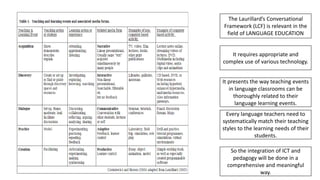
The Laurillard’s Conversational
Framework (LCF) is relevant in the
field of LANGUAGE EDUCATION
It requires appropriate and
complex use of various technology.
It presents the way teaching events
in language classrooms can be
thoroughly related to their
language learning events.
Every language teachers need to
systematically match their teaching
styles to the learning needs of their
students.
So the integration of ICT and
pedagogy will be done in a
comprehensive and meaningful
way.
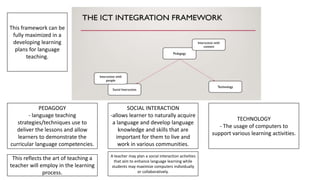
This framework can be
fully maximized in a
developing learning
plans for language
teaching.
PEDAGOGY
- language teaching
strategies/techniques use to
deliver the lessons and allow
learners to demonstrate the
curricular language competencies.
This reflects the art of teaching a
teacher will employ in the learning
process.
SOCIAL INTERACTION
-allows learner to naturally acquire
a language and develop language
knowledge and skills that are
important for them to live and
work in various communities.
A teacher may plan a social interaction activities
that aim to enhance language learning while
students may maximize computers individually
or collaboratively.
TECHNOLOGY
- The usage of computers to
support various learning activities.
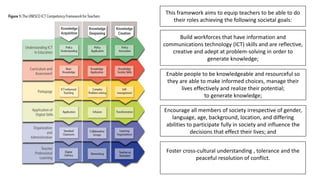
This framework aims to equip teachers to be able to do
their roles achieving the following societal goals:
Build workforces that have information and
communications technology (ICT) skills and are reflective,
creative and adept at problem-solving in order to
generate knowledge;
Enable people to be knowledgeable and resourceful so
they are able to make informed choices, manage their
lives effectively and realize their potential;
to generate knowledge;
Encourage all members of society irrespective of gender,
language, age, background, location, and differing
abilities to participate fully in society and influence the
decisions that effect their lives; and
Foster cross-cultural understanding , tolerance and the
peaceful resolution of conflict.
teachers,
we aim to
develop
the macro
skills of
our
learners.
The
concern
is, how do
we teach
these
skills in
KWL CHART
Language Topic:
Big Question:
What I know What I want to Know What I learned
• A process of asking questions
• Providing solutions to emerging issues affecting the society in general.
• An approach requiring learner’s active participation in finding
answers to curricular questions.
• Learners are given opportunities to engage in self-regulated activities
as they pursue their investigation.
• Using this approach in a language class can develop communication
skills as it involves activities such as writing questions, deliberating
ways of finding answers to curricular questions, and presenting
outputs as evidence of inquiry among others.
Inquiry-Based and Research-Based Learning
Types of Inquiry
1. Structured – This lets the students follow the lead of the
teacher as the entire class engages in one inquiry together.
2. Controlled – The teacher chooses topics and identifies the
resources that the students will use to answer questions.
3. Guided – The teacher chooses topics or questions and students
design the product or solution.
4. Free – Students are allowed to choose their own topics without
any reference to a prescribed outcome.
Role of the Language Teacher:
1. LT needs to look into the learning competencies that can be satisfied by a
simple inquiry or more complex inquiry.
2. LT controls and prepares the topic for investigation and guides learners by
setting the questions to be explored.
3. LT has to consider the following fields when designing IBL approach:
*Prior Knowledge Capacity
*Context – Learners require meaning from experience.
*Content and Learning materials
*Process
*Strategy of reactions and behavior
*Course Outcomes
Problem-Based Learning and Project-Based Learning
Nature of Problem-Based Learning
•Involves a process of inquiry and solving open-
ended questions that serves as the main
problem that the learners will work on.
•Questions must focus on a specific content
standard and its application to real life issues.
•It requires more than one answer or solution
•Its end goal is to ensure that the target and the
learning competencies are achieved in the
process.
5 Principles of PBL (Ali (2009))
• It is a power of independent and self-directed
learning.
• Learning happens in a group and teacher is a
facilitator.
• All groups have to participate equally.
• Students’ learn about motivation, teamwork,
problem-solving and engagement with the task.
• Materials such as data, photographs, articles, can be
used to solve the problem.
Benefits of Problem-Based Learning
(Ghufron & Ermawati, 2018, p. 666 – in EFL writing class)
1. Promotes self-confidence and motivation
2. Reduces students’ nervousness during the learning process.
3. Increases students’ responsibility in learning.
4. Makes students’ easily learn the material through sharing of
ideas.
5. Promotes problem-solving skills
6. Promotes self-directed learning
7. Promotes active learning
8. Makes students explore many learning resources
9. Makes students develop positive attitude towards learning
Baresh, Ali, & Darmi, 2019 – EFL Students:
•Enhances fluency in communication
•Improves grammar
•Increases comprehension
•Enhances good pronunciations and
intonations
•Enhances self-confidence
•Increases range of vocabulary
Nature of Project-Based Learning
• A teaching method that engages learners in a series of
planned tasks resulting to the generation of solutions to
real-world problems.
• A student-centered approach focusing on the experiences
and interest of students.
• Based on John Dewey’s principle of Learning by Doing and
Vygotsky’s constructivist theory of learning that advocates
social construction of knowledge.
• A collaborative learning activity where learners work on an
authentic task guided by an open-ended question.

Lesson-3.pptx

  • 1.
    The Laurillard’s Conversational Framework(LCF) is relevant in the field of LANGUAGE EDUCATION It requires appropriate and complex use of various technology. It presents the way teaching events in language classrooms can be thoroughly related to their language learning events. Every language teachers need to systematically match their teaching styles to the learning needs of their students. So the integration of ICT and pedagogy will be done in a comprehensive and meaningful way.
  • 2.
    This framework canbe fully maximized in a developing learning plans for language teaching. PEDAGOGY - language teaching strategies/techniques use to deliver the lessons and allow learners to demonstrate the curricular language competencies. This reflects the art of teaching a teacher will employ in the learning process. SOCIAL INTERACTION -allows learner to naturally acquire a language and develop language knowledge and skills that are important for them to live and work in various communities. A teacher may plan a social interaction activities that aim to enhance language learning while students may maximize computers individually or collaboratively. TECHNOLOGY - The usage of computers to support various learning activities.
  • 3.
    This framework aimsto equip teachers to be able to do their roles achieving the following societal goals: Build workforces that have information and communications technology (ICT) skills and are reflective, creative and adept at problem-solving in order to generate knowledge; Enable people to be knowledgeable and resourceful so they are able to make informed choices, manage their lives effectively and realize their potential; to generate knowledge; Encourage all members of society irrespective of gender, language, age, background, location, and differing abilities to participate fully in society and influence the decisions that effect their lives; and Foster cross-cultural understanding , tolerance and the peaceful resolution of conflict.
  • 4.
    teachers, we aim to develop themacro skills of our learners. The concern is, how do we teach these skills in
  • 5.
    KWL CHART Language Topic: BigQuestion: What I know What I want to Know What I learned
  • 6.
    • A processof asking questions • Providing solutions to emerging issues affecting the society in general. • An approach requiring learner’s active participation in finding answers to curricular questions. • Learners are given opportunities to engage in self-regulated activities as they pursue their investigation. • Using this approach in a language class can develop communication skills as it involves activities such as writing questions, deliberating ways of finding answers to curricular questions, and presenting outputs as evidence of inquiry among others. Inquiry-Based and Research-Based Learning
  • 7.
    Types of Inquiry 1.Structured – This lets the students follow the lead of the teacher as the entire class engages in one inquiry together. 2. Controlled – The teacher chooses topics and identifies the resources that the students will use to answer questions. 3. Guided – The teacher chooses topics or questions and students design the product or solution. 4. Free – Students are allowed to choose their own topics without any reference to a prescribed outcome.
  • 8.
    Role of theLanguage Teacher: 1. LT needs to look into the learning competencies that can be satisfied by a simple inquiry or more complex inquiry. 2. LT controls and prepares the topic for investigation and guides learners by setting the questions to be explored. 3. LT has to consider the following fields when designing IBL approach: *Prior Knowledge Capacity *Context – Learners require meaning from experience. *Content and Learning materials *Process *Strategy of reactions and behavior *Course Outcomes
  • 9.
    Problem-Based Learning andProject-Based Learning
  • 11.
    Nature of Problem-BasedLearning •Involves a process of inquiry and solving open- ended questions that serves as the main problem that the learners will work on. •Questions must focus on a specific content standard and its application to real life issues. •It requires more than one answer or solution •Its end goal is to ensure that the target and the learning competencies are achieved in the process.
  • 12.
    5 Principles ofPBL (Ali (2009)) • It is a power of independent and self-directed learning. • Learning happens in a group and teacher is a facilitator. • All groups have to participate equally. • Students’ learn about motivation, teamwork, problem-solving and engagement with the task. • Materials such as data, photographs, articles, can be used to solve the problem.
  • 13.
    Benefits of Problem-BasedLearning (Ghufron & Ermawati, 2018, p. 666 – in EFL writing class) 1. Promotes self-confidence and motivation 2. Reduces students’ nervousness during the learning process. 3. Increases students’ responsibility in learning. 4. Makes students’ easily learn the material through sharing of ideas. 5. Promotes problem-solving skills 6. Promotes self-directed learning 7. Promotes active learning 8. Makes students explore many learning resources 9. Makes students develop positive attitude towards learning
  • 14.
    Baresh, Ali, &Darmi, 2019 – EFL Students: •Enhances fluency in communication •Improves grammar •Increases comprehension •Enhances good pronunciations and intonations •Enhances self-confidence •Increases range of vocabulary
  • 15.
    Nature of Project-BasedLearning • A teaching method that engages learners in a series of planned tasks resulting to the generation of solutions to real-world problems. • A student-centered approach focusing on the experiences and interest of students. • Based on John Dewey’s principle of Learning by Doing and Vygotsky’s constructivist theory of learning that advocates social construction of knowledge. • A collaborative learning activity where learners work on an authentic task guided by an open-ended question.