British Council Resources II 
The following resources are designed by members of the British Council 
and are meant to be implemented thorughout LINGUAVENTURAS, ESL 
Project from SED
SESSION AIM 
• By the end of this session you will have clarity about 
the procedure you must follow for the microteaching 
assignment.
STEPS TO PLAN YOUR MICRO TEACHING 
ELEMENTS YOUR MICROTEACHING 
SHOULD INCLUDE 
• a WARM UP to allow your students switch from a Spanish 
speaking environment to an English class. 
• AIMS to guide the activities and to let students know what 
they are expected to do and achieve by the end of the lesson. 
• a formal PRESENTATION of the target language. Use one of 
the techniques reviewed earlier.
STEPS TO PLAN YOUR MICRO TEACHING 
ELEMENTS YOUR MICROTEACHING 
SHOULD INCLUDE 
• A COMMUNICATIVE ACTIVITY to allow students use 
the language studied during the lesson. 
• A WRAP UP activity in which you can provide 
students with feedback and finish the lesson.
AIMS 
• By the end of this session you will 
• have a clearer understanding of the differences between LBL 
and TBL. 
• analyzed TBL framework from a practical example 
• be better able to plan lessons with the TBL approach
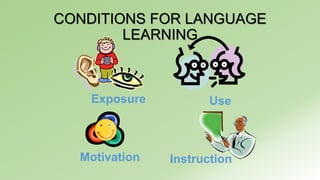
CONDITIONS FOR LANGUAGE 
LEARNING 
Exposure Use 
Motivation Instruction
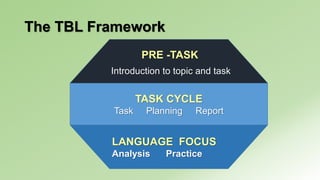
The TBL Framework 
PRE -TASK 
Introduction to topic and task 
TASK CYCLE 
Task Planning Report 
LANGUAGE FOCUS 
Analysis Practice
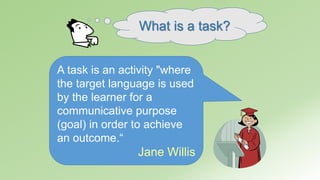
What is a task? 
A task is an activity "where 
the target language is used 
by the learner for a 
communicative purpose 
(goal) in order to achieve 
an outcome.“ 
Jane Willis
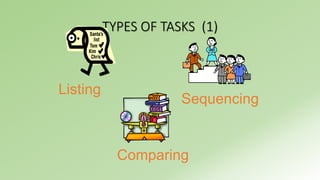
TYPES OF TASKS (1) 
Listing 
Sequencing 
Comparing
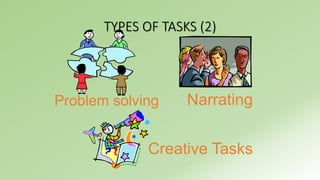
TYPES OF TASKS (2) 
Problem solving Narrating 
Creative Tasks
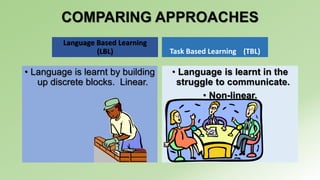
COMPARING APPROACHES 
Language Based Learning 
(LBL) 
• Language is learnt by building 
up discrete blocks. Linear. 
Task Based Learning (TBL) 
• Language is learnt in the 
struggle to communicate. 
• Non-linear.
FEATURES OF TBL APPROACH 
• The central focus of the lesson is the task itself, not a 
grammar point or a lexical area. 
• The objective is not to ‘learn the structure’ but to 
‘complete the task’. 
• The language, therefore becomes an instrument of 
communication, whose purpose is to help complete 
the task successfully. 
• The students can use any language they need to 
reach their objective. Usually there is no ‘correct 
answer’ for a task outcome. Students decide on their 
own way of completing it, using the language they see 
fit.
ADVANTAGES OF TBL 
• TBL model allows students to focus on real communication before doing 
any serious language analysis. 
• It focuses on students’ needs by putting them into authentic 
communicative situations and allowing them to use all their language 
resources to deal with them. 
• It makes learners aware of their needs and encourages them to take 
(some of the) responsibility for their own learning. 
• Learners are exposed to a wide variety of language and not just grammar.
ADVANTAGES OF TBL 
• Unlike LBL (a PPP approach), students are free 
of language control. 
• A natural context is developed from the students’ 
experiences with the language. 
• Students will have a much more varied exposure 
to language. 
• It is a strong communicative approach where 
students spend a lot of time communicating. 
• It is enjoyable and motivating.
MAKING TASKS WORK 
1) Treat tasks primarily as an opportunity for 
communication. 
2) Adapt them to suit your class. 
3) Set the final objective clearly before students start 
preparing 
4) Give students time to think and plan. 
5) Feed in ‘useful language’ 
6) Make notes for further input and correction after the 
task.
SESSION AIMS 
•By the end of this session you will… 
• have gotten a better understanding of the methodologies 
and techniques that can be used to plan and develop classes in 
the immersion rooms. 
• count on a wider variety of ways of structuring a class 
and give your students the chance to become familiar with 
English.
HOW MANY TEACHING APPROACHES 
CAN YOU IDENTIFY? 
• ARC 
• PPP 
• TTT 
• PBL 
• TBL
AUTHENTICATION 
RESTRICTED 
CLARIFICATION
ARC 
It stands for AUTHENTIC, RESTRICTED AND CLARIFICATION was developed by Jim Scrivener, 
not as a teaching method but rather as a means to examine the different stages in a lesson and 
evaluate them in terms of what the students get out of them. The idea is that every lesson should 
have an appropriate balance of activities that can be categorised as above. 
Authentic activities are those in which the language is not restricted. They can be either receptive or 
productive activities. An example of receptive would be a relatively authentic reading or listening 
which exposes students to natural English. Productive would be a speaking activity with a focus on 
fluency, where the student has free choice of language rather than practicing specific structures. 
Communicative activities are authentic. 
Restricted activities are those which restrict the students to using specific linguistic items, such as 
specific lexis or grammatical structures. Typical activities might include gap fills or substitution drills 
(i.e. the students use the grammatical form in a different way). Controlled practice activities are 
restricted. 
Clarification refers to any activity in which the language is explained to the students. It could simply 
be explanations of grammar or lexis provided by the teacher, or it could be students discovering 
meanings and/or rules for themselves through guided discovery.
PRESENTATION 
PRACTICE 
PRODUCTION
WHAT IS PRESENTATION – PRACTICE – 
PRODUCTION? 
Presentation – Practice – Production, or PPP, is a method for 
teaching structures (e.g. grammar or vocabulary) in a foreign 
language. As its name suggests, PPP is divided into three 
phases, moving from tight teacher control towards greater 
learner freedom. Note that some writers1 use the name to refer 
to a specific method that focuses on oral skills, but it can also 
be applied more broadly to a family of related methods which 
rely on the progression from presentation, through controlled 
practice, to free production.
TEST 
TEACH 
TEST
PROJECT 
BASED 
LEARNING
TASK 
BASED 
LEARNING
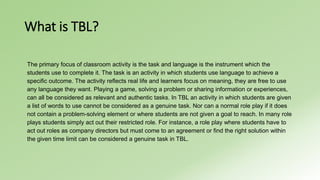
What is TBL? 
The primary focus of classroom activity is the task and language is the instrument which the 
students use to complete it. The task is an activity in which students use language to achieve a 
specific outcome. The activity reflects real life and learners focus on meaning, they are free to use 
any language they want. Playing a game, solving a problem or sharing information or experiences, 
can all be considered as relevant and authentic tasks. In TBL an activity in which students are given 
a list of words to use cannot be considered as a genuine task. Nor can a normal role play if it does 
not contain a problem-solving element or where students are not given a goal to reach. In many role 
plays students simply act out their restricted role. For instance, a role play where students have to 
act out roles as company directors but must come to an agreement or find the right solution within 
the given time limit can be considered a genuine task in TBL.

British council resources ii

  • 1.
    British Council ResourcesII The following resources are designed by members of the British Council and are meant to be implemented thorughout LINGUAVENTURAS, ESL Project from SED
  • 2.
    SESSION AIM •By the end of this session you will have clarity about the procedure you must follow for the microteaching assignment.
  • 3.
    STEPS TO PLANYOUR MICRO TEACHING ELEMENTS YOUR MICROTEACHING SHOULD INCLUDE • a WARM UP to allow your students switch from a Spanish speaking environment to an English class. • AIMS to guide the activities and to let students know what they are expected to do and achieve by the end of the lesson. • a formal PRESENTATION of the target language. Use one of the techniques reviewed earlier.
  • 4.
    STEPS TO PLANYOUR MICRO TEACHING ELEMENTS YOUR MICROTEACHING SHOULD INCLUDE • A COMMUNICATIVE ACTIVITY to allow students use the language studied during the lesson. • A WRAP UP activity in which you can provide students with feedback and finish the lesson.
  • 5.
    AIMS • Bythe end of this session you will • have a clearer understanding of the differences between LBL and TBL. • analyzed TBL framework from a practical example • be better able to plan lessons with the TBL approach
  • 6.
    CONDITIONS FOR LANGUAGE LEARNING Exposure Use Motivation Instruction
  • 7.
    The TBL Framework PRE -TASK Introduction to topic and task TASK CYCLE Task Planning Report LANGUAGE FOCUS Analysis Practice
  • 8.
    What is atask? A task is an activity "where the target language is used by the learner for a communicative purpose (goal) in order to achieve an outcome.“ Jane Willis
  • 9.
    TYPES OF TASKS(1) Listing Sequencing Comparing
  • 10.
    TYPES OF TASKS(2) Problem solving Narrating Creative Tasks
  • 11.
    COMPARING APPROACHES LanguageBased Learning (LBL) • Language is learnt by building up discrete blocks. Linear. Task Based Learning (TBL) • Language is learnt in the struggle to communicate. • Non-linear.
  • 12.
    FEATURES OF TBLAPPROACH • The central focus of the lesson is the task itself, not a grammar point or a lexical area. • The objective is not to ‘learn the structure’ but to ‘complete the task’. • The language, therefore becomes an instrument of communication, whose purpose is to help complete the task successfully. • The students can use any language they need to reach their objective. Usually there is no ‘correct answer’ for a task outcome. Students decide on their own way of completing it, using the language they see fit.
  • 13.
    ADVANTAGES OF TBL • TBL model allows students to focus on real communication before doing any serious language analysis. • It focuses on students’ needs by putting them into authentic communicative situations and allowing them to use all their language resources to deal with them. • It makes learners aware of their needs and encourages them to take (some of the) responsibility for their own learning. • Learners are exposed to a wide variety of language and not just grammar.
  • 14.
    ADVANTAGES OF TBL • Unlike LBL (a PPP approach), students are free of language control. • A natural context is developed from the students’ experiences with the language. • Students will have a much more varied exposure to language. • It is a strong communicative approach where students spend a lot of time communicating. • It is enjoyable and motivating.
  • 15.
    MAKING TASKS WORK 1) Treat tasks primarily as an opportunity for communication. 2) Adapt them to suit your class. 3) Set the final objective clearly before students start preparing 4) Give students time to think and plan. 5) Feed in ‘useful language’ 6) Make notes for further input and correction after the task.
  • 16.
    SESSION AIMS •Bythe end of this session you will… • have gotten a better understanding of the methodologies and techniques that can be used to plan and develop classes in the immersion rooms. • count on a wider variety of ways of structuring a class and give your students the chance to become familiar with English.
  • 17.
    HOW MANY TEACHINGAPPROACHES CAN YOU IDENTIFY? • ARC • PPP • TTT • PBL • TBL
  • 18.
  • 19.
    ARC It standsfor AUTHENTIC, RESTRICTED AND CLARIFICATION was developed by Jim Scrivener, not as a teaching method but rather as a means to examine the different stages in a lesson and evaluate them in terms of what the students get out of them. The idea is that every lesson should have an appropriate balance of activities that can be categorised as above. Authentic activities are those in which the language is not restricted. They can be either receptive or productive activities. An example of receptive would be a relatively authentic reading or listening which exposes students to natural English. Productive would be a speaking activity with a focus on fluency, where the student has free choice of language rather than practicing specific structures. Communicative activities are authentic. Restricted activities are those which restrict the students to using specific linguistic items, such as specific lexis or grammatical structures. Typical activities might include gap fills or substitution drills (i.e. the students use the grammatical form in a different way). Controlled practice activities are restricted. Clarification refers to any activity in which the language is explained to the students. It could simply be explanations of grammar or lexis provided by the teacher, or it could be students discovering meanings and/or rules for themselves through guided discovery.
  • 20.
  • 21.
    WHAT IS PRESENTATION– PRACTICE – PRODUCTION? Presentation – Practice – Production, or PPP, is a method for teaching structures (e.g. grammar or vocabulary) in a foreign language. As its name suggests, PPP is divided into three phases, moving from tight teacher control towards greater learner freedom. Note that some writers1 use the name to refer to a specific method that focuses on oral skills, but it can also be applied more broadly to a family of related methods which rely on the progression from presentation, through controlled practice, to free production.
  • 22.
  • 23.
  • 24.
  • 25.
    What is TBL? The primary focus of classroom activity is the task and language is the instrument which the students use to complete it. The task is an activity in which students use language to achieve a specific outcome. The activity reflects real life and learners focus on meaning, they are free to use any language they want. Playing a game, solving a problem or sharing information or experiences, can all be considered as relevant and authentic tasks. In TBL an activity in which students are given a list of words to use cannot be considered as a genuine task. Nor can a normal role play if it does not contain a problem-solving element or where students are not given a goal to reach. In many role plays students simply act out their restricted role. For instance, a role play where students have to act out roles as company directors but must come to an agreement or find the right solution within the given time limit can be considered a genuine task in TBL.

Editor's Notes

  • #10 OUTCOMES: Listing: complete list. Ex: listing items one might need to use on a camping trip. Sequencing: Set of information ordered according to a criteria. Ex: choosing the three most important skills applicant need for a certain post. Comparing: items matched in line with common features. Ex: identifying differences between
  • #11 OUTCOMES: 4. Problem solving: Solutions to the problem, which can then be evaluated. 5. Narrating: Largely social 6. Creative tasks: End product which can be appreciated by a wider audience.
  • #12 LBL: Learners learn grammar structures following a discrete order: verb to be, present simple, present continuous, past simple, past continuous, etc.