1
Presented by:
Keshab Raj Joshi
Lumbini medical college
Pravas, Tansen, Palpa
CARBOHYDRATE METABOLISM
2
Major pathway for Carbohydrate metabolism:
1) Glycolysis
2) TCA cycle
3) Gluconeogenesis
4) Glycogenesis
5) Glycogenolysis
6) Hexose monophosphate pathway
3
Major pathway for Carbohydrate metabolism:
1) Glycolysis:-
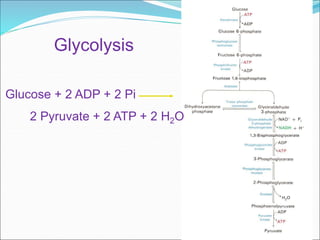
 Glycolysis is defined as the sequence of reaction converting
glucose to pyruvate under aerobic condition and lactate under
anaerobic condition with the production of ATP.
2) TCA Cycle:
 The oxidation of acetyl Co-A to Co2.
 Kreb’s cycle is the final oxidative pathway for carbohydrate, fat,
or amino acids through acetyl Co-A.
3) Gluconeogenesis:
 The synthesis of glucose from non-carbohydrate precursor.
eg: amino acids, glycerol
4) Glycogenesis:
> The formation of glycogen from glucose
4
 Metabolism is all the chemical reactions that occur in an
organism
 Cellular metabolism
 Cells break down excess carbohydrates first, then lipids, finally
amino acids if energy needs are not metabolized by
carbohydrates and fat
 Nutrients not used for energy are used to build up structure, are
stored, or they are excreted
 40% of the energy released in catabolism is captured in ATP,
the rest is released as heat
Metabolism
 Performance of structural maintenance and
repairs
 Support of growth
 Production of secretions
 Building of nutrient reserves
Anabolism
 Breakdown of nutrients to provide energy (in
the form of ATP) for body processes
 Nutrients directly absorbed
 Stored nutrients
Catabolism
 Cells provide small organic molecules to
mitochondria
 Mitochondria produce ATP used to
perform cellular functions
Cells and Mitochondria
Carbohydrate Metabolism
 Primarily glucose
 Fructose and galactose enter the pathways at various
points
 All cells can utilize glucose for energy production
 Glucose uptake from blood to cells usually mediated by
insulin and transporters
 Liver is central site for carbohydrate metabolism
 Glucose uptake independent of insulin
 The only exporter of glucose
Fates of Glucose
 Fed state
 Storage as glycogen
 Liver
 Skeletal muscle
 Storage as lipids
 Adipose tissue
 Fasted state
 Metabolized for energy
 New glucose synthesized
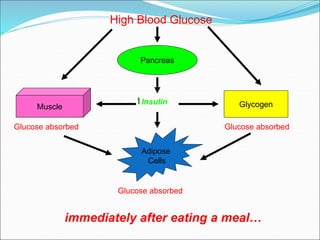
High Blood Glucose
Glucose absorbed
Insulin
Pancreas
Muscle
Adipose
Cells
Glycogen
Glucose absorbed
Glucose absorbed
immediately after eating a meal…
Glucose Metabolism
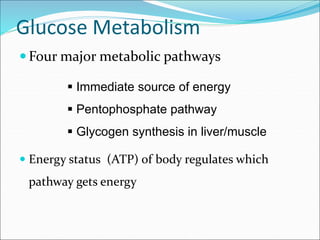
 Four major metabolic pathways
 Energy status (ATP) of body regulates which
pathway gets energy
 Immediate source of energy
 Pentophosphate pathway
 Glycogen synthesis in liver/muscle
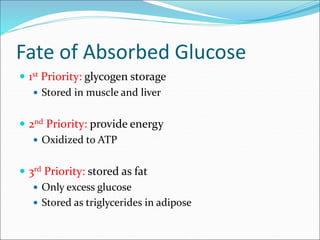
Fate of Absorbed Glucose
 1st Priority: glycogen storage
 Stored in muscle and liver
 2nd Priority: provide energy
 Oxidized to ATP
 3rd Priority: stored as fat
 Only excess glucose
 Stored as triglycerides in adipose
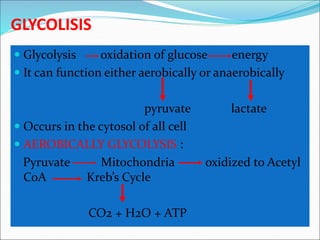
GLYCOLISIS
 Glycolysis oxidation of glucose energy
 It can function either aerobically or anaerobically
pyruvate lactate
 Occurs in the cytosol of all cell
 AEROBICALLY GLYCOLYSIS :
Pyruvate Mitochondria oxidized to Acetyl
CoA Kreb’s Cycle
CO2 + H2O + ATP
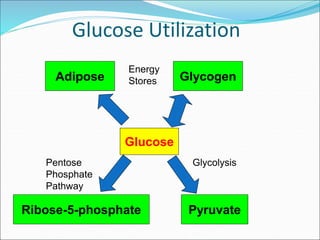
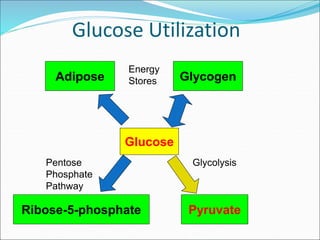
Glucose Utilization
Glucose
Pyruvate
Ribose-5-phosphate
Glycogen
Energy
Stores
Pentose
Phosphate
Pathway
Glycolysis
Adipose
Glucose Utilization
Glucose
Pyruvate
Ribose-5-phosphate
Glycogen
Energy
Stores
Pentose
Phosphate
Pathway
Glycolysis
Adipose
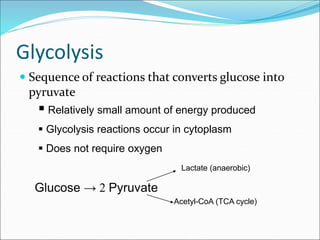
Glycolysis
 Sequence of reactions that converts glucose into
pyruvate
 Relatively small amount of energy produced
 Glycolysis reactions occur in cytoplasm
 Does not require oxygen
Glucose → 2 Pyruvate
Lactate (anaerobic)
Acetyl-CoA (TCA cycle)
18
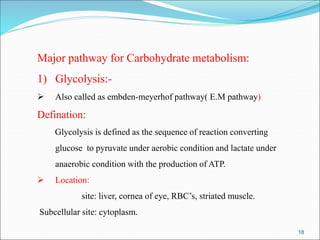
Major pathway for Carbohydrate metabolism:
1) Glycolysis:-
 Also called as embden-meyerhof pathway( E.M pathway)
Defination:
Glycolysis is defined as the sequence of reaction converting
glucose to pyruvate under aerobic condition and lactate under
anaerobic condition with the production of ATP.
 Location:
site: liver, cornea of eye, RBC’s, striated muscle.
Subcellular site: cytoplasm.
19
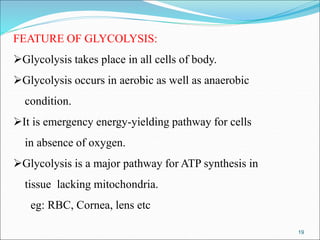
FEATURE OF GLYCOLYSIS:
Glycolysis takes place in all cells of body.
Glycolysis occurs in aerobic as well as anaerobic
condition.
It is emergency energy-yielding pathway for cells
in absence of oxygen.
Glycolysis is a major pathway for ATP synthesis in
tissue lacking mitochondria.
eg: RBC, Cornea, lens etc
Glycolysis
Glucose + 2 ADP + 2 Pi
2 Pyruvate + 2 ATP + 2 H2O
21
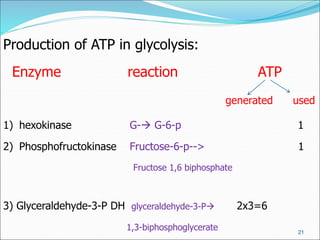
Production of ATP in glycolysis:
Enzyme reaction ATP
generated used
1) hexokinase G- G-6-p 1
2) Phosphofructokinase Fructose-6-p--> 1
Fructose 1,6 biphosphate
3) Glyceraldehyde-3-P DH glyceraldehyde-3-P 2x3=6
1,3-biphosphoglycerate
22
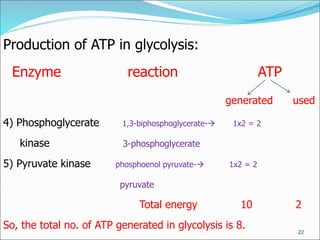
Production of ATP in glycolysis:
Enzyme reaction ATP
generated used
4) Phosphoglycerate 1,3-biphosphoglycerate- 1x2 = 2
kinase 3-phosphoglycerate
5) Pyruvate kinase phosphoenol pyruvate- 1x2 = 2
pyruvate
Total energy 10 2
So, the total no. of ATP generated in glycolysis is 8.
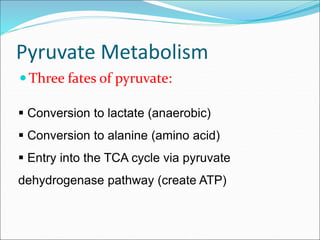
Pyruvate Metabolism
 Three fates of pyruvate:
 Conversion to lactate (anaerobic)
 Conversion to alanine (amino acid)
 Entry into the TCA cycle via pyruvate
dehydrogenase pathway (create ATP)
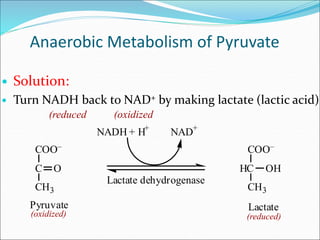
Anaerobic Metabolism of Pyruvate
 Solution:
 Turn NADH back to NAD+ by making lactate (lactic acid)
COO–
C O
CH3
COO–
HC OH
CH3
Lactate
Pyruvate
Lactate dehydrogenase
NADH + H+
NAD+
(oxidized) (reduced)
(oxidized
(reduced
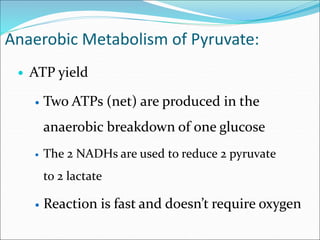
Anaerobic Metabolism of Pyruvate:
 ATP yield
 Two ATPs (net) are produced in the
anaerobic breakdown of one glucose
 The 2 NADHs are used to reduce 2 pyruvate
to 2 lactate
 Reaction is fast and doesn’t require oxygen
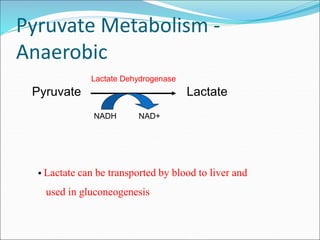
Pyruvate Metabolism -
Anaerobic
Pyruvate Lactate
NADH NAD+
Lactate Dehydrogenase
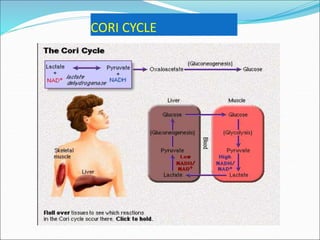
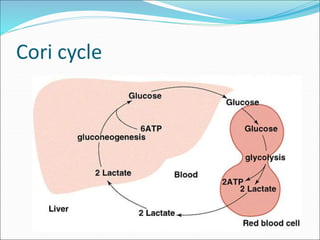
 Lactate can be transported by blood to liver and
used in gluconeogenesis
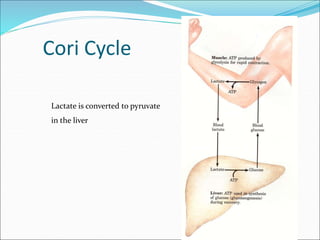
Cori Cycle
Lactate is converted to pyruvate
in the liver
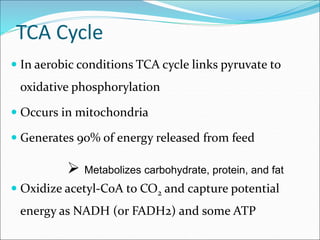
TCA Cycle
 In aerobic conditions TCA cycle links pyruvate to
oxidative phosphorylation
 Occurs in mitochondria
 Generates 90% of energy released from feed
 Oxidize acetyl-CoA to CO2 and capture potential
energy as NADH (or FADH2) and some ATP
 Metabolizes carbohydrate, protein, and fat
TCA Cycle
The Citric acid cycle is the most important
metabolic pathway for the energy supply to the body.
About 65-70% of the ATP is synthesized from kreb
cycle.
This cell utilized about 2/3rd of total oxygen
consumed.
function of TCA Cycle
It is the final oxidative pathway that oxidises acetyl
Co-A to CO2.
It is the sources of reduced co-enzymes that
provides the substrate for respiratory chain.
It has both anabolic and catabolic role ( Amphibolic
role)
It provides the precursor for the synthesis of Amino
acids and Nucleotides
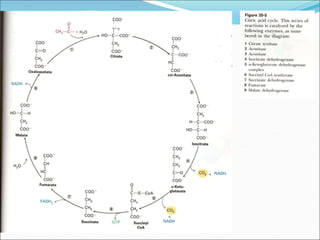
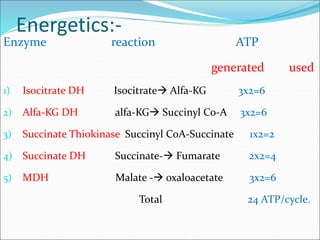
Energetics:-
Enzyme reaction ATP
generated used
1) Isocitrate DH Isocitrate Alfa-KG 3x2=6
2) Alfa-KG DH alfa-KG Succinyl Co-A 3x2=6
3) Succinate Thiokinase Succinyl CoA-Succinate 1x2=2
4) Succinate DH Succinate- Fumarate 2x2=4
5) MDH Malate - oxaloacetate 3x2=6
Total 24 ATP/cycle.
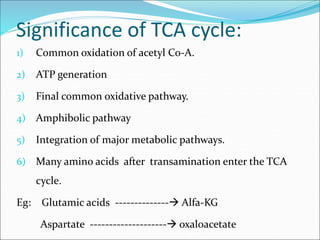
Significance of TCA cycle:
1) Common oxidation of acetyl Co-A.
2) ATP generation
3) Final common oxidative pathway.
4) Amphibolic pathway
5) Integration of major metabolic pathways.
6) Many amino acids after transamination enter the TCA
cycle.
Eg: Glutamic acids -------------- Alfa-KG
Aspartate -------------------- oxaloacetate
Regulatory enzyme of TCA cycle
1) Citrate Synthase:-
 It is inhibited by ATP, NADH, Acyl CoA and Succinyl CoA.
2) Iso-citrate Dehydrogenase:-
 It is activated by ADP and Inhibited by ATP and NADH
3) Alfa-keto glutarate dehydrogenase:-
 It is inhibited by Succinyl coA and NADH.
4) Availability of ADP:-
 It is very imp. For the TCA cycle to proceed.
 If ADP are unsufficient than oxidation of NADH and
FADH2 through ETC stops.
 Than accumulation of NADH and FADH2 lead inhibition
of enzyme.
 Also need to supply the NAD and FAD essential for TCA
cycle to proceeds. 34
Gluconeogenesis:-
Gluco = Glucose
Neo =New
Genesis = synthesis
Defination:
The process by which the glucose molecule are
synthesized from non-carbohydrate precursors/
compounds is called Gluconeogenesis.
The major precursor are:
a) Lactate b) Pyruvate c) Glycerol
d) Glucogenic amino acids. 35
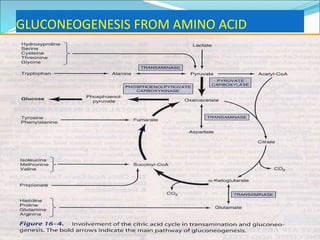
a) Alanine, serine, Cysteine, Glycine, threonine, and
tryptophan.
Pyruvate
b) Aspartate and Aspargine
Oxaloacetate
c) Arginine, Glutamate, Glutamine, Histidine,Proline
Alfa-Ketoglutarate 36
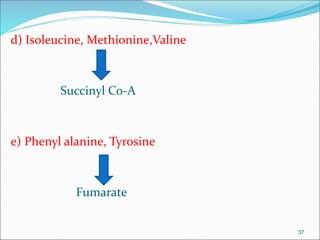
d) Isoleucine, Methionine,Valine
Succinyl Co-A
e) Phenyl alanine, Tyrosine
Fumarate
37
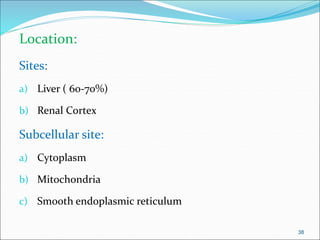
Location:
Sites:
a) Liver ( 60-70%)
b) Renal Cortex
Subcellular site:
a) Cytoplasm
b) Mitochondria
c) Smooth endoplasmic reticulum
38
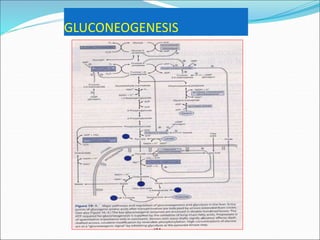
GLUCONEOGENESIS
Pathways that responsible for converting
noncarbohydrate precursors to glucose or glycogen
In mammals occurs in liver and kidney
Major substrate :
1. Lactic acid from muscle, erythrocyte
2. Glycerol from TG hydrolysis
3.Glucogenic amino acid
4. Propionic acid in ruminant
Why do we produce glucose?
 Need to maintain glucose levels
within a narrow range in blood.
 Brain, erythrocytes, and muscles in
exertion use glucose at a rapid rate
and require glucose between meals,
especially after several hours.
 What is the major precursor?
The major precursor for glucose
biosynthesis is pyruvate.
Gluconeogenesis meets the needs of the body for glucose when
carbohydrate is not available from the diet or from glycogenolysis
A supply of glucose is necessary especially for nervous system
and erythrocytes.
The key enzymes are :
1. Pyruvate carboxylase
2. Phosphoenolpyruvate Carboxikinase
3. Fructose 1,6-biphosphatase
4. Glucose-6-phosphatase
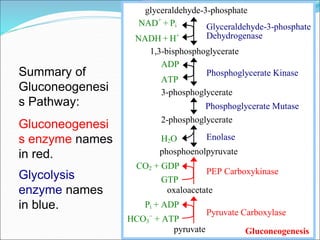
Glyceraldehyde-3-phosphate
Dehydrogenase
Phosphoglycerate Kinase
Enolase
PEP Carboxykinase
glyceraldehyde-3-phosphate
NAD+
+ Pi
NADH + H+
1,3-bisphosphoglycerate
ADP
ATP
3-phosphoglycerate
Phosphoglycerate Mutase
2-phosphoglycerate
H2O
phosphoenolpyruvate
CO2 + GDP
GTP
oxaloacetate
Pi + ADP
HCO3

+ ATP
pyruvate
Pyruvate Carboxylase
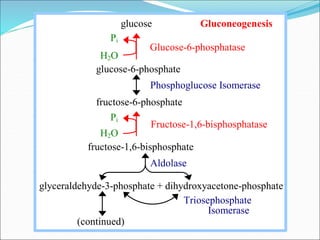
Gluconeogenesis
Summary of
Gluconeogenesi
s Pathway:
Gluconeogenesi
s enzyme names
in red.
Glycolysis
enzyme names
in blue.
Glucose-6-phosphatase
Fructose-1,6-bisphosphatase
glucose Gluconeogenesis
Pi
H2O
glucose-6-phosphate
Phosphoglucose Isomerase
fructose-6-phosphate
Pi
H2O
fructose-1,6-bisphosphate
Aldolase
glyceraldehyde-3-phosphate + dihydroxyacetone-phosphate
Triosephosphate
Isomerase
(continued)
GLUCONEOGENESIS
GLUCONEOGENESIS FROM AMINO ACID
CORI CYCLE
Cori cycle
Importance of Gluconeogenesis:
During starvation gluconeogenesis maintain the blood glucose
level.
The stored glycogen is depleted within the first 12-18hrs of
fasting.
On prolonged starvation the gluconeogenesis is speeded up
and protein catabolism provide the substrate namely
glucogenic amino acids.
Brain alone require 120gm/day of glucose out of 160 gm/day
needed by the entire body so during starvation,
gluconeogenesis is reponsible for providing glucose to brain.
49
REGULATION OF GLUCONEOGENESIS:
Gluconeogenesis and Glycolysis are reciprocally regulated so
that one pathway is relatively inactive when the other is active.
Gluconeogenesis occurs during fasting, also stumulated during
prolonged exercise and high protein intake and under
condition of stress:
a) Availability of substrate:
Gluconeogenesis is stimulated by the flow of it’s major
substrate from the peripheral tissue to the liver.
i) Lactate: - elevated during exercise
ii) Amino acids:- elevated when insulin is low and cortisol is
elevated also elevated when protein intake is high. 50
REGULATION OF GLUCONEOGENESIS:
b) Hormonal:
Starvation------- Hypoglycemia--------increased Glycogen
Stimulated
Gluconeogenesis
c) Covalent modification of pyruvate kinase:
d) Regulatory enzyme of gluconeogenesis are:
i) Pyruvate Carboxylase
ii) Phosphoenol pyruvate carboxylase
iii) Fructise 1,6-bisphosphatase
iv) glucose-6-phosphatase. 51
REGULATION OF GLUCONEOGENESIS:
d) Regulatory enzyme of gluconeogenesis are:
i) Pyruvate Carboxylase:-
This is the key enzyme in gluconeogenetic pathways.
The enzyme is activated allosterically by acetyl Co-A.
It bind with the allosteric site of the enzyme, bring about
conformational change at tertiary level so that the affinity of
the enzyme for Co2 increases.
ii) Phosphoenol pyruvate carboxylase:-
> The enzyme is induced by Glucagon, during starvation, thus
increasing gluconeogenesis.
52
iii) Fructise 1,6-bisphosphatase:
This enzyme is strongly and allosterically inhibited by AMP,
but is activated by citrates. Hence Gluconeogenesis is
increased when there is increased ATP and citrate levels.
Gluconeogenesis is decreased by inhibition of this enzyme
when liver cells are rich in AMP and low in citrate
concerntration.
iv) Glucose-6-phosphatase:-
> This enzyme is induced by the hormones Glucagon and
Glucocorticoids, which are secreted during starvation thus
enhancing gluconeogenesis. Insulin repress the enzyme.
53
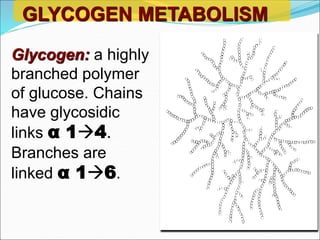
GLYCOGEN METABOLISM
Glycogen: a highly
branched polymer
of glucose. Chains
have glycosidic
links α 14.
Branches are
linked α 16.
Glucose stored in polymeric form as
glycogen mostly in the liver and
skeletal muscle.
 Glucose can be rapidly delivered to
the blood stream when needed upon
degradation of glycogen.
= glycogenolysis
 Enough glucose and energy triggers
synthesis of glycogen.
= glycogenesis
Good luck!! Thank you

carbohydrate metabolism new.ppt

  • 1.
    1 Presented by: Keshab RajJoshi Lumbini medical college Pravas, Tansen, Palpa CARBOHYDRATE METABOLISM
  • 2.
    2 Major pathway forCarbohydrate metabolism: 1) Glycolysis 2) TCA cycle 3) Gluconeogenesis 4) Glycogenesis 5) Glycogenolysis 6) Hexose monophosphate pathway
  • 3.
    3 Major pathway forCarbohydrate metabolism: 1) Glycolysis:-  Glycolysis is defined as the sequence of reaction converting glucose to pyruvate under aerobic condition and lactate under anaerobic condition with the production of ATP. 2) TCA Cycle:  The oxidation of acetyl Co-A to Co2.  Kreb’s cycle is the final oxidative pathway for carbohydrate, fat, or amino acids through acetyl Co-A.
  • 4.
    3) Gluconeogenesis:  Thesynthesis of glucose from non-carbohydrate precursor. eg: amino acids, glycerol 4) Glycogenesis: > The formation of glycogen from glucose 4
  • 5.
     Metabolism isall the chemical reactions that occur in an organism  Cellular metabolism  Cells break down excess carbohydrates first, then lipids, finally amino acids if energy needs are not metabolized by carbohydrates and fat  Nutrients not used for energy are used to build up structure, are stored, or they are excreted  40% of the energy released in catabolism is captured in ATP, the rest is released as heat Metabolism
  • 6.
     Performance ofstructural maintenance and repairs  Support of growth  Production of secretions  Building of nutrient reserves Anabolism
  • 7.
     Breakdown ofnutrients to provide energy (in the form of ATP) for body processes  Nutrients directly absorbed  Stored nutrients Catabolism
  • 8.
     Cells providesmall organic molecules to mitochondria  Mitochondria produce ATP used to perform cellular functions Cells and Mitochondria
  • 9.
    Carbohydrate Metabolism  Primarilyglucose  Fructose and galactose enter the pathways at various points  All cells can utilize glucose for energy production  Glucose uptake from blood to cells usually mediated by insulin and transporters  Liver is central site for carbohydrate metabolism  Glucose uptake independent of insulin  The only exporter of glucose
  • 10.
    Fates of Glucose Fed state  Storage as glycogen  Liver  Skeletal muscle  Storage as lipids  Adipose tissue  Fasted state  Metabolized for energy  New glucose synthesized
  • 11.
    High Blood Glucose Glucoseabsorbed Insulin Pancreas Muscle Adipose Cells Glycogen Glucose absorbed Glucose absorbed immediately after eating a meal…
  • 12.
    Glucose Metabolism  Fourmajor metabolic pathways  Energy status (ATP) of body regulates which pathway gets energy  Immediate source of energy  Pentophosphate pathway  Glycogen synthesis in liver/muscle
  • 13.
    Fate of AbsorbedGlucose  1st Priority: glycogen storage  Stored in muscle and liver  2nd Priority: provide energy  Oxidized to ATP  3rd Priority: stored as fat  Only excess glucose  Stored as triglycerides in adipose
  • 14.
    GLYCOLISIS  Glycolysis oxidationof glucose energy  It can function either aerobically or anaerobically pyruvate lactate  Occurs in the cytosol of all cell  AEROBICALLY GLYCOLYSIS : Pyruvate Mitochondria oxidized to Acetyl CoA Kreb’s Cycle CO2 + H2O + ATP
  • 15.
  • 16.
  • 17.
    Glycolysis  Sequence ofreactions that converts glucose into pyruvate  Relatively small amount of energy produced  Glycolysis reactions occur in cytoplasm  Does not require oxygen Glucose → 2 Pyruvate Lactate (anaerobic) Acetyl-CoA (TCA cycle)
  • 18.
    18 Major pathway forCarbohydrate metabolism: 1) Glycolysis:-  Also called as embden-meyerhof pathway( E.M pathway) Defination: Glycolysis is defined as the sequence of reaction converting glucose to pyruvate under aerobic condition and lactate under anaerobic condition with the production of ATP.  Location: site: liver, cornea of eye, RBC’s, striated muscle. Subcellular site: cytoplasm.
  • 19.
    19 FEATURE OF GLYCOLYSIS: Glycolysistakes place in all cells of body. Glycolysis occurs in aerobic as well as anaerobic condition. It is emergency energy-yielding pathway for cells in absence of oxygen. Glycolysis is a major pathway for ATP synthesis in tissue lacking mitochondria. eg: RBC, Cornea, lens etc
  • 20.
    Glycolysis Glucose + 2ADP + 2 Pi 2 Pyruvate + 2 ATP + 2 H2O
  • 21.
    21 Production of ATPin glycolysis: Enzyme reaction ATP generated used 1) hexokinase G- G-6-p 1 2) Phosphofructokinase Fructose-6-p--> 1 Fructose 1,6 biphosphate 3) Glyceraldehyde-3-P DH glyceraldehyde-3-P 2x3=6 1,3-biphosphoglycerate
  • 22.
    22 Production of ATPin glycolysis: Enzyme reaction ATP generated used 4) Phosphoglycerate 1,3-biphosphoglycerate- 1x2 = 2 kinase 3-phosphoglycerate 5) Pyruvate kinase phosphoenol pyruvate- 1x2 = 2 pyruvate Total energy 10 2 So, the total no. of ATP generated in glycolysis is 8.
  • 23.
    Pyruvate Metabolism  Threefates of pyruvate:  Conversion to lactate (anaerobic)  Conversion to alanine (amino acid)  Entry into the TCA cycle via pyruvate dehydrogenase pathway (create ATP)
  • 24.
    Anaerobic Metabolism ofPyruvate  Solution:  Turn NADH back to NAD+ by making lactate (lactic acid) COO– C O CH3 COO– HC OH CH3 Lactate Pyruvate Lactate dehydrogenase NADH + H+ NAD+ (oxidized) (reduced) (oxidized (reduced
  • 25.
    Anaerobic Metabolism ofPyruvate:  ATP yield  Two ATPs (net) are produced in the anaerobic breakdown of one glucose  The 2 NADHs are used to reduce 2 pyruvate to 2 lactate  Reaction is fast and doesn’t require oxygen
  • 26.
    Pyruvate Metabolism - Anaerobic PyruvateLactate NADH NAD+ Lactate Dehydrogenase  Lactate can be transported by blood to liver and used in gluconeogenesis
  • 27.
    Cori Cycle Lactate isconverted to pyruvate in the liver
  • 28.
    TCA Cycle  Inaerobic conditions TCA cycle links pyruvate to oxidative phosphorylation  Occurs in mitochondria  Generates 90% of energy released from feed  Oxidize acetyl-CoA to CO2 and capture potential energy as NADH (or FADH2) and some ATP  Metabolizes carbohydrate, protein, and fat
  • 29.
    TCA Cycle The Citricacid cycle is the most important metabolic pathway for the energy supply to the body. About 65-70% of the ATP is synthesized from kreb cycle. This cell utilized about 2/3rd of total oxygen consumed.
  • 30.
    function of TCACycle It is the final oxidative pathway that oxidises acetyl Co-A to CO2. It is the sources of reduced co-enzymes that provides the substrate for respiratory chain. It has both anabolic and catabolic role ( Amphibolic role) It provides the precursor for the synthesis of Amino acids and Nucleotides
  • 32.
    Energetics:- Enzyme reaction ATP generatedused 1) Isocitrate DH Isocitrate Alfa-KG 3x2=6 2) Alfa-KG DH alfa-KG Succinyl Co-A 3x2=6 3) Succinate Thiokinase Succinyl CoA-Succinate 1x2=2 4) Succinate DH Succinate- Fumarate 2x2=4 5) MDH Malate - oxaloacetate 3x2=6 Total 24 ATP/cycle.
  • 33.
    Significance of TCAcycle: 1) Common oxidation of acetyl Co-A. 2) ATP generation 3) Final common oxidative pathway. 4) Amphibolic pathway 5) Integration of major metabolic pathways. 6) Many amino acids after transamination enter the TCA cycle. Eg: Glutamic acids -------------- Alfa-KG Aspartate -------------------- oxaloacetate
  • 34.
    Regulatory enzyme ofTCA cycle 1) Citrate Synthase:-  It is inhibited by ATP, NADH, Acyl CoA and Succinyl CoA. 2) Iso-citrate Dehydrogenase:-  It is activated by ADP and Inhibited by ATP and NADH 3) Alfa-keto glutarate dehydrogenase:-  It is inhibited by Succinyl coA and NADH. 4) Availability of ADP:-  It is very imp. For the TCA cycle to proceed.  If ADP are unsufficient than oxidation of NADH and FADH2 through ETC stops.  Than accumulation of NADH and FADH2 lead inhibition of enzyme.  Also need to supply the NAD and FAD essential for TCA cycle to proceeds. 34
  • 35.
    Gluconeogenesis:- Gluco = Glucose Neo=New Genesis = synthesis Defination: The process by which the glucose molecule are synthesized from non-carbohydrate precursors/ compounds is called Gluconeogenesis. The major precursor are: a) Lactate b) Pyruvate c) Glycerol d) Glucogenic amino acids. 35
  • 36.
    a) Alanine, serine,Cysteine, Glycine, threonine, and tryptophan. Pyruvate b) Aspartate and Aspargine Oxaloacetate c) Arginine, Glutamate, Glutamine, Histidine,Proline Alfa-Ketoglutarate 36
  • 37.
    d) Isoleucine, Methionine,Valine SuccinylCo-A e) Phenyl alanine, Tyrosine Fumarate 37
  • 38.
    Location: Sites: a) Liver (60-70%) b) Renal Cortex Subcellular site: a) Cytoplasm b) Mitochondria c) Smooth endoplasmic reticulum 38
  • 39.
    GLUCONEOGENESIS Pathways that responsiblefor converting noncarbohydrate precursors to glucose or glycogen In mammals occurs in liver and kidney Major substrate : 1. Lactic acid from muscle, erythrocyte 2. Glycerol from TG hydrolysis 3.Glucogenic amino acid 4. Propionic acid in ruminant
  • 40.
    Why do weproduce glucose?  Need to maintain glucose levels within a narrow range in blood.  Brain, erythrocytes, and muscles in exertion use glucose at a rapid rate and require glucose between meals, especially after several hours.
  • 41.
     What isthe major precursor? The major precursor for glucose biosynthesis is pyruvate.
  • 42.
    Gluconeogenesis meets theneeds of the body for glucose when carbohydrate is not available from the diet or from glycogenolysis A supply of glucose is necessary especially for nervous system and erythrocytes. The key enzymes are : 1. Pyruvate carboxylase 2. Phosphoenolpyruvate Carboxikinase 3. Fructose 1,6-biphosphatase 4. Glucose-6-phosphatase
  • 43.
    Glyceraldehyde-3-phosphate Dehydrogenase Phosphoglycerate Kinase Enolase PEP Carboxykinase glyceraldehyde-3-phosphate NAD+ +Pi NADH + H+ 1,3-bisphosphoglycerate ADP ATP 3-phosphoglycerate Phosphoglycerate Mutase 2-phosphoglycerate H2O phosphoenolpyruvate CO2 + GDP GTP oxaloacetate Pi + ADP HCO3  + ATP pyruvate Pyruvate Carboxylase Gluconeogenesis Summary of Gluconeogenesi s Pathway: Gluconeogenesi s enzyme names in red. Glycolysis enzyme names in blue.
  • 44.
  • 45.
  • 46.
  • 47.
  • 48.
  • 49.
    Importance of Gluconeogenesis: Duringstarvation gluconeogenesis maintain the blood glucose level. The stored glycogen is depleted within the first 12-18hrs of fasting. On prolonged starvation the gluconeogenesis is speeded up and protein catabolism provide the substrate namely glucogenic amino acids. Brain alone require 120gm/day of glucose out of 160 gm/day needed by the entire body so during starvation, gluconeogenesis is reponsible for providing glucose to brain. 49
  • 50.
    REGULATION OF GLUCONEOGENESIS: Gluconeogenesisand Glycolysis are reciprocally regulated so that one pathway is relatively inactive when the other is active. Gluconeogenesis occurs during fasting, also stumulated during prolonged exercise and high protein intake and under condition of stress: a) Availability of substrate: Gluconeogenesis is stimulated by the flow of it’s major substrate from the peripheral tissue to the liver. i) Lactate: - elevated during exercise ii) Amino acids:- elevated when insulin is low and cortisol is elevated also elevated when protein intake is high. 50
  • 51.
    REGULATION OF GLUCONEOGENESIS: b)Hormonal: Starvation------- Hypoglycemia--------increased Glycogen Stimulated Gluconeogenesis c) Covalent modification of pyruvate kinase: d) Regulatory enzyme of gluconeogenesis are: i) Pyruvate Carboxylase ii) Phosphoenol pyruvate carboxylase iii) Fructise 1,6-bisphosphatase iv) glucose-6-phosphatase. 51
  • 52.
    REGULATION OF GLUCONEOGENESIS: d)Regulatory enzyme of gluconeogenesis are: i) Pyruvate Carboxylase:- This is the key enzyme in gluconeogenetic pathways. The enzyme is activated allosterically by acetyl Co-A. It bind with the allosteric site of the enzyme, bring about conformational change at tertiary level so that the affinity of the enzyme for Co2 increases. ii) Phosphoenol pyruvate carboxylase:- > The enzyme is induced by Glucagon, during starvation, thus increasing gluconeogenesis. 52
  • 53.
    iii) Fructise 1,6-bisphosphatase: Thisenzyme is strongly and allosterically inhibited by AMP, but is activated by citrates. Hence Gluconeogenesis is increased when there is increased ATP and citrate levels. Gluconeogenesis is decreased by inhibition of this enzyme when liver cells are rich in AMP and low in citrate concerntration. iv) Glucose-6-phosphatase:- > This enzyme is induced by the hormones Glucagon and Glucocorticoids, which are secreted during starvation thus enhancing gluconeogenesis. Insulin repress the enzyme. 53
  • 54.
    GLYCOGEN METABOLISM Glycogen: ahighly branched polymer of glucose. Chains have glycosidic links α 14. Branches are linked α 16.
  • 55.
    Glucose stored inpolymeric form as glycogen mostly in the liver and skeletal muscle.  Glucose can be rapidly delivered to the blood stream when needed upon degradation of glycogen. = glycogenolysis  Enough glucose and energy triggers synthesis of glycogen. = glycogenesis
  • 56.