TaqMan® Gene Expression Assays
Protocol
For Research Use Only. Not for use in diagnostic procedures.
Information in this document is subject to change without notice.
APPLIED BIOSYSTEMS DISCLAIMS ALL WARRANTIES WITH RESPECT TO THIS DOCUMENT, EXPRESSED OR IMPLIED, INCLUDING BUT NOT LIMITED TO
THOSE OF MERCHANTABILITY OR FITNESS FOR A PARTICULAR PURPOSE. TO THE FULLEST EXTENT ALLOWED BY LAW, IN NO EVENT SHALL APPLIED
BIOSYSTEMS BE LIABLE, WHETHER IN CONTRACT, TORT, WARRANTY, OR UNDER ANY STATUTE OR ON ANY OTHER BASIS FOR SPECIAL, INCIDENTAL,
INDIRECT, PUNITIVE, MULTIPLE OR CONSEQUENTIAL DAMAGES IN CONNECTION WITH OR ARISING FROM THIS DOCUMENT, INCLUDING BUT NOT
LIMITED TO THE USE THEREOF, WHETHER OR NOT FORESEEABLE AND WHETHER OR NOT APPLIED BIOSYSTEMS IS ADVISED OF THE POSSIBILITY OF
SUCH DAMAGES.
NOTICE TO PURCHASER: LIMITED LICENSE
The purchase of this product conveys to the purchaser the limited, non-transferable right to use the purchased amount of the product only to perform internal
research for the sole benefit of the purchaser. No right to resell this product or any of its components is conveyed expressly, by implication, or by estoppel.
This product is for internal research purposes only and is not for use in commercial applications of any kind, including, without limitation, quality control and
commercial services such as reporting the results of purchaser’s activities for a fee or other form of consideration. For information on obtaining additional
rights, please contact outlicensing@lifetech.com or Out Licensing, Life Technologies, 5791 Van Allen Way, Carlsbad, California 92008.
This product is covered by U.S. Patent Nos. 5,677,152, 5,773,258 and 5,804,375. No right under any other patent claim (such as claims to methods, apparatus
or reagents) is conveyed expressly, by implication, or by estoppel. Human diagnostic uses require a separate license from Roche.
TRADEMARKS
The trademarks mentioned herein are the property of Life Technologies or their respective owners.
RealTime StatMiner is a trademark of Integromics SL.
AmpErase, AmpliTaq Gold, and TaqMan are registered trademarks of Roche Molecular Systems, Inc.
© 2010 Life Technologies Corporation. All rights reserved.


Part Number 4333458 Rev. N
11/2010
Contents


                           About This Guide . . . . . . . . . . . . . . . . . . . . . . . . . . . . . . . . . . . . . . . . . . . 7
                           Purpose . . . . . . . . . . . . . . . . . . . . . . . . . . . . . . . . . . . . . . . . . . . . . . . . . . . . . . . . . . . . . . . . . . . . . . . . 7
                           Safety information . . . . . . . . . . . . . . . . . . . . . . . . . . . . . . . . . . . . . . . . . . . . . . . . . . . . . . . . . . . . . . . 7
                                Safety alert words . . . . . . . . . . . . . . . . . . . . . . . . . . . . . . . . . . . . . . . . . . . . . . . . . . . . . . . . . . . 7
                                SDSs . . . . . . . . . . . . . . . . . . . . . . . . . . . . . . . . . . . . . . . . . . . . . . . . . . . . . . . . . . . . . . . . . . . . . . 8


     PROTOCOL              TaqMan® Gene Expression Assays . . . . . . . . . . . . . . . . . . . . . . . . . . . 9
                           Product information . . . . . . . . . . . . . . . . . . . . . . . . . . . . . . . . . . . . . . . . . . . . . . . . . . . . . . . . . . . . . 9
                               Purpose of the product . . . . . . . . . . . . . . . . . . . . . . . . . . . . . . . . . . . . . . . . . . . . . . . . . . . . . . 9
                               Assay formulations . . . . . . . . . . . . . . . . . . . . . . . . . . . . . . . . . . . . . . . . . . . . . . . . . . . . . . . . . . 9
                               Kit contents . . . . . . . . . . . . . . . . . . . . . . . . . . . . . . . . . . . . . . . . . . . . . . . . . . . . . . . . . . . . . . . 10
                               Storage and dilution . . . . . . . . . . . . . . . . . . . . . . . . . . . . . . . . . . . . . . . . . . . . . . . . . . . . . . . . 11
                           Materials and equipment not included . . . . . . . . . . . . . . . . . . . . . . . . . . . . . . . . . . . . . . . . . . . . 12
                               Endogenous control assay(s) . . . . . . . . . . . . . . . . . . . . . . . . . . . . . . . . . . . . . . . . . . . . . . . . 12
                               Materials for reverse transcription and PCR . . . . . . . . . . . . . . . . . . . . . . . . . . . . . . . . . . . 12
                               Compatible real-time instruments . . . . . . . . . . . . . . . . . . . . . . . . . . . . . . . . . . . . . . . . . . . 13
                           Workflow . . . . . . . . . . . . . . . . . . . . . . . . . . . . . . . . . . . . . . . . . . . . . . . . . . . . . . . . . . . . . . . . . . . . . . 14
                           Prepare the cDNA sample . . . . . . . . . . . . . . . . . . . . . . . . . . . . . . . . . . . . . . . . . . . . . . . . . . . . . . . 15
                               Isolate total RNA . . . . . . . . . . . . . . . . . . . . . . . . . . . . . . . . . . . . . . . . . . . . . . . . . . . . . . . . . . . 15
                               Perform reverse transcription . . . . . . . . . . . . . . . . . . . . . . . . . . . . . . . . . . . . . . . . . . . . . . . 15
                               Evaluate the cDNA . . . . . . . . . . . . . . . . . . . . . . . . . . . . . . . . . . . . . . . . . . . . . . . . . . . . . . . . . 15
                               (Optional) Store the cDNA . . . . . . . . . . . . . . . . . . . . . . . . . . . . . . . . . . . . . . . . . . . . . . . . . . . 16
                           Prepare the reaction mix and load the plate . . . . . . . . . . . . . . . . . . . . . . . . . . . . . . . . . . . . . . . . 16
                               Thaw and mix the reagents . . . . . . . . . . . . . . . . . . . . . . . . . . . . . . . . . . . . . . . . . . . . . . . . . . 16
                               Calculate the number of reactions . . . . . . . . . . . . . . . . . . . . . . . . . . . . . . . . . . . . . . . . . . . 16
                               Prepare the PCR reaction mix . . . . . . . . . . . . . . . . . . . . . . . . . . . . . . . . . . . . . . . . . . . . . . . 17
                               Load the plate . . . . . . . . . . . . . . . . . . . . . . . . . . . . . . . . . . . . . . . . . . . . . . . . . . . . . . . . . . . . . 17
                           Run the real-time PCR reaction . . . . . . . . . . . . . . . . . . . . . . . . . . . . . . . . . . . . . . . . . . . . . . . . . . 18
                                Create the plate document/experiment and run the plate . . . . . . . . . . . . . . . . . . . . . . . 18
                           Analyze the results . . . . . . . . . . . . . . . . . . . . . . . . . . . . . . . . . . . . . . . . . . . . . . . . . . . . . . . . . . . . . 20
                                Resources for data analysis . . . . . . . . . . . . . . . . . . . . . . . . . . . . . . . . . . . . . . . . . . . . . . . . . 20
                                Tools for data analysis . . . . . . . . . . . . . . . . . . . . . . . . . . . . . . . . . . . . . . . . . . . . . . . . . . . . . . 21
                           Troubleshooting . . . . . . . . . . . . . . . . . . . . . . . . . . . . . . . . . . . . . . . . . . . . . . . . . . . . . . . . . . . . . . . . 22


TaqMan® Gene Expression Assays Protocol                                                                                                                                          3
Contents


     APPENDIX A   How to Order TaqMan® Gene Expression Assays . . . . . . . . . . . . . . . 31
                  Step 1: Search for an assay . . . . . . . . . . . . . . . . . . . . . . . . . . . . . . . . . . . . . . . . . . . . . . . . . . . . . .              32
                       Search for TaqMan® Gene Expression Assays or Non-coding RNA Assays . . . . . . . . .                                                            32
                       Search for TaqMan® Gene Expression Assays only . . . . . . . . . . . . . . . . . . . . . . . . . . . . .                                        32
                       About TaqMan® Gene Expression Assay IDs . . . . . . . . . . . . . . . . . . . . . . . . . . . . . . . . . . .                                   33
                  Step 2: Order the assay . . . . . . . . . . . . . . . . . . . . . . . . . . . . . . . . . . . . . . . . . . . . . . . . . . . . . . . . . .          35
                       Order TaqMan® Gene Expression Assays and TaqMan® Non-coding RNA Assays . . .                                                                    35
                       Order Custom TaqMan® Expression Assays . . . . . . . . . . . . . . . . . . . . . . . . . . . . . . . . . . .                                    35
                       Reorder a Custom TaqMan® Gene Expression Assay . . . . . . . . . . . . . . . . . . . . . . . . . . .                                            35
                  Step 3: Order a candidate endogenous control assay . . . . . . . . . . . . . . . . . . . . . . . . . . . . . . . . 36
                       Assays for normalization . . . . . . . . . . . . . . . . . . . . . . . . . . . . . . . . . . . . . . . . . . . . . . . . . . . 36
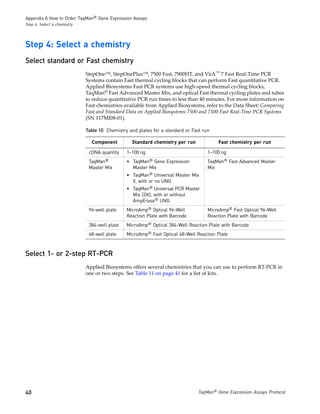
                  Step 4: Select a chemistry . . . . . . . . . . . . . . . . . . . . . . . . . . . . . . . . . . . . . . . . . . . . . . . . . . . . . . . 40
                       Select standard or Fast chemistry . . . . . . . . . . . . . . . . . . . . . . . . . . . . . . . . . . . . . . . . . . . . 40
                       Select 1- or 2-step RT-PCR . . . . . . . . . . . . . . . . . . . . . . . . . . . . . . . . . . . . . . . . . . . . . . . . . 40
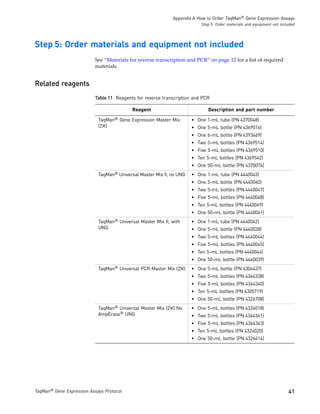
                  Step 5: Order materials and equipment not included . . . . . . . . . . . . . . . . . . . . . . . . . . . . . . . .                                   41
                       Related reagents . . . . . . . . . . . . . . . . . . . . . . . . . . . . . . . . . . . . . . . . . . . . . . . . . . . . . . . . . .            41
                       Reaction plates and accessories . . . . . . . . . . . . . . . . . . . . . . . . . . . . . . . . . . . . . . . . . . . . .                       42
                       Related gene expression assays and arrays products . . . . . . . . . . . . . . . . . . . . . . . . . . .                                        44


     APPENDIX B   Good PCR Practices . . . . . . . . . . . . . . . . . . . . . . . . . . . . . . . . . . . . . . . . 47
                  Prevent contamination and nonspecific amplification . . . . . . . . . . . . . . . . . . . . . . . . . . . . . . . . 47
                       AmpErase® UNG . . . . . . . . . . . . . . . . . . . . . . . . . . . . . . . . . . . . . . . . . . . . . . . . . . . . . . . . . . 47
                       PCR good laboratory practices . . . . . . . . . . . . . . . . . . . . . . . . . . . . . . . . . . . . . . . . . . . . . . 47


     APPENDIX C   Duplex Reactions . . . . . . . . . . . . . . . . . . . . . . . . . . . . . . . . . . . . . . . . . . 49
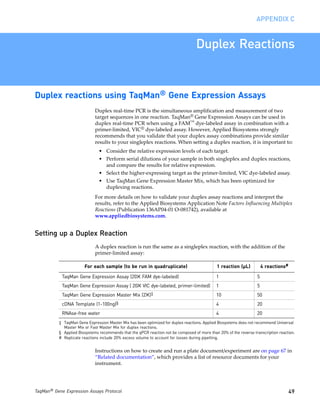
                  Duplex reactions using TaqMan® Gene Expression Assays . . . . . . . . . . . . . . . . . . . . . . . . . . . 49
                      Setting up a Duplex Reaction . . . . . . . . . . . . . . . . . . . . . . . . . . . . . . . . . . . . . . . . . . . . . . . . 49


     APPENDIX D   Background Information . . . . . . . . . . . . . . . . . . . . . . . . . . . . . . . . . . . . 51
                  About TaqMan® chemistry . . . . . . . . . . . . . . . . . . . . . . . . . . . . . . . . . . . . . . . . . . . . . . . . . . . . . . . 51
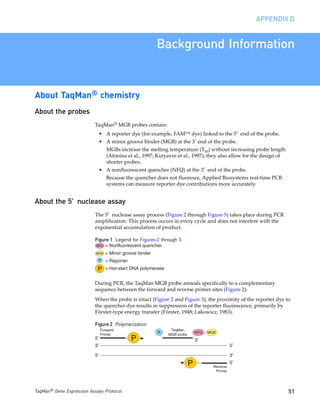
                      About the probes . . . . . . . . . . . . . . . . . . . . . . . . . . . . . . . . . . . . . . . . . . . . . . . . . . . . . . . . . . 51
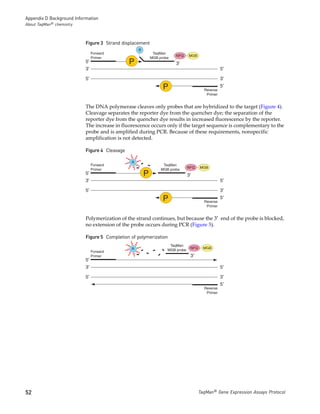
                      About the 5′ nuclease assay . . . . . . . . . . . . . . . . . . . . . . . . . . . . . . . . . . . . . . . . . . . . . . . . 51
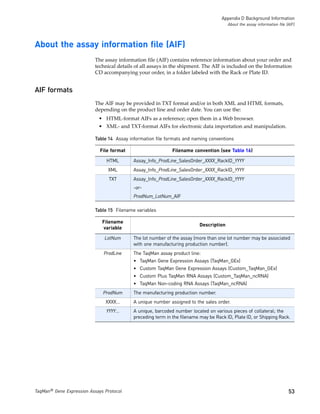
                  About the assay information file (AIF) . . . . . . . . . . . . . . . . . . . . . . . . . . . . . . . . . . . . . . . . . . . . . 53
                      AIF formats . . . . . . . . . . . . . . . . . . . . . . . . . . . . . . . . . . . . . . . . . . . . . . . . . . . . . . . . . . . . . . . 53
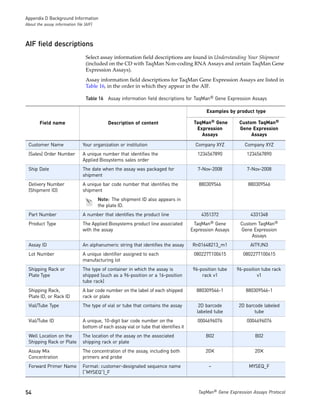
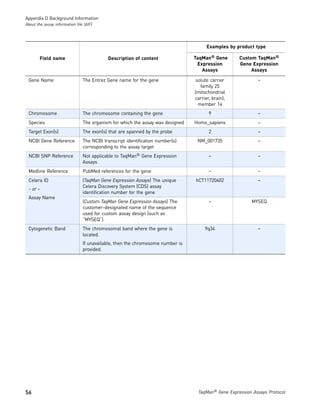
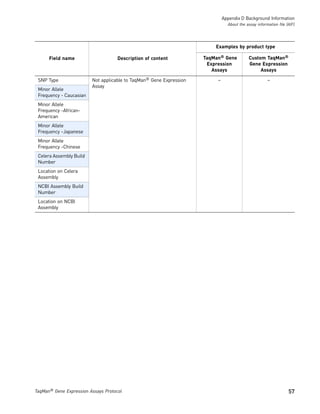
                      AIF field descriptions . . . . . . . . . . . . . . . . . . . . . . . . . . . . . . . . . . . . . . . . . . . . . . . . . . . . . . . 54


     APPENDIX E   Safety . . . . . . . . . . . . . . . . . . . . . . . . . . . . . . . . . . . . . . . . . . . . . . . . . . . . 59
                  Chemical safety . . . . . . . . . . . . . . . . . . . . . . . . . . . . . . . . . . . . . . . . . . . . . . . . . . . . . . . . . . . . . . . .      60
                      General chemical safety . . . . . . . . . . . . . . . . . . . . . . . . . . . . . . . . . . . . . . . . . . . . . . . . . . . .                  60
                      SDSs . . . . . . . . . . . . . . . . . . . . . . . . . . . . . . . . . . . . . . . . . . . . . . . . . . . . . . . . . . . . . . . . . . . . .   61
                      Chemical waste safety . . . . . . . . . . . . . . . . . . . . . . . . . . . . . . . . . . . . . . . . . . . . . . . . . . . . . .                61
                      Biological hazard safety . . . . . . . . . . . . . . . . . . . . . . . . . . . . . . . . . . . . . . . . . . . . . . . . . . . .                 63
                  General safety alerts for all chemicals . . . . . . . . . . . . . . . . . . . . . . . . . . . . . . . . . . . . . . . . . . . . 63

4                                                                                                      TaqMan® Gene Expression Assays Protocol
Contents


                           Bibliography . . . . . . . . . . . . . . . . . . . . . . . . . . . . . . . . . . . . . . . . . . . . . . 65

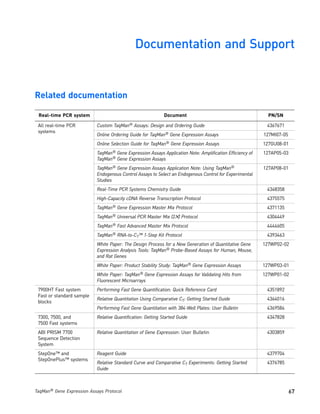
                           Documentation and Support . . . . . . . . . . . . . . . . . . . . . . . . . . . . . . . . 67
                           Related documentation . . . . . . . . . . . . . . . . . . . . . . . . . . . . . . . . . . . . . . . . . . . . . . . . . . . . . . . . . 67
                                Obtaining support . . . . . . . . . . . . . . . . . . . . . . . . . . . . . . . . . . . . . . . . . . . . . . . . . . . . . . . . . . 68


TaqMan® Gene Expression Assays Protocol                                                                                                                              5
Contents


6          TaqMan® Gene Expression Assays Protocol
About This Guide


Purpose
                           This TaqMan® Gene Expression Assays Protocol provides instructions for performing
                           real-time reverse transcription-PCR (real-time RT-PCR) using TaqMan Gene
                           Expression Assays and TaqMan Non-coding RNA Assays.


Safety information
                                 Note: For general safety information, see this section and Appendix E, “Safety”
                                 on page 59. When a hazard symbol and hazard type appear by an instrument
                                 hazard, see the “Safety” Appendix for the complete alert on the instrument.


Safety alert words
                           Four safety alert words appear in Applied Biosystems user documentation at points in
                           the document where you need to be aware of relevant hazards. Each alert word—
                           IMPORTANT, CAUTION, WARNING, DANGER—implies a particular level of
                           observation or action, as defined below:
                                 IMPORTANT! – Indicates information that is necessary for proper instrument
                                 operation, accurate chemistry kit use, or safe use of a chemical.


                                 CAUTION! – Indicates a potentially hazardous situation that, if not avoided,
                                 may result in minor or moderate injury. It may also be used to alert against
                                 unsafe practices.


                                 WARNING! – Indicates a potentially hazardous situation that, if not avoided,
                                 could result in death or serious injury.


                                 DANGER! – Indicates an imminently hazardous situation that, if not avoided,
                                 will result in death or serious injury. This signal word is to be limited to the most
                                 extreme situations.


TaqMan® Gene Expression Assays Protocol                                                                              7
About This Guide
Safety information


SDSs
                     The SDSs for any chemicals supplied by Applied Biosystems or Ambion are available
                     to you free 24 hours a day. For instructions on obtaining SDSs, see “SDSs” on page 61.
                           IMPORTANT! For the SDSs of chemicals not distributed by Applied Biosystems
                           or Ambion contact the chemical manufacturer.


8                                                                     TaqMan® Gene Expression Assays Protocol
PROTOCOL


                            TaqMan® Gene Expression Assays


Product information
Purpose of the product
                           Applied Biosystems offers comprehensive collections of predesigned, preformulated
                           primer and probe sets that help researchers perform quantitative gene expression
                           studies on a variety of species.
                            • TaqMan® Gene Expression Assays – Target protein-coding transcripts from a
                              variety of species, including human, mouse, rat, Arabidopsis, C. elegans, and
                              Drosophila. See Table 6 on page 33 for a complete list of species.
                            • TaqMan® Non-coding RNA Assays – Target long non-coding RNA (ncRNA) in
                              human, mouse, and rat species. These assays are designed to ncRNAs that are
                              >60 nt in length.
                           This protocol provides instructions for real-time reverse transcription-PCR (real-time
                           RT-PCR) using TaqMan Gene Expression Assays and TaqMan Non-coding RNA
                           Assays. Both assays are compatible with the same instruments and master mixes, and
                           real-time RT-PCR is performed using the same procedure. Unless explicitly stated
                           otherwise, the term “TaqMan Gene Expression Assays” is used throughout this guide
                           to mean either assay type.
                           For information about TaqMan assay reactions, refer to “About TaqMan® chemistry”
                           on page 51.


Assay formulations
                           TaqMan Gene Expression Assays are available as:
                            • Inventoried Assays – Predesigned real-time PCR assays that are previously
                              manufactured and immediately available at the time you submit an order.
                            • Made-to-Order Assays – Predesigned real-time PCR assays that are
                              manufactured at the time you submit an order.
                            • Custom Assays – Custom assays designed for you to target any sequence within
                              a gene, either across exon boundaries or within an exon. Submit a target sequence
                              for any organism and Applied Biosystems sends you a ready-to-use gene
                              expression assay with optimized primers and probe.
                            • TaqMan® Endogenous Controls – A collection of predesigned assays for
                              candidate control genes used to normalize for differences in sample RNA added
                              to a reaction. A number of candidate endogenous control genes are available for
                              use with TaqMan® Gene Expression Assays or TaqMan Non-coding RNA Assays.
                              For more information on selecting endogenous controls, see “Step 3: Order a
                              candidate endogenous control assay” on page 36.
                           TaqMan Non-coding RNA Assays are available as Made-to-Order Assays.


TaqMan® Gene Expression Assays Protocol                                                                         9
Product information


Kit contents
                      TaqMan Gene Expression Assays and TaqMan Non-coding RNA Assays include:
                       • One tube for each assay that is ordered. The tube contains:
                            – Two unlabeled primers (1✕ final concentration is 900 nM per primer;
                              20✕ stock concentration is 18 µM per primer)
                            – One 6-FAM™ dye-labeled TaqMan® MGB probe (1✕ final concentration is
                              250 nM; 20✕ stock concentration is 5 µM)
                            – (TaqMan Gene Expression Assays only) One 6-VIC® dye-labeled TaqMan
                              MGB probe (1X concentration is 250nM; 20X stock concentration is 5 µM);
                              also available as primer limited (1X final concentration is 150 nM per primer;
                              20X stock concentration is 3 µM per primer)
                                 Note: The assay ID that appears on the tube of each TaqMan® Gene
                                 Expression Assay is a unique, alphanumeric string that identifies the assay
                                 and encodes basic descriptive information. See “About TaqMan® Gene
                                 Expression Assay IDs” on page 33 for more information.
                       • A data sheet containing information about the assay.
                       • An Information CD that includes the following files:
                            – Assay information file (AIF)
                            – TaqMan® Gene Expression Assays Protocol (PN 4333458)
                            – TaqMan® Gene Expression Assays Quick Reference Card (PN 4401212)
                            – Understanding Your Shipment, included with TaqMan Non-coding RNA
                              Assays and certain TaqMan Gene Expression Assays

                      Table 1 TaqMan® Assay formulations

                             Product          Type     20-µL rxns.   Part number           Availability

                       TaqMan® Gene           Extra          75         4453320         Inventoried (20X)
                       Expression Assays      Small
                       (FAM™ dye-labeled
                                              Extra          75         4448892        Made-to-Order (20✕)
                       MGB probe)
                                              Small
                                              Small        250          4331182         Inventoried (20✕)
                                              Small        360          4351372        Made-to-Order (20✕)
                                             Medium        750          4351370
                                              Large        2900         4351368        Made-to-Order (60X)
                       TaqMan® Gene           Small        360          4448489        Made-to-Order (20✕)
                       Expression Assays
                                             Medium        750          4448490
                       (VIC® dye-labeled
                       MGB probe)             Large        2900         4448491        Made-to-Order (60✕)
                       TaqMan® Gene           Small        360          4448484        Made-to-Order (20✕)
                       Expression Assays
                                             Medium        750          4448485
                       Primer-Limited
                       (VIC® dye-labeled      Large        2900         4448486        Made-to-Order (60✕)
                       MGB probe)


10                                                                    TaqMan® Gene Expression Assays Protocol
Product information


                                   Product               Type       20-µL rxns.      Part number        Availability

                            TaqMan® Non-                 Small           360            4426961     Made-to-Order (20✕)
                            coding RNA Assay
                                                       Medium            750            4426962
                                                         Large          2900            4426963     Made-to-Order (60✕)
                            Custom Plus                  Small           360            4441114        Custom (20✕)
                            TaqMan® RNA Assay
                                                       Medium            750            4441117
                                                         Large          2900            4441118        Custom (60✕)
                            Custom TaqMan®               Small           360            4331348        Custom (20✕)
                            Gene Expression
                                                       Medium            750            4332078
                            Assays
                                                         Large          2900            4332079        Custom (60✕)
                            TaqMan®                      Small           125               –   ‡     Inventoried (20✕)
                            Endogenous
                                                       Medium            500
                            Controls (20✕):
                            • Non-primer                 Large          2500
                              limited, FAM™
                              dye-labeled MGB
                              probe
                            • Primer limited,
                              VIC® dye-labeled
                              MGB probe
                            • Primer limited,
                              VIC® dye-labeled
                              probe
                            • TAMRA™ dye-
                              quenched probe
                           ‡ See “Step 3: Order a candidate endogenous control assay” on page 36.


Ordering an assay          For details on how to order an assay, refer to the TaqMan® Gene Expression Assays
                           products page at www.allgenes.com or Appendix A, “How to Order TaqMan® Gene
                           Expression Assays” on page 31.


Storage and dilution
                            • Store TaqMan Gene Expression Assay and TaqMan Non-coding RNA Assay
                              products at –15 to –25 °C and keep them protected from light.
                            • To minimize freeze-thaw cycles, consider diluting 60✕ assays to 20✕ working
                              stocks and dividing the solutions into smaller aliquots.


TaqMan® Gene Expression Assays Protocol                                                                                  11
Materials and equipment not included


Materials and equipment not included
Endogenous control assay(s)
                               TaqMan® Endogenous Controls are a collection of predesigned assays for candidate
                               control genes, used to normalize for differences in sample RNA added to a reaction.
                               For a list of endogenous control assays, refer to “Step 3: Order a candidate endogenous
                               control assay” on page 36. For more information on selecting an endogenous control,
                               refer to the Application Note: Using TaqMan® Endogenous Control Assays to Select an
                               Endogenous Control for Experimental Studies (Stock Number 127AP08-01), available at:
                                       www.appliedbiosystems.com


Materials for reverse transcription and PCR
                               Obtain the following materials for the reverse transcription and PCR (see “Step 5:
                               Order materials and equipment not included” on page 41 for a complete list of
                               materials). Unless otherwise indicated, all materials are available from major
                               laboratory suppliers (MLS).

                               Table 2 Required materials and equipment

                                  ✔                             Material                                  Source

                                        Reverse transcription reagents                               Applied Biosystems
                                                                                                  (See Table 11 on page 41)
                                        PCR reagents
                                        Thermal cycler (or real-time PCR instrument)                 Applied Biosystems
                                        Real-time PCR instrument
                                        Reaction plates and accessories for your real-time PCR       Applied Biosystems
                                        instrument                                                (See Table 12 on page 42)
                                        Centrifuge (with plate adapter)                                     MLS
                                        Disposable gloves                                                   MLS
                                        Microcentrifuge                                                     MLS
                                        Pipette tips, aerosol-resistant                                     MLS
                                        Pipettors (positive/air-displacement or multichannel)               MLS
                                        Polypropylene tubes (various sizes)                                 MLS
                                        Vortexer                                                            MLS
                                        Nuclease-free water (no diethyl pyrocarbonate [DEPC])               MLS


12                                                                                   TaqMan® Gene Expression Assays Protocol
Materials and equipment not included


Compatible real-time instruments
                           TaqMan Gene Expression Assays and TaqMan Non-coding RNA Assays can be used
                           with the Applied Biosystems:
                            • 7300 Real-Time PCR System
                            • 7500 Real-Time PCR System
                            • 7500 Fast Real-Time PCR System
                            • 7900HT Real-Time PCR System
                            • StepOne™ Real-Time PCR System
                            • StepOnePlus™ Real-Time PCR System
                            •   ViiA™ 7 Real-Time PCR System


TaqMan® Gene Expression Assays Protocol                                                                     13
Workflow


Workflow

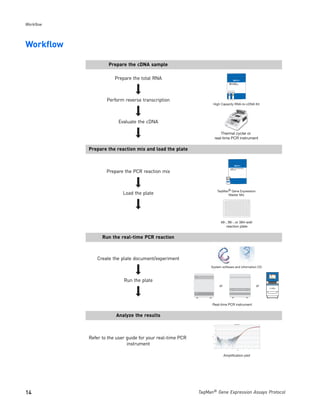
                    Prepare the cDNA sample

                       Prepare the total RNA


                   Perform reverse transcription
                                                                  High Capacity RNA-to-cDNA Kit


                        Evaluate the cDNA                                            GeneAm
                                                                                            p
                                                                                   PCR System ®
                                                                                              9700


                                                                       Thermal cycler or
                                                                   real-time PCR instrument

           Prepare the reaction mix and load the plate


                   Prepare the PCR reaction mix


                                                                     TaqMan® Gene Expression
                           Load the plate                                  Master Mix
                                                                               1   2                 3   4   5   6   7   8   9   10   11   12
                                                                           A

                                                                           B

                                                                           C

                                                                           D

                                                                           E

                                                                           F

                                                                           G

                                                                           H


                                                                       48-, 96-, or 384-well
                                                                           reaction plate


                 Run the real-time PCR reaction


              Create the plate document/experiment
                                                                 System software and information CD


                           Run the plate
                                                                      or                                                                        or


                                                                  Real-time PCR instrument


                       Analyze the results


           Refer to the user guide for your real-time PCR
                             instrument

                                                                           Amplification plot


14                                                          TaqMan® Gene Expression Assays Protocol
Prepare the cDNA sample


Prepare the cDNA sample
Isolate total RNA
                           Before running the TaqMan Gene Expression Assays, isolate total RNA to use as a
                           template for synthesis of single-stranded cDNA. For optimal performance, Applied
                           Biosystems recommends using an Ambion® RNA isolation kit. Go to
                           www4.appliedbiosystems.com, select RNA Isolation Which RNA Isolation Kit to
                           Choose? to view a list of kits.
                           Applied Biosystems recommends using total RNA that is:
                            • Between 0.002 and 0.2 µg/µL
                            • Less than 0.005% of genomic DNA by weight
                                      IMPORTANT! Assays designed to a single exon (assay IDs with _s and _g
                                      suffixes) will detect genomic DNA. When using these types of assays, if
                                      your RNA purification method does not include DNase treatment, treat the
                                      purified RNA with the Ambion® TURBO DNA-free™ Kit (recommended;
                                      PN AM1907) using the standard protocol.
                            • Dissolved in a PCR-compatible buffer
                            • Free of RNase activity
                            • Free of inhibitors of reverse transcription and PCR
                            • Nondenatured
                                      IMPORTANT! Denaturation of the RNA is not necessary and may reduce
                                      the yield of cDNA for some gene targets.


Perform reverse transcription
                           Applied Biosystems recommends using one of the following kits to obtain cDNA from
                           RNA samples.
                            • High Capacity RNA-to-cDNA Kit (PN 4387406)
                            • High Capacity cDNA Reverse Transcription Kit (PN 4368813, 4374966)
                                 Note: Use the same reverse transcription procedure for all samples in an
                                 experimental study. See Table 11 on page 41 for a list of compatible reverse
                                 transcription kits.


Evaluate the cDNA
                           Applied Biosystems recommends that you use:
                            • 1 to 100 ng of cDNA per 20-µL amplification reaction (PCR)
                            • The same amount of cDNA in each reaction


TaqMan® Gene Expression Assays Protocol                                                                         15
Prepare the reaction mix and load the plate


DNA quantitation                Applied Biosystems recommends that you use:
methods                            •    TaqMan® RNase P Detection Reagents (recommended; PN 4316831). These
                                       reagents enable quantitation of cDNA that is able to function as a template in
                                       PCR. Refer to Creating Standard Curves with Genomic DNA or Plasmid DNA
                                       Templates for Use in Quantitative PCR (search for PN 4371090 at
                                       www.appliedbiosystems.com).
                                       or
                                   • UV absorbance (A260/A280) measurements.


(Optional) Store the cDNA
                                If you do not proceed immediately to PCR amplification, store all cDNA samples at
                                −15 to −25 °C. To minimize freeze-thaw cycles, store the cDNA in smaller aliquots.


Prepare the reaction mix and load the plate
Thaw and mix the reagents
                                  1. Thaw on ice, completely resuspend by gently vortexing, then briefly centrifuge to
                                       bring liquid to the bottom of the tube:
                                         • TaqMan Gene Expression Assays (20✕)
                                         • cDNA samples

                                  2. Mix the master mix reagent by gently swirling the bottle (see Table 11 on page 41
                                       for a list of compatible master mixes available from Applied Biosystems).


Calculate the number of reactions
                                Calculate the number of reactions that you need for each assay. Applied Biosystems
                                recommends performing four replicates of each reaction. Be sure to include on each
                                plate:
                                   • A TaqMan Gene Expression Assay for each cDNA sample
                                   • Endogenous control assays
                                   • (Optional) No template controls (NTCs) for each gene expression assay on the
                                     plate


16                                                                                 TaqMan® Gene Expression Assays Protocol
Prepare the reaction mix and load the plate


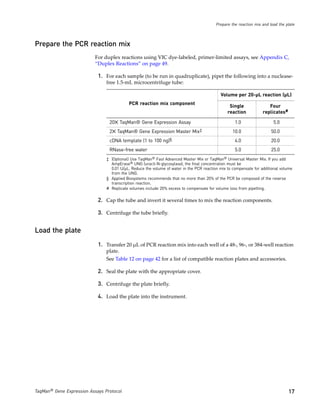
Prepare the PCR reaction mix
                           For duplex reactions using VIC dye-labeled, primer-limited assays, see Appendix C,
                           “Duplex Reactions” on page 49.

                            1. For each sample (to be run in quadruplicate), pipet the following into a nuclease-
                                free 1.5-mL microcentrifuge tube:

                                                                                            Volume per 20-µL reaction (µL)
                                            PCR reaction mix component
                                                                                                 Single               Four
                                                                                                reaction           replicates#

                                 20✕ TaqMan® Gene Expression Assay                                  1.0                  5.0
                                 2✕ TaqMan® Gene Expression Master           Mix‡                  10.0                 50.0
                                 cDNA template (1 to 100 ng)§                                       4.0                 20.0
                                 RNase-free water                                                   5.0                 25.0
                                ‡ (Optional) Use TaqMan® Fast Advanced Master Mix or TaqMan® Universal Master Mix. If you add
                                  AmpErase® UNG (uracil-N-glycosylase), the final concentration must be
                                  0.01 U/µL. Reduce the volume of water in the PCR reaction mix to compensate for additional volume
                                  from the UNG.
                                § Applied Biosystems recommends that no more than 20% of the PCR be composed of the reverse
                                  transcription reaction.
                                # Replicate volumes include 20% excess to compensate for volume loss from pipetting.

                            2. Cap the tube and invert it several times to mix the reaction components.

                            3. Centrifuge the tube briefly.


Load the plate
                            1. Transfer 20 µL of PCR reaction mix into each well of a 48-, 96-, or 384-well reaction
                                plate.
                                See Table 12 on page 42 for a list of compatible reaction plates and accessories.

                            2. Seal the plate with the appropriate cover.

                            3. Centrifuge the plate briefly.

                            4. Load the plate into the instrument.


TaqMan® Gene Expression Assays Protocol                                                                                          17
Run the real-time PCR reaction


Run the real-time PCR reaction
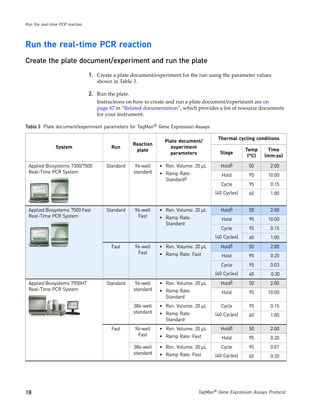
Create the plate document/experiment and run the plate
                                 1. Create a plate document/experiment for the run using the parameter values
                                    shown in Table 3.

                                 2. Run the plate.
                                    Instructions on how to create and run a plate document/experiment are on
                                    page 67 in “Related documentation”, which provides a list of resource documents
                                    for your instrument.

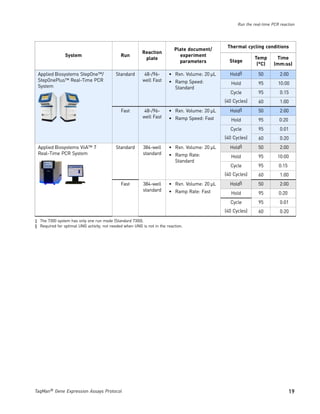
Table 3 Plate document/experiment parameters for TaqMan® Gene Expression Assays

                                                                                        Thermal cycling conditions
                                                                  Plate document/
                                                     Reaction
                System                    Run                       experiment
                                                      plate                                          Temp     Time
                                                                    parameters           Stage
                                                                                                      (°C)   (mm:ss)

 Applied Biosystems 7300/7500           Standard      96-well   • Rxn. Volume: 20 µL      Hold§       50        2:00
 Real-Time PCR System                                standard   • Ramp Rate:              Hold        95       10:00
                                                                  Standard‡
                                                                                          Cycle       95        0:15
                                                                                       (40 Cycles)    60        1:00


 Applied Biosystems 7500 Fast           Standard     96-well    • Rxn. Volume: 20 µL      Hold§       50        2:00
 Real-Time PCR System                                 Fast      • Ramp Rate:              Hold        95       10:00
                                                                  Standard
                                                                                          Cycle       95        0:15
                                                                                       (40 Cycles)    60        1:00
                                          Fast       96-well    • Rxn. Volume: 20 µL      Hold§       50        2:00
                                                      Fast      • Ramp Rate: Fast         Hold        95        0:20
                                                                                          Cycle       95        0:03
                                                                                       (40 Cycles)    60        0:30
 Applied Biosystems 7900HT              Standard      96-well   • Rxn. Volume: 20 µL      Hold§       50        2:00
 Real-Time PCR System                                standard   • Ramp Rate:              Hold        95       10:00
                                                                  Standard
                                                     384-well   • Rxn. Volume: 20 µL      Cycle       95        0:15
                                                     standard   • Ramp Rate:           (40 Cycles)    60        1:00
                                                                  Standard
                                          Fast       96-well    • Rxn. Volume: 20 µL      Hold§       50        2:00
                                                      Fast      • Ramp Rate: Fast         Hold        95        0:20
                                                     384-well   • Rxn. Volume: 20 µL      Cycle       95        0:01
                                                     standard   • Ramp Rate: Fast      (40 Cycles)    60        0:20


18                                                                              TaqMan® Gene Expression Assays Protocol
Run the real-time PCR reaction


                                                                                                Thermal cycling conditions
                                                                           Plate document/
                                                          Reaction
                System                        Run                            experiment
                                                           plate                                             Temp        Time
                                                                             parameters          Stage
                                                                                                              (°C)      (mm:ss)

 Applied Biosystems StepOne™/              Standard        48-/96-      • Rxn. Volume: 20 µL     Hold§         50          2:00
 StepOnePlus™ Real-Time PCR                               well Fast     • Ramp Speed:             Hold         95         10:00
 System                                                                   Standard
                                                                                                 Cycle         95          0:15
                                                                                               (40 Cycles)     60          1:00
                                              Fast         48-/96-      • Rxn. Volume: 20 µL     Hold§         50          2:00
                                                          well Fast     • Ramp Speed: Fast        Hold         95         0:20
                                                                                                 Cycle         95          0:01
                                                                                               (40 Cycles)     60          0:20
 Applied Biosystems ViiA™ 7                Standard       384-well      • Rxn. Volume: 20 µL     Hold§         50          2:00
 Real-Time PCR System                                     standard      • Ramp Rate:              Hold         95        10:00
                                                                          Standard
                                                                                                 Cycle         95         0:15
                                                                                               (40 Cycles)     60          1:00
                                              Fast        384-well      • Rxn. Volume: 20 µL     Hold§         50          2:00
                                                          standard      • Ramp Rate: Fast         Hold         95         0:20
                                                                                                 Cycle         95          0:01
                                                                                               (40 Cycles)     60          0:20
‡ The 7300 system has only one run mode (Standard 7300).
§ Required for optimal UNG activity; not needed when UNG is not in the reaction.


TaqMan® Gene Expression Assays Protocol                                                                                          19
Analyze the results


Analyze the results
                      Analyzing the data from TaqMan Gene Expression Assays requires you to:
                       • View the amplification plots for the entire plate.
                       • Set the baseline and threshold values.
                       • Use the relative standard curve or the comparative CT method to analyze your
                         data.


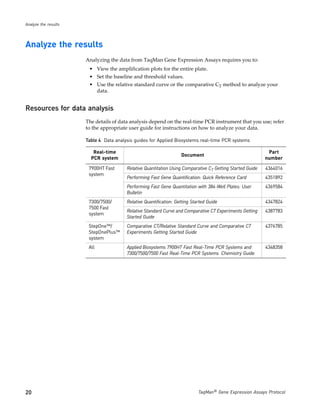
Resources for data analysis
                      The details of data analysis depend on the real-time PCR instrument that you use; refer
                      to the appropriate user guide for instructions on how to analyze your data.

                      Table 4 Data analysis guides for Applied Biosystems real-time PCR systems

                         Real-time                                                                          Part
                                                                   Document
                        PCR system                                                                         number

                       7900HT Fast      Relative Quantitation Using Comparative CT Getting Started Guide   4364016
                       system
                                        Performing Fast Gene Quantification: Quick Reference Card          4351892
                                        Performing Fast Gene Quantitation with 384-Well Plates: User       4369584
                                        Bulletin
                       7300/7500/       Relative Quantification: Getting Started Guide                     4347824
                       7500 Fast
                                        Relative Standard Curve and Comparative CT Experiments Getting     4387783
                       system
                                        Started Guide
                       StepOne™/        Comparative CT/Relative Standard Curve and Comparative CT          4376785
                       StepOnePlus™     Experiments Getting Started Guide
                       system
                       All              Applied Biosystems 7900HT Fast Real-Time PCR Systems and           4348358
                                        7300/7500/7500 Fast Real-Time PCR Systems Chemistry Guide


20                                                                          TaqMan® Gene Expression Assays Protocol
Analyze the results


Tools for data analysis
                           Applied Biosystems recommends the following software for analyzing data generated
                           using TaqMan® Gene Expression Assays.

DataAssist™                DataAssist™ Software is a simple, yet powerful data analysis tool for sample
Software                   comparison when using the comparative CT (ΔΔCT) method for calculating relative
                           quantitation of gene expression. It contains a filtering procedure for outlier removal,
                           various normalization methods based on single or multiple genes, and provides
                           relative quantification analysis of gene expression through a combination of statistical
                           analysis and interactive visualization.
                           DataAssist™ Software is free and can be downloaded from:
                                www.appliedbiosystems.com/dataassist

RealTime                   RealTime StatMiner® Software from Integromics is a software analysis package for
StatMiner®                 qPCR experiments that is compatible with all Applied Biosystems instruments.
Software                   RealTime StatMiner® Software uses a step-by-step analysis workflow guide that
                           includes parametric, non-parametric, and paired tests for relative quantification of
                           gene expression, as well as 2-way ANOVA for two-factor differential expression
                           analysis.
                           For more information, visit:
                                www.integromics.com/StatMiner


TaqMan® Gene Expression Assays Protocol                                                                            21
Troubleshooting


Troubleshooting

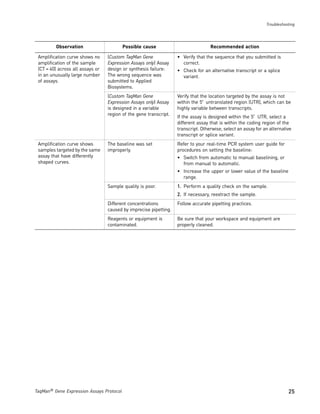
                               Observation                                                                         Possible cause                                                      Recommended action

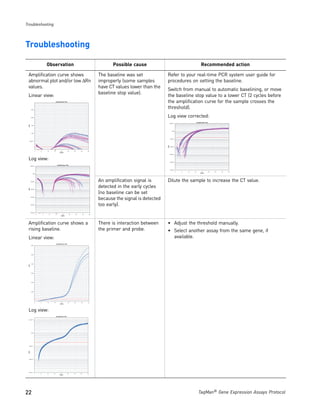
 Amplification curve shows                                                                                  The baseline was set             Refer to your real-time PCR system user guide for
 abnormal plot and/or low ΔRn                                                                               improperly (some samples         procedures on setting the baseline.
 values.                                                                                                    have CT values lower than the
                                                                                                                                             Switch from manual to automatic baselining, or move
                                                                                                            baseline stop value).
 Linear view:                                                                                                                                the baseline stop value to a lower CT (2 cycles before
                                              Amplification Plot                                                                             the amplification curve for the sample crosses the
       2.500
                                                                                                                                             threshold).
       2.000                                                                                                                                 Log view corrected:
                                                                                                                                                                                Amplification Plot
                                                                                                                                              1.000 E+1
 Rn


       1.500


                                                                                                                                                     1.000

       1.000


                                                                                                                                                  1.000 E-1

  5.000 E1


                                                                                                                                             Rn
                                                                                                                                                  1.000 E-2


               0       5       10        15              20         25        30        35        40
                                                       Cycle
                                                                                                                                                  1.000 E-3


 Log view:                                                                                                                                        1.000 E-4

                                                   Amplification Plot
   1.000 E+1


                                                                                                                                                  1.000 E-5
                                                                                                                                                              0   5   10   15           20           25   30   35   40
                                                                                                                                                                                      Cycle
         1.000


      1.000 E-1                                                                                             An amplification signal is       Dilute the sample to increase the CT value.
                                                                                                            detected in the early cycles
 Rn


      1.000 E-2


                                                                                                            (no baseline can be set
      1.000 E-3

                                                                                                            because the signal is detected
      1.000 E-4
                                                                                                            too early).
      1.000 E-5
                   0       5        10        15              20         25        30        35        40
                                                         Cycle


 Amplification curve shows a                                                                                There is interaction between     • Adjust the threshold manually.
 rising baseline.                                                                                           the primer and probe.            • Select another assay from the same gene, if
 Linear view:                                                                                                                                  available.
                                               Amplification Plot
      1.000


      1.000


      1.000
 Rn


      1.000


      1.000


      1.000


               0       5       10        15              20         25        30        35         40
                                                       Cycle


 Log view:
                                              Amplification Plot

 1.000 E+1


      1.000


 1.000 E-1
 Rn


 1.000 E-2


 1.000 E-3
               0       5       10        15             20          25        30        35        40
                                                      Cycle


22                                                                                                                                                                                 TaqMan® Gene Expression Assays Protocol
Troubleshooting


         Observation                      Possible cause                          Recommended action

 Amplification curve shows      (Custom TaqMan Gene              Perform bioinformatics analysis. For more information,
 weak amplification.            Expression Assays only)          refer to the:
                                Sequence provided for the        • Bioinformatic Evaluation of a Sequence for Custom
                                assay design contains              TaqMan® Gene Expression Assays Tutorial
                                mismatches with sample             (PN 4371002).
                                sequences.
                                                                 • Custom TaqMan® Assays Design and Ordering Guide
                                                                   (PN 4367671).
                                Reagents and/or probe are        • Check the expiration date of the reagents.
                                degraded reagents.               • Verify that you follow the correct handling and
                                                                   storage conditions.
                                                                 • Avoid excessive freeze-thaw cycles. (Consider
                                                                   diluting the 60✕ TaqMan® Gene Expression Assay
                                                                   to a 20✕ working stock.)
                                Template is contaminated or      • Improve the sample integrity (extraction methods).
                                degraded.                          See “Prepare the cDNA sample” on page 15.
                                                                 • Check each template preparation by agarose gel
                                                                   electrophoresis or bioanalyzer to determine the:
                                                                   – Purity (only one product should be formed)
                                                                    – Level of degradation
                                                                 • Use RNase-free, sterile, filtered water.
                                Inhibitors are present in the    Verify the presence of an inhibitor:
                                reaction.
                                                                 1. Create a serial dilution of your sample.
                                                                 2. Run the serial dilution with an assay for an
                                                                    expressed gene (for example, an endogenous
                                                                    control). If an inhibitor is present, low concentrations
                                                                    yield higher-than-expected CT values. (High
                                                                    concentration means more inhibition because the
                                                                    sample is not diluted.)
                                                                 3. Rerun the assay with purified template.
                                                                 4. Improve the sample integrity (extraction methods).
                                                                    See “Prepare the cDNA sample” on page 15.
                                The reverse transcription (RT)   • Check the RNA sample for degradation.
                                conversion to cDNA is poor.      • Input RNA could be too concentrated or too dilute.
                                                                   Verify the concentration by optical density (OD),
                                                                   make new serial dilutions of template RNA from the
                                                                   original stock, then repeat the RT-PCR.
                                                                 • Ensure that the RT-PCR setup is performed under
                                                                   the appropriate conditions to avoid premature cDNA
                                                                   synthesis.
                                                                 • Check the RT reagents for contamination and/or
                                                                   degradation.
                                Primer-dimer formation and       (Fast chemistry only) For optimal results, run the
                                residual polymerase activity     reaction plate as soon as possible after completing the
                                occurs.                          reaction setup. If you cannot run a reaction plate within
                                                                 2 hours after completing the reaction setup, refrigerate
                                                                 or freeze the reaction plate until you can run it.


TaqMan® Gene Expression Assays Protocol                                                                                   23
Troubleshooting


           Observation                   Possible cause                             Recommended action

 Amplification curve shows low    Inaccurate pipetting: Little or   Follow accurate pipetting practices.
 ROX™ dye (passive reference      no TaqMan® Universal PCR
 dye).                            Master Mix is present.
 Amplification curve shows no     One or more of the reaction       Verify that the cDNA, TaqMan Gene Expression Assays,
 amplification of the sample      components was not added.         and TaqMan® Gene Expression Master Mix were added
 (CT = 40) across all assays or                                     to the reaction plate. (If the master mix is missing, the
 in an unusually large number                                       passive reference fails.)
 of assays.
                                  Incorrect dye components          Check the dye components settings and reanalyze the
                                  were selected.                    data.
                                  The annealing temperature on      Verify that the thermal cycler is set to the correct
                                  the thermal cycler was too        annealing and extension temperatures. Ensure that the
                                  high for the primers and/or       thermal cycler is calibrated and maintained regularly.
                                  probe.
                                  Inappropriate reaction            Troubleshoot the RT-PCR optimization.
                                  conditions were used.
                                  The template is degraded.         • Determine the quality of the template.
                                                                    • Rerun the assay with fresh template.
                                                                    • Use RNase-free reagents.
                                                                    • Use an RNase inhibitor.
                                  Inhibitors are present in the     Verify the presence of an inhibitor:
                                  reaction.
                                                                    1. Create a serial dilution of your sample.
                                                                    2. Run the serial dilution with an expressing assay (for
                                                                       example, an endogenous control). If an inhibitor is
                                                                       present, low concentrations yield higher-than-
                                                                       expected CT values. (High concentration means
                                                                       more inhibition because the sample is not diluted.)
                                                                    3. Rerun the assay with purified template.
                                  The baseline and/or threshold     Refer to your real-time PCR system user guide for
                                  was improperly set.               procedures on setting the baseline and threshold:
                                                                    • Switch from automatic to manual baselining, or
                                                                      from manual to automatic.
                                                                    • Lower the threshold value to within the appropriate
                                                                      range.
                                  cDNA conversion failed.           • Check the RNA integrity and concentration.
                                                                    • Check for RNase activity.
                                                                    • Follow Applied Biosystems recommended thermal
                                                                      profile.
                                                                    • Repeat the RT step using new reagents.


24                                                                                 TaqMan® Gene Expression Assays Protocol
Troubleshooting


         Observation                      Possible cause                           Recommended action

 Amplification curve shows no     (Custom TaqMan Gene              • Verify that the sequence that you submitted is
 amplification of the sample      Expression Assays only) Assay      correct.
 (CT = 40) across all assays or   design or synthesis failure:     • Check for an alternative transcript or a splice
 in an unusually large number     The wrong sequence was             variant.
 of assays.                       submitted to Applied
                                  Biosystems.
                                  (Custom TaqMan Gene              Verify that the location targeted by the assay is not
                                  Expression Assays only) Assay    within the 5′ untranslated region (UTR), which can be
                                  is designed in a variable        highly variable between transcripts.
                                  region of the gene transcript.
                                                                   If the assay is designed within the 5′ UTR, select a
                                                                   different assay that is within the coding region of the
                                                                   transcript. Otherwise, select an assay for an alternative
                                                                   transcript or splice variant.
 Amplification curve shows        The baseline was set             Refer to your real-time PCR system user guide for
 samples targeted by the same     improperly.                      procedures on setting the baseline:
 assay that have differently                                       • Switch from automatic to manual baselining, or
 shaped curves.                                                      from manual to automatic.
                                                                   • Increase the upper or lower value of the baseline
                                                                     range.
                                  Sample quality is poor.          1. Perform a quality check on the sample.
                                                                   2. If necessary, reextract the sample.
                                  Different concentrations         Follow accurate pipetting practices.
                                  caused by imprecise pipetting.
                                  Reagents or equipment is         Be sure that your workspace and equipment are
                                  contaminated.                    properly cleaned.


TaqMan® Gene Expression Assays Protocol                                                                                   25
Troubleshooting


           Observation                   Possible cause                           Recommended action

 Amplification curve shows no      The gene is not expressed in   • Verify the known expression of the gene in the
 amplification of the sample       the tested sample.               sample type.
 (CT = 40) in the target assay.                                   • Verify by:
                                                                    – Rerunning the sample using the same assay.
                                                                     – Rerunning the assay using more sample. Avoid
                                                                       preparing the PCR reaction mix with more than
                                                                       20% from the reverse transcription reaction.
                                                                     – (TaqMan Gene Expression Assays only) Running the
                                                                       sample using an alternative assay, if available,
                                                                       that detects a different transcript or more than
                                                                       one transcript from the same gene.
                                                                         Note: If the recommended actions do not
                                                                         resolve the problem, the result may be correct.
                                   The sample may not have        Verify by:
                                   enough copies of the target    • Rerunning the sample using the same assay.
                                   RNA.
                                                                  • Rerunning the assay using more sample. Avoid
                                                                    preparing the PCR reaction mix with more than 20%
                                                                    from the reverse transcription reaction.
                                                                         Note: If the recommended actions do not
                                                                         resolve the problem, the result may be correct.
                                   One or more of the reaction    Check your pipetting equipment and/or technique.
                                   components was not added.
                                   Incorrect dye components       Check the settings of the dye components before data
                                   were selected.                 analysis.
 Decrease in ROX™ dye              Precipitation in the TaqMan®   • When using the TaqMan® PCR Core Reagents Kit,
 fluorescence (passive             buffers occurs.                  be sure to mix the tubes well.
 reference dye).                                                  • Use TaqMan® Gene Expression Master Mix (2✕). Be
                                                                    sure to mix thoroughly to produce a homogenous
                                                                    solution.
                                   Reagents are degraded.         Verify that kits and reagents have been stored
                                                                  according to the instructions on the packaging and that
                                                                  they have not expired.
 Simultaneous increase in          The sample evaporated.         Check the seal of the optical adhesive cover for leaks.
 fluorescence from both the:
 • Passive reference (ROX™)
   dye
 • Reporter dye(s)
 Multicomponent signal for         Pure dye components spectra    Rerun the pure dye spectra.
 ROX™ dye is not linear.           are incorrect.
                                   Incorrect dye components       Select the correct dyes for the data analysis.
                                   were selected.
 Rn on Rn-vs.-Cycle plot is very   ROX™ dye was not selected as   Select the ROX™ dye as the passive reference, then
 high.                             the passive reference when     reanalyze the data.
                                   the plate document/
                                   experiment was set up.


26                                                                              TaqMan® Gene Expression Assays Protocol
Troubleshooting


         Observation                      Possible cause                           Recommended action

 No template control (NTC)        Contaminated reagents             • Rerun the assay using new reagents.
 shows amplification.             (contaminated with gDNA,          • Be sure your workspace and equipment are cleaned
                                  amplicon, or plasmid clones).       properly.
                                                                    • Use UNG.
                                                                    • Run no-reverse-transcription controls to rule out
                                                                      genomic DNA contamination.
                                                                    • Treat the sample with DNase.
                                                                    • (gDNA contamination only; TaqMan Gene Expression
                                                                      Assays only) Design an assay that spans an exon-
                                                                      exon boundary.
                                  (TaqMan Gene Expression           Use AmpliTaq Gold® LD DNA Polymerase.
                                  Assays only) Bacterial
                                  sequences used as template.
 The endogenous control CTs       Endogenous control is not         Refer to the Application Note: Using TaqMan®
 vary, or do not normalize the    consistently expressed across     Endogenous Control Assays to Select an Endogenous
 sample well.                     the samples.                      Control for Experimental Studies (127AP08-01) for
                                                                    information on selecting an endogenous control.
                                  Sample concentrations vary        If desired, quantitate and normalize samples before
                                  widely.                           running them.
                                  Pipetting was inaccurate.         • Check the calibration of the pipettes.
                                                                    • Pipet more than 5 µL of sample.
 High standard deviation of       Inefficient mixing of reagents.   • Increase the length of time that you mix the
 replicates (inconsistent data,                                       reagents.
 CT varies).                                                        • Validate your mixing process by running a replicate
                                                                      plate.
                                  Pipetting was inaccurate.         • Check the calibration of the pipettes.
                                                                    • Pipette more than 5 µL of sample.
                                  Threshold was set improperly.     Set the threshold above the noise and where the
                                                                    replicates are tightest. Refer to your real-time PCR
                                                                    system user documentation for procedures on setting
                                                                    the threshold.
                                  Low concentration of target.      Rerun the assay using more template.
                                  Template absorption occurred      Add a carrier (for example, yeast tRNA).
                                  (adhering to the tube).


TaqMan® Gene Expression Assays Protocol                                                                                   27
Troubleshooting


           Observation                 Possible cause                             Recommended action

 CT value is lower than         gDNA contamination                • Verify contamination by running an RT-minus
 expected.                      occurred.                           reaction (without the reverse transcriptase).
                                                                  • Treat the sample with DNase.
                                                                  • (TaqMan Gene Expression Assays only) Perform
                                                                    bioinformatics analysis: design a custom assay to
                                                                    span an exon-exon junction. For more information,
                                                                    refer to the:
                                                                    – Bioinformatic Evaluation of a Sequence for Custom
                                                                       TaqMan® Gene Expression Assays Tutorial
                                                                       (PN 4371002).
                                                                     – Custom TaqMan® Assays: Design and Ordering
                                                                       Guide (PN 4367671).
                                More sample added than            • Reduce the amount of sample.
                                expected.                         • Quantitate and adjust the concentration of the
                                                                    sample.
                                Template or amplicon is           Follow established PCR good laboratory practices.
                                contaminated.
 Amplification occurs in the    gDNA contamination                • Improve sample extraction methods to eliminate
 no-RT controls.                occurred.                           gDNA. See “Isolate total RNA” on page 15.
                                                                  • Treat the sample with DNase.
                                                                  • (TaqMan Gene Expression Assays only) Perform
                                                                    bioinformatics analysis: design a custom assay to
                                                                    span an exon-exon junction. For more information,
                                                                    refer to the:
                                                                    – Bioinformatic Evaluation of a Sequence for Custom
                                                                       TaqMan® Gene Expression Assays Tutorial
                                                                       (PN 4371002).
                                                                     – Custom TaqMan® Assays: Design and Ordering
                                                                       Guide (PN 4367671).
                                Template or amplicon is           Follow established PCR good laboratory practices.
                                contaminated.
 Shifting Rn value during the   Fluorescence did not stabilize    • Reset the lower value of the baseline range.
 early cycles of the PCR        to the buffer conditions of the   • Use automatic baselining.
 (cycles 0 to 5).               reaction mix.
                                       Note: This condition
                                       does not affect PCR or
                                       the final results.
 Small ΔRn.                     PCR efficiency is poor.           Recheck the concentration of the reagents.
                                Quantity of starting target is    Increase the quantity of the starting target.
                                low (low copy number of
                                target).


28                                                                               TaqMan® Gene Expression Assays Protocol
Troubleshooting


         Observation                      Possible cause                      Recommended action

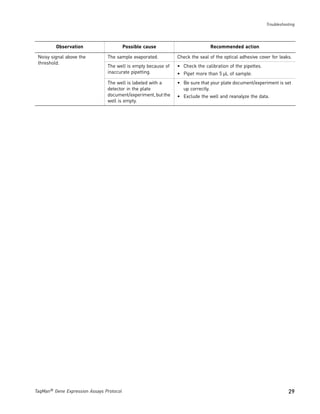
 Noisy signal above the         The sample evaporated.         Check the seal of the optical adhesive cover for leaks.
 threshold.
                                The well is empty because of   • Check the calibration of the pipettes.
                                inaccurate pipetting.          • Pipet more than 5 µL of sample.
                                The well is labeled with a     • Be sure that your plate document/experiment is set
                                detector in the plate            up correctly.
                                document/experiment, but the   • Exclude the well and reanalyze the data.
                                well is empty.


TaqMan® Gene Expression Assays Protocol                                                                              29
Troubleshooting


30                TaqMan® Gene Expression Assays Protocol
APPENDIX A


            How to Order TaqMan® Gene Expression
                                         Assays

                           To order TaqMan® Gene Expression Assays, follow these steps:
                            ■   Step 1: Search for an assay. . . . . . . . . . . . . . . . . . . . . . . . . . . . . . . . . . . . . . . . . . . . . . 32
                            ■   Step 2: Order the assay. . . . . . . . . . . . . . . . . . . . . . . . . . . . . . . . . . . . . . . . . . . . . . . . . 35
                            ■   Step 3: Order a candidate endogenous control assay . . . . . . . . . . . . . . . . . . . . . . . 36
                            ■   Step 4: Select a chemistry. . . . . . . . . . . . . . . . . . . . . . . . . . . . . . . . . . . . . . . . . . . . . . . 40
                            ■   Step 5: Order materials and equipment not included. . . . . . . . . . . . . . . . . . . . . . . 41


TaqMan® Gene Expression Assays Protocol                                                                                                                31
Appendix A How to Order TaqMan® Gene Expression Assays
Step 1: Search for an assay


Step 1: Search for an assay
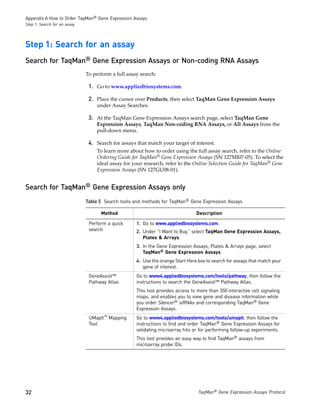
Search for TaqMan® Gene Expression Assays or Non-coding RNA Assays
                              To perform a full assay search:

                               1. Go to www.appliedbiosystems.com.

                               2. Place the cursor over Products, then select TaqMan Gene Expression Assays
                                  under Assay Searches.

                               3. At the TaqMan Gene Expression Assays search page, select TaqMan Gene
                                  Expression Assays, TaqMan Non-coding RNA Assays, or All Assays from the
                                  pull-down menu.

                               4. Search for assays that match your target of interest.
                                  To learn more about how to order using the full assay search, refer to the Online
                                  Ordering Guide for TaqMan® Gene Expression Assays (SN 127MI07-05). To select the
                                  ideal assay for your research, refer to the Online Selection Guide for TaqMan® Gene
                                  Expression Assays (SN 127GU08-01).


Search for TaqMan® Gene Expression Assays only
                              Table 5 Search tools and methods for TaqMan® Gene Expression Assays

                                    Method                                      Description

                               Perform a quick      1. Go to www.appliedbiosystems.com.
                               search               2. Under “I Want to Buy,” select TaqMan Gene Expression Assays,
                                                       Plates & Arrays.
                                                    3. In the Gene Expression Assays, Plates & Arrays page, select
                                                       TaqMan® Gene Expression Assays.
                                                    4. Use the orange Start Here box to search for assays that match your
                                                       gene of interest.
                               GeneAssist™          Go to www4.appliedbiosystems.com/tools/pathway, then follow the
                               Pathway Atlas        instructions to search the GeneAssist™ Pathway Atlas.
                                                    This tool provides access to more than 350 interactive cell signaling
                                                    maps, and enables you to view gene and disease information while
                                                    you order Silencer® siRNAs and corresponding TaqMan® Gene
                                                    Expression Assays.
                               UMapIt™ Mapping      Go to www4.appliedbiosystems.com/tools/umapit, then follow the
                               Tool                 instructions to find and order TaqMan® Gene Expression Assays for
                                                    validating microarray hits or for performing follow-up experiments.
                                                    This tool provides an easy way to find TaqMan® assays from
                                                    microarray probe IDs.


32                                                                               TaqMan® Gene Expression Assays Protocol
Appendix A How to Order TaqMan® Gene Expression Assays
                                                                                                    Step 1: Search for an assay


About TaqMan® Gene Expression Assay IDs
                                    Note: The assay ID prefix and suffix codes for TaqMan Gene Expression Assays
                                    and TaqMan Non-coding RNA Assays are identical.

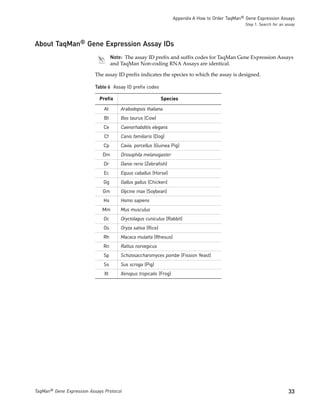
                           The assay ID prefix indicates the species to which the assay is designed.

                           Table 6 Assay ID prefix codes

                             Prefix                           Species

                               At       Arabodopsis thaliana
                               Bt       Bos taurus (Cow)
                              Ce        Caenorhabditis elegans
                               Cf       Canis familiaris (Dog)
                              Cp        Cavia. porcellus (Guinea Pig)
                              Dm        Drosophila melanogaster
                              Dr        Danio rerio (Zebrafish)
                              Ec        Equus caballus (Horse)
                              Gg        Gallus gallus (Chicken)
                              Gm        Glycine max (Soybean)
                              Hs        Homo sapiens
                              Mm        Mus musculus
                              Oc        Oryctolagus cuniculus (Rabbit)
                              Os        Oryza sativa (Rice)
                              Rh        Macaca mulatta (Rhesus)
                              Rn        Rattus norvegicus
                              Sp        Schizosaccharomyces pombe (Fission Yeast)
                              Ss        Sus scroga (Pig)
                               Xt       Xenopus tropicalis (Frog)


TaqMan® Gene Expression Assays Protocol                                                                                    33
Appendix A How to Order TaqMan® Gene Expression Assays
Step 1: Search for an assay


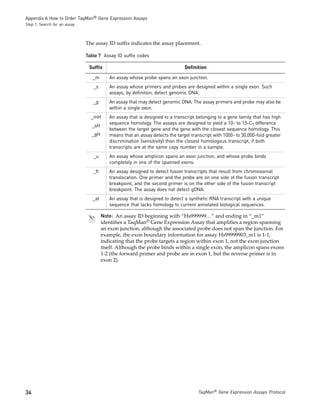
                              The assay ID suffix indicates the assay placement.

                              Table 7 Assay ID suffix codes

                               Suffix                                         Definition

                                 _m       An assay whose probe spans an exon junction.
                                 _s       An assay whose primers and probes are designed within a single exon. Such
                                          assays, by definition, detect genomic DNA.
                                 _g       An assay that may detect genomic DNA. The assay primers and probe may also be
                                          within a single exon.
                                _mH       An assay that is designed to a transcript belonging to a gene family that has high
                                          sequence homology. The assays are designed to yield a 10- to 15-CT difference
                                _sH
                                          between the target gene and the gene with the closest sequence homology. This
                                _gH       means that an assay detects the target transcript with 1000- to 30,000-fold greater
                                          discrimination (sensitivity) than the closest homologous transcript, if both
                                          transcripts are at the same copy number in a sample.
                                 _u       An assay whose amplicon spans an exon junction, and whose probe binds
                                          completely in one of the spanned exons.
                                 _ft      An assay designed to detect fusion transcripts that result from chromosomal
                                          translocation. One primer and the probe are on one side of the fusion transcript
                                          breakpoint, and the second primer is on the other side of the fusion transcript
                                          breakpoint. The assay does not detect gDNA.
                                 _at      An assay that is designed to detect a synthetic RNA transcript with a unique
                                          sequence that lacks homology to current annotated biological sequences.

                                       Note: An assay ID beginning with “Hs999999…” and ending in “_m1”
                                       identifies a TaqMan® Gene Expression Assay that amplifies a region spanning
                                       an exon junction, although the associated probe does not span the junction. For
                                       example, the exon boundary information for assay Hs99999903_m1 is 1-1,
                                       indicating that the probe targets a region within exon 1, not the exon junction
                                       itself. Although the probe binds within a single exon, the amplicon spans exons
                                       1-2 (the forward primer and probe are in exon 1, but the reverse primer is in
                                       exon 2).


34                                                                                   TaqMan® Gene Expression Assays Protocol
Appendix A How to Order TaqMan® Gene Expression Assays
                                                                                                 Step 2: Order the assay


Step 2: Order the assay
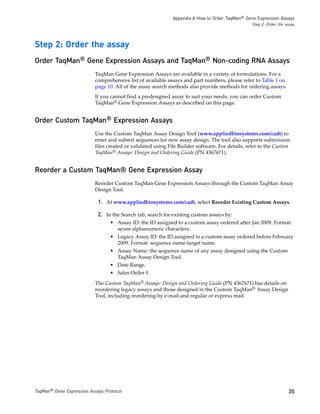
Order TaqMan® Gene Expression Assays and TaqMan® Non-coding RNA Assays
                           TaqMan Gene Expression Assays are available in a variety of formulations. For a
                           comprehensive list of available assays and part numbers, please refer to Table 1 on
                           page 10. All of the assay search methods also provide methods for ordering assays.
                           If you cannot find a predesigned assay to suit your needs, you can order Custom
                           TaqMan® Gene Expression Assays as described on this page.


Order Custom TaqMan® Expression Assays
                           Use the Custom TaqMan Assay Design Tool (www.appliedbiosystems.com/cadt) to
                           enter and submit sequences for new assay design. The tool also supports submission
                           files created or validated using File Builder software. For details, refer to the Custom
                           TaqMan® Assays: Design and Ordering Guide (PN 4367671).


Reorder a Custom TaqMan® Gene Expression Assay
                           Reorder Custom TaqMan Gene Expression Assays through the Custom TaqMan Assay
                           Design Tool.

                            1. At www.appliedbiosystems.com/cadt, select Reorder Existing Custom Assays.

                            2. In the Search tab, search for existing custom assays by:
                                 • Assay ID: the ID assigned to a custom assay ordered after Jan 2009. Format:
                                   seven alphanumeric characters.
                                 • Legacy Assay ID: the ID assigned to a custom assay ordered before February
                                   2009. Format: sequence name-target name.
                                 • Assay Name: the sequence name of any assay designed using the Custom
                                   TaqMan Assay Design Tool.
                                 • Date Range.
                                 • Sales Order #.

                           The Custom TaqMan® Assays: Design and Ordering Guide (PN 4367671) has details on
                           reordering legacy assays and those designed in the Custom TaqMan® Assay Design
                           Tool, including reordering by e-mail and regular or express mail.


TaqMan® Gene Expression Assays Protocol                                                                             35
Appendix A How to Order TaqMan® Gene Expression Assays
Step 3: Order a candidate endogenous control assay


Step 3: Order a candidate endogenous control assay
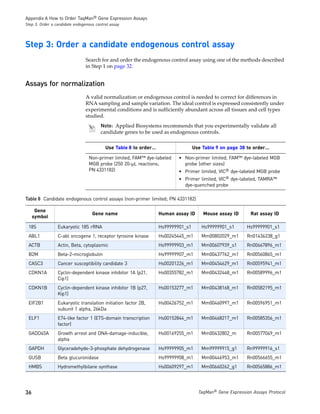
                                Search for and order the endogenous control assay using one of the methods described
                                in Step 1 on page 32.


Assays for normalization
                                A valid normalization or endogenous control is needed to correct for differences in
                                RNA sampling and sample variation. The ideal control is expressed consistently under
                                experimental conditions and is sufficiently abundant across all tissues and cell types
                                studied.
                                        Note: Applied Biosystems recommends that you experimentally validate all
                                        candidate genes to be used as endogenous controls.

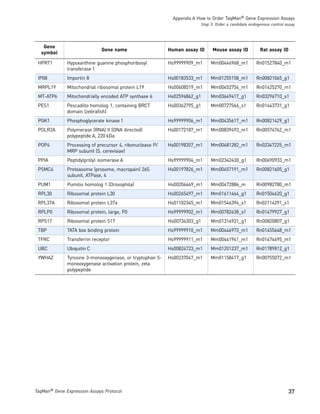
                                          Use Table 8 to order…                   Use Table 9 on page 38 to order…

                                 Non-primer limited, FAM™ dye-labeled     • Non-primer limited, FAM™ dye-labeled MGB
                                 MGB probe (250 20-µL reactions;            probe (other sizes)
                                 PN 4331182)                              • Primer limited, VIC® dye-labeled MGB probe
                                                                          • Primer limited, VIC® dye-labeled, TAMRA™
                                                                            dye-quenched probe

Table 8 Candidate endogenous control assays (non-primer limited; PN 4331182)

      Gene
                                   Gene name                      Human assay ID      Mouse assay ID       Rat assay ID
     symbol

 18S             Eukaryotic 18S rRNA                              Hs99999901_s1      Hs99999901_s1       Hs99999901_s1
 ABL1            C-abl oncogene 1, receptor tyrosine kinase       Hs00245445_m1      Mm00802029_m1       Rn01436238_g1
 ACTB            Actin, Beta, cytoplasmic                         Hs99999903_m1      Mm00607939_s1       Rn00667896_m1
 B2M             Beta-2-microglobulin                             Hs99999907_m1      Mm00437762_m1       Rn00560865_m1
 CASC3           Cancer susceptibility candidate 3                Hs00201226_m1      Mm00454629_m1       Rn00595941_m1
 CDKN1A          Cyclin-dependent kinase inhibitor 1A (p21,       Hs00355782_m1      Mm00432448_m1       Rn00589996_m1
                 Cip1)
 CDKN1B          Cyclin-dependent kinase inhibitor 1B (p27,       Hs00153277_m1      Mm00438168_m1       Rn00582195_m1
                 Kip1)
 EIF2B1          Eukaryotic translation initiation factor 2B,     Hs00426752_m1      Mm00460997_m1       Rn00596951_m1
                 subunit 1 alpha, 26kDa
 ELF1            E74-like factor 1 (ETS-domain transcription      Hs00152844_m1      Mm00468217_m1       Rn00585356_m1
                 factor)
 GADD45A         Growth arrest and DNA-damage-inducible,          Hs00169255_m1      Mm00432802_m        Rn00577049_m1
                 alpha
 GAPDH           Glyceradehyde-3-phosphate dehydrogenase          Hs99999905_m1      Mm99999915_g1       Rn99999916_s1
 GUSB            Beta glucuronidase                               Hs99999908_m1      Mm00446953_m1       Rn00566655_m1
 HMBS            Hydromethylbilane synthase                       Hs00609297_m1      Mm00660262_g1       Rn00565886_m1


36                                                                                  TaqMan® Gene Expression Assays Protocol
Appendix A How to Order TaqMan® Gene Expression Assays
                                                                        Step 3: Order a candidate endogenous control assay


   Gene
                              Gene name                    Human assay ID     Mouse assay ID           Rat assay ID
  symbol

 HPRT1        Hypoxanthine guanine phosphoribosyl          Hs99999909_m1     Mm00446968_m1           Rn01527840_m1
              transferase 1
 IP08         Importin 8                                   Hs00183533_m1     Mm01255158_m1           Rn00821065_g1
 MRPL19       Mitochondrial ribosomal protein L19          Hs00608519_m1     Mm00452754_m1           Rn01425270_m1
 MT-ATP6      Mitochondrially encoded ATP synthase 6       Hs02596862_g1     Mm03649417_g1           Rn03296710_s1
 PES1         Pescadillo homolog 1, containing BRCT        Hs00362795_g1     Mm00727566_s1           Rn01443731_g1
              domain (zebrafish)
 PGK1         Phosphoglycerate kinase 1                    Hs99999906_m1     Mm00435617_m1           Rn00821429_g1
 POLR2A       Polymerase (RNA) II (DNA directed)           Hs00172187_m1     Mm00839493_m1           Rn00574762_m1
              polypeptide A, 220 kDa
 POP4         Processing of precursor 4, ribonuclease P/   Hs00198357_m1     Mm00481282_m1           Rn02347225_m1
              MRP subunit (S. cerevisiae)
 PPIA         Peptidylprolyl isomerase A                   Hs99999904_m1     Mm02342430_g1           Rn00690933_m1
 PSMC4        Proteasome (prosome, macropain) 26S          Hs00197826_m1     Mm00457191_m1           Rn00821605_g1
              subunit, ATPase, 4
 PUM1         Pumilio homolog 1 (Drosophila)               Hs00206469_m1     Mm00472886_m            Rn00982780_m1
 RPL30        Ribosomal protein L30                        Hs00265497_m1     Mm01611464_g1           Rn01504620_g1
 RPL37A       Ribosomal protein L37a                       Hs01102345_m1     Mm01546394_s1           Rn02114291_s1
 RPLP0        Ribosomal protein, large, P0                 Hs99999902_m1     Mm00782638_s1           Rn01479927_g1
 RPS17        Ribosomal protein S17                        Hs00734303_g1     Mm01314921_g1           Rn00820807_g1
 TBP          TATA box binding protein                     Hs99999910_m1     Mm00446973_m1           Rn01455648_m1
 TFRC         Transferrin receptor                         Hs99999911_m1     Mm00441941_m1           Rn01474695_m1
 UBC          Ubiquitin C                                  Hs00824723_m1     Mm01201237_m1           Rn01789812_g1
 YWHAZ        Tyrosine 3-monooxygenase, or tryptophan 5-   Hs00237047_m1     Mm01158417_g1           Rn00755072_m1
              monooxygenase activation protein, zeta
              polypeptide


TaqMan® Gene Expression Assays Protocol                                                                               37
Appendix A How to Order TaqMan® Gene Expression Assays
Step 3: Order a candidate endogenous control assay


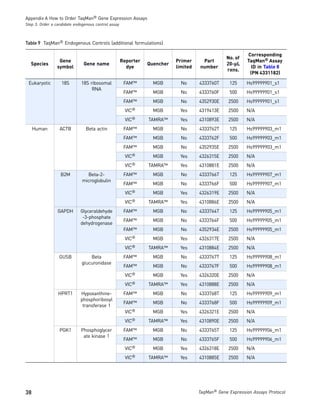
Table 9 TaqMan® Endogenous Controls (additional formulations)

                                                                                                          Corresponding
                                                                                                 No. of
                 Gene                                Reporter              Primer     Part                TaqMan® Assay
  Species                      Gene name                        Quencher                         20-µL
                symbol                                 dye                 limited   number                 ID in Table 8
                                                                                                 rxns.
                                                                                                           (PN 4331182)

 Eukaryotic        18S       18S ribosomal            FAM™        MGB        No      4333760T      125    Hs99999901_s1
                                  RNA
                                                      FAM™        MGB        No      4333760F      500    Hs99999901_s1
                                                      FAM™        MGB        No      4352930E     2500    Hs99999901_s1
                                                      VIC®        MGB        Yes     4319413E     2500    N/A
                                                      VIC®      TAMRA™      Yes      4310893E     2500    N/A
     Human        ACTB          Beta actin            FAM™        MGB        No      4333762T      125    Hs99999903_m1
                                                      FAM™        MGB        No      4333762F      500    Hs99999903_m1
                                                      FAM™        MGB        No      4352935E     2500    Hs99999903_m1
                                                      VIC®        MGB       Yes      4326315E     2500    N/A
                                                      VIC®      TAMRA™       Yes     4310881E     2500    N/A
                  B2M           Beta-2-               FAM™        MGB        No      4333766T      125    Hs99999907_m1
                              microglobulin
                                                      FAM™        MGB        No      4333766F      500    Hs99999907_m1
                                                      VIC®        MGB       Yes      4326319E     2500    N/A
                                                      VIC®      TAMRA™       Yes     4310886E     2500    N/A
                 GAPDH       Glyceraldehyde           FAM™        MGB        No      4333764T      125    Hs99999905_m1
                              -3-phosphate
                                                      FAM™        MGB        No      4333764F      500    Hs99999905_m1
                             dehydrogenase
                                                      FAM™        MGB        No      4352934E     2500    Hs99999905_m1
                                                      VIC®        MGB        Yes     4326317E     2500    N/A
                                                      VIC®      TAMRA™      Yes      4310884E     2500    N/A
                  GUSB            Beta                FAM™        MGB        No      4333767T      125    Hs99999908_m1
                              glucuronidase
                                                      FAM™        MGB        No      4333767F      500    Hs99999908_m1
                                                      VIC®        MGB        Yes     4326320E     2500    N/A
                                                      VIC®      TAMRA™      Yes      4310888E     2500    N/A
                 HPRT1       Hypoxanthine-            FAM™        MGB        No      4333768T      125    Hs99999909_m1
                             phosphoribosyl
                                                      FAM™        MGB        No      4333768F      500    Hs99999909_m1
                              transferase 1
                                                      VIC®        MGB        Yes     4326321E     2500    N/A
                                                      VIC®      TAMRA™      Yes      4310890E     2500    N/A
                  PGK1       Phosphoglycer            FAM™        MGB        No      4333765T      125    Hs99999906_m1
                              ate kinase 1
                                                      FAM™        MGB        No      4333765F      500    Hs99999906_m1
                                                      VIC®        MGB        Yes     4326318E     2500    N/A
                                                      VIC®      TAMRA™      Yes      4310885E     2500    N/A


38                                                                                   TaqMan® Gene Expression Assays Protocol
Appendix A How to Order TaqMan® Gene Expression Assays
                                                                           Step 3: Order a candidate endogenous control assay


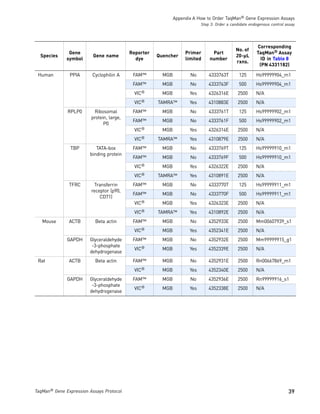
                                                                                                        Corresponding
                                                                                             No. of
               Gene                        Reporter                Primer       Part                    TaqMan® Assay
  Species                 Gene name                   Quencher                               20-µL
              symbol                         dye                   limited     number                     ID in Table 8
                                                                                             rxns.
                                                                                                         (PN 4331182)

 Human         PPIA      Cyclophilin A      FAM™        MGB          No        4333763T        125      Hs99999904_m1
                                            FAM™        MGB          No        4333763F        500      Hs99999904_m1
                                            VIC®        MGB          Yes       4326316E       2500      N/A
                                            VIC®      TAMRA™         Yes       4310883E       2500      N/A
              RPLP0        Ribosomal        FAM™        MGB          No        4333761T        125      Hs99999902_m1
                         protein, large,
                                            FAM™        MGB          No        4333761F        500      Hs99999902_m1
                               P0
                                            VIC®        MGB          Yes       4326314E       2500      N/A
                                            VIC®      TAMRA™         Yes       4310879E       2500      N/A
               TBP         TATA-box         FAM™        MGB          No        4333769T        125      Hs99999910_m1
                        binding protein
                                            FAM™        MGB          No        4333769F        500      Hs99999910_m1
                                            VIC®        MGB          Yes       4326322E       2500      N/A
                                            VIC®      TAMRA™         Yes       4310891E       2500      N/A
               TFRC       Transferrin       FAM™        MGB          No        4333770T        125      Hs99999911_m1
                         receptor (p90,
                                            FAM™        MGB          No        4333770F        500      Hs99999911_m1
                             CD71)
                                            VIC®        MGB          Yes       4326323E       2500      N/A
                                            VIC®      TAMRA™         Yes       4310892E       2500      N/A
   Mouse       ACTB        Beta actin       FAM™        MGB          No        4352933E       2500      Mm00607939_s1
                                            VIC®        MGB          Yes       4352341E       2500      N/A
              GAPDH     Glyceraldehyde      FAM™        MGB          No        4352932E       2500      Mm99999915_g1
                         -3-phosphate
                                            VIC®        MGB          Yes       4352339E       2500      N/A
                        dehydrogenase
 Rat           ACTB        Beta actin       FAM™        MGB          No        4352931E       2500      Rn00667869_m1
                                            VIC®        MGB          Yes       4352340E       2500      N/A
              GAPDH     Glyceraldehyde      FAM™        MGB          No        4352936E       2500      Rn99999916_s1
                         -3-phosphate
                                            VIC®        MGB          Yes       4352338E       2500      N/A
                        dehydrogenase


TaqMan® Gene Expression Assays Protocol                                                                                  39
Appendix A How to Order TaqMan® Gene Expression Assays
Step 4: Select a chemistry


Step 4: Select a chemistry
Select standard or Fast chemistry
                             StepOne™, StepOnePlus™, 7500 Fast, 7900HT, and ViiA™ 7 Fast Real-Time PCR
                             Systems contain Fast thermal cycling blocks that can perform Fast quantitative PCR.
                             Applied Biosystems Fast PCR systems use high-speed thermal cycling blocks,
                             TaqMan® Fast Advanced Master Mix, and optical Fast thermal cycling plates and tubes
                             to reduce quantitative PCR run times to less than 40 minutes. For more information on
                             Fast chemistries available from Applied Biosystems, refer to the Data Sheet: Comparing
                             Fast and Standard Data on Applied Biosystems 7500 and 7500 Fast Real-Time PCR Systems
                             (SN 117MI08-01).

                             Table 10 Chemistry and plates for a standard or Fast run

                               Component          Standard chemistry per run            Fast chemistry per run

                              cDNA quantity    1–100 ng                             1–100 ng
                              TaqMan®          • TaqMan® Gene Expression            TaqMan® Fast Advanced Master
                              Master Mix         Master Mix                         Mix
                                               • TaqMan® Universal Master Mix
                                                 II, with or no UNG
                                               • TaqMan® Universal PCR Master
                                                 Mix (2✕), with or without
                                                 AmpErase® UNG
                              96-well plate    MicroAmp® Optical 96-Well            MicroAmp® Fast Optical 96-Well
                                               Reaction Plate with Barcode          Reaction Plate with Barcode
                              384-well plate   MicroAmp® Optical 384-Well Reaction Plate with Barcode
                              48-well plate    MicroAmp® Fast Optical 48-Well Reaction Plate


Select 1- or 2-step RT-PCR
                             Applied Biosystems offers several chemistries that you can use to perform RT-PCR in
                             one or two steps. See Table 11 on page 41 for a list of kits.


40                                                                             TaqMan® Gene Expression Assays Protocol
Appendix A How to Order TaqMan® Gene Expression Assays
                                                                          Step 5: Order materials and equipment not included


Step 5: Order materials and equipment not included
                           See “Materials for reverse transcription and PCR” on page 12 for a list of required
                           materials.


Related reagents
                           Table 11 Reagents for reverse transcription and PCR

                                           Reagent                           Description and part number

                            TaqMan® Gene Expression Master Mix        • One 1-mL tube (PN 4370048)
                            (2✕)                                      • One 5-mL bottle (PN 4369016)
                                                                      • One 6-mL bottle (PN 4393469)
                                                                      • Two 5-mL bottles (PN 4369514)
                                                                      • Five 5-mL bottles (PN 4369510)
                                                                      • Ten 5-mL bottles (PN 4369542)
                                                                      • One 50-mL bottle (PN 4370074)
                            TaqMan® Universal Master Mix II, no UNG   • One 1-mL tube (PN 4440043)
                                                                      • One 5-mL bottle (PN 4440040)
                                                                      • Two 5-mL bottles (PN 4440047)
                                                                      • Five 5-mL bottles (PN 4440048)
                                                                      • Ten 5-mL bottles (PN 4440049)
                                                                      • One 50-mL bottle (PN 4440041)
                            TaqMan® Universal Master Mix II, with     • One 1-mL tube (PN 4440042)
                            UNG                                       • One 5-mL bottle (PN 4440038)
                                                                      • Two 5-mL bottles (PN 4440044)
                                                                      • Five 5-mL bottles (PN 4440045)
                                                                      • Ten 5-mL bottles (PN 4440046)
                                                                      • One 50-mL bottle (PN 4440039)
                            TaqMan® Universal PCR Master Mix (2✕)     • One 5-mL bottle (PN 4304437)
                                                                      • Two 5-mL bottles (PN 4364338)
                                                                      • Five 5-mL bottles (PN 4364340)
                                                                      • Ten 5-mL bottles (PN 4305719)
                                                                      • One 50-mL bottle (PN 4326708)
                            TaqMan® Universal Master Mix (2✕) No      • One 5-mL bottles (PN 4324018)
                            AmpErase® UNG                             • Two 5-mL bottles (PN 4364341)
                                                                      • Five 5-mL bottles (PN 4364343)
                                                                      • Ten 5-mL bottles (PN 4324020)
                                                                      • One 50-mL bottle (PN 4326614)


TaqMan® Gene Expression Assays Protocol                                                                                 41
Appendix A How to Order TaqMan® Gene Expression Assays
Step 5: Order materials and equipment not included


                                                     Reagent                              Description and part number

                                  TaqMan® Fast Advanced Master Mix             • Mini-Pack 1 ×1 mL 100 (PN 4444556)
                                                                               • 1-Pack 1× 5 mL 500 (PN 4444557)
                                                                               • 2-Pack 2 × 5 mL 1,000 (PN 4444963)
                                                                               • 5-Pack 5 × 5 mL 2,500 (PN 4444964)
                                                                               • 10-Pack 10 × 5 mL 5,000 (PN 4444965)
                                                                               • Bulk-Pack 1 × 50 mL 5,000 (PN 4444558)
                                  TaqMan®Fast Universal Master Mix (2✕)        • 250 × 20-µL reactions (PN 4352042)
                                  No AmpErase® UNG                             • 500 × 20-µL reactions (PN 4366072)
                                                                               • 1250 × 20-µL reactions (PN 4366073)
                                                                               • 2500 × 20-µL reactions (PN 4364103)
                                                                               • 5000 × 20-µL reactions (PN 4367846)
                                  High Capacity RNA-to-cDNA Kit                50 reactions (PN 4387406)
                                  High Capacity cDNA Reverse                   • 200 reactions (PN 4368814)
                                  Transcription Kit                            • 200 reactions with RNase Inhibitor
                                                                                 (PN 4374966)
                                                                               • 1000 reactions (PN 4368813)
                                                                               • 1000 reactions with RNase Inhibitor
                                                                                 (PN 4374967)
                                  TaqMan® RNA-to-CT™ 1-Step Kit                • 40 × 50-µL reactions (PN 4392653)
                                                                               • 200 × 50-µL reactions (PN 4392938)
                                                                               • 2000 × 50-µL reactions (PN 4392656)
                                  Nuclease-free water (no diethyl              500 mL (PN AM9930)
                                  pyrocarbonate [DEPC])


Reaction plates and accessories
                                Table 12 Reaction plates and accessories for Applied Biosystems thermal cyclers and real-
                                time PCR systems

                                      Instrument                           Reaction plates and accessories

                                  7300 system             • MicroAmp® Optical 96-Well Reaction Plate with Barcode:
                                  7500 system               – 500 plates (PN 4326659)
                                                               – 20 plates (PN 4306737)
                                                          • MicroAmp® Optical Adhesive Film (PN 4311971)
                                                          • MicroAmp® Optical 8-Tube Strips, 0.2-mL, 1000 tubes in strips of
                                                            eight (PN 4316567)
                                                          • MicroAmp® Optical 8-Cap Strips, 300 strips (PN 4323032)
                                  7500 Fast system        • MicroAmp® Fast Optical 96-Well Reaction Plate with Barcode:
                                                            – 200 plates (PN 4366932)
                                                               – 20 plates (PN 4346906)
                                                          • MicroAmp® Optical Adhesive Film (PN 4311971)


42                                                                                    TaqMan® Gene Expression Assays Protocol
Appendix A How to Order TaqMan® Gene Expression Assays
                                                                          Step 5: Order materials and equipment not included


                                Instrument                       Reaction plates and accessories

                            7900HT Fast system,   • MicroAmp® Optical 96-Well Reaction Plate with Barcode:
                            standard 96-well        – 500 plates (PN 4326659)
                            block
                                                    – 20 plates (PN 4306737)
                                                  • MicroAmp® Optical Adhesive Film (PN 4311971)
                                                  • MicroAmp® Optical Film Compression Pad (PN 4312639) for use
                                                    with one plate
                            7900HT Fast system,   • MicroAmp® Fast Optical 96-Well Reaction Plate with Barcode:
                            Fast 96-well block      – 200 plates (PN 4366932)
                                                    – 20 plates (PN 4346906)
                                                  • MicroAmp® Optical Adhesive Film (PN 4311971)
                                                  • MicroAmp® Optical Film Compression Pad (PN 4312639) for use
                                                    with one plate
                            7900HT Fast system,   • MicroAmp® Optical 384-Well Reaction Plate with Barcode:
                            384-well block          – 1000 plates (PN 4343814)
                                                    – 500 plates (PN 4326270)
                                                    – 50 plates (PN 4309849)
                                                  • MicroAmp® Optical 384-Well Reaction Plate, 1000 plates
                                                    (PN 4343370)
                                                  • MicroAmp® Optical Adhesive Film (PN 4311971)
                            Applied Biosystems    • MicroAmp® Optical 384-Well Reaction Plate with Barcode:
                            ViiA™ 7 system          – 1000 plates (PN 4343814)
                                                    – 500 plates (PN 4326270)
                                                    – 50 plates (PN 4309849)
                                                  • MicroAmp® Optical 384-Well Reaction Plate, 1000 plates
                                                    (PN 4343370)
                                                  • MicroAmp® Optical Adhesive Film (PN 4311971)
                            StepOne™ system       • MicroAmp® Fast Optical 48-Well Reaction Plate, 20 plates
                                                    (PN 4375816)
                                                  • MicroAmp® 48-Well Optical Adhesive Film (PN 4375323)
                            StepOnePlus™          • MicroAmp® Fast Optical 96-Well Reaction Plate with Barcode:
                            system                  – 200 plates (PN 4366932)
                                                    – 20 plates (PN 4346906)
                                                  • MicroAmp® Optical Adhesive Film (PN 4311971)


TaqMan® Gene Expression Assays Protocol                                                                                 43
Appendix A How to Order TaqMan® Gene Expression Assays
Step 5: Order materials and equipment not included


                                      Instrument                           Reaction plates and accessories

                                  9700 instrument          • MicroAmp® Optical 96-Well Reaction Plate with Barcode:
                                                             – 500 plates (PN 4326659)
                                                             – 20 plates (PN 4306737)
                                                           • MicroAmp® Optical 384-Well Clear Optical Reaction Plate with
                                                             Barcode:
                                                             – 1000 plates (PN 4343814)
                                                             – 500 plates (PN 4326270)
                                                             – 50 plates (PN 4309849)
                                                           • MicroAmp® Optical Adhesive Film (PN 4311971)
                                                           • MicroAmp® Clear Adhesive Films, 100 films (PN 4306311)
                                                           • MicroAmp® Optical 8-Tube Strips, 0.2-mL, 1000 tubes in strips of
                                                             eight (PN 4316567)
                                                           • MicroAmp® Optical 8-Cap Strips, 300 strips (PN 4323032)
                                  Veriti® 96-well          • MicroAmp® Optical 96-Well Reaction Plate:
                                  thermal cycler             – 500 plates (PN 4316813)
                                                             – 10 plates (PN N8010560)
                                                           • MicroAmp® Optical Adhesive Film (PN 4311971)
                                                           • MicroAmp® Clear Adhesive Films, 100 films (PN 4306311)
                                  Veriti® 384-well         • MicroAmp® Optical 384-Well Reaction Plate with Barcode:
                                  thermal cycler             – 1000 plates (PN 4343814)
                                                             – 500 plates (PN 4326270)
                                                             – 50 plates (PN 4309849)
                                                           • MicroAmp® Optical Adhesive Film (PN 4311971)


Related gene expression assays and arrays products
                                Table 13 Related gene expression assays and arrays products

                                                     Assay or array                            For more information...

                                  TaqMan®       TaqMan® MicroRNA Assays                  miRNA.appliedbiosystems.com
                                  assays
                                                Custom TaqMan® Small RNA Assays          www.appliedbiosystems.com


                                                TaqMan® Pri-miRNA Assays                 mirna.appliedbiosystems.com
                                                Custom  TaqMan®   Probes and             www.appliedbiosystems.com
                                                Primers‡


44                                                                                    TaqMan® Gene Expression Assays Protocol
Appendix A How to Order TaqMan® Gene Expression Assays
                                                                                     Step 5: Order materials and equipment not included


                                                 Assay or array                                   For more information...

                            TaqMan®        TaqMan® Array Cards:                            taqmanarray.appliedbiosystems.com
                            arrays         • TaqMan® Custom Arrays
                                           • TaqMan® Gene Signature Array
                                           • TaqMan® Gene Sets
                                           TaqMan® Array Plates§                           www.allgenes.com
                                           •   TaqMan®MicroRNA Arrays                      miRNA.appliedbiosystems.com
                                               – Human
                                               – Rodent
                                           • Megaplex™ Primer Pools
                                             – Megaplex™ RT Primers
                                               – Megaplex™ PreAmp Primers
                           ‡ Probes and primers that are synthesized by Applied Biosystems to your exact sequence and choice of quencher
                             and reporter dyes.
                           § TaqMan® Gene Expression Assays dried in MicroAmp® Optical 96-Well Reaction Plates.


TaqMan® Gene Expression Assays Protocol                                                                                             45
Appendix A How to Order TaqMan® Gene Expression Assays
Step 5: Order materials and equipment not included


46                                                       TaqMan® Gene Expression Assays Protocol
APPENDIX B


                                                                 Good PCR Practices


Prevent contamination and nonspecific amplification
                           PCR assays require special laboratory practices to avoid false positive amplifications.
                           The high throughput and repetition of these assays can lead to amplification of one
                           DNA molecule.


AmpErase® UNG
                           AmpErase® uracil-N-glycosylase (UNG) prevents reamplification of carryover-PCR
                           products in an assay if all previous PCR for that assay is performed using a dUTP-
                           containing master mix. UNG acts on single- and double-stranded dU-containing DNA
                           by hydrolyzing uracil-glycosidic bonds at dU-containing DNA sites. The enzyme
                           causes the release of uracil, thereby creating an alkali-sensitive apyrimidic site in the
                           DNA. The enzyme has no activity on RNA or dT-containing DNA (Longo et al., 1990).


PCR good laboratory practices
                           When preparing samples for PCR amplification:
                            • Wear clean gloves and a clean lab coat (not previously worn while handling
                              amplified PCR products or used during sample preparation).
                            • Change gloves whenever you suspect that they are contaminated.
                            • Maintain separate areas and dedicated equipment and supplies for:
                                 – Sample preparation
                                 – PCR setup
                                 – PCR amplification
                                 – Analysis of PCR products
                            • Never bring amplified PCR products into the PCR setup area.
                            • Open and close all sample tubes carefully. Try not to splash or spray PCR
                              samples.
                            • Keep reactions and components capped as much as possible.
                            • Use a positive-displacement pipette or aerosol-resistant pipette tips.
                            • Clean lab benches and equipment periodically with 10% bleach solution.


TaqMan® Gene Expression Assays Protocol                                                                          47
Appendix B Good PCR Practices
Prevent contamination and nonspecific amplification


48                                                    TaqMan® Gene Expression Assays Protocol
APPENDIX C


                                                                                   Duplex Reactions


Duplex reactions using TaqMan® Gene Expression Assays
                             Duplex real-time PCR is the simultaneous amplification and measurement of two
                             target sequences in one reaction. TaqMan® Gene Expression Assays can be used in
                             duplex real-time PCR when using a FAM™ dye-labeled assay in combination with a
                             primer-limited, VIC® dye-labeled assay. However, Applied Biosystems strongly
                             recommends that you validate that your duplex assay combinations provide similar
                             results to your singleplex reactions. When setting a duplex reaction, it is important to:
                               • Consider the relative expression levels of each target.
                               • Perform serial dilutions of your sample in both singleplex and duplex reactions,
                                 and compare the results for relative expression.
                               • Select the higher-expressing target as the primer-limited, VIC dye-labeled assay.
                               • Use TaqMan Gene Expression Master Mix, which has been optimized for
                                 duplexing reactions.
                             For more details on how to validate your duplex assay reactions and interpret the
                             results, refer to the Applied Biosystems Application Note Factors Influencing Multiplex
                             Reactions (Publication 136AP04-01 O-081742), available at
                             www.appliedbiosystems.com.


Setting up a Duplex Reaction
                             A duplex reaction is run the same as a singleplex reaction, with the addition of the
                             primer-limited assay:

                       For each sample (to be run in quadruplicate)                           1 reaction (µL)          4 reactions#

            TaqMan Gene Expression Assay (20✕ FAM dye-labeled)                                1                    5
            TaqMan Gene Expression Assay ( 20✕ VIC dye-labeled, primer-limited)               1                    5
            TaqMan Gene Expression Master Mix (2✕)‡                                           10                   50
            cDNA Template (1-100ng)§                                                          4                    20
            RNAse-free water                                                                  4                    20
          ‡ TaqMan Gene Expression Master Mix has been optimized for duplex reactions. Applied Biosystems does not recommend Universal
            Master Mix or Fast Master Mix for duplex reactions.
          § Applied Biosystems recommends that the qPCR reaction not be composed of more than 20% of the reverse transcription reaction.
          # Replicate reactions include 20% excess volume to account for losses during pipetting.


                             Instructions on how to create and run a plate document/experiment are on page 67 in
                             “Related documentation”, which provides a list of resource documents for your
                             instrument.


TaqMan® Gene Expression Assays Protocol                                                                                               49
Appendix C Duplex Reactions
Duplex reactions using TaqMan® Gene Expression Assays


50                                                      TaqMan® Gene Expression Assays Protocol
APPENDIX D


                                                          Background Information


About TaqMan® chemistry
About the probes
                           TaqMan® MGB probes contain:
                            • A reporter dye (for example, FAM™ dye) linked to the 5′ end of the probe.
                            • A minor groove binder (MGB) at the 3´ end of the probe.
                                   MGBs increase the melting temperature (Tm) without increasing probe length
                                   (Afonina et al., 1997; Kutyavin et al., 1997); they also allow for the design of
                                   shorter probes.
                            • A nonfluorescent quencher (NFQ) at the 3′ end of the probe.
                                   Because the quencher does not fluoresce, Applied Biosystems real-time PCR
                                   systems can measure reporter dye contributions more accurately.


About the 5′ nuclease assay
                           The 5′ nuclease assay process (Figure 2 through Figure 5) takes place during PCR
                           amplification. This process occurs in every cycle and does not interfere with the
                           exponential accumulation of product.

                           Figure 1 Legend for Figures 2 through 5
                           NFQ    = Nonfluorescent quencher
                           MGB    = Minor groove binder
                            R     = Reporter
                            P     = Hot-start DNA polymerase


                           During PCR, the TaqMan MGB probe anneals specifically to a complementary
                           sequence between the forward and reverse primer sites (Figure 2).
                           When the probe is intact (Figure 2 and Figure 3), the proximity of the reporter dye to
                           the quencher dye results in suppression of the reporter fluorescence, primarily by
                           Förster-type energy transfer (Förster, 1948; Lakowicz, 1983).

                           Figure 2 Polymerization
                                Forward                         TaqMan
                                                          R                    NFQ   MGB
                                Primer                         MGB probe
                           5′                  P                               3′
                           3′                                                                    5′

                           5′                                                                    3′
                                                                           P           Reverse
                                                                                                 5′
                                                                                        Primer


TaqMan® Gene Expression Assays Protocol                                                                               51
Appendix D Background Information
About TaqMan® chemistry


                           Figure 3 Strand displacement


                                                   R
                                Forward                     TaqMan
                                                                       NFQ     MGB
                                Primer                     MGB probe
                           5′                  P                       3′
                           3′                                                                     5′

                           5′                                                                     3′
                                                                 P                      Reverse
                                                                                                  5′
                                                                                         Primer


                           The DNA polymerase cleaves only probes that are hybridized to the target (Figure 4).
                           Cleavage separates the reporter dye from the quencher dye; the separation of the
                           reporter dye from the quencher dye results in increased fluorescence by the reporter.
                           The increase in fluorescence occurs only if the target sequence is complementary to the
                           probe and is amplified during PCR. Because of these requirements, nonspecific
                           amplification is not detected.

                           Figure 4 Cleavage

                                               R
                                Forward                          TaqMan
                                                                               NFQ    MGB
                                Primer                          MGB probe
                           5′                          P                       3′
                           3′                                                                     5′

                           5′                                                                     3′
                                                                 P                      Reverse
                                                                                                  5′
                                                                                         Primer


                           Polymerization of the strand continues, but because the 3′ end of the probe is blocked,
                           no extension of the probe occurs during PCR (Figure 5).

                           Figure 5 Completion of polymerization
                                                                    TaqMan
                                               R                                NFQ     MGB
                                Forward                            MGB probe
                                Primer                                          3′
                           5′
                           3′                                                                     5′

                           5′                                                                     3′
                                                                                                  5′
                                                                                        Reverse
                                                                                         Primer


52                                                                                    TaqMan® Gene Expression Assays Protocol
Appendix D Background Information
                                                                                         About the assay information file (AIF)


About the assay information file (AIF)
                           The assay information file (AIF) contains reference information about your order and
                           technical details of all assays in the shipment. The AIF is included on the Information
                           CD accompanying your order, in a folder labeled with the Rack or Plate ID.


AIF formats
                           The AIF may be provided in TXT format and/or in both XML and HTML formats,
                           depending on the product line and order date. You can use the:
                            • HTML-format AIFs as a reference; open them in a Web browser.
                            • XML- and TXT-format AIFs for electronic data importation and manipulation.

                           Table 14 Assay information file formats and naming conventions

                             File format                      Filename convention (see Table 16)

                                HTML        Assay_Info_ProdLine_SalesOrder_XXXX_RackID_YYYY
                                XML         Assay_Info_ProdLine_SalesOrder_XXXX_RackID_YYYY
                                 TXT        Assay_Info_ProdLine_SalesOrder_XXXX_RackID_YYYY
                                            -or-
                                            ProdNum_LotNum_AIF

                           Table 15 Filename variables

                              Filename
                                                                           Description
                              variable

                               LotNum       The lot number of the assay (more than one lot number may be associated
                                            with one manufacturing production number).
                              ProdLine      The TaqMan assay product line:
                                            • TaqMan Gene Expression Assays (TaqMan_GEx)
                                            • Custom TaqMan Gene Expression Assays (Custom_TaqMan_GEx)
                                            • Custom Plus TaqMan RNA Assays (Custom_TaqMan_ncRNA)
                                            • TaqMan Non-coding RNA Assays (TaqMan_ncRNA)
                              ProdNum       The manufacturing production number.
                               XXXX...      A unique number assigned to the sales order.
                                YYYY...     A unique, barcoded number located on various pieces of collateral; the
                                            preceding term in the filename may be Rack ID, Plate ID, or Shipping Rack.


TaqMan® Gene Expression Assays Protocol                                                                                    53
Appendix D Background Information
About the assay information file (AIF)


AIF field descriptions
                                  Select assay information field descriptions are found in Understanding Your Shipment
                                  (included on the CD with TaqMan Non-coding RNA Assays and certain TaqMan Gene
                                  Expression Assays).
                                  Assay information field descriptions for TaqMan Gene Expression Assays are listed in
                                  Table 16, in the order in which they appear in the AIF.

                                  Table 16 Assay information field descriptions for TaqMan® Gene Expression Assays

                                                                                              Examples by product type

        Field name                           Description of content                     TaqMan® Gene        Custom TaqMan®
                                                                                         Expression         Gene Expression
                                                                                           Assays                Assays

 Customer Name                  Your organization or institution                         Company XYZ          Company XYZ
 (Sales) Order Number           A unique number that identifies the                       1234567890           1234567890
                                Applied Biosystems sales order
 Ship Date                      The date when the assay was packaged for                  7-Nov-2008           7-Nov-2008
                                shipment
 Delivery Number                A unique bar code number that identifies the              880309546             880309546
 (Shipment ID)                  shipment
                                         Note: The shipment ID also appears in
                                         the plate ID.
 Part Number                    A number that identifies the product line                  4351372               4331348
 Product Type                   The Applied Biosystems product line associated          TaqMan® Gene        Custom TaqMan®
                                with the assay                                         Expression Assays    Gene Expression
                                                                                                                 Assays
 Assay ID                       An alphanumeric string that identifies the assay       Rn01648213_m1             AIT9JN3
 Lot Number                     A unique identifier assigned to each                    080227T100615         080227T100615
                                manufacturing lot
 Shipping Rack or               The type of container in which the assay is             96-position tube   96-position tube rack
 Plate Type                     shipped (such as a 96-position or a 16-position             rack v1                  v1
                                tube rack)
 Shipping Rack,                 A bar code number on the label of each shipped           880309546-1           880309546-1
 Plate ID, or Rack ID           rack or plate
 Vial/Tube Type                 The type of vial or tube that contains the assay          2D barcode        2D barcode labeled
                                                                                         labeled tube              tube
 Vial/Tube ID                   A unique, 10-digit bar code number on the                 0004696076           0004696076
                                bottom of each assay vial or tube that identifies it
 Well Location on the           The location of the assay on the associated                   B02                  B02
 Shipping Rack or Plate         shipping rack or plate
 Assay Mix                      The concentration of the assay, including both               20✕                   20✕
 Concentration                  primers and probe
 Forward Primer Name            Format: customer-designated sequence name                      –                MYSEQ_F
                                (“MYSEQ”)_F


54                                                                                        TaqMan® Gene Expression Assays Protocol
Appendix D Background Information
                                                                                         About the assay information file (AIF)


                                                                                  Examples by product type

      Field name                     Description of content                  TaqMan® Gene           Custom TaqMan®
                                                                              Expression            Gene Expression
                                                                                Assays                   Assays

 Forward Primer          The nucleotide sequence of the forward primer             –               GGACTTGCACGACTAA
 Sequence
 Forward Primer          The concentration of the forward primer (µM)             18                          18
 Concentration
 Reverse Primer Name     Format: customer-designated sequence name                 –                      MYSEQ_R
                         (“MYSEQ”)_R
 Reverse Primer          The nucleotide sequence of the reverse primer             –               CCGTACGTCAATTGAC
 Sequence
 Reverse Primer          The concentration of the reverse primer (µM)             18                          18
 Concentration
 Reporter 1 Name         Reporter 1 refers to the oligonucleotide probe.           –                      MYSEQ_M
                         Format: customer-designated sequence name
                         (“MYSEQ”)_M.
 Reporter 1 Dye          The reporter dye label for the reporter 1 probe         FAM™                        FAM
 Reporter 1 Sequence     The nucleotide sequence of the reporter 1 probe           –                 TTCGAACTGATCAT
 Reporter 1              The concentration of the reporter 1 probe (µM)            5                           5
 Concentration
 Reporter 1 Quencher     The quencher used for the reporter 1 probe (for         NFQ                         NFQ
                         example, Non-fluorescent Quencher [NFQ])
 Reporter 2 Name         Not applicable to TaqMan® Gene Expression                 –                           –
                         Assays
 Reporter 2 Dye
 Reporter 2 Sequence
 Reporter 2
 Concentration
 Reporter 2 Quencher
 Context Sequence        The 25-nucleotide sequence surrounding the         ...NNNNNNNNN...                    –
                         probe
 Design Strand           Not applicable to TaqMan® Gene Expression                 –                           –
                         Assays
 Category                The Celera Panther Protein Classification              receptor                       –
                         (Level 1) for the gene product
 Category ID             A unique, 10-character alphanumeric                  REC1010000                       –
                         abbreviation of the Panther category
                         classification
 Group                   The Celera Panther Protein Classification           protein kinase                    –
                         (Level 2) for the gene product                         receptor
 Group ID                A unique, 10-character alphanumeric                  1010200000                       –
                         abbreviation of the Panther group classification
 Gene Symbol             The Entrez Gene symbol for the gene                   SLC25A14                        –


TaqMan® Gene Expression Assays Protocol                                                                                    55
Appendix D Background Information
About the assay information file (AIF)


                                                                                      Examples by product type

        Field name                         Description of content               TaqMan® Gene       Custom TaqMan®
                                                                                 Expression        Gene Expression
                                                                                   Assays               Assays

 Gene Name                      The Entrez Gene name for the gene                solute carrier            –
                                                                                   family 25
                                                                                (mitochondrial
                                                                                carrier, brain),
                                                                                  member 14
 Chromosome                     The chromosome containing the gene                     9                   –
 Species                        The organism for which the assay was designed   Homo_sapiens               –
 Target Exon(s)                 The exon(s) that are spanned by the probe              2                   –
 NCBI Gene Reference            The NCBI transcript identification number(s)     NM_001735                 –
                                corresponding to the assay target
 NCBI SNP Reference             Not applicable to TaqMan® Gene Expression              –                   –
                                Assays
 Medline Reference              PubMed references for the gene                         –                   –
 Celera ID                      (TaqMan Gene Expression Assays) The unique      hCT11720402                –
                                Celera Discovery System (CDS) assay
 - or -
                                identification number for the gene
 Assay Name
                                (Custom TaqMan Gene Expression Assays) The             –                MYSEQ
                                customer-designated name of the sequence
                                used for custom assay design (such as
                                “MYSEQ”).
 Cytogenetic Band               The chromosomal band where the gene is               9q34                  –
                                located.
                                If unavailable, then the chromosome number is
                                provided.


56                                                                               TaqMan® Gene Expression Assays Protocol
Appendix D Background Information
                                                                                About the assay information file (AIF)


                                                                         Examples by product type

      Field name                     Description of content          TaqMan® Gene          Custom TaqMan®
                                                                      Expression           Gene Expression
                                                                        Assays                  Assays

 SNP Type                Not applicable to TaqMan® Gene Expression        –                           –
                         Assay
 Minor Allele
 Frequency - Caucasian
 Minor Allele
 Frequency -African-
 American
 Minor Allele
 Frequency -Japanese
 Minor Allele
 Frequency -Chinese
 Celera Assembly Build
 Number
 Location on Celera
 Assembly
 NCBI Assembly Build
 Number
 Location on NCBI
 Assembly


TaqMan® Gene Expression Assays Protocol                                                                           57
Appendix D Background Information
About the assay information file (AIF)


58                                       TaqMan® Gene Expression Assays Protocol
APPENDIX E


                                                                                                                                              Safety


                           This appendix covers:
                            ■   Chemical safety . . . . . . . . . . . . . . . . . . . . . . . . . . . . . . . . . . . . . . . . . . . . . . . . . . . . . . . 60
                                General chemical safety . . . . . . . . . . . . . . . . . . . . . . . . . . . . . . . . . . . . . . . . . . . . . . . . 60
                                SDSs . . . . . . . . . . . . . . . . . . . . . . . . . . . . . . . . . . . . . . . . . . . . . . . . . . . . . . . . . . . . . . . . 61
                                Chemical waste safety . . . . . . . . . . . . . . . . . . . . . . . . . . . . . . . . . . . . . . . . . . . . . . . . . 61
                                Biological hazard safety. . . . . . . . . . . . . . . . . . . . . . . . . . . . . . . . . . . . . . . . . . . . . . . . 63
                            ■   General safety alerts for all chemicals . . . . . . . . . . . . . . . . . . . . . . . . . . . . . . . . . . . . 63


TaqMan® Gene Expression Assays Protocol                                                                                                                           59
Appendix E Safety
Chemical safety


Chemical safety
General chemical safety
Chemical hazard           WARNING! CHEMICAL HAZARD. Before handling any chemicals, refer to
warning                   the Safety Data Sheet (SDS) provided by the manufacturer, and observe all
                          relevant precautions.


                          WARNING! CHEMICAL HAZARD. All chemicals in the instrument, including
                          liquid in the lines, are potentially hazardous. Always determine what chemicals
                          have been used in the instrument before changing reagents or instrument
                          components. Wear appropriate eyewear, protective clothing, and gloves when
                          working on the instrument.


                          WARNING! CHEMICAL HAZARD. Four-liter reagent and waste bottles can
                          crack and leak. Each 4-liter bottle should be secured in a low-density
                          polyethylene safety container with the cover fastened and the handles locked in
                          the upright position. Wear appropriate eyewear, clothing, and gloves when
                          handling reagent and waste bottles.


                          WARNING! CHEMICAL STORAGE HAZARD. Never collect or store waste in
                          a glass container because of the risk of breaking or shattering. Reagent and
                          waste bottles can crack and leak. Each waste bottle should be secured in a low-
                          density polyethylene safety container with the cover fastened and the handles
                          locked in the upright position. Wear appropriate eyewear, clothing, and gloves
                          when handling reagent and waste bottles.


Chemical safety     To minimize the hazards of chemicals:
guidelines           • Read and understand the Safety Data Sheets (SDSs) provided by the chemical
                       manufacturer before you store, handle, or work with any chemicals or hazardous
                       materials. (See “About SDSs” on page 61.)
                     • Minimize contact with chemicals. Wear appropriate personal protective
                       equipment when handling chemicals (for example, safety glasses, gloves, or
                       protective clothing). For additional safety guidelines, consult the SDS.
                     • Minimize the inhalation of chemicals. Do not leave chemical containers open. Use
                       only with adequate ventilation (for example, fume hood). For additional safety
                       guidelines, consult the SDS.
                     • Check regularly for chemical leaks or spills. If a leak or spill occurs, follow the
                       manufacturer’s cleanup procedures as recommended in the SDS.
                     • Comply with all local, state/provincial, or national laws and regulations related to
                       chemical storage, handling, and disposal.


60                                                                    TaqMan® Gene Expression Assays Protocol
Appendix E Safety
                                                                                                       Chemical safety


SDSs
About SDSs                 Chemical manufacturers supply current Safety Data Sheets (SDSs) with shipments of
                           hazardous chemicals to new customers. They also provide SDSs with the first
                           shipment of a hazardous chemical to a customer after an SDS has been updated. SDSs
                           provide the safety information you need to store, handle, transport, and dispose of the
                           chemicals safely.
                           Each time you receive a new SDS packaged with a hazardous chemical, be sure to
                           replace the appropriate SDS in your files.

Obtaining                  The SDS for any chemical supplied by Applied Biosystems is available to you free
SDSs                       24 hours a day. To obtain SDSs:

                            1. Go to www.appliedbiosystems.com, click Support, then select SDS.

                            2. In the Keyword Search field, enter the chemical name, product name, SDS part
                                number, or other information that appears in the SDS of interest. Select the
                                language of your choice, then click Search.

                            3. Find the document of interest, right-click the document title, then select any of the
                                following:
                                 • Open – To view the document
                                 • Print Target – To print the document
                                 • Save Target As – To download a PDF version of the document to a
                                   destination that you choose

                                 Note: For the SDSs of chemicals not distributed by Applied Biosystems, contact
                                 the chemical manufacturer.


Chemical waste safety


Chemical waste                   CAUTION! HAZARDOUS WASTE. Refer to Material Safety Data Sheets and
hazards                          local regulations for handling and disposal.


                                 WARNING! CHEMICAL WASTE HAZARD. Wastes produced by Applied
                                 Biosystems instruments are potentially hazardous and can cause injury, illness,
                                 or death.


                                 WARNING! CHEMICAL STORAGE HAZARD. Never collect or store waste in
                                 a glass container because of the risk of breaking or shattering. Reagent and
                                 waste bottles can crack and leak. Each waste bottle should be secured in a low-
                                 density polyethylene safety container with the cover fastened and the handles
                                 locked in the upright position. Wear appropriate eyewear, clothing, and gloves
                                 when handling reagent and waste bottles.


TaqMan® Gene Expression Assays Protocol                                                                           61
Appendix E Safety
Chemical safety


Chemical waste      To minimize the hazards of chemical waste:
safety guidelines    • Read and understand the Safety Data Sheets (SDSs) provided by the
                       manufacturers of the chemicals in the waste container before you store, handle, or
                       dispose of chemical waste.
                     • Provide primary and secondary waste containers. (A primary waste container
                       holds the immediate waste. A secondary container contains spills or leaks from
                       the primary container. Both containers must be compatible with the waste
                       material and meet federal, state, and local requirements for container storage.)
                     • Minimize contact with chemicals. Wear appropriate personal protective
                       equipment when handling chemicals (for example, safety glasses, gloves, or
                       protective clothing). For additional safety guidelines, consult the SDS.
                     • Minimize the inhalation of chemicals. Do not leave chemical containers open. Use
                       only with adequate ventilation (for example, fume hood). For additional safety
                       guidelines, consult the SDS.
                     • Handle chemical wastes in a fume hood.
                     • After emptying a waste container, seal it with the cap provided.
                     • Dispose of the contents of the waste tray and waste bottle in accordance with
                       good laboratory practices and local, state/provincial, or national environmental
                       and health regulations.

Waste disposal      If potentially hazardous waste is generated when you operate the instrument, you
                    must:
                     • Characterize (by analysis if necessary) the waste generated by the particular
                       applications, reagents, and substrates used in your laboratory.
                     • Ensure the health and safety of all personnel in your laboratory.
                     • Ensure that the instrument waste is stored, transferred, transported, and disposed
                       of according to all local, state/provincial, and/or national regulations.
                               IMPORTANT! Radioactive or biohazardous materials may require special
                               handling, and disposal limitations may apply.


62                                                                  TaqMan® Gene Expression Assays Protocol
Appendix E Safety
                                                                                     General safety alerts for all chemicals


Biological hazard safety
General biohazard                WARNING! BIOHAZARD. Biological samples such as tissues, body fluids,
                                 infectious agents, and blood of humans and other animals have the potential to
                                 transmit infectious diseases. Follow all applicable local, state/provincial, and/or
                                 national regulations. Wear appropriate protective equipment, which includes
                                 but is not limited to: protective eyewear, face shield, clothing/lab coat, and
                                 gloves. All work should be conducted in properly equipped facilities using the
                                 appropriate safety equipment (for example, physical containment devices).
                                 Individuals should be trained according to applicable regulatory and company/
                                 institution requirements before working with potentially infectious materials.
                                 Read and follow the applicable guidelines and/or regulatory requirements in
                                 the following:
                                  • U.S. Department of Health and Human Services guidelines published in
                                    Biosafety in Microbiological and Biomedical Laboratories (www.cdc.gov/od/ohs/
                                    biosfty/bmbl5/bmbl5toc.htm)
                                  • Occupational Safety and Health Standards, Bloodborne Pathogens (29
                                    CFR§1910.1030; www.access.gpo.gov/ nara/cfr/waisidx_01/
                                    29cfr1910a_01.html).
                                  • Your company’s/institution’s Biosafety Program protocols for working with/
                                    handling potentially infectious materials.
                                 Additional information about biohazard guidelines is available at:
                                       www.cdc.gov


General safety alerts for all chemicals
                           Avoid contact with skin, eyes, and/or clothing. Read the SDS, and follow the handling
                           instructions. Wear appropriate protective eyewear, clothing, and gloves.


TaqMan® Gene Expression Assays Protocol                                                                                 63
Appendix E Safety
General safety alerts for all chemicals


64                                        TaqMan® Gene Expression Assays Protocol
Bibliography


                           Afonina, I., Zivarts, M., Kutyavin, I., et al., 1997. Efficient priming of PCR with short
                           oligonucleotides conjugated to a minor groove binder. Nucleic Acids Res. 25:2657–
                           2660.
                           Förster, V. T. 1948. Zwischenmolekulare Energiewanderung und Fluoreszenz. Annals of
                           Physics (Leipzig) 2:55–75.
                           Kutyavin, I.V., Lukhtanov, E.A., Gamper, H.B., and Meyer, R.B. 1997. Oligonucleotides
                           with conjugated dihydropyrroloindole tripeptides: base composition and backbone
                           effects on hybridization. Nucleic Acids Res. 25:3718–3723.
                           Lakowicz, J.R. 1983. Energy Transfer. In Principles of Fluorescence Spectroscopy, New York:
                           Plenum Press 303–339.
                           Longo, M.C., Berninger, M.S., and Hartley, J.L. 1990. Use of uracil DNA glycosylase to
                           control carryover contamination in polymerase chain reactions. Gene 93:125–128.
                           Livak, K.J. and Schmittgen, T.D. Analyzing real-time PCR data by the comparative
                           CT method. Nature Protocols 3, 1101-1108 (2008).
                           Livak, K.J. and Schmittgen, T.D. Analysis of relative gene expression data using
                           real-time, quantitative PCR and the 2-ΔΔ CT Method. Methods 25, 402–408 (2001).


TaqMan® Gene Expression Assays Protocol                                                                            65
Bibliography


66             TaqMan® Gene Expression Assays Protocol
Documentation and Support


Related documentation

 Real-time PCR system                                        Document                                       PN/SN

 All real-time PCR         Custom TaqMan® Assays: Design and Ordering Guide                                4367671
 systems
                           Online Ordering Guide for TaqMan® Gene Expression Assays                       127MI07-05
                           Online Selection Guide for   TaqMan®   Gene Expression Assays                  127GU08-01
                           TaqMan® Gene Expression Assays Application Note: Amplification Efficiency of   127AP05-03
                           TaqMan® Gene Expression Assays
                           TaqMan® Gene Expression Assays Application Note: Using TaqMan®                 127AP08-01
                           Endogenous Control Assays to Select an Endogenous Control for Experimental
                           Studies
                           Real-Time PCR Systems Chemistry Guide                                           4348358
                           High-Capacity cDNA Reverse Transcription Protocol                               4375575
                           TaqMan® Gene Expression Master Mix Protocol                                     4371135
                           TaqMan®   Universal PCR Master Mix (2✕) Protocol                                4304449
                           TaqMan® Fast Advanced Master Mix Protocol                                       4444605
                           TaqMan® RNA-to-CT™ 1-Step Kit Protocol                                          4393463
                           White Paper: The Design Process for a New Generation of Quantitative Gene      127WP02-02
                           Expression Analysis Tools: TaqMan® Probe-Based Assays for Human, Mouse,
                           and Rat Genes
                           White Paper: Product Stability Study: TaqMan® Gene Expression Assays           127WP03-01
                           White Paper: TaqMan® Gene Expression Assays for Validating Hits from           127WP01-02
                           Fluorescent Microarrays
 7900HT Fast system        Performing Fast Gene Quantification: Quick Reference Card                       4351892
 Fast or standard sample
                           Relative Quantitation Using Comparative CT: Getting Started Guide               4364016
 blocks
                           Performing Fast Gene Quantitation with 384-Well Plates: User Bulletin           4369584
 7300, 7500, and           Relative Quantification: Getting Started Guide                                  4347828
 7500 Fast systems
 ABI PRISM 7700            Relative Quantitation of Gene Expression: User Bulletin                         4303859
 Sequence Detection
 System
 StepOne™ and              Reagent Guide                                                                   4379704
 StepOnePlus™ systems
                           Relative Standard Curve and Comparative CT Experiments: Getting Started         4376785
                           Guide


TaqMan® Gene Expression Assays Protocol                                                                                67
Documentation and Support
Related documentation


                            Portable document format (PDF) versions of this and other documents are also
                            available on the TaqMan Gene Expression Assays CD.
                                  Note: To open the user documentation included on the TaqMan® Gene
                                  Expression Assays CD, use the Adobe® Acrobat® Reader® software available
                                  from www.adobe.com

                                  Note: For additional documentation, see “Obtaining support”.


Obtaining support
                            For the latest services and support information for all locations, go to:
                            www.appliedbiosystems.com
                            At the Applied Biosystems web site, you can:
                             • Access worldwide telephone and fax numbers to contact Applied Biosystems
                               Technical Support and Sales facilities.
                             • Search through frequently asked questions (FAQs).
                             • Submit a question directly to Technical Support.
                             • Order Applied Biosystems user documents, SDSs, certificates of analysis, and
                               other related documents.
                             • Download PDF documents.
                             • Obtain information about customer training.
                             • Download software updates and patches.


68                                                                             TaqMan® Gene Expression Assays Protocol
Part Number 4333458 Rev. N 11/2010


                                     Headquarters                                  Technical Resources and Support
                                     5791 Van Allen Way | Carlsbad, CA 92008 USA   For the latest technical resources and support information
                                     Phone 760.603.7200                            for all locations, please refer to our Web site at
                                     www.lifetechnologies.com                      www.appliedbiosystems.com

TaqMan® Gene Expression Assays Protocol

  • 1.
    TaqMan® Gene ExpressionAssays Protocol
  • 2.
    For Research UseOnly. Not for use in diagnostic procedures. Information in this document is subject to change without notice. APPLIED BIOSYSTEMS DISCLAIMS ALL WARRANTIES WITH RESPECT TO THIS DOCUMENT, EXPRESSED OR IMPLIED, INCLUDING BUT NOT LIMITED TO THOSE OF MERCHANTABILITY OR FITNESS FOR A PARTICULAR PURPOSE. TO THE FULLEST EXTENT ALLOWED BY LAW, IN NO EVENT SHALL APPLIED BIOSYSTEMS BE LIABLE, WHETHER IN CONTRACT, TORT, WARRANTY, OR UNDER ANY STATUTE OR ON ANY OTHER BASIS FOR SPECIAL, INCIDENTAL, INDIRECT, PUNITIVE, MULTIPLE OR CONSEQUENTIAL DAMAGES IN CONNECTION WITH OR ARISING FROM THIS DOCUMENT, INCLUDING BUT NOT LIMITED TO THE USE THEREOF, WHETHER OR NOT FORESEEABLE AND WHETHER OR NOT APPLIED BIOSYSTEMS IS ADVISED OF THE POSSIBILITY OF SUCH DAMAGES. NOTICE TO PURCHASER: LIMITED LICENSE The purchase of this product conveys to the purchaser the limited, non-transferable right to use the purchased amount of the product only to perform internal research for the sole benefit of the purchaser. No right to resell this product or any of its components is conveyed expressly, by implication, or by estoppel. This product is for internal research purposes only and is not for use in commercial applications of any kind, including, without limitation, quality control and commercial services such as reporting the results of purchaser’s activities for a fee or other form of consideration. For information on obtaining additional rights, please contact outlicensing@lifetech.com or Out Licensing, Life Technologies, 5791 Van Allen Way, Carlsbad, California 92008. This product is covered by U.S. Patent Nos. 5,677,152, 5,773,258 and 5,804,375. No right under any other patent claim (such as claims to methods, apparatus or reagents) is conveyed expressly, by implication, or by estoppel. Human diagnostic uses require a separate license from Roche. TRADEMARKS The trademarks mentioned herein are the property of Life Technologies or their respective owners. RealTime StatMiner is a trademark of Integromics SL. AmpErase, AmpliTaq Gold, and TaqMan are registered trademarks of Roche Molecular Systems, Inc. © 2010 Life Technologies Corporation. All rights reserved. Part Number 4333458 Rev. N 11/2010
  • 3.
    Contents About This Guide . . . . . . . . . . . . . . . . . . . . . . . . . . . . . . . . . . . . . . . . . . . 7 Purpose . . . . . . . . . . . . . . . . . . . . . . . . . . . . . . . . . . . . . . . . . . . . . . . . . . . . . . . . . . . . . . . . . . . . . . . . 7 Safety information . . . . . . . . . . . . . . . . . . . . . . . . . . . . . . . . . . . . . . . . . . . . . . . . . . . . . . . . . . . . . . . 7 Safety alert words . . . . . . . . . . . . . . . . . . . . . . . . . . . . . . . . . . . . . . . . . . . . . . . . . . . . . . . . . . . 7 SDSs . . . . . . . . . . . . . . . . . . . . . . . . . . . . . . . . . . . . . . . . . . . . . . . . . . . . . . . . . . . . . . . . . . . . . . 8 PROTOCOL TaqMan® Gene Expression Assays . . . . . . . . . . . . . . . . . . . . . . . . . . . 9 Product information . . . . . . . . . . . . . . . . . . . . . . . . . . . . . . . . . . . . . . . . . . . . . . . . . . . . . . . . . . . . . 9 Purpose of the product . . . . . . . . . . . . . . . . . . . . . . . . . . . . . . . . . . . . . . . . . . . . . . . . . . . . . . 9 Assay formulations . . . . . . . . . . . . . . . . . . . . . . . . . . . . . . . . . . . . . . . . . . . . . . . . . . . . . . . . . . 9 Kit contents . . . . . . . . . . . . . . . . . . . . . . . . . . . . . . . . . . . . . . . . . . . . . . . . . . . . . . . . . . . . . . . 10 Storage and dilution . . . . . . . . . . . . . . . . . . . . . . . . . . . . . . . . . . . . . . . . . . . . . . . . . . . . . . . . 11 Materials and equipment not included . . . . . . . . . . . . . . . . . . . . . . . . . . . . . . . . . . . . . . . . . . . . 12 Endogenous control assay(s) . . . . . . . . . . . . . . . . . . . . . . . . . . . . . . . . . . . . . . . . . . . . . . . . 12 Materials for reverse transcription and PCR . . . . . . . . . . . . . . . . . . . . . . . . . . . . . . . . . . . 12 Compatible real-time instruments . . . . . . . . . . . . . . . . . . . . . . . . . . . . . . . . . . . . . . . . . . . 13 Workflow . . . . . . . . . . . . . . . . . . . . . . . . . . . . . . . . . . . . . . . . . . . . . . . . . . . . . . . . . . . . . . . . . . . . . . 14 Prepare the cDNA sample . . . . . . . . . . . . . . . . . . . . . . . . . . . . . . . . . . . . . . . . . . . . . . . . . . . . . . . 15 Isolate total RNA . . . . . . . . . . . . . . . . . . . . . . . . . . . . . . . . . . . . . . . . . . . . . . . . . . . . . . . . . . . 15 Perform reverse transcription . . . . . . . . . . . . . . . . . . . . . . . . . . . . . . . . . . . . . . . . . . . . . . . 15 Evaluate the cDNA . . . . . . . . . . . . . . . . . . . . . . . . . . . . . . . . . . . . . . . . . . . . . . . . . . . . . . . . . 15 (Optional) Store the cDNA . . . . . . . . . . . . . . . . . . . . . . . . . . . . . . . . . . . . . . . . . . . . . . . . . . . 16 Prepare the reaction mix and load the plate . . . . . . . . . . . . . . . . . . . . . . . . . . . . . . . . . . . . . . . . 16 Thaw and mix the reagents . . . . . . . . . . . . . . . . . . . . . . . . . . . . . . . . . . . . . . . . . . . . . . . . . . 16 Calculate the number of reactions . . . . . . . . . . . . . . . . . . . . . . . . . . . . . . . . . . . . . . . . . . . 16 Prepare the PCR reaction mix . . . . . . . . . . . . . . . . . . . . . . . . . . . . . . . . . . . . . . . . . . . . . . . 17 Load the plate . . . . . . . . . . . . . . . . . . . . . . . . . . . . . . . . . . . . . . . . . . . . . . . . . . . . . . . . . . . . . 17 Run the real-time PCR reaction . . . . . . . . . . . . . . . . . . . . . . . . . . . . . . . . . . . . . . . . . . . . . . . . . . 18 Create the plate document/experiment and run the plate . . . . . . . . . . . . . . . . . . . . . . . 18 Analyze the results . . . . . . . . . . . . . . . . . . . . . . . . . . . . . . . . . . . . . . . . . . . . . . . . . . . . . . . . . . . . . 20 Resources for data analysis . . . . . . . . . . . . . . . . . . . . . . . . . . . . . . . . . . . . . . . . . . . . . . . . . 20 Tools for data analysis . . . . . . . . . . . . . . . . . . . . . . . . . . . . . . . . . . . . . . . . . . . . . . . . . . . . . . 21 Troubleshooting . . . . . . . . . . . . . . . . . . . . . . . . . . . . . . . . . . . . . . . . . . . . . . . . . . . . . . . . . . . . . . . . 22 TaqMan® Gene Expression Assays Protocol 3
  • 4.
    Contents APPENDIX A How to Order TaqMan® Gene Expression Assays . . . . . . . . . . . . . . . 31 Step 1: Search for an assay . . . . . . . . . . . . . . . . . . . . . . . . . . . . . . . . . . . . . . . . . . . . . . . . . . . . . . 32 Search for TaqMan® Gene Expression Assays or Non-coding RNA Assays . . . . . . . . . 32 Search for TaqMan® Gene Expression Assays only . . . . . . . . . . . . . . . . . . . . . . . . . . . . . 32 About TaqMan® Gene Expression Assay IDs . . . . . . . . . . . . . . . . . . . . . . . . . . . . . . . . . . . 33 Step 2: Order the assay . . . . . . . . . . . . . . . . . . . . . . . . . . . . . . . . . . . . . . . . . . . . . . . . . . . . . . . . . . 35 Order TaqMan® Gene Expression Assays and TaqMan® Non-coding RNA Assays . . . 35 Order Custom TaqMan® Expression Assays . . . . . . . . . . . . . . . . . . . . . . . . . . . . . . . . . . . 35 Reorder a Custom TaqMan® Gene Expression Assay . . . . . . . . . . . . . . . . . . . . . . . . . . . 35 Step 3: Order a candidate endogenous control assay . . . . . . . . . . . . . . . . . . . . . . . . . . . . . . . . 36 Assays for normalization . . . . . . . . . . . . . . . . . . . . . . . . . . . . . . . . . . . . . . . . . . . . . . . . . . . 36 Step 4: Select a chemistry . . . . . . . . . . . . . . . . . . . . . . . . . . . . . . . . . . . . . . . . . . . . . . . . . . . . . . . 40 Select standard or Fast chemistry . . . . . . . . . . . . . . . . . . . . . . . . . . . . . . . . . . . . . . . . . . . . 40 Select 1- or 2-step RT-PCR . . . . . . . . . . . . . . . . . . . . . . . . . . . . . . . . . . . . . . . . . . . . . . . . . 40 Step 5: Order materials and equipment not included . . . . . . . . . . . . . . . . . . . . . . . . . . . . . . . . 41 Related reagents . . . . . . . . . . . . . . . . . . . . . . . . . . . . . . . . . . . . . . . . . . . . . . . . . . . . . . . . . . 41 Reaction plates and accessories . . . . . . . . . . . . . . . . . . . . . . . . . . . . . . . . . . . . . . . . . . . . . 42 Related gene expression assays and arrays products . . . . . . . . . . . . . . . . . . . . . . . . . . . 44 APPENDIX B Good PCR Practices . . . . . . . . . . . . . . . . . . . . . . . . . . . . . . . . . . . . . . . . 47 Prevent contamination and nonspecific amplification . . . . . . . . . . . . . . . . . . . . . . . . . . . . . . . . 47 AmpErase® UNG . . . . . . . . . . . . . . . . . . . . . . . . . . . . . . . . . . . . . . . . . . . . . . . . . . . . . . . . . . 47 PCR good laboratory practices . . . . . . . . . . . . . . . . . . . . . . . . . . . . . . . . . . . . . . . . . . . . . . 47 APPENDIX C Duplex Reactions . . . . . . . . . . . . . . . . . . . . . . . . . . . . . . . . . . . . . . . . . . 49 Duplex reactions using TaqMan® Gene Expression Assays . . . . . . . . . . . . . . . . . . . . . . . . . . . 49 Setting up a Duplex Reaction . . . . . . . . . . . . . . . . . . . . . . . . . . . . . . . . . . . . . . . . . . . . . . . . 49 APPENDIX D Background Information . . . . . . . . . . . . . . . . . . . . . . . . . . . . . . . . . . . . 51 About TaqMan® chemistry . . . . . . . . . . . . . . . . . . . . . . . . . . . . . . . . . . . . . . . . . . . . . . . . . . . . . . . 51 About the probes . . . . . . . . . . . . . . . . . . . . . . . . . . . . . . . . . . . . . . . . . . . . . . . . . . . . . . . . . . 51 About the 5′ nuclease assay . . . . . . . . . . . . . . . . . . . . . . . . . . . . . . . . . . . . . . . . . . . . . . . . 51 About the assay information file (AIF) . . . . . . . . . . . . . . . . . . . . . . . . . . . . . . . . . . . . . . . . . . . . . 53 AIF formats . . . . . . . . . . . . . . . . . . . . . . . . . . . . . . . . . . . . . . . . . . . . . . . . . . . . . . . . . . . . . . . 53 AIF field descriptions . . . . . . . . . . . . . . . . . . . . . . . . . . . . . . . . . . . . . . . . . . . . . . . . . . . . . . . 54 APPENDIX E Safety . . . . . . . . . . . . . . . . . . . . . . . . . . . . . . . . . . . . . . . . . . . . . . . . . . . . 59 Chemical safety . . . . . . . . . . . . . . . . . . . . . . . . . . . . . . . . . . . . . . . . . . . . . . . . . . . . . . . . . . . . . . . . 60 General chemical safety . . . . . . . . . . . . . . . . . . . . . . . . . . . . . . . . . . . . . . . . . . . . . . . . . . . . 60 SDSs . . . . . . . . . . . . . . . . . . . . . . . . . . . . . . . . . . . . . . . . . . . . . . . . . . . . . . . . . . . . . . . . . . . . . 61 Chemical waste safety . . . . . . . . . . . . . . . . . . . . . . . . . . . . . . . . . . . . . . . . . . . . . . . . . . . . . . 61 Biological hazard safety . . . . . . . . . . . . . . . . . . . . . . . . . . . . . . . . . . . . . . . . . . . . . . . . . . . . 63 General safety alerts for all chemicals . . . . . . . . . . . . . . . . . . . . . . . . . . . . . . . . . . . . . . . . . . . . 63 4 TaqMan® Gene Expression Assays Protocol
  • 5.
    Contents Bibliography . . . . . . . . . . . . . . . . . . . . . . . . . . . . . . . . . . . . . . . . . . . . . . 65 Documentation and Support . . . . . . . . . . . . . . . . . . . . . . . . . . . . . . . . 67 Related documentation . . . . . . . . . . . . . . . . . . . . . . . . . . . . . . . . . . . . . . . . . . . . . . . . . . . . . . . . . 67 Obtaining support . . . . . . . . . . . . . . . . . . . . . . . . . . . . . . . . . . . . . . . . . . . . . . . . . . . . . . . . . . 68 TaqMan® Gene Expression Assays Protocol 5
  • 6.
    Contents 6 TaqMan® Gene Expression Assays Protocol
  • 7.
    About This Guide Purpose This TaqMan® Gene Expression Assays Protocol provides instructions for performing real-time reverse transcription-PCR (real-time RT-PCR) using TaqMan Gene Expression Assays and TaqMan Non-coding RNA Assays. Safety information Note: For general safety information, see this section and Appendix E, “Safety” on page 59. When a hazard symbol and hazard type appear by an instrument hazard, see the “Safety” Appendix for the complete alert on the instrument. Safety alert words Four safety alert words appear in Applied Biosystems user documentation at points in the document where you need to be aware of relevant hazards. Each alert word— IMPORTANT, CAUTION, WARNING, DANGER—implies a particular level of observation or action, as defined below: IMPORTANT! – Indicates information that is necessary for proper instrument operation, accurate chemistry kit use, or safe use of a chemical. CAUTION! – Indicates a potentially hazardous situation that, if not avoided, may result in minor or moderate injury. It may also be used to alert against unsafe practices. WARNING! – Indicates a potentially hazardous situation that, if not avoided, could result in death or serious injury. DANGER! – Indicates an imminently hazardous situation that, if not avoided, will result in death or serious injury. This signal word is to be limited to the most extreme situations. TaqMan® Gene Expression Assays Protocol 7
  • 8.
    About This Guide Safetyinformation SDSs The SDSs for any chemicals supplied by Applied Biosystems or Ambion are available to you free 24 hours a day. For instructions on obtaining SDSs, see “SDSs” on page 61. IMPORTANT! For the SDSs of chemicals not distributed by Applied Biosystems or Ambion contact the chemical manufacturer. 8 TaqMan® Gene Expression Assays Protocol
  • 9.
    PROTOCOL TaqMan® Gene Expression Assays Product information Purpose of the product Applied Biosystems offers comprehensive collections of predesigned, preformulated primer and probe sets that help researchers perform quantitative gene expression studies on a variety of species. • TaqMan® Gene Expression Assays – Target protein-coding transcripts from a variety of species, including human, mouse, rat, Arabidopsis, C. elegans, and Drosophila. See Table 6 on page 33 for a complete list of species. • TaqMan® Non-coding RNA Assays – Target long non-coding RNA (ncRNA) in human, mouse, and rat species. These assays are designed to ncRNAs that are >60 nt in length. This protocol provides instructions for real-time reverse transcription-PCR (real-time RT-PCR) using TaqMan Gene Expression Assays and TaqMan Non-coding RNA Assays. Both assays are compatible with the same instruments and master mixes, and real-time RT-PCR is performed using the same procedure. Unless explicitly stated otherwise, the term “TaqMan Gene Expression Assays” is used throughout this guide to mean either assay type. For information about TaqMan assay reactions, refer to “About TaqMan® chemistry” on page 51. Assay formulations TaqMan Gene Expression Assays are available as: • Inventoried Assays – Predesigned real-time PCR assays that are previously manufactured and immediately available at the time you submit an order. • Made-to-Order Assays – Predesigned real-time PCR assays that are manufactured at the time you submit an order. • Custom Assays – Custom assays designed for you to target any sequence within a gene, either across exon boundaries or within an exon. Submit a target sequence for any organism and Applied Biosystems sends you a ready-to-use gene expression assay with optimized primers and probe. • TaqMan® Endogenous Controls – A collection of predesigned assays for candidate control genes used to normalize for differences in sample RNA added to a reaction. A number of candidate endogenous control genes are available for use with TaqMan® Gene Expression Assays or TaqMan Non-coding RNA Assays. For more information on selecting endogenous controls, see “Step 3: Order a candidate endogenous control assay” on page 36. TaqMan Non-coding RNA Assays are available as Made-to-Order Assays. TaqMan® Gene Expression Assays Protocol 9
  • 10.
    Product information Kit contents TaqMan Gene Expression Assays and TaqMan Non-coding RNA Assays include: • One tube for each assay that is ordered. The tube contains: – Two unlabeled primers (1✕ final concentration is 900 nM per primer; 20✕ stock concentration is 18 µM per primer) – One 6-FAM™ dye-labeled TaqMan® MGB probe (1✕ final concentration is 250 nM; 20✕ stock concentration is 5 µM) – (TaqMan Gene Expression Assays only) One 6-VIC® dye-labeled TaqMan MGB probe (1X concentration is 250nM; 20X stock concentration is 5 µM); also available as primer limited (1X final concentration is 150 nM per primer; 20X stock concentration is 3 µM per primer) Note: The assay ID that appears on the tube of each TaqMan® Gene Expression Assay is a unique, alphanumeric string that identifies the assay and encodes basic descriptive information. See “About TaqMan® Gene Expression Assay IDs” on page 33 for more information. • A data sheet containing information about the assay. • An Information CD that includes the following files: – Assay information file (AIF) – TaqMan® Gene Expression Assays Protocol (PN 4333458) – TaqMan® Gene Expression Assays Quick Reference Card (PN 4401212) – Understanding Your Shipment, included with TaqMan Non-coding RNA Assays and certain TaqMan Gene Expression Assays Table 1 TaqMan® Assay formulations Product Type 20-µL rxns. Part number Availability TaqMan® Gene Extra 75 4453320 Inventoried (20X) Expression Assays Small (FAM™ dye-labeled Extra 75 4448892 Made-to-Order (20✕) MGB probe) Small Small 250 4331182 Inventoried (20✕) Small 360 4351372 Made-to-Order (20✕) Medium 750 4351370 Large 2900 4351368 Made-to-Order (60X) TaqMan® Gene Small 360 4448489 Made-to-Order (20✕) Expression Assays Medium 750 4448490 (VIC® dye-labeled MGB probe) Large 2900 4448491 Made-to-Order (60✕) TaqMan® Gene Small 360 4448484 Made-to-Order (20✕) Expression Assays Medium 750 4448485 Primer-Limited (VIC® dye-labeled Large 2900 4448486 Made-to-Order (60✕) MGB probe) 10 TaqMan® Gene Expression Assays Protocol
  • 11.
    Product information Product Type 20-µL rxns. Part number Availability TaqMan® Non- Small 360 4426961 Made-to-Order (20✕) coding RNA Assay Medium 750 4426962 Large 2900 4426963 Made-to-Order (60✕) Custom Plus Small 360 4441114 Custom (20✕) TaqMan® RNA Assay Medium 750 4441117 Large 2900 4441118 Custom (60✕) Custom TaqMan® Small 360 4331348 Custom (20✕) Gene Expression Medium 750 4332078 Assays Large 2900 4332079 Custom (60✕) TaqMan® Small 125 – ‡ Inventoried (20✕) Endogenous Medium 500 Controls (20✕): • Non-primer Large 2500 limited, FAM™ dye-labeled MGB probe • Primer limited, VIC® dye-labeled MGB probe • Primer limited, VIC® dye-labeled probe • TAMRA™ dye- quenched probe ‡ See “Step 3: Order a candidate endogenous control assay” on page 36. Ordering an assay For details on how to order an assay, refer to the TaqMan® Gene Expression Assays products page at www.allgenes.com or Appendix A, “How to Order TaqMan® Gene Expression Assays” on page 31. Storage and dilution • Store TaqMan Gene Expression Assay and TaqMan Non-coding RNA Assay products at –15 to –25 °C and keep them protected from light. • To minimize freeze-thaw cycles, consider diluting 60✕ assays to 20✕ working stocks and dividing the solutions into smaller aliquots. TaqMan® Gene Expression Assays Protocol 11
  • 12.
    Materials and equipmentnot included Materials and equipment not included Endogenous control assay(s) TaqMan® Endogenous Controls are a collection of predesigned assays for candidate control genes, used to normalize for differences in sample RNA added to a reaction. For a list of endogenous control assays, refer to “Step 3: Order a candidate endogenous control assay” on page 36. For more information on selecting an endogenous control, refer to the Application Note: Using TaqMan® Endogenous Control Assays to Select an Endogenous Control for Experimental Studies (Stock Number 127AP08-01), available at: www.appliedbiosystems.com Materials for reverse transcription and PCR Obtain the following materials for the reverse transcription and PCR (see “Step 5: Order materials and equipment not included” on page 41 for a complete list of materials). Unless otherwise indicated, all materials are available from major laboratory suppliers (MLS). Table 2 Required materials and equipment ✔ Material Source Reverse transcription reagents Applied Biosystems (See Table 11 on page 41) PCR reagents Thermal cycler (or real-time PCR instrument) Applied Biosystems Real-time PCR instrument Reaction plates and accessories for your real-time PCR Applied Biosystems instrument (See Table 12 on page 42) Centrifuge (with plate adapter) MLS Disposable gloves MLS Microcentrifuge MLS Pipette tips, aerosol-resistant MLS Pipettors (positive/air-displacement or multichannel) MLS Polypropylene tubes (various sizes) MLS Vortexer MLS Nuclease-free water (no diethyl pyrocarbonate [DEPC]) MLS 12 TaqMan® Gene Expression Assays Protocol
  • 13.
    Materials and equipmentnot included Compatible real-time instruments TaqMan Gene Expression Assays and TaqMan Non-coding RNA Assays can be used with the Applied Biosystems: • 7300 Real-Time PCR System • 7500 Real-Time PCR System • 7500 Fast Real-Time PCR System • 7900HT Real-Time PCR System • StepOne™ Real-Time PCR System • StepOnePlus™ Real-Time PCR System • ViiA™ 7 Real-Time PCR System TaqMan® Gene Expression Assays Protocol 13
  • 14.
    Workflow Workflow Prepare the cDNA sample Prepare the total RNA Perform reverse transcription High Capacity RNA-to-cDNA Kit Evaluate the cDNA GeneAm p PCR System ® 9700 Thermal cycler or real-time PCR instrument Prepare the reaction mix and load the plate Prepare the PCR reaction mix TaqMan® Gene Expression Load the plate Master Mix 1 2 3 4 5 6 7 8 9 10 11 12 A B C D E F G H 48-, 96-, or 384-well reaction plate Run the real-time PCR reaction Create the plate document/experiment System software and information CD Run the plate or or Real-time PCR instrument Analyze the results Refer to the user guide for your real-time PCR instrument Amplification plot 14 TaqMan® Gene Expression Assays Protocol
  • 15.
    Prepare the cDNAsample Prepare the cDNA sample Isolate total RNA Before running the TaqMan Gene Expression Assays, isolate total RNA to use as a template for synthesis of single-stranded cDNA. For optimal performance, Applied Biosystems recommends using an Ambion® RNA isolation kit. Go to www4.appliedbiosystems.com, select RNA Isolation Which RNA Isolation Kit to Choose? to view a list of kits. Applied Biosystems recommends using total RNA that is: • Between 0.002 and 0.2 µg/µL • Less than 0.005% of genomic DNA by weight IMPORTANT! Assays designed to a single exon (assay IDs with _s and _g suffixes) will detect genomic DNA. When using these types of assays, if your RNA purification method does not include DNase treatment, treat the purified RNA with the Ambion® TURBO DNA-free™ Kit (recommended; PN AM1907) using the standard protocol. • Dissolved in a PCR-compatible buffer • Free of RNase activity • Free of inhibitors of reverse transcription and PCR • Nondenatured IMPORTANT! Denaturation of the RNA is not necessary and may reduce the yield of cDNA for some gene targets. Perform reverse transcription Applied Biosystems recommends using one of the following kits to obtain cDNA from RNA samples. • High Capacity RNA-to-cDNA Kit (PN 4387406) • High Capacity cDNA Reverse Transcription Kit (PN 4368813, 4374966) Note: Use the same reverse transcription procedure for all samples in an experimental study. See Table 11 on page 41 for a list of compatible reverse transcription kits. Evaluate the cDNA Applied Biosystems recommends that you use: • 1 to 100 ng of cDNA per 20-µL amplification reaction (PCR) • The same amount of cDNA in each reaction TaqMan® Gene Expression Assays Protocol 15
  • 16.
    Prepare the reactionmix and load the plate DNA quantitation Applied Biosystems recommends that you use: methods • TaqMan® RNase P Detection Reagents (recommended; PN 4316831). These reagents enable quantitation of cDNA that is able to function as a template in PCR. Refer to Creating Standard Curves with Genomic DNA or Plasmid DNA Templates for Use in Quantitative PCR (search for PN 4371090 at www.appliedbiosystems.com). or • UV absorbance (A260/A280) measurements. (Optional) Store the cDNA If you do not proceed immediately to PCR amplification, store all cDNA samples at −15 to −25 °C. To minimize freeze-thaw cycles, store the cDNA in smaller aliquots. Prepare the reaction mix and load the plate Thaw and mix the reagents 1. Thaw on ice, completely resuspend by gently vortexing, then briefly centrifuge to bring liquid to the bottom of the tube: • TaqMan Gene Expression Assays (20✕) • cDNA samples 2. Mix the master mix reagent by gently swirling the bottle (see Table 11 on page 41 for a list of compatible master mixes available from Applied Biosystems). Calculate the number of reactions Calculate the number of reactions that you need for each assay. Applied Biosystems recommends performing four replicates of each reaction. Be sure to include on each plate: • A TaqMan Gene Expression Assay for each cDNA sample • Endogenous control assays • (Optional) No template controls (NTCs) for each gene expression assay on the plate 16 TaqMan® Gene Expression Assays Protocol
  • 17.
    Prepare the reactionmix and load the plate Prepare the PCR reaction mix For duplex reactions using VIC dye-labeled, primer-limited assays, see Appendix C, “Duplex Reactions” on page 49. 1. For each sample (to be run in quadruplicate), pipet the following into a nuclease- free 1.5-mL microcentrifuge tube: Volume per 20-µL reaction (µL) PCR reaction mix component Single Four reaction replicates# 20✕ TaqMan® Gene Expression Assay 1.0 5.0 2✕ TaqMan® Gene Expression Master Mix‡ 10.0 50.0 cDNA template (1 to 100 ng)§ 4.0 20.0 RNase-free water 5.0 25.0 ‡ (Optional) Use TaqMan® Fast Advanced Master Mix or TaqMan® Universal Master Mix. If you add AmpErase® UNG (uracil-N-glycosylase), the final concentration must be 0.01 U/µL. Reduce the volume of water in the PCR reaction mix to compensate for additional volume from the UNG. § Applied Biosystems recommends that no more than 20% of the PCR be composed of the reverse transcription reaction. # Replicate volumes include 20% excess to compensate for volume loss from pipetting. 2. Cap the tube and invert it several times to mix the reaction components. 3. Centrifuge the tube briefly. Load the plate 1. Transfer 20 µL of PCR reaction mix into each well of a 48-, 96-, or 384-well reaction plate. See Table 12 on page 42 for a list of compatible reaction plates and accessories. 2. Seal the plate with the appropriate cover. 3. Centrifuge the plate briefly. 4. Load the plate into the instrument. TaqMan® Gene Expression Assays Protocol 17
  • 18.
    Run the real-timePCR reaction Run the real-time PCR reaction Create the plate document/experiment and run the plate 1. Create a plate document/experiment for the run using the parameter values shown in Table 3. 2. Run the plate. Instructions on how to create and run a plate document/experiment are on page 67 in “Related documentation”, which provides a list of resource documents for your instrument. Table 3 Plate document/experiment parameters for TaqMan® Gene Expression Assays Thermal cycling conditions Plate document/ Reaction System Run experiment plate Temp Time parameters Stage (°C) (mm:ss) Applied Biosystems 7300/7500 Standard 96-well • Rxn. Volume: 20 µL Hold§ 50 2:00 Real-Time PCR System standard • Ramp Rate: Hold 95 10:00 Standard‡ Cycle 95 0:15 (40 Cycles) 60 1:00 Applied Biosystems 7500 Fast Standard 96-well • Rxn. Volume: 20 µL Hold§ 50 2:00 Real-Time PCR System Fast • Ramp Rate: Hold 95 10:00 Standard Cycle 95 0:15 (40 Cycles) 60 1:00 Fast 96-well • Rxn. Volume: 20 µL Hold§ 50 2:00 Fast • Ramp Rate: Fast Hold 95 0:20 Cycle 95 0:03 (40 Cycles) 60 0:30 Applied Biosystems 7900HT Standard 96-well • Rxn. Volume: 20 µL Hold§ 50 2:00 Real-Time PCR System standard • Ramp Rate: Hold 95 10:00 Standard 384-well • Rxn. Volume: 20 µL Cycle 95 0:15 standard • Ramp Rate: (40 Cycles) 60 1:00 Standard Fast 96-well • Rxn. Volume: 20 µL Hold§ 50 2:00 Fast • Ramp Rate: Fast Hold 95 0:20 384-well • Rxn. Volume: 20 µL Cycle 95 0:01 standard • Ramp Rate: Fast (40 Cycles) 60 0:20 18 TaqMan® Gene Expression Assays Protocol
  • 19.
    Run the real-timePCR reaction Thermal cycling conditions Plate document/ Reaction System Run experiment plate Temp Time parameters Stage (°C) (mm:ss) Applied Biosystems StepOne™/ Standard 48-/96- • Rxn. Volume: 20 µL Hold§ 50 2:00 StepOnePlus™ Real-Time PCR well Fast • Ramp Speed: Hold 95 10:00 System Standard Cycle 95 0:15 (40 Cycles) 60 1:00 Fast 48-/96- • Rxn. Volume: 20 µL Hold§ 50 2:00 well Fast • Ramp Speed: Fast Hold 95 0:20 Cycle 95 0:01 (40 Cycles) 60 0:20 Applied Biosystems ViiA™ 7 Standard 384-well • Rxn. Volume: 20 µL Hold§ 50 2:00 Real-Time PCR System standard • Ramp Rate: Hold 95 10:00 Standard Cycle 95 0:15 (40 Cycles) 60 1:00 Fast 384-well • Rxn. Volume: 20 µL Hold§ 50 2:00 standard • Ramp Rate: Fast Hold 95 0:20 Cycle 95 0:01 (40 Cycles) 60 0:20 ‡ The 7300 system has only one run mode (Standard 7300). § Required for optimal UNG activity; not needed when UNG is not in the reaction. TaqMan® Gene Expression Assays Protocol 19
  • 20.
    Analyze the results Analyzethe results Analyzing the data from TaqMan Gene Expression Assays requires you to: • View the amplification plots for the entire plate. • Set the baseline and threshold values. • Use the relative standard curve or the comparative CT method to analyze your data. Resources for data analysis The details of data analysis depend on the real-time PCR instrument that you use; refer to the appropriate user guide for instructions on how to analyze your data. Table 4 Data analysis guides for Applied Biosystems real-time PCR systems Real-time Part Document PCR system number 7900HT Fast Relative Quantitation Using Comparative CT Getting Started Guide 4364016 system Performing Fast Gene Quantification: Quick Reference Card 4351892 Performing Fast Gene Quantitation with 384-Well Plates: User 4369584 Bulletin 7300/7500/ Relative Quantification: Getting Started Guide 4347824 7500 Fast Relative Standard Curve and Comparative CT Experiments Getting 4387783 system Started Guide StepOne™/ Comparative CT/Relative Standard Curve and Comparative CT 4376785 StepOnePlus™ Experiments Getting Started Guide system All Applied Biosystems 7900HT Fast Real-Time PCR Systems and 4348358 7300/7500/7500 Fast Real-Time PCR Systems Chemistry Guide 20 TaqMan® Gene Expression Assays Protocol
  • 21.
    Analyze the results Toolsfor data analysis Applied Biosystems recommends the following software for analyzing data generated using TaqMan® Gene Expression Assays. DataAssist™ DataAssist™ Software is a simple, yet powerful data analysis tool for sample Software comparison when using the comparative CT (ΔΔCT) method for calculating relative quantitation of gene expression. It contains a filtering procedure for outlier removal, various normalization methods based on single or multiple genes, and provides relative quantification analysis of gene expression through a combination of statistical analysis and interactive visualization. DataAssist™ Software is free and can be downloaded from: www.appliedbiosystems.com/dataassist RealTime RealTime StatMiner® Software from Integromics is a software analysis package for StatMiner® qPCR experiments that is compatible with all Applied Biosystems instruments. Software RealTime StatMiner® Software uses a step-by-step analysis workflow guide that includes parametric, non-parametric, and paired tests for relative quantification of gene expression, as well as 2-way ANOVA for two-factor differential expression analysis. For more information, visit: www.integromics.com/StatMiner TaqMan® Gene Expression Assays Protocol 21
  • 22.
    Troubleshooting Troubleshooting Observation Possible cause Recommended action Amplification curve shows The baseline was set Refer to your real-time PCR system user guide for abnormal plot and/or low ΔRn improperly (some samples procedures on setting the baseline. values. have CT values lower than the Switch from manual to automatic baselining, or move baseline stop value). Linear view: the baseline stop value to a lower CT (2 cycles before Amplification Plot the amplification curve for the sample crosses the 2.500 threshold). 2.000 Log view corrected: Amplification Plot 1.000 E+1 Rn 1.500 1.000 1.000 1.000 E-1 5.000 E1 Rn 1.000 E-2 0 5 10 15 20 25 30 35 40 Cycle 1.000 E-3 Log view: 1.000 E-4 Amplification Plot 1.000 E+1 1.000 E-5 0 5 10 15 20 25 30 35 40 Cycle 1.000 1.000 E-1 An amplification signal is Dilute the sample to increase the CT value. detected in the early cycles Rn 1.000 E-2 (no baseline can be set 1.000 E-3 because the signal is detected 1.000 E-4 too early). 1.000 E-5 0 5 10 15 20 25 30 35 40 Cycle Amplification curve shows a There is interaction between • Adjust the threshold manually. rising baseline. the primer and probe. • Select another assay from the same gene, if Linear view: available. Amplification Plot 1.000 1.000 1.000 Rn 1.000 1.000 1.000 0 5 10 15 20 25 30 35 40 Cycle Log view: Amplification Plot 1.000 E+1 1.000 1.000 E-1 Rn 1.000 E-2 1.000 E-3 0 5 10 15 20 25 30 35 40 Cycle 22 TaqMan® Gene Expression Assays Protocol
  • 23.
    Troubleshooting Observation Possible cause Recommended action Amplification curve shows (Custom TaqMan Gene Perform bioinformatics analysis. For more information, weak amplification. Expression Assays only) refer to the: Sequence provided for the • Bioinformatic Evaluation of a Sequence for Custom assay design contains TaqMan® Gene Expression Assays Tutorial mismatches with sample (PN 4371002). sequences. • Custom TaqMan® Assays Design and Ordering Guide (PN 4367671). Reagents and/or probe are • Check the expiration date of the reagents. degraded reagents. • Verify that you follow the correct handling and storage conditions. • Avoid excessive freeze-thaw cycles. (Consider diluting the 60✕ TaqMan® Gene Expression Assay to a 20✕ working stock.) Template is contaminated or • Improve the sample integrity (extraction methods). degraded. See “Prepare the cDNA sample” on page 15. • Check each template preparation by agarose gel electrophoresis or bioanalyzer to determine the: – Purity (only one product should be formed) – Level of degradation • Use RNase-free, sterile, filtered water. Inhibitors are present in the Verify the presence of an inhibitor: reaction. 1. Create a serial dilution of your sample. 2. Run the serial dilution with an assay for an expressed gene (for example, an endogenous control). If an inhibitor is present, low concentrations yield higher-than-expected CT values. (High concentration means more inhibition because the sample is not diluted.) 3. Rerun the assay with purified template. 4. Improve the sample integrity (extraction methods). See “Prepare the cDNA sample” on page 15. The reverse transcription (RT) • Check the RNA sample for degradation. conversion to cDNA is poor. • Input RNA could be too concentrated or too dilute. Verify the concentration by optical density (OD), make new serial dilutions of template RNA from the original stock, then repeat the RT-PCR. • Ensure that the RT-PCR setup is performed under the appropriate conditions to avoid premature cDNA synthesis. • Check the RT reagents for contamination and/or degradation. Primer-dimer formation and (Fast chemistry only) For optimal results, run the residual polymerase activity reaction plate as soon as possible after completing the occurs. reaction setup. If you cannot run a reaction plate within 2 hours after completing the reaction setup, refrigerate or freeze the reaction plate until you can run it. TaqMan® Gene Expression Assays Protocol 23
  • 24.
    Troubleshooting Observation Possible cause Recommended action Amplification curve shows low Inaccurate pipetting: Little or Follow accurate pipetting practices. ROX™ dye (passive reference no TaqMan® Universal PCR dye). Master Mix is present. Amplification curve shows no One or more of the reaction Verify that the cDNA, TaqMan Gene Expression Assays, amplification of the sample components was not added. and TaqMan® Gene Expression Master Mix were added (CT = 40) across all assays or to the reaction plate. (If the master mix is missing, the in an unusually large number passive reference fails.) of assays. Incorrect dye components Check the dye components settings and reanalyze the were selected. data. The annealing temperature on Verify that the thermal cycler is set to the correct the thermal cycler was too annealing and extension temperatures. Ensure that the high for the primers and/or thermal cycler is calibrated and maintained regularly. probe. Inappropriate reaction Troubleshoot the RT-PCR optimization. conditions were used. The template is degraded. • Determine the quality of the template. • Rerun the assay with fresh template. • Use RNase-free reagents. • Use an RNase inhibitor. Inhibitors are present in the Verify the presence of an inhibitor: reaction. 1. Create a serial dilution of your sample. 2. Run the serial dilution with an expressing assay (for example, an endogenous control). If an inhibitor is present, low concentrations yield higher-than- expected CT values. (High concentration means more inhibition because the sample is not diluted.) 3. Rerun the assay with purified template. The baseline and/or threshold Refer to your real-time PCR system user guide for was improperly set. procedures on setting the baseline and threshold: • Switch from automatic to manual baselining, or from manual to automatic. • Lower the threshold value to within the appropriate range. cDNA conversion failed. • Check the RNA integrity and concentration. • Check for RNase activity. • Follow Applied Biosystems recommended thermal profile. • Repeat the RT step using new reagents. 24 TaqMan® Gene Expression Assays Protocol
  • 25.
    Troubleshooting Observation Possible cause Recommended action Amplification curve shows no (Custom TaqMan Gene • Verify that the sequence that you submitted is amplification of the sample Expression Assays only) Assay correct. (CT = 40) across all assays or design or synthesis failure: • Check for an alternative transcript or a splice in an unusually large number The wrong sequence was variant. of assays. submitted to Applied Biosystems. (Custom TaqMan Gene Verify that the location targeted by the assay is not Expression Assays only) Assay within the 5′ untranslated region (UTR), which can be is designed in a variable highly variable between transcripts. region of the gene transcript. If the assay is designed within the 5′ UTR, select a different assay that is within the coding region of the transcript. Otherwise, select an assay for an alternative transcript or splice variant. Amplification curve shows The baseline was set Refer to your real-time PCR system user guide for samples targeted by the same improperly. procedures on setting the baseline: assay that have differently • Switch from automatic to manual baselining, or shaped curves. from manual to automatic. • Increase the upper or lower value of the baseline range. Sample quality is poor. 1. Perform a quality check on the sample. 2. If necessary, reextract the sample. Different concentrations Follow accurate pipetting practices. caused by imprecise pipetting. Reagents or equipment is Be sure that your workspace and equipment are contaminated. properly cleaned. TaqMan® Gene Expression Assays Protocol 25
  • 26.
    Troubleshooting Observation Possible cause Recommended action Amplification curve shows no The gene is not expressed in • Verify the known expression of the gene in the amplification of the sample the tested sample. sample type. (CT = 40) in the target assay. • Verify by: – Rerunning the sample using the same assay. – Rerunning the assay using more sample. Avoid preparing the PCR reaction mix with more than 20% from the reverse transcription reaction. – (TaqMan Gene Expression Assays only) Running the sample using an alternative assay, if available, that detects a different transcript or more than one transcript from the same gene. Note: If the recommended actions do not resolve the problem, the result may be correct. The sample may not have Verify by: enough copies of the target • Rerunning the sample using the same assay. RNA. • Rerunning the assay using more sample. Avoid preparing the PCR reaction mix with more than 20% from the reverse transcription reaction. Note: If the recommended actions do not resolve the problem, the result may be correct. One or more of the reaction Check your pipetting equipment and/or technique. components was not added. Incorrect dye components Check the settings of the dye components before data were selected. analysis. Decrease in ROX™ dye Precipitation in the TaqMan® • When using the TaqMan® PCR Core Reagents Kit, fluorescence (passive buffers occurs. be sure to mix the tubes well. reference dye). • Use TaqMan® Gene Expression Master Mix (2✕). Be sure to mix thoroughly to produce a homogenous solution. Reagents are degraded. Verify that kits and reagents have been stored according to the instructions on the packaging and that they have not expired. Simultaneous increase in The sample evaporated. Check the seal of the optical adhesive cover for leaks. fluorescence from both the: • Passive reference (ROX™) dye • Reporter dye(s) Multicomponent signal for Pure dye components spectra Rerun the pure dye spectra. ROX™ dye is not linear. are incorrect. Incorrect dye components Select the correct dyes for the data analysis. were selected. Rn on Rn-vs.-Cycle plot is very ROX™ dye was not selected as Select the ROX™ dye as the passive reference, then high. the passive reference when reanalyze the data. the plate document/ experiment was set up. 26 TaqMan® Gene Expression Assays Protocol
  • 27.
    Troubleshooting Observation Possible cause Recommended action No template control (NTC) Contaminated reagents • Rerun the assay using new reagents. shows amplification. (contaminated with gDNA, • Be sure your workspace and equipment are cleaned amplicon, or plasmid clones). properly. • Use UNG. • Run no-reverse-transcription controls to rule out genomic DNA contamination. • Treat the sample with DNase. • (gDNA contamination only; TaqMan Gene Expression Assays only) Design an assay that spans an exon- exon boundary. (TaqMan Gene Expression Use AmpliTaq Gold® LD DNA Polymerase. Assays only) Bacterial sequences used as template. The endogenous control CTs Endogenous control is not Refer to the Application Note: Using TaqMan® vary, or do not normalize the consistently expressed across Endogenous Control Assays to Select an Endogenous sample well. the samples. Control for Experimental Studies (127AP08-01) for information on selecting an endogenous control. Sample concentrations vary If desired, quantitate and normalize samples before widely. running them. Pipetting was inaccurate. • Check the calibration of the pipettes. • Pipet more than 5 µL of sample. High standard deviation of Inefficient mixing of reagents. • Increase the length of time that you mix the replicates (inconsistent data, reagents. CT varies). • Validate your mixing process by running a replicate plate. Pipetting was inaccurate. • Check the calibration of the pipettes. • Pipette more than 5 µL of sample. Threshold was set improperly. Set the threshold above the noise and where the replicates are tightest. Refer to your real-time PCR system user documentation for procedures on setting the threshold. Low concentration of target. Rerun the assay using more template. Template absorption occurred Add a carrier (for example, yeast tRNA). (adhering to the tube). TaqMan® Gene Expression Assays Protocol 27
  • 28.
    Troubleshooting Observation Possible cause Recommended action CT value is lower than gDNA contamination • Verify contamination by running an RT-minus expected. occurred. reaction (without the reverse transcriptase). • Treat the sample with DNase. • (TaqMan Gene Expression Assays only) Perform bioinformatics analysis: design a custom assay to span an exon-exon junction. For more information, refer to the: – Bioinformatic Evaluation of a Sequence for Custom TaqMan® Gene Expression Assays Tutorial (PN 4371002). – Custom TaqMan® Assays: Design and Ordering Guide (PN 4367671). More sample added than • Reduce the amount of sample. expected. • Quantitate and adjust the concentration of the sample. Template or amplicon is Follow established PCR good laboratory practices. contaminated. Amplification occurs in the gDNA contamination • Improve sample extraction methods to eliminate no-RT controls. occurred. gDNA. See “Isolate total RNA” on page 15. • Treat the sample with DNase. • (TaqMan Gene Expression Assays only) Perform bioinformatics analysis: design a custom assay to span an exon-exon junction. For more information, refer to the: – Bioinformatic Evaluation of a Sequence for Custom TaqMan® Gene Expression Assays Tutorial (PN 4371002). – Custom TaqMan® Assays: Design and Ordering Guide (PN 4367671). Template or amplicon is Follow established PCR good laboratory practices. contaminated. Shifting Rn value during the Fluorescence did not stabilize • Reset the lower value of the baseline range. early cycles of the PCR to the buffer conditions of the • Use automatic baselining. (cycles 0 to 5). reaction mix. Note: This condition does not affect PCR or the final results. Small ΔRn. PCR efficiency is poor. Recheck the concentration of the reagents. Quantity of starting target is Increase the quantity of the starting target. low (low copy number of target). 28 TaqMan® Gene Expression Assays Protocol
  • 29.
    Troubleshooting Observation Possible cause Recommended action Noisy signal above the The sample evaporated. Check the seal of the optical adhesive cover for leaks. threshold. The well is empty because of • Check the calibration of the pipettes. inaccurate pipetting. • Pipet more than 5 µL of sample. The well is labeled with a • Be sure that your plate document/experiment is set detector in the plate up correctly. document/experiment, but the • Exclude the well and reanalyze the data. well is empty. TaqMan® Gene Expression Assays Protocol 29
  • 30.
    Troubleshooting 30 TaqMan® Gene Expression Assays Protocol
  • 31.
    APPENDIX A How to Order TaqMan® Gene Expression Assays To order TaqMan® Gene Expression Assays, follow these steps: ■ Step 1: Search for an assay. . . . . . . . . . . . . . . . . . . . . . . . . . . . . . . . . . . . . . . . . . . . . . 32 ■ Step 2: Order the assay. . . . . . . . . . . . . . . . . . . . . . . . . . . . . . . . . . . . . . . . . . . . . . . . . 35 ■ Step 3: Order a candidate endogenous control assay . . . . . . . . . . . . . . . . . . . . . . . 36 ■ Step 4: Select a chemistry. . . . . . . . . . . . . . . . . . . . . . . . . . . . . . . . . . . . . . . . . . . . . . . 40 ■ Step 5: Order materials and equipment not included. . . . . . . . . . . . . . . . . . . . . . . 41 TaqMan® Gene Expression Assays Protocol 31
  • 32.
    Appendix A How toOrder TaqMan® Gene Expression Assays Step 1: Search for an assay Step 1: Search for an assay Search for TaqMan® Gene Expression Assays or Non-coding RNA Assays To perform a full assay search: 1. Go to www.appliedbiosystems.com. 2. Place the cursor over Products, then select TaqMan Gene Expression Assays under Assay Searches. 3. At the TaqMan Gene Expression Assays search page, select TaqMan Gene Expression Assays, TaqMan Non-coding RNA Assays, or All Assays from the pull-down menu. 4. Search for assays that match your target of interest. To learn more about how to order using the full assay search, refer to the Online Ordering Guide for TaqMan® Gene Expression Assays (SN 127MI07-05). To select the ideal assay for your research, refer to the Online Selection Guide for TaqMan® Gene Expression Assays (SN 127GU08-01). Search for TaqMan® Gene Expression Assays only Table 5 Search tools and methods for TaqMan® Gene Expression Assays Method Description Perform a quick 1. Go to www.appliedbiosystems.com. search 2. Under “I Want to Buy,” select TaqMan Gene Expression Assays, Plates & Arrays. 3. In the Gene Expression Assays, Plates & Arrays page, select TaqMan® Gene Expression Assays. 4. Use the orange Start Here box to search for assays that match your gene of interest. GeneAssist™ Go to www4.appliedbiosystems.com/tools/pathway, then follow the Pathway Atlas instructions to search the GeneAssist™ Pathway Atlas. This tool provides access to more than 350 interactive cell signaling maps, and enables you to view gene and disease information while you order Silencer® siRNAs and corresponding TaqMan® Gene Expression Assays. UMapIt™ Mapping Go to www4.appliedbiosystems.com/tools/umapit, then follow the Tool instructions to find and order TaqMan® Gene Expression Assays for validating microarray hits or for performing follow-up experiments. This tool provides an easy way to find TaqMan® assays from microarray probe IDs. 32 TaqMan® Gene Expression Assays Protocol
  • 33.
    Appendix A How toOrder TaqMan® Gene Expression Assays Step 1: Search for an assay About TaqMan® Gene Expression Assay IDs Note: The assay ID prefix and suffix codes for TaqMan Gene Expression Assays and TaqMan Non-coding RNA Assays are identical. The assay ID prefix indicates the species to which the assay is designed. Table 6 Assay ID prefix codes Prefix Species At Arabodopsis thaliana Bt Bos taurus (Cow) Ce Caenorhabditis elegans Cf Canis familiaris (Dog) Cp Cavia. porcellus (Guinea Pig) Dm Drosophila melanogaster Dr Danio rerio (Zebrafish) Ec Equus caballus (Horse) Gg Gallus gallus (Chicken) Gm Glycine max (Soybean) Hs Homo sapiens Mm Mus musculus Oc Oryctolagus cuniculus (Rabbit) Os Oryza sativa (Rice) Rh Macaca mulatta (Rhesus) Rn Rattus norvegicus Sp Schizosaccharomyces pombe (Fission Yeast) Ss Sus scroga (Pig) Xt Xenopus tropicalis (Frog) TaqMan® Gene Expression Assays Protocol 33
  • 34.
    Appendix A How toOrder TaqMan® Gene Expression Assays Step 1: Search for an assay The assay ID suffix indicates the assay placement. Table 7 Assay ID suffix codes Suffix Definition _m An assay whose probe spans an exon junction. _s An assay whose primers and probes are designed within a single exon. Such assays, by definition, detect genomic DNA. _g An assay that may detect genomic DNA. The assay primers and probe may also be within a single exon. _mH An assay that is designed to a transcript belonging to a gene family that has high sequence homology. The assays are designed to yield a 10- to 15-CT difference _sH between the target gene and the gene with the closest sequence homology. This _gH means that an assay detects the target transcript with 1000- to 30,000-fold greater discrimination (sensitivity) than the closest homologous transcript, if both transcripts are at the same copy number in a sample. _u An assay whose amplicon spans an exon junction, and whose probe binds completely in one of the spanned exons. _ft An assay designed to detect fusion transcripts that result from chromosomal translocation. One primer and the probe are on one side of the fusion transcript breakpoint, and the second primer is on the other side of the fusion transcript breakpoint. The assay does not detect gDNA. _at An assay that is designed to detect a synthetic RNA transcript with a unique sequence that lacks homology to current annotated biological sequences. Note: An assay ID beginning with “Hs999999…” and ending in “_m1” identifies a TaqMan® Gene Expression Assay that amplifies a region spanning an exon junction, although the associated probe does not span the junction. For example, the exon boundary information for assay Hs99999903_m1 is 1-1, indicating that the probe targets a region within exon 1, not the exon junction itself. Although the probe binds within a single exon, the amplicon spans exons 1-2 (the forward primer and probe are in exon 1, but the reverse primer is in exon 2). 34 TaqMan® Gene Expression Assays Protocol
  • 35.
    Appendix A How toOrder TaqMan® Gene Expression Assays Step 2: Order the assay Step 2: Order the assay Order TaqMan® Gene Expression Assays and TaqMan® Non-coding RNA Assays TaqMan Gene Expression Assays are available in a variety of formulations. For a comprehensive list of available assays and part numbers, please refer to Table 1 on page 10. All of the assay search methods also provide methods for ordering assays. If you cannot find a predesigned assay to suit your needs, you can order Custom TaqMan® Gene Expression Assays as described on this page. Order Custom TaqMan® Expression Assays Use the Custom TaqMan Assay Design Tool (www.appliedbiosystems.com/cadt) to enter and submit sequences for new assay design. The tool also supports submission files created or validated using File Builder software. For details, refer to the Custom TaqMan® Assays: Design and Ordering Guide (PN 4367671). Reorder a Custom TaqMan® Gene Expression Assay Reorder Custom TaqMan Gene Expression Assays through the Custom TaqMan Assay Design Tool. 1. At www.appliedbiosystems.com/cadt, select Reorder Existing Custom Assays. 2. In the Search tab, search for existing custom assays by: • Assay ID: the ID assigned to a custom assay ordered after Jan 2009. Format: seven alphanumeric characters. • Legacy Assay ID: the ID assigned to a custom assay ordered before February 2009. Format: sequence name-target name. • Assay Name: the sequence name of any assay designed using the Custom TaqMan Assay Design Tool. • Date Range. • Sales Order #. The Custom TaqMan® Assays: Design and Ordering Guide (PN 4367671) has details on reordering legacy assays and those designed in the Custom TaqMan® Assay Design Tool, including reordering by e-mail and regular or express mail. TaqMan® Gene Expression Assays Protocol 35
  • 36.
    Appendix A How toOrder TaqMan® Gene Expression Assays Step 3: Order a candidate endogenous control assay Step 3: Order a candidate endogenous control assay Search for and order the endogenous control assay using one of the methods described in Step 1 on page 32. Assays for normalization A valid normalization or endogenous control is needed to correct for differences in RNA sampling and sample variation. The ideal control is expressed consistently under experimental conditions and is sufficiently abundant across all tissues and cell types studied. Note: Applied Biosystems recommends that you experimentally validate all candidate genes to be used as endogenous controls. Use Table 8 to order… Use Table 9 on page 38 to order… Non-primer limited, FAM™ dye-labeled • Non-primer limited, FAM™ dye-labeled MGB MGB probe (250 20-µL reactions; probe (other sizes) PN 4331182) • Primer limited, VIC® dye-labeled MGB probe • Primer limited, VIC® dye-labeled, TAMRA™ dye-quenched probe Table 8 Candidate endogenous control assays (non-primer limited; PN 4331182) Gene Gene name Human assay ID Mouse assay ID Rat assay ID symbol 18S Eukaryotic 18S rRNA Hs99999901_s1 Hs99999901_s1 Hs99999901_s1 ABL1 C-abl oncogene 1, receptor tyrosine kinase Hs00245445_m1 Mm00802029_m1 Rn01436238_g1 ACTB Actin, Beta, cytoplasmic Hs99999903_m1 Mm00607939_s1 Rn00667896_m1 B2M Beta-2-microglobulin Hs99999907_m1 Mm00437762_m1 Rn00560865_m1 CASC3 Cancer susceptibility candidate 3 Hs00201226_m1 Mm00454629_m1 Rn00595941_m1 CDKN1A Cyclin-dependent kinase inhibitor 1A (p21, Hs00355782_m1 Mm00432448_m1 Rn00589996_m1 Cip1) CDKN1B Cyclin-dependent kinase inhibitor 1B (p27, Hs00153277_m1 Mm00438168_m1 Rn00582195_m1 Kip1) EIF2B1 Eukaryotic translation initiation factor 2B, Hs00426752_m1 Mm00460997_m1 Rn00596951_m1 subunit 1 alpha, 26kDa ELF1 E74-like factor 1 (ETS-domain transcription Hs00152844_m1 Mm00468217_m1 Rn00585356_m1 factor) GADD45A Growth arrest and DNA-damage-inducible, Hs00169255_m1 Mm00432802_m Rn00577049_m1 alpha GAPDH Glyceradehyde-3-phosphate dehydrogenase Hs99999905_m1 Mm99999915_g1 Rn99999916_s1 GUSB Beta glucuronidase Hs99999908_m1 Mm00446953_m1 Rn00566655_m1 HMBS Hydromethylbilane synthase Hs00609297_m1 Mm00660262_g1 Rn00565886_m1 36 TaqMan® Gene Expression Assays Protocol
  • 37.
    Appendix A How toOrder TaqMan® Gene Expression Assays Step 3: Order a candidate endogenous control assay Gene Gene name Human assay ID Mouse assay ID Rat assay ID symbol HPRT1 Hypoxanthine guanine phosphoribosyl Hs99999909_m1 Mm00446968_m1 Rn01527840_m1 transferase 1 IP08 Importin 8 Hs00183533_m1 Mm01255158_m1 Rn00821065_g1 MRPL19 Mitochondrial ribosomal protein L19 Hs00608519_m1 Mm00452754_m1 Rn01425270_m1 MT-ATP6 Mitochondrially encoded ATP synthase 6 Hs02596862_g1 Mm03649417_g1 Rn03296710_s1 PES1 Pescadillo homolog 1, containing BRCT Hs00362795_g1 Mm00727566_s1 Rn01443731_g1 domain (zebrafish) PGK1 Phosphoglycerate kinase 1 Hs99999906_m1 Mm00435617_m1 Rn00821429_g1 POLR2A Polymerase (RNA) II (DNA directed) Hs00172187_m1 Mm00839493_m1 Rn00574762_m1 polypeptide A, 220 kDa POP4 Processing of precursor 4, ribonuclease P/ Hs00198357_m1 Mm00481282_m1 Rn02347225_m1 MRP subunit (S. cerevisiae) PPIA Peptidylprolyl isomerase A Hs99999904_m1 Mm02342430_g1 Rn00690933_m1 PSMC4 Proteasome (prosome, macropain) 26S Hs00197826_m1 Mm00457191_m1 Rn00821605_g1 subunit, ATPase, 4 PUM1 Pumilio homolog 1 (Drosophila) Hs00206469_m1 Mm00472886_m Rn00982780_m1 RPL30 Ribosomal protein L30 Hs00265497_m1 Mm01611464_g1 Rn01504620_g1 RPL37A Ribosomal protein L37a Hs01102345_m1 Mm01546394_s1 Rn02114291_s1 RPLP0 Ribosomal protein, large, P0 Hs99999902_m1 Mm00782638_s1 Rn01479927_g1 RPS17 Ribosomal protein S17 Hs00734303_g1 Mm01314921_g1 Rn00820807_g1 TBP TATA box binding protein Hs99999910_m1 Mm00446973_m1 Rn01455648_m1 TFRC Transferrin receptor Hs99999911_m1 Mm00441941_m1 Rn01474695_m1 UBC Ubiquitin C Hs00824723_m1 Mm01201237_m1 Rn01789812_g1 YWHAZ Tyrosine 3-monooxygenase, or tryptophan 5- Hs00237047_m1 Mm01158417_g1 Rn00755072_m1 monooxygenase activation protein, zeta polypeptide TaqMan® Gene Expression Assays Protocol 37
  • 38.
    Appendix A How toOrder TaqMan® Gene Expression Assays Step 3: Order a candidate endogenous control assay Table 9 TaqMan® Endogenous Controls (additional formulations) Corresponding No. of Gene Reporter Primer Part TaqMan® Assay Species Gene name Quencher 20-µL symbol dye limited number ID in Table 8 rxns. (PN 4331182) Eukaryotic 18S 18S ribosomal FAM™ MGB No 4333760T 125 Hs99999901_s1 RNA FAM™ MGB No 4333760F 500 Hs99999901_s1 FAM™ MGB No 4352930E 2500 Hs99999901_s1 VIC® MGB Yes 4319413E 2500 N/A VIC® TAMRA™ Yes 4310893E 2500 N/A Human ACTB Beta actin FAM™ MGB No 4333762T 125 Hs99999903_m1 FAM™ MGB No 4333762F 500 Hs99999903_m1 FAM™ MGB No 4352935E 2500 Hs99999903_m1 VIC® MGB Yes 4326315E 2500 N/A VIC® TAMRA™ Yes 4310881E 2500 N/A B2M Beta-2- FAM™ MGB No 4333766T 125 Hs99999907_m1 microglobulin FAM™ MGB No 4333766F 500 Hs99999907_m1 VIC® MGB Yes 4326319E 2500 N/A VIC® TAMRA™ Yes 4310886E 2500 N/A GAPDH Glyceraldehyde FAM™ MGB No 4333764T 125 Hs99999905_m1 -3-phosphate FAM™ MGB No 4333764F 500 Hs99999905_m1 dehydrogenase FAM™ MGB No 4352934E 2500 Hs99999905_m1 VIC® MGB Yes 4326317E 2500 N/A VIC® TAMRA™ Yes 4310884E 2500 N/A GUSB Beta FAM™ MGB No 4333767T 125 Hs99999908_m1 glucuronidase FAM™ MGB No 4333767F 500 Hs99999908_m1 VIC® MGB Yes 4326320E 2500 N/A VIC® TAMRA™ Yes 4310888E 2500 N/A HPRT1 Hypoxanthine- FAM™ MGB No 4333768T 125 Hs99999909_m1 phosphoribosyl FAM™ MGB No 4333768F 500 Hs99999909_m1 transferase 1 VIC® MGB Yes 4326321E 2500 N/A VIC® TAMRA™ Yes 4310890E 2500 N/A PGK1 Phosphoglycer FAM™ MGB No 4333765T 125 Hs99999906_m1 ate kinase 1 FAM™ MGB No 4333765F 500 Hs99999906_m1 VIC® MGB Yes 4326318E 2500 N/A VIC® TAMRA™ Yes 4310885E 2500 N/A 38 TaqMan® Gene Expression Assays Protocol
  • 39.
    Appendix A How toOrder TaqMan® Gene Expression Assays Step 3: Order a candidate endogenous control assay Corresponding No. of Gene Reporter Primer Part TaqMan® Assay Species Gene name Quencher 20-µL symbol dye limited number ID in Table 8 rxns. (PN 4331182) Human PPIA Cyclophilin A FAM™ MGB No 4333763T 125 Hs99999904_m1 FAM™ MGB No 4333763F 500 Hs99999904_m1 VIC® MGB Yes 4326316E 2500 N/A VIC® TAMRA™ Yes 4310883E 2500 N/A RPLP0 Ribosomal FAM™ MGB No 4333761T 125 Hs99999902_m1 protein, large, FAM™ MGB No 4333761F 500 Hs99999902_m1 P0 VIC® MGB Yes 4326314E 2500 N/A VIC® TAMRA™ Yes 4310879E 2500 N/A TBP TATA-box FAM™ MGB No 4333769T 125 Hs99999910_m1 binding protein FAM™ MGB No 4333769F 500 Hs99999910_m1 VIC® MGB Yes 4326322E 2500 N/A VIC® TAMRA™ Yes 4310891E 2500 N/A TFRC Transferrin FAM™ MGB No 4333770T 125 Hs99999911_m1 receptor (p90, FAM™ MGB No 4333770F 500 Hs99999911_m1 CD71) VIC® MGB Yes 4326323E 2500 N/A VIC® TAMRA™ Yes 4310892E 2500 N/A Mouse ACTB Beta actin FAM™ MGB No 4352933E 2500 Mm00607939_s1 VIC® MGB Yes 4352341E 2500 N/A GAPDH Glyceraldehyde FAM™ MGB No 4352932E 2500 Mm99999915_g1 -3-phosphate VIC® MGB Yes 4352339E 2500 N/A dehydrogenase Rat ACTB Beta actin FAM™ MGB No 4352931E 2500 Rn00667869_m1 VIC® MGB Yes 4352340E 2500 N/A GAPDH Glyceraldehyde FAM™ MGB No 4352936E 2500 Rn99999916_s1 -3-phosphate VIC® MGB Yes 4352338E 2500 N/A dehydrogenase TaqMan® Gene Expression Assays Protocol 39
  • 40.
    Appendix A How toOrder TaqMan® Gene Expression Assays Step 4: Select a chemistry Step 4: Select a chemistry Select standard or Fast chemistry StepOne™, StepOnePlus™, 7500 Fast, 7900HT, and ViiA™ 7 Fast Real-Time PCR Systems contain Fast thermal cycling blocks that can perform Fast quantitative PCR. Applied Biosystems Fast PCR systems use high-speed thermal cycling blocks, TaqMan® Fast Advanced Master Mix, and optical Fast thermal cycling plates and tubes to reduce quantitative PCR run times to less than 40 minutes. For more information on Fast chemistries available from Applied Biosystems, refer to the Data Sheet: Comparing Fast and Standard Data on Applied Biosystems 7500 and 7500 Fast Real-Time PCR Systems (SN 117MI08-01). Table 10 Chemistry and plates for a standard or Fast run Component Standard chemistry per run Fast chemistry per run cDNA quantity 1–100 ng 1–100 ng TaqMan® • TaqMan® Gene Expression TaqMan® Fast Advanced Master Master Mix Master Mix Mix • TaqMan® Universal Master Mix II, with or no UNG • TaqMan® Universal PCR Master Mix (2✕), with or without AmpErase® UNG 96-well plate MicroAmp® Optical 96-Well MicroAmp® Fast Optical 96-Well Reaction Plate with Barcode Reaction Plate with Barcode 384-well plate MicroAmp® Optical 384-Well Reaction Plate with Barcode 48-well plate MicroAmp® Fast Optical 48-Well Reaction Plate Select 1- or 2-step RT-PCR Applied Biosystems offers several chemistries that you can use to perform RT-PCR in one or two steps. See Table 11 on page 41 for a list of kits. 40 TaqMan® Gene Expression Assays Protocol
  • 41.
    Appendix A How toOrder TaqMan® Gene Expression Assays Step 5: Order materials and equipment not included Step 5: Order materials and equipment not included See “Materials for reverse transcription and PCR” on page 12 for a list of required materials. Related reagents Table 11 Reagents for reverse transcription and PCR Reagent Description and part number TaqMan® Gene Expression Master Mix • One 1-mL tube (PN 4370048) (2✕) • One 5-mL bottle (PN 4369016) • One 6-mL bottle (PN 4393469) • Two 5-mL bottles (PN 4369514) • Five 5-mL bottles (PN 4369510) • Ten 5-mL bottles (PN 4369542) • One 50-mL bottle (PN 4370074) TaqMan® Universal Master Mix II, no UNG • One 1-mL tube (PN 4440043) • One 5-mL bottle (PN 4440040) • Two 5-mL bottles (PN 4440047) • Five 5-mL bottles (PN 4440048) • Ten 5-mL bottles (PN 4440049) • One 50-mL bottle (PN 4440041) TaqMan® Universal Master Mix II, with • One 1-mL tube (PN 4440042) UNG • One 5-mL bottle (PN 4440038) • Two 5-mL bottles (PN 4440044) • Five 5-mL bottles (PN 4440045) • Ten 5-mL bottles (PN 4440046) • One 50-mL bottle (PN 4440039) TaqMan® Universal PCR Master Mix (2✕) • One 5-mL bottle (PN 4304437) • Two 5-mL bottles (PN 4364338) • Five 5-mL bottles (PN 4364340) • Ten 5-mL bottles (PN 4305719) • One 50-mL bottle (PN 4326708) TaqMan® Universal Master Mix (2✕) No • One 5-mL bottles (PN 4324018) AmpErase® UNG • Two 5-mL bottles (PN 4364341) • Five 5-mL bottles (PN 4364343) • Ten 5-mL bottles (PN 4324020) • One 50-mL bottle (PN 4326614) TaqMan® Gene Expression Assays Protocol 41
  • 42.
    Appendix A How toOrder TaqMan® Gene Expression Assays Step 5: Order materials and equipment not included Reagent Description and part number TaqMan® Fast Advanced Master Mix • Mini-Pack 1 ×1 mL 100 (PN 4444556) • 1-Pack 1× 5 mL 500 (PN 4444557) • 2-Pack 2 × 5 mL 1,000 (PN 4444963) • 5-Pack 5 × 5 mL 2,500 (PN 4444964) • 10-Pack 10 × 5 mL 5,000 (PN 4444965) • Bulk-Pack 1 × 50 mL 5,000 (PN 4444558) TaqMan®Fast Universal Master Mix (2✕) • 250 × 20-µL reactions (PN 4352042) No AmpErase® UNG • 500 × 20-µL reactions (PN 4366072) • 1250 × 20-µL reactions (PN 4366073) • 2500 × 20-µL reactions (PN 4364103) • 5000 × 20-µL reactions (PN 4367846) High Capacity RNA-to-cDNA Kit 50 reactions (PN 4387406) High Capacity cDNA Reverse • 200 reactions (PN 4368814) Transcription Kit • 200 reactions with RNase Inhibitor (PN 4374966) • 1000 reactions (PN 4368813) • 1000 reactions with RNase Inhibitor (PN 4374967) TaqMan® RNA-to-CT™ 1-Step Kit • 40 × 50-µL reactions (PN 4392653) • 200 × 50-µL reactions (PN 4392938) • 2000 × 50-µL reactions (PN 4392656) Nuclease-free water (no diethyl 500 mL (PN AM9930) pyrocarbonate [DEPC]) Reaction plates and accessories Table 12 Reaction plates and accessories for Applied Biosystems thermal cyclers and real- time PCR systems Instrument Reaction plates and accessories 7300 system • MicroAmp® Optical 96-Well Reaction Plate with Barcode: 7500 system – 500 plates (PN 4326659) – 20 plates (PN 4306737) • MicroAmp® Optical Adhesive Film (PN 4311971) • MicroAmp® Optical 8-Tube Strips, 0.2-mL, 1000 tubes in strips of eight (PN 4316567) • MicroAmp® Optical 8-Cap Strips, 300 strips (PN 4323032) 7500 Fast system • MicroAmp® Fast Optical 96-Well Reaction Plate with Barcode: – 200 plates (PN 4366932) – 20 plates (PN 4346906) • MicroAmp® Optical Adhesive Film (PN 4311971) 42 TaqMan® Gene Expression Assays Protocol
  • 43.
    Appendix A How toOrder TaqMan® Gene Expression Assays Step 5: Order materials and equipment not included Instrument Reaction plates and accessories 7900HT Fast system, • MicroAmp® Optical 96-Well Reaction Plate with Barcode: standard 96-well – 500 plates (PN 4326659) block – 20 plates (PN 4306737) • MicroAmp® Optical Adhesive Film (PN 4311971) • MicroAmp® Optical Film Compression Pad (PN 4312639) for use with one plate 7900HT Fast system, • MicroAmp® Fast Optical 96-Well Reaction Plate with Barcode: Fast 96-well block – 200 plates (PN 4366932) – 20 plates (PN 4346906) • MicroAmp® Optical Adhesive Film (PN 4311971) • MicroAmp® Optical Film Compression Pad (PN 4312639) for use with one plate 7900HT Fast system, • MicroAmp® Optical 384-Well Reaction Plate with Barcode: 384-well block – 1000 plates (PN 4343814) – 500 plates (PN 4326270) – 50 plates (PN 4309849) • MicroAmp® Optical 384-Well Reaction Plate, 1000 plates (PN 4343370) • MicroAmp® Optical Adhesive Film (PN 4311971) Applied Biosystems • MicroAmp® Optical 384-Well Reaction Plate with Barcode: ViiA™ 7 system – 1000 plates (PN 4343814) – 500 plates (PN 4326270) – 50 plates (PN 4309849) • MicroAmp® Optical 384-Well Reaction Plate, 1000 plates (PN 4343370) • MicroAmp® Optical Adhesive Film (PN 4311971) StepOne™ system • MicroAmp® Fast Optical 48-Well Reaction Plate, 20 plates (PN 4375816) • MicroAmp® 48-Well Optical Adhesive Film (PN 4375323) StepOnePlus™ • MicroAmp® Fast Optical 96-Well Reaction Plate with Barcode: system – 200 plates (PN 4366932) – 20 plates (PN 4346906) • MicroAmp® Optical Adhesive Film (PN 4311971) TaqMan® Gene Expression Assays Protocol 43
  • 44.
    Appendix A How toOrder TaqMan® Gene Expression Assays Step 5: Order materials and equipment not included Instrument Reaction plates and accessories 9700 instrument • MicroAmp® Optical 96-Well Reaction Plate with Barcode: – 500 plates (PN 4326659) – 20 plates (PN 4306737) • MicroAmp® Optical 384-Well Clear Optical Reaction Plate with Barcode: – 1000 plates (PN 4343814) – 500 plates (PN 4326270) – 50 plates (PN 4309849) • MicroAmp® Optical Adhesive Film (PN 4311971) • MicroAmp® Clear Adhesive Films, 100 films (PN 4306311) • MicroAmp® Optical 8-Tube Strips, 0.2-mL, 1000 tubes in strips of eight (PN 4316567) • MicroAmp® Optical 8-Cap Strips, 300 strips (PN 4323032) Veriti® 96-well • MicroAmp® Optical 96-Well Reaction Plate: thermal cycler – 500 plates (PN 4316813) – 10 plates (PN N8010560) • MicroAmp® Optical Adhesive Film (PN 4311971) • MicroAmp® Clear Adhesive Films, 100 films (PN 4306311) Veriti® 384-well • MicroAmp® Optical 384-Well Reaction Plate with Barcode: thermal cycler – 1000 plates (PN 4343814) – 500 plates (PN 4326270) – 50 plates (PN 4309849) • MicroAmp® Optical Adhesive Film (PN 4311971) Related gene expression assays and arrays products Table 13 Related gene expression assays and arrays products Assay or array For more information... TaqMan® TaqMan® MicroRNA Assays miRNA.appliedbiosystems.com assays Custom TaqMan® Small RNA Assays www.appliedbiosystems.com TaqMan® Pri-miRNA Assays mirna.appliedbiosystems.com Custom TaqMan® Probes and www.appliedbiosystems.com Primers‡ 44 TaqMan® Gene Expression Assays Protocol
  • 45.
    Appendix A How toOrder TaqMan® Gene Expression Assays Step 5: Order materials and equipment not included Assay or array For more information... TaqMan® TaqMan® Array Cards: taqmanarray.appliedbiosystems.com arrays • TaqMan® Custom Arrays • TaqMan® Gene Signature Array • TaqMan® Gene Sets TaqMan® Array Plates§ www.allgenes.com • TaqMan®MicroRNA Arrays miRNA.appliedbiosystems.com – Human – Rodent • Megaplex™ Primer Pools – Megaplex™ RT Primers – Megaplex™ PreAmp Primers ‡ Probes and primers that are synthesized by Applied Biosystems to your exact sequence and choice of quencher and reporter dyes. § TaqMan® Gene Expression Assays dried in MicroAmp® Optical 96-Well Reaction Plates. TaqMan® Gene Expression Assays Protocol 45
  • 46.
    Appendix A How toOrder TaqMan® Gene Expression Assays Step 5: Order materials and equipment not included 46 TaqMan® Gene Expression Assays Protocol
  • 47.
    APPENDIX B Good PCR Practices Prevent contamination and nonspecific amplification PCR assays require special laboratory practices to avoid false positive amplifications. The high throughput and repetition of these assays can lead to amplification of one DNA molecule. AmpErase® UNG AmpErase® uracil-N-glycosylase (UNG) prevents reamplification of carryover-PCR products in an assay if all previous PCR for that assay is performed using a dUTP- containing master mix. UNG acts on single- and double-stranded dU-containing DNA by hydrolyzing uracil-glycosidic bonds at dU-containing DNA sites. The enzyme causes the release of uracil, thereby creating an alkali-sensitive apyrimidic site in the DNA. The enzyme has no activity on RNA or dT-containing DNA (Longo et al., 1990). PCR good laboratory practices When preparing samples for PCR amplification: • Wear clean gloves and a clean lab coat (not previously worn while handling amplified PCR products or used during sample preparation). • Change gloves whenever you suspect that they are contaminated. • Maintain separate areas and dedicated equipment and supplies for: – Sample preparation – PCR setup – PCR amplification – Analysis of PCR products • Never bring amplified PCR products into the PCR setup area. • Open and close all sample tubes carefully. Try not to splash or spray PCR samples. • Keep reactions and components capped as much as possible. • Use a positive-displacement pipette or aerosol-resistant pipette tips. • Clean lab benches and equipment periodically with 10% bleach solution. TaqMan® Gene Expression Assays Protocol 47
  • 48.
    Appendix B Good PCRPractices Prevent contamination and nonspecific amplification 48 TaqMan® Gene Expression Assays Protocol
  • 49.
    APPENDIX C Duplex Reactions Duplex reactions using TaqMan® Gene Expression Assays Duplex real-time PCR is the simultaneous amplification and measurement of two target sequences in one reaction. TaqMan® Gene Expression Assays can be used in duplex real-time PCR when using a FAM™ dye-labeled assay in combination with a primer-limited, VIC® dye-labeled assay. However, Applied Biosystems strongly recommends that you validate that your duplex assay combinations provide similar results to your singleplex reactions. When setting a duplex reaction, it is important to: • Consider the relative expression levels of each target. • Perform serial dilutions of your sample in both singleplex and duplex reactions, and compare the results for relative expression. • Select the higher-expressing target as the primer-limited, VIC dye-labeled assay. • Use TaqMan Gene Expression Master Mix, which has been optimized for duplexing reactions. For more details on how to validate your duplex assay reactions and interpret the results, refer to the Applied Biosystems Application Note Factors Influencing Multiplex Reactions (Publication 136AP04-01 O-081742), available at www.appliedbiosystems.com. Setting up a Duplex Reaction A duplex reaction is run the same as a singleplex reaction, with the addition of the primer-limited assay: For each sample (to be run in quadruplicate) 1 reaction (µL) 4 reactions# TaqMan Gene Expression Assay (20✕ FAM dye-labeled) 1 5 TaqMan Gene Expression Assay ( 20✕ VIC dye-labeled, primer-limited) 1 5 TaqMan Gene Expression Master Mix (2✕)‡ 10 50 cDNA Template (1-100ng)§ 4 20 RNAse-free water 4 20 ‡ TaqMan Gene Expression Master Mix has been optimized for duplex reactions. Applied Biosystems does not recommend Universal Master Mix or Fast Master Mix for duplex reactions. § Applied Biosystems recommends that the qPCR reaction not be composed of more than 20% of the reverse transcription reaction. # Replicate reactions include 20% excess volume to account for losses during pipetting. Instructions on how to create and run a plate document/experiment are on page 67 in “Related documentation”, which provides a list of resource documents for your instrument. TaqMan® Gene Expression Assays Protocol 49
  • 50.
    Appendix C Duplex Reactions Duplexreactions using TaqMan® Gene Expression Assays 50 TaqMan® Gene Expression Assays Protocol
  • 51.
    APPENDIX D Background Information About TaqMan® chemistry About the probes TaqMan® MGB probes contain: • A reporter dye (for example, FAM™ dye) linked to the 5′ end of the probe. • A minor groove binder (MGB) at the 3´ end of the probe. MGBs increase the melting temperature (Tm) without increasing probe length (Afonina et al., 1997; Kutyavin et al., 1997); they also allow for the design of shorter probes. • A nonfluorescent quencher (NFQ) at the 3′ end of the probe. Because the quencher does not fluoresce, Applied Biosystems real-time PCR systems can measure reporter dye contributions more accurately. About the 5′ nuclease assay The 5′ nuclease assay process (Figure 2 through Figure 5) takes place during PCR amplification. This process occurs in every cycle and does not interfere with the exponential accumulation of product. Figure 1 Legend for Figures 2 through 5 NFQ = Nonfluorescent quencher MGB = Minor groove binder R = Reporter P = Hot-start DNA polymerase During PCR, the TaqMan MGB probe anneals specifically to a complementary sequence between the forward and reverse primer sites (Figure 2). When the probe is intact (Figure 2 and Figure 3), the proximity of the reporter dye to the quencher dye results in suppression of the reporter fluorescence, primarily by Förster-type energy transfer (Förster, 1948; Lakowicz, 1983). Figure 2 Polymerization Forward TaqMan R NFQ MGB Primer MGB probe 5′ P 3′ 3′ 5′ 5′ 3′ P Reverse 5′ Primer TaqMan® Gene Expression Assays Protocol 51
  • 52.
    Appendix D Background Information AboutTaqMan® chemistry Figure 3 Strand displacement R Forward TaqMan NFQ MGB Primer MGB probe 5′ P 3′ 3′ 5′ 5′ 3′ P Reverse 5′ Primer The DNA polymerase cleaves only probes that are hybridized to the target (Figure 4). Cleavage separates the reporter dye from the quencher dye; the separation of the reporter dye from the quencher dye results in increased fluorescence by the reporter. The increase in fluorescence occurs only if the target sequence is complementary to the probe and is amplified during PCR. Because of these requirements, nonspecific amplification is not detected. Figure 4 Cleavage R Forward TaqMan NFQ MGB Primer MGB probe 5′ P 3′ 3′ 5′ 5′ 3′ P Reverse 5′ Primer Polymerization of the strand continues, but because the 3′ end of the probe is blocked, no extension of the probe occurs during PCR (Figure 5). Figure 5 Completion of polymerization TaqMan R NFQ MGB Forward MGB probe Primer 3′ 5′ 3′ 5′ 5′ 3′ 5′ Reverse Primer 52 TaqMan® Gene Expression Assays Protocol
  • 53.
    Appendix D Background Information About the assay information file (AIF) About the assay information file (AIF) The assay information file (AIF) contains reference information about your order and technical details of all assays in the shipment. The AIF is included on the Information CD accompanying your order, in a folder labeled with the Rack or Plate ID. AIF formats The AIF may be provided in TXT format and/or in both XML and HTML formats, depending on the product line and order date. You can use the: • HTML-format AIFs as a reference; open them in a Web browser. • XML- and TXT-format AIFs for electronic data importation and manipulation. Table 14 Assay information file formats and naming conventions File format Filename convention (see Table 16) HTML Assay_Info_ProdLine_SalesOrder_XXXX_RackID_YYYY XML Assay_Info_ProdLine_SalesOrder_XXXX_RackID_YYYY TXT Assay_Info_ProdLine_SalesOrder_XXXX_RackID_YYYY -or- ProdNum_LotNum_AIF Table 15 Filename variables Filename Description variable LotNum The lot number of the assay (more than one lot number may be associated with one manufacturing production number). ProdLine The TaqMan assay product line: • TaqMan Gene Expression Assays (TaqMan_GEx) • Custom TaqMan Gene Expression Assays (Custom_TaqMan_GEx) • Custom Plus TaqMan RNA Assays (Custom_TaqMan_ncRNA) • TaqMan Non-coding RNA Assays (TaqMan_ncRNA) ProdNum The manufacturing production number. XXXX... A unique number assigned to the sales order. YYYY... A unique, barcoded number located on various pieces of collateral; the preceding term in the filename may be Rack ID, Plate ID, or Shipping Rack. TaqMan® Gene Expression Assays Protocol 53
  • 54.
    Appendix D Background Information Aboutthe assay information file (AIF) AIF field descriptions Select assay information field descriptions are found in Understanding Your Shipment (included on the CD with TaqMan Non-coding RNA Assays and certain TaqMan Gene Expression Assays). Assay information field descriptions for TaqMan Gene Expression Assays are listed in Table 16, in the order in which they appear in the AIF. Table 16 Assay information field descriptions for TaqMan® Gene Expression Assays Examples by product type Field name Description of content TaqMan® Gene Custom TaqMan® Expression Gene Expression Assays Assays Customer Name Your organization or institution Company XYZ Company XYZ (Sales) Order Number A unique number that identifies the 1234567890 1234567890 Applied Biosystems sales order Ship Date The date when the assay was packaged for 7-Nov-2008 7-Nov-2008 shipment Delivery Number A unique bar code number that identifies the 880309546 880309546 (Shipment ID) shipment Note: The shipment ID also appears in the plate ID. Part Number A number that identifies the product line 4351372 4331348 Product Type The Applied Biosystems product line associated TaqMan® Gene Custom TaqMan® with the assay Expression Assays Gene Expression Assays Assay ID An alphanumeric string that identifies the assay Rn01648213_m1 AIT9JN3 Lot Number A unique identifier assigned to each 080227T100615 080227T100615 manufacturing lot Shipping Rack or The type of container in which the assay is 96-position tube 96-position tube rack Plate Type shipped (such as a 96-position or a 16-position rack v1 v1 tube rack) Shipping Rack, A bar code number on the label of each shipped 880309546-1 880309546-1 Plate ID, or Rack ID rack or plate Vial/Tube Type The type of vial or tube that contains the assay 2D barcode 2D barcode labeled labeled tube tube Vial/Tube ID A unique, 10-digit bar code number on the 0004696076 0004696076 bottom of each assay vial or tube that identifies it Well Location on the The location of the assay on the associated B02 B02 Shipping Rack or Plate shipping rack or plate Assay Mix The concentration of the assay, including both 20✕ 20✕ Concentration primers and probe Forward Primer Name Format: customer-designated sequence name – MYSEQ_F (“MYSEQ”)_F 54 TaqMan® Gene Expression Assays Protocol
  • 55.
    Appendix D Background Information About the assay information file (AIF) Examples by product type Field name Description of content TaqMan® Gene Custom TaqMan® Expression Gene Expression Assays Assays Forward Primer The nucleotide sequence of the forward primer – GGACTTGCACGACTAA Sequence Forward Primer The concentration of the forward primer (µM) 18 18 Concentration Reverse Primer Name Format: customer-designated sequence name – MYSEQ_R (“MYSEQ”)_R Reverse Primer The nucleotide sequence of the reverse primer – CCGTACGTCAATTGAC Sequence Reverse Primer The concentration of the reverse primer (µM) 18 18 Concentration Reporter 1 Name Reporter 1 refers to the oligonucleotide probe. – MYSEQ_M Format: customer-designated sequence name (“MYSEQ”)_M. Reporter 1 Dye The reporter dye label for the reporter 1 probe FAM™ FAM Reporter 1 Sequence The nucleotide sequence of the reporter 1 probe – TTCGAACTGATCAT Reporter 1 The concentration of the reporter 1 probe (µM) 5 5 Concentration Reporter 1 Quencher The quencher used for the reporter 1 probe (for NFQ NFQ example, Non-fluorescent Quencher [NFQ]) Reporter 2 Name Not applicable to TaqMan® Gene Expression – – Assays Reporter 2 Dye Reporter 2 Sequence Reporter 2 Concentration Reporter 2 Quencher Context Sequence The 25-nucleotide sequence surrounding the ...NNNNNNNNN... – probe Design Strand Not applicable to TaqMan® Gene Expression – – Assays Category The Celera Panther Protein Classification receptor – (Level 1) for the gene product Category ID A unique, 10-character alphanumeric REC1010000 – abbreviation of the Panther category classification Group The Celera Panther Protein Classification protein kinase – (Level 2) for the gene product receptor Group ID A unique, 10-character alphanumeric 1010200000 – abbreviation of the Panther group classification Gene Symbol The Entrez Gene symbol for the gene SLC25A14 – TaqMan® Gene Expression Assays Protocol 55
  • 56.
    Appendix D Background Information Aboutthe assay information file (AIF) Examples by product type Field name Description of content TaqMan® Gene Custom TaqMan® Expression Gene Expression Assays Assays Gene Name The Entrez Gene name for the gene solute carrier – family 25 (mitochondrial carrier, brain), member 14 Chromosome The chromosome containing the gene 9 – Species The organism for which the assay was designed Homo_sapiens – Target Exon(s) The exon(s) that are spanned by the probe 2 – NCBI Gene Reference The NCBI transcript identification number(s) NM_001735 – corresponding to the assay target NCBI SNP Reference Not applicable to TaqMan® Gene Expression – – Assays Medline Reference PubMed references for the gene – – Celera ID (TaqMan Gene Expression Assays) The unique hCT11720402 – Celera Discovery System (CDS) assay - or - identification number for the gene Assay Name (Custom TaqMan Gene Expression Assays) The – MYSEQ customer-designated name of the sequence used for custom assay design (such as “MYSEQ”). Cytogenetic Band The chromosomal band where the gene is 9q34 – located. If unavailable, then the chromosome number is provided. 56 TaqMan® Gene Expression Assays Protocol
  • 57.
    Appendix D Background Information About the assay information file (AIF) Examples by product type Field name Description of content TaqMan® Gene Custom TaqMan® Expression Gene Expression Assays Assays SNP Type Not applicable to TaqMan® Gene Expression – – Assay Minor Allele Frequency - Caucasian Minor Allele Frequency -African- American Minor Allele Frequency -Japanese Minor Allele Frequency -Chinese Celera Assembly Build Number Location on Celera Assembly NCBI Assembly Build Number Location on NCBI Assembly TaqMan® Gene Expression Assays Protocol 57
  • 58.
    Appendix D Background Information Aboutthe assay information file (AIF) 58 TaqMan® Gene Expression Assays Protocol
  • 59.
    APPENDIX E Safety This appendix covers: ■ Chemical safety . . . . . . . . . . . . . . . . . . . . . . . . . . . . . . . . . . . . . . . . . . . . . . . . . . . . . . . 60 General chemical safety . . . . . . . . . . . . . . . . . . . . . . . . . . . . . . . . . . . . . . . . . . . . . . . . 60 SDSs . . . . . . . . . . . . . . . . . . . . . . . . . . . . . . . . . . . . . . . . . . . . . . . . . . . . . . . . . . . . . . . . 61 Chemical waste safety . . . . . . . . . . . . . . . . . . . . . . . . . . . . . . . . . . . . . . . . . . . . . . . . . 61 Biological hazard safety. . . . . . . . . . . . . . . . . . . . . . . . . . . . . . . . . . . . . . . . . . . . . . . . 63 ■ General safety alerts for all chemicals . . . . . . . . . . . . . . . . . . . . . . . . . . . . . . . . . . . . 63 TaqMan® Gene Expression Assays Protocol 59
  • 60.
    Appendix E Safety Chemical safety Chemicalsafety General chemical safety Chemical hazard WARNING! CHEMICAL HAZARD. Before handling any chemicals, refer to warning the Safety Data Sheet (SDS) provided by the manufacturer, and observe all relevant precautions. WARNING! CHEMICAL HAZARD. All chemicals in the instrument, including liquid in the lines, are potentially hazardous. Always determine what chemicals have been used in the instrument before changing reagents or instrument components. Wear appropriate eyewear, protective clothing, and gloves when working on the instrument. WARNING! CHEMICAL HAZARD. Four-liter reagent and waste bottles can crack and leak. Each 4-liter bottle should be secured in a low-density polyethylene safety container with the cover fastened and the handles locked in the upright position. Wear appropriate eyewear, clothing, and gloves when handling reagent and waste bottles. WARNING! CHEMICAL STORAGE HAZARD. Never collect or store waste in a glass container because of the risk of breaking or shattering. Reagent and waste bottles can crack and leak. Each waste bottle should be secured in a low- density polyethylene safety container with the cover fastened and the handles locked in the upright position. Wear appropriate eyewear, clothing, and gloves when handling reagent and waste bottles. Chemical safety To minimize the hazards of chemicals: guidelines • Read and understand the Safety Data Sheets (SDSs) provided by the chemical manufacturer before you store, handle, or work with any chemicals or hazardous materials. (See “About SDSs” on page 61.) • Minimize contact with chemicals. Wear appropriate personal protective equipment when handling chemicals (for example, safety glasses, gloves, or protective clothing). For additional safety guidelines, consult the SDS. • Minimize the inhalation of chemicals. Do not leave chemical containers open. Use only with adequate ventilation (for example, fume hood). For additional safety guidelines, consult the SDS. • Check regularly for chemical leaks or spills. If a leak or spill occurs, follow the manufacturer’s cleanup procedures as recommended in the SDS. • Comply with all local, state/provincial, or national laws and regulations related to chemical storage, handling, and disposal. 60 TaqMan® Gene Expression Assays Protocol
  • 61.
    Appendix E Safety Chemical safety SDSs About SDSs Chemical manufacturers supply current Safety Data Sheets (SDSs) with shipments of hazardous chemicals to new customers. They also provide SDSs with the first shipment of a hazardous chemical to a customer after an SDS has been updated. SDSs provide the safety information you need to store, handle, transport, and dispose of the chemicals safely. Each time you receive a new SDS packaged with a hazardous chemical, be sure to replace the appropriate SDS in your files. Obtaining The SDS for any chemical supplied by Applied Biosystems is available to you free SDSs 24 hours a day. To obtain SDSs: 1. Go to www.appliedbiosystems.com, click Support, then select SDS. 2. In the Keyword Search field, enter the chemical name, product name, SDS part number, or other information that appears in the SDS of interest. Select the language of your choice, then click Search. 3. Find the document of interest, right-click the document title, then select any of the following: • Open – To view the document • Print Target – To print the document • Save Target As – To download a PDF version of the document to a destination that you choose Note: For the SDSs of chemicals not distributed by Applied Biosystems, contact the chemical manufacturer. Chemical waste safety Chemical waste CAUTION! HAZARDOUS WASTE. Refer to Material Safety Data Sheets and hazards local regulations for handling and disposal. WARNING! CHEMICAL WASTE HAZARD. Wastes produced by Applied Biosystems instruments are potentially hazardous and can cause injury, illness, or death. WARNING! CHEMICAL STORAGE HAZARD. Never collect or store waste in a glass container because of the risk of breaking or shattering. Reagent and waste bottles can crack and leak. Each waste bottle should be secured in a low- density polyethylene safety container with the cover fastened and the handles locked in the upright position. Wear appropriate eyewear, clothing, and gloves when handling reagent and waste bottles. TaqMan® Gene Expression Assays Protocol 61
  • 62.
    Appendix E Safety Chemical safety Chemicalwaste To minimize the hazards of chemical waste: safety guidelines • Read and understand the Safety Data Sheets (SDSs) provided by the manufacturers of the chemicals in the waste container before you store, handle, or dispose of chemical waste. • Provide primary and secondary waste containers. (A primary waste container holds the immediate waste. A secondary container contains spills or leaks from the primary container. Both containers must be compatible with the waste material and meet federal, state, and local requirements for container storage.) • Minimize contact with chemicals. Wear appropriate personal protective equipment when handling chemicals (for example, safety glasses, gloves, or protective clothing). For additional safety guidelines, consult the SDS. • Minimize the inhalation of chemicals. Do not leave chemical containers open. Use only with adequate ventilation (for example, fume hood). For additional safety guidelines, consult the SDS. • Handle chemical wastes in a fume hood. • After emptying a waste container, seal it with the cap provided. • Dispose of the contents of the waste tray and waste bottle in accordance with good laboratory practices and local, state/provincial, or national environmental and health regulations. Waste disposal If potentially hazardous waste is generated when you operate the instrument, you must: • Characterize (by analysis if necessary) the waste generated by the particular applications, reagents, and substrates used in your laboratory. • Ensure the health and safety of all personnel in your laboratory. • Ensure that the instrument waste is stored, transferred, transported, and disposed of according to all local, state/provincial, and/or national regulations. IMPORTANT! Radioactive or biohazardous materials may require special handling, and disposal limitations may apply. 62 TaqMan® Gene Expression Assays Protocol
  • 63.
    Appendix E Safety General safety alerts for all chemicals Biological hazard safety General biohazard WARNING! BIOHAZARD. Biological samples such as tissues, body fluids, infectious agents, and blood of humans and other animals have the potential to transmit infectious diseases. Follow all applicable local, state/provincial, and/or national regulations. Wear appropriate protective equipment, which includes but is not limited to: protective eyewear, face shield, clothing/lab coat, and gloves. All work should be conducted in properly equipped facilities using the appropriate safety equipment (for example, physical containment devices). Individuals should be trained according to applicable regulatory and company/ institution requirements before working with potentially infectious materials. Read and follow the applicable guidelines and/or regulatory requirements in the following: • U.S. Department of Health and Human Services guidelines published in Biosafety in Microbiological and Biomedical Laboratories (www.cdc.gov/od/ohs/ biosfty/bmbl5/bmbl5toc.htm) • Occupational Safety and Health Standards, Bloodborne Pathogens (29 CFR§1910.1030; www.access.gpo.gov/ nara/cfr/waisidx_01/ 29cfr1910a_01.html). • Your company’s/institution’s Biosafety Program protocols for working with/ handling potentially infectious materials. Additional information about biohazard guidelines is available at: www.cdc.gov General safety alerts for all chemicals Avoid contact with skin, eyes, and/or clothing. Read the SDS, and follow the handling instructions. Wear appropriate protective eyewear, clothing, and gloves. TaqMan® Gene Expression Assays Protocol 63
  • 64.
    Appendix E Safety General safetyalerts for all chemicals 64 TaqMan® Gene Expression Assays Protocol
  • 65.
    Bibliography Afonina, I., Zivarts, M., Kutyavin, I., et al., 1997. Efficient priming of PCR with short oligonucleotides conjugated to a minor groove binder. Nucleic Acids Res. 25:2657– 2660. Förster, V. T. 1948. Zwischenmolekulare Energiewanderung und Fluoreszenz. Annals of Physics (Leipzig) 2:55–75. Kutyavin, I.V., Lukhtanov, E.A., Gamper, H.B., and Meyer, R.B. 1997. Oligonucleotides with conjugated dihydropyrroloindole tripeptides: base composition and backbone effects on hybridization. Nucleic Acids Res. 25:3718–3723. Lakowicz, J.R. 1983. Energy Transfer. In Principles of Fluorescence Spectroscopy, New York: Plenum Press 303–339. Longo, M.C., Berninger, M.S., and Hartley, J.L. 1990. Use of uracil DNA glycosylase to control carryover contamination in polymerase chain reactions. Gene 93:125–128. Livak, K.J. and Schmittgen, T.D. Analyzing real-time PCR data by the comparative CT method. Nature Protocols 3, 1101-1108 (2008). Livak, K.J. and Schmittgen, T.D. Analysis of relative gene expression data using real-time, quantitative PCR and the 2-ΔΔ CT Method. Methods 25, 402–408 (2001). TaqMan® Gene Expression Assays Protocol 65
  • 66.
    Bibliography 66 TaqMan® Gene Expression Assays Protocol
  • 67.
    Documentation and Support Relateddocumentation Real-time PCR system Document PN/SN All real-time PCR Custom TaqMan® Assays: Design and Ordering Guide 4367671 systems Online Ordering Guide for TaqMan® Gene Expression Assays 127MI07-05 Online Selection Guide for TaqMan® Gene Expression Assays 127GU08-01 TaqMan® Gene Expression Assays Application Note: Amplification Efficiency of 127AP05-03 TaqMan® Gene Expression Assays TaqMan® Gene Expression Assays Application Note: Using TaqMan® 127AP08-01 Endogenous Control Assays to Select an Endogenous Control for Experimental Studies Real-Time PCR Systems Chemistry Guide 4348358 High-Capacity cDNA Reverse Transcription Protocol 4375575 TaqMan® Gene Expression Master Mix Protocol 4371135 TaqMan® Universal PCR Master Mix (2✕) Protocol 4304449 TaqMan® Fast Advanced Master Mix Protocol 4444605 TaqMan® RNA-to-CT™ 1-Step Kit Protocol 4393463 White Paper: The Design Process for a New Generation of Quantitative Gene 127WP02-02 Expression Analysis Tools: TaqMan® Probe-Based Assays for Human, Mouse, and Rat Genes White Paper: Product Stability Study: TaqMan® Gene Expression Assays 127WP03-01 White Paper: TaqMan® Gene Expression Assays for Validating Hits from 127WP01-02 Fluorescent Microarrays 7900HT Fast system Performing Fast Gene Quantification: Quick Reference Card 4351892 Fast or standard sample Relative Quantitation Using Comparative CT: Getting Started Guide 4364016 blocks Performing Fast Gene Quantitation with 384-Well Plates: User Bulletin 4369584 7300, 7500, and Relative Quantification: Getting Started Guide 4347828 7500 Fast systems ABI PRISM 7700 Relative Quantitation of Gene Expression: User Bulletin 4303859 Sequence Detection System StepOne™ and Reagent Guide 4379704 StepOnePlus™ systems Relative Standard Curve and Comparative CT Experiments: Getting Started 4376785 Guide TaqMan® Gene Expression Assays Protocol 67
  • 68.
    Documentation and Support Relateddocumentation Portable document format (PDF) versions of this and other documents are also available on the TaqMan Gene Expression Assays CD. Note: To open the user documentation included on the TaqMan® Gene Expression Assays CD, use the Adobe® Acrobat® Reader® software available from www.adobe.com Note: For additional documentation, see “Obtaining support”. Obtaining support For the latest services and support information for all locations, go to: www.appliedbiosystems.com At the Applied Biosystems web site, you can: • Access worldwide telephone and fax numbers to contact Applied Biosystems Technical Support and Sales facilities. • Search through frequently asked questions (FAQs). • Submit a question directly to Technical Support. • Order Applied Biosystems user documents, SDSs, certificates of analysis, and other related documents. • Download PDF documents. • Obtain information about customer training. • Download software updates and patches. 68 TaqMan® Gene Expression Assays Protocol
  • 69.
    Part Number 4333458Rev. N 11/2010 Headquarters Technical Resources and Support 5791 Van Allen Way | Carlsbad, CA 92008 USA For the latest technical resources and support information Phone 760.603.7200 for all locations, please refer to our Web site at www.lifetechnologies.com www.appliedbiosystems.com