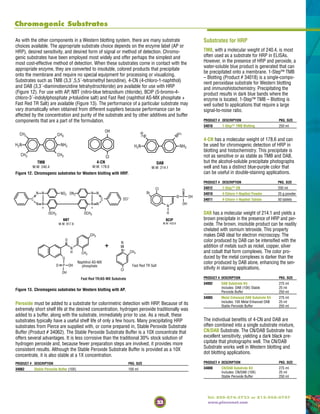
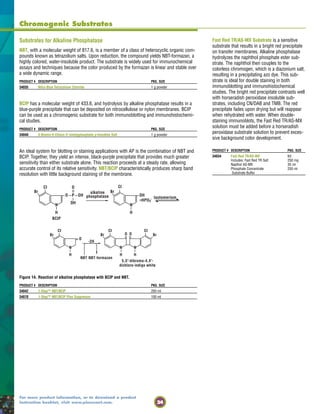
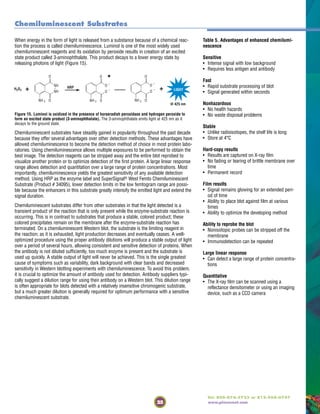
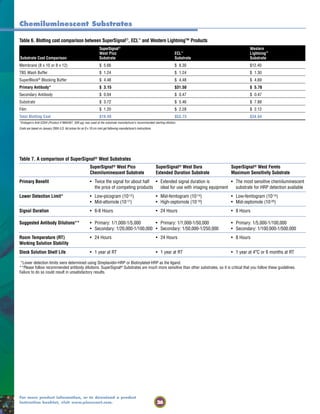
For more product information, or to download a product
instruction booklet, visit www.piercenet.com.
Tel: 800-874-3723 or 815-968-0747
www.piercenet.com
G r a s p t h e P r o t e o m e ™
Western Blotting
Handbook and Troubleshooting Guide
Featuring the SuperSignal® West Family of Products
For more product information, or to download a product
instruction booklet, visit www.piercenet.com.
Table of Contents
Introduction . . . . . . . . . . . . . . . . . . . . . . . . . . . . . . . . . . . . . . . . . . . . . . . . . 1
Western Blotting Overview . . . . . . . . . . . . . . . . . . . . . . . . . . . . . . . . . . . . . 2-3
Transfer Protein to a Membrane . . . . . . . . . . . . . . . . . . . . . . . . . . . . . . . . . . . 4
MemCode™ Protein Stains. . . . . . . . . . . . . . . . . . . . . . . . . . . . . . . . . . 4-5
Blocking Nonspecific Binding Sites. . . . . . . . . . . . . . . . . . . . . . . . . . . . . . . . . 6
Transfer Buffers . . . . . . . . . . . . . . . . . . . . . . . . . . . . . . . . . . . . . . . . . . . 6
Transfer Membranes . . . . . . . . . . . . . . . . . . . . . . . . . . . . . . . . . . . . . . . 6
Blocking Buffer Optimization . . . . . . . . . . . . . . . . . . . . . . . . . . . . . . . . . . . . . 7
Blocking Buffers . . . . . . . . . . . . . . . . . . . . . . . . . . . . . . . . . . . . . . . . . 8-9
Washing the Membrane. . . . . . . . . . . . . . . . . . . . . . . . . . . . . . . . . . . . . . . . 10
Wash Buffers. . . . . . . . . . . . . . . . . . . . . . . . . . . . . . . . . . . . . . . . . . . . 10
Primary and Secondary Antibodies . . . . . . . . . . . . . . . . . . . . . . . . . . . . . . . . 11
Conjugate Stabilizer Solutions . . . . . . . . . . . . . . . . . . . . . . . . . . . . . . . . 12
Affinity-Purified Secondary Antibodies . . . . . . . . . . . . . . . . . . . . . . . . 13-15
Labeling Your Own Antibodies . . . . . . . . . . . . . . . . . . . . . . . . . . . . . . . . . . . 16
ImmunoPure®
Enzymes. . . . . . . . . . . . . . . . . . . . . . . . . . . . . . . . . . . . . 17
EZ-Link™ Activated Enzymes. . . . . . . . . . . . . . . . . . . . . . . . . . . . . . . 18-19
EZ-Label™ Fluorescent Labeling Kits . . . . . . . . . . . . . . . . . . . . . . . . . . . . . . 20
Optimizing Antibody Concentration. . . . . . . . . . . . . . . . . . . . . . . . . . . . . . 21-22
Chromogenic Substrates . . . . . . . . . . . . . . . . . . . . . . . . . . . . . . . . . . . . . 23-24
Chemiluminescent Substrates . . . . . . . . . . . . . . . . . . . . . . . . . . . . . . . . . 25-31
SuperSignal®
Chemiluminescent Substrates . . . . . . . . . . . . . . . . . . . . 26-30
LumiPhos™ Chemiluminescent Substrate . . . . . . . . . . . . . . . . . . . . . . . . 31
Quick Reference Substrate Guide . . . . . . . . . . . . . . . . . . . . . . . . . . . . . . 31
Data Imaging . . . . . . . . . . . . . . . . . . . . . . . . . . . . . . . . . . . . . . . . . . . . . . . 32
CL-XPosure™ Film . . . . . . . . . . . . . . . . . . . . . . . . . . . . . . . . . . . . . . . . 32
Western Blot Detection Kit . . . . . . . . . . . . . . . . . . . . . . . . . . . . . . . . . . . . . . 34
Far-Western Blotting. . . . . . . . . . . . . . . . . . . . . . . . . . . . . . . . . . . . . . . . 35-36
In-Gel Western Detection . . . . . . . . . . . . . . . . . . . . . . . . . . . . . . . . . . . . 37-39
Optimizing the Signal-to-Noise Ratio . . . . . . . . . . . . . . . . . . . . . . . . . . . . . . 40
Restore™ Western Blot Stripping Buffer . . . . . . . . . . . . . . . . . . . . . . . . . 42
Qentix™ Western Blot Signal Enhancer. . . . . . . . . . . . . . . . . . . . . . . . . . 43
Erase-It®
Background Eliminator . . . . . . . . . . . . . . . . . . . . . . . . . . . . 44-45
Troubleshooting Guide – Blotting with Chemiluminescence . . . . . . . . . . . . . 46-49
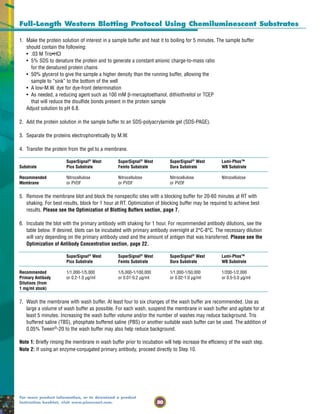
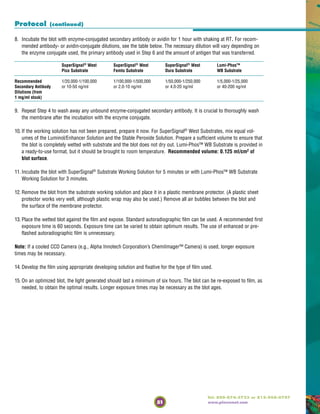
Western Blotting Protocol Using Chemiluminescent Substrates . . . . . . . . . . 50-51
Recommended Reading. . . . . . . . . . . . . . . . . . . . . . . . . . . . . . . . . . . . . . . . 52
Introduction
1
Tel: 800-874-3723 or 815-968-0747
www.piercenet.com
The term “blotting” refers to the transfer of biological samples from a gel to a membrane and
their subsequent detection on the surface of the membrane. Western blotting (also called
immunoblotting because an antibody is used to specifically detect its antigen) was introduced
by Towbin, et al. in 1979 and is now a routine technique for protein analysis. The specificity of
the antibody-antigen interaction enables a single protein to be identified in the midst of a com-
plex protein mixture. Western blotting is commonly used to positively identify a specific
protein in a complex mixture and to obtain qualitative and semiquantitative data about that
protein.
The first step in a Western blotting procedure is to separate the macromolecules using gel
electrophoresis. Following electrophoresis, the separated molecules are transferred or blotted
onto a second matrix, generally a nitrocellulose or polyvinylidene fluoride (PVDF) membrane.
Next, the membrane is blocked to prevent any nonspecific binding of antibodies to the surface
of the membrane. The transferred protein is complexed with an enzyme-labeled antibody as a
probe. An appropriate substrate is then added to the enzyme and together they produce a
detectable product such as a chromogenic or fluorogenic precipitate on the membrane for col-
orimetric or fluorometric detection, respectively. The most sensitive detection methods use a
chemiluminescent substrate that, when combined with the enzyme, produces light as a
byproduct. The light output can be captured using film, a CCD camera or a phosphorimager
that is designed for chemiluminescent detection. Whatever substrate is used, the intensity of
the signal should correlate with the abundance of the antigen on the blotting membrane.
Detailed procedures for detection of a Western blot vary widely. One common variation
involves direct vs. indirect detection as shown in Figure 1. With the direct detection method,
the primary antibody that is used to detect an antigen on the blot is also labeled with an
enzyme or fluorescent dye. This detection method is not widely used as most researchers pre-
fer the indirect detection method for a variety of reasons.
In the indirect detection method, a primary antibody is added first to bind to the antigen. This
is followed by a labeled secondary antibody that is directed against the primary antibody.
Labels include biotin, fluorescent probes such as fluorescein or rhodamine, and enzyme conju-
gates such as horseradish peroxidase or alkaline phosphatase. The indirect method offers
many advantages over the direct method.
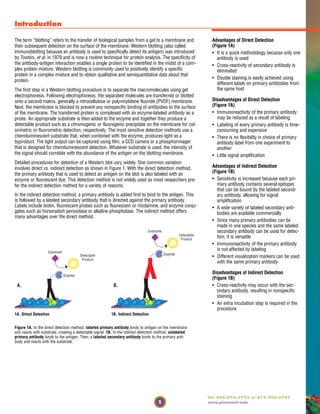
Substrate
Detectable
Product
Substrate
A. B.
Detectable
Product
Enzyme
Enzyme
Figure 1A. In the direct detection method, labeled primary antibody binds to antigen on the membrane
and reacts with substrate, creating a detectable signal. 1B. In the indirect detection method, unlabeled
primary antibody binds to the antigen. Then, a labeled secondary antibody binds to the primary anti-
body and reacts with the substrate.
Advantages of Direct Detection
(Figure 1A)
• It is a quick methodology because only one
antibody is used
• Cross-reactivity of secondary antibody is
eliminated
• Double staining is easily achieved using
different labels on primary antibodies from
the same host
Disadvantages of Direct Detection
(Figure 1A)
• Immunoreactivity of the primary antibody
may be reduced as a result of labeling
• Labeling of every primary antibody is time-
consuming and expensive
• There is no flexibility in choice of primary
antibody label from one experiment to
another
• Little signal amplification
Advantages of Indirect Detection
(Figure 1B)
• Sensitivity is increased because each pri-
mary antibody contains several epitopes
that can be bound by the labeled second-
ary antibody, allowing for signal
amplification
• A wide variety of labeled secondary anti-
bodies are available commercially
• Since many primary antibodies can be
made in one species and the same labeled
secondary antibody can be used for detec-
tion, it is versatile
• Immunoreactivity of the primary antibody
is not affected by labeling
• Different visualization markers can be used
with the same primary antibody
Disadvantages of Indirect Detection
(Figure 1B)
• Cross-reactivity may occur with the sec-
ondary antibody, resulting in nonspecific
staining
• An extra incubation step is required in the
procedure
1A. Direct Detection 1B. Indirect Detection
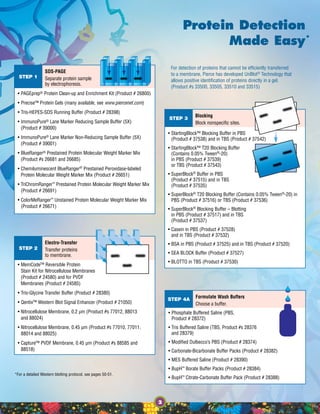
SDS-PAGE
Separate protein sample
by electrophoresis.
• PAGEprep® Protein Clean-up and Enrichment Kit (Product # 26800)
• Precise™ Protein Gels (many available, see www.piercenet.com)
• Tris-HEPES-SDS Running Buffer (Product # 28398)
• ImmunoPure® Lane Marker Reducing Sample Buffer (5X)
(Product # 39000)
• ImmunoPure® Lane Marker Non-Reducing Sample Buffer (5X)
(Product # 39001)
• BlueRanger® Prestained Protein Molecular Weight Marker Mix
(Product #s 26681 and 26685)
• Chemiluminescent BlueRanger®
Prestained Peroxidase-labeled
Protein Molecular Weight Marker Mix (Product # 26651)
• TriChromRanger™ Prestained Protein Molecular Weight Marker Mix
(Product # 26691)
• ColorMeRanger™ Unstained Protein Molecular Weight Marker Mix
(Product # 26671)
Electro-Transfer
Transfer proteins
to membrane.
• MemCode™ Reversible Protein
Stain Kit for Nitrocellulose Membranes
(Product # 24580) and for PVDF
Membranes (Product # 24585)
• Tris-Glycine Transfer Buffer (Product # 28380)
• Qentix™ Western Blot Signal Enhancer (Product # 21050)
• Nitrocellulose Membrane, 0.2 µm (Product #s 77012, 88013
and 88024)
• Nitrocellulose Membrane, 0.45 µm (Product #s 77010, 77011,
88014 and 88025)
• Capture™ PVDF Membrane, 0.45 µm (Product #s 88585 and
88518)
Blocking
Block nonspecific sites.
• StartingBlock™ Blocking Buffer in PBS
(Product # 37538) and in TBS (Product # 37542)
• StartingBlock™ T20 Blocking Buffer
(Contains 0.05% Tween®
-20)
in PBS (Product # 37539)
or TBS (Product # 37543)
• SuperBlock®
Buffer in PBS
(Product # 37515) and in TBS
(Product # 37535)
• SuperBlock®
T20 Blocking Buffer (Contains 0.05% Tween®
-20) in
PBS (Product # 37516) or TBS (Product # 37536)
• SuperBlock®
Blocking Buffer – Blotting
in PBS (Product # 37517) and in TBS
(Product # 37537)
• Casein in PBS (Product # 37528)
and in TBS (Product # 37532)
• BSA in PBS (Product # 37525) and in TBS (Product # 37520)
• SEA BLOCK Buffer (Product # 37527)
• BLOTTO in TBS (Product # 37530)
Formulate Wash Buffers
Choose a buffer.
• Phosphate Buffered Saline (PBS,
Product # 28372)
• Tris Buffered Saline (TBS, Product #s 28376
and 28379)
• Modified Dulbecco’s PBS (Product # 28374)
• Carbonate-Bicarbonate Buffer Packs (Product # 28382)
• MES Buffered Saline (Product # 28390)
• BupH™ Borate Buffer Packs (Product # 28384)
• BupH™ Citrate-Carbonate Buffer Pack (Product # 28388)
For detection of proteins that cannot be efficiently transferred
to a membrane, Pierce has developed UnBlot®
Technology that
allows positive identification of proteins directly in a gel.
(Product #s 33500, 33505, 33510 and 33515)
Protein Detection
Made Easy
STEP 1
STEP 2
STEP 3
STEP 4A
2
*
*For a detailed Western blotting protocol, see pages 50-51.
Formulate Wash Buffers
Add detergent to blocking/wash
buffers to reduce nonspecific binding.
[Skip this step if you use StartingBlock™ T20 Blocking Buffer
in PBS (Product # 37539) or TBS (Product # 37543) or
SuperBlock® T20 Blocking Buffer in PBS (Product #
37516) or TBS (Product # 37536). These buffers already
contain Tween®-20 Detergent at optimized concentrations.]
Surfact-Amps®
Brand Detergents containing:
• Tween®
-20 (Product # 28320)
and Tween®
-80 (Product # 28328)
• Triton®
X-100 (Product # 28314) and Triton®
X-114 (Product # 28332)
• Nonidet P-40 (Product # 28324)
• Brij®
-35 (Product # 28316) and Brij®
-58 (Product # 28336)
Stripping Buffer
Reprobe the blot if necessary.
• Restore™ Western Blot Stripping Buffer
(Product # 21059)
• IgG Elution Buffer (Product #s 21004
and 21009)
Film
Expose the membrane to X-ray film.
• CL-XPosure™ Film
5" x 7" sheets, (Product #s 34090 and 34092);
8" x 10" sheets, (Product #s 34091 and 34093)
• Erase-It® Background Eliminator Kit (Product # 21065)
Enzyme Substrates
Add the detection reagent.
Chemiluminescent Substrates:
• SuperSignal®
West Pico Chemiluminescent
Substrate (Product #s 34077 and 34080)
• SuperSignal®
West Femto Maximum Sensitivity
Substrate (Product #s 34096
and 34095)
• SuperSignal®
West Dura
Extended Duration Substrate (Product #s 34076 and 34075)
• Lumi-Phos™ WB Substrate (Product # 34150)
Colorimetric Substrates:
• 1-Step™ Chloronaphthol (Product # 34012)
• TMB-Blotting (Product # 34018)
• NBT/BCIP (Product # 34042)
• Metal Enhanced DAB (Product # 34065)
HRP
SuperSignal®
Substrate
Primary and Secondary Detection Reagents
Incubate the membrane with antibody.
For a complete list, visit the antibody selection guide
on our web site (www.piercenet.com) accessible
under the Products tab.
For direct detection methods we offer:
• Monoclonal Antibodies
• Fluorescent Probes and Labeling Kits
• Enzyme Labeling Kits
For indirect detection methods we offer:
• Biotinylation Kits
• Protein A, Protein G and Protein L labeled with fluorescein,
rhodamine, HRP, AP or biotin
• Avidin, Streptavidin and NeutrAvidin™ Biotin-Binding Protein
labeled with fluorescein, rhodamine, HRP or AP
• Secondary antibodies labeled with fluorescein, rhodamine,
HRP, AP or biotin
HRP
Ag
For convenience and economy, Pierce also offers complete Western
blotting Kits that include chemiluminescent substrates, enzyme-
conjugated antibodies, blocking buffers and standard buffers.
Western Blotting
the Pierce Way
STEP 4B
STEP 5
STEP 6
STEP 7
STEP 8
3
4
For more product information, or to download a product
instruction booklet, visit www.piercenet.com.
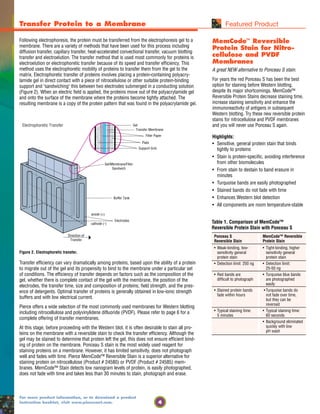
Following electrophoresis, the protein must be transferred from the electrophoresis gel to a
membrane. There are a variety of methods that have been used for this process including
diffusion transfer, capillary transfer, heat-accelerated convectional transfer, vacuum blotting
transfer and electroelution. The transfer method that is used most commonly for proteins is
electroelution or electrophoretic transfer because of its speed and transfer efficiency. This
method uses the electrophoretic mobility of proteins to transfer them from the gel to the
matrix. Electrophoretic transfer of proteins involves placing a protein-containing polyacry-
lamide gel in direct contact with a piece of nitrocellulose or other suitable protein-binding
support and "sandwiching" this between two electrodes submerged in a conducting solution
(Figure 2). When an electric field is applied, the proteins move out of the polyacrylamide gel
and onto the surface of the membrane where the proteins become tightly attached. The
resulting membrane is a copy of the protein pattern that was found in the polyacrylamide gel.
Figure 2. Electrophoretic transfer.
Transfer efficiency can vary dramatically among proteins, based upon the ability of a protein
to migrate out of the gel and its propensity to bind to the membrane under a particular set
of conditions. The efficiency of transfer depends on factors such as the composition of the
gel, whether there is complete contact of the gel with the membrane, the position of the
electrodes, the transfer time, size and composition of proteins, field strength, and the pres-
ence of detergents. Optimal transfer of proteins is generally obtained in low-ionic strength
buffers and with low electrical current.
Pierce offers a wide selection of the most commonly used membranes for Western blotting
including nitrocellulose and polyvinylidene difluoride (PVDF). Please refer to page 6 for a
complete offering of transfer membranes.
At this stage, before proceeding with the Western blot, it is often desirable to stain all pro-
teins on the membrane with a reversible stain to check the transfer efficiency. Although the
gel may be stained to determine that protein left the gel, this does not ensure efficient bind-
ing of protein on the membrane. Ponceau S stain is the most widely used reagent for
staining proteins on a membrane. However, it has limited sensitivity, does not photograph
well and fades with time. Pierce MemCode™ Reversible Stain is a superior alternative for
staining protein on nitrocellulose (Product # 24580) or PVDF (Product # 24585) mem-
branes. MemCode™ Stain detects low nanogram levels of protein, is easily photographed,
does not fade with time and takes less than 30 minutes to stain, photograph and erase.
Gel/Membrane/Filter
Sandwich
Buffer Tank
Direction of
Transfer
anode (+)
cathode (-)
Electrodes
Gel
Transfer Membrane
Filter Paper
Pads
Support Grid
Electrophoretic Transfer
Transfer Protein to a Membrane Featured Product
MemCode™ Reversible
Protein Stain for Nitro-
cellulose and PVDF
Membranes
A great NEW alternative to Ponceau S stain.
For years the red Ponceau S has been the best
option for staining before Western blotting,
despite its major shortcomings. MemCode™
Reversible Protein Stains decrease staining time,
increase staining sensitivity and enhance the
immunoreactivity of antigens in subsequent
Western blotting. Try these new reversible protein
stains for nitrocellulose and PVDF membranes
and you will never use Ponceau S again.
Highlights:
• Sensitive, general protein stain that binds
tightly to proteins
• Stain is protein-specific, avoiding interference
from other biomolecules
• From stain to destain to band erasure in
minutes
• Turquoise bands are easily photographed
• Stained bands do not fade with time
• Enhances Western blot detection
• All components are room temperature-stable
Table 1. Comparison of MemCode™
Reversible Protein Stain with Ponceau S
Ponceau S MemCode™ Reversible
Reversible Stain Protein Stain
• Weak-binding, low- • Tight-binding, higher
sensitivity general sensitivity general
protein stain protein stain
• Detection limit: 250 ng • Detection limit:
25-50 ng
• Red bands are • Turquoise blue bands
difficult to photograph are photographed
easily
• Stained protein bands • Turquoise bands do
fade within hours not fade over time,
but they can be
reversed
• Typical staining time: • Typical staining time:
5 minutes 60 seconds
• Background eliminated
quickly with low
pH wash
5
Tel: 800-874-3723 or 815-968-0747
www.piercenet.com
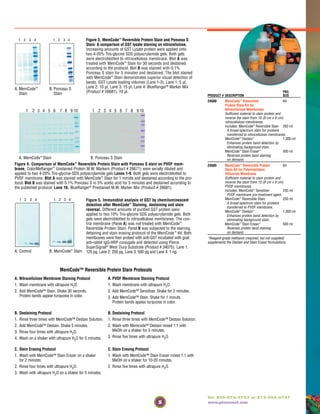
1 2 3 4 1 2 3 4
A. MemCode™ B. Ponceau S
Stain Stain
1 2 3 4 1 2 3 4
A. Control B. MemCode™ Stain
1 2 3 4 5 6 7 8 9 10 1 2 3 4 5 6 7 8 9 10
A. MemCode™ Stain B. Ponceau S Stain
Figure 4. Comparison of MemCode™ Reversible Protein Stain with Ponceau S stain on PVDF mem-
brane. ColorMeRanger™ Unstained Protein M.W. Markers (Product # 26671) were serially diluted and
applied to two 4-20% Tris-glycine-SDS polyacrylamide gels Lanes 1-9. Both gels were electroblotted to
PVDF membrane. Blot A was stained with MemCode™ Stain for 1 minute and destained according to the pro-
tocol. Blot B was stained with 0.1% Ponceau S in 5% acetic acid for 5 minutes and destained according to
the published protocol. Lane 10. BlueRanger®
Prestained M.W. Marker Mix (Product # 26681).
MemCode™ Reversible Protein Stain Protocols
A. Nitrocellulose Membrane Staining Protocol A. PVDF Membrane Staining Protocol
1. Wash membrane with ultrapure H2O. 1. Wash membrane with ultrapure H2O.
2. Add MemCode™ Stain. Shake 30 seconds. 2. Add MemCode™ Sensitizer. Shake for 2 minutes.
Protein bands appear turquoise in color. 3. Add MemCode™ Stain. Shake for 1 minute.
Protein bands appear turquoise in color.
B. Destaining Protocol B. Destaining Protocol
1. Rinse three times with MemCode™ Destain Solution. 1. Rinse three times with MemCode™ Destain Solution.
2. Add MemCode™ Destain. Shake 5 minutes. 2. Wash with Memcode™ Destain mixed 1:1 with
MeOH on a shaker for 5 minutes.3. Rinse four times with ultrapure H2O.
3. Rinse five times with ultrapure H2O.4. Wash on a shaker with ultrapure H2O for 5 minutes.
C. Stain Erasing Protocol C. Stain Erasing Protocol
1. Wash with MemCode™ Stain Eraser on a shaker 1. Wash with MemCode™ Stain Eraser mixed 1:1 with
for 2 minutes. MeOH on a shaker for 10-20 minutes.
2. Rinse four times with ultrapure H2O. 2. Rinse five times with ultrapure H2O.
3. Wash with ultrapure H2O on a shaker for 5 minutes.
Figure 3. MemCode™ Reversible Protein Stain and Ponceau S
Stain: A comparison of GST lysate staining on nitrocellulose.
Increasing amounts of GST Lysate protein were applied onto
two 4-20% Tris-glycine SDS polyacrylamide gels. Both gels
were electroblotted to nitrocellulose membrane. Blot A was
treated with MemCode™ Stain for 30 seconds and destained
according to the protocol. Blot B was stained with 0.1%
Ponceau S stain for 5 minutes and destained. The blot stained
with MemCode™ Stain demonstrates superior visual detection of
bands. GST Lysate loading volumes (Lane 1-3). Lane 1: 5 µl,
Lane 2: 10 µl, Lane 3: 15 µl, Lane 4: BlueRanger®
Marker Mix
(Product # 26681), 10 µl.
Figure 5. Immunoblot analysis of GST by chemiluminescent
detection after MemCode™ Staining, destaining and stain
reversal. Different amounts of purified GST protein were
applied to two 10% Tris-glycine SDS polyacrylamide gels. Both
gels were electroblotted to nitrocellulose membranes. The con-
trol membrane (Panel A) was not treated with MemCode™
Reversible Protein Stain. Panel B was subjected to the staining,
detaining and stain erasing protocol of the MemCode™ Kit. Both
membranes were then probed with anti-GST incubated with goat
anti-rabbit IgG-HRP conjugate and detected using Pierce
SuperSignal®
West Dura Substrate (Product # 34075). Lane 1:
125 pg, Lane 2: 250 pg, Lane 3: 500 pg and Lane 4: 1 ng.
PKG.
PRODUCT # DESCRIPTION SIZE
24580 MemCode™ Reversible Kit
Protein Stain Kit for
Nitrocellulose Membranes
Sufficient material to stain protein and
reverse the stain from 10 (8 cm x 8 cm)
nitrocellulose membranes.
Includes: MemCode™ Reversible Stain 250 ml
A broad-spectrum stain for proteins
transferred to nitrocellulose membranes.
MemCode™ Destain* 1,000 ml
Enhances protein band detection by
eliminating background stain.
MemCode™ Stain Eraser* 500 ml
Reverses protein band staining
on demand.
24585 MemCode™ Reversible Protein Kit
Stain Kit for Polyvinylidene
Difluoride Membrane
Sufficient material to stain protein and
reverse the stain from 10 (8 cm x 8 cm)
PVDF membranes.
Includes: MemCode™ Sensitizer 250 ml
PVDF membrane pre-treatment agent.
MemCode™ Reversible Stain 250 ml
A broad-spectrum stain for proteins
transferred to PVDF membrane.
MemCode™ Destain* 1,000 ml
Enhances protein band detection by
eliminating background stain.
MemCode™ Stain Eraser* 500 ml
Reverses protein band staining
on demand.
*Reagent-grade methanol (required, but not supplied)
supplements the Destain and Stain Eraser formulations.
6
For more product information, or to download a product
instruction booklet, visit www.piercenet.com.
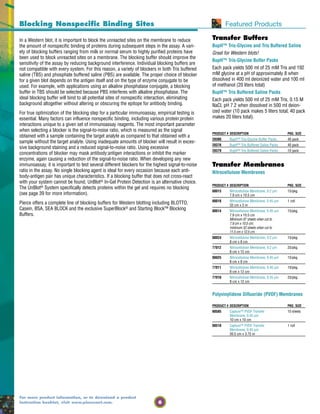
Transfer Buffers
BupH™ Tris-Glycine and Tris Buffered Saline
Great for Western blots!
BupH™ Tris-Glycine Buffer Packs
Each pack yields 500 ml of 25 mM Tris and 192
mM glycine at a pH of approximately 8 when
dissolved in 400 ml deionized water and 100 ml
of methanol (20 liters total)
BupH™ Tris Buffered Saline Packs
Each pack yields 500 ml of 25 mM Tris, 0.15 M
NaCl, pH 7.2 when dissolved in 500 ml deion-
ized water (10 pack makes 5 liters total; 40 pack
makes 20 liters total).
In a Western blot, it is important to block the unreacted sites on the membrane to reduce
the amount of nonspecific binding of proteins during subsequent steps in the assay. A vari-
ety of blocking buffers ranging from milk or normal serum to highly purified proteins have
been used to block unreacted sites on a membrane. The blocking buffer should improve the
sensitivity of the assay by reducing background interference. Individual blocking buffers are
not compatible with every system. For this reason, a variety of blockers in both Tris buffered
saline (TBS) and phosphate buffered saline (PBS) are available. The proper choice of blocker
for a given blot depends on the antigen itself and on the type of enzyme conjugate to be
used. For example, with applications using an alkaline phosphatase conjugate, a blocking
buffer in TBS should be selected because PBS interferes with alkaline phosphatase. The
ideal blocking buffer will bind to all potential sites of nonspecific interaction, eliminating
background altogether without altering or obscuring the epitope for antibody binding.
For true optimization of the blocking step for a particular immunoassay, empirical testing is
essential. Many factors can influence nonspecific binding, including various protein:protein
interactions unique to a given set of immunoassay reagents. The most important parameter
when selecting a blocker is the signal-to-noise ratio, which is measured as the signal
obtained with a sample containing the target analyte as compared to that obtained with a
sample without the target analyte. Using inadequate amounts of blocker will result in exces-
sive background staining and a reduced signal-to-noise ratio. Using excessive
concentrations of blocker may mask antibody:antigen interactions or inhibit the marker
enzyme, again causing a reduction of the signal-to-noise ratio. When developing any new
immunoassay, it is important to test several different blockers for the highest signal-to-noise
ratio in the assay. No single blocking agent is ideal for every occasion because each anti-
body-antigen pair has unique characteristics. If a blocking buffer that does not cross-react
with your system cannot be found, UnBlot® In-Gel Protein Detection is an alternative choice.
The UnBlot® System specifically detects proteins within the gel and requires no blocking
(see page 39 for more information).
Pierce offers a complete line of blocking buffers for Western blotting including BLOTTO,
Casein, BSA, SEA BLOCK and the exclusive SuperBlock® and Starting Block™ Blocking
Buffers.
Blocking Nonspecific Binding Sites Featured Products
PRODUCT # DESCRIPTION PKG. SIZE
28380 BupH™ Tris-Glycine Buffer Packs 40 pack
28376 BupH™ Tris Buffered Saline Packs 40 pack
28379 BupH™ Tris Buffered Saline Packs 10 pack
Transfer Membranes
Nitrocellulose Membranes
PRODUCT # DESCRIPTION PKG. SIZE
88013 Nitrocellulose Membrane, 0.2 µm 15/pkg.
7.9 cm x 10.5 cm
88018 Nitrocellulose Membrane, 0.45 µm 1 roll
33 cm x 3 m
88014 Nitrocellulose Membrane, 0.45 µm 15/pkg.
7.9 cm x 10.5 cm
Minimum 87 sheets when cut to
7.9 cm x 10.5 cm;
minimum 52 sheets when cut to
11.5 cm x 12.5 cm.
88024 Nitrocellulose Membrane, 0.2 µm 15/pkg.
8 cm x 8 cm
77012 Nitrocellulose Membrane, 0.2 µm 25/pkg.
8 cm x 12 cm
88025 Nitrocellulose Membrane, 0.45 µm 15/pkg.
8 cm x 8 cm
77011 Nitrocellulose Membrane, 0.45 µm 10/pkg.
8 cm x 12 cm
77010 Nitrocellulose Membrane, 0.45 µm 25/pkg.
8 cm x 12 cm
Polyvinylidene Difluoride (PVDF) Membranes
PRODUCT # DESCRIPTION PKG. SIZE
88585 Capture™ PVDF Transfer 10 sheets
Membrane, 0.45 µm
10 cm x 10 cm
88518 Capture™ PVDF Transfer 1 roll
Membrane, 0.45 µm
26.5 cm x 3.75 m
7
Tel: 800-874-3723 or 815-968-0747
www.piercenet.com
Blocking Buffer Optimization
The most appropriate blocking buffer for
Western blotting use is often system-depend-
ent. Determining the proper blocking buffer can
help to increase the system’s signal-to-noise
ratio. Occasionally, when switching from one
substrate to another, the blocking buffer that
you are using will lead to diminished signal or
increased background. Empirically testing vari-
ous blocking buffers with your system can help
achieve the best possible results. Avoid using
milk as a blocking reagent for blots that rely on
the avidin/biotin system because milk contains
variable amounts of biotin. Although
SuperBlock® Blocking Buffer (Product # 37515)
often gives excellent results, we recommend
testing several blocking reagents for their suit-
ability in a particular system. There is no
blocking reagent that will be the optimal reagent
for all systems.
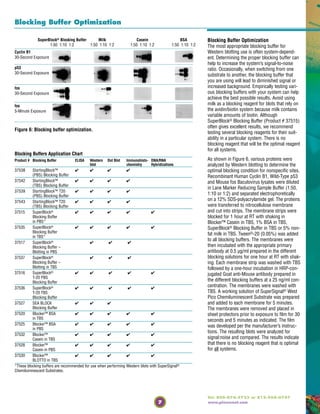
As shown in Figure 6, various proteins were
analyzed by Western blotting to determine the
optimal blocking condition for nonspecific sites.
Recombinant Human Cyclin B1, Wild-Type p53
and Mouse fos Baculovirus lysates were diluted
in Lane Marker Reducing Sample Buffer (1:50,
1:10 or 1:2) and separated electrophoretically
on a 12% SDS-polyacrylamide gel. The proteins
were transferred to nitrocellulose membrane
and cut into strips. The membrane strips were
blocked for 1 hour at RT with shaking in
Blocker™ Casein in TBS, 1% BSA in TBS,
SuperBlock® Blocking Buffer in TBS or 5% non-
fat milk in TBS. Tween®-20 (0.05%) was added
to all blocking buffers. The membranes were
then incubated with the appropriate primary
antibody at 0.5 µg/ml prepared in the different
blocking solutions for one hour at RT with shak-
ing. Each membrane strip was washed with TBS
followed by a one-hour incubation in HRP-con-
jugated Goat anti-Mouse antibody prepared in
the different blocking buffers at a 25 ng/ml con-
centration. The membranes were washed with
TBS. A working solution of SuperSignal® West
Pico Chemiluminescent Substrate was prepared
and added to each membrane for 5 minutes.
The membranes were removed and placed in
sheet protectors prior to exposure to film for 30
seconds and 5 minutes as indicated. The film
was developed per the manufacturer’s instruc-
tions. The resulting blots were analyzed for
signal:noise and compared. The results indicate
that there is no blocking reagent that is optimal
for all systems.
Cyclin B1
30-Second Exposure
p53
30-Second Exposure
fos
30-Second Exposure
fos
5-Minute Exposure
SuperBlock® Blocking Buffer Milk Casein BSA
1:50 1:10 1:2 1:50 1:10 1:2 1:50 1:10 1:2 1:50 1:10 1:2
Figure 6: Blocking buffer optimization.
Blocking Buffer Optimization
Blocking Buffers Application Chart
Product # Blocking Buffer ELISA Western Dot Blot Immunohisto- DNA/RNA
blot chemistry Hybridizations
37538 StartingBlock™ ✔ ✔ ✔ ✔
(PBS) Blocking Buffer
37542 StartingBlock™ ✔ ✔ ✔ ✔
(TBS) Blocking Buffer
37539 StartingBlock™ T20 ✔ ✔ ✔ ✔
(PBS) Blocking Buffer
37543 StartingBlock™ T20 ✔ ✔ ✔ ✔
(TBS) Blocking Buffer
37515 SuperBlock® ✔ ✔ ✔ ✔ ✔
Blocking Buffer
in PBS*
37535 SuperBlock® ✔ ✔ ✔ ✔ ✔
Blocking Buffer
in TBS*
37517 SuperBlock® ✔ ✔ ✔
Blocking Buffer –
Blotting in PBS
37537 SuperBlock® ✔ ✔ ✔
Blocking Buffer –
Blotting in TBS
37516 SuperBlock® ✔ ✔ ✔ ✔ ✔
T-20 PBS
Blocking Buffer
37536 SuperBlock® ✔ ✔ ✔ ✔ ✔
T-20 TBS
Blocking Buffer
37527 SEA BLOCK ✔ ✔ ✔
Blocking Buffer
37520 Blocker™ BSA ✔ ✔ ✔ ✔ ✔
in TBS
37525 Blocker™ BSA ✔ ✔ ✔ ✔ ✔
in PBS
37532 Blocker™ ✔ ✔ ✔ ✔ ✔
Casein in TBS
37528 Blocker™ ✔ ✔ ✔ ✔ ✔
Casein in PBS
37530 Blocker™ ✔ ✔ ✔ ✔ ✔
BLOTTO in TBS
*These blocking buffers are recommended for use when performing Western blots with SuperSignal®
Chemiluminescent Substrates.
8
For more product information, or to download a product
instruction booklet, visit www.piercenet.com.
StartingBlock™ Blocking Buffer
Confused about all the blocking options available for Western blot and ELISA applications?
StartingBlock™ Blocking Buffer simplifies the selection of a blocker.
Although no blocking buffer is ideal for every system, you can improve the odds dramatical-
ly with StartingBlock™ Blocking Buffer because it is compatible with the widest variety of
antibodies.
For example: StartingBlock™ Blocking Buffers are compatible with biotin-containing sys-
tems, while milk-based protein blockers interfere. StartingBlock™ Buffers do not cross-react
with rabbit antibodies, while many other blockers do. StartingBlock™ Blocking Buffers are
also free of potentially interfering serum proteins.
StartingBlock™ Blocking Buffers offer a high level of performance – regardless of the sys-
tem you choose for your Western blotting or ELISA application. In fact, they may be the
only blockers you ever use.
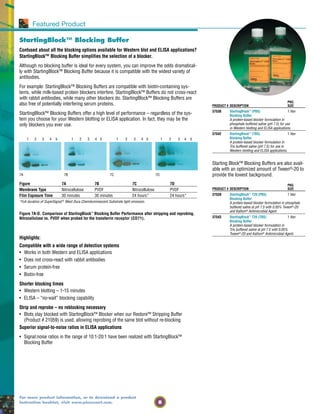
7A 7B 7C 7D
Figure 7A 7B 7C 7D
Membrane Type Nitrocellulose PVDF Nitrocellulose PVDF
Film Exposure Time 30 minutes 30 minutes 24 hours* 24 hours*
*Full duration of SuperSignal ®
West Dura Chemiluminescent Substrate light emission.
Figure 7A-D. Comparison of StartingBlock™ Blocking Buffer Performance after stripping and reprobing.
Nitrocellulose vs. PVDF when probed for the transferrin receptor (CD71).
Highlights:
Compatible with a wide range of detection systems
• Works in both Western and ELISA applications
• Does not cross-react with rabbit antibodies
• Serum protein-free
• Biotin-free
Shorter blocking times
• Western blotting – 1-15 minutes
• ELISA – “no-wait” blocking capability
Strip and reprobe – no reblocking necessary
• Blots stay blocked with StartingBlock™ Blocker when our Restore™ Stripping Buffer
(Product # 21059) is used, allowing reprobing of the same blot without re-blocking
Superior signal-to-noise ratios in ELISA applications
• Signal:noise ratios in the range of 10:1-20:1 have been realized with StartingBlock™
Blocking Buffer
Featured Product
1 2 3 4 5 1 2 3 4 5 1 2 3 4 5 1 2 3 4 5
PKG.
PRODUCT # DESCRIPTION SIZE
37538 StartingBlock™ (PBS) 1 liter
Blocking Buffer
A protein-based blocker formulation in
phosphate buffered saline (pH 7.5) for use
in Western blotting and ELISA applications.
37542 StartingBlock™ (TBS) 1 liter
Blocking Buffer
A protein-based blocker formulation in
Tris buffered saline (pH 7.5) for use in
Western blotting and ELISA applications.
Starting Block™ Blocking Buffers are also avail-
able with an optimized amount of Tween®-20 to
provide the lowest background.
PKG.
PRODUCT # DESCRIPTION SIZE
37539 StartingBlock™ T20 (PBS) 1 liter
Blocking Buffer
A protein-based blocker formulation in phosphate
buffered saline at pH 7.5 with 0.05% Tween®-20
and Kathon® Antimicrobial Agent.
37543 StartingBlock™ T20 (TBS) 1 liter
Blocking Buffer
A protein-based blocker formulation in
Tris buffered saline at pH 7.5 with 0.05%
Tween®-20 and Kathon® Antimicrobial Agent.
9
Tel: 800-874-3723 or 815-968-0747
www.piercenet.com
Featured Products
SuperBlock® Blocking Buffers
Guaranteed to be biotin-free.
Our most popular blocking buffer, SuperBlock® Blocking Buffer, now comes in both dry and
liquid formats! Many researchers have discovered that SuperBlock® Blocking Buffer is the
only blocking buffer needed for all of their applications.
Highlights:
• Fast blocking – blocks ELISA plates in two minutes or membranes in five to 10 minutes
• Non-serum protein solution yields a very high signal-to-noise ratio
• Plates blocked with SuperBlock® Blocking Buffer can be stored dry for up to 12 months
• Liquid formulations available in PBS or TBS
SuperBlock® Dry Blend (TBS) Blocking Buffer
Delivers the ultimate in space-saving convenience.
Highlights:
• Delivers even more economy and stability
• Each pouch reconstitutes to form 200 ml of SuperBlock® Blocking Buffer in TBS
• Room-temperature storage; small packaging takes up minimal shelf space
References
Ikeda, K., et al. (2003) J. Biol. Chem. 278, 7725-7734.
Leclerc, G.J. and Barredo, J.C. (2001) Clin. Cancer Res. 7, 942-951.
Subbarayan, V., et al. (2001) Cancer Res. 61, 2720-276.
Walters, R.W., et al. (2002) Cell 100, 789-799.
SEA BLOCK Blocking Buffer
No mammalian proteins, reducing the risk of nonspecific interaction.
Highlights:
• Made from steelhead salmon serum
• Functions as a universal blocker
• Offers reduced background
• Can be diluted up to 1:10 with buffer
References
Hypolite, J.A., et al. (2001). Am. J. Physiol. Cell Physiol. 280, C254-264.
Wang, L., et al. (2002). J. Clin. Invest. 110, 1175-1184.
PRODUCT # DESCRIPTION PKG. SIZE
37527 SEA BLOCK Blocking Buffer 500 ml
Blocker™ Casein
Ready-to-use solution (1% w/v) of Hammersten
Grade casein for blocking nonspecific sites.
Highlights:
• Preformulated for ease of use
• Use when skim milk demonstrates high
background problems
• Thimerosal-free formulation
PRODUCT # DESCRIPTION PKG. SIZE
37532 Blocker™ Casein in TBS 1 liter
1% (w/v) Casein Hammersten Grade in TBS,
Contains Kathon® Antimicrobial Reagent
as preservative, pH 7.4.
37528 Blocker™ Casein in PBS 1 liter
1% (w/v) Casein Hammersten Grade in PBS,
Contains Kathon® Antimicrobial Reagent
as preservative, pH 7.4.
Blocker™ BLOTTO
Ready-to-use blocking buffers made of nonfat
dry milk.
Highlights:
• Preformulated for ease of use
• Anti-foaming agent added
• Available in TBS Buffer
• Merthiolate-free formulation
PRODUCT # DESCRIPTION PKG. SIZE
37530 Blocker™ BLOTTO in TBS 1 liter
5% (w/v) nonfat powdered milk in TBS, 0.01%
Anti-foam A, contains Kathon® Antimicrobial
Reagent as preservative, pH 7.4.
Blocker™ BSA
For all blocking applications.
Highlights:
• 10% solutions of high-quality Bovine Serum
Albumin
• Concentrated formulation saves storage
space
• No waiting for powder to dissolve with this
ready-to-dilute liquid concentrate
PRODUCT # DESCRIPTION PKG. SIZE
37525 Blocker™ BSA in PBS (10X) 200 ml
37520 Blocker™ BSA in TBS (10X) 125 ml
Surfact-Amps® 20 Purified Detergent Solution
Specially purified form of Tween®-20.
Highlights:
• Guaranteed <1 milliequivalent of peroxides
and carbonyl in a 10% solution
• Enhances signal-to-background ratio
PRODUCT # DESCRIPTION PKG. SIZE
28320 Surfact-Amps® 20 Purified 6 x 10 ml
Detergent Solution
PRODUCT # DESCRIPTION PKG. SIZE
37515 SuperBlock® (PBS) Blocking Buffer 1 liter
37516 SuperBlock® T20 (PBS) Blocking Buffer (Contains 0.05% Tween®-20) 1 liter
37535 SuperBlock® (TBS) Blocking Buffer 1 liter
37536 SuperBlock® T20 (TBS) Blocking Buffer (Contains 0.05% Tween®-20) 1 liter
37517 SuperBlock® (PBS) Blocking Buffer – Blotting* 1 liter
37537 SuperBlock® (TBS) Blocking Buffer – Blotting* 1 liter
37545 SuperBlock® (TBS) Blocking Buffer 5 pouches
Dry Blend Blocking Buffer
Each pouch yields 200 ml when reconstituted.
* Formulated for precipitating enzyme substrates. Added ingredient to keep precipitate from flaking. Not recommended for
chemiluminescent substrates.
10
For more product information, or to download a product
instruction booklet, visit www.piercenet.com.
Like other immunoassay procedures, Western blotting consists of a series of incubations
with different immunochemical reagents separated by wash steps. Washing steps are nec-
essary to remove unbound reagents and reduce background, thereby increasing the
signal-to-noise ratio. Insufficient washing will allow high background, while excessive wash-
ing may result in decreased sensitivity caused by elution of the antibody and/or antigen
from the blot. As with other steps in performing a Western blot, a variety of buffers may be
used. Occasionally, washing is performed in a physiologic buffer such as Tris buffered saline
(TBS) or phosphate buffered saline (PBS) without any additives. More commonly, a deter-
gent such as 0.05% Tween®-20 (Product # 28320) is added to the buffer to help remove
nonspecifically bound material. Another common technique is to use a dilute solution of the
blocking buffer along with some added detergent. Including the blocking agent and adding a
detergent in wash buffers helps to minimize background in the assay. For best results, use
high-purity detergents, such as Surfact-Amps® Detergents for Western blotting.
BupH™ Dry Buffers
The most advanced, versatile, time-saving buffer product line available.
The ultimate in convenience …
1. Reach for the sealed foil pack sitting conveniently on your bench top.
2. Open, pour into beaker and add water.
3. The fresh buffer is ready to use in practical aliquots so there’s no waste.
The ultimate in versatility …
1. Routine buffers are designed for use in Western blotting, dialysis, cross-linking, ELISAs,
immunohistochemistry, protein plate-coating, biotinylation and other applications.
2. Using one buffer source maintains consistency and eliminates variables within the lab.
The ultimate in integrity …
1. BupH™ Buffers are protected from contamination and are fresh every time.
2. Carry out applications with confidence in buffer quality.
3. “Test-assured” with the Pierce commitment to quality management standards.
The ultimate in time savings …
1. Making routine buffers is no longer time-consuming.
2. No component measurement, pH adjustment, quality validation, preparation tracking or
refrigeration hassles.
3. Move forward with your work by eliminating re-tests due to buffer problems.
Washing the Membrane
BupH™ Phosphate Buffered Saline Packs
Great wash buffer for Western blots!
Each pack yields 500 ml of 0.1 M phosphate,
0.15 M NaCl, pH 7.0 when dissolved in 500 ml
deionized water (20 liters total).
PRODUCT # DESCRIPTION PKG. SIZE
28372 BupH™ Phosphate Buffered 40 pack
Saline Packs
BupH™ Tris Buffered Saline
Great wash buffer for Western blots!
Each pack yields 500 ml of 25 mM Tris, 0.15 M
NaCl, pH 7.2 when dissolved in 500 ml deion-
ized water (10 pack makes 5 liters total; 40 pack
makes 20 liters total).
PRODUCT # DESCRIPTION PKG. SIZE
28380 BupH™ Tris-Glycine 40 pack
Buffer Packs
28376 BupH™ Tris Buffered 40 pack
Saline Packs
28379 BupH™ Tris Buffered 10 pack
Saline Packs
Surfact-Amps® 20 Purified Detergent Solution
Specially purified form of Tween®-20.
Highlights:
• Can be added to PBS or TBS wash buffers to
improve performance
• Guaranteed < 1 milliequivalent of peroxides
and carbonyl in a 10% solution
• Enhances signal-to-background ratio
PRODUCT # DESCRIPTION PKG. SIZE
28320 Surfact-Amps® 20 6 x 10 ml
11
Tel: 800-874-3723 or 815-968-0747
www.piercenet.com
Primary and Secondary Antibodies
The choice of a primary antibody for a Western blot will depend on the antigen to be detected
and what antibodies are available to that antigen. A huge number of primary antibodies are
available commercially and can be identified quickly by searching sites such as www.anti-
bodyresource.com or www.sciquest.com on the Internet. Alternatively, a primary antibody may
be made to recognize the antigen of interest. For more information on producing a custom
antibody, see the Antibody Production and Purification technical section of the Pierce
Technical Handbook and Catalog. Both polyclonal and monoclonal antibodies work well for
Western blotting. Polyclonal antibodies are less expensive and less time-consuming to pro-
duce and they often have a high affinity for the antigen. Monoclonal antibodies are valued for
their specificity, purity and consistency that result in lower background. Crude antibody prepa-
rations such as serum or ascites fluid are sometimes used for Western blotting, but the
impurities present may increase background. To obtain antibodies with the greatest specificity,
they can be affinity-purified using the immobilized antigen. For more information on affinity
purification, order your FREE Affinity Purification Handbook from a Pierce Customer Service
representative at 800-874-3723 or 815-968-0747, or from your local Perbio Science Branch
office or distributor.
A wide variety of labeled, secondary antibodies can be used for Western blot detection. The
choice of secondary antibody depends upon the species of animal in which the primary anti-
body was raised (the host species). For example, if the primary antibody is a mouse
monoclonal antibody, the secondary antibody must be an anti-mouse antibody obtained from
a host other than the mouse. The host species of the secondary antibody often will not affect
the experiment. However, secondary antibodies are available from several different host
species and, if a secondary antibody causes high background in a particular assay, another
host species may be chosen. Another option to reduce background is to use a secondary anti-
body that has been pre-adsorbed to serum proteins from other species. This pre-adsorption
process removes antibodies that have the potential to cross-react with serum proteins, includ-
ing antibodies, from those species. To expedite the process of choosing the appropriate
secondary antibody, visit the Secondary Antibody Selection Guide on the Pierce web site,
located under the Products tab, or the home page.
Antibodies for Western blotting are typically used as dilute solutions, ranging from 1/100-
1/500,000 dilutions beginning from a 1 mg/ml stock solution. The optimal dilution of a given
antibody with a particular detection system must be determined experimentally. More sensitive
detection systems require that less antibody be used, which can result in substantial savings on
antibody costs and allow a limited supply of antibody to be stretched out over more experiments.
It also produces a side benefit of reduced background because the limited amount of antibody
shows increased specificity for the target with the highest affinity. Antibody dilutions are typically
made in the wash buffer containing a blocking agent. The presence of a small amount of blocking
agent and detergent in the antibody diluent often helps to minimize background.
Pierce offers a wide variety of ImmunoPure® Labeled Secondary Antibodies for use in
Western blotting. The labels include biotin, fluorescein, rhodamine, horseradish peroxidase
and alkaline phosphatase. For the complete list of labeled secondary antibodies please refer to
pages 13-15.
Antibody Labels
The choice of secondary antibody also depends upon the type of label that is desired. Many
different labels can be conjugated to antibodies. Radioisotopes were used extensively in the
past, but they are expensive, have a short shelf-life, offer no improvement in signal-to-noise
ratio and require special handling. Alternative labels are biotin, fluorophores and enzymes. The
use of fluorophores requires fewer steps; however, special equipment is needed to view the
fluorescence. Also, a photograph must be taken if a permanent record of the results is
desired. Enzymatic labels are used most commonly and, although they require extra steps,
they can also be extremely sensitive.
Alkaline phosphatase (AP) and horseradish peroxidase (HRP) are the two enzymes that are
used extensively as labels for protein detection. An array of chromogenic, fluorogenic and
chemiluminescent substrates is available for use with either enzyme. For a detailed compari-
son of these two enzymes, see Table 2.
Alkaline phosphatase, a 140,000 dalton protein
that is generally isolated from calf intestine, cat-
alyzes the hydrolysis of phosphate groups from
a substrate molecule, resulting in a colored or
fluorescent product or the release of light as a
byproduct. AP has optimal enzymatic activity at
a basic pH (pH 8-10) and can be inhibited by
cyanides, arsenate, inorganic phosphate and
divalent cation chelators, such as EDTA. As a
label for Western blotting, AP offers a distinct
advantage over other enzymes. Because its
reaction rate remains linear, detection sensitivity
can be improved by simply allowing a reaction
to proceed for a longer time period.
Horseradish peroxidase is a 40,000 dalton pro-
tein that catalyzes the oxidation of substrates by
hydrogen peroxide, resulting in a colored or flu-
orescent product or the release of light as a
byproduct. HRP functions optimally at a near-
neutral pH and can be inhibited by cyanides,
sulfides and azides. Antibody-HRP conjugates
are superior to antibody-AP conjugates with
respect to the specific activities of both the
enzyme and antibody. In addition, its high
turnover rate, good stability, low cost and wide
availability of substrates make HRP the enzyme
of choice for most applications.
Table 2. Comparison of horseradish peroxidase
and alkaline phosphatase enzymes
Horseradish Alkaline
Peroxidase Phosphatase
Size 40 kDa 140 kDa
Price Relatively Relatively
Inexpensive Expensive
Stability Stable at < 0˚C Unstable at < 0˚C
(Storage)
Number of Many Few
Substrates
Kinetics Rapid Slower
pH optimum 5-7 8-10
12
For more product information, or to download a product
instruction booklet, visit www.piercenet.com.
Table 3: Key to abbreviations for individual species
Bv = Bovine Gu = Guinea Pig Hs = Horse Rt = Rat
Ch = Chicken Ha = Hamster Ms = Mouse Sh = Sheep
Gt = Goat Hn = Human Rb = Rabbit Sw = Swine
ImmunoPure® Polyclonal Conjugated Antibodies contain bovine serum albumin as a stabiliz-
er. Table 4 lists the typical working dilutions for the conjugated antibodies when doing
ELISAs, immunoblotting or immunohistochemical techniques.
Table 4: Typical dilution ranges recommended for Pierce ImmunoPure® Polyclonal
Conjugated Antibodies
Conjugate ELISA Immunoblotting Immunohistochemistry
Alkaline 1:5,000-1:50,000 1:2,500-1:25,000 1:500-1:5,000
Phosphatase
Peroxidase 1:5,000-1:200,000 1:25,000-1:500,000 1:500-1:5,000
(for SuperSignal® (for SuperSignal®
ELISA Products) West Products)
Fluorescein — — 1:50-1:200
Rhodamine — — 1:50-1:200
Affinity-Purified Secondary Antibodies
Using Antibodies: A Laboratory Manual
Few technical manuals
have become standards
in bioresearch like
Antibodies: A Laboratory
Manual by Ed Harlow
and David Lane, which
has enjoyed that status
for more than a decade.
The authors, however,
have raised the standard with the publication of
their book Using Antibodies: A Laboratory Manual.
Harlow and Lane have completely revised their
guide for using antibody reagents in the laborato-
ry. Chapters have been entirely rewritten,
reorganized and updated to provide background,
context and step-by-step instructions for tech-
niques ranging from choosing the right antibody
and handling it correctly, to the proper methods
for characterizing antigens in cells and solutions.
They’ve also added new chapters on tagging pro-
teins and epitope mapping.
Rather than presenting an array of solutions for
working with antibodies and antigens, Using
Antibodies identifies the best approach to specif-
ic problems. These recommendations include
more detail in the protocols, extensive advice on
avoiding and solving problems, information
regarding proper controls, and thorough illustra-
tion of theory, methods and results. The book
also includes a bonus – a set of portable proto-
cols that include step-by-step instructions for the
most frequently used and essential techniques.
The protocols are printed on durable cards,
enabling them to be used easily at the bench.
This helpful guide, along with high-quality prod-
ucts from Pierce, will help you purify, immobilize,
label and store antibodies and perform common
procedures such as immunoprecipitation,
Western blotting and ELISA.
ImmunoPure® Affinity-Purified Antibodies are available unconjugated or conjugated with
biotin, alkaline phosphatase, horseradish peroxidase, fluorescein or rhodamine. F(ab')2 frag-
ments of antibodies to immunoglobulins are also available in unconjugated or conjugated
forms. These F(ab')2 fragments of antibodies are especially useful in assays in which binding
between the Fc portions of antibodies and Fc receptor-bearing cells must be eliminated.
ImmunoPure® Polyclonal Antibodies are purified by immunoaffinity chromatography using
antigens coupled to agarose gels. Affinity purification helps to eliminate nonspecific antibod-
ies, resulting in an increase in sensitivity and specificity, with a decrease in background. The
purification process involves an elution procedure, yielding antibodies with high avidity.
These antibodies exhibit both maximal binding to antigens and minimal cross-reactivity to
other molecules. Conjugated antibodies are affinity-purified prior to the conjugation process.
Selected ImmunoPure® Antibodies have been further purified by passing them through
immobilized serum proteins from other species. This additional processing minimizes
cross-reactivities to other species’ serum proteins and is indicated by “min x Species Sr
Prot.” The key to abbreviations for the individual species is shown in Table 3.
Storing Enzyme Conjugates
Pierce provides a variety of reagents to help preserve enzyme conjugate activity. Typically,
conjugates are aliquoted in 50-100 µl increments using purified ethylene glycol (Product #
29810) as a preservative for -20°C storage. Conjugates can maintain activity for up to two
years. An alternative to aliquoting is to use SuperFreeze™ Peroxidase Conjugate Stabilizer
(Product # 31503), diluting the conjugate 1:1 in the stabilizer and storing it at -20°C for up
to one year as a stock solution. Guardian™ Peroxidase Stabilizer/Diluents (Product #’s
37548 and 37552) allow peroxidase conjugates to be reconstituted and stored at 4°C as a
1:1,000 dilution or a 1:100,000 dilution stock solution.
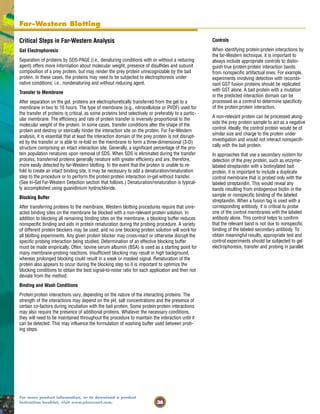
Conjugate Stabilizers
PRODUCT # DESCRIPTION PKG. SIZE
37548 Guardian™ Peroxidase Conjugate Stabilizer/Diluent (SD) 200 ml
37552 Guardian™ Peroxidase Conjugate Stabilizer/Diluent (SD) 1 liter
31503 SuperFreeze™ Peroxidase Conjugate Stabilizer 25 ml
29810 Ethylene Glycol 200 ml
(50% aqueous solution)
PRODUCT # DESCRIPTION PKG. SIZE
15051 Using Antibodies: 1 book
A Laboratory Manual
Ed Harlow and David Lane
Published by Cold Spring Harbor
Laboratory Press, 1999. 495 pages;
wire spiral-bound hardcover with
nine separate portable protocols
* Sorry, books are nonreturnable.
13
Tel: 800-874-3723 or 815-968-0747
www.piercenet.com
Affinity-Purified Secondary Antibodies
*See Table 3 on page 12 for the Key to Abbreviations.
Product #
Pkg. Size
Specificity Description Host Unconj. Biotin-LC Fluorescein Rhodamine Peroxidase Alk. Phos.
Anti-BOVINE Bovine IgG (H+L) Goat 31100 31710
2 mg 2 ml
Bovine IgG (H+L) Rabbit 31103 31712
2 mg 1.5 ml
Anti-CHICKEN Chicken IgY (H+L) Rabbit 31104 31720 31501 31401
2 mg 1.5 ml 1.5 mg 1.5 ml
Anti-GOAT Goat IgG (H+L) Donkey 31108
1.5 mg
Goat IgG (H+L) Mouse 31107 31730 31512 31400
(min x HnMsRb Sr Prot)* 1.5 mg 1 ml 1 mg 1 ml
Goat IgG (H+L) Rabbit 31105 31732 31509 31650 31402 31300
2 mg 1.5 mg 1.5 mg 1.5 mg 1.5 ml 1 ml
Goat IgG [F(ab')2] Rabbit 31153 31753 31553 31403 31405
2 mg 1.5 ml 1.5 mg 1.5 ml 1 ml
Goat IgG (Fc) Rabbit 31133 31733 31533 31433 31337
2 mg 1.5 ml 1.5 mg 1.5 ml 1 ml
Anti-GOAT F(ab')2 Goat IgG (H+L) Rabbit 31109 31302
Fragment of (min x Hn Sr Prot)* 0.5 mg 0.5 ml
Host Antibody
Anti-GUINEA PIG Guinea Pig IgG (H+L) Goat 31114
2 mg
Anti-HAMSTER Hamster IgG (H+L) Goat 31115 31750
1.5 mg 1.5 mg
Hamster IgG (H+L) Rabbit 31120 31587 31652
2 mg 1.5 mg 1.5 mg
Anti-HORSE Horse IgG (H+L) Goat 31116 31760
2 mg 1.5 mg
Anti-HUMAN Human IgG (H+L) Goat 31130 31770 31529 31656 31410 31310
2 mg 1.5 mg 2 mg 2 mg 2 ml 1 ml
Human IgG Goat 31118
Gamma Chain Specific 0.5 mg
Human IgG (H+L) Goat 31119 31774 31531 31412
(min x BvHsMs Sr Prot)* 1.5 mg 1.5 ml 1.5 mg 1.5 ml
Human IgG [F(ab')2] Goat 31122 31312
2 mg 1 ml
Human IgG [F(ab')2] Goat 31132 31414
(min x BvHsMs Sr Prot)* 1.5 mg 1.5 ml
Human IgG (Fc) Goat 31123 31416
(min x BvHsMs Sr Prot)* 1.5 mg 1.5 ml
Human IgM (Fc5µ) Goat 31136 31575 31415
2 mg 2 mg 2 ml
Human IgM (µ) Goat 31124 31778
0.5 mg 0.5 mg
Human IgM (Fc5µ) Goat 31138
(min x Bv Sr Prot)* 1.5 mg
Human IgA (α) Goat 31140 31577 31417 31314
2 mg 2 mg 2 ml 1 ml
Human IgG + IgM Goat 31134 31776
(H+L) 2 mg 2 ml
Human IgA + IgG Goat 31128 31782 31418 31316
+ IgM (H+L) 2 mg 2 ml 2 ml 1 ml
Human Kappa Chain Goat 31129 31780
0.5 mg 0.5 mg
Human Lambda Chain Goat 31131
0.5 mg
Human IgG (H+L) Mouse 31135 31420
(min x Ms Sr Prot)* 2 mg 1.5 ml
14
For more product information, or to download a product
instruction booklet, visit www.piercenet.com.
Affinity-Purified Secondary Antibodies
*See Table 3 on page 12 for the Key to Abbreviations.
Product #
Pkg. Size
Specificity Description Host Unconj. Biotin-LC Fluorescein Rhodamine Peroxidase Alk. Phos.
Anti-HUMAN Human IgG (H+L) Mouse 31137 31784
continued (min x BvHsMs Sr Prot)* 1.5 mg 1 ml
Human IgG (H+L) Rabbit 31143 31786
2 mg 1.5 ml
Human IgG (H+L) Rabbit 31147
(min x Ms Sr Prot)* 1.5 mg
Human IgG (Fc) Rabbit 31142 31789 31535 31423 31318
2 mg 1.5 ml 1.5 mg 1.5 ml 1 ml
Human IgM (Fc5µ) Rabbit 31149
2 mg
Anti-HUMAN Human IgG (Fc) Goat 31163
F(ab')2 Fragment 1 mg
of Host Antibody
Human IgG (H+L) Goat 31165
1 mg
Human IgA + IgG Goat 31539
+ IgM (H+L) 1 mg
Human IgG Mouse 31155
(min x MsBvHs Sr Prot)* 1.5 mg
Anti-MOUSE Mouse IgA (α) Goat 31169
(min x Hn Sr Prot)* 1 mg
Mouse IgA + IgG Goat 31171
+ IgM (H+L) 2 mg
Mouse IgG (H+L) Goat 31160 31800 31569 31660 31430 31320
2 mg 2 ml 2 mg 2 mg 2 ml 1 ml
Mouse IgG (H+L) Goat 31164 31802 31541 31661 31432 31322
(min x BvHnHs Sr Prot)* 1.5 mg 1.5 mg 1.5 mg 1.5 mg 1.5 ml 1 ml
Mouse IgG [F(ab')2] Goat 31166 31803 31543 31436 31324
2 mg 2 ml 2 mg 2 ml 1 ml
Mouse IgG (Fc) Goat 31168 31805 31547 31663 31437 31325
2 mg 2 ml 2 mg 2 mg 2 ml 1 ml
Mouse IgG (Fc) Goat 31170 31439 31327
(min x BvHnHs Sr Prot)* 1.5 mg 1.5 ml 1 ml
Mouse IgM (µ) Goat 31172 31804 31992 31662 31440 31326
2 mg 0.5 mg 2 mg 2 mg 2 ml 1 ml
Mouse IgM (µ) Goat 31176 31585 31664
(min x BvHnHs Sr Prot)* 1.5 mg 1.5 mg 1.5 mg
Mouse IgG + IgM Goat 31182 31807 31586 31444 31328
(H+L) 2 mg 2 ml 1.5 mg 2 ml 1 ml
Mouse IgG + IgM Goat 31184 31446 31330
(H+L) (min x BvHnHs Sr Prot)* 1.5 mg 1.5 ml 1 ml
Mouse IgG (H+L) Horse 31181 31806
1.5 mg 1.5 mg
Mouse IgG (H+L) Rabbit 31188 31810 31561 31665 31450 31329
2 mg 1.5 ml 1.5 mg 1.5 mg 1.5 ml 1 ml
Mouse IgG (H+L) Rabbit 31190 31812 31452 31334
(min x Hn Sr Prot)* 1.5 mg 1 ml 1 ml 0.5 ml
Mouse IgG [F(ab')2] Rabbit 31192 31811 31559 31666 31451 31331
2 mg 1.5 ml 1.5 mg 1.5 mg/ 1.5 ml 1 ml
Mouse IgG (Fc) Rabbit 31194 31813 31555 31455 31332
2 mg 1.5 ml 1.5 mg 1.5 ml 1 ml
Mouse IgM (µ) Rabbit 31196 31814 31557 31456 31333
2 mg 1.5 ml 1.5 mg 1.5 ml 1 ml
Mouse IgG + IgM Rabbit 31198 31815 31558 31457 31335
(H+L) 2 mg 1.5 ml 1.5 mg 1.5 ml 1 ml
Mouse IgG (H+L) Goat 31185 31565 31438
(min x BvHnHs Sr Prot)* 1 mg 1 mg 0.5 ml
15
Tel: 800-874-3723 or 815-968-0747
www.piercenet.com
Affinity-Purified Secondary Antibodies
*See Table 3 on page 12 for the Key to Abbreviations.
Product #
Pkg. Size
Specificity Description Host Unconj. Biotin-LC Fluorescein Rhodamine Peroxidase Alk. Phos.
Anti-MOUSE Mouse IgM (µ) Goat 31178
F(ab')2 Fragment 1 mg
of Host Antibody
continued
Mouse IgM (µ) Goat 31186 31442
(min x BvHnHs Sr Prot) 1 mg 0.5 ml
Mouse IgG + IgM Goat 31448
(H+L) (min x BvHnHs Sr Prot) 0.5 ml
Mouse IgG (H+L) Rabbit 31189
1 mg
Anti-RABBIT Rabbit IgG (H+L) Donkey 31821 31568 31458 31345
(min x BvGtHnHsMsRtSh Sr Prot) 0.5 ml 0.5 mg 0.5 ml 0.5 ml
Rabbit IgG (H+L) Goat 31210 31820 31670 31460 31340
2 mg 1.5 mg 2 mg 2 ml 1 ml
Rabbit IgG (H+L) Goat 31212 31822 31583 31462 31342
(min x Hn Sr Prot) 1.5 mg 1.5 ml 1.5 mg 1.5 ml 1 ml
Rabbit IgG [F(ab')2] Goat 31234 31823 31573 31461 31343
2 mg 2 ml 2 mg 2 ml 1 ml
Rabbit IgG (Fc) Goat 31216 31463 31341
2 mg 2 ml 1 ml
Rabbit IgG (H+L) Mouse 31213 31824 31584 31674 31464
(min x GtHnMsSh Sr Prot) 1.5 mg 1 ml 1 mg 1 mg 1 ml
Anti-RABBIT Rabbit IgG (H+L) Goat 31214 31579
F(ab')2 Fragment 1 mg 1 mg
of Host Antibody
Rabbit IgG (H+L) Goat 31215
(min x Hn Sr Prot) 1 mg
Rabbit IgG (Fc) Goat 31217 31581
1 mg 1 mg
Anti-RAT Rat IgG (H+L) Goat 31220 31830 31629 31680 31470 31350
2 mg 2 ml 2 mg 2 mg 2 ml 1 ml
Rat IgG [F(ab')2] Goat 31474
2 ml
Rat IgG (Fc) Goat 31226 31833 31621 31475 31353
2 mg 2 ml 2 mg 2 ml 1 ml
Rat IgM (µ) Goat 31228 31832 31631 31476 31354
2 mg 2 ml 2 mg 2 ml 1 ml
Rat IgG (H+L) Rabbit 31218 31834
2 mg 1.5 mg
Rat IgG (H+L) Rabbit 31219 31836
(min x Ms Sr Prot) 0.5 mg 0.5 mg
Anti-RAT Rat IgG (H+L) Rabbit 31227
F(ab')2 Fragment 1 mg
of Host Antibody
Rat IgG + IgM Goat 31625
(H+L) 1 mg
Rat IgG (H+L) Mouse 31225 31633 31682
(min x Ms Sr Prot) 1 mg 0.5 mg 0.5 mg
Anti-SHEEP Sheep IgG (H+L) Rabbit 31240 31840 31627 31480 31360
2 mg 1.5 mg 1.5 mg 1.5 ml 1 ml
Sheep IgG (Fc) Rabbit 31241 31841 31441 31356
2 mg 1.5 ml 1.5 ml 1 ml
Sheep IgG [F(ab')2] Rabbit 31244 31844 31481 31344
2 mg 1.5 ml 1.5 ml 1 ml
Anti-SHEEP Sheep IgG (H+L) Rabbit 31229
F(ab')2 Fragment 1 mg
of Host Antibody
Anti-SWINE Swine IgG (H+L) Goat 31231
2 mg
16
For more product information, or to download a product
instruction booklet, visit www.piercenet.com.
Chemical cross-linking reagents have become an invaluable tool in the scientific community.
These reagents are used in preparing antibody-enzyme conjugates and other labeled protein
reagents. After the protein is conjugated to an appropriate enzyme, it may then be used as a
detection reagent in a variety of assays and applications. A number of cross-linking methods
have been used to prepare enzyme conjugates. For example, an N-hydroxysuccinimide ester
can be prepared from a ligand of interest, then reacted with a primary amine on the surface
of the enzyme. While this method is necessary in some applications, such as those in which
the ligand does not contain a primary amine, it is not useful as a general-purpose method.
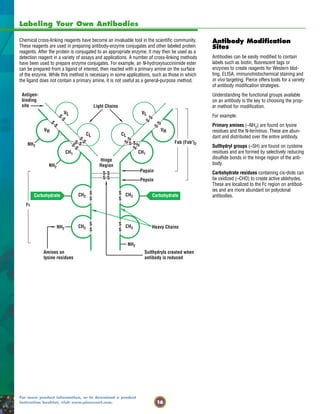
Antigen-
binding
site Light Chains
Carbohydrate Carbohydrate
Hinge
Region
CH2
CH3
CH2
CH3
CH1 CH1
VL
CL
VL
CL
VH
S-S
S-S
S-S
S-S
S-S
S-S
S-S
Papain
Pepsin
S-S
S-S
S-S
S-S
S-S
Fab (Fab')2
FC
S
S
S
S
S
S
S
S
Heavy Chains
VH
NH2
Amines on
lysine residues
Sulfhydryls created when
antibody is reduced
NH2
NH2
NH2
Antibody Modification
Sites
Antibodies can be easily modified to contain
labels such as biotin, fluorescent tags or
enzymes to create reagents for Western blot-
ting, ELISA, immunohistochemical staining and
in vivo targeting. Pierce offers tools for a variety
of antibody modification strategies.
Understanding the functional groups available
on an antibody is the key to choosing the prop-
er method for modification.
For example:
Primary amines (–NH2) are found on lysine
residues and the N-terminus. These are abun-
dant and distributed over the entire antibody.
Sulfhydryl groups (–SH) are found on cysteine
residues and are formed by selectively reducing
disulfide bonds in the hinge region of the anti-
body.
Carbohydrate residues containing cis-diols can
be oxidized (–CHO) to create active aldehydes.
These are localized to the Fc region on antibod-
ies and are more abundant on polyclonal
antibodies.
Labeling Your Own Antibodies
17
Tel: 800-874-3723 or 815-968-0747
www.piercenet.com
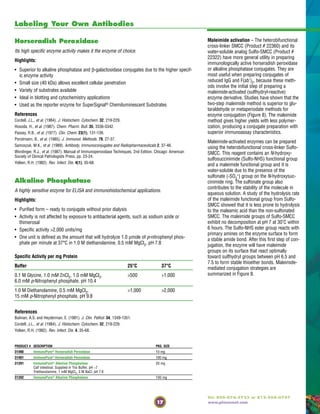
Labeling Your Own Antibodies
Maleimide activation – The heterobifunctional
cross-linker SMCC (Product # 22360) and its
water-soluble analog Sulfo-SMCC (Product #
22322) have more general utility in preparing
immunologically active horseradish peroxidase
or alkaline phosphatase conjugates. They are
most useful when preparing conjugates of
reduced IgG and F(ab')2, because these meth-
ods involve the initial step of preparing a
maleimide-activated (sulfhydryl-reactive)
enzyme derivative. Studies have shown that the
two-step maleimide method is superior to glu-
taraldehyde or metaperiodate methods for
enzyme conjugation (Figure 8). The maleimide
method gives higher yields with less polymer-
ization, producing a conjugate preparation with
superior immunoassay characteristics.
Maleimide-activated enzymes can be prepared
using the heterobifunctional cross-linker Sulfo-
SMCC. This reagent contains an N-hydroxy-
sulfosuccinimide (Sulfo-NHS) functional group
and a maleimide functional group and it is
water-soluble due to the presence of the
sulfonate (-SO3
-) group on the N-hydroxysuc-
cinimide ring. The sulfonate group also
contributes to the stability of the molecule in
aqueous solution. A study of the hydrolysis rate
of the maleimide functional group from Sulfo-
SMCC showed that it is less prone to hydrolysis
to the maleamic acid than the non-sulfonated
SMCC. The maleimide groups of Sulfo-SMCC
exhibit no decomposition at pH 7 at 30˚C within
6 hours. The Sulfo-NHS ester group reacts with
primary amines on the enzyme surface to form
a stable amide bond. After this first step of con-
jugation, the enzyme will have maleimide
groups on its surface that react optimally
toward sulfhydryl groups between pH 6.5 and
7.5 to form stable thioether bonds. Maleimide-
mediated conjugation strategies are
summarized in Figure 8.
Alkaline Phosphatase
A highly sensitive enzyme for ELISA and immunohistochemical applications.
Highlights:
• Purified form – ready to conjugate without prior dialysis
• Activity is not affected by exposure to antibacterial agents, such as sodium azide or
thimerosal
• Specific activity >2,000 units/mg
• One unit is defined as the amount that will hydrolyze 1.0 µmole of p-nitrophenyl phos-
phate per minute at 37°C in 1.0 M diethanolamine, 0.5 mM MgCl2, pH 7.8
Specific Activity per mg Protein
Buffer 25°C 37°C
0.1 M Glycine, 1.0 mM ZnCl2, 1.0 mM MgCl2, >500 >1,000
6.0 mM p-Nitrophenyl phosphate, pH 10.4
1.0 M Diethanolamine, 0.5 mM MgCl2, >1,000 >2,000
15 mM p-Nitrophenyl phosphate, pH 9.8
References
Bulman, A.S. and Heyderman, E. (1981). J. Clin. Pathol. 34, 1349-1351.
Cordell, J.L., et al. (1984). J. Histochem. Cytochem. 32, 219-229.
Yolken, R.H. (1982). Rev. Infect. Dis. 4, 35-68.
Horseradish Peroxidase
Its high specific enzyme activity makes it the enzyme of choice.
Highlights:
• Superior to alkaline phosphatase and β-galactosidase conjugates due to the higher specif-
ic enzyme activity
• Small size (40 kDa) allows excellent cellular penetration
• Variety of substrates available
• Ideal in blotting and cytochemistry applications
• Used as the reporter enzyme for SuperSignal® Chemiluminescent Substrates
References
Cordell, J.L., et al. (1984). J. Histochem. Cytochem. 32, 219-229.
Hosoda, H., et al. (1987). Chem. Pharm. Bull. 35, 3336-3342.
Passey, R.B., et al. (1977). Clin. Chem. 23(1), 131-139.
Porstmann, B., et al. (1985). J. Immunol. Methods. 79, 27-37.
Samoszuk, M.K., et al. (1989). Antibody, Immunoconjugates and Radiopharmaceuticals 2, 37-46.
Wordinger, R.J., et al. (1987). Manual of Immunoperoxidase Techniques, 2nd Edition. Chicago: American
Society of Clinical Pathologists Press, pp. 23-24.
Yolken, R.H. (1982). Rev. Infect. Dis. 4(1), 35-68.
PRODUCT # DESCRIPTION PKG. SIZE
31490 ImmunoPure® Horseradish Peroxidase 10 mg
31491 ImmunoPure® Horseradish Peroxidase 100 mg
31391 ImmunoPure® Alkaline Phosphatase 20 mg
Calf intestinal. Supplied in Tris Buffer, pH ~7
Triethanolamine, 1 mM MgCl2, 3 M NaCl, pH 7.6
31392 ImmunoPure® Alkaline Phosphatase 100 mg
18
For more product information, or to download a product
instruction booklet, visit www.piercenet.com.
Two reagents, Mercaptoethylamine•HCl (Product # 20408) and SATA (Product # 26102), are
available to produce free sulfhydryls on macromolecules for conjugation to the maleimide-
activated enzymes. For labeling antibody molecules, mild reduction with Mercaptoethyl-
amine•HCl (MEA) results in two half-antibody fragments containing free sulfhydryl groups in
the hinge region. Labeling in this area is advantageous because it directs the modification
away from the antigen-binding region. Native proteins lacking a free sulfhydryl on their sur-
face can be reacted with SATA to generate blocked sulfhydryl groups. The SATA molecule
reacts with primary amines via its NHS ester end to form stable amide linkages. The acety-
lated sulfhydryl group (blocked) is stable until treated with hydroxylamine to generate the
free sulfhydryls.
Pierce offers stable, preactivated enzyme derivatives that are reactive toward sulfhydryl
(-SH) groups, EZ-Link™ Maleimide Activated Alkaline Phosphatase (Product # 31486) and
Horseradish Peroxidase (Product # 31485). These products eliminate the first step of the
two-step maleimide method, simplifying and facilitating the conjugation protocol, while sav-
ing several hours. They can be used to prepare enzyme conjugates directly from proteins,
peptides or other ligands that contain a free –SH group. Two reagents, SATA and mercap-
toethylamine•HCl, are also included in the kit formats to produce free sulfhydryls on
macromolecules for conjugation.
EZ-Link® Maleimide Activated Peroxidase References
Choi, J.Y., et al. (2002). J. Biol. Chem. 277, 21630-21638.
Seo, Y.R., et al. (2002). PNAS 99, 14548-14553.
Yoo, J.H., et al. (2004). J. Biol. Chem. 279, 848-858.
SHProtein
Protein Protein
Three methods for free sulfhydryl generation Maleimide activation of enzyme
Native protein has a free
sulfhydryl on its surface.
Native protein is reacted with SATA. Blocked sulfhydryl
groups are introduced on primary amines.
Hydroxylamine (H) treatment generates free sulfhydryls.
Native protein contains disulfide bonds that can be reduced to generate free sulfhydryls. Enzyme is SMCC labeled through primary amines to generate a
maleimide activated enzyme for conjugation to free sulfhydryls.
O
C
S S
MEA
EDTA
SH
NH2Protein
SATA
Protein
Protein
CH2 S
O
C CH3
H
CH2 SH
SHProtein
Protein
H
N
O
C
H
N
O
O
O
OO
O
N
SMCC
NHS
OH
OO
N
N + H2N E
S
O
O
N
O
N E
E
O
O
N
O
N
SH
Figure 8. Three strategies for maleimide-mediated conjugation of enzymes.
Labeling Your Own Antibodies
PRODUCT # DESCRIPTION PKG. SIZE
31486 EZ-Link® Maleimide Activated 2 mg
Alkaline Phosphatase
31493 EZ-Link® Maleimide Activated Kit
Alkaline Phosphatase Kit
Includes: EZ-Link® Maleimide 2 mg
Activated Alkaline Phosphatase
Activation/Conjugation Buffer 20 ml
BupH™ Tris Buffered Saline Pack 2 packs
BupH™ Phosphate Buffered 1 pack
Saline Pack
Polyacrylamide Desalting Column 1 x 10 ml
Mercaptoethylamine•HCl 6 mg
SATA 2 mg
Hydroxylamine 5 mg
DMF 1 ml
Column Extender
31485 EZ-Link® Maleimide Activated 5 mg
Horseradish Peroxidase
31494 EZ-Link® Maleimide Activated Kit
Horseradish Peroxidase Kit
Includes: EZ-Link® Maleimide 5 mg
Activated Horseradish Peroxidase
Activated Horseradish Peroxidase 20 ml
Conjugation Buffer
2-Mercaptoethylamine•HCl 6 mg
SATA 2 mg
Dimethylformamide 1 ml
Hydroxylamine•HCl 5 mg
Polyacrylamide Desalting Column 1 x 10 ml
19
Tel: 800-874-3723 or 815-968-0747
www.piercenet.com
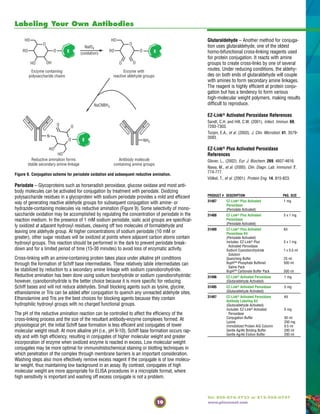
Labeling Your Own Antibodies
Periodate – Glycoproteins such as horseradish peroxidase, glucose oxidase and most anti-
body molecules can be activated for conjugation by treatment with periodate. Oxidizing
polysaccharide residues in a glycoprotein with sodium periodate provides a mild and efficient
way of generating reactive aldehyde groups for subsequent conjugation with amine- or
hydrazide-containing molecules via reductive amination (Figure 9). Some selectivity of mono-
saccharide oxidation may be accomplished by regulating the concentration of periodate in the
reaction medium. In the presence of 1 mM sodium periodate, sialic acid groups are specifical-
ly oxidized at adjacent hydroxyl residues, cleaving off two molecules of formaldehyde and
leaving one aldehyde group. At higher concentrations of sodium periodate (10 mM or
greater), other sugar residues will be oxidized at points where adjacent carbon atoms contain
hydroxyl groups. This reaction should be performed in the dark to prevent periodate break-
down and for a limited period of time (15-30 minutes) to avoid loss of enzymatic activity.
Cross-linking with an amine-containing protein takes place under alkaline pH conditions
through the formation of Schiff base intermediates. These relatively labile intermediates can
be stabilized by reduction to a secondary amine linkage with sodium cyanoborohydride.
Reductive amination has been done using sodium borohydride or sodium cyanoborohydride;
however, cyanoborohydride is the better choice because it is more specific for reducing
Schiff bases and will not reduce aldehydes. Small blocking agents such as lysine, glycine,
ethanolamine or Tris can be added after conjugation to quench any unreacted aldehyde sites.
Ethanolamine and Tris are the best choices for blocking agents because they contain
hydrophilic hydroxyl groups with no charged functional groups.
The pH of the reductive amination reaction can be controlled to affect the efficiency of the
cross-linking process and the size of the resultant antibody-enzyme complexes formed. At
physiological pH, the initial Schiff base formation is less efficient and conjugates of lower
molecular weight result. At more alkaline pH (i.e., pH 9-10), Schiff base formation occurs rap-
idly and with high efficiency, resulting in conjugates of higher molecular weight and greater
incorporation of enzyme when oxidized enzyme is reacted in excess. Low molecular weight
conjugates may be more optimal for immunohistochemical staining or blotting techniques in
which penetration of the complex through membrane barriers is an important consideration.
Washing steps also more effectively remove excess reagent if the conjugate is of low molecu-
lar weight, thus maintaining low background in an assay. By contrast, conjugates of high
molecular weight are more appropriate for ELISA procedures in a microplate format, where
high sensitivity is important and washing off excess conjugate is not a problem.
Figure 9. Conjugation scheme for periodate oxidation and subsequent reductive amination.
OHHO
RO
HO
O
O
OO
RO
HO
O
O
N
NH2
NaCNBH3
O
RO
HO
O
O
Enzyme containing
polysaccharide chains
Enzyme with
reactive aldehyde groups
Reductive amination forms
stable secondary amine linkage
Antibody molecule
containing amine groups
NalO4
(oxidation)E E
E
Glutaraldehyde – Another method for conjuga-
tion uses glutaraldehyde, one of the oldest
homo-bifunctional cross-linking reagents used
for protein conjugation. It reacts with amine
groups to create cross-links by one of several
routes. Under reducing conditions, the aldehy-
des on both ends of glutaraldehyde will couple
with amines to form secondary amine linkages.
The reagent is highly efficient at protein conju-
gation but has a tendency to form various
high-molecular weight polymers, making results
difficult to reproduce.
EZ-Link® Activated Peroxidase References
Sandt, C.H. and Hill, C.W. (2001). Infect. Immun. 69,
7293-7303.
Turpin, E.A., et al. (2003). J. Clin. Microbiol. 41, 3579-
3583.
EZ-Link® Plus Activated Peroxidase
References
Glover, L., (2002). Eur. J. Biochem. 269, 4607-4616.
Nawa, M., et al. (2000). Clin. Diagn. Lab. Immunol. 7,
774-777.
Völkel, T., et al. (2001). Protein Eng. 14, 815-823.
PRODUCT # DESCRIPTION PKG. SIZE
31487 EZ-Link® Plus Activated 1 mg
Peroxidase
(Periodate Activated)
31488 EZ-Link® Plus Activated 5 x 1 mg
Peroxidase
(Periodate Activated)
31489 EZ-Link® Plus Activated Kit
Peroxidase Kit
(Periodate Activated)
Includes: EZ-Link® Plus 5 x 1 mg
Activated Peroxidase
Sodium Cyanoborohydride 1 x 0.5 ml
Solution
Quenching Buffer 25 ml
BupH™ Phosphate Buffered 500 ml
Saline Pack
BupH™ Carbonate Buffer Pack 500 ml
31496 EZ-Link® Activated Peroxidase 1 mg
(Glutaraldehyde Activated)
31495 EZ-Link® Activated Peroxidase 5 mg
(Glutaraldehyde Activated)
31497 EZ-Link® Activated Peroxidase Kit
Antibody Labeling Kit
(Glutaraldehyde Activated)
Includes: EZ-Link® Activated 5 mg
Peroxidase
Conjugation Buffer 50 ml
Lysine 250 mg
Immobilized Protein A/G Column 0.5 ml
Gentle Ag/Ab Binding Buffer 200 ml
Gentle Ag/Ab Elution Buffer 200 ml
20
For more product information, or to download a product
instruction booklet, visit www.piercenet.com.
Featured Product
EZ-Label™ Fluorescent Labeling Kits
Make your own fluorescent-labeled antibody in less than two hours!
EZ-Label™ Kits are designed for labeling any size protein – small or large – even if you have
only a small amount of your protein. Protein sample volumes ranging from 50 µl-1 ml can
be used, with protein concentration up to 10 mg/ml for each reaction. EZ-Label™ Kits were
specially developed and optimized for the most efficient labeling.
EZ-Label™ Kits contain everything you need to successfully label your antibody or protein:
• Fluorescent dye provided in individual microtubes, eliminating the need to weigh dye
• Conveniently packaged dimethylformamide (DMF) to prepare the fluorescent dye solution
• Pre-made borate and phosphate buffers – just add water to the powder and they are
ready-to-use
• Pre-packed, ready-to-use desalting columns for fast buffer exchange when your protein
sample volume is greater than 100 µl
• Slide-A-Lyzer® MINI Dialysis Units for easy buffer exchange when your protein sample
volume is less than or equal to 100 µl
• Amber reaction tubes – no handling in the dark required
Excitation Emission
EZ-Label™ Kit Wavelength (nm) Wavelength (nm)
Fluorescein Protein Labeling Kit 491 518
Rhodamine Protein Labeling Kit 544 576
Fluorescein Isothiocyanate 494 520
(FITC) Protein Labeling Kit
These kits contain sufficient reagents to perform five fluorescent labeling reactions, which use up to 10
mg/ml of protein for each reaction (50 µl-1 ml volume of protein).
Step 1. Preparation of Protein
For salt-free lyophilized protein:
Dissolve in borate buffer.
Reconstitute
fluorescent
dye with DMF.
Add dye to the
protein solution.
Incubate for 1 hour.
Step 2. Labeling Reaction Step 3. Removal of Excess Fluorescent Dye
For proteins in buffers or salt solutions:
a.) Sample volume of 100 µl or less:
Exchange into borate buffer using
Slide-A-Lyzer®
MINI Dialysis Unit.
b.) Sample volume greater than 100 µl:
Exchange into borate buffer using
a D-Salt™
Dextran Column.
For sample volume of 100 µl or less:
Exchange into PBS buffer using
Slide-A-Lyzer®
MINI Dialysis Unit.
For sample volume greater than 100 µl:
Exchange into PBS buffer using a
D-Salt™
Dextran Column.
See how easy the fluorescent labeling procedure is when you use EZ-Label™ Kits.
PRODUCT # DESCRIPTION PKG. SIZE
53000 EZ-Label™ Fluorescein Protein Kit
Labeling Kit
Sufficient for five coupling reactions.
Includes: No-Weigh™ 6 x 1 mg
Pre-Measured Fluorescein microtubes
Microtubes
Dimethylformamide (DMF) 1 ml
BupH™ Borate Buffer Packs 5 packs
BupH™ Phosphate Buffered 5 packs
Saline Packs
D-Salt™ Dextran Desalting 5 columns
Columns
Slide-A-Lyzer® MINI Dialysis 5 units
Unit Pack
Reaction Tubes 5 tubes
53002 EZ-Label™ Rhodamine Protein Kit
Labeling Kit
Sufficient for five coupling reactions.
Includes: No-Weigh™ 6 x 0.5 mg
Pre-Measured Rhodamine microtubes
Microtubes
Dimethylformamide (DMF) 1 ml
BupH™ Borate Buffer Packs 5 packs
BupH™ Phosphate Buffered 5 packs
Saline Packs
D-Salt™ Dextran Desalting 5 columns
Columns
Slide-A-Lyzer® MINI Dialysis 5 units
Unit Pack
Reaction Tubes 5 tubes
53004 EZ-Label™ Fluorescein Kit
Isothiocyanate (FITC)
Protein Labeling Kit
Sufficient for five coupling reactions.
Includes: No-Weigh™ 6 x 1 mg
Pre-Measured microtubes
FITC Microtubes
Dimethylformamide (DMF) 1 ml
BupH™ Borate Buffer Packs 5 packs
BupH™ Phosphate Buffered 5 packs
Saline Packs
D-Salt™ Dextran Desalting 5 columns
Columns
Slide-A-Lyzer® MINI Dialysis 5 units
Unit Pack
Reaction Tubes 5 tubes
21
Tel: 800-874-3723 or 815-968-0747
www.piercenet.com
Optimizing Antibody Concentration
Figure 10. Example of signal intensity on a Western blot when using SuperSignal® West Pico Substrate
and antibodies at various concentrations. Recombinant Human Wild-Type p53 Baculovirus lysate at various
concentrations was electrophoretically separated and transferred to nitrocellulose membrane. The membrane
was blocked with BSA and then incubated with various dilutions of mouse anti-human p53 starting at the man-
ufacturer’s recommended dilution. Horseradish peroxidase-labeled goat anti-mouse was added at different
concentrations and the signal was developed with SuperSignal® West Pico Substrate. The exposure times were
also varied as indicated above. In blot 1, the blot was totally black due to both the primary and secondary anti-
body concentrations being too high. In blot 2, the background is inconsistent but very dark, again a result of
too much primary and secondary antibody. In blots 3 and 4, the signal-to-noise was much better because both
the primary and secondary antibody concentrations were reduced. Neither blots 3 nor 4 had background sig-
nal.
Figure 11. Example of signal intensity on a Western blot using SuperSignal® West Dura Substrate and
antibodies at various concentrations.
In Figure 11, blots were optimized with SuperSignal
®
West Dura Chemiluminescent
Substrate. The blot with a primary antibody concentration of 1:500 and a secondary anti-
body concentration of 1:5,000 shows what happens when the antibody levels are too high.
The background is not excessively high, but the bands are too intense and blur together,
resulting in poor resolution. A large number of nonspecific bands are also visible. An opti-
mal blot was achieved by using a 1:5,000 primary antibody dilution and a 1:50,000
secondary antibody dilution.
Because every new Western blot is unique,
there is no "perfect" antibody concentration for
every blot. Therefore, every new Western blot
needs to be optimized to find out which anti-
body concentration is most appropriate to that
particular combination of membranes, proteins
and antibodies. Optimization is even more cru-
cial when key components of a system are
changed, such as switching from a colorimetric
substrate like chlororonaphthol (CN) to more
sensitive chemiluminescent substrates such as
SuperSignal®
West Products. The first step of
optimizing the blotting conditions usually
involves optimizing the antibody concentrations
(or dilutions) through the use of a dot blot pro-
tocol. The next step is usually the optimization
of the blocking buffer by testing cross-reactivity
of several different buffers with the blotting sys-
tem’s key components (see page 7).
Dot Blot Protocol for Optimization of Antigen
and Antibody Concentrations
The optimal antibody concentrations to use with
a given antigen are dependent on the antigen
and antibody themselves. The affinity/avidity of
the antibody for the antigen and the specific
activity of both the primary and secondary anti-
body will vary. The optimal antigen and antibody
concentrations can be determined by perform-
ing complete Western blots with varying
concentrations of antigen and antibody.
Alternatively, a faster and easier method is to
perform a dot blot procedure. The following is
an example of a dot blot protocol using
SuperSignal® West Pico Substrate. When using
other substrates from Pierce, refer to the
instruction booklet for recommended
antigen/antibody concentrations.
Mouse anti-Human p53 1/500 1/500 1/1,000 1/1,000
(1 µg/ml) (1 µg/ml) (0.5 µg/ml) (0.5 µg/ml)
Goat anti-Mouse HRP 1/1,000 1/5,000 1/10,000 1/20,000
(1 µg/ml) (0.2 µg/ml) (0.1 µg/ml) (0.05 µg/ml)
Exposure Time 30 seconds 30 seconds 1 minute 1 minute
Primary Antibody 1:500
Secondary Antibody 1:5,000
Primary Antibody 1:5,000
Secondary Antibody 1:50,000
1. 2. 3. 4.
22
For more product information, or to download a product
instruction booklet, visit www.piercenet.com.
Optimizing Antibody Concentration
Note: All antibody dilutions assume a starting concentration of ~1 mg/ml.
1. Prepare dilutions of the protein sample in either TBS or PBS. The proper dilution will
depend on the antigen concentration present in the sample because the concentration of
the antigen of interest often is not known. It is necessary to test a wide range of dilu-
tions. SuperSignal®
West Pico Substrate has picogram-level detection sensitivity so
sample dilutions can range from the low microgram to low picogram levels. If too much
antigen is applied, the immunoassay results may show any or all of the following: detec-
tion of nonspecific bands, blurred banding patterns and rapid signal deterioration.
2. Prepare nitrocellulose membranes. The number of membrane pieces needed depends on
how many different dilutions of primary and/or secondary antibody will be screened.
Typically, one or two dilutions of the primary antibody are tested with two or three differ-
ent dilutions of the secondary antibody. For example: 1/1,000 primary with 1/50,000
secondary, 1/1,000 primary with 1/100,000 secondary, 1/5,000 primary with 1/50,000
secondary, and 1/5,000 primary with 1/100,000 secondary.
3. Place dry nitrocellulose membranes on a paper towel. Dot antigen dilutions onto the
membranes. Apply the smallest possible volume to the membranes (2-5 µl works well)
because the greater the volume that is applied, the more diffuse the signal will be. Allow
the antigen dilutions to dry on the membranes for 10-30 minutes or until no visible
moisture remains.
4. Block the nonspecific sites on the nitrocellulose membranes by incubating them in
blocking buffer that contains 0.05% Tween®
-20 (blocker/Tween®
-20) for 1 hour at RT
with shaking.
5. Prepare the primary antibody dilutions (1/1,000-1/5,000) in blocker/Tween®
-20 and
apply to the membranes. Incubate for 1 hour at RT with shaking.
SuperSignal®
SuperSignal®
SuperSignal®
Lumi-Phos™
West Pico West Femto West Dura WB Substrate
Substrate Substrate Substrate
Recommended Primary 1/1,000-1/5,000 1/5,000-1/100,000 1/1,000-1/50,000 1/200-1/2,000
Antibody Dilutions or 0.2-1.0 µg/ml or 0.01-0.2 µg/ml or 0.02-1.0 µg/ml or 0.5-5.0 µg/ml
(from 1 mg/ml stock)
6. Wash the membrane 4-6 times in TBS or PBS, using as large a volume of wash buffer
as possible. Add 0.05% Tween®
-20 to the wash buffer to help reduce nonspecific back-
ground. For each wash, suspend the membrane in wash buffer and agitate for
approximately 5 minutes. Pour off the wash buffer and repeat. Brief rinses of the mem-
branes before incubation in the wash buffer may increase the wash step efficiency.
7. Prepare dilutions of the secondary antibody/HRP conjugate (1/20,000-1/100,000) in
blocker/Tween®
-20. Add the secondary antibody dilutions to the membranes and incu-
bate for 1 hour with shaking.
SuperSignal®
SuperSignal®
SuperSignal®
Lumi-Phos™
West Pico West Femto West Dura WB Substrate
Substrate Substrate Substrate
Recommended Secondary 1/20,000-1/100,000 1/100,000-1/500,000 1/50,000-1/250,000 1/5,000-1/25,000
Antibody Dilutions or 10-50 ng/ml or 2.0-10 ng/ml or 4.0-20 ng/ml or 40-200 ng/ml
(from 1 mg/ml stock)
8. Wash the membrane again as described in Step 6.
9. Prepare the substrate working solution by mixing equal volumes of the
Luminol/Enhancer Solution and the Stable Peroxide Solution. Prepare a sufficient vol-
ume to ensure that the blot is completely wetted with substrate and the blot does not
dry out during incubation. Recommended volume: 0.125 ml/cm2
of blot surface.
10. Incubate the membrane in the SuperSignal®
West Pico Substrate Working Solution for 5
minutes.
11. Remove the membrane from the substrate
and place in a plastic sheet protector or
other protective wrap.
12. Place the blot against the film – protein side
up – and expose. Any standard or enhanced
autoradiographic film can be used. A recom-
mended first exposure is 30-60 seconds.
Exposure time can be varied to obtain opti-
mum results. Alternatively, use a CCD
camera or other imaging device; however,
these devices may require longer exposure
times.
13. On an optimized blot, the SuperSignal®
West Pico Substrate-generated signal
should last for up to eight hours. The blot
can be re-exposed to film or an imaging
device as needed to obtain the optimal
results. Longer exposure times may be
necessary as the blot ages. If optimal results
are not achieved, repeat this procedure
using different antigen and/or antibody
dilutions.
23
Tel: 800-874-3723 or 815-968-0747
www.piercenet.com
Chromogenic Substrates
As with the other components in a Western blotting system, there are many substrate
choices available. The appropriate substrate choice depends on the enzyme label (AP or
HRP), desired sensitivity, and desired form of signal or method of detection. Chromo-
genic substrates have been employed most widely and offer perhaps the simplest and
most cost-effective method of detection. When these substrates come in contact with the
appropriate enzyme, they are converted to insoluble, colored products that precipitate
onto the membrane and require no special equipment for processing or visualizing.
Substrates such as TMB (3,3´,5,5´-tetramethyl benzidine), 4-CN (4-chloro-1-naphthol)
and DAB (3,3´-diaminobenzidine tetrahydrochloride) are available for use with HRP
(Figure 12). For use with AP, NBT (nitro-blue tetrazolium chloride), BCIP (5-bromo-4-
chloro-3´-indolylphosphate p-toluidine salt) and Fast Red (naphthol AS-MX phosphate +
Fast Red TR Salt) are available (Figure 13). The performance of a particular substrate may
vary dramatically when obtained from different suppliers because performance can be
affected by the concentration and purity of the substrate and by other additives and buffer
components that are a part of the formulation.
Figure 12. Chromogenic substrates for Western blotting with HRP.
Figure 13. Chromogenic substrates for Western blotting with AP.
CH3
NH2
CH3
CH3
H2N
CH3
TMB
M.W. 240.4
OH
CI
4-CN
M.W. 178.6
NH2H2N
H2
N
NH
2
DAB
M.W. 214.1
C
N N NO2
N N
+
C
NN
NN
+
ON2
OCH3 OCH3
2CI-
NBT
M.W. 817.6
N
CI
Br
H
O P
O
OH
O OH
BCIP
M.W. 433.6
O
N
H
CH3
CH3
Naphthol AS-MX
phosphate
O
P OHO
OH
CI
CH3
N+
N
Fast Red TR Salt
Fast Red TR/AS-MX Substrate
+
Substrates for HRP
TMB, with a molecular weight of 240.4, is most
often used as a substrate for HRP in ELISAs.
However, in the presence of HRP and peroxide, a
water-soluble blue product is generated that can
be precipitated onto a membrane. 1-Step™ TMB
– Blotting (Product # 34018) is a single-compo-
nent peroxidase substrate for Western blotting
and immunohistochemistry. Precipitating the
product results in dark blue bands where the
enzyme is located. 1-Step™ TMB – Blotting is
well suited to applications that require a large
signal-to-noise ratio.
PRODUCT # DESCRIPTION PKG. SIZE
34018 1-Step™ TMB Blotting 250 ml
4-CN has a molecular weight of 178.6 and can
be used for chromogenic detection of HRP in
blotting and histochemistry. This precipitate is
not as sensitive or as stable as TMB and DAB,
but the alcohol-soluble precipitate photographs
well and has a distinct blue-purple color that
can be useful in double-staining applications.
PRODUCT # DESCRIPTION PKG. SIZE
34012 1-Step™ CN 250 ml
34010 4-Chloro-1-Napthol Powder 25 g powder
34011 4-Chloro-1-Napthol Tablets 50 tablets
DAB has a molecular weight of 214.1 and yields a
brown precipitate in the presence of HRP and per-
oxide. The brown, insoluble product can be readily
chelated with osmium tetroxide. This property
makes DAB ideal for electron microscopy. The
color produced by DAB can be intensified with the
addition of metals such as nickel, copper, silver
and cobalt that form complexes. The color pro-
duced by the metal complexes is darker than the
color produced by DAB alone, enhancing the sen-
sitivity in staining applications.
PRODUCT # DESCRIPTION PKG. SIZE
34002 DAB Substrate Kit 275 ml
Includes: DAB (10X) Stable 25 ml
Peroxide Buffer 250 ml
34065 Metal Enhanced DAB Substrate Kit 275 ml
Includes: 10X Metal Enhanced DAB 25 ml
Stable Peroxide Buffer 250 ml
The individual benefits of 4-CN and DAB are
often combined into a single substrate mixture,
CN/DAB Substrate. The CN/DAB Substrate has
excellent sensitivity, yielding a dark black pre-
cipitate that photographs well. The CN/DAB
Substrate works well in Western blotting and
dot blotting applications.
PRODUCT # DESCRIPTION PKG. SIZE
34000 CN/DAB Substrate Kit 275 ml
Includes: CN/DAB (10X) 25 ml
Stable Peroxide Buffer 250 ml
Peroxide must be added to a substrate for colorimetric detection with HRP. Because of its
extremely short shelf life at the desired concentration, hydrogen peroxide traditionally was
added to a buffer, along with the substrate, immediately prior to use. As a result, these
substrates typically have a useful shelf life of only a few hours. Many precipitating HRP
substrates from Pierce are supplied with, or come prepared in, Stable Peroxide Substrate
Buffer (Product # 34062). The Stable Peroxide Substrate Buffer is a 10X concentrate that
offers several advantages. It is less corrosive than the traditional 30% stock solution of
hydrogen peroxide and, because fewer preparation steps are involved, it provides more
consistent results. Although the Stable Peroxide Substrate Buffer is provided as a 10X
concentrate, it is also stable at a 1X concentration.
PRODUCT # DESCRIPTION PKG. SIZE
34062 Stable Peroxide Buffer (10X) 100 ml
24
For more product information, or to download a product
instruction booklet, visit www.piercenet.com.
Chromogenic Substrates
Br
CI
O P OH
O
OH
alkaline
phosphatase
Br
CI
OH
HPO3
- tautomerism
N
H
BCIP
N
H
Br
CI
O
N
H
Br
CI
N
H
O Br
CI
N
H
O
5,5'-dibromo-4,4'-
dichloro-indigo white
-2H
NBT NBT-formazan
Substrates for Alkaline Phosphatase
NBT, with a molecular weight of 817.6, is a member of a class of heterocyclic organic com-
pounds known as tetrazolium salts. Upon reduction, the compound yields NBT-formazan, a
highly colored, water-insoluble product. The substrate is widely used for immunochemical
assays and techniques because the color produced by the formazan is linear and stable over
a wide dynamic range.
PRODUCT # DESCRIPTION PKG. SIZE
34035 Nitro-Blue Tetrazolium Chloride 1 g powder
BCIP has a molecular weight of 433.6, and hydrolysis by alkaline phosphatase results in a
blue-purple precipitate that can be deposited on nitrocellulose or nylon membranes. BCIP
can be used as a chromogenic substrate for both immunoblotting and immunohistochemi-
cal studies.
PRODUCT # DESCRIPTION PKG. SIZE
34040 5-Bromo-4-Chloro-3'-indolyphosphate p-toluidine Salt 1 g powder
An ideal system for blotting or staining applications with AP is the combination of NBT and
BCIP. Together, they yield an intense, black-purple precipitate that provides much greater
sensitivity than either substrate alone. This reaction proceeds at a steady rate, allowing
accurate control of its relative sensitivity. NBT/BCIP characteristically produces sharp band
resolution with little background staining of the membrane.
Figure 14. Reaction of alkaline phosphatase with BCIP and NBT.
PRODUCT # DESCRIPTION PKG. SIZE
34042 1-Step™ NBT/BCIP 250 ml
34070 1-Step™ NBT/BCIP Plus Suppressor 100 ml
Fast Red TR/AS-MX Substrate is a sensitive
substrate that results in a bright red precipitate
on transfer membranes. Alkaline phosphatase
hydrolyzes the naphthol phosphate ester sub-
strate. The naphthol then couples to the
colorless chromogen, which is a diazonium salt,
resulting in a precipitating azo dye. This sub-
strate is ideal for double staining in both
immunoblotting and immunohistochemical
studies. The bright red precipitate contrasts well
with horseradish peroxidase insoluble sub-
strates, including CN/DAB and TMB. The red
precipitate fades upon drying but will reappear
when rehydrated with water. When double-
staining immunoblots, the Fast Red TR/AS-MX
solution must be added before a horseradish
peroxidase substrate solution to prevent exces-
sive background color development.
PRODUCT # DESCRIPTION PKG. SIZE
34034 Fast Red TR/AS-MX Kit
Includes: Fast Red TR Salt 250 mg
Napthol AS-MX 35 ml
Phosphate Concentrate 250 ml
Substrate Buffer
25
Tel: 800-874-3723 or 815-968-0747
www.piercenet.com
Chemiluminescent Substrates
When energy in the form of light is released from a substance because of a chemical reac-
tion the process is called chemiluminescence. Luminol is one of the most widely used
chemiluminescent reagents and its oxidation by peroxide results in creation of an excited
state product called 3-aminophthalate. This product decays to a lower energy state by
releasing photons of light (Figure 15).
Figure 15. Luminol is oxidized in the presence of horseradish peroxidase and hydrogen peroxide to
form an excited state product (3-aminophthalate). The 3-aminophthalate emits light at 425 nm as it
decays to the ground state.
Chemiluminescent substrates have steadily gained in popularity throughout the past decade
because they offer several advantages over other detection methods. These advantages have
allowed chemiluminescence to become the detection method of choice in most protein labo-
ratories. Using chemiluminescence allows multiple exposures to be performed to obtain the
best image. The detection reagents can be stripped away and the entire blot reprobed to
visualize another protein or to optimize detection of the first protein. A large linear response
range allows detection and quantitation over a large range of protein concentrations. Most
importantly, chemiluminescence yields the greatest sensitivity of any available detection
method. Using HRP as the enzyme label and SuperSignal® West Femto Chemiluminescent
Substrate (Product # 34095), lower detection limits in the low femtogram range are possi-
ble because the enhancers in this substrate greatly intensify the emitted light and extend the
signal duration.
Chemiluminescent substrates differ from other substrates in that the light detected is a
transient product of the reaction that is only present while the enzyme-substrate reaction is
occurring. This is in contrast to substrates that produce a stable, colored product; these
colored precipitates remain on the membrane after the enzyme-substrate reaction has
terminated. On a chemiluminescent Western blot, the substrate is the limiting reagent in
the reaction; as it is exhausted, light production decreases and eventually ceases. A well-
optimized procedure using the proper antibody dilutions will produce a stable output of light
over a period of several hours, allowing consistent and sensitive detection of proteins. When
the antibody is not diluted sufficiently, too much enzyme is present and the substrate is
used up quickly. A stable output of light will never be achieved. This is the single greatest
cause of symptoms such as variability, dark background with clear bands and decreased
sensitivity in Western blotting experiments with chemiluminescence. To avoid this problem,
it is crucial to optimize the amount of antibody used for detection. Antibody suppliers typi-
cally suggest a dilution range for using their antibody on a Western blot. This dilution range
is often appropriate for blots detected with a relatively insensitive chromogenic substrate,
but a much greater dilution is generally required for optimum performance with a sensitive
chemiluminescent substrate.
H2O2 + +HRP
LIGHT
*
@ 425 nm
NH
NH
O
ONH 2
O
O
O
ONH 2
O
O
O
ONH 2
Table 5. Advantages of enhanced chemilumi-
nescence
Sensitive
• Intense signal with low background
• Requires less antigen and antibody
Fast
• Rapid substrate processing of blot
• Signal generated within seconds
Nonhazardous
• No health hazards
• No waste disposal problems
Stable
• Unlike radioisotopes, the shelf life is long
• Store at 4°C
Hard-copy results
• Results are captured on X-ray film
• No fading or tearing of brittle membrane over
time
• Permanent record
Film results
• Signal remains glowing for an extended peri-
od of time
• Ability to place blot against film at various
times
• Ability to optimize the developing method
Ability to reprobe the blot
• Nonisotopic probes can be stripped off the
membrane
• Immunodetection can be repeated
Large linear response
• Can detect a large range of protein concentra-
tions
Quantitative
• The X-ray film can be scanned using a
reflectance densitometer or using an imaging
device, such as a CCD camera
26
For more product information, or to download a product
instruction booklet, visit www.piercenet.com.
Table 6. Blotting cost comparison between SuperSignal®
, ECL™ and Western Lightning™ Products
SuperSignal®
Western
West Pico ECL™ Lightning™
Substrate Cost Comparison Substrate Substrate Substrate
Membrane (8 x 10 or 8 x 12) $ 5.66 $ 8.30 $12.40
TBS Wash Buffer $ 1.24 $ 1.24 $ 1.30
SuperBlock®
Blocking Buffer $ 4.48 $ 4.48 $ 4.69
Primary Antibody* $ 3.15 $31.50 $ 5.78
Secondary Antibody $ 0.04 $ 0.47 $ 0.47
Substrate $ 3.72 $ 5.46 $ 7.88
Film $ 1.20 $ 2.28 $ 2.12
Total Blotting Cost $19.49 $53.73 $34.64
*Endogen’s Anti-CD54 (Product # MA5407, 500 µg) was used at the substrate manufacturer’s recommended starting dilution.
Costs are based on January 2004 U.S. list prices for an 8 x 10 cm mini gel following manufacturer’s instructions.
Table 7. A comparison of SuperSignal® West Substrates
SuperSignal® West Pico SuperSignal® West Dura SuperSignal® West Femto
Chemiluminescent Substrate Extended Duration Substrate Maximum Sensitivity Substrate
Primary Benefit • Twice the signal for about half • Extended signal duration is • The most sensitive chemiluminescent
the price of competing products ideal for use with imaging equipment substrate for HRP detection available
Lower Detection Limit* • Low-picogram (10-12) • Mid-femtogram (10-14) • Low-femtogram (10-15)
• Mid-attomole (10-17) • High-zeptomole (10-19) • Mid-zeptomole (10-20)
Signal Duration • 6-8 Hours • 24 Hours • 8 Hours
Suggested Antibody Dilutions** • Primary: 1/1,000-1/5,000 • Primary: 1/1,000-1/50,000 • Primary: 1/5,000-1/100,000
• Secondary: 1/20,000-1/100,000 • Secondary: 1/50,000-1/250,000 • Secondary: 1/100,000-1/500,000
Room Temperature (RT) • 24 Hours • 24 Hours • 8 Hours
Working Solution Stability
Stock Solution Shelf Life • 1 year at RT • 1 year at RT • 1 year at 4°C or 6 months at RT
*Lower detection limits were determined using Streptavidin-HRP or Biotinylated-HRP as the ligand.
**Please follow recommended antibody dilutions. SuperSignal® Substrates are much more sensitive than other substrates, so it is critical that you follow these guidelines.
Failure to do so could result in unsatisfactory results.
Chemiluminescent Substrates
27
Tel: 800-874-3723 or 815-968-0747
www.piercenet.com
SuperSignal® West Pico Chemiluminescent Substrate
Twice as much signal for about 40% less than the price of the ECL™ System.
In side-by-side comparisons using identical conditions, blots incubated in SuperSignal®
West Pico Chemiluminescent Substrate exhibit at least twice the intensity of blots treated
with the ECL™ System.
SuperSignal® West Pico Chemiluminescent Substrate costs much less than the ECL™ System.
SuperSignal® West Pico ECL™ Western Blotting Detection
Substrate (Product # 34080) Substrate (Product # RPN2106)
2004 U.S. List Price $0.05 $0.07
per cm2 of membrane
More stable
SuperSignal® West Pico Substrate is room temperature (RT)-stable for months, with no dis-
cernable loss in activity. RT stability frees up valuable cold-room space and saves time
because there is no need to wait for the reagents to warm up.
Long signal
With signal duration of more than six hours, there is adequate time to optimize the expo-
sure conditions. In most cases, there is no need to rerun samples and repeat the blotting
procedure.
SuperSignal® West Pico Substrate
1 minute
50 25 12.5 6.3 3.1 1.6 0.8 0.4 0.2 0.1 .05 .03 .013 .006 .003 ng
ECL™ System
1 minute
50 25 12.5 6.3 3.1 1.6 0.8 0.4 0.2 0.1 .05 .03 .013 .006 .003 ng
SuperSignal® West Pico Substrate
5 minutes
50 25 12.5 6.3 3.1 1.6 0.8 0.4 0.2 0.1 .05 .03 .013 .006 .003 ng
ECL™ System
5 minutes
50 25 12.5 6.3 3.1 1.6 0.8 0.4 0.2 0.1 .05 .03 .013 .006 .003 ng
Figure 16. 50 ng of Recombinant Mouse IL-2 was serially diluted down to 0.003 ng and electrophoresis was performed. The gels were trans-
ferred to nitrocellulose membranes, blocked and incubated with a 1 µg/ml dilution of rat anti-mouse IL-2. After washing, the membranes were
incubated with 20 ng/ml dilutions of HRP-conjugated goat anti-rat antibody. The membranes were washed again and then incubated with sub-
strate that was prepared according to the manufacturer’s instructions. Blots were exposed to film for one- and five-minute exposures.
Highlights:
• Economy – costs less per ml than other chemi-
luminescent substrates
• Longer light emission – strong light emission
over a working day allows you to make several
exposures
• High intensity – signal is twice as intense as
other compatibly priced luminol-based systems
• Picogram sensitivity – highly sensitive for the
rapid development of a wide range of protein
levels
• Excellent stability – 24-hour-plus working solu-
tion stability; kit is stable for at least one year at
ambient temperature
• Saves antibody – primary and secondary anti-
bodies are diluted further so they can be used
for more blots
Figure 17. Net relative intensity six hours after incubation.
SuperSignal®
West Pico Substrate
NetRelativeIntensity
ECL™
System
0
100,000
300,000
200,000
400,000
500,000
Enhanced Light Emission Kinetics
SuperSignal®
Substrate vs. ECL™
System
Featured Product
28
For more product information, or to download a product
instruction booklet, visit www.piercenet.com.
Table 8. A conversion protocol for using SuperSignal® Substrates
Step-by-step ECL™ Substrate SuperSignal® West
Conversion Protocol Pico Substrate
1. Perform standard electro- Use their Hybond™ Use any nitrocellulose
phoresis and blotting. Nitrocellulose Membrane. membrane.
2. Block the nonspecific sites. Add blocking reagent, Add blocking reagent,
incubate and wash. incubate and skip the wash!
3. Add diluted primary antibody; Optimization Range: Optimization Range:
incubate for 1 hour, 1/100-1/1,500 dilution 1/1,000-1/5,000 dilution
then wash.
4. Add diluted secondary Optimization Range: Optimization Range:
antibody (HRP-labeled); 1/1,500-1/50,000 dilution 1/20,000 - 1/100,000 dilution
incubate for 1 hour, then wash.
5. Prepare chemiluminescent Mix equal volumes Mix equal volumes
substrate. of both solutions. of both solutions.
6. Incubate the substrate Incubate blot with Working Incubate blot with Working
on the blot. Solution without agitation Solution with agitation
for precisely 1 minute. for ~5 minutes.
It’s recommended that you The signal lasts for hours,
work quickly once ECL™ so take your time!
Working Solution has been
added to the membrane.
7. Expose to film. Immediately expose to film Expose to film for 1 minute.
for 1 minute.
References
Ju, T., et al. (2002). J. Biol. Chem. 277, 178-186.
Kagan, A., et al. (2000). J. Biol. Chem. 275, 11241-11248.
Messenger, M.M., et al. (2002). J. Biol. Chem. 277, 23054-23064.
Featured Product
PRODUCT # DESCRIPTION PKG. SIZE
34080 SuperSignal® West Pico 500 ml
Chemiluminescent Substrate
Includes: Luminol/Enhancer 250 ml
Stable Peroxide Buffer 250 ml
34077 SuperSignal® West Pico 100 ml
Chemiluminescent Substrate
Includes: Luminol/Enhancer 2 x 25 ml
Stable Peroxide Buffer 2 x 25 ml
34079 SuperSignal® West Pico 50 ml
Chemiluminescent Substrate
Trial Kit
Includes: Luminol/Enhancer 25 ml
Stable Peroxide Buffer 25 ml
SuperSignal® Western Blotting Kits
For convenience and ease-of-use, nothing beats
a complete Western blotting kit!
The Standard Detection Kits provide:
• HRP-conjugated Anti-Rabbit IgG, Anti-Mouse
IgG or NeutrAvidin™ Biotin-Binding Protein
• SuperSignal® West Pico Substrate
The Complete Detection Kits provide:
• HRP-conjugated Anti-Rabbit IgG, Anti-Mouse
IgG or NeutrAvidin™ Biotin-Binding Protein
• SuperBlock® Blocking Buffer
• TBS Wash Buffer
• SuperSignal® West Pico Substrate
PRODUCT # DESCRIPTION PKG. SIZE
34081 SuperSignal® West Pico Complete Kit
Mouse IgG Detection Kit
34082 SuperSignal® West Pico Kit
Mouse IgG Detection Kit
34084 SuperSignal® West Pico Complete Kit
Rabbit IgG Detection Kit
34083 SuperSignal® West Pico Kit
Rabbit IgG Detection Kit
34086 SuperSignal® West Pico Complete Kit
Biotinylated Protein Detection Kit
34085 SuperSignal® West Pico Kit
Biotinylated Protein Detection Kit
29
Tel: 800-874-3723 or 815-968-0747
www.piercenet.com
Featured Product
SuperSignal® West Dura Extended Duration
Substrate
Specially formulated for use with CCD cameras.
Along with advances in cooled CCD technology has come an overall reduction in the cost of
imaging instruments. It is increasingly common to see these instruments in today’s research
labs. Pierce developed SuperSignal® West Dura Extended Duration Substrate to meet the
needs of researchers using this efficient new technology. Cooled CCD cameras, which offer
the advantages of instant image manipulation, higher sensitivity, greater resolution and a
larger dynamic range than film, also eliminate the need for film processing equipment and a
darkroom. However, this technology has one drawback – it requires a substrate that pro-
duces an intense signal that is strong enough, and of long enough duration, to be captured
by the cameras. Pierce developed SuperSignal® West Dura Substrate to meet this need. By
combining 24-hour light emission with ultraintensity, SuperSignal® West Dura Substrate
allows researchers to take full advantage of all the features offered by imaging instruments.
Because SuperSignal® West Dura Substrate provides the maximum light duration, which
allows for multiple extended exposures, an IL-2 blot was repeated in comparison to the
acridan-based HRP chemiluminescent substrate (ECL Plus™ Substrate) using the manufactur-
er’s recommended dilutions and membrane. ECL Plus™ Substrate strongly recommends the
use of PVDF. The proteins were transferred to PVDF for the ECL Plus™ Substrate and to nitro-
cellulose for the SuperSignal® System. The primary antibody for both substrates was used at a
1 µg/ml dilution.
A 10 ng/ml dilution was used for the secondary antibody SuperSignal® West Dura Substrate
and a 20 ng/ml dilution was used for ECL Plus™ Substrate. A five-minute film exposure
showed a high signal-to-noise ratio for the SuperSignal® West Dura System with detection
down to 3 pg of IL-2 (Figure 17A). It showed high background for the acridan system and
detection down to only 800 pg of IL-2 (Figure 17B). A 30-minute exposure at F1.6 on the
CCD camera demonstrated detection down to 12.5 pg of IL-2 with the SuperSignal® Product
(Figure 17C). When the ECL Plus™ Blot was exposed to the CCD camera at F1.6, the expo-
sure was stopped at 15 minutes because of the intense background. Signal was difficult to
distinguish above background (Figure 17D).
Reference
Tokumaru, H., et al. (2001). Cell 104, 421-432.
Highlights:
• 24-hour light emission – 10 times longer than
that offered by other enhanced chemilumines-
cent substrates for HRP; make multiple
exposures for publication-quality blots
• Great sensitivity – see bands you’ve never
been able to see before with femtogram-level
sensitivity
• Save your antibody – antibodies can be diluted
much further when using SuperSignal® West
Dura Extended Duration Substrate than with
other chemiluminescent substrates; perform
25-50 times more blots than possible with
other chemiluminescent substrates
• Comes with HRP-labeled secondary antibodies
• Intense signal that is generated immediately
and easily detected on film or chemilumines-
cent imager systems
• Working solution is stable for at least 24
hours; the kit itself is stable for at least one
year with ambient shipping conditions
SuperSignal® West Dura Substrate
5 minutes (film)
ECL Plus™ Substrate
5 minutes (film)
30 minutes (ChemiImager™ 4000) 15 minutes (ChemiImager™ 4000)
Figure 17. 50 ng of recombinant mouse IL-2 was serially diluted to 0.003 ng and
electrophoresis was performed. The gel to be used for SuperSignal® West Dura
Substrate was transferred to nitrocellulose membrane and the gel to be used for ECL
Plus™ Substrate was transferred to PVDF membrane. The membranes were blocked
and then incubated with a 1 µg/ml dilution of the primary antibody, rat anti-mouse
IL-2. After washing, the membranes were incubated with the secondary antibody,
HRP-conjugated goat anti-rat IgG.
The membranes were washed again and then incubated with substrates that were pre-
pared according to the manufacturer’s instructions. Each membrane was exposed to
X-ray film for 5 minutes. The SuperSignal® West Dura Substrate membrane was
exposed to the ChemiImager™ 4000 for 30 minutes and the ECL Plus™ Blot was
exposed for 15 minutes. (The exposure of the ECL Plus™ Blot was not extended to 30
minutes due to the high background that had already accumulated at 15 minutes.)
PRODUCT # DESCRIPTION PKG. SIZE
34075 SuperSignal® West Dura 100 ml
Extended Duration Substrate
Includes: Luminol/Enhancer 50 ml
Stable Peroxide Buffer 50 ml
HRP-Conjugated Goat Anti-Rabbit 1 ml
HRP-Conjugated Goat Anti-Mouse 1 ml
34076 SuperSignal® West Dura 200 ml
Extended Duration Substrate
Includes: Luminol/Enhancer 100 ml
Stable Peroxide Buffer 100 ml
HRP-Conjugated Goat Anti-Rabbit 1 ml
HRP-Conjugated Goat Anti-Mouse 1 ml
37071 SuperSignal® West Dura Extended 20 ml
Duration Substrate Trial Kit
Includes: Luminol/Enhancer 10 ml
Stable Peroxide Buffer 10 ml
30
For more product information, or to download a product
instruction booklet, visit www.piercenet.com.
Featured Product
SuperSignal® West Femto Maximum Sensitivity
Substrate
SuperSignal® West Femto Maximum Sensitivity Substrate provides the ultimate sensitivity
for Western blotting, allowing users to see protein bands that were never visualized before.
Highlights:
• Sensitive – reach low-femtogram detection limits, that’s zeptomole-level detection
• Economical – conserve precious primary antibodies with up to 1/100,000 dilutions and
secondary antibodies to 1/500,000
• Comes with HRP-labeled secondary antibodies
• Intense – releases the most intense signal generated by chemiluminescent systems, mak-
ing it easy to capture an image on film or via an imager system
Lower detection limit
• Low-femtogram (10-15)
• Mid-zeptomole (10-20)
Signal duration
• 8 hours
Suggested antibody dilutions (from 1 mg/ml stock)
• Primary: 1/5,000-1/100,000
• Secondary: 1/100,000-1,500,000
Reagent stability
• 1 year at 4˚C or 6 months at RT
SuperSignal® West Acridan-based
Femto Substrate Substrate
Nitrocellulose Nitrocellulose
Figure 18. A comparison between SuperSignal®
West Femto and ECL Plus™ Substrates. Two-fold serial
dilutions of mouse IL-2 from 1,000 to 15.6 pg were detected with both substrates. The primary antibody
dilution was 1/2,000 and the secondary antibody dilution was 1/300,000. Both antibodies had a 1 mg/ml
starting concentration.
PRODUCT # DESCRIPTION PKG. SIZE
34095 SuperSignal® West Femto 100 ml
Maximum Sensitivity Substrate
Sufficient substrate for 800 cm2 of
blotting membrane.
Includes: Luminol/Enhancer Solution 50 ml
Stable Peroxide Solution 50 ml
HRP-Conjugated Goat Anti-Rabbit 1 ml
HRP-Conjugated Goat Anti-Mouse 1 ml
34096 SuperSignal® West Femto 200 ml
Maximum Sensitivity Substrate
Sufficient substrate for 800 cm2 of
blotting membrane.
Includes: Luminol/Enhancer 100 ml
Solution
Stable Peroxide Solution 100 ml
HRP-Conjugated Goat Anti-Rabbit 1 ml
HRP-Conjugated Goat Anti-Mouse 1 ml
34094 SuperSignal® West Femto 20 ml
Maximum Sensitivity Substrate
Trial Kit
Includes: Luminol/Enhancer 10 ml
Solution
Stable Peroxide Solution 10 ml
References
Adilakshmi, T. and Laine, R.O. (2002). J. Biol. Chem.
277, 4147-4151.
Conti, L.R., et al. (2001). J. Biol. Chem. 276, 41270-
41278.
Guo, Y., et al. (2001). J. Biol. Chem. 276, 45791-45799.
31
Tel: 800-874-3723 or 815-968-0747
www.piercenet.com
Featured Product
Lumi-Phos™ WB Chemiluminescent Substrate
A chemiluminescent substrate for alkaline phosphatase detection that provides the best of
both worlds – high sensitivity and low background.
Figure 19. Serial dilutions of recombinant mouse IL-2 were separated electrophoretically on a 4-20%
SDS-polyacrylamide gel. The separated protein was then transferred to nitrocellulose membrane followed
by blocking. The membranes were subsequently incubated in a 1/500 (1 µg/ml) dilution of purified rat anti-
mouse IL-2, followed by a 1/5,000 (200 ng/ml) dilution of AP-labeled goat anti-rat IgG. The membranes
were washed and then incubated in Lumi-Phos™ WB Substrate for five minutes prior to film exposure.
Lumi-Phos™ WB Chemiluminescent Substrate overcomes all of the limitations posed by
conventional chemiluminescent substrates for AP.
Lumi-Phos™ WB Substrate provides sensitivity in the low picogram range, enabling you to
detect mere attomoles of your target ligand. Lumi-Phos™ WB Substrate also produces less
background noise than other popular chemiluminescent substrates for AP, providing a better
signal:noise ratio and a clearer image. Because signal generation is immediate, there’s no
need to wait 15 to 30 minutes for a measurable signal. All of these benefits are combined
with a low, low price.
Table 9. Quick reference substrate guide
Dilution range of Antibody Approximate
Substrate Product # Measurement / Color (From 1 mg/ml stock) Sensitivity* Enzyme
SuperSignal® West Pico Substrate 34080 425 nm chemiluminescent 1° 1:1K-1:5K 1 pg HRP
2° 1:20K-100K
SuperSignal® West Dura Substrate 34075 425 nm chemiluminescent 1° 1:1K-1:50K 250 fg HRP
2° 1:50K-250K
SuperSignal® West Femto Substrate 34095 425 nm chemiluminescent 1° 1:5K-1:50K 60 fg HRP
2° 1:100K-500K
1-Step™ TMB - Blotting Substrate 34018 Dark blue PPT 1° 1:500 1 ng HRP
2° 1:2K-20K
1-Step™ 4-CN Substrate 34012 Blue-purple PPT 1° 1:500 1 ng HRP
2° 1:2K-20K
CN/DAB Substrate 34000 Black PPT 1° 1:500 1 ng HRP
2° 1:2K-20K
DAB Substrate 34001 Brown PPT 1° 1:500 1 ng HRP
2° 1:2K-20K
Metal Enhanced DAB Substrate 34065 Brown-black PPT 1° 1:500 20 pg HRP
2° 1:2K-20K
Lumi-Phos™ Substrate 34150 440 nm chemiluminescent 1° 1:5K 15 pg AP
2° 1:25K
1-Step™ NBT/BCIP Substrate 34042 Black-purple PPT 1° 1:500 30 pg AP
2° 1:2.5K
1-Step™ NBT/BCIP + Suppressor Substrate 34070 Black-Purple PPT 1° 1:500 30 pg AP
2° 1:2.5K
NBT Substrate 34035 Blue-purple PPT 1° 1:250 100 pg AP
2° 1:2.5K
BCIP Substrate 34040 Blue-purple PPT 1° 1:250 100 pg AP
2° 1:2.5K
Fast Red Substrate 34034 Red PPT 1° 1:250 320 pg AP
2° 1:2.5K
* Actual sensitivity is unique to each antibody-antigen pair. The approximate sensitivities listed are conservative amounts that should be easily detectable for most antigens.
1°= Primary, 2°= Secondary, PPT = precipitate, HRP = horseradish peroxidase, AP = alkaline phosphatase
References
Capasso, J.M., et al. (2003). PNAS 100, 6428-6433.
Ha, S-A., et al. (2003). Mol. Biol. Cell. 14, 1319-1333.
Liu, R.Y., et al. (2000). J. Biol. Chem. 275, 21086-21093.
Tikhonov, I., et al. (2003). J. Virol. 77, 3157-3166.
Highlights:
• High sensitivity – able to detect 1.2 pg or 71
attomoles of the target ligand mouse IL-2
• Low background – high signal:noise ratios
produce clearer blots
• Inexpensive – less expensive than other sub-
strates (based on 2004 U.S. list prices) and
there is no need to purchase additional
enhancers for nitrocellulose membranes
• Long signal duration – allows you to redevel-
op blots over and over
• Attomole-range detection and crystal-clear
background
• Immediate strong signal – no more waiting
15 to 30 minutes for the signal to become
strong enough to detect
• Ready to use – no mixing required with this
one-component system
PRODUCT # DESCRIPTION PKG. SIZE
34150 Lumi-Phos™ WB 100 ml
Chemiluminescent Substrate
32
For more product information, or to download a product
instruction booklet, visit www.piercenet.com.
Data Imaging
There are several methods for capturing data generated from chemiluminescent Western
blots including X-ray film, cooled CCD cameras and phosphorimagers that detect chemilu-
minescence. Cooled CCD cameras, which offer the advantages of instant image
manipulation, higher sensitivity, greater resolution and a larger dynamic range than film,
also eliminate the need for a darkroom and film processing equipment. However, this tech-
nology has one drawback – it requires a substrate that produces an intense signal of long
enough duration to be captured by the camera. To meet the needs required by this new
technology, Pierce introduced SuperSignal® West Dura Extended Duration Substrate
(Product # 34075). Its 24-hour light emission and ultra-intense signal combine to allow
researchers to take full advantage of the benefits offered by digital imaging equipment. Most
instrument companies know and recommend SuperSignal®
West Substrates over other
chemiluminescent substrates for use in their instruments. The high signal intensity and long
signal duration make them ideal – and sometimes essential – for use in these instruments.
Although electronic data capture with digital cameras and imagers is growing in popularity
as the technologies improve and equipment prices decline, most of the data obtained from
Western blotting with chemiluminescence is still captured on film. Often, it is necessary to
expose several films for different time periods to obtain the proper balance between signal
and background. The goal is to time the exposure of the membranes to the film so that the
desired signal is clearly visible while the background remains low. This is difficult to accom-
plish because the process cannot be observed and stopped when the desired endpoint is
reached. If the film is not exposed long enough (underexposed), the signal will not be visi-
ble. If the film is exposed too long (overexposed), the signal may be lost in the background
or separate bands may become blurred together. An overexposed film can be “fixed” by
incubating it in Erase-It® Background Eliminator Solution (Product # 21065), which effec-
tively decreases the initial exposure time without altering the integrity of the data. This is
done at the lab bench while watching the film and the process can be halted when the signal
is clearly visible and background is at a minimum. For more information on this method,
see page 44.
Most instrument companies know and recommend SuperSignal®
West Substrates over
other chemiluminescent substrates for use in their instruments.
Troubleshooting tips for chemiluminescence
and cooled CCD cameras
• SuperSignal®
West Dura and SuperSignal®
West Femto Substrates are the recommended
substrates for use in imaging instruments.
• SuperSignal®
West Pico Substrate will work
in imaging instruments, but sensitivity may
not be as good as that which is obtained with
film.
• Imagers sometimes require longer exposure
times than required by film to obtain similar
images.
• Background is less of an issue in many of
these instruments; therefore, higher antibody
concentrations may be used to achieve the
best image in the shortest exposure time.
• No darkroom is necessary when using imag-
ing instruments. The instruments have their
own light-proof boxes.
• Refer to the instrument manufacturer’s
instructions for more information on an indi-
vidual instrument.
Featured Product
CL-XPosure™ Film
Save 60-75% on film!
Pierce Kodak BioMax™ Kodak X-Omat™
CL-XPosure™ Film MR-1 Film Blue (XB) Film
Highlights:
• Up to one-third the price of competitive prod-
ucts
• Provides the same detection sensitivity as
other commercially available films
• Available in either 5” x 7” or 8” x 10” sheets,
in packages of 25, 50 or 100 non-interleaved
sheets
Reference
Tikhonov, I., et al. (2003). J. Virol. 77, 3157-3166.
Cost Comparison of 5” x 7” Sheets
Product Cost-per-sheet (U.S. Price)
Pierce CL-XPosure™ Film (Blue X-ray Film) $0.79
Kodak X-Omat™ Blue (XB) Film (Blue X-ray Film) (Perkin Elmer) $2.10
Kodak BioMax™ MR-1 (Gray X-ray Film) (Amersham) $3.36
Source: 2004 Online Catalogs
Figure 20. CL-XPosure™ Film vs. Kodak Film. Three types of X-ray film were tested using identical Western
blotting conditions (2 blue, 1 grey). The results showed no appreciable difference between any of these films.
The only significant difference is the cost-per-sheet of film as indicated in the table below.
PRODUCT # DESCRIPTION PKG. SIZE
34090 CL-XPosure™ Film 100 sheets
(5” x 7” sheets)
34091 CL-XPosure™ Film 100 sheets
(8” x 10” sheets)
34092 CL-XPosure™ Film 25 sheets
(5” x 7” sheets)
34093 CL-XPosure™ Film 50 sheets
(8” x 10” sheets)
33
Tel: 800-874-3723 or 815-968-0747
www.piercenet.com
SuperSignal® West Pico HisProbe™ Kit
Specific detection of histidine-tagged fusion proteins.
This chemiluminescent system uses HisProbe™-HRP chemistry to overcome the limitations
of anti-histidine antibodies and other detection strategies. HisProbe™-HRP is more specific
for polyhistidine tags, reducing background problems. Unlike anti-His antibodies,
HisProbe™-HRP can recognize polyhistidine tags independent of adjacent tags.
Highlights:
• Specific – more specific for the detection of histidine-tagged fusion proteins than anti-His
antibodies
• Fast – one-step probe incubation eliminates the need to run a lengthy two-step
primary/secondary antibody sequential reaction protocol
• Sensitive – when used in combination with SuperSignal® West Chemiluminescent
Substrates, kit allows the detection of even low-expression histidine-tagged clones
• More versatile than anti-polyHis antibody-based systems; the HisProbe™ Kit detects poly-
histidine fusion proteins that are undetectable using some monoclonal anti-polyHis
antibodies
• Sufficient reagents for fifty 7.5 x 10 cm blots
References
Adler, J. and Bibi, E. (2004). J. Biol. Chem. 279, 8957-8965.
Kanaya, E., et al. (2001). J. Biol. Chem. 276, 7383-7390.
Kiick, K.L., et al. (2002). PNAS 99, 19-24.
Sylvester, S.R. and Roy, A. (2002). Biol. Reprod. 67, 895-899.
Phosphoprotein Detection Reagent and Kit
Novel chemistry enables specific detection of phosphorylated protein.
PhosphoProbe™-HRP is an iron (Fe3+)-activated derivative of horseradish peroxidase (HRP).
PhosphoProbe™-HRP exhibits two distinct binding specificities, one of which is phosphate
(R-PO3)-specific. The other binding specificity is related to a carboxyl-containing binding
motif that is common to most proteins and some peptides. This carboxyl motif binding
specificity can be used in a total protein detection application. A novel treatment, reactive
chemical blocking (RCB), may be used to eliminate this carboxyl-binding motif, thus impart-
ing exclusive specificity toward phosphate groups. PhosphoProbe™-HRP, in conjunction
with RCB, is a universal phosphate detection probe. PhosphoProbe™-HRP has been opti-
mized for direct detection of phosphoester molecules such as nucleotides or
protein/peptides containing phosphoserine, phosphothreonine and phosphotyrosine.
Featured Products
PO3
Phospho-
protein
EDC & EDA
Reactive chemical
blocking step
Carboxyls are selectively
converted to amines
PhosphoProbe™-HRP binds
only to free phosphates
PO3COOH
COOH PO3
Phospho-
protein
C–N–C=C–NH2
PO3O
NH2–C=C–N–C
FE3+–PO3FE3+
Phospho-
protein
C–N–C=C–NH2
PO3–FE3+
H2N–C=C–N–C
O O
O
H
H
Addition of
PhosphoProbe™-HRP
HRP HRP
HRP
Comparison of Polyhistidine-tagged (PHT)
Fusion Protein Detection Methods
A. B.
Figure 21. Panel A using HisProbe™-HRP shows high
specific binding and low background. Panel B using
anti-polyHis failed to recognize two of the three fusion
proteins.
PRODUCT # DESCRIPTION PKG. SIZE
15165 HisProbe™-HRP 2 mg
15168 SuperSignal® West Pico Kit
HisProbe™ Kit
Includes: HisProbe™-HRP 2 mg
SuperSignal® West Pico 500 ml
Chemiluminescent Substrate
Blocker™ BSA in TBS (10X) 1 x 125 ml
BupH™ Tris Buffered 10 x 500 ml
Saline Packs
Surfact-Amps® 20 (10%) 6 x 10 ml
ampules
15166 PhosphoProbe™-HRP 2 mg
23031 Ethylenediamine Dihydrochloride 10 g
22980 EDC 5 g
22981 EDC 25 g
15167 PhosphoProbe™ Phosphorylated Kit
Protein Detection Kit
Includes: PhosphoProbe™-HRP 2 mg
EDC 5 g
Ethylenediamine 10 g
Tween®-20 1 vial
34
For more product information, or to download a product
instruction booklet, visit www.piercenet.com.
O-GlcNAc Western Blot Detection Kit
High specificity monoclonal against O-GlcNAc
The Pierce O-GlcNAc Western Blot Detection Kit contains the most highly specific mouse
monoclonal antibody available for the detection of the O-GlcNAc posttranslational modifica-
tion on a membrane. Reaction of the monoclonal antibody in this Western blotting kit is
confined to the β-O-linked serine or threonine GlcNAc modification. There is no cross-reac-
tivity with the α-O-GlcNAc linkage, the α/β-O-GalNAc modification or the other N-linked
oligosaccharides.
Speed and sensitivity of chemiluminescent detection
Chemiluminescent detection with Pierce SuperSignal® West Dura Extended Duration
Substrate allows visualization of O-GlcNAc-modified proteins in less than one minute after
exposure of the blot to X-ray film. In addition to speed, this kit is sensitive to the low pico-
mole range.
Performance validated on Jurkat cell lysates
This Western blot kit also includes our popular M-PER® Mammalian Cell Lysis Reagent; an
HRP-labeled, anti-IgM antibody conjugate; blocking buffer; and wash buffer components all
validated to perform as specified.
Highlights:
Kit includes MAb CTD 110.6, the most specific monoclonal antibody for the detection of β-
O-linked N-acetylglucosamine (O-GlcNAc)
• Detect only the β-O-GlcNAc modification on the proteins within the sample
• Detection of the target modification confined to only β-O-linked serine or threonine
• No cross-reactivity with the α-O-GlcNAc linkage
Kit includes M-PER® Mammalian Protein Extraction Reagent
• Convenient, efficient eukaryotic cell lysis
Kit includes super-sensitive, patented SuperSignal® West Dura Chemiluminescent Substrate
• Provides maximum sensitivity from the antigen-primary-secondary-HRP complex formed
at the site of a β-O-GlcNAc modification
• Sensitivity to low picomole level
Figure 22. Western blot detection of O-GlcNAc-modified proteins after SDS-PAGE. Lanes 1-4 are proteins from
the Jurkat cell extract. Lanes 5, 6 and 7 are the negative controls: ovalbumin (5 µg), fetuin (5 µg) and O-β-GalNAc-modified
BSA (10 ng). Lane 8 is O-β-GlcNAc-modified BSA (5 ng, positive control). The (+) and (-) refer to plus and minus treatment
with PUGNAc and glucosamine, and M represents the molecular weight marker (BlueRanger® Prestained Protein Molecular
Weight Marker Mix, Product # 26681).
O
N
O
H
OH
H
O
H
O
NH
HO
H
H
C
H3C
HC
CH3
CH2OHH2C
C C N
H H H
β-O-GlcNAc Modified Serine/
Threonine in Peptide Linkage
+ – + – + – + –
Featured Product
1 2 3 4 5 6 7 8 1 2 3 4 5 6 7 8 M
Immunoblot Stained Gel
PRODUCT # DESCRIPTION PKG. SIZE
24565 O-GlcNAc Western Blot Kit
Detection Kit
Sufficient material to develop up to 10 mini-blots
Includes: M-PER® Mammalian 25 ml
Protein Extraction Reagent Dilution
Buffer (10X) – Blocking Buffer 2 x 50 ml
BupH™ Phosphate Buffered Saline 17 packs
Surfact-Amps™ 20 3 x 10 ml
(10% Tween®-20 solution)
Anti O-GlcNAc Monoclonal Antibody 100 µl
(MAb CTD 110.6) in ascites
Goat anti-Mouse IgM(µ), 75 µg
HRP Conjugate
SuperSignal® West Dura Extended 100 ml
Duration Substrate
Note: This Western blot kit is shipped in a single box as a two-part
kit. Part A contains some components that require storage at 4˚C
upon arrival. Part B contains only the O-GlcNAc-specific monoclonal
antibody. This MAb is shipped on dry ice to ensure it maintains
integrity during transit. Upon its arrival, store it at -20˚C.
35
Tel: 800-874-3723 or 815-968-0747
www.piercenet.com
Studying Protein Interactions by Far-Western Blotting
Far-Western blotting was originally developed to screen protein expression libraries with
32P-labeled glutathione S-transferase (GST)-fusion protein. Far-Western blotting is now used
to identify protein:protein interactions. In recent years, far-Western blotting has been used
to determine receptor:ligand interactions and to screen libraries for interacting proteins. It is
possible to study the effect of post-translational modifications on protein:protein interac-
tions, examine interaction sequences using synthetic peptides as probes and identify
protein:protein interactions without using antigen-specific antibodies with this method of
analysis.
Far-Western blotting vs. Western blotting
The far-Western blotting technique is quite similar to Western blotting. In a Western blot,
an antibody is used to detect the corresponding antigen on a membrane. In a classical
far-Western analysis, a labeled or antibody-detectable “bait” protein is used to probe and
detect the target “prey” protein on the membrane. The sample (usually a lysate) contain-
ing the unknown prey protein is separated by sodium dodecyl sulfate-polyacrylamide gel
electrophoresis (SDS-PAGE) or native PAGE and then transferred to a membrane. When
attached to the surface of the membrane, the prey protein becomes accessible to probing.
After transfer, the membrane is blocked and then probed with a known bait protein, which
usually is applied in pure form. Following reaction of the bait protein with the prey pro-
tein, a detection system specific for the bait protein is used to identify the corresponding
band (Table 10).
Specialized Far-Western Analysis
By creative design of bait protein variants and other controls, the far-Western blotting
method can be adapted to yield very specific information about protein:protein interactions.
For example, Burgess, et al. used a modified far-Western blotting approach to determine
sites of contact among subunits of a multi-subunit complex. By an “ordered fragment lad-
der” far-Western analysis, they were able to identify the interaction domains of E. coli RNA
polymerase β´ subunit. The protein was expressed as a polyhistidine-tagged fusion, then
partially cleaved and purified using a Ni2+-chelate affinity column. The polyhistidine-tagged
fragments were separated by SDS-PAGE and transferred to a nitrocellulose membrane. The
fragment-localized interaction domain was identified using a 32P-labeled protein probe.
Table 10. Comparison of Western blotting and far-Western blotting methods
Step Western Blotting Far-Western Analysis
Gel Electrophoresis Native or denaturing (usually) Native (usually) or denaturing
Transfer System Optimal membrane and transfer system determined empirically Optimal membrane and transfer system determined empirically
Blocking Buffer Optimal blocking system determined empirically Optimal blocking system determined empirically
Detection Unlabeled primary antibody→ Unlabeled bait protein→
(several possible Enzyme-labeled secondary antibody→ Enzyme-labeled bait-specific antibody→
strategies)* Substrate reagent Substrate reagent
Enzyme-labeled primary antibody→ Radiolabeled bait protein→
[Arrows designate Substrate reagent Exposure to film
sequence of steps Biotinylated antibody→ Biotinylated bait protein→
in the detection Enzyme-labeled streptavidin→ Enzyme-labeled streptavidin→
strategy] Substrate reagent Substrate reagent
Fusion-tagged bait protein→
Tag-specific antibody→
Enzyme-labeled secondary antibody→
Substrate reagent
* Labeled antibodies generally are enzyme-labeled (either horseradish peroxidase or alkaline phosphatase). By contrast, bait proteins generally are not enzyme-labeled because a
large enzyme label is likely to sterically hinder unknown binding sites between bait and prey proteins. Other labeling and detection schemes are possible.
Far-Western Blotting
Importance of Native Prey Protein Structure in
Far-Western Analysis
Far-Western blotting procedures must be per-
formed with care and attention to preserving as
much as possible the native conformation and
interaction conditions for the proteins under
study. Denatured proteins may not be able to
interact, resulting in a failure to identify an inter-
action. Alternatively, proteins presented in
non-native conformations may interact in novel,
artificial ways, resulting in “false-positive” interac-
tions. The prey protein in particular is subjected
to preparative processing steps for far-Western
blotting that can have significant effects on detec-
tion of protein:protein interactions. This is not to
imply that identification of valid interactions is not
possible, but only to stress the importance of
appropriate validation and use of controls.
36
For more product information, or to download a product
instruction booklet, visit www.piercenet.com.
Critical Steps in Far-Western Analysis
Gel Electrophoresis
Separation of proteins by SDS-PAGE (i.e., denaturing conditions with or without a reducing
agent) offers more information about molecular weight, presence of disulfides and subunit
composition of a prey protein, but may render the prey protein unrecognizable by the bait
protein. In these cases, the proteins may need to be subjected to electrophoresis under
native conditions; i.e., nondenaturing and without reducing agent.
Transfer to Membrane
After separation on the gel, proteins are electrophoretically transferred from the gel to a
membrane in two to 16 hours. The type of membrane (e.g., nitrocellulose or PVDF) used for
the transfer of proteins is critical, as some proteins bind selectively or preferably to a partic-
ular membrane. The efficiency and rate of protein transfer is inversely proportional to the
molecular weight of the protein. In some cases, transfer conditions alter the shape of the
protein and destroy or sterically hinder the interaction site on the protein. For Far-Western
analysis, it is essential that at least the interaction domain of the prey protein is not disrupt-
ed by the transfer or is able to re-fold on the membrane to form a three-dimensional (3-D)
structure comprising an intact interaction site. Generally, a significant percentage of the pro-
tein population renatures upon removal of SDS. When SDS is eliminated during the transfer
process, transferred proteins generally renature with greater efficiency and are, therefore,
more easily detected by far-Western blotting. In the event that the protein is unable to re-
fold to create an intact binding site, it may be necessary to add a denaturation/renaturation
step to the procedure or to perform the protein:protein interaction in-gel without transfer.
(See In-Gel Far-Western Detection section that follows.) Denaturation/renaturation is typical-
ly accomplished using guanidinium hydrochloride.
Blocking Buffer
After transferring proteins to the membrane, Western blotting procedures require that unre-
acted binding sites on the membrane be blocked with a non-relevant protein solution. In
addition to blocking all remaining binding sites on the membrane, a blocking buffer reduces
nonspecific binding and aids in protein renaturation during the probing procedure. A variety
of different protein blockers may be used, and no one blocking protein solution will work for
all blotting experiments. Any given protein blocker may cross-react or otherwise disrupt the
specific probing interaction being studied. Determination of an effective blocking buffer
must be made empirically. Often, bovine serum albumin (BSA) is used as a starting point for
many membrane-probing reactions. Insufficient blocking may result in high background,
whereas prolonged blocking could result in a weak or masked signal. Renaturation of the
protein also appears to occur during the blocking step so it is important to optimize the
blocking conditions to obtain the best signal-to-noise ratio for each application and then not
deviate from the method.
Binding and Wash Conditions
Protein:protein interactions vary, depending on the nature of the interacting proteins. The
strength of the interactions may depend on the pH, salt concentrations and the presence of
certain co-factors during incubation with the bait protein. Some protein:protein interactions
may also require the presence of additional proteins. Whatever the necessary conditions,
they will need to be maintained throughout the procedure to maintain the interaction until it
can be detected. This may influence the formulation of washing buffer used between prob-
ing steps.
Far-Western Blotting
Controls
When identifying protein:protein interactions by
the far-Western technique, it is important to
always include appropriate controls to distin-
guish true protein:protein interaction bands
from nonspecific artifactual ones. For example,
experiments involving detection with recombi-
nant GST fusion proteins should be replicated
with GST alone. A bait protein with a mutation
in the predicted interaction domain can be
processed as a control to determine specificity
of the protein:protein interaction.
A non-relevant protein can be processed along-
side the prey protein sample to act as a negative
control. Ideally, the control protein would be of
similar size and charge to the protein under
investigation and would not interact nonspecifi-
cally with the bait protein.
In approaches that use a secondary system for
detection of the prey protein, such as enzyme-
labeled streptavidin with a biotinylated bait
protein, it is important to include a duplicate
control membrane that is probed only with the
labeled streptavidin. This would reveal any
bands resulting from endogenous biotin in the
sample or nonspecific binding of the labeled
streptavidin. When a fusion tag is used with a
corresponding antibody, it is critical to probe
one of the control membranes with the labeled
antibody alone. This control helps to confirm
that the relevant band is not due to nonspecific
binding of the labeled secondary antibody. To
obtain meaningful results, appropriate test and
control experiments should be subjected to gel
electrophoresis, transfer and probing in parallel.
37
Tel: 800-874-3723 or 815-968-0747
www.piercenet.com
In-Gel Far-Western Detection
ProFound™ Far-Western Protein:Protein
Interaction Kits
Highlights:
• On-membrane or in-gel detection options – on-membrane detection offers greater
sensitivity; in-gel detection method offers speed and prevents problems associated with
incomplete or inefficient transfer
• Nonradioactive alternative for far-Western analysis – reliable and sensitive biotin/
streptavidin-HRP or anti-GST-HRP chemistry combined with chemiluminescent detection
offers a practical and safe alternative to radiolabeling the bait protein
• Useful interaction range – kit targets moderate to strong associations between a prey and
the biotinylated bait protein or GST-tagged probe protein
• Primary antibody-free detection – kit uses a biotinylated or GST-tagged protein as the
probe, eliminating the need for antibody production
• Compatible with both SDS-PAGE and native gels – provides option to probe for prey
proteins in a more native environment because reduced or denaturing systems may not
always present an interface that promotes the intended interaction
• Reduced nonspecific binding – biotin/streptavidin-HRP systems demonstrate less
nonspecific binding compared to antibodies directed against the bait protein; the anti-GST
antibody conjugate is highly specific for the GST tag
• Compatible with protein staining – can be used for total protein staining after the chemi-
luminescent detection step, eliminating the need to run two gels
Advantages of In-Gel Detection
Because of restrictions associated with the transfer process, blocking and the possibility of non-
specific binding of bait proteins to unrelated bands on the membranes, it is sometimes
advantageous to perform far-Western detection within the gel. In this procedure, the gels are pre-
treated with 50% isopropyl alcohol and water to remove SDS from the gel and to allow the prey
protein to renature. The gel is then incubated with the bait protein. The bait protein is then detect-
ed with an HRP-tagged antibody or biotin-binding protein.
The same controls and experimental conditions necessary for optimization of membrane-based
far-Westerns apply to in-gel detection. With in-gel detection, the blocking step can be eliminated
but the “bait” protein and the labeled detection protein must be diluted in the blocking buffer to
reduce nonspecific binding. Also, higher amounts of prey and bait proteins are often required for
detection compared to membrane detection with the equivalent chemiluminescent substrate.
ProFound™ Far-Western Protein:Protein Interaction Kits
Pierce provides two kits for far-Western analysis. These kits are optimized for detection both on-
membrane or in-gel. One kit allows the detection of biotinylated bait proteins (Product # 23500)
and the other allows for the detection of GST-tagged bait proteins (Product # 23505). Both kits
include blocking and wash buffers, HRP-labeled detection protein (Streptavidin-HRP or Anti-GST-
HRP), and an extremely sensitive formulation of UnBlot® Chemiluminescent Substrate optimized
for both on-membrane and in-gel use.
Featured Product
References
Blackwood, E.M. and Eisenman, R.N. (1991). Science
251,1211-1217.
Burgress, R.R., et al. (2000). Methods Enzymol. 328,
141-157.
Edmondson, D.G. and Dent, S.Y.R. (2001). Current
Protocols in Protein Science 19.7.1-19.7.10.
Golemis, E., Ed. (2002). Protein-Protein Interactions –
A Laboratory Manual; Cold Spring Harbor Laboratory
Press. (Product # 20068).
Kaelin, W.G., et al. (1992). Cell 70, 351-364.
Reddy, V.M. and Kumar, B. (2000). J. Infect. Dis. 181,
1189-1193.
PRODUCT # DESCRIPTION PKG. SIZE
23500 ProFound™ Far-Western 10 mini gels
Biotinylated-Protein:Protein
Interaction Kit
Materials and methods for the discovery,
in-gel or on-membrane, of protein
interactions using a biotinylated bait
protein as the probe.
Includes: Streptavidin-HRP 0.1 mg
Dilution Buffer (10X) 50 ml
BupH™ Phosphate Buffered 17 packs
Saline
10% Tween®-20 6 x 10 ml
ampules
UnBlot® Stable Peroxide 55 ml
UnBlot® Luminol Enhancer 55 ml
Cellophane Exposure Sheets 10 pack
23505 ProFound™ Far-Western GST- 10 mini gels
Protein:Protein Interaction Kit
Materials and methods for the discovery,
in-gel or on-membrane, of protein
interactions using a GST-tagged bait
protein as the probe.
Includes: Anti-Glutathione 0.25 mg
S-Transferase (GST)-HRP
Dilution Buffer (10X) 50 ml
BupH™ Phosphate Buffered 17 packs
Saline
10% Tween®-20 6 x 10 ml
ampules
UnBlot® Stable Peroxide 55 ml
UnBlot® Luminol Enhancer 55 ml
Cellophane Exposure Sheets 10 pack
38
For more product information, or to download a product
instruction booklet, visit www.piercenet.com.
In-Gel Western Detection
Detection of Difficult-to-transfer Proteins
The major reason that proteins are blotted or adsorbed onto a membrane for detection with
an antibody is that the proteins on a membrane are more accessible to immunochemical
reagents (antibodies, etc.) than are proteins within polyacrylamide gels. A recent advance in
the field of Western blotting involves immunodetection of proteins directly in the gel. This
technique, Pierce UnBlot® In-Gel Detection, circumvents the transfer and blocking steps
entirely, allowing immunoblotting techniques to be applied to proteins that cannot be trans-
ferred efficiently from a gel to a membrane. Because there is no transfer of proteins from
gel to membrane, no protein is lost in the process and no artifacts are introduced into the
data. This makes UnBlot® Detection an ideal control experiment to confirm results obtained
by Western blotting and to study proteins that cannot be transferred to a membrane.
Another feature of the UnBlot® System is that it does not require any blocking step. If there
is no blocking, then there is no chance of cross-reactivity with the blocking buffer. This
saves time because no blocking buffer optimization is necessary and background is often
lower than with traditional Western blotting.
Protein left in a gel after transfer to a nitrocellulose membrane
Figure 23. Pure GFP/6xHis-tagged protein and E. coli bacterial GFP/6xHis-tagged lysate were separated
by SDS-PAGE (Novex®
10-20% Tris-Glycine gels). Gels were transferred to nitrocellulose membrane using
the Bio-Rad®
Mini Gel Transfer Unit. Following the transfer, the protein left in the gel was detected using the
UnBlot®
System with a 1:500 dilution of anti-Penta His antibody followed by a 1:250 dilution of HRP-labeled
goat anti-mouse antibody. Lanes 1-5: E. coli bacterial GFP/6xHis-tagged lysate diluted 1:100, 1:250, 1:1,000,
1:2,000 and 1:4,000, respectively. Lanes 6-13: pure GFP/6xHis-tagged protein at 12.5, 6.25, 3.12, 1.56, 1.0,
0.5, 0.1 and 0.05 ng, respectively. Lane 14: 6xHis-tagged ladder (1:16 dilution).
1 2 3 4 5 6 7 8 9 10 11 1213 14
39
Tel: 800-874-3723 or 815-968-0747
www.piercenet.com
UnBlot® In-Gel Chemiluminescent Detection
Highlights
• Uniform representation of antigen(s) not skewed by inefficient transfer
• Compatible with stripping and reprobing protocols
• Compatible with protein staining
• Sensitive to 1 ng – comparable to ECL™ Substrate
Benefits
• Many proteins, such as membrane proteins, do not transfer well to membranes; the use
of UnBlot® Technology prevents any problems associated with incomplete transfer
• When performing transfers, low molecular weight (MW) proteins transfer more efficiently
than higher MW proteins, often skewing results
• Transfer units, buffers, membranes and filter paper are eliminated
• Procedure can be optimized by stripping and reprobing without running another gel
• After immunodetection, the gel can be used for total protein staining; there’s no need to
run two gels
• The blocking step is omitted because the antibodies bind only specific antigens on the gel
Figure 25. Versatility and specificity of the UnBlot® System. E. coli bacterial GFP/6xHis-tagged lysate.
Pure GFP/6xHis-tagged and yeast GFP extract were separated by SDS-PAGE. Both gels were pre-treated
with 50% isopropanol. The antigens were detected using a 1:1,000 dilution of GFP Monoclonal, Mouse
(Gel #1) or of a 1: 500 dilution of anti-Penta his, mouse antibody (Gel #2) and the UnBlot® In-Gel
Chemiluminescent Detection Kit – Rabbit (Product # 33500). Signal was detected using UnBlot®
Substrate. Lanes 1, 2 and 3 correspond to 10, 5 and 1 ng pure GFP/6xHis-tagged, respectively. Lanes 4
and 5 correspond to E. coli bacterial GFP lysate diluted 1:100 and 1:1,000, respectively. Lanes 6 and 7 cor-
respond to yeast GFP lysate 1:10 and 1:100, respectively.
NOTE: The UnBlot® In-Gel Chemiluminescent Detection Kit has been tested successfully with Novex®, FMC-BioWhittaker
and Bio-Rad Criterion™ brand gels.
• The UnBlot® In-Gel Chemiluminescent Detection Kit does not perform well with Bio-Rad Ready Gels, Precise™ Protein
Gels or Gradipore iGels. Studies showed 25 times lower sensitivity and require individual optimization.
• The recommended gel thickness for use with this kit is 0.75-1.5 mm.
• The recommended cross-linking of gel is 8-18%, 4-20% and 10-20% gradient.
When using UnBlot® Technology with homemade gels, the glass plates must be siliconized prior to pouring the gel.
Please visit the Pierce web site to review the protocol and see other tips on optimizing UnBlot® Technology.
In-gel Detection Membrane Detection
Figure 24. High sensitivity using UnBlot® Detection. Pure GFP 6xHis-tagged and yeast GFP extract were
separated by SDS-PAGE. One gel was transferred to nitrocellulose membrane. After transfer, the mem-
brane was blocked overnight in 1% BSA. The other gel was pre-treated with 50% isopropanol. Antigens
were detected using a 1:1,000 dilution of polyclonal Anti-Living Color Peptide Antibody, Rabbit (Clontech)
and the UnBlot® In-Gel Chemiluminescent Detection Kit – Rabbit (Product # 33500). Signal was detected
using UnBlot® Substrate. The lanes on the gel and in the membrane are as follows: Lanes 1, 2 and 3 cor-
respond to 10, 5 and 1 ng pure GFP/6xHis-tagged, respectively. Lanes 4 and 5 correspond to E. coli
bacterial GFP lysate diluted 1:100 and 1:1,000, respectively. Lanes 6 and 7 correspond to yeast GFP Lysate
diluted 1:10 and 1:100, respectively.
References
Desai, S., Dworecki, B. and Cichon, E. (2001). Anal.
Biochem. 297, 94-98.
Desai, S., Dworecki, B. and Cichon, E. (2002).
Immunodetection of proteins within polyacrylamide gels.
Bioluminescence and Chemiluminescence. World
Scientific Publishing Co., pp. 413-416.
Roberts, K.P., et al. (2002). Biol. Reprod. 67, 525-533.
Featured Product
PRODUCT # DESCRIPTION PKG. SIZE
33500 UnBlot® In-Gel Chemiluminescent Kit
Detection Kit – Rabbit
Sufficient reagents to perform
10 mini-gel detections.
Includes: UnBlot® Substrate 110 ml
Stabilized Goat anti-Rabbit-HRP 10 µl
Dilution Buffer 50 ml
BupH™ Pack PBS Buffer 17 packs
Tween®-20 5 x 10 ml
Hands-Off™ Incubation Colander 1 unit
Pre-cut Cellophane 10 sheets
CL-XPosure™ Film (5" x 7") 25 sheets
33505 UnBlot® In-Gel Chemiluminescent Kit
Detection Kit – Mouse
Includes same components as
Product # 33500 except it contains
Goat anti-Mouse-HRP instead of Goat
anti-Rabbit-HRP 10 µl
33510 UnBlot® In-Gel Chemiluminescent Kit
Detection Kit for Biotinylated
Antibody Probes
Includes: Streptavidin-HRP 0.1 mg
Dilution Buffer 50 ml
Phosphate Buffered Saline 17 packs
10% Tween®-20 6 x 10 ml
UnBlot® Substrate 110 ml
Cellophane Exposure Sheets 10 pack
33515 UnBlot® In-Gel Chemiluminescent Kit
Detection Kit for GST-Tagged Proteins
Includes: Anti-Glutathione 0.25 mg
S-transferase (GST)-HRP
Dilution Buffer 50 ml
Phosphate Buffered Saline 17 packs
10% Tween®-20 6 x 10 ml
UnBlot® Substrate 110 ml
Cellophane Exposure Sheets 10 pack
33550 UnBlot® Chemiluminescent 110 ml
Substrate
33499 Hands-Off™ Incubation Colander 1 unit
40
For more product information, or to download a product
instruction booklet, visit www.piercenet.com.
Signal-to-noise ratio (S/N ratio) refers to how much relevant content (signal) something has
as opposed to non-relevant content (noise). The term is from radio, but is often applied to
Western blotting. In Western blotting, the signal is the density of the specific protein band
being probed for; the noise is the density of the background. Optimizing the S/N ratio is
often more important than increasing the sensitivity of the system. The sensitivity of the
system is irrelevant if the signal cannot be distinguished from the noise.
The General Troubleshooting Guide in the next section contains many tips on optimizing the
S/N, including a method of increasing the signal and lowering the background by optimizing
antibody concentration. This process is made much easier by stripping and reprobing the
membrane instead of starting from the beginning.
Stripping and Reprobing a Membrane
One of the major advantages offered by chemiluminescent detection is the ability to strip
reagents from a blot and then reprobe the same blot. This is possible with chemilumines-
cence because all of the reagents can be removed from the membrane because the product
detected is light rather than a colored precipitate on the membrane. A blot may be stripped
and reprobed several times to visualize other proteins or to optimize detection of a protein
(i.e., antibody concentrations) without the need for multiple gels and transfers. The key to
this process is to use conditions that cause the release of antibody from the antigen without
causing a significant amount of antigen to be released from the membrane. Various proto-
cols have been proposed to accomplish this purpose and they generally include some
combination of detergent, reducing agent, heat and/or low pH. During the stripping proce-
dure, some amount of antigen is inevitably lost from the membrane. It is important to
minimize this loss by stripping the antibody under gentle conditions. Because each anti-
body-antigen pair has unique characteristics, there is no guaranteed method to remove
every antibody while preserving the antigen. Restore™ Western Blot Stripping Buffer
(Product # 21059) was designed to achieve maximum removal of antibodies from a mem-
brane while preserving the integrity of the antigen. It is unique among stripping buffers
because it is odor-free and can often strip a membrane in as little as 15 minutes.
Stripping and reprobing a Western blot instead of running an entirely new blot may be
preferable because it:
• Conserves sample
When the protein mixture is rare or valuable, reprobing conserves the sample and
allows the membrane to be analyzed with the same or different antibodies.
• Saves time
It is time-consuming to run an SDS-polyacrylamide gel and then transfer the proteins
to a membrane. By using the same blot for several different detections, you save time.
• Makes it easy to optimize
The increased light emission intensity of SuperSignal®
West Pico Substrate, along with
the increased sensitivity of SuperSignal®
West Dura and SuperSignal®
West Femto
Substrates, often require antibody concentration optimization to achieve the highest
quality blot. Optimization is achieved easily by stripping the membrane and reprobing
with a different antibody concentration.
• Saves money
By reusing the same blot, you save money on the costs of blots, membrane, buffers
and protein sample.
• Makes it easy to confirm atypical results
When immunoblot results are not expected, reprobing allows the use of the same pro-
tein sample without going back to gel electrophoresis.
• Makes it easy to correct mistakes
Immunoblotting requires many steps, providing ample opportunity for mistakes to
occur. By stripping the membrane, the blot can be reused.
Optimizing the Signal-to-Noise Ratio
Following any stripping procedure, the blot
should be tested to ensure that all of the detec-
tion reagents were removed. The membrane
should be washed several times with blocking
agent, incubated with secondary antibody, then
reincubated with chemiluminescent substrate. If
the primary antibody was effectively removed
by the stripping procedure, no secondary anti-
body should bind to the membrane and no
signal should be produced. If bands are still vis-
ible on the blot, the stripping conditions must
be intensified. Often a simple increase of the
reaction time or temperature will complete the
stripping process. However, it is sometimes
necessary to alter the composition of the strip-
ping buffer or change methods entirely.
41
Tel: 800-874-3723 or 815-968-0747
www.piercenet.com
Protocol for Stripping an Immunoblot
Note 1: Optimization of both incubation time and temperature is essential for best results.
Note 2: If the blot cannot be stripped immediately after chemiluminescent detection, the blot
can be stored in PBS at 4°C until the stripping procedure is to be performed.
1. Place the blot to be stripped in Restore™ Western Blot Stripping Buffer and incubate for
5-15 minutes at RT. Use a sufficient volume of buffer to ensure that the blot is complete-
ly wetted (i.e., approximately 20 ml for an 8 x 10 cm blot). Alternatively, the blot can be
incubated with a solution of 2% w/v SDS, 62.5 mM Tris•HCl, 100 mM β-mercap-
toethanol, pH 6.8 for 30-90 minutes at 50-70°C. However, these reaction conditions are
much harsher than Restore™ Western Blot Stripping Buffer and are more likely to inter-
fere with future ligand:antibody interactions.
Note: In general, high-affinity antibodies will require at least 15 minutes of stripping and
may require an incubation temperature of 37°C.
2. Remove the blot from the Restore™ Western Blot Stripping Buffer and wash in Wash
Buffer.
3. Test for the removal of the immunodetection reagents.
A. To test for complete removal of the HRP label, incubate the membrane as described
above with fresh SuperSignal®
West Working Solution and expose to film. If no signal is
detected with a 5-minute exposure, the HRP conjugate has been successfully removed
from the antigen or primary antibody.
B. To test for complete removal of the primary antibody, incubate the membrane with the
HRP-labeled secondary antibody, followed by a wash in wash buffer. Apply fresh
SuperSignal®
West Working Solution as described above. If no signal is detected with a
5-minute exposure, the primary antibody has been successfully removed from the antigen.
C. If signal is detected with experiment A or B, place the blot back into Restore™
Western Blot Stripping Buffer for an additional 5-15 minutes. Some antigen/antibody
systems require an increase in temperature and/or longer incubation periods. Analysis of
the successful removal of immunoprobes is recommended to prevent removal of the
antigen or the unsuccessful removal of the antibodies.
After it has been determined that the membrane is free of immunodetection reagents, a sec-
ond immunoprobing can begin.
Note 1: The Western blot can be stripped and reprobed several times, but it may require
longer exposure times or a more sensitive chemiluminescent substrate. Subsequent reprob-
ings may result in a decrease in signal if the antigen is labile in Restore™ Western Blot
Stripping Buffer. Analysis of the individual system is required.
Note 2: Reblocking of the membrane is not critical, but it may be required in some appli-
cations. Figure 26. Restore™ Western Blot Stripping
Buffer Protocol.
42
For more product information, or to download a product
instruction booklet, visit www.piercenet.com.
Restore™ Western Blot Stripping Buffer
Strip time off your research with Restore™ Stripping Buffer.
Tired of re-running electrophoresis gels and waiting to see your results? Although optimiz-
ing assay conditions is the best way to achieve optimum results, re-performing the gel
electrophoresis process to test each new primary antibody or antibody concentration is
time-consuming and expensive. You can forget about starting over when you use new
Restore™ Western Blot Stripping Buffer!
Optimize Assay Conditions
Using Pierce SuperSignal® West Substrates, Figure 27 shows how the secondary antibody
concentrations are optimized after a single stripping and re-probing cycle. A chemilumines-
cent detection system is the most sensitive method to detect any reagent still bound after
the stripping procedure.
Test Different Primary Antibodies
There’s no need to waste precious sample and re-run a gel to test different primary antibod-
ies. Simply strip the membrane with Restore™ Stripping Buffer to remove the first primary
antibody and set of reagents. It takes only 5-15 minutes, depending on the affinity of the pri-
mary antibody. After stripping, re-probe with a new primary antibody. Figure 28 shows how
the SuperSignal® Chemiluminescent Detection System can analyze two different proteins
using the same blot.
Featured Product
A B C
Figure 28. Re-probing with different antibodies. Western blots of HeLa cell lysate protein (diluted from
750-83.3 ng) were detected with SuperSignal® West Dura Chemiluminescent Substrate. The first blot used
polyclonal rabbit anti-JAK-1 primary antibody (BD PharMingen) at 1:2,000 dilution with an HRP-secondary
conjugate diluted at 1:350,000. The same blot was stripped for 5 minutes at room temperature in Restore™
Western Blot Stripping Buffer and then re-probed with purified mouse anti-human Bak monoclonal primary
antibody at 1:1,000 with the HRP-secondary conjugate at 1:100,000. Five-percent nonfat milk with
0.05%Tween®-20 was used for blocking.
Figure 27. Antibody optimization study. Western blots of Interleukin-2 (diluted 20-0.156 ng) were detected
using SuperSignal® West Pico Chemiluminescent Substrate. The first blot (A) used the primary antibody
diluted to 1/1,000 (0.5 µg/ml) of Rat anti-Mouse IL-2 (BD PharMingen) and the horseradish peroxidase
(HRP)-labeled Goat anti-Rat secondary antibody (Product # 31470) diluted 1/5,000. The same blot was
stripped with Restore™ Western Blot Stripping Buffer (B) for 5 minutes at room temperature and re-probed
(C) with the primary antibody at 1/5,000 and the HRP-secondary conjugate at 1:20,000. SuperBlock®
Blocking Buffer was used for blocking.
Highlights:
• Saves time – no need to re-run gels
• Saves precious sample – re-probe the mem-
brane using the same target sample
• Provides efficient removal – proprietary for-
mulation works better than “homemade”
buffers
• Gentle formulation – does not damage target
protein after stripping and re-probing
• Odor-free – no mercaptans means no acrid
odors with reducing agents
• Economical – less-expensive than other com-
peting stripping buffers
References
Baolin Zhang, B., et al. (2003). Mol. Cell. Biol. 23,
5716-5725.
Kaufmann, S.H., et al. (1987). Anal. Biochem. 161,
89-95.
Kaufmann, S.H. and Kellner, U. (1998). Erasure of
Western blots after autoradiographic or chemilumines-
cent detection. In Immunochemical Protocols. Ed.
Pound, J.D. Humana Press, Totowa, NJ, 223-235.
Lanying Wen, L., et al. (2003). Genetics. 165, 771-779.
Schrager, J.A., et al. (2002). J. Biol. Chem. 277,
6137-6142.
Skurk, C., et al. (2004). J. Biol. Chem. 279, 1513-1525.
PRODUCT # DESCRIPTION PKG. SIZE
21059 Restore™ Western Blot 500 ml
Stripping Buffer
Sufficient for stripping 25
(8 cm x 10 cm) blots.
21062 Restore™ Western Blot 30 ml
Stripping Buffer
Sufficient for stripping
1 (8 cm x 10 cm) blot.
43
Tel: 800-874-3723 or 815-968-0747
www.piercenet.com
Increasing the Sensitivity of a Western Blot
1. Rinse membrane after
transfer with ultrapure water
2. Incubate membrane with
Reagent 1 for 2 minutes
on a shaker
3. Rinse membrane with
ultrapure water
(repeat 5 times)
1
Ultrapure
H2O
Ultrapure
H2O
4. Incubate membrane with
Reagent 2 for 10 minutes
on a shaker
2
5. Rinse membrane with
ultrapure water
(repeat 5 times)
Ultrapure
H2O Start your
detection
protocol.
Total time = 15 minutes
Figure 29. Enhanced chemiluminescent detection of identical serial dilutions of IL-6 before and after
treatment with Qentix™ Western Blot Signal Enhancer.
Qentix™ [ken´-tiks] Western Blot Signal Enhancer
It’s like intensifying screens in a bottle.
There are many ways to increase the sensitivity of a Western blot. Some methods are as
simple as switching substrates or blocking buffers, while others are more time-consuming
such as optimizing antibody titer or checking for proper protein transfer. Those solutions are
covered in the troubleshooting section of this handbook.
One of the more certain and easiest ways to increase the sensitivity of any Western blot is to
use the new Qentix™ Western Blot Signal Enhancer.
Qentix™ Western Blot Signal Enhancer does for enzyme-/substrate-based blotting what
intensifying screens do for radioactive blotting – it increases the signal up to 10-fold (or one
order of magnitude) in only 15 minutes.
The Qentix™ Western Blot Signal Enhancer membrane treatment is a simple, 15-minute pro-
cedure that can be added to your current Western blotting protocol. The result is an
increase in the intensity of target protein bands on the Western blot or detection of target
proteins at a level that could not previously be detected. Some protein targets have resulted
in a 10-fold increase in band intensity after treatment with the Western Blot Signal Enhancer
compared to the typical detection protocol without treatment.
Untreated blot Blot treated with Qentix™ Western Blot Enhancer
Figure 31. Qentix™ Western Blot Signal Enhancer Protocol – performed after transfer and before blocking.
Figure 30. Enhanced chromogenic detection of identical serial dilutions of IL-6 before and after treat-
ment with Qentix™ Western Blot Signal Enhancer.
Untreated blot Blot treated with Qentix™ Western Blot Enhancer
1 2 3 4 1 2 3 4
Highlights:
Enhances chemiluminescent, fluorescent and
colorimetric detection up to 10-fold
• Treatment with Western Blot Signal Enhancer can
boost the band intensity from three- to 10-fold,
regardless of what substrate is used
Enhances detection of targets transferred to
either nitrocellulose or PVDF*, independent of
membrane pore size
• Works with the most commonly used Western blot-
ting membranes
• Signal intensity has been increased with targets
such as mouse IL-6, p53, NF-κB, BRCA1 and EGF
Room temperature-stable, ready-to-use
reagents
• No thawing, formulating or diluting necessary
15-minute protocol
• Optimized to save time and improve detection capa-
bility of your specific analyte
* Signal enhancement of proteins on PVDF membrane has
been shown to be variable from no significant enhancement
for some proteins, to several-fold enhancement for others.
PRODUCT # DESCRIPTION PKG. SIZE
21050 Qentix™ Western Blot Kit
Signal Enhancer*
Sufficient reagent for ten
10 cm x 10 cm blots.
Includes: Enhancer Reagent 1 250 ml
Enhancer Reagent 2 250 ml
44
For more product information, or to download a product
instruction booklet, visit www.piercenet.com.
Featured Product
Erase-It® Background Eliminator
Another method by which the S/N ratio can be improved is to “erase” the background, leav-
ing just the signal with little to no interference. Erase-It® Background Eliminator does just
that without altering the integrity of the data. The Erase-It® Solution works on overexposed
film, lightening the entire film evenly. The end result is to effectively reduce the initial expo-
sure time. This is done directly in the lab while viewing the film. No darkroom is required.
The process can be halted when the signal is clearly visible and the background is at a mini-
mum, thereby increasing the S/N ratio without altering the data’s integrity (Figure 32).
Erase-It® Background Eliminator provides fast, easy removal of background image on
exposed X-ray film for Western, Northern or Southern blots, so you can see your results
clearly.
High background, shading, overexposed bands and speckling are problems inherent to film
exposure. High background and shading can be caused by overexposure, poor use of block-
ing buffer, or inappropriate enzyme-labeled probe or antibody concentration. Overexposed
bands are a common occurrence when the enzyme-labeled probe or antibody concentration
used is too high or if the film was exposed for too long. Speckling and shading occur when
enzyme conjugates form complexes and precipitate on the blot. The Erase-It® Kit can correct
all these problems without the need to re-expose your blot to film or re-do the experiment,
allowing you to visualize your data within minutes (Figures 32, 33 and 35). The Erase-It®
Solution can be used with newly exposed films or exposed films that have been stored for
years. In addition, the Erase-It® Kit can be used with any brand of film.
For applications requiring densitometric measurement, the Erase-It® Background Eliminator
reduces signal evenly over the film so that relative densitometry values are consistent
(Figure 34).
The procedure is simple. Immerse your exposed film in Erase-It® Working Solution, watch
for desired image and stop the reaction by rinsing the film in water. The Erase-It® Solution
works quickly, with ideal signal level typically attained in just a few minutes.
B. Two days later C. Four minutes later
Figure 32. A431 cell lysate was electrophoresed on a 4-12% NuPage®
Gel (Novex) and transferred
overnight to nitrocellulose. The membrane was blocked with SuperBlock®
Blocking Buffer in PBS (Product #
37515) for 1 hour and incubated with 1.25 ng/ml of HRP-labeled mouse anti-phosphotyrosine (PY20) for 1
hour. After the membrane was washed for 30 minutes, SuperSignal®
West Dura Substrate (Product # 34075)
was added. The blot was exposed to film for 10 seconds and resulted in a completely black image (A). Using
the old option to resolve the problem of a completely dark film, another gel was prepared to optimize assay
conditions. The proteins were transferred overnight and then the membrane was blocked with a 5% dry milk
solution for 1 hour. The blot was detected with 2.5 ng/ml of anti-phosphotyrosine (PY20)-HRP and
SuperSignal®
West Dura Substrate (Product # 34075). The blot was exposed to film for 10 seconds. This
optimization required a two-day procedure (B). Using the new option, the initial dark film (A) was treated with
Erase-It® Background Eliminator to allow the band images to appear in 4 minutes (C).
New option:
Use Erase-It® Background Eliminator.
Old option:
Start over and re-optimize antibody
concentration and blocking buffer.
A. Overexposed Film:
Highlights:
• Reduces signal evenly over the film – no
“altering” of results
• Fast, easy background elimination from over-
exposed, speckled or shaded films
• Works with any X-ray film, new or old
• No need for time-consuming re-exposures to
find the optimal image
• No need to re-optimize assay reagents to
obtain the optimal image
Erase-It® Technology can be used for any appli-
cation using X-ray film exposures including:
• Western, Northern and Southern blots such as
with SuperSignal® Substrates and the
North2South® Chemiluminescent Detection Kit
• In-gel detection systems
• Gel-shift assays
• Ribonuclease protection assays (RPA)
PRODUCT # DESCRIPTION PKG. SIZE
21065 Erase-It® Background Eliminator Kit
Sufficient reagent to prepare
3 liters of working solution.
Includes: Erase-It® Reagent A 100 ml
Erase-It® Reagent B 100 ml
45
Tel: 800-874-3723 or 815-968-0747
www.piercenet.com
Lightens Overexposed Bands
A. B,
Figure 33. Recombinant human wild-type p53 baculovirus lysate was separated on a 12% SDS-polyacry-
lamide gel. The proteins were transferred to a nitrocellulose membrane and blocked with SuperBlock®
Blocking Buffer in PBS (Product # 37515). The protein was detected with mouse anti-p53 followed by goat
anti-Mouse-HRP (Product # 31434) and SuperSignal®
West Pico Substrate (Product # 34080). The mem-
brane was exposed to film for 1 minute (A). The film had overexposed bands and was treated with Erase-It®
Background Eliminator for 6 minutes. The resulting image provided better visualization of the different p53
protein bands (B).
Erases Speckling
A. B.
Figure 35. Recombinant Human TNFa was electro-
phoresed on a 4-20% SDS-polyacrylamide gel and
transferred to a nitrocellulose membrane. The mem-
brane was blocked and detected with mouse anti-human
TNFα followed by goat anti-mouse-HRP (Product #
31434) and SuperSignal®
West Dura Substrate (Product
# 34075). The blot was exposed to film for 30 seconds,
resulting in considerable background speckling (A).
The film was then treated with Erase-It® Background
Eliminator for 2 minutes to eliminate the background
speckling (B).
Featured Product (con’t)
After using
Erase-It®
Solution
Before using
Erase-It®
Solution
pg sample
30
25
20
15
10
5
0
1,000 62.5
RelativeIntensity
250 15.625
Before Erase-It™
Eliminator
1 Minute
2.5 Minutes
4 Minutes
Figure 34. Densitometry data on dot blot comparing before and after use of the Erase-It® Background
Eliminator. Dot blots were prepared on nitrocellulose (Product # 77010) using Biotinylated-BSA (Product #
29130) at 1,000, 250, 62.5 and 15.6 pg. The blot was blocked with SuperBlock®
Blocking Buffer in PBS
(Product # 37515) and incubated with a 1/50,000 dilution of SA-HRP (Product # 21126). The blot was then
washed for 30 minutes, incubated in SuperSignal®
West Pico Substrate (Product # 34080) and exposed to
film (Product # 34092) for 5 minutes. The resulting film had high background that was cut into four strips
each containing three replicates per concentration. The Erase-It® Working Solution was used on separate film
strips at 1, 2.5 and 4 minutes, leaving a control strip for comparison. After scanning on a densitometer, the
relative signal intensity was compared. The results showed that signal intensity decreased evenly with time
when treated with the Erase-It® Solution maintaining similar slopes on a dose response curve.
After using
Erase-It® Solution
Before using
Erase-It® Solution
46
For more product information, or to download a product
instruction booklet, visit www.piercenet.com.
High Background that is Uniformly Distributed
Possible Causes Precautions/Solutions
Antibody concentrations are too high • The primary and/or secondary antibody can cause high background if the concentrations used
are too high.
• Decrease antibody concentrations.
Wrong blocking buffer was used • Compare different blocking buffers.
Insufficient blocking of • Optimize blocking buffer. The best blocking buffer is system-dependent.
nonspecific sites • Increase the concentration of protein in the blocking buffer.
• Optimize blocking time and/or temperature. Block for at least 1 hour at RT or overnight at 4°C.
• Add Tween®
-20 to blocking buffer. Use a final concentration of 0.05% Tween®
-20.
Skip this step if you use StartingBlock™ T20 Blocking Buffer in PBS (Product # 37539) or TBS
(Product # 37543) or SuperBlock®
T20 Blocking Buffer in PBS (Product # 37516) or TBS
(Product # 37536). These buffers already contain Tween®
-20 Detergent at optimized concentrations.
• Prepare antibody dilutions in blocking buffer with 0.05% Tween®
-20.
Cross-reactivity of antibody with • Use a different blocking buffer.
other proteins in blocking buffer • Do not use milk to block membranes when using an avidin-biotin system. Milk contains biotin.
• Test for cross-reactivity. Block a clean piece of membrane, incubate with antibodies and then detect with
SuperSignal®
Chemiluminescent Substrate.
• Reduce the concentration of the HRP conjugate.
Insufficient washing • Increase number of washes and the volume of buffer used.
• Add Tween®
-20 to wash buffer if it’s not already included. Use a final concentration of 0.05% Tween®
-20.
(Caution: If the concentration of Tween®
-20 is too high, it can strip proteins off the membrane.)
Skip this step if you use StartingBlock™ T20 Blocking Buffer in PBS (Product # 37539) or TBS
(Product # 37543) or SuperBlock®
T20 Blocking Buffer in PBS (Product # 37516) or TBS
(Product # 37536). These buffers already contain Tween®
-20 Detergent at optimized concentrations.
Exposure time is too long • Reduce the time the blot is exposed to film.
Membrane problems • Make sure membranes are wetted thoroughly and according to the manufacturer’s instructions.
• Use new membranes.
• Ensure the membrane is adequately covered with liquid at all times to prevent it from drying.
• Use agitation during all incubations.
• Handle membranes carefully – damage to the membrane can cause nonspecific binding.
• Do not handle membrane with bare hands. Always wear clean gloves or use forceps.
Contamination or growth in buffers • Prepare new buffers. Possible Causes Precautions/Solutions
Blotting with Chemiluminescence – Troubleshooting Guide
47
Tel: 800-874-3723 or 815-968-0747
www.piercenet.com
Possible Causes Precautions/Solutions
Antibody concentrations are too high • The primary and/or secondary antibody can cause high background if the concentrations used
are too high.
• Decrease antibody concentrations.
Aggregate formation in the HRP • Filter the conjugate through a 0.2 µm filter.
conjugate can cause speckling • Use a fresh, high-quality conjugate.
Wrong blocking buffer was used • Compare different blocking buffers.
Insufficient blocking of • Optimize blocking buffer. The best blocking buffer is system-dependent.
nonspecific sites • Increase concentration of protein in the blocking buffer.
• Optimize blocking time and/or temperature. Block for at least 1 hour at RT or overnight at 4°C.
• Add Tween®
-20 to blocking buffer. A concentration of 0.05% Tween®
-20 is recommended.
Skip this step if you use StartingBlock™ T20 Blocking Buffer in PBS (Product # 37539) or TBS
(Product # 37543) or SuperBlock®
T20 Blocking Buffer in PBS (Product # 37516) or TBS
(Product # 37536). These buffers already contain Tween®
-20 Detergent at optimized concentrations.
• Make up antibody dilutions in blocking buffer with 0.05% Tween®
-20.
Cross-reactivity of antibody with • Use a different blocking buffer.
other proteins in blocking buffer • Do not use milk to block membranes when using an avidin-biotin system. Milk contains biotin.
• Test for cross-reactivity. Block a clean piece of membrane, incubate with antibodies and then detect with
SuperSignal®
Chemiluminescent Substrate.
• Reduce the concentration of the HRP conjugate.
Membrane was not wetted properly • Wet membrane according to the manufacturer’s instructions.
• Do not handle membrane with bare hands. Always wear clean gloves or use forceps.
• Use a new membrane.
• Make sure the membrane is covered with a sufficient amount of liquid at all times to prevent it
from drying.
• Use agitation during all incubations.
• Incubate membranes separately to ensure that membrane strips are not covering one
another during incubations.
• Handle membranes carefully – damage to the membrane can cause nonspecific binding.
Contamination in buffers • Use new buffers.
• Filter buffers before use.
Contaminated equipment • Make sure electrophoresis equipment, blotting equipment and incubation trays are clean and free of
foreign contaminants.
• Make sure there are no pieces of gel left on the membrane after transfer. Proteins can stick to
the pieces of gel and cause background.
Blotting with Chemiluminescence – Troubleshooting Guide
High Background that is Blotchy or Speckled
48
For more product information, or to download a product
instruction booklet, visit www.piercenet.com.
Blotting with Chemiluminescence – Troubleshooting Guide
Weak Signal or No Signal
Possible Causes Precautions/Solutions
Proteins did not transfer properly • After transfer is complete, stain the gel with a total protein stain to determine transfer efficiency.
to the membrane (Note: Total protein stains may not be able to detect low quantities of antigen.)
• Use MemCode™ Stain to check membrane for transfer efficiency.
• Make sure there is sufficient contact between the gel and membrane during transfer.
• Make sure the transfer sandwich is assembled correctly.
• Be sure to follow the membrane manufacturer’s instructions for wetting the membrane.
• Make sure transfer unit does not overheat during electroblotting procedure.
• Use positive control and/or molecular weight markers.
• Optimize transfer time and current.
• Use Pierce Lane Marker Sample Buffer. The tracking dye transfers to the membrane.
• Make sure sample preparation conditions prior to blotting of the protein have not destroyed
antigenicity of the sample. (Caution: Some proteins cannot be run under reducing conditions.)
Insufficient binding to membrane • Adding 20% methanol to the transfer buffer helps binding. Low M.W. antigen may pass
through the membrane. Use a membrane with a smaller pore size.
Insufficient amount of antibodies • Increase antibody concentrations. Antibody may have poor affinity for the protein of interest.
• Antibody may have lost activity. Perform a dot blot to determine activity.
Insufficient amount of antigen present • Load more protein onto the gel.
The antigen is masked by the • Try different blocking buffers.
blocking buffer • Optimize blocking buffer protein concentration.
Buffers contain azide as a preservative • Azide is an inhibitor of HRP; do not use azide as a preservative.
Exposure time is too short • Lengthen the film exposure time. (Note: SuperSignal®
Chemiluminescent Substrates will
continue to glow for a minimum of six hours.)
Substrate incubation is too short • A five-minute substrate incubation is required when using SuperSignal®
Substrates.
The wrong membrane was used • Nitrocellulose is the recommended membrane when using SuperSignal®
West Pico Chemiluminescent
Substrate for Western Blotting. PVDF can be used, but may require further optimization.
• SuperSignal®
West Dura Chemiluminescent Substrate and SuperSignal®
West Femto Chemiluminescent
Substrate can be used with nitrocellulose, PVDF, nylon and charge-modified nylon membranes.
Substrate has lost activity • SuperSignal®
West Pico Chemiluminescent Substrate and SuperSignal®
West Dura
Chemiluminescent Substrate are stable for up to 12 months at RT. SuperSignal®
West Femto
Chemiluminescent Substrate is stable for at least six months at RT.
• To determine if the substrate has lost activity, prepare a small amount of working solution.
In a darkroom, add a small amount of HRP conjugate. A blue light should be observed.
If no glow is observed, either the substrate or the HRP conjugate has lost activity.
• Ensure that there is no cross-contamination between the two bottles. Contamination between
the two substrate reagents can cause a decline in activity.
Membrane has been • There may be some antigen loss or denaturation during membrane stripping procedures.
stripped and reprobed Optimize stripping procedure.
• Reprobe only when necessary.
• Avoid repeated reprobing of the same membrane.
Digestion of antigen on the membrane • Blocking substance may have proteolytic activity (e.g., gelatin).
Protein degradation from blot storage • Prepare a new blot. Possible Causes Precautions/Solutions
49
Tel: 800-874-3723 or 815-968-0747
www.piercenet.com
Possible Causes Precautions/Solutions
Antibody concentrations are too high • Reduce antibody concentrations.
SDS caused nonspecific binding • Wash blots after transfer.
to immobilized protein bands • Do not use SDS during immunoassay procedure.
Possible Causes Precautions/Solutions
Antibody concentrations are too high • Reduce antibody concentrations.
Too much protein is loaded • Reduce the amount of protein loaded onto the gel.
onto the gel
Possible Causes Precautions/Solutions
Antibody concentrations are too high • Reduce antibody concentrations, especially the HRP conjugate. Signal that decreases quickly
and the appearance of white bands are indications that there is too much HRP in the system.
Possible Causes Precautions/Solutions
Incomplete transfer of proteins • Make sure there are no air bubbles between the gel and membrane during transfer.
from the gel • Wet membrane according to the manufacturer’s instructions.
• Do not handle the membrane with bare hands. Always wear clean gloves or use forceps.
• Use a new membrane.
• Incubate membranes separately to ensure that membrane strips are not covering one
another during incubations.
Nonspecific Bands
Diffuse Bands
Black blots with white bands or signal that decreases quickly
Problem: Partly developed area or blank areas
Blotting with Chemiluminescence – Troubleshooting Guide
50
Full-Length Western Blotting Protocol Using Chemiluminescent Substrates
1. Make the protein solution of interest in a sample buffer and heat it to boiling for 5 minutes. The sample buffer
should contain the following:
• .03 M Tris•HCl
• 5% SDS to denature the protein and to generate a constant anionic charge-to-mass ratio
for the denatured protein chains
• 50% glycerol to give the sample a higher density than the running buffer, allowing the
sample to “sink” to the bottom of the well
• A low-M.W. dye for dye-front determination
• As needed, a reducing agent such as 100 mM β-mercaptoethanol, dithiothreitol or TCEP
that will reduce the disulfide bonds present in the protein sample
Adjust solution to pH 6.8.
2. Add the protein solution in the sample buffer to an SDS-polyacrylamide gel (SDS-PAGE).
3. Separate the proteins electrophoretically by M.W.
4. Transfer the protein from the gel to a membrane.
SuperSignal®
West SuperSignal®
West SuperSignal®
West Lumi-Phos™
Substrate Pico Substrate Femto Substrate Dura Substrate WB Substrate
Recommended Nitrocellulose Nitrocellulose Nitrocellulose Nitrocellulose
Membrane or PVDF or PVDF or PVDF
5. Remove the membrane blot and block the nonspecific sites with a blocking buffer for 20-60 minutes at RT with
shaking. For best results, block for 1 hour at RT. Optimization of blocking buffer may be required to achieve best
results. Please see the Optimization of Blotting Buffers section, page 7.
6. Incubate the blot with the primary antibody with shaking for 1 hour. For recommended antibody dilutions, see the
table below. If desired, blots can be incubated with primary antibody overnight at 2°C-8°C. The necessary dilution
will vary depending on the primary antibody used and the amount of antigen that was transferred. Please see the
Optimization of Antibody Concentration section, page 22.
SuperSignal®
West SuperSignal®
West SuperSignal®
West Lumi-Phos™
Pico Substrate Femto Substrate Dura Substrate WB Substrate
Recommended 1/1,000-1/5,000 1/5,000-1/100,000 1/1,000-1/50,000 1/200-1/2,000
Primary Antibody or 0.2-1.0 µg/ml or 0.01-0.2 µg/ml or 0.02-1.0 µg/ml or 0.5-5.0 µg/ml
Dilutions (from
1 mg/ml stock)
7. Wash the membrane with wash buffer. At least four to six changes of the wash buffer are recommended. Use as
large a volume of wash buffer as possible. For each wash, suspend the membrane in wash buffer and agitate for at
least 5 minutes. Increasing the wash buffer volume and/or the number of washes may reduce background. Tris
buffered saline (TBS), phosphate buffered saline (PBS) or another suitable wash buffer can be used. The addition of
0.05% Tween®
-20 to the wash buffer may also help reduce background.
Note 1: Briefly rinsing the membrane in wash buffer prior to incubation will help increase the efficiency of the wash step.
Note 2: If using an enzyme-conjugated primary antibody, proceed directly to Step 10.
For more product information, or to download a product
instruction booklet, visit www.piercenet.com.
51
Tel: 800-874-3723 or 815-968-0747
www.piercenet.com
8. Incubate the blot with enzyme-conjugated secondary antibody or avidin for 1 hour with shaking at RT. For recom-
mended antibody- or avidin-conjugate dilutions, see the table below. The necessary dilution will vary depending on
the enzyme conjugate used, the primary antibody used in Step 6 and the amount of antigen that was transferred.
SuperSignal®
West SuperSignal®
West SuperSignal®
West Lumi-Phos™
Pico Substrate Femto Substrate Dura Substrate WB Substrate
Recommended 1/20,000-1/100,000 1/100,000-1/500,000 1/50,000-1/250,000 1/5,000-1/25,000
Secondary Antibody or 10-50 ng/ml or 2.0-10 ng/ml or 4.0-20 ng/ml or 40-200 ng/ml
Dilutions (from
1 mg/ml stock)
9. Repeat Step 4 to wash away any unbound enzyme-conjugated secondary antibody. It is crucial to thoroughly wash
the membrane after the incubation with the enzyme conjugate.
10. If the working solution has not been prepared, prepare it now. For SuperSignal®
West Substrates, mix equal vol-
umes of the Luminol/Enhancer Solution and the Stable Peroxide Solution. Prepare a sufficient volume to ensure that
the blot is completely wetted with substrate and the blot does not dry out. Lumi-Phos™ WB Substrate is provided in
a ready-to-use format, but it should be brought to room temperature. Recommended volume: 0.125 ml/cm2
of
blot surface.
11. Incubate the blot with SuperSignal®
Substrate Working Solution for 5 minutes or with Lumi-Phos™ WB Substrate
Working Solution for 3 minutes.
12. Remove the blot from the substrate working solution and place it in a plastic membrane protector. (A plastic sheet
protector works very well, although plastic wrap may also be used.) Remove all air bubbles between the blot and
the surface of the membrane protector.
13. Place the wetted blot against the film and expose. Standard autoradiographic film can be used. A recommended first
exposure time is 60 seconds. Exposure time can be varied to obtain optimum results. The use of enhanced or pre-
flashed autoradiographic film is unnecessary.
Note: If a cooled CCD Camera (e.g., Alpha Innotech Corporation’s ChemiImager™ Camera) is used, longer exposure
times may be necessary.
14. Develop the film using appropriate developing solution and fixative for the type of film used.
15. On an optimized blot, the light generated should last a minimum of six hours. The blot can be re-exposed to film, as
needed, to obtain the optimal results. Longer exposure times may be necessary as the blot ages.
Protocol (continued)
52
For more product information, or to download a product
instruction booklet, visit www.piercenet.com.
Recommended Reading
Bers, G. and Garfin, D. (1985). Protein and nucleic acid blotting and immunobiochemical
detection. BioTechniques 3, 276-288.
Bjerrum, O.J. and Heegaard, N.H.H. (1988). Handbook of Immunoblotting of Proteins.
Volume 1. Technical Descriptions. CRC Press, Boca Raton.
Bollag, D.M., et al. (1996). Protein Methods. Second Edition. Wiley-Liss, Inc., New York.
(Product # 20001)
Gallagher, S. (1996). Immunoblot Detection. Current Protocols in Protein Science, pp.
10.10.1-10.10.11. John Wiley and Sons, Inc., New York.
Gershoni, J. (1988). Protein blotting. Meth. Biochem. Anal. 33, 1-58.
Gershoni, J.M. and Palade, G.E. (1983). Protein blotting: principles and applications. Anal.
Biochem. 131, 1-15.
Gershoni, J.M. and Palade, G.E. (1982). Electrophoretic transfer of proteins from sodium
dodecyl sulfate-polyacrylamide gels to a positively charged membrane filter. Anal. Biochem.
124, 396-405.
Harlow, E. and Lane, D. (1988). Antibodies: A Laboratory Manual. Cold Spring Harbor
Laboratory, Cold Spring Harbor, New York. (Product # 15050)
Malik, V.S. and Lillehoj, E.P. (1994). Antibody Techniques. Academic Press, Inc., San Diego,
CA.
Ramlau, J. (1987). Use of secondary antibodies for visualization of bound primary reagents
in blotting procedures. Electrophoresis 8, 398-402.
Spinola, S.M. and Cannon, J.G. (1985). Different blocking agents cause variation in the
immunologic detection of proteins transferred to nitrocellulose membranes. J. Immunol.
Meth. 81, 161.
Towbin, H., et al. (1979). Electrophoretic transfer of proteins from polyacrylamide gels to
nitrocellulose sheets: procedure and some applications. Proc. Natl. Acad. Sci. USA 76,
4350-4354.
Ursitti, J.A., et al. (1995). Electroblotting from Polyacrylamide Gels. Current Protocols in
Protein Science, pp. 10.7.1-10.7.14. John Wiley and Sons, Inc., New York.
Young, P.R. (1989) An improved method for the detection of peroxidase conjugated antibod-
ies on immunoblots. J. Virol. Meth. 24, 227-236.
SuperSignal®
Technology is protected by U.S. Patent # 6,432,662.
Slide-A-Lyzer®
MINI Dialysis Unit Technology is protected by U.S. Patent # 6,039,781.
U.S. patent pending on UnBlot®
Technology.
Bio-Rad®
is a trademark of Bio-Rad Laboratories, Inc.
ChemiImager™ is a trademark of Alpha Innotech.
Kathon®
and Triton®
are trademarks of Rohm & Haas.
LumiPhos™ is a trademark of – and is sourced from – Lumigen, Inc.
Novex®
and NuPAGE®
are trademarks of Novel Experimental Technology.
BioMax™ and X-Omat™ are trademarks of Kodak.
Tween®
is a registered trademark of ICI Americas.
ECL™, ECL Plus™ and Hybond™ are trademarks of Amersham Pharmacia Biotech.
The new Electrophoresis and Staining Handbook from
Pierce includes technical and ordering information for
all the Pierce products you need to separate and detect
your proteins. The well-organized handbook walks you
step-by-step through the electrophoresis process and
beyond. Contact Pierce, your Perbio Science branch
office or your local distributor to request your FREE
copy of this helpful handbook!
www.piercenet.com
Tel: 815-968-0747 or 800-874-3723 • Fax: 815-968-7316 • Customer Assistance E-mail: CS@piercenet.com
Outside the United States, visit our web site or call 815-968-0747 to locate your local Perbio Science branch office (below) or distributor
Pierce products are suppied for laboratory or manufacturing use only.
© Pierce Biotechnology, Inc., 2004. Unless otherwise noted, all trademarks belong to Pierce Biotechnology, Inc.
Belgium & Dist.:
Tel +32 (0)53 83 44 04
euroinfo@perbio.com
France:
Tel 0800 50 82 15
euroinfo@perbio.com
Germany:
Tel 0228 9125650
de.info@perbio.com
The Netherlands:
Tel 076 50 31 880
euroinfo@perbio.com
United Kingdom:
Tel 01829 771744
uk.info@perbio.com
Switzerland:
Tel 0800 56 31 40
euroinfo@perbio.com
www.piercenet.com
#1600991 05/04

Wb1600990

  • 1.
    For more productinformation, or to download a product instruction booklet, visit www.piercenet.com. Tel: 800-874-3723 or 815-968-0747 www.piercenet.com G r a s p t h e P r o t e o m e ™ Western Blotting Handbook and Troubleshooting Guide Featuring the SuperSignal® West Family of Products
  • 2.
    For more productinformation, or to download a product instruction booklet, visit www.piercenet.com. Table of Contents Introduction . . . . . . . . . . . . . . . . . . . . . . . . . . . . . . . . . . . . . . . . . . . . . . . . . 1 Western Blotting Overview . . . . . . . . . . . . . . . . . . . . . . . . . . . . . . . . . . . . . 2-3 Transfer Protein to a Membrane . . . . . . . . . . . . . . . . . . . . . . . . . . . . . . . . . . . 4 MemCode™ Protein Stains. . . . . . . . . . . . . . . . . . . . . . . . . . . . . . . . . . 4-5 Blocking Nonspecific Binding Sites. . . . . . . . . . . . . . . . . . . . . . . . . . . . . . . . . 6 Transfer Buffers . . . . . . . . . . . . . . . . . . . . . . . . . . . . . . . . . . . . . . . . . . . 6 Transfer Membranes . . . . . . . . . . . . . . . . . . . . . . . . . . . . . . . . . . . . . . . 6 Blocking Buffer Optimization . . . . . . . . . . . . . . . . . . . . . . . . . . . . . . . . . . . . . 7 Blocking Buffers . . . . . . . . . . . . . . . . . . . . . . . . . . . . . . . . . . . . . . . . . 8-9 Washing the Membrane. . . . . . . . . . . . . . . . . . . . . . . . . . . . . . . . . . . . . . . . 10 Wash Buffers. . . . . . . . . . . . . . . . . . . . . . . . . . . . . . . . . . . . . . . . . . . . 10 Primary and Secondary Antibodies . . . . . . . . . . . . . . . . . . . . . . . . . . . . . . . . 11 Conjugate Stabilizer Solutions . . . . . . . . . . . . . . . . . . . . . . . . . . . . . . . . 12 Affinity-Purified Secondary Antibodies . . . . . . . . . . . . . . . . . . . . . . . . 13-15 Labeling Your Own Antibodies . . . . . . . . . . . . . . . . . . . . . . . . . . . . . . . . . . . 16 ImmunoPure® Enzymes. . . . . . . . . . . . . . . . . . . . . . . . . . . . . . . . . . . . . 17 EZ-Link™ Activated Enzymes. . . . . . . . . . . . . . . . . . . . . . . . . . . . . . . 18-19 EZ-Label™ Fluorescent Labeling Kits . . . . . . . . . . . . . . . . . . . . . . . . . . . . . . 20 Optimizing Antibody Concentration. . . . . . . . . . . . . . . . . . . . . . . . . . . . . . 21-22 Chromogenic Substrates . . . . . . . . . . . . . . . . . . . . . . . . . . . . . . . . . . . . . 23-24 Chemiluminescent Substrates . . . . . . . . . . . . . . . . . . . . . . . . . . . . . . . . . 25-31 SuperSignal® Chemiluminescent Substrates . . . . . . . . . . . . . . . . . . . . 26-30 LumiPhos™ Chemiluminescent Substrate . . . . . . . . . . . . . . . . . . . . . . . . 31 Quick Reference Substrate Guide . . . . . . . . . . . . . . . . . . . . . . . . . . . . . . 31 Data Imaging . . . . . . . . . . . . . . . . . . . . . . . . . . . . . . . . . . . . . . . . . . . . . . . 32 CL-XPosure™ Film . . . . . . . . . . . . . . . . . . . . . . . . . . . . . . . . . . . . . . . . 32 Western Blot Detection Kit . . . . . . . . . . . . . . . . . . . . . . . . . . . . . . . . . . . . . . 34 Far-Western Blotting. . . . . . . . . . . . . . . . . . . . . . . . . . . . . . . . . . . . . . . . 35-36 In-Gel Western Detection . . . . . . . . . . . . . . . . . . . . . . . . . . . . . . . . . . . . 37-39 Optimizing the Signal-to-Noise Ratio . . . . . . . . . . . . . . . . . . . . . . . . . . . . . . 40 Restore™ Western Blot Stripping Buffer . . . . . . . . . . . . . . . . . . . . . . . . . 42 Qentix™ Western Blot Signal Enhancer. . . . . . . . . . . . . . . . . . . . . . . . . . 43 Erase-It® Background Eliminator . . . . . . . . . . . . . . . . . . . . . . . . . . . . 44-45 Troubleshooting Guide – Blotting with Chemiluminescence . . . . . . . . . . . . . 46-49 Western Blotting Protocol Using Chemiluminescent Substrates . . . . . . . . . . 50-51 Recommended Reading. . . . . . . . . . . . . . . . . . . . . . . . . . . . . . . . . . . . . . . . 52
  • 3.
    Introduction 1 Tel: 800-874-3723 or815-968-0747 www.piercenet.com The term “blotting” refers to the transfer of biological samples from a gel to a membrane and their subsequent detection on the surface of the membrane. Western blotting (also called immunoblotting because an antibody is used to specifically detect its antigen) was introduced by Towbin, et al. in 1979 and is now a routine technique for protein analysis. The specificity of the antibody-antigen interaction enables a single protein to be identified in the midst of a com- plex protein mixture. Western blotting is commonly used to positively identify a specific protein in a complex mixture and to obtain qualitative and semiquantitative data about that protein. The first step in a Western blotting procedure is to separate the macromolecules using gel electrophoresis. Following electrophoresis, the separated molecules are transferred or blotted onto a second matrix, generally a nitrocellulose or polyvinylidene fluoride (PVDF) membrane. Next, the membrane is blocked to prevent any nonspecific binding of antibodies to the surface of the membrane. The transferred protein is complexed with an enzyme-labeled antibody as a probe. An appropriate substrate is then added to the enzyme and together they produce a detectable product such as a chromogenic or fluorogenic precipitate on the membrane for col- orimetric or fluorometric detection, respectively. The most sensitive detection methods use a chemiluminescent substrate that, when combined with the enzyme, produces light as a byproduct. The light output can be captured using film, a CCD camera or a phosphorimager that is designed for chemiluminescent detection. Whatever substrate is used, the intensity of the signal should correlate with the abundance of the antigen on the blotting membrane. Detailed procedures for detection of a Western blot vary widely. One common variation involves direct vs. indirect detection as shown in Figure 1. With the direct detection method, the primary antibody that is used to detect an antigen on the blot is also labeled with an enzyme or fluorescent dye. This detection method is not widely used as most researchers pre- fer the indirect detection method for a variety of reasons. In the indirect detection method, a primary antibody is added first to bind to the antigen. This is followed by a labeled secondary antibody that is directed against the primary antibody. Labels include biotin, fluorescent probes such as fluorescein or rhodamine, and enzyme conju- gates such as horseradish peroxidase or alkaline phosphatase. The indirect method offers many advantages over the direct method. Substrate Detectable Product Substrate A. B. Detectable Product Enzyme Enzyme Figure 1A. In the direct detection method, labeled primary antibody binds to antigen on the membrane and reacts with substrate, creating a detectable signal. 1B. In the indirect detection method, unlabeled primary antibody binds to the antigen. Then, a labeled secondary antibody binds to the primary anti- body and reacts with the substrate. Advantages of Direct Detection (Figure 1A) • It is a quick methodology because only one antibody is used • Cross-reactivity of secondary antibody is eliminated • Double staining is easily achieved using different labels on primary antibodies from the same host Disadvantages of Direct Detection (Figure 1A) • Immunoreactivity of the primary antibody may be reduced as a result of labeling • Labeling of every primary antibody is time- consuming and expensive • There is no flexibility in choice of primary antibody label from one experiment to another • Little signal amplification Advantages of Indirect Detection (Figure 1B) • Sensitivity is increased because each pri- mary antibody contains several epitopes that can be bound by the labeled second- ary antibody, allowing for signal amplification • A wide variety of labeled secondary anti- bodies are available commercially • Since many primary antibodies can be made in one species and the same labeled secondary antibody can be used for detec- tion, it is versatile • Immunoreactivity of the primary antibody is not affected by labeling • Different visualization markers can be used with the same primary antibody Disadvantages of Indirect Detection (Figure 1B) • Cross-reactivity may occur with the sec- ondary antibody, resulting in nonspecific staining • An extra incubation step is required in the procedure 1A. Direct Detection 1B. Indirect Detection
  • 4.
    SDS-PAGE Separate protein sample byelectrophoresis. • PAGEprep® Protein Clean-up and Enrichment Kit (Product # 26800) • Precise™ Protein Gels (many available, see www.piercenet.com) • Tris-HEPES-SDS Running Buffer (Product # 28398) • ImmunoPure® Lane Marker Reducing Sample Buffer (5X) (Product # 39000) • ImmunoPure® Lane Marker Non-Reducing Sample Buffer (5X) (Product # 39001) • BlueRanger® Prestained Protein Molecular Weight Marker Mix (Product #s 26681 and 26685) • Chemiluminescent BlueRanger® Prestained Peroxidase-labeled Protein Molecular Weight Marker Mix (Product # 26651) • TriChromRanger™ Prestained Protein Molecular Weight Marker Mix (Product # 26691) • ColorMeRanger™ Unstained Protein Molecular Weight Marker Mix (Product # 26671) Electro-Transfer Transfer proteins to membrane. • MemCode™ Reversible Protein Stain Kit for Nitrocellulose Membranes (Product # 24580) and for PVDF Membranes (Product # 24585) • Tris-Glycine Transfer Buffer (Product # 28380) • Qentix™ Western Blot Signal Enhancer (Product # 21050) • Nitrocellulose Membrane, 0.2 µm (Product #s 77012, 88013 and 88024) • Nitrocellulose Membrane, 0.45 µm (Product #s 77010, 77011, 88014 and 88025) • Capture™ PVDF Membrane, 0.45 µm (Product #s 88585 and 88518) Blocking Block nonspecific sites. • StartingBlock™ Blocking Buffer in PBS (Product # 37538) and in TBS (Product # 37542) • StartingBlock™ T20 Blocking Buffer (Contains 0.05% Tween® -20) in PBS (Product # 37539) or TBS (Product # 37543) • SuperBlock® Buffer in PBS (Product # 37515) and in TBS (Product # 37535) • SuperBlock® T20 Blocking Buffer (Contains 0.05% Tween® -20) in PBS (Product # 37516) or TBS (Product # 37536) • SuperBlock® Blocking Buffer – Blotting in PBS (Product # 37517) and in TBS (Product # 37537) • Casein in PBS (Product # 37528) and in TBS (Product # 37532) • BSA in PBS (Product # 37525) and in TBS (Product # 37520) • SEA BLOCK Buffer (Product # 37527) • BLOTTO in TBS (Product # 37530) Formulate Wash Buffers Choose a buffer. • Phosphate Buffered Saline (PBS, Product # 28372) • Tris Buffered Saline (TBS, Product #s 28376 and 28379) • Modified Dulbecco’s PBS (Product # 28374) • Carbonate-Bicarbonate Buffer Packs (Product # 28382) • MES Buffered Saline (Product # 28390) • BupH™ Borate Buffer Packs (Product # 28384) • BupH™ Citrate-Carbonate Buffer Pack (Product # 28388) For detection of proteins that cannot be efficiently transferred to a membrane, Pierce has developed UnBlot® Technology that allows positive identification of proteins directly in a gel. (Product #s 33500, 33505, 33510 and 33515) Protein Detection Made Easy STEP 1 STEP 2 STEP 3 STEP 4A 2 * *For a detailed Western blotting protocol, see pages 50-51.
  • 5.
    Formulate Wash Buffers Adddetergent to blocking/wash buffers to reduce nonspecific binding. [Skip this step if you use StartingBlock™ T20 Blocking Buffer in PBS (Product # 37539) or TBS (Product # 37543) or SuperBlock® T20 Blocking Buffer in PBS (Product # 37516) or TBS (Product # 37536). These buffers already contain Tween®-20 Detergent at optimized concentrations.] Surfact-Amps® Brand Detergents containing: • Tween® -20 (Product # 28320) and Tween® -80 (Product # 28328) • Triton® X-100 (Product # 28314) and Triton® X-114 (Product # 28332) • Nonidet P-40 (Product # 28324) • Brij® -35 (Product # 28316) and Brij® -58 (Product # 28336) Stripping Buffer Reprobe the blot if necessary. • Restore™ Western Blot Stripping Buffer (Product # 21059) • IgG Elution Buffer (Product #s 21004 and 21009) Film Expose the membrane to X-ray film. • CL-XPosure™ Film 5" x 7" sheets, (Product #s 34090 and 34092); 8" x 10" sheets, (Product #s 34091 and 34093) • Erase-It® Background Eliminator Kit (Product # 21065) Enzyme Substrates Add the detection reagent. Chemiluminescent Substrates: • SuperSignal® West Pico Chemiluminescent Substrate (Product #s 34077 and 34080) • SuperSignal® West Femto Maximum Sensitivity Substrate (Product #s 34096 and 34095) • SuperSignal® West Dura Extended Duration Substrate (Product #s 34076 and 34075) • Lumi-Phos™ WB Substrate (Product # 34150) Colorimetric Substrates: • 1-Step™ Chloronaphthol (Product # 34012) • TMB-Blotting (Product # 34018) • NBT/BCIP (Product # 34042) • Metal Enhanced DAB (Product # 34065) HRP SuperSignal® Substrate Primary and Secondary Detection Reagents Incubate the membrane with antibody. For a complete list, visit the antibody selection guide on our web site (www.piercenet.com) accessible under the Products tab. For direct detection methods we offer: • Monoclonal Antibodies • Fluorescent Probes and Labeling Kits • Enzyme Labeling Kits For indirect detection methods we offer: • Biotinylation Kits • Protein A, Protein G and Protein L labeled with fluorescein, rhodamine, HRP, AP or biotin • Avidin, Streptavidin and NeutrAvidin™ Biotin-Binding Protein labeled with fluorescein, rhodamine, HRP or AP • Secondary antibodies labeled with fluorescein, rhodamine, HRP, AP or biotin HRP Ag For convenience and economy, Pierce also offers complete Western blotting Kits that include chemiluminescent substrates, enzyme- conjugated antibodies, blocking buffers and standard buffers. Western Blotting the Pierce Way STEP 4B STEP 5 STEP 6 STEP 7 STEP 8 3
  • 6.
    4 For more productinformation, or to download a product instruction booklet, visit www.piercenet.com. Following electrophoresis, the protein must be transferred from the electrophoresis gel to a membrane. There are a variety of methods that have been used for this process including diffusion transfer, capillary transfer, heat-accelerated convectional transfer, vacuum blotting transfer and electroelution. The transfer method that is used most commonly for proteins is electroelution or electrophoretic transfer because of its speed and transfer efficiency. This method uses the electrophoretic mobility of proteins to transfer them from the gel to the matrix. Electrophoretic transfer of proteins involves placing a protein-containing polyacry- lamide gel in direct contact with a piece of nitrocellulose or other suitable protein-binding support and "sandwiching" this between two electrodes submerged in a conducting solution (Figure 2). When an electric field is applied, the proteins move out of the polyacrylamide gel and onto the surface of the membrane where the proteins become tightly attached. The resulting membrane is a copy of the protein pattern that was found in the polyacrylamide gel. Figure 2. Electrophoretic transfer. Transfer efficiency can vary dramatically among proteins, based upon the ability of a protein to migrate out of the gel and its propensity to bind to the membrane under a particular set of conditions. The efficiency of transfer depends on factors such as the composition of the gel, whether there is complete contact of the gel with the membrane, the position of the electrodes, the transfer time, size and composition of proteins, field strength, and the pres- ence of detergents. Optimal transfer of proteins is generally obtained in low-ionic strength buffers and with low electrical current. Pierce offers a wide selection of the most commonly used membranes for Western blotting including nitrocellulose and polyvinylidene difluoride (PVDF). Please refer to page 6 for a complete offering of transfer membranes. At this stage, before proceeding with the Western blot, it is often desirable to stain all pro- teins on the membrane with a reversible stain to check the transfer efficiency. Although the gel may be stained to determine that protein left the gel, this does not ensure efficient bind- ing of protein on the membrane. Ponceau S stain is the most widely used reagent for staining proteins on a membrane. However, it has limited sensitivity, does not photograph well and fades with time. Pierce MemCode™ Reversible Stain is a superior alternative for staining protein on nitrocellulose (Product # 24580) or PVDF (Product # 24585) mem- branes. MemCode™ Stain detects low nanogram levels of protein, is easily photographed, does not fade with time and takes less than 30 minutes to stain, photograph and erase. Gel/Membrane/Filter Sandwich Buffer Tank Direction of Transfer anode (+) cathode (-) Electrodes Gel Transfer Membrane Filter Paper Pads Support Grid Electrophoretic Transfer Transfer Protein to a Membrane Featured Product MemCode™ Reversible Protein Stain for Nitro- cellulose and PVDF Membranes A great NEW alternative to Ponceau S stain. For years the red Ponceau S has been the best option for staining before Western blotting, despite its major shortcomings. MemCode™ Reversible Protein Stains decrease staining time, increase staining sensitivity and enhance the immunoreactivity of antigens in subsequent Western blotting. Try these new reversible protein stains for nitrocellulose and PVDF membranes and you will never use Ponceau S again. Highlights: • Sensitive, general protein stain that binds tightly to proteins • Stain is protein-specific, avoiding interference from other biomolecules • From stain to destain to band erasure in minutes • Turquoise bands are easily photographed • Stained bands do not fade with time • Enhances Western blot detection • All components are room temperature-stable Table 1. Comparison of MemCode™ Reversible Protein Stain with Ponceau S Ponceau S MemCode™ Reversible Reversible Stain Protein Stain • Weak-binding, low- • Tight-binding, higher sensitivity general sensitivity general protein stain protein stain • Detection limit: 250 ng • Detection limit: 25-50 ng • Red bands are • Turquoise blue bands difficult to photograph are photographed easily • Stained protein bands • Turquoise bands do fade within hours not fade over time, but they can be reversed • Typical staining time: • Typical staining time: 5 minutes 60 seconds • Background eliminated quickly with low pH wash
  • 7.
    5 Tel: 800-874-3723 or815-968-0747 www.piercenet.com 1 2 3 4 1 2 3 4 A. MemCode™ B. Ponceau S Stain Stain 1 2 3 4 1 2 3 4 A. Control B. MemCode™ Stain 1 2 3 4 5 6 7 8 9 10 1 2 3 4 5 6 7 8 9 10 A. MemCode™ Stain B. Ponceau S Stain Figure 4. Comparison of MemCode™ Reversible Protein Stain with Ponceau S stain on PVDF mem- brane. ColorMeRanger™ Unstained Protein M.W. Markers (Product # 26671) were serially diluted and applied to two 4-20% Tris-glycine-SDS polyacrylamide gels Lanes 1-9. Both gels were electroblotted to PVDF membrane. Blot A was stained with MemCode™ Stain for 1 minute and destained according to the pro- tocol. Blot B was stained with 0.1% Ponceau S in 5% acetic acid for 5 minutes and destained according to the published protocol. Lane 10. BlueRanger® Prestained M.W. Marker Mix (Product # 26681). MemCode™ Reversible Protein Stain Protocols A. Nitrocellulose Membrane Staining Protocol A. PVDF Membrane Staining Protocol 1. Wash membrane with ultrapure H2O. 1. Wash membrane with ultrapure H2O. 2. Add MemCode™ Stain. Shake 30 seconds. 2. Add MemCode™ Sensitizer. Shake for 2 minutes. Protein bands appear turquoise in color. 3. Add MemCode™ Stain. Shake for 1 minute. Protein bands appear turquoise in color. B. Destaining Protocol B. Destaining Protocol 1. Rinse three times with MemCode™ Destain Solution. 1. Rinse three times with MemCode™ Destain Solution. 2. Add MemCode™ Destain. Shake 5 minutes. 2. Wash with Memcode™ Destain mixed 1:1 with MeOH on a shaker for 5 minutes.3. Rinse four times with ultrapure H2O. 3. Rinse five times with ultrapure H2O.4. Wash on a shaker with ultrapure H2O for 5 minutes. C. Stain Erasing Protocol C. Stain Erasing Protocol 1. Wash with MemCode™ Stain Eraser on a shaker 1. Wash with MemCode™ Stain Eraser mixed 1:1 with for 2 minutes. MeOH on a shaker for 10-20 minutes. 2. Rinse four times with ultrapure H2O. 2. Rinse five times with ultrapure H2O. 3. Wash with ultrapure H2O on a shaker for 5 minutes. Figure 3. MemCode™ Reversible Protein Stain and Ponceau S Stain: A comparison of GST lysate staining on nitrocellulose. Increasing amounts of GST Lysate protein were applied onto two 4-20% Tris-glycine SDS polyacrylamide gels. Both gels were electroblotted to nitrocellulose membrane. Blot A was treated with MemCode™ Stain for 30 seconds and destained according to the protocol. Blot B was stained with 0.1% Ponceau S stain for 5 minutes and destained. The blot stained with MemCode™ Stain demonstrates superior visual detection of bands. GST Lysate loading volumes (Lane 1-3). Lane 1: 5 µl, Lane 2: 10 µl, Lane 3: 15 µl, Lane 4: BlueRanger® Marker Mix (Product # 26681), 10 µl. Figure 5. Immunoblot analysis of GST by chemiluminescent detection after MemCode™ Staining, destaining and stain reversal. Different amounts of purified GST protein were applied to two 10% Tris-glycine SDS polyacrylamide gels. Both gels were electroblotted to nitrocellulose membranes. The con- trol membrane (Panel A) was not treated with MemCode™ Reversible Protein Stain. Panel B was subjected to the staining, detaining and stain erasing protocol of the MemCode™ Kit. Both membranes were then probed with anti-GST incubated with goat anti-rabbit IgG-HRP conjugate and detected using Pierce SuperSignal® West Dura Substrate (Product # 34075). Lane 1: 125 pg, Lane 2: 250 pg, Lane 3: 500 pg and Lane 4: 1 ng. PKG. PRODUCT # DESCRIPTION SIZE 24580 MemCode™ Reversible Kit Protein Stain Kit for Nitrocellulose Membranes Sufficient material to stain protein and reverse the stain from 10 (8 cm x 8 cm) nitrocellulose membranes. Includes: MemCode™ Reversible Stain 250 ml A broad-spectrum stain for proteins transferred to nitrocellulose membranes. MemCode™ Destain* 1,000 ml Enhances protein band detection by eliminating background stain. MemCode™ Stain Eraser* 500 ml Reverses protein band staining on demand. 24585 MemCode™ Reversible Protein Kit Stain Kit for Polyvinylidene Difluoride Membrane Sufficient material to stain protein and reverse the stain from 10 (8 cm x 8 cm) PVDF membranes. Includes: MemCode™ Sensitizer 250 ml PVDF membrane pre-treatment agent. MemCode™ Reversible Stain 250 ml A broad-spectrum stain for proteins transferred to PVDF membrane. MemCode™ Destain* 1,000 ml Enhances protein band detection by eliminating background stain. MemCode™ Stain Eraser* 500 ml Reverses protein band staining on demand. *Reagent-grade methanol (required, but not supplied) supplements the Destain and Stain Eraser formulations.
  • 8.
    6 For more productinformation, or to download a product instruction booklet, visit www.piercenet.com. Transfer Buffers BupH™ Tris-Glycine and Tris Buffered Saline Great for Western blots! BupH™ Tris-Glycine Buffer Packs Each pack yields 500 ml of 25 mM Tris and 192 mM glycine at a pH of approximately 8 when dissolved in 400 ml deionized water and 100 ml of methanol (20 liters total) BupH™ Tris Buffered Saline Packs Each pack yields 500 ml of 25 mM Tris, 0.15 M NaCl, pH 7.2 when dissolved in 500 ml deion- ized water (10 pack makes 5 liters total; 40 pack makes 20 liters total). In a Western blot, it is important to block the unreacted sites on the membrane to reduce the amount of nonspecific binding of proteins during subsequent steps in the assay. A vari- ety of blocking buffers ranging from milk or normal serum to highly purified proteins have been used to block unreacted sites on a membrane. The blocking buffer should improve the sensitivity of the assay by reducing background interference. Individual blocking buffers are not compatible with every system. For this reason, a variety of blockers in both Tris buffered saline (TBS) and phosphate buffered saline (PBS) are available. The proper choice of blocker for a given blot depends on the antigen itself and on the type of enzyme conjugate to be used. For example, with applications using an alkaline phosphatase conjugate, a blocking buffer in TBS should be selected because PBS interferes with alkaline phosphatase. The ideal blocking buffer will bind to all potential sites of nonspecific interaction, eliminating background altogether without altering or obscuring the epitope for antibody binding. For true optimization of the blocking step for a particular immunoassay, empirical testing is essential. Many factors can influence nonspecific binding, including various protein:protein interactions unique to a given set of immunoassay reagents. The most important parameter when selecting a blocker is the signal-to-noise ratio, which is measured as the signal obtained with a sample containing the target analyte as compared to that obtained with a sample without the target analyte. Using inadequate amounts of blocker will result in exces- sive background staining and a reduced signal-to-noise ratio. Using excessive concentrations of blocker may mask antibody:antigen interactions or inhibit the marker enzyme, again causing a reduction of the signal-to-noise ratio. When developing any new immunoassay, it is important to test several different blockers for the highest signal-to-noise ratio in the assay. No single blocking agent is ideal for every occasion because each anti- body-antigen pair has unique characteristics. If a blocking buffer that does not cross-react with your system cannot be found, UnBlot® In-Gel Protein Detection is an alternative choice. The UnBlot® System specifically detects proteins within the gel and requires no blocking (see page 39 for more information). Pierce offers a complete line of blocking buffers for Western blotting including BLOTTO, Casein, BSA, SEA BLOCK and the exclusive SuperBlock® and Starting Block™ Blocking Buffers. Blocking Nonspecific Binding Sites Featured Products PRODUCT # DESCRIPTION PKG. SIZE 28380 BupH™ Tris-Glycine Buffer Packs 40 pack 28376 BupH™ Tris Buffered Saline Packs 40 pack 28379 BupH™ Tris Buffered Saline Packs 10 pack Transfer Membranes Nitrocellulose Membranes PRODUCT # DESCRIPTION PKG. SIZE 88013 Nitrocellulose Membrane, 0.2 µm 15/pkg. 7.9 cm x 10.5 cm 88018 Nitrocellulose Membrane, 0.45 µm 1 roll 33 cm x 3 m 88014 Nitrocellulose Membrane, 0.45 µm 15/pkg. 7.9 cm x 10.5 cm Minimum 87 sheets when cut to 7.9 cm x 10.5 cm; minimum 52 sheets when cut to 11.5 cm x 12.5 cm. 88024 Nitrocellulose Membrane, 0.2 µm 15/pkg. 8 cm x 8 cm 77012 Nitrocellulose Membrane, 0.2 µm 25/pkg. 8 cm x 12 cm 88025 Nitrocellulose Membrane, 0.45 µm 15/pkg. 8 cm x 8 cm 77011 Nitrocellulose Membrane, 0.45 µm 10/pkg. 8 cm x 12 cm 77010 Nitrocellulose Membrane, 0.45 µm 25/pkg. 8 cm x 12 cm Polyvinylidene Difluoride (PVDF) Membranes PRODUCT # DESCRIPTION PKG. SIZE 88585 Capture™ PVDF Transfer 10 sheets Membrane, 0.45 µm 10 cm x 10 cm 88518 Capture™ PVDF Transfer 1 roll Membrane, 0.45 µm 26.5 cm x 3.75 m
  • 9.
    7 Tel: 800-874-3723 or815-968-0747 www.piercenet.com Blocking Buffer Optimization The most appropriate blocking buffer for Western blotting use is often system-depend- ent. Determining the proper blocking buffer can help to increase the system’s signal-to-noise ratio. Occasionally, when switching from one substrate to another, the blocking buffer that you are using will lead to diminished signal or increased background. Empirically testing vari- ous blocking buffers with your system can help achieve the best possible results. Avoid using milk as a blocking reagent for blots that rely on the avidin/biotin system because milk contains variable amounts of biotin. Although SuperBlock® Blocking Buffer (Product # 37515) often gives excellent results, we recommend testing several blocking reagents for their suit- ability in a particular system. There is no blocking reagent that will be the optimal reagent for all systems. As shown in Figure 6, various proteins were analyzed by Western blotting to determine the optimal blocking condition for nonspecific sites. Recombinant Human Cyclin B1, Wild-Type p53 and Mouse fos Baculovirus lysates were diluted in Lane Marker Reducing Sample Buffer (1:50, 1:10 or 1:2) and separated electrophoretically on a 12% SDS-polyacrylamide gel. The proteins were transferred to nitrocellulose membrane and cut into strips. The membrane strips were blocked for 1 hour at RT with shaking in Blocker™ Casein in TBS, 1% BSA in TBS, SuperBlock® Blocking Buffer in TBS or 5% non- fat milk in TBS. Tween®-20 (0.05%) was added to all blocking buffers. The membranes were then incubated with the appropriate primary antibody at 0.5 µg/ml prepared in the different blocking solutions for one hour at RT with shak- ing. Each membrane strip was washed with TBS followed by a one-hour incubation in HRP-con- jugated Goat anti-Mouse antibody prepared in the different blocking buffers at a 25 ng/ml con- centration. The membranes were washed with TBS. A working solution of SuperSignal® West Pico Chemiluminescent Substrate was prepared and added to each membrane for 5 minutes. The membranes were removed and placed in sheet protectors prior to exposure to film for 30 seconds and 5 minutes as indicated. The film was developed per the manufacturer’s instruc- tions. The resulting blots were analyzed for signal:noise and compared. The results indicate that there is no blocking reagent that is optimal for all systems. Cyclin B1 30-Second Exposure p53 30-Second Exposure fos 30-Second Exposure fos 5-Minute Exposure SuperBlock® Blocking Buffer Milk Casein BSA 1:50 1:10 1:2 1:50 1:10 1:2 1:50 1:10 1:2 1:50 1:10 1:2 Figure 6: Blocking buffer optimization. Blocking Buffer Optimization Blocking Buffers Application Chart Product # Blocking Buffer ELISA Western Dot Blot Immunohisto- DNA/RNA blot chemistry Hybridizations 37538 StartingBlock™ ✔ ✔ ✔ ✔ (PBS) Blocking Buffer 37542 StartingBlock™ ✔ ✔ ✔ ✔ (TBS) Blocking Buffer 37539 StartingBlock™ T20 ✔ ✔ ✔ ✔ (PBS) Blocking Buffer 37543 StartingBlock™ T20 ✔ ✔ ✔ ✔ (TBS) Blocking Buffer 37515 SuperBlock® ✔ ✔ ✔ ✔ ✔ Blocking Buffer in PBS* 37535 SuperBlock® ✔ ✔ ✔ ✔ ✔ Blocking Buffer in TBS* 37517 SuperBlock® ✔ ✔ ✔ Blocking Buffer – Blotting in PBS 37537 SuperBlock® ✔ ✔ ✔ Blocking Buffer – Blotting in TBS 37516 SuperBlock® ✔ ✔ ✔ ✔ ✔ T-20 PBS Blocking Buffer 37536 SuperBlock® ✔ ✔ ✔ ✔ ✔ T-20 TBS Blocking Buffer 37527 SEA BLOCK ✔ ✔ ✔ Blocking Buffer 37520 Blocker™ BSA ✔ ✔ ✔ ✔ ✔ in TBS 37525 Blocker™ BSA ✔ ✔ ✔ ✔ ✔ in PBS 37532 Blocker™ ✔ ✔ ✔ ✔ ✔ Casein in TBS 37528 Blocker™ ✔ ✔ ✔ ✔ ✔ Casein in PBS 37530 Blocker™ ✔ ✔ ✔ ✔ ✔ BLOTTO in TBS *These blocking buffers are recommended for use when performing Western blots with SuperSignal® Chemiluminescent Substrates.
  • 10.
    8 For more productinformation, or to download a product instruction booklet, visit www.piercenet.com. StartingBlock™ Blocking Buffer Confused about all the blocking options available for Western blot and ELISA applications? StartingBlock™ Blocking Buffer simplifies the selection of a blocker. Although no blocking buffer is ideal for every system, you can improve the odds dramatical- ly with StartingBlock™ Blocking Buffer because it is compatible with the widest variety of antibodies. For example: StartingBlock™ Blocking Buffers are compatible with biotin-containing sys- tems, while milk-based protein blockers interfere. StartingBlock™ Buffers do not cross-react with rabbit antibodies, while many other blockers do. StartingBlock™ Blocking Buffers are also free of potentially interfering serum proteins. StartingBlock™ Blocking Buffers offer a high level of performance – regardless of the sys- tem you choose for your Western blotting or ELISA application. In fact, they may be the only blockers you ever use. 7A 7B 7C 7D Figure 7A 7B 7C 7D Membrane Type Nitrocellulose PVDF Nitrocellulose PVDF Film Exposure Time 30 minutes 30 minutes 24 hours* 24 hours* *Full duration of SuperSignal ® West Dura Chemiluminescent Substrate light emission. Figure 7A-D. Comparison of StartingBlock™ Blocking Buffer Performance after stripping and reprobing. Nitrocellulose vs. PVDF when probed for the transferrin receptor (CD71). Highlights: Compatible with a wide range of detection systems • Works in both Western and ELISA applications • Does not cross-react with rabbit antibodies • Serum protein-free • Biotin-free Shorter blocking times • Western blotting – 1-15 minutes • ELISA – “no-wait” blocking capability Strip and reprobe – no reblocking necessary • Blots stay blocked with StartingBlock™ Blocker when our Restore™ Stripping Buffer (Product # 21059) is used, allowing reprobing of the same blot without re-blocking Superior signal-to-noise ratios in ELISA applications • Signal:noise ratios in the range of 10:1-20:1 have been realized with StartingBlock™ Blocking Buffer Featured Product 1 2 3 4 5 1 2 3 4 5 1 2 3 4 5 1 2 3 4 5 PKG. PRODUCT # DESCRIPTION SIZE 37538 StartingBlock™ (PBS) 1 liter Blocking Buffer A protein-based blocker formulation in phosphate buffered saline (pH 7.5) for use in Western blotting and ELISA applications. 37542 StartingBlock™ (TBS) 1 liter Blocking Buffer A protein-based blocker formulation in Tris buffered saline (pH 7.5) for use in Western blotting and ELISA applications. Starting Block™ Blocking Buffers are also avail- able with an optimized amount of Tween®-20 to provide the lowest background. PKG. PRODUCT # DESCRIPTION SIZE 37539 StartingBlock™ T20 (PBS) 1 liter Blocking Buffer A protein-based blocker formulation in phosphate buffered saline at pH 7.5 with 0.05% Tween®-20 and Kathon® Antimicrobial Agent. 37543 StartingBlock™ T20 (TBS) 1 liter Blocking Buffer A protein-based blocker formulation in Tris buffered saline at pH 7.5 with 0.05% Tween®-20 and Kathon® Antimicrobial Agent.
  • 11.
    9 Tel: 800-874-3723 or815-968-0747 www.piercenet.com Featured Products SuperBlock® Blocking Buffers Guaranteed to be biotin-free. Our most popular blocking buffer, SuperBlock® Blocking Buffer, now comes in both dry and liquid formats! Many researchers have discovered that SuperBlock® Blocking Buffer is the only blocking buffer needed for all of their applications. Highlights: • Fast blocking – blocks ELISA plates in two minutes or membranes in five to 10 minutes • Non-serum protein solution yields a very high signal-to-noise ratio • Plates blocked with SuperBlock® Blocking Buffer can be stored dry for up to 12 months • Liquid formulations available in PBS or TBS SuperBlock® Dry Blend (TBS) Blocking Buffer Delivers the ultimate in space-saving convenience. Highlights: • Delivers even more economy and stability • Each pouch reconstitutes to form 200 ml of SuperBlock® Blocking Buffer in TBS • Room-temperature storage; small packaging takes up minimal shelf space References Ikeda, K., et al. (2003) J. Biol. Chem. 278, 7725-7734. Leclerc, G.J. and Barredo, J.C. (2001) Clin. Cancer Res. 7, 942-951. Subbarayan, V., et al. (2001) Cancer Res. 61, 2720-276. Walters, R.W., et al. (2002) Cell 100, 789-799. SEA BLOCK Blocking Buffer No mammalian proteins, reducing the risk of nonspecific interaction. Highlights: • Made from steelhead salmon serum • Functions as a universal blocker • Offers reduced background • Can be diluted up to 1:10 with buffer References Hypolite, J.A., et al. (2001). Am. J. Physiol. Cell Physiol. 280, C254-264. Wang, L., et al. (2002). J. Clin. Invest. 110, 1175-1184. PRODUCT # DESCRIPTION PKG. SIZE 37527 SEA BLOCK Blocking Buffer 500 ml Blocker™ Casein Ready-to-use solution (1% w/v) of Hammersten Grade casein for blocking nonspecific sites. Highlights: • Preformulated for ease of use • Use when skim milk demonstrates high background problems • Thimerosal-free formulation PRODUCT # DESCRIPTION PKG. SIZE 37532 Blocker™ Casein in TBS 1 liter 1% (w/v) Casein Hammersten Grade in TBS, Contains Kathon® Antimicrobial Reagent as preservative, pH 7.4. 37528 Blocker™ Casein in PBS 1 liter 1% (w/v) Casein Hammersten Grade in PBS, Contains Kathon® Antimicrobial Reagent as preservative, pH 7.4. Blocker™ BLOTTO Ready-to-use blocking buffers made of nonfat dry milk. Highlights: • Preformulated for ease of use • Anti-foaming agent added • Available in TBS Buffer • Merthiolate-free formulation PRODUCT # DESCRIPTION PKG. SIZE 37530 Blocker™ BLOTTO in TBS 1 liter 5% (w/v) nonfat powdered milk in TBS, 0.01% Anti-foam A, contains Kathon® Antimicrobial Reagent as preservative, pH 7.4. Blocker™ BSA For all blocking applications. Highlights: • 10% solutions of high-quality Bovine Serum Albumin • Concentrated formulation saves storage space • No waiting for powder to dissolve with this ready-to-dilute liquid concentrate PRODUCT # DESCRIPTION PKG. SIZE 37525 Blocker™ BSA in PBS (10X) 200 ml 37520 Blocker™ BSA in TBS (10X) 125 ml Surfact-Amps® 20 Purified Detergent Solution Specially purified form of Tween®-20. Highlights: • Guaranteed <1 milliequivalent of peroxides and carbonyl in a 10% solution • Enhances signal-to-background ratio PRODUCT # DESCRIPTION PKG. SIZE 28320 Surfact-Amps® 20 Purified 6 x 10 ml Detergent Solution PRODUCT # DESCRIPTION PKG. SIZE 37515 SuperBlock® (PBS) Blocking Buffer 1 liter 37516 SuperBlock® T20 (PBS) Blocking Buffer (Contains 0.05% Tween®-20) 1 liter 37535 SuperBlock® (TBS) Blocking Buffer 1 liter 37536 SuperBlock® T20 (TBS) Blocking Buffer (Contains 0.05% Tween®-20) 1 liter 37517 SuperBlock® (PBS) Blocking Buffer – Blotting* 1 liter 37537 SuperBlock® (TBS) Blocking Buffer – Blotting* 1 liter 37545 SuperBlock® (TBS) Blocking Buffer 5 pouches Dry Blend Blocking Buffer Each pouch yields 200 ml when reconstituted. * Formulated for precipitating enzyme substrates. Added ingredient to keep precipitate from flaking. Not recommended for chemiluminescent substrates.
  • 12.
    10 For more productinformation, or to download a product instruction booklet, visit www.piercenet.com. Like other immunoassay procedures, Western blotting consists of a series of incubations with different immunochemical reagents separated by wash steps. Washing steps are nec- essary to remove unbound reagents and reduce background, thereby increasing the signal-to-noise ratio. Insufficient washing will allow high background, while excessive wash- ing may result in decreased sensitivity caused by elution of the antibody and/or antigen from the blot. As with other steps in performing a Western blot, a variety of buffers may be used. Occasionally, washing is performed in a physiologic buffer such as Tris buffered saline (TBS) or phosphate buffered saline (PBS) without any additives. More commonly, a deter- gent such as 0.05% Tween®-20 (Product # 28320) is added to the buffer to help remove nonspecifically bound material. Another common technique is to use a dilute solution of the blocking buffer along with some added detergent. Including the blocking agent and adding a detergent in wash buffers helps to minimize background in the assay. For best results, use high-purity detergents, such as Surfact-Amps® Detergents for Western blotting. BupH™ Dry Buffers The most advanced, versatile, time-saving buffer product line available. The ultimate in convenience … 1. Reach for the sealed foil pack sitting conveniently on your bench top. 2. Open, pour into beaker and add water. 3. The fresh buffer is ready to use in practical aliquots so there’s no waste. The ultimate in versatility … 1. Routine buffers are designed for use in Western blotting, dialysis, cross-linking, ELISAs, immunohistochemistry, protein plate-coating, biotinylation and other applications. 2. Using one buffer source maintains consistency and eliminates variables within the lab. The ultimate in integrity … 1. BupH™ Buffers are protected from contamination and are fresh every time. 2. Carry out applications with confidence in buffer quality. 3. “Test-assured” with the Pierce commitment to quality management standards. The ultimate in time savings … 1. Making routine buffers is no longer time-consuming. 2. No component measurement, pH adjustment, quality validation, preparation tracking or refrigeration hassles. 3. Move forward with your work by eliminating re-tests due to buffer problems. Washing the Membrane BupH™ Phosphate Buffered Saline Packs Great wash buffer for Western blots! Each pack yields 500 ml of 0.1 M phosphate, 0.15 M NaCl, pH 7.0 when dissolved in 500 ml deionized water (20 liters total). PRODUCT # DESCRIPTION PKG. SIZE 28372 BupH™ Phosphate Buffered 40 pack Saline Packs BupH™ Tris Buffered Saline Great wash buffer for Western blots! Each pack yields 500 ml of 25 mM Tris, 0.15 M NaCl, pH 7.2 when dissolved in 500 ml deion- ized water (10 pack makes 5 liters total; 40 pack makes 20 liters total). PRODUCT # DESCRIPTION PKG. SIZE 28380 BupH™ Tris-Glycine 40 pack Buffer Packs 28376 BupH™ Tris Buffered 40 pack Saline Packs 28379 BupH™ Tris Buffered 10 pack Saline Packs Surfact-Amps® 20 Purified Detergent Solution Specially purified form of Tween®-20. Highlights: • Can be added to PBS or TBS wash buffers to improve performance • Guaranteed < 1 milliequivalent of peroxides and carbonyl in a 10% solution • Enhances signal-to-background ratio PRODUCT # DESCRIPTION PKG. SIZE 28320 Surfact-Amps® 20 6 x 10 ml
  • 13.
    11 Tel: 800-874-3723 or815-968-0747 www.piercenet.com Primary and Secondary Antibodies The choice of a primary antibody for a Western blot will depend on the antigen to be detected and what antibodies are available to that antigen. A huge number of primary antibodies are available commercially and can be identified quickly by searching sites such as www.anti- bodyresource.com or www.sciquest.com on the Internet. Alternatively, a primary antibody may be made to recognize the antigen of interest. For more information on producing a custom antibody, see the Antibody Production and Purification technical section of the Pierce Technical Handbook and Catalog. Both polyclonal and monoclonal antibodies work well for Western blotting. Polyclonal antibodies are less expensive and less time-consuming to pro- duce and they often have a high affinity for the antigen. Monoclonal antibodies are valued for their specificity, purity and consistency that result in lower background. Crude antibody prepa- rations such as serum or ascites fluid are sometimes used for Western blotting, but the impurities present may increase background. To obtain antibodies with the greatest specificity, they can be affinity-purified using the immobilized antigen. For more information on affinity purification, order your FREE Affinity Purification Handbook from a Pierce Customer Service representative at 800-874-3723 or 815-968-0747, or from your local Perbio Science Branch office or distributor. A wide variety of labeled, secondary antibodies can be used for Western blot detection. The choice of secondary antibody depends upon the species of animal in which the primary anti- body was raised (the host species). For example, if the primary antibody is a mouse monoclonal antibody, the secondary antibody must be an anti-mouse antibody obtained from a host other than the mouse. The host species of the secondary antibody often will not affect the experiment. However, secondary antibodies are available from several different host species and, if a secondary antibody causes high background in a particular assay, another host species may be chosen. Another option to reduce background is to use a secondary anti- body that has been pre-adsorbed to serum proteins from other species. This pre-adsorption process removes antibodies that have the potential to cross-react with serum proteins, includ- ing antibodies, from those species. To expedite the process of choosing the appropriate secondary antibody, visit the Secondary Antibody Selection Guide on the Pierce web site, located under the Products tab, or the home page. Antibodies for Western blotting are typically used as dilute solutions, ranging from 1/100- 1/500,000 dilutions beginning from a 1 mg/ml stock solution. The optimal dilution of a given antibody with a particular detection system must be determined experimentally. More sensitive detection systems require that less antibody be used, which can result in substantial savings on antibody costs and allow a limited supply of antibody to be stretched out over more experiments. It also produces a side benefit of reduced background because the limited amount of antibody shows increased specificity for the target with the highest affinity. Antibody dilutions are typically made in the wash buffer containing a blocking agent. The presence of a small amount of blocking agent and detergent in the antibody diluent often helps to minimize background. Pierce offers a wide variety of ImmunoPure® Labeled Secondary Antibodies for use in Western blotting. The labels include biotin, fluorescein, rhodamine, horseradish peroxidase and alkaline phosphatase. For the complete list of labeled secondary antibodies please refer to pages 13-15. Antibody Labels The choice of secondary antibody also depends upon the type of label that is desired. Many different labels can be conjugated to antibodies. Radioisotopes were used extensively in the past, but they are expensive, have a short shelf-life, offer no improvement in signal-to-noise ratio and require special handling. Alternative labels are biotin, fluorophores and enzymes. The use of fluorophores requires fewer steps; however, special equipment is needed to view the fluorescence. Also, a photograph must be taken if a permanent record of the results is desired. Enzymatic labels are used most commonly and, although they require extra steps, they can also be extremely sensitive. Alkaline phosphatase (AP) and horseradish peroxidase (HRP) are the two enzymes that are used extensively as labels for protein detection. An array of chromogenic, fluorogenic and chemiluminescent substrates is available for use with either enzyme. For a detailed compari- son of these two enzymes, see Table 2. Alkaline phosphatase, a 140,000 dalton protein that is generally isolated from calf intestine, cat- alyzes the hydrolysis of phosphate groups from a substrate molecule, resulting in a colored or fluorescent product or the release of light as a byproduct. AP has optimal enzymatic activity at a basic pH (pH 8-10) and can be inhibited by cyanides, arsenate, inorganic phosphate and divalent cation chelators, such as EDTA. As a label for Western blotting, AP offers a distinct advantage over other enzymes. Because its reaction rate remains linear, detection sensitivity can be improved by simply allowing a reaction to proceed for a longer time period. Horseradish peroxidase is a 40,000 dalton pro- tein that catalyzes the oxidation of substrates by hydrogen peroxide, resulting in a colored or flu- orescent product or the release of light as a byproduct. HRP functions optimally at a near- neutral pH and can be inhibited by cyanides, sulfides and azides. Antibody-HRP conjugates are superior to antibody-AP conjugates with respect to the specific activities of both the enzyme and antibody. In addition, its high turnover rate, good stability, low cost and wide availability of substrates make HRP the enzyme of choice for most applications. Table 2. Comparison of horseradish peroxidase and alkaline phosphatase enzymes Horseradish Alkaline Peroxidase Phosphatase Size 40 kDa 140 kDa Price Relatively Relatively Inexpensive Expensive Stability Stable at < 0˚C Unstable at < 0˚C (Storage) Number of Many Few Substrates Kinetics Rapid Slower pH optimum 5-7 8-10
  • 14.
    12 For more productinformation, or to download a product instruction booklet, visit www.piercenet.com. Table 3: Key to abbreviations for individual species Bv = Bovine Gu = Guinea Pig Hs = Horse Rt = Rat Ch = Chicken Ha = Hamster Ms = Mouse Sh = Sheep Gt = Goat Hn = Human Rb = Rabbit Sw = Swine ImmunoPure® Polyclonal Conjugated Antibodies contain bovine serum albumin as a stabiliz- er. Table 4 lists the typical working dilutions for the conjugated antibodies when doing ELISAs, immunoblotting or immunohistochemical techniques. Table 4: Typical dilution ranges recommended for Pierce ImmunoPure® Polyclonal Conjugated Antibodies Conjugate ELISA Immunoblotting Immunohistochemistry Alkaline 1:5,000-1:50,000 1:2,500-1:25,000 1:500-1:5,000 Phosphatase Peroxidase 1:5,000-1:200,000 1:25,000-1:500,000 1:500-1:5,000 (for SuperSignal® (for SuperSignal® ELISA Products) West Products) Fluorescein — — 1:50-1:200 Rhodamine — — 1:50-1:200 Affinity-Purified Secondary Antibodies Using Antibodies: A Laboratory Manual Few technical manuals have become standards in bioresearch like Antibodies: A Laboratory Manual by Ed Harlow and David Lane, which has enjoyed that status for more than a decade. The authors, however, have raised the standard with the publication of their book Using Antibodies: A Laboratory Manual. Harlow and Lane have completely revised their guide for using antibody reagents in the laborato- ry. Chapters have been entirely rewritten, reorganized and updated to provide background, context and step-by-step instructions for tech- niques ranging from choosing the right antibody and handling it correctly, to the proper methods for characterizing antigens in cells and solutions. They’ve also added new chapters on tagging pro- teins and epitope mapping. Rather than presenting an array of solutions for working with antibodies and antigens, Using Antibodies identifies the best approach to specif- ic problems. These recommendations include more detail in the protocols, extensive advice on avoiding and solving problems, information regarding proper controls, and thorough illustra- tion of theory, methods and results. The book also includes a bonus – a set of portable proto- cols that include step-by-step instructions for the most frequently used and essential techniques. The protocols are printed on durable cards, enabling them to be used easily at the bench. This helpful guide, along with high-quality prod- ucts from Pierce, will help you purify, immobilize, label and store antibodies and perform common procedures such as immunoprecipitation, Western blotting and ELISA. ImmunoPure® Affinity-Purified Antibodies are available unconjugated or conjugated with biotin, alkaline phosphatase, horseradish peroxidase, fluorescein or rhodamine. F(ab')2 frag- ments of antibodies to immunoglobulins are also available in unconjugated or conjugated forms. These F(ab')2 fragments of antibodies are especially useful in assays in which binding between the Fc portions of antibodies and Fc receptor-bearing cells must be eliminated. ImmunoPure® Polyclonal Antibodies are purified by immunoaffinity chromatography using antigens coupled to agarose gels. Affinity purification helps to eliminate nonspecific antibod- ies, resulting in an increase in sensitivity and specificity, with a decrease in background. The purification process involves an elution procedure, yielding antibodies with high avidity. These antibodies exhibit both maximal binding to antigens and minimal cross-reactivity to other molecules. Conjugated antibodies are affinity-purified prior to the conjugation process. Selected ImmunoPure® Antibodies have been further purified by passing them through immobilized serum proteins from other species. This additional processing minimizes cross-reactivities to other species’ serum proteins and is indicated by “min x Species Sr Prot.” The key to abbreviations for the individual species is shown in Table 3. Storing Enzyme Conjugates Pierce provides a variety of reagents to help preserve enzyme conjugate activity. Typically, conjugates are aliquoted in 50-100 µl increments using purified ethylene glycol (Product # 29810) as a preservative for -20°C storage. Conjugates can maintain activity for up to two years. An alternative to aliquoting is to use SuperFreeze™ Peroxidase Conjugate Stabilizer (Product # 31503), diluting the conjugate 1:1 in the stabilizer and storing it at -20°C for up to one year as a stock solution. Guardian™ Peroxidase Stabilizer/Diluents (Product #’s 37548 and 37552) allow peroxidase conjugates to be reconstituted and stored at 4°C as a 1:1,000 dilution or a 1:100,000 dilution stock solution. Conjugate Stabilizers PRODUCT # DESCRIPTION PKG. SIZE 37548 Guardian™ Peroxidase Conjugate Stabilizer/Diluent (SD) 200 ml 37552 Guardian™ Peroxidase Conjugate Stabilizer/Diluent (SD) 1 liter 31503 SuperFreeze™ Peroxidase Conjugate Stabilizer 25 ml 29810 Ethylene Glycol 200 ml (50% aqueous solution) PRODUCT # DESCRIPTION PKG. SIZE 15051 Using Antibodies: 1 book A Laboratory Manual Ed Harlow and David Lane Published by Cold Spring Harbor Laboratory Press, 1999. 495 pages; wire spiral-bound hardcover with nine separate portable protocols * Sorry, books are nonreturnable.
  • 15.
    13 Tel: 800-874-3723 or815-968-0747 www.piercenet.com Affinity-Purified Secondary Antibodies *See Table 3 on page 12 for the Key to Abbreviations. Product # Pkg. Size Specificity Description Host Unconj. Biotin-LC Fluorescein Rhodamine Peroxidase Alk. Phos. Anti-BOVINE Bovine IgG (H+L) Goat 31100 31710 2 mg 2 ml Bovine IgG (H+L) Rabbit 31103 31712 2 mg 1.5 ml Anti-CHICKEN Chicken IgY (H+L) Rabbit 31104 31720 31501 31401 2 mg 1.5 ml 1.5 mg 1.5 ml Anti-GOAT Goat IgG (H+L) Donkey 31108 1.5 mg Goat IgG (H+L) Mouse 31107 31730 31512 31400 (min x HnMsRb Sr Prot)* 1.5 mg 1 ml 1 mg 1 ml Goat IgG (H+L) Rabbit 31105 31732 31509 31650 31402 31300 2 mg 1.5 mg 1.5 mg 1.5 mg 1.5 ml 1 ml Goat IgG [F(ab')2] Rabbit 31153 31753 31553 31403 31405 2 mg 1.5 ml 1.5 mg 1.5 ml 1 ml Goat IgG (Fc) Rabbit 31133 31733 31533 31433 31337 2 mg 1.5 ml 1.5 mg 1.5 ml 1 ml Anti-GOAT F(ab')2 Goat IgG (H+L) Rabbit 31109 31302 Fragment of (min x Hn Sr Prot)* 0.5 mg 0.5 ml Host Antibody Anti-GUINEA PIG Guinea Pig IgG (H+L) Goat 31114 2 mg Anti-HAMSTER Hamster IgG (H+L) Goat 31115 31750 1.5 mg 1.5 mg Hamster IgG (H+L) Rabbit 31120 31587 31652 2 mg 1.5 mg 1.5 mg Anti-HORSE Horse IgG (H+L) Goat 31116 31760 2 mg 1.5 mg Anti-HUMAN Human IgG (H+L) Goat 31130 31770 31529 31656 31410 31310 2 mg 1.5 mg 2 mg 2 mg 2 ml 1 ml Human IgG Goat 31118 Gamma Chain Specific 0.5 mg Human IgG (H+L) Goat 31119 31774 31531 31412 (min x BvHsMs Sr Prot)* 1.5 mg 1.5 ml 1.5 mg 1.5 ml Human IgG [F(ab')2] Goat 31122 31312 2 mg 1 ml Human IgG [F(ab')2] Goat 31132 31414 (min x BvHsMs Sr Prot)* 1.5 mg 1.5 ml Human IgG (Fc) Goat 31123 31416 (min x BvHsMs Sr Prot)* 1.5 mg 1.5 ml Human IgM (Fc5µ) Goat 31136 31575 31415 2 mg 2 mg 2 ml Human IgM (µ) Goat 31124 31778 0.5 mg 0.5 mg Human IgM (Fc5µ) Goat 31138 (min x Bv Sr Prot)* 1.5 mg Human IgA (α) Goat 31140 31577 31417 31314 2 mg 2 mg 2 ml 1 ml Human IgG + IgM Goat 31134 31776 (H+L) 2 mg 2 ml Human IgA + IgG Goat 31128 31782 31418 31316 + IgM (H+L) 2 mg 2 ml 2 ml 1 ml Human Kappa Chain Goat 31129 31780 0.5 mg 0.5 mg Human Lambda Chain Goat 31131 0.5 mg Human IgG (H+L) Mouse 31135 31420 (min x Ms Sr Prot)* 2 mg 1.5 ml
  • 16.
    14 For more productinformation, or to download a product instruction booklet, visit www.piercenet.com. Affinity-Purified Secondary Antibodies *See Table 3 on page 12 for the Key to Abbreviations. Product # Pkg. Size Specificity Description Host Unconj. Biotin-LC Fluorescein Rhodamine Peroxidase Alk. Phos. Anti-HUMAN Human IgG (H+L) Mouse 31137 31784 continued (min x BvHsMs Sr Prot)* 1.5 mg 1 ml Human IgG (H+L) Rabbit 31143 31786 2 mg 1.5 ml Human IgG (H+L) Rabbit 31147 (min x Ms Sr Prot)* 1.5 mg Human IgG (Fc) Rabbit 31142 31789 31535 31423 31318 2 mg 1.5 ml 1.5 mg 1.5 ml 1 ml Human IgM (Fc5µ) Rabbit 31149 2 mg Anti-HUMAN Human IgG (Fc) Goat 31163 F(ab')2 Fragment 1 mg of Host Antibody Human IgG (H+L) Goat 31165 1 mg Human IgA + IgG Goat 31539 + IgM (H+L) 1 mg Human IgG Mouse 31155 (min x MsBvHs Sr Prot)* 1.5 mg Anti-MOUSE Mouse IgA (α) Goat 31169 (min x Hn Sr Prot)* 1 mg Mouse IgA + IgG Goat 31171 + IgM (H+L) 2 mg Mouse IgG (H+L) Goat 31160 31800 31569 31660 31430 31320 2 mg 2 ml 2 mg 2 mg 2 ml 1 ml Mouse IgG (H+L) Goat 31164 31802 31541 31661 31432 31322 (min x BvHnHs Sr Prot)* 1.5 mg 1.5 mg 1.5 mg 1.5 mg 1.5 ml 1 ml Mouse IgG [F(ab')2] Goat 31166 31803 31543 31436 31324 2 mg 2 ml 2 mg 2 ml 1 ml Mouse IgG (Fc) Goat 31168 31805 31547 31663 31437 31325 2 mg 2 ml 2 mg 2 mg 2 ml 1 ml Mouse IgG (Fc) Goat 31170 31439 31327 (min x BvHnHs Sr Prot)* 1.5 mg 1.5 ml 1 ml Mouse IgM (µ) Goat 31172 31804 31992 31662 31440 31326 2 mg 0.5 mg 2 mg 2 mg 2 ml 1 ml Mouse IgM (µ) Goat 31176 31585 31664 (min x BvHnHs Sr Prot)* 1.5 mg 1.5 mg 1.5 mg Mouse IgG + IgM Goat 31182 31807 31586 31444 31328 (H+L) 2 mg 2 ml 1.5 mg 2 ml 1 ml Mouse IgG + IgM Goat 31184 31446 31330 (H+L) (min x BvHnHs Sr Prot)* 1.5 mg 1.5 ml 1 ml Mouse IgG (H+L) Horse 31181 31806 1.5 mg 1.5 mg Mouse IgG (H+L) Rabbit 31188 31810 31561 31665 31450 31329 2 mg 1.5 ml 1.5 mg 1.5 mg 1.5 ml 1 ml Mouse IgG (H+L) Rabbit 31190 31812 31452 31334 (min x Hn Sr Prot)* 1.5 mg 1 ml 1 ml 0.5 ml Mouse IgG [F(ab')2] Rabbit 31192 31811 31559 31666 31451 31331 2 mg 1.5 ml 1.5 mg 1.5 mg/ 1.5 ml 1 ml Mouse IgG (Fc) Rabbit 31194 31813 31555 31455 31332 2 mg 1.5 ml 1.5 mg 1.5 ml 1 ml Mouse IgM (µ) Rabbit 31196 31814 31557 31456 31333 2 mg 1.5 ml 1.5 mg 1.5 ml 1 ml Mouse IgG + IgM Rabbit 31198 31815 31558 31457 31335 (H+L) 2 mg 1.5 ml 1.5 mg 1.5 ml 1 ml Mouse IgG (H+L) Goat 31185 31565 31438 (min x BvHnHs Sr Prot)* 1 mg 1 mg 0.5 ml
  • 17.
    15 Tel: 800-874-3723 or815-968-0747 www.piercenet.com Affinity-Purified Secondary Antibodies *See Table 3 on page 12 for the Key to Abbreviations. Product # Pkg. Size Specificity Description Host Unconj. Biotin-LC Fluorescein Rhodamine Peroxidase Alk. Phos. Anti-MOUSE Mouse IgM (µ) Goat 31178 F(ab')2 Fragment 1 mg of Host Antibody continued Mouse IgM (µ) Goat 31186 31442 (min x BvHnHs Sr Prot) 1 mg 0.5 ml Mouse IgG + IgM Goat 31448 (H+L) (min x BvHnHs Sr Prot) 0.5 ml Mouse IgG (H+L) Rabbit 31189 1 mg Anti-RABBIT Rabbit IgG (H+L) Donkey 31821 31568 31458 31345 (min x BvGtHnHsMsRtSh Sr Prot) 0.5 ml 0.5 mg 0.5 ml 0.5 ml Rabbit IgG (H+L) Goat 31210 31820 31670 31460 31340 2 mg 1.5 mg 2 mg 2 ml 1 ml Rabbit IgG (H+L) Goat 31212 31822 31583 31462 31342 (min x Hn Sr Prot) 1.5 mg 1.5 ml 1.5 mg 1.5 ml 1 ml Rabbit IgG [F(ab')2] Goat 31234 31823 31573 31461 31343 2 mg 2 ml 2 mg 2 ml 1 ml Rabbit IgG (Fc) Goat 31216 31463 31341 2 mg 2 ml 1 ml Rabbit IgG (H+L) Mouse 31213 31824 31584 31674 31464 (min x GtHnMsSh Sr Prot) 1.5 mg 1 ml 1 mg 1 mg 1 ml Anti-RABBIT Rabbit IgG (H+L) Goat 31214 31579 F(ab')2 Fragment 1 mg 1 mg of Host Antibody Rabbit IgG (H+L) Goat 31215 (min x Hn Sr Prot) 1 mg Rabbit IgG (Fc) Goat 31217 31581 1 mg 1 mg Anti-RAT Rat IgG (H+L) Goat 31220 31830 31629 31680 31470 31350 2 mg 2 ml 2 mg 2 mg 2 ml 1 ml Rat IgG [F(ab')2] Goat 31474 2 ml Rat IgG (Fc) Goat 31226 31833 31621 31475 31353 2 mg 2 ml 2 mg 2 ml 1 ml Rat IgM (µ) Goat 31228 31832 31631 31476 31354 2 mg 2 ml 2 mg 2 ml 1 ml Rat IgG (H+L) Rabbit 31218 31834 2 mg 1.5 mg Rat IgG (H+L) Rabbit 31219 31836 (min x Ms Sr Prot) 0.5 mg 0.5 mg Anti-RAT Rat IgG (H+L) Rabbit 31227 F(ab')2 Fragment 1 mg of Host Antibody Rat IgG + IgM Goat 31625 (H+L) 1 mg Rat IgG (H+L) Mouse 31225 31633 31682 (min x Ms Sr Prot) 1 mg 0.5 mg 0.5 mg Anti-SHEEP Sheep IgG (H+L) Rabbit 31240 31840 31627 31480 31360 2 mg 1.5 mg 1.5 mg 1.5 ml 1 ml Sheep IgG (Fc) Rabbit 31241 31841 31441 31356 2 mg 1.5 ml 1.5 ml 1 ml Sheep IgG [F(ab')2] Rabbit 31244 31844 31481 31344 2 mg 1.5 ml 1.5 ml 1 ml Anti-SHEEP Sheep IgG (H+L) Rabbit 31229 F(ab')2 Fragment 1 mg of Host Antibody Anti-SWINE Swine IgG (H+L) Goat 31231 2 mg
  • 18.
    16 For more productinformation, or to download a product instruction booklet, visit www.piercenet.com. Chemical cross-linking reagents have become an invaluable tool in the scientific community. These reagents are used in preparing antibody-enzyme conjugates and other labeled protein reagents. After the protein is conjugated to an appropriate enzyme, it may then be used as a detection reagent in a variety of assays and applications. A number of cross-linking methods have been used to prepare enzyme conjugates. For example, an N-hydroxysuccinimide ester can be prepared from a ligand of interest, then reacted with a primary amine on the surface of the enzyme. While this method is necessary in some applications, such as those in which the ligand does not contain a primary amine, it is not useful as a general-purpose method. Antigen- binding site Light Chains Carbohydrate Carbohydrate Hinge Region CH2 CH3 CH2 CH3 CH1 CH1 VL CL VL CL VH S-S S-S S-S S-S S-S S-S S-S Papain Pepsin S-S S-S S-S S-S S-S Fab (Fab')2 FC S S S S S S S S Heavy Chains VH NH2 Amines on lysine residues Sulfhydryls created when antibody is reduced NH2 NH2 NH2 Antibody Modification Sites Antibodies can be easily modified to contain labels such as biotin, fluorescent tags or enzymes to create reagents for Western blot- ting, ELISA, immunohistochemical staining and in vivo targeting. Pierce offers tools for a variety of antibody modification strategies. Understanding the functional groups available on an antibody is the key to choosing the prop- er method for modification. For example: Primary amines (–NH2) are found on lysine residues and the N-terminus. These are abun- dant and distributed over the entire antibody. Sulfhydryl groups (–SH) are found on cysteine residues and are formed by selectively reducing disulfide bonds in the hinge region of the anti- body. Carbohydrate residues containing cis-diols can be oxidized (–CHO) to create active aldehydes. These are localized to the Fc region on antibod- ies and are more abundant on polyclonal antibodies. Labeling Your Own Antibodies
  • 19.
    17 Tel: 800-874-3723 or815-968-0747 www.piercenet.com Labeling Your Own Antibodies Maleimide activation – The heterobifunctional cross-linker SMCC (Product # 22360) and its water-soluble analog Sulfo-SMCC (Product # 22322) have more general utility in preparing immunologically active horseradish peroxidase or alkaline phosphatase conjugates. They are most useful when preparing conjugates of reduced IgG and F(ab')2, because these meth- ods involve the initial step of preparing a maleimide-activated (sulfhydryl-reactive) enzyme derivative. Studies have shown that the two-step maleimide method is superior to glu- taraldehyde or metaperiodate methods for enzyme conjugation (Figure 8). The maleimide method gives higher yields with less polymer- ization, producing a conjugate preparation with superior immunoassay characteristics. Maleimide-activated enzymes can be prepared using the heterobifunctional cross-linker Sulfo- SMCC. This reagent contains an N-hydroxy- sulfosuccinimide (Sulfo-NHS) functional group and a maleimide functional group and it is water-soluble due to the presence of the sulfonate (-SO3 -) group on the N-hydroxysuc- cinimide ring. The sulfonate group also contributes to the stability of the molecule in aqueous solution. A study of the hydrolysis rate of the maleimide functional group from Sulfo- SMCC showed that it is less prone to hydrolysis to the maleamic acid than the non-sulfonated SMCC. The maleimide groups of Sulfo-SMCC exhibit no decomposition at pH 7 at 30˚C within 6 hours. The Sulfo-NHS ester group reacts with primary amines on the enzyme surface to form a stable amide bond. After this first step of con- jugation, the enzyme will have maleimide groups on its surface that react optimally toward sulfhydryl groups between pH 6.5 and 7.5 to form stable thioether bonds. Maleimide- mediated conjugation strategies are summarized in Figure 8. Alkaline Phosphatase A highly sensitive enzyme for ELISA and immunohistochemical applications. Highlights: • Purified form – ready to conjugate without prior dialysis • Activity is not affected by exposure to antibacterial agents, such as sodium azide or thimerosal • Specific activity >2,000 units/mg • One unit is defined as the amount that will hydrolyze 1.0 µmole of p-nitrophenyl phos- phate per minute at 37°C in 1.0 M diethanolamine, 0.5 mM MgCl2, pH 7.8 Specific Activity per mg Protein Buffer 25°C 37°C 0.1 M Glycine, 1.0 mM ZnCl2, 1.0 mM MgCl2, >500 >1,000 6.0 mM p-Nitrophenyl phosphate, pH 10.4 1.0 M Diethanolamine, 0.5 mM MgCl2, >1,000 >2,000 15 mM p-Nitrophenyl phosphate, pH 9.8 References Bulman, A.S. and Heyderman, E. (1981). J. Clin. Pathol. 34, 1349-1351. Cordell, J.L., et al. (1984). J. Histochem. Cytochem. 32, 219-229. Yolken, R.H. (1982). Rev. Infect. Dis. 4, 35-68. Horseradish Peroxidase Its high specific enzyme activity makes it the enzyme of choice. Highlights: • Superior to alkaline phosphatase and β-galactosidase conjugates due to the higher specif- ic enzyme activity • Small size (40 kDa) allows excellent cellular penetration • Variety of substrates available • Ideal in blotting and cytochemistry applications • Used as the reporter enzyme for SuperSignal® Chemiluminescent Substrates References Cordell, J.L., et al. (1984). J. Histochem. Cytochem. 32, 219-229. Hosoda, H., et al. (1987). Chem. Pharm. Bull. 35, 3336-3342. Passey, R.B., et al. (1977). Clin. Chem. 23(1), 131-139. Porstmann, B., et al. (1985). J. Immunol. Methods. 79, 27-37. Samoszuk, M.K., et al. (1989). Antibody, Immunoconjugates and Radiopharmaceuticals 2, 37-46. Wordinger, R.J., et al. (1987). Manual of Immunoperoxidase Techniques, 2nd Edition. Chicago: American Society of Clinical Pathologists Press, pp. 23-24. Yolken, R.H. (1982). Rev. Infect. Dis. 4(1), 35-68. PRODUCT # DESCRIPTION PKG. SIZE 31490 ImmunoPure® Horseradish Peroxidase 10 mg 31491 ImmunoPure® Horseradish Peroxidase 100 mg 31391 ImmunoPure® Alkaline Phosphatase 20 mg Calf intestinal. Supplied in Tris Buffer, pH ~7 Triethanolamine, 1 mM MgCl2, 3 M NaCl, pH 7.6 31392 ImmunoPure® Alkaline Phosphatase 100 mg
  • 20.
    18 For more productinformation, or to download a product instruction booklet, visit www.piercenet.com. Two reagents, Mercaptoethylamine•HCl (Product # 20408) and SATA (Product # 26102), are available to produce free sulfhydryls on macromolecules for conjugation to the maleimide- activated enzymes. For labeling antibody molecules, mild reduction with Mercaptoethyl- amine•HCl (MEA) results in two half-antibody fragments containing free sulfhydryl groups in the hinge region. Labeling in this area is advantageous because it directs the modification away from the antigen-binding region. Native proteins lacking a free sulfhydryl on their sur- face can be reacted with SATA to generate blocked sulfhydryl groups. The SATA molecule reacts with primary amines via its NHS ester end to form stable amide linkages. The acety- lated sulfhydryl group (blocked) is stable until treated with hydroxylamine to generate the free sulfhydryls. Pierce offers stable, preactivated enzyme derivatives that are reactive toward sulfhydryl (-SH) groups, EZ-Link™ Maleimide Activated Alkaline Phosphatase (Product # 31486) and Horseradish Peroxidase (Product # 31485). These products eliminate the first step of the two-step maleimide method, simplifying and facilitating the conjugation protocol, while sav- ing several hours. They can be used to prepare enzyme conjugates directly from proteins, peptides or other ligands that contain a free –SH group. Two reagents, SATA and mercap- toethylamine•HCl, are also included in the kit formats to produce free sulfhydryls on macromolecules for conjugation. EZ-Link® Maleimide Activated Peroxidase References Choi, J.Y., et al. (2002). J. Biol. Chem. 277, 21630-21638. Seo, Y.R., et al. (2002). PNAS 99, 14548-14553. Yoo, J.H., et al. (2004). J. Biol. Chem. 279, 848-858. SHProtein Protein Protein Three methods for free sulfhydryl generation Maleimide activation of enzyme Native protein has a free sulfhydryl on its surface. Native protein is reacted with SATA. Blocked sulfhydryl groups are introduced on primary amines. Hydroxylamine (H) treatment generates free sulfhydryls. Native protein contains disulfide bonds that can be reduced to generate free sulfhydryls. Enzyme is SMCC labeled through primary amines to generate a maleimide activated enzyme for conjugation to free sulfhydryls. O C S S MEA EDTA SH NH2Protein SATA Protein Protein CH2 S O C CH3 H CH2 SH SHProtein Protein H N O C H N O O O OO O N SMCC NHS OH OO N N + H2N E S O O N O N E E O O N O N SH Figure 8. Three strategies for maleimide-mediated conjugation of enzymes. Labeling Your Own Antibodies PRODUCT # DESCRIPTION PKG. SIZE 31486 EZ-Link® Maleimide Activated 2 mg Alkaline Phosphatase 31493 EZ-Link® Maleimide Activated Kit Alkaline Phosphatase Kit Includes: EZ-Link® Maleimide 2 mg Activated Alkaline Phosphatase Activation/Conjugation Buffer 20 ml BupH™ Tris Buffered Saline Pack 2 packs BupH™ Phosphate Buffered 1 pack Saline Pack Polyacrylamide Desalting Column 1 x 10 ml Mercaptoethylamine•HCl 6 mg SATA 2 mg Hydroxylamine 5 mg DMF 1 ml Column Extender 31485 EZ-Link® Maleimide Activated 5 mg Horseradish Peroxidase 31494 EZ-Link® Maleimide Activated Kit Horseradish Peroxidase Kit Includes: EZ-Link® Maleimide 5 mg Activated Horseradish Peroxidase Activated Horseradish Peroxidase 20 ml Conjugation Buffer 2-Mercaptoethylamine•HCl 6 mg SATA 2 mg Dimethylformamide 1 ml Hydroxylamine•HCl 5 mg Polyacrylamide Desalting Column 1 x 10 ml
  • 21.
    19 Tel: 800-874-3723 or815-968-0747 www.piercenet.com Labeling Your Own Antibodies Periodate – Glycoproteins such as horseradish peroxidase, glucose oxidase and most anti- body molecules can be activated for conjugation by treatment with periodate. Oxidizing polysaccharide residues in a glycoprotein with sodium periodate provides a mild and efficient way of generating reactive aldehyde groups for subsequent conjugation with amine- or hydrazide-containing molecules via reductive amination (Figure 9). Some selectivity of mono- saccharide oxidation may be accomplished by regulating the concentration of periodate in the reaction medium. In the presence of 1 mM sodium periodate, sialic acid groups are specifical- ly oxidized at adjacent hydroxyl residues, cleaving off two molecules of formaldehyde and leaving one aldehyde group. At higher concentrations of sodium periodate (10 mM or greater), other sugar residues will be oxidized at points where adjacent carbon atoms contain hydroxyl groups. This reaction should be performed in the dark to prevent periodate break- down and for a limited period of time (15-30 minutes) to avoid loss of enzymatic activity. Cross-linking with an amine-containing protein takes place under alkaline pH conditions through the formation of Schiff base intermediates. These relatively labile intermediates can be stabilized by reduction to a secondary amine linkage with sodium cyanoborohydride. Reductive amination has been done using sodium borohydride or sodium cyanoborohydride; however, cyanoborohydride is the better choice because it is more specific for reducing Schiff bases and will not reduce aldehydes. Small blocking agents such as lysine, glycine, ethanolamine or Tris can be added after conjugation to quench any unreacted aldehyde sites. Ethanolamine and Tris are the best choices for blocking agents because they contain hydrophilic hydroxyl groups with no charged functional groups. The pH of the reductive amination reaction can be controlled to affect the efficiency of the cross-linking process and the size of the resultant antibody-enzyme complexes formed. At physiological pH, the initial Schiff base formation is less efficient and conjugates of lower molecular weight result. At more alkaline pH (i.e., pH 9-10), Schiff base formation occurs rap- idly and with high efficiency, resulting in conjugates of higher molecular weight and greater incorporation of enzyme when oxidized enzyme is reacted in excess. Low molecular weight conjugates may be more optimal for immunohistochemical staining or blotting techniques in which penetration of the complex through membrane barriers is an important consideration. Washing steps also more effectively remove excess reagent if the conjugate is of low molecu- lar weight, thus maintaining low background in an assay. By contrast, conjugates of high molecular weight are more appropriate for ELISA procedures in a microplate format, where high sensitivity is important and washing off excess conjugate is not a problem. Figure 9. Conjugation scheme for periodate oxidation and subsequent reductive amination. OHHO RO HO O O OO RO HO O O N NH2 NaCNBH3 O RO HO O O Enzyme containing polysaccharide chains Enzyme with reactive aldehyde groups Reductive amination forms stable secondary amine linkage Antibody molecule containing amine groups NalO4 (oxidation)E E E Glutaraldehyde – Another method for conjuga- tion uses glutaraldehyde, one of the oldest homo-bifunctional cross-linking reagents used for protein conjugation. It reacts with amine groups to create cross-links by one of several routes. Under reducing conditions, the aldehy- des on both ends of glutaraldehyde will couple with amines to form secondary amine linkages. The reagent is highly efficient at protein conju- gation but has a tendency to form various high-molecular weight polymers, making results difficult to reproduce. EZ-Link® Activated Peroxidase References Sandt, C.H. and Hill, C.W. (2001). Infect. Immun. 69, 7293-7303. Turpin, E.A., et al. (2003). J. Clin. Microbiol. 41, 3579- 3583. EZ-Link® Plus Activated Peroxidase References Glover, L., (2002). Eur. J. Biochem. 269, 4607-4616. Nawa, M., et al. (2000). Clin. Diagn. Lab. Immunol. 7, 774-777. Völkel, T., et al. (2001). Protein Eng. 14, 815-823. PRODUCT # DESCRIPTION PKG. SIZE 31487 EZ-Link® Plus Activated 1 mg Peroxidase (Periodate Activated) 31488 EZ-Link® Plus Activated 5 x 1 mg Peroxidase (Periodate Activated) 31489 EZ-Link® Plus Activated Kit Peroxidase Kit (Periodate Activated) Includes: EZ-Link® Plus 5 x 1 mg Activated Peroxidase Sodium Cyanoborohydride 1 x 0.5 ml Solution Quenching Buffer 25 ml BupH™ Phosphate Buffered 500 ml Saline Pack BupH™ Carbonate Buffer Pack 500 ml 31496 EZ-Link® Activated Peroxidase 1 mg (Glutaraldehyde Activated) 31495 EZ-Link® Activated Peroxidase 5 mg (Glutaraldehyde Activated) 31497 EZ-Link® Activated Peroxidase Kit Antibody Labeling Kit (Glutaraldehyde Activated) Includes: EZ-Link® Activated 5 mg Peroxidase Conjugation Buffer 50 ml Lysine 250 mg Immobilized Protein A/G Column 0.5 ml Gentle Ag/Ab Binding Buffer 200 ml Gentle Ag/Ab Elution Buffer 200 ml
  • 22.
    20 For more productinformation, or to download a product instruction booklet, visit www.piercenet.com. Featured Product EZ-Label™ Fluorescent Labeling Kits Make your own fluorescent-labeled antibody in less than two hours! EZ-Label™ Kits are designed for labeling any size protein – small or large – even if you have only a small amount of your protein. Protein sample volumes ranging from 50 µl-1 ml can be used, with protein concentration up to 10 mg/ml for each reaction. EZ-Label™ Kits were specially developed and optimized for the most efficient labeling. EZ-Label™ Kits contain everything you need to successfully label your antibody or protein: • Fluorescent dye provided in individual microtubes, eliminating the need to weigh dye • Conveniently packaged dimethylformamide (DMF) to prepare the fluorescent dye solution • Pre-made borate and phosphate buffers – just add water to the powder and they are ready-to-use • Pre-packed, ready-to-use desalting columns for fast buffer exchange when your protein sample volume is greater than 100 µl • Slide-A-Lyzer® MINI Dialysis Units for easy buffer exchange when your protein sample volume is less than or equal to 100 µl • Amber reaction tubes – no handling in the dark required Excitation Emission EZ-Label™ Kit Wavelength (nm) Wavelength (nm) Fluorescein Protein Labeling Kit 491 518 Rhodamine Protein Labeling Kit 544 576 Fluorescein Isothiocyanate 494 520 (FITC) Protein Labeling Kit These kits contain sufficient reagents to perform five fluorescent labeling reactions, which use up to 10 mg/ml of protein for each reaction (50 µl-1 ml volume of protein). Step 1. Preparation of Protein For salt-free lyophilized protein: Dissolve in borate buffer. Reconstitute fluorescent dye with DMF. Add dye to the protein solution. Incubate for 1 hour. Step 2. Labeling Reaction Step 3. Removal of Excess Fluorescent Dye For proteins in buffers or salt solutions: a.) Sample volume of 100 µl or less: Exchange into borate buffer using Slide-A-Lyzer® MINI Dialysis Unit. b.) Sample volume greater than 100 µl: Exchange into borate buffer using a D-Salt™ Dextran Column. For sample volume of 100 µl or less: Exchange into PBS buffer using Slide-A-Lyzer® MINI Dialysis Unit. For sample volume greater than 100 µl: Exchange into PBS buffer using a D-Salt™ Dextran Column. See how easy the fluorescent labeling procedure is when you use EZ-Label™ Kits. PRODUCT # DESCRIPTION PKG. SIZE 53000 EZ-Label™ Fluorescein Protein Kit Labeling Kit Sufficient for five coupling reactions. Includes: No-Weigh™ 6 x 1 mg Pre-Measured Fluorescein microtubes Microtubes Dimethylformamide (DMF) 1 ml BupH™ Borate Buffer Packs 5 packs BupH™ Phosphate Buffered 5 packs Saline Packs D-Salt™ Dextran Desalting 5 columns Columns Slide-A-Lyzer® MINI Dialysis 5 units Unit Pack Reaction Tubes 5 tubes 53002 EZ-Label™ Rhodamine Protein Kit Labeling Kit Sufficient for five coupling reactions. Includes: No-Weigh™ 6 x 0.5 mg Pre-Measured Rhodamine microtubes Microtubes Dimethylformamide (DMF) 1 ml BupH™ Borate Buffer Packs 5 packs BupH™ Phosphate Buffered 5 packs Saline Packs D-Salt™ Dextran Desalting 5 columns Columns Slide-A-Lyzer® MINI Dialysis 5 units Unit Pack Reaction Tubes 5 tubes 53004 EZ-Label™ Fluorescein Kit Isothiocyanate (FITC) Protein Labeling Kit Sufficient for five coupling reactions. Includes: No-Weigh™ 6 x 1 mg Pre-Measured microtubes FITC Microtubes Dimethylformamide (DMF) 1 ml BupH™ Borate Buffer Packs 5 packs BupH™ Phosphate Buffered 5 packs Saline Packs D-Salt™ Dextran Desalting 5 columns Columns Slide-A-Lyzer® MINI Dialysis 5 units Unit Pack Reaction Tubes 5 tubes
  • 23.
    21 Tel: 800-874-3723 or815-968-0747 www.piercenet.com Optimizing Antibody Concentration Figure 10. Example of signal intensity on a Western blot when using SuperSignal® West Pico Substrate and antibodies at various concentrations. Recombinant Human Wild-Type p53 Baculovirus lysate at various concentrations was electrophoretically separated and transferred to nitrocellulose membrane. The membrane was blocked with BSA and then incubated with various dilutions of mouse anti-human p53 starting at the man- ufacturer’s recommended dilution. Horseradish peroxidase-labeled goat anti-mouse was added at different concentrations and the signal was developed with SuperSignal® West Pico Substrate. The exposure times were also varied as indicated above. In blot 1, the blot was totally black due to both the primary and secondary anti- body concentrations being too high. In blot 2, the background is inconsistent but very dark, again a result of too much primary and secondary antibody. In blots 3 and 4, the signal-to-noise was much better because both the primary and secondary antibody concentrations were reduced. Neither blots 3 nor 4 had background sig- nal. Figure 11. Example of signal intensity on a Western blot using SuperSignal® West Dura Substrate and antibodies at various concentrations. In Figure 11, blots were optimized with SuperSignal ® West Dura Chemiluminescent Substrate. The blot with a primary antibody concentration of 1:500 and a secondary anti- body concentration of 1:5,000 shows what happens when the antibody levels are too high. The background is not excessively high, but the bands are too intense and blur together, resulting in poor resolution. A large number of nonspecific bands are also visible. An opti- mal blot was achieved by using a 1:5,000 primary antibody dilution and a 1:50,000 secondary antibody dilution. Because every new Western blot is unique, there is no "perfect" antibody concentration for every blot. Therefore, every new Western blot needs to be optimized to find out which anti- body concentration is most appropriate to that particular combination of membranes, proteins and antibodies. Optimization is even more cru- cial when key components of a system are changed, such as switching from a colorimetric substrate like chlororonaphthol (CN) to more sensitive chemiluminescent substrates such as SuperSignal® West Products. The first step of optimizing the blotting conditions usually involves optimizing the antibody concentrations (or dilutions) through the use of a dot blot pro- tocol. The next step is usually the optimization of the blocking buffer by testing cross-reactivity of several different buffers with the blotting sys- tem’s key components (see page 7). Dot Blot Protocol for Optimization of Antigen and Antibody Concentrations The optimal antibody concentrations to use with a given antigen are dependent on the antigen and antibody themselves. The affinity/avidity of the antibody for the antigen and the specific activity of both the primary and secondary anti- body will vary. The optimal antigen and antibody concentrations can be determined by perform- ing complete Western blots with varying concentrations of antigen and antibody. Alternatively, a faster and easier method is to perform a dot blot procedure. The following is an example of a dot blot protocol using SuperSignal® West Pico Substrate. When using other substrates from Pierce, refer to the instruction booklet for recommended antigen/antibody concentrations. Mouse anti-Human p53 1/500 1/500 1/1,000 1/1,000 (1 µg/ml) (1 µg/ml) (0.5 µg/ml) (0.5 µg/ml) Goat anti-Mouse HRP 1/1,000 1/5,000 1/10,000 1/20,000 (1 µg/ml) (0.2 µg/ml) (0.1 µg/ml) (0.05 µg/ml) Exposure Time 30 seconds 30 seconds 1 minute 1 minute Primary Antibody 1:500 Secondary Antibody 1:5,000 Primary Antibody 1:5,000 Secondary Antibody 1:50,000 1. 2. 3. 4.
  • 24.
    22 For more productinformation, or to download a product instruction booklet, visit www.piercenet.com. Optimizing Antibody Concentration Note: All antibody dilutions assume a starting concentration of ~1 mg/ml. 1. Prepare dilutions of the protein sample in either TBS or PBS. The proper dilution will depend on the antigen concentration present in the sample because the concentration of the antigen of interest often is not known. It is necessary to test a wide range of dilu- tions. SuperSignal® West Pico Substrate has picogram-level detection sensitivity so sample dilutions can range from the low microgram to low picogram levels. If too much antigen is applied, the immunoassay results may show any or all of the following: detec- tion of nonspecific bands, blurred banding patterns and rapid signal deterioration. 2. Prepare nitrocellulose membranes. The number of membrane pieces needed depends on how many different dilutions of primary and/or secondary antibody will be screened. Typically, one or two dilutions of the primary antibody are tested with two or three differ- ent dilutions of the secondary antibody. For example: 1/1,000 primary with 1/50,000 secondary, 1/1,000 primary with 1/100,000 secondary, 1/5,000 primary with 1/50,000 secondary, and 1/5,000 primary with 1/100,000 secondary. 3. Place dry nitrocellulose membranes on a paper towel. Dot antigen dilutions onto the membranes. Apply the smallest possible volume to the membranes (2-5 µl works well) because the greater the volume that is applied, the more diffuse the signal will be. Allow the antigen dilutions to dry on the membranes for 10-30 minutes or until no visible moisture remains. 4. Block the nonspecific sites on the nitrocellulose membranes by incubating them in blocking buffer that contains 0.05% Tween® -20 (blocker/Tween® -20) for 1 hour at RT with shaking. 5. Prepare the primary antibody dilutions (1/1,000-1/5,000) in blocker/Tween® -20 and apply to the membranes. Incubate for 1 hour at RT with shaking. SuperSignal® SuperSignal® SuperSignal® Lumi-Phos™ West Pico West Femto West Dura WB Substrate Substrate Substrate Substrate Recommended Primary 1/1,000-1/5,000 1/5,000-1/100,000 1/1,000-1/50,000 1/200-1/2,000 Antibody Dilutions or 0.2-1.0 µg/ml or 0.01-0.2 µg/ml or 0.02-1.0 µg/ml or 0.5-5.0 µg/ml (from 1 mg/ml stock) 6. Wash the membrane 4-6 times in TBS or PBS, using as large a volume of wash buffer as possible. Add 0.05% Tween® -20 to the wash buffer to help reduce nonspecific back- ground. For each wash, suspend the membrane in wash buffer and agitate for approximately 5 minutes. Pour off the wash buffer and repeat. Brief rinses of the mem- branes before incubation in the wash buffer may increase the wash step efficiency. 7. Prepare dilutions of the secondary antibody/HRP conjugate (1/20,000-1/100,000) in blocker/Tween® -20. Add the secondary antibody dilutions to the membranes and incu- bate for 1 hour with shaking. SuperSignal® SuperSignal® SuperSignal® Lumi-Phos™ West Pico West Femto West Dura WB Substrate Substrate Substrate Substrate Recommended Secondary 1/20,000-1/100,000 1/100,000-1/500,000 1/50,000-1/250,000 1/5,000-1/25,000 Antibody Dilutions or 10-50 ng/ml or 2.0-10 ng/ml or 4.0-20 ng/ml or 40-200 ng/ml (from 1 mg/ml stock) 8. Wash the membrane again as described in Step 6. 9. Prepare the substrate working solution by mixing equal volumes of the Luminol/Enhancer Solution and the Stable Peroxide Solution. Prepare a sufficient vol- ume to ensure that the blot is completely wetted with substrate and the blot does not dry out during incubation. Recommended volume: 0.125 ml/cm2 of blot surface. 10. Incubate the membrane in the SuperSignal® West Pico Substrate Working Solution for 5 minutes. 11. Remove the membrane from the substrate and place in a plastic sheet protector or other protective wrap. 12. Place the blot against the film – protein side up – and expose. Any standard or enhanced autoradiographic film can be used. A recom- mended first exposure is 30-60 seconds. Exposure time can be varied to obtain opti- mum results. Alternatively, use a CCD camera or other imaging device; however, these devices may require longer exposure times. 13. On an optimized blot, the SuperSignal® West Pico Substrate-generated signal should last for up to eight hours. The blot can be re-exposed to film or an imaging device as needed to obtain the optimal results. Longer exposure times may be necessary as the blot ages. If optimal results are not achieved, repeat this procedure using different antigen and/or antibody dilutions.
  • 25.
    23 Tel: 800-874-3723 or815-968-0747 www.piercenet.com Chromogenic Substrates As with the other components in a Western blotting system, there are many substrate choices available. The appropriate substrate choice depends on the enzyme label (AP or HRP), desired sensitivity, and desired form of signal or method of detection. Chromo- genic substrates have been employed most widely and offer perhaps the simplest and most cost-effective method of detection. When these substrates come in contact with the appropriate enzyme, they are converted to insoluble, colored products that precipitate onto the membrane and require no special equipment for processing or visualizing. Substrates such as TMB (3,3´,5,5´-tetramethyl benzidine), 4-CN (4-chloro-1-naphthol) and DAB (3,3´-diaminobenzidine tetrahydrochloride) are available for use with HRP (Figure 12). For use with AP, NBT (nitro-blue tetrazolium chloride), BCIP (5-bromo-4- chloro-3´-indolylphosphate p-toluidine salt) and Fast Red (naphthol AS-MX phosphate + Fast Red TR Salt) are available (Figure 13). The performance of a particular substrate may vary dramatically when obtained from different suppliers because performance can be affected by the concentration and purity of the substrate and by other additives and buffer components that are a part of the formulation. Figure 12. Chromogenic substrates for Western blotting with HRP. Figure 13. Chromogenic substrates for Western blotting with AP. CH3 NH2 CH3 CH3 H2N CH3 TMB M.W. 240.4 OH CI 4-CN M.W. 178.6 NH2H2N H2 N NH 2 DAB M.W. 214.1 C N N NO2 N N + C NN NN + ON2 OCH3 OCH3 2CI- NBT M.W. 817.6 N CI Br H O P O OH O OH BCIP M.W. 433.6 O N H CH3 CH3 Naphthol AS-MX phosphate O P OHO OH CI CH3 N+ N Fast Red TR Salt Fast Red TR/AS-MX Substrate + Substrates for HRP TMB, with a molecular weight of 240.4, is most often used as a substrate for HRP in ELISAs. However, in the presence of HRP and peroxide, a water-soluble blue product is generated that can be precipitated onto a membrane. 1-Step™ TMB – Blotting (Product # 34018) is a single-compo- nent peroxidase substrate for Western blotting and immunohistochemistry. Precipitating the product results in dark blue bands where the enzyme is located. 1-Step™ TMB – Blotting is well suited to applications that require a large signal-to-noise ratio. PRODUCT # DESCRIPTION PKG. SIZE 34018 1-Step™ TMB Blotting 250 ml 4-CN has a molecular weight of 178.6 and can be used for chromogenic detection of HRP in blotting and histochemistry. This precipitate is not as sensitive or as stable as TMB and DAB, but the alcohol-soluble precipitate photographs well and has a distinct blue-purple color that can be useful in double-staining applications. PRODUCT # DESCRIPTION PKG. SIZE 34012 1-Step™ CN 250 ml 34010 4-Chloro-1-Napthol Powder 25 g powder 34011 4-Chloro-1-Napthol Tablets 50 tablets DAB has a molecular weight of 214.1 and yields a brown precipitate in the presence of HRP and per- oxide. The brown, insoluble product can be readily chelated with osmium tetroxide. This property makes DAB ideal for electron microscopy. The color produced by DAB can be intensified with the addition of metals such as nickel, copper, silver and cobalt that form complexes. The color pro- duced by the metal complexes is darker than the color produced by DAB alone, enhancing the sen- sitivity in staining applications. PRODUCT # DESCRIPTION PKG. SIZE 34002 DAB Substrate Kit 275 ml Includes: DAB (10X) Stable 25 ml Peroxide Buffer 250 ml 34065 Metal Enhanced DAB Substrate Kit 275 ml Includes: 10X Metal Enhanced DAB 25 ml Stable Peroxide Buffer 250 ml The individual benefits of 4-CN and DAB are often combined into a single substrate mixture, CN/DAB Substrate. The CN/DAB Substrate has excellent sensitivity, yielding a dark black pre- cipitate that photographs well. The CN/DAB Substrate works well in Western blotting and dot blotting applications. PRODUCT # DESCRIPTION PKG. SIZE 34000 CN/DAB Substrate Kit 275 ml Includes: CN/DAB (10X) 25 ml Stable Peroxide Buffer 250 ml Peroxide must be added to a substrate for colorimetric detection with HRP. Because of its extremely short shelf life at the desired concentration, hydrogen peroxide traditionally was added to a buffer, along with the substrate, immediately prior to use. As a result, these substrates typically have a useful shelf life of only a few hours. Many precipitating HRP substrates from Pierce are supplied with, or come prepared in, Stable Peroxide Substrate Buffer (Product # 34062). The Stable Peroxide Substrate Buffer is a 10X concentrate that offers several advantages. It is less corrosive than the traditional 30% stock solution of hydrogen peroxide and, because fewer preparation steps are involved, it provides more consistent results. Although the Stable Peroxide Substrate Buffer is provided as a 10X concentrate, it is also stable at a 1X concentration. PRODUCT # DESCRIPTION PKG. SIZE 34062 Stable Peroxide Buffer (10X) 100 ml
  • 26.
    24 For more productinformation, or to download a product instruction booklet, visit www.piercenet.com. Chromogenic Substrates Br CI O P OH O OH alkaline phosphatase Br CI OH HPO3 - tautomerism N H BCIP N H Br CI O N H Br CI N H O Br CI N H O 5,5'-dibromo-4,4'- dichloro-indigo white -2H NBT NBT-formazan Substrates for Alkaline Phosphatase NBT, with a molecular weight of 817.6, is a member of a class of heterocyclic organic com- pounds known as tetrazolium salts. Upon reduction, the compound yields NBT-formazan, a highly colored, water-insoluble product. The substrate is widely used for immunochemical assays and techniques because the color produced by the formazan is linear and stable over a wide dynamic range. PRODUCT # DESCRIPTION PKG. SIZE 34035 Nitro-Blue Tetrazolium Chloride 1 g powder BCIP has a molecular weight of 433.6, and hydrolysis by alkaline phosphatase results in a blue-purple precipitate that can be deposited on nitrocellulose or nylon membranes. BCIP can be used as a chromogenic substrate for both immunoblotting and immunohistochemi- cal studies. PRODUCT # DESCRIPTION PKG. SIZE 34040 5-Bromo-4-Chloro-3'-indolyphosphate p-toluidine Salt 1 g powder An ideal system for blotting or staining applications with AP is the combination of NBT and BCIP. Together, they yield an intense, black-purple precipitate that provides much greater sensitivity than either substrate alone. This reaction proceeds at a steady rate, allowing accurate control of its relative sensitivity. NBT/BCIP characteristically produces sharp band resolution with little background staining of the membrane. Figure 14. Reaction of alkaline phosphatase with BCIP and NBT. PRODUCT # DESCRIPTION PKG. SIZE 34042 1-Step™ NBT/BCIP 250 ml 34070 1-Step™ NBT/BCIP Plus Suppressor 100 ml Fast Red TR/AS-MX Substrate is a sensitive substrate that results in a bright red precipitate on transfer membranes. Alkaline phosphatase hydrolyzes the naphthol phosphate ester sub- strate. The naphthol then couples to the colorless chromogen, which is a diazonium salt, resulting in a precipitating azo dye. This sub- strate is ideal for double staining in both immunoblotting and immunohistochemical studies. The bright red precipitate contrasts well with horseradish peroxidase insoluble sub- strates, including CN/DAB and TMB. The red precipitate fades upon drying but will reappear when rehydrated with water. When double- staining immunoblots, the Fast Red TR/AS-MX solution must be added before a horseradish peroxidase substrate solution to prevent exces- sive background color development. PRODUCT # DESCRIPTION PKG. SIZE 34034 Fast Red TR/AS-MX Kit Includes: Fast Red TR Salt 250 mg Napthol AS-MX 35 ml Phosphate Concentrate 250 ml Substrate Buffer
  • 27.
    25 Tel: 800-874-3723 or815-968-0747 www.piercenet.com Chemiluminescent Substrates When energy in the form of light is released from a substance because of a chemical reac- tion the process is called chemiluminescence. Luminol is one of the most widely used chemiluminescent reagents and its oxidation by peroxide results in creation of an excited state product called 3-aminophthalate. This product decays to a lower energy state by releasing photons of light (Figure 15). Figure 15. Luminol is oxidized in the presence of horseradish peroxidase and hydrogen peroxide to form an excited state product (3-aminophthalate). The 3-aminophthalate emits light at 425 nm as it decays to the ground state. Chemiluminescent substrates have steadily gained in popularity throughout the past decade because they offer several advantages over other detection methods. These advantages have allowed chemiluminescence to become the detection method of choice in most protein labo- ratories. Using chemiluminescence allows multiple exposures to be performed to obtain the best image. The detection reagents can be stripped away and the entire blot reprobed to visualize another protein or to optimize detection of the first protein. A large linear response range allows detection and quantitation over a large range of protein concentrations. Most importantly, chemiluminescence yields the greatest sensitivity of any available detection method. Using HRP as the enzyme label and SuperSignal® West Femto Chemiluminescent Substrate (Product # 34095), lower detection limits in the low femtogram range are possi- ble because the enhancers in this substrate greatly intensify the emitted light and extend the signal duration. Chemiluminescent substrates differ from other substrates in that the light detected is a transient product of the reaction that is only present while the enzyme-substrate reaction is occurring. This is in contrast to substrates that produce a stable, colored product; these colored precipitates remain on the membrane after the enzyme-substrate reaction has terminated. On a chemiluminescent Western blot, the substrate is the limiting reagent in the reaction; as it is exhausted, light production decreases and eventually ceases. A well- optimized procedure using the proper antibody dilutions will produce a stable output of light over a period of several hours, allowing consistent and sensitive detection of proteins. When the antibody is not diluted sufficiently, too much enzyme is present and the substrate is used up quickly. A stable output of light will never be achieved. This is the single greatest cause of symptoms such as variability, dark background with clear bands and decreased sensitivity in Western blotting experiments with chemiluminescence. To avoid this problem, it is crucial to optimize the amount of antibody used for detection. Antibody suppliers typi- cally suggest a dilution range for using their antibody on a Western blot. This dilution range is often appropriate for blots detected with a relatively insensitive chromogenic substrate, but a much greater dilution is generally required for optimum performance with a sensitive chemiluminescent substrate. H2O2 + +HRP LIGHT * @ 425 nm NH NH O ONH 2 O O O ONH 2 O O O ONH 2 Table 5. Advantages of enhanced chemilumi- nescence Sensitive • Intense signal with low background • Requires less antigen and antibody Fast • Rapid substrate processing of blot • Signal generated within seconds Nonhazardous • No health hazards • No waste disposal problems Stable • Unlike radioisotopes, the shelf life is long • Store at 4°C Hard-copy results • Results are captured on X-ray film • No fading or tearing of brittle membrane over time • Permanent record Film results • Signal remains glowing for an extended peri- od of time • Ability to place blot against film at various times • Ability to optimize the developing method Ability to reprobe the blot • Nonisotopic probes can be stripped off the membrane • Immunodetection can be repeated Large linear response • Can detect a large range of protein concentra- tions Quantitative • The X-ray film can be scanned using a reflectance densitometer or using an imaging device, such as a CCD camera
  • 28.
    26 For more productinformation, or to download a product instruction booklet, visit www.piercenet.com. Table 6. Blotting cost comparison between SuperSignal® , ECL™ and Western Lightning™ Products SuperSignal® Western West Pico ECL™ Lightning™ Substrate Cost Comparison Substrate Substrate Substrate Membrane (8 x 10 or 8 x 12) $ 5.66 $ 8.30 $12.40 TBS Wash Buffer $ 1.24 $ 1.24 $ 1.30 SuperBlock® Blocking Buffer $ 4.48 $ 4.48 $ 4.69 Primary Antibody* $ 3.15 $31.50 $ 5.78 Secondary Antibody $ 0.04 $ 0.47 $ 0.47 Substrate $ 3.72 $ 5.46 $ 7.88 Film $ 1.20 $ 2.28 $ 2.12 Total Blotting Cost $19.49 $53.73 $34.64 *Endogen’s Anti-CD54 (Product # MA5407, 500 µg) was used at the substrate manufacturer’s recommended starting dilution. Costs are based on January 2004 U.S. list prices for an 8 x 10 cm mini gel following manufacturer’s instructions. Table 7. A comparison of SuperSignal® West Substrates SuperSignal® West Pico SuperSignal® West Dura SuperSignal® West Femto Chemiluminescent Substrate Extended Duration Substrate Maximum Sensitivity Substrate Primary Benefit • Twice the signal for about half • Extended signal duration is • The most sensitive chemiluminescent the price of competing products ideal for use with imaging equipment substrate for HRP detection available Lower Detection Limit* • Low-picogram (10-12) • Mid-femtogram (10-14) • Low-femtogram (10-15) • Mid-attomole (10-17) • High-zeptomole (10-19) • Mid-zeptomole (10-20) Signal Duration • 6-8 Hours • 24 Hours • 8 Hours Suggested Antibody Dilutions** • Primary: 1/1,000-1/5,000 • Primary: 1/1,000-1/50,000 • Primary: 1/5,000-1/100,000 • Secondary: 1/20,000-1/100,000 • Secondary: 1/50,000-1/250,000 • Secondary: 1/100,000-1/500,000 Room Temperature (RT) • 24 Hours • 24 Hours • 8 Hours Working Solution Stability Stock Solution Shelf Life • 1 year at RT • 1 year at RT • 1 year at 4°C or 6 months at RT *Lower detection limits were determined using Streptavidin-HRP or Biotinylated-HRP as the ligand. **Please follow recommended antibody dilutions. SuperSignal® Substrates are much more sensitive than other substrates, so it is critical that you follow these guidelines. Failure to do so could result in unsatisfactory results. Chemiluminescent Substrates
  • 29.
    27 Tel: 800-874-3723 or815-968-0747 www.piercenet.com SuperSignal® West Pico Chemiluminescent Substrate Twice as much signal for about 40% less than the price of the ECL™ System. In side-by-side comparisons using identical conditions, blots incubated in SuperSignal® West Pico Chemiluminescent Substrate exhibit at least twice the intensity of blots treated with the ECL™ System. SuperSignal® West Pico Chemiluminescent Substrate costs much less than the ECL™ System. SuperSignal® West Pico ECL™ Western Blotting Detection Substrate (Product # 34080) Substrate (Product # RPN2106) 2004 U.S. List Price $0.05 $0.07 per cm2 of membrane More stable SuperSignal® West Pico Substrate is room temperature (RT)-stable for months, with no dis- cernable loss in activity. RT stability frees up valuable cold-room space and saves time because there is no need to wait for the reagents to warm up. Long signal With signal duration of more than six hours, there is adequate time to optimize the expo- sure conditions. In most cases, there is no need to rerun samples and repeat the blotting procedure. SuperSignal® West Pico Substrate 1 minute 50 25 12.5 6.3 3.1 1.6 0.8 0.4 0.2 0.1 .05 .03 .013 .006 .003 ng ECL™ System 1 minute 50 25 12.5 6.3 3.1 1.6 0.8 0.4 0.2 0.1 .05 .03 .013 .006 .003 ng SuperSignal® West Pico Substrate 5 minutes 50 25 12.5 6.3 3.1 1.6 0.8 0.4 0.2 0.1 .05 .03 .013 .006 .003 ng ECL™ System 5 minutes 50 25 12.5 6.3 3.1 1.6 0.8 0.4 0.2 0.1 .05 .03 .013 .006 .003 ng Figure 16. 50 ng of Recombinant Mouse IL-2 was serially diluted down to 0.003 ng and electrophoresis was performed. The gels were trans- ferred to nitrocellulose membranes, blocked and incubated with a 1 µg/ml dilution of rat anti-mouse IL-2. After washing, the membranes were incubated with 20 ng/ml dilutions of HRP-conjugated goat anti-rat antibody. The membranes were washed again and then incubated with sub- strate that was prepared according to the manufacturer’s instructions. Blots were exposed to film for one- and five-minute exposures. Highlights: • Economy – costs less per ml than other chemi- luminescent substrates • Longer light emission – strong light emission over a working day allows you to make several exposures • High intensity – signal is twice as intense as other compatibly priced luminol-based systems • Picogram sensitivity – highly sensitive for the rapid development of a wide range of protein levels • Excellent stability – 24-hour-plus working solu- tion stability; kit is stable for at least one year at ambient temperature • Saves antibody – primary and secondary anti- bodies are diluted further so they can be used for more blots Figure 17. Net relative intensity six hours after incubation. SuperSignal® West Pico Substrate NetRelativeIntensity ECL™ System 0 100,000 300,000 200,000 400,000 500,000 Enhanced Light Emission Kinetics SuperSignal® Substrate vs. ECL™ System Featured Product
  • 30.
    28 For more productinformation, or to download a product instruction booklet, visit www.piercenet.com. Table 8. A conversion protocol for using SuperSignal® Substrates Step-by-step ECL™ Substrate SuperSignal® West Conversion Protocol Pico Substrate 1. Perform standard electro- Use their Hybond™ Use any nitrocellulose phoresis and blotting. Nitrocellulose Membrane. membrane. 2. Block the nonspecific sites. Add blocking reagent, Add blocking reagent, incubate and wash. incubate and skip the wash! 3. Add diluted primary antibody; Optimization Range: Optimization Range: incubate for 1 hour, 1/100-1/1,500 dilution 1/1,000-1/5,000 dilution then wash. 4. Add diluted secondary Optimization Range: Optimization Range: antibody (HRP-labeled); 1/1,500-1/50,000 dilution 1/20,000 - 1/100,000 dilution incubate for 1 hour, then wash. 5. Prepare chemiluminescent Mix equal volumes Mix equal volumes substrate. of both solutions. of both solutions. 6. Incubate the substrate Incubate blot with Working Incubate blot with Working on the blot. Solution without agitation Solution with agitation for precisely 1 minute. for ~5 minutes. It’s recommended that you The signal lasts for hours, work quickly once ECL™ so take your time! Working Solution has been added to the membrane. 7. Expose to film. Immediately expose to film Expose to film for 1 minute. for 1 minute. References Ju, T., et al. (2002). J. Biol. Chem. 277, 178-186. Kagan, A., et al. (2000). J. Biol. Chem. 275, 11241-11248. Messenger, M.M., et al. (2002). J. Biol. Chem. 277, 23054-23064. Featured Product PRODUCT # DESCRIPTION PKG. SIZE 34080 SuperSignal® West Pico 500 ml Chemiluminescent Substrate Includes: Luminol/Enhancer 250 ml Stable Peroxide Buffer 250 ml 34077 SuperSignal® West Pico 100 ml Chemiluminescent Substrate Includes: Luminol/Enhancer 2 x 25 ml Stable Peroxide Buffer 2 x 25 ml 34079 SuperSignal® West Pico 50 ml Chemiluminescent Substrate Trial Kit Includes: Luminol/Enhancer 25 ml Stable Peroxide Buffer 25 ml SuperSignal® Western Blotting Kits For convenience and ease-of-use, nothing beats a complete Western blotting kit! The Standard Detection Kits provide: • HRP-conjugated Anti-Rabbit IgG, Anti-Mouse IgG or NeutrAvidin™ Biotin-Binding Protein • SuperSignal® West Pico Substrate The Complete Detection Kits provide: • HRP-conjugated Anti-Rabbit IgG, Anti-Mouse IgG or NeutrAvidin™ Biotin-Binding Protein • SuperBlock® Blocking Buffer • TBS Wash Buffer • SuperSignal® West Pico Substrate PRODUCT # DESCRIPTION PKG. SIZE 34081 SuperSignal® West Pico Complete Kit Mouse IgG Detection Kit 34082 SuperSignal® West Pico Kit Mouse IgG Detection Kit 34084 SuperSignal® West Pico Complete Kit Rabbit IgG Detection Kit 34083 SuperSignal® West Pico Kit Rabbit IgG Detection Kit 34086 SuperSignal® West Pico Complete Kit Biotinylated Protein Detection Kit 34085 SuperSignal® West Pico Kit Biotinylated Protein Detection Kit
  • 31.
    29 Tel: 800-874-3723 or815-968-0747 www.piercenet.com Featured Product SuperSignal® West Dura Extended Duration Substrate Specially formulated for use with CCD cameras. Along with advances in cooled CCD technology has come an overall reduction in the cost of imaging instruments. It is increasingly common to see these instruments in today’s research labs. Pierce developed SuperSignal® West Dura Extended Duration Substrate to meet the needs of researchers using this efficient new technology. Cooled CCD cameras, which offer the advantages of instant image manipulation, higher sensitivity, greater resolution and a larger dynamic range than film, also eliminate the need for film processing equipment and a darkroom. However, this technology has one drawback – it requires a substrate that pro- duces an intense signal that is strong enough, and of long enough duration, to be captured by the cameras. Pierce developed SuperSignal® West Dura Substrate to meet this need. By combining 24-hour light emission with ultraintensity, SuperSignal® West Dura Substrate allows researchers to take full advantage of all the features offered by imaging instruments. Because SuperSignal® West Dura Substrate provides the maximum light duration, which allows for multiple extended exposures, an IL-2 blot was repeated in comparison to the acridan-based HRP chemiluminescent substrate (ECL Plus™ Substrate) using the manufactur- er’s recommended dilutions and membrane. ECL Plus™ Substrate strongly recommends the use of PVDF. The proteins were transferred to PVDF for the ECL Plus™ Substrate and to nitro- cellulose for the SuperSignal® System. The primary antibody for both substrates was used at a 1 µg/ml dilution. A 10 ng/ml dilution was used for the secondary antibody SuperSignal® West Dura Substrate and a 20 ng/ml dilution was used for ECL Plus™ Substrate. A five-minute film exposure showed a high signal-to-noise ratio for the SuperSignal® West Dura System with detection down to 3 pg of IL-2 (Figure 17A). It showed high background for the acridan system and detection down to only 800 pg of IL-2 (Figure 17B). A 30-minute exposure at F1.6 on the CCD camera demonstrated detection down to 12.5 pg of IL-2 with the SuperSignal® Product (Figure 17C). When the ECL Plus™ Blot was exposed to the CCD camera at F1.6, the expo- sure was stopped at 15 minutes because of the intense background. Signal was difficult to distinguish above background (Figure 17D). Reference Tokumaru, H., et al. (2001). Cell 104, 421-432. Highlights: • 24-hour light emission – 10 times longer than that offered by other enhanced chemilumines- cent substrates for HRP; make multiple exposures for publication-quality blots • Great sensitivity – see bands you’ve never been able to see before with femtogram-level sensitivity • Save your antibody – antibodies can be diluted much further when using SuperSignal® West Dura Extended Duration Substrate than with other chemiluminescent substrates; perform 25-50 times more blots than possible with other chemiluminescent substrates • Comes with HRP-labeled secondary antibodies • Intense signal that is generated immediately and easily detected on film or chemilumines- cent imager systems • Working solution is stable for at least 24 hours; the kit itself is stable for at least one year with ambient shipping conditions SuperSignal® West Dura Substrate 5 minutes (film) ECL Plus™ Substrate 5 minutes (film) 30 minutes (ChemiImager™ 4000) 15 minutes (ChemiImager™ 4000) Figure 17. 50 ng of recombinant mouse IL-2 was serially diluted to 0.003 ng and electrophoresis was performed. The gel to be used for SuperSignal® West Dura Substrate was transferred to nitrocellulose membrane and the gel to be used for ECL Plus™ Substrate was transferred to PVDF membrane. The membranes were blocked and then incubated with a 1 µg/ml dilution of the primary antibody, rat anti-mouse IL-2. After washing, the membranes were incubated with the secondary antibody, HRP-conjugated goat anti-rat IgG. The membranes were washed again and then incubated with substrates that were pre- pared according to the manufacturer’s instructions. Each membrane was exposed to X-ray film for 5 minutes. The SuperSignal® West Dura Substrate membrane was exposed to the ChemiImager™ 4000 for 30 minutes and the ECL Plus™ Blot was exposed for 15 minutes. (The exposure of the ECL Plus™ Blot was not extended to 30 minutes due to the high background that had already accumulated at 15 minutes.) PRODUCT # DESCRIPTION PKG. SIZE 34075 SuperSignal® West Dura 100 ml Extended Duration Substrate Includes: Luminol/Enhancer 50 ml Stable Peroxide Buffer 50 ml HRP-Conjugated Goat Anti-Rabbit 1 ml HRP-Conjugated Goat Anti-Mouse 1 ml 34076 SuperSignal® West Dura 200 ml Extended Duration Substrate Includes: Luminol/Enhancer 100 ml Stable Peroxide Buffer 100 ml HRP-Conjugated Goat Anti-Rabbit 1 ml HRP-Conjugated Goat Anti-Mouse 1 ml 37071 SuperSignal® West Dura Extended 20 ml Duration Substrate Trial Kit Includes: Luminol/Enhancer 10 ml Stable Peroxide Buffer 10 ml
  • 32.
    30 For more productinformation, or to download a product instruction booklet, visit www.piercenet.com. Featured Product SuperSignal® West Femto Maximum Sensitivity Substrate SuperSignal® West Femto Maximum Sensitivity Substrate provides the ultimate sensitivity for Western blotting, allowing users to see protein bands that were never visualized before. Highlights: • Sensitive – reach low-femtogram detection limits, that’s zeptomole-level detection • Economical – conserve precious primary antibodies with up to 1/100,000 dilutions and secondary antibodies to 1/500,000 • Comes with HRP-labeled secondary antibodies • Intense – releases the most intense signal generated by chemiluminescent systems, mak- ing it easy to capture an image on film or via an imager system Lower detection limit • Low-femtogram (10-15) • Mid-zeptomole (10-20) Signal duration • 8 hours Suggested antibody dilutions (from 1 mg/ml stock) • Primary: 1/5,000-1/100,000 • Secondary: 1/100,000-1,500,000 Reagent stability • 1 year at 4˚C or 6 months at RT SuperSignal® West Acridan-based Femto Substrate Substrate Nitrocellulose Nitrocellulose Figure 18. A comparison between SuperSignal® West Femto and ECL Plus™ Substrates. Two-fold serial dilutions of mouse IL-2 from 1,000 to 15.6 pg were detected with both substrates. The primary antibody dilution was 1/2,000 and the secondary antibody dilution was 1/300,000. Both antibodies had a 1 mg/ml starting concentration. PRODUCT # DESCRIPTION PKG. SIZE 34095 SuperSignal® West Femto 100 ml Maximum Sensitivity Substrate Sufficient substrate for 800 cm2 of blotting membrane. Includes: Luminol/Enhancer Solution 50 ml Stable Peroxide Solution 50 ml HRP-Conjugated Goat Anti-Rabbit 1 ml HRP-Conjugated Goat Anti-Mouse 1 ml 34096 SuperSignal® West Femto 200 ml Maximum Sensitivity Substrate Sufficient substrate for 800 cm2 of blotting membrane. Includes: Luminol/Enhancer 100 ml Solution Stable Peroxide Solution 100 ml HRP-Conjugated Goat Anti-Rabbit 1 ml HRP-Conjugated Goat Anti-Mouse 1 ml 34094 SuperSignal® West Femto 20 ml Maximum Sensitivity Substrate Trial Kit Includes: Luminol/Enhancer 10 ml Solution Stable Peroxide Solution 10 ml References Adilakshmi, T. and Laine, R.O. (2002). J. Biol. Chem. 277, 4147-4151. Conti, L.R., et al. (2001). J. Biol. Chem. 276, 41270- 41278. Guo, Y., et al. (2001). J. Biol. Chem. 276, 45791-45799.
  • 33.
    31 Tel: 800-874-3723 or815-968-0747 www.piercenet.com Featured Product Lumi-Phos™ WB Chemiluminescent Substrate A chemiluminescent substrate for alkaline phosphatase detection that provides the best of both worlds – high sensitivity and low background. Figure 19. Serial dilutions of recombinant mouse IL-2 were separated electrophoretically on a 4-20% SDS-polyacrylamide gel. The separated protein was then transferred to nitrocellulose membrane followed by blocking. The membranes were subsequently incubated in a 1/500 (1 µg/ml) dilution of purified rat anti- mouse IL-2, followed by a 1/5,000 (200 ng/ml) dilution of AP-labeled goat anti-rat IgG. The membranes were washed and then incubated in Lumi-Phos™ WB Substrate for five minutes prior to film exposure. Lumi-Phos™ WB Chemiluminescent Substrate overcomes all of the limitations posed by conventional chemiluminescent substrates for AP. Lumi-Phos™ WB Substrate provides sensitivity in the low picogram range, enabling you to detect mere attomoles of your target ligand. Lumi-Phos™ WB Substrate also produces less background noise than other popular chemiluminescent substrates for AP, providing a better signal:noise ratio and a clearer image. Because signal generation is immediate, there’s no need to wait 15 to 30 minutes for a measurable signal. All of these benefits are combined with a low, low price. Table 9. Quick reference substrate guide Dilution range of Antibody Approximate Substrate Product # Measurement / Color (From 1 mg/ml stock) Sensitivity* Enzyme SuperSignal® West Pico Substrate 34080 425 nm chemiluminescent 1° 1:1K-1:5K 1 pg HRP 2° 1:20K-100K SuperSignal® West Dura Substrate 34075 425 nm chemiluminescent 1° 1:1K-1:50K 250 fg HRP 2° 1:50K-250K SuperSignal® West Femto Substrate 34095 425 nm chemiluminescent 1° 1:5K-1:50K 60 fg HRP 2° 1:100K-500K 1-Step™ TMB - Blotting Substrate 34018 Dark blue PPT 1° 1:500 1 ng HRP 2° 1:2K-20K 1-Step™ 4-CN Substrate 34012 Blue-purple PPT 1° 1:500 1 ng HRP 2° 1:2K-20K CN/DAB Substrate 34000 Black PPT 1° 1:500 1 ng HRP 2° 1:2K-20K DAB Substrate 34001 Brown PPT 1° 1:500 1 ng HRP 2° 1:2K-20K Metal Enhanced DAB Substrate 34065 Brown-black PPT 1° 1:500 20 pg HRP 2° 1:2K-20K Lumi-Phos™ Substrate 34150 440 nm chemiluminescent 1° 1:5K 15 pg AP 2° 1:25K 1-Step™ NBT/BCIP Substrate 34042 Black-purple PPT 1° 1:500 30 pg AP 2° 1:2.5K 1-Step™ NBT/BCIP + Suppressor Substrate 34070 Black-Purple PPT 1° 1:500 30 pg AP 2° 1:2.5K NBT Substrate 34035 Blue-purple PPT 1° 1:250 100 pg AP 2° 1:2.5K BCIP Substrate 34040 Blue-purple PPT 1° 1:250 100 pg AP 2° 1:2.5K Fast Red Substrate 34034 Red PPT 1° 1:250 320 pg AP 2° 1:2.5K * Actual sensitivity is unique to each antibody-antigen pair. The approximate sensitivities listed are conservative amounts that should be easily detectable for most antigens. 1°= Primary, 2°= Secondary, PPT = precipitate, HRP = horseradish peroxidase, AP = alkaline phosphatase References Capasso, J.M., et al. (2003). PNAS 100, 6428-6433. Ha, S-A., et al. (2003). Mol. Biol. Cell. 14, 1319-1333. Liu, R.Y., et al. (2000). J. Biol. Chem. 275, 21086-21093. Tikhonov, I., et al. (2003). J. Virol. 77, 3157-3166. Highlights: • High sensitivity – able to detect 1.2 pg or 71 attomoles of the target ligand mouse IL-2 • Low background – high signal:noise ratios produce clearer blots • Inexpensive – less expensive than other sub- strates (based on 2004 U.S. list prices) and there is no need to purchase additional enhancers for nitrocellulose membranes • Long signal duration – allows you to redevel- op blots over and over • Attomole-range detection and crystal-clear background • Immediate strong signal – no more waiting 15 to 30 minutes for the signal to become strong enough to detect • Ready to use – no mixing required with this one-component system PRODUCT # DESCRIPTION PKG. SIZE 34150 Lumi-Phos™ WB 100 ml Chemiluminescent Substrate
  • 34.
    32 For more productinformation, or to download a product instruction booklet, visit www.piercenet.com. Data Imaging There are several methods for capturing data generated from chemiluminescent Western blots including X-ray film, cooled CCD cameras and phosphorimagers that detect chemilu- minescence. Cooled CCD cameras, which offer the advantages of instant image manipulation, higher sensitivity, greater resolution and a larger dynamic range than film, also eliminate the need for a darkroom and film processing equipment. However, this tech- nology has one drawback – it requires a substrate that produces an intense signal of long enough duration to be captured by the camera. To meet the needs required by this new technology, Pierce introduced SuperSignal® West Dura Extended Duration Substrate (Product # 34075). Its 24-hour light emission and ultra-intense signal combine to allow researchers to take full advantage of the benefits offered by digital imaging equipment. Most instrument companies know and recommend SuperSignal® West Substrates over other chemiluminescent substrates for use in their instruments. The high signal intensity and long signal duration make them ideal – and sometimes essential – for use in these instruments. Although electronic data capture with digital cameras and imagers is growing in popularity as the technologies improve and equipment prices decline, most of the data obtained from Western blotting with chemiluminescence is still captured on film. Often, it is necessary to expose several films for different time periods to obtain the proper balance between signal and background. The goal is to time the exposure of the membranes to the film so that the desired signal is clearly visible while the background remains low. This is difficult to accom- plish because the process cannot be observed and stopped when the desired endpoint is reached. If the film is not exposed long enough (underexposed), the signal will not be visi- ble. If the film is exposed too long (overexposed), the signal may be lost in the background or separate bands may become blurred together. An overexposed film can be “fixed” by incubating it in Erase-It® Background Eliminator Solution (Product # 21065), which effec- tively decreases the initial exposure time without altering the integrity of the data. This is done at the lab bench while watching the film and the process can be halted when the signal is clearly visible and background is at a minimum. For more information on this method, see page 44. Most instrument companies know and recommend SuperSignal® West Substrates over other chemiluminescent substrates for use in their instruments. Troubleshooting tips for chemiluminescence and cooled CCD cameras • SuperSignal® West Dura and SuperSignal® West Femto Substrates are the recommended substrates for use in imaging instruments. • SuperSignal® West Pico Substrate will work in imaging instruments, but sensitivity may not be as good as that which is obtained with film. • Imagers sometimes require longer exposure times than required by film to obtain similar images. • Background is less of an issue in many of these instruments; therefore, higher antibody concentrations may be used to achieve the best image in the shortest exposure time. • No darkroom is necessary when using imag- ing instruments. The instruments have their own light-proof boxes. • Refer to the instrument manufacturer’s instructions for more information on an indi- vidual instrument. Featured Product CL-XPosure™ Film Save 60-75% on film! Pierce Kodak BioMax™ Kodak X-Omat™ CL-XPosure™ Film MR-1 Film Blue (XB) Film Highlights: • Up to one-third the price of competitive prod- ucts • Provides the same detection sensitivity as other commercially available films • Available in either 5” x 7” or 8” x 10” sheets, in packages of 25, 50 or 100 non-interleaved sheets Reference Tikhonov, I., et al. (2003). J. Virol. 77, 3157-3166. Cost Comparison of 5” x 7” Sheets Product Cost-per-sheet (U.S. Price) Pierce CL-XPosure™ Film (Blue X-ray Film) $0.79 Kodak X-Omat™ Blue (XB) Film (Blue X-ray Film) (Perkin Elmer) $2.10 Kodak BioMax™ MR-1 (Gray X-ray Film) (Amersham) $3.36 Source: 2004 Online Catalogs Figure 20. CL-XPosure™ Film vs. Kodak Film. Three types of X-ray film were tested using identical Western blotting conditions (2 blue, 1 grey). The results showed no appreciable difference between any of these films. The only significant difference is the cost-per-sheet of film as indicated in the table below. PRODUCT # DESCRIPTION PKG. SIZE 34090 CL-XPosure™ Film 100 sheets (5” x 7” sheets) 34091 CL-XPosure™ Film 100 sheets (8” x 10” sheets) 34092 CL-XPosure™ Film 25 sheets (5” x 7” sheets) 34093 CL-XPosure™ Film 50 sheets (8” x 10” sheets)
  • 35.
    33 Tel: 800-874-3723 or815-968-0747 www.piercenet.com SuperSignal® West Pico HisProbe™ Kit Specific detection of histidine-tagged fusion proteins. This chemiluminescent system uses HisProbe™-HRP chemistry to overcome the limitations of anti-histidine antibodies and other detection strategies. HisProbe™-HRP is more specific for polyhistidine tags, reducing background problems. Unlike anti-His antibodies, HisProbe™-HRP can recognize polyhistidine tags independent of adjacent tags. Highlights: • Specific – more specific for the detection of histidine-tagged fusion proteins than anti-His antibodies • Fast – one-step probe incubation eliminates the need to run a lengthy two-step primary/secondary antibody sequential reaction protocol • Sensitive – when used in combination with SuperSignal® West Chemiluminescent Substrates, kit allows the detection of even low-expression histidine-tagged clones • More versatile than anti-polyHis antibody-based systems; the HisProbe™ Kit detects poly- histidine fusion proteins that are undetectable using some monoclonal anti-polyHis antibodies • Sufficient reagents for fifty 7.5 x 10 cm blots References Adler, J. and Bibi, E. (2004). J. Biol. Chem. 279, 8957-8965. Kanaya, E., et al. (2001). J. Biol. Chem. 276, 7383-7390. Kiick, K.L., et al. (2002). PNAS 99, 19-24. Sylvester, S.R. and Roy, A. (2002). Biol. Reprod. 67, 895-899. Phosphoprotein Detection Reagent and Kit Novel chemistry enables specific detection of phosphorylated protein. PhosphoProbe™-HRP is an iron (Fe3+)-activated derivative of horseradish peroxidase (HRP). PhosphoProbe™-HRP exhibits two distinct binding specificities, one of which is phosphate (R-PO3)-specific. The other binding specificity is related to a carboxyl-containing binding motif that is common to most proteins and some peptides. This carboxyl motif binding specificity can be used in a total protein detection application. A novel treatment, reactive chemical blocking (RCB), may be used to eliminate this carboxyl-binding motif, thus impart- ing exclusive specificity toward phosphate groups. PhosphoProbe™-HRP, in conjunction with RCB, is a universal phosphate detection probe. PhosphoProbe™-HRP has been opti- mized for direct detection of phosphoester molecules such as nucleotides or protein/peptides containing phosphoserine, phosphothreonine and phosphotyrosine. Featured Products PO3 Phospho- protein EDC & EDA Reactive chemical blocking step Carboxyls are selectively converted to amines PhosphoProbe™-HRP binds only to free phosphates PO3COOH COOH PO3 Phospho- protein C–N–C=C–NH2 PO3O NH2–C=C–N–C FE3+–PO3FE3+ Phospho- protein C–N–C=C–NH2 PO3–FE3+ H2N–C=C–N–C O O O H H Addition of PhosphoProbe™-HRP HRP HRP HRP Comparison of Polyhistidine-tagged (PHT) Fusion Protein Detection Methods A. B. Figure 21. Panel A using HisProbe™-HRP shows high specific binding and low background. Panel B using anti-polyHis failed to recognize two of the three fusion proteins. PRODUCT # DESCRIPTION PKG. SIZE 15165 HisProbe™-HRP 2 mg 15168 SuperSignal® West Pico Kit HisProbe™ Kit Includes: HisProbe™-HRP 2 mg SuperSignal® West Pico 500 ml Chemiluminescent Substrate Blocker™ BSA in TBS (10X) 1 x 125 ml BupH™ Tris Buffered 10 x 500 ml Saline Packs Surfact-Amps® 20 (10%) 6 x 10 ml ampules 15166 PhosphoProbe™-HRP 2 mg 23031 Ethylenediamine Dihydrochloride 10 g 22980 EDC 5 g 22981 EDC 25 g 15167 PhosphoProbe™ Phosphorylated Kit Protein Detection Kit Includes: PhosphoProbe™-HRP 2 mg EDC 5 g Ethylenediamine 10 g Tween®-20 1 vial
  • 36.
    34 For more productinformation, or to download a product instruction booklet, visit www.piercenet.com. O-GlcNAc Western Blot Detection Kit High specificity monoclonal against O-GlcNAc The Pierce O-GlcNAc Western Blot Detection Kit contains the most highly specific mouse monoclonal antibody available for the detection of the O-GlcNAc posttranslational modifica- tion on a membrane. Reaction of the monoclonal antibody in this Western blotting kit is confined to the β-O-linked serine or threonine GlcNAc modification. There is no cross-reac- tivity with the α-O-GlcNAc linkage, the α/β-O-GalNAc modification or the other N-linked oligosaccharides. Speed and sensitivity of chemiluminescent detection Chemiluminescent detection with Pierce SuperSignal® West Dura Extended Duration Substrate allows visualization of O-GlcNAc-modified proteins in less than one minute after exposure of the blot to X-ray film. In addition to speed, this kit is sensitive to the low pico- mole range. Performance validated on Jurkat cell lysates This Western blot kit also includes our popular M-PER® Mammalian Cell Lysis Reagent; an HRP-labeled, anti-IgM antibody conjugate; blocking buffer; and wash buffer components all validated to perform as specified. Highlights: Kit includes MAb CTD 110.6, the most specific monoclonal antibody for the detection of β- O-linked N-acetylglucosamine (O-GlcNAc) • Detect only the β-O-GlcNAc modification on the proteins within the sample • Detection of the target modification confined to only β-O-linked serine or threonine • No cross-reactivity with the α-O-GlcNAc linkage Kit includes M-PER® Mammalian Protein Extraction Reagent • Convenient, efficient eukaryotic cell lysis Kit includes super-sensitive, patented SuperSignal® West Dura Chemiluminescent Substrate • Provides maximum sensitivity from the antigen-primary-secondary-HRP complex formed at the site of a β-O-GlcNAc modification • Sensitivity to low picomole level Figure 22. Western blot detection of O-GlcNAc-modified proteins after SDS-PAGE. Lanes 1-4 are proteins from the Jurkat cell extract. Lanes 5, 6 and 7 are the negative controls: ovalbumin (5 µg), fetuin (5 µg) and O-β-GalNAc-modified BSA (10 ng). Lane 8 is O-β-GlcNAc-modified BSA (5 ng, positive control). The (+) and (-) refer to plus and minus treatment with PUGNAc and glucosamine, and M represents the molecular weight marker (BlueRanger® Prestained Protein Molecular Weight Marker Mix, Product # 26681). O N O H OH H O H O NH HO H H C H3C HC CH3 CH2OHH2C C C N H H H β-O-GlcNAc Modified Serine/ Threonine in Peptide Linkage + – + – + – + – Featured Product 1 2 3 4 5 6 7 8 1 2 3 4 5 6 7 8 M Immunoblot Stained Gel PRODUCT # DESCRIPTION PKG. SIZE 24565 O-GlcNAc Western Blot Kit Detection Kit Sufficient material to develop up to 10 mini-blots Includes: M-PER® Mammalian 25 ml Protein Extraction Reagent Dilution Buffer (10X) – Blocking Buffer 2 x 50 ml BupH™ Phosphate Buffered Saline 17 packs Surfact-Amps™ 20 3 x 10 ml (10% Tween®-20 solution) Anti O-GlcNAc Monoclonal Antibody 100 µl (MAb CTD 110.6) in ascites Goat anti-Mouse IgM(µ), 75 µg HRP Conjugate SuperSignal® West Dura Extended 100 ml Duration Substrate Note: This Western blot kit is shipped in a single box as a two-part kit. Part A contains some components that require storage at 4˚C upon arrival. Part B contains only the O-GlcNAc-specific monoclonal antibody. This MAb is shipped on dry ice to ensure it maintains integrity during transit. Upon its arrival, store it at -20˚C.
  • 37.
    35 Tel: 800-874-3723 or815-968-0747 www.piercenet.com Studying Protein Interactions by Far-Western Blotting Far-Western blotting was originally developed to screen protein expression libraries with 32P-labeled glutathione S-transferase (GST)-fusion protein. Far-Western blotting is now used to identify protein:protein interactions. In recent years, far-Western blotting has been used to determine receptor:ligand interactions and to screen libraries for interacting proteins. It is possible to study the effect of post-translational modifications on protein:protein interac- tions, examine interaction sequences using synthetic peptides as probes and identify protein:protein interactions without using antigen-specific antibodies with this method of analysis. Far-Western blotting vs. Western blotting The far-Western blotting technique is quite similar to Western blotting. In a Western blot, an antibody is used to detect the corresponding antigen on a membrane. In a classical far-Western analysis, a labeled or antibody-detectable “bait” protein is used to probe and detect the target “prey” protein on the membrane. The sample (usually a lysate) contain- ing the unknown prey protein is separated by sodium dodecyl sulfate-polyacrylamide gel electrophoresis (SDS-PAGE) or native PAGE and then transferred to a membrane. When attached to the surface of the membrane, the prey protein becomes accessible to probing. After transfer, the membrane is blocked and then probed with a known bait protein, which usually is applied in pure form. Following reaction of the bait protein with the prey pro- tein, a detection system specific for the bait protein is used to identify the corresponding band (Table 10). Specialized Far-Western Analysis By creative design of bait protein variants and other controls, the far-Western blotting method can be adapted to yield very specific information about protein:protein interactions. For example, Burgess, et al. used a modified far-Western blotting approach to determine sites of contact among subunits of a multi-subunit complex. By an “ordered fragment lad- der” far-Western analysis, they were able to identify the interaction domains of E. coli RNA polymerase β´ subunit. The protein was expressed as a polyhistidine-tagged fusion, then partially cleaved and purified using a Ni2+-chelate affinity column. The polyhistidine-tagged fragments were separated by SDS-PAGE and transferred to a nitrocellulose membrane. The fragment-localized interaction domain was identified using a 32P-labeled protein probe. Table 10. Comparison of Western blotting and far-Western blotting methods Step Western Blotting Far-Western Analysis Gel Electrophoresis Native or denaturing (usually) Native (usually) or denaturing Transfer System Optimal membrane and transfer system determined empirically Optimal membrane and transfer system determined empirically Blocking Buffer Optimal blocking system determined empirically Optimal blocking system determined empirically Detection Unlabeled primary antibody→ Unlabeled bait protein→ (several possible Enzyme-labeled secondary antibody→ Enzyme-labeled bait-specific antibody→ strategies)* Substrate reagent Substrate reagent Enzyme-labeled primary antibody→ Radiolabeled bait protein→ [Arrows designate Substrate reagent Exposure to film sequence of steps Biotinylated antibody→ Biotinylated bait protein→ in the detection Enzyme-labeled streptavidin→ Enzyme-labeled streptavidin→ strategy] Substrate reagent Substrate reagent Fusion-tagged bait protein→ Tag-specific antibody→ Enzyme-labeled secondary antibody→ Substrate reagent * Labeled antibodies generally are enzyme-labeled (either horseradish peroxidase or alkaline phosphatase). By contrast, bait proteins generally are not enzyme-labeled because a large enzyme label is likely to sterically hinder unknown binding sites between bait and prey proteins. Other labeling and detection schemes are possible. Far-Western Blotting Importance of Native Prey Protein Structure in Far-Western Analysis Far-Western blotting procedures must be per- formed with care and attention to preserving as much as possible the native conformation and interaction conditions for the proteins under study. Denatured proteins may not be able to interact, resulting in a failure to identify an inter- action. Alternatively, proteins presented in non-native conformations may interact in novel, artificial ways, resulting in “false-positive” interac- tions. The prey protein in particular is subjected to preparative processing steps for far-Western blotting that can have significant effects on detec- tion of protein:protein interactions. This is not to imply that identification of valid interactions is not possible, but only to stress the importance of appropriate validation and use of controls.
  • 38.
    36 For more productinformation, or to download a product instruction booklet, visit www.piercenet.com. Critical Steps in Far-Western Analysis Gel Electrophoresis Separation of proteins by SDS-PAGE (i.e., denaturing conditions with or without a reducing agent) offers more information about molecular weight, presence of disulfides and subunit composition of a prey protein, but may render the prey protein unrecognizable by the bait protein. In these cases, the proteins may need to be subjected to electrophoresis under native conditions; i.e., nondenaturing and without reducing agent. Transfer to Membrane After separation on the gel, proteins are electrophoretically transferred from the gel to a membrane in two to 16 hours. The type of membrane (e.g., nitrocellulose or PVDF) used for the transfer of proteins is critical, as some proteins bind selectively or preferably to a partic- ular membrane. The efficiency and rate of protein transfer is inversely proportional to the molecular weight of the protein. In some cases, transfer conditions alter the shape of the protein and destroy or sterically hinder the interaction site on the protein. For Far-Western analysis, it is essential that at least the interaction domain of the prey protein is not disrupt- ed by the transfer or is able to re-fold on the membrane to form a three-dimensional (3-D) structure comprising an intact interaction site. Generally, a significant percentage of the pro- tein population renatures upon removal of SDS. When SDS is eliminated during the transfer process, transferred proteins generally renature with greater efficiency and are, therefore, more easily detected by far-Western blotting. In the event that the protein is unable to re- fold to create an intact binding site, it may be necessary to add a denaturation/renaturation step to the procedure or to perform the protein:protein interaction in-gel without transfer. (See In-Gel Far-Western Detection section that follows.) Denaturation/renaturation is typical- ly accomplished using guanidinium hydrochloride. Blocking Buffer After transferring proteins to the membrane, Western blotting procedures require that unre- acted binding sites on the membrane be blocked with a non-relevant protein solution. In addition to blocking all remaining binding sites on the membrane, a blocking buffer reduces nonspecific binding and aids in protein renaturation during the probing procedure. A variety of different protein blockers may be used, and no one blocking protein solution will work for all blotting experiments. Any given protein blocker may cross-react or otherwise disrupt the specific probing interaction being studied. Determination of an effective blocking buffer must be made empirically. Often, bovine serum albumin (BSA) is used as a starting point for many membrane-probing reactions. Insufficient blocking may result in high background, whereas prolonged blocking could result in a weak or masked signal. Renaturation of the protein also appears to occur during the blocking step so it is important to optimize the blocking conditions to obtain the best signal-to-noise ratio for each application and then not deviate from the method. Binding and Wash Conditions Protein:protein interactions vary, depending on the nature of the interacting proteins. The strength of the interactions may depend on the pH, salt concentrations and the presence of certain co-factors during incubation with the bait protein. Some protein:protein interactions may also require the presence of additional proteins. Whatever the necessary conditions, they will need to be maintained throughout the procedure to maintain the interaction until it can be detected. This may influence the formulation of washing buffer used between prob- ing steps. Far-Western Blotting Controls When identifying protein:protein interactions by the far-Western technique, it is important to always include appropriate controls to distin- guish true protein:protein interaction bands from nonspecific artifactual ones. For example, experiments involving detection with recombi- nant GST fusion proteins should be replicated with GST alone. A bait protein with a mutation in the predicted interaction domain can be processed as a control to determine specificity of the protein:protein interaction. A non-relevant protein can be processed along- side the prey protein sample to act as a negative control. Ideally, the control protein would be of similar size and charge to the protein under investigation and would not interact nonspecifi- cally with the bait protein. In approaches that use a secondary system for detection of the prey protein, such as enzyme- labeled streptavidin with a biotinylated bait protein, it is important to include a duplicate control membrane that is probed only with the labeled streptavidin. This would reveal any bands resulting from endogenous biotin in the sample or nonspecific binding of the labeled streptavidin. When a fusion tag is used with a corresponding antibody, it is critical to probe one of the control membranes with the labeled antibody alone. This control helps to confirm that the relevant band is not due to nonspecific binding of the labeled secondary antibody. To obtain meaningful results, appropriate test and control experiments should be subjected to gel electrophoresis, transfer and probing in parallel.
  • 39.
    37 Tel: 800-874-3723 or815-968-0747 www.piercenet.com In-Gel Far-Western Detection ProFound™ Far-Western Protein:Protein Interaction Kits Highlights: • On-membrane or in-gel detection options – on-membrane detection offers greater sensitivity; in-gel detection method offers speed and prevents problems associated with incomplete or inefficient transfer • Nonradioactive alternative for far-Western analysis – reliable and sensitive biotin/ streptavidin-HRP or anti-GST-HRP chemistry combined with chemiluminescent detection offers a practical and safe alternative to radiolabeling the bait protein • Useful interaction range – kit targets moderate to strong associations between a prey and the biotinylated bait protein or GST-tagged probe protein • Primary antibody-free detection – kit uses a biotinylated or GST-tagged protein as the probe, eliminating the need for antibody production • Compatible with both SDS-PAGE and native gels – provides option to probe for prey proteins in a more native environment because reduced or denaturing systems may not always present an interface that promotes the intended interaction • Reduced nonspecific binding – biotin/streptavidin-HRP systems demonstrate less nonspecific binding compared to antibodies directed against the bait protein; the anti-GST antibody conjugate is highly specific for the GST tag • Compatible with protein staining – can be used for total protein staining after the chemi- luminescent detection step, eliminating the need to run two gels Advantages of In-Gel Detection Because of restrictions associated with the transfer process, blocking and the possibility of non- specific binding of bait proteins to unrelated bands on the membranes, it is sometimes advantageous to perform far-Western detection within the gel. In this procedure, the gels are pre- treated with 50% isopropyl alcohol and water to remove SDS from the gel and to allow the prey protein to renature. The gel is then incubated with the bait protein. The bait protein is then detect- ed with an HRP-tagged antibody or biotin-binding protein. The same controls and experimental conditions necessary for optimization of membrane-based far-Westerns apply to in-gel detection. With in-gel detection, the blocking step can be eliminated but the “bait” protein and the labeled detection protein must be diluted in the blocking buffer to reduce nonspecific binding. Also, higher amounts of prey and bait proteins are often required for detection compared to membrane detection with the equivalent chemiluminescent substrate. ProFound™ Far-Western Protein:Protein Interaction Kits Pierce provides two kits for far-Western analysis. These kits are optimized for detection both on- membrane or in-gel. One kit allows the detection of biotinylated bait proteins (Product # 23500) and the other allows for the detection of GST-tagged bait proteins (Product # 23505). Both kits include blocking and wash buffers, HRP-labeled detection protein (Streptavidin-HRP or Anti-GST- HRP), and an extremely sensitive formulation of UnBlot® Chemiluminescent Substrate optimized for both on-membrane and in-gel use. Featured Product References Blackwood, E.M. and Eisenman, R.N. (1991). Science 251,1211-1217. Burgress, R.R., et al. (2000). Methods Enzymol. 328, 141-157. Edmondson, D.G. and Dent, S.Y.R. (2001). Current Protocols in Protein Science 19.7.1-19.7.10. Golemis, E., Ed. (2002). Protein-Protein Interactions – A Laboratory Manual; Cold Spring Harbor Laboratory Press. (Product # 20068). Kaelin, W.G., et al. (1992). Cell 70, 351-364. Reddy, V.M. and Kumar, B. (2000). J. Infect. Dis. 181, 1189-1193. PRODUCT # DESCRIPTION PKG. SIZE 23500 ProFound™ Far-Western 10 mini gels Biotinylated-Protein:Protein Interaction Kit Materials and methods for the discovery, in-gel or on-membrane, of protein interactions using a biotinylated bait protein as the probe. Includes: Streptavidin-HRP 0.1 mg Dilution Buffer (10X) 50 ml BupH™ Phosphate Buffered 17 packs Saline 10% Tween®-20 6 x 10 ml ampules UnBlot® Stable Peroxide 55 ml UnBlot® Luminol Enhancer 55 ml Cellophane Exposure Sheets 10 pack 23505 ProFound™ Far-Western GST- 10 mini gels Protein:Protein Interaction Kit Materials and methods for the discovery, in-gel or on-membrane, of protein interactions using a GST-tagged bait protein as the probe. Includes: Anti-Glutathione 0.25 mg S-Transferase (GST)-HRP Dilution Buffer (10X) 50 ml BupH™ Phosphate Buffered 17 packs Saline 10% Tween®-20 6 x 10 ml ampules UnBlot® Stable Peroxide 55 ml UnBlot® Luminol Enhancer 55 ml Cellophane Exposure Sheets 10 pack
  • 40.
    38 For more productinformation, or to download a product instruction booklet, visit www.piercenet.com. In-Gel Western Detection Detection of Difficult-to-transfer Proteins The major reason that proteins are blotted or adsorbed onto a membrane for detection with an antibody is that the proteins on a membrane are more accessible to immunochemical reagents (antibodies, etc.) than are proteins within polyacrylamide gels. A recent advance in the field of Western blotting involves immunodetection of proteins directly in the gel. This technique, Pierce UnBlot® In-Gel Detection, circumvents the transfer and blocking steps entirely, allowing immunoblotting techniques to be applied to proteins that cannot be trans- ferred efficiently from a gel to a membrane. Because there is no transfer of proteins from gel to membrane, no protein is lost in the process and no artifacts are introduced into the data. This makes UnBlot® Detection an ideal control experiment to confirm results obtained by Western blotting and to study proteins that cannot be transferred to a membrane. Another feature of the UnBlot® System is that it does not require any blocking step. If there is no blocking, then there is no chance of cross-reactivity with the blocking buffer. This saves time because no blocking buffer optimization is necessary and background is often lower than with traditional Western blotting. Protein left in a gel after transfer to a nitrocellulose membrane Figure 23. Pure GFP/6xHis-tagged protein and E. coli bacterial GFP/6xHis-tagged lysate were separated by SDS-PAGE (Novex® 10-20% Tris-Glycine gels). Gels were transferred to nitrocellulose membrane using the Bio-Rad® Mini Gel Transfer Unit. Following the transfer, the protein left in the gel was detected using the UnBlot® System with a 1:500 dilution of anti-Penta His antibody followed by a 1:250 dilution of HRP-labeled goat anti-mouse antibody. Lanes 1-5: E. coli bacterial GFP/6xHis-tagged lysate diluted 1:100, 1:250, 1:1,000, 1:2,000 and 1:4,000, respectively. Lanes 6-13: pure GFP/6xHis-tagged protein at 12.5, 6.25, 3.12, 1.56, 1.0, 0.5, 0.1 and 0.05 ng, respectively. Lane 14: 6xHis-tagged ladder (1:16 dilution). 1 2 3 4 5 6 7 8 9 10 11 1213 14
  • 41.
    39 Tel: 800-874-3723 or815-968-0747 www.piercenet.com UnBlot® In-Gel Chemiluminescent Detection Highlights • Uniform representation of antigen(s) not skewed by inefficient transfer • Compatible with stripping and reprobing protocols • Compatible with protein staining • Sensitive to 1 ng – comparable to ECL™ Substrate Benefits • Many proteins, such as membrane proteins, do not transfer well to membranes; the use of UnBlot® Technology prevents any problems associated with incomplete transfer • When performing transfers, low molecular weight (MW) proteins transfer more efficiently than higher MW proteins, often skewing results • Transfer units, buffers, membranes and filter paper are eliminated • Procedure can be optimized by stripping and reprobing without running another gel • After immunodetection, the gel can be used for total protein staining; there’s no need to run two gels • The blocking step is omitted because the antibodies bind only specific antigens on the gel Figure 25. Versatility and specificity of the UnBlot® System. E. coli bacterial GFP/6xHis-tagged lysate. Pure GFP/6xHis-tagged and yeast GFP extract were separated by SDS-PAGE. Both gels were pre-treated with 50% isopropanol. The antigens were detected using a 1:1,000 dilution of GFP Monoclonal, Mouse (Gel #1) or of a 1: 500 dilution of anti-Penta his, mouse antibody (Gel #2) and the UnBlot® In-Gel Chemiluminescent Detection Kit – Rabbit (Product # 33500). Signal was detected using UnBlot® Substrate. Lanes 1, 2 and 3 correspond to 10, 5 and 1 ng pure GFP/6xHis-tagged, respectively. Lanes 4 and 5 correspond to E. coli bacterial GFP lysate diluted 1:100 and 1:1,000, respectively. Lanes 6 and 7 cor- respond to yeast GFP lysate 1:10 and 1:100, respectively. NOTE: The UnBlot® In-Gel Chemiluminescent Detection Kit has been tested successfully with Novex®, FMC-BioWhittaker and Bio-Rad Criterion™ brand gels. • The UnBlot® In-Gel Chemiluminescent Detection Kit does not perform well with Bio-Rad Ready Gels, Precise™ Protein Gels or Gradipore iGels. Studies showed 25 times lower sensitivity and require individual optimization. • The recommended gel thickness for use with this kit is 0.75-1.5 mm. • The recommended cross-linking of gel is 8-18%, 4-20% and 10-20% gradient. When using UnBlot® Technology with homemade gels, the glass plates must be siliconized prior to pouring the gel. Please visit the Pierce web site to review the protocol and see other tips on optimizing UnBlot® Technology. In-gel Detection Membrane Detection Figure 24. High sensitivity using UnBlot® Detection. Pure GFP 6xHis-tagged and yeast GFP extract were separated by SDS-PAGE. One gel was transferred to nitrocellulose membrane. After transfer, the mem- brane was blocked overnight in 1% BSA. The other gel was pre-treated with 50% isopropanol. Antigens were detected using a 1:1,000 dilution of polyclonal Anti-Living Color Peptide Antibody, Rabbit (Clontech) and the UnBlot® In-Gel Chemiluminescent Detection Kit – Rabbit (Product # 33500). Signal was detected using UnBlot® Substrate. The lanes on the gel and in the membrane are as follows: Lanes 1, 2 and 3 cor- respond to 10, 5 and 1 ng pure GFP/6xHis-tagged, respectively. Lanes 4 and 5 correspond to E. coli bacterial GFP lysate diluted 1:100 and 1:1,000, respectively. Lanes 6 and 7 correspond to yeast GFP Lysate diluted 1:10 and 1:100, respectively. References Desai, S., Dworecki, B. and Cichon, E. (2001). Anal. Biochem. 297, 94-98. Desai, S., Dworecki, B. and Cichon, E. (2002). Immunodetection of proteins within polyacrylamide gels. Bioluminescence and Chemiluminescence. World Scientific Publishing Co., pp. 413-416. Roberts, K.P., et al. (2002). Biol. Reprod. 67, 525-533. Featured Product PRODUCT # DESCRIPTION PKG. SIZE 33500 UnBlot® In-Gel Chemiluminescent Kit Detection Kit – Rabbit Sufficient reagents to perform 10 mini-gel detections. Includes: UnBlot® Substrate 110 ml Stabilized Goat anti-Rabbit-HRP 10 µl Dilution Buffer 50 ml BupH™ Pack PBS Buffer 17 packs Tween®-20 5 x 10 ml Hands-Off™ Incubation Colander 1 unit Pre-cut Cellophane 10 sheets CL-XPosure™ Film (5" x 7") 25 sheets 33505 UnBlot® In-Gel Chemiluminescent Kit Detection Kit – Mouse Includes same components as Product # 33500 except it contains Goat anti-Mouse-HRP instead of Goat anti-Rabbit-HRP 10 µl 33510 UnBlot® In-Gel Chemiluminescent Kit Detection Kit for Biotinylated Antibody Probes Includes: Streptavidin-HRP 0.1 mg Dilution Buffer 50 ml Phosphate Buffered Saline 17 packs 10% Tween®-20 6 x 10 ml UnBlot® Substrate 110 ml Cellophane Exposure Sheets 10 pack 33515 UnBlot® In-Gel Chemiluminescent Kit Detection Kit for GST-Tagged Proteins Includes: Anti-Glutathione 0.25 mg S-transferase (GST)-HRP Dilution Buffer 50 ml Phosphate Buffered Saline 17 packs 10% Tween®-20 6 x 10 ml UnBlot® Substrate 110 ml Cellophane Exposure Sheets 10 pack 33550 UnBlot® Chemiluminescent 110 ml Substrate 33499 Hands-Off™ Incubation Colander 1 unit
  • 42.
    40 For more productinformation, or to download a product instruction booklet, visit www.piercenet.com. Signal-to-noise ratio (S/N ratio) refers to how much relevant content (signal) something has as opposed to non-relevant content (noise). The term is from radio, but is often applied to Western blotting. In Western blotting, the signal is the density of the specific protein band being probed for; the noise is the density of the background. Optimizing the S/N ratio is often more important than increasing the sensitivity of the system. The sensitivity of the system is irrelevant if the signal cannot be distinguished from the noise. The General Troubleshooting Guide in the next section contains many tips on optimizing the S/N, including a method of increasing the signal and lowering the background by optimizing antibody concentration. This process is made much easier by stripping and reprobing the membrane instead of starting from the beginning. Stripping and Reprobing a Membrane One of the major advantages offered by chemiluminescent detection is the ability to strip reagents from a blot and then reprobe the same blot. This is possible with chemilumines- cence because all of the reagents can be removed from the membrane because the product detected is light rather than a colored precipitate on the membrane. A blot may be stripped and reprobed several times to visualize other proteins or to optimize detection of a protein (i.e., antibody concentrations) without the need for multiple gels and transfers. The key to this process is to use conditions that cause the release of antibody from the antigen without causing a significant amount of antigen to be released from the membrane. Various proto- cols have been proposed to accomplish this purpose and they generally include some combination of detergent, reducing agent, heat and/or low pH. During the stripping proce- dure, some amount of antigen is inevitably lost from the membrane. It is important to minimize this loss by stripping the antibody under gentle conditions. Because each anti- body-antigen pair has unique characteristics, there is no guaranteed method to remove every antibody while preserving the antigen. Restore™ Western Blot Stripping Buffer (Product # 21059) was designed to achieve maximum removal of antibodies from a mem- brane while preserving the integrity of the antigen. It is unique among stripping buffers because it is odor-free and can often strip a membrane in as little as 15 minutes. Stripping and reprobing a Western blot instead of running an entirely new blot may be preferable because it: • Conserves sample When the protein mixture is rare or valuable, reprobing conserves the sample and allows the membrane to be analyzed with the same or different antibodies. • Saves time It is time-consuming to run an SDS-polyacrylamide gel and then transfer the proteins to a membrane. By using the same blot for several different detections, you save time. • Makes it easy to optimize The increased light emission intensity of SuperSignal® West Pico Substrate, along with the increased sensitivity of SuperSignal® West Dura and SuperSignal® West Femto Substrates, often require antibody concentration optimization to achieve the highest quality blot. Optimization is achieved easily by stripping the membrane and reprobing with a different antibody concentration. • Saves money By reusing the same blot, you save money on the costs of blots, membrane, buffers and protein sample. • Makes it easy to confirm atypical results When immunoblot results are not expected, reprobing allows the use of the same pro- tein sample without going back to gel electrophoresis. • Makes it easy to correct mistakes Immunoblotting requires many steps, providing ample opportunity for mistakes to occur. By stripping the membrane, the blot can be reused. Optimizing the Signal-to-Noise Ratio Following any stripping procedure, the blot should be tested to ensure that all of the detec- tion reagents were removed. The membrane should be washed several times with blocking agent, incubated with secondary antibody, then reincubated with chemiluminescent substrate. If the primary antibody was effectively removed by the stripping procedure, no secondary anti- body should bind to the membrane and no signal should be produced. If bands are still vis- ible on the blot, the stripping conditions must be intensified. Often a simple increase of the reaction time or temperature will complete the stripping process. However, it is sometimes necessary to alter the composition of the strip- ping buffer or change methods entirely.
  • 43.
    41 Tel: 800-874-3723 or815-968-0747 www.piercenet.com Protocol for Stripping an Immunoblot Note 1: Optimization of both incubation time and temperature is essential for best results. Note 2: If the blot cannot be stripped immediately after chemiluminescent detection, the blot can be stored in PBS at 4°C until the stripping procedure is to be performed. 1. Place the blot to be stripped in Restore™ Western Blot Stripping Buffer and incubate for 5-15 minutes at RT. Use a sufficient volume of buffer to ensure that the blot is complete- ly wetted (i.e., approximately 20 ml for an 8 x 10 cm blot). Alternatively, the blot can be incubated with a solution of 2% w/v SDS, 62.5 mM Tris•HCl, 100 mM β-mercap- toethanol, pH 6.8 for 30-90 minutes at 50-70°C. However, these reaction conditions are much harsher than Restore™ Western Blot Stripping Buffer and are more likely to inter- fere with future ligand:antibody interactions. Note: In general, high-affinity antibodies will require at least 15 minutes of stripping and may require an incubation temperature of 37°C. 2. Remove the blot from the Restore™ Western Blot Stripping Buffer and wash in Wash Buffer. 3. Test for the removal of the immunodetection reagents. A. To test for complete removal of the HRP label, incubate the membrane as described above with fresh SuperSignal® West Working Solution and expose to film. If no signal is detected with a 5-minute exposure, the HRP conjugate has been successfully removed from the antigen or primary antibody. B. To test for complete removal of the primary antibody, incubate the membrane with the HRP-labeled secondary antibody, followed by a wash in wash buffer. Apply fresh SuperSignal® West Working Solution as described above. If no signal is detected with a 5-minute exposure, the primary antibody has been successfully removed from the antigen. C. If signal is detected with experiment A or B, place the blot back into Restore™ Western Blot Stripping Buffer for an additional 5-15 minutes. Some antigen/antibody systems require an increase in temperature and/or longer incubation periods. Analysis of the successful removal of immunoprobes is recommended to prevent removal of the antigen or the unsuccessful removal of the antibodies. After it has been determined that the membrane is free of immunodetection reagents, a sec- ond immunoprobing can begin. Note 1: The Western blot can be stripped and reprobed several times, but it may require longer exposure times or a more sensitive chemiluminescent substrate. Subsequent reprob- ings may result in a decrease in signal if the antigen is labile in Restore™ Western Blot Stripping Buffer. Analysis of the individual system is required. Note 2: Reblocking of the membrane is not critical, but it may be required in some appli- cations. Figure 26. Restore™ Western Blot Stripping Buffer Protocol.
  • 44.
    42 For more productinformation, or to download a product instruction booklet, visit www.piercenet.com. Restore™ Western Blot Stripping Buffer Strip time off your research with Restore™ Stripping Buffer. Tired of re-running electrophoresis gels and waiting to see your results? Although optimiz- ing assay conditions is the best way to achieve optimum results, re-performing the gel electrophoresis process to test each new primary antibody or antibody concentration is time-consuming and expensive. You can forget about starting over when you use new Restore™ Western Blot Stripping Buffer! Optimize Assay Conditions Using Pierce SuperSignal® West Substrates, Figure 27 shows how the secondary antibody concentrations are optimized after a single stripping and re-probing cycle. A chemilumines- cent detection system is the most sensitive method to detect any reagent still bound after the stripping procedure. Test Different Primary Antibodies There’s no need to waste precious sample and re-run a gel to test different primary antibod- ies. Simply strip the membrane with Restore™ Stripping Buffer to remove the first primary antibody and set of reagents. It takes only 5-15 minutes, depending on the affinity of the pri- mary antibody. After stripping, re-probe with a new primary antibody. Figure 28 shows how the SuperSignal® Chemiluminescent Detection System can analyze two different proteins using the same blot. Featured Product A B C Figure 28. Re-probing with different antibodies. Western blots of HeLa cell lysate protein (diluted from 750-83.3 ng) were detected with SuperSignal® West Dura Chemiluminescent Substrate. The first blot used polyclonal rabbit anti-JAK-1 primary antibody (BD PharMingen) at 1:2,000 dilution with an HRP-secondary conjugate diluted at 1:350,000. The same blot was stripped for 5 minutes at room temperature in Restore™ Western Blot Stripping Buffer and then re-probed with purified mouse anti-human Bak monoclonal primary antibody at 1:1,000 with the HRP-secondary conjugate at 1:100,000. Five-percent nonfat milk with 0.05%Tween®-20 was used for blocking. Figure 27. Antibody optimization study. Western blots of Interleukin-2 (diluted 20-0.156 ng) were detected using SuperSignal® West Pico Chemiluminescent Substrate. The first blot (A) used the primary antibody diluted to 1/1,000 (0.5 µg/ml) of Rat anti-Mouse IL-2 (BD PharMingen) and the horseradish peroxidase (HRP)-labeled Goat anti-Rat secondary antibody (Product # 31470) diluted 1/5,000. The same blot was stripped with Restore™ Western Blot Stripping Buffer (B) for 5 minutes at room temperature and re-probed (C) with the primary antibody at 1/5,000 and the HRP-secondary conjugate at 1:20,000. SuperBlock® Blocking Buffer was used for blocking. Highlights: • Saves time – no need to re-run gels • Saves precious sample – re-probe the mem- brane using the same target sample • Provides efficient removal – proprietary for- mulation works better than “homemade” buffers • Gentle formulation – does not damage target protein after stripping and re-probing • Odor-free – no mercaptans means no acrid odors with reducing agents • Economical – less-expensive than other com- peting stripping buffers References Baolin Zhang, B., et al. (2003). Mol. Cell. Biol. 23, 5716-5725. Kaufmann, S.H., et al. (1987). Anal. Biochem. 161, 89-95. Kaufmann, S.H. and Kellner, U. (1998). Erasure of Western blots after autoradiographic or chemilumines- cent detection. In Immunochemical Protocols. Ed. Pound, J.D. Humana Press, Totowa, NJ, 223-235. Lanying Wen, L., et al. (2003). Genetics. 165, 771-779. Schrager, J.A., et al. (2002). J. Biol. Chem. 277, 6137-6142. Skurk, C., et al. (2004). J. Biol. Chem. 279, 1513-1525. PRODUCT # DESCRIPTION PKG. SIZE 21059 Restore™ Western Blot 500 ml Stripping Buffer Sufficient for stripping 25 (8 cm x 10 cm) blots. 21062 Restore™ Western Blot 30 ml Stripping Buffer Sufficient for stripping 1 (8 cm x 10 cm) blot.
  • 45.
    43 Tel: 800-874-3723 or815-968-0747 www.piercenet.com Increasing the Sensitivity of a Western Blot 1. Rinse membrane after transfer with ultrapure water 2. Incubate membrane with Reagent 1 for 2 minutes on a shaker 3. Rinse membrane with ultrapure water (repeat 5 times) 1 Ultrapure H2O Ultrapure H2O 4. Incubate membrane with Reagent 2 for 10 minutes on a shaker 2 5. Rinse membrane with ultrapure water (repeat 5 times) Ultrapure H2O Start your detection protocol. Total time = 15 minutes Figure 29. Enhanced chemiluminescent detection of identical serial dilutions of IL-6 before and after treatment with Qentix™ Western Blot Signal Enhancer. Qentix™ [ken´-tiks] Western Blot Signal Enhancer It’s like intensifying screens in a bottle. There are many ways to increase the sensitivity of a Western blot. Some methods are as simple as switching substrates or blocking buffers, while others are more time-consuming such as optimizing antibody titer or checking for proper protein transfer. Those solutions are covered in the troubleshooting section of this handbook. One of the more certain and easiest ways to increase the sensitivity of any Western blot is to use the new Qentix™ Western Blot Signal Enhancer. Qentix™ Western Blot Signal Enhancer does for enzyme-/substrate-based blotting what intensifying screens do for radioactive blotting – it increases the signal up to 10-fold (or one order of magnitude) in only 15 minutes. The Qentix™ Western Blot Signal Enhancer membrane treatment is a simple, 15-minute pro- cedure that can be added to your current Western blotting protocol. The result is an increase in the intensity of target protein bands on the Western blot or detection of target proteins at a level that could not previously be detected. Some protein targets have resulted in a 10-fold increase in band intensity after treatment with the Western Blot Signal Enhancer compared to the typical detection protocol without treatment. Untreated blot Blot treated with Qentix™ Western Blot Enhancer Figure 31. Qentix™ Western Blot Signal Enhancer Protocol – performed after transfer and before blocking. Figure 30. Enhanced chromogenic detection of identical serial dilutions of IL-6 before and after treat- ment with Qentix™ Western Blot Signal Enhancer. Untreated blot Blot treated with Qentix™ Western Blot Enhancer 1 2 3 4 1 2 3 4 Highlights: Enhances chemiluminescent, fluorescent and colorimetric detection up to 10-fold • Treatment with Western Blot Signal Enhancer can boost the band intensity from three- to 10-fold, regardless of what substrate is used Enhances detection of targets transferred to either nitrocellulose or PVDF*, independent of membrane pore size • Works with the most commonly used Western blot- ting membranes • Signal intensity has been increased with targets such as mouse IL-6, p53, NF-κB, BRCA1 and EGF Room temperature-stable, ready-to-use reagents • No thawing, formulating or diluting necessary 15-minute protocol • Optimized to save time and improve detection capa- bility of your specific analyte * Signal enhancement of proteins on PVDF membrane has been shown to be variable from no significant enhancement for some proteins, to several-fold enhancement for others. PRODUCT # DESCRIPTION PKG. SIZE 21050 Qentix™ Western Blot Kit Signal Enhancer* Sufficient reagent for ten 10 cm x 10 cm blots. Includes: Enhancer Reagent 1 250 ml Enhancer Reagent 2 250 ml
  • 46.
    44 For more productinformation, or to download a product instruction booklet, visit www.piercenet.com. Featured Product Erase-It® Background Eliminator Another method by which the S/N ratio can be improved is to “erase” the background, leav- ing just the signal with little to no interference. Erase-It® Background Eliminator does just that without altering the integrity of the data. The Erase-It® Solution works on overexposed film, lightening the entire film evenly. The end result is to effectively reduce the initial expo- sure time. This is done directly in the lab while viewing the film. No darkroom is required. The process can be halted when the signal is clearly visible and the background is at a mini- mum, thereby increasing the S/N ratio without altering the data’s integrity (Figure 32). Erase-It® Background Eliminator provides fast, easy removal of background image on exposed X-ray film for Western, Northern or Southern blots, so you can see your results clearly. High background, shading, overexposed bands and speckling are problems inherent to film exposure. High background and shading can be caused by overexposure, poor use of block- ing buffer, or inappropriate enzyme-labeled probe or antibody concentration. Overexposed bands are a common occurrence when the enzyme-labeled probe or antibody concentration used is too high or if the film was exposed for too long. Speckling and shading occur when enzyme conjugates form complexes and precipitate on the blot. The Erase-It® Kit can correct all these problems without the need to re-expose your blot to film or re-do the experiment, allowing you to visualize your data within minutes (Figures 32, 33 and 35). The Erase-It® Solution can be used with newly exposed films or exposed films that have been stored for years. In addition, the Erase-It® Kit can be used with any brand of film. For applications requiring densitometric measurement, the Erase-It® Background Eliminator reduces signal evenly over the film so that relative densitometry values are consistent (Figure 34). The procedure is simple. Immerse your exposed film in Erase-It® Working Solution, watch for desired image and stop the reaction by rinsing the film in water. The Erase-It® Solution works quickly, with ideal signal level typically attained in just a few minutes. B. Two days later C. Four minutes later Figure 32. A431 cell lysate was electrophoresed on a 4-12% NuPage® Gel (Novex) and transferred overnight to nitrocellulose. The membrane was blocked with SuperBlock® Blocking Buffer in PBS (Product # 37515) for 1 hour and incubated with 1.25 ng/ml of HRP-labeled mouse anti-phosphotyrosine (PY20) for 1 hour. After the membrane was washed for 30 minutes, SuperSignal® West Dura Substrate (Product # 34075) was added. The blot was exposed to film for 10 seconds and resulted in a completely black image (A). Using the old option to resolve the problem of a completely dark film, another gel was prepared to optimize assay conditions. The proteins were transferred overnight and then the membrane was blocked with a 5% dry milk solution for 1 hour. The blot was detected with 2.5 ng/ml of anti-phosphotyrosine (PY20)-HRP and SuperSignal® West Dura Substrate (Product # 34075). The blot was exposed to film for 10 seconds. This optimization required a two-day procedure (B). Using the new option, the initial dark film (A) was treated with Erase-It® Background Eliminator to allow the band images to appear in 4 minutes (C). New option: Use Erase-It® Background Eliminator. Old option: Start over and re-optimize antibody concentration and blocking buffer. A. Overexposed Film: Highlights: • Reduces signal evenly over the film – no “altering” of results • Fast, easy background elimination from over- exposed, speckled or shaded films • Works with any X-ray film, new or old • No need for time-consuming re-exposures to find the optimal image • No need to re-optimize assay reagents to obtain the optimal image Erase-It® Technology can be used for any appli- cation using X-ray film exposures including: • Western, Northern and Southern blots such as with SuperSignal® Substrates and the North2South® Chemiluminescent Detection Kit • In-gel detection systems • Gel-shift assays • Ribonuclease protection assays (RPA) PRODUCT # DESCRIPTION PKG. SIZE 21065 Erase-It® Background Eliminator Kit Sufficient reagent to prepare 3 liters of working solution. Includes: Erase-It® Reagent A 100 ml Erase-It® Reagent B 100 ml
  • 47.
    45 Tel: 800-874-3723 or815-968-0747 www.piercenet.com Lightens Overexposed Bands A. B, Figure 33. Recombinant human wild-type p53 baculovirus lysate was separated on a 12% SDS-polyacry- lamide gel. The proteins were transferred to a nitrocellulose membrane and blocked with SuperBlock® Blocking Buffer in PBS (Product # 37515). The protein was detected with mouse anti-p53 followed by goat anti-Mouse-HRP (Product # 31434) and SuperSignal® West Pico Substrate (Product # 34080). The mem- brane was exposed to film for 1 minute (A). The film had overexposed bands and was treated with Erase-It® Background Eliminator for 6 minutes. The resulting image provided better visualization of the different p53 protein bands (B). Erases Speckling A. B. Figure 35. Recombinant Human TNFa was electro- phoresed on a 4-20% SDS-polyacrylamide gel and transferred to a nitrocellulose membrane. The mem- brane was blocked and detected with mouse anti-human TNFα followed by goat anti-mouse-HRP (Product # 31434) and SuperSignal® West Dura Substrate (Product # 34075). The blot was exposed to film for 30 seconds, resulting in considerable background speckling (A). The film was then treated with Erase-It® Background Eliminator for 2 minutes to eliminate the background speckling (B). Featured Product (con’t) After using Erase-It® Solution Before using Erase-It® Solution pg sample 30 25 20 15 10 5 0 1,000 62.5 RelativeIntensity 250 15.625 Before Erase-It™ Eliminator 1 Minute 2.5 Minutes 4 Minutes Figure 34. Densitometry data on dot blot comparing before and after use of the Erase-It® Background Eliminator. Dot blots were prepared on nitrocellulose (Product # 77010) using Biotinylated-BSA (Product # 29130) at 1,000, 250, 62.5 and 15.6 pg. The blot was blocked with SuperBlock® Blocking Buffer in PBS (Product # 37515) and incubated with a 1/50,000 dilution of SA-HRP (Product # 21126). The blot was then washed for 30 minutes, incubated in SuperSignal® West Pico Substrate (Product # 34080) and exposed to film (Product # 34092) for 5 minutes. The resulting film had high background that was cut into four strips each containing three replicates per concentration. The Erase-It® Working Solution was used on separate film strips at 1, 2.5 and 4 minutes, leaving a control strip for comparison. After scanning on a densitometer, the relative signal intensity was compared. The results showed that signal intensity decreased evenly with time when treated with the Erase-It® Solution maintaining similar slopes on a dose response curve. After using Erase-It® Solution Before using Erase-It® Solution
  • 48.
    46 For more productinformation, or to download a product instruction booklet, visit www.piercenet.com. High Background that is Uniformly Distributed Possible Causes Precautions/Solutions Antibody concentrations are too high • The primary and/or secondary antibody can cause high background if the concentrations used are too high. • Decrease antibody concentrations. Wrong blocking buffer was used • Compare different blocking buffers. Insufficient blocking of • Optimize blocking buffer. The best blocking buffer is system-dependent. nonspecific sites • Increase the concentration of protein in the blocking buffer. • Optimize blocking time and/or temperature. Block for at least 1 hour at RT or overnight at 4°C. • Add Tween® -20 to blocking buffer. Use a final concentration of 0.05% Tween® -20. Skip this step if you use StartingBlock™ T20 Blocking Buffer in PBS (Product # 37539) or TBS (Product # 37543) or SuperBlock® T20 Blocking Buffer in PBS (Product # 37516) or TBS (Product # 37536). These buffers already contain Tween® -20 Detergent at optimized concentrations. • Prepare antibody dilutions in blocking buffer with 0.05% Tween® -20. Cross-reactivity of antibody with • Use a different blocking buffer. other proteins in blocking buffer • Do not use milk to block membranes when using an avidin-biotin system. Milk contains biotin. • Test for cross-reactivity. Block a clean piece of membrane, incubate with antibodies and then detect with SuperSignal® Chemiluminescent Substrate. • Reduce the concentration of the HRP conjugate. Insufficient washing • Increase number of washes and the volume of buffer used. • Add Tween® -20 to wash buffer if it’s not already included. Use a final concentration of 0.05% Tween® -20. (Caution: If the concentration of Tween® -20 is too high, it can strip proteins off the membrane.) Skip this step if you use StartingBlock™ T20 Blocking Buffer in PBS (Product # 37539) or TBS (Product # 37543) or SuperBlock® T20 Blocking Buffer in PBS (Product # 37516) or TBS (Product # 37536). These buffers already contain Tween® -20 Detergent at optimized concentrations. Exposure time is too long • Reduce the time the blot is exposed to film. Membrane problems • Make sure membranes are wetted thoroughly and according to the manufacturer’s instructions. • Use new membranes. • Ensure the membrane is adequately covered with liquid at all times to prevent it from drying. • Use agitation during all incubations. • Handle membranes carefully – damage to the membrane can cause nonspecific binding. • Do not handle membrane with bare hands. Always wear clean gloves or use forceps. Contamination or growth in buffers • Prepare new buffers. Possible Causes Precautions/Solutions Blotting with Chemiluminescence – Troubleshooting Guide
  • 49.
    47 Tel: 800-874-3723 or815-968-0747 www.piercenet.com Possible Causes Precautions/Solutions Antibody concentrations are too high • The primary and/or secondary antibody can cause high background if the concentrations used are too high. • Decrease antibody concentrations. Aggregate formation in the HRP • Filter the conjugate through a 0.2 µm filter. conjugate can cause speckling • Use a fresh, high-quality conjugate. Wrong blocking buffer was used • Compare different blocking buffers. Insufficient blocking of • Optimize blocking buffer. The best blocking buffer is system-dependent. nonspecific sites • Increase concentration of protein in the blocking buffer. • Optimize blocking time and/or temperature. Block for at least 1 hour at RT or overnight at 4°C. • Add Tween® -20 to blocking buffer. A concentration of 0.05% Tween® -20 is recommended. Skip this step if you use StartingBlock™ T20 Blocking Buffer in PBS (Product # 37539) or TBS (Product # 37543) or SuperBlock® T20 Blocking Buffer in PBS (Product # 37516) or TBS (Product # 37536). These buffers already contain Tween® -20 Detergent at optimized concentrations. • Make up antibody dilutions in blocking buffer with 0.05% Tween® -20. Cross-reactivity of antibody with • Use a different blocking buffer. other proteins in blocking buffer • Do not use milk to block membranes when using an avidin-biotin system. Milk contains biotin. • Test for cross-reactivity. Block a clean piece of membrane, incubate with antibodies and then detect with SuperSignal® Chemiluminescent Substrate. • Reduce the concentration of the HRP conjugate. Membrane was not wetted properly • Wet membrane according to the manufacturer’s instructions. • Do not handle membrane with bare hands. Always wear clean gloves or use forceps. • Use a new membrane. • Make sure the membrane is covered with a sufficient amount of liquid at all times to prevent it from drying. • Use agitation during all incubations. • Incubate membranes separately to ensure that membrane strips are not covering one another during incubations. • Handle membranes carefully – damage to the membrane can cause nonspecific binding. Contamination in buffers • Use new buffers. • Filter buffers before use. Contaminated equipment • Make sure electrophoresis equipment, blotting equipment and incubation trays are clean and free of foreign contaminants. • Make sure there are no pieces of gel left on the membrane after transfer. Proteins can stick to the pieces of gel and cause background. Blotting with Chemiluminescence – Troubleshooting Guide High Background that is Blotchy or Speckled
  • 50.
    48 For more productinformation, or to download a product instruction booklet, visit www.piercenet.com. Blotting with Chemiluminescence – Troubleshooting Guide Weak Signal or No Signal Possible Causes Precautions/Solutions Proteins did not transfer properly • After transfer is complete, stain the gel with a total protein stain to determine transfer efficiency. to the membrane (Note: Total protein stains may not be able to detect low quantities of antigen.) • Use MemCode™ Stain to check membrane for transfer efficiency. • Make sure there is sufficient contact between the gel and membrane during transfer. • Make sure the transfer sandwich is assembled correctly. • Be sure to follow the membrane manufacturer’s instructions for wetting the membrane. • Make sure transfer unit does not overheat during electroblotting procedure. • Use positive control and/or molecular weight markers. • Optimize transfer time and current. • Use Pierce Lane Marker Sample Buffer. The tracking dye transfers to the membrane. • Make sure sample preparation conditions prior to blotting of the protein have not destroyed antigenicity of the sample. (Caution: Some proteins cannot be run under reducing conditions.) Insufficient binding to membrane • Adding 20% methanol to the transfer buffer helps binding. Low M.W. antigen may pass through the membrane. Use a membrane with a smaller pore size. Insufficient amount of antibodies • Increase antibody concentrations. Antibody may have poor affinity for the protein of interest. • Antibody may have lost activity. Perform a dot blot to determine activity. Insufficient amount of antigen present • Load more protein onto the gel. The antigen is masked by the • Try different blocking buffers. blocking buffer • Optimize blocking buffer protein concentration. Buffers contain azide as a preservative • Azide is an inhibitor of HRP; do not use azide as a preservative. Exposure time is too short • Lengthen the film exposure time. (Note: SuperSignal® Chemiluminescent Substrates will continue to glow for a minimum of six hours.) Substrate incubation is too short • A five-minute substrate incubation is required when using SuperSignal® Substrates. The wrong membrane was used • Nitrocellulose is the recommended membrane when using SuperSignal® West Pico Chemiluminescent Substrate for Western Blotting. PVDF can be used, but may require further optimization. • SuperSignal® West Dura Chemiluminescent Substrate and SuperSignal® West Femto Chemiluminescent Substrate can be used with nitrocellulose, PVDF, nylon and charge-modified nylon membranes. Substrate has lost activity • SuperSignal® West Pico Chemiluminescent Substrate and SuperSignal® West Dura Chemiluminescent Substrate are stable for up to 12 months at RT. SuperSignal® West Femto Chemiluminescent Substrate is stable for at least six months at RT. • To determine if the substrate has lost activity, prepare a small amount of working solution. In a darkroom, add a small amount of HRP conjugate. A blue light should be observed. If no glow is observed, either the substrate or the HRP conjugate has lost activity. • Ensure that there is no cross-contamination between the two bottles. Contamination between the two substrate reagents can cause a decline in activity. Membrane has been • There may be some antigen loss or denaturation during membrane stripping procedures. stripped and reprobed Optimize stripping procedure. • Reprobe only when necessary. • Avoid repeated reprobing of the same membrane. Digestion of antigen on the membrane • Blocking substance may have proteolytic activity (e.g., gelatin). Protein degradation from blot storage • Prepare a new blot. Possible Causes Precautions/Solutions
  • 51.
    49 Tel: 800-874-3723 or815-968-0747 www.piercenet.com Possible Causes Precautions/Solutions Antibody concentrations are too high • Reduce antibody concentrations. SDS caused nonspecific binding • Wash blots after transfer. to immobilized protein bands • Do not use SDS during immunoassay procedure. Possible Causes Precautions/Solutions Antibody concentrations are too high • Reduce antibody concentrations. Too much protein is loaded • Reduce the amount of protein loaded onto the gel. onto the gel Possible Causes Precautions/Solutions Antibody concentrations are too high • Reduce antibody concentrations, especially the HRP conjugate. Signal that decreases quickly and the appearance of white bands are indications that there is too much HRP in the system. Possible Causes Precautions/Solutions Incomplete transfer of proteins • Make sure there are no air bubbles between the gel and membrane during transfer. from the gel • Wet membrane according to the manufacturer’s instructions. • Do not handle the membrane with bare hands. Always wear clean gloves or use forceps. • Use a new membrane. • Incubate membranes separately to ensure that membrane strips are not covering one another during incubations. Nonspecific Bands Diffuse Bands Black blots with white bands or signal that decreases quickly Problem: Partly developed area or blank areas Blotting with Chemiluminescence – Troubleshooting Guide
  • 52.
    50 Full-Length Western BlottingProtocol Using Chemiluminescent Substrates 1. Make the protein solution of interest in a sample buffer and heat it to boiling for 5 minutes. The sample buffer should contain the following: • .03 M Tris•HCl • 5% SDS to denature the protein and to generate a constant anionic charge-to-mass ratio for the denatured protein chains • 50% glycerol to give the sample a higher density than the running buffer, allowing the sample to “sink” to the bottom of the well • A low-M.W. dye for dye-front determination • As needed, a reducing agent such as 100 mM β-mercaptoethanol, dithiothreitol or TCEP that will reduce the disulfide bonds present in the protein sample Adjust solution to pH 6.8. 2. Add the protein solution in the sample buffer to an SDS-polyacrylamide gel (SDS-PAGE). 3. Separate the proteins electrophoretically by M.W. 4. Transfer the protein from the gel to a membrane. SuperSignal® West SuperSignal® West SuperSignal® West Lumi-Phos™ Substrate Pico Substrate Femto Substrate Dura Substrate WB Substrate Recommended Nitrocellulose Nitrocellulose Nitrocellulose Nitrocellulose Membrane or PVDF or PVDF or PVDF 5. Remove the membrane blot and block the nonspecific sites with a blocking buffer for 20-60 minutes at RT with shaking. For best results, block for 1 hour at RT. Optimization of blocking buffer may be required to achieve best results. Please see the Optimization of Blotting Buffers section, page 7. 6. Incubate the blot with the primary antibody with shaking for 1 hour. For recommended antibody dilutions, see the table below. If desired, blots can be incubated with primary antibody overnight at 2°C-8°C. The necessary dilution will vary depending on the primary antibody used and the amount of antigen that was transferred. Please see the Optimization of Antibody Concentration section, page 22. SuperSignal® West SuperSignal® West SuperSignal® West Lumi-Phos™ Pico Substrate Femto Substrate Dura Substrate WB Substrate Recommended 1/1,000-1/5,000 1/5,000-1/100,000 1/1,000-1/50,000 1/200-1/2,000 Primary Antibody or 0.2-1.0 µg/ml or 0.01-0.2 µg/ml or 0.02-1.0 µg/ml or 0.5-5.0 µg/ml Dilutions (from 1 mg/ml stock) 7. Wash the membrane with wash buffer. At least four to six changes of the wash buffer are recommended. Use as large a volume of wash buffer as possible. For each wash, suspend the membrane in wash buffer and agitate for at least 5 minutes. Increasing the wash buffer volume and/or the number of washes may reduce background. Tris buffered saline (TBS), phosphate buffered saline (PBS) or another suitable wash buffer can be used. The addition of 0.05% Tween® -20 to the wash buffer may also help reduce background. Note 1: Briefly rinsing the membrane in wash buffer prior to incubation will help increase the efficiency of the wash step. Note 2: If using an enzyme-conjugated primary antibody, proceed directly to Step 10. For more product information, or to download a product instruction booklet, visit www.piercenet.com.
  • 53.
    51 Tel: 800-874-3723 or815-968-0747 www.piercenet.com 8. Incubate the blot with enzyme-conjugated secondary antibody or avidin for 1 hour with shaking at RT. For recom- mended antibody- or avidin-conjugate dilutions, see the table below. The necessary dilution will vary depending on the enzyme conjugate used, the primary antibody used in Step 6 and the amount of antigen that was transferred. SuperSignal® West SuperSignal® West SuperSignal® West Lumi-Phos™ Pico Substrate Femto Substrate Dura Substrate WB Substrate Recommended 1/20,000-1/100,000 1/100,000-1/500,000 1/50,000-1/250,000 1/5,000-1/25,000 Secondary Antibody or 10-50 ng/ml or 2.0-10 ng/ml or 4.0-20 ng/ml or 40-200 ng/ml Dilutions (from 1 mg/ml stock) 9. Repeat Step 4 to wash away any unbound enzyme-conjugated secondary antibody. It is crucial to thoroughly wash the membrane after the incubation with the enzyme conjugate. 10. If the working solution has not been prepared, prepare it now. For SuperSignal® West Substrates, mix equal vol- umes of the Luminol/Enhancer Solution and the Stable Peroxide Solution. Prepare a sufficient volume to ensure that the blot is completely wetted with substrate and the blot does not dry out. Lumi-Phos™ WB Substrate is provided in a ready-to-use format, but it should be brought to room temperature. Recommended volume: 0.125 ml/cm2 of blot surface. 11. Incubate the blot with SuperSignal® Substrate Working Solution for 5 minutes or with Lumi-Phos™ WB Substrate Working Solution for 3 minutes. 12. Remove the blot from the substrate working solution and place it in a plastic membrane protector. (A plastic sheet protector works very well, although plastic wrap may also be used.) Remove all air bubbles between the blot and the surface of the membrane protector. 13. Place the wetted blot against the film and expose. Standard autoradiographic film can be used. A recommended first exposure time is 60 seconds. Exposure time can be varied to obtain optimum results. The use of enhanced or pre- flashed autoradiographic film is unnecessary. Note: If a cooled CCD Camera (e.g., Alpha Innotech Corporation’s ChemiImager™ Camera) is used, longer exposure times may be necessary. 14. Develop the film using appropriate developing solution and fixative for the type of film used. 15. On an optimized blot, the light generated should last a minimum of six hours. The blot can be re-exposed to film, as needed, to obtain the optimal results. Longer exposure times may be necessary as the blot ages. Protocol (continued)
  • 54.
    52 For more productinformation, or to download a product instruction booklet, visit www.piercenet.com. Recommended Reading Bers, G. and Garfin, D. (1985). Protein and nucleic acid blotting and immunobiochemical detection. BioTechniques 3, 276-288. Bjerrum, O.J. and Heegaard, N.H.H. (1988). Handbook of Immunoblotting of Proteins. Volume 1. Technical Descriptions. CRC Press, Boca Raton. Bollag, D.M., et al. (1996). Protein Methods. Second Edition. Wiley-Liss, Inc., New York. (Product # 20001) Gallagher, S. (1996). Immunoblot Detection. Current Protocols in Protein Science, pp. 10.10.1-10.10.11. John Wiley and Sons, Inc., New York. Gershoni, J. (1988). Protein blotting. Meth. Biochem. Anal. 33, 1-58. Gershoni, J.M. and Palade, G.E. (1983). Protein blotting: principles and applications. Anal. Biochem. 131, 1-15. Gershoni, J.M. and Palade, G.E. (1982). Electrophoretic transfer of proteins from sodium dodecyl sulfate-polyacrylamide gels to a positively charged membrane filter. Anal. Biochem. 124, 396-405. Harlow, E. and Lane, D. (1988). Antibodies: A Laboratory Manual. Cold Spring Harbor Laboratory, Cold Spring Harbor, New York. (Product # 15050) Malik, V.S. and Lillehoj, E.P. (1994). Antibody Techniques. Academic Press, Inc., San Diego, CA. Ramlau, J. (1987). Use of secondary antibodies for visualization of bound primary reagents in blotting procedures. Electrophoresis 8, 398-402. Spinola, S.M. and Cannon, J.G. (1985). Different blocking agents cause variation in the immunologic detection of proteins transferred to nitrocellulose membranes. J. Immunol. Meth. 81, 161. Towbin, H., et al. (1979). Electrophoretic transfer of proteins from polyacrylamide gels to nitrocellulose sheets: procedure and some applications. Proc. Natl. Acad. Sci. USA 76, 4350-4354. Ursitti, J.A., et al. (1995). Electroblotting from Polyacrylamide Gels. Current Protocols in Protein Science, pp. 10.7.1-10.7.14. John Wiley and Sons, Inc., New York. Young, P.R. (1989) An improved method for the detection of peroxidase conjugated antibod- ies on immunoblots. J. Virol. Meth. 24, 227-236. SuperSignal® Technology is protected by U.S. Patent # 6,432,662. Slide-A-Lyzer® MINI Dialysis Unit Technology is protected by U.S. Patent # 6,039,781. U.S. patent pending on UnBlot® Technology. Bio-Rad® is a trademark of Bio-Rad Laboratories, Inc. ChemiImager™ is a trademark of Alpha Innotech. Kathon® and Triton® are trademarks of Rohm & Haas. LumiPhos™ is a trademark of – and is sourced from – Lumigen, Inc. Novex® and NuPAGE® are trademarks of Novel Experimental Technology. BioMax™ and X-Omat™ are trademarks of Kodak. Tween® is a registered trademark of ICI Americas. ECL™, ECL Plus™ and Hybond™ are trademarks of Amersham Pharmacia Biotech.
  • 55.
    The new Electrophoresisand Staining Handbook from Pierce includes technical and ordering information for all the Pierce products you need to separate and detect your proteins. The well-organized handbook walks you step-by-step through the electrophoresis process and beyond. Contact Pierce, your Perbio Science branch office or your local distributor to request your FREE copy of this helpful handbook! www.piercenet.com
  • 56.
    Tel: 815-968-0747 or800-874-3723 • Fax: 815-968-7316 • Customer Assistance E-mail: CS@piercenet.com Outside the United States, visit our web site or call 815-968-0747 to locate your local Perbio Science branch office (below) or distributor Pierce products are suppied for laboratory or manufacturing use only. © Pierce Biotechnology, Inc., 2004. Unless otherwise noted, all trademarks belong to Pierce Biotechnology, Inc. Belgium & Dist.: Tel +32 (0)53 83 44 04 euroinfo@perbio.com France: Tel 0800 50 82 15 euroinfo@perbio.com Germany: Tel 0228 9125650 de.info@perbio.com The Netherlands: Tel 076 50 31 880 euroinfo@perbio.com United Kingdom: Tel 01829 771744 uk.info@perbio.com Switzerland: Tel 0800 56 31 40 euroinfo@perbio.com www.piercenet.com #1600991 05/04