• Misbahud Din
• Faisal Hayat khan
• Shehryar khan
1
2
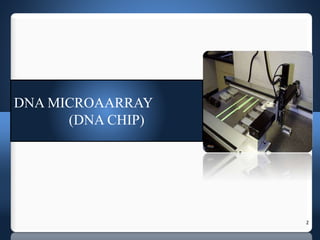
DNA MICROAARRAY
(DNA CHIP)
3
Introduction:
Definition: DNA microarrays are solid supports, usually of glass or
silicon, upon which DNA is attached in an organized grid fashion.
Each spot of DNA, called a probe, represents a single gene.
There are several synonyms of DNA microarrays such as DNA
chips, gene chips, DNA arrays, gene arrays and biochips.
[Ref: Presscot (Book for Microbiology), www.wikipedia.org]
History: Microarray technology evolved from Southern blotting,
where fragmented DNA is attached to a substrate and then probed with
a known DNA sequence.
The use of miniaturized microarrays for gene expression profiling was
first reported in 1995, and a complete eukaryotic genome
(Saccharomyces cerevisiae) on a microarray was published in 1997.
4
Principle
The principle of DNA microarrays lies on the hybridization
between the nucleotide. Using this technology the presence
of one genomic or cDNA sequence in 1,00,000 or more
sequences can be screened in a single hybridization.
The property of complementary nucleic
acid sequences is to specifically pair with each other by
forming hydrogen bonds between complementary
nucleotide base pairs.
The Plate.
• Usually made commercially.
• Made of glass, silicon, or nylon.
• Each plate contains thousands of spots, and each spot contains a probe for
a different gene.
• A probe can be a cDNA fragment or a synthetic oligonucleotide, such as
BAC (bacterial artificial chromosome set).
• Probes can either be attached by robotic means, where a needle applies
the cDNA to the plate, or by a method similar to making silicon chips for
computers. The latter is called a Gene Chip.
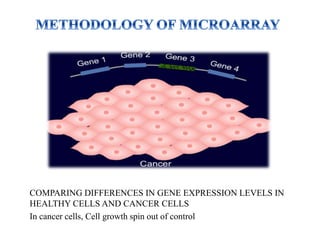
COMPARING DIFFERENCES IN GENE EXPRESSION LEVELS IN
HEALTHY CELLS AND CANCER CELLS
In cancer cells, Cell growth spin out of control
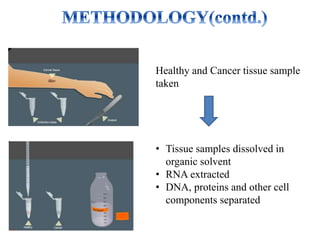
Healthy and Cancer tissue sample
taken
• Tissue samples dissolved in
organic solvent
• RNA extracted
• DNA, proteins and other cell
components separated
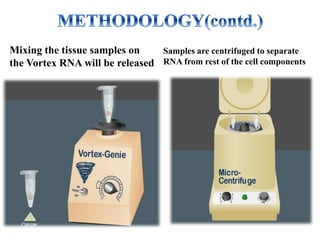
Mixing the tissue samples on
the Vortex RNA will be released
Samples are centrifuged to separate
RNA from rest of the cell components
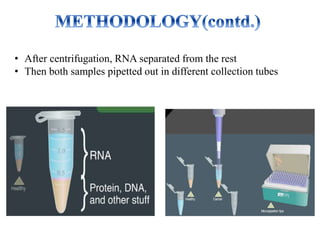
• After centrifugation, RNA separated from the rest
• Then both samples pipetted out in different collection tubes
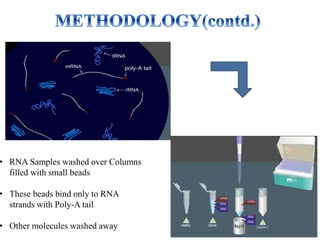
• RNA Samples washed over Columns
filled with small beads
• These beads bind only to RNA
strands with Poly-A tail
• Other molecules washed away
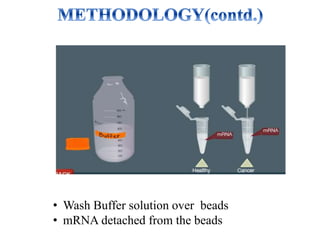
• Wash Buffer solution over beads
• mRNA detached from the beads
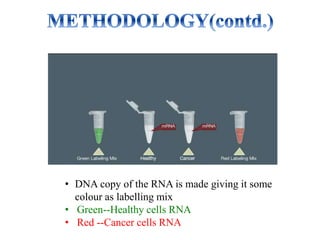
• DNA copy of the RNA is made giving it some
colour as labelling mix
• Green--Healthy cells RNA
• Red --Cancer cells RNA
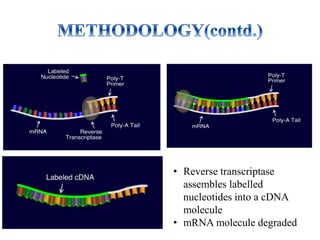
• Reverse transcriptase
assembles labelled
nucleotides into a cDNA
molecule
• mRNA molecule degraded
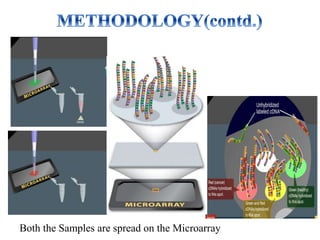
Both the Samples are spread on the Microarray
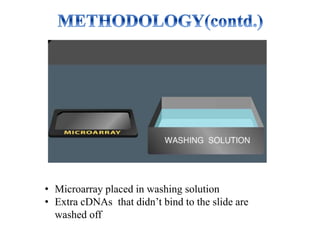
• Microarray placed in washing solution
• Extra cDNAs that didn’t bind to the slide are
washed off
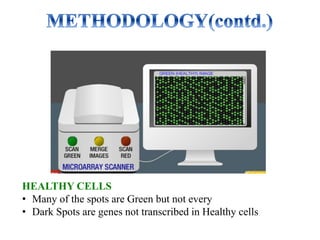
HEALTHY CELLS
• Many of the spots are Green but not every
• Dark Spots are genes not transcribed in Healthy cells
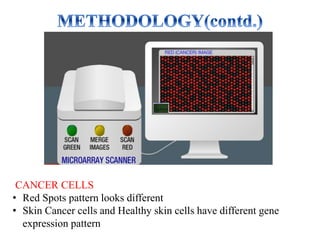
CANCER CELLS
• Red Spots pattern looks different
• Skin Cancer cells and Healthy skin cells have different gene
expression pattern
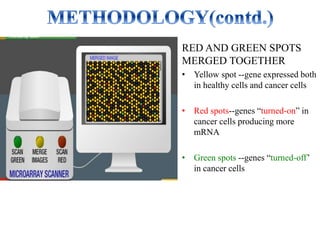
RED AND GREEN SPOTS
MERGED TOGETHER
• Yellow spot --gene expressed both
in healthy cells and cancer cells
• Red spots--genes “turned-on” in
cancer cells producing more
mRNA
• Green spots --genes “turned-off’
in cancer cells
19
The DNA chips are used in many areas as given
below:
• Gene expression profiling
• Discovery of drugs
• Disease diagnostic
• Gene Discovery
• Alternative splicing detection
• Functional genomics
• DNA sequencing
• Toxicological research (Toxicogenomics)
Applications
20
• Provides data for thousands of genes.
• One experiment instead of many.
• Fast and easy to obtain results.
• Huge step closer to discovering cures for diseases and cancer.
• Different parts of DNA can be used to study gene expresion.
ADVANTAGES
[Ref: www.biotechnologyforums.com, www.ehow.com]
21
Disadvantages:
• The biggest disadvantage of DNA chips is that
they are expensive to create.
• The production of too many results at a time requires
long time for analysis, which is quite complex in nature.
• The DNA chips do not have very long shelf life, which
proves to be another major disadvantage of the
technology.
22
THANK YOU

Dna microarray

  • 1.
    • Misbahud Din •Faisal Hayat khan • Shehryar khan 1
  • 2.
  • 3.
    3 Introduction: Definition: DNA microarraysare solid supports, usually of glass or silicon, upon which DNA is attached in an organized grid fashion. Each spot of DNA, called a probe, represents a single gene. There are several synonyms of DNA microarrays such as DNA chips, gene chips, DNA arrays, gene arrays and biochips. [Ref: Presscot (Book for Microbiology), www.wikipedia.org] History: Microarray technology evolved from Southern blotting, where fragmented DNA is attached to a substrate and then probed with a known DNA sequence. The use of miniaturized microarrays for gene expression profiling was first reported in 1995, and a complete eukaryotic genome (Saccharomyces cerevisiae) on a microarray was published in 1997.
  • 4.
    4 Principle The principle ofDNA microarrays lies on the hybridization between the nucleotide. Using this technology the presence of one genomic or cDNA sequence in 1,00,000 or more sequences can be screened in a single hybridization. The property of complementary nucleic acid sequences is to specifically pair with each other by forming hydrogen bonds between complementary nucleotide base pairs.
  • 5.
    The Plate. • Usuallymade commercially. • Made of glass, silicon, or nylon. • Each plate contains thousands of spots, and each spot contains a probe for a different gene. • A probe can be a cDNA fragment or a synthetic oligonucleotide, such as BAC (bacterial artificial chromosome set). • Probes can either be attached by robotic means, where a needle applies the cDNA to the plate, or by a method similar to making silicon chips for computers. The latter is called a Gene Chip.
  • 6.
    COMPARING DIFFERENCES INGENE EXPRESSION LEVELS IN HEALTHY CELLS AND CANCER CELLS In cancer cells, Cell growth spin out of control
  • 7.
    Healthy and Cancertissue sample taken • Tissue samples dissolved in organic solvent • RNA extracted • DNA, proteins and other cell components separated
  • 8.
    Mixing the tissuesamples on the Vortex RNA will be released Samples are centrifuged to separate RNA from rest of the cell components
  • 9.
    • After centrifugation,RNA separated from the rest • Then both samples pipetted out in different collection tubes
  • 10.
    • RNA Sampleswashed over Columns filled with small beads • These beads bind only to RNA strands with Poly-A tail • Other molecules washed away
  • 11.
    • Wash Buffersolution over beads • mRNA detached from the beads
  • 12.
    • DNA copyof the RNA is made giving it some colour as labelling mix • Green--Healthy cells RNA • Red --Cancer cells RNA
  • 13.
    • Reverse transcriptase assembleslabelled nucleotides into a cDNA molecule • mRNA molecule degraded
  • 14.
    Both the Samplesare spread on the Microarray
  • 15.
    • Microarray placedin washing solution • Extra cDNAs that didn’t bind to the slide are washed off
  • 16.
    HEALTHY CELLS • Manyof the spots are Green but not every • Dark Spots are genes not transcribed in Healthy cells
  • 17.
    CANCER CELLS • RedSpots pattern looks different • Skin Cancer cells and Healthy skin cells have different gene expression pattern
  • 18.
    RED AND GREENSPOTS MERGED TOGETHER • Yellow spot --gene expressed both in healthy cells and cancer cells • Red spots--genes “turned-on” in cancer cells producing more mRNA • Green spots --genes “turned-off’ in cancer cells
  • 19.
    19 The DNA chipsare used in many areas as given below: • Gene expression profiling • Discovery of drugs • Disease diagnostic • Gene Discovery • Alternative splicing detection • Functional genomics • DNA sequencing • Toxicological research (Toxicogenomics) Applications
  • 20.
    20 • Provides datafor thousands of genes. • One experiment instead of many. • Fast and easy to obtain results. • Huge step closer to discovering cures for diseases and cancer. • Different parts of DNA can be used to study gene expresion. ADVANTAGES [Ref: www.biotechnologyforums.com, www.ehow.com]
  • 21.
    21 Disadvantages: • The biggestdisadvantage of DNA chips is that they are expensive to create. • The production of too many results at a time requires long time for analysis, which is quite complex in nature. • The DNA chips do not have very long shelf life, which proves to be another major disadvantage of the technology.
  • 22.