MALDI - TOF
HIMA HARIDASAN
INTRODUCTION
• Proteome – complete set of proteins encoded in a
genome
• Proteomics
• Protein identification requires their separation by
methods :_
1. IEF
2. SDS- gel electrophoresis
3. Mass spectroscopy (MS)
MASS SPECTROSCOPY
• Separation of charged molecules/ molecules
according to their mass to charge
• Determines relative molecular mass (Mr)
• High resolution, precision, & sensitivity
• Requires charged gaseous molecules for its analysis
COMPONENTS OF MASS
SPECTROSCOPY
• Ionization source
1. Matrix assisted laser desorption/ ionization – time of
flight(MALDI)
2. Electrospray (ES)
• Analyser m/z : TOF, Magnet,..
• Detector : Photomultiplier, Electron multiplier, ..
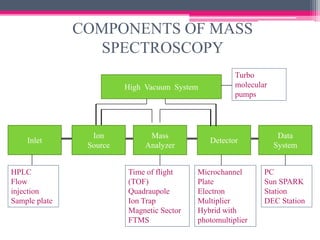
COMPONENTS OF MASS
SPECTROSCOPY
Inlet Detector
Data
System
Mass
Analyzer
High Vacuum System
Ion
Source
Time of flight
(TOF)
Quadraupole
Ion Trap
Magnetic Sector
FTMS
Turbo
molecular
pumps
HPLC
Flow
injection
Sample plate
Microchannel
Plate
Electron
Multiplier
Hybrid with
photomultiplier
PC
Sun SPARK
Station
DEC Station
MALDI - TOF
• Synonyms : MALDI, TOF – MS
• MALDI- Term was coined in 1985 by Franz Hillenkamp,
Michael Karas
• Principle : velocity of ions depend on its mass & energy,
the time taken by an ion to travel a specified distance
(TOF)
• Use : MALDI ionization & TOF of the ions to reach the
detector as a parameter to measure m/z ratio.
• Sample excitation – from the energy of a laser transferred
via a UV light absorbing matrix
MATRIX
• Conjugated organic compound or weak organic acid
• Weak organic acid – derivative of cinnamic acid &
dihydroxybenzoic acid
• Eg : sinapinic acid- proteins (10Da)
• Usually mixed with sample
• Absorbs maximum light at a wavelength (λ) of the laser,
typically a N2 laser of 337nm or yytrium – aluminium
garnet (Nd-YAG) AT 335nm.
• Acts as an absorbing media for the UV light
WORKING
Sample
(1 – 10 pmolmm-3)
Mixing Excess matrix
Sample – matrix
Dried on target plate
Co- crystallization
UV rays
Desorption
Pulses of laser light
Rapid excitation
Rapid heating of the region
Matrix & analyte ions ejection
Into
Gas phase
Results in
Explotion of sample region into high vacuum
Gas phase protonated molecules
Enter
TOF
Sample molecule ionization
MH+ + A - > M + AH+
(M - H)- + A - > [A – H-] + M
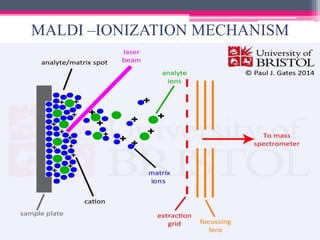
MALDI –IONIZATION MECHANISM
SAMPLE CONCENTRATION FOR MATRIX
• Maximum sensitivity if samples a diluted to a specific
concentration range
• For unknown sample concentration a dilution series may be
needed
• Sample loaded as a spot
• Peptides & proteins give best spectra (10pmolmm-3)
• Especially glycoproteins (10pmolmm-3)
• Oligonucleotides- better spectra at 10 - 100pmolmm-3
• Polymers - 100pmolmm-3
MALDI ADVANTAGES
• Gentle Ionization technique
• High molecular weight analyte can be ionized
• Molecule need not be volatile
• Sub-picomole sensitivity easy to obtain
• Wide array of matrices
TOF
• Best type of mass analyser to couple to MALDI
• Unlimited mass range
• Macromolecules of Mr > 400,000 – accurately measured
• 100 pulses of laser light (10nanoseconds)
• Result – seen as a good spectrum
• Camera – tracks the laser beam around the MALDI
TOF ADVANTAGES
• All ions detected at once
• High mass accuracy and resolving power possible
• Reasonable performance for cost
▫ <5 ppm mass accuracy and >20,000 resolving power
commercially available
• High mass, low charge ions not a problem
▫ Theoretically unlimited mass range
• Principle:-
Ions
Enter
Flight tube
Reaches
Detector
Acceleration of ions
Fixed point & initial time
Ion separation
(according to m/z ratio)
TOF
Converted to
Mass
LINEAR TOF MS
• Uses MALDI & TOF
• Samples are deposited on a metal substrate (100)
Analyte spots
laser
Short burst of ions
Ion acceleration to a fixed KE
Ions travel down a flight tube
DE MALDI – TOF MS
• Delayed extraction TOF MS
• Mass dependent
• Used for DNA sequencing
• Lacks resolution & sentivity to analyze complex
mixtures
RE TOF MS
• Reflectron TOF MS
• Single stage or dual stage reflectron – at the end of
flight tube
• High resolution
• Reflectron – compensate for the difference in the
TOF of ions with same m/z ratio, but same KE
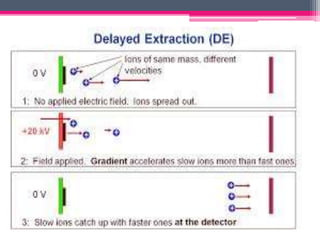
DELAYED EXTRACTION(DE)
• Extraction of ions generated by a high electrostatic field
occurs
• Ions from different spots have different energy
• Energy spreads, so broadens the peak corresponding to each
ion (low accuracy)
• If extraction is delayed until all ions are formed, spread
minimizes (high accuracy) : DE
• Here extraction occurs by high voltage.
• Lengthening time of delay controls ion fragmentation degree.
POST SOURCE DECAY
• Ion extraction results in ion fragmentation
• Biological molecules gives rise to molecules that
have been extracted before this dissociation is
complete
• Fragment ion’s velocity = precursor velocity
• Use of reflector overcomes this.
• Give structural information
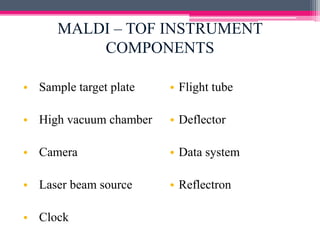
MALDI – TOF INSTRUMENT
COMPONENTS
• Sample target plate
• High vacuum chamber
• Camera
• Laser beam source
• Clock
• Flight tube
• Deflector
• Data system
• Reflectron
Camera
Laser
Sample
plate
Pumping Pumping
Timed ion
selector Reflector
Linear
detector
Extraction
grids
Reflector
detector
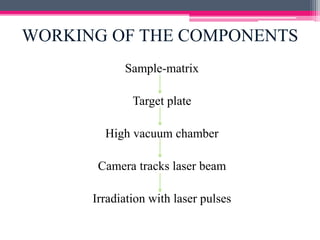
WORKING OF THE COMPONENTS
Sample-matrix
Target plate
High vacuum chamber
Camera tracks laser beam
Irradiation with laser pulses
Clock (on)
Measures TOF
EF
Acceleration of ions to same kinetic energy
Ions fly through the flight tube
Ion separation (mass)
Ions strike detector
Data system
(controls instrument parameters, acquires signal v/s time &
process the data )
TYPES OF MALDI SAMPLE PLATES
1. 100 well stainless steel flat plates
2. Four – hundred – spot Teflon – coated plates
3. Gold - coated plates
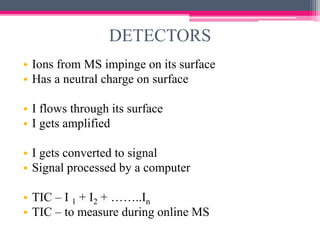
DETECTORS
• Ions from MS impinge on its surface
• Has a neutral charge on surface
• I flows through its surface
• I gets amplified
• I gets converted to signal
• Signal processed by a computer
• TIC – I 1 + I2 + ……..In
• TIC – to measure during online MS
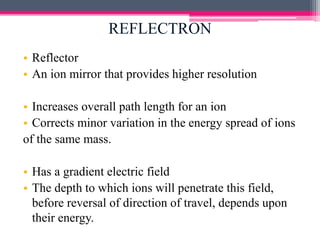
REFLECTRON
• Reflector
• An ion mirror that provides higher resolution
• Increases overall path length for an ion
• Corrects minor variation in the energy spread of ions
of the same mass.
• Has a gradient electric field
• The depth to which ions will penetrate this field,
before reversal of direction of travel, depends upon
their energy.
• Higher energy ions travels more & vice versa.
• Thus, TOF gets focussed
• Neutral fragments - unaffected by deflection
• Improves resolution & mass accuracy
• Allows structure & sequence information collection by
PSD analysis.
• Focuses charged fragments of a specific range of m/z
• So, a number of spectra are run at different settings &
stiched together to generate composite spectrum.
APPLICATIONS
Chemistry
Pharmaceutical
analysis
Clinical
analysis
Taxonomy
MICROBIOLOGY
CONCLUSION
• MALDI – TOF
• Working
• Measures only mass
• Instrument components
• Working of the instruments
REFERENCES
• Ashim k. Chakravarty - Intoduction to
Biotechnology – 2013- Oxford university press –
New Delhi – Pg. no : 301
• Glazer N. Alexander, Hiroshi Nikaido –
Fundamentals of Applied Microbiology – second
edition – 2008 – Cambridge university press - Pg. no
: 159 – 162
• H,K. Das – Textbook of Biotechnology – fourth
edition - 2011- Beekem printers – NewDelhi - Pg. no
: 135
• H.S. Chawla – Introduction to Plant Biotechnology –
third edition – 2013 – Oxford IBH Publishing
company pvt ltd – NewDelhi - Pg. no : 589 – 590
• Keith Wilson, John Walker – Practical Biochemistry,
Principles and Techniques – fifth edition – 2000 –
Cambridge university Press - Pg. no : 592 – 595, 586,
602
• P.K. Gupta – Biotechnology and Genomics – first
edition – 2010 – Rastogi publications – Meerut - Pg.
no : 83 - 87

MALDI - TOF

  • 1.
  • 2.
    INTRODUCTION • Proteome –complete set of proteins encoded in a genome • Proteomics • Protein identification requires their separation by methods :_ 1. IEF 2. SDS- gel electrophoresis 3. Mass spectroscopy (MS)
  • 3.
    MASS SPECTROSCOPY • Separationof charged molecules/ molecules according to their mass to charge • Determines relative molecular mass (Mr) • High resolution, precision, & sensitivity • Requires charged gaseous molecules for its analysis
  • 4.
    COMPONENTS OF MASS SPECTROSCOPY •Ionization source 1. Matrix assisted laser desorption/ ionization – time of flight(MALDI) 2. Electrospray (ES) • Analyser m/z : TOF, Magnet,.. • Detector : Photomultiplier, Electron multiplier, ..
  • 5.
    COMPONENTS OF MASS SPECTROSCOPY InletDetector Data System Mass Analyzer High Vacuum System Ion Source Time of flight (TOF) Quadraupole Ion Trap Magnetic Sector FTMS Turbo molecular pumps HPLC Flow injection Sample plate Microchannel Plate Electron Multiplier Hybrid with photomultiplier PC Sun SPARK Station DEC Station
  • 6.
    MALDI - TOF •Synonyms : MALDI, TOF – MS • MALDI- Term was coined in 1985 by Franz Hillenkamp, Michael Karas • Principle : velocity of ions depend on its mass & energy, the time taken by an ion to travel a specified distance (TOF) • Use : MALDI ionization & TOF of the ions to reach the detector as a parameter to measure m/z ratio. • Sample excitation – from the energy of a laser transferred via a UV light absorbing matrix
  • 7.
    MATRIX • Conjugated organiccompound or weak organic acid • Weak organic acid – derivative of cinnamic acid & dihydroxybenzoic acid • Eg : sinapinic acid- proteins (10Da) • Usually mixed with sample • Absorbs maximum light at a wavelength (λ) of the laser, typically a N2 laser of 337nm or yytrium – aluminium garnet (Nd-YAG) AT 335nm. • Acts as an absorbing media for the UV light
  • 8.
    WORKING Sample (1 – 10pmolmm-3) Mixing Excess matrix Sample – matrix Dried on target plate Co- crystallization UV rays Desorption Pulses of laser light Rapid excitation
  • 9.
    Rapid heating ofthe region Matrix & analyte ions ejection Into Gas phase Results in Explotion of sample region into high vacuum Gas phase protonated molecules Enter TOF
  • 10.
    Sample molecule ionization MH++ A - > M + AH+ (M - H)- + A - > [A – H-] + M
  • 11.
  • 12.
    SAMPLE CONCENTRATION FORMATRIX • Maximum sensitivity if samples a diluted to a specific concentration range • For unknown sample concentration a dilution series may be needed • Sample loaded as a spot • Peptides & proteins give best spectra (10pmolmm-3) • Especially glycoproteins (10pmolmm-3) • Oligonucleotides- better spectra at 10 - 100pmolmm-3 • Polymers - 100pmolmm-3
  • 13.
    MALDI ADVANTAGES • GentleIonization technique • High molecular weight analyte can be ionized • Molecule need not be volatile • Sub-picomole sensitivity easy to obtain • Wide array of matrices
  • 14.
    TOF • Best typeof mass analyser to couple to MALDI • Unlimited mass range • Macromolecules of Mr > 400,000 – accurately measured • 100 pulses of laser light (10nanoseconds) • Result – seen as a good spectrum • Camera – tracks the laser beam around the MALDI
  • 15.
    TOF ADVANTAGES • Allions detected at once • High mass accuracy and resolving power possible • Reasonable performance for cost ▫ <5 ppm mass accuracy and >20,000 resolving power commercially available • High mass, low charge ions not a problem ▫ Theoretically unlimited mass range
  • 16.
    • Principle:- Ions Enter Flight tube Reaches Detector Accelerationof ions Fixed point & initial time Ion separation (according to m/z ratio) TOF Converted to Mass
  • 18.
    LINEAR TOF MS •Uses MALDI & TOF • Samples are deposited on a metal substrate (100) Analyte spots laser Short burst of ions Ion acceleration to a fixed KE Ions travel down a flight tube
  • 19.
    DE MALDI –TOF MS • Delayed extraction TOF MS • Mass dependent • Used for DNA sequencing • Lacks resolution & sentivity to analyze complex mixtures
  • 20.
    RE TOF MS •Reflectron TOF MS • Single stage or dual stage reflectron – at the end of flight tube • High resolution • Reflectron – compensate for the difference in the TOF of ions with same m/z ratio, but same KE
  • 21.
    DELAYED EXTRACTION(DE) • Extractionof ions generated by a high electrostatic field occurs • Ions from different spots have different energy • Energy spreads, so broadens the peak corresponding to each ion (low accuracy) • If extraction is delayed until all ions are formed, spread minimizes (high accuracy) : DE • Here extraction occurs by high voltage. • Lengthening time of delay controls ion fragmentation degree.
  • 23.
    POST SOURCE DECAY •Ion extraction results in ion fragmentation • Biological molecules gives rise to molecules that have been extracted before this dissociation is complete • Fragment ion’s velocity = precursor velocity • Use of reflector overcomes this. • Give structural information
  • 24.
    MALDI – TOFINSTRUMENT COMPONENTS • Sample target plate • High vacuum chamber • Camera • Laser beam source • Clock • Flight tube • Deflector • Data system • Reflectron
  • 25.
    Camera Laser Sample plate Pumping Pumping Timed ion selectorReflector Linear detector Extraction grids Reflector detector
  • 26.
    WORKING OF THECOMPONENTS Sample-matrix Target plate High vacuum chamber Camera tracks laser beam Irradiation with laser pulses
  • 27.
    Clock (on) Measures TOF EF Accelerationof ions to same kinetic energy Ions fly through the flight tube Ion separation (mass) Ions strike detector Data system (controls instrument parameters, acquires signal v/s time & process the data )
  • 28.
    TYPES OF MALDISAMPLE PLATES 1. 100 well stainless steel flat plates 2. Four – hundred – spot Teflon – coated plates 3. Gold - coated plates
  • 29.
    DETECTORS • Ions fromMS impinge on its surface • Has a neutral charge on surface • I flows through its surface • I gets amplified • I gets converted to signal • Signal processed by a computer • TIC – I 1 + I2 + ……..In • TIC – to measure during online MS
  • 30.
    REFLECTRON • Reflector • Anion mirror that provides higher resolution • Increases overall path length for an ion • Corrects minor variation in the energy spread of ions of the same mass. • Has a gradient electric field • The depth to which ions will penetrate this field, before reversal of direction of travel, depends upon their energy.
  • 31.
    • Higher energyions travels more & vice versa. • Thus, TOF gets focussed • Neutral fragments - unaffected by deflection • Improves resolution & mass accuracy • Allows structure & sequence information collection by PSD analysis. • Focuses charged fragments of a specific range of m/z • So, a number of spectra are run at different settings & stiched together to generate composite spectrum.
  • 32.
  • 33.
    CONCLUSION • MALDI –TOF • Working • Measures only mass • Instrument components • Working of the instruments
  • 34.
    REFERENCES • Ashim k.Chakravarty - Intoduction to Biotechnology – 2013- Oxford university press – New Delhi – Pg. no : 301 • Glazer N. Alexander, Hiroshi Nikaido – Fundamentals of Applied Microbiology – second edition – 2008 – Cambridge university press - Pg. no : 159 – 162 • H,K. Das – Textbook of Biotechnology – fourth edition - 2011- Beekem printers – NewDelhi - Pg. no : 135
  • 35.
    • H.S. Chawla– Introduction to Plant Biotechnology – third edition – 2013 – Oxford IBH Publishing company pvt ltd – NewDelhi - Pg. no : 589 – 590 • Keith Wilson, John Walker – Practical Biochemistry, Principles and Techniques – fifth edition – 2000 – Cambridge university Press - Pg. no : 592 – 595, 586, 602 • P.K. Gupta – Biotechnology and Genomics – first edition – 2010 – Rastogi publications – Meerut - Pg. no : 83 - 87