xMAP®
Cookbook
A collection of methods and protocols for developing multiplex
assays with xMAP Technology.
2nd Edition
©2013-2014 Luminex Corporation. All rights reserved. The trademarks mentioned herein are the property of Luminex or their respective owners.
www.luminexcorp.com | Page 2
BR_574.01_0614
Authors
Stephen Angeloni, Ph.D.
Robert Cordes, B.A.
Sherry Dunbar, Ph.D.
Carlos Garcia, B.A.
Grant Gibson, Ph.D.
Charles Martin, Ph.D.
Valerie Stone, M.S., C.T. (A.S.C.P.)
Contributors
Cassie Bannister, B.A.
Geoffrey Wyatt, M.S.
Effective Date: 01 July 2014
Certain applications using Luminex® Microspheres, including those illustrated
in this documentation, may be covered by patents owned by parties other than
Luminex. Purchase and use of Luminex Microspheres does not convey a license
to any third party patents unless explicitly stated in writing. You are responsible
for conducting the necessary due diligence and securing rights to any third party
intellectual property required for your specific application(s) of any Luminex
Microspheres. Nothing herein is to be construed as recommending any practice or
any product in violation of any patent or in violation of any law or regulation.
www.luminexcorp.com | Page 3
BR_574.01_0614
Table of Contents
Table of Contents
1.	Introduction. . . . . . . . . . . . . . . . . . . . . . . . . . . . . . . . . . . . . . . . . . . . . . . . . . . . . . . . . . . . . . . . . . . . . . . . . . . . . . . . . . . . . . . . . . . . . . . . . . . . . . . . . . . . . . . . . . . . 4
2.	 xMAP® Technology. . . . . . . . . . . . . . . . . . . . . . . . . . . . . . . . . . . . . . . . . . . . . . . . . . . . . . . . . . . . . . . . . . . . . . . . . . . . . . . . . . . . . . . . . . . . . . . . . . . . . . . . . . . . . 5
3.	 Development of an xMAP Assay. . . . . . . . . . . . . . . . . . . . . . . . . . . . . . . . . . . . . . . . . . . . . . . . . . . . . . . . . . . . . . . . . . . . . . . . . . . . . . . . . . . . . . . . . . . . . . . . . 7
	 3.1	 Assay Design. . . . . . . . . . . . . . . . . . . . . . . . . . . . . . . . . . . . . . . . . . . . . . . . . . . . . . . . . . . . . . . . . . . . . . . . . . . . . . . . . . . . . . . . . . . . . . . . . . . . . . . . . . . . . . 8
	 3.2	 Reagents and Equipment. . . . . . . . . . . . . . . . . . . . . . . . . . . . . . . . . . . . . . . . . . . . . . . . . . . . . . . . . . . . . . . . . . . . . . . . . . . . . . . . . . . . . . . . . . . . . . . . . . 10
4.	 Proteomic Applications. . . . . . . . . . . . . . . . . . . . . . . . . . . . . . . . . . . . . . . . . . . . . . . . . . . . . . . . . . . . . . . . . . . . . . . . . . . . . . . . . . . . . . . . . . . . . . . . . . . . . . . .  12
	 4.1	 Development of xMAP Proteomic assays. . . . . . . . . . . . . . . . . . . . . . . . . . . . . . . . . . . . . . . . . . . . . . . . . . . . . . . . . . . . . . . . . . . . . . . . . . . . . . . . . . .  13
	 4.2	 Protein Coupling. . . . . . . . . . . . . . . . . . . . . . . . . . . . . . . . . . . . . . . . . . . . . . . . . . . . . . . . . . . . . . . . . . . . . . . . . . . . . . . . . . . . . . . . . . . . . . . . . . . . . . . . . . 14
		4.2.1	 Carbodiimide Coupling Protocol for Antibodies and Proteins. . . . . . . . . . . . . . . . . . . . . . . . . . . . . . . . . . . . . . . . . . . . . . . . . . . . . . . . . . . 16
		4.2.2	 Coupling Confirmation. . . . . . . . . . . . . . . . . . . . . . . . . . . . . . . . . . . . . . . . . . . . . . . . . . . . . . . . . . . . . . . . . . . . . . . . . . . . . . . . . . . . . . . . . . . .  20
	 4.3	 Common xMAP Immunoassay Formats. . . . . . . . . . . . . . . . . . . . . . . . . . . . . . . . . . . . . . . . . . . . . . . . . . . . . . . . . . . . . . . . . . . . . . . . . . . . . . . . . . . . . 24
		 4.3.1	 Capture Sandwich Immunoassay. . . . . . . . . . . . . . . . . . . . . . . . . . . . . . . . . . . . . . . . . . . . . . . . . . . . . . . . . . . . . . . . . . . . . . . . . . . . . . . . . . . . 25
		 4.3.2	 Competitive Immunoassay. . . . . . . . . . . . . . . . . . . . . . . . . . . . . . . . . . . . . . . . . . . . . . . . . . . . . . . . . . . . . . . . . . . . . . . . . . . . . . . . . . . . . . . . . . 31
		 4.3.3	 Indirect (Serological) Immunoassay. . . . . . . . . . . . . . . . . . . . . . . . . . . . . . . . . . . . . . . . . . . . . . . . . . . . . . . . . . . . . . . . . . . . . . . . . . . . . . . . . 37
		 4.3.4	 Combined Capture Sandwich and Competitive Immunoassay. . . . . . . . . . . . . . . . . . . . . . . . . . . . . . . . . . . . . . . . . . . . . . . . . . . . . . . . .  42
	 4.4	 Other Coupling Moieties. . . . . . . . . . . . . . . . . . . . . . . . . . . . . . . . . . . . . . . . . . . . . . . . . . . . . . . . . . . . . . . . . . . . . . . . . . . . . . . . . . . . . . . . . . . . . . . . .  45
		 4.4.1	 Binding Biotinylated Peptides to LumAvidin® Microspheres. . . . . . . . . . . . . . . . . . . . . . . . . . . . . . . . . . . . . . . . . . . . . . . . . . . . . . . . . . .  46
		 4.4.2	 Modification of Microspheres with ADH. . . . . . . . . . . . . . . . . . . . . . . . . . . . . . . . . . . . . . . . . . . . . . . . . . . . . . . . . . . . . . . . . . . . . . . . . . . .  48
		 4.4.3	 Coupling Peptides to ADH-Modified Microspheres . . . . . . . . . . . . . . . . . . . . . . . . . . . . . . . . . . . . . . . . . . . . . . . . . . . . . . . . . . . . . . . . . .  50
		 4.4.4	 Modification of Microspheres with MPBH . . . . . . . . . . . . . . . . . . . . . . . . . . . . . . . . . . . . . . . . . . . . . . . . . . . . . . . . . . . . . . . . . . . . . . . . . . . 52
		 4.4.5	 Coupling Peptides to Maleimide-Modified Microspheres . . . . . . . . . . . . . . . . . . . . . . . . . . . . . . . . . . . . . . . . . . . . . . . . . . . . . . . . . . . . .  54
	 4.5	 Optimization of Immunoassays. . . . . . . . . . . . . . . . . . . . . . . . . . . . . . . . . . . . . . . . . . . . . . . . . . . . . . . . . . . . . . . . . . . . . . . . . . . . . . . . . . . . . . . . . . . . 56
	 4.6	 Immunoassay Validation. . . . . . . . . . . . . . . . . . . . . . . . . . . . . . . . . . . . . . . . . . . . . . . . . . . . . . . . . . . . . . . . . . . . . . . . . . . . . . . . . . . . . . . . . . . . . . . . . . 67
	 4.7	 Proteomics FAQ’s. . . . . . . . . . . . . . . . . . . . . . . . . . . . . . . . . . . . . . . . . . . . . . . . . . . . . . . . . . . . . . . . . . . . . . . . . . . . . . . . . . . . . . . . . . . . . . . . . . . . . . . . . 71
5.	 Genomic Applications. . . . . . . . . . . . . . . . . . . . . . . . . . . . . . . . . . . . . . . . . . . . . . . . . . . . . . . . . . . . . . . . . . . . . . . . . . . . . . . . . . . . . . . . . . . . . . . . . . . . . . . . . 78
	 5.1	 Development of Nucleic Acid Assays. . . . . . . . . . . . . . . . . . . . . . . . . . . . . . . . . . . . . . . . . . . . . . . . . . . . . . . . . . . . . . . . . . . . . . . . . . . . . . . . . . . . . . . 79
	 5.2	 Nucleic Acid Coupling. . . . . . . . . . . . . . . . . . . . . . . . . . . . . . . . . . . . . . . . . . . . . . . . . . . . . . . . . . . . . . . . . . . . . . . . . . . . . . . . . . . . . . . . . . . . . . . . . . . . . 81
		 5.2.1	 Standard Nucleic Acid Coupling to xMAP Microspheres. . . . . . . . . . . . . . . . . . . . . . . . . . . . . . . . . . . . . . . . . . . . . . . . . . . . . . . . . . . . . . . 83
		 5.2.2	 Oligonucleotide Coupling Confirmation. . . . . . . . . . . . . . . . . . . . . . . . . . . . . . . . . . . . . . . . . . . . . . . . . . . . . . . . . . . . . . . . . . . . . . . . . . . . .  86
	 5.3	 Common Nucleic Acid Assay Formats. . . . . . . . . . . . . . . . . . . . . . . . . . . . . . . . . . . . . . . . . . . . . . . . . . . . . . . . . . . . . . . . . . . . . . . . . . . . . . . . . . . . .  89
		 5.3.1	 Oligo Ligation Assay (OLA) SNP Typing. . . . . . . . . . . . . . . . . . . . . . . . . . . . . . . . . . . . . . . . . . . . . . . . . . . . . . . . . . . . . . . . . . . . . . . . . . . . .  90
		 5.3.2	 Allele-Specific Primer Extension (ASPE) SNP Typing . . . . . . . . . . . . . . . . . . . . . . . . . . . . . . . . . . . . . . . . . . . . . . . . . . . . . . . . . . . . . . . . .  99
		 5.3.3	 Target-Specific PCR Sequence Detection with MagPlex®-TAG™ Microspheres. . . . . . . . . . . . . . . . . . . . . . . . . . . . . . . . . . . . . . . . . 108
		 5.3.4	 Direct DNA Hybridization Sequence Detection. . . . . . . . . . . . . . . . . . . . . . . . . . . . . . . . . . . . . . . . . . . . . . . . . . . . . . . . . . . . . . . . . . . . . .  113
		 5.3.5	 MicroRNA Analysis. . . . . . . . . . . . . . . . . . . . . . . . . . . . . . . . . . . . . . . . . . . . . . . . . . . . . . . . . . . . . . . . . . . . . . . . . . . . . . . . . . . . . . . . . . . . . . . 120
	 5.4	 Optimization of Nucleic Acid Assays. . . . . . . . . . . . . . . . . . . . . . . . . . . . . . . . . . . . . . . . . . . . . . . . . . . . . . . . . . . . . . . . . . . . . . . . . . . . . . . . . . . . . . 129
	 5.5	 Nucleic Acid Assay Validation. . . . . . . . . . . . . . . . . . . . . . . . . . . . . . . . . . . . . . . . . . . . . . . . . . . . . . . . . . . . . . . . . . . . . . . . . . . . . . . . . . . . . . . . . . . . 133
	 5.6	 Genomics FAQ’s. . . . . . . . . . . . . . . . . . . . . . . . . . . . . . . . . . . . . . . . . . . . . . . . . . . . . . . . . . . . . . . . . . . . . . . . . . . . . . . . . . . . . . . . . . . . . . . . . . . . . . . . . 135
Appendix A – Common Buffers Used in xMAP Protocols . . . . . . . . . . . . . . . . . . . . . . . . . . . . . . . . . . . . . . . . . . . . . . . . . . . . . . . . . . . . . . . . . . . . . . . . . . . . . 138
Appendix B – Equipment Needed for xMAP Protocols. . . . . . . . . . . . . . . . . . . . . . . . . . . . . . . . . . . . . . . . . . . . . . . . . . . . . . . . . . . . . . . . . . . . . . . . . . . . . . .  140
Appendix C – Automated Bead Washing Option. . . . . . . . . . . . . . . . . . . . . . . . . . . . . . . . . . . . . . . . . . . . . . . . . . . . . . . . . . . . . . . . . . . . . . . . . . . . . . . . . . . . . 143
www.luminexcorp.com | Page 4Chapter 1 | Introduction
BR_574.01_0614
Chapter 1
Introduction
Biological assays have evolved from relatively large volume reactions to smaller
volume, faster, highly automated tests. Whether in a test tube rack, a microwell
plate, or a micro-volume chip, these may all be considered ‘arrays’ of assays, where
different samples are physically separated from one another.
Since biological assays are typically coupled to a colorimetric readout, the notion
of ‘multiplexing’, or reading multiple test results in a single sample volume has
been complicated primarily by spectral overlap. Color from one assay detection
channel interferes with color in other detection channels. This limitation has made
such multi-color assays useful only to a few analytes per sample.
While microarrays (2-dimensional solid arrays) allow small-volume assaying
of physically separated features, limitations such as slow, solid-phase kinetics;
instability of immobilized protein or nucleic acid capture molecules; and poor
reproducibility may limit its broader application in the clinical or research laboratory.
Solution-phase multiplex assays remain highly desirable to laboratories due to the
following benefits:
•	 reduced sample volume and other redundant consumables
•	 more data from the same amount of labor
•	 faster results due to solution-phase kinetics
What is multiplexing?
Multiplexing describes
assaying multiple analytes
simultaneously within
a single sample volume
and within a single cycle
or run. While solid-phase
microarrays technically
meet this definition,
multiplexing typically
describes solution-phase
assays such as xMAP®
Technology or quantitative
PCR.
www.luminexcorp.com | Page 5Chapter 2 | xMAP® Technology
BR_574.01_0614
Chapter 2
xMAP®
Technology
In the late 1990s, scientists at Luminex® invented xMAP Technology, a major
advance in multiplexed biological assays. xMAP Technology draws from the
strengths of solid-phase separation technology without the typical limitations of
solid-phase reaction kinetics. By combining advanced fluidics, optics, and digital
signal processing with proprietary microsphere (“bead”) technology, xMAP
Technology enables a high degree of multiplexing within a single sample volume.
Featuring a flexible open-architecture design, xMAP Technology can be configured
to perform a wide variety of assays quickly, cost-effectively, and accurately.
How does xMAP Technology work?
xMAP Technology uses colored beads to perform biological assays similar to
ELISA or nucleic acid hybridization assays. By color-coding microscopic beads
into many spectrally distinct sets, each bead set can be coated with a nucleic
acid or protein capture molecule specific to a particular biological target, allowing
the simultaneous capture of multiple analytes from a single sample. Because
of the microscopic size and low density of these beads, assay reactions exhibit
virtually solution-phase kinetics. However, once an assay is complete the solid-
phase characteristics allow each bead to be analyzed discretely. By incorporating
magnetic properties into xMAP Microspheres, assay washing is simplified while
maintaining desirable solution-phase properties.
Figure 1.
Excite at One Excitation
Wavelength
Observe Two Emission
Wavelengths
A B
C D
5’-PO4
Excite at One Excitation
Wavelength
Observe Three Emission
Wavelengths
Figure 1 – xMAP Microspheres include
two dyes where (A) one excitation
wavelength allows observation of
two separate fluorescence emission
wavelengths, yielding (B) 100 unique
microsphere sets (10x10 dye matrix);
or three dyes where (C) one excitation
wavelength allows observation of three
separate fluorescence wavelengths,
yielding (D) 500 unique microsphere sets.
(10x10x5 dye matrix).
xMAP Technology name origin
	 x	= biomarker or disease panel
to be tested
	 MAP	= Multi-Analyte Profiling
xMAP		= multiplex biological testing of
up to 500 analytes in a single
sample volume
www.luminexcorp.com | Page 6Chapter 2 | xMAP® Technology
BR_574.01_0614
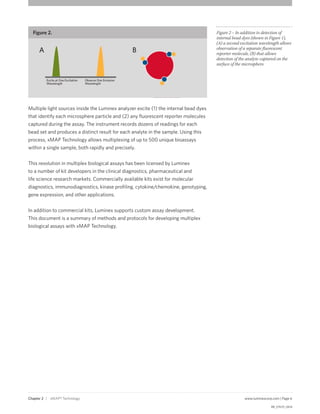
Figure 2.
Excite at One Excitation
Wavelength
Observe One Emission
Wavelength
A B
5’-PO4
Multiple light sources inside the Luminex analyzer excite (1) the internal bead dyes
that identify each microsphere particle and (2) any fluorescent reporter molecules
captured during the assay. The instrument records dozens of readings for each
bead set and produces a distinct result for each analyte in the sample. Using this
process, xMAP Technology allows multiplexing of up to 500 unique bioassays
within a single sample, both rapidly and precisely.
This revolution in multiplex biological assays has been licensed by Luminex
to a number of kit developers in the clinical diagnostics, pharmaceutical and
life science research markets. Commercially available kits exist for molecular
diagnostics, immunodiagnostics, kinase profiling, cytokine/chemokine, genotyping,
gene expression, and other applications.
In addition to commercial kits, Luminex supports custom assay development.
This document is a summary of methods and protocols for developing multiplex
biological assays with xMAP Technology.
Figure 2 – In addition to detection of
internal bead dyes (shown in Figure 1),
(A) a second excitation wavelength allows
observation of a separate fluorescent
reporter molecule, (B) that allows
detection of the analyte captured on the
surface of the microsphere.
www.luminexcorp.com | Page 7Chapter 3 | Development of an xMAP® Assay
BR_574.01_0614
Chapter 3
Development of an xMAP®
Assay
The development process for xMAP multiplex assays is relatively simple, but does
require a few unique considerations compared to monoplex assays. The following
describes the general workflow of xMAP assay development.
This chapter covers the initial steps and considerations for developing an xMAP
multiplex assay, including general assay design reagents and equipment needed.
Additional assay development steps such as bead coupling, optimization and
validation are discussed separately in Chapters 4 (Proteomic Applications) and 5
(Genomic Applications).
Identify Appropriate Assay
Design
•	 Protein/Nucleic Acid
•	 Assay Format (i.e Capture
Sandwich, Oligo Ligation,
etc.)
Validate
•	 Known samples
•	 Standards
•	 Controls
Identify Necessary
Reagents and Equipment
•	 Antibodies/Probes
•	 Microspheres
•	 Buffers
•	 Thermocycler
•	 Shaker
Optimize
•	 Volumes
•	 Concentrations
•	 Incubation Times
•	 Cross Reactivity
•	 Signal
•	 Sensitivity
•	 Specificity
Couple Beads
•	 Antibody Coupling
(AbC) Kit
•	 Custom Coupling
•	 LumAvidin® (non-magnetic)
•	 MagPlex®-TAG™
(pre-coupled by Luminex®)
www.luminexcorp.com | Page 8Chapter 3.1 | Assay Design
BR_574.01_0614
Chapter 3.1
Assay Design
xMAP® Technology is adaptable to a number of biological assays, including
immunoassays, nucleic acid assays and enzyme activity assays. Common
immunoassay formats are capture sandwich, competitive, and indirect antibody
assays. Nucleic acid assays are hybridization-based where a probe sequence
captures a labeled complementary target from your sample reaction. Enzyme
activity assays typically involve labeling or cleaving a peptide substrate to
introduce or release a fluorescent molecule.
Immunoassay Nucleic Acid Enzyme Activity
Capture sandwich TAG incorporation Kinase/Phosphatase selectivity
Competitive PCR based
Indirect assay Primer extension
Probe ligation
Immunoassays
An immunoassay is a biochemical test that measures the presence or
concentration of a macromolecule in a solution through the use of an antibody
or immunoglobulin. The macromolecule detected by the immunoassay is often
referred to as an “analyte” and is in many cases a protein.
Figure 3.
A
Capture Sandwich
B C
Indirect Serological AssayCompetitive Assay
Figure 3 - Common assay formats for
immunoassays include (A) capture
sandwich assay, requiring capture and
detection antibodies to your analyte
target (polyclonal capture antibodies
should be purified and mono-specific);
(B) competitive (antibody) assay, requiring
a single antibody and a labeled positive
target; and (C) indirect assay (or serology
assay), requiring both a target protein and
an anti-antibody.
www.luminexcorp.com | Page 9Chapter 3.1 | Assay Design
BR_574.01_0614
Immunoassays are used for the detection of biological substances, and have
become established as one of the most popular analytical techniques applied
in clinical and veterinary medicine, drug discovery, and rapidly emerging areas
such as biothreat and food safety. Due to the ease of use, accuracy, specificity,
and speed, immunoassays are commonly used to measure a large number of
hormones, blood products, enzymes, drugs, disease markers, and other biological
molecules. Many immunoassays can be performed directly on untreated samples,
such as plasma, serum, urine, saliva, and cerebrospinal fluid. Single-analyte ELISA
has been an industry standard for decades and has led to more novel techniques
such as highly multiplexed immunoassays for measuring potentially hundreds of
analytes simultaneously. Such multiplex assays can be used to generate profiles
of clinical samples that can facilitate accurate disease diagnoses or prediction of
drug responses.
Nucleic acid assays
Multiplex nucleic acid assays require different optimization steps from
immunoassays, although some similarities exist. Sensitivity of nucleic acid
assays may be affected by the assay chemistry selected, the amount of capture
oligonucleotide and the amount of beads used. In order to distinguish similar
nucleic acid sequences, standards and controls must be run to confirm that there
is minimal cross hybridization and non-specific hybridization between sequences.
Depending on whether the purpose of your assay is gene expression, genotyping,
or simply sequence detection, there are different requirements for the type of
starting nucleic acid used in the assay and the chemistry required to generate
reporter molecules. No matter which chemistry is used to generate the reporter
molecules, the capture and detection of the reporter molecules is performed as
diagrammed in Figure 4.
Figure 4.
A
a
Homozygous AA
Signal
aA
Figure 4 - Schematic of nucleic acid
assay analysis on Luminex® beads. Each
bead has a unique capture sequence
specific for a marker sequence. If reporter
molecules are generated and captured
(bead A) a fluorescence signal is detected.
If no reporter molecules are generated
and captured (bead a) minimal or
background signal is detected.
www.luminexcorp.com | Page 10Chapter 3.2 | Reagents and Equipment
BR_574.01_0614
Chapter 3.2
Reagents and Equipment
While Luminex® has a number of partnerships with other companies for the
purchase of a variety of kits, reagents, and instrumentation, a number of products
can be purchased directly from Luminex for the development and analysis of
protein and genomic assays. These products include reagents, instruments and
supplies that can be found on the Luminex web site (www.luminexcorp.com).
At the heart of the Luminex platform’s flexibility and multiplexing capability are
Luminex beads. Luminex’s newest generation of xMAP® beads are MagPlex®
Microspheres, which are 6.5-micron superparamagnetic beads. The beads are dyed
with different ratios of two or three dyes allowing the generation of 500 different
colored beads or bead regions for the development of multi-analyte assays up
to 500-plex. The surface of these beads are impregnated with iron-containing
magnetite particles. This feature allows the use of magnets to rapidly remove the
beads from reaction suspensions to speed up processing protocols and to minimize
bead loss, resulting in more reproducible data generation.
MagPlex® Microspheres should be purchased from Luminex. The beads should be
stored at 4°C and be kept in the dark. They can be used directly from their vials
as described in the coupling protocols for the development of different proteomic
or genomic assays. MagPlex Microspheres are available at concentrations of 2.5
million and 12.5 million beads/mL and can be ordered in 1 mL and 4 mL vial sizes.
Special orders of larger size vials are also available upon request.
MagPlex®-TAG™ Microspheres are MagPlex beads where each bead region is
covalently coupled with a unique 24-base oligonucleotide or ‘anti-TAG’ sequence.
These beads enable the user to quickly and easily design custom genomic assays
by incorporating complementary ‘TAG’ sequences in primers or probes used in
assay reactions. This allows reporter molecules generated in the reactions to
be hybridized to specific anti-TAG sequences on specific beads regions. For a
complete list of the TAG and anti-TAG sequences for each of the 150 available
microspheres, visit www.luminexcorp.com.
MagPlex and MagPlex-TAG Microspheres are compatible with all Luminex
instruments, including MAGPIX® (up to 50-plex), Luminex® 100/200™ with
xPONENT® software (up to 80-plex) and FLEXMAP 3D® (up to 500-plex for
MagPlex; up to 150-plex for MagPlex-TAG). Basic reagents for Luminex equipment
include Calibration and Verification kits and Sheath or Drive Fluid. The products
are also offered in a variety of custom volumes. For additional information on all
xMAP reagents, contact your Luminex representative or visit www.luminexcorp.
com/Products/ReagentsMicrospheres/.
Note: Bead colors are referred
to as “regions” because
beads are plotted in different
regions of the bead map in the
instrument software, based on
their dye ratios.
Note: The assays and protocols
described in this cookbook
are optimized for use with
MagPlex or MagPlex-TAG
Microspheres unless otherwise
noted. If using nonmagnetic
MicroPlex® beads, contact
Technical Support or your
Luminex Field Application
Scientist (FAS) for information
on assay modifications needed
for non-magnetic beads.
www.luminexcorp.com | Page 11Chapter 3.2 | Reagents and Equipment
BR_574.01_0614
Whether you need to couple your own capture molecules to Luminex beads, or
use any of our other bead types, developing a custom assay will require additional
reagents and equipment that must be provided by the user. To assist with the
development of different types of assays, this xMAP Cookbook is divided into
sections for proteomic and genomic based assays. Each of the protocols in the two
sections includes lists and recommended sources of reagents, equipment needed
and information on troubleshooting and validation. A list of common buffers and
equipment required for different xMAP assays can be found in Appendices A and
B, and a protocol for automated bead washing is found in Appendix C.
www.luminexcorp.com | Page 12Chapter 4 | Proteomic Applications
BR_574.01_0614
Chapter 4
Proteomic Applications
Chapter 4
Proteomic Applications
www.luminexcorp.com | Page 13Chapter 4.1 | Development of xMAP® Proteomic Assays
BR_574.01_0614
Chapter 4.1
Development of xMAP® Proteomic Assays
This section provides protocols needed for developing a number of different
proteomic assays. These assays can be used for studying immunological responses,
detecting concentrations of proteins and other molecules in different samples, for
analyzing protein-protein interactions, and for other applications.
Before undertaking the task of developing a new assay, one should review the
hundreds of commercial assay kits available through more than 50 licensed
Luminex® partners. With dozens of new commercial kits being developed every
month, many common biological targets can be found in pre-optimized panels
developed by these partners. The xMAP Kit Finder online catalog of research
immunoassays is a helpful tool for identifying commercial kits from many Luminex
partners and can be found at www.luminexcorp.com/kitfinder.
If there are no commercial kits available for the targets of interests and a new
assay must be developed, the first step will be to select an appropriate assay
format such as capture sandwich, competitive, or indirect serological/ELISA assay.
Once a format has been chosen, the beads can be coupled to the proteins used in
the assay.
Assay format will largely depend on what antibodies are available and the size of
the target analyte. Consult the literature to determine if any similar assays have
already been developed and described. If the assay is already available on another
platform, try the same format on the Luminex platform. A capture sandwich
format is commonly used for xMAP protein assays (and for ELISA) where the
analyte is “sandwiched” between a capture and detection antibody. The capture
sandwich format is compatible with a wide variety of target analytes. An indirect
format is used for serological assays to measure the amount of antigen-specific
antibody present in biological samples. A competitive format is used when the
target analyte is of low molecular weight and has only one or two antibody binding
epitopes, and if only one antibody is available. Competitive xMAP assays can be
developed using either antibody-coupled or antigen-coupled beads and can be
multiplexed with the capture sandwich format in the same assay.
In the following sections, a standard carbodiimide coupling protocol is provided
which can be used for coupling immunoglobulins, linkers, and other proteins
as needed. Additional protocols for the use of these coupled beads for various
applications are provided. Each protocol includes information that outlines the
concept of the protocol, lists the required reagents, supplies, and equipment needed,
and notes any troubleshooting, validation, scaling, or optimization tips.
www.luminexcorp.com | Page 14Chapter 4.2 | Protein Coupling
BR_574.01_0614
Chapter 4.2
Protein Coupling
The development of different proteomic applications with xMAP® Microspheres
requires the covalent coupling of capture molecules such as antibodies, proteins,
or small molecule linkers to the beads. The carbodiimide coupling chemistry
takes advantage of approximately 100 million carboxyl groups on each xMAP
microsphere. The chemistry of the coupling process involves formation of a
covalent bond between primary amines on an antibody, protein, or linker with
activated carboxyl groups on the surface of xMAP Microspheres.
The carbodiimide chemistry is a simple two-step process during which
microsphere carboxyl groups are first activated with EDC (1-Ethyl-3-[3-
dimethylaminopropyl]carbodiimide hydrochloride) reagent in the presence of
Sulfo-NHS (N-hydroxysulfosuccinimide) to form a sulfo-NHS-ester intermediate.
The reactive intermediate is then replaced by reacting with the primary amine
of the coupling molecule (antibody, protein, linker or peptide) to form a covalent
amide bond.
Protein coupling chemistry
Unstable reactive
o-acylisourea ester
O
O NH
N
Cl-
+NH
O
OH
Cl-
Carboxylated
microsphere
N
EDC
N
C
+NH
Sulfo-NHS
O
O
O
HO O
O-
S
N
Semi-stable
amine-reactive
NHS-ester
O
O
O
O
O
O
O-
S
N
R’—NH2
R’-Coupled
Microsphere
O
N
H
R’
A number of factors can affect the efficiency of the coupling reaction. Some common
additives to proteins and buffers that can interfere with coupling include amine-
containing compounds such as Tris, BSA, and azide. In addition, glycerol, urea,
imidazole, and some detergents may also interfere with the coupling chemistry. If
any of these compounds are present in the protein storage buffer, they should be
removed from the preparation with a suitable buffer exchange method.
For antibodies, common antibody purification methods that can be used for buffer
exchange include Protein A, Protein G, ion exchange, size exclusion, and analyte-
specific affinity chromatography. Affinity purification is the method of choice as it
reduces nonspecific immunoglobulins and other interfering molecules. In some cases
where interfering substances cannot be removed or are in low concentration (such
as detergents, azide or urea) a sufficient dilution can be performed to allow efficient
coupling to proceed. For other protein or peptide preparations, ion exchange, size
exclusion and/or dialysis methods are available to facilitate buffer exchange.
www.luminexcorp.com | Page 15Chapter 4.2 | Protein Coupling
BR_574.01_0614
When the molecule to be coupled is in a suitable buffer, the carbodiimide coupling
reaction is most efficient at low pH (i.e., pH 5-6). However, for proteins sensitive
to lower pH conditions, coupling reactions may be carried out at higher pH to
ensure stability and functional conformation of the protein. For capture sandwich
assays, monoclonal antibodies should be used for capturing the analyte to the
microsphere surface to achieve maximum sensitivity and specificity. If a polyclonal
antibody is used as a capture molecule, it should be monospecific and affinity-
purified. The optimal amount of capture reagent may vary depending on the
reagent used and should be titrated. For antibodies, about 5 μg of antibody per
1 million microspheres performs well. For other proteins the optimum amount to
couple (per million beads) will vary depending on the molecular weight and amino
acid composition of the protein being coupled. Coupling a peptide may require a
chemical linker. Protocols for coupling specific linkers and peptides are included in
the chapter titled Other Coupling Moieties.
To determine where reactive groups are on your protein, a number of bioinformatic
tools are available to analyze a protein’s sequence, and in some cases its 3D
structure. Sites for searching for 3D structures include the NCBI Structure Group
(www.ncbi.nlm.nih.gov/Structure/index.shtml), the RSCD Protein Data Bank
(www.rcsb.org/pdb/home/home.do) and the SWISS-MODEL Repository (www.
expasy.org/proteomics/protein_structure).
www.luminexcorp.com | Page 16Chapter 4.2.1 | Carbodiimide Coupling Protocol for Antibodies and Proteins
BR_574.01_0614
Chapter 4.2.1
Carbodiimide Coupling Protocol for
Antibodies and Proteins
General guidelines for coupling protein to xMAP® Microspheres
Luminex® has made coupling of antibodies or other proteins easy with the
xMAP Antibody Coupling (AbC) Kit. The kit contains all the reagents necessary
to covalently couple antibodies (or other proteins) to Luminex® MagPlex®
Microspheres in approximately three hours. Alternatively, LumAvidin®
Microspheres are non-magnetic microspheres pre-coupled with avidin to allow
simple (non-covalent) binding of biotinylated molecules, such as peptides, without
having to chemically couple capture molecules.
Whether using the antibody coupling kit or coupling with reagents provided by
the user, a summary of the standard coupling protocol can be found below. Once
coupled, the stability of coupled microspheres is dependent on a number of factors
such as the stability of the coupled protein, buffer composition and other storage
conditions. When stored properly, coupled microspheres can be stable for more
than one year.
Summary of protocol
Add microspheres
to reaction tube
Wash microspheres
with MES
Wash microspheres
with water
Add antibody or
protein
Add monobasic
sodium phosphate,
sulfo-NHS and
EDC solutions
Incubate for 2 hr
Incubate for 20
minutes
Wash and resus-
pend microspheres
with PBS-TBN
www.luminexcorp.com | Page 17Chapter 4.2.1 | Carbodiimide Coupling Protocol for Antibodies and Proteins
BR_574.01_0614
Materials needed
Reagents and Consumables Vendor
MagPlex Microspheres Luminex
Antibody/Protein to be coupled Any suitable source
1-Ethyl-3-[3-dimethylaminopropyl]carbodiimide hydrochloride (EDC) Pierce® 77149
ProteoChem® c1100-100mg
Sulfo-NHS Pierce 24510 (500 mg)
or 24520 (8 x 2 mg,
No-Weigh Format)
Activation Buffer1
(0.1 M NaH2
PO4
, pH 6.2) Sigma® S3139
Coupling Buffer2
(50 mM MES, pH 5.0) Sigma M2933
Assay/Wash Buffer (PBS, 1% BSA) Sigma P3688
Phosphate buffered saline (PBS), pH 7.43
Sigma P3813
Sigma P3563
PBS-BN buffer4
Sigma P3688
PBS–TBN buffer4,5
Sigma P3813
Sigma A7888
Sigma P9416
1.5 mL microcentrifuge tubes USA Scientific® 1415-2500
or Eppendorf® Protein
LoBind® 022431081
Disposable pipette tips Any suitable brand
Distilled deionized water (ddH2
O) Any suitable source
1.	 Activation can be performed in 50 mM MES, pH 6.0–6.2, with similar results.
2.	Coupling can be performed in 100 mM MES, pH 6.0, with similar results. For some proteins, better
solubility and better coupling may be achieved at a higher coupling pH.
3.	Alternative coupling buffer for proteins that do not couple well at pH 5–6.
4.	Also used as assay buffer.
5.	Also used as wash buffer.
Protocol 4.2.1: Carbodiimide coupling
1.	 Resuspend the stock uncoupled microsphere suspension according to the
instructions described in the product information sheet provided with your
microspheres.
2.	 Transfer 5.0 x 10⁶
of the stock microspheres to a recommended
microcentrifuge tube.
3.	 Place the tube into a magnetic separator and allow separation to occur for
30 to 60 seconds.
4.	 With the tube still positioned in the magnetic separator, remove the
supernatant. Take care not to disturb the microspheres.
5.	 Remove the tube from the magnetic separator and resuspend the
microspheres in 100 μL dH2
O by vortex and sonication for approximately
20 seconds.
6.	 Place the tube into a magnetic separator and allow separation to occur for
30 to 60 seconds.
7.	 With the tube still positioned in the magnetic separator, remove the
supernatant. Take care not to disturb the microspheres.
Note: Microspheres should
be protected from prolonged
exposure to light throughout
this procedure.
Note: For scaling of coupling
reactions, see Scale Up
Information Table at the end
of this section.
For complete equipment and
materials list see Appendix B
www.luminexcorp.com | Page 18Chapter 4.2.1 | Carbodiimide Coupling Protocol for Antibodies and Proteins
BR_574.01_0614
8.	 Remove the tube from the magnetic separator and resuspend the washed
microspheres in 80 μL 100 mM Monobasic Sodium Phosphate, pH 6.2 by
vortex and sonication for approximately 20 seconds.
9.	 Add 10 μL of 50 mg/mL Sulfo-NHS (diluted in dH2
0) to the microspheres and
mix gently by vortex.
10.	 Add 10 μL of 50 mg/mL EDC (diluted in dH2
0) to the microspheres and mix
gently by vortex.
11.	 Incubate for 20 minutes at room temperature with gentle mixing by vortex at
10 minute intervals.
12.	 Place the tube into a magnetic separator and allow separation to occur for
30 to 60 seconds.
13.	 With the tube still positioned in the magnetic separator, remove the
supernatant. Take care not to disturb the microspheres.
14.	 Remove the tube from the magnetic separator and resuspend the
microspheres in 250 μL of 50 mM MES, pH 5.0 by vortex and sonication for
approximately 20 seconds.
15.	 Repeat steps 13 and 14 for a total of two washes with 50 mM MES, pH 5.0.
16.	 Remove the tube from the magnetic separator and resuspend the activated
and washed microspheres in 100 μL of 50 mM MES, pH 5.0 by vortex and
sonication for approximately 20 seconds.
17.	 Add 25 μg protein to the resuspended microspheres (i.e., 5 μg/1 million
microspheres). (Note: 5 μg protein per 1 million beads typically performs well.
We recommend titrating up and/or down as needed to achieve optimal assay
performance.)
18.	 Bring total volume to 500 μL with 50 mM MES, pH 5.0.
19.	 Mix coupling reaction by vortex.
20.	Incubate for 2 hours with mixing (by rotation) at room temperature.
21.	 Place the tube into a magnetic separator and allow separation to occur for
30 to 60 seconds.
22.	With the tube still positioned in the magnetic separator, remove the
supernatant. Take care not to disturb the microspheres.
23.	Remove the tube from the magnetic separator and resuspend the
coupled microspheres in 500 μL of PBS-TBN by vortex and sonication for
approximately 20 seconds.
24.	Optional blocking step – Incubate for 30 minutes with mixing (by rotation) at
room temperature. (Note: Perform this step when using the microspheres the
same day.)
25.	Place the tube into a magnetic separator and allow separation to occur for
30 to 60 seconds.
26.	With the tube still positioned in the magnetic separator, remove the
supernatant. Take care not to disturb the microspheres.
27.	 Remove the tube from the magnetic separator and resuspend the
microspheres in 1 mL of PBS-TBN by vortex and sonication for approximately
20 seconds.
28.	Repeat steps 25 and 26. This is a total of two washes with 1 mL PBS-TBN.
29.	Remove the tube from the magnetic separator and resuspend the coupled and
washed microspheres in 250-1000 μL of PBS-TBN.
30.	Count the number of microspheres recovered after the coupling reaction using
a cell counter or hemacytometer.
31.	 Store coupled microspheres refrigerated at 2-8°C in the dark.
Follow this coupling procedure with Coupling Confirmation (section 4.2.2).
Simplify Coupling Your
Antibodies to MagPlex
Microspheres
xMAP Antibody Coupling
(AbC) Kit – The xMAP
Antibody Coupling Kit
contains all of the necessary
reagents and consumables
needed to couple antibodies
to MagPlex Microspheres;
and an easy to use protocol.
[Catalog Number 40-
50016]
Luminex Magnetic Tube
Separator – If coupling
only a few bead sets at
a time, try the Luminex
Magnetic Tube Separator. A
convenient tool for washing
beads one 1.5mL vial at a
time. [Catalog Number CN-
0288-01]
Note: When counting on
a hemacytometer use the
following calculation: Total
microspheres = count (1
corner of 4 x 4 section) x (1
x 104
) x (dilution factor) x
(resuspension volume in mL)
www.luminexcorp.com | Page 19Chapter 4.2.1 | Carbodiimide Coupling Protocol for Antibodies and Proteins
BR_574.01_0614
Scale-up Information for Bead Coupling
Microspheres EDC Sulfo-NHS Activation
Volume
Coupling
Volume
S-NHS
(50 mg/mL)
EDC (50 mg/mL) # of 96-well
plates using
2500 beads/
well
1 million 0.5 mg 0.5 mg 100 μL 0.5 mL 10 μL 10 μL 4
2.5 million 0.5 mg 0.5 mg 100 μL 0.5 mL 10 μL 10 μL 10
5 million 0.5 mg 0.5 mg 100 μL 0.5 mL 10 μL 10 μL 20
10 million 2.5 mg 2.5 mg 100 μL 1 mL 10 μL 10 μL 40
12.5 million 2.5 mg 2.5 mg 100 μL 1 mL 10 μL 10 μL 50
50 million 2.5 mg 2.5 mg 500 μL 2 mL 10 μL 10 μL 200
100 million 5 mg 5 mg 500 μL 2 mL 100 μL 100 μL 400
200 million 5 mg 5 mg 500 μL 2 mL 100 μL 100 μL 800
600 million 20 mg 20 mg 500 µL 2 mL 400 µL 400 µL 2400
Note: Coupling reactions of
0.5 to 1 mL are performed
in 1.5 mL microcentrifuge
tubes, and 2 mL coupling
reactions are performed in
4 mL microcentrifuge tubes or
15 mL polypropylene centrifuge
tubes. See Appendix B for
recommended tubes.
www.luminexcorp.com | Page 20Chapter 4.2.2 | Coupling Confirmation
BR_574.01_0614
Chapter 4.2.2
Coupling Confirmation
Once antibodies or proteins are coupled to xMAP® Microspheres, it is strongly
recommended to assess coupling efficiency before proceeding to assay development.
The coupled microspheres can be incubated with suitable phycoerythrin (PE)-labeled
antibodies specific for the proteins coupled. For example, if a mouse monoclonal was
coupled to the beads, a suitable goat, rabbit, or other anti-mouse PE labeled antibody
can be used for analysis on a Luminex® instrument. Alternatively, a biotinylated
target antigen specific for the coupled antibody may be used and subsequently
labeled with streptavidin-R-phycoerythrin (SAPE). Examples of coupling confirmation
can be found in de Jager et al.1
If an antigen or other protein is coupled to the beads, a suitable PE labeled or
biotinylated conjugated antibody to the protein can be used. In the case of coupling
linkers, the efficiency is determined after the subsequent coupling of the peptide
using PE labeled or biotin conjugated antibodies that recognize the peptide. Details
are provided in the protocols on coupling peptides to different linkers in the chapter
titled Other Coupling Moieties.
Keep in mind that proteins are typically coupled in random orientation as they may
have many lysine groups available for coupling. In assays where retention of the
conformation or activity of a protein needs to be maintained, functional testing of the
coupled protein is also critical during assay development.
Summary of protocol
Add microspheres to
reaction tube
Read 50-75 μL on
Luminex analyzer
Add detection antibody Incubate for
30 minutes
Wash and resuspend
microspheres with
assay buffer (2x)
1. de Jager W, te Velthuis H, Prakken BJ, Kuis W, Rijkers GT. Simultaneous detection of 15 human cytokines in a single
sample of stimulated peripheral blood mononuclear cells. Clin Diagn Lab Immunol 2003;10:133-9.
www.luminexcorp.com | Page 21Chapter 4.2.2 | Coupling Confirmation
BR_574.01_0614
Materials needed
Reagents and Consumables Vendor
MagPlex® Microspheres (antibody-coupled) Supplied by user
Assay/Wash Buffer (PBS, 1% BSA) Sigma P3688
PBS-BN buffer1
Sigma P3813
Sigma A7888
Sigma P9416
PBS–TBN buffer1,2
Sigma P3813
96 well plate See Appendix B
PE or Biotin-labeled anti-species detection Antibody Any suitable source
streptavidin-R-phycoerythrin (SAPE) Moss SAPE-001G75,
Life Technologies® S-866,
ProZyme®, Caltag or
equivalent
1.5 mL microcentrifuge tubes USA Scientific 1415-2500
or Eppendorf LoBind®
022431081
Disposable pipette tips Any suitable brand
Distilled deionized water (ddH2
O) Any suitable source
1.	 Also used as assay buffer.
2.	Also used as wash buffer.
A protocol for verifying coupling efficiency is provided below. A dose response
increase in MFI should be observed as concentration of labeled detection antibody
increases. In general, an antibody coupling should yield at least 10,000 MFI (at
standard PMT settings on Luminex® 200™ and FLEXMAP 3D® instruments or
on a MAGPIX® instrument) at saturation for optimal use in immunoassays. The
maximum MFI for other proteins will vary depending on the detection antibodies
used. However, a saturation curve can still be obtained by a detection antibody
titration to determine coupling efficiency.
Protocol 4.2.2: Antibody coupling confirmation
1.	 Select the appropriate antibody-coupled microsphere set or sets.
2.	 Resuspend the microspheres by vortex and sonication for approximately
20 seconds.
3.	 Prepare a working microsphere mixture by diluting the coupled microsphere
stocks to a final concentration of 50 beads/μL in assay buffer.
4.	 Prepare a solution of phycoerythrin-labeled anti-species IgG detection
antibody at 4 μg/mL in assay buffer. Prepare a 1:2 dilution series of that
detection antibody solution to a concentration of 0.0625 μg/mL as shown in
the following table.
Note: Microspheres should
be protected from prolonged
exposure to light throughout
this procedure.
Note: 50 μL per well of the
microsphere solution is
required for each reaction
(16 wells = 800 μL)
Note: An Excel®-based bead
calculator to facilitate
determining the method and
volumes needed in making the
working microsphere mixture
can be obtained by contacting
Luminex Technical Support.
For complete equipment and
materials list see Appendix B
www.luminexcorp.com | Page 22Chapter 4.2.2 | Coupling Confirmation
BR_574.01_0614
Dilution
Tube
Volume of PBS-1%
BSA
Volume of Detection
Antibody
Concentration
1:1 - - 4 μg/mL
1:2 500 μL 500 μL from Tube 1:1 2 μg/mL
1:4 500 μL 500 μL from Tube 1:2 1 μg/mL
1:8 500 μL 500 μL from Tube 1:4 0.5 μg/mL
1:16 500 μL 500 μL from Tube 1:8 0.25 μg/mL
1:32 500 μL 500 μL from Tube 1:16 0.125 μg/mL
1:64 500 μL 500 μL from Tube 1:32 0.0625 μg/mL
5.	 Aliquot 50 μL of the microsphere solution prepared in Step 3 into each well in
two columns of the 96-well plate (16 wells total).
6.	 Add 50 μL of assay buffer, as a blank sample, into the wells in A1 and A2
containing the microsphere solution.
7.	 Add 50 μL of each of the diluted detection antibody solutions prepared in Step
4 into the appropriate wells (as shown in the plate layout below).
1 2 3 4 5 6 7 8 9 10 11 12
A Blank Blank
B 1:64 1:64
C 1:32 1:32
D 1:16 1:16
E 1:8 1:8
F 1:4 1:4
G 1:2 1:2
H 1:1 1:1
	
	 (Example of plate layout using columns 1 & 2)
8.	 Mix the reactions gently by pipetting up and down several times with a
pipettor.
9.	 Cover the plate and incubate for 30 minutes at room temperature on a plate
shaker.
10.	 Clip the plate in place on the Luminex Magnetic Plate Separator and rapidly
and forcefully invert over a biohazard receptacle to evacuate the liquid from
the wells.
	 Note: For information on the MagPlex Manual Wash Method, please visit the
Magnetic Separators page at www.luminexcorp.com.
11.	 Wash each well with 100 μL of assay buffer by gently pipetting up and down
several times with a pipettor, and remove the liquid by using the procedure
described in the previous step.
12.	 Repeat step 11 for a total of 2 washes.
13.	 Resuspend the microspheres in 100 μL of assay buffer by gently pipetting up
and down several times with a pipettor.
14.	 Analyze 50-75 μL on the Luminex analyzer according to the system manual.
An example of typical results is shown below.
www.luminexcorp.com | Page 23Chapter 4.2.2 | Coupling Confirmation
BR_574.01_0614
Figure 5.
0
0 1 2 3 4 5
2000
MedianFluorescence
4000
6000
8000
10000
12000
14000
Antibody Coupling Confirmation
Anti-Species IgG - PE conjugate (ug/ml)
Antibody coupling references
General antibody coupling
•	 de Jager W, te Velthuis H, Prakken BJ, Kuis W, Rijkers GT. Simultaneous
detection of 15 human cytokines in a single sample of stimulated peripheral
blood mononuclear cells. Clin Diagn Lab Immunol 2003;10:133-9.
•	 Giavedoni LD. Simultaneous detection of multiple cytokines and chemokines
from nonhuman primates using Luminex technology. J Immunol Methods
2005;301:89-101.
•	 Lawson S, Lunney J, Zuckermann F, Osorio F, Nelson E, Welbon C, Clement T,
Fang Y, Wong S, Kulas K, Christopher-Hennings J. Development of an 8-plex
Luminex assay to detect swine cytokines for vaccine development: Assessment
of immunity after porcine reproductive and respiratory syndrome virus (PRRSV)
vaccination. Vaccine 2010;28:5356-64.
Antibody coupling confirmation
•	 Clotilde LM, Bernard C, Salvador A, Lin A, Lauzon CR, Muldoon M, Xu
YC, Lindpaintner K, Carter JM. A 7-plex microbead-based immunoassay
for serotyping Shiga toxin-producing Escherichia coli. J Microbiol Methods
2013;92(2):226-230.
Antibody coupling kit
•	 Charlermroj R, Himananto O, Seepiban C, Kumpoosiri M, Warin N, Oplatowska
M, Gajanandana O, Grant IR, Karoonuthaisiri N, Elliott CT. Multiplex detection
of plant pathogens using a microsphere immunoassay technology. PLoS One
2013;8(4):U504-U514.
•	 Duran MC, Willenbrock S, Mueller JMV, Nolte I, Feige K, Murua Escobar
H. Establishment and evaluation of a bead-based Luminex assay allowing
simultaneous quantification of equine IL-12 and IFN-gamma. Anticancer Res
2013;33(4):1325-1336.
Figure 5 – Plot of typical results for
anti-species IgG-PE conjugate titration
of antibody-coupled microspheres, as
measured by a Luminex analyzer.
www.luminexcorp.com | Page 24Chapter 4.3 | Common xMAP® Immunoassay Formats
BR_574.01_0614
Chapter 4.3
Common xMAP® Immunoassay Formats
xMAP Microspheres offer a flexible means of developing a range of immunoassays.
Antibodies, antigens and proteins are easily coupled to xMAP microspheres to
allow capture and quantitation of analytes in a range of sample types.
Figure 6.
A B C
Capture Sandwich Indirect Serological AssayCompetitive Assay
Depending on the availability of antibodies and the type of molecule to be
measured, common assay formats include Capture Sandwich, Competitive or
Indirect Serological assays. The following sections cover each of these assays
in detail, including assay principle and overview, summary of protocol, technical
notes, materials needed, step-by-step protocols, and references.
Figure 6 - Common assay formats include
(A) capture sandwich assay, requiring two
monoclonal antibodies to your analyte
target; (B) competitive (antibody) assay,
requiring a single antibody and a labeled
positive target; and (C) indirect antibody
assay (or, serology assay), requiring both a
target protein and an anti-IgG antibody.
www.luminexcorp.com | Page 25Chapter 4.3.1 | Capture Sandwich Immunoassay
BR_574.01_0614
Chapter 4.3.1
Capture Sandwich Immunoassay
The following immunoassay protocol presumes that the user is familiar with
general assay development and optimization (including microsphere coupling).
Figure 7. Capture Sandwich
Assay principle and overview
A capture sandwich immunoassay is used to detect an antigen (target) with the
use of a capture antibody attached to the surface of a microsphere and a detection
antibody that incorporates a fluorescent label, forming a “sandwich.” This assay
is commonly used to measure a large number of hormones, blood products,
enzymes, drugs, disease markers and other biological molecules. The general steps
to performing a sandwich immunoassay with xMAP® Technology are as follows:
Summary of protocol
Add antigen-coupled
microspheres
Add labeled detection
antibody
Add antigen-containing
sample
Wash microspheres w/
assay buffer
Wash microspheres w/
assay buffer
Read 50 μL on
Luminex analyzer
www.luminexcorp.com | Page 26Chapter 4.3.1 | Capture Sandwich Immunoassay
BR_574.01_0614
Technical notes
•	 For capture sandwich immunoassays, 2-4 μg/mL detection antibody is usually
sufficient; however, up to five-fold more detection antibody may be required
for a no-wash assay format. To optimize detection antibody concentration for
washed assays, we recommend starting with 4 μg/mL and titrating down to
1 μg/mL by two-fold dilutions.
•	 The optimal detection antibody concentration will depend on specific reagents
and level of multiplexing. Concentrations often need to be increased when
increasing the number of multiplexed assays and when converting to a no-
wash assay format.
•	 The reporter concentration should be approximately one and one-half times
the concentration of the detection antibody. When using streptavidin-R-
phycoerythrin (SAPE) at concentrations >8 μg/mL final concentration in a no
wash format, a dilution or wash step may be required to minimize background
fluorescence prior to analysis on the Luminex® instrument.
Materials needed
Reagents and Consumables Vendor
MagPlex® Microspheres (antibody coupled) Supplied by user
Assay/Wash Buffer (PBS, 1% BSA) Sigma P3688
PBS-BN buffer1
Sigma P3688
PBS–TBN buffer1,2
Sigma P3813
Sigma A7888
Sigma P9416
96 well plate See Appendix B
PE or Biotin-labeled Detection Antibody Any suitable source
streptavidin-R-phycoerythrin (SAPE) Moss SAPE-001G75,
Life Technologies® S-866,
ProZyme®, Caltag or
equivalent
1.5 mL microcentrifuge tubes USA Scientific 1415-2500
or Eppendorf LoBind®
022431081
Disposable pipette tips Any suitable brand
Distilled deionized water (ddH2
O) Any suitable source
1.	 Also used as assay buffer.
2.	Also used as wash buffer.
Protocol 4.3.1: Capture sandwich immunoassay
1. 	 Select the appropriate antibody-coupled microsphere sets.
2. 	 Resuspend the microspheres by vortex and sonication for approximately 20
seconds.
3. 	 Prepare a working microsphere mixture by diluting the coupled microsphere
stocks to a final concentration of 50 microspheres of each set/μL in assay
buffer.
For complete equipment and
materials list see Appendix B
Note: Microspheres should
be protected from prolonged
exposure to light throughout
this procedure.
Note: 50 μL of working
microsphere mixture is
required for each reaction.
www.luminexcorp.com | Page 27Chapter 4.3.1 | Capture Sandwich Immunoassay
BR_574.01_0614
4. 	 Aliquot 50 μL of the working microsphere mixture into the appropriate wells of
a 96-well plate.
5. 	 Add 50 μL of assay buffer to each background well.
6. 	 Add 50 μL of standard or sample to the appropriate wells.
7. 	 Mix the reactions gently by pipetting up and down several times with a multi-
channel pipettor.
8. 	 Cover the plate and incubate for 30 minutes at room temperature on a plate
shaker set to approximately 800 rpm.
9. 	 Place the plate into the magnetic separator and allow separation to occur for
30-60 seconds.
10. Use a multi-channel pipette to carefully aspirate the supernatant from each
well. Take care not to disturb the microspheres.
11. 	 Leave the plate in the magnetic separator for the following wash steps:
a. 	Add 100 μL assay buffer to each well.
b. 	Use a multi-channel pipette to carefully aspirate the supernatant from each
well or use the manual inversion wash method. Take care not to disturb the
microspheres.
c. 	Repeat steps a and b above.
12. Remove the plate from the magnetic separator and resuspend the
microspheres in 50 μL of assay buffer by gently pipetting up and down several
times using a multi-channel pipettor.
13. Dilute the biotinylated detection antibody to 4 μg/mL in assay buffer.
14. 	Add 50 μL of the diluted detection antibody to each well.
15. 	Mix the reactions gently by pipetting up and down several times with a multi-
channel pipettor.
16. 	Cover the plate and incubate for 30 minutes at room temperature on a plate
shaker set to approximately 800 rpm.
17. 	Place the plate into the magnetic separator and allow separation to occur for
30-60 seconds.
18. 	Use a multi-channel pipette to carefully aspirate the supernatant from each
well. Take care not to disturb the microspheres.
19. 	Leave the plate in the magnetic separator for the following wash steps:
a. Add 100 μL assay buffer to each well.
b. Use a multi-channel pipette to carefully aspirate the supernatant from each
well or use the manual inversion wash method. Take care not to disturb
the microspheres.
c. Repeat steps a and b above.
20. Remove the plate from the magnetic separator and resuspend the
microspheres in 50 μL of assay buffer by gently pipetting up and down several
times with a multi-channel pipettor.
21. 	Dilute SAPE reporter to 4 μg/mL in assay buffer.
22. 	Add 50 μL of the diluted SAPE to each well.
23. 	Mix the reactions gently by pipetting up and down several times with a multi-
channel pipettor.
24. 	Cover the plate and incubate for 30 minutes at room temperature on a plate
shaker set to approximately 800 rpm.
25. 	Place the plate into the magnetic separator and allow separation to occur for
30-60 seconds.
26. Use a multi-channel pipette to carefully aspirate the supernatant from each
well. Take care not to disturb the microspheres.
Note: 50 μL of diluted
detection antibody is required
for each reaction.
Note: An Excel-based bead
calculator to facilitate
determining the method and
volumes needed in making the
working microsphere mixture
can be obtained by contacting
Luminex Technical Support.
Note: 50 μL of diluted SAPE is
required for each reaction.
www.luminexcorp.com | Page 28Chapter 4.3.1 | Capture Sandwich Immunoassay
BR_574.01_0614
27. 	Leave the plate in the magnetic separator for the following wash steps:
a. 	 Add 100 μL assay buffer to each well.
b. 	 Use a multi-channel pipette to carefully aspirate the supernatant from
each well or use the manual inversion wash method. Take care not to
disturb the microspheres.
c. 	 Repeat steps a and b above.
28. 	Remove the plate from the magnetic separator and resuspend the
microspheres in 100 μL of assay buffer by gently pipetting up and down
several times with a multi-channel pipettor.
29. 	Analyze 50–75 μL on the Luminex analyzer according to the system manual.
Capture sandwich immunoassay references
•	 Anderson GP, Legler PM, Zabetakis D, Goldman ER. Comparison of
immunoreactivity of Staphylococcal enterotoxin B mutants for use as toxin
surrogates. Anal Chem 2012;84(12):5198-5203.
•	 Aqai P, Peters J, Gerssen A, Haasnoot W, Nielen MWF. Immunomagnetic
microbeads for screening with flow cytometry and identification with nano-
liquid chromatography mass spectrometry of ochratoxins in wheat and cereal.
Anal Bioanal Chem 2011;400(9):3085-3096.
•	 Bjerre M, Hansen TK, Flyvbjerg A, Tønnesen E. Simultaneous detection of
porcine cytokines by multiplex analysis: development of magnetic Bioplex assay.
Vet Immunol Immunopathol 2009; 130:53-58.
•	 Campbell CT, Llewellyn SR, Damberg T, Morgan IL, Robert-Guroff M,
Gildersleeve JC. High-throughput profiling of anti-glycan humoral responses to
SIV vaccination and challenge. PLoS One 2013;8(9):U1049-U1060.
•	 Charlermroj R, Himananto O, Seepiban C, Kumpoosiri M, Warin N, Oplatowska
M, Gajanandana O, Grant IR, Karoonuthaisiri N, Elliott CT. Multiplex detection
of plant pathogens using a microsphere immunoassay technology. PLoS One
2013;8(4):U504-U514.
•	 Cho NL, Lin CI, Du JY, Whang EE, Ito H, Moore FD Jr, Ruan DT. Global tyrosine
kinome profiling of human thyroid tumors identifies Src as a promising target for
invasive cancers. Biochem Biophys Res Commun 2012;421(3):508-513.
•	 Clotilde LM, Bernard C, Salvador A, Lin A, Lauzon CR, Muldoon M, Xu
YC, Lindpaintner K, Carter JM. A 7-plex microbead-based immunoassay
for serotyping shiga toxin-producing Escherichia coli. J Microbiol Methods
2013;92(2):226-230.
•	 Crompton BD, Carlton AL, Thorner AR, Christie AL, Du JY, Calicchio ML, Rivera
MN, Fleming MD, Kohl NE, Kung AL, Stegmaier K. High-throughput tyrosine
kinase activity profiling identifies FAK as a candidate therapeutic target in Ewing
sarcoma. Cancer Research 2013;73(9):2873-2883.
•	 Darmanis S, Nong R Y, Vaenelid J, Siegbahn A, Ericsson O, Fredriksson S,
Baecklin C, Gut M, Heath S, Gut I G, Wallentin L, Gustafsson M G, Kamali-
Moghaddam M,Landegren U. ProteinSeq: High-performance proteomic
analyses by proximity ligation and next generation sequencing. PLoS One
2011;6(9):U375-U384.
•	 Du J, Bernasconi P, Clauser K, Mani D, Finn S, Beroukhim R, Burns M, Julian B,
Peng X, Hieronymus H, Maglathlin R, Lewis T, Liau L, Nghiemphu P, Mellinghoff I,
Louis D, Loda M, Carr S, Kung A, Golub T. Bead-based profiling of tyrosine kinase
phosphorylation identifies SRC as a potential target for glioblastoma therapy.
Nat Biotechnol 2009;27(1):77-83.
www.luminexcorp.com | Page 29Chapter 4.3.1 | Capture Sandwich Immunoassay
BR_574.01_0614
•	 Garber EA, Venkateswaran KV, O’Brien TW. Simultaneous multiplex detection
and confirmation of the proteinaceous toxins abrin, ricin, botulinum toxins,
and Staphylococcus enterotoxins A, B, and C in food. J Agric Food Chem
2010;58(11):6600-6607.
•	 Guo YA, Chekaluk Y, Zhang JM, Du JY, Gray NS, Wu CL, Kwiatkowski DJ. TSC1
involvement in bladder cancer: Diverse effects and therapeutic implications. J
Pathol 2013;230(1):17-27.
•	 Guo YA, Du JY, Kwiatkowski DJ. Molecular dissection of AKT activation in lung
cancer cell lines. Mol Cancer Res 2013;11(3):282-293.
•	 Herskovits AZ, Locascio JJ, Peskind ER, Li G, Hyman BT. A Luminex assay detects
amyloid beta oligomers in Alzheimer’s disease cerebrospinal fluid. PLoS One
2013;8(7):U1137-U1147.
•	 Kim J, Taitt C, Ligler F, Anderson G. Multiplexed magnetic microsphere
immunoassays for detection of pathogens in foods. Sens Instrum Food Qual Saf
2010;4(2):73-81.
•	 Kirouac DC, Du JY, Lahdenranta J, Overland R, Yarar D, Paragas V, Pace E,
McDonagh CF, Nielsen UB, Onsum MD. Computational modeling of ERBB2-
amplified breast cancer identifies combined ErbB2/3 blockade as superior to the
combination of MEK and AKT inhibitors. Sci Signal 2013;6(288):U12-U30.
•	 Lisciandro JG, Prescott SL, Nadal-Sims MG, Devitt CJ, Pomat W, Siba PM, Holt
PG, Strickland D, van den Biggelaar AHJ. Comparison of neonatal T regulatory
cell function in Papua New Guinean and Australian newborns. Pediatr Allergy
Immunol 2012;23(2):173-180.
•	 Liu JL, Zabetakis D, Goldman ER, Anderson GP. Selection and evaluation of
single domain antibodies toward MS2 phage and coat protein. Mol Immunol
2013;53(1-2):118-125.
•	 Meimaridou A, Haasnoot W, Noteboom L, Mintzas D, Pulkrabova J, Hajslova J,
Nielen M. Color encoded microbeads-based flow cytometric immunoassay for
polycyclic aromatic hydrocarbons in food. Anal Chim Acta 2010;672(1-2):9-14.
•	 Meimaridou A, Haasnoot W, Shelver WL, Franek M, Nielen MWF. Multiplex
immunoassay for persistent organic pollutants in tilapia: Comparison of
imaging- and flow cytometry-based platforms using spectrally encoded
paramagnetic microspheres. Food Addit Contam Part A Chem Anal Control Expo
Risk Assess 2013;30(5):843-852.
•	 Meimaridou A, Kalachova K, Shelver WL, Franek M, Pulkrabova J, Haasnoot W,
Nielen MWF. Multiplex screening of persistent organic pollutants in fish using
spectrally encoded microspheres. Anal Chem 2011;83(22):8696-8702.
•	 Schenk MF, Cordewener JHG, America AHP, Peters J, Smulders MJM, Gilissen L.
Proteomic analysis of the major birch allergen Bet v 1 predicts allergenicity for 15
birch species. J Proteomics 2011;74(8):1290.
•	 Straussman R, Morikawa T, Shee K, Barzily-Rokni M, Qian ZR, Du JY, Davis A,
Mongare MM, Gould J, Frederick DT, Cooper ZA, Chapman PB, Solit DB, Ribas
A, Lo RS, Flaherty KT, Ogino S, Wargo JA, Golub TR. Tumour micro-environment
elicits innate resistance to RAF inhibitors through HGF secretion. Nature
2012;487(7408):500-504.
•	 Tamborrini M, Holzer M, Seeberger P, Schuerch N, Pluschke G. Anthrax spore
detection by a Luminex assay based on monoclonal antibodies that recognize
anthrose-containing oligosaccharides. Clin Vaccine Immunol 2010;17(9):1446-
1451.
•	 van den Biggelaar AHJ, Pomat W, Bosco A, Phuanukoonnon S, Devitt CJ, Nadal-
Sims MA, Siba PM, Richmond PC, Lehmann D, Holt PG. Pneumococcal conjugate
vaccination at birth in a high-risk setting: No evidence for neonatal T-cell
tolerance. Vaccine 2011;29(33):5414-5420.
www.luminexcorp.com | Page 30Chapter 4.3.1 | Capture Sandwich Immunoassay
BR_574.01_0614
•	 van den Biggelaar AHJ, Pomat WS, Phuanukoonnon S, Michael A, Aho C, Nadal-
Sims MA, Devitt CJ, Jacoby PA, Hales BJ, Smith WA, Mitchell T, Wiertsema S,
Richmond P, Siba P, Holt PG, Lehmann D. Effect of early carriage of Streptococcus
pneumoniae on the development of pneumococcal protein-specific cellular
immune responses in infancy. Pediatr Infect Dis J 2012;31(3):243-248.
•	 Wood BA, Carver S, Troyer RM, Elder JH, VandeWoude S. Domestic
cat microsphere immunoassays: Detection of antibodies during feline
immunodeficiency virus infection. J Immunol Methods 2013;396(1-2):74–86.
www.luminexcorp.com | Page 31Chapter 4.3.2 | Competitive Immunoassay
BR_574.01_0614
Chapter 4.3.2
Competitive Immunoassay
The following immunoassay protocol presumes that the user is familiar with
general assay development and optimization (including microsphere coupling).
Figure 8. Competitive Assay
Format 1
Antibody-coupled
Microspheres
Format 2
Antigen-coupled
Microspheres
Assay principle and overview
A competitive immunoassay enables detection of an antigen (target) with the
use of a single capture antibody attached to the surface of a microsphere and a
competitive, labeled antigen reversibly bound to the antibody (Format 1). Analyte
in the sample is detected by competing away the bound, labeled antigen and
causing a decrease in signal. The assay format may also be reversed with the
antigen attached to the microsphere and the antibody labeled (Format 2). In this
case, the analyte in the sample competes away the labeled antibody in solution
rather than on the surface of the microsphere. This assay is useful for smaller
protein analytes (<3-4 kD) with only a single (or very few) epitopes or when only
a single antibody is available. The general steps to performing this type of assay on
xMAP® Technology are as follows:
Summary of protocol (format 1)
Add capture anti-
body-coupled
microspheres
Wash microspheres w/
assay buffer
Add antigen-containing
sample
Add labeled antigen
Read 50 μL on
Luminex analyzer
www.luminexcorp.com | Page 32Chapter 4.3.2 | Competitive Immunoassay
BR_574.01_0614
For competitive immunoassays, the reporter signal is inversely proportional to the
sample target concentration—i.e., the higher the sample target concentration, the
lower the reporter signal. A major advantage of a competitive immunoassay is the
ability to use crude or impure samples and still selectively bind any target that may
be present.
Technical notes
•	 For Competitive Immunoassay Format 1, we recommend testing a range of
competing analyte (0.2 to 5 μg) with increasing concentrations of detection
antibody. For Format 2, test a range of detection antibody concentrations
starting with an excess (e.g., 4 µg/mL) and titrating down by 2-fold serial
dilution. The competitor or detection antibody concentration that yields 70-
80% of the maximum signal should provide the largest linear dynamic range
for the assay. The reporter concentration should be approximately one and
one-half times the concentration of the competitor or detection antibody. When
using streptavidin-R-phycoerythrin (SAPE) at concentrations >8 μg/mL in a no
wash format, a dilution or wash step may be required to minimize background
fluorescence prior to analysis on the Luminex® instrument.
Materials needed
Reagents and Consumables Vendor
MagPlex® Microspheres (antibody- or antigen-coupled) Supplied by user
Assay/Wash Buffer (PBS, 1% BSA) Sigma P3688
PBS-BN buffer1
Sigma P3688
PBS–TBN buffer1,2
Sigma P3813
Sigma A7888
Sigma P9416
96 well plate See Appendix B
PE or Biotin-labeled Detection Antibody or Analyte Any suitable source
streptavidin-R-phycoerythrin (SAPE) Moss SAPE-001G75, Life
Technologies® S-866,
ProZyme®, Caltag or
equivalent
1.5 mL microcentrifuge tubes USA Scientific 1415-2500
or Eppendorf LoBind®
022431081
Disposable pipette tips Any suitable brand
Distilled deionized water (ddH2
O) Any suitable source
1.	 Also used as assay buffer.
2.	Also used as wash buffer.
For complete equipment and
materials list see Appendix B
www.luminexcorp.com | Page 33Chapter 4.3.2 | Competitive Immunoassay
BR_574.01_0614
Protocol 4.3.2.1: Competitive immunoassay (format 1)
1. 	 Select the appropriate antibody-coupled microsphere sets.
2. 	 Resuspend the microspheres by vortex and sonication for approximately
20 seconds.
3. 	 Prepare a working microsphere mixture by diluting the coupled microsphere
stocks to a final concentration of 100 microspheres of each set/μL in assay
buffer. Note: 25 μL of working microsphere mixture is required for each
reaction.
4. 	 Dilute the biotinylated competitor to the [IC70
] or [IC80
] in assay buffer.
5. 	 Add 25 μL of PBS-1%BSA to each background well.
6. 	 Add 25 μL of standard or sample to the appropriate wells.
7. 	 Add 25 μL of the diluted, biotinylated competitor to each well.
8. 	 Mix the reactions gently by pipetting up and down several times with a multi-
channel pipettor.
9. 	 Add 25 μL of the working microsphere mixture to the appropriate wells
10. 	Mix the reactions gently by pipetting up and down several times with a multi-
channel pipettor.
11. 	 Cover the plate and incubate for 60 minutes at room temperature on a plate
shaker at 800 rpm.
12. 	Dilute the SAPE reporter to 4 μg/mL in assay buffer. Note: 25 μL of diluted
SAPE is required for each reaction.
13. 	Add 25 μL of the diluted SAPE to each well.
14. 	Mix the reactions gently by pipetting up and down several times with a multi-
channel pipettor.
15. 	Cover the plate and incubate for 30 minutes at room temperature on a plate
shaker at 800 rpm.
16. 	OPTIONAL - Include the following steps if high backgrounds occur:
a.	 Carefully remove the supernatant from each well by magnetic plate
separator using either manual inversion, manual pipetting or magnetic
plate washer. Take care not to disturb the microspheres.
b.	 Add 100 μL of wash buffer to each reaction well. Take care not to disturb
the microspheres.
17. 	Repeat step 16 once more for a total of two washes.
18. 	Bring final volume of each reaction to 100 μL with assay buffer.
19. 	Analyze 50-75 μL on the Luminex analyzer according to the system manual.
Technical Note
The [IC70
] and [IC80
] are the
concentrations of biotinylated
competitor that yield 70%
and 80% of the maximum
obtainable signal, respectively.
The [IC70
] or [IC80
] should be
determined by titration in PBS-
1% BSA (or PBS-BN).
Note: Microspheres should
be protected from prolonged
exposure to light throughout
this procedure.
Note: 25 μL of diluted
competitor is required for each
reaction.
Note: An Excel-based bead
calculator to facilitate
determining the method and
volumes needed in making the
working microsphere mixture
can be obtained by contacting
Luminex Technical Support.
www.luminexcorp.com | Page 34Chapter 4.3.2 | Competitive Immunoassay
BR_574.01_0614
Summary of protocol (format 2)
Protocol 4.3.2.2: Competitive immunoassay (format 2)
1. 	 Select the appropriate antigen-coupled microsphere sets.
2. 	 Resuspend the microspheres by vortex and sonication for approximately
20 seconds.
3. 	 Prepare a working microsphere mixture by diluting the coupled microsphere
stocks to a final concentration of 100 microspheres of each set/μL in assay
buffer. 25 μL of working microsphere mixture is required for each reaction.
4. 	 Dilute the biotinylated detection antibody to the [IC70
] or [IC80
] in assay
buffer. 25 μL of biotinylated detection antibody is required for each reaction.
5. 	 Add 25 μL of assay buffer to each background well.
6. 	 Add 25 μL of standard or sample to the appropriate wells.
7. 	 Add 25 μL of the working microsphere mixture to each well.
8. 	 Mix the reactions gently by pipetting up and down several times with a multi-
channel pipettor.
9. 	 Add 25 μL of the diluted biotinylated detection antibody to each well.
10. 	Mix the reactions gently by pipetting up and down several times with a multi-
channel pipettor.
11. 	 Cover the plate and incubate for 60 minutes at room temperature on a plate
shaker (800 rpm for MagPlex Microspheres).
12. 	Dilute the SAPE reporter to the appropriate concentration (typically ≥4 μg/
mL) in assay buffer. 25 μL of diluted SAPE is required for each reaction.
13. 	Add 25 μL of the diluted SAPE to each well.
14. 	Mix the reactions gently by pipetting up and down several times with a multi-
channel pipettor.
15. 	Cover the plate and incubate for 30 minutes at room temperature on a plate
shaker (400 rpm for non-magnetic microspheres or 800 rpm for MagPlex
Microspheres).
16. 	OPTIONAL: Include the following steps if high backgrounds occur:
a.	 Carefully remove the supernatant from each well by magnetic plate
separator using either manual inversion, manual pipetting or magnetic
plate washer. Take care not to disturb the microspheres.
b.	 Add 100 μL of wash buffer to each reaction well. Take care not to disturb
the microspheres.
17. 	Repeat step 16 once more for a total of two washes.
18. 	Bring final volume of each reaction to 100 μL with assay buffer.
19. 	Analyze 50–75 μL on the Luminex analyzer according to the system manual.
Technical Notes
The [IC70
] and [IC80
] are the
concentrations of detection
antibody that yield 70%
and 80% of the maximum
obtainable signal, respectively.
The [IC70
] or [IC80
] should be
determined by titration in assay
buffer.
Concentrations of the detection
antibodies and SAPE should
be optimized. The optimal
concentrations tend to be
higher than in a washed assay.
Note: Microspheres should
be protected from prolonged
exposure to light throughout
this procedure.
Add antigen-coupled
microspheres
Wash microspheres w/
assay buffer
Add labeled antigen Add reporter antibody
Read 50 μL on Luminex
analyzer
Note: An Excel-based bead
calculator to facilitate
determining the method and
volumes needed in making the
working microsphere mixture
can be obtained by contacting
Luminex Technical Support.
www.luminexcorp.com | Page 35Chapter 4.3.2 | Competitive Immunoassay
BR_574.01_0614
Competitive assay references
•	 Anderson G, Goldman E. TNT detection using llama antibodies and a two-step
competitive fluid array immunoassay. J Immunol Methods 2008;339(1):47-54.
•	 Anderson G, Lamar J, Charles P. Development of a Luminex based
competitive immunoassay for 2,4,6-trinitrotoluene (TNT). Environ Sci Technol
2007;41(8):2888-2893.
•	 Bonanni P, Boccalini S, Bechini A. Efficacy, duration of immunity and
cross protection after HPV vaccination: A review of the evidence. Vaccine
2009;27(A46-A53.
•	 Czeh A, Mandy F, Feher-Toth S, Torok L, Mike Z, Koszegi B, Lustyik G. A flow
cytometry based competitive fluorescent microsphere immunoassay (CFIA)
system for detecting up to six mycotoxins. J Immunol Methods 2012;384(1-
2):71-80.
•	 Daniels LB, Barrett-Connor E, Clopton P, Laughlin GA, Ix JH, Maisel AS. Plasma
neutrophil gelatinase-associated lipocalin is independently associated with
cardiovascular disease and mortality in community-dwelling older adults: The
Rancho Bernardo Study. J Am Coll Cardiol 2012;59(12):1101-1109.
•	 Deng GZ, Xu K, Sun Y, Chen Y, Zheng TS, Li JL. High sensitive immunoassay for
multiplex mycotoxin detection with photonic crystal microsphere suspension
array. Anal Chem 2013;85(5):2833-2840.
•	 Dias D, Van Doren J, Schlottmann S, Kelly S, Puchalski D, Ruiz W, Boerckel P,
Kessler J, Antonello J, Green T, Brown M, Smith J, Chirmule N, Barr E, Jansen K,
Esser M. Optimization and validation of a multiplexed Luminex assay to quantify
antibodies to neutralizing epitopes on human papillomaviruses 6, 11,16, and 18.
Clin Diagn Lab Immunol 2005;12(8):959-969.
•	 Findlow H, Laher G, Balmer P, Broughton C, Carrol E, Borrow R. Competitive
inhibition flow analysis assay for the non-culture-based detection and
serotyping of pneumococcal capsular polysaccharide. Clin Vaccine Immunol
2009;16(2):222-229.
•	 Guo YR, Tian J, Liang CZ, Zhu GN, Gui WJ. Multiplex bead-array competitive
immunoassay for simultaneous detection of three pesticides in vegetables.
Microchimica Acta 2013;180(5-6):387-395.
•	 Jia X, Raya R, Zhang L, Foord O, Walker W, Gallo M, Haak-Frendscho M, Green
L, Davis C. A novel method of multiplexed competitive antibody binning for the
characterization of monoclonal antibodies. J Immunol Methods 2004;288(1-
2):91-98.
•	 Kelly S, Green T, Van Doren J, Puchalski D, Boerckel P, Chirmule N, Esser M.
Automation of a multiplexed competitive Luminex immunoassay for measuring
antibodies to human papillomavirus types 6, 11, 16, and 18. Journal of Laboratory
Automation 2005;10(5):301-309.
•	 Krajden M, Cook D, Yu A, Chow R, Mei W, McNeil S, Money D, Dionne M,
Karunakaran K, Palefsky J, Dobson S, Ogilvie G, Petric M. Human papillomavirus
16 (HPV 16) and HPV 18 antibody responses measured by pseudovirus
neutralization and competitive Luminex assays in a two- versus three-dose HPV
vaccine trial. Clin Vaccine Immunol 2011;18(3):418-423.
•	 Liang CZ, Zou MQ, Guo LH, Gui WJ, Zhu GN. Development of a bead-based
immunoassay for detection of triazophos and application validation. Food and
Agricultural Immunology 2013;24(1):9-20.
•	 Liu JL, Zabetakis D, Acevedo-Velez G, Goldman ER, Anderson GP. Comparison
of an antibody and its recombinant derivative for the detection of the small
molecule explosive 2,4,6-trinitrotoluene. Anal Chim Acta 2013;759:100-104.
www.luminexcorp.com | Page 36Chapter 4.3.2 | Competitive Immunoassay
BR_574.01_0614
•	 Lv P, Zhu HM, Wang HF, Wang G. Development of a 2-plex Luminex-based
competitive immunoassay to quantify neutralizing antibodies induced by virus-
like particles for human papillomavirus 16 and 18. J Biomed Biotechnol 2011;U1.
•	 Manaskova SH, Bikker FJ, Veerman ECI, van Belkum A, van Wamel WJB. Rapid
detection and semi-quantification of IgG-accessible Staphylococcus aureus
surface-associated antigens using a multiplex competitive Luminex assay. J
Immunol Methods 2013;397(1-2):18–27.
•	 Opalka D, Lachman C, MacMullen S, Jansen K, Smith J, Chirmule N, Esser M.
Simultaneous quantitation of antibodies to neutralizing epitopes on virus-like
particles for human papillomavirus types 6, 11, 16, and 18 by a multiplexed
Luminex assay 2. Clin Diagn Lab Immunol 2003;10(1):108-115.
•	 Opalka D, Matys K, Bojczuk P, Green T, Gesser R, Saah A, Haupt R, Dutko F,
Esser M. Multiplexed serologic assay for nine anogenital human papillomavirus
types. Clinical And Vaccine Immunology 2010;17(5):818-827.
•	 Peng C, Qin Z, Ruan Z, Xu C, Jin Z. Rapid determination of clenbuterol in urine by
a competitive bead immunoassay based on Luminex technology. Immunol Invest
2011;40(1):14-28.
•	 Peters J, Thomas D, Boers E, de Rijk T, Berthiller F, Haasnoot W, Nielen MWF.
Colour-encoded paramagnetic microbead-based direct inhibition triplex flow
cytometric immunoassay for ochratoxin A, fumonisins and zearalenone in
cereals and cereal-based feed. Anal Bioanal Chem 2013;405(24):7783-7794.
•	 Qin Z, Chen S, Lu T, Zeng S, Sun J, Lv J, Hua Q, Wu A. Simultaneous screening
for five veterinary drug residues by a developed multiplexed Luminex assay.
Analytical Letters 2009;42(2):255-264.
•	 Song E, VanDunk C, Kuddo T, Nelson P. Measurement of vasoactive intestinal
peptide using a competitive fluorescent microsphere immunoassay or ELISA in
human blood samples. J Immunol Methods 2005;300:63-73.
www.luminexcorp.com | Page 37Chapter 4.3.3 | Indirect (Serological) Immunoassay
BR_574.01_0614
Chapter 4.3.3
Indirect (Serological) Immunoassay
The following immunoassay protocol presumes that the user is familiar with
general assay development and optimization (including microsphere coupling).
Figure 9. Indirect Serological Assay
Assay principle and overview
An indirect immunoassay enables the detection of an antibody (target) with the
use of a capture protein antigen and a detection antibody. This assay is useful for
serology assays where serum antibodies are measured to determine infection
status, vaccine responses, allergy or autoimmune activity. The general steps to
performing a serology immunoassay with xMAP® Technology are as follows:
Summary of protocol
Add capture
antigen-coupled
microspheres
Add labeled detection
antibody
Add antibody-
containing sample
Wash microspheres w/
assay buffer
Wash microspheres w/
assay buffer
Read 50 μL on Luminex
analyzer
www.luminexcorp.com | Page 38Chapter 4.3.3 | Indirect (Serological) Immunoassay
BR_574.01_0614
Technical notes
•	 For Indirect (Serological) immunoassays, 2-4 μg/mL detection antibody
is usually sufficient, however up to five-fold more detection antibody may
be required for a no-wash assay format. To optimize detection antibody
concentration for washed assays, we recommend starting with 4 μg/mL and
titrating down to 1 μg/mL by two-fold dilutions. The optimal detection antibody
concentration will depend on specific reagents and level of multiplexing.
Concentrations often need to be increased when increasing the number of
multiplexed assays and when converting to a no-wash assay format.
•	 The reporter concentration should be approximately one and one-half times
the concentration of the detection antibody. When using streptavidin-R-
phycoerythrin (SAPE) at concentrations >8 μg/mL final concentration in a no
wash format, a dilution or wash step may be required to minimize background
fluorescence prior to analysis on the Luminex® instrument.
Materials needed
Reagents and Consumables Vendor
MagPlex® Microspheres (antigen-coupled) Supplied by user
Assay/Wash Buffer (PBS, 1% BSA) Sigma P3688
PBS-BN buffer1
Sigma P3688
PBS–TBN buffer1,2
Sigma P3813
Sigma A7888
Sigma P9416
96 well plate See Appendix B
PE or Biotin-labeled Detection Antibody Any suitable source
streptavidin-R-phycoerythrin (SAPE) Moss SAPE-001G75, Life
Technologies® S-866,
ProZyme®, Caltag or
equivalent
1.5 mL microcentrifuge tubes USA Scientific 1415-2500
or Eppendorf LoBind®
022431081
Disposable pipette tips Any suitable brand
Distilled deionized water (ddH2
O) Any suitable source
1.	 Also used as assay buffer.
2.	Also used as wash buffer.
For complete equipment and
materials list see Appendix B
www.luminexcorp.com | Page 39Chapter 4.3.3 | Indirect (Serological) Immunoassay
BR_574.01_0614
Protocol 4.3.3: Indirect (serological) immunoassay
1. 	 Dilute samples and controls using diluent (for example, dilute 1 to 500).
2. 	 Select the appropriate antigen-coupled microsphere sets. Prepare a working
microsphere mixture by diluting the coupled microsphere stocks to a final
concentration of 50 microspheres of each set/μL in assay buffer.
3. 	 Resuspend the microspheres by vortex and sonication for approximately 20
seconds.
4. 	 Aliquot 50 μL of the working microsphere mixture into the appropriate wells.
5. 	 Add 50 μL of diluted controls and diluted samples to the appropriate wells.
6. 	 If available, add 50 μL of standard to the appropriate wells.
7. 	 Cover the plate to protect it from light and incubate for 60 minutes at room
temperature on a plate shaker set to approximately 800 rpm.
8. 	 Place the plate into the magnetic separator and allow separation to occur for
30-60 seconds.
a.	 Carefully remove the supernatant from each well by magnetic plate
separator using either manual inversion, manual pipetting or magnetic
plate washer. Take care not to disturb the microspheres.
b.	 Add 100 μL of wash buffer to each reaction well.
9. 	 Repeat step 8 once more for a total of two washes.
10. 	Remove the plate from the magnetic separator and add 100 μL of biotinylated
detection antibody to each well of the plate.
11. 	 Cover the plate to protect it from light and incubate for 30 minutes at room
temperature on a plate shaker set to approximately 800 rpm.
12. 	Place the plate into the magnetic separator and allow separation to occur for
30-60 seconds.
a.	 Carefully remove the supernatant from each well by magnetic plate
separator using either manual inversion, manual pipetting or magnetic
plate washer. Take care not to disturb the microspheres.
b.	 Add 100 μL of wash buffer to each reaction well.
13. 	Repeat step 14 once more for a total of two washes.
14. 	Remove the plate from the magnetic separator and add 100 μL of reporter 	
conjugate (e.g. SAPE) to each well of the plate.
15. 	Cover the plate to protect it from light and incubate for 30 minutes at room
temperature on a plate shaker set to approximately 800 rpm.
16.	 Place the plate into the magnetic separator and allow separation to occur for
60 seconds.
a.	 Carefully remove the supernatant from each well by magnetic plate
separator using either manual inversion, manual pipetting or magnetic
plate washer. Take care not to disturb the microspheres.
b.	 Add 100 μL of wash buffer to each reaction well.
17. 	Repeat step 16 once more for a total of two washes.
18.	 Remove the plate from the magnetic separator and add 100 μL of wash buffer
to each well of the plate.
19. 	Resuspend the microspheres by pipetting up and down several times
with a multichannel pipettor or placing the plate onto a plate shaker for
approximately 15 seconds.
20. Analyze 50-75 μL on the Luminex analyzer according to the system manual.
Note: Microspheres should
be protected from prolonged
exposure to light throughout
this procedure.
Note: 50 μL of working
microsphere mixture is
required for each reaction.
Note: Many standards are
supplied prediluted at working
concentration and do not
require further dilution.
Note: Directly PE-conjugated
anti-species antibody may be
used for detection in place of a
biotinylated detection antibody
and SAPE. PE-conjugated anti-
species detection antibodies
are commercially available
from Jackson ImmunoResearch
Laboratories, Rockland
Immunochemicals, or
equivalent.
Note: An Excel-based bead
calculator to facilitate
determining the method and
volumes needed in making the
working microsphere mixture
can be obtained by contacting
Luminex Technical Support.
www.luminexcorp.com | Page 40Chapter 4.3.3 | Indirect (Serological) Immunoassay
BR_574.01_0614
Indirect immunoassay references
•	 Ayoglu B, Haggmark A, Khademi M, Olsson T, Uhlen M, Schwenk J M, Nilsson
P. Autoantibody profiling in multiple sclerosis using arrays of human protein
fragments. Mol Cell Proteomics 2013;12(9):2657-2672.
•	 Biagini RE, Schlottmann SA, Sammons DL, Smith JP, Snawder JC, Striley CA,
MacKenzie BA, Weissman DN. Method for simultaneous measurement of
antibodies to 23 pneumococcal capsular polysaccharides. Clin Diagn Lab
Immunol 2003;10(5)744–750.
•	 Gimenez-Lirola LG, Jiang YH, Sun D, Hoang H, Yoon KJ, Halbur PG, Opriessnig
T. Simultaneous detection of antibodies against Apx toxins ApxI, ApxII, ApxIII,
and ApxIV in pigs with known and unknown Actinobacillus pleuropneumoniae
exposure using a multiplexing liquid array platform. Clin Vaccine Immunol
2014;21(1):85–95.
•	 Hamsten C, Neiman M, Schwenk J, Hamsten M, March J, Persson A.
Recombinant surface proteomics as a tool to analyze humoral immune
responses in bovines infected by Mycoplasma mycoides subsp. mycoides small
colony type. Mol Cell Proteomics 2009;8(11):2544-2554.
•	 Kumar M, Roe K, Orillo B, Muruve DA, Nerurkar VR, Gale M Jr, Verma S.
Inflammasome adaptor protein Apoptosis-associated speck-like protein
containing CARD (ASC) is critical for the immune response and survival in West
Nile virus encephalitis. J Virol 2013;87(7):3655-3667.
•	 Namekar M, Kumar M, O’Connell M, Nerurkar VR. Effect of serum heat-
inactivation and dilution on detection of anti-WNV antibodies in mice
by West Nile virus E-protein microsphere immunoassay. PLoS One
2012;7(9):U965-U970.
•	 Neiman M, Hamsten C, Schwenk J, Boelske G, Persson A. Multiplex screening
of surface proteins from Mycoplasma mycoides subsp. mycoides small colony for
an antigen cocktail enzyme-linked immunosorbent assay. Clin Vaccine Immunol
2009;16(11):1665-1674.
•	 Pickering JW, Martins TB, Greer RW, Schroder MC, Astill ME, Litwin CM,
Hildreth SW, Hill, HR. A multiplexed fluorescent microsphere immunoassay
for antibodies to pneumococcal capsular polysaccharides. Am J Clin Pathol
2002;117, 589–596.
•	 Planatscher H, Rimmele S, Michel G, Poetz O, Joos T, Schneiderhan-Marra N.
Systematic reference sample generation for multiplexed serological assays. Sci
Rep 2013;3(U17 - U21).
•	 Ravindran R, Krishnan VV, Dhawan R, Wunderlich ML, Lerche NW, Flynn JL,
Luciw PA, Khan IH. Plasma antibody profiles in non-human primate tuberculosis.
J Med Primatol 2014;43(2):59-71.
•	 Ryan J, Rose T, Development of whole-virus multiplex Luminex-based
serological assays for diagnosis of infections with Kaposi’s sarcoma-associated
herpesvirus/human herpesvirus 8 homologs in macaques. Clin Vaccine Immunol
2013;20(3):409-419.
•	 Sellebjerg F, Hedegaard CJ, Krakauer M, Hesse D, Lund H, Nielsen CH,
Sondergaard HB, Sorensen PS. Glatiramer acetate antibodies, gene expression
and disease activity in multiple sclerosis. Mult Scler 2012;18(3):305-313.
•	 Shichijo S, Keicho N, Long HT, Quy T, Phi NC, Ha LD, Ban VV, Itoyama S, Hu
CJ, Komatsu N, Kirikae T, Kirikae F, Shirasawa S, Kaji M, Fukuda T, Sata M,
Kuratsuji T, Itoh K, Sasazuki T. Assessment of synthetic peptides of severe acute
respiratory syndrome coronavirus recognized by long-lasting immunity. Tissue
Antigens 2004;64(5):600–607.
www.luminexcorp.com | Page 41Chapter 4.3.3 | Indirect (Serological) Immunoassay
BR_574.01_0614
•	 van der Wal FJ, Achterberg RP, de Boer SM, Boshra H, Brun A, Maassen CBM,
Kortekaas J. Bead-based suspension array for simultaneous detection of
antibodies against the Rift Valley fever virus nucleocapsid and Gn glycoprotein. J
Virol Methods 2012;183(2):99-105.
•	 van der Wal FJ, Achterberg RP, Kant A, Maassen CBM. A bead-based suspension
array for the serological detection of Trichinella in pigs. Vet J 2013;196(3):439-444.
www.luminexcorp.com | Page 42Chapter 4.3.4 | Combined Capture Sandwich and Competitive Immunoassay
BR_574.01_0614
Chapter 4.3.4
Combined Capture Sandwich and Competitive
Immunoassay
The following immunoassay protocol presumes that the user is familiar with
general assay development and optimization (including microsphere coupling).
Figure 10. Combined Capture Sandwich and Competitive Antibody Assay
Capture Sandwich Competitive Antibody Assay
Assay principle and overview
Competitive Immunoassays can be multiplexed with Capture Sandwich
Immunoassays, adding versatility to your multiplex assays. The general steps to
performing a combined capture sandwich and competitive immunoassay with
xMAP® Technology are as follows:
Summary of protocol
Add antigen- and
antibody-containing
sample and diluted
competitor
Wash microspheres w/
assay buffer
Add capture antibody-
and/or antigen-coupled
microspheres
Add labeled detection
antibody
Read 50 μL on
Luminex® analyzer
www.luminexcorp.com | Page 43Chapter 4.3.4 | Combined Capture Sandwich and Competitive Immunoassay
BR_574.01_0614
Materials needed
Reagents and Consumables Vendor
MagPlex® Microspheres (antibody- or antigen-coupled) Supplied by user
Assay/Wash Buffer (PBS, 1% BSA) Sigma P3688
PBS-BN buffer1
Sigma P3688
PBS–TBN buffer1,2
Sigma P3813
Sigma A7888
Sigma P9416
96 well plate See Appendix B
PE or Biotin-labeled Detection Antibody Any suitable source
streptavidin-R-phycoerythrin (SAPE) Moss SAPE-001G75, Life
Technologies® S-866,
ProZyme®, Caltag or
equivalent
1.5 mL microcentrifuge tubes USA Scientific 1415-2500
or Eppendorf LoBind®
022431081
Disposable pipette tips Any suitable brand
Distilled deionized water (ddH2
O) Any suitable source
1.	 Also used as assay buffer.
2.	Also used as wash buffer.
Protocol 4.3.4: Combined capture sandwich and competitive
immunoassay
1. 	 Select the appropriate antibody- and/or antigen-coupled microsphere sets.
2. 	 Resuspend the microspheres by vortex and sonication for approximately
20 seconds.
3. 	 Prepare a working microsphere mixture by diluting the coupled microsphere
stocks to a final concentration of 500 microspheres of each set/μL in assay
buffer. 5 μL of working microsphere mixture is required for each reaction.
4. 	 Dilute the biotinylated competitor to the [IC70
] or [IC80
] in assay buffer. 5 μL of
diluted competitor is required for each reaction.
5. 	 Add 10 μL of assay buffer to each background.
6. 	 Add 10 μL of standard or sample to the appropriate wells.
7. 	 Add 5 μL of the diluted competitor to each well.
8. 	 Mix the reactions gently by pipetting up and down several times with a multi-
channel pipettor.
9. 	 Aliquot 5 μL of the working microsphere mixture to each well.
10. 	Mix the reactions gently by pipetting up and down several times with a multi-
channel pipettor.
11. 	 Cover the filter plate and incubate for 60 minutes at room temperature on a
plate shaker (800 rpm for MagPlex Microspheres).
12. 	Dilute the biotinylated detection antibody to the appropriate concentration in
assay buffer. 10 μL of diluted detection antibody is required for each reaction.
13. 	Add 10 μL of the diluted detection antibody to each well.
14. 	Mix the reactions gently by pipetting up and down several times with a multi-
channel pipettor.
For complete equipment and
materials list see Appendix B
Note: Microspheres should
be protected from prolonged
exposure to light throughout
this procedure.
Note: An Excel-based bead
calculator to facilitate
determining the method and
volumes needed in making the
working microsphere mixture
can be obtained by contacting
Luminex Technical Support.
www.luminexcorp.com | Page 44Chapter 4.3.4 | Combined Capture Sandwich and Competitive Immunoassay
BR_574.01_0614
15. 	Cover the plate and incubate for 60 minutes at room temperature on a plate
shaker (800 rpm for MagPlex Microspheres).
16. 	Dilute the SAPE reporter to the appropriate concentration (typically ≥10–12
μg/mL) in assay buffer. 10 μL of diluted SAPE is required for each reaction.
17. 	Add 10 μL of the diluted SAPE to each well.
18. 	Mix the reactions gently by pipetting up and down several times with a multi-
channel pipettor.
19. 	Cover the plate and incubate for 30 minutes at room temperature on a plate
shaker (800 rpm for MagPlex Microspheres).
20.	Bring final volume of each reaction to 100 uL with assay buffer.
21. 	OPTIONAL: Include the following steps if high backgrounds occur:
a.	 Carefully remove the supernatant from each well by magnetic plate
separator using either manual inversion, manual pipetting or magnetic
plate washer. Take care not to disturb the microspheres.
b.	 Add 100 μL of wash buffer to each reaction well. Take care not to disturb
the microspheres.
22 	Repeat step 21 once more for a total of two washes.
23. 	Bring final volume of each reaction to 100 μL with assay buffer.
24. 	Analyze 50–75 μL on the Luminex® analyzer according to the system manual.
Technical Notes
The [IC70
] and [IC80
] are the
concentrations of detection
antibody that yield 70%
and 80% of the maximum
obtainable signal, respectively.
The [IC70
] or [IC80
] should be
determined by titration in assay
buffer.
Concentrations of biotinylated
competitors, detection
antibodies, and SAPE should
be optimized. The optimal
concentrations tend to be
higher than in a washed assay.
If high backgrounds are
observed, a final post-labeling
wash step may be performed
just prior to analysis.
www.luminexcorp.com | Page 45Chapter 4.4 | Other Coupling Moieties
BR_574.01_0614
Chapter 4.4
Other Coupling Moieties
Peptides, phospholipids, and other small molecules can be directly coupled to
the microsphere surface1
but may be more efficiently accomplished through
modification of the small molecule or the microsphere to provide adequate spacing
from the microsphere surface. This can be done using a linker or carrier protein
attached to the small molecule, which can then be coupled to the microsphere
surface using the standard one-step carbodiimide chemistry. If the small molecule
is available in a biotinylated form, it can be bound to LumAvidin® Microspheres
where the avidin provides spacing from the microsphere surface.2,3
1. Komatsu N, Shichijo S, Nakagawa M, Itoh K. New multiplexed flow cytometric assay to measure anti-peptide
antibody: a novel tool for monitoring immune responses to peptides used for immunization. Scand J Clin Lab Invest
2004;64(6):535–545.
2. Iannone MA, Consler TG, Pearce KH, Stimmel JB, Parks DJ, Gray JG. Multiplexed molecular interactions of nuclear
receptors using fluorescent microspheres. Cytometry 2001;44(4):326–337.
3. Drummond JE, Shaw EE, Antonello JM, Green T, Page GJ, Motley CO, Wilson KA, Finnefrock AC, Liang X, Casimiro DR.
Design and optimization of a multiplex anti-influenza peptide immunoassay. J Immunol Methods 2008;334(1-2):11–20.
Luminex® recommends, in the following order
1.	 Couple molecules >10 kD directly without using a linker.
2.	 Couple peptides via a carrier protein: Conjugating your small molecule
to a carrier protein such as bovine serum albumin (BSA), keyhole limpet
hemocyanin (KLH), or thyroglobulin (TG) may be done using commercially
available cross-linking reagents, followed by coupling the peptide-carrier
protein conjugate to the beads using our standard protein coupling protocol.
3.	 Biotinylate the peptide and bind it to LumAvidin beads (non-magnetic) –
Your capture peptide may be available in biotinylated form, or may be easily
biotinylated using commercially available reagents. In this case the detection
reagent must be directly conjugated with PE.
4.	 Modify the microsphere surface with adipic acid dihydrazide (ADH) or
4-(4-N-Maleimidophenyl)butyric acid hydrazide hydrochloride (MPBH) and
couple the peptide via carboxyl or sulfhydryl groups using EDC.
Other coupling moiety references
•	 Lauer SA, Nolan JP. Development and characterization of Ni-NTA-bearing
microspheres. Cytometry 2002;48(3):136-45.
•	 Pochechueva T, Chinarev A, Spengler M, Korchagina E, Heinzelmann-Schwarz
V, Bovin N, Rieben R. Multiplex suspension array for human anti-carbohydrate
antibody profiling. Analyst 2011;136(3):560-569.
•	 Schlottmann SA, Jain N, Chirmule N, Esser MT. A novel chemistry for
conjugating pneumococcal polysaccharides to Luminex microspheres. J
Immunol Methods 2006;309(1-2)75–85.
•	 Wang H, Li H, Zhang W, Wei L, Yu H, Yang P. Multiplex profiling of glycoproteins
using a novel bead-based lectin array. Proteomics 2014;14(1):78–86.
Common chemical
spacers used to couple
peptides to xMAP®
Microspheres:
BSA – Bovine Serum
Albumin
KLH – Keyhole Limpet
Hemocyanin
TG – Thyroglobulin
ADH – Adipic Acid
Dihydrazide
MPBH –
(4-N-Maleimidophenyl)
butyric acid hydrazide
hydrochloride
Maleimide
Biotin
Ni-NTA – (Nickel-
Nitrilotriacetic acid)
www.luminexcorp.com | Page 46Chapter 4.4.1 | Binding Biotinylated Peptides to LumAvidin® Microspheres
BR_574.01_0614
Chapter 4.4.1
Binding Biotinylated Peptides to LumAvidin®
Microspheres
A sample protocol for binding biotinylated molecules to LumAvidin® Microspheres
is described below. However, with this approach a biotin–streptavidin system
cannot be used for reporter labeling and an alternative reporter labeling method,
such as a direct conjugation of PE to the detection reagent, would be necessary.
Summary of protocol
Add LumAvidin
Microspheres
Add biotinylated
peptide
Wash microspheres w/
buffer
Add PBS-BSA blocking
buffer
Incubate 30 minutes Wash and resuspend
microspheres w/ buffer
Materials needed
Reagents and Consumables Vendor
LumAvidin Microspheres Luminex®
Assay/Wash Buffer (PBS, 1% BSA) Sigma P3688
Biotin conjugated molecule Any suitable brand
PBS-BN buffer1
Sigma P3688
PBS–TBN buffer1,2
Sigma P3813
Sigma A7888
Sigma P9416
1.5 mL microcentrifuge tubes USA Scientific 1415-2500
Eppendorf LoBind®
022431081
Disposable pipette tips Any suitable brand
Distilled deionized water (ddH2
O) Any suitable source
1.	 Also used as assay buffer.
2.	Also used as wash buffer.
For complete equipment and
materials list see Appendix B
www.luminexcorp.com | Page 47Chapter 4.4.1 | Binding Biotinylated Peptides to LumAvidin® Microspheres
BR_574.01_0614
Protocol 4.4.1: Coupling biotinylated peptides to LumAvidin
Microspheres
1. 	 Resuspend the stock LumAvidin microsphere suspension according to the
instructions described in the product information sheet provided with your
microspheres.
2. 	 Transfer 1.0×10⁵
of the stock microspheres to a recommended microcentrifuge
tube.
3. 	 Pellet the stock microspheres by microcentrifugation at ≥8000 g for
1–2 minutes and remove supernatant.
4. 	 Remove the supernatant and resuspend the pelleted microspheres in 250 μL
of PBS–BSA by vortex and sonication for approximately 20 seconds.
5. 	 Dilute the biotin-conjugated molecule in PBS–BSA. The optimal concentration
should be determined by titration in the 4–4000 nM range.
6. 	 Add 250 μL of the biotin-conjugated molecule solution to the microsphere
suspension and mix immediately by vortex.
7. 	 Incubate for 30 minutes with mixing (by rotation) at room temperature.
8. 	 Pellet the bound microspheres by microcentrifugation at ≥8000 g for
1–2 minutes and remove supernatant.
9. 	 Resuspend the pelleted microspheres in 500 μL of blocking/storage buffer
(PBS-BN or PBS–TBN) by vortex.
10. Repeat steps 8 and 9 for a total of two washes with blocking/storage buffer.
11. 	 Remove the supernatant and resuspend the microspheres in 250–1000 μL
blocking/storage buffer by vortex and sonication for approximately
20 seconds.
12. 	Store the bound LumAvidin microspheres refrigerated at 2–8 °C in the dark.
Note: Microspheres should
be protected from prolonged
exposure to light throughout this
procedure.
www.luminexcorp.com | Page 48Chapter 4.4.2 | Modification of Microspheres with ADH
BR_574.01_0614
Chapter 4.4.2
Modification of Microspheres with ADH
Adipic acid dihydrazide (ADH) is a suitable chemical spacer for extending the
peptide away from the surface of xMAP® Microspheres for optimum reactivity
with sample and reagents. ADH provides a 10-atom spacer with an active amine
group for coupling to peptide carboxyls. A sample protocol for modifying xMAP
Microspheres with ADH is described below.
Summary of protocol
Add uncoupled
microspheres
Add EDC
Wash microspheres w/
coupling buffer
Add ADH
Incubate 1 hour Wash and resuspend
microspheres w/
coupling buffer
Materials needed
Reagents and Consumables Vendor
MagPlex® Microspheres Luminex®
Adipic acid dihydrazide (ADH) Sigma A0368
Coupling Buffer (0.1 M MES, pH 6.0) Sigma M2933
1-Ethyl-3-[3-dimethylaminopropyl]carbodiimide hydrochloride
(EDC)
Pierce 77149
ProteoChem c1100-100mg
PBS pH7.4 See Appendix A
Storage Buffer (PBS–TBN buffer) Sigma P3813
Sigma A7888
Sigma P9416
1.5 mL microcentrifuge tubes USA Scientific 1415-2500
or Eppendorf LoBind®
022431081
Disposable pipette tips Any suitable brand
Distilled deionized water (ddH2
O) Any suitable source
For complete equipment and
materials list see Appendix B
www.luminexcorp.com | Page 49Chapter 4.4.2 | Modification of Microspheres with ADH
BR_574.01_0614
Protocol 4.4.2: Modification of microspheres with adipic acid
dihydrazide (ADH)
1. 	 Resuspend the stock microsphere suspension according to the instructions
described in the product information sheet provided with your microspheres.
2. 	 Remove an aliquot of 25 × 106
of microspheres and pellet by centrifugation
at ≥4000 g for 2 min (or by using a magnetic separator) and remove
supernatant.
3 	 Resuspend the pelleted microspheres in 1 mL of 0.1 M MES, pH 6.0, by vortex
and sonication for approximately 20 seconds.
4. 	 Transfer the resuspended microspheres to a recommended microcentrifuge
tube and pellet the microspheres by microcentrifugation at ≥8000 g for
1–2 minutes (or by using a magnetic separator) and remove supernatant.
5. 	 Resuspend the microspheres in 1 mL of 35 mg/mL ADH (diluted in 0.1 M MES,
pH 6.0) by vortex.
6. 	 Add 200 μL of 200 mg/mL EDC (prepared immediately before use in 0.1 M
MES, pH 6.0) and mix by vortex.
7. 	 Incubate for 1 hour with mixing (by rotation) at room temperature.
8. 	 Pellet the microspheres by microcentrifugation at ≥8000 g for 1–2 minutes (or
by using a magnetic separator) and remove supernatant.
9. 	 Resuspend the pelleted microspheres in 1 mL of 0.1 M MES, pH 4.5, by vortex.
10. 	Pellet the microspheres by microcentrifugation at 8000 g for 1–2 minutes (or
by using a magnetic separator) and remove supernatant. Repeat for a total of
3 washes with 1 mL of 0.1 M MES, pH 4.5.
12. 	Resuspend the ADH-modified microspheres in 1 mL of 0.1 M MES, pH 4.5, and
store refrigerated at 2–8 °C in the dark.
Note: Microspheres should
be protected from prolonged
exposure to light throughout this
procedure.
www.luminexcorp.com | Page 50Chapter 4.4.3 | Coupling Peptides to ADH-Modified Microspheres
BR_574.01_0614
Chapter 4.4.3
Coupling Peptides to ADH-Modified
Microspheres
Adipic acid dihydrazide (ADH) is a suitable chemical spacer for extending the
peptide away from the surface of xMAP® Microspheres for optimum reactivity
with sample and reagents. A sample protocol for coupling peptides to ADH-
modified microspheres is described below.
Summary of protocol
Materials needed
Reagents and Consumables Vendor
MagPlex® Microspheres (ADH-coupled) Supplied by user
Protein to couple Any suitable source
Wash Buffer (0.1 M MES, pH 6.0) Sigma M2933
1-Ethyl-3-[3-dimethylaminopropyl]carbodiimide hydrochloride
(EDC)
Pierce 77149
ProteoChem c1100-100mg
Wash Buffer (PBS-TBN buffer) Sigma P3813
Sigma A7888
Sigma P9416
PBS pH7.4 See Appendix A
1.5 mL microcentrifuge tubes USA Scientific 1415-2500
or Eppendorf LoBind®
022431081
Disposable pipette tips Any suitable brand
Distilled deionized water (ddH2
O) Any suitable source
Add ADH-coupled
microspheres
Add EDC
Wash microspheres w/
buffer
Add peptide
Incubate 2 hours Wash and resuspend
microspheres w/ buffer
For complete equipment and
materials list see Appendix B
www.luminexcorp.com | Page 51Chapter 4.4.3 | Coupling Peptides to ADH-Modified Microspheres
BR_574.01_0614
Protocol 4.4.3: Coupling peptides to ADH-modified
microspheres
1. 	 Resuspend stock ADH-modified microsphere suspension by vortex and
sonication (15-30 seconds).
2. 	 Remove an aliquot of 25 x 106
ADH microspheres and pellet by centrifugation
at ≥8000 x g, 1-2 minutes (or by using a magnetic separator) and remove
supernatant.
3. 	 Wash once with 1 mL 0.1 M MES, pH 6.0 and pellet by centrifugation at ≥8000
x g, 1-2 minutes (or by using a magnetic separator) and remove supernatant,
and resuspend ADH microspheres in 100 μL 0.1 M MES, pH 6.0, vortex.
4. 	 Add 250 μg protein to ADH microspheres and adjust volume to 500 μL with
0.1 M MES, pH 6.0.
5. 	 Add 50 μL 200 mg/mL EDC (prepared immediately before use in 0.1 M MES,
pH 6.0), vortex.
6. 	 Incubate 2 hours at room temperature with rotation (protect from light).
7. 	 Pellet by centrifugation at ≥8000 x g, 1-2 minutes or by using a magnetic
separator and remove supernatant, resuspend coupled microspheres in 1 mL
PBS, pH and vortex.
8. 	 Pellet by centrifugation at ≥8000 x g, 1-2 minutes, or by using a magnetic
separator and remove supernatant, wash twice with 1 mL PBS-TBN.
9. 	 Resuspend coupled microspheres in 1 mL PBS-TBN.
10. 	Count microsphere suspension by hemacytometer.
	 *Calculation: Total microspheres = count (1 corner 4x4 section) x (1 x 10⁴
) x
(dilution factor) x (resuspension volume in mL)
Note: Microspheres should
be protected from prolonged
exposure to light throughout this
procedure.
www.luminexcorp.com | Page 52Chapter 4.4.4 | Modification of Microspheres with MPBH
BR_574.01_0614
Chapter 4.4.4
Modification of Microspheres with MPBH
4-(4-N-Maleimidophenyl)butyric acid hydrazide hydrochloride (MPBH) is a
suitable chemical spacer for extending the peptide away from the surface of
xMAP® Microspheres for optimum reactivity with sample and reagents. MPBH
provides an 8-atom spacer with a reactive maleimide group for coupling to
cysteine sulfhydryls. A sample protocol for modifying xMAP Microspheres with
MPBH is described below.
Summary of protocol
Add uncoupled
microspheres
Add EDC
Wash microspheres w/
buffer
Add MPBH
Incubate 1 hour Wash and resuspend
microspheres w/ buffer
Materials needed
Reagents and Consumables Vendor
MagPlex® Microspheres Luminex®
4-(4-N-Maleimidophenyl)butyric acid hydrazide hydrochloride
(MPBH)
Pierce 22305
0.1 M MES, pH 6.0 Sigma M2933
DMSO Any suitable source
1-Ethyl-3-[3-dimethylaminopropyl]carbodiimide hydrochloride
(EDC)
Pierce 77149
ProteoChem c1100-100mg
0.1 M MES, pH 4.5 Sigma M2933
1.5 mL microcentrifuge tubes USA Scientific 1415-2500
or Eppendorf LoBind®
022431081
Disposable pipette tips Any suitable brand
Distilled deionized water (ddH2
O) Any suitable source
For complete equipment and
materials list see Appendix B
www.luminexcorp.com | Page 53Chapter 4.4.4 | Modification of Microspheres with MPBH
BR_574.01_0614
Protocol 4.4.4: Modification of microspheres with MPBH
(maleimide)
1. 	 Resuspend the stock microsphere suspension according to the instructions
described in the product information sheet provided with your microspheres.
2. 	 Remove an aliquot of 25 × 106
of microspheres and pellet by centrifugation
at ≥4000 g for 2 min (or by using a magnetic separator) and remove
supernatant.
3. 	 Resuspend the pelleted microspheres in 1 mL of 0.1 M MES, pH 6.0, by vortex
and sonication for approximately 20 seconds.
4. 	 Transfer the resuspended microspheres to a recommended microcentrifuge
tube and pellet the microspheres by microcentrifugation at ≥8000 g for 1–2
minutes (or by using a magnetic separator) and remove supernatant.
5. 	 Dissolve MPBH at 80 mM (28.3 mg/mL) with DMSO.
6. 	 Dilute dissolved MPBH to 16 mM (5.7 mg/mL) with 0.1 M MES, pH 6.0.
7. 	 Resuspend the microspheres in 250 μL of diluted MPBH by vortex.
8. 	 Add 100 μL of 20 mg/mL EDC (prepared immediately before use in 0.1 M
MES, pH 6.0) and mix by vortex.
9. 	 Incubate for 1 hour with mixing (by rotation) at room temperature.
10. 	Add 1 mL of 0.1 M MES, pH 4.5, and mix by vortex.
11. 	 Pellet the microspheres by microcentrifugation at ≥8000 g for 1–2 minutes (or
by using a magnetic separator) and remove supernatant.
12. 	Resuspend the pelleted microspheres in 1 mL of 0.1 M MES, pH 4.5 by vortex
and pellet by microcentrifugation at ≥8000 g for 1–2 minutes (or by using a
magnetic separator) and remove supernatant.
13. 	Repeat step 14 for a total of 2 washes with 1 mL of 0.1 M MES, pH 4.5.
14. 	Resuspend the MPBH-modified microspheres in 1 mL of 0.1 M MES, pH 4.5,
and store refrigerated at 2–8 °C in the dark.
Note: Microspheres should
be protected from prolonged
exposure to light throughout this
procedure.
www.luminexcorp.com | Page 54Chapter 4.4.5 | Coupling Peptides to Maleimide-Modified Microspheres
BR_574.01_0614
Chapter 4.4.5
Coupling Peptides to Maleimide-Modified
Microspheres
A maleimide-containing linker, such as MPBH, is suitable for extending the
free terminal cysteine-containing peptide away from the surface of xMAP®
Microspheres for optimum reactivity with sample and reagents. A sample protocol
for coupling peptides to MPBH-modified xMAP Microspheres is described below.
Summary of protocol
Materials needed
Reagents and Consumables Vendor
MagPlex® Microspheres (MBPH-modified) Supplied by user
Peptide to couple Any suitable source
100 mM Tris, pH 7.4 See Appendix A
Assay/Wash Buffer (PBS, 1% BSA) See Appendix A
Storage Buffer (PBS-TBN) Sigma P3813
Sigma A7888
Sigma P9416
0.1M Sodium Phosphate, 50mM NaCl pH 7.0 See Appendix A
1.5 mL microcentrifuge tubes USA Scientific 1415-2500
or Eppendorf LoBind®
022431081
Disposable pipette tips Any suitable brand
Distilled deionized water (ddH2
O) Any suitable source
Add MPBH-coupled
microspheres
Wash microspheres w/
buffer
Add peptide
Incubate 1 hour Wash and resuspend
microspheres w/ buffer
For complete equipment and
materials list see Appendix B
www.luminexcorp.com | Page 55Chapter 4.4.5 | Coupling Peptides to Maleimide-Modified Microspheres
BR_574.01_0614
Protocol 4.4.5: Coupling peptides to maleimide-modified
microspheres
1. 	 Resuspend stock maleimide-modified microsphere suspension by vortex and
sonication (15-30 seconds).
2. 	 Remove an aliquot of 1 x 10⁵
maleimide microspheres and pellet by
centrifugation at ≥8000 x g, 1-2 minutes (or by using a magnetic separator)
and remove supernatant.
3. 	 Resuspend maleimide microspheres at 1 x 10⁵
/mL in 0.1 M Sodium Phosphate,
50 mM NaCl, pH 7.0 by vortex.
4. 	 Aliquot 1 x 10⁴
microspheres to each coupling reaction (100 μL).
5. 	 Add peptide (100 μL, in 100 mM Tris, pH 7.4) to each 1 x 10⁴
microsphere
reaction (see below).
6. 	 Incubate 1 hour at room temperature with shaking (protect from light).
7. 	 Pellet by centrifugation at ≥8000 x g, 1-2 minutes (or by using a magnetic
separator) and remove supernatant.
8. 	 Wash twice with assay buffer, (200-500 μL).
9. 	 Resuspend coupled microspheres in PBS-TBN.
Peptide Coupling Titration
	 1	 16.5 nmol
	 2 	 1.65 nmol
	 3 	 0.165 nmol
	 4	 0.0165 nmol
	 5 	 0.00165 nmol
	 6	 0.000165 nmol
	 7	 0.0000165 nmol
Note: Microspheres should
be protected from prolonged
exposure to light throughout this
procedure.
www.luminexcorp.com | Page 56Chapter 4.5 | Optimization of Immunoassays
BR_574.01_0614
Chapter 4.5
Optimization of Immunoassays
Multiplex immunoassays offer a number of advantages over monoplex assays,
but these robust assays require that several questions must be addressed during
optimization. For multiplex immunoassays, the effective biological range of each
analyte must be considered to ensure that reporter fluorescence will fall into the
dynamic range of your assay. Monoplex assays address this by serial dilution of
the sample, but a multiplex assay must take a different approach. Some analytes
may exist in such a low range of concentrations that a more sensitive assay is
needed for that analyte, while another analyte in the same multiplex assay may
be abundant and therefore require a lower-sensitivity assay. Assay sensitivity can
be affected by the affinity of the capture antibody, the abundance of the capture
antibody and the amount of capture beads used for that analyte.
A higher affinity antibody for capture and/or detection may improve the lower limit
of detection (LLOD) for an assay, whereas a lower affinity antibody may improve
the upper limit of detection (ULOD) by extending the linear dynamic range for an
assay. Decreasing the amount of antibody coupled to the beads can also improve
sensitivity by improving linearity at low analyte concentrations. Conversely,
increasing the amount of capture antibody can increase the signal for an assay but
may provide less linearity at low analyte concentrations. For multiplexing assays
with widely disparate concentration ranges, increasing the number of beads per
set or using a weaker reporter for the high concentration analytes can bring these
assays into the detectable dynamic range while allowing a minimal sample dilution
to ensure optimal sensitivity for the low concentration analytes.
Another consideration for polystyrene microsphere-based immunoassays is
the biological matrix and non-specific binding. Serum samples typically have
extraneous proteins that may non-specifically bind to polystyrene and other
materials. xMAP® Microspheres are polystyrene beads that appear relatively
smooth under a microscope, but on a molecular level have irregular, porous
surfaces. Microsphere pores range in size from 100 to 2000 angstroms, allowing
them to trap proteins, which typically range from 50 to 100 angstroms in diameter.
Microsphere assays can employ blocking agents optimized for each biological
matrix to reduce non-specific binding of non-target molecules.
Users must ensure that the optimum amount of capture molecule is bound to the
microsphere and that capture reagent pairs allow maximum binding and detection
capacity. For capture sandwich immunoassays, it is important to confirm that the
pair of antibodies used bind to different epitopes. One advantage of multiplexing
is that it can facilitate the screening of candidate capture and detection reagents.
For example, several different potential capture antibodies for a particular analyte
can each be coupled to a different microsphere set and then tested in multiplex
with the individual candidate detection antibodies and analytes. This allows rapid
identification of the best-performing capture and detection antibody pair for a
particular analyte.
TIP
High-quality reagents are
particularly important in
multiplex assays, where
contamination by a single
component may affect
results of many assays. When
possible, consider additional
purification or filtration steps
for oligonucleotides, antibodies,
peptides and buffers.
www.luminexcorp.com | Page 57Chapter 4.5 | Optimization of Immunoassays
BR_574.01_0614
Figure 11. Antibody Pair Optimization
Both polyclonal and monoclonal antibodies can be used for detection, but
monoclonal antibodies should be specific for a different epitope than the capture
antibody or can be used if they are directed to a repeating epitope on the analyte.
Detection antibodies are typically biotinylated to use with streptavidin-R-
phycoerythrin (SAPE) as the reporter but detection antibodies may also be directly
conjugated to PE, which eliminates the need for a separate reporter labeling step in
the assay protocol.
General immunoassay tips
Coupling tips
• 	Coupling should be allowed to proceed for 2 hours with end-over-end mixing
on a rotator.
• 	For scaling up to 50-600 million microspheres per coupling reaction, couple in
2 mL using a 15 mL polypropylene centrifuge tube or a 4 mL microcentrifuge
tube. Place 15 mL centrifuge tubes at a 33-45 degree angle in a tube rack and
mix on a plate rotator for the 2 hour coupling incubation.
• 	After washing, allow microspheres to block overnight in Blocking/Storage
Buffer at 4°C in the dark if possible.
• 	Too much antibody in coupling reactions may lead to passive adsorption and
can manifest as a very high signal initially, with continued decline over time
as the antibody becomes detached. Additionally cross-reactivity can occur if
beads are stored as a multiplex.
Assay tips
• 	Run at least 2 background samples.
• 	Run all samples at least in duplicate if possible whenever sample allows.
• 	Minimize the presence of detergents in samples. Some antibodies may be
sensitive to detergents, even at low concentrations (e.g., 0.1% SDS).
Figure 11 - Determining the best capture
antibody and detection antibody by
pairwise analysis. Using a small test
quantity of antibody and microspheres,
each candidate capture antibody is
coupled to a separate microsphere and
tested with target antigen and multiple
candidate detection antibodies. Because
of xMAP multiplexing capabilities, the
above 16 reactions can be performed in 4
wells. The best-matched pair can easily be
determined, allowing the greatest assay
sensitivity.
www.luminexcorp.com | Page 58Chapter 4.5 | Optimization of Immunoassays
BR_574.01_0614
• 	Dilute concentrated biological samples 1:5 to overcome matrix (serum) effects
that can interfere with analysis of the microspheres. If samples cannot be
diluted at least 1:5, try using a small initial reaction volume and diluting the
final reaction prior to analysis.
• 	For Capture Sandwich and Indirect (Serological) immunoassays, 2-4 μg/mL
detection antibody is usually sufficient.
• 	Up to five-fold more detection antibody may be required for a no-wash assay
format.
• 	The optimal detection antibody concentration will depend on specific reagents
and level of multiplexing. Concentrations often need to be increased when
increasing the number of multiplexed assays and when converting to a no
wash assay format.
•	 For Competitive Immunoassay using antibody-coupled beads (Format 1, see
chapter 4.3.2), we recommend testing a range of competing analyte (0.2 to
5 μg) with increasing concentrations of detection antibody. For antigen-
coupled beads (Format 2, see chapter 4.3.2), test a range of detection
antibody concentrations starting with an excess (e.g., 4 µg/mL) and
titrating down by 2-fold serial dilution. The competitor or detection antibody
concentration that yields 70-80% of the maximum signal should provide the
largest linear dynamic range for the assay.
• 	The reporter concentration should be approximately one and one-half times
the concentration of the detection antibody.
• 	Use SAPE as your reporter molecule (gives highest signal of all the dyes we
have compared).
• 	Use either PBS-1%BSA or PBS-TBN as the assay buffer.
• 	When using SAPE at >8 μg/mL final concentration in a no wash assay, a
dilution or post-labeling wash step may be required to minimize background
fluorescence prior to analysis on the Luminex® instrument.
Factors affecting multiplex assays
Assay dynamic range, cross-reactivity and biological matrix are factors that need
to be uniquely and specifically addressed in multiplex assays in order to ensure
optimal results. Understanding the biological range of each analyte, the binding
specificity of assay reagents and the unique makeup of your sample (plasma,
culture media, urine, etc.) allows you to develop the most effective multiplex assay.
Assay conditions, such as buffer system, blocking agents, sample volume and
dilution, total reaction volume, number of microspheres per reaction (2000–5000
per region per well), concentration of capture reagent for coupling, detection
antibody and reporter concentration, assay format (washed vs. unwashed), and
incubation times should be optimized to provide best results according to the
specific assay requirements. The final assay performance should be evaluated and
validated with known samples. Concentrated biological samples and samples of a
highly complex nature, such as serum, plasma, or tissue lysates, should be diluted
at least 1:5 to prevent interference or microsphere agglutination from matrix
effects. Any reagents that show interference, cross-reactivity, or poor performance
should be replaced.
Optimization of assay performance and meeting requirements for sensitivity,
dynamic range, ease of use, and time to result should be kept in mind when
developing the multiplexed assay. These factors and others are described in more
detail below.
www.luminexcorp.com | Page 59Chapter 4.5 | Optimization of Immunoassays
BR_574.01_0614
Coupling optimization
To improve the sensitivity of an assay, try using a higher affinity antibody for
capture and/or detection. Sensitivity may also be improved by decreasing the
amount of antigen or antibody coupled to the microspheres and decreasing the
detection antibody concentration. The median fluorescent signal will tend be lower
and saturate at a lower analyte concentration but with improved linearity at lower
analyte concentrations.
To increase the median fluorescent signal of an assay, try increasing the amount of
antigen or antibody coupled to the microspheres and using the detection antibody
at 70-80% saturating concentration. The median fluorescent signal will tend to be
higher and saturate at higher analyte concentration but with less linearity at lower
analyte concentrations.
Using a lower affinity antibody for capture and/or detection may also increase the
upper limit of detection by extending the linear dynamic range of the assay.
An example of these effects is shown in Figure 12.
Figure 12.
0
0 1 2 3 4 5 6 7 8 9
5000
MedianFluorescence
10000
15000
20000
25000
Anitbody Coupling Titration
Detection Antibody (µg/mL)
0
0 10 100 1000 10000 100000
10
MedianFluorescence
100
1000
10000
100000
Functional Assay
Analyte (pg/mL)
0.2 µg 1 µg 5 µg 25 µg
Figure 12 - (A) Antibody Coupling
Titration. Capture antibody was coupled
to individual microsphere sets at 0.2,
1, 5 and 25 µg/1 million microspheres.
Coupling efficiency was assessed using the
Coupling Confirmation assay protocol as
described in Protocol 4.2.2. (B) Functional
Assay. Assay performance was assessed
by a standard curve using the Capture
Sandwich Immunoassay protocol as
described in Protocol 4.3.1.
www.luminexcorp.com | Page 60Chapter 4.5 | Optimization of Immunoassays
BR_574.01_0614
To achieve both maximum sensitivity and a broad dynamic range for an assay,
try coupling different amounts of the antigen or antibody (or antibodies of
different affinities) to different bead sets and/or using a combination of detection
antibodies to generate a multiplexed standard curve. See Figure 13.
Figure 13.
10
0.001 0.01 0.1 1 10 100 1000 10000
100
MFI
1000
10000
100000
Assay Calibrators (µlU/mL)
High Affinity Antibody Medium Affinity Antibody Low Affinity Antibody
For multiplexing assays with widely disparate concentration ranges, increasing the
number of beads per set or using a weaker reporter for the high concentration analytes
can bring these assays into the detectable dynamic range while allowing a minimal
sample dilution to ensure optimal sensitivity for the low concentration analytes.
Amount of detection antibody
Multiplexed microspheres should be analyzed with individual analytes and
multiplexed detection antibodies to determine sensitivity and detect interference
between the various detection antibodies. The optimal detection antibody
concentration will vary with the specific reagent and should be determined by
titration (e.g., two-fold serial dilution from 4 to 1 μg/mL), but generally, 2–4 μg/
mL is adequate. Detection antibody concentrations may need to be increased in
multiplex as compared to the concentration used in monoplex due to interactions
between various detection antibodies.
In general, as the level of multiplexing increases, the amount needed for each
detection antibody may also increase. In unwashed assay formats, detection
antibody concentrations may need to be increased by up to as much as five-fold
to compensate for excess unbound analyte in the supernatant. Typically, reporter
fluorophore (SAPE) concentration should be one and one-half to two times the
concentration of detection antibody. Final concentrations above 8 μg/mL of SAPE
may interfere with the background subtraction performed by the analyzer and thus
may require a post-labeling wash step.
Figure 13 - Capture antibodies of different
affinities were coupled to individual bead
sets and then combined to generate a
multiplexed standard curve.
www.luminexcorp.com | Page 61Chapter 4.5 | Optimization of Immunoassays
BR_574.01_0614
Cross-reactivity
If cross-reactivity between antibodies for different targets is observed, it may be
necessary to replace with other reagents. Selecting other antibodies pre-screened
during coupling optimization steps may be required. Multiplexed assays should be
tested for specificity and cross-reactivity with (see illustration below):
1.	individual analytes and corresponding reporter antibodies (to determine if
analytes cross-react with non-target beads)
2.	individual analytes and multiplexed detection antibodies (to determine if
reporter antibodies cross-react with non-target analytes)
3.	multiplexed analytes and multiplex detection antibodies (to determine
sensitivity and to confirm there is no cross-reactivity or interference in the
fully multiplexed assay).
Sample cross-reactivity protocol
Figure 14 - 3-plex cytokine assay
Test 1 Test 2 Test 3
Multiplexed Beads Multiplexed Beads Multiplexed Beads
Multiplexed Analytes
IL-4 IL-6 IL-8 IL-6 IL-8 IL-4 IL-6 IL-8
Detection
IL-4
Detection
IL-6
Detection
IL-8 IL-4
Multiplexed Detection
IL-6 IL-8 IL-4
Multiplexed Detection
IL-6 IL-8
IL-4
34
73
77
34
73
77
34
73
77
Test 1 is for individual analytes and corresponding reporter antibodies to determine
if analytes cross-react with non-target beads. Test 2 is for individual analytes and
multiplexed detection antibodies to determine if reporter antibodies cross-react
with non-target analytes. Test 3 is for multiplexed analytes and multiplex detection
antibodies to determine sensitivity and to confirm there is no cross-reactivity in the
fully multiplexed assay. Each test should be run as a standard curve with a blank
and 7 concentrations of analyte as shown in the dilution table on the next page:
Figure 14 - Immunoassay cross-reactivity
protocol. (Test 1) Test multiplex capture
beads with 3 separate titrations of IL-4,
IL-6 and IL-8 using appropriate monoplex
reporter antibody for each titration. (Test
2) Test multiplex capture beads with 3
separate titrations of IL-4, IL-6 and IL-8
using multiplexed reporter antibodies.
(Test 3) Test multiplex capture beads with
multiplex titration of IL-4, IL-6 and IL-8
with multiplex reporter antibodies (i.e.,
the full multiplex reaction)
www.luminexcorp.com | Page 62Chapter 4.5 | Optimization of Immunoassays
BR_574.01_0614
Three-fold serial dilution of individual and multiplexed cytokines
Tube IL-4 (pg/mL) IL-6 (pg/mL) IL-8 (pg/mL) IL-4, IL-6, IL-8 (pg/mL)
1 10,000 10,000 10,000 10,000
2 3333.3 3333.3 3333.3 3333.3
3 1111.1 1111.1 1111.1 1111.1
4 370.4 370.4 370.4 370.4
5 123.5 123.5 123.5 123.5
6 41.2 41.2 41.2 41.2
7 13.7 13.7 13.7 13.7
Replace any reagents that show interference, cross-reactivity, or poor performance
and determine the optimal sample and reaction volumes, microspheres per
reaction (within the range of 2000-5000 microspheres per region), incubation
times, detection antibody and reporter concentrations, coupling amount for
capture reagents, and assay format (washed vs. homogeneous), and evaluate the
performance of the optimized assay with test samples.
The assay results below are specific with <1% cross-reactivity among the cytokine
targets. Cross-reactivity was calculated using the net median fluorescence
intensity (Net MFI) of individual and multiplexed detection antibodies and capture
antibody-coupled beads in the presence of single antigen at the third highest
concentration in the standard curve.
Cross-Reactivity Results: Percentage of Total Signal (Net MFI)
Target IL-4 IL-6 IL-8 IL-4, IL-6, IL-8
IL-4 90 -0.3 -0.2 90
IL-6 0 93 -0.4 93
IL-8 0.1 -0.4 98 98
Sensitivity, limit of detection, precision, and linearity
Several resources are available for guidance in determining the analytical
performance characteristics for an assay, such as those listed below. The
information provided here serves only as an example approach for determining
some of those characteristics. Be sure to consult the references appropriate
for your laboratory and assay to ensure all required parameters have been
incorporated into your study design.
The working assay range will also need to be determined during assay
development. Limit of Blank (LoB), Limit of Detection (LoD), and Limit of
Quantitation (LoQ) are used to determine the smallest concentration that can be
reliably measured by an analytical procedure.
•	 LoD is the lowest analyte concentration likely to be reliably distinguished from
the LoB and at which detection is feasible. LoD is determined by utilizing both
the measured LoB and test replicates of a sample known to contain a low
concentration of analyte.
•	 LoB is the highest apparent analyte concentration expected to be found when
replicates of a blank sample containing no analyte are tested.
www.luminexcorp.com | Page 63Chapter 4.5 | Optimization of Immunoassays
BR_574.01_0614
•	 LoQ is the lowest concentration at which the analyte can not only be reliably
detected but at which some predefined goals for bias and imprecision are
met. The LoQ may be equivalent to the LoD or it could be at a much higher
concentration.
•	 The lower limit of quantitation (LLoQ) is the lowest analyte concentration that
can be quantified with acceptable precision and accuracy.
•	 The upper limit of quantitation (ULoQ) is the highest analyte concentration
that can be quantified with acceptable precision and accuracy.
Targets LLoQ ULoQ LOD Intra-assay Inter-assay
3-Plex Assay pg/mL pg/mL pg/mL %CV %CV
IL-4 3.1 7,394 0.8 5 4
IL-6 3.4 1,958 0.8 6 11
IL-8 24.1 3,066 7 6 4
The assay results (above) are sensitive, accurate, and precise. The LLoQ and
ULoQ values define the working assay range - accuracy (80-120% recovery)
and precision (<10% intra-assay CV). The LoD is defined here as the lowest
measurable concentration obtained at the MFI of 3 replicate wells for 8 standard
points. The inter-assay %CV is measured from the CV of observed concentrations
of 8 standard points for 3 independent assays.
Precision
Intra-assay and inter-assay repeatability and run-to-run and site-to-site
reproducibility should be determined in the appropriate sample matrix and diluent
(i.e., simulated spiked samples). NOTE: Intra/inter-assay CV may vary between
site (user) and assay. The following can be used as guidelines:
Within assay working range:
Intra-assay CV <10% is usually acceptable.
A minimum of 3 separate runs should be performed to determine the
intra-assay precision. The intra-assay precision should be calculated from
a minimum of 2 replicates at each of 2 spiked concentrations.
Inter-assay CV <20% is usually acceptable.
A minimum of 5 separate runs should be performed to determine inter-
assay precision.
NOTE: LLoQ may vary between site (user) and target (analyte).
Linearity
A linear relationship should also be evaluated across the range of the assay. The
linearity of dilution provides confidence that the analytes present are within the
assay range and that assay values are directly proportional to the concentration of
the analyte in the expected sample type(s) or matrix.
www.luminexcorp.com | Page 64Chapter 4.5 | Optimization of Immunoassays
BR_574.01_0614
Linearity of Sample Dilutions (R2)
Matrix IL-4 IL-6 IL-8
Plasma 0.9999 0.9999 0.9962
Serum 0.9958 0.9995 0.9986
Cell Culture 0.9998 0.9996 0.9955
The R2 was determined by linear regression analysis of analytes measured in a
3-fold serial dilution of standard ‘spiked’ samples within assay range in 3 matrices.
Parallelism is related to dilutional linearity. That is, if the sample is diluted and the
standards are diluted in the same manner, the results from the standard curves
should follow the same pattern as the dilutions, or be ‘parallel’. Note that sample
matrices may affect linearity and parallelism and should be considered in the study
design.
For additional examples, calculations, and information, refer to the following
documents:
•	 EP05-A2: Evaluation of Precision Performance of Quantitative Measurement
Methods, Approved Guideline-Second Edition (Clinical Laboratory Standards
Institute, www.clsi.org)
• 	EP06-A: Evaluation of the Linearity of Quantitative Measurement Procedures:
A Statistical Approach; Approved Guideline (Clinical Laboratory Standards
Institute, www.clsi.org)
• 	EP17-A2: Evaluation of Detection Capability for Clinical Laboratory
Measurement Procedures; Approved Guideline—Second Edition (Clinical
Laboratory Standards Institute, www.clsi.org)
•	 Guidance for Industry - Bioanalytical Method Validation (FDA, http://www.
fda.gov/downloads/Drugs/Guidances/ucm070107.pdf)
•	 Ligand–Binding Assays (Development, Validation, and Implementation in the
Drug Development Arena ) Edited by Masood N. Khan and John W. A. Findlay
(Wiley)
•	 Tietz Textbook of Clinical Chemistry and Molecular Diagnostics. Carl Burtis,
Edward Ashwood and David Bruns (Elsevier)
Binding kinetics and assay sensitivity
Reducing the volume of the initial incubation with microspheres and sample
and/or increasing the initial incubation time may improve the kinetics for analyte
binding, thus improving analytical sensitivity. Though seemingly paradoxical,
improved sensitivity can be sometimes accomplished by decreasing the amount
of capture reagent coupled to the microspheres. While this may result in
saturation at lower analyte concentrations and lower the maximum achievable
signal, it may improve linearity at low concentrations, thus improving the limit of
detection (Fig. 15A).
www.luminexcorp.com | Page 65Chapter 4.5 | Optimization of Immunoassays
BR_574.01_0614
Figure 15.
0
0 1 2 3 4 5
MedianFluorescence
14000
Higher amount of capture antibody Lower amount of capture antibody
[conc] [conc]
0
0 1 2 3 4 5
MedianFluorescence
14000
Extended dynamic range with a muliplexed standard curve
[conc]
Bead 1
Bead 2
Bead 3
0
0 1 2 3 4 5
14000
Linear curve at lower
analyte concentation
A
B
Antibody affinity and sensitivity
Antibodies with higher affinity can also improve analytical sensitivity, both as
capture and detection reagents. Higher signals and extended dynamic range at
high analyte concentrations can be achieved by increasing the amount of capture
reagent coupled to the microspheres. Both high sensitivity and broad dynamic
range can sometimes be achieved through coupling capture antibodies of different
affinities to different microsphere color sets and combining them to create a
multiplexed standard curve (Fig. 15B). The same effect can be accomplished
by coupling different concentrations of the same capture reagent to different
microsphere color sets.
Matrix effects
Highly concentrated serum or plasma can lead to ‘matrix effects’ presenting as
poor bead recovery, instrumentation clogging, low signals, and variable results.
Matrix effects can play a major role in assay performance and the type of sample
tested may therefore have effects on assay performance. Labs developing
immunoassays should include replicates of samples as well as negative and
positive (low, medium, and high) controls with known concentrations of the
analytes of interest to aid in interpretation of results. Dilutions of controls should
be included that reflect the diluents used to reconstitute the standards and the
sample matrix tested, in order to account for possible matrix effects. This will
allow the assessment of linearity, precision, and recovery and aid in the choice of
best standard curve regression and optimal calibration. An interference study may
help in determining the effects of potentially interfering substances.1
Luminex®
recommends that plasma and serum be diluted at least 1:5. If samples cannot be
diluted at least 1:5, try using a small initial reaction volume and diluting the final
Figure 15 – Dynamic range and assay
sensitivity may be affected by (A) reducing
the amount of capture antibody on
the bead to make lower concentration
range more linear, and (B) by using
different amounts of capture antibody
(or antibodies with different affinities) on
multiple bead sets to form a multiplexed
standard curve.
1. EP7-A2: Interference Testing in Clinical Chemistry; Approved Guideline–Second Edition (Clinical Laboratory
Standards Institute, www.clsi.org).
www.luminexcorp.com | Page 66Chapter 4.5 | Optimization of Immunoassays
BR_574.01_0614
reaction prior to analysis on the Luminex instrument. In addition, if non-specificity
remains after diluting the serum samples, try adding additional blockers to the
assay buffers. If BSA is not helping or might interfere with the assay, you may opt
for other species albumin (porcine), milk casein, ChemiBLOCKER™, StabilGuard®,
Prionex®, etc. or switch to a washed assay format if using a no-wash.
Washed versus unwashed assays
Conversion of a washed assay to an unwashed assay format can reduce hands-
on time as well as decrease total assay time. To convert to an unwashed
format, sample volume may be decreased and/or detection antibody and SAPE
concentrations are increased to compensate for higher concentrations of unbound
analyte and detection antibody present in the reaction. Increasing the volume of
the detection antibody used as compared to the washed format assay introduces
more detection antibody and dilutes the sample prior to analysis, which may
overcome matrix effects or issues caused by interfering substances. In some cases,
a final post-labeling wash step may be included to reduce background signals and
improve overall assay performance and sensitivity.
Instrument settings and reporter fluorescence
Optimization of assay performance and meeting requirements for sensitivity,
dynamic range, ease of use, and time to result should be kept in mind when
developing the multiplexed assay. To improve sensitivity or increase signal many
factors may be considered, including adjustment of the PMT setting on Luminex®
100/200™ and FLEXMAP 3D® instruments; selection of different vendors or types
of SAPE reporter; and incorporation of dendrimers, rolling circle amplification, or
additional reporter labeling steps.
Other reagent optimization
Finally, the fully multiplexed assay is performed to determine sensitivity
and interference when all analytes and reagents are present in the reaction.
Multiplexed assay development can be an iterative process, requiring further
optimization as complex interactions between assay components are observed.
Assay conditions, such as buffer system, blocking agents, sample volume and
dilution, total reaction volume, number of microspheres per reaction (2000–5000
per region per well), concentration of capture reagent for coupling, detection
antibody and reporter concentration, assay format (washed vs. unwashed), and
incubation times are optimized to provide best results according to the specific
assay requirements, and the performance is evaluated and validated with known
samples. Concentrated biological samples and samples of a highly complex nature,
such as serum, plasma, or tissue lysates, should be diluted at least 1:5 to prevent
interference or microsphere agglutination from matrix effects. Any reagents that
show interference, cross-reactivity, or poor performance should be replaced.
www.luminexcorp.com | Page 67Chapter 4.6 | Immunoassay Validation
BR_574.01_0614
Chapter 4.6
Immunoassay Validation
After confirmation of successful coupling and sufficient signal from a multiplex
assay, microspheres should be further tested with standard or control materials.
These are often recombinant proteins as known positive and negative samples.
Protein samples should be prepared in the appropriate sample matrix to match the
composition of the test samples as closely as possible.
Validation of xMAP® immunoassays is described in detail in multiple
publications.1-7
The parameters selected and optimized will be determined by your
particular research needs. The National Institutes of Health Chemical Genomics
Center is a good resource for general immunoassay validation (www.ncgc.nih.
gov/guidance/section10.html). The Clinical and Laboratory Standards Institute
(www.clsi.org) is also a good source for consensus standards and guidelines for
laboratories (www.clsi.org/standards/). There are also publications that give
“fit-for-purpose” guidelines for validating assays.8,9
Information described here
is intended to serve as an example approach to immunoassay validation. Be sure
to consult the references appropriate for your laboratory and assay to ensure all
required parameters have been considered in your validation protocol.
1. Dernfalk J, Waller KP, Johannisson A. The xMAP technique can be used for detection of the inflammatory cytokines
IL-1beta, IL-6 and TNF- bovine samples. Vet Immunol Immunopathol 2007;118(1-2):40-49.
2. Bjerre M, Hansen TK, Flyvbjerg A, Tønnesen E. Simultaneous detection of porcine cytokines by multiplex analysis:
development of magnetic Bioplex assay. Vet Immunol Immunopathol. 2009;130(1-2):53-8.
3. de Jager W, Bourcier K, Rijkers GT, Prakken BJ, Seyfert-Margolis V. Prerequisites for cytokine measurements in clinical
trials with multiplex immunoassays. BMC Immunol 2009;10:52.
4. Kellar, K. L. and Douglass, J. P. Multiplexed microsphere-based flow cytometric immunoassays for human cytokines. J
Immunol Methods 2003; 279:277-85.
5. Ray, C. A., Bowsher, R. R., Smith, W. C., Devanarayan, V., Willey, M. B., Brandt, J. T., and Dean, R. A. Development,
validation, and implementation of a multiplex immunoassay for the simultaneous determination of five cytokines in
human serum. J Pharm Biomed Anal 2005; 36:1037-44.
6. Rizzi, G., Zhang, Y. J., Latek, R., Weiner, R., and Rhyne, P. W. Characterization and development of a Luminex®-based
assay for the detection of human IL-23. Bioanalysis 2010; 2:1561-72.
7. Wood, B., O’Halloran, K. and VandeWoude, S. Development and validation of a multiplex microsphere-based assay for
detection of domestic cat (Felis catus) cytokines. Clin Vaccine Immunol 2011, doi:10.1128/CVI.00289-10
8. Lee JW, Devanaryan V, Barrett YC, Weiner R, Allinson J, Fountain S, Keller S, Weinryb I, Green M, Duan L, Rogers JA,
Millham R, O’Brien PJ, Sailstad J, Khan M, Ray C, Wagner JA. Fit-for-Purpose Method Development and Validation for
Successful Biomarker Measurement. Pharm Res 2006;23(2):312-28.
9. Lee JW, Hall M. Method validation of protein biomarkers in support of drug development or clinical diagnosis/
prognosis. J Chromatogr B Analyt Technol Biomed Life Sci 2009;877:1259-71.
www.luminexcorp.com | Page 68Chapter 4.6 | Immunoassay Validation
BR_574.01_0614
Spike and recovery immunoassay sample validation protocol
Preparing sample/control spike serial dilutions (testing sample linearity)
To test samples for linearity, make serial dilutions of the sample spike and control
spike (using an appropriate sample matrix). If the neat sample has a value greater
than 60% of the high standard, test the sample for natural linearity using the same
dilution series described below. Vortex briefly between each dilution.
1:2 dilution
Add 0.5 mL of sample spike, control spike, or neat sample to 0.5 mL standard
curve diluent.
1:4 dilution
Add 0.5 mL of 1:2 dilution to 0.5 mL standard curve diluent.
1:8 dilution
Add 0.5 mL of 1:4 dilution to 0.5 mL standard curve diluent.
	
These dilutions will be read off the standard curve to determine if dilutions of
unvalidated samples are parallel to the standard curve and if the values of the
sample dilutions are accurate.
Calculations
1. 	 Spike/Recovery
•	 	% Recovery = Observed - Neat x 100
•	 	Observed = Spiked sample value
•	 	Neat = Unspiked sample value
•	 	Expected = Amount spiked into sample
•	 	Note: The neat sample may read 0 pg/mL.
•	 	Recovery should be in the range of 80-120%.
•	 	Control spike should have a recovery value within 80-120%. If not, this
indicates there was a problem in preparing the control spike.
2. 	 Linearity
•	 	Use the spiked sample value as the expected value if testing linearity of
the spiked sample.
•	 	Use the neat sample value as the expected value if testing linearity of the
unspiked sample.
•	 % Recovery (1:2) = Observed value (pg/mL) of 1:2 dilution x 100
•	 Expected value (pg/mL) divided by 2
•	 % Recovery (1:4) = Observed value (pg/mL) of 1:4 dilution x 100
•	 Expected value (pg/mL) divided by 4
•	 % Recovery (1:8) = Observed value (pg/mL) of 1:8 dilution x 100
•	 Expected value (pg/mL) divided by 8
•	 	Diluting the control spike is a good control for serial dilutions. Recovery
for the control spike should be in the range of 80-120%. If not, this
indicates there was a problem in preparing the control spike.
Note: Recovery of spiked/
neat samples should be in
the range of 80-120%.
www.luminexcorp.com | Page 69Chapter 4.6 | Immunoassay Validation
BR_574.01_0614
Design of assay validation
Typical Performance Parameters
Limit of Detection ≤1 pg/mL
Precision
Intra-assay CV
Inter-assay CV
<10%
≤15%
Accuracy (% recovery) 80-120%
Cross-reactivity <1%
Working Assay Range Varies from target-to-target
Matrices Plasma, serum, culture supernatant, lysates,
other biological fluids
Sample Plate Layout
1 2 3 4 5 6 7 8 9 10 11 12
A
B
C
D
E
F
G
H
Above is a general plate layout for assay validation. Columns 1-3 and 10-12 are
standards, ideally a 7- or 8-point standard curve in standard diluent. The data
from these six standard curves will be used to determine standard curve recovery,
intra-assay CV, LLOQ, and ULOQ. The wells marked with a B are blank wells, i.e.
assays run only with sample diluent. The average of these ten should be used to
determine background levels. In columns 4-6, samples 1-6 are standard dilution
series run in standard diluent to determine spike control recovery and linearity
of dilution. In columns 7-9, samples 1-6 are standard diluted in sample matrix to
determine sample spike recovery and inter-assay CV, although a minimum of three
plates needs to be run for inter-assay CV. Sample matrix should be depleted of
target proteins, e.g. use depleted serum or plasma.
Immunoassay validation references
•	 Belabani C, Rajasekharan S, Poupon V, Johnson T, Bar-Or A, CIHR/MSSC NET in
Clinical Autoimmunity; Canadian Pediatric Demyelinating Disease Network. A
condensed performance-validation strategy for multiplex detection kits used in
studies of human clinical samples. J Immunol Methods 2013;387(1-2):1-10.
•	 Davies, C. Immunoassay Performance Measures, The Immunoassay Handbook,
4th ed. edited by David Wild.
1 1
2 2
3 3
4 4
5 5
6 6
7 7
8 8
1 1
2 2
3 3
4 4
5 5
6 6
7 7
8 8
1 1
2 2
3 3
4 4
5 5
6 6
7 7
8 8
B
B
B
B
B
B
B
B
B
B
B
B
1 1
2 2
3 3
4 4
5 5
6 6
1 1
2 2
3 3
4 4
5 5
6 6
1 1
2 2
3 3
4 4
5 5
6 6
Standard curve in
triplicate
Standard curve in
triplicate
Blank wells with sample
diluent
Standard dilution series
in diluent
Standard dilution series
in sample matrix
www.luminexcorp.com | Page 70Chapter 4.6 | Immunoassay Validation
BR_574.01_0614
•	 Faust H, Knekt P, Forslund O, Dillner J. Validation of multiplexed human
papillomavirus serology using pseudovirions bound to heparin-coated beads. J
Gen Virol 2010;91(Pt7):1840-1848.
•	 Johnson A, Cheshier R, Cosentino G, Masri H, Mock V, Oesterle R, Lanciotti
R, Martin D, Panella A, Kosoy O, Biggerstaff B. Validation of a microsphere-
based immunoassay for detection of anti-West Nile virus and anti-St. Louis
encephalitis virus immunoglobulin M antibodies. Clin Vaccine Immunol
2007;14(9):1084-1093.
•	 Kofoed K, Schneider U, Scheel T, Andersen O, Eugen-Olsen J. Development
and validation of a multiplex add-on assay for sepsis biomarkers using xMAP®
technology. Clin Chem 2006;52(7):1284-1293.
•	 Lal G, Balmer P, Stanford E, Martin S, Warrington R, Borrow R. Development and
validation of a nonaplex assay for the simultaneous quantitation of antibodies
to nine Streptococcus pneumoniae serotypes. J Immunol Methods 2005;296(1-
2)135-147.
•	 Lee JW, Devanaryan V, Barrett YC, Weiner R, Allinson J, Fountain S, Keller S,
Weinryb I, Green M, Duan L, Rogers JA, Millham R, O’Brien PJ, Sailstad J, Khan
M, Ray C, Wagner JA. Fit-for-Purpose Method Development and Validation for
Successful Biomarker Measurement. Pharm Res 2006;23(2):312-28.
•	 Lee JW, Hall M. Method validation of protein biomarkers in support of drug
development or clinical diagnosis/prognosis. J Chromatogr B Analyt Technol
Biomed Life Sci 2009;877:1259-71.
•	 NIH Chemical Genomics Center. Immunoassay Methods. http://www.ncgc.nih.
gov/guidance/section10.html
•	 Pavlov I, Martins T, Delgado J. Development and validation of a fluorescent
microsphere immunoassay for soluble CD30 testing. Clin Vaccine Immunol
2009;16(9):1327-1331.
•	 Ravindran R, Khan I, Krishnan V, Ziman M, Kendall L, Frasier J, Bates R, Griffey
S, Fahey J, Luciw P. Validation of multiplex microbead immunoassay for
simultaneous serodetection of multiple infectious agents in laboratory mouse. J
Immunol Methods 2010;363(1):51-59.
•	 van Gageldonk P, van Schaijk F, van der K, FR.,Berbers G. Development and
validation of a multiplex immunoassay for the simultaneous determination
of serum antibodies to Bordetella pertussis, diphtheria and tetanus. J Immunol
Methods 2008;335(1-2):79-89.
•	 Wagner B, Freer H, Rollins A, Erb HN, Lu Z, Groehn Y. Development of a
multiplex assay for the detection of antibodies to Borrelia burgdorferi in horses
and its validation using Bayesian and conventional statistical methods. Vet
Immunol Immunopathol 2011;144(3-4):374-381.
www.luminexcorp.com | Page 71Chapter 4.7 | Proteomics FAQs
BR_574.01_0614
Chapter 4.7
Proteomics FAQs
For immunoassays, should you couple a polyclonal or
monoclonal antibody to the microspheres?
Monoclonal antibodies are recommended because of their specificity. Polyclonal
antibodies can be used after an affinity purification step. If options are limited, use
what is available and check for possible cross-reactivity with other analytes in the
sample. The success of the assay achieving the desired sensitivity and specificity
will depend on the quality of the reagents.
Do protein-protein interactions work on Luminex® Microspheres?
Yes. An example of protein-protein interactions is a transcription complex
where proteins interact to influence gene expression. Protein-protein interaction
applications can be difficult for proteins that have low binding affinity. For a
guide to multiplex protein-protein interaction assay applications, visit http://
info2.luminexcorp.com/free-guide-to-multiplex-protein. See other references for
protein-protein interactions:
•	 Bida AT, Gil D, Schrum AG. Multiplex IP-FCM (immunoprecipitation-flow
cytometry): Principles and guidelines for assessing physiologic protein-protein
interactions in multiprotein complexes. Methods 2012 Feb;56(2):154-60.
•	 Smith SE, Bida AT, Davis TR, Sicotte H, Patterson SE, Gil D, Schrum AG.
IP-FCM measures physiologic protein-protein interactions modulated
by signal transduction and small-molecule drug inhibition. PLoS One
2012;7(9):e45722.
Does Luminex recommend sources for antibody pairs?
Luminex has used several sources including R&D Systems®, Pharmingen™,
Rockland™, OEM, and Fitzgerald but recommends that customers consult their
preferred vendor. Origene® has validated antibody pairs for Luminex assays
(see www.origene.com/antibody/Luminex). Quality and purity are of utmost
importance. Manufacturers of ELISA kits often sell matched pairs that are easily
transferable to microspheres. Examples include but are not limited to, DuoSets®
from R&D Systems and eBioscience. Many publications list the source, catalog
number and clone number for their antibodies used. Many of the assays built in
these publications are common and Luminex suggests you use these as a starting
point to save time (see below for antibody pair references).
Websites such as the Antibody Directory (www.antibodydirectory.com),
Antibodies Online (www.antibodies-online.com), and Antibody Resource (www.
antibodyresource.com) are good resources for searching antibody suppliers.
The Antibody Search Engine (www.citeab.com) offers the ability to browse
antibodies by Luminex application. When choosing raw materials (antibodies
and recombinant proteins), select vendors that have rigorous quality control
procedures and provide as much information as possible about the antibodies or
www.luminexcorp.com | Page 72Chapter 4.7 | Proteomics FAQs
BR_574.01_0614
proteins. Request that the vendor provide purity information from SDS- and non-
denaturing-PAGE. Also, request profiles of the antibody from capillary isoelectric
focusing to compare lots from the same vendor. Luminex recommends that you
devise your own incoming materials quality control procedure to compare lots
from antibody suppliers. See other references for sources for antibody pairs:
•	 Bjerre M, Hansen TK, Flyvbjerg A, Tonnesen E. Simultaneous detection of
porcine cytokines by multiplex analysis: Development of magnetic Bioplex
assay. Vet Immunol Immunopathol 2009;130:53-8.
•	 Carson RT, Vignali DAA. Simultaneous quantitation of 15 cytokines using a
multiplexed flow cytometric assay. J Immunol Methods 1999;227:41-52.
•	 de Jager W, te Velthuis H, Prakken BJ, Kuis W, Rijkers GT. Simultaneous
detection of 15 human cytokines in a single sample of stimulated peripheral
blood mononuclear cells. Clin Diagn Lab Immunol 2003;10:133-9.
•	 de Jager W, Prakken BJ, Bijlsma JWJ, Kuis W, Rijkers GT. Improved multiplex
immunoassay performance in human plasma and synovial fluid following
removal of interfering heterophilic antibodies. J Immunol Methods
2005;300:124-35.
•	 de Jager W, Bourcier K, Rijkers GT, Prakken BJ, Seyfert-Margolis V.
Prerequisites for cytokine measurements in clinical trials with multiplex
immunoassays. BMC Immunol 2009;10:U1-U11.
•	 Dernfalk J, Waller KP, Johannisson A. Commercially available antibodies to
human tumour necrosis factor-alpha tested for cross-reactivity with ovine
and bovine tumour necrosis factor-alpha using flow cytometric assays. Acta
Vet Scand 2004;45:99-107.
•	 Dernfalk J, Waller KP, Johannisson A. The xMAP® technique can be used for
detection of the inflammatory cytokines IL-1a, IL-6 and TNF-alpha bovine
samples. Vet Immunol Immunopathol 2007; 118:40-9.
•	 Faucher S, Crawley AM, Decker W, Sherring A, Bogdanovic D, Ding
T, Bergeron M, Angel JB, Sandstrom P. Development of a quantitative
microsphere capture assay for soluble IL-7 receptor alpha in human plasma.
PLoS One 2009;4:U66-U71.
•	 Lawson S, Lunney J, Zuckermann F, Osorio F, Nelson E, Welbon C, Clement
T, Fang Y, Wong S, Kulas K, Christopher-Hennings J. Development of an
8-plex Luminex assay to detect swine cytokines for vaccine development:
Assessment of immunity after porcine reproductive and respiratory
syndrome virus (PRRSV) vaccination. Vaccine 2010;28:5356-64.
•	 Ray CA, Bowsher RR, Smith WC, Devanarayan V, Willey MB, Brandt JT,
Dean RA. Development, validation, and implementation of a multiplex
immunoassay for the simultaneous determination of five cytokines in human
serum. J Pharm Biomed Anal 2005;36:1037-44.
•	 Rizzi G, Zhang YJ, Latek R, Weiner R, Rhyne PW. Characterization and
development of a Luminex-based assay for the detection of human IL-23.
Bioanalysis 2010;2:1561-72.
•	 Skogstrand K, Thorsen P, Norgaard-Pedersen B, Schendel DE, Sorensen LC,
Hougaard DM. Simultaneous measurement of 25 inflammatory markers and
neurotrophinsin neonatal dried blood spots by immunoassay with xMAP
technology. Clin Chem 2005;51:1854-66.
•	 Wood B, O’Halloran K, VandeWoude S. Development and validation of a
multiplex microsphere-based assay for detection of domestic cat (Felis
catus) cytokines. Clin Vaccine Immunol 2011,doi:10.1128/CVI.00289-10.
www.luminexcorp.com | Page 73Chapter 4.7 | Proteomics FAQs
BR_574.01_0614
Does Luminex recommend specific assay controls?
Many customers have successfully incorporated commercially available assay
controls, like the AssayCheX® Process Control Panel from Radix® Biosolutions, in
their xMAP assays.
Should peptides be synthesized with a linker?
Putting the linker on the beads makes peptide synthesis easier and cheaper.
Adding a linker with a terminal amine on the peptide for coupling to carboxylated
microspheres is a suitable alternative.
Does an assay involving peptides require alternate assay buffers?
It depends upon the assay format. If assaying for peptide specific antibodies then
a normal immunoassay buffer should suffice (like PBS-BSA). When using peptides
to measure enzymatic reactions, a buffer optimal for that assay would be required.
Do you have any recommendations for labeling proteins?
Biotin labeling can be performed using the sNHS-LC-Biotin labeling kit from
Pierce® (ThermoFisher®) www.piercenet.com/product/ez-link-sulfo-nhs-lc-
biotin-biotinylation-kits. Reagents may be ordered with reporter fluorophores
directly labeled. We have had success labeling proteins with phycoerythrin using
PhycoLink® kits from Prozyme (www.prozyme.com).
Can polysaccharides be coupled to microspheres?
For information regarding the coupling of polysaccharides to microspheres, please
refer to the following publications:
•	 Pickering JW, Martins TB, Greer RW, Schroder MC, Astill ME, Litwin CM,
Hildreth SW, Hill HR. A multiplexed fluorescent microsphere immunoassay
for antibodies to pneumococcal capsular polysaccharides. Am J Clin Pathol
2002;117:589-596.
•	 Biagini RE, Schlottmann SA, Sammons DL, Smith JP, Snawder JC, Striley CA,
MacKenzie BA, Weissman DN. Method for simultaneous measurement of
antibodies to 23 pneumococcal capsular polysaccharides. Clin Diagn Lab
Immunol 2003;10:744-750.
•	 Schlottmann S, Jain N, Chirmule N, Esser M. A novel chemistry for
conjugating pneumococcal polysaccharides to Luminex microspheres. J
Immunol Methods 2006;309:75-85.
Are there alternatives to BSA for blocking?
Any non-specific protein can be used for blocking including many of the
commercially available blocking buffers. Alternative blocking materials include:
fish or porcine collagen, casein, StabilGuard® Immunoassay Stabilizer (BSA-Free).
Do not use unpurified blockers such as non-fat milk.
www.luminexcorp.com | Page 74Chapter 4.7 | Proteomics FAQs
BR_574.01_0614
Can xMAP be used for enzyme activity assays?
Yes, substrates can be coupled to the beads and labeled. Enzyme activity is then
monitored by a decrease in MFI. For an example see:
•	 Albrecht A, Rahmoune H, Leedjaerv K, Knorpp T, Joos T, Stocki P, Guest
PC, Bahn S. Development of a novel assay for proprotein converting
enzyme activity on a multiplex bead-based array system. Proteomics
2013;13(20):2976-2979.
Can streptavidin-R-phycoerythrin (SAPE) be used in assays
when the samples are in tissue culture media?
Tissue culture generally contains a large amount of biotin. The SAPE will bind
to the biotin in the media and not onto the detection antibody. Here are some
suggestions for a no-wash format with tissue culture samples:
•	 Use directly coupled detection antibody.
•	 Pre-combine the detection antibody and the SAPE (30-60 minutes) before
addition to the sample. By doing this the detection antibody and SAPE can
bind first before the free biotin can interfere.
How many PE molecules per MFI?
Based on experiments using PE standards, the approximate molecules of PE per
MFI is:
•	 For Luminex 200, 23 PE/MFI at standard (low) PMT; 5 PE/MFI at high PMT.
•	 For FLEXMAP 3D®, 15 PE/MFI at standard (low) PMT; 3 PE/MFI at high PMT.
•	 For MAGPIX®, 23 PE/MFI.
If you have multiple instruments or collaborator(s) with different instruments, be
sure to optimize on all instrument types as the raw MFI results will differ between
instruments.
What third-party data processing tools does Luminex
recommend?
•	 Bio-Rad® - BioPlex® Manager
www.bio-rad.com/evportal/en/US/LSR/Category/45938d9d-c2ec-4ae4-9ed3-
e7358a98d30b/Bio-Plex-Software
•	 Microsoft® Excel®
•	 Millipore® - MILLIPLEX® Analyst	
www.millipore.com/bmia/flx4/multiplex-assay-analysis-software
•	 MiraiBio® - MasterPlex® QT
www.miraibio.com/masterplex-qt-qt-luminex-quantitative-data-analysis-
software/
•	 Sigma Plot™
BR_574.01_0613
www.luminexcorp.com | Page 75Chapter 4.7 | Proteomics FAQs
BR_574.01_0614
How do samples containing biological fluids perform on the
Luminex Instruments?
As long as the reagents function in the biological matrix, the assay should
work on the Luminex platform with the proper optimization. A 1:5 dilution is a
recommended starting point for samples containing serum or plasma. Urine, CSF
and synovial fluid may be run without dilution following centrifugation or filtration.
Assays can be performed in undiluted biological fluids and then diluted before
running on the Luminex platform. Often, routine assay processing includes a
sufficient dilution with the addition of the microspheres, detection antibody and
fluorescent reporter. Assays may not be as sensitive in biological fluids as they are
in buffer because the fluids are less purified and may contain interferents. When
running biological fluids, remember to sanitize with 10-20% bleach and wash and
soak with distilled water at the end of the day to prevent clogging. Also use the
stringent cleaning routine (with 0.1-0.2N NaOH) daily to weekly as needed to
minimize clogs.
What signal is considered a ‘positive’ signal?
A general recommendation is that a positive signal should be at least 2 to 3
standard deviations (SD) above background (or the negative control). Similarly,
a signal-to-noise ratio (SNR) of 2 to 3 may be considered a positive result.
Appropriate cutoff values for positive MFI should be determined for each assay by
running known positive and negative samples. Typically, a Confidence Interval (i.e.,
95% confidence interval) is used to determine the reliability of the cutoff value.
Which buffers/solvents are compatible with the Luminex system?
During the coupling procedure, avoid buffers that contain free amines that
might interfere with the coupling to the COOH sites on the beads. As the salt
concentration of the assay buffer increases, the classification of the beads in the
flow analyzers may be effected causing the beads to spread out of the region
(i.e., SSC buffer). Also avoid organic solvents as they will cause the internal
classification dyes of the beads to leach out causing misclassification. See
Appendix A for a list of Incompatible Buffers.
Can formaldehyde be used to stop reactions on the Luminex
Microspheres?
Stop solutions are generally not needed, particularly for washed assays. Assays
can be held for several hours prior to analysis if a final wash is performed to
remove unbound reporter and the reactions (resuspended in assay buffer) are
held refrigerated and protected from light. Formaldehyde or Paraformaldehyde can
usually be used to stop reactions in microsphere assays. The final concentration
should be less than 1%. We recommend testing it with a small sample of beads
coupled to reagents before incorporating it fully into the procedure.
www.luminexcorp.com | Page 76Chapter 4.7 | Proteomics FAQs
BR_574.01_0614
How much should you increase the amount of PE when
converting from monoplex to multiplex?
Use the cumulative concentration of the monoplex assays, generally 1.5 times the
detection antibody concentration. There is no prescribed ratio of biotin to
SAPE concentration because the extent of biotinylation of detection antibodies is
usually not known. Titration is recommended. More PE must be added for
no-wash than for washed assays.
What does it mean when there is a high RP1 peak in the zero bin
of the histogram?
This may occur in no-wash assays where the RP1 signal on the bead is less than
the background signal. The background subtract algorithm of the software takes
a background reading before and after each bead. If the amount of fluorescence
present in solution is greater than the fluorescence on the beads themselves, zero
values will be reported. This can be corrected by reducing the amount of reporter
fluorescence or washing samples before running them.
Can the Luminex platform analyze whole cell assays?
The Luminex platform is not designed to analyze whole cells, especially eukaryotic
cells, which are much larger than the xMAP microspheres. However, the platform
has been used for capture of bacterial cells. If you do run cell-based assays on
the MAGPIX, there is the possibility of a biofilm layer forming in the imaging cell.
Routine cleaning with 0.1 N NaOH is a necessity in order to minimize bacterial
growth. These papers describe the capture whole bacterial cells:
•	 Stroot JM, Leach KM, Stroot PG, Lim DV. Capture antibody targeted
fluorescence in situ hybridization (CAT-FISH): Dual labeling allows
for increased specificity in complex samples. J Microbiol Methods
2012;88(2):275-284.
•	 Clotilde L, Bernard C, Hartman G, Lau D, Carter J. Microbead-based
immunoassay for simultaneous detection of Shiga toxins and isolation of
Escherichia coli O157 in foods. J Food Prot 2011;74(3):373-379.
•	 Clotilde LM, Bernard C, Salvador A, Lin A, Lauzon CR, Muldoon M, Xu
YC, Lindpaintner K, Carter JM. A 7-plex microbead-based immunoassay
for serotyping Shiga toxin-producing Escherichia coli. J Microbiol Methods
2013;92(2):226-230.
Cell lysates can be analyzed as long as the viscosity of the sample is sufficiently
reduced before aspirating into the analyzer. This must be determined empirically
by the user. The user needs to be aware of potential shifting of the beads out of
their regions due to composition differences between the sample core and sheath
fluid in the flow analyzers.
www.luminexcorp.com | Page 77Chapter 4.7 | Proteomics FAQs
BR_574.01_0614
How many events should be collected per analyte?
50-100 events is sufficient to obtain accurate results. For a detailed study on the
effect of counting bead events and assay results see:
•	 Jacobson J, Oliver K, Weiss C, Kettman J. Analysis of individual data from
bead-based assays (‘bead arrays’). Cytometry A 2006;69(5):384-390.
Carson and Vignali (1999) concluded, “The data derived from as few as 100 beads
per cytokine assay was sufficient to obtain accurate results. While all subsequent
data presented here represent the collection of approximately 100 events per
cytokine per sample, comparable results from fewer events may be possible.”
•	 Jarson RT, Vignali DA. Simultaneous quantitation of 15 cytokines using a
multiplexed flow cytometric assay. J Immunol Methods 1999;227(1-2):41-52.
Several studies (not published) have concluded that a minimum of 35 events
is required to obtain a statistically valid median result. Customers may want to
carry out a similar study to determine the optimal number of events to collect. In
determining how many microsphere events to collect in your sample, keep in mind
that the output of the assay is median fluorescence determined from the sampled
microspheres.
Is there an alternative to washing microspheres with dH2
O prior
to activation?
While Luminex recommends washing microspheres with dH2
O prior to activation
with sulfo-NHS and EDC, customers can choose to wash microspheres with MES,
pH 6.0.
Can I multiplex assays when the analytes are found in widely
different biological concentrations (e.g., µg/mL vs. pg/mL)?
Low concentration analytes require the sample to be diluted as little as possible
(1:5 or less) in the initial incubation step. This can cause high concentration
analytes to be outside of the dynamic range of the system. To multiplex assays for
analytes with widely disparate concentration ranges, try increasing the number
of beads per set for the high conentration analytes to use the beads to “dilute”
the analyte. Alternatively, using a weaker reporter (Alexa Fluor® 532) for the
high concentration analytes can bring these assays into the detectable dynamic
range. The FLEXMAP 3D analyzer has an extended dynamic range that may
make it possible to multiplex assays with different dynamic ranges without any
modifications at all.
www.luminexcorp.com | Page 78Chapter 5 | Genomic Applications
BR_574.01_0614
Chapter 5
Genomic Applications
Chapter 5
Genomic Applications
www.luminexcorp.com | Page 79Chapter 5.1 | Development of Nucleic Acid Assays
BR_574.01_0614
Chapter 5.1
Development of Nucleic Acid Assays
While there are a large number of scientific publications describing a variety of
Luminex® based multiplex genomic assays (www.luminexcorp.com/publications),
the protocols outlined in this guide describe a number of chemistries developed
and tested at Luminex. While protocols for oligo coupling, different SNP typing
chemistries, miRNA assays and hybridization protocols are provided, protocols
or kits for multiplex gene expression and other applications can be found in the
literature or may be provided by certain Luminex partners.
For users needing to develop their own multiplex assays, the open nature of
Luminex’s xMAP® Technology allows it to be used for the development of a
number of genomic applications such as gene expression analysis, miRNA
analysis, single nucleotide polymorphism (SNP) analysis, specific sequence
detection and other applications. Multiplex genomic assays may be developed
by coupling user defined sequence-specific capture oligos to MagPlex® beads,
or to shorten assay development times the user can purchase MagPlex®-TAG™
beads which are already coupled to unique capture sequences which can be used
for most genomic applications. For any Luminex based multiplex genomic assay,
analysis is based on the analyte signal intensity detected on the different analyte
specific bead regions in a multiplex reaction mix.
Figure 16.
A
a
Homozygous AA
Signal
aA
Many of the protocols in this cookbook focus on several genomic chemistries
where target molecules are captured with MagPlex-TAG Microspheres. However,
with certain modifications, some of these applications can be used with beads
coupled with capture sequences designed by the user.
Whether using MagPlex-TAG Microspheres or coupling user defined capture
sequences, development of an effective xMAP-based nucleic acid assay is
dependent on a number of factors. One of the first things to consider is the
purpose of the assay. Depending on the application chosen, different types of
starting nucleic acid types and specific chemistries may be required to generate
labeled target molecules for data collection with a Luminex instrument.
In general, the steps involved with designing a xMAP-based nucleic acid assay are
described in the following workflow:
Figure 16 - Schematic of nucleic acid
assay analysis on Luminex beads. Each
bead has a unique capture sequence
specific for a marker sequence. If reporter
molecules are generated and captured
(bead A), a fluorescence signal is detected.
If no reporter molecules are generated
and captured (bead a), minimal or
background signal is detected.
www.luminexcorp.com | Page 80Chapter 5.1 | Development of Nucleic Acid Assays
BR_574.01_0614
Identify assay application
•	 Gene expression
•	 SNP typing
•	 Sequence detection (CNV,
pathogen detection, etc.)
•	 miRNA analysis
Optimize and validate with
more probes to generate
complete multiplex mix
•	 Is background low across all
probes and samples?
•	 Is specific signal for each
analyte maintained and
are expected patterns
observed?
•	 Is signal range acceptable
for accurate analysis?
Identify sample type and
type of nucleic acid starting
material required
•	 Tissue, cell culture, swabs,
etc.
•	 DNA or RNA input material
Bead types needed
•	 Need to couple capture
molecules to beads?
•	 Can MagPlex-TAG beads be
used?
•	 What bead regions are
compatible with your
instrument?
Determine best chemistry
to generate reporter
molecules
•	 Need to convert RNA to
DNA?
•	 Starting with DNA
preparation?
•	 Is PCR amplification of
target needed?
•	 Type of chemistry, PCR,
primer extension or
ligation-based application
Design probes for
specific chemistry and
optimization
•	 Use bioinformation tools to
design suitable probes for
application
•	 Test low plex mixes to
optimize with assay
chemistry
www.luminexcorp.com | Page 81Chapter 5.2 | Nucleic Acid Coupling
BR_574.01_0614
Chapter 5.2
Nucleic Acid Coupling
General guidelines for nucleic acid coupling to xMAP®
Microspheres
Coupling oligonucleotides (oligos) to xMAP Microspheres is a straightforward
process but does require some optimization steps to ensure the best results with
a multiplex assay. While Luminex® supports custom oligo coupling, for some
applications, Luminex has developed MagPlex®-TAG™ Microspheres. These are
beads that are already coupled with unique 24-base DNA sequences (‘anti-TAGs’)
that capture complementary ‘TAG’ sequences generated on target molecules with
several different genomic chemistries. These beads circumvent the need for assay
developers to go through the process of coupling oligos to beads and validating the
in-house coupled beads when developing a multiplex assay.
Figure 17.
1
(anti-TAG 1) (TAG
1)
(TAG 3)
(TAG
2)
2
(anti-TAG 2)
3
(anti-TAG 3)
1
2
3
For users wishing to couple custom capture oligonucleotide sequences to
xMAP beads, below is a standard carbodiimide coupling protocol. Oligo probes
must have a primary amine for coupling to bead carboxyl groups. For best
performance we recommend that oligonucleotides are synthesized with a 5’
end amine-spacer (e.g., amino-modifier C12). Having this spacer ensures that
the coupled oligo is positioned off of the bead surface to facilitate interaction
with the target and reporter molecules it needs to capture in an assay. Refer to
Chapter 5.4 (Optimization of Nucleic Acid Assays) for additional information and
recommendations.
Figure 17 – MagPlex-TAG Microspheres
are pre-coupled with anti-TAG sequences,
allowing the user to incorporate TAG tails
into assay reactions to facilitate bead
capture without the need to chemically
couple oligos.
www.luminexcorp.com | Page 82Chapter 5.2 | Nucleic Acid Coupling
BR_574.01_0614
Nucleic acid coupling chemistry
O
OH
Carboxylated
microsphere
+
H3
N
N
C
CH3
CH3
Cl-
N+
N+
H
N
EDC
X
Amino-Modified
Oligonucleotide
Oligonucleotide-Coupled
Microsphere
X
O
HN
CH3
CH3
O
O C
N
+
HN
N
o-Acylisourea Active
Intermediate
Oligonucleotide coupling is a one-step process where microsphere carboxyl
groups are activated by EDC and form covalent bonds with primary amines on
amine-modified oligonucleotides. Because of the reactivity with primary amines,
modified oligo preparations should not be stored in buffers with amine-containing
compounds such as Tris, BSA, azide, glycerol, urea and some detergents. It is best
to resuspend oligos in molecular grade H2
O.
www.luminexcorp.com | Page 83Chapter 5.2.1 | Standard Nucleic Acid Coupling to xMAP® Microspheres
BR_574.01_0614
Chapter 5.2.1
Standard Nucleic Acid Coupling to xMAP®
Microspheres
Below is a standard coupling protocol for 5 million MagPlex® Microspheres per
reaction. Coupled microsphere stability depends on the stability of the coupled
nucleic acid but when properly stored, coupled microspheres are usually stable
for more than 1 year. The protocol for coupling amine-modified oligos to beads
only takes a few hours and can be scaled up or down as needed. The optimal ratio
of oligo to beads will depend on several factors including length of probe, size of
target and secondary structure; however, 0.2 to 0.5 nmol oligo performs best in a
5 million microsphere coupling reaction. Additional recommendations for oligo to
bead ratios can be found in Chapter 5.4 - Optimization of Nucleic Acid Assays.
Summary of protocol
Add microspheres
to reaction tube
Incubate for
30 minutes
Wash microspheres with SDS buffer and
resuspend microspheres w/ TE buffer
Wash microspheres
with MES buffer
Add 2nd EDC
solution
Add
oligonucleotide
Incubate for
30 minutes
Add EDC solution
Add Tween-20
buffer
www.luminexcorp.com | Page 84Chapter 5.2.1 | Standard Nucleic Acid Coupling to xMAP® Microspheres
BR_574.01_0614
Materials needed
Reagents and Consumables Vendor
MagPlex Microspheres Luminex
5’ amine C-12 spacer Oligonucleotides (Special order) IDT® or other vendor
0.1 M MES Buffer pH 4.5 Sigma M2933
0.02% Tween-20 Sigma P9416
1-Ethyl-3-[3-dimethylaminopropyl]carbodiimide hydrochloride (EDC) Pierce 77149
TE Buffer pH 8.0 Sigma T9285
0.1% SDS Sigma L4522
RNase/DNase-Free Microcentrifuge Tubes 1.5 mL USA Scientific 1415-2500
or Eppendorf Protein
LoBind® 022431081
Disposable pipette tips; multi- and single-channel (2-1000 µL) Any suitable brand
Barrier pipette tips Any suitable brand
Distilled deionized H2O (ddH2O) - molecular grade Any suitable source
Protocol 5.2.1: Nucleic acid coupling
1.	 Bring a fresh aliquot of -20°C, desiccated Pierce EDC powder to room
temperature.
2.	 Resuspend the amine-substituted oligonucleotide (“probe” or “capture” oligo)
to 1 mM (1 nanomole/μL) in dH2
O.
3.	 Resuspend the stock uncoupled microspheres by vortexing and sonication
according to the instructions described in the product information sheet
provided with your microspheres.
4.	 Transfer 5.0 x 10⁶
of the stock microspheres to a USA Scientific
microcentrifuge tube.
5.	 Pellet the stock microspheres with a tube magnet or by microcentrifugation at
≥8000 x g for 1-2 minutes.
6.	 Remove the supernatant and resuspend the pelleted microspheres in 50 μL of
0.1 M MES, pH 4.5 by vortexing and sonication for approximately 20 seconds.
7.	 Prepare a 1:10 dilution of the 1 mM capture oligo in dH2
O (0.1 nanomole/μL).
8.	 Add 2 μL (0.2 nanomole) of the 1:10 diluted capture oligo to the resuspended
microspheres and mix by vortex.
9.	 Prepare a fresh solution of 10 mg/mL EDC in dH2
O.
10.	 One by one for each coupling reaction, add 2.5 μL of fresh 10 mg/mL EDC to
the microspheres (25 μg or ≅ [0.5 μg/μL]final
) and mix by vortex.
11.	 Incubate for 30 minutes at room temperature in the dark.
12.	 Prepare a second fresh solution of 10 mg/mL EDC in dH2
O.
13.	 One by one for each coupling reaction, add 2.5 μL of fresh 10 mg/mL EDC to
the microspheres and mix by vortex.
14.	 Incubate for 30 minutes at room temperature in the dark.
15.	 Add 1.0 mL of 0.02% Tween-20 to the coupled microspheres.
16.	 Pellet the coupled microspheres with a tube magnet or by microcentrifugation
at ≥8000 x g for 1-2 minutes.
17.	 Remove the supernatant and resuspend the coupled microspheres in 1.0 mL of
0.1% SDS by vortex.
Note: Microspheres should
be protected from prolonged
exposure to light throughout
this procedure.
Note: See Recommendations
for Scaling Oligonucleotide-
Microsphere Coupling in next
section.
Note: We recommend using a
fresh aliquot of EDC powder
for each EDC addition.
For complete equipment and
materials list see Appendix B
www.luminexcorp.com | Page 85Chapter 5.2.1 | Standard Nucleic Acid Coupling to xMAP® Microspheres
BR_574.01_0614
18.	 Pellet the coupled microspheres with a tube magnet or by microcentrifugation
at ≥8000 x g for 1-2 minutes.
19.	 Remove the supernatant and resuspend the coupled microspheres in 100 μL of
TE, pH 8.0 by vortex and sonication for approximately 20 seconds.
20.	Enumerate the coupled microspheres by hemacytometer or other particle/cell
counter.
21.	 Store coupled microspheres refrigerated at 2-8°C in the dark.
Note: If using a hemacytometer
proceed as follows:
a. 	Dilute the resuspended,
coupled microspheres 1:100
in dH2
0.
b. 	Mix thoroughly by
vortexing.
c. 	Transfer 10 μL to the
hemacytometer.
d. 	Count the microspheres
within the 4 large corners of
the hemacytometer grid.
e. 	Microspheres/μL = (Sum
of microspheres in 4 large
corners) x 2.5 x 100 (dilution
factor).
f. 	 Note: maximum is 50,000
microspheres/μL.
www.luminexcorp.com | Page 86Chapter 5.2.2 | Oligonucleotide Coupling Confirmation
BR_574.01_0614
Chapter 5.2.2
Oligonucleotide Coupling Confirmation
Once capture oligonucleotides have been coupled to xMAP® Microspheres, it is
strongly recommended to assess coupling efficiency before proceeding to assay
development. The coupled microspheres can be hybridized to biotinylated target
oligonucleotides, labeled with streptavidin-R-phycoerythrin (SAPE) and analyzed
on a Luminex® instrument.
Determining the optimum amount of oligo that provides the highest signal
may require several coupling reactions at different oligo amounts. Beads from
each coupling reaction can then be hybridized with a complementary biotin
labeled oligonucleotide (5 to 200 fmols) to analyze coupling efficiency and
signal intensity. We recommend purchasing sequence-specific 5’ biotinylated
complementary oligos for each capture sequence as the most reliable method,
since it allows precise amounts of target with a single biotin group to be used in
the hybridization reaction.
The following protocol may be used for confirmation of oligonucleotide coupling
reactions.
Summary of protocol
Add microspheres to
reaction tube
Add SAPE
Add biotinylated oligo
probe
Move to thermal cycler:
96°C for 90 s, 37-60°C
for 15 minutes
Incubate 37-60°C for
5 min
Read 50 μL on Luminex
analyzer
www.luminexcorp.com | Page 87Chapter 5.2.2 | Oligonucleotide Coupling Confirmation
BR_574.01_0614
Materials needed
Reagents and Consumables Vendor
MagPlex® Microspheres (oligonucleotide-coupled) Supplied by user
1.5X TMAC Hybridization Solution See Appendix A
1X TMAC Hybridization Solution See Appendix A
TE Buffer pH 8.0 Sigma T9285
96 well bead hybridization plate Corning® Costar® 6509
Biotin-labeled complementary oligonucleotide targets Any suitable source
streptavidin-R-phycoerythrin (SAPE) Moss SAPE-001G75, Life
Technologies® S-866,
ProZyme® or equivalent
RNase/DNase-free microcentrifuge tubes 1.5 mL USA Scientific 1415-2500
or Eppendorf LoBind®
022431081
MicroSeal® A film BioRad MSA5001
Brayer roller, soft rubber or silicon USA Scientific 9127-2940
Disposable pipette tips; multi- and single-channel (2-1000 µL) Any suitable brand
Distilled deionized H2
O (ddH2
O) - molecular grade Any suitable source
A protocol for verifying oligonucleotide coupling is provided below. A dose
response increase in MFI should be observed as concentration of labeled target
oligonucleotide increases. In general, an oligonucleotide coupling should yield at
least 10,000 MFI (standard PMT or MAGPIX®) at saturation for optimal use in
hybridization assays.
Protocol 5.2.2: Oligonucleotide coupling confirmation
1.	 Select the appropriate individual MagPlex coupled bead sets and resuspend by
vortexing and sonication for 20 seconds each.
2.	 Dilute/concentrate the coupled bead sets to prepare a mixture containing 75
microspheres of each set/μL in 1.5X TMAC hybridization solution. Vortex and
sonicate for approximately 20 seconds. (Note: 33 μL are required for each
reaction to give 2,500 beads of each set/reaction.)
3.	 Add 33 μL of the microsphere mixture to each well of a bead hybridization
plate as needed for each reaction.
4.	 Add 17 μL of dH2
O to each background well.
5.	 Add 5 to 20 μL of complementary biotin-oligonucleotide (5 to 200
femtomoles) to appropriate sample wells.
6.	 Adjust the total volume to 50 μL by adding the appropriate volume of dH2
O or
TE to each sample well.
7.	 Cover the plate with MicroSeal A film to prevent evaporation. Process in a
thermal cycler with the following program.
96°C for 90 seconds
37-60°C for 15 minutes
8.	 Dilute SAPE to 10 μg/mL in 1X TMAC Hybridization solution. (Note: 25 μL are
required for each reaction.)
9.	 Add 25 μL of 10 μg/mL SAPE to each well and mix by gently pipetting up and
down several times. (Note: Final concentration of SAPE should be 2-4 μg/mL.)
10.	 Incubate at hybridization temperature for 5 minutes.
11.	 Analyze 50 μL at hybridization temperature on the Luminex analyzer
according to the system manual.
Note: Microspheres should
be protected from prolonged
exposure to light throughout
this procedure.
Note: Coupling confirmation
should be performed at
the anticipated assay
hybridization temperature.
For complete equipment and
materials list see Appendix B
Note: Luminex Tm Buffers are
specific for MagPlex®-TAG™ (low
G-C) hybridization reactions. TMAC
buffers are best suited for custom
coupling (typically used for direct
hybridization assays).
If shipping/receiving TMAC is
problematic, 2X Tm Buffer may
be a suitable substitute for direct
hybridization assays run on
MAGPIX. See Appendix A.
www.luminexcorp.com | Page 88Chapter 5.2.2 | Oligonucleotide Coupling Confirmation
BR_574.01_0614
Figure 18. Typical Results of an Oligonucleotide Coupling Reaction
0
0 25 50 75 100 125 150 175 200 225
2000
NetMedianFluorescence
5000
7500
10000
12500
15000
17500
20000
Oligonucleotide Hybridization
fmol Complementary Oligo
Oligonucleotide coupling references
•	 Deshpande A, Nolan JP, White PS, Valdez YE, Hunt WC, Peyton CL, Wheeler
CM. TNF-alpha promoter polymorphisms and susceptibility to human
papillomavirus 16-associated cervical cancer. J Infect Dis 2005:191(6):969-976.
•	 Ros-Garcia A, Juste RA, Hurtado A. A highly sensitive DNA bead-based
suspension array for the detection and species identification of bovine
piroplasms. Int J Parasitol 2012 42(2):207-214.
•	 Sun K, Chen XF, Zhu XB, Hu HL, Zhang W, Shao FM, Li P, Miao QL, Huang
YR, Li Z. A new molecular diagnostic approach to assess Y chromosome
microdeletions in infertile men. Journal of International Medical Research 2012
40(1):237-248.
•	 Taniuchi M, Walter CC, Gratz J, Maro A, Kumburu H, Serichantalergs O,
Sethabutr O, Bodhidatta L, Kibiki G, Toney DM, Berkeley L, Nataro JP, Houpt, ER.
Development of a multiplex polymerase chain reaction assay for diarrheagenic
Escherichia coli and Shigella spp. and its evaluation on colonies, culture broths,
and stool. Diagnostic Microbiology and Infectious Disease 73(2):121-128.
Figure 18 – Plot of experimental results for
oligo coupling, as measured by a Luminex
analyzer. Results shown are typical for
successful coupling reactions. MFI values
increase as more complementary oligo is
added and the MFI values exceed 10,000
as the hybridization reaction reaches
saturation. Optimal amount for typical
coupling is usually 0.2 to 1 nanomole per
5 million microspheres.
www.luminexcorp.com | Page 89Chapter 5.3 | Common Nucleic Acid Assay Formats
BR_574.01_0614
Chapter 5.3
Common Nucleic Acid Assay Formats
Luminex® is capable of a number of genomic assay formats such as gene
expression analysis, micro RNA analysis, single nucleotide polymorphism (SNP)
analysis, specific sequence detection and other applications. Assays may be
developed by coupling sequence specific capture oligos to MagPlex® beads, or
TAG sequences may be incorporated into assay reactions to capture to MagPlex®-
TAG™ beads without the need to couple oligos.
Figure 19.
A
A
B
1 2 3
4
a
Heterozygous
Expressed
Not Expressed
Signal
aA
Common nucleic assay formats include Oligo Ligation Assay (OLA) SNP Typing,
Allele-Specific Primer Extension (ASPE) SNP Typing, Target-Specific PCR Sequence
Detection, Direct DNA Hybridization Sequence Detection and MicroRNA Analysis.
The following sections cover each of these assays in detail, including Assay
Overview, Materials Needed, Buffer and Reagent Recipes, Step-by-Step Protocols,
Recommendations for Optimization and Troubleshooting and References.
Figure 19 - Common assay formats for
nucleic acid assays include A) genotyping
(qualitative) and B) gene expression
(quantitative).
www.luminexcorp.com | Page 90Chapter 5.3.1 | Oligo Ligation Assay (OLA) SNP Typing
BR_574.01_0614
Chapter 5.3.1
Oligo Ligation Assay (OLA) SNP Typing
The oligonucleotide ligation assay (OLA) is a flexible, inexpensive and simple
approach for detecting SNPs and other sequence variations. The flexibility of
the assay has allowed its use for genotyping a number of different genes and
organisms.1-5
In OLA chemistry, one or more forward probes containing TAG sequences bind
adjacent to a common biotinylated downstream probe (Figure 20). The close
proximity of a bound OLA-TAG probe 3’ end with the OLA reporter probe 5’
end allows enzymatic ligation to join them into a complete biotinylated reporter
molecule. If the OLA-TAG probe 3’ base is not complementary to the SNP variant
base, ligation does not occur and no significant signal is generated for analysis.
Note that OLA probes do not have primer binding sites for PCR amplification
as with other ligation chemistries. With this chemistry, signal amplification is
achieved by prior amplification of genomic target regions and multiple cycles of
the ligation reaction.
Figure 20. OLA Probe Design
A
G
T
TAG
2
TAG
1
Amplified genomic target region
OLA-TAG Probes OLA Reporter Probe
1. Bruse S, Moreau M, Azaro M, Zimmerman R, Brzustowicz L. Improvements to bead-based oligonucleotide ligation SNP
genotyping assays. Biotechniques 2008;45(5): 559-571.
2. Schwartz KM, Pike-Buchanan LL, Muralidharan K, Redman JB, Wilson JA, Jarvis M, Cura MG, Pratt VM. Identification
of cystic fibrosis variants by polymerase chain reaction/oligonucleotide ligation assay. J Molec Diagn 2009 11(3):211-215.
3. Henry-Halldin CN, Nadesakumaran K, Keven JB, Zimmerman AM, Siba P, Mueller I, Hetzel MW, Kazura JW, Thomsen
E, Reimer LF, Zimmerman PA. Multiplex assay for species identification and monitoring of insecticide resistance in
Anopheles punctulatus group populations of Papua New Guinea. Am J Trop Med Hyg 2012:86(1): 140-151.
4. Carnevale EP, Kouri D, DaRe JT, McNamara DT, Mueller I, Zimmerman PA. A multiplex ligase detection reaction-
fluorescent microsphere assay for simultaneous detection of single nucleotide polymorphisms associated with
Plasmodium falciparum drug resistance. Journal Of Clinical Microbiology 2007;45(3):752-761.
5. Mehlotra RK, Cheruvu VK, Blood Zikursh MJ, Benish RL, Lederman MM, Salata RA, Gripshover B, McComsey GA,
Lisgaris MV, Fulton S, Subauste CS, Jurevic RJ, Guillemette C, Zimmerman PA, Rodriguez B. Chemokine (C-C Motif)
Receptor 5 -2459 Genotype in Patients Receiving Highly Active Antiretroviral Therapy: Race-Specific Influence on
Virologic Success. Journal Of Infectious Diseases 2011;204(2):291-298.
Figure 20 - Oligo Ligation Assay (OLA)
involves two target-specific probes
that align adjacent to one another
allowing enzymatic ligation if an exact
match occurs at the target SNP site.
Incorporation of TAG sequences enables
capture of each possible allele to a unique
MagPlex-TAG Microspheres.
www.luminexcorp.com | Page 91Chapter 5.3.1 | Oligo Ligation Assay (OLA) SNP Typing
BR_574.01_0614
Materials needed
Reagents and Consumables Vendor
MagPlex®-TAG™ Microspheres Luminex®
Primers for PCR amplification of gDNA target regions. IDT or other vendor
OLA-TAG primers with 5’ TAG sequence and biotinylated OLA
reporter primers
IDT or other vendor
Qiagen® HotStarTaq® 2X Master Mix Qiagen 203443 or
equivalent
Taq DNA Ligase and 10X Ligase Buffer New England Biolabs®
M0208S or equivalent
2X Tm Hybridization Buffer See Buffer and Reagent
Recipes section
1X Tm Hybridization Buffer See Buffer and Reagent
Recipes section
streptavidin-R-phycoerythrin (SAPE) Moss SAPE-001G75, Life
Technologies® S-866,
ProZyme® or equivalent
96-well PCR Plate BioRad MSP9601
MicroSeal® A film BioRad MSA5001
Magnetic separation plate (special order) V&P Scientific® VP771LD-
4CS or equivalent
Disposable pipette tips; multi- and single-channel (2-1000 µL) Any suitable brand
RNase/DNase-Free Microcentrifuge Tubes 1.5 mL USA Scientific or Equivalent
Barrier Pipette Tips Any suitable brand
Vortex Mixer Any suitable brand
Microcentrifuge Any suitable brand
Bath Sonicator (40 - 55 kHz) Any suitable brand
Centrifuge with Microplate Swinging Bucket Rotor Eppendorf 5704 or
equivalent
Brayer roller, soft rubber or silicon USA Scientific 9127-2940
Thermocycler with 96-well Head and Heated Lid Any suitable brand
Luminex Instrument with xPONENT® 3.1 or higher software Luminex
OLA buffer and reagent recipes
Step Notes
MagPlex®-TAG™
Microspheres from
Luminex
Required microspheres regions should be purchased from Luminex.
They should be stored at 4°C in the dark. For multiplex assays,
combine different bead regions as directed in the protocol. To assist
with making multiplex a microsphere stock mix from individual bead
stocks, an Excel based bead calculator is available for determining
the method and volumes needed for making the bead mix. Contact
Luminex Technical Support for a copy of the bead calculator.
Enzymes and enzyme
reaction buffers
All enzymes and their reaction buffers can be used as directed in the
protocol.
For complete equipment and
materials list see Appendix B
Note: Molecular grade ddH2
O
should be used for all nucleic
acid protocols.
www.luminexcorp.com | Page 92Chapter 5.3.1 | Oligo Ligation Assay (OLA) SNP Typing
BR_574.01_0614
PCR amplification primers
for gDNA targets
Proper design of these primers for amplification of target regions
is required for optimum assay performance. Recommendations for
primer designs include:
1. PCR primers should be designed to amplify gDNA target regions
containing the SNP(s) of interest.
2. PCR primers should not be labeled.
3. A small amplicon size is not required, as the amplicon is not directly
hybridized to the bead surface. However, amplicon size may be
restricted by the efficiency of the polymerase used and proximity
of the SNPs being studied. If amplifying multiple genomic regions,
consider designing amplicons to be similar in size.
These primers can be purchased from multiple vendors. Upon
receipt, the primers should be dissolved or diluted with molecular
grade distilled-deionized H2
O (ddH2
O) to a concentration of 1 mM
(1 nanomole/μL). They can be stored as individual stocks at -20°C.
Pooled mixes can be made to deliver 0.2 μM of each primer/ PCR
reaction or as your gDNA protocol requires.
OLA-TAG and biotinylated
OLA reporter primers
OLA primers can be ordered from several oligo manufacturers, such
as IDT. Upon receipt, they should be resuspended in molecular grade
ddH2
O to 1 mM (1 nanomole/μL). Make a 100 nM OLA-TAG probe
mix by combining and diluting each 1 mM stock 1:10,000 into one tube
with molecular grade ddH2
O. Make a 5 μM OLA reporter probe mix
by combining and diluting each 1 mM stock 1:200 into one tube with
molecular grade ddH2
O. Individual stocks and probe mixes should be
stored at -20°C.
OLA primer design factors 1.	 OLA probes should be synthesized for all sequence variants and all
OLA-TAG and OLA reporter pairs for each target should be from the
same DNA strand.
2.	OLA probes should be matched for melting temperature at 51-56°C.
3.	 OLA-TAG probes should extend out to and include the SNP as the 3’
nucleotide.
4.	Use oligo design software to select an appropriate TAG sequence or
contact Luminex Technical Support for assistance in selecting TAG
sequences.
5.	The OLA-TAG probe is synthesized with the TAG sequence
incorporated at the 5’ end.
6.	The OLA reporter probe should have a melting temperature of 51-
56°C.
7.	 The OLA reporter probe’s 5’ base should be the nucleotide.
immediately downstream from the SNP variant nucleotide.
8.	The OLA reporter probe must be modified with phosphate at the 5’
end and with biotin at the 3’ end.
9. If two SNPs are close enough so that OLA-TAG and reporter probes
overlap, target the second SNP on the opposite strand.
2X Tm Hybridization buffer The buffer’s composition is 0.4 M NaCl, 0.2 M Tris, 0.16% Triton
X-100, pH 8.0. It should be filter sterilized and stored at 4°C.
1X Tm Hybridization buffer The buffer’s composition is 0.2 M NaCl, 0.1 M Tris, 0.08% Triton
X-100, pH 8.0. It should be filter sterilized and stored at 4°C.
streptavidin-R-
phycoerythrin (SAPE)
SAPE at can be purchased from a number of suppliers such as Moss
Incorporated (SAPE-001G75), Life Technologies™ (S866), ProZyme
(various) or equivalent. A working aliquot should be made fresh
by diluting with 1X Tm Hybridization buffer to the required volume
and concentrations needed as indicated in the washed or no wash
protocols.
www.luminexcorp.com | Page 93Chapter 5.3.1 | Oligo Ligation Assay (OLA) SNP Typing
BR_574.01_0614
Protocol 5.3.1: OLA SNP typing
Genomic Target Sequence Amplification
Multiplexed PCR amplification of genomic target regions containing SNPs of
interest should be performed under optimized conditions. The parameters listed
below are for example purposes only and may not be optimum for your samples or
any specific genomic amplification kit you may be using.
Each final reaction contains:
Reagent Amount
gDNA template 50 ng
Qiagen PCR reaction buffer 1X
MgCl2
1.5 mM
dNTP 200 μM each
primer 0.2 μM each
Qiagen HotStar or other Taq polymerase 2.5 Units
Amplification of target regions can be done with the following PCR Cycling
Parameters:
Temperature Time Cycle
95°C 15 minutes (for enzyme activation)
94°C 30 seconds
55°C 30 seconds 35 cycles
72°C 30 seconds
72°C 7 minutes
4°C Hold
Multiplex OLA reaction
Prior to making the 2X OLA master mix, make stocks of 100 nM OLA-TAG primer
mix and 5 μM OLA reporter mix as directed in the OLA Buffer and Reagent Recipes
section.
1. Make a 2X OLA master mix as follows:
Reagent Amount
10X Taq Ligase buffer 2.0 μL
Taq DNA Ligase (40,000 U/mL) 0.25 μL
OLA-TAG primer mix (100 nM each) 1.0 μL
OLA reporter mix (5 μM each) 1.0 μL
ddH2
O (Molecular Grade) 5.75 μL
Total volume= 10 μL
www.luminexcorp.com | Page 94Chapter 5.3.1 | Oligo Ligation Assay (OLA) SNP Typing
BR_574.01_0614
2. Assemble OLA reactions in 20 μL total volume for each sample as follows:
Reagent Amount
2X OLA master mix 10 μL
Amplified genomic targets (0.5 to 5 μL) Y μL
ddH2
O (Molecular Grade) as needed (to 20 μL ) X μL
Total volume= 20 μL
3. Mix OLA reactions by pipetting up and down several times.
4. Cover plate with a plate sealer and perform multiple rounds of ligation in a
thermal cycler with the following parameters:
Temperature Time Cycle
96°C 2 minutes
94°C 15 seconds
37°C 1 minute 30 cycles
4°C Hold
5. Proceed to hybridization with MagPlex-TAG Microspheres using a washed or no
wash protocol.
Hybridization to MagPlex-TAG Microspheres: Washed protocol
1.	 Select the appropriate MagPlex-TAG microsphere sets and resuspend
according to the instructions described in the product information sheet
provided with your microspheres.
2. 	 Combine 2500 microspheres of each set per reaction. (Note: If needed, an
Excel based bead calculator is available for determining the method and
volumes needed for making the bead mix. Contact Luminex Technical Support
for a copy of the bead calculator.)
3. 	 Dilute/concentrate the MagPlex-TAG microsphere mixture to 100
microspheres of each set per μL in 2X Tm hybridization buffer and mix by
vortex and sonication for approximately 20 seconds.
4. 	 Aliquot 25 μL of the MagPlex-TAG microsphere mixture to each well. (Note:
This will provide 2500 beads of each set/reaction.)
5. 	 Add 5 to 25 μL of each OLA reaction to appropriate wells (Note: 1-5 μL is
usually sufficient) and add 25 μL of dH2
O to each background well.
6. 	 Adjust the total volume to 50 μL by adding the appropriate volume of dH2
O to
each sample well that received less than 25 μL of OLA reaction.
7. 	 Cover the plate with MicroSeal A film to prevent evaporation and hybridize in
a thermal cycler with the following parameters;
96°C for 90 seconds
37°C for 30 minutes
8. 	 Pellet the MagPlex-TAG Microspheres by placing the plate on a magnetic
separator for 30 to 60 seconds.
9. 	 After the beads have pelleted, remove the supernatant being careful not to
disturb the bead pellets.
10. 	Resuspend the pelleted MagPlex-TAG Microspheres in 75 μL of 1X Tm
hybridization buffer on a magnetic separator for 30 to 60 seconds.
11. 	 After the beads have pelleted, remove the supernatant being careful not to
disturb the bead pellets.
Note: Microspheres should
be protected from prolonged
exposure to light throughout
this procedure.
Note: An Excel-based bead
calculator to facilitate
determining the method and
volumes needed in making the
working microsphere mixture
can be obtained by contacting
Luminex Technical Support.
www.luminexcorp.com | Page 95Chapter 5.3.1 | Oligo Ligation Assay (OLA) SNP Typing
BR_574.01_0614
12. 	Repeat steps 8 to 11 for a total of two washes.
13. 	Resuspend microspheres in 75 μL of 1X Tm hybridization buffer containing
2-8 μg/mL SAPE.
14. 	Incubate at 37°C for 15 minutes.
15. 	Analyze 50 μL at 37°C on the Luminex analyzer according to the system
manual.
Hybridization to MagPlex-TAG Microspheres: No wash protocol
1.	 Select the appropriate MagPlex-TAG microsphere sets and resuspend
according to the instructions described in the product information sheet
provided with your microspheres.
2.	 Combine 2500 microspheres of each set per reaction.
3.	 Dilute/concentrate the MagPlex-TAG microsphere mixture to 111 microspheres
of each set per μL in 1X Tm hybridization buffer and mix by vortex and
sonication for approximately 20 seconds.
4.	 Aliquot 22.5 μL of the MagPlex-TAG microsphere mixture to each well. (Note:
This will provide 2500 beads of each set/reaction.)
5.	 Add 2.5 μL of dH2
O to each background well.
6.	 Add 2.5 μL of each sample to the appropriate wells.
7.	 Cover the plate with MicroSeal A film to prevent evaporation and hybridize in
a thermal cycler with the following parameters;
96°C for 90 seconds
37°C for 30 minutes
8.	 Prepare SAPE Mix by diluting SAPE to 10 μg/mL in 1X Tm hybridization buffer.
9.	 Add 100 μL SAPE Mix to each well. Mix gently.
10.	 Incubate at 37°C for 15 minutes.
11.	 Analyze 100 μL at 37°C on a Luminex analyzer according to the system
manual.
Recommendations for optimization and troubleshooting
Low Reporter Intensity
1.	 Verify the production of the genomic target PCR products (OLA templates) on
agarose gels.
2.	 Verify the hybridization assay by direct hybridization to 5 and 50 femtomoles
of labeled oligonucleotide targets (i.e., biotinylated TAGs).
3.	 Titrate the gDNA input for target region generation to determine the optimal
amount for OLA reaction.
4.	 Titrate the gDNA amplified template input into OLA reaction to determine the
optimal amount of template.
5.	 Titrate the allele-specific and reporter probe inputs to determine optimal
concentrations for OLA.
6.	 Increase the number of cycles in the OLA reaction.
7.	 Decrease and/or increase the OLA annealing temperature.
8	 Check the primer and template sequences for potential secondary structure.
9.	 Redesign the PCR primers.
10.	 Redesign the OLA probes for the opposite DNA strand.
11.	 Lengthen the OLA probes.
Note: An allele-specific to
reporter probe ratio of 1:50
improves the probability that
an allele-specific probe will
anneal adjacent to a reporter
probe.
Note: An Excel-based bead
calculator to facilitate
determining the method and
volumes needed in making the
working microsphere mixture
can be obtained by contacting
Luminex Technical Support.
www.luminexcorp.com | Page 96Chapter 5.3.1 | Oligo Ligation Assay (OLA) SNP Typing
BR_574.01_0614
Poor Discrimination
1.	 Increase the OLA annealing temperature.
2.	 Redesign the OLA probes for the opposite DNA strand.
3.	 Shorten the “leaky” OLA probe.
Poor Reporter Distribution Between Alleles
1.	 Redesign the OLA probes for the opposite DNA strand.
2.	 Lengthen the OLA probes to increase signal on the “low” allele.
3.	 Shorten the OLA probes to decrease signal on the “high” allele.
High Background
1.	 If not using SAPE already containing BSA (i.e., Moss SAPE-001G75),
dilute SAPE in 1X Tm buffer containing BSA. Final BSA concentration in the
hybridization reaction should be 0.1% BSA.
2.	 If the high background is due to contamination of the PCR reaction, replace the
PCR reagents.
3.	 If high background is observed for the hybridization negative control, replace
the hybridization reagents.
4.	 If high background is observed for the OLA negative control, replace the OLA
reagents.
OLA references
•	 Barnadas C, Kent D, Timinao L, Iga J, Gray LR, Siba P, Mueller I, Thomas P J,
Zimmerman PA. A new high-throughput method for simultaneous detection of
drug resistance associated mutations in Plasmodium vivax dhfr, dhps and mdr1
genes. Malar J 2011;10:282.
•	 Bartlett CW, Hou L, Flax JF, Hare A, Cheong SY, Fermano Z, Zimmerman-Bier
B, Cartwright C, Azaro MA, Buyske S, Brzustowicz LM. A genome scan for loci
shared by autism spectrum disorder and language impairment. Am J Psychiatry
2014;171(1):72–81.
•	 Benish R, Rodriguez B, Zimmerman P, Mehlotra R. Comparative description of
haplotype structure and genetic diversity of MDR1 (ABCB1) in HIV-positive and
HIV-negative populations. Infect Genet Evol 2010;10(1):60-67.
•	 Bruse S, Moreau M, Azaro M, Zimmerman R, Brzustowicz L. Improvements
to bead-based oligonucleotide ligation SNP genotyping assays. Biotechniques
2008;45(5): 559-571.
•	 Carnevale E, Kouri D, Dare J, McNamara D, Mueller I, Zimmerman P. A multiplex
ligase detection reaction-fluorescent microsphere assay for simultaneous
detection of single nucleotide polymorphisms associated with Plasmodium
falciparum drug resistance. J Clin Microbiol 2007;45(3):752-761.
•	 Cole-Tobian J, Zimmerman P, King C. High-throughput identification of the
predominant malaria parasite clone in complex blood stage infections using a
multi-SNP molecular haplotyping assay. Am J Trop Med Hyg 2007;76(1):12-19.
•	 Cordray MS, Richards-Kortum RR. Review: Emerging nucleic acid based tests for
point-of-care detection of malaria. Am J Trop Med Hyg 2012;87(2):223-230.
•	 DaRe J, Kouri D, Zimmerman P, Thomas P. Differentiating Plasmodium falciparum
alleles by transforming Cartesian X,Y data to polar coordinates. BMC Genet
2010;11:57.
•	 Dent AE, Yohn C, Zimmerman P, Vulule J, Kazura J, Moormann A. A polymerase
chain reaction/ligase detection reaction-fluorescent microsphere assay to
determine Plasmodium falciparum MSP-1(19) haplotypes. Am J Trop Med Hyg
2007;77(2):250-255.
www.luminexcorp.com | Page 97Chapter 5.3.1 | Oligo Ligation Assay (OLA) SNP Typing
BR_574.01_0614
•	 Dent AE, Moormann AM, Yohn CT, Kimmel RJ, Sumba PO, Vulule J, Long C A,
Narum DL, Crabb BS, Kazura JW, Tisch DJ. Broadly reactive antibodies specific
for Plasmodium falciparum MSP-1(19) are associated with the protection of
naturally exposed children against infection. Malar J 2012;11:287.
•	 Hansson HH, Kurtzhals JA, Goka BQ, Rodriques OP, Nkrumah FN, Theander
TG, Bygbjerg IC, Alifrangis M. Human genetic polymorphisms in the Knops
blood group are not associated with a protective advantage against Plasmodium
falciparum malaria in Southern Ghana. Malar J 2013;12:400.
•	 Henry-Halldin C, Reimer L, Thomsen E, Koimbu G, Zimmerman A, Keven J,
Dagoro H, Hetzel M, Mueller I, Siba P, Zimmerman P. High throughput multiplex
assay for species identification of Papua New Guinea malaria vectors members
of the Anopheles punctulatus (Diptera: Culicidae) species group. Am J Trop Med
Hyg 2011;84(1):166-173.
•	 Henry-Halldin CN, Nadesakumaran K, Keven JB, Zimmerman AM, Siba P,
Mueller I, Hetzel MW, Kazura JW, Thomsen E, Reimer LF, Zimmerman PA.
Multiplex assay for species identification and monitoring of insecticide
resistance in Anopheles punctulatus group populations of Papua New Guinea. Am
J Trop Med Hyg 2012:86(1): 140-151.
•	 Kasehagen L, Mueller I, McNamara D, Bockarie M, Kiniboro B, Rare L, Lorry K,
Kastens W, Reeder J, Kazura J, Zimmerman P. Changing patterns of Plasmodium
blood-stage infections in the Wosera region of Papua New Guinea monitored
by light microscopy and high throughput PCR diagnosis. Am J Trop Med Hyg
2006;75(4):588-596.
•	 Lalonde M, Arts E. DNA suspension arrays: Silencing discrete artifacts for high-
sensitivity applications. PLoS One 2010;5(11):U268-U276.
•	 McNamara D, Kasehagen L, Grimberg B, Cole-Tobian J, Collins W, Zimmerman
P. Diagnosing infection levels of four human malaria parasite species by a
polymerase chain reaction/ligase detection reaction fluorescent microsphere-
based assay. Am J Trop Med Hyg 2006;74(3):413-421.
•	 Mehlotra R, Bockarie M, Zimmerman P. Prevalence of UGT1A9 and UGT2B7
nonsynonymous single nucleotide polymorphisms in West African, Papua New
Guinean, and North American populations. Eur J Clin Pharmacol 2007;63(1):1-8.
•	 Mehlotra RK, Gray L, Blood-Zikursh M, Kloos Z, Henry-Halldin C, Tisch D,
Thomsen E, Reimer L, Kastens W, Baea M, Baea K, Baisor M, Tarongka N,
Kazura J, Zimmerman P. Short report: Molecular-based assay for simultaneous
detection of four Plasmodium spp. and Wuchereria bancrofti infections. Am J Trop
Med Hyg 2010;82(6):1030-1033.
•	 Mehlotra RK, Ziats M, Bockarie M, Zimmerman P. Prevalence of CYP2B6 alleles
in malaria-endemic populations of West Africa and Papua New Guinea. Eur J
Clin Pharmacol 2006;62(4):267-275.
•	 Mehlotra RK, Zimmerman PA, Weinberg A, Jurevic RJ. Variation in human beta-
defensin genes: New insights from a multi-population study. Int J Immunogenet
2013;40(4):261-269.
•	 Mehlotra RK, Cheruvu VK, Blood Zikursh MJ, Benish RL, Lederman MM, Salata
RA, Gripsover B, McComsey GA, Lisgaris MV, Fulton S, Subauste CS, Jurevic RJ,
Guillemette C, Zimmerman PA, Rodriguez B. Chemokine (C-C motif) receptor 5
-2459 genotype in patients receiving highly active antiretroviral therapy: Race-
specific influence on virologic success. J Infect Dis 2011;204(2):291-298.
•	 Menge D, Ernst K, Vulule J, Zimmerman P, Guo H, John C. Microscopy
underestimates the frequency of Plasmodium falciparum infection in symptomatic
individuals in a low transmission highland area. Am J Trop Med Hyg
2008;79(2):173-177.
www.luminexcorp.com | Page 98Chapter 5.3.1 | Oligo Ligation Assay (OLA) SNP Typing
BR_574.01_0614
•	 Michon P, Cole-Tobian J, Dabod E, Schoepflin S, Igu J, Susapu M, Tarongka N,
Zimmerman P, Reeder J, Beeson J, Schofield L, King C, Mueller I. The risk of
malarial infections and disease in Papua New Guinean children. Am J Trop Med
Hyg 2007;76(6):997-1008.
•	 Rosanas-Urgell A, Mueller D, Betuela I, Barnadas C, Iga J, Zimmerman P, del
Portillo HA, Siba P, Mueller I, Felger I. Comparison of diagnostic methods for the
detection and quantification of the four sympatric Plasmodium species in field
samples from Papua New Guinea. Malar J 2010;9 :361.
•	 Sam-Agudu N, Greene J, Opoka R, Kazura J, Boivin M, Zimmerman P, Riedesel
M, Bergemann T, Schimmenti L, John C. TLR9 polymorphisms are associated
with altered IFN-gamma levels in children with cerebral malaria. Am J Trop Med
Hyg 2010;82(4):548-555.
•	 Schwartz KM, Pike-Buchanan LL, Muralidharan K, Redman JB, Wilson JA, Jarvis
M, Cura MG, Pratt VM. Identification of cystic fibrosis variants by polymerase
chain reaction/oligonucleotide ligation assay. J Molec Diagn 2009 11(3):211-215.
www.luminexcorp.com | Page 99Chapter 5.3.2 | Allele-Specific Primer Extension (ASPE) SNP Typing
BR_574.01_0614
Chapter 5.3.2
Allele-Specific Primer Extension (ASPE) SNP
Typing
Allele Specific Primer Extension (ASPE) is a flexible, inexpensive and simple
chemistry for detecting SNPs and other sequence variations. The flexibility of the
assay has allowed its use for genotyping typing a number of different genes and
organisms.1-5
Figure 21. ASPE mechanism
AA
G
T
3’
3’5’
dATP, dTTP, dGTP,
5’
TAG
2
TAG
1
dCTP
AB
G
T
3’
3’5’
5’
dATP, dTTP, dGTP,
TAG
2
TAG
1
dCTP
The chemistry takes advantage of a primer’s ability to act as a primer for DNA
polymerase when the 3’ base is complementary to the target SNP’s base (Figure
21A). When the 3’ base is complementary, the polymerase can use it as a start site
to synthesize new DNA containing biotin-labeled nucleotides, but a primer cannot
promote this extension if its 3’ base is mismatched (Figure 21B). With several
rounds of primer extension, significant quantities of labeled targets are produced to
generate the signals required for analysis of multiple genotypes in one reaction.
1. Francis DM, 2012. DNA sequence variation (SNP) genotyping using Allele Specific Primer Extension (ASPE)
with the Luminex platform. The Ohio State University web site at http://www.extension.org/pages/32476/dna-
sequencevariation-snp-genotyping-using-allele-specific-primer-extension-aspe-with-theluminex-pl
2. Koo S, Ong T, Chong K, Lee C, Chew F, Lee E. Multiplexed genotyping of ABC transporter polymorphisms with the
Bioplex suspension array. Biological Procedures Online (2007):27-42.
3. Li G, Luo X, He J, Zhu Z, Yu G, Qin H, Zeng T, Liu Z, Wu S, Xu J, Ren-Heidenreich L. A novel liquid chip platform for
simultaneous detection of 70 alleles of DNA somatic mutations on EGFR, KRAS, BRAF and PIK3CA from formalin-fixed
and paraffin-embedded slides containing tumor tissue. Clin Chem Lab Med 2011;49(2): 191-195.
4. Li Y, Jortani S, Ramey-Hartung B, Hudson E, Lemieux B, Kong H. Genotyping three SNPs affecting warfarin drug
response by isothermal real-time HDA assays. Clin Chim Acta 2011;412:79-85.
5. Marcil V, Sinnett D, Seidman E, Boudreau F, Gendron FP, Beaulieu JF, Menard D, Lambert M, Bitton A, Sanchez R, Amre
D, Levy E. Association between genetic variants in the HNF4A gene and childhood-onset Crohn’s disease. Genes And
Immunity 2012;13(7): 556–565.
Figure 21 - Allele-Specific Primer
Extension (ASPE) involves target-specific
primers with 3’ bases matching the
possible SNP alleles of interest. A) A
primer anneals to the target region with
its 3’ end aligned at the SNP site. B) If
the primer finds a perfect match at the
3’ base (as with TAG1 probe) then DNA
polymerase is able to extend the primer,
thereby incorporating labeled dNTPs
downstream. Primers with a 3’ mismatch
at the SNP site (as with TAG2 probe) are
not extended and no labeled dNTPs are
incorporated. Inclusion of TAG sequences
enables capture of each possible allele to a
unique MagPlex-TAG Microsphere.
www.luminexcorp.com | Page 100Chapter 5.3.2 | Allele-Specific Primer Extension (ASPE) SNP Typing
BR_574.01_0614
To take advantage of this chemistry with the xTAG® Technology, each ASPE primer
that identifies a SNP variation needs a unique TAG sequence on its 5’ end (Figure
21). In addition, for each SNP, gDNA targets containing SNPs of interest must be
amplified before testing with ASPE probe mixes. This is achieved using standard
multiplex PCR amplification methods (Figure 22). Target genomic amplicons can be
of various sizes containing multiple SNP targets.
This combination of gDNA target amplification, primer extension for variant
detection, and multiplexing with MagPlex®-TAG™ beads, often allows this chemistry
to be more reliable than other applications for typing SNP variations in the same
reaction.
Figure 22. Amplifications of gDNA target regions of interest
Chr. 1 pair
Chr. 6 pair
Chr. 7 pair
Chr. 2 pair
Chr. 4 pair
Chr. 5 pair
Targeted PCR
Chr. 3 pair
Chr. 1 pair
Chr. 6 pair
Chr. 7 pair
Chr. 2 pair
Chr. 4 pair
Chr. 5 pair
Chr. 3 pair
Materials needed
Reagents and Consumables Vendor
MagPlex-TAG Microspheres Luminex®
Primers for PCR amplification of gDNA target regions. IDT or other vendor
ASPE primers with 5’ TAG sequences IDT or other vendor
Qiagen® HotStarTaq® 2X Master Mix Qiagen, 203443 or equivalent
ExoSAP-IT® or separate Exo I and SAP GE Healthcare® US78200, or
equivalent
Platinum® Tsp DNA polymerase, 10X PCR Buffer, 50 mM MgCl2
Invitrogen®, 11448-024 or
equivalent
Biotin-14-dCTP Invitrogen, 19518-018 or
equivalent
dNTPs stocks Life Technologies® 10297-018 or
equivalent
2X Tm Hybridization Buffer See Buffer and Reagent Recipes
section
For complete equipment and
materials list see Appendix B
Figure 22 - Genomic DNA is amplified in
the region of each SNP using standard
multiplex PCR amplification prior to
performing ASPE assay. Amplified targets
may be of various lengths and may even
contain multiple SNPs.
Note: Molecular grade ddH2
O
should be used for all nucleic
acid protocols.
Technical Note
Platinum Tfi Exo(-) DNA
Polymerase (Life Technologies,
60684-050) and TaKaRa Taq
Hot Start DNA Polymerase
(Takara Bio®, R007A) also
perform well in xTAG ASPE
applications.
www.luminexcorp.com | Page 101Chapter 5.3.2 | Allele-Specific Primer Extension (ASPE) SNP Typing
BR_574.01_0614
1X Tm Hybridization Buffer See Buffer and Reagent Recipes
section
streptavidin-R-phycoerythrin (SAPE) Moss SAPE-001G75, Life
Technologies S-866, ProZyme or
equivalent
96-well PCR Plate BioRad MSP9601
96-well Bead Hybridization Plate (optional) Corning® Costar® 6509
MicroSeal® A film BioRad MSA5001
Magnetic separation plate (special order) V&P Scientific VP771LD-4CS or
equivalent
Disposable pipette tips; multi- and single-channel (2-1000 µL) Any suitable brand
25 mL reservoirs (divided well) Any suitable brand
RNase/DNase-Free Microcentrifuge Tubes 1.5 mL USA Scientific or Equivalent
Barrier pipette Tips Any suitable brand
Vortex Mixer Any suitable brand
Microcentrifuge Any suitable brand
Bath Sonicator (40 - 55 kHz) Any suitable brand
Centrifuge with Microplate Swinging Bucket Rotor Eppendorf 5704 or equivalent
Brayer roller, soft rubber or silicon USA Scientific 9127-2940
Thermocycler with 96-well Head and Heated Lid Any suitable brand
Luminex Instrument with xPONENT® 3.1 or higher software Luminex
ASPE buffer and reagent recipes
Step Notes
MagPlex-TAG
Microspheres from
Luminex
Required microsphere regions should be purchased from Luminex.
They should be stored at 4°C in the dark. For multiplex assays,
combine different bead regions as directed in the protocol.
Enzymes and enzyme
reaction buffers
All enzymes and their reaction buffers can be used as directed in the
protocol.
PCR amplification primers
for gDNA targets.
Proper design of these primers for amplification of target regions
is required for optimum assay performance. Recommendations for
primer designs include:
1. PCR primers should be designed to amplify gDNA target regions
containing the SNP(s) of interest.
2. PCR primers should not be labeled.
3. A small amplicon size is not required, as the amplicon is not directly
hybridized to the bead surface. However, amplicon size may be
restricted by the efficiency of the polymerase used and proximity
of the SNPs being studied. If amplifying multiple genomic regions,
consider designing amplicons to be similar in size.
These primers can be purchased from multiple vendors. Upon receipt,
the primers should be dissolved or diluted with molecular grade
ddH2
O to a concentration of 1 mM (1 nanomole/μL). They can be
stored as individual stocks at -20°C. Pooled mixes can be made to
deliver 0.2 μM of each primer/PCR reaction or as your gDNA protocol
requires.
www.luminexcorp.com | Page 102Chapter 5.3.2 | Allele-Specific Primer Extension (ASPE) SNP Typing
BR_574.01_0614
ASPE primers with 5’ TAG
sequence
ASPE primers can be ordered from several oligo manufacturers, such
as IDT. Upon receipt, they should be resuspended in molecular grade
ddH2
O to 1 mM (1 nanomole/μL). Individual stocks and concentrated
mixes should be stored at -20°C.
When designing the ASPE
primers the following
factors should be
considered.
1.	 ASPE primers should be synthesized for all sequence variants and
should be from the same DNA strand for each target sequence.
2. ASPE primers should be matched for melting temperature at 51-
56°C.
3. ASPE primers should extend out to and include the SNP variant base
as the 3’ nucleotide.
4. Use oligo design software to select an appropriate TAG sequence or
contact Luminex Technical Support for assistance in selecting TAG
sequences.
5. The ASPE primer is designed to include the TAG sequence at its 5’
end.
6. If two SNPs are close enough such that the TAG-ASPE primers will
overlap, target the second SNP on the opposite strand.
dNTPs These can be purchased from several vendors such as Life
Technologies™ (10297-018). A 33 mM stock mix can be made by
mixing equal amounts of 100 mM dATP, dTTP, and dGTP for the 3
dNTP stock mix for ASPE. Individual stocks and concentrated mixes
should be stored at -20°C.
Biotin-14-dCTP Biotin-labeled dCTP can be purchased from several sources including
Life Technologies™ (Invitrogen, 19518-018). It is supplied at 0.4 mM
in 100 mM Tris-HCl (pH 7.5), 0.1 mM EDTA. Store at -20°C and use as
indicated in the protocol.
2X Tm Hybridization Buffer The buffer’s composition is 0.4 M NaCl, 0.2 M Tris, 0.16% Triton
X-100, pH 8.0. It should be filter sterilized and stored at 4°C.
1X Tm Hybridization Buffer The buffer’s composition is 0.2 M NaCl, 0.1 M Tris, 0.08% Triton
X-100, pH 8.0. It should be filter sterilized and stored at 4°C.
streptavidin-R-
phycoerythrin (SAPE)
SAPE can be purchased from a number of suppliers such as Moss
Incorporated (SAPE-001G75), Life Technologies™ (S866), ProZyme
(various) or equivalent. A working aliquot should be made fresh by
diluting with 1X Tm Hybridization buffer to the required volume and
concentrations needed as indicated in the wash or no wash protocols.
Protocol 5.3.2: ASPE SNP typing
Genomic Target Sequence Amplification
Multiplexed PCR amplification of genomic target regions containing SNPs of
interest should be performed under optimized conditions. The parameters listed
below are for example purposes only and may not be optimum for your samples or
any specific genomic amplification kit you may be using.
Each final reaction contains:
Reagent Amount
gDNA template 50 ng
Qiagen PCR reaction buffer 1X
MgCl2
1.5 mM
dNTP 200 μM each
primer 0.2 μM each
Qiagen HotStar or other Taq polymerase 2.5 Units
Amplification of target regions can be done with the following PCR Cycling
www.luminexcorp.com | Page 103Chapter 5.3.2 | Allele-Specific Primer Extension (ASPE) SNP Typing
BR_574.01_0614
Parameters:
Temperature Time Cycle
95°C 15 minutes (for enzyme activation)
94°C 30 seconds
55°C 30 seconds 35 cycles
72°C 30 seconds
72°C 7 minutes
4°C Hold
EXO/SAP Treatment for the Removal of Unused Primers
Treat 7.5 μL of each PCR reaction with ExoSAP-IT according to the following
procedure:
Reagent Amount
PCR Reaction 7.5 μL
ExoSAP-IT 3.0 μL
Total volume= 10.5 μL
Mix and incubate in a thermal cycler with the following protocol:
Temperature Time
37°C 30 minutes
80°C 15 minutes
4°C Hold (or store at -20°C)
Detailed Multiplex ASPE Reaction Protocol
Prior to making the 2X ASPE Master Mix dilute the 1 mM ASPE-TAG primer mix
1:2000 (500 nM each) and the 33 mM 3 dNTP stock 1:330 (100 μM each).
1. Make a 2X ASPE Master Mix as follows:
Reagent Amount
10X PCR reaction buffer 2.0 μL
50 mM MgCl2
0.5 μL
TAG-ASPE primer mix (500 nM each) 1.0 μL
Tsp DNA polymerase (5 U/μL) 0.15 μL
3 dNTP mix (-dCTP) (100 μM each) 1.0 μL
400 μM biotin-dCTP 0.25 μL
ddH2
O (Molecular Grade)	 5.1 μL
Total volume= 10 μL
www.luminexcorp.com | Page 104Chapter 5.3.2 | Allele-Specific Primer Extension (ASPE) SNP Typing
BR_574.01_0614
2. Assemble the ASPE reactions in 20 μL total volume for each sample as follows:
Reagent Amount
2X ASPE Master Mix 10 μL
Target EXO treated PCR Use up to Y μL
ddH2
O as needed (to 20 μL) X μL
Total volume= 20 μL
3. Mix each ASPE reaction by pipetting up and down several times.
4. Cover plate with a plate sealer and perform multiple rounds of primer extension
in a thermal cycler with the following parameters: (Note: The temperature of the
1 minute hybridization step can be adjusted to what is needed for different probe
mixes.)
Temperature Time Cycle
96°C 2 minutes
94°C 30 seconds
55°C 1 minute 30 cycles
72°C - 74°C 2 minutes
4°C Hold
5. Proceed to hybridization with MagPlex-TAG Microspheres using a washed or no
wash protocol.
Hybridization to MagPlex-TAG Microspheres: Washed protocol
1.	 Select the appropriate MagPlex-TAG microsphere sets and resuspend
according to the instructions described in the product information sheet
provided with your microspheres (beads).
2. 	 Combine 2500 microspheres of each set per reaction. (Note: If needed, an
Excel based bead calculator is available for determining the method and
volumes needed for making the bead mix. Contact Luminex Technical Support
for a copy of the bead calculator.)
3. 	 Dilute/concentrate the MagPlex-TAG microsphere mixture to 100
microspheres of each set per μL in 2X Tm hybridization buffer and mix by
vortex and sonication for approximately 20 seconds.
4. 	 Aliquot 25 μL of the MagPlex-TAG microsphere mixture to each well.
5. 	 Add 5 to 25 μL of each ASPE reaction to appropriate wells (Note: 1-5 μL is
usually sufficient) and add 25 μL of dH2
O to each background well.
6. 	 Adjust the total volume to 50 μL by adding the appropriate volume of dH2
O to
each sample well that received less than 20 μL of extension reaction.
7. 	 Cover the plate with MicroSeal A film to prevent evaporation and hybridize in
a thermal cycler with the following parameters;
		 96°C for 90 seconds
		 37°C for 30 minutes
8. 	 Pellet the MagPlex-TAG Microspheres by placing the plate on a magnetic
separator for 30 to 60 seconds. .
9. 	 After the beads have pelleted, remove the supernatant being careful not to
disturb the bead pellets.
10. 	Resuspend the pelleted MagPlex-TAG Microspheres in 75 μL of 1X Tm
hybridization buffer on a magnetic separator for 30 to 60 seconds.
Note: Microspheres should
be protected from prolonged
exposure to light throughout
this procedure.
www.luminexcorp.com | Page 105Chapter 5.3.2 | Allele-Specific Primer Extension (ASPE) SNP Typing
BR_574.01_0614
11. 	 After the beads have pelleted, remove the supernatant being careful not to
disturb the bead pellets.
12. 	Repeat steps 8 to 11. This is a total of two washes.
13. 	Resuspend microspheres in 75 μL of 1X Tm hybridization buffer containing
2-8 μg/mL SAPE.
14. 	Incubate at 37°C for 15 minutes.
15. 	Analyze 50 μL at 37°C on the Luminex analyzer according to the system
manual.
Hybridization to MagPlex-TAG Microspheres: No wash protocol
1.	 Select the appropriate MagPlex-TAG microsphere sets and resuspend
according to the instructions described in the product information sheet
provided with your microspheres (beads).
2.	 Combine 2500 microspheres of each set per reaction.
3.	 Dilute/concentrate the MagPlex-TAG microsphere mixture to 111 microspheres
of each set per μL in 1X Tm hybridization buffer and mix by vortex and
sonication for approximately 20 seconds.
4.	 Aliquot 22.5 μL of the MagPlex-TAG microsphere mixture to each well.
5.	 Add 2.5 μL of dH2
O to each background well.
6.	 Add 2.5 μL of each sample to the appropriate wells.
7.	 Cover the plate with MicroSeal A film to prevent evaporation and hybridize in
a thermal cycler with the following parameters;
		 96°C for 90 seconds
		 37°C for 30 minutes
8.	 Prepare reporter mix by diluting SAPE to 10 μg/mL in 1X Tm hybridization
buffer.
9.	 Add 100 μL reporter mix to each well. Mix gently.
10.	 Incubate at 37°C for 15 minutes.
11.	 Analyze 100 μL at 37°C on the Luminex analyzer according to the system
manual.
Recommendations for optimization and troubleshooting xTAG
with ASPE assays
Low Reporter Intensity
1.	 Verify the production of the PCR products (ASPE templates) on agarose gels.
2.	 Verify the hybridization assay by direct hybridization to 5 and 50 femtomoles
of labeled oligonucleotide targets (i.e., biotinylated TAGs).
3.	 Titrate the target input to determine the optimal amount for hybridization.
4.	 Titrate the template input to determine the optimal amount for ASPE.
5.	 Titrate the biotinylated dCTP input to determine the optimal concentration for
ASPE.
6.	 Increase the number of cycles in the ASPE reaction.
7.	 Decrease and/or increase the ASPE annealing temperature.
8.	 Check the primer and template sequences for potential secondary structure.
9.	 Redesign the PCR primers.
10.	 Redesign the ASPE primers for the opposite DNA strand.
11.	 Lengthen the ASPE primers.
Note: An Excel-based bead
calculator to facilitate
determining the method and
volumes needed in making the
working microsphere mixture
can be obtained by contacting
Luminex Technical Support.
www.luminexcorp.com | Page 106Chapter 5.3.2 | Allele-Specific Primer Extension (ASPE) SNP Typing
BR_574.01_0614
Poor Discrimination
1.	 Increase the ASPE annealing temperature.
2.	 Redesign the ASPE primers for the opposite DNA strand.
3.	 Shorten the “leaky” ASPE primer.
Poor Reporter Distribution between Alleles
1.	 Redesign the ASPE primers for the opposite DNA strand.
2.	 Lengthen the ASPE primer to increase signal on the “low” allele.
3.	 Shorten the ASPE primer to decrease signal on the “high” allele.
High Background
1.	 If not using SAPE already containing BSA (i.e., Moss SAPE-001G75),
dilute SAPE in 1X Tm buffer containing BSA. Final BSA concentration in the
hybridization reaction should be 0.1%.
2.	 If high background is observed for the PCR negative control, verify
performance of the Exo/SAP step.
3.	 If the high background is due to contamination of the PCR reaction, replace the
PCR reagents.
4.	 If high background is observed for the hybridization negative control, replace
the hybridization reagents.
5.	 If high background is observed for the ASPE negative control, replace the ASPE
reagents.
ASPE references
•	 Bandier J, Ross-Hansen K, Carlsen BC, Menne T, Linneberg A, Stender S,
Szecsi PB, Meldgaard M, Thyssen JP, Johansen JD. Carriers of filaggrin gene
(FLG) mutations avoid professional exposure to irritants in adulthood. Contact
Dermatitis 2013;69(6):355-362.
•	 Bletz S, Bielaszewska M, Leopold SR, Koeck R, Witten A, Schuldes J, Zhang W,
Karch H, Mellmann A. Evolution of enterohemorrhagic Escherichia coli O26 based
on single-nucleotide polymorphisms. Genome Biol Evol 2013;5(10):1807-1816.
•	 Campbell CT, Llewellyn SR, Damberg T, Morgan IL, Robert-Guroff M,
Gildersleeve JC. High-throughput profiling of anti-glycan humoral responses to
SIV vaccination and challenge. PLoS One 2013;8(9):U1049-U1060.
•	 Cardoso SP, Chong W, Lucas G, Green A, Navarrete C. Determination of human
neutrophil antigen-1, -3, -4 and -5 allele frequencies in English Caucasoid
blood donors using a multiplex fluorescent DNA-based assay. Vox Sang
2013;105(1):65-72.
•	 Francis DM, 2012. DNA sequence variation (SNP) genotyping using Allele
Specific Primer Extension (ASPE) with the Luminex platform. The Ohio
State University web site at http://www.extension.org/pages/32476/dna-
sequencevariation-snp-genotyping-using-allele-specific-primer-extension-aspe-
with-theluminex-pl.
•	 Gomgnimbou MK, Abadia E, Zhang J, Refregier G, Panaiotov S, Bachiyska
E, Sola C. “Spoligoriftyping,” a dual-priming-oligonucleotide-based direct-
hybridization assay for tuberculosis control with a multianalyte microbead-
based hybridization system. J Clin Microbiol 2012;50(10):3172-3179.
www.luminexcorp.com | Page 107Chapter 5.3.2 | Allele-Specific Primer Extension (ASPE) SNP Typing
BR_574.01_0614
•	 Gomgnimbou MK, Hernandez-Neuta I, Panaiotov S, Bachiyska E, Palomino
JC, Martin A, del Portillo P, Refregier G, Sola C. Tuberculosis-spoligo-rifampin-
isoniazid typing: An all-in-one assay technique for surveillance and control
of multidrug-resistant tuberculosis on Luminex devices. J Clin Microbiol
2013;51(11):3527-3534.
•	 Hayden M, Tabone T, Mather D. Development and assessment of simple PCR
markers for SNP genotyping in barley. Theor Appl Genet 2009;119(5):939-951.
•	 Holmes A, McAllister G, McAdam PR, Choi SH, Girvan K, Robb A, Edwards G,
Templeton K, Fitzgerald JR. Genome-wide single nucleotide polymorphism-
based assay for high-resolution epidemiological analysis of the methicillin-
resistant Staphylococcus aureus hospital clone EMRSA-15. Clin Microbiol Infect
2014;20(2):O124-O131.
•	 Janse I, Bok JM, Hamidjaja RA, Hodemaekers HM, van Rotterdam BJ.
Development and comparison of two assay formats for parallel detection
of four biothreat pathogens by using suspension microarrays. PLoS One
2012;7(2):U1024-U1035.
•	 Koo S, Ong T, Chong K, Lee C, Chew F, Lee E. Multiplexed genotyping of ABC
transporter polymorphisms with the Bioplex suspension array. Biological
Procedures Online (2007):27-42.
•	 Li G, Luo X, He J, Zhu Z, Yu G, Qin H, Zeng T, Liu Z, Wu S, Xu J, Ren-Heidenreich
L. A novel liquid chip platform for simultaneous detection of 70 alleles of DNA
somatic mutations on EGFR, KRAS, BRAF and PIK3CA from formalin-fixed
and paraffin-embedded slides containing tumor tissue. Clin Chem Lab Med
2011;49(2): 191-195.
•	 Li Y, Jortani S, Ramey-Hartung B, Hudson E, Lemieux B, Kong H. Genotyping
three SNPs affecting warfarin drug response by isothermal real-time HDA
assays. Clin Chim Acta 2011;412:79-85.
•	 Marcil V, Sinnett D, Seidman E, Boudreau F, Gendron FP, Beaulieu JF, Menard D,
Lambert M, Bitton A, Sanchez R, Amre D, Levy E. Association between genetic
variants in the HNF4A gene and childhood-onset Crohn’s disease. Genes And
Immunity 2012;13(7): 556–565.
•	 Skaaby T, Husemoen LL, Martinussen T, Thyssen JP, Melgaard M, Thuesen BH,
Pisinger C, Jorgensen T, Johansen JD, Menne T, Carlsen B, Szecsi PB, Stender
S, Fenger RV, Fenger M, Linneberg A. Vitamin D status, filaggrin genotype, and
cardiovascular risk factors: A Mendelian randomization approach. PLoS One
2013;8(2):U1430-U1437.
•	 Song Y, Roumagnac P, Weill F, Wain J, Dolecek C, Mazzoni C, Holt K,
Achtman M. A multiplex single nucleotide polymorphism typing assay for
detecting mutations that result in decreased fluoroquinolone susceptibility in
Salmonella enterica serovars Typhi and Paratyphi A. J Antimicrob Chemother
2010;65(8):1631-1641.
•	 Zhang G, Cai F, Zhou Z, Devos J, Wagar N, Diallo K, Zulu I, Wadonda-Kabondo
N, Stringer JS, Weidle PJ, Ndongmo CB, Sikazwe I, Sarr A, Kagoli M, Nkengasong
J, Gao F, Yang C. Simultaneous detection of major drug resistance mutations in
the protease and reverse transcriptase genes for HIV-1 subtype C by use of a
multiplex allele-specific assay. J Clin Microbiol 2013;51(11):3666-3674.
www.luminexcorp.com | Page 108Chapter 5.3.3 | Target-Specific PCR Sequence Detection with MagPlex®-TAG™ Microspheres
BR_574.01_0614
Chapter 5.3.3
Target-Specific PCR Sequence Detection with
MagPlex®-TAG™ Microspheres
There are a number of different PCR approaches to generate reporter molecules
for detecting sequences in different types of samples. These approaches have been
used for a number of applications including the detection of various pathogens.1
With standard PCR reaction chemistries, double-stranded PCR amplicons are
generated along the whole length of the target sequence and primers. These
double stranded amplicons can generate low signals in xTAG applications since
the biotin-labeled TAG strand will preferentially bind its complementary anti-
TAG strand rather than the complementary anti-TAG sequence on the beads.
Elimination or reduction of the amount of unlabeled complementary strand
can be achieved with more complex protocols involving enzyme treatments or
asymmetric PCR chemistries.
A simpler and more straightforward approach is to prevent synthesis of the anti-
TAG complementary portion of the amplicon during the PCR reaction. This can
be achieved with the use of a TAG-containing primer where the TAG sequence
is separated from the sequence-specific portion of the primer with an internal
spacer (Figure 23A). When this TAG primer is combined with a sequence-specific
5’ biotinylated reverse primer, an amplicon containing a single-stranded TAG
overhang and a sequence specific double-stranded biotinylated region is generated
(Figure 23B). The TAG portions of these amplicons do not have a competing anti-
TAG complementary strand to inhibit binding to the anti-TAG sequences on the
MagPlex-TAG beads (Figure 23C).
Figure 23. Outline of Target-Specific PCR Primer Design and Chemistry
A
3’
3’
5’
TAG primer
Spacer
Biotinylated primer
Sequence Specific Region
gDNA
TAG
B
TAG
C
TAG
Anti-TAG
1. Babady NE, Mead P, Stiles J, Brennan C, Li H, Shuptar S, Stratton CW, Tan YW, Kamboj M. Comparison of the Luminex®
xTAG® RVP Fast Assay and the Idaho Technology FilmArray RP assay for detection of respiratory viruses in pediatric
patients at a cancer hospital. J Clin Microbiol 2012;50(7):2282-2288.
Figure 23 - Target-Specific PCR sequence
detection involves (A) a TAG-containing
primer separated from the sequence-
specific portion by an internal spacer.
When combined with a biotinylated
sequence-specific reverse primer, (B) a
double-stranded amplicon is created
with a single-stranded TAG overhang. (C)
The TAG overhang allows hybridization
to MagPlex-TAG microspheres without
a competing anti-TAG complementary
strand generated in the PCR reaction.
www.luminexcorp.com | Page 109Chapter 5.3.3 | Target-Specific PCR Sequence Detection with MagPlex®-TAG™ Microspheres
BR_574.01_0614
Materials needed
Reagents and Consumables Vendor
MagPlex-TAG Microspheres Luminex
Spacer-modified TAG PCR primers IDT or other vendor
5’ biotinylated reverse PCR primers IDT or other vendor
Qiagen® HotStarTaq® 2X Master Mix Qiagen 203443 or
equivalent
2X Tm Hybridization Buffer See Target-Specific PCR
Buffer and Reagent Recipes
section
1X Tm Hybridization Buffer See Target-Specific PCR
Buffer and Reagent Recipes
section
streptavidin-R-phycoerythrin (SAPE) Moss, Inc. SAPE-001G75,
Life Technologies® S-866,
ProZyme® or equivalent
96-well PCR Plate BioRad MSP9601
96-well Bead Hybridization Plate (optional) Corning Costar 6509
MicroSeal® A film BioRad MSA5001
Magnetic separation plate (special order) V&P Scientific VP771LD-4CS
or equivalent
Disposable pipette tips; multi- and single-channel (2-1000 µL) Any suitable brand
25 mL reservoirs (divided well) Any suitable brand
RNase/DNase-Free Microcentrifuge Tubes 1.5 mL USA Scientific or Equivalent
Barrier Pipette Tips Any suitable brand
Vortex Mixer Any suitable brand
Microcentrifuge Any suitable brand
Bath Sonicator (40 - 55 kHz) Any suitable brand
Centrifuge with Microplate Swinging Bucket Rotor Eppendorf 5704 or
equivalent
Brayer roller, soft rubber or silicon USA Scientific 9127-2940
Thermocycler with 96-well Head and Heated Lid Any suitable brand
Luminex Instrument with xPONENT® 3.1 or higher software Luminex
For complete equipment and
materials list see Appendix B
Note: Molecular grade ddH2
O
should be used for all nucleic
acid protocols.
www.luminexcorp.com | Page 110Chapter 5.3.3 | Target-Specific PCR Sequence Detection with MagPlex®-TAG™ Microspheres
BR_574.01_0614
Target-specific PCR buffer and reagent recipes
Step Notes
MagPlex-TAG
Microspheres from
Luminex
Required microsphere regions should be purchased from Luminex.
They should be stored at 4°C in the dark. For multiplex assays,
combine different bead regions as directed in the protocol.
Enzymes and enzyme
reaction buffers
All enzymes and their reaction buffers can be used as directed in the
protocol.
PCR Primer Design PCR primers should be designed to amplify a region containing any
sequence of interest and the pairs should be matched for melting
temperatures at 51-56°C. Primers should amplify a region in the
100-150 bp range for best performance. The TAG containing primer
should have a 12 to 18 atom spacer separating the TAG sequence on
its 5’ end from its sequence specific 3’ end. The reverse primer should
be biotinylated on its 5’ end. When designing these primers use oligo
design software to select an appropriate TAG sequence to include on
the TAG primers or contact Luminex Technical Support for assistance
in selecting TAG sequences.
These primers can be purchased from multiple vendors , such as IDT.
Upon receipt, the primers should be dissolved or diluted with sterile
molecular grade ddH2
O to a concentration of 1 mM (1 nanomole/μL).
They can be stored as individual stocks at -20°C. Pooled mixes can
be made to deliver 0.2 μM of each primer/ PCR reaction or as your
optimized PCR protocol requires.
1X Tm Hybridization Buffer The buffer’s composition is 0.2 M NaCl, 0.1 M Tris, 0.08% Triton
X-100, pH 8.0. It should be filter sterilized and stored at 4°C.
Streptavidin-R-
Phycoerythrin (SAPE)
SAPE can be purchased from a number of suppliers such as Moss
Incorporated (SAPE-001G75), Life Technologies™ (S866), ProZyme
(various) or equivalent. A working aliquot should be made fresh
by diluting with 2X Tm Hybridization buffer to the required volume
and concentrations needed as indicated in the washed or no wash
protocols.
Protocol 5.3.3: Target-specific PCR sequence detection
Target Sequence Amplification
Multiplexed PCR amplification of target regions should be performed under
optimized conditions. The parameters listed below are for example purposes only
and may not be optimum for your samples or any specific genomic amplification
protocol you may be using.
www.luminexcorp.com | Page 111Chapter 5.3.3 | Target-Specific PCR Sequence Detection with MagPlex®-TAG™ Microspheres
BR_574.01_0614
1. Assembly of PCR reactions. Each final reaction contains:
Reagent Amount
DNA template 50 ng
Qiagen PCR reaction buffer 1X
MgCl2
1.5 mM
dNTP 200 μM each
xTAG and Biotinylated primer 0.2 μM each
Qiagen HotStar or other Taq polymerase 2.5 Units
2. Cover plate with a plate sealer and place in a thermal cycler. Perform PCR with
the following program: (Note: The temperature of the 55°C annealing step can be
adjusted as needed.)
Temperature Time Cycle
95°C 15 minutes
94°C 30 seconds
55°C 30 seconds 35 cycles
72°C 30 seconds
72°C 7 minutes
4°C Hold
3. Proceed to hybridization with MagPlex-TAG Microspheres using the no wash
protocol.
Hybridization to MagPlex-TAG Microspheres: No wash protocol
1.	 Select the appropriate MagPlex-TAG microsphere sets and resuspend
according to the instructions described in the product information sheet
provided with your microspheres.
2. 	 Combine 2500 microspheres of each set per reaction.
3. 	 Dilute/concentrate the MagPlex-TAG microsphere mixture to 125
microspheres of each set per μL in 1X Tm hybridization buffer and mix by
vortex and sonication for approximately 20 seconds.
4. 	 Aliquot 20 μL of the MagPlex-TAG microsphere mixture to each well including
those for bead background. This will provide 2500 beads of each set per
reaction.
5. 	 Add 1 to 5 μL of each PCR reaction to appropriate wells and add 5 μL of dH2
O
to each background well.
6. 	 Adjust the total volume to 25 μL by adding the appropriate volume of dH2
O to
each sample well that received less than 5 μL of PCR reaction.
7. 	 Prepare reporter mix by diluting SAPE to 8-10 μg/mL in 1X Tm hybridization
buffer.
8. 	 Add 70-75 μL SAPE to each well. Mix gently.
9. 	 Cover the plate to prevent evaporation and hybridize in a thermal cycler or a
temperature controlled bench top plate shaker with the following parameters;
	 37-45°C for 25 to 45 minutes (up to 45°C may be used to improve
specificity of TAG/anti-TAG annealing.)
10. 	Analyze 70 μL at hybridization temperature on the Luminex analyzer according
to the system manual.
Note: Microspheres should
be protected from prolonged
exposure to light throughout
this procedure.
Note: If needed, an Excel based
bead calculator is available
for determining the method
and volumes needed for
making the bead mix. Contact
Luminex Technical Support.
www.luminexcorp.com | Page 112Chapter 5.3.3 | Target-Specific PCR Sequence Detection with MagPlex®-TAG™ Microspheres
BR_574.01_0614
Recommendations for optimization and troubleshooting
Low Reporter Intensity
1.	 Verify production of amplified products on agarose gels.
2.	 Verify labeling of amplified target.
3.	 Try increasing and decreasing the target input to determine optimal amount.
4.	 Check primer and target sequences for potential secondary structure.
5.	 Check primer and target sequences for specific sequence complementarity.
6.	 Redesign PCR primers to target a different region if needed.
7.	 Try increasing amount of SAPE.
Poor Discrimination
1.	 Decrease the target input.
2.	 Increase the hybridization temperature to 45°C.
3.	 Verify PCR primer sequence specificity and binding characteristics.
4.	 Redesign PCR primers to target more unique regions.
High Background
1. 	 If not using SAPE already containing BSA (i.e., Moss SAPE-001G75),
dilute SAPE in 1X Tm buffer containing BSA. Final BSA concentration in the
hybridization reaction should be 0.1%.
2.	 If high background is isolated to one or a few microsphere sets, test individual
PCR TAG amplicons with the bead mix to determine if the high background is
related to specific target cross hybridization with the microspheres.
3.	 Redesign targets with high background.
4.	 If high background occurs on all microsphere sets try decreasing the target
input to determine optimal amount.
5.	 Try decreasing amount of SAPE.
Target-specific PCR references
•	 Babady NE, Mead P, Stiles J, Brennan C, Li H, Shuptar S, Stratton CW, Tan YW,
Kamboj M. Comparison of the Luminex xTAG RVP Fast Assay and the Idaho
Technology FilmArray RP assay for detection of respiratory viruses in pediatric
patients at a cancer hospital. J Clin Microbiol 2012;50(7):2282-2288.
•	 Babady NE, Miranda E, Gilhuley KA. Evaluation of Luminex xTAG fungal analyte-
specific reagents for rapid identification of clinically relevant fungi. J Clin
Microbiol 2011;49(11):3777-3782.
•	 Balada-Llasat JM, LaRue H, Kamboj K, Rigali L, Smith D, Thomas K, Pancholi P.
Detection of yeasts in blood cultures by the Luminex xTAG fungal assay. J Clin
Microbiol 2012;50(2):492-494.
•	 Buelow DR, Gu ZM, Walsh TJ, Hayden RT. Evaluation of multiplexed PCR and
liquid-phase array for identification of respiratory fungal pathogens. Med Mycol
2012;50(7):775-780.
•	 Navidad JF, Griswold DJ, Gradus MS, Bhattacharyya S. Evaluation of Luminex
xTAG gastrointestinal pathogens analyte-specific reagents for high-throughput,
simultaneous detection of bacteria, viruses and parasites of clinical and public
health importance. J Clin Microbiol 2013;51(9):3018-3024.
•	 Selvaraju SB, Selvarangan R. Evaluation of xTAG Respiratory Viral Panel FAST
and xTAG Human Parainfluenza Virus Analyte-Specific Reagents for detection
of human parainfluenza viruses in respiratory specimens. Diagn Microbiol Infect
Dis 2012;72(3):278-281.
www.luminexcorp.com | Page 113Chapter 5.3.4 | Direct DNA Hybridization Sequence Detection
BR_574.01_0614
Chapter 5.3.4
Direct DNA Hybridization Sequence
Detection
For some applications a Luminex® based genomic assay may require coupling
Luminex beads with specific capture sequences that are complementary to
organism specific sequences in the labeled reporter molecules generated by an
assay chemistry. These different approaches can be used for gene expression
analysis, genotyping, specific sequence detection or other applications.1-3
In these
situations specificity may require coupling capture probes of different lengths and/
or similar base compositions to different beads in the multiplex mix.
For these types of applications the hybridization of labeled target sequences to
the beads requires stringent hybridization conditions to ensure a high degree of
specificity with robust signal strength and low background. To meet these needs,
the use of TMAC containing buffers has proven to be a good alternative to other
buffer systems.3-5
This protocol outlines a TMAC-based hybridization procedure that can be used for
these types of direct hybridization assays as well as other applications.
1. Yang L, Tran D, Wang X. BADGE, BeadsArray for the Detection of Gene Expression, a high-throughput diagnostic
bioassay. Genome Res 2001 11(11):1888-1898.
2. Itoh Y, Mizuki N, Shimada T, Azuma F, Itakura M, Kashiwase K, Kikkawa E, Kulski JK, Satake M, Inoko H. High-
throughput DNA typing of HLA-A, -B, -C, and -DRB1 loci by a PCR-SSOP-Luminex method in the Japanese population.
Immunogenetics 2005;57(10): 717-729.
3. Oehrmalm C, Eriksson R, Jobs M, Simonson M, Stromme M, Bondeson K, Herrmann B, Melhus A, Blomberg J.
Variation-tolerant capture and multiplex detection of nucleic acids: Application to detection of microbes. J Clin Microbiol
2012 50(10): 3208-3215.
4. Dunbar SA, Jacobson JW. Quantitative, multiplexed detection of Salmonella and other pathogens by Luminex xMAP
suspension array. Methods Mol Biol 2007;394:1-19.
5. Oehrmalm C, Jobs M, Eriksson R, Golbob S, Elfaitouri A, Benachenhou F, Stromme M, Blomberg J. Hybridization
properties of long nucleic acid probes for detection of variable target sequences, and development of a hybridization
prediction algorithm. Nucleic Acids Res 38(21):E195-EU175.
Figure 24 - Direct DNA Hybridization
Sequence Detection relies on sequence-
specific hybridization to capture target
sequences. Labeled reporter molecules
are incubated with microspheres coupled
with a complementary capture sequence.
Stringent hybridization conditions are
required to discriminate positive reactions
from non-specific binding.
Figure 24. Direct DNA Hybridization Sequence Detection
www.luminexcorp.com | Page 114Chapter 5.3.4 | Direct DNA Hybridization Sequence Detection
BR_574.01_0614
Materials needed
Reagents and Consumables Vendor
MagPlex® Microspheres (oligo-coupled) Supplied by user
1.5X TMAC Hybridization solution See Direct Hybridization
Buffer and Reagent Recipes
section
1X TMAC Hybridization solution See Direct Hybridization
Buffer and Reagent Recipes
section
TE, pH 8.0 See Direct Hybridization
Buffer and Reagent Recipes
section
streptavidin-R-phycoerythrin (SAPE) Moss, Inc. SAPE-001G75,
Life Technologies® S-866,
ProZyme® or equivalent
96-well PCR Plate BioRad MSP9601
96-well Bead Hybridization Plate (optional) Corning® Costar® 6509
MicroSeal® A film BioRad MSA5001
Silicon Mat (optional) Phenix Research® products
SMX-CM
Magnetic separation plate Any suitable magnet
Disposable pipette tips; multi- and single-channel (2-1000 µL) Any suitable brand
25 mL reservoirs (divided well) Any suitable brand
RNase/DNase-Free Microcentrifuge Tubes 1.5 mL USA Scientific or Equivalent
Barrier Pipette Tips Any suitable brand
Vortex Mixer Any suitable brand
Microcentrifuge Any suitable brand
Bath Sonicator (40 - 55 kHz) Any suitable brand
Centrifuge with Microplate Swinging Bucket Rotor Eppendorf 5704 or
equivalent
Brayer roller, soft rubber or silicon USA Scientific 9127-2940
Thermocycler with 96-well Head and Heated Lid Any suitable brand
Luminex Instrument with xPONENT® 3.1 or higher software Luminex
For complete equipment and
materials list see Appendix B
www.luminexcorp.com | Page 115Chapter 5.3.4 | Direct DNA Hybridization Sequence Detection
BR_574.01_0614
Direct hybridization buffer and reagent recipes
Step Notes
MagPlex Microspheres
coupled with desired
capture sequences
Required microspheres region should be purchased from Luminex
and coupled with desired capture probes as outlined in the Standard
Nucleic Acid Coupling to xMAP® Microspheres protocol (Chapter
5.2.1). The coupled beads should be resuspended as recommended
in the coupling protocol and stored at 4°C in the dark. For multiplex
assays, combine different coupled bead regions as indicted in the
following direct hybridization protocols.
1.5X TMAC Hybridization
solution
The composition of this solution is 4.5 M TMAC (Sigma T3411), 0.15%
Sarkosyl (Sigma L7414), 75mM Tris and 6mM EDTA. The solution
should be stored at room temperature.
1X TMAC Hybridization
solution
The composition of this solution is 3 M TMAC (Sigma T3411), 0.1%
Sarkosyl (Sigma L7414), 50 mM Tris and 4 mM EDTA. The solution
should be stored at room temperature.
TE, pH 8.0 This is a 1X Tris-EDTA Buffer, pH 8.0. It can be purchased directly from
any suitable vendor or made from more concentrated stocks. It should
be filter sterilized (if diluted from concentrate) and stored at room
temperature.
Streptavidin-R-
phycoerythrin (SAPE)
SAPE can be purchased from a number of suppliers such as Moss
Incorporated (SAPE-001G75), Life Technologies™ (S866) or ProZyme
(various). A working aliquot should be made fresh by diluting with 1X
TMAC Hybridization buffer to the required volume and concentrations
needed as indicated in the washed or no wash protocols.
Protocol 5.3.4.1: Direct DNA Hybridization - no wash protocol
1.		 Select the appropriate oligonucleotide-coupled microsphere sets.
2.		 Resuspend the microspheres by vortex and sonication for approximately
20 seconds.
3.		 Prepare a working microsphere mixture by diluting coupled microsphere
stocks to 76 microspheres of each set/μL in 1.5X TMAC hybridization solution.
Since 33 μL of working microsphere mixture is required for each reaction this
will provide about 2,500 beads of each region/reaction.
4.		 Mix the working microsphere mixture by vortex and sonication for
approximately 20 seconds.
5.		 To each sample or background well, add 33 μL of working microsphere
mixture.
6.		 To each background well, add 17 μL TE, pH 8.
7.		 To each sample well add volumes of labeled target reaction and TE, pH 8.0 to
a total volume of 17 µL. (Note: For most assay chemistries 1-5 μL of a robust
PCR or labeled target reaction will be sufficient for detection.)
8.		 Mix reaction wells gently by pipetting up and down several times.
9.		 Cover the plate to prevent evaporation and hybridize in a thermal cycler with
the following parameters:
		 95°C for 5 minutes (denaturation step)
		 45 to 60°C for 15 to 20 minutes (hybridization step)
10.		 During the hybridization incubation, prepare fresh reporter mix by diluting
SAPE to 6-24 μg/mL in 1X TMAC hybridization solution (which will provide a
final SAPE concentration of 2-8 μg/mL).
11.		 Add 25 μL of reporter mix to each well and mix gently by pipetting up and
down several times.
Note: If needed, an Excel
based bead calculator is
available for determining the
method and volumes needed
for making the working
microsphere mixture.
Contact Luminex Technical
Support.
Note: For most assay
chemistries 2-5 μL of a
robust PCR or labeled target
reaction will be sufficient for
detection.
Note: Use the optimum
hybridization temperature
for the target sequences in
the mix.
Note: 25 μL of reporter
mix is required for each
reaction.
www.luminexcorp.com | Page 116Chapter 5.3.4 | Direct DNA Hybridization Sequence Detection
BR_574.01_0614
12.		 Incubate the reaction plate at hybridization temperature for 5 minutes.
13.		 Analyze 50 μL at hybridization temperature on the Luminex analyzer
according to the system manual.
Protocol 5.3.4.2 - Direct DNA Hybridization washed protocol
1.	 Select the appropriate oligonucleotide-coupled microsphere sets.
2.	 Resuspend the microspheres by vortex and sonication for approximately
20 seconds.
3.	 Prepare a working microsphere mixture by diluting coupled microsphere
stocks to 76 microspheres of each set/μL in 1.5X TMAC hybridization solution.
Since 33 μL of working microsphere mixture is required for each reaction this
will provide about 2,500 beads of each region/reaction.
4.	 Mix the working microsphere mixture by vortex and sonication for
approximately 20 seconds.
5.	 To each sample or background well, add 33 μL of working microsphere
mixture.
6.	 To each background well, add 17 μL TE, pH 8.
7.	 To each sample well add volumes of labeled target reaction and TE, pH 8.0 to
a total volume of 17 µL. (Note: For most assay chemistries 1-5 μL of a robust
PCR or labeled target reaction will be sufficient for detection.)
8.	 Mix reaction wells gently by pipetting up and down several times.
9.	 Cover the plate to prevent evaporation and hybridize in a thermal cycler with
the following parameters:
	 95°C for 5 minutes (denaturation step)
	 45 to 60°C for 15 to 20 minutes (hybridization step)
10.	 During the hybridization incubation, prepare fresh reporter mix by diluting
SAPE to 2-8 μg/mL in 1X TMAC hybridization solution.
11.	 Place plate on plate magnet for 30-60 seconds to pellet the microspheres.
12.	 After beads have collected on side of wells, carefully remove the supernatant.
13.	 Remove plate from the plate magnet and return the sample plate to
hybridization temperature.
14.	 Add 75 μL of reporter mix to each well and mix gently by pipetting up and
down several times.
15.	 Incubate the reaction plate at hybridization temperature for 5 minutes.
16.	 Analyze 50 μL at hybridization temperature on the Luminex analyzer
according to the system manual.
Note: Microspheres should
be protected from prolonged
exposure to light throughout
this procedure.
Note: Use the optimum
hybridization temperature
for the target sequences in the
mix.
Note: 75 μL of reporter mix is
required for each reaction.
Note: An 8-channel pipettor
can be used to extract the
supernatant in 8 wells
simultaneously.
Note: An Excel-based bead
calculator to facilitate
determining the method and
volumes needed in making the
working microsphere mixture
can be obtained by contacting
Luminex Technical Support.
www.luminexcorp.com | Page 117Chapter 5.3.4 | Direct DNA Hybridization Sequence Detection
BR_574.01_0614
Recommendations for Optimization and Troubleshooting
Low Reporter Intensity
1.	 Verify coupling and hybridization assay components by direct hybridization to
labeled reverse complementary oligonucleotides (0 to 200 femtomoles).
2.	 Verify production of amplified target.
3.	 Verify labeling of amplified target.
4.	 Try increasing and decreasing the target input to determine optimal amount.
5.	 Decrease the hybridization temperature.
6.	 Check probe and target sequences for potential secondary structure.
7.	 Increase probe length.
8.	 Decrease size of target.
9.	 Redesign probes and target for the opposite DNA strand.
Poor Discrimination
1.	 If not using SAPE already containing BSA (i.e., Moss SAPE-001G75), dilute
SAPE in 1X TMAC buffer containing BSA. Final BSA concentration in the
hybridization reaction should be 0.1%.
2.	 Decrease the target input.
3.	 Increase the hybridization temperature.
4.	 Decrease probe length.
5.	 Redesign probes and target for the opposite strand of DNA.
High Background
1.	 If not using SAPE already containing BSA (i.e., Moss SAPE-001G75), dilute
SAPE in 1X TMAC buffer containing BSA. Final BSA concentration in the
hybridization reaction should be 0.1%.
2.	 If high background is isolated to one or a few microsphere sets, recouple the
probes to different microsphere sets to determine if the high background is
related to the probes or the microspheres.
3.	 Resynthesize probes with high background.
4.	 If high background occurs on all microsphere sets from the same coupling, use
coupled microspheres with low background to test hybridization buffers for
contamination.
5.	 Replace all coupling buffers and recouple.
Low Bead Count
1.	 Microsphere mix was diluted incorrectly. Make sure the microsphere mix is
vortexed thoroughly and prepared correctly. Note: If needed, an Excel based bead
calculator is available for determining the method and volumes needed for making
the bead mix. Contact Luminex Technical Support for a copy of the bead calculator.
2. 	 Beads were lost during washes. When using a manual wash, make sure the
assay plate is properly seated in the magnetic separator. Make sure you
selected a suitable magnetic separator based on the type of plate and reaction
volumes used in the assay. Guidelines for plate selection can be found at http://
www.luminexcorp.com/blog/selecting-the-right-plate-magnet-for-luminex-
assays/ and in Appendix B. Be careful not to hold the pipette tip immediately
above the beads/bead pellet; be sure to aim away from the pelleted beads.
Carefully remove the supernatant slowly. When using automatic plate washers,
make sure the washer settings are programmed according to the plate washer’s
User’s Manual and the appropriate separator is used.
3. 	 Incorrect probe height adjustment. Adjust probe height according to the
instruments User’s Manual.
Note: Some of these problems
and solutions will be unique to
the chemistry used to generate
labeled targets and not all
are addressed in the following
recommendations.
www.luminexcorp.com | Page 118Chapter 5.3.4 | Direct DNA Hybridization Sequence Detection
BR_574.01_0614
4. 	 Incorrect protocol set-up on the Luminex instrument. Make sure correct bead
regions are selected based on your particular bead mix.
5. 	 Beads shifting out of region in the bead map on the Luminex instrument.
Ensure hybridization/wash buffer was made properly and washes (if any) are
performed thoroughly. Make sure the bead solution is stored in the dark at 4°C
to prevent photobleaching.
Direct DNA hybridization references
•	 Dunbar SA, Jacobson JW. Quantitative, multiplexed detection of Salmonella
and other pathogens by Luminex xMAP suspension array. Methods Mol Biol
2007;394:1-19.
•	 de Ronde H, Alonso PG, van Soolingen D, Klatser PR, Anthony RM. Bead
array direct rRNA capture assay (rCapA) for amplification free speciation of
Mycobacterium cultures. PLoS One 2012;7(3):U243-U250.
•	 Gomgnimbou MK, Abadia E, Zhang J, Refrégier G, Panaiotov S, Bachiyska
E, Sola C, “Spoligoriftyping” a dual-priming-oligonucleotide-based direct-
hybridization assay for tuberculosis control with a multianalyte microbead-
based hybridization system. J Clin Microbiol. 2012 Oct;50(10):3172-9.
•	 Han X, Wang H, Chen H, Mei L, Wu S, Jia G, Cheng T, Zhu S, Lin X. Development
and primary application of a fluorescent liquid bead array for the simultaneous
identification of multiple genetically modified maize. Biosens Bioelectron
2013;49:360-366.
•	 Hida K, Kulka M, Papafragkou E. Development of a rapid total nucleic acid
extraction method for the isolation of hepatitis A virus from fresh produce. Int J
Food Microbiol 2013;161(3):143-150.
•	 Hildebrandt S. Multiplexed identification of different fish species by detection of
parvalbumin, a common fish allergen gene: A DNA application of multi-analyte
profiling (xMAP) technology. Anal Bioanal Chem 2010;397(5):1787-1796.
•	 Itoh Y, Mizuki N, Shimada T, Azuma F, Itakura M, Kashiwase K, Kikkawa E,
Kulski JK, Satake M, Inoko H. High-throughput DNA typing of HLA-A, -B, -C,
and -DRB1 loci by a PCR-SSOP-Luminex method in the Japanese population.
Immunogenetics 2005;57(10): 717-729.
•	 Janse I, Bok JM, Hamidjaja RA, Hodemaekers HM, van Rotterdam BJ.
Development and comparison of two assay formats for parallel detection
of four biothreat pathogens by using suspension microarrays. PLoS One
2012;7(2):U1024-U1035.
•	 Jensen MA, Akhras MS, Fukushima M, Pourmand N, Davis RW. Direct
oligonucleotide synthesis onto super-paramagnetic beads, J Biotechnol. 2013
Sep 20;167(4):448-53.
•	 Lin A, Kase JA, Moore MM, Son I, Tran N, Clotilde LM, Jarvis K, Jones K, Kasturi
K, Nabe K, Nucci M, Wagley GS, Wang F, Ge B, Hammack TS. Multilaboratory
validation of a Luminex microbead-based suspension array for the identification
of the 11 most clinically relevant Shiga toxin-producing Escherichia coli O
serogroups. J Food Prot 2013;76(5):867-870.
•	 Lin A, Nguyen L, Lee T, Clotilde LM, Kase JA, Son I, Carter JM, Lauzon CR. Rapid
O serogroup identification of the ten most clinically relevant STECS by Luminex
microbead-based suspension array. J Microbiol Methods 2011;87(1):105-110.
•	 Ocheretina O, Merveille YM, Mabou MM, Escuyer VE, Dunbar SA, Johnson WD,
Pape JW, Fitzgerald DW. Use of Luminex MagPlex magnetic microspheres for
high-throughput spoligotyping of Mycobacterium tuberculosis isolates in Port-au-
Prince, Haiti. J Clin Microbiol 2013;51(7):2232-2237.
www.luminexcorp.com | Page 119Chapter 5.3.4 | Direct DNA Hybridization Sequence Detection
BR_574.01_0614
•	 Oehrmalm C, Eriksson R, Jobs M, Simonson M, Stromme M, Bondeson K,
Herrmann B, Melhus A, Blomberg J. Variation-tolerant capture and multiplex
detection of nucleic acids: Application to detection of microbes. J Clin Microbiol
2012 50(10): 3208-3215.
•	 Oehrmalm C, Jobs M, Eriksson R, Golbob S, Elfaitouri A, Benachenhou F,
Stromme M, Blomberg J. Hybridization properties of long nucleic acid probes
for detection of variable target sequences, and development of a hybridization
prediction algorithm. Nucleic Acids Res 38(21):E195-EU175.
•	 Ponzoni E, Breviario D, Mautino A, Giani S, Morello L. A multiplex, bead-based
array for profiling plant-derived components in complex food matrixes. Anal
Bioanal Chem 2013;405(30):9849-9858.
•	 Schneider UV. Improved DNA hybridization parameters by Twisted Intercalating
Nucleic Acid (TINA). Dan Med J 2012;59(1):U51-U85.
•	 Schneider UV, Geci I, Johnk N, Mikkelsen ND, Pedersen EB, Lisby G. Increasing
the analytical sensitivity by oligonucleotides modified with para- and ortho-
Twisted Intercalating Nucleic Acid (TINA). PLoS One 2011;6(6):U234-U243.
•	 Yang L, Tran D, Wang X. BADGE, BeadsArray for the Detection of Gene
Expression, a high-throughput diagnostic bioassay. Genome Res 2001
11(11):1888-1898.
www.luminexcorp.com | Page 120Chapter 5.3.5 | MicroRNA Analysis
BR_574.01_0614
Chapter 5.3.5
MicroRNA Analysis
A number of PCR based and direct hybridization assays are available for the
analysis of miRNA expression levels. Most of the PCR based approaches can only
be run as single plex assays in individual reactions or on costly chips increasing
processing times, requiring more sample and limiting the number of samples
that can be processed rapidly.1-3
Hybridization assays can be multiplexed to
different degrees with the use of special costly probes, cassettes and analysis
instruments.4-5
Many of these chemistries are suitable for analysis of expression
levels but often lack the ability to distinguish between closely related miRNA
targets that differ by a single base. In addition to the lack of single base resolution,
these assays can also be costly per sample with low sample throughput
capabilities.
To overcome these obstacles, the Luminex® based nuclease protection approach
takes advantage of a unique combination of three essential assay characteristics:
1. 	Use of MagPlex®-TAG™ Microspheres. Users can create their own mixes
as needed. These magnetic beads are available from Luminex with unique
TAG sequences already coupled to them. These sequences are universal
array sequences that do not cross-hybridize with each other or with native
sequences.
2. 	Biotin-labeled chimeric probes. These are composed of RNA sequences
that are 100% complementary to their mature miRNA targets and a DNA
sequence which is 100% complementary to specific anti-TAG sequences on
the MagPlex-TAG Microspheres. The probes can be easily designed by the
user making the assay more cost effective and flexible to meet the user’s
needs.
3. 	Nuclease protection chemistry. This chemistry, when combined with the
assay’s step down hybridization protocol, results in single base resolution
of nucleotide differences even with miRNA species that cannot be
distinguished with other chemistries.
This combination of characteristics also contributes to the assay having a short
one day protocol without sacrificing single nucleotide specificity even without PCR
amplification.6
This is achieved by the ability of the biotinylated chimeric probes to
specifically bind their miRNA targets in a short period of time with the protocol’s
step down hybridization approach. The chimeric probe/miRNA complexes are then
rapidly captured on MagPlex-TAG beads followed by a short nuclease reaction that
degrades mismatched and unbound probes. Following a short SAPE labeling step
and some washes, the samples are ready for analysis. The following protocol is
based on the former Luminex FLEXMIR® v2 product.
www.luminexcorp.com | Page 121Chapter 5.3.5 | MicroRNA Analysis
BR_574.01_0614
Figure 25. miRNA assay work flow
A
Step-down Probe Hybridization Microsphere Hybridization
B
C
RNase Digestions SAPE Incubation
D
1. Jang JS, Simon VA, Feddersen RM, Rakhshan F, Schultz DA, Zschunke MA, Lingle WL, Kolbert CP, Jen J. Quantitative
miRNA expression analysis using Fluidigm microfluidics dynamic arrays. BMC Genomics 2011;12:144.
2. Taylor CJ, Satoor SN, Ranjan AK, Pereira e Cotta MV, Joglekar MV. A protocol for measurement of noncoding RNA in
human serum. Exp Diabetes Res 2012:168368.
3. Ragusa M, Caltabiano R, Russo A, Puzzo L, Avitabile T, Longo A, Toro MD, Di Pietro C, Purrello M, Reibaldi M.
MicroRNAs in vitreus humor from patients with ocular diseases. Mol Vis 2013;(19):430-440.
4. Cascione L, Gasparini P, Lovat F, Carasi S, Pulvirenti A, Ferro A, Alder H, He G, Vecchione A, Croce CM, Shapiro CL,
Huebner K. Integrated microRNA and mRNA signatures associated with survival in triple negative breast cancer. PLoS
One 2013;8(2):e55910.
5. Jacob NK, Cooley JV, Yee TN, Jacob J, Alder H, Wickramasinghe P, Maclean KH, Chakravarti A. Identification of
sensitive serum microRNA biomarkers for radiation biodosimetry. PLoS One 2013;8(2).
6. Sorensen K. Individualized miRNA assay panels using optically encoded beads. Next-Generation MicroRNA Expression
Profiling Technology: Methods and Protocols. J.-B. Fan, Humana Press. 822:131-141.
Materials needed
Reagents and Consumables Vendor
MagPlex-TAG Microspheres Luminex
Chimeric probes IDT or other vendor
Stock RNase One Promega M4265
Wash and Hybridization buffer See miRNA Buffer and
Reagent Recipes section
streptavidin-R-phycoerythrin (SAPE) Moss SAPE-001G75, Life
Technologies® S-866,
ProZyme® or equivalent
96-well PCR Plate BioRad MSP9601
96-well Bead Hybridization Plate (optional) Corning® Costar® 6509
MicroSeal® A film BioRad MSA5001
Silicon Mat Phenix Research® products
SMX-CM
Figure 25 - (A) Step-down Probe
Hybridization - DNA/RNA chimeric
probes hybridize to target miRNAs during
incremental reductions in annealing
temperature. 2 hours. (B) Microsphere
Hybridization - miRNA-chimeric probe
complexes are hybridized to microspheres.
30 minutes. (C) RNase Digestion - Excess
probes, single-stranded RNAs and
mismatched probes are digested. Only
perfectly-matched probes are protected.
30 minutes. (D) SAPE Incubation - A brief
incubation with steptavidin-conjugated
R-Phycoerythrin (SAPE) incorporates
reporter molecules. 30 minutes.
Detection - Targets of interest are
quantified on an xMAP® instrument
<5 hours total to results.
For complete equipment and
materials list see Appendix B
Note: Molecular grade ddH2
O
should be used for all nucleic
acid protocols.
www.luminexcorp.com | Page 122Chapter 5.3.5 | MicroRNA Analysis
BR_574.01_0614
Magnetic separation plate (special order) V&P Scientific VP771LD-4CS
or equivalent
Disposable pipette tips; multi- and single-channel (2-1000 µL) Any suitable brand
25 mL reservoirs (divided well) Any suitable brand
RNase/DNase-Free Microcentrifuge Tubes 1.5 mL USA Scientific or Equivalent
Barrier Pipette Tips Any suitable brand
Vortex Mixer Any suitable brand
Microcentrifuge Any suitable brand
Bath Sonicator (40 - 55 kHz) Any suitable brand
Centrifuge with Microplate Swinging Bucket Rotor Eppendorf 5704 or
equivalent
Brayer roller, soft rubber or silicon USA Scientific 9127-2940
Thermocycler with 96-well Head and Heated Lid Any suitable brand
Luminex Instrument with xPONENT® 3.1 or higher software Luminex
miRNA Buffer and Reagent Recipes
Title Title
Enzymes and enzyme
buffers.
All enzymes and their buffers can be purchased from the
recommended manufacturers. Use of each enzyme and its buffer in
different master mixes are indicated in the protocol.
Chimeric probe design
strategy
Probe Portion Sequence
miRNA sequence for mmu-miR-34b-5p 5’-AGGCAGUGUAAUUAGCUGAUUGU-3’
Reverse complement of miRNA: 5’-ACAAUCAGCUAAUUACACUGCCU-3’ (RNA)
Anti-TAG sequence on MagPlex-TAG MTAG-A015 5’-GTTGTAAATTGTAGTAAAGAAGTA-3’
Reverse complement of anti-TAG Sequence 15: 5’-TACTTCTTTACTACAATTTACAAC-3’ (DNA)
Oligo to order: 5’-Biotin-ACAAUCAGCUAAUUACACUGCCUTACTTCTTTACTACAATTTACAAC-3’
Proper design of the chimeric probes is critical for proper assay
performance. (Note: If needed, an Excel based bead calculator is
available for determining the method and volumes needed for making
the bead mix. Contact Luminex Technical Support for a copy of the
bead calculator. To design probes with or without the bead calculator,
use the following procedure.
1. Identify the miRNAs desired for the assay and obtain their
sequences.
2. Select MagPlex-TAG bead regions desired for the plex required for
cover all miRNAs of interest and internal controls.
3. Design the chimeric capture probes so that each chimeric probe will
capture the miRNA desired as well as the anti-TAG sequence on
the beads. Note that the capture end for the probe should be RNA
and the end for the xTAG® sequence should be DNA. This chimeric
oligo should be biotinylated at the RNA 5’ end (see table below).
4. Order the biotinylated chimeric DNA/RNA probes from an oligo
vendor. See the Luminex chimeric probe design excel workbook for
additional information for probe design characteristics.
Note: The probes MUST be designed
to be a perfect match to the miRNA
under investigation, since the high
specificity of the method allows single
base resolution of mismatches between
closely related miRNAs.
www.luminexcorp.com | Page 123Chapter 5.3.5 | MicroRNA Analysis
BR_574.01_0614
Chimeric probe mix: Individual chimeric probe preparations from the manufacturer can be
dissolved to 100 µM with TE buffer pH 8.0. If you need to make probe
mixes higher than 100 plex, the individual probe should be dissolved to
higher concentrations (200 µM if possible). The individual dissolved
probes can be aliquoted and stored frozen at this point (as individual
concentrates). To create an equimolar mix of chimeric probes, a
concentrated mixed probe stock at 1 µM for each probe is first made
then further diluted to generate a working mix where 1.25 µL of probe
mix for each reaction delivers 10 nM for each probe.
Example: A 5 plex miRNA profile is to be analyzed on 100 samples.
The total number of samples will require 100 x 1.25 µL = 125 µL of
a 10nM probe mix with all 5 probes. Each of the individual chimeric
probes are at 100 µM and need to be diluted 1:100 to generate the
1 µM concentrated probe mix. This 1 µM mix can be made by adding
1.25 ul of each probe into an empty tube with 118.75 µL of TE buffer
(5 x 1.25 µL = 6.25 µL + 118.75 µL TE buffer creates 125 µL of 1 µM
probe mix). The working stock is made fresh by making a 1:100
dilution of this 1 µM probe mix with hybridization buffer to bring the
probe mix to the 10 nM concentration. This working dilution is the
Chimeric Probe mix that is used at 1.25 µL/reaction as described in the
protocol.
Hybridization and wash
buffer:
The same buffer is used for hybridization to Luminex beads and washes.
It is a pH 7.7 buffer consisting of 10 mM Tris, 200 mM sodium acetate,
5 mM EDTA, and 0.05% Tween 20. This buffer can be made from 3 M
sodium acetate stock solution, a 0.5 M EDTA solution (pH 8.0), a 1 M
Tris pH 7.5, and a 10% Tween 20 solution – with a final adjustment to
the proper pH as needed. Filter sterilize and store at 4°C.
MagPlex-TAG Magnetic
bead mixes
Pre-defined MagPlex-TAG bead mixes come in a concentration of
2.5 x10⁶
beads per region per mL. Since each region should contribute
1,000 beads per reaction, 0.4 µL of the bead stock would be needed
for each reaction and can be diluted into a maximum volume of
4.0 µL (see protocol). Creation of a master mixture that is added as
4.0 µL/reaction to deliver 1,000 beads/reaction for each region can be
made as follows, assuming the bead stock purchased has all the bead
regions required for the assay.
Multiply the number of samples by 0.4 µL. For example, if 100 samples
are to be tested, this would be 40.0 µL of bead stock. Since 0.4 µL of
this stock is needed per reaction, it can be diluted to the 4.0 µL volume
required for each reaction as follows. For 100 samples add 360 µL of
TE, pH 8.0 buffer to the 40 µL of bead mix. Place the tube on a magnet
or spin to pellet the beads. Remove all of the supernatant. Resuspend
the beads in 400 µL of hybridization buffer. This will achieve a mix
where 4 µL will deliver 1,000 beads per region to each well for
100 wells/reactions. To compensate for slight fluid loss during
pipetting a 20% overage can be calculated for these volumes.
Note: For assays above 10 plex, the use of multiple bead stocks of
individual bead regions will require additional concentration steps
to make a master mix that can deliver all the required bead regions
at 1,000 beads per region in 4 µL. If needed, an Excel based bead
calculator is available for determining the method and volumes
needed for making the bead mix. Contact Luminex Technical Support
for a copy of the bead calculator.
www.luminexcorp.com | Page 124Chapter 5.3.5 | MicroRNA Analysis
BR_574.01_0614
Sample Requirements for
the assay:
Only purified total RNA should be used. Purified miRNA or “small
RNA” is not recommended. Purification methods used to isolate
miRNAs may introduce unwanted bias by selectively purifying some
miRNA species over others, resulting in losses that may be universal
or specific. Isolation of total RNA has no bias toward particular miRNA
species. Traditional methods such as phenol/chloroform extraction
may also be use for total RNA extraction. Some older bind-and-elute
methods are not suitable as they do not recover miRNAs. Please make
sure that a total RNA extraction method that maximizes the recovery
of miRNAs is used. Adjust the sample’s total RNA concentration to
deliver from 250 ng to 500 ng per sample in a volume of 2.5 µL or less.
Example: If the sample RNA concentration is 1 mg/mL (1,000 ng/
µL) then combine 0.5 µL RNA with 2.0 µL of hybridization buffer to
achieve 500 ng in the 2.5 µL recommended sample volume.
Protocol 5.3.5 – miRNA Analysis
1. 	 In a nuclease free tube, for each sample and a no RNA negative control, make
a sample master mix as follows with 20% overage. The total RNA samples
should be delivering 250 ng to 500 ng of RNA in 2.5 µL.
Reagent 1 rxn N rxns + 20%
Hybridization buffer 16.25 µL (16.25 µL x N) + 20%
Sample (Total RNA or H2
O for Neg. control) 2.5 µL (2.5 µL x N) + 20%
Chimeric Probe mix (10 nM each probe) 1.25 µL (1.25 µL x N) + 20%
Total volume = 20.0 µL (20.0 µL x N) + 20%
2.	 Pipette 20.0 µL of the sample master mix to appropriate wells of a 96 well PCR
plate.
3.	 Seal plate with MicroSeal A film using a brayer to secure the seal. Vortex for
5 seconds followed by quick spin to ensure all reagents are at the bottom of
the wells.
4.	 Cover plate with silicon mat and place in thermal cycler programmed with the
step down profile using the following parameters:
90°C for 3 minutes
80°C for 6 minutes
Program to drop 1°C every 6 minutes until 60°C is achieved (i.e., steps
will be 80° for 6 minutes, then 79°C for 6 minutes, then 78°C for
6 minutes, etc. to 60°C )
37°C and HOLD until user intervention (see steps 5 and 6 below)
37°C for 30 minutes after user intervention
30°C and HOLD for user intervention (see steps 7 to 9 below)
30°C for 30 minutes
END
5.	 At the 37°C HOLD step, pause the thermal cycler and add 4 µL of the bead
mix to each well. Mix well by pipetting up and down or remove the re-sealed
plate, vortex for 10 to 15 seconds and quick spin for 1–2 seconds. Note: See
miRNA Buffer and Reagent Recipes on how to make the bead mix. The bead
mix should deliver at least 1,000 beads/region for each reaction.
6.	 Resume step down program (37°C for 30 minutes).
Note: Microspheres should
be protected from prolonged
exposure to light throughout
this procedure.
www.luminexcorp.com | Page 125Chapter 5.3.5 | MicroRNA Analysis
BR_574.01_0614
7.	 Nuclease Enzyme digestion: 5 min prior to the completion of the 37°C bead
hybridization step, prepare a 1:500 dilution of the stock nuclease enzyme using
the hybridization buffer as the diluent. At the 30°C HOLD, pause the thermal
cycler, remove MicroSeal A film and add 2.5 µL of diluted nuclease enzyme
to each reaction while the plate remains in the cycler. It is important that
the enzyme is pipetted into the bottom of the tube, not onto the walls. After
addition, seal with new MicroSeal A film.
8.	 Remove the plate briefly from the thermal cycler and mix well by gentle
vortexing, followed by a brief spin (1 to 2 seconds) to bring the all contents
down into the bottom of the wells.
9.	 Return plate to the thermal cycler for the final step of 30°C for 30 minutes.
10.	 Five minutes prior to the end of the 30°C step, prepare a 1:500 dilution master
mix of SAPE in hybridization buffer. Calculate the volume by using 75 µL per
well with an overage of 20%. Example: If 10 samples are tested, make 10x75 µL
of reporter solution plus 20% overage= 900 µL.
11.	 Remove the reaction supernatant prior to the addition of SAPE as follows:
Place the plate on a magnetic separator. Let the magnetic beads migrate for
2 minutes.
12.	 Remove MicroSeal A film. With a multi-channel pipette remove the fluid gently
from the wells without disturbing the bead pellet.
13.	 Add 200 µL of wash buffer to each well and resuspend the beads by pipetting
up and down 3 or 4 times.
14.	 Return the plate to the magnetic separator and again allow the microspheres
(beads) to migrate and form a pellet for 2 minutes.
15.	 Again, remove MicroSeal A film and remove the supernatant gently and
carefully.
16.	 Add 75 µL of the diluted SAPE solution and mix by pipetting up and down
several times. Seal the plate with MicroSeal A film.
17.	 Shake the sealed plate on a plate shaker for 30 minutes at room temperature.
Shake at a speed that insures a mixing vortex is formed in each well.
18.	 Remove plate from plate shaker and place it on the magnetic separator,
allowing the microspheres to migrate for 2 minutes.
19.	 Remove all of the solution from the wells by pipetting without disturbing the
pellet.
20.	Add 200 µL of wash buffer to each well and resuspend the beads by pipetting
up and down 3 to 4 times
21.	 Return the plate to the magnetic separator and allow beads to migrate for
2 minutes and remove all the supernatant without disturbing the bead pellets.
22.	Repeat steps 20 to 22 for another wash.
23.	Remove plate form magnet and add 100 µL wash buffer and resuspend beads
by pipetting up and down 3 to 4 times. Caution: Avoid making foam or bubbles.
24.	Read the plate in a suitable Luminex instrument which has been adjusted
for the type of plate used. If you prefer, you may transfer the 100 µL of bead
suspension to a standard bead hybridization plate (Corning Costar 6509) for
analysis.
www.luminexcorp.com | Page 126Chapter 5.3.5 | MicroRNA Analysis
BR_574.01_0614
Recommendations for Optimization and Troubleshooting
High Background
1.	 Wash steps were not performed thoroughly. Ensure that as much supernatant
is removed as possible during each wash step while taking care to avoid
disturbing the microsphere pellet.
2.	 Possible reagent contamination. Replace all buffers first. Use only nuclease-
free, barrier pipette tips for all reagent additions and mixing.
Unexpected Results from Control Samples
1.	 Reagents were not stored at the recommended temperatures. Make sure all
reagents are stored at the recommended temperatures. For reagents that
are frozen, avoid multiple freeze-thaw cycles. Place reagent master mixes
that contain enzymes on ice during preparation. If indicated, pre-warm other
reagents to room temperature immediately before use.
2.	 Vortexing enzyme stocks. You should never vortex enzyme stocks. Instead,
flick tube to mix. Gently vortex and quick-spin the enzyme solution only after
you have made the recommended dilution.
3.	 High signal on Negative Control sample due to contamination. Make sure
all consumables such as tubes and pipette tips are nuclease-free as well as
general reagents such as PBS, 10 mM Tris pH 7.0, and nuclease-free dH2
O. If
problem persists, replace all buffer reagents.
4.	 Positive Control sample signal is too low. Verify that the purified control RNA
concentration is correct and the RNA is not degraded.
Low MFI Signal
1.	 RNA concentration too low or RNA degraded. Verify that the RNA
concentration is correct and the RNA is not degraded.
2.	 Thermal cycler not functioning properly or error in program. Ensure all actual
incubation temperatures are within ±2°C of the recommended incubation
temperature. Make sure the step down protocol and other steps in the PCR
program are entered correctly.
3.	 Incorrect probe hybridization temperature and/or annealing temperature.
Ensure probe hybridization and temperature, annealing temperatures are
optimum for the particular probe mix.
4.	 Nuclease Enzyme too active. Make sure the Enzyme is properly diluted and
not at too high a concentration. Decrease concentration if needed.
5.	 Either SAPE not added or incorrect SAPE dilution used. Make sure SAPE is
stored at 4°C in the dark, do not freeze SAPE solutions, and ensure SAPE
dilutions are prepared as described in the protocol and SAPE working stock is
protected from light.
6.	 Luminex instrument was not set for detection using high PMT. Ensure Luminex
analyzer is set to high reporter gain setting (high PMT).
7.	 Severe agitation. Avoid foam formation when pipetting reagents. You should
perform all reagent additions and mixing gently and to the bottom of the well.
8.	 Sample evaporation. Make sure all wells are sealed properly, especially during
incubations.
9.	 Reagent additions not performed correctly. Make sure all reagents are added
at the bottom of each well. Accurate pipetting is critical for achieving tight
%CVs between replicates.
www.luminexcorp.com | Page 127Chapter 5.3.5 | MicroRNA Analysis
BR_574.01_0614
Low Microsphere Count
1.	 Microsphere mix was diluted incorrectly. Make sure you thoroughly vortex the
microsphere mix vial and prepare the dilution as described in the protocol.
2.	 Microspheres were lost during washes. Use the recommended magnetic plate
separator (V&P Scientific VP771LD-4CS) or suitable substitute (see Appendix
B). When performing a manual wash, make sure the plate sits properly on the
magnetic separator. Be careful not to hold the pipette tip directly above or near
where the microspheres are pelleted. Remove the supernatant carefully and
slowly. When using automatic plate washers, make sure the washer settings
are programmed according to the plate washer instruction manual. Make sure
the washing protocol has been optimized for the magnetic separator and plate
type used.
3.	 Incorrect probe height adjustment on instrument. Adjust the probe height
according to the instructions in the Adjust the Probe Height section.
4.	 Incorrect protocol set up on the Luminex instrument. Make sure you enter
assay parameters and bead regions correctly when you create your protocol.
5.	 Microspheres shifting out of region in the bead map on the Luminex
instrument. Make sure wash buffer was prepared correctly. Make sure the
microsphere solution is stored in the dark at 4°C to prevent photobleaching.
Low Specificity
1.	 Wrong concentration of probe mix in the reactions. Make sure the probe mix
dilution is prepared correctly.
2. 	 Pipetting errors. Verify that pipettes are calibrated and volumes measured are
accurate.
Low Sensitivity
1.	 RNA concentration not correct or RNA degraded. Verify that the RNA
concentration not too high or too low and that the RNA is not degraded.
2.	 Carryover contamination. Make sure you carefully perform the manual washes
to avoid sample transfer mistakes or carryover contamination. While removing
plate sealers, make sure well contents do not splash over adjacent wells.
3.	 Chimeric probe hybridization to RNA needs to be optimized. Probe
concentration or hybridization temperatures need to be adjusted. A chimeric
probe titration series and different probe hybridization step down temperature
range may need to be tested.
4.	 Chimeric probe sequences not accurate. Make sure the chimeric probe
sequences are the correct reverse complement to the target RNA sequence.
Use the Excel based miRNA Chimeric probe design tool for proper probe
design. Contact Luminex Technical Support to receive a copy of this
spreadsheet tool.
5.	 Bead hybridization temperature too high or low. A temperature gradient may
be needed to determine the optimum bead hybridization temperature.
www.luminexcorp.com | Page 128Chapter 5.3.5 | MicroRNA Analysis
BR_574.01_0614
MicroRNA references
•	 Albulescu R, Neagu M, Albulescu L, Tanase C. Tissular and soluble miRNAs for
diagnostic and therapy improvement in digestive tract cancers. Expert Rev Mol
Diagn 2011 Jan;11(1):101-20.
•	 Cascione L, Gasparini P, Lovat F, Carasi S, Pulvirenti A, Ferro A, Alder H, He
G, Vecchione A, Croce CM, Shapiro CL, Huebner K. Integrated microRNA and
mRNA signatures associated with survival in triple negative breast cancer. PLoS
One 2013;8(2):e55910.
•	 Jang JS, Simon VA, Feddersen RM, Rakhshan F, Schultz DA, Zschunke MA, Lingle
WL, Kolbert CP, Jen J. Quantitative miRNA expression analysis using Fluidigm
microfluidics dynamic arrays. BMC Genomics 2011;12:144.
•	 Li S, Moffett H, Lu J, Werner L, Zhang H, Ritz J, Neuberg D, Wucherpfennig K,
Brown J, Novina C. MicroRNA expression profiling identifies activated B cell
status in chronic lymphocytic leukemia cells. PLoS One 2011;6(3):U126-U134.
•	 Ragusa M, Caltabiano R, Russo A, Puzzo L, Avitabile T, Longo A, Toro MD, Di
Pietro C, Purrello M, Reibaldi M. MicroRNAs in vitreus humor from patients with
ocular diseases. Mol Vis 2013;(19):430-440.
•	 Jacob NK, Cooley JV, Yee TN, Jacob J, Alder H, Wickramasinghe P, Maclean
KH, Chakravarti A. Identification of sensitive serum microRNA biomarkers for
radiation biodosimetry. PLoS One 2013;8(2).
•	 Sorensen K. Individualized miRNA assay panels using optically encoded beads.
Next-Generation MicroRNA Expression Profiling Technology: Methods and
Protocols. J.-B. Fan, Humana Press. 822:131-141.
•	 Taylor CJ, Satoor SN, Ranjan AK, Pereira e Cotta MV, Joglekar MV. A protocol
for measurement of noncoding RNA in human serum. Exp Diabetes Res
2012:168368.
www.luminexcorp.com | Page 129Chapter 5.4 | Optimization of Nucleic Acid Assays
BR_574.01_0614
Chapter 5.4
Optimization of Nucleic Acid Assays
Probe Design Strategy for Direct Hybridization
1.	 All probes should be exactly the same length per target sequence (using
TMAC hybridization buffer).
2.	 For detection of point mutations, use probes between 18 and 24 nucleotides in
length. 20 nucleotides is a good starting point.
3.	 If point mutations (or SNPs) are expected in a sequence they should be
positioned at the center of the probe sequence (i.e., position 10 or 11 for a
20 nucleotide probe). Multiple polymorphisms should be equally spaced
throughout the probe sequence.
	 Point mutations may be positioned off-center if necessary to prevent
secondary structure in probe sequence. Usually, adequate specificity can be
achieved if a point mutation is at nucleotide position 8-14 in a 19 or
20 nucleotide probe.
4.	 Probes should be synthesized for all sequence variants (all mutant and
wild type sequences) and should be from the same DNA strand (per target
sequence).
5.	 For unrelated sequences, probes may be lengthened. Better sensitivity may be
achieved with longer probes (50 or 70 nucleotides).
6.	 Probes must have a primary amino group for coupling to the carboxyl group on
the microsphere. We suggest synthesizing the oligonucleotide with a 5’ amine-
spacer (See 7.).
7.	 Probes must have a spacer between the reacting amine and the hybridizing
sequence. We recommend synthesizing capture probes with 5’ Amino
Modifier C12.
Tips, Important Points & Critical Factors for Direct
Hybridization
1.	 Amine-substituted oligonucleotide probes should be resuspended and diluted
in dH2
0. Tris, azide or other amine-containing buffers must not be present
during the coupling procedure. If oligonucleotides were previously solubilized
in an amine-containing buffer, desalting by column or precipitation and
resuspension into dH2
O is required.
2.	 We recommend using EDC from Pierce for best results. EDC is labile in the
presence of water. The active species is hydrolyzed in aqueous solutions at
a rate constant of just a few seconds, so care should be taken to minimize
exposure to air and moisture. EDC should be stored desiccated at -20°C in dry,
single-use aliquots with secure closures. A fresh aliquot of EDC powder should
be used for each addition. Allow the dry aliquot to warm to room temperature
before opening. Prepare a fresh 10 mg/mL EDC solution immediately before
each of the two additions and discard after use.
www.luminexcorp.com | Page 130Chapter 5.4 | Optimization of Nucleic Acid Assays
BR_574.01_0614
3.	 Uncoupled microspheres tend to be somewhat sticky and will adhere to
the walls of most microcentrifuge tubes, resulting in poor post-coupling
microsphere recovery. We have found that copolymer microcentrifuge tubes
from USA Scientific (#1415-2500) perform best for coupling and yield the
highest microsphere recoveries post-coupling. Eppendorf Protein LoBind®
(#022431081) also perform well for microsphere coupling.
4.	 100 mM MES, pH 4.5 should be filter-sterilized and either prepared fresh or
stored at 4°C between uses. Do not store at room temperature. The pH must
be in the 4.5-4.7 range for optimal coupling efficiency.
5.	 The optimal amount of a particular oligonucleotide capture probe for coupling
to carboxylated microspheres is determined by coupling various amounts in
the range of 0.04-1 nmol per 5 x 10⁶
microspheres. Usually, 0.2 to 1 nmol per
5 x 10⁶
microspheres in a 50 μL reaction is optimal. The coupling procedure
can be scaled up or down. Above 5 x 10⁶
microspheres, use the minimum
volume required to resuspend the microspheres. Below 5 x 10⁶
microspheres,
maintain the microsphere concentration and scale down the volume
accordingly.
6.	 We use 5 M TMAC (Tetramethylammonium chloride) solution from Sigma
(T-3411) for preparation of 1.5X and 1X TMAC hybridization solutions. We find
that this TMAC formulation does not have a strong “ammonia” odor. TMAC
hybridization solutions should be stored at room temperature to prevent
precipitation of the Sarkosyl. TMAC hybridization solutions can be warmed to
hybridization temperature to re-solubilize precipitated Sarkosyl.
7.	 Denaturation and hybridization can be performed in a thermal cycler. Use
a heated lid and a spacer (if necessary) to prevent evaporation. Maintain
hybridization temperature throughout the labeling and analysis steps.
8.	 The hybridization kinetics and thermodynamic affinities of matched and
mismatched sequences can be driven in a concentration-dependent manner.
At concentrations beyond the saturation level, the hybridization efficiency
can decrease presumably due to competition of the complementary strand
and renaturation of the PCR product. Therefore, it is important to determine
the range of target concentrations that yield efficient hybridization without
sacrificing discrimination.
9.	 Whether it is necessary to remove the hybridization supernatant before
the labeling step is depend on the amount of biotinylated PCR primers and
unhybridized biotinylated PCR products that are present and available to compete
with the hybridized biotinylated PCR product for binding to the SAPE reporter.
www.luminexcorp.com | Page 131Chapter 5.4 | Optimization of Nucleic Acid Assays
BR_574.01_0614
Oligonucleotide coupling optimization
It is recommended that you check the efficiency of each coupling with a range of
biotinylated complementary oligonucleotide concentrations. For example, if you
coupled xMAP® Microsphere #1 to 4 different amounts of oligo #1 (ranging from
0.04 nmol to 5.0 nmol), each of these couplings should be hybridized with several
amounts of biotinylated complementary oligonucleotide target as shown below:
5 fmols labeled
complementary target
25 fmols labeled
complementary target
50 fmols labeled
complementary target
100 fmols labeled
complementary target
Bead 1- no oligo #1 Bead 1- no oligo #1 Bead 1- no oligo #1 Bead 1- no oligo #1
Bead 1- 0.04nmol oligo #1 Bead 1- 0.04nmol oligo #1 Bead 1- 0.04nmol oligo #1 Bead 1- 0.04nmol oligo #1
Bead 1- 0.20 nmol oligo #1 Bead 1- 0.20 nmol oligo #1 Bead 1- 0.20 nmol oligo #1 Bead 1- 0.20 nmol oligo #1
Bead 1- 1.00 nmol oligo #1 Bead 1- 1.00 nmol oligo #1 Bead 1- 1.00 nmol oligo #1 Bead 1- 1.00 nmol oligo #1
Bead 1- 5.00 nmol oligo #1 Bead 1- 5.00 nmol oligo #1 Bead 1- 5.00 nmol oligo #1 Bead 1- 5.00 nmol oligo #1
H2
O background (no beads) H2
O background (no beads)
Figure 26.
0
0.01 0.1 1 10
500
NetMFI
1000
1500
2000
10 fmol Oligo Target
nmol Probe
0
0.01 0.1 1 10
500
NetMFI
1000
1500
2000
PCR Target
nmol Probe
Figure 26 – Plot of experimental results
for oligo coupling, as measured by a
Luminex® analyzer. Results show that 0.2
nmol for a 5 million microsphere coupling
yielded highest MFI values. Optimal
amount for typical coupling is usually 0.2
to 1 nanomole per 5 million microspheres.
www.luminexcorp.com | Page 132Chapter 5.4 | Optimization of Nucleic Acid Assays
BR_574.01_0614
To determine the optimum ratio for scaled up or for smaller coupling reactions,
use the following table as a guide for adjusting the amount of reagents used in the
coupling reactions:
Recommendations for Scaling Oligonucleotide-Microsphere Coupling
Number of
Microspheres
Reaction
Volume
Probe Inputa
EDC Concentration Tween-20
Wash Volume
SDS Wash
Volume
Final Volumeb
1 x 10⁶
10 μL 0.04-0.1 nmol 0.5-1 mg/mL 0.5 mL 0.5 mL 20 μL
2.5 x 10⁶
25 μL 0.1-0.2 nmol 0.5-1 mg/mL 0.5 mL 0.5 mL 50 μL
5 x 10⁶
50 μL 0.2-1 nmol 0.5-1 mg/mL 1.0 mL 1.0 mL 100 μL
10 x 106
50 μL 0.5-1 nmol 0.5-1 mg/mL 1.0 mL 1.0 mL 200 μL
50 x 106
50-100 μL 1-4 nmol 0.5-1 mg/mL 1.0 mL 1.0 mL 1.0 mL
100 x 106
100 -200 μL 1-4 nmol 0.5-1 mg/mL 1.0 mL 1.0 mL 2.0 mL
200 x 106
200-300 µL 2 nmol 0.5-1 mg/mL 1.0 mL 1.0 mL 4.0 mL
400 x 106
400 µL 4 nmol 0.5-1 mg/mL 1.0 mL 1.0 mL 8.0 mL
a We recommend titrating the probe input to optimize coupling for the particular application when
needed.
b Resuspension volume of TE, pH 8.0 for 50,000 microspheres/μL assuming 100% recovery. Adjust as
needed.
www.luminexcorp.com | Page 133Chapter 5.5 | Nucleic Acid Assay Validation
BR_574.01_0614
Chapter 5.5
Nucleic Acid Assay Validation
After confirmation of successful coupling and sufficient signal from a multiplex
assay, coupled microspheres should be further validated as a genomic assay. Each
assay may have specific validation requirements, but typical parameters include
Accuracy, Limit of Detection (LoD), Limit of Background (LoB), Input Range,
Precision, Reproducibility and Potential Interfering Substances. The examples
for genomic/genotyping assays described below are for informational purposes
only. Several resources are available for guidance in determining the performance
characteristics for an assay, such as those listed at the end of this section. Be sure
to consult the references appropriate for your laboratory and assay to ensure all
required parameters have been incorporated into your validation study design.
The Clinical and Laboratory Standards Institute (www.clsi.org) is a good source for
consensus standards and guidelines for molecular methods.
Accuracy
Generally, assay results should be compared to a ‘gold standard’ method. For
genotyping assays, this standard is sequencing.
Limit of Detection (LOD)
LOD is defined as the lowest amount of genomic DNA in a sample for which the
assay can detect genotypes with a given accuracy and precision. For example, one
may choose to use a probability of 95% with a false negative level of 5%. Smaller
error levels may also be considered.
Limit of Background (LOB)
LOB is defined as the highest measurement result (MFI) that is likely to be
observed for a sample that is negative for a mutation.
Input Range
Input range is defined as the range of input DNA for which the assay can
accurately detect genotypes with a stated probability, for example, at a 95%
positivity rate with a 95% confidence interval (CI).
Precision and Reproducibility
Evaluate pre- and post-extraction reproducibility; and also within-run and
between-run reproducibility. Some examples are listed below.
•	Precision
•	 1 site, 21 runs, 3 reagent lots and 3 instruments
•	 Multiplexed assays vs ‘X’ specimens with single analyte, 4 specimens
with two analytes (one high, one low) and one negative control specimen
in sample matrix.
•	Reproducibility
www.luminexcorp.com | Page 134Chapter 5.5 | Nucleic Acid Assay Validation
BR_574.01_0614
•	 3 sites, 5 runs, ‘X’ single-positive specimens at three dilutions, 4
specimens with dual-positive specimens and 1 negative specimen.
•	 Dilutions at LOD, 0.1 x LOD NS 10 or 100 x LOD
•	 Each sample tested in 6 replicates per run
•	 Extraction method – ‘X’ samples tested with 3 lots each of 3 different
extractions methods.
•	LOD/LOB
•	 25-80 replicates per dilution; non-Gaussian – nonparametric ranking
methods are used.
•	 LOD for each target, >95%positive calls (beta or type II error risk <5%)
•	 LOB for each target, <5% positive calls (alpha or type I error risk <5%)
Interfering Substances
Examine the effects of potential interfering substances that might be expected to
be found in samples. For example, in whole blood samples potential interfering
substances include hemoglobin, bilirubin, and various triglycerides.
Genomics assay validation references
•	 Eastwood B, Iturria S, Iversen P, et al. Assay validation.(2005) In Guidance for
Assay Development and HTS, Eli Lilly & Company and the National Institutes of
Health Chemical Genomics Center.
•	 Etienne K, Kano R, Balajee S. Development and validation of a microsphere
based Luminex® assay for rapid identification of clinically relevant aspergilli. J
Clin Microbiol 2009;47(4):1096-1100.
•	 Hughes M, Inglese H, Kurtz A, et al. Early drug discovery and development
guidelines: for academic researchers, collaborators and start-up companies.
(2012) In Sittampalam GS, Gal-Edd N, Arkin M, et al., eds. Assay Guidance
Manual, Ely Lilly & Company and the National Center for Advancing
Translational Sciences.
•	 Lin A, Kase JA, Moore MM, Son I, Tran N, Clotilde LM, Jarvis K, Jones K, Kasturi
K, Nabe K, Nucci M, Wagley GS, Wang F, Ge B, Hammack TS. Multilaboratory
validation of a Luminex microbead-based suspension array for the identification
of the 11 most clinically relevant Shiga toxin-producing Escherichia coli O
serogroups. J Food Prot 2013;76(5):867-870.
•	 Milosevic D, Lundquist P, Cradic K, Vidal-Folch N, Huynh T, Pacak K, Grebe
S. Development and validation of a comprehensive mutation and deletion
detection assay for SDHB, SDHC, and SDHD. Clin Biochem 2010;43(7-8):700-
704.
•	 EP12-A2: User Protocol for Evaluation of Qualitative Test Performance, Approved
Guideline-Second Edition (Clinical Laboratory Standards Institute, www.clsi.org).
•	 EP17-A2: Protocols for Determination of Limits of Detection and Limits of
Quantitation, Approved Guideline–Second Edition (Clinical Laboratory Standards
Institute, www.clsi.org).
•	 MM12-A: Diagnostic Nucleic Acid Microarrays, Approved Guideline (Clinical
Laboratory Standards Institute, www.clsi.org).
•	 MM17-A: Verification and Validation of Multiplex Nucleic Acid Assays,
Approved Guideline (Clinical Laboratory Standards Institute, www.clsi.org).
www.luminexcorp.com | Page 135Chapter 5.6 | Genomics FAQ’s
BR_574.01_0614
Chapter 5.6
Genomics FAQ’s
What primer design software shoud I use?
Luminex® has not tested every primer design software available on the market.
Customers have used PrimerPlex from Premier Biosoft as well as others.
References using PrimerPlex software for xMAP® genomics assays:
•	 Bletz S, Bielaszewska M, Leopold SR, Koeck R, Witten A, Schuldes J, Zhang W,
Karch H, Mellmann A. Evolution of enterohemorrhagic Escherichia coli O26 based
on single-nucleotide polymorphisms. Genome Biol Evol 2013;5(10):1807-1816.
•	 Gomgnimbou MK, Abadia E, Zhang J, Refregier G, Panaiotov S, Bachiyska
E, Sola C. “Spoligoriftyping,” a dual-priming-oligonucleotide-based direct-
hybridization assay for tuberculosis control with a multianalyte microbead-
based hybridization system. J Clin Microbiol 2012;50(10):3172-3179.
•	 Holmes A, McAllister G, McAdam PR, Choi SH, Girvan K, Robb A, Edwards G,
Templeton K, Fitzgerald JR. Genome-wide single nucleotide polymorphism-
based assay for high-resolution epidemiological analysis of the methicillin-
resistant Staphylococcus aureus hospital clone EMRSA-15. Clin Microbiol Infect
2014;20(2):O124-O131.
•	 Hsu HL, Huang HH, Liang CC, Lin HC, Liu WT, Lin FP, Kau JH, Sun KH.
Suspension bead array of the single-stranded multiplex polymerase chain
reaction amplicons for enhanced identification and quantification of multiple
pathogens. Anal Chem 2013;36(4):5562-5568.
•	 Liu Y, Xu ZQ, Zhang Q, Jin M, Yu JM, Li JS, Liu N, Cui SX, Kong XY, Wang H, Li
HY, Cheng WX, Ma XJ, Duan ZJ. Simultaneous detection of seven enteric viruses
associated with acute gastroenteritis by a multiplexed Luminex-based assay. J
Clin Microbiol 2012;50(7):2384-2389.
•	 Ros-Garcia A, Juste RA, Hurtado A. A highly sensitive DNA bead-based
suspension array for the detection and species identification of bovine
piroplasms. Int J Parasitol 2012;42(2):207-214.
•	 Song Y, Roumagnac P, Weill F, Wain J, Dolecek C, Mazzoni C, Holt K,
Achtman M. A multiplex single nucleotide polymorphism typing assay for
detecting mutations that result in decreased fluoroquinolone susceptibility in
Salmonella enterica serovars Typhi and Paratyphi A. J Antimicrob Chemother
2010;65(8):1631-1641.
•	 Underwood AP, Dallman T, Thomson NR, Williams M, Harker K, Perry N, Adak
B, Willshaw G, Cheasty T, Green J, Dougan G, Parkhill J, Wain J. Public health
value of next-generation DNA sequencing of enterohemorrhagic Escherichia coli
isolates from an outbreak. J Clin Microbiol 2013;51(1):232-237.
•	 Wang W, Yang Y, Wang J, Zhao T, Sun X, Liu L. High-throughput xMAP
suspension arrays for simultaneous detection of 9 tick-borne pathogens.
Zhongguo Meijieshengwuxue Ji Kongzhi Zazhi 2013;24(5):397-401.
www.luminexcorp.com | Page 136Chapter 5.6 | Genomics FAQ’s
BR_574.01_0614
How do I choose which genomic format to use?
The table below will proivde a general guidelines on which method to choose.
Nucleic Acid Format Comparison
Feature Direct Hybridization xTAG®/ASPE xTAG/OLA Target Specific PCR
Sequence Detection
Usage SNPs, Multiple
polymorphisms, Unrelated
sequences
SNPs, Multiple
polymorphisms, Unrelated
sequences
SNPs, Multiple
polymorphisms, Unrelated
sequences
SNPs, Multiple
polymorphisms, Unrelated
sequences
Plex Best for low-mid plex (1-
50), more possible
Up to 500-plex Up to 500-plex Best for low-mid plex
(1-50)
Oligos Required PCR Primers,
Capture Probes
PCR Primers,
Target-specific Primers
PCR Primers,
Target-specific Primers
Target-specific PCR Primers
Coupling Required YES NO NO NO
Workflow PCR, <300 bp
Biotinylate Target Strand
Hybridization & Detection
PCR, all sizes
Exo-SAP, Enzymatic
Genotyping
Hybridization & Detection
PCR, all sizes
Enzymatic Genotyping
Hybridization & Detection
Target-specific PCR <300 bp
Hybridization & Detection
Hybridization Conditions TMAC Buffer, 45-55°C
(optimize)
15-30 minutes
Wash/No Wash
Tm Buffer, 37°C
30 minutes
Wash/No Wash
Tm Buffer, 37°C
30 minutes
Wash/No Wash
Tm Buffer, 37-45°C
25-45 minutes
Wash/No Wash
Total Time ~3.5 hours ~6-7 hours ~4 hours ~4.5 hours
Are there other methods for genomic assays that are not de-
scribed in the xMAP Cookbook?
Yes, and a few examples are listed below. xMAP Technology is very flexible and
scientists have been creative in designing a multitude of methods. Some Examples
of Other Genomics Application References:
•	 Aste-Amezaga M, Zhang N, Lineberger J, Arnold B, Toner T, Gu M, Huang L,
Vitelli S, Vo K, Haytko P, Zhao J, Baleydier F, L’Heureux S, Wang H, Gordon
W, Thoryk E, Andrawes M, Tiyanont K, Stegmaier K, Roti G, Ross K, Franlin L,
Wang H, Wang F, Chastain M, Bett A, Audoly L, Aster J, Blacklow S, Huber H.
Characterization of Notch1 antibodies that inhibit signaling of both normal and
mutated Notch1 receptors. PLoS One 2010;5(2):U69-U81.
•	 Corsello S, Roti G, Ross K, Chow K, Galinsky I, DeAngelo D, Stone R, Kung A,
Golub T, Stegmaier K. Identification of AML1-ETO modulators by chemical
genomics. Blood 2009;113(24):6193-6205
•	 Deshpande A, Gans J, Graves S, Green L, Taylor L, Kim H, Kunde Y, Leonard P, Li
P, Mark J, Song J, Vuyisich M, White P. A rapid multiplex assay for nucleic acid-
based diagnostics. J Microbiol Methods 2010;80(2):155-163.
•	 Deshpande A, White PS. Multiplexed nucleic acid-based assays for molecular
diagnostics of human disease. Expert Rev Mol Diagn 2012;12(6):645-659.
•	 Haining W, Angelosanto J, Brosnahan K, Ross K, Hahn C, Russell K, Drury L,
Norton S, Nadler L, Stegmaier K. High-throughput gene expression profiling of
memory differentiation in primary human T cells. BMC Immunol 2008;9(U1-
U11).
•	 Peck D, Crawford E, Ross K, Stegmaier K, Golub T, Lamb J. A method
for high-throughput gene expression signature analysis. Genome Biol
2006;7(7):U159-U164.
www.luminexcorp.com | Page 137Chapter 5.6 | Genomics FAQ’s
BR_574.01_0614
•	 Stegmaier K, Wong J, Ross K, Chow K, Peck D, Wright R, Lessnick S, Kung
A, Golub T. Signature-based small molecule screening identifies cytosine
arabinoside as an EWS/FLI modulator in Ewing sarcoma. PLoS Med
2007;4(4):702-714.
•	 Stucki D, Malla B, Hostettler S, Huna T, Feldmann J, Yeboah-Manu D, Borrell S,
Fenner L, Comas I, Coscolla M, Gagneux S. Two new rapid SNP-typing method
for classifying Mycobacterium tuberculosis complex into the main phylogenetic
lineages. PLoS One 2012;7(7):U636-U648.
•	 Thierry S, Hamidjaja RA, Girault G, Loefstroem C, Ruuls R, Sylviane D.
A multiplex bead-based suspension array assay for interrogation of
phylogenetically informative single nucleotide polymorphisms for Bacillus
anthracis. J Microbiol Methods 2013;95(3):357-365.
www.luminexcorp.com | Page 138Appendix A | Common Buffers Used in xMAP® Protocols
BR_574.01_0614
Appendix A
xMAP® Buffers
Buffer Composition Use(s) Source Notes
Activation Buffer 1
0.1 M NaH2
PO4
, pH 6.2 Microsphere (“bead”)
activation buffer for protein
coupling
Sigma S3139 Adjust to pH 6.2 with 5 N
NaOH
Filter sterilize
Store at 4 °C
Coupling Buffer2
50 mM MES, pH 5.0 Microsphere-protein
coupling buffer
Sigma M2933 Adjust to pH 5.0 with 5 N
NaOH
Filter sterilize
Store at 4 °C
Phosphate buffered saline
(PBS), pH 7.4 3
138 mM NaCl, 2.7 mM KCl,
pH 7.4
Alternate microsphere-
protein coupling buffer
Sigma P3813 Filter sterilize
Store at 4 °C
PBS-Tween buffer PBS, 0.05% Tween-20,
pH 7.4
Microsphere wash buffer Sigma P3563 Filter sterilize
Store at 4 °C
PBS-BN buffer4
PBS, 1% BSA, 0.05%
sodium azide
Microsphere blocking/
storage buffer
Assay buffer
Sigma P3688
Sigma S8032
Filter sterilize
Store at 4 °C
PBS–TBN buffer4,5
PBS, 0.1% BSA, 0.02%
Tween-20, 0.05% sodium
azide
Microsphere blocking/
storage buffer
Microsphere wash buffer
Assay buffer
Sigma P3813
Sigma A7888
Sigma P9416
Sigma S8032
Filter sterilize
Store at 4 °C
Assay/Wash Buffer PBS, 1% BSA, pH 7.4 Assay buffer Sigma P3688 Filter sterilize
Store at 4 °C
0.1 M MES Buffer pH 4.5 0.1 M MES Oligonucleotide-
microsphere coupling
buffer
Sigma M2933 Adjust pH w/ 5N NaOH
Filter sterilize
Store at 4 °C
0.02% Tween-20 Wash 0.02% Tween-20 Oligo coupling wash buffer Sigma P9416 Filter sterilize
Store at room temperature
0.1% SDS Wash 0.1% SDS Oligo coupling wash buffer Sigma L4522 Filter sterilize
Store at room temperature
EDC 1-Ethyl-3-[3-
dimethylaminopropyl]
carbodiimide hydrochloride
(EDC)
Microsphere coupling
activation
Pierce 77149
ProteoChem c1100-100mg
Store desiccated at -20 °C
TE Buffer pH 8.0 TE General purpose nucleic
acid buffer
Sigma T9285 Filter sterilize
Store at room temperature
2X Tm Hybridization Buffer 0.2 M Tris pH 8.0, 0.4 M
NaCl, and 0.16% Triton®
X-100
xTAG® DNA hybridization
reactions
Filter sterilize
Store at 4 °C
1X Tm Hybridization Buffer 0.1 M Tris pH 8.0, 0.2 M
NaCl, and 0.08% Triton®
X-100
xTAG labeling and wash
buffer
Filter sterilize
Store at 4 °C
1.5X TMAC Hybridization
Solution
4.5 M TMAC, 0.15%
Sarkosyl solution, 75 mM
Tris-HCL, 6 mM EDTA (pH
8.0)
Direct DNA hybridization
microsphere diluent
Sigma T3411
Sigma L7414
Sigma T3038
Invitrogen 15575-020
Filter sterilize
Store at room temperature
Common Buffers Used in xMAP® Protocols
www.luminexcorp.com | Page 139Appendix A | Common Buffers Used in xMAP® Protocols
BR_574.01_0614
1X TMAC Hybridization
Solution
3 M TMAC, 0.1% Sarkosyl
solution, 50 mM Tris-HCL,
4 mM EDTA (pH 8.0)
Direct DNA hybridization
labeling and wash buffer
Add 1 part Molecular
Grade ddH2
O to 2 parts
1.5X TMAC Hybridization
Solution
Filter sterilize
Store at room temperature
1. Activation can be performed in 50 mM MES, pH 6.0–6.2, with similar results.
2. Coupling can be performed in 100 mM MES, pH 6.0, with similar results. For some proteins, better
solubility and better coupling may be achieved at a higher coupling pH.
3. Alternative coupling buffer for proteins that do not couple well at pH 5–6.
4. Also used as assay buffer.
5. Also used as wash buffer.
Incompatible Buffers
The following solvents should not be used with Luminex® microspheres as they
will affect the classification dyes in the microspheres:
Aromatic hydrocarbons
•	 Benzene
•	 Toluene
•	 Xylene
•	 Ethylbenzene
•	 Chlorinated aliphatic
Hydrocarbons
•	 Methylene chloride
•	 Chloroform
•	 Carbon tetrachloride
Others
•	 Pyridine
•	 Dioxane
•	 Dimethylformamide
•	 Methyl ethyl ketone
•	 Diisopropyl ketone
•	 Cyclohexanone
•	 Tetrahydrofuran
•	 N-butyl phthalate
•	 Methyl phthalate
•	 Ethyl phthalate
•	 Tetrahydrofurfuryl alcohol
•	 Ethyl acetate
•	 Butyl acetate
•	 1-nitro-propane
•	 Carbon disulfide
•	 tributyl phosphate
•	 cyclohexane
•	 methylcyclohexane
•	 ethylcyclohexane
•	 acetone
•	 DMSO
High Salt Buffers
High salt concentrations will affect the classification of the microspheres on the
Luminex® 100/200™ and FLEXMAP 3D®. As the salt concentration of the buffer
increases, the microspheres will tend to spread out on the bead map. High salt
buffers (6X SSC, >0.2 M NaCl) should be diluted or exchanged prior to analysis as
they can interfere with microsphere classification.
Note: Luminex® R&D has
tested 10% DMSO at 37°C
(98.6°F) for 1 month with no
obvious change in microsphere
properties. Testing of 20%
DMSO was shown to have no
effect over a period of several
hours, but no long-term
studies have been done at this
concentration.
www.luminexcorp.com | Page 140Appendix B | Equipment needed for xMAP® protocols
BR_574.01_0614
Appendix B
Equipment needed for xMAP® protocols
Immunoassay Equipment Vendor
Luminex® xMAP® analyzer with xPONENT®
software1
Luminex
Magnet for 1.5 mL microcentrifuge tube washing2
(Dynal® MPC®-S Magnetic Particle Concentrator, Invitrogen 120-20D) or equivalent.
Magnet for 96 well plate washing3
(See list below)
Balance Any suitable brand capable of weighing down to 0.1 mg
Microcentrifuge Any suitable brand
Hemacytometer or Cell Counter Cellometer® Auto 2000, TC10, TC20 Cell Counter, Countess® Automated Cell Counter
Vortex mixer Any suitable brand
Sonicator bath Ultrasonic Cleaner, Cole-Parmer®, A-08849-00 or equivalent
Rotator Any suitable brand capable of 15-30 rpm
Microtiter plate shaker Any suitable brand capable of 800 rpm
96-well plate
Nucleic Acid Assay Equipment Vendor
Thermocycler with 96-well Head and Heated Lid Any suitable brand
1.	 Note : MAGPIX® has the ability to perform a final wash step prior to reading the plate.
2. Note: If a magnet is not available, use a microcentrifuge (8000 x g for 1-2 minutes).
3.	Note : If a magnet not available, use a centrifuge compatible with 96 well plates (8000 x g for 1-2
minutes)
4.	Note: LumAvidin® beads are not magnetic and require MultiScreen™ Filter Plates (Millipore, MABV
N12) and vacuum pump system manifold for vacuum pump system, such as the MultiScreen Resist
Vacuum Manifold from Millipore (MAVM0960R).
www.luminexcorp.com | Page 141Appendix B | Equipment needed for xMAP® protocols
BR_574.01_0614
Magnetic Separators for MagPlex® Microspheres with
compatible tubes and plates*
Product Use Source Compatible Tube
Luminex Magnetic Tube Separator Coupling Luminex Corporation, CN-0288-01 1.5 mL, co-polymer microcentrifuge tubes (USA
Scientific 1415-2500)
Dynal MPC®-S magnetic particle
concentrator
Coupling Life Technologies® A13346 1.5 mL, co-polymer microcentrifuge tubes (USA
Scientific 1415-2500)
Product Use Source Compatible Plates
Luminex magnetic plate separator Assays Luminex Corporation CN-0269-01 96-well, round-bottom polystyrene solid plates
(Costar® 3789 or 3792)
LifeSep™ 96F magnetic separation unit Assays Dexter Magnetic Technologies®, Inc.
2501008
96-well, round-bottom polystyrene solid plates
(Costar 3789 or 3792)
Ambion® 96-well magnetic ring stand Assays Life Technologies® AM10050 96-well, round-bottom polystyrene solid plates
(Costar 3789 or 3792)
96-well plate magnet Assays PerkinElmer® (Customer Care)
5083175
96-well, round-bottom polystyrene solid plates
(Costar 3789 or 3792)
96-well, Thermowell® P polycarbonate PCR plates
(Costar 6509)
96-well, F-bottom, (chimney well), µclear, med.
Binding, black (Greiner® bio-one 655096)
Aluminum Foil Lids (Beckman® 538619) or
equivalent
*Note: LumAvidin beads are not magnetic and require MultiScreen Filter Plates (Millipore, Cat. No. MABV N12) and
vacuum pump system manifold for vacuum pump system, such as the MultiScreen™ Resist Vacuum Manifold from
Millipore (MAVM0960R)
www.luminexcorp.com | Page 142Appendix B | Equipment needed for xMAP® protocols
BR_574.01_0614
Compatible Plates and Consumables
Description Use Analyzer(s) Source Catalog Number Notes
1.5 mL copolymer
microcentrifuge tubes
Coupling USA Scientific 1415-2500
1.5 mL Protein LoBind
microcentrifuge tubes
Coupling Eppendorf 22431081
Extended Fine Tip
Transfer Pipette
Coupling Samco Scientific® 233 Good for removing
supernatant from
coupling wash steps
96-well, flat bottom,
polystyrene solid plates
Protein/Unheated
assays
Luminex® 100/200™,
FLEXMAP 3D®,
MAGPIX
Corning (Costar) 3912, 3915
96-well, round bottom,
polystyrene solid plates
Protein/Unheated
assays
Luminex 100/200,
FLEXMAP 3D,
MAGPIX
Corning (Costar) 3789, 3792
96-well, Thermowell
polycarbonate PCR
plates, Model P
Nucleic Acid/Heated Luminex 100/200,
FLEXMAP 3D,
MAGPIX
Corning (Costar) 6509
96-well, Multiscreen-BV
1.2 mm filter plates
Protein/Unheated Luminex 100/200,
FLEXMAP 3D,
MAGPIX
EMD Millipore® MABVN1250 Can be used for
washes with vacuum
filtration for LumAvidin/
nonmagnetic beads
96-well, uClear, flat
bottom, chimney well
plates
Protein/Unheated Luminex 100/200,
FLEXMAP 3D,
MAGPIX
Greiner Bio-One 655096
384-well, uClear, flat
bottom, chimney well
plates
Protein/Unheated FLEXMAP 3D Greiner Bio-One 781906
384-well, Thermowell
GOLD polypropylene
microplates
Nucleic Acid/Heated FLEXMAP 3D Corning (Costar) 3757
384-well, Armadillo PCR
Plates
Nucleic Acid/Heated FLEXMAP 3D Thermo Scientific AB-2384
384-well, Hard-Shell,
thin wall, skirted PCR
Plates
Nucleic Acid/Heated FLEXMAP 3D Bio-Rad HSP-3805
384-well, twin.tec PCR
plate
Nucleic Acid/Heated FLEXMAP 3D Eppendorf 951020702
96-well microplate
aluminum sealing tape
Nucleic Acid/Heated FLEXMAP 3D,
MAGPIX
Corning (Costar) 6570
Microseal ‘A’ film Nucleic Acid/Heated Luminex 100/200,
FLEXMAP 3D,
MAGPIX
Bio-Rad MSA-5001
www.luminexcorp.com | Page 143Appendix C | Automated Bead Washing Option
BR_574.01_0614
Appendix C
BioTek®
ELx405 and ELx406 Microplate Washer – Keypad Pro-
gramming Instructions
Luminex® Mag Bead Assay Wash 96-well Protocol – 2 Cycle Wash with No Final
Dispense
1) Create SOAK program.
DEFINE → CREATE → MORE → SOAK → name (Ex. SOAK60) note: to get letters,
scroll through with OPTIONS button → ENTER.
SOAK DURATION: 60 SEC → ENTER.
SHAKE BEFORE SOAK?: YES → ENTER.
SHAKE DURATION: 1 SEC → ENTER.
SHAKE INTENSITY: 1 → ENTER.
OK TO SAVE PROGRAM? YES → ENTER.
2) Create ASPIRATION program.
DEFINE → CREATE → MORE → ASPIR → name (Ex. ASPIR) note: to get letters,
scroll through with OPTIONS button → ENTER.
PLATE TYPE: 96 → ENTER.
ASPIRATE HEIGHT: 58 → ENTER.
HORIZONTAL ASPR POS: -50 → ENTER.
HORIZ Y ASPR POS: 0 → ENTER.
ASPIRATION RATE: 1 → ENTER.
ASPIRATE DELAY: 0 → ENTER.
CROSSWISE ASPIR: NO → ENTER.
OK TO SAVE PROGRAM? YES → ENTER.
3) Create WASH program.
DEFINE → CREATE → WASH → name (Ex. WASH2X) note: to get letters scroll
through with OPTIONS button → ENTER.
SELECT REAGENT BOTTLE: A → ENTER.
PLATE TYPE: 96 → ENTER.
METHOD → NUMBER OF CYCLES: 2 → ENTER → SOAK/SHAKE: YES → ENTER
→ SOAK DURATION: 60 SEC → ENTER → SHAKE BEFORE SOAK: NO → ENTER
→ PRIME AFTER SOAK: NO → ENTER.
Automated Bead Washing Option
Note: For use with BioTek-
provided magnet P/N
7103016 (Dexter LifeSep 96F
technology) and round-bottom
96-well microplate
Note: Program delays for 60
seconds with 96-well plate on
magnet prior to an aspiration
followed by a two cycle wash
with 60 second delays after
each dispense and ends with a
final aspiration
Note: Instructions created
1/6/2011 by J. Greene, BioTek
Instruments with settings
determined by H. Baker,
Luminex Corporation
www.luminexcorp.com | Page 144Appendix C | Automated Bead Washing Option
BR_574.01_0614
DISP →
DISPENSE VOLUME: 100 UL/WELL → ENTER.
DISPENSE FLOW RATE: 9 → ENTER.
DISPENSE HEIGHT: 128 → ENTER.
HORIZONTAL DISP POS: 0 → ENTER.
HORIZ Y DISP POS: 0 → ENTER.
DISABLE ASPIRATE? NO → ENTER.
BOTTOM WASH FIRST?: NO → ENTER.
PRIME BEFORE START?: NO → ENTER.
ASPIR →
ASPIRATE HEIGHT: 58 → ENTER.
HORIZONTAL ASPR POS: -50 → ENTER.
HORIZ Y ASPR POS: 0 → ENTER.
ASPIRATION RATE: 7 → ENTER.
ASPIRATE DELAY: 0 → ENTER.
CROSSWISE ASPIR: NO → ENTER.
FINAL ASPIRATION: YES → ENTER.
FINAL ASPIR DELAY: 0 → ENTER.
MAIN MENU → OK TO SAVE PROGRAM?: YES → ENTER.
4) Create LINK program.
DEFINE → CREATE → MORE → LINK → name (Ex. LUMINEX) note: to get letters,
scroll through with OPTIONS button → ENTER → MORE → SOAK (scroll through
using OPTIONS button to find SOAK program you made in step # 1) → ENTER →
MORE → ASPIR (scroll through using OPTIONS button to find ASPIR program you
made in step # 2) → ENTER → WASH (scroll through using OPTIONS button to find
WASH program you made in step # 3) → ENTER.
MAIN MENU → OK TO SAVE PROGRAM?: YES → ENTER.
5) Run LINK program.
•	 After creating LINK program, this is what you will actually run when washing plates.
•	 RUN → MORE → LINK (scroll through with OPTIONS button to find LINK program
you made in step # 4) → ENTER.
6) Basic maintenance.
•	 Before each use:
RUN → PRIME (using your wash buffer) → scroll through using OPTIONS to
PRIME 200 → ENTER.
•	 End of the day:
Switch to bottle containing rinse liquid (ex. deionized water).
MAINT → scroll through using OPTIONS to OVERNIGHT LOOP → ENTER.

xMAP Cookbook 2nd Edition

  • 1.
    xMAP® Cookbook A collection ofmethods and protocols for developing multiplex assays with xMAP Technology. 2nd Edition ©2013-2014 Luminex Corporation. All rights reserved. The trademarks mentioned herein are the property of Luminex or their respective owners.
  • 2.
    www.luminexcorp.com | Page2 BR_574.01_0614 Authors Stephen Angeloni, Ph.D. Robert Cordes, B.A. Sherry Dunbar, Ph.D. Carlos Garcia, B.A. Grant Gibson, Ph.D. Charles Martin, Ph.D. Valerie Stone, M.S., C.T. (A.S.C.P.) Contributors Cassie Bannister, B.A. Geoffrey Wyatt, M.S. Effective Date: 01 July 2014 Certain applications using Luminex® Microspheres, including those illustrated in this documentation, may be covered by patents owned by parties other than Luminex. Purchase and use of Luminex Microspheres does not convey a license to any third party patents unless explicitly stated in writing. You are responsible for conducting the necessary due diligence and securing rights to any third party intellectual property required for your specific application(s) of any Luminex Microspheres. Nothing herein is to be construed as recommending any practice or any product in violation of any patent or in violation of any law or regulation.
  • 3.
    www.luminexcorp.com | Page3 BR_574.01_0614 Table of Contents Table of Contents 1. Introduction. . . . . . . . . . . . . . . . . . . . . . . . . . . . . . . . . . . . . . . . . . . . . . . . . . . . . . . . . . . . . . . . . . . . . . . . . . . . . . . . . . . . . . . . . . . . . . . . . . . . . . . . . . . . . . . . . . . . 4 2. xMAP® Technology. . . . . . . . . . . . . . . . . . . . . . . . . . . . . . . . . . . . . . . . . . . . . . . . . . . . . . . . . . . . . . . . . . . . . . . . . . . . . . . . . . . . . . . . . . . . . . . . . . . . . . . . . . . . . 5 3. Development of an xMAP Assay. . . . . . . . . . . . . . . . . . . . . . . . . . . . . . . . . . . . . . . . . . . . . . . . . . . . . . . . . . . . . . . . . . . . . . . . . . . . . . . . . . . . . . . . . . . . . . . . . 7 3.1 Assay Design. . . . . . . . . . . . . . . . . . . . . . . . . . . . . . . . . . . . . . . . . . . . . . . . . . . . . . . . . . . . . . . . . . . . . . . . . . . . . . . . . . . . . . . . . . . . . . . . . . . . . . . . . . . . . . 8 3.2 Reagents and Equipment. . . . . . . . . . . . . . . . . . . . . . . . . . . . . . . . . . . . . . . . . . . . . . . . . . . . . . . . . . . . . . . . . . . . . . . . . . . . . . . . . . . . . . . . . . . . . . . . . . 10 4. Proteomic Applications. . . . . . . . . . . . . . . . . . . . . . . . . . . . . . . . . . . . . . . . . . . . . . . . . . . . . . . . . . . . . . . . . . . . . . . . . . . . . . . . . . . . . . . . . . . . . . . . . . . . . . . . 12 4.1 Development of xMAP Proteomic assays. . . . . . . . . . . . . . . . . . . . . . . . . . . . . . . . . . . . . . . . . . . . . . . . . . . . . . . . . . . . . . . . . . . . . . . . . . . . . . . . . . . 13 4.2 Protein Coupling. . . . . . . . . . . . . . . . . . . . . . . . . . . . . . . . . . . . . . . . . . . . . . . . . . . . . . . . . . . . . . . . . . . . . . . . . . . . . . . . . . . . . . . . . . . . . . . . . . . . . . . . . . 14 4.2.1 Carbodiimide Coupling Protocol for Antibodies and Proteins. . . . . . . . . . . . . . . . . . . . . . . . . . . . . . . . . . . . . . . . . . . . . . . . . . . . . . . . . . . 16 4.2.2 Coupling Confirmation. . . . . . . . . . . . . . . . . . . . . . . . . . . . . . . . . . . . . . . . . . . . . . . . . . . . . . . . . . . . . . . . . . . . . . . . . . . . . . . . . . . . . . . . . . . . 20 4.3 Common xMAP Immunoassay Formats. . . . . . . . . . . . . . . . . . . . . . . . . . . . . . . . . . . . . . . . . . . . . . . . . . . . . . . . . . . . . . . . . . . . . . . . . . . . . . . . . . . . . 24 4.3.1 Capture Sandwich Immunoassay. . . . . . . . . . . . . . . . . . . . . . . . . . . . . . . . . . . . . . . . . . . . . . . . . . . . . . . . . . . . . . . . . . . . . . . . . . . . . . . . . . . . 25 4.3.2 Competitive Immunoassay. . . . . . . . . . . . . . . . . . . . . . . . . . . . . . . . . . . . . . . . . . . . . . . . . . . . . . . . . . . . . . . . . . . . . . . . . . . . . . . . . . . . . . . . . . 31 4.3.3 Indirect (Serological) Immunoassay. . . . . . . . . . . . . . . . . . . . . . . . . . . . . . . . . . . . . . . . . . . . . . . . . . . . . . . . . . . . . . . . . . . . . . . . . . . . . . . . . 37 4.3.4 Combined Capture Sandwich and Competitive Immunoassay. . . . . . . . . . . . . . . . . . . . . . . . . . . . . . . . . . . . . . . . . . . . . . . . . . . . . . . . . 42 4.4 Other Coupling Moieties. . . . . . . . . . . . . . . . . . . . . . . . . . . . . . . . . . . . . . . . . . . . . . . . . . . . . . . . . . . . . . . . . . . . . . . . . . . . . . . . . . . . . . . . . . . . . . . . . 45 4.4.1 Binding Biotinylated Peptides to LumAvidin® Microspheres. . . . . . . . . . . . . . . . . . . . . . . . . . . . . . . . . . . . . . . . . . . . . . . . . . . . . . . . . . . 46 4.4.2 Modification of Microspheres with ADH. . . . . . . . . . . . . . . . . . . . . . . . . . . . . . . . . . . . . . . . . . . . . . . . . . . . . . . . . . . . . . . . . . . . . . . . . . . . 48 4.4.3 Coupling Peptides to ADH-Modified Microspheres . . . . . . . . . . . . . . . . . . . . . . . . . . . . . . . . . . . . . . . . . . . . . . . . . . . . . . . . . . . . . . . . . . 50 4.4.4 Modification of Microspheres with MPBH . . . . . . . . . . . . . . . . . . . . . . . . . . . . . . . . . . . . . . . . . . . . . . . . . . . . . . . . . . . . . . . . . . . . . . . . . . . 52 4.4.5 Coupling Peptides to Maleimide-Modified Microspheres . . . . . . . . . . . . . . . . . . . . . . . . . . . . . . . . . . . . . . . . . . . . . . . . . . . . . . . . . . . . . 54 4.5 Optimization of Immunoassays. . . . . . . . . . . . . . . . . . . . . . . . . . . . . . . . . . . . . . . . . . . . . . . . . . . . . . . . . . . . . . . . . . . . . . . . . . . . . . . . . . . . . . . . . . . . 56 4.6 Immunoassay Validation. . . . . . . . . . . . . . . . . . . . . . . . . . . . . . . . . . . . . . . . . . . . . . . . . . . . . . . . . . . . . . . . . . . . . . . . . . . . . . . . . . . . . . . . . . . . . . . . . . 67 4.7 Proteomics FAQ’s. . . . . . . . . . . . . . . . . . . . . . . . . . . . . . . . . . . . . . . . . . . . . . . . . . . . . . . . . . . . . . . . . . . . . . . . . . . . . . . . . . . . . . . . . . . . . . . . . . . . . . . . . 71 5. Genomic Applications. . . . . . . . . . . . . . . . . . . . . . . . . . . . . . . . . . . . . . . . . . . . . . . . . . . . . . . . . . . . . . . . . . . . . . . . . . . . . . . . . . . . . . . . . . . . . . . . . . . . . . . . . 78 5.1 Development of Nucleic Acid Assays. . . . . . . . . . . . . . . . . . . . . . . . . . . . . . . . . . . . . . . . . . . . . . . . . . . . . . . . . . . . . . . . . . . . . . . . . . . . . . . . . . . . . . . 79 5.2 Nucleic Acid Coupling. . . . . . . . . . . . . . . . . . . . . . . . . . . . . . . . . . . . . . . . . . . . . . . . . . . . . . . . . . . . . . . . . . . . . . . . . . . . . . . . . . . . . . . . . . . . . . . . . . . . . 81 5.2.1 Standard Nucleic Acid Coupling to xMAP Microspheres. . . . . . . . . . . . . . . . . . . . . . . . . . . . . . . . . . . . . . . . . . . . . . . . . . . . . . . . . . . . . . . 83 5.2.2 Oligonucleotide Coupling Confirmation. . . . . . . . . . . . . . . . . . . . . . . . . . . . . . . . . . . . . . . . . . . . . . . . . . . . . . . . . . . . . . . . . . . . . . . . . . . . . 86 5.3 Common Nucleic Acid Assay Formats. . . . . . . . . . . . . . . . . . . . . . . . . . . . . . . . . . . . . . . . . . . . . . . . . . . . . . . . . . . . . . . . . . . . . . . . . . . . . . . . . . . . . 89 5.3.1 Oligo Ligation Assay (OLA) SNP Typing. . . . . . . . . . . . . . . . . . . . . . . . . . . . . . . . . . . . . . . . . . . . . . . . . . . . . . . . . . . . . . . . . . . . . . . . . . . . . 90 5.3.2 Allele-Specific Primer Extension (ASPE) SNP Typing . . . . . . . . . . . . . . . . . . . . . . . . . . . . . . . . . . . . . . . . . . . . . . . . . . . . . . . . . . . . . . . . . 99 5.3.3 Target-Specific PCR Sequence Detection with MagPlex®-TAG™ Microspheres. . . . . . . . . . . . . . . . . . . . . . . . . . . . . . . . . . . . . . . . . 108 5.3.4 Direct DNA Hybridization Sequence Detection. . . . . . . . . . . . . . . . . . . . . . . . . . . . . . . . . . . . . . . . . . . . . . . . . . . . . . . . . . . . . . . . . . . . . . 113 5.3.5 MicroRNA Analysis. . . . . . . . . . . . . . . . . . . . . . . . . . . . . . . . . . . . . . . . . . . . . . . . . . . . . . . . . . . . . . . . . . . . . . . . . . . . . . . . . . . . . . . . . . . . . . . 120 5.4 Optimization of Nucleic Acid Assays. . . . . . . . . . . . . . . . . . . . . . . . . . . . . . . . . . . . . . . . . . . . . . . . . . . . . . . . . . . . . . . . . . . . . . . . . . . . . . . . . . . . . . 129 5.5 Nucleic Acid Assay Validation. . . . . . . . . . . . . . . . . . . . . . . . . . . . . . . . . . . . . . . . . . . . . . . . . . . . . . . . . . . . . . . . . . . . . . . . . . . . . . . . . . . . . . . . . . . . 133 5.6 Genomics FAQ’s. . . . . . . . . . . . . . . . . . . . . . . . . . . . . . . . . . . . . . . . . . . . . . . . . . . . . . . . . . . . . . . . . . . . . . . . . . . . . . . . . . . . . . . . . . . . . . . . . . . . . . . . . 135 Appendix A – Common Buffers Used in xMAP Protocols . . . . . . . . . . . . . . . . . . . . . . . . . . . . . . . . . . . . . . . . . . . . . . . . . . . . . . . . . . . . . . . . . . . . . . . . . . . . . 138 Appendix B – Equipment Needed for xMAP Protocols. . . . . . . . . . . . . . . . . . . . . . . . . . . . . . . . . . . . . . . . . . . . . . . . . . . . . . . . . . . . . . . . . . . . . . . . . . . . . . . 140 Appendix C – Automated Bead Washing Option. . . . . . . . . . . . . . . . . . . . . . . . . . . . . . . . . . . . . . . . . . . . . . . . . . . . . . . . . . . . . . . . . . . . . . . . . . . . . . . . . . . . . 143
  • 4.
    www.luminexcorp.com | Page4Chapter 1 | Introduction BR_574.01_0614 Chapter 1 Introduction Biological assays have evolved from relatively large volume reactions to smaller volume, faster, highly automated tests. Whether in a test tube rack, a microwell plate, or a micro-volume chip, these may all be considered ‘arrays’ of assays, where different samples are physically separated from one another. Since biological assays are typically coupled to a colorimetric readout, the notion of ‘multiplexing’, or reading multiple test results in a single sample volume has been complicated primarily by spectral overlap. Color from one assay detection channel interferes with color in other detection channels. This limitation has made such multi-color assays useful only to a few analytes per sample. While microarrays (2-dimensional solid arrays) allow small-volume assaying of physically separated features, limitations such as slow, solid-phase kinetics; instability of immobilized protein or nucleic acid capture molecules; and poor reproducibility may limit its broader application in the clinical or research laboratory. Solution-phase multiplex assays remain highly desirable to laboratories due to the following benefits: • reduced sample volume and other redundant consumables • more data from the same amount of labor • faster results due to solution-phase kinetics What is multiplexing? Multiplexing describes assaying multiple analytes simultaneously within a single sample volume and within a single cycle or run. While solid-phase microarrays technically meet this definition, multiplexing typically describes solution-phase assays such as xMAP® Technology or quantitative PCR.
  • 5.
    www.luminexcorp.com | Page5Chapter 2 | xMAP® Technology BR_574.01_0614 Chapter 2 xMAP® Technology In the late 1990s, scientists at Luminex® invented xMAP Technology, a major advance in multiplexed biological assays. xMAP Technology draws from the strengths of solid-phase separation technology without the typical limitations of solid-phase reaction kinetics. By combining advanced fluidics, optics, and digital signal processing with proprietary microsphere (“bead”) technology, xMAP Technology enables a high degree of multiplexing within a single sample volume. Featuring a flexible open-architecture design, xMAP Technology can be configured to perform a wide variety of assays quickly, cost-effectively, and accurately. How does xMAP Technology work? xMAP Technology uses colored beads to perform biological assays similar to ELISA or nucleic acid hybridization assays. By color-coding microscopic beads into many spectrally distinct sets, each bead set can be coated with a nucleic acid or protein capture molecule specific to a particular biological target, allowing the simultaneous capture of multiple analytes from a single sample. Because of the microscopic size and low density of these beads, assay reactions exhibit virtually solution-phase kinetics. However, once an assay is complete the solid- phase characteristics allow each bead to be analyzed discretely. By incorporating magnetic properties into xMAP Microspheres, assay washing is simplified while maintaining desirable solution-phase properties. Figure 1. Excite at One Excitation Wavelength Observe Two Emission Wavelengths A B C D 5’-PO4 Excite at One Excitation Wavelength Observe Three Emission Wavelengths Figure 1 – xMAP Microspheres include two dyes where (A) one excitation wavelength allows observation of two separate fluorescence emission wavelengths, yielding (B) 100 unique microsphere sets (10x10 dye matrix); or three dyes where (C) one excitation wavelength allows observation of three separate fluorescence wavelengths, yielding (D) 500 unique microsphere sets. (10x10x5 dye matrix). xMAP Technology name origin x = biomarker or disease panel to be tested MAP = Multi-Analyte Profiling xMAP = multiplex biological testing of up to 500 analytes in a single sample volume
  • 6.
    www.luminexcorp.com | Page6Chapter 2 | xMAP® Technology BR_574.01_0614 Figure 2. Excite at One Excitation Wavelength Observe One Emission Wavelength A B 5’-PO4 Multiple light sources inside the Luminex analyzer excite (1) the internal bead dyes that identify each microsphere particle and (2) any fluorescent reporter molecules captured during the assay. The instrument records dozens of readings for each bead set and produces a distinct result for each analyte in the sample. Using this process, xMAP Technology allows multiplexing of up to 500 unique bioassays within a single sample, both rapidly and precisely. This revolution in multiplex biological assays has been licensed by Luminex to a number of kit developers in the clinical diagnostics, pharmaceutical and life science research markets. Commercially available kits exist for molecular diagnostics, immunodiagnostics, kinase profiling, cytokine/chemokine, genotyping, gene expression, and other applications. In addition to commercial kits, Luminex supports custom assay development. This document is a summary of methods and protocols for developing multiplex biological assays with xMAP Technology. Figure 2 – In addition to detection of internal bead dyes (shown in Figure 1), (A) a second excitation wavelength allows observation of a separate fluorescent reporter molecule, (B) that allows detection of the analyte captured on the surface of the microsphere.
  • 7.
    www.luminexcorp.com | Page7Chapter 3 | Development of an xMAP® Assay BR_574.01_0614 Chapter 3 Development of an xMAP® Assay The development process for xMAP multiplex assays is relatively simple, but does require a few unique considerations compared to monoplex assays. The following describes the general workflow of xMAP assay development. This chapter covers the initial steps and considerations for developing an xMAP multiplex assay, including general assay design reagents and equipment needed. Additional assay development steps such as bead coupling, optimization and validation are discussed separately in Chapters 4 (Proteomic Applications) and 5 (Genomic Applications). Identify Appropriate Assay Design • Protein/Nucleic Acid • Assay Format (i.e Capture Sandwich, Oligo Ligation, etc.) Validate • Known samples • Standards • Controls Identify Necessary Reagents and Equipment • Antibodies/Probes • Microspheres • Buffers • Thermocycler • Shaker Optimize • Volumes • Concentrations • Incubation Times • Cross Reactivity • Signal • Sensitivity • Specificity Couple Beads • Antibody Coupling (AbC) Kit • Custom Coupling • LumAvidin® (non-magnetic) • MagPlex®-TAG™ (pre-coupled by Luminex®)
  • 8.
    www.luminexcorp.com | Page8Chapter 3.1 | Assay Design BR_574.01_0614 Chapter 3.1 Assay Design xMAP® Technology is adaptable to a number of biological assays, including immunoassays, nucleic acid assays and enzyme activity assays. Common immunoassay formats are capture sandwich, competitive, and indirect antibody assays. Nucleic acid assays are hybridization-based where a probe sequence captures a labeled complementary target from your sample reaction. Enzyme activity assays typically involve labeling or cleaving a peptide substrate to introduce or release a fluorescent molecule. Immunoassay Nucleic Acid Enzyme Activity Capture sandwich TAG incorporation Kinase/Phosphatase selectivity Competitive PCR based Indirect assay Primer extension Probe ligation Immunoassays An immunoassay is a biochemical test that measures the presence or concentration of a macromolecule in a solution through the use of an antibody or immunoglobulin. The macromolecule detected by the immunoassay is often referred to as an “analyte” and is in many cases a protein. Figure 3. A Capture Sandwich B C Indirect Serological AssayCompetitive Assay Figure 3 - Common assay formats for immunoassays include (A) capture sandwich assay, requiring capture and detection antibodies to your analyte target (polyclonal capture antibodies should be purified and mono-specific); (B) competitive (antibody) assay, requiring a single antibody and a labeled positive target; and (C) indirect assay (or serology assay), requiring both a target protein and an anti-antibody.
  • 9.
    www.luminexcorp.com | Page9Chapter 3.1 | Assay Design BR_574.01_0614 Immunoassays are used for the detection of biological substances, and have become established as one of the most popular analytical techniques applied in clinical and veterinary medicine, drug discovery, and rapidly emerging areas such as biothreat and food safety. Due to the ease of use, accuracy, specificity, and speed, immunoassays are commonly used to measure a large number of hormones, blood products, enzymes, drugs, disease markers, and other biological molecules. Many immunoassays can be performed directly on untreated samples, such as plasma, serum, urine, saliva, and cerebrospinal fluid. Single-analyte ELISA has been an industry standard for decades and has led to more novel techniques such as highly multiplexed immunoassays for measuring potentially hundreds of analytes simultaneously. Such multiplex assays can be used to generate profiles of clinical samples that can facilitate accurate disease diagnoses or prediction of drug responses. Nucleic acid assays Multiplex nucleic acid assays require different optimization steps from immunoassays, although some similarities exist. Sensitivity of nucleic acid assays may be affected by the assay chemistry selected, the amount of capture oligonucleotide and the amount of beads used. In order to distinguish similar nucleic acid sequences, standards and controls must be run to confirm that there is minimal cross hybridization and non-specific hybridization between sequences. Depending on whether the purpose of your assay is gene expression, genotyping, or simply sequence detection, there are different requirements for the type of starting nucleic acid used in the assay and the chemistry required to generate reporter molecules. No matter which chemistry is used to generate the reporter molecules, the capture and detection of the reporter molecules is performed as diagrammed in Figure 4. Figure 4. A a Homozygous AA Signal aA Figure 4 - Schematic of nucleic acid assay analysis on Luminex® beads. Each bead has a unique capture sequence specific for a marker sequence. If reporter molecules are generated and captured (bead A) a fluorescence signal is detected. If no reporter molecules are generated and captured (bead a) minimal or background signal is detected.
  • 10.
    www.luminexcorp.com | Page10Chapter 3.2 | Reagents and Equipment BR_574.01_0614 Chapter 3.2 Reagents and Equipment While Luminex® has a number of partnerships with other companies for the purchase of a variety of kits, reagents, and instrumentation, a number of products can be purchased directly from Luminex for the development and analysis of protein and genomic assays. These products include reagents, instruments and supplies that can be found on the Luminex web site (www.luminexcorp.com). At the heart of the Luminex platform’s flexibility and multiplexing capability are Luminex beads. Luminex’s newest generation of xMAP® beads are MagPlex® Microspheres, which are 6.5-micron superparamagnetic beads. The beads are dyed with different ratios of two or three dyes allowing the generation of 500 different colored beads or bead regions for the development of multi-analyte assays up to 500-plex. The surface of these beads are impregnated with iron-containing magnetite particles. This feature allows the use of magnets to rapidly remove the beads from reaction suspensions to speed up processing protocols and to minimize bead loss, resulting in more reproducible data generation. MagPlex® Microspheres should be purchased from Luminex. The beads should be stored at 4°C and be kept in the dark. They can be used directly from their vials as described in the coupling protocols for the development of different proteomic or genomic assays. MagPlex Microspheres are available at concentrations of 2.5 million and 12.5 million beads/mL and can be ordered in 1 mL and 4 mL vial sizes. Special orders of larger size vials are also available upon request. MagPlex®-TAG™ Microspheres are MagPlex beads where each bead region is covalently coupled with a unique 24-base oligonucleotide or ‘anti-TAG’ sequence. These beads enable the user to quickly and easily design custom genomic assays by incorporating complementary ‘TAG’ sequences in primers or probes used in assay reactions. This allows reporter molecules generated in the reactions to be hybridized to specific anti-TAG sequences on specific beads regions. For a complete list of the TAG and anti-TAG sequences for each of the 150 available microspheres, visit www.luminexcorp.com. MagPlex and MagPlex-TAG Microspheres are compatible with all Luminex instruments, including MAGPIX® (up to 50-plex), Luminex® 100/200™ with xPONENT® software (up to 80-plex) and FLEXMAP 3D® (up to 500-plex for MagPlex; up to 150-plex for MagPlex-TAG). Basic reagents for Luminex equipment include Calibration and Verification kits and Sheath or Drive Fluid. The products are also offered in a variety of custom volumes. For additional information on all xMAP reagents, contact your Luminex representative or visit www.luminexcorp. com/Products/ReagentsMicrospheres/. Note: Bead colors are referred to as “regions” because beads are plotted in different regions of the bead map in the instrument software, based on their dye ratios. Note: The assays and protocols described in this cookbook are optimized for use with MagPlex or MagPlex-TAG Microspheres unless otherwise noted. If using nonmagnetic MicroPlex® beads, contact Technical Support or your Luminex Field Application Scientist (FAS) for information on assay modifications needed for non-magnetic beads.
  • 11.
    www.luminexcorp.com | Page11Chapter 3.2 | Reagents and Equipment BR_574.01_0614 Whether you need to couple your own capture molecules to Luminex beads, or use any of our other bead types, developing a custom assay will require additional reagents and equipment that must be provided by the user. To assist with the development of different types of assays, this xMAP Cookbook is divided into sections for proteomic and genomic based assays. Each of the protocols in the two sections includes lists and recommended sources of reagents, equipment needed and information on troubleshooting and validation. A list of common buffers and equipment required for different xMAP assays can be found in Appendices A and B, and a protocol for automated bead washing is found in Appendix C.
  • 12.
    www.luminexcorp.com | Page12Chapter 4 | Proteomic Applications BR_574.01_0614 Chapter 4 Proteomic Applications Chapter 4 Proteomic Applications
  • 13.
    www.luminexcorp.com | Page13Chapter 4.1 | Development of xMAP® Proteomic Assays BR_574.01_0614 Chapter 4.1 Development of xMAP® Proteomic Assays This section provides protocols needed for developing a number of different proteomic assays. These assays can be used for studying immunological responses, detecting concentrations of proteins and other molecules in different samples, for analyzing protein-protein interactions, and for other applications. Before undertaking the task of developing a new assay, one should review the hundreds of commercial assay kits available through more than 50 licensed Luminex® partners. With dozens of new commercial kits being developed every month, many common biological targets can be found in pre-optimized panels developed by these partners. The xMAP Kit Finder online catalog of research immunoassays is a helpful tool for identifying commercial kits from many Luminex partners and can be found at www.luminexcorp.com/kitfinder. If there are no commercial kits available for the targets of interests and a new assay must be developed, the first step will be to select an appropriate assay format such as capture sandwich, competitive, or indirect serological/ELISA assay. Once a format has been chosen, the beads can be coupled to the proteins used in the assay. Assay format will largely depend on what antibodies are available and the size of the target analyte. Consult the literature to determine if any similar assays have already been developed and described. If the assay is already available on another platform, try the same format on the Luminex platform. A capture sandwich format is commonly used for xMAP protein assays (and for ELISA) where the analyte is “sandwiched” between a capture and detection antibody. The capture sandwich format is compatible with a wide variety of target analytes. An indirect format is used for serological assays to measure the amount of antigen-specific antibody present in biological samples. A competitive format is used when the target analyte is of low molecular weight and has only one or two antibody binding epitopes, and if only one antibody is available. Competitive xMAP assays can be developed using either antibody-coupled or antigen-coupled beads and can be multiplexed with the capture sandwich format in the same assay. In the following sections, a standard carbodiimide coupling protocol is provided which can be used for coupling immunoglobulins, linkers, and other proteins as needed. Additional protocols for the use of these coupled beads for various applications are provided. Each protocol includes information that outlines the concept of the protocol, lists the required reagents, supplies, and equipment needed, and notes any troubleshooting, validation, scaling, or optimization tips.
  • 14.
    www.luminexcorp.com | Page14Chapter 4.2 | Protein Coupling BR_574.01_0614 Chapter 4.2 Protein Coupling The development of different proteomic applications with xMAP® Microspheres requires the covalent coupling of capture molecules such as antibodies, proteins, or small molecule linkers to the beads. The carbodiimide coupling chemistry takes advantage of approximately 100 million carboxyl groups on each xMAP microsphere. The chemistry of the coupling process involves formation of a covalent bond between primary amines on an antibody, protein, or linker with activated carboxyl groups on the surface of xMAP Microspheres. The carbodiimide chemistry is a simple two-step process during which microsphere carboxyl groups are first activated with EDC (1-Ethyl-3-[3- dimethylaminopropyl]carbodiimide hydrochloride) reagent in the presence of Sulfo-NHS (N-hydroxysulfosuccinimide) to form a sulfo-NHS-ester intermediate. The reactive intermediate is then replaced by reacting with the primary amine of the coupling molecule (antibody, protein, linker or peptide) to form a covalent amide bond. Protein coupling chemistry Unstable reactive o-acylisourea ester O O NH N Cl- +NH O OH Cl- Carboxylated microsphere N EDC N C +NH Sulfo-NHS O O O HO O O- S N Semi-stable amine-reactive NHS-ester O O O O O O O- S N R’—NH2 R’-Coupled Microsphere O N H R’ A number of factors can affect the efficiency of the coupling reaction. Some common additives to proteins and buffers that can interfere with coupling include amine- containing compounds such as Tris, BSA, and azide. In addition, glycerol, urea, imidazole, and some detergents may also interfere with the coupling chemistry. If any of these compounds are present in the protein storage buffer, they should be removed from the preparation with a suitable buffer exchange method. For antibodies, common antibody purification methods that can be used for buffer exchange include Protein A, Protein G, ion exchange, size exclusion, and analyte- specific affinity chromatography. Affinity purification is the method of choice as it reduces nonspecific immunoglobulins and other interfering molecules. In some cases where interfering substances cannot be removed or are in low concentration (such as detergents, azide or urea) a sufficient dilution can be performed to allow efficient coupling to proceed. For other protein or peptide preparations, ion exchange, size exclusion and/or dialysis methods are available to facilitate buffer exchange.
  • 15.
    www.luminexcorp.com | Page15Chapter 4.2 | Protein Coupling BR_574.01_0614 When the molecule to be coupled is in a suitable buffer, the carbodiimide coupling reaction is most efficient at low pH (i.e., pH 5-6). However, for proteins sensitive to lower pH conditions, coupling reactions may be carried out at higher pH to ensure stability and functional conformation of the protein. For capture sandwich assays, monoclonal antibodies should be used for capturing the analyte to the microsphere surface to achieve maximum sensitivity and specificity. If a polyclonal antibody is used as a capture molecule, it should be monospecific and affinity- purified. The optimal amount of capture reagent may vary depending on the reagent used and should be titrated. For antibodies, about 5 μg of antibody per 1 million microspheres performs well. For other proteins the optimum amount to couple (per million beads) will vary depending on the molecular weight and amino acid composition of the protein being coupled. Coupling a peptide may require a chemical linker. Protocols for coupling specific linkers and peptides are included in the chapter titled Other Coupling Moieties. To determine where reactive groups are on your protein, a number of bioinformatic tools are available to analyze a protein’s sequence, and in some cases its 3D structure. Sites for searching for 3D structures include the NCBI Structure Group (www.ncbi.nlm.nih.gov/Structure/index.shtml), the RSCD Protein Data Bank (www.rcsb.org/pdb/home/home.do) and the SWISS-MODEL Repository (www. expasy.org/proteomics/protein_structure).
  • 16.
    www.luminexcorp.com | Page16Chapter 4.2.1 | Carbodiimide Coupling Protocol for Antibodies and Proteins BR_574.01_0614 Chapter 4.2.1 Carbodiimide Coupling Protocol for Antibodies and Proteins General guidelines for coupling protein to xMAP® Microspheres Luminex® has made coupling of antibodies or other proteins easy with the xMAP Antibody Coupling (AbC) Kit. The kit contains all the reagents necessary to covalently couple antibodies (or other proteins) to Luminex® MagPlex® Microspheres in approximately three hours. Alternatively, LumAvidin® Microspheres are non-magnetic microspheres pre-coupled with avidin to allow simple (non-covalent) binding of biotinylated molecules, such as peptides, without having to chemically couple capture molecules. Whether using the antibody coupling kit or coupling with reagents provided by the user, a summary of the standard coupling protocol can be found below. Once coupled, the stability of coupled microspheres is dependent on a number of factors such as the stability of the coupled protein, buffer composition and other storage conditions. When stored properly, coupled microspheres can be stable for more than one year. Summary of protocol Add microspheres to reaction tube Wash microspheres with MES Wash microspheres with water Add antibody or protein Add monobasic sodium phosphate, sulfo-NHS and EDC solutions Incubate for 2 hr Incubate for 20 minutes Wash and resus- pend microspheres with PBS-TBN
  • 17.
    www.luminexcorp.com | Page17Chapter 4.2.1 | Carbodiimide Coupling Protocol for Antibodies and Proteins BR_574.01_0614 Materials needed Reagents and Consumables Vendor MagPlex Microspheres Luminex Antibody/Protein to be coupled Any suitable source 1-Ethyl-3-[3-dimethylaminopropyl]carbodiimide hydrochloride (EDC) Pierce® 77149 ProteoChem® c1100-100mg Sulfo-NHS Pierce 24510 (500 mg) or 24520 (8 x 2 mg, No-Weigh Format) Activation Buffer1 (0.1 M NaH2 PO4 , pH 6.2) Sigma® S3139 Coupling Buffer2 (50 mM MES, pH 5.0) Sigma M2933 Assay/Wash Buffer (PBS, 1% BSA) Sigma P3688 Phosphate buffered saline (PBS), pH 7.43 Sigma P3813 Sigma P3563 PBS-BN buffer4 Sigma P3688 PBS–TBN buffer4,5 Sigma P3813 Sigma A7888 Sigma P9416 1.5 mL microcentrifuge tubes USA Scientific® 1415-2500 or Eppendorf® Protein LoBind® 022431081 Disposable pipette tips Any suitable brand Distilled deionized water (ddH2 O) Any suitable source 1. Activation can be performed in 50 mM MES, pH 6.0–6.2, with similar results. 2. Coupling can be performed in 100 mM MES, pH 6.0, with similar results. For some proteins, better solubility and better coupling may be achieved at a higher coupling pH. 3. Alternative coupling buffer for proteins that do not couple well at pH 5–6. 4. Also used as assay buffer. 5. Also used as wash buffer. Protocol 4.2.1: Carbodiimide coupling 1. Resuspend the stock uncoupled microsphere suspension according to the instructions described in the product information sheet provided with your microspheres. 2. Transfer 5.0 x 10⁶ of the stock microspheres to a recommended microcentrifuge tube. 3. Place the tube into a magnetic separator and allow separation to occur for 30 to 60 seconds. 4. With the tube still positioned in the magnetic separator, remove the supernatant. Take care not to disturb the microspheres. 5. Remove the tube from the magnetic separator and resuspend the microspheres in 100 μL dH2 O by vortex and sonication for approximately 20 seconds. 6. Place the tube into a magnetic separator and allow separation to occur for 30 to 60 seconds. 7. With the tube still positioned in the magnetic separator, remove the supernatant. Take care not to disturb the microspheres. Note: Microspheres should be protected from prolonged exposure to light throughout this procedure. Note: For scaling of coupling reactions, see Scale Up Information Table at the end of this section. For complete equipment and materials list see Appendix B
  • 18.
    www.luminexcorp.com | Page18Chapter 4.2.1 | Carbodiimide Coupling Protocol for Antibodies and Proteins BR_574.01_0614 8. Remove the tube from the magnetic separator and resuspend the washed microspheres in 80 μL 100 mM Monobasic Sodium Phosphate, pH 6.2 by vortex and sonication for approximately 20 seconds. 9. Add 10 μL of 50 mg/mL Sulfo-NHS (diluted in dH2 0) to the microspheres and mix gently by vortex. 10. Add 10 μL of 50 mg/mL EDC (diluted in dH2 0) to the microspheres and mix gently by vortex. 11. Incubate for 20 minutes at room temperature with gentle mixing by vortex at 10 minute intervals. 12. Place the tube into a magnetic separator and allow separation to occur for 30 to 60 seconds. 13. With the tube still positioned in the magnetic separator, remove the supernatant. Take care not to disturb the microspheres. 14. Remove the tube from the magnetic separator and resuspend the microspheres in 250 μL of 50 mM MES, pH 5.0 by vortex and sonication for approximately 20 seconds. 15. Repeat steps 13 and 14 for a total of two washes with 50 mM MES, pH 5.0. 16. Remove the tube from the magnetic separator and resuspend the activated and washed microspheres in 100 μL of 50 mM MES, pH 5.0 by vortex and sonication for approximately 20 seconds. 17. Add 25 μg protein to the resuspended microspheres (i.e., 5 μg/1 million microspheres). (Note: 5 μg protein per 1 million beads typically performs well. We recommend titrating up and/or down as needed to achieve optimal assay performance.) 18. Bring total volume to 500 μL with 50 mM MES, pH 5.0. 19. Mix coupling reaction by vortex. 20. Incubate for 2 hours with mixing (by rotation) at room temperature. 21. Place the tube into a magnetic separator and allow separation to occur for 30 to 60 seconds. 22. With the tube still positioned in the magnetic separator, remove the supernatant. Take care not to disturb the microspheres. 23. Remove the tube from the magnetic separator and resuspend the coupled microspheres in 500 μL of PBS-TBN by vortex and sonication for approximately 20 seconds. 24. Optional blocking step – Incubate for 30 minutes with mixing (by rotation) at room temperature. (Note: Perform this step when using the microspheres the same day.) 25. Place the tube into a magnetic separator and allow separation to occur for 30 to 60 seconds. 26. With the tube still positioned in the magnetic separator, remove the supernatant. Take care not to disturb the microspheres. 27. Remove the tube from the magnetic separator and resuspend the microspheres in 1 mL of PBS-TBN by vortex and sonication for approximately 20 seconds. 28. Repeat steps 25 and 26. This is a total of two washes with 1 mL PBS-TBN. 29. Remove the tube from the magnetic separator and resuspend the coupled and washed microspheres in 250-1000 μL of PBS-TBN. 30. Count the number of microspheres recovered after the coupling reaction using a cell counter or hemacytometer. 31. Store coupled microspheres refrigerated at 2-8°C in the dark. Follow this coupling procedure with Coupling Confirmation (section 4.2.2). Simplify Coupling Your Antibodies to MagPlex Microspheres xMAP Antibody Coupling (AbC) Kit – The xMAP Antibody Coupling Kit contains all of the necessary reagents and consumables needed to couple antibodies to MagPlex Microspheres; and an easy to use protocol. [Catalog Number 40- 50016] Luminex Magnetic Tube Separator – If coupling only a few bead sets at a time, try the Luminex Magnetic Tube Separator. A convenient tool for washing beads one 1.5mL vial at a time. [Catalog Number CN- 0288-01] Note: When counting on a hemacytometer use the following calculation: Total microspheres = count (1 corner of 4 x 4 section) x (1 x 10⁴ ) x (dilution factor) x (resuspension volume in mL)
  • 19.
    www.luminexcorp.com | Page19Chapter 4.2.1 | Carbodiimide Coupling Protocol for Antibodies and Proteins BR_574.01_0614 Scale-up Information for Bead Coupling Microspheres EDC Sulfo-NHS Activation Volume Coupling Volume S-NHS (50 mg/mL) EDC (50 mg/mL) # of 96-well plates using 2500 beads/ well 1 million 0.5 mg 0.5 mg 100 μL 0.5 mL 10 μL 10 μL 4 2.5 million 0.5 mg 0.5 mg 100 μL 0.5 mL 10 μL 10 μL 10 5 million 0.5 mg 0.5 mg 100 μL 0.5 mL 10 μL 10 μL 20 10 million 2.5 mg 2.5 mg 100 μL 1 mL 10 μL 10 μL 40 12.5 million 2.5 mg 2.5 mg 100 μL 1 mL 10 μL 10 μL 50 50 million 2.5 mg 2.5 mg 500 μL 2 mL 10 μL 10 μL 200 100 million 5 mg 5 mg 500 μL 2 mL 100 μL 100 μL 400 200 million 5 mg 5 mg 500 μL 2 mL 100 μL 100 μL 800 600 million 20 mg 20 mg 500 µL 2 mL 400 µL 400 µL 2400 Note: Coupling reactions of 0.5 to 1 mL are performed in 1.5 mL microcentrifuge tubes, and 2 mL coupling reactions are performed in 4 mL microcentrifuge tubes or 15 mL polypropylene centrifuge tubes. See Appendix B for recommended tubes.
  • 20.
    www.luminexcorp.com | Page20Chapter 4.2.2 | Coupling Confirmation BR_574.01_0614 Chapter 4.2.2 Coupling Confirmation Once antibodies or proteins are coupled to xMAP® Microspheres, it is strongly recommended to assess coupling efficiency before proceeding to assay development. The coupled microspheres can be incubated with suitable phycoerythrin (PE)-labeled antibodies specific for the proteins coupled. For example, if a mouse monoclonal was coupled to the beads, a suitable goat, rabbit, or other anti-mouse PE labeled antibody can be used for analysis on a Luminex® instrument. Alternatively, a biotinylated target antigen specific for the coupled antibody may be used and subsequently labeled with streptavidin-R-phycoerythrin (SAPE). Examples of coupling confirmation can be found in de Jager et al.1 If an antigen or other protein is coupled to the beads, a suitable PE labeled or biotinylated conjugated antibody to the protein can be used. In the case of coupling linkers, the efficiency is determined after the subsequent coupling of the peptide using PE labeled or biotin conjugated antibodies that recognize the peptide. Details are provided in the protocols on coupling peptides to different linkers in the chapter titled Other Coupling Moieties. Keep in mind that proteins are typically coupled in random orientation as they may have many lysine groups available for coupling. In assays where retention of the conformation or activity of a protein needs to be maintained, functional testing of the coupled protein is also critical during assay development. Summary of protocol Add microspheres to reaction tube Read 50-75 μL on Luminex analyzer Add detection antibody Incubate for 30 minutes Wash and resuspend microspheres with assay buffer (2x) 1. de Jager W, te Velthuis H, Prakken BJ, Kuis W, Rijkers GT. Simultaneous detection of 15 human cytokines in a single sample of stimulated peripheral blood mononuclear cells. Clin Diagn Lab Immunol 2003;10:133-9.
  • 21.
    www.luminexcorp.com | Page21Chapter 4.2.2 | Coupling Confirmation BR_574.01_0614 Materials needed Reagents and Consumables Vendor MagPlex® Microspheres (antibody-coupled) Supplied by user Assay/Wash Buffer (PBS, 1% BSA) Sigma P3688 PBS-BN buffer1 Sigma P3813 Sigma A7888 Sigma P9416 PBS–TBN buffer1,2 Sigma P3813 96 well plate See Appendix B PE or Biotin-labeled anti-species detection Antibody Any suitable source streptavidin-R-phycoerythrin (SAPE) Moss SAPE-001G75, Life Technologies® S-866, ProZyme®, Caltag or equivalent 1.5 mL microcentrifuge tubes USA Scientific 1415-2500 or Eppendorf LoBind® 022431081 Disposable pipette tips Any suitable brand Distilled deionized water (ddH2 O) Any suitable source 1. Also used as assay buffer. 2. Also used as wash buffer. A protocol for verifying coupling efficiency is provided below. A dose response increase in MFI should be observed as concentration of labeled detection antibody increases. In general, an antibody coupling should yield at least 10,000 MFI (at standard PMT settings on Luminex® 200™ and FLEXMAP 3D® instruments or on a MAGPIX® instrument) at saturation for optimal use in immunoassays. The maximum MFI for other proteins will vary depending on the detection antibodies used. However, a saturation curve can still be obtained by a detection antibody titration to determine coupling efficiency. Protocol 4.2.2: Antibody coupling confirmation 1. Select the appropriate antibody-coupled microsphere set or sets. 2. Resuspend the microspheres by vortex and sonication for approximately 20 seconds. 3. Prepare a working microsphere mixture by diluting the coupled microsphere stocks to a final concentration of 50 beads/μL in assay buffer. 4. Prepare a solution of phycoerythrin-labeled anti-species IgG detection antibody at 4 μg/mL in assay buffer. Prepare a 1:2 dilution series of that detection antibody solution to a concentration of 0.0625 μg/mL as shown in the following table. Note: Microspheres should be protected from prolonged exposure to light throughout this procedure. Note: 50 μL per well of the microsphere solution is required for each reaction (16 wells = 800 μL) Note: An Excel®-based bead calculator to facilitate determining the method and volumes needed in making the working microsphere mixture can be obtained by contacting Luminex Technical Support. For complete equipment and materials list see Appendix B
  • 22.
    www.luminexcorp.com | Page22Chapter 4.2.2 | Coupling Confirmation BR_574.01_0614 Dilution Tube Volume of PBS-1% BSA Volume of Detection Antibody Concentration 1:1 - - 4 μg/mL 1:2 500 μL 500 μL from Tube 1:1 2 μg/mL 1:4 500 μL 500 μL from Tube 1:2 1 μg/mL 1:8 500 μL 500 μL from Tube 1:4 0.5 μg/mL 1:16 500 μL 500 μL from Tube 1:8 0.25 μg/mL 1:32 500 μL 500 μL from Tube 1:16 0.125 μg/mL 1:64 500 μL 500 μL from Tube 1:32 0.0625 μg/mL 5. Aliquot 50 μL of the microsphere solution prepared in Step 3 into each well in two columns of the 96-well plate (16 wells total). 6. Add 50 μL of assay buffer, as a blank sample, into the wells in A1 and A2 containing the microsphere solution. 7. Add 50 μL of each of the diluted detection antibody solutions prepared in Step 4 into the appropriate wells (as shown in the plate layout below). 1 2 3 4 5 6 7 8 9 10 11 12 A Blank Blank B 1:64 1:64 C 1:32 1:32 D 1:16 1:16 E 1:8 1:8 F 1:4 1:4 G 1:2 1:2 H 1:1 1:1 (Example of plate layout using columns 1 & 2) 8. Mix the reactions gently by pipetting up and down several times with a pipettor. 9. Cover the plate and incubate for 30 minutes at room temperature on a plate shaker. 10. Clip the plate in place on the Luminex Magnetic Plate Separator and rapidly and forcefully invert over a biohazard receptacle to evacuate the liquid from the wells. Note: For information on the MagPlex Manual Wash Method, please visit the Magnetic Separators page at www.luminexcorp.com. 11. Wash each well with 100 μL of assay buffer by gently pipetting up and down several times with a pipettor, and remove the liquid by using the procedure described in the previous step. 12. Repeat step 11 for a total of 2 washes. 13. Resuspend the microspheres in 100 μL of assay buffer by gently pipetting up and down several times with a pipettor. 14. Analyze 50-75 μL on the Luminex analyzer according to the system manual. An example of typical results is shown below.
  • 23.
    www.luminexcorp.com | Page23Chapter 4.2.2 | Coupling Confirmation BR_574.01_0614 Figure 5. 0 0 1 2 3 4 5 2000 MedianFluorescence 4000 6000 8000 10000 12000 14000 Antibody Coupling Confirmation Anti-Species IgG - PE conjugate (ug/ml) Antibody coupling references General antibody coupling • de Jager W, te Velthuis H, Prakken BJ, Kuis W, Rijkers GT. Simultaneous detection of 15 human cytokines in a single sample of stimulated peripheral blood mononuclear cells. Clin Diagn Lab Immunol 2003;10:133-9. • Giavedoni LD. Simultaneous detection of multiple cytokines and chemokines from nonhuman primates using Luminex technology. J Immunol Methods 2005;301:89-101. • Lawson S, Lunney J, Zuckermann F, Osorio F, Nelson E, Welbon C, Clement T, Fang Y, Wong S, Kulas K, Christopher-Hennings J. Development of an 8-plex Luminex assay to detect swine cytokines for vaccine development: Assessment of immunity after porcine reproductive and respiratory syndrome virus (PRRSV) vaccination. Vaccine 2010;28:5356-64. Antibody coupling confirmation • Clotilde LM, Bernard C, Salvador A, Lin A, Lauzon CR, Muldoon M, Xu YC, Lindpaintner K, Carter JM. A 7-plex microbead-based immunoassay for serotyping Shiga toxin-producing Escherichia coli. J Microbiol Methods 2013;92(2):226-230. Antibody coupling kit • Charlermroj R, Himananto O, Seepiban C, Kumpoosiri M, Warin N, Oplatowska M, Gajanandana O, Grant IR, Karoonuthaisiri N, Elliott CT. Multiplex detection of plant pathogens using a microsphere immunoassay technology. PLoS One 2013;8(4):U504-U514. • Duran MC, Willenbrock S, Mueller JMV, Nolte I, Feige K, Murua Escobar H. Establishment and evaluation of a bead-based Luminex assay allowing simultaneous quantification of equine IL-12 and IFN-gamma. Anticancer Res 2013;33(4):1325-1336. Figure 5 – Plot of typical results for anti-species IgG-PE conjugate titration of antibody-coupled microspheres, as measured by a Luminex analyzer.
  • 24.
    www.luminexcorp.com | Page24Chapter 4.3 | Common xMAP® Immunoassay Formats BR_574.01_0614 Chapter 4.3 Common xMAP® Immunoassay Formats xMAP Microspheres offer a flexible means of developing a range of immunoassays. Antibodies, antigens and proteins are easily coupled to xMAP microspheres to allow capture and quantitation of analytes in a range of sample types. Figure 6. A B C Capture Sandwich Indirect Serological AssayCompetitive Assay Depending on the availability of antibodies and the type of molecule to be measured, common assay formats include Capture Sandwich, Competitive or Indirect Serological assays. The following sections cover each of these assays in detail, including assay principle and overview, summary of protocol, technical notes, materials needed, step-by-step protocols, and references. Figure 6 - Common assay formats include (A) capture sandwich assay, requiring two monoclonal antibodies to your analyte target; (B) competitive (antibody) assay, requiring a single antibody and a labeled positive target; and (C) indirect antibody assay (or, serology assay), requiring both a target protein and an anti-IgG antibody.
  • 25.
    www.luminexcorp.com | Page25Chapter 4.3.1 | Capture Sandwich Immunoassay BR_574.01_0614 Chapter 4.3.1 Capture Sandwich Immunoassay The following immunoassay protocol presumes that the user is familiar with general assay development and optimization (including microsphere coupling). Figure 7. Capture Sandwich Assay principle and overview A capture sandwich immunoassay is used to detect an antigen (target) with the use of a capture antibody attached to the surface of a microsphere and a detection antibody that incorporates a fluorescent label, forming a “sandwich.” This assay is commonly used to measure a large number of hormones, blood products, enzymes, drugs, disease markers and other biological molecules. The general steps to performing a sandwich immunoassay with xMAP® Technology are as follows: Summary of protocol Add antigen-coupled microspheres Add labeled detection antibody Add antigen-containing sample Wash microspheres w/ assay buffer Wash microspheres w/ assay buffer Read 50 μL on Luminex analyzer
  • 26.
    www.luminexcorp.com | Page26Chapter 4.3.1 | Capture Sandwich Immunoassay BR_574.01_0614 Technical notes • For capture sandwich immunoassays, 2-4 μg/mL detection antibody is usually sufficient; however, up to five-fold more detection antibody may be required for a no-wash assay format. To optimize detection antibody concentration for washed assays, we recommend starting with 4 μg/mL and titrating down to 1 μg/mL by two-fold dilutions. • The optimal detection antibody concentration will depend on specific reagents and level of multiplexing. Concentrations often need to be increased when increasing the number of multiplexed assays and when converting to a no- wash assay format. • The reporter concentration should be approximately one and one-half times the concentration of the detection antibody. When using streptavidin-R- phycoerythrin (SAPE) at concentrations >8 μg/mL final concentration in a no wash format, a dilution or wash step may be required to minimize background fluorescence prior to analysis on the Luminex® instrument. Materials needed Reagents and Consumables Vendor MagPlex® Microspheres (antibody coupled) Supplied by user Assay/Wash Buffer (PBS, 1% BSA) Sigma P3688 PBS-BN buffer1 Sigma P3688 PBS–TBN buffer1,2 Sigma P3813 Sigma A7888 Sigma P9416 96 well plate See Appendix B PE or Biotin-labeled Detection Antibody Any suitable source streptavidin-R-phycoerythrin (SAPE) Moss SAPE-001G75, Life Technologies® S-866, ProZyme®, Caltag or equivalent 1.5 mL microcentrifuge tubes USA Scientific 1415-2500 or Eppendorf LoBind® 022431081 Disposable pipette tips Any suitable brand Distilled deionized water (ddH2 O) Any suitable source 1. Also used as assay buffer. 2. Also used as wash buffer. Protocol 4.3.1: Capture sandwich immunoassay 1. Select the appropriate antibody-coupled microsphere sets. 2. Resuspend the microspheres by vortex and sonication for approximately 20 seconds. 3. Prepare a working microsphere mixture by diluting the coupled microsphere stocks to a final concentration of 50 microspheres of each set/μL in assay buffer. For complete equipment and materials list see Appendix B Note: Microspheres should be protected from prolonged exposure to light throughout this procedure. Note: 50 μL of working microsphere mixture is required for each reaction.
  • 27.
    www.luminexcorp.com | Page27Chapter 4.3.1 | Capture Sandwich Immunoassay BR_574.01_0614 4. Aliquot 50 μL of the working microsphere mixture into the appropriate wells of a 96-well plate. 5. Add 50 μL of assay buffer to each background well. 6. Add 50 μL of standard or sample to the appropriate wells. 7. Mix the reactions gently by pipetting up and down several times with a multi- channel pipettor. 8. Cover the plate and incubate for 30 minutes at room temperature on a plate shaker set to approximately 800 rpm. 9. Place the plate into the magnetic separator and allow separation to occur for 30-60 seconds. 10. Use a multi-channel pipette to carefully aspirate the supernatant from each well. Take care not to disturb the microspheres. 11. Leave the plate in the magnetic separator for the following wash steps: a. Add 100 μL assay buffer to each well. b. Use a multi-channel pipette to carefully aspirate the supernatant from each well or use the manual inversion wash method. Take care not to disturb the microspheres. c. Repeat steps a and b above. 12. Remove the plate from the magnetic separator and resuspend the microspheres in 50 μL of assay buffer by gently pipetting up and down several times using a multi-channel pipettor. 13. Dilute the biotinylated detection antibody to 4 μg/mL in assay buffer. 14. Add 50 μL of the diluted detection antibody to each well. 15. Mix the reactions gently by pipetting up and down several times with a multi- channel pipettor. 16. Cover the plate and incubate for 30 minutes at room temperature on a plate shaker set to approximately 800 rpm. 17. Place the plate into the magnetic separator and allow separation to occur for 30-60 seconds. 18. Use a multi-channel pipette to carefully aspirate the supernatant from each well. Take care not to disturb the microspheres. 19. Leave the plate in the magnetic separator for the following wash steps: a. Add 100 μL assay buffer to each well. b. Use a multi-channel pipette to carefully aspirate the supernatant from each well or use the manual inversion wash method. Take care not to disturb the microspheres. c. Repeat steps a and b above. 20. Remove the plate from the magnetic separator and resuspend the microspheres in 50 μL of assay buffer by gently pipetting up and down several times with a multi-channel pipettor. 21. Dilute SAPE reporter to 4 μg/mL in assay buffer. 22. Add 50 μL of the diluted SAPE to each well. 23. Mix the reactions gently by pipetting up and down several times with a multi- channel pipettor. 24. Cover the plate and incubate for 30 minutes at room temperature on a plate shaker set to approximately 800 rpm. 25. Place the plate into the magnetic separator and allow separation to occur for 30-60 seconds. 26. Use a multi-channel pipette to carefully aspirate the supernatant from each well. Take care not to disturb the microspheres. Note: 50 μL of diluted detection antibody is required for each reaction. Note: An Excel-based bead calculator to facilitate determining the method and volumes needed in making the working microsphere mixture can be obtained by contacting Luminex Technical Support. Note: 50 μL of diluted SAPE is required for each reaction.
  • 28.
    www.luminexcorp.com | Page28Chapter 4.3.1 | Capture Sandwich Immunoassay BR_574.01_0614 27. Leave the plate in the magnetic separator for the following wash steps: a. Add 100 μL assay buffer to each well. b. Use a multi-channel pipette to carefully aspirate the supernatant from each well or use the manual inversion wash method. Take care not to disturb the microspheres. c. Repeat steps a and b above. 28. Remove the plate from the magnetic separator and resuspend the microspheres in 100 μL of assay buffer by gently pipetting up and down several times with a multi-channel pipettor. 29. Analyze 50–75 μL on the Luminex analyzer according to the system manual. Capture sandwich immunoassay references • Anderson GP, Legler PM, Zabetakis D, Goldman ER. Comparison of immunoreactivity of Staphylococcal enterotoxin B mutants for use as toxin surrogates. Anal Chem 2012;84(12):5198-5203. • Aqai P, Peters J, Gerssen A, Haasnoot W, Nielen MWF. Immunomagnetic microbeads for screening with flow cytometry and identification with nano- liquid chromatography mass spectrometry of ochratoxins in wheat and cereal. Anal Bioanal Chem 2011;400(9):3085-3096. • Bjerre M, Hansen TK, Flyvbjerg A, Tønnesen E. Simultaneous detection of porcine cytokines by multiplex analysis: development of magnetic Bioplex assay. Vet Immunol Immunopathol 2009; 130:53-58. • Campbell CT, Llewellyn SR, Damberg T, Morgan IL, Robert-Guroff M, Gildersleeve JC. High-throughput profiling of anti-glycan humoral responses to SIV vaccination and challenge. PLoS One 2013;8(9):U1049-U1060. • Charlermroj R, Himananto O, Seepiban C, Kumpoosiri M, Warin N, Oplatowska M, Gajanandana O, Grant IR, Karoonuthaisiri N, Elliott CT. Multiplex detection of plant pathogens using a microsphere immunoassay technology. PLoS One 2013;8(4):U504-U514. • Cho NL, Lin CI, Du JY, Whang EE, Ito H, Moore FD Jr, Ruan DT. Global tyrosine kinome profiling of human thyroid tumors identifies Src as a promising target for invasive cancers. Biochem Biophys Res Commun 2012;421(3):508-513. • Clotilde LM, Bernard C, Salvador A, Lin A, Lauzon CR, Muldoon M, Xu YC, Lindpaintner K, Carter JM. A 7-plex microbead-based immunoassay for serotyping shiga toxin-producing Escherichia coli. J Microbiol Methods 2013;92(2):226-230. • Crompton BD, Carlton AL, Thorner AR, Christie AL, Du JY, Calicchio ML, Rivera MN, Fleming MD, Kohl NE, Kung AL, Stegmaier K. High-throughput tyrosine kinase activity profiling identifies FAK as a candidate therapeutic target in Ewing sarcoma. Cancer Research 2013;73(9):2873-2883. • Darmanis S, Nong R Y, Vaenelid J, Siegbahn A, Ericsson O, Fredriksson S, Baecklin C, Gut M, Heath S, Gut I G, Wallentin L, Gustafsson M G, Kamali- Moghaddam M,Landegren U. ProteinSeq: High-performance proteomic analyses by proximity ligation and next generation sequencing. PLoS One 2011;6(9):U375-U384. • Du J, Bernasconi P, Clauser K, Mani D, Finn S, Beroukhim R, Burns M, Julian B, Peng X, Hieronymus H, Maglathlin R, Lewis T, Liau L, Nghiemphu P, Mellinghoff I, Louis D, Loda M, Carr S, Kung A, Golub T. Bead-based profiling of tyrosine kinase phosphorylation identifies SRC as a potential target for glioblastoma therapy. Nat Biotechnol 2009;27(1):77-83.
  • 29.
    www.luminexcorp.com | Page29Chapter 4.3.1 | Capture Sandwich Immunoassay BR_574.01_0614 • Garber EA, Venkateswaran KV, O’Brien TW. Simultaneous multiplex detection and confirmation of the proteinaceous toxins abrin, ricin, botulinum toxins, and Staphylococcus enterotoxins A, B, and C in food. J Agric Food Chem 2010;58(11):6600-6607. • Guo YA, Chekaluk Y, Zhang JM, Du JY, Gray NS, Wu CL, Kwiatkowski DJ. TSC1 involvement in bladder cancer: Diverse effects and therapeutic implications. J Pathol 2013;230(1):17-27. • Guo YA, Du JY, Kwiatkowski DJ. Molecular dissection of AKT activation in lung cancer cell lines. Mol Cancer Res 2013;11(3):282-293. • Herskovits AZ, Locascio JJ, Peskind ER, Li G, Hyman BT. A Luminex assay detects amyloid beta oligomers in Alzheimer’s disease cerebrospinal fluid. PLoS One 2013;8(7):U1137-U1147. • Kim J, Taitt C, Ligler F, Anderson G. Multiplexed magnetic microsphere immunoassays for detection of pathogens in foods. Sens Instrum Food Qual Saf 2010;4(2):73-81. • Kirouac DC, Du JY, Lahdenranta J, Overland R, Yarar D, Paragas V, Pace E, McDonagh CF, Nielsen UB, Onsum MD. Computational modeling of ERBB2- amplified breast cancer identifies combined ErbB2/3 blockade as superior to the combination of MEK and AKT inhibitors. Sci Signal 2013;6(288):U12-U30. • Lisciandro JG, Prescott SL, Nadal-Sims MG, Devitt CJ, Pomat W, Siba PM, Holt PG, Strickland D, van den Biggelaar AHJ. Comparison of neonatal T regulatory cell function in Papua New Guinean and Australian newborns. Pediatr Allergy Immunol 2012;23(2):173-180. • Liu JL, Zabetakis D, Goldman ER, Anderson GP. Selection and evaluation of single domain antibodies toward MS2 phage and coat protein. Mol Immunol 2013;53(1-2):118-125. • Meimaridou A, Haasnoot W, Noteboom L, Mintzas D, Pulkrabova J, Hajslova J, Nielen M. Color encoded microbeads-based flow cytometric immunoassay for polycyclic aromatic hydrocarbons in food. Anal Chim Acta 2010;672(1-2):9-14. • Meimaridou A, Haasnoot W, Shelver WL, Franek M, Nielen MWF. Multiplex immunoassay for persistent organic pollutants in tilapia: Comparison of imaging- and flow cytometry-based platforms using spectrally encoded paramagnetic microspheres. Food Addit Contam Part A Chem Anal Control Expo Risk Assess 2013;30(5):843-852. • Meimaridou A, Kalachova K, Shelver WL, Franek M, Pulkrabova J, Haasnoot W, Nielen MWF. Multiplex screening of persistent organic pollutants in fish using spectrally encoded microspheres. Anal Chem 2011;83(22):8696-8702. • Schenk MF, Cordewener JHG, America AHP, Peters J, Smulders MJM, Gilissen L. Proteomic analysis of the major birch allergen Bet v 1 predicts allergenicity for 15 birch species. J Proteomics 2011;74(8):1290. • Straussman R, Morikawa T, Shee K, Barzily-Rokni M, Qian ZR, Du JY, Davis A, Mongare MM, Gould J, Frederick DT, Cooper ZA, Chapman PB, Solit DB, Ribas A, Lo RS, Flaherty KT, Ogino S, Wargo JA, Golub TR. Tumour micro-environment elicits innate resistance to RAF inhibitors through HGF secretion. Nature 2012;487(7408):500-504. • Tamborrini M, Holzer M, Seeberger P, Schuerch N, Pluschke G. Anthrax spore detection by a Luminex assay based on monoclonal antibodies that recognize anthrose-containing oligosaccharides. Clin Vaccine Immunol 2010;17(9):1446- 1451. • van den Biggelaar AHJ, Pomat W, Bosco A, Phuanukoonnon S, Devitt CJ, Nadal- Sims MA, Siba PM, Richmond PC, Lehmann D, Holt PG. Pneumococcal conjugate vaccination at birth in a high-risk setting: No evidence for neonatal T-cell tolerance. Vaccine 2011;29(33):5414-5420.
  • 30.
    www.luminexcorp.com | Page30Chapter 4.3.1 | Capture Sandwich Immunoassay BR_574.01_0614 • van den Biggelaar AHJ, Pomat WS, Phuanukoonnon S, Michael A, Aho C, Nadal- Sims MA, Devitt CJ, Jacoby PA, Hales BJ, Smith WA, Mitchell T, Wiertsema S, Richmond P, Siba P, Holt PG, Lehmann D. Effect of early carriage of Streptococcus pneumoniae on the development of pneumococcal protein-specific cellular immune responses in infancy. Pediatr Infect Dis J 2012;31(3):243-248. • Wood BA, Carver S, Troyer RM, Elder JH, VandeWoude S. Domestic cat microsphere immunoassays: Detection of antibodies during feline immunodeficiency virus infection. J Immunol Methods 2013;396(1-2):74–86.
  • 31.
    www.luminexcorp.com | Page31Chapter 4.3.2 | Competitive Immunoassay BR_574.01_0614 Chapter 4.3.2 Competitive Immunoassay The following immunoassay protocol presumes that the user is familiar with general assay development and optimization (including microsphere coupling). Figure 8. Competitive Assay Format 1 Antibody-coupled Microspheres Format 2 Antigen-coupled Microspheres Assay principle and overview A competitive immunoassay enables detection of an antigen (target) with the use of a single capture antibody attached to the surface of a microsphere and a competitive, labeled antigen reversibly bound to the antibody (Format 1). Analyte in the sample is detected by competing away the bound, labeled antigen and causing a decrease in signal. The assay format may also be reversed with the antigen attached to the microsphere and the antibody labeled (Format 2). In this case, the analyte in the sample competes away the labeled antibody in solution rather than on the surface of the microsphere. This assay is useful for smaller protein analytes (<3-4 kD) with only a single (or very few) epitopes or when only a single antibody is available. The general steps to performing this type of assay on xMAP® Technology are as follows: Summary of protocol (format 1) Add capture anti- body-coupled microspheres Wash microspheres w/ assay buffer Add antigen-containing sample Add labeled antigen Read 50 μL on Luminex analyzer
  • 32.
    www.luminexcorp.com | Page32Chapter 4.3.2 | Competitive Immunoassay BR_574.01_0614 For competitive immunoassays, the reporter signal is inversely proportional to the sample target concentration—i.e., the higher the sample target concentration, the lower the reporter signal. A major advantage of a competitive immunoassay is the ability to use crude or impure samples and still selectively bind any target that may be present. Technical notes • For Competitive Immunoassay Format 1, we recommend testing a range of competing analyte (0.2 to 5 μg) with increasing concentrations of detection antibody. For Format 2, test a range of detection antibody concentrations starting with an excess (e.g., 4 µg/mL) and titrating down by 2-fold serial dilution. The competitor or detection antibody concentration that yields 70- 80% of the maximum signal should provide the largest linear dynamic range for the assay. The reporter concentration should be approximately one and one-half times the concentration of the competitor or detection antibody. When using streptavidin-R-phycoerythrin (SAPE) at concentrations >8 μg/mL in a no wash format, a dilution or wash step may be required to minimize background fluorescence prior to analysis on the Luminex® instrument. Materials needed Reagents and Consumables Vendor MagPlex® Microspheres (antibody- or antigen-coupled) Supplied by user Assay/Wash Buffer (PBS, 1% BSA) Sigma P3688 PBS-BN buffer1 Sigma P3688 PBS–TBN buffer1,2 Sigma P3813 Sigma A7888 Sigma P9416 96 well plate See Appendix B PE or Biotin-labeled Detection Antibody or Analyte Any suitable source streptavidin-R-phycoerythrin (SAPE) Moss SAPE-001G75, Life Technologies® S-866, ProZyme®, Caltag or equivalent 1.5 mL microcentrifuge tubes USA Scientific 1415-2500 or Eppendorf LoBind® 022431081 Disposable pipette tips Any suitable brand Distilled deionized water (ddH2 O) Any suitable source 1. Also used as assay buffer. 2. Also used as wash buffer. For complete equipment and materials list see Appendix B
  • 33.
    www.luminexcorp.com | Page33Chapter 4.3.2 | Competitive Immunoassay BR_574.01_0614 Protocol 4.3.2.1: Competitive immunoassay (format 1) 1. Select the appropriate antibody-coupled microsphere sets. 2. Resuspend the microspheres by vortex and sonication for approximately 20 seconds. 3. Prepare a working microsphere mixture by diluting the coupled microsphere stocks to a final concentration of 100 microspheres of each set/μL in assay buffer. Note: 25 μL of working microsphere mixture is required for each reaction. 4. Dilute the biotinylated competitor to the [IC70 ] or [IC80 ] in assay buffer. 5. Add 25 μL of PBS-1%BSA to each background well. 6. Add 25 μL of standard or sample to the appropriate wells. 7. Add 25 μL of the diluted, biotinylated competitor to each well. 8. Mix the reactions gently by pipetting up and down several times with a multi- channel pipettor. 9. Add 25 μL of the working microsphere mixture to the appropriate wells 10. Mix the reactions gently by pipetting up and down several times with a multi- channel pipettor. 11. Cover the plate and incubate for 60 minutes at room temperature on a plate shaker at 800 rpm. 12. Dilute the SAPE reporter to 4 μg/mL in assay buffer. Note: 25 μL of diluted SAPE is required for each reaction. 13. Add 25 μL of the diluted SAPE to each well. 14. Mix the reactions gently by pipetting up and down several times with a multi- channel pipettor. 15. Cover the plate and incubate for 30 minutes at room temperature on a plate shaker at 800 rpm. 16. OPTIONAL - Include the following steps if high backgrounds occur: a. Carefully remove the supernatant from each well by magnetic plate separator using either manual inversion, manual pipetting or magnetic plate washer. Take care not to disturb the microspheres. b. Add 100 μL of wash buffer to each reaction well. Take care not to disturb the microspheres. 17. Repeat step 16 once more for a total of two washes. 18. Bring final volume of each reaction to 100 μL with assay buffer. 19. Analyze 50-75 μL on the Luminex analyzer according to the system manual. Technical Note The [IC70 ] and [IC80 ] are the concentrations of biotinylated competitor that yield 70% and 80% of the maximum obtainable signal, respectively. The [IC70 ] or [IC80 ] should be determined by titration in PBS- 1% BSA (or PBS-BN). Note: Microspheres should be protected from prolonged exposure to light throughout this procedure. Note: 25 μL of diluted competitor is required for each reaction. Note: An Excel-based bead calculator to facilitate determining the method and volumes needed in making the working microsphere mixture can be obtained by contacting Luminex Technical Support.
  • 34.
    www.luminexcorp.com | Page34Chapter 4.3.2 | Competitive Immunoassay BR_574.01_0614 Summary of protocol (format 2) Protocol 4.3.2.2: Competitive immunoassay (format 2) 1. Select the appropriate antigen-coupled microsphere sets. 2. Resuspend the microspheres by vortex and sonication for approximately 20 seconds. 3. Prepare a working microsphere mixture by diluting the coupled microsphere stocks to a final concentration of 100 microspheres of each set/μL in assay buffer. 25 μL of working microsphere mixture is required for each reaction. 4. Dilute the biotinylated detection antibody to the [IC70 ] or [IC80 ] in assay buffer. 25 μL of biotinylated detection antibody is required for each reaction. 5. Add 25 μL of assay buffer to each background well. 6. Add 25 μL of standard or sample to the appropriate wells. 7. Add 25 μL of the working microsphere mixture to each well. 8. Mix the reactions gently by pipetting up and down several times with a multi- channel pipettor. 9. Add 25 μL of the diluted biotinylated detection antibody to each well. 10. Mix the reactions gently by pipetting up and down several times with a multi- channel pipettor. 11. Cover the plate and incubate for 60 minutes at room temperature on a plate shaker (800 rpm for MagPlex Microspheres). 12. Dilute the SAPE reporter to the appropriate concentration (typically ≥4 μg/ mL) in assay buffer. 25 μL of diluted SAPE is required for each reaction. 13. Add 25 μL of the diluted SAPE to each well. 14. Mix the reactions gently by pipetting up and down several times with a multi- channel pipettor. 15. Cover the plate and incubate for 30 minutes at room temperature on a plate shaker (400 rpm for non-magnetic microspheres or 800 rpm for MagPlex Microspheres). 16. OPTIONAL: Include the following steps if high backgrounds occur: a. Carefully remove the supernatant from each well by magnetic plate separator using either manual inversion, manual pipetting or magnetic plate washer. Take care not to disturb the microspheres. b. Add 100 μL of wash buffer to each reaction well. Take care not to disturb the microspheres. 17. Repeat step 16 once more for a total of two washes. 18. Bring final volume of each reaction to 100 μL with assay buffer. 19. Analyze 50–75 μL on the Luminex analyzer according to the system manual. Technical Notes The [IC70 ] and [IC80 ] are the concentrations of detection antibody that yield 70% and 80% of the maximum obtainable signal, respectively. The [IC70 ] or [IC80 ] should be determined by titration in assay buffer. Concentrations of the detection antibodies and SAPE should be optimized. The optimal concentrations tend to be higher than in a washed assay. Note: Microspheres should be protected from prolonged exposure to light throughout this procedure. Add antigen-coupled microspheres Wash microspheres w/ assay buffer Add labeled antigen Add reporter antibody Read 50 μL on Luminex analyzer Note: An Excel-based bead calculator to facilitate determining the method and volumes needed in making the working microsphere mixture can be obtained by contacting Luminex Technical Support.
  • 35.
    www.luminexcorp.com | Page35Chapter 4.3.2 | Competitive Immunoassay BR_574.01_0614 Competitive assay references • Anderson G, Goldman E. TNT detection using llama antibodies and a two-step competitive fluid array immunoassay. J Immunol Methods 2008;339(1):47-54. • Anderson G, Lamar J, Charles P. Development of a Luminex based competitive immunoassay for 2,4,6-trinitrotoluene (TNT). Environ Sci Technol 2007;41(8):2888-2893. • Bonanni P, Boccalini S, Bechini A. Efficacy, duration of immunity and cross protection after HPV vaccination: A review of the evidence. Vaccine 2009;27(A46-A53. • Czeh A, Mandy F, Feher-Toth S, Torok L, Mike Z, Koszegi B, Lustyik G. A flow cytometry based competitive fluorescent microsphere immunoassay (CFIA) system for detecting up to six mycotoxins. J Immunol Methods 2012;384(1- 2):71-80. • Daniels LB, Barrett-Connor E, Clopton P, Laughlin GA, Ix JH, Maisel AS. Plasma neutrophil gelatinase-associated lipocalin is independently associated with cardiovascular disease and mortality in community-dwelling older adults: The Rancho Bernardo Study. J Am Coll Cardiol 2012;59(12):1101-1109. • Deng GZ, Xu K, Sun Y, Chen Y, Zheng TS, Li JL. High sensitive immunoassay for multiplex mycotoxin detection with photonic crystal microsphere suspension array. Anal Chem 2013;85(5):2833-2840. • Dias D, Van Doren J, Schlottmann S, Kelly S, Puchalski D, Ruiz W, Boerckel P, Kessler J, Antonello J, Green T, Brown M, Smith J, Chirmule N, Barr E, Jansen K, Esser M. Optimization and validation of a multiplexed Luminex assay to quantify antibodies to neutralizing epitopes on human papillomaviruses 6, 11,16, and 18. Clin Diagn Lab Immunol 2005;12(8):959-969. • Findlow H, Laher G, Balmer P, Broughton C, Carrol E, Borrow R. Competitive inhibition flow analysis assay for the non-culture-based detection and serotyping of pneumococcal capsular polysaccharide. Clin Vaccine Immunol 2009;16(2):222-229. • Guo YR, Tian J, Liang CZ, Zhu GN, Gui WJ. Multiplex bead-array competitive immunoassay for simultaneous detection of three pesticides in vegetables. Microchimica Acta 2013;180(5-6):387-395. • Jia X, Raya R, Zhang L, Foord O, Walker W, Gallo M, Haak-Frendscho M, Green L, Davis C. A novel method of multiplexed competitive antibody binning for the characterization of monoclonal antibodies. J Immunol Methods 2004;288(1- 2):91-98. • Kelly S, Green T, Van Doren J, Puchalski D, Boerckel P, Chirmule N, Esser M. Automation of a multiplexed competitive Luminex immunoassay for measuring antibodies to human papillomavirus types 6, 11, 16, and 18. Journal of Laboratory Automation 2005;10(5):301-309. • Krajden M, Cook D, Yu A, Chow R, Mei W, McNeil S, Money D, Dionne M, Karunakaran K, Palefsky J, Dobson S, Ogilvie G, Petric M. Human papillomavirus 16 (HPV 16) and HPV 18 antibody responses measured by pseudovirus neutralization and competitive Luminex assays in a two- versus three-dose HPV vaccine trial. Clin Vaccine Immunol 2011;18(3):418-423. • Liang CZ, Zou MQ, Guo LH, Gui WJ, Zhu GN. Development of a bead-based immunoassay for detection of triazophos and application validation. Food and Agricultural Immunology 2013;24(1):9-20. • Liu JL, Zabetakis D, Acevedo-Velez G, Goldman ER, Anderson GP. Comparison of an antibody and its recombinant derivative for the detection of the small molecule explosive 2,4,6-trinitrotoluene. Anal Chim Acta 2013;759:100-104.
  • 36.
    www.luminexcorp.com | Page36Chapter 4.3.2 | Competitive Immunoassay BR_574.01_0614 • Lv P, Zhu HM, Wang HF, Wang G. Development of a 2-plex Luminex-based competitive immunoassay to quantify neutralizing antibodies induced by virus- like particles for human papillomavirus 16 and 18. J Biomed Biotechnol 2011;U1. • Manaskova SH, Bikker FJ, Veerman ECI, van Belkum A, van Wamel WJB. Rapid detection and semi-quantification of IgG-accessible Staphylococcus aureus surface-associated antigens using a multiplex competitive Luminex assay. J Immunol Methods 2013;397(1-2):18–27. • Opalka D, Lachman C, MacMullen S, Jansen K, Smith J, Chirmule N, Esser M. Simultaneous quantitation of antibodies to neutralizing epitopes on virus-like particles for human papillomavirus types 6, 11, 16, and 18 by a multiplexed Luminex assay 2. Clin Diagn Lab Immunol 2003;10(1):108-115. • Opalka D, Matys K, Bojczuk P, Green T, Gesser R, Saah A, Haupt R, Dutko F, Esser M. Multiplexed serologic assay for nine anogenital human papillomavirus types. Clinical And Vaccine Immunology 2010;17(5):818-827. • Peng C, Qin Z, Ruan Z, Xu C, Jin Z. Rapid determination of clenbuterol in urine by a competitive bead immunoassay based on Luminex technology. Immunol Invest 2011;40(1):14-28. • Peters J, Thomas D, Boers E, de Rijk T, Berthiller F, Haasnoot W, Nielen MWF. Colour-encoded paramagnetic microbead-based direct inhibition triplex flow cytometric immunoassay for ochratoxin A, fumonisins and zearalenone in cereals and cereal-based feed. Anal Bioanal Chem 2013;405(24):7783-7794. • Qin Z, Chen S, Lu T, Zeng S, Sun J, Lv J, Hua Q, Wu A. Simultaneous screening for five veterinary drug residues by a developed multiplexed Luminex assay. Analytical Letters 2009;42(2):255-264. • Song E, VanDunk C, Kuddo T, Nelson P. Measurement of vasoactive intestinal peptide using a competitive fluorescent microsphere immunoassay or ELISA in human blood samples. J Immunol Methods 2005;300:63-73.
  • 37.
    www.luminexcorp.com | Page37Chapter 4.3.3 | Indirect (Serological) Immunoassay BR_574.01_0614 Chapter 4.3.3 Indirect (Serological) Immunoassay The following immunoassay protocol presumes that the user is familiar with general assay development and optimization (including microsphere coupling). Figure 9. Indirect Serological Assay Assay principle and overview An indirect immunoassay enables the detection of an antibody (target) with the use of a capture protein antigen and a detection antibody. This assay is useful for serology assays where serum antibodies are measured to determine infection status, vaccine responses, allergy or autoimmune activity. The general steps to performing a serology immunoassay with xMAP® Technology are as follows: Summary of protocol Add capture antigen-coupled microspheres Add labeled detection antibody Add antibody- containing sample Wash microspheres w/ assay buffer Wash microspheres w/ assay buffer Read 50 μL on Luminex analyzer
  • 38.
    www.luminexcorp.com | Page38Chapter 4.3.3 | Indirect (Serological) Immunoassay BR_574.01_0614 Technical notes • For Indirect (Serological) immunoassays, 2-4 μg/mL detection antibody is usually sufficient, however up to five-fold more detection antibody may be required for a no-wash assay format. To optimize detection antibody concentration for washed assays, we recommend starting with 4 μg/mL and titrating down to 1 μg/mL by two-fold dilutions. The optimal detection antibody concentration will depend on specific reagents and level of multiplexing. Concentrations often need to be increased when increasing the number of multiplexed assays and when converting to a no-wash assay format. • The reporter concentration should be approximately one and one-half times the concentration of the detection antibody. When using streptavidin-R- phycoerythrin (SAPE) at concentrations >8 μg/mL final concentration in a no wash format, a dilution or wash step may be required to minimize background fluorescence prior to analysis on the Luminex® instrument. Materials needed Reagents and Consumables Vendor MagPlex® Microspheres (antigen-coupled) Supplied by user Assay/Wash Buffer (PBS, 1% BSA) Sigma P3688 PBS-BN buffer1 Sigma P3688 PBS–TBN buffer1,2 Sigma P3813 Sigma A7888 Sigma P9416 96 well plate See Appendix B PE or Biotin-labeled Detection Antibody Any suitable source streptavidin-R-phycoerythrin (SAPE) Moss SAPE-001G75, Life Technologies® S-866, ProZyme®, Caltag or equivalent 1.5 mL microcentrifuge tubes USA Scientific 1415-2500 or Eppendorf LoBind® 022431081 Disposable pipette tips Any suitable brand Distilled deionized water (ddH2 O) Any suitable source 1. Also used as assay buffer. 2. Also used as wash buffer. For complete equipment and materials list see Appendix B
  • 39.
    www.luminexcorp.com | Page39Chapter 4.3.3 | Indirect (Serological) Immunoassay BR_574.01_0614 Protocol 4.3.3: Indirect (serological) immunoassay 1. Dilute samples and controls using diluent (for example, dilute 1 to 500). 2. Select the appropriate antigen-coupled microsphere sets. Prepare a working microsphere mixture by diluting the coupled microsphere stocks to a final concentration of 50 microspheres of each set/μL in assay buffer. 3. Resuspend the microspheres by vortex and sonication for approximately 20 seconds. 4. Aliquot 50 μL of the working microsphere mixture into the appropriate wells. 5. Add 50 μL of diluted controls and diluted samples to the appropriate wells. 6. If available, add 50 μL of standard to the appropriate wells. 7. Cover the plate to protect it from light and incubate for 60 minutes at room temperature on a plate shaker set to approximately 800 rpm. 8. Place the plate into the magnetic separator and allow separation to occur for 30-60 seconds. a. Carefully remove the supernatant from each well by magnetic plate separator using either manual inversion, manual pipetting or magnetic plate washer. Take care not to disturb the microspheres. b. Add 100 μL of wash buffer to each reaction well. 9. Repeat step 8 once more for a total of two washes. 10. Remove the plate from the magnetic separator and add 100 μL of biotinylated detection antibody to each well of the plate. 11. Cover the plate to protect it from light and incubate for 30 minutes at room temperature on a plate shaker set to approximately 800 rpm. 12. Place the plate into the magnetic separator and allow separation to occur for 30-60 seconds. a. Carefully remove the supernatant from each well by magnetic plate separator using either manual inversion, manual pipetting or magnetic plate washer. Take care not to disturb the microspheres. b. Add 100 μL of wash buffer to each reaction well. 13. Repeat step 14 once more for a total of two washes. 14. Remove the plate from the magnetic separator and add 100 μL of reporter conjugate (e.g. SAPE) to each well of the plate. 15. Cover the plate to protect it from light and incubate for 30 minutes at room temperature on a plate shaker set to approximately 800 rpm. 16. Place the plate into the magnetic separator and allow separation to occur for 60 seconds. a. Carefully remove the supernatant from each well by magnetic plate separator using either manual inversion, manual pipetting or magnetic plate washer. Take care not to disturb the microspheres. b. Add 100 μL of wash buffer to each reaction well. 17. Repeat step 16 once more for a total of two washes. 18. Remove the plate from the magnetic separator and add 100 μL of wash buffer to each well of the plate. 19. Resuspend the microspheres by pipetting up and down several times with a multichannel pipettor or placing the plate onto a plate shaker for approximately 15 seconds. 20. Analyze 50-75 μL on the Luminex analyzer according to the system manual. Note: Microspheres should be protected from prolonged exposure to light throughout this procedure. Note: 50 μL of working microsphere mixture is required for each reaction. Note: Many standards are supplied prediluted at working concentration and do not require further dilution. Note: Directly PE-conjugated anti-species antibody may be used for detection in place of a biotinylated detection antibody and SAPE. PE-conjugated anti- species detection antibodies are commercially available from Jackson ImmunoResearch Laboratories, Rockland Immunochemicals, or equivalent. Note: An Excel-based bead calculator to facilitate determining the method and volumes needed in making the working microsphere mixture can be obtained by contacting Luminex Technical Support.
  • 40.
    www.luminexcorp.com | Page40Chapter 4.3.3 | Indirect (Serological) Immunoassay BR_574.01_0614 Indirect immunoassay references • Ayoglu B, Haggmark A, Khademi M, Olsson T, Uhlen M, Schwenk J M, Nilsson P. Autoantibody profiling in multiple sclerosis using arrays of human protein fragments. Mol Cell Proteomics 2013;12(9):2657-2672. • Biagini RE, Schlottmann SA, Sammons DL, Smith JP, Snawder JC, Striley CA, MacKenzie BA, Weissman DN. Method for simultaneous measurement of antibodies to 23 pneumococcal capsular polysaccharides. Clin Diagn Lab Immunol 2003;10(5)744–750. • Gimenez-Lirola LG, Jiang YH, Sun D, Hoang H, Yoon KJ, Halbur PG, Opriessnig T. Simultaneous detection of antibodies against Apx toxins ApxI, ApxII, ApxIII, and ApxIV in pigs with known and unknown Actinobacillus pleuropneumoniae exposure using a multiplexing liquid array platform. Clin Vaccine Immunol 2014;21(1):85–95. • Hamsten C, Neiman M, Schwenk J, Hamsten M, March J, Persson A. Recombinant surface proteomics as a tool to analyze humoral immune responses in bovines infected by Mycoplasma mycoides subsp. mycoides small colony type. Mol Cell Proteomics 2009;8(11):2544-2554. • Kumar M, Roe K, Orillo B, Muruve DA, Nerurkar VR, Gale M Jr, Verma S. Inflammasome adaptor protein Apoptosis-associated speck-like protein containing CARD (ASC) is critical for the immune response and survival in West Nile virus encephalitis. J Virol 2013;87(7):3655-3667. • Namekar M, Kumar M, O’Connell M, Nerurkar VR. Effect of serum heat- inactivation and dilution on detection of anti-WNV antibodies in mice by West Nile virus E-protein microsphere immunoassay. PLoS One 2012;7(9):U965-U970. • Neiman M, Hamsten C, Schwenk J, Boelske G, Persson A. Multiplex screening of surface proteins from Mycoplasma mycoides subsp. mycoides small colony for an antigen cocktail enzyme-linked immunosorbent assay. Clin Vaccine Immunol 2009;16(11):1665-1674. • Pickering JW, Martins TB, Greer RW, Schroder MC, Astill ME, Litwin CM, Hildreth SW, Hill, HR. A multiplexed fluorescent microsphere immunoassay for antibodies to pneumococcal capsular polysaccharides. Am J Clin Pathol 2002;117, 589–596. • Planatscher H, Rimmele S, Michel G, Poetz O, Joos T, Schneiderhan-Marra N. Systematic reference sample generation for multiplexed serological assays. Sci Rep 2013;3(U17 - U21). • Ravindran R, Krishnan VV, Dhawan R, Wunderlich ML, Lerche NW, Flynn JL, Luciw PA, Khan IH. Plasma antibody profiles in non-human primate tuberculosis. J Med Primatol 2014;43(2):59-71. • Ryan J, Rose T, Development of whole-virus multiplex Luminex-based serological assays for diagnosis of infections with Kaposi’s sarcoma-associated herpesvirus/human herpesvirus 8 homologs in macaques. Clin Vaccine Immunol 2013;20(3):409-419. • Sellebjerg F, Hedegaard CJ, Krakauer M, Hesse D, Lund H, Nielsen CH, Sondergaard HB, Sorensen PS. Glatiramer acetate antibodies, gene expression and disease activity in multiple sclerosis. Mult Scler 2012;18(3):305-313. • Shichijo S, Keicho N, Long HT, Quy T, Phi NC, Ha LD, Ban VV, Itoyama S, Hu CJ, Komatsu N, Kirikae T, Kirikae F, Shirasawa S, Kaji M, Fukuda T, Sata M, Kuratsuji T, Itoh K, Sasazuki T. Assessment of synthetic peptides of severe acute respiratory syndrome coronavirus recognized by long-lasting immunity. Tissue Antigens 2004;64(5):600–607.
  • 41.
    www.luminexcorp.com | Page41Chapter 4.3.3 | Indirect (Serological) Immunoassay BR_574.01_0614 • van der Wal FJ, Achterberg RP, de Boer SM, Boshra H, Brun A, Maassen CBM, Kortekaas J. Bead-based suspension array for simultaneous detection of antibodies against the Rift Valley fever virus nucleocapsid and Gn glycoprotein. J Virol Methods 2012;183(2):99-105. • van der Wal FJ, Achterberg RP, Kant A, Maassen CBM. A bead-based suspension array for the serological detection of Trichinella in pigs. Vet J 2013;196(3):439-444.
  • 42.
    www.luminexcorp.com | Page42Chapter 4.3.4 | Combined Capture Sandwich and Competitive Immunoassay BR_574.01_0614 Chapter 4.3.4 Combined Capture Sandwich and Competitive Immunoassay The following immunoassay protocol presumes that the user is familiar with general assay development and optimization (including microsphere coupling). Figure 10. Combined Capture Sandwich and Competitive Antibody Assay Capture Sandwich Competitive Antibody Assay Assay principle and overview Competitive Immunoassays can be multiplexed with Capture Sandwich Immunoassays, adding versatility to your multiplex assays. The general steps to performing a combined capture sandwich and competitive immunoassay with xMAP® Technology are as follows: Summary of protocol Add antigen- and antibody-containing sample and diluted competitor Wash microspheres w/ assay buffer Add capture antibody- and/or antigen-coupled microspheres Add labeled detection antibody Read 50 μL on Luminex® analyzer
  • 43.
    www.luminexcorp.com | Page43Chapter 4.3.4 | Combined Capture Sandwich and Competitive Immunoassay BR_574.01_0614 Materials needed Reagents and Consumables Vendor MagPlex® Microspheres (antibody- or antigen-coupled) Supplied by user Assay/Wash Buffer (PBS, 1% BSA) Sigma P3688 PBS-BN buffer1 Sigma P3688 PBS–TBN buffer1,2 Sigma P3813 Sigma A7888 Sigma P9416 96 well plate See Appendix B PE or Biotin-labeled Detection Antibody Any suitable source streptavidin-R-phycoerythrin (SAPE) Moss SAPE-001G75, Life Technologies® S-866, ProZyme®, Caltag or equivalent 1.5 mL microcentrifuge tubes USA Scientific 1415-2500 or Eppendorf LoBind® 022431081 Disposable pipette tips Any suitable brand Distilled deionized water (ddH2 O) Any suitable source 1. Also used as assay buffer. 2. Also used as wash buffer. Protocol 4.3.4: Combined capture sandwich and competitive immunoassay 1. Select the appropriate antibody- and/or antigen-coupled microsphere sets. 2. Resuspend the microspheres by vortex and sonication for approximately 20 seconds. 3. Prepare a working microsphere mixture by diluting the coupled microsphere stocks to a final concentration of 500 microspheres of each set/μL in assay buffer. 5 μL of working microsphere mixture is required for each reaction. 4. Dilute the biotinylated competitor to the [IC70 ] or [IC80 ] in assay buffer. 5 μL of diluted competitor is required for each reaction. 5. Add 10 μL of assay buffer to each background. 6. Add 10 μL of standard or sample to the appropriate wells. 7. Add 5 μL of the diluted competitor to each well. 8. Mix the reactions gently by pipetting up and down several times with a multi- channel pipettor. 9. Aliquot 5 μL of the working microsphere mixture to each well. 10. Mix the reactions gently by pipetting up and down several times with a multi- channel pipettor. 11. Cover the filter plate and incubate for 60 minutes at room temperature on a plate shaker (800 rpm for MagPlex Microspheres). 12. Dilute the biotinylated detection antibody to the appropriate concentration in assay buffer. 10 μL of diluted detection antibody is required for each reaction. 13. Add 10 μL of the diluted detection antibody to each well. 14. Mix the reactions gently by pipetting up and down several times with a multi- channel pipettor. For complete equipment and materials list see Appendix B Note: Microspheres should be protected from prolonged exposure to light throughout this procedure. Note: An Excel-based bead calculator to facilitate determining the method and volumes needed in making the working microsphere mixture can be obtained by contacting Luminex Technical Support.
  • 44.
    www.luminexcorp.com | Page44Chapter 4.3.4 | Combined Capture Sandwich and Competitive Immunoassay BR_574.01_0614 15. Cover the plate and incubate for 60 minutes at room temperature on a plate shaker (800 rpm for MagPlex Microspheres). 16. Dilute the SAPE reporter to the appropriate concentration (typically ≥10–12 μg/mL) in assay buffer. 10 μL of diluted SAPE is required for each reaction. 17. Add 10 μL of the diluted SAPE to each well. 18. Mix the reactions gently by pipetting up and down several times with a multi- channel pipettor. 19. Cover the plate and incubate for 30 minutes at room temperature on a plate shaker (800 rpm for MagPlex Microspheres). 20. Bring final volume of each reaction to 100 uL with assay buffer. 21. OPTIONAL: Include the following steps if high backgrounds occur: a. Carefully remove the supernatant from each well by magnetic plate separator using either manual inversion, manual pipetting or magnetic plate washer. Take care not to disturb the microspheres. b. Add 100 μL of wash buffer to each reaction well. Take care not to disturb the microspheres. 22 Repeat step 21 once more for a total of two washes. 23. Bring final volume of each reaction to 100 μL with assay buffer. 24. Analyze 50–75 μL on the Luminex® analyzer according to the system manual. Technical Notes The [IC70 ] and [IC80 ] are the concentrations of detection antibody that yield 70% and 80% of the maximum obtainable signal, respectively. The [IC70 ] or [IC80 ] should be determined by titration in assay buffer. Concentrations of biotinylated competitors, detection antibodies, and SAPE should be optimized. The optimal concentrations tend to be higher than in a washed assay. If high backgrounds are observed, a final post-labeling wash step may be performed just prior to analysis.
  • 45.
    www.luminexcorp.com | Page45Chapter 4.4 | Other Coupling Moieties BR_574.01_0614 Chapter 4.4 Other Coupling Moieties Peptides, phospholipids, and other small molecules can be directly coupled to the microsphere surface1 but may be more efficiently accomplished through modification of the small molecule or the microsphere to provide adequate spacing from the microsphere surface. This can be done using a linker or carrier protein attached to the small molecule, which can then be coupled to the microsphere surface using the standard one-step carbodiimide chemistry. If the small molecule is available in a biotinylated form, it can be bound to LumAvidin® Microspheres where the avidin provides spacing from the microsphere surface.2,3 1. Komatsu N, Shichijo S, Nakagawa M, Itoh K. New multiplexed flow cytometric assay to measure anti-peptide antibody: a novel tool for monitoring immune responses to peptides used for immunization. Scand J Clin Lab Invest 2004;64(6):535–545. 2. Iannone MA, Consler TG, Pearce KH, Stimmel JB, Parks DJ, Gray JG. Multiplexed molecular interactions of nuclear receptors using fluorescent microspheres. Cytometry 2001;44(4):326–337. 3. Drummond JE, Shaw EE, Antonello JM, Green T, Page GJ, Motley CO, Wilson KA, Finnefrock AC, Liang X, Casimiro DR. Design and optimization of a multiplex anti-influenza peptide immunoassay. J Immunol Methods 2008;334(1-2):11–20. Luminex® recommends, in the following order 1. Couple molecules >10 kD directly without using a linker. 2. Couple peptides via a carrier protein: Conjugating your small molecule to a carrier protein such as bovine serum albumin (BSA), keyhole limpet hemocyanin (KLH), or thyroglobulin (TG) may be done using commercially available cross-linking reagents, followed by coupling the peptide-carrier protein conjugate to the beads using our standard protein coupling protocol. 3. Biotinylate the peptide and bind it to LumAvidin beads (non-magnetic) – Your capture peptide may be available in biotinylated form, or may be easily biotinylated using commercially available reagents. In this case the detection reagent must be directly conjugated with PE. 4. Modify the microsphere surface with adipic acid dihydrazide (ADH) or 4-(4-N-Maleimidophenyl)butyric acid hydrazide hydrochloride (MPBH) and couple the peptide via carboxyl or sulfhydryl groups using EDC. Other coupling moiety references • Lauer SA, Nolan JP. Development and characterization of Ni-NTA-bearing microspheres. Cytometry 2002;48(3):136-45. • Pochechueva T, Chinarev A, Spengler M, Korchagina E, Heinzelmann-Schwarz V, Bovin N, Rieben R. Multiplex suspension array for human anti-carbohydrate antibody profiling. Analyst 2011;136(3):560-569. • Schlottmann SA, Jain N, Chirmule N, Esser MT. A novel chemistry for conjugating pneumococcal polysaccharides to Luminex microspheres. J Immunol Methods 2006;309(1-2)75–85. • Wang H, Li H, Zhang W, Wei L, Yu H, Yang P. Multiplex profiling of glycoproteins using a novel bead-based lectin array. Proteomics 2014;14(1):78–86. Common chemical spacers used to couple peptides to xMAP® Microspheres: BSA – Bovine Serum Albumin KLH – Keyhole Limpet Hemocyanin TG – Thyroglobulin ADH – Adipic Acid Dihydrazide MPBH – (4-N-Maleimidophenyl) butyric acid hydrazide hydrochloride Maleimide Biotin Ni-NTA – (Nickel- Nitrilotriacetic acid)
  • 46.
    www.luminexcorp.com | Page46Chapter 4.4.1 | Binding Biotinylated Peptides to LumAvidin® Microspheres BR_574.01_0614 Chapter 4.4.1 Binding Biotinylated Peptides to LumAvidin® Microspheres A sample protocol for binding biotinylated molecules to LumAvidin® Microspheres is described below. However, with this approach a biotin–streptavidin system cannot be used for reporter labeling and an alternative reporter labeling method, such as a direct conjugation of PE to the detection reagent, would be necessary. Summary of protocol Add LumAvidin Microspheres Add biotinylated peptide Wash microspheres w/ buffer Add PBS-BSA blocking buffer Incubate 30 minutes Wash and resuspend microspheres w/ buffer Materials needed Reagents and Consumables Vendor LumAvidin Microspheres Luminex® Assay/Wash Buffer (PBS, 1% BSA) Sigma P3688 Biotin conjugated molecule Any suitable brand PBS-BN buffer1 Sigma P3688 PBS–TBN buffer1,2 Sigma P3813 Sigma A7888 Sigma P9416 1.5 mL microcentrifuge tubes USA Scientific 1415-2500 Eppendorf LoBind® 022431081 Disposable pipette tips Any suitable brand Distilled deionized water (ddH2 O) Any suitable source 1. Also used as assay buffer. 2. Also used as wash buffer. For complete equipment and materials list see Appendix B
  • 47.
    www.luminexcorp.com | Page47Chapter 4.4.1 | Binding Biotinylated Peptides to LumAvidin® Microspheres BR_574.01_0614 Protocol 4.4.1: Coupling biotinylated peptides to LumAvidin Microspheres 1. Resuspend the stock LumAvidin microsphere suspension according to the instructions described in the product information sheet provided with your microspheres. 2. Transfer 1.0×10⁵ of the stock microspheres to a recommended microcentrifuge tube. 3. Pellet the stock microspheres by microcentrifugation at ≥8000 g for 1–2 minutes and remove supernatant. 4. Remove the supernatant and resuspend the pelleted microspheres in 250 μL of PBS–BSA by vortex and sonication for approximately 20 seconds. 5. Dilute the biotin-conjugated molecule in PBS–BSA. The optimal concentration should be determined by titration in the 4–4000 nM range. 6. Add 250 μL of the biotin-conjugated molecule solution to the microsphere suspension and mix immediately by vortex. 7. Incubate for 30 minutes with mixing (by rotation) at room temperature. 8. Pellet the bound microspheres by microcentrifugation at ≥8000 g for 1–2 minutes and remove supernatant. 9. Resuspend the pelleted microspheres in 500 μL of blocking/storage buffer (PBS-BN or PBS–TBN) by vortex. 10. Repeat steps 8 and 9 for a total of two washes with blocking/storage buffer. 11. Remove the supernatant and resuspend the microspheres in 250–1000 μL blocking/storage buffer by vortex and sonication for approximately 20 seconds. 12. Store the bound LumAvidin microspheres refrigerated at 2–8 °C in the dark. Note: Microspheres should be protected from prolonged exposure to light throughout this procedure.
  • 48.
    www.luminexcorp.com | Page48Chapter 4.4.2 | Modification of Microspheres with ADH BR_574.01_0614 Chapter 4.4.2 Modification of Microspheres with ADH Adipic acid dihydrazide (ADH) is a suitable chemical spacer for extending the peptide away from the surface of xMAP® Microspheres for optimum reactivity with sample and reagents. ADH provides a 10-atom spacer with an active amine group for coupling to peptide carboxyls. A sample protocol for modifying xMAP Microspheres with ADH is described below. Summary of protocol Add uncoupled microspheres Add EDC Wash microspheres w/ coupling buffer Add ADH Incubate 1 hour Wash and resuspend microspheres w/ coupling buffer Materials needed Reagents and Consumables Vendor MagPlex® Microspheres Luminex® Adipic acid dihydrazide (ADH) Sigma A0368 Coupling Buffer (0.1 M MES, pH 6.0) Sigma M2933 1-Ethyl-3-[3-dimethylaminopropyl]carbodiimide hydrochloride (EDC) Pierce 77149 ProteoChem c1100-100mg PBS pH7.4 See Appendix A Storage Buffer (PBS–TBN buffer) Sigma P3813 Sigma A7888 Sigma P9416 1.5 mL microcentrifuge tubes USA Scientific 1415-2500 or Eppendorf LoBind® 022431081 Disposable pipette tips Any suitable brand Distilled deionized water (ddH2 O) Any suitable source For complete equipment and materials list see Appendix B
  • 49.
    www.luminexcorp.com | Page49Chapter 4.4.2 | Modification of Microspheres with ADH BR_574.01_0614 Protocol 4.4.2: Modification of microspheres with adipic acid dihydrazide (ADH) 1. Resuspend the stock microsphere suspension according to the instructions described in the product information sheet provided with your microspheres. 2. Remove an aliquot of 25 × 106 of microspheres and pellet by centrifugation at ≥4000 g for 2 min (or by using a magnetic separator) and remove supernatant. 3 Resuspend the pelleted microspheres in 1 mL of 0.1 M MES, pH 6.0, by vortex and sonication for approximately 20 seconds. 4. Transfer the resuspended microspheres to a recommended microcentrifuge tube and pellet the microspheres by microcentrifugation at ≥8000 g for 1–2 minutes (or by using a magnetic separator) and remove supernatant. 5. Resuspend the microspheres in 1 mL of 35 mg/mL ADH (diluted in 0.1 M MES, pH 6.0) by vortex. 6. Add 200 μL of 200 mg/mL EDC (prepared immediately before use in 0.1 M MES, pH 6.0) and mix by vortex. 7. Incubate for 1 hour with mixing (by rotation) at room temperature. 8. Pellet the microspheres by microcentrifugation at ≥8000 g for 1–2 minutes (or by using a magnetic separator) and remove supernatant. 9. Resuspend the pelleted microspheres in 1 mL of 0.1 M MES, pH 4.5, by vortex. 10. Pellet the microspheres by microcentrifugation at 8000 g for 1–2 minutes (or by using a magnetic separator) and remove supernatant. Repeat for a total of 3 washes with 1 mL of 0.1 M MES, pH 4.5. 12. Resuspend the ADH-modified microspheres in 1 mL of 0.1 M MES, pH 4.5, and store refrigerated at 2–8 °C in the dark. Note: Microspheres should be protected from prolonged exposure to light throughout this procedure.
  • 50.
    www.luminexcorp.com | Page50Chapter 4.4.3 | Coupling Peptides to ADH-Modified Microspheres BR_574.01_0614 Chapter 4.4.3 Coupling Peptides to ADH-Modified Microspheres Adipic acid dihydrazide (ADH) is a suitable chemical spacer for extending the peptide away from the surface of xMAP® Microspheres for optimum reactivity with sample and reagents. A sample protocol for coupling peptides to ADH- modified microspheres is described below. Summary of protocol Materials needed Reagents and Consumables Vendor MagPlex® Microspheres (ADH-coupled) Supplied by user Protein to couple Any suitable source Wash Buffer (0.1 M MES, pH 6.0) Sigma M2933 1-Ethyl-3-[3-dimethylaminopropyl]carbodiimide hydrochloride (EDC) Pierce 77149 ProteoChem c1100-100mg Wash Buffer (PBS-TBN buffer) Sigma P3813 Sigma A7888 Sigma P9416 PBS pH7.4 See Appendix A 1.5 mL microcentrifuge tubes USA Scientific 1415-2500 or Eppendorf LoBind® 022431081 Disposable pipette tips Any suitable brand Distilled deionized water (ddH2 O) Any suitable source Add ADH-coupled microspheres Add EDC Wash microspheres w/ buffer Add peptide Incubate 2 hours Wash and resuspend microspheres w/ buffer For complete equipment and materials list see Appendix B
  • 51.
    www.luminexcorp.com | Page51Chapter 4.4.3 | Coupling Peptides to ADH-Modified Microspheres BR_574.01_0614 Protocol 4.4.3: Coupling peptides to ADH-modified microspheres 1. Resuspend stock ADH-modified microsphere suspension by vortex and sonication (15-30 seconds). 2. Remove an aliquot of 25 x 106 ADH microspheres and pellet by centrifugation at ≥8000 x g, 1-2 minutes (or by using a magnetic separator) and remove supernatant. 3. Wash once with 1 mL 0.1 M MES, pH 6.0 and pellet by centrifugation at ≥8000 x g, 1-2 minutes (or by using a magnetic separator) and remove supernatant, and resuspend ADH microspheres in 100 μL 0.1 M MES, pH 6.0, vortex. 4. Add 250 μg protein to ADH microspheres and adjust volume to 500 μL with 0.1 M MES, pH 6.0. 5. Add 50 μL 200 mg/mL EDC (prepared immediately before use in 0.1 M MES, pH 6.0), vortex. 6. Incubate 2 hours at room temperature with rotation (protect from light). 7. Pellet by centrifugation at ≥8000 x g, 1-2 minutes or by using a magnetic separator and remove supernatant, resuspend coupled microspheres in 1 mL PBS, pH and vortex. 8. Pellet by centrifugation at ≥8000 x g, 1-2 minutes, or by using a magnetic separator and remove supernatant, wash twice with 1 mL PBS-TBN. 9. Resuspend coupled microspheres in 1 mL PBS-TBN. 10. Count microsphere suspension by hemacytometer. *Calculation: Total microspheres = count (1 corner 4x4 section) x (1 x 10⁴ ) x (dilution factor) x (resuspension volume in mL) Note: Microspheres should be protected from prolonged exposure to light throughout this procedure.
  • 52.
    www.luminexcorp.com | Page52Chapter 4.4.4 | Modification of Microspheres with MPBH BR_574.01_0614 Chapter 4.4.4 Modification of Microspheres with MPBH 4-(4-N-Maleimidophenyl)butyric acid hydrazide hydrochloride (MPBH) is a suitable chemical spacer for extending the peptide away from the surface of xMAP® Microspheres for optimum reactivity with sample and reagents. MPBH provides an 8-atom spacer with a reactive maleimide group for coupling to cysteine sulfhydryls. A sample protocol for modifying xMAP Microspheres with MPBH is described below. Summary of protocol Add uncoupled microspheres Add EDC Wash microspheres w/ buffer Add MPBH Incubate 1 hour Wash and resuspend microspheres w/ buffer Materials needed Reagents and Consumables Vendor MagPlex® Microspheres Luminex® 4-(4-N-Maleimidophenyl)butyric acid hydrazide hydrochloride (MPBH) Pierce 22305 0.1 M MES, pH 6.0 Sigma M2933 DMSO Any suitable source 1-Ethyl-3-[3-dimethylaminopropyl]carbodiimide hydrochloride (EDC) Pierce 77149 ProteoChem c1100-100mg 0.1 M MES, pH 4.5 Sigma M2933 1.5 mL microcentrifuge tubes USA Scientific 1415-2500 or Eppendorf LoBind® 022431081 Disposable pipette tips Any suitable brand Distilled deionized water (ddH2 O) Any suitable source For complete equipment and materials list see Appendix B
  • 53.
    www.luminexcorp.com | Page53Chapter 4.4.4 | Modification of Microspheres with MPBH BR_574.01_0614 Protocol 4.4.4: Modification of microspheres with MPBH (maleimide) 1. Resuspend the stock microsphere suspension according to the instructions described in the product information sheet provided with your microspheres. 2. Remove an aliquot of 25 × 106 of microspheres and pellet by centrifugation at ≥4000 g for 2 min (or by using a magnetic separator) and remove supernatant. 3. Resuspend the pelleted microspheres in 1 mL of 0.1 M MES, pH 6.0, by vortex and sonication for approximately 20 seconds. 4. Transfer the resuspended microspheres to a recommended microcentrifuge tube and pellet the microspheres by microcentrifugation at ≥8000 g for 1–2 minutes (or by using a magnetic separator) and remove supernatant. 5. Dissolve MPBH at 80 mM (28.3 mg/mL) with DMSO. 6. Dilute dissolved MPBH to 16 mM (5.7 mg/mL) with 0.1 M MES, pH 6.0. 7. Resuspend the microspheres in 250 μL of diluted MPBH by vortex. 8. Add 100 μL of 20 mg/mL EDC (prepared immediately before use in 0.1 M MES, pH 6.0) and mix by vortex. 9. Incubate for 1 hour with mixing (by rotation) at room temperature. 10. Add 1 mL of 0.1 M MES, pH 4.5, and mix by vortex. 11. Pellet the microspheres by microcentrifugation at ≥8000 g for 1–2 minutes (or by using a magnetic separator) and remove supernatant. 12. Resuspend the pelleted microspheres in 1 mL of 0.1 M MES, pH 4.5 by vortex and pellet by microcentrifugation at ≥8000 g for 1–2 minutes (or by using a magnetic separator) and remove supernatant. 13. Repeat step 14 for a total of 2 washes with 1 mL of 0.1 M MES, pH 4.5. 14. Resuspend the MPBH-modified microspheres in 1 mL of 0.1 M MES, pH 4.5, and store refrigerated at 2–8 °C in the dark. Note: Microspheres should be protected from prolonged exposure to light throughout this procedure.
  • 54.
    www.luminexcorp.com | Page54Chapter 4.4.5 | Coupling Peptides to Maleimide-Modified Microspheres BR_574.01_0614 Chapter 4.4.5 Coupling Peptides to Maleimide-Modified Microspheres A maleimide-containing linker, such as MPBH, is suitable for extending the free terminal cysteine-containing peptide away from the surface of xMAP® Microspheres for optimum reactivity with sample and reagents. A sample protocol for coupling peptides to MPBH-modified xMAP Microspheres is described below. Summary of protocol Materials needed Reagents and Consumables Vendor MagPlex® Microspheres (MBPH-modified) Supplied by user Peptide to couple Any suitable source 100 mM Tris, pH 7.4 See Appendix A Assay/Wash Buffer (PBS, 1% BSA) See Appendix A Storage Buffer (PBS-TBN) Sigma P3813 Sigma A7888 Sigma P9416 0.1M Sodium Phosphate, 50mM NaCl pH 7.0 See Appendix A 1.5 mL microcentrifuge tubes USA Scientific 1415-2500 or Eppendorf LoBind® 022431081 Disposable pipette tips Any suitable brand Distilled deionized water (ddH2 O) Any suitable source Add MPBH-coupled microspheres Wash microspheres w/ buffer Add peptide Incubate 1 hour Wash and resuspend microspheres w/ buffer For complete equipment and materials list see Appendix B
  • 55.
    www.luminexcorp.com | Page55Chapter 4.4.5 | Coupling Peptides to Maleimide-Modified Microspheres BR_574.01_0614 Protocol 4.4.5: Coupling peptides to maleimide-modified microspheres 1. Resuspend stock maleimide-modified microsphere suspension by vortex and sonication (15-30 seconds). 2. Remove an aliquot of 1 x 10⁵ maleimide microspheres and pellet by centrifugation at ≥8000 x g, 1-2 minutes (or by using a magnetic separator) and remove supernatant. 3. Resuspend maleimide microspheres at 1 x 10⁵ /mL in 0.1 M Sodium Phosphate, 50 mM NaCl, pH 7.0 by vortex. 4. Aliquot 1 x 10⁴ microspheres to each coupling reaction (100 μL). 5. Add peptide (100 μL, in 100 mM Tris, pH 7.4) to each 1 x 10⁴ microsphere reaction (see below). 6. Incubate 1 hour at room temperature with shaking (protect from light). 7. Pellet by centrifugation at ≥8000 x g, 1-2 minutes (or by using a magnetic separator) and remove supernatant. 8. Wash twice with assay buffer, (200-500 μL). 9. Resuspend coupled microspheres in PBS-TBN. Peptide Coupling Titration 1 16.5 nmol 2 1.65 nmol 3 0.165 nmol 4 0.0165 nmol 5 0.00165 nmol 6 0.000165 nmol 7 0.0000165 nmol Note: Microspheres should be protected from prolonged exposure to light throughout this procedure.
  • 56.
    www.luminexcorp.com | Page56Chapter 4.5 | Optimization of Immunoassays BR_574.01_0614 Chapter 4.5 Optimization of Immunoassays Multiplex immunoassays offer a number of advantages over monoplex assays, but these robust assays require that several questions must be addressed during optimization. For multiplex immunoassays, the effective biological range of each analyte must be considered to ensure that reporter fluorescence will fall into the dynamic range of your assay. Monoplex assays address this by serial dilution of the sample, but a multiplex assay must take a different approach. Some analytes may exist in such a low range of concentrations that a more sensitive assay is needed for that analyte, while another analyte in the same multiplex assay may be abundant and therefore require a lower-sensitivity assay. Assay sensitivity can be affected by the affinity of the capture antibody, the abundance of the capture antibody and the amount of capture beads used for that analyte. A higher affinity antibody for capture and/or detection may improve the lower limit of detection (LLOD) for an assay, whereas a lower affinity antibody may improve the upper limit of detection (ULOD) by extending the linear dynamic range for an assay. Decreasing the amount of antibody coupled to the beads can also improve sensitivity by improving linearity at low analyte concentrations. Conversely, increasing the amount of capture antibody can increase the signal for an assay but may provide less linearity at low analyte concentrations. For multiplexing assays with widely disparate concentration ranges, increasing the number of beads per set or using a weaker reporter for the high concentration analytes can bring these assays into the detectable dynamic range while allowing a minimal sample dilution to ensure optimal sensitivity for the low concentration analytes. Another consideration for polystyrene microsphere-based immunoassays is the biological matrix and non-specific binding. Serum samples typically have extraneous proteins that may non-specifically bind to polystyrene and other materials. xMAP® Microspheres are polystyrene beads that appear relatively smooth under a microscope, but on a molecular level have irregular, porous surfaces. Microsphere pores range in size from 100 to 2000 angstroms, allowing them to trap proteins, which typically range from 50 to 100 angstroms in diameter. Microsphere assays can employ blocking agents optimized for each biological matrix to reduce non-specific binding of non-target molecules. Users must ensure that the optimum amount of capture molecule is bound to the microsphere and that capture reagent pairs allow maximum binding and detection capacity. For capture sandwich immunoassays, it is important to confirm that the pair of antibodies used bind to different epitopes. One advantage of multiplexing is that it can facilitate the screening of candidate capture and detection reagents. For example, several different potential capture antibodies for a particular analyte can each be coupled to a different microsphere set and then tested in multiplex with the individual candidate detection antibodies and analytes. This allows rapid identification of the best-performing capture and detection antibody pair for a particular analyte. TIP High-quality reagents are particularly important in multiplex assays, where contamination by a single component may affect results of many assays. When possible, consider additional purification or filtration steps for oligonucleotides, antibodies, peptides and buffers.
  • 57.
    www.luminexcorp.com | Page57Chapter 4.5 | Optimization of Immunoassays BR_574.01_0614 Figure 11. Antibody Pair Optimization Both polyclonal and monoclonal antibodies can be used for detection, but monoclonal antibodies should be specific for a different epitope than the capture antibody or can be used if they are directed to a repeating epitope on the analyte. Detection antibodies are typically biotinylated to use with streptavidin-R- phycoerythrin (SAPE) as the reporter but detection antibodies may also be directly conjugated to PE, which eliminates the need for a separate reporter labeling step in the assay protocol. General immunoassay tips Coupling tips • Coupling should be allowed to proceed for 2 hours with end-over-end mixing on a rotator. • For scaling up to 50-600 million microspheres per coupling reaction, couple in 2 mL using a 15 mL polypropylene centrifuge tube or a 4 mL microcentrifuge tube. Place 15 mL centrifuge tubes at a 33-45 degree angle in a tube rack and mix on a plate rotator for the 2 hour coupling incubation. • After washing, allow microspheres to block overnight in Blocking/Storage Buffer at 4°C in the dark if possible. • Too much antibody in coupling reactions may lead to passive adsorption and can manifest as a very high signal initially, with continued decline over time as the antibody becomes detached. Additionally cross-reactivity can occur if beads are stored as a multiplex. Assay tips • Run at least 2 background samples. • Run all samples at least in duplicate if possible whenever sample allows. • Minimize the presence of detergents in samples. Some antibodies may be sensitive to detergents, even at low concentrations (e.g., 0.1% SDS). Figure 11 - Determining the best capture antibody and detection antibody by pairwise analysis. Using a small test quantity of antibody and microspheres, each candidate capture antibody is coupled to a separate microsphere and tested with target antigen and multiple candidate detection antibodies. Because of xMAP multiplexing capabilities, the above 16 reactions can be performed in 4 wells. The best-matched pair can easily be determined, allowing the greatest assay sensitivity.
  • 58.
    www.luminexcorp.com | Page58Chapter 4.5 | Optimization of Immunoassays BR_574.01_0614 • Dilute concentrated biological samples 1:5 to overcome matrix (serum) effects that can interfere with analysis of the microspheres. If samples cannot be diluted at least 1:5, try using a small initial reaction volume and diluting the final reaction prior to analysis. • For Capture Sandwich and Indirect (Serological) immunoassays, 2-4 μg/mL detection antibody is usually sufficient. • Up to five-fold more detection antibody may be required for a no-wash assay format. • The optimal detection antibody concentration will depend on specific reagents and level of multiplexing. Concentrations often need to be increased when increasing the number of multiplexed assays and when converting to a no wash assay format. • For Competitive Immunoassay using antibody-coupled beads (Format 1, see chapter 4.3.2), we recommend testing a range of competing analyte (0.2 to 5 μg) with increasing concentrations of detection antibody. For antigen- coupled beads (Format 2, see chapter 4.3.2), test a range of detection antibody concentrations starting with an excess (e.g., 4 µg/mL) and titrating down by 2-fold serial dilution. The competitor or detection antibody concentration that yields 70-80% of the maximum signal should provide the largest linear dynamic range for the assay. • The reporter concentration should be approximately one and one-half times the concentration of the detection antibody. • Use SAPE as your reporter molecule (gives highest signal of all the dyes we have compared). • Use either PBS-1%BSA or PBS-TBN as the assay buffer. • When using SAPE at >8 μg/mL final concentration in a no wash assay, a dilution or post-labeling wash step may be required to minimize background fluorescence prior to analysis on the Luminex® instrument. Factors affecting multiplex assays Assay dynamic range, cross-reactivity and biological matrix are factors that need to be uniquely and specifically addressed in multiplex assays in order to ensure optimal results. Understanding the biological range of each analyte, the binding specificity of assay reagents and the unique makeup of your sample (plasma, culture media, urine, etc.) allows you to develop the most effective multiplex assay. Assay conditions, such as buffer system, blocking agents, sample volume and dilution, total reaction volume, number of microspheres per reaction (2000–5000 per region per well), concentration of capture reagent for coupling, detection antibody and reporter concentration, assay format (washed vs. unwashed), and incubation times should be optimized to provide best results according to the specific assay requirements. The final assay performance should be evaluated and validated with known samples. Concentrated biological samples and samples of a highly complex nature, such as serum, plasma, or tissue lysates, should be diluted at least 1:5 to prevent interference or microsphere agglutination from matrix effects. Any reagents that show interference, cross-reactivity, or poor performance should be replaced. Optimization of assay performance and meeting requirements for sensitivity, dynamic range, ease of use, and time to result should be kept in mind when developing the multiplexed assay. These factors and others are described in more detail below.
  • 59.
    www.luminexcorp.com | Page59Chapter 4.5 | Optimization of Immunoassays BR_574.01_0614 Coupling optimization To improve the sensitivity of an assay, try using a higher affinity antibody for capture and/or detection. Sensitivity may also be improved by decreasing the amount of antigen or antibody coupled to the microspheres and decreasing the detection antibody concentration. The median fluorescent signal will tend be lower and saturate at a lower analyte concentration but with improved linearity at lower analyte concentrations. To increase the median fluorescent signal of an assay, try increasing the amount of antigen or antibody coupled to the microspheres and using the detection antibody at 70-80% saturating concentration. The median fluorescent signal will tend to be higher and saturate at higher analyte concentration but with less linearity at lower analyte concentrations. Using a lower affinity antibody for capture and/or detection may also increase the upper limit of detection by extending the linear dynamic range of the assay. An example of these effects is shown in Figure 12. Figure 12. 0 0 1 2 3 4 5 6 7 8 9 5000 MedianFluorescence 10000 15000 20000 25000 Anitbody Coupling Titration Detection Antibody (µg/mL) 0 0 10 100 1000 10000 100000 10 MedianFluorescence 100 1000 10000 100000 Functional Assay Analyte (pg/mL) 0.2 µg 1 µg 5 µg 25 µg Figure 12 - (A) Antibody Coupling Titration. Capture antibody was coupled to individual microsphere sets at 0.2, 1, 5 and 25 µg/1 million microspheres. Coupling efficiency was assessed using the Coupling Confirmation assay protocol as described in Protocol 4.2.2. (B) Functional Assay. Assay performance was assessed by a standard curve using the Capture Sandwich Immunoassay protocol as described in Protocol 4.3.1.
  • 60.
    www.luminexcorp.com | Page60Chapter 4.5 | Optimization of Immunoassays BR_574.01_0614 To achieve both maximum sensitivity and a broad dynamic range for an assay, try coupling different amounts of the antigen or antibody (or antibodies of different affinities) to different bead sets and/or using a combination of detection antibodies to generate a multiplexed standard curve. See Figure 13. Figure 13. 10 0.001 0.01 0.1 1 10 100 1000 10000 100 MFI 1000 10000 100000 Assay Calibrators (µlU/mL) High Affinity Antibody Medium Affinity Antibody Low Affinity Antibody For multiplexing assays with widely disparate concentration ranges, increasing the number of beads per set or using a weaker reporter for the high concentration analytes can bring these assays into the detectable dynamic range while allowing a minimal sample dilution to ensure optimal sensitivity for the low concentration analytes. Amount of detection antibody Multiplexed microspheres should be analyzed with individual analytes and multiplexed detection antibodies to determine sensitivity and detect interference between the various detection antibodies. The optimal detection antibody concentration will vary with the specific reagent and should be determined by titration (e.g., two-fold serial dilution from 4 to 1 μg/mL), but generally, 2–4 μg/ mL is adequate. Detection antibody concentrations may need to be increased in multiplex as compared to the concentration used in monoplex due to interactions between various detection antibodies. In general, as the level of multiplexing increases, the amount needed for each detection antibody may also increase. In unwashed assay formats, detection antibody concentrations may need to be increased by up to as much as five-fold to compensate for excess unbound analyte in the supernatant. Typically, reporter fluorophore (SAPE) concentration should be one and one-half to two times the concentration of detection antibody. Final concentrations above 8 μg/mL of SAPE may interfere with the background subtraction performed by the analyzer and thus may require a post-labeling wash step. Figure 13 - Capture antibodies of different affinities were coupled to individual bead sets and then combined to generate a multiplexed standard curve.
  • 61.
    www.luminexcorp.com | Page61Chapter 4.5 | Optimization of Immunoassays BR_574.01_0614 Cross-reactivity If cross-reactivity between antibodies for different targets is observed, it may be necessary to replace with other reagents. Selecting other antibodies pre-screened during coupling optimization steps may be required. Multiplexed assays should be tested for specificity and cross-reactivity with (see illustration below): 1. individual analytes and corresponding reporter antibodies (to determine if analytes cross-react with non-target beads) 2. individual analytes and multiplexed detection antibodies (to determine if reporter antibodies cross-react with non-target analytes) 3. multiplexed analytes and multiplex detection antibodies (to determine sensitivity and to confirm there is no cross-reactivity or interference in the fully multiplexed assay). Sample cross-reactivity protocol Figure 14 - 3-plex cytokine assay Test 1 Test 2 Test 3 Multiplexed Beads Multiplexed Beads Multiplexed Beads Multiplexed Analytes IL-4 IL-6 IL-8 IL-6 IL-8 IL-4 IL-6 IL-8 Detection IL-4 Detection IL-6 Detection IL-8 IL-4 Multiplexed Detection IL-6 IL-8 IL-4 Multiplexed Detection IL-6 IL-8 IL-4 34 73 77 34 73 77 34 73 77 Test 1 is for individual analytes and corresponding reporter antibodies to determine if analytes cross-react with non-target beads. Test 2 is for individual analytes and multiplexed detection antibodies to determine if reporter antibodies cross-react with non-target analytes. Test 3 is for multiplexed analytes and multiplex detection antibodies to determine sensitivity and to confirm there is no cross-reactivity in the fully multiplexed assay. Each test should be run as a standard curve with a blank and 7 concentrations of analyte as shown in the dilution table on the next page: Figure 14 - Immunoassay cross-reactivity protocol. (Test 1) Test multiplex capture beads with 3 separate titrations of IL-4, IL-6 and IL-8 using appropriate monoplex reporter antibody for each titration. (Test 2) Test multiplex capture beads with 3 separate titrations of IL-4, IL-6 and IL-8 using multiplexed reporter antibodies. (Test 3) Test multiplex capture beads with multiplex titration of IL-4, IL-6 and IL-8 with multiplex reporter antibodies (i.e., the full multiplex reaction)
  • 62.
    www.luminexcorp.com | Page62Chapter 4.5 | Optimization of Immunoassays BR_574.01_0614 Three-fold serial dilution of individual and multiplexed cytokines Tube IL-4 (pg/mL) IL-6 (pg/mL) IL-8 (pg/mL) IL-4, IL-6, IL-8 (pg/mL) 1 10,000 10,000 10,000 10,000 2 3333.3 3333.3 3333.3 3333.3 3 1111.1 1111.1 1111.1 1111.1 4 370.4 370.4 370.4 370.4 5 123.5 123.5 123.5 123.5 6 41.2 41.2 41.2 41.2 7 13.7 13.7 13.7 13.7 Replace any reagents that show interference, cross-reactivity, or poor performance and determine the optimal sample and reaction volumes, microspheres per reaction (within the range of 2000-5000 microspheres per region), incubation times, detection antibody and reporter concentrations, coupling amount for capture reagents, and assay format (washed vs. homogeneous), and evaluate the performance of the optimized assay with test samples. The assay results below are specific with <1% cross-reactivity among the cytokine targets. Cross-reactivity was calculated using the net median fluorescence intensity (Net MFI) of individual and multiplexed detection antibodies and capture antibody-coupled beads in the presence of single antigen at the third highest concentration in the standard curve. Cross-Reactivity Results: Percentage of Total Signal (Net MFI) Target IL-4 IL-6 IL-8 IL-4, IL-6, IL-8 IL-4 90 -0.3 -0.2 90 IL-6 0 93 -0.4 93 IL-8 0.1 -0.4 98 98 Sensitivity, limit of detection, precision, and linearity Several resources are available for guidance in determining the analytical performance characteristics for an assay, such as those listed below. The information provided here serves only as an example approach for determining some of those characteristics. Be sure to consult the references appropriate for your laboratory and assay to ensure all required parameters have been incorporated into your study design. The working assay range will also need to be determined during assay development. Limit of Blank (LoB), Limit of Detection (LoD), and Limit of Quantitation (LoQ) are used to determine the smallest concentration that can be reliably measured by an analytical procedure. • LoD is the lowest analyte concentration likely to be reliably distinguished from the LoB and at which detection is feasible. LoD is determined by utilizing both the measured LoB and test replicates of a sample known to contain a low concentration of analyte. • LoB is the highest apparent analyte concentration expected to be found when replicates of a blank sample containing no analyte are tested.
  • 63.
    www.luminexcorp.com | Page63Chapter 4.5 | Optimization of Immunoassays BR_574.01_0614 • LoQ is the lowest concentration at which the analyte can not only be reliably detected but at which some predefined goals for bias and imprecision are met. The LoQ may be equivalent to the LoD or it could be at a much higher concentration. • The lower limit of quantitation (LLoQ) is the lowest analyte concentration that can be quantified with acceptable precision and accuracy. • The upper limit of quantitation (ULoQ) is the highest analyte concentration that can be quantified with acceptable precision and accuracy. Targets LLoQ ULoQ LOD Intra-assay Inter-assay 3-Plex Assay pg/mL pg/mL pg/mL %CV %CV IL-4 3.1 7,394 0.8 5 4 IL-6 3.4 1,958 0.8 6 11 IL-8 24.1 3,066 7 6 4 The assay results (above) are sensitive, accurate, and precise. The LLoQ and ULoQ values define the working assay range - accuracy (80-120% recovery) and precision (<10% intra-assay CV). The LoD is defined here as the lowest measurable concentration obtained at the MFI of 3 replicate wells for 8 standard points. The inter-assay %CV is measured from the CV of observed concentrations of 8 standard points for 3 independent assays. Precision Intra-assay and inter-assay repeatability and run-to-run and site-to-site reproducibility should be determined in the appropriate sample matrix and diluent (i.e., simulated spiked samples). NOTE: Intra/inter-assay CV may vary between site (user) and assay. The following can be used as guidelines: Within assay working range: Intra-assay CV <10% is usually acceptable. A minimum of 3 separate runs should be performed to determine the intra-assay precision. The intra-assay precision should be calculated from a minimum of 2 replicates at each of 2 spiked concentrations. Inter-assay CV <20% is usually acceptable. A minimum of 5 separate runs should be performed to determine inter- assay precision. NOTE: LLoQ may vary between site (user) and target (analyte). Linearity A linear relationship should also be evaluated across the range of the assay. The linearity of dilution provides confidence that the analytes present are within the assay range and that assay values are directly proportional to the concentration of the analyte in the expected sample type(s) or matrix.
  • 64.
    www.luminexcorp.com | Page64Chapter 4.5 | Optimization of Immunoassays BR_574.01_0614 Linearity of Sample Dilutions (R2) Matrix IL-4 IL-6 IL-8 Plasma 0.9999 0.9999 0.9962 Serum 0.9958 0.9995 0.9986 Cell Culture 0.9998 0.9996 0.9955 The R2 was determined by linear regression analysis of analytes measured in a 3-fold serial dilution of standard ‘spiked’ samples within assay range in 3 matrices. Parallelism is related to dilutional linearity. That is, if the sample is diluted and the standards are diluted in the same manner, the results from the standard curves should follow the same pattern as the dilutions, or be ‘parallel’. Note that sample matrices may affect linearity and parallelism and should be considered in the study design. For additional examples, calculations, and information, refer to the following documents: • EP05-A2: Evaluation of Precision Performance of Quantitative Measurement Methods, Approved Guideline-Second Edition (Clinical Laboratory Standards Institute, www.clsi.org) • EP06-A: Evaluation of the Linearity of Quantitative Measurement Procedures: A Statistical Approach; Approved Guideline (Clinical Laboratory Standards Institute, www.clsi.org) • EP17-A2: Evaluation of Detection Capability for Clinical Laboratory Measurement Procedures; Approved Guideline—Second Edition (Clinical Laboratory Standards Institute, www.clsi.org) • Guidance for Industry - Bioanalytical Method Validation (FDA, http://www. fda.gov/downloads/Drugs/Guidances/ucm070107.pdf) • Ligand–Binding Assays (Development, Validation, and Implementation in the Drug Development Arena ) Edited by Masood N. Khan and John W. A. Findlay (Wiley) • Tietz Textbook of Clinical Chemistry and Molecular Diagnostics. Carl Burtis, Edward Ashwood and David Bruns (Elsevier) Binding kinetics and assay sensitivity Reducing the volume of the initial incubation with microspheres and sample and/or increasing the initial incubation time may improve the kinetics for analyte binding, thus improving analytical sensitivity. Though seemingly paradoxical, improved sensitivity can be sometimes accomplished by decreasing the amount of capture reagent coupled to the microspheres. While this may result in saturation at lower analyte concentrations and lower the maximum achievable signal, it may improve linearity at low concentrations, thus improving the limit of detection (Fig. 15A).
  • 65.
    www.luminexcorp.com | Page65Chapter 4.5 | Optimization of Immunoassays BR_574.01_0614 Figure 15. 0 0 1 2 3 4 5 MedianFluorescence 14000 Higher amount of capture antibody Lower amount of capture antibody [conc] [conc] 0 0 1 2 3 4 5 MedianFluorescence 14000 Extended dynamic range with a muliplexed standard curve [conc] Bead 1 Bead 2 Bead 3 0 0 1 2 3 4 5 14000 Linear curve at lower analyte concentation A B Antibody affinity and sensitivity Antibodies with higher affinity can also improve analytical sensitivity, both as capture and detection reagents. Higher signals and extended dynamic range at high analyte concentrations can be achieved by increasing the amount of capture reagent coupled to the microspheres. Both high sensitivity and broad dynamic range can sometimes be achieved through coupling capture antibodies of different affinities to different microsphere color sets and combining them to create a multiplexed standard curve (Fig. 15B). The same effect can be accomplished by coupling different concentrations of the same capture reagent to different microsphere color sets. Matrix effects Highly concentrated serum or plasma can lead to ‘matrix effects’ presenting as poor bead recovery, instrumentation clogging, low signals, and variable results. Matrix effects can play a major role in assay performance and the type of sample tested may therefore have effects on assay performance. Labs developing immunoassays should include replicates of samples as well as negative and positive (low, medium, and high) controls with known concentrations of the analytes of interest to aid in interpretation of results. Dilutions of controls should be included that reflect the diluents used to reconstitute the standards and the sample matrix tested, in order to account for possible matrix effects. This will allow the assessment of linearity, precision, and recovery and aid in the choice of best standard curve regression and optimal calibration. An interference study may help in determining the effects of potentially interfering substances.1 Luminex® recommends that plasma and serum be diluted at least 1:5. If samples cannot be diluted at least 1:5, try using a small initial reaction volume and diluting the final Figure 15 – Dynamic range and assay sensitivity may be affected by (A) reducing the amount of capture antibody on the bead to make lower concentration range more linear, and (B) by using different amounts of capture antibody (or antibodies with different affinities) on multiple bead sets to form a multiplexed standard curve. 1. EP7-A2: Interference Testing in Clinical Chemistry; Approved Guideline–Second Edition (Clinical Laboratory Standards Institute, www.clsi.org).
  • 66.
    www.luminexcorp.com | Page66Chapter 4.5 | Optimization of Immunoassays BR_574.01_0614 reaction prior to analysis on the Luminex instrument. In addition, if non-specificity remains after diluting the serum samples, try adding additional blockers to the assay buffers. If BSA is not helping or might interfere with the assay, you may opt for other species albumin (porcine), milk casein, ChemiBLOCKER™, StabilGuard®, Prionex®, etc. or switch to a washed assay format if using a no-wash. Washed versus unwashed assays Conversion of a washed assay to an unwashed assay format can reduce hands- on time as well as decrease total assay time. To convert to an unwashed format, sample volume may be decreased and/or detection antibody and SAPE concentrations are increased to compensate for higher concentrations of unbound analyte and detection antibody present in the reaction. Increasing the volume of the detection antibody used as compared to the washed format assay introduces more detection antibody and dilutes the sample prior to analysis, which may overcome matrix effects or issues caused by interfering substances. In some cases, a final post-labeling wash step may be included to reduce background signals and improve overall assay performance and sensitivity. Instrument settings and reporter fluorescence Optimization of assay performance and meeting requirements for sensitivity, dynamic range, ease of use, and time to result should be kept in mind when developing the multiplexed assay. To improve sensitivity or increase signal many factors may be considered, including adjustment of the PMT setting on Luminex® 100/200™ and FLEXMAP 3D® instruments; selection of different vendors or types of SAPE reporter; and incorporation of dendrimers, rolling circle amplification, or additional reporter labeling steps. Other reagent optimization Finally, the fully multiplexed assay is performed to determine sensitivity and interference when all analytes and reagents are present in the reaction. Multiplexed assay development can be an iterative process, requiring further optimization as complex interactions between assay components are observed. Assay conditions, such as buffer system, blocking agents, sample volume and dilution, total reaction volume, number of microspheres per reaction (2000–5000 per region per well), concentration of capture reagent for coupling, detection antibody and reporter concentration, assay format (washed vs. unwashed), and incubation times are optimized to provide best results according to the specific assay requirements, and the performance is evaluated and validated with known samples. Concentrated biological samples and samples of a highly complex nature, such as serum, plasma, or tissue lysates, should be diluted at least 1:5 to prevent interference or microsphere agglutination from matrix effects. Any reagents that show interference, cross-reactivity, or poor performance should be replaced.
  • 67.
    www.luminexcorp.com | Page67Chapter 4.6 | Immunoassay Validation BR_574.01_0614 Chapter 4.6 Immunoassay Validation After confirmation of successful coupling and sufficient signal from a multiplex assay, microspheres should be further tested with standard or control materials. These are often recombinant proteins as known positive and negative samples. Protein samples should be prepared in the appropriate sample matrix to match the composition of the test samples as closely as possible. Validation of xMAP® immunoassays is described in detail in multiple publications.1-7 The parameters selected and optimized will be determined by your particular research needs. The National Institutes of Health Chemical Genomics Center is a good resource for general immunoassay validation (www.ncgc.nih. gov/guidance/section10.html). The Clinical and Laboratory Standards Institute (www.clsi.org) is also a good source for consensus standards and guidelines for laboratories (www.clsi.org/standards/). There are also publications that give “fit-for-purpose” guidelines for validating assays.8,9 Information described here is intended to serve as an example approach to immunoassay validation. Be sure to consult the references appropriate for your laboratory and assay to ensure all required parameters have been considered in your validation protocol. 1. Dernfalk J, Waller KP, Johannisson A. The xMAP technique can be used for detection of the inflammatory cytokines IL-1beta, IL-6 and TNF- bovine samples. Vet Immunol Immunopathol 2007;118(1-2):40-49. 2. Bjerre M, Hansen TK, Flyvbjerg A, Tønnesen E. Simultaneous detection of porcine cytokines by multiplex analysis: development of magnetic Bioplex assay. Vet Immunol Immunopathol. 2009;130(1-2):53-8. 3. de Jager W, Bourcier K, Rijkers GT, Prakken BJ, Seyfert-Margolis V. Prerequisites for cytokine measurements in clinical trials with multiplex immunoassays. BMC Immunol 2009;10:52. 4. Kellar, K. L. and Douglass, J. P. Multiplexed microsphere-based flow cytometric immunoassays for human cytokines. J Immunol Methods 2003; 279:277-85. 5. Ray, C. A., Bowsher, R. R., Smith, W. C., Devanarayan, V., Willey, M. B., Brandt, J. T., and Dean, R. A. Development, validation, and implementation of a multiplex immunoassay for the simultaneous determination of five cytokines in human serum. J Pharm Biomed Anal 2005; 36:1037-44. 6. Rizzi, G., Zhang, Y. J., Latek, R., Weiner, R., and Rhyne, P. W. Characterization and development of a Luminex®-based assay for the detection of human IL-23. Bioanalysis 2010; 2:1561-72. 7. Wood, B., O’Halloran, K. and VandeWoude, S. Development and validation of a multiplex microsphere-based assay for detection of domestic cat (Felis catus) cytokines. Clin Vaccine Immunol 2011, doi:10.1128/CVI.00289-10 8. Lee JW, Devanaryan V, Barrett YC, Weiner R, Allinson J, Fountain S, Keller S, Weinryb I, Green M, Duan L, Rogers JA, Millham R, O’Brien PJ, Sailstad J, Khan M, Ray C, Wagner JA. Fit-for-Purpose Method Development and Validation for Successful Biomarker Measurement. Pharm Res 2006;23(2):312-28. 9. Lee JW, Hall M. Method validation of protein biomarkers in support of drug development or clinical diagnosis/ prognosis. J Chromatogr B Analyt Technol Biomed Life Sci 2009;877:1259-71.
  • 68.
    www.luminexcorp.com | Page68Chapter 4.6 | Immunoassay Validation BR_574.01_0614 Spike and recovery immunoassay sample validation protocol Preparing sample/control spike serial dilutions (testing sample linearity) To test samples for linearity, make serial dilutions of the sample spike and control spike (using an appropriate sample matrix). If the neat sample has a value greater than 60% of the high standard, test the sample for natural linearity using the same dilution series described below. Vortex briefly between each dilution. 1:2 dilution Add 0.5 mL of sample spike, control spike, or neat sample to 0.5 mL standard curve diluent. 1:4 dilution Add 0.5 mL of 1:2 dilution to 0.5 mL standard curve diluent. 1:8 dilution Add 0.5 mL of 1:4 dilution to 0.5 mL standard curve diluent. These dilutions will be read off the standard curve to determine if dilutions of unvalidated samples are parallel to the standard curve and if the values of the sample dilutions are accurate. Calculations 1. Spike/Recovery • % Recovery = Observed - Neat x 100 • Observed = Spiked sample value • Neat = Unspiked sample value • Expected = Amount spiked into sample • Note: The neat sample may read 0 pg/mL. • Recovery should be in the range of 80-120%. • Control spike should have a recovery value within 80-120%. If not, this indicates there was a problem in preparing the control spike. 2. Linearity • Use the spiked sample value as the expected value if testing linearity of the spiked sample. • Use the neat sample value as the expected value if testing linearity of the unspiked sample. • % Recovery (1:2) = Observed value (pg/mL) of 1:2 dilution x 100 • Expected value (pg/mL) divided by 2 • % Recovery (1:4) = Observed value (pg/mL) of 1:4 dilution x 100 • Expected value (pg/mL) divided by 4 • % Recovery (1:8) = Observed value (pg/mL) of 1:8 dilution x 100 • Expected value (pg/mL) divided by 8 • Diluting the control spike is a good control for serial dilutions. Recovery for the control spike should be in the range of 80-120%. If not, this indicates there was a problem in preparing the control spike. Note: Recovery of spiked/ neat samples should be in the range of 80-120%.
  • 69.
    www.luminexcorp.com | Page69Chapter 4.6 | Immunoassay Validation BR_574.01_0614 Design of assay validation Typical Performance Parameters Limit of Detection ≤1 pg/mL Precision Intra-assay CV Inter-assay CV <10% ≤15% Accuracy (% recovery) 80-120% Cross-reactivity <1% Working Assay Range Varies from target-to-target Matrices Plasma, serum, culture supernatant, lysates, other biological fluids Sample Plate Layout 1 2 3 4 5 6 7 8 9 10 11 12 A B C D E F G H Above is a general plate layout for assay validation. Columns 1-3 and 10-12 are standards, ideally a 7- or 8-point standard curve in standard diluent. The data from these six standard curves will be used to determine standard curve recovery, intra-assay CV, LLOQ, and ULOQ. The wells marked with a B are blank wells, i.e. assays run only with sample diluent. The average of these ten should be used to determine background levels. In columns 4-6, samples 1-6 are standard dilution series run in standard diluent to determine spike control recovery and linearity of dilution. In columns 7-9, samples 1-6 are standard diluted in sample matrix to determine sample spike recovery and inter-assay CV, although a minimum of three plates needs to be run for inter-assay CV. Sample matrix should be depleted of target proteins, e.g. use depleted serum or plasma. Immunoassay validation references • Belabani C, Rajasekharan S, Poupon V, Johnson T, Bar-Or A, CIHR/MSSC NET in Clinical Autoimmunity; Canadian Pediatric Demyelinating Disease Network. A condensed performance-validation strategy for multiplex detection kits used in studies of human clinical samples. J Immunol Methods 2013;387(1-2):1-10. • Davies, C. Immunoassay Performance Measures, The Immunoassay Handbook, 4th ed. edited by David Wild. 1 1 2 2 3 3 4 4 5 5 6 6 7 7 8 8 1 1 2 2 3 3 4 4 5 5 6 6 7 7 8 8 1 1 2 2 3 3 4 4 5 5 6 6 7 7 8 8 B B B B B B B B B B B B 1 1 2 2 3 3 4 4 5 5 6 6 1 1 2 2 3 3 4 4 5 5 6 6 1 1 2 2 3 3 4 4 5 5 6 6 Standard curve in triplicate Standard curve in triplicate Blank wells with sample diluent Standard dilution series in diluent Standard dilution series in sample matrix
  • 70.
    www.luminexcorp.com | Page70Chapter 4.6 | Immunoassay Validation BR_574.01_0614 • Faust H, Knekt P, Forslund O, Dillner J. Validation of multiplexed human papillomavirus serology using pseudovirions bound to heparin-coated beads. J Gen Virol 2010;91(Pt7):1840-1848. • Johnson A, Cheshier R, Cosentino G, Masri H, Mock V, Oesterle R, Lanciotti R, Martin D, Panella A, Kosoy O, Biggerstaff B. Validation of a microsphere- based immunoassay for detection of anti-West Nile virus and anti-St. Louis encephalitis virus immunoglobulin M antibodies. Clin Vaccine Immunol 2007;14(9):1084-1093. • Kofoed K, Schneider U, Scheel T, Andersen O, Eugen-Olsen J. Development and validation of a multiplex add-on assay for sepsis biomarkers using xMAP® technology. Clin Chem 2006;52(7):1284-1293. • Lal G, Balmer P, Stanford E, Martin S, Warrington R, Borrow R. Development and validation of a nonaplex assay for the simultaneous quantitation of antibodies to nine Streptococcus pneumoniae serotypes. J Immunol Methods 2005;296(1- 2)135-147. • Lee JW, Devanaryan V, Barrett YC, Weiner R, Allinson J, Fountain S, Keller S, Weinryb I, Green M, Duan L, Rogers JA, Millham R, O’Brien PJ, Sailstad J, Khan M, Ray C, Wagner JA. Fit-for-Purpose Method Development and Validation for Successful Biomarker Measurement. Pharm Res 2006;23(2):312-28. • Lee JW, Hall M. Method validation of protein biomarkers in support of drug development or clinical diagnosis/prognosis. J Chromatogr B Analyt Technol Biomed Life Sci 2009;877:1259-71. • NIH Chemical Genomics Center. Immunoassay Methods. http://www.ncgc.nih. gov/guidance/section10.html • Pavlov I, Martins T, Delgado J. Development and validation of a fluorescent microsphere immunoassay for soluble CD30 testing. Clin Vaccine Immunol 2009;16(9):1327-1331. • Ravindran R, Khan I, Krishnan V, Ziman M, Kendall L, Frasier J, Bates R, Griffey S, Fahey J, Luciw P. Validation of multiplex microbead immunoassay for simultaneous serodetection of multiple infectious agents in laboratory mouse. J Immunol Methods 2010;363(1):51-59. • van Gageldonk P, van Schaijk F, van der K, FR.,Berbers G. Development and validation of a multiplex immunoassay for the simultaneous determination of serum antibodies to Bordetella pertussis, diphtheria and tetanus. J Immunol Methods 2008;335(1-2):79-89. • Wagner B, Freer H, Rollins A, Erb HN, Lu Z, Groehn Y. Development of a multiplex assay for the detection of antibodies to Borrelia burgdorferi in horses and its validation using Bayesian and conventional statistical methods. Vet Immunol Immunopathol 2011;144(3-4):374-381.
  • 71.
    www.luminexcorp.com | Page71Chapter 4.7 | Proteomics FAQs BR_574.01_0614 Chapter 4.7 Proteomics FAQs For immunoassays, should you couple a polyclonal or monoclonal antibody to the microspheres? Monoclonal antibodies are recommended because of their specificity. Polyclonal antibodies can be used after an affinity purification step. If options are limited, use what is available and check for possible cross-reactivity with other analytes in the sample. The success of the assay achieving the desired sensitivity and specificity will depend on the quality of the reagents. Do protein-protein interactions work on Luminex® Microspheres? Yes. An example of protein-protein interactions is a transcription complex where proteins interact to influence gene expression. Protein-protein interaction applications can be difficult for proteins that have low binding affinity. For a guide to multiplex protein-protein interaction assay applications, visit http:// info2.luminexcorp.com/free-guide-to-multiplex-protein. See other references for protein-protein interactions: • Bida AT, Gil D, Schrum AG. Multiplex IP-FCM (immunoprecipitation-flow cytometry): Principles and guidelines for assessing physiologic protein-protein interactions in multiprotein complexes. Methods 2012 Feb;56(2):154-60. • Smith SE, Bida AT, Davis TR, Sicotte H, Patterson SE, Gil D, Schrum AG. IP-FCM measures physiologic protein-protein interactions modulated by signal transduction and small-molecule drug inhibition. PLoS One 2012;7(9):e45722. Does Luminex recommend sources for antibody pairs? Luminex has used several sources including R&D Systems®, Pharmingen™, Rockland™, OEM, and Fitzgerald but recommends that customers consult their preferred vendor. Origene® has validated antibody pairs for Luminex assays (see www.origene.com/antibody/Luminex). Quality and purity are of utmost importance. Manufacturers of ELISA kits often sell matched pairs that are easily transferable to microspheres. Examples include but are not limited to, DuoSets® from R&D Systems and eBioscience. Many publications list the source, catalog number and clone number for their antibodies used. Many of the assays built in these publications are common and Luminex suggests you use these as a starting point to save time (see below for antibody pair references). Websites such as the Antibody Directory (www.antibodydirectory.com), Antibodies Online (www.antibodies-online.com), and Antibody Resource (www. antibodyresource.com) are good resources for searching antibody suppliers. The Antibody Search Engine (www.citeab.com) offers the ability to browse antibodies by Luminex application. When choosing raw materials (antibodies and recombinant proteins), select vendors that have rigorous quality control procedures and provide as much information as possible about the antibodies or
  • 72.
    www.luminexcorp.com | Page72Chapter 4.7 | Proteomics FAQs BR_574.01_0614 proteins. Request that the vendor provide purity information from SDS- and non- denaturing-PAGE. Also, request profiles of the antibody from capillary isoelectric focusing to compare lots from the same vendor. Luminex recommends that you devise your own incoming materials quality control procedure to compare lots from antibody suppliers. See other references for sources for antibody pairs: • Bjerre M, Hansen TK, Flyvbjerg A, Tonnesen E. Simultaneous detection of porcine cytokines by multiplex analysis: Development of magnetic Bioplex assay. Vet Immunol Immunopathol 2009;130:53-8. • Carson RT, Vignali DAA. Simultaneous quantitation of 15 cytokines using a multiplexed flow cytometric assay. J Immunol Methods 1999;227:41-52. • de Jager W, te Velthuis H, Prakken BJ, Kuis W, Rijkers GT. Simultaneous detection of 15 human cytokines in a single sample of stimulated peripheral blood mononuclear cells. Clin Diagn Lab Immunol 2003;10:133-9. • de Jager W, Prakken BJ, Bijlsma JWJ, Kuis W, Rijkers GT. Improved multiplex immunoassay performance in human plasma and synovial fluid following removal of interfering heterophilic antibodies. J Immunol Methods 2005;300:124-35. • de Jager W, Bourcier K, Rijkers GT, Prakken BJ, Seyfert-Margolis V. Prerequisites for cytokine measurements in clinical trials with multiplex immunoassays. BMC Immunol 2009;10:U1-U11. • Dernfalk J, Waller KP, Johannisson A. Commercially available antibodies to human tumour necrosis factor-alpha tested for cross-reactivity with ovine and bovine tumour necrosis factor-alpha using flow cytometric assays. Acta Vet Scand 2004;45:99-107. • Dernfalk J, Waller KP, Johannisson A. The xMAP® technique can be used for detection of the inflammatory cytokines IL-1a, IL-6 and TNF-alpha bovine samples. Vet Immunol Immunopathol 2007; 118:40-9. • Faucher S, Crawley AM, Decker W, Sherring A, Bogdanovic D, Ding T, Bergeron M, Angel JB, Sandstrom P. Development of a quantitative microsphere capture assay for soluble IL-7 receptor alpha in human plasma. PLoS One 2009;4:U66-U71. • Lawson S, Lunney J, Zuckermann F, Osorio F, Nelson E, Welbon C, Clement T, Fang Y, Wong S, Kulas K, Christopher-Hennings J. Development of an 8-plex Luminex assay to detect swine cytokines for vaccine development: Assessment of immunity after porcine reproductive and respiratory syndrome virus (PRRSV) vaccination. Vaccine 2010;28:5356-64. • Ray CA, Bowsher RR, Smith WC, Devanarayan V, Willey MB, Brandt JT, Dean RA. Development, validation, and implementation of a multiplex immunoassay for the simultaneous determination of five cytokines in human serum. J Pharm Biomed Anal 2005;36:1037-44. • Rizzi G, Zhang YJ, Latek R, Weiner R, Rhyne PW. Characterization and development of a Luminex-based assay for the detection of human IL-23. Bioanalysis 2010;2:1561-72. • Skogstrand K, Thorsen P, Norgaard-Pedersen B, Schendel DE, Sorensen LC, Hougaard DM. Simultaneous measurement of 25 inflammatory markers and neurotrophinsin neonatal dried blood spots by immunoassay with xMAP technology. Clin Chem 2005;51:1854-66. • Wood B, O’Halloran K, VandeWoude S. Development and validation of a multiplex microsphere-based assay for detection of domestic cat (Felis catus) cytokines. Clin Vaccine Immunol 2011,doi:10.1128/CVI.00289-10.
  • 73.
    www.luminexcorp.com | Page73Chapter 4.7 | Proteomics FAQs BR_574.01_0614 Does Luminex recommend specific assay controls? Many customers have successfully incorporated commercially available assay controls, like the AssayCheX® Process Control Panel from Radix® Biosolutions, in their xMAP assays. Should peptides be synthesized with a linker? Putting the linker on the beads makes peptide synthesis easier and cheaper. Adding a linker with a terminal amine on the peptide for coupling to carboxylated microspheres is a suitable alternative. Does an assay involving peptides require alternate assay buffers? It depends upon the assay format. If assaying for peptide specific antibodies then a normal immunoassay buffer should suffice (like PBS-BSA). When using peptides to measure enzymatic reactions, a buffer optimal for that assay would be required. Do you have any recommendations for labeling proteins? Biotin labeling can be performed using the sNHS-LC-Biotin labeling kit from Pierce® (ThermoFisher®) www.piercenet.com/product/ez-link-sulfo-nhs-lc- biotin-biotinylation-kits. Reagents may be ordered with reporter fluorophores directly labeled. We have had success labeling proteins with phycoerythrin using PhycoLink® kits from Prozyme (www.prozyme.com). Can polysaccharides be coupled to microspheres? For information regarding the coupling of polysaccharides to microspheres, please refer to the following publications: • Pickering JW, Martins TB, Greer RW, Schroder MC, Astill ME, Litwin CM, Hildreth SW, Hill HR. A multiplexed fluorescent microsphere immunoassay for antibodies to pneumococcal capsular polysaccharides. Am J Clin Pathol 2002;117:589-596. • Biagini RE, Schlottmann SA, Sammons DL, Smith JP, Snawder JC, Striley CA, MacKenzie BA, Weissman DN. Method for simultaneous measurement of antibodies to 23 pneumococcal capsular polysaccharides. Clin Diagn Lab Immunol 2003;10:744-750. • Schlottmann S, Jain N, Chirmule N, Esser M. A novel chemistry for conjugating pneumococcal polysaccharides to Luminex microspheres. J Immunol Methods 2006;309:75-85. Are there alternatives to BSA for blocking? Any non-specific protein can be used for blocking including many of the commercially available blocking buffers. Alternative blocking materials include: fish or porcine collagen, casein, StabilGuard® Immunoassay Stabilizer (BSA-Free). Do not use unpurified blockers such as non-fat milk.
  • 74.
    www.luminexcorp.com | Page74Chapter 4.7 | Proteomics FAQs BR_574.01_0614 Can xMAP be used for enzyme activity assays? Yes, substrates can be coupled to the beads and labeled. Enzyme activity is then monitored by a decrease in MFI. For an example see: • Albrecht A, Rahmoune H, Leedjaerv K, Knorpp T, Joos T, Stocki P, Guest PC, Bahn S. Development of a novel assay for proprotein converting enzyme activity on a multiplex bead-based array system. Proteomics 2013;13(20):2976-2979. Can streptavidin-R-phycoerythrin (SAPE) be used in assays when the samples are in tissue culture media? Tissue culture generally contains a large amount of biotin. The SAPE will bind to the biotin in the media and not onto the detection antibody. Here are some suggestions for a no-wash format with tissue culture samples: • Use directly coupled detection antibody. • Pre-combine the detection antibody and the SAPE (30-60 minutes) before addition to the sample. By doing this the detection antibody and SAPE can bind first before the free biotin can interfere. How many PE molecules per MFI? Based on experiments using PE standards, the approximate molecules of PE per MFI is: • For Luminex 200, 23 PE/MFI at standard (low) PMT; 5 PE/MFI at high PMT. • For FLEXMAP 3D®, 15 PE/MFI at standard (low) PMT; 3 PE/MFI at high PMT. • For MAGPIX®, 23 PE/MFI. If you have multiple instruments or collaborator(s) with different instruments, be sure to optimize on all instrument types as the raw MFI results will differ between instruments. What third-party data processing tools does Luminex recommend? • Bio-Rad® - BioPlex® Manager www.bio-rad.com/evportal/en/US/LSR/Category/45938d9d-c2ec-4ae4-9ed3- e7358a98d30b/Bio-Plex-Software • Microsoft® Excel® • Millipore® - MILLIPLEX® Analyst www.millipore.com/bmia/flx4/multiplex-assay-analysis-software • MiraiBio® - MasterPlex® QT www.miraibio.com/masterplex-qt-qt-luminex-quantitative-data-analysis- software/ • Sigma Plot™ BR_574.01_0613
  • 75.
    www.luminexcorp.com | Page75Chapter 4.7 | Proteomics FAQs BR_574.01_0614 How do samples containing biological fluids perform on the Luminex Instruments? As long as the reagents function in the biological matrix, the assay should work on the Luminex platform with the proper optimization. A 1:5 dilution is a recommended starting point for samples containing serum or plasma. Urine, CSF and synovial fluid may be run without dilution following centrifugation or filtration. Assays can be performed in undiluted biological fluids and then diluted before running on the Luminex platform. Often, routine assay processing includes a sufficient dilution with the addition of the microspheres, detection antibody and fluorescent reporter. Assays may not be as sensitive in biological fluids as they are in buffer because the fluids are less purified and may contain interferents. When running biological fluids, remember to sanitize with 10-20% bleach and wash and soak with distilled water at the end of the day to prevent clogging. Also use the stringent cleaning routine (with 0.1-0.2N NaOH) daily to weekly as needed to minimize clogs. What signal is considered a ‘positive’ signal? A general recommendation is that a positive signal should be at least 2 to 3 standard deviations (SD) above background (or the negative control). Similarly, a signal-to-noise ratio (SNR) of 2 to 3 may be considered a positive result. Appropriate cutoff values for positive MFI should be determined for each assay by running known positive and negative samples. Typically, a Confidence Interval (i.e., 95% confidence interval) is used to determine the reliability of the cutoff value. Which buffers/solvents are compatible with the Luminex system? During the coupling procedure, avoid buffers that contain free amines that might interfere with the coupling to the COOH sites on the beads. As the salt concentration of the assay buffer increases, the classification of the beads in the flow analyzers may be effected causing the beads to spread out of the region (i.e., SSC buffer). Also avoid organic solvents as they will cause the internal classification dyes of the beads to leach out causing misclassification. See Appendix A for a list of Incompatible Buffers. Can formaldehyde be used to stop reactions on the Luminex Microspheres? Stop solutions are generally not needed, particularly for washed assays. Assays can be held for several hours prior to analysis if a final wash is performed to remove unbound reporter and the reactions (resuspended in assay buffer) are held refrigerated and protected from light. Formaldehyde or Paraformaldehyde can usually be used to stop reactions in microsphere assays. The final concentration should be less than 1%. We recommend testing it with a small sample of beads coupled to reagents before incorporating it fully into the procedure.
  • 76.
    www.luminexcorp.com | Page76Chapter 4.7 | Proteomics FAQs BR_574.01_0614 How much should you increase the amount of PE when converting from monoplex to multiplex? Use the cumulative concentration of the monoplex assays, generally 1.5 times the detection antibody concentration. There is no prescribed ratio of biotin to SAPE concentration because the extent of biotinylation of detection antibodies is usually not known. Titration is recommended. More PE must be added for no-wash than for washed assays. What does it mean when there is a high RP1 peak in the zero bin of the histogram? This may occur in no-wash assays where the RP1 signal on the bead is less than the background signal. The background subtract algorithm of the software takes a background reading before and after each bead. If the amount of fluorescence present in solution is greater than the fluorescence on the beads themselves, zero values will be reported. This can be corrected by reducing the amount of reporter fluorescence or washing samples before running them. Can the Luminex platform analyze whole cell assays? The Luminex platform is not designed to analyze whole cells, especially eukaryotic cells, which are much larger than the xMAP microspheres. However, the platform has been used for capture of bacterial cells. If you do run cell-based assays on the MAGPIX, there is the possibility of a biofilm layer forming in the imaging cell. Routine cleaning with 0.1 N NaOH is a necessity in order to minimize bacterial growth. These papers describe the capture whole bacterial cells: • Stroot JM, Leach KM, Stroot PG, Lim DV. Capture antibody targeted fluorescence in situ hybridization (CAT-FISH): Dual labeling allows for increased specificity in complex samples. J Microbiol Methods 2012;88(2):275-284. • Clotilde L, Bernard C, Hartman G, Lau D, Carter J. Microbead-based immunoassay for simultaneous detection of Shiga toxins and isolation of Escherichia coli O157 in foods. J Food Prot 2011;74(3):373-379. • Clotilde LM, Bernard C, Salvador A, Lin A, Lauzon CR, Muldoon M, Xu YC, Lindpaintner K, Carter JM. A 7-plex microbead-based immunoassay for serotyping Shiga toxin-producing Escherichia coli. J Microbiol Methods 2013;92(2):226-230. Cell lysates can be analyzed as long as the viscosity of the sample is sufficiently reduced before aspirating into the analyzer. This must be determined empirically by the user. The user needs to be aware of potential shifting of the beads out of their regions due to composition differences between the sample core and sheath fluid in the flow analyzers.
  • 77.
    www.luminexcorp.com | Page77Chapter 4.7 | Proteomics FAQs BR_574.01_0614 How many events should be collected per analyte? 50-100 events is sufficient to obtain accurate results. For a detailed study on the effect of counting bead events and assay results see: • Jacobson J, Oliver K, Weiss C, Kettman J. Analysis of individual data from bead-based assays (‘bead arrays’). Cytometry A 2006;69(5):384-390. Carson and Vignali (1999) concluded, “The data derived from as few as 100 beads per cytokine assay was sufficient to obtain accurate results. While all subsequent data presented here represent the collection of approximately 100 events per cytokine per sample, comparable results from fewer events may be possible.” • Jarson RT, Vignali DA. Simultaneous quantitation of 15 cytokines using a multiplexed flow cytometric assay. J Immunol Methods 1999;227(1-2):41-52. Several studies (not published) have concluded that a minimum of 35 events is required to obtain a statistically valid median result. Customers may want to carry out a similar study to determine the optimal number of events to collect. In determining how many microsphere events to collect in your sample, keep in mind that the output of the assay is median fluorescence determined from the sampled microspheres. Is there an alternative to washing microspheres with dH2 O prior to activation? While Luminex recommends washing microspheres with dH2 O prior to activation with sulfo-NHS and EDC, customers can choose to wash microspheres with MES, pH 6.0. Can I multiplex assays when the analytes are found in widely different biological concentrations (e.g., µg/mL vs. pg/mL)? Low concentration analytes require the sample to be diluted as little as possible (1:5 or less) in the initial incubation step. This can cause high concentration analytes to be outside of the dynamic range of the system. To multiplex assays for analytes with widely disparate concentration ranges, try increasing the number of beads per set for the high conentration analytes to use the beads to “dilute” the analyte. Alternatively, using a weaker reporter (Alexa Fluor® 532) for the high concentration analytes can bring these assays into the detectable dynamic range. The FLEXMAP 3D analyzer has an extended dynamic range that may make it possible to multiplex assays with different dynamic ranges without any modifications at all.
  • 78.
    www.luminexcorp.com | Page78Chapter 5 | Genomic Applications BR_574.01_0614 Chapter 5 Genomic Applications Chapter 5 Genomic Applications
  • 79.
    www.luminexcorp.com | Page79Chapter 5.1 | Development of Nucleic Acid Assays BR_574.01_0614 Chapter 5.1 Development of Nucleic Acid Assays While there are a large number of scientific publications describing a variety of Luminex® based multiplex genomic assays (www.luminexcorp.com/publications), the protocols outlined in this guide describe a number of chemistries developed and tested at Luminex. While protocols for oligo coupling, different SNP typing chemistries, miRNA assays and hybridization protocols are provided, protocols or kits for multiplex gene expression and other applications can be found in the literature or may be provided by certain Luminex partners. For users needing to develop their own multiplex assays, the open nature of Luminex’s xMAP® Technology allows it to be used for the development of a number of genomic applications such as gene expression analysis, miRNA analysis, single nucleotide polymorphism (SNP) analysis, specific sequence detection and other applications. Multiplex genomic assays may be developed by coupling user defined sequence-specific capture oligos to MagPlex® beads, or to shorten assay development times the user can purchase MagPlex®-TAG™ beads which are already coupled to unique capture sequences which can be used for most genomic applications. For any Luminex based multiplex genomic assay, analysis is based on the analyte signal intensity detected on the different analyte specific bead regions in a multiplex reaction mix. Figure 16. A a Homozygous AA Signal aA Many of the protocols in this cookbook focus on several genomic chemistries where target molecules are captured with MagPlex-TAG Microspheres. However, with certain modifications, some of these applications can be used with beads coupled with capture sequences designed by the user. Whether using MagPlex-TAG Microspheres or coupling user defined capture sequences, development of an effective xMAP-based nucleic acid assay is dependent on a number of factors. One of the first things to consider is the purpose of the assay. Depending on the application chosen, different types of starting nucleic acid types and specific chemistries may be required to generate labeled target molecules for data collection with a Luminex instrument. In general, the steps involved with designing a xMAP-based nucleic acid assay are described in the following workflow: Figure 16 - Schematic of nucleic acid assay analysis on Luminex beads. Each bead has a unique capture sequence specific for a marker sequence. If reporter molecules are generated and captured (bead A), a fluorescence signal is detected. If no reporter molecules are generated and captured (bead a), minimal or background signal is detected.
  • 80.
    www.luminexcorp.com | Page80Chapter 5.1 | Development of Nucleic Acid Assays BR_574.01_0614 Identify assay application • Gene expression • SNP typing • Sequence detection (CNV, pathogen detection, etc.) • miRNA analysis Optimize and validate with more probes to generate complete multiplex mix • Is background low across all probes and samples? • Is specific signal for each analyte maintained and are expected patterns observed? • Is signal range acceptable for accurate analysis? Identify sample type and type of nucleic acid starting material required • Tissue, cell culture, swabs, etc. • DNA or RNA input material Bead types needed • Need to couple capture molecules to beads? • Can MagPlex-TAG beads be used? • What bead regions are compatible with your instrument? Determine best chemistry to generate reporter molecules • Need to convert RNA to DNA? • Starting with DNA preparation? • Is PCR amplification of target needed? • Type of chemistry, PCR, primer extension or ligation-based application Design probes for specific chemistry and optimization • Use bioinformation tools to design suitable probes for application • Test low plex mixes to optimize with assay chemistry
  • 81.
    www.luminexcorp.com | Page81Chapter 5.2 | Nucleic Acid Coupling BR_574.01_0614 Chapter 5.2 Nucleic Acid Coupling General guidelines for nucleic acid coupling to xMAP® Microspheres Coupling oligonucleotides (oligos) to xMAP Microspheres is a straightforward process but does require some optimization steps to ensure the best results with a multiplex assay. While Luminex® supports custom oligo coupling, for some applications, Luminex has developed MagPlex®-TAG™ Microspheres. These are beads that are already coupled with unique 24-base DNA sequences (‘anti-TAGs’) that capture complementary ‘TAG’ sequences generated on target molecules with several different genomic chemistries. These beads circumvent the need for assay developers to go through the process of coupling oligos to beads and validating the in-house coupled beads when developing a multiplex assay. Figure 17. 1 (anti-TAG 1) (TAG 1) (TAG 3) (TAG 2) 2 (anti-TAG 2) 3 (anti-TAG 3) 1 2 3 For users wishing to couple custom capture oligonucleotide sequences to xMAP beads, below is a standard carbodiimide coupling protocol. Oligo probes must have a primary amine for coupling to bead carboxyl groups. For best performance we recommend that oligonucleotides are synthesized with a 5’ end amine-spacer (e.g., amino-modifier C12). Having this spacer ensures that the coupled oligo is positioned off of the bead surface to facilitate interaction with the target and reporter molecules it needs to capture in an assay. Refer to Chapter 5.4 (Optimization of Nucleic Acid Assays) for additional information and recommendations. Figure 17 – MagPlex-TAG Microspheres are pre-coupled with anti-TAG sequences, allowing the user to incorporate TAG tails into assay reactions to facilitate bead capture without the need to chemically couple oligos.
  • 82.
    www.luminexcorp.com | Page82Chapter 5.2 | Nucleic Acid Coupling BR_574.01_0614 Nucleic acid coupling chemistry O OH Carboxylated microsphere + H3 N N C CH3 CH3 Cl- N+ N+ H N EDC X Amino-Modified Oligonucleotide Oligonucleotide-Coupled Microsphere X O HN CH3 CH3 O O C N + HN N o-Acylisourea Active Intermediate Oligonucleotide coupling is a one-step process where microsphere carboxyl groups are activated by EDC and form covalent bonds with primary amines on amine-modified oligonucleotides. Because of the reactivity with primary amines, modified oligo preparations should not be stored in buffers with amine-containing compounds such as Tris, BSA, azide, glycerol, urea and some detergents. It is best to resuspend oligos in molecular grade H2 O.
  • 83.
    www.luminexcorp.com | Page83Chapter 5.2.1 | Standard Nucleic Acid Coupling to xMAP® Microspheres BR_574.01_0614 Chapter 5.2.1 Standard Nucleic Acid Coupling to xMAP® Microspheres Below is a standard coupling protocol for 5 million MagPlex® Microspheres per reaction. Coupled microsphere stability depends on the stability of the coupled nucleic acid but when properly stored, coupled microspheres are usually stable for more than 1 year. The protocol for coupling amine-modified oligos to beads only takes a few hours and can be scaled up or down as needed. The optimal ratio of oligo to beads will depend on several factors including length of probe, size of target and secondary structure; however, 0.2 to 0.5 nmol oligo performs best in a 5 million microsphere coupling reaction. Additional recommendations for oligo to bead ratios can be found in Chapter 5.4 - Optimization of Nucleic Acid Assays. Summary of protocol Add microspheres to reaction tube Incubate for 30 minutes Wash microspheres with SDS buffer and resuspend microspheres w/ TE buffer Wash microspheres with MES buffer Add 2nd EDC solution Add oligonucleotide Incubate for 30 minutes Add EDC solution Add Tween-20 buffer
  • 84.
    www.luminexcorp.com | Page84Chapter 5.2.1 | Standard Nucleic Acid Coupling to xMAP® Microspheres BR_574.01_0614 Materials needed Reagents and Consumables Vendor MagPlex Microspheres Luminex 5’ amine C-12 spacer Oligonucleotides (Special order) IDT® or other vendor 0.1 M MES Buffer pH 4.5 Sigma M2933 0.02% Tween-20 Sigma P9416 1-Ethyl-3-[3-dimethylaminopropyl]carbodiimide hydrochloride (EDC) Pierce 77149 TE Buffer pH 8.0 Sigma T9285 0.1% SDS Sigma L4522 RNase/DNase-Free Microcentrifuge Tubes 1.5 mL USA Scientific 1415-2500 or Eppendorf Protein LoBind® 022431081 Disposable pipette tips; multi- and single-channel (2-1000 µL) Any suitable brand Barrier pipette tips Any suitable brand Distilled deionized H2O (ddH2O) - molecular grade Any suitable source Protocol 5.2.1: Nucleic acid coupling 1. Bring a fresh aliquot of -20°C, desiccated Pierce EDC powder to room temperature. 2. Resuspend the amine-substituted oligonucleotide (“probe” or “capture” oligo) to 1 mM (1 nanomole/μL) in dH2 O. 3. Resuspend the stock uncoupled microspheres by vortexing and sonication according to the instructions described in the product information sheet provided with your microspheres. 4. Transfer 5.0 x 10⁶ of the stock microspheres to a USA Scientific microcentrifuge tube. 5. Pellet the stock microspheres with a tube magnet or by microcentrifugation at ≥8000 x g for 1-2 minutes. 6. Remove the supernatant and resuspend the pelleted microspheres in 50 μL of 0.1 M MES, pH 4.5 by vortexing and sonication for approximately 20 seconds. 7. Prepare a 1:10 dilution of the 1 mM capture oligo in dH2 O (0.1 nanomole/μL). 8. Add 2 μL (0.2 nanomole) of the 1:10 diluted capture oligo to the resuspended microspheres and mix by vortex. 9. Prepare a fresh solution of 10 mg/mL EDC in dH2 O. 10. One by one for each coupling reaction, add 2.5 μL of fresh 10 mg/mL EDC to the microspheres (25 μg or ≅ [0.5 μg/μL]final ) and mix by vortex. 11. Incubate for 30 minutes at room temperature in the dark. 12. Prepare a second fresh solution of 10 mg/mL EDC in dH2 O. 13. One by one for each coupling reaction, add 2.5 μL of fresh 10 mg/mL EDC to the microspheres and mix by vortex. 14. Incubate for 30 minutes at room temperature in the dark. 15. Add 1.0 mL of 0.02% Tween-20 to the coupled microspheres. 16. Pellet the coupled microspheres with a tube magnet or by microcentrifugation at ≥8000 x g for 1-2 minutes. 17. Remove the supernatant and resuspend the coupled microspheres in 1.0 mL of 0.1% SDS by vortex. Note: Microspheres should be protected from prolonged exposure to light throughout this procedure. Note: See Recommendations for Scaling Oligonucleotide- Microsphere Coupling in next section. Note: We recommend using a fresh aliquot of EDC powder for each EDC addition. For complete equipment and materials list see Appendix B
  • 85.
    www.luminexcorp.com | Page85Chapter 5.2.1 | Standard Nucleic Acid Coupling to xMAP® Microspheres BR_574.01_0614 18. Pellet the coupled microspheres with a tube magnet or by microcentrifugation at ≥8000 x g for 1-2 minutes. 19. Remove the supernatant and resuspend the coupled microspheres in 100 μL of TE, pH 8.0 by vortex and sonication for approximately 20 seconds. 20. Enumerate the coupled microspheres by hemacytometer or other particle/cell counter. 21. Store coupled microspheres refrigerated at 2-8°C in the dark. Note: If using a hemacytometer proceed as follows: a. Dilute the resuspended, coupled microspheres 1:100 in dH2 0. b. Mix thoroughly by vortexing. c. Transfer 10 μL to the hemacytometer. d. Count the microspheres within the 4 large corners of the hemacytometer grid. e. Microspheres/μL = (Sum of microspheres in 4 large corners) x 2.5 x 100 (dilution factor). f. Note: maximum is 50,000 microspheres/μL.
  • 86.
    www.luminexcorp.com | Page86Chapter 5.2.2 | Oligonucleotide Coupling Confirmation BR_574.01_0614 Chapter 5.2.2 Oligonucleotide Coupling Confirmation Once capture oligonucleotides have been coupled to xMAP® Microspheres, it is strongly recommended to assess coupling efficiency before proceeding to assay development. The coupled microspheres can be hybridized to biotinylated target oligonucleotides, labeled with streptavidin-R-phycoerythrin (SAPE) and analyzed on a Luminex® instrument. Determining the optimum amount of oligo that provides the highest signal may require several coupling reactions at different oligo amounts. Beads from each coupling reaction can then be hybridized with a complementary biotin labeled oligonucleotide (5 to 200 fmols) to analyze coupling efficiency and signal intensity. We recommend purchasing sequence-specific 5’ biotinylated complementary oligos for each capture sequence as the most reliable method, since it allows precise amounts of target with a single biotin group to be used in the hybridization reaction. The following protocol may be used for confirmation of oligonucleotide coupling reactions. Summary of protocol Add microspheres to reaction tube Add SAPE Add biotinylated oligo probe Move to thermal cycler: 96°C for 90 s, 37-60°C for 15 minutes Incubate 37-60°C for 5 min Read 50 μL on Luminex analyzer
  • 87.
    www.luminexcorp.com | Page87Chapter 5.2.2 | Oligonucleotide Coupling Confirmation BR_574.01_0614 Materials needed Reagents and Consumables Vendor MagPlex® Microspheres (oligonucleotide-coupled) Supplied by user 1.5X TMAC Hybridization Solution See Appendix A 1X TMAC Hybridization Solution See Appendix A TE Buffer pH 8.0 Sigma T9285 96 well bead hybridization plate Corning® Costar® 6509 Biotin-labeled complementary oligonucleotide targets Any suitable source streptavidin-R-phycoerythrin (SAPE) Moss SAPE-001G75, Life Technologies® S-866, ProZyme® or equivalent RNase/DNase-free microcentrifuge tubes 1.5 mL USA Scientific 1415-2500 or Eppendorf LoBind® 022431081 MicroSeal® A film BioRad MSA5001 Brayer roller, soft rubber or silicon USA Scientific 9127-2940 Disposable pipette tips; multi- and single-channel (2-1000 µL) Any suitable brand Distilled deionized H2 O (ddH2 O) - molecular grade Any suitable source A protocol for verifying oligonucleotide coupling is provided below. A dose response increase in MFI should be observed as concentration of labeled target oligonucleotide increases. In general, an oligonucleotide coupling should yield at least 10,000 MFI (standard PMT or MAGPIX®) at saturation for optimal use in hybridization assays. Protocol 5.2.2: Oligonucleotide coupling confirmation 1. Select the appropriate individual MagPlex coupled bead sets and resuspend by vortexing and sonication for 20 seconds each. 2. Dilute/concentrate the coupled bead sets to prepare a mixture containing 75 microspheres of each set/μL in 1.5X TMAC hybridization solution. Vortex and sonicate for approximately 20 seconds. (Note: 33 μL are required for each reaction to give 2,500 beads of each set/reaction.) 3. Add 33 μL of the microsphere mixture to each well of a bead hybridization plate as needed for each reaction. 4. Add 17 μL of dH2 O to each background well. 5. Add 5 to 20 μL of complementary biotin-oligonucleotide (5 to 200 femtomoles) to appropriate sample wells. 6. Adjust the total volume to 50 μL by adding the appropriate volume of dH2 O or TE to each sample well. 7. Cover the plate with MicroSeal A film to prevent evaporation. Process in a thermal cycler with the following program. 96°C for 90 seconds 37-60°C for 15 minutes 8. Dilute SAPE to 10 μg/mL in 1X TMAC Hybridization solution. (Note: 25 μL are required for each reaction.) 9. Add 25 μL of 10 μg/mL SAPE to each well and mix by gently pipetting up and down several times. (Note: Final concentration of SAPE should be 2-4 μg/mL.) 10. Incubate at hybridization temperature for 5 minutes. 11. Analyze 50 μL at hybridization temperature on the Luminex analyzer according to the system manual. Note: Microspheres should be protected from prolonged exposure to light throughout this procedure. Note: Coupling confirmation should be performed at the anticipated assay hybridization temperature. For complete equipment and materials list see Appendix B Note: Luminex Tm Buffers are specific for MagPlex®-TAG™ (low G-C) hybridization reactions. TMAC buffers are best suited for custom coupling (typically used for direct hybridization assays). If shipping/receiving TMAC is problematic, 2X Tm Buffer may be a suitable substitute for direct hybridization assays run on MAGPIX. See Appendix A.
  • 88.
    www.luminexcorp.com | Page88Chapter 5.2.2 | Oligonucleotide Coupling Confirmation BR_574.01_0614 Figure 18. Typical Results of an Oligonucleotide Coupling Reaction 0 0 25 50 75 100 125 150 175 200 225 2000 NetMedianFluorescence 5000 7500 10000 12500 15000 17500 20000 Oligonucleotide Hybridization fmol Complementary Oligo Oligonucleotide coupling references • Deshpande A, Nolan JP, White PS, Valdez YE, Hunt WC, Peyton CL, Wheeler CM. TNF-alpha promoter polymorphisms and susceptibility to human papillomavirus 16-associated cervical cancer. J Infect Dis 2005:191(6):969-976. • Ros-Garcia A, Juste RA, Hurtado A. A highly sensitive DNA bead-based suspension array for the detection and species identification of bovine piroplasms. Int J Parasitol 2012 42(2):207-214. • Sun K, Chen XF, Zhu XB, Hu HL, Zhang W, Shao FM, Li P, Miao QL, Huang YR, Li Z. A new molecular diagnostic approach to assess Y chromosome microdeletions in infertile men. Journal of International Medical Research 2012 40(1):237-248. • Taniuchi M, Walter CC, Gratz J, Maro A, Kumburu H, Serichantalergs O, Sethabutr O, Bodhidatta L, Kibiki G, Toney DM, Berkeley L, Nataro JP, Houpt, ER. Development of a multiplex polymerase chain reaction assay for diarrheagenic Escherichia coli and Shigella spp. and its evaluation on colonies, culture broths, and stool. Diagnostic Microbiology and Infectious Disease 73(2):121-128. Figure 18 – Plot of experimental results for oligo coupling, as measured by a Luminex analyzer. Results shown are typical for successful coupling reactions. MFI values increase as more complementary oligo is added and the MFI values exceed 10,000 as the hybridization reaction reaches saturation. Optimal amount for typical coupling is usually 0.2 to 1 nanomole per 5 million microspheres.
  • 89.
    www.luminexcorp.com | Page89Chapter 5.3 | Common Nucleic Acid Assay Formats BR_574.01_0614 Chapter 5.3 Common Nucleic Acid Assay Formats Luminex® is capable of a number of genomic assay formats such as gene expression analysis, micro RNA analysis, single nucleotide polymorphism (SNP) analysis, specific sequence detection and other applications. Assays may be developed by coupling sequence specific capture oligos to MagPlex® beads, or TAG sequences may be incorporated into assay reactions to capture to MagPlex®- TAG™ beads without the need to couple oligos. Figure 19. A A B 1 2 3 4 a Heterozygous Expressed Not Expressed Signal aA Common nucleic assay formats include Oligo Ligation Assay (OLA) SNP Typing, Allele-Specific Primer Extension (ASPE) SNP Typing, Target-Specific PCR Sequence Detection, Direct DNA Hybridization Sequence Detection and MicroRNA Analysis. The following sections cover each of these assays in detail, including Assay Overview, Materials Needed, Buffer and Reagent Recipes, Step-by-Step Protocols, Recommendations for Optimization and Troubleshooting and References. Figure 19 - Common assay formats for nucleic acid assays include A) genotyping (qualitative) and B) gene expression (quantitative).
  • 90.
    www.luminexcorp.com | Page90Chapter 5.3.1 | Oligo Ligation Assay (OLA) SNP Typing BR_574.01_0614 Chapter 5.3.1 Oligo Ligation Assay (OLA) SNP Typing The oligonucleotide ligation assay (OLA) is a flexible, inexpensive and simple approach for detecting SNPs and other sequence variations. The flexibility of the assay has allowed its use for genotyping a number of different genes and organisms.1-5 In OLA chemistry, one or more forward probes containing TAG sequences bind adjacent to a common biotinylated downstream probe (Figure 20). The close proximity of a bound OLA-TAG probe 3’ end with the OLA reporter probe 5’ end allows enzymatic ligation to join them into a complete biotinylated reporter molecule. If the OLA-TAG probe 3’ base is not complementary to the SNP variant base, ligation does not occur and no significant signal is generated for analysis. Note that OLA probes do not have primer binding sites for PCR amplification as with other ligation chemistries. With this chemistry, signal amplification is achieved by prior amplification of genomic target regions and multiple cycles of the ligation reaction. Figure 20. OLA Probe Design A G T TAG 2 TAG 1 Amplified genomic target region OLA-TAG Probes OLA Reporter Probe 1. Bruse S, Moreau M, Azaro M, Zimmerman R, Brzustowicz L. Improvements to bead-based oligonucleotide ligation SNP genotyping assays. Biotechniques 2008;45(5): 559-571. 2. Schwartz KM, Pike-Buchanan LL, Muralidharan K, Redman JB, Wilson JA, Jarvis M, Cura MG, Pratt VM. Identification of cystic fibrosis variants by polymerase chain reaction/oligonucleotide ligation assay. J Molec Diagn 2009 11(3):211-215. 3. Henry-Halldin CN, Nadesakumaran K, Keven JB, Zimmerman AM, Siba P, Mueller I, Hetzel MW, Kazura JW, Thomsen E, Reimer LF, Zimmerman PA. Multiplex assay for species identification and monitoring of insecticide resistance in Anopheles punctulatus group populations of Papua New Guinea. Am J Trop Med Hyg 2012:86(1): 140-151. 4. Carnevale EP, Kouri D, DaRe JT, McNamara DT, Mueller I, Zimmerman PA. A multiplex ligase detection reaction- fluorescent microsphere assay for simultaneous detection of single nucleotide polymorphisms associated with Plasmodium falciparum drug resistance. Journal Of Clinical Microbiology 2007;45(3):752-761. 5. Mehlotra RK, Cheruvu VK, Blood Zikursh MJ, Benish RL, Lederman MM, Salata RA, Gripshover B, McComsey GA, Lisgaris MV, Fulton S, Subauste CS, Jurevic RJ, Guillemette C, Zimmerman PA, Rodriguez B. Chemokine (C-C Motif) Receptor 5 -2459 Genotype in Patients Receiving Highly Active Antiretroviral Therapy: Race-Specific Influence on Virologic Success. Journal Of Infectious Diseases 2011;204(2):291-298. Figure 20 - Oligo Ligation Assay (OLA) involves two target-specific probes that align adjacent to one another allowing enzymatic ligation if an exact match occurs at the target SNP site. Incorporation of TAG sequences enables capture of each possible allele to a unique MagPlex-TAG Microspheres.
  • 91.
    www.luminexcorp.com | Page91Chapter 5.3.1 | Oligo Ligation Assay (OLA) SNP Typing BR_574.01_0614 Materials needed Reagents and Consumables Vendor MagPlex®-TAG™ Microspheres Luminex® Primers for PCR amplification of gDNA target regions. IDT or other vendor OLA-TAG primers with 5’ TAG sequence and biotinylated OLA reporter primers IDT or other vendor Qiagen® HotStarTaq® 2X Master Mix Qiagen 203443 or equivalent Taq DNA Ligase and 10X Ligase Buffer New England Biolabs® M0208S or equivalent 2X Tm Hybridization Buffer See Buffer and Reagent Recipes section 1X Tm Hybridization Buffer See Buffer and Reagent Recipes section streptavidin-R-phycoerythrin (SAPE) Moss SAPE-001G75, Life Technologies® S-866, ProZyme® or equivalent 96-well PCR Plate BioRad MSP9601 MicroSeal® A film BioRad MSA5001 Magnetic separation plate (special order) V&P Scientific® VP771LD- 4CS or equivalent Disposable pipette tips; multi- and single-channel (2-1000 µL) Any suitable brand RNase/DNase-Free Microcentrifuge Tubes 1.5 mL USA Scientific or Equivalent Barrier Pipette Tips Any suitable brand Vortex Mixer Any suitable brand Microcentrifuge Any suitable brand Bath Sonicator (40 - 55 kHz) Any suitable brand Centrifuge with Microplate Swinging Bucket Rotor Eppendorf 5704 or equivalent Brayer roller, soft rubber or silicon USA Scientific 9127-2940 Thermocycler with 96-well Head and Heated Lid Any suitable brand Luminex Instrument with xPONENT® 3.1 or higher software Luminex OLA buffer and reagent recipes Step Notes MagPlex®-TAG™ Microspheres from Luminex Required microspheres regions should be purchased from Luminex. They should be stored at 4°C in the dark. For multiplex assays, combine different bead regions as directed in the protocol. To assist with making multiplex a microsphere stock mix from individual bead stocks, an Excel based bead calculator is available for determining the method and volumes needed for making the bead mix. Contact Luminex Technical Support for a copy of the bead calculator. Enzymes and enzyme reaction buffers All enzymes and their reaction buffers can be used as directed in the protocol. For complete equipment and materials list see Appendix B Note: Molecular grade ddH2 O should be used for all nucleic acid protocols.
  • 92.
    www.luminexcorp.com | Page92Chapter 5.3.1 | Oligo Ligation Assay (OLA) SNP Typing BR_574.01_0614 PCR amplification primers for gDNA targets Proper design of these primers for amplification of target regions is required for optimum assay performance. Recommendations for primer designs include: 1. PCR primers should be designed to amplify gDNA target regions containing the SNP(s) of interest. 2. PCR primers should not be labeled. 3. A small amplicon size is not required, as the amplicon is not directly hybridized to the bead surface. However, amplicon size may be restricted by the efficiency of the polymerase used and proximity of the SNPs being studied. If amplifying multiple genomic regions, consider designing amplicons to be similar in size. These primers can be purchased from multiple vendors. Upon receipt, the primers should be dissolved or diluted with molecular grade distilled-deionized H2 O (ddH2 O) to a concentration of 1 mM (1 nanomole/μL). They can be stored as individual stocks at -20°C. Pooled mixes can be made to deliver 0.2 μM of each primer/ PCR reaction or as your gDNA protocol requires. OLA-TAG and biotinylated OLA reporter primers OLA primers can be ordered from several oligo manufacturers, such as IDT. Upon receipt, they should be resuspended in molecular grade ddH2 O to 1 mM (1 nanomole/μL). Make a 100 nM OLA-TAG probe mix by combining and diluting each 1 mM stock 1:10,000 into one tube with molecular grade ddH2 O. Make a 5 μM OLA reporter probe mix by combining and diluting each 1 mM stock 1:200 into one tube with molecular grade ddH2 O. Individual stocks and probe mixes should be stored at -20°C. OLA primer design factors 1. OLA probes should be synthesized for all sequence variants and all OLA-TAG and OLA reporter pairs for each target should be from the same DNA strand. 2. OLA probes should be matched for melting temperature at 51-56°C. 3. OLA-TAG probes should extend out to and include the SNP as the 3’ nucleotide. 4. Use oligo design software to select an appropriate TAG sequence or contact Luminex Technical Support for assistance in selecting TAG sequences. 5. The OLA-TAG probe is synthesized with the TAG sequence incorporated at the 5’ end. 6. The OLA reporter probe should have a melting temperature of 51- 56°C. 7. The OLA reporter probe’s 5’ base should be the nucleotide. immediately downstream from the SNP variant nucleotide. 8. The OLA reporter probe must be modified with phosphate at the 5’ end and with biotin at the 3’ end. 9. If two SNPs are close enough so that OLA-TAG and reporter probes overlap, target the second SNP on the opposite strand. 2X Tm Hybridization buffer The buffer’s composition is 0.4 M NaCl, 0.2 M Tris, 0.16% Triton X-100, pH 8.0. It should be filter sterilized and stored at 4°C. 1X Tm Hybridization buffer The buffer’s composition is 0.2 M NaCl, 0.1 M Tris, 0.08% Triton X-100, pH 8.0. It should be filter sterilized and stored at 4°C. streptavidin-R- phycoerythrin (SAPE) SAPE at can be purchased from a number of suppliers such as Moss Incorporated (SAPE-001G75), Life Technologies™ (S866), ProZyme (various) or equivalent. A working aliquot should be made fresh by diluting with 1X Tm Hybridization buffer to the required volume and concentrations needed as indicated in the washed or no wash protocols.
  • 93.
    www.luminexcorp.com | Page93Chapter 5.3.1 | Oligo Ligation Assay (OLA) SNP Typing BR_574.01_0614 Protocol 5.3.1: OLA SNP typing Genomic Target Sequence Amplification Multiplexed PCR amplification of genomic target regions containing SNPs of interest should be performed under optimized conditions. The parameters listed below are for example purposes only and may not be optimum for your samples or any specific genomic amplification kit you may be using. Each final reaction contains: Reagent Amount gDNA template 50 ng Qiagen PCR reaction buffer 1X MgCl2 1.5 mM dNTP 200 μM each primer 0.2 μM each Qiagen HotStar or other Taq polymerase 2.5 Units Amplification of target regions can be done with the following PCR Cycling Parameters: Temperature Time Cycle 95°C 15 minutes (for enzyme activation) 94°C 30 seconds 55°C 30 seconds 35 cycles 72°C 30 seconds 72°C 7 minutes 4°C Hold Multiplex OLA reaction Prior to making the 2X OLA master mix, make stocks of 100 nM OLA-TAG primer mix and 5 μM OLA reporter mix as directed in the OLA Buffer and Reagent Recipes section. 1. Make a 2X OLA master mix as follows: Reagent Amount 10X Taq Ligase buffer 2.0 μL Taq DNA Ligase (40,000 U/mL) 0.25 μL OLA-TAG primer mix (100 nM each) 1.0 μL OLA reporter mix (5 μM each) 1.0 μL ddH2 O (Molecular Grade) 5.75 μL Total volume= 10 μL
  • 94.
    www.luminexcorp.com | Page94Chapter 5.3.1 | Oligo Ligation Assay (OLA) SNP Typing BR_574.01_0614 2. Assemble OLA reactions in 20 μL total volume for each sample as follows: Reagent Amount 2X OLA master mix 10 μL Amplified genomic targets (0.5 to 5 μL) Y μL ddH2 O (Molecular Grade) as needed (to 20 μL ) X μL Total volume= 20 μL 3. Mix OLA reactions by pipetting up and down several times. 4. Cover plate with a plate sealer and perform multiple rounds of ligation in a thermal cycler with the following parameters: Temperature Time Cycle 96°C 2 minutes 94°C 15 seconds 37°C 1 minute 30 cycles 4°C Hold 5. Proceed to hybridization with MagPlex-TAG Microspheres using a washed or no wash protocol. Hybridization to MagPlex-TAG Microspheres: Washed protocol 1. Select the appropriate MagPlex-TAG microsphere sets and resuspend according to the instructions described in the product information sheet provided with your microspheres. 2. Combine 2500 microspheres of each set per reaction. (Note: If needed, an Excel based bead calculator is available for determining the method and volumes needed for making the bead mix. Contact Luminex Technical Support for a copy of the bead calculator.) 3. Dilute/concentrate the MagPlex-TAG microsphere mixture to 100 microspheres of each set per μL in 2X Tm hybridization buffer and mix by vortex and sonication for approximately 20 seconds. 4. Aliquot 25 μL of the MagPlex-TAG microsphere mixture to each well. (Note: This will provide 2500 beads of each set/reaction.) 5. Add 5 to 25 μL of each OLA reaction to appropriate wells (Note: 1-5 μL is usually sufficient) and add 25 μL of dH2 O to each background well. 6. Adjust the total volume to 50 μL by adding the appropriate volume of dH2 O to each sample well that received less than 25 μL of OLA reaction. 7. Cover the plate with MicroSeal A film to prevent evaporation and hybridize in a thermal cycler with the following parameters; 96°C for 90 seconds 37°C for 30 minutes 8. Pellet the MagPlex-TAG Microspheres by placing the plate on a magnetic separator for 30 to 60 seconds. 9. After the beads have pelleted, remove the supernatant being careful not to disturb the bead pellets. 10. Resuspend the pelleted MagPlex-TAG Microspheres in 75 μL of 1X Tm hybridization buffer on a magnetic separator for 30 to 60 seconds. 11. After the beads have pelleted, remove the supernatant being careful not to disturb the bead pellets. Note: Microspheres should be protected from prolonged exposure to light throughout this procedure. Note: An Excel-based bead calculator to facilitate determining the method and volumes needed in making the working microsphere mixture can be obtained by contacting Luminex Technical Support.
  • 95.
    www.luminexcorp.com | Page95Chapter 5.3.1 | Oligo Ligation Assay (OLA) SNP Typing BR_574.01_0614 12. Repeat steps 8 to 11 for a total of two washes. 13. Resuspend microspheres in 75 μL of 1X Tm hybridization buffer containing 2-8 μg/mL SAPE. 14. Incubate at 37°C for 15 minutes. 15. Analyze 50 μL at 37°C on the Luminex analyzer according to the system manual. Hybridization to MagPlex-TAG Microspheres: No wash protocol 1. Select the appropriate MagPlex-TAG microsphere sets and resuspend according to the instructions described in the product information sheet provided with your microspheres. 2. Combine 2500 microspheres of each set per reaction. 3. Dilute/concentrate the MagPlex-TAG microsphere mixture to 111 microspheres of each set per μL in 1X Tm hybridization buffer and mix by vortex and sonication for approximately 20 seconds. 4. Aliquot 22.5 μL of the MagPlex-TAG microsphere mixture to each well. (Note: This will provide 2500 beads of each set/reaction.) 5. Add 2.5 μL of dH2 O to each background well. 6. Add 2.5 μL of each sample to the appropriate wells. 7. Cover the plate with MicroSeal A film to prevent evaporation and hybridize in a thermal cycler with the following parameters; 96°C for 90 seconds 37°C for 30 minutes 8. Prepare SAPE Mix by diluting SAPE to 10 μg/mL in 1X Tm hybridization buffer. 9. Add 100 μL SAPE Mix to each well. Mix gently. 10. Incubate at 37°C for 15 minutes. 11. Analyze 100 μL at 37°C on a Luminex analyzer according to the system manual. Recommendations for optimization and troubleshooting Low Reporter Intensity 1. Verify the production of the genomic target PCR products (OLA templates) on agarose gels. 2. Verify the hybridization assay by direct hybridization to 5 and 50 femtomoles of labeled oligonucleotide targets (i.e., biotinylated TAGs). 3. Titrate the gDNA input for target region generation to determine the optimal amount for OLA reaction. 4. Titrate the gDNA amplified template input into OLA reaction to determine the optimal amount of template. 5. Titrate the allele-specific and reporter probe inputs to determine optimal concentrations for OLA. 6. Increase the number of cycles in the OLA reaction. 7. Decrease and/or increase the OLA annealing temperature. 8 Check the primer and template sequences for potential secondary structure. 9. Redesign the PCR primers. 10. Redesign the OLA probes for the opposite DNA strand. 11. Lengthen the OLA probes. Note: An allele-specific to reporter probe ratio of 1:50 improves the probability that an allele-specific probe will anneal adjacent to a reporter probe. Note: An Excel-based bead calculator to facilitate determining the method and volumes needed in making the working microsphere mixture can be obtained by contacting Luminex Technical Support.
  • 96.
    www.luminexcorp.com | Page96Chapter 5.3.1 | Oligo Ligation Assay (OLA) SNP Typing BR_574.01_0614 Poor Discrimination 1. Increase the OLA annealing temperature. 2. Redesign the OLA probes for the opposite DNA strand. 3. Shorten the “leaky” OLA probe. Poor Reporter Distribution Between Alleles 1. Redesign the OLA probes for the opposite DNA strand. 2. Lengthen the OLA probes to increase signal on the “low” allele. 3. Shorten the OLA probes to decrease signal on the “high” allele. High Background 1. If not using SAPE already containing BSA (i.e., Moss SAPE-001G75), dilute SAPE in 1X Tm buffer containing BSA. Final BSA concentration in the hybridization reaction should be 0.1% BSA. 2. If the high background is due to contamination of the PCR reaction, replace the PCR reagents. 3. If high background is observed for the hybridization negative control, replace the hybridization reagents. 4. If high background is observed for the OLA negative control, replace the OLA reagents. OLA references • Barnadas C, Kent D, Timinao L, Iga J, Gray LR, Siba P, Mueller I, Thomas P J, Zimmerman PA. A new high-throughput method for simultaneous detection of drug resistance associated mutations in Plasmodium vivax dhfr, dhps and mdr1 genes. Malar J 2011;10:282. • Bartlett CW, Hou L, Flax JF, Hare A, Cheong SY, Fermano Z, Zimmerman-Bier B, Cartwright C, Azaro MA, Buyske S, Brzustowicz LM. A genome scan for loci shared by autism spectrum disorder and language impairment. Am J Psychiatry 2014;171(1):72–81. • Benish R, Rodriguez B, Zimmerman P, Mehlotra R. Comparative description of haplotype structure and genetic diversity of MDR1 (ABCB1) in HIV-positive and HIV-negative populations. Infect Genet Evol 2010;10(1):60-67. • Bruse S, Moreau M, Azaro M, Zimmerman R, Brzustowicz L. Improvements to bead-based oligonucleotide ligation SNP genotyping assays. Biotechniques 2008;45(5): 559-571. • Carnevale E, Kouri D, Dare J, McNamara D, Mueller I, Zimmerman P. A multiplex ligase detection reaction-fluorescent microsphere assay for simultaneous detection of single nucleotide polymorphisms associated with Plasmodium falciparum drug resistance. J Clin Microbiol 2007;45(3):752-761. • Cole-Tobian J, Zimmerman P, King C. High-throughput identification of the predominant malaria parasite clone in complex blood stage infections using a multi-SNP molecular haplotyping assay. Am J Trop Med Hyg 2007;76(1):12-19. • Cordray MS, Richards-Kortum RR. Review: Emerging nucleic acid based tests for point-of-care detection of malaria. Am J Trop Med Hyg 2012;87(2):223-230. • DaRe J, Kouri D, Zimmerman P, Thomas P. Differentiating Plasmodium falciparum alleles by transforming Cartesian X,Y data to polar coordinates. BMC Genet 2010;11:57. • Dent AE, Yohn C, Zimmerman P, Vulule J, Kazura J, Moormann A. A polymerase chain reaction/ligase detection reaction-fluorescent microsphere assay to determine Plasmodium falciparum MSP-1(19) haplotypes. Am J Trop Med Hyg 2007;77(2):250-255.
  • 97.
    www.luminexcorp.com | Page97Chapter 5.3.1 | Oligo Ligation Assay (OLA) SNP Typing BR_574.01_0614 • Dent AE, Moormann AM, Yohn CT, Kimmel RJ, Sumba PO, Vulule J, Long C A, Narum DL, Crabb BS, Kazura JW, Tisch DJ. Broadly reactive antibodies specific for Plasmodium falciparum MSP-1(19) are associated with the protection of naturally exposed children against infection. Malar J 2012;11:287. • Hansson HH, Kurtzhals JA, Goka BQ, Rodriques OP, Nkrumah FN, Theander TG, Bygbjerg IC, Alifrangis M. Human genetic polymorphisms in the Knops blood group are not associated with a protective advantage against Plasmodium falciparum malaria in Southern Ghana. Malar J 2013;12:400. • Henry-Halldin C, Reimer L, Thomsen E, Koimbu G, Zimmerman A, Keven J, Dagoro H, Hetzel M, Mueller I, Siba P, Zimmerman P. High throughput multiplex assay for species identification of Papua New Guinea malaria vectors members of the Anopheles punctulatus (Diptera: Culicidae) species group. Am J Trop Med Hyg 2011;84(1):166-173. • Henry-Halldin CN, Nadesakumaran K, Keven JB, Zimmerman AM, Siba P, Mueller I, Hetzel MW, Kazura JW, Thomsen E, Reimer LF, Zimmerman PA. Multiplex assay for species identification and monitoring of insecticide resistance in Anopheles punctulatus group populations of Papua New Guinea. Am J Trop Med Hyg 2012:86(1): 140-151. • Kasehagen L, Mueller I, McNamara D, Bockarie M, Kiniboro B, Rare L, Lorry K, Kastens W, Reeder J, Kazura J, Zimmerman P. Changing patterns of Plasmodium blood-stage infections in the Wosera region of Papua New Guinea monitored by light microscopy and high throughput PCR diagnosis. Am J Trop Med Hyg 2006;75(4):588-596. • Lalonde M, Arts E. DNA suspension arrays: Silencing discrete artifacts for high- sensitivity applications. PLoS One 2010;5(11):U268-U276. • McNamara D, Kasehagen L, Grimberg B, Cole-Tobian J, Collins W, Zimmerman P. Diagnosing infection levels of four human malaria parasite species by a polymerase chain reaction/ligase detection reaction fluorescent microsphere- based assay. Am J Trop Med Hyg 2006;74(3):413-421. • Mehlotra R, Bockarie M, Zimmerman P. Prevalence of UGT1A9 and UGT2B7 nonsynonymous single nucleotide polymorphisms in West African, Papua New Guinean, and North American populations. Eur J Clin Pharmacol 2007;63(1):1-8. • Mehlotra RK, Gray L, Blood-Zikursh M, Kloos Z, Henry-Halldin C, Tisch D, Thomsen E, Reimer L, Kastens W, Baea M, Baea K, Baisor M, Tarongka N, Kazura J, Zimmerman P. Short report: Molecular-based assay for simultaneous detection of four Plasmodium spp. and Wuchereria bancrofti infections. Am J Trop Med Hyg 2010;82(6):1030-1033. • Mehlotra RK, Ziats M, Bockarie M, Zimmerman P. Prevalence of CYP2B6 alleles in malaria-endemic populations of West Africa and Papua New Guinea. Eur J Clin Pharmacol 2006;62(4):267-275. • Mehlotra RK, Zimmerman PA, Weinberg A, Jurevic RJ. Variation in human beta- defensin genes: New insights from a multi-population study. Int J Immunogenet 2013;40(4):261-269. • Mehlotra RK, Cheruvu VK, Blood Zikursh MJ, Benish RL, Lederman MM, Salata RA, Gripsover B, McComsey GA, Lisgaris MV, Fulton S, Subauste CS, Jurevic RJ, Guillemette C, Zimmerman PA, Rodriguez B. Chemokine (C-C motif) receptor 5 -2459 genotype in patients receiving highly active antiretroviral therapy: Race- specific influence on virologic success. J Infect Dis 2011;204(2):291-298. • Menge D, Ernst K, Vulule J, Zimmerman P, Guo H, John C. Microscopy underestimates the frequency of Plasmodium falciparum infection in symptomatic individuals in a low transmission highland area. Am J Trop Med Hyg 2008;79(2):173-177.
  • 98.
    www.luminexcorp.com | Page98Chapter 5.3.1 | Oligo Ligation Assay (OLA) SNP Typing BR_574.01_0614 • Michon P, Cole-Tobian J, Dabod E, Schoepflin S, Igu J, Susapu M, Tarongka N, Zimmerman P, Reeder J, Beeson J, Schofield L, King C, Mueller I. The risk of malarial infections and disease in Papua New Guinean children. Am J Trop Med Hyg 2007;76(6):997-1008. • Rosanas-Urgell A, Mueller D, Betuela I, Barnadas C, Iga J, Zimmerman P, del Portillo HA, Siba P, Mueller I, Felger I. Comparison of diagnostic methods for the detection and quantification of the four sympatric Plasmodium species in field samples from Papua New Guinea. Malar J 2010;9 :361. • Sam-Agudu N, Greene J, Opoka R, Kazura J, Boivin M, Zimmerman P, Riedesel M, Bergemann T, Schimmenti L, John C. TLR9 polymorphisms are associated with altered IFN-gamma levels in children with cerebral malaria. Am J Trop Med Hyg 2010;82(4):548-555. • Schwartz KM, Pike-Buchanan LL, Muralidharan K, Redman JB, Wilson JA, Jarvis M, Cura MG, Pratt VM. Identification of cystic fibrosis variants by polymerase chain reaction/oligonucleotide ligation assay. J Molec Diagn 2009 11(3):211-215.
  • 99.
    www.luminexcorp.com | Page99Chapter 5.3.2 | Allele-Specific Primer Extension (ASPE) SNP Typing BR_574.01_0614 Chapter 5.3.2 Allele-Specific Primer Extension (ASPE) SNP Typing Allele Specific Primer Extension (ASPE) is a flexible, inexpensive and simple chemistry for detecting SNPs and other sequence variations. The flexibility of the assay has allowed its use for genotyping typing a number of different genes and organisms.1-5 Figure 21. ASPE mechanism AA G T 3’ 3’5’ dATP, dTTP, dGTP, 5’ TAG 2 TAG 1 dCTP AB G T 3’ 3’5’ 5’ dATP, dTTP, dGTP, TAG 2 TAG 1 dCTP The chemistry takes advantage of a primer’s ability to act as a primer for DNA polymerase when the 3’ base is complementary to the target SNP’s base (Figure 21A). When the 3’ base is complementary, the polymerase can use it as a start site to synthesize new DNA containing biotin-labeled nucleotides, but a primer cannot promote this extension if its 3’ base is mismatched (Figure 21B). With several rounds of primer extension, significant quantities of labeled targets are produced to generate the signals required for analysis of multiple genotypes in one reaction. 1. Francis DM, 2012. DNA sequence variation (SNP) genotyping using Allele Specific Primer Extension (ASPE) with the Luminex platform. The Ohio State University web site at http://www.extension.org/pages/32476/dna- sequencevariation-snp-genotyping-using-allele-specific-primer-extension-aspe-with-theluminex-pl 2. Koo S, Ong T, Chong K, Lee C, Chew F, Lee E. Multiplexed genotyping of ABC transporter polymorphisms with the Bioplex suspension array. Biological Procedures Online (2007):27-42. 3. Li G, Luo X, He J, Zhu Z, Yu G, Qin H, Zeng T, Liu Z, Wu S, Xu J, Ren-Heidenreich L. A novel liquid chip platform for simultaneous detection of 70 alleles of DNA somatic mutations on EGFR, KRAS, BRAF and PIK3CA from formalin-fixed and paraffin-embedded slides containing tumor tissue. Clin Chem Lab Med 2011;49(2): 191-195. 4. Li Y, Jortani S, Ramey-Hartung B, Hudson E, Lemieux B, Kong H. Genotyping three SNPs affecting warfarin drug response by isothermal real-time HDA assays. Clin Chim Acta 2011;412:79-85. 5. Marcil V, Sinnett D, Seidman E, Boudreau F, Gendron FP, Beaulieu JF, Menard D, Lambert M, Bitton A, Sanchez R, Amre D, Levy E. Association between genetic variants in the HNF4A gene and childhood-onset Crohn’s disease. Genes And Immunity 2012;13(7): 556–565. Figure 21 - Allele-Specific Primer Extension (ASPE) involves target-specific primers with 3’ bases matching the possible SNP alleles of interest. A) A primer anneals to the target region with its 3’ end aligned at the SNP site. B) If the primer finds a perfect match at the 3’ base (as with TAG1 probe) then DNA polymerase is able to extend the primer, thereby incorporating labeled dNTPs downstream. Primers with a 3’ mismatch at the SNP site (as with TAG2 probe) are not extended and no labeled dNTPs are incorporated. Inclusion of TAG sequences enables capture of each possible allele to a unique MagPlex-TAG Microsphere.
  • 100.
    www.luminexcorp.com | Page100Chapter 5.3.2 | Allele-Specific Primer Extension (ASPE) SNP Typing BR_574.01_0614 To take advantage of this chemistry with the xTAG® Technology, each ASPE primer that identifies a SNP variation needs a unique TAG sequence on its 5’ end (Figure 21). In addition, for each SNP, gDNA targets containing SNPs of interest must be amplified before testing with ASPE probe mixes. This is achieved using standard multiplex PCR amplification methods (Figure 22). Target genomic amplicons can be of various sizes containing multiple SNP targets. This combination of gDNA target amplification, primer extension for variant detection, and multiplexing with MagPlex®-TAG™ beads, often allows this chemistry to be more reliable than other applications for typing SNP variations in the same reaction. Figure 22. Amplifications of gDNA target regions of interest Chr. 1 pair Chr. 6 pair Chr. 7 pair Chr. 2 pair Chr. 4 pair Chr. 5 pair Targeted PCR Chr. 3 pair Chr. 1 pair Chr. 6 pair Chr. 7 pair Chr. 2 pair Chr. 4 pair Chr. 5 pair Chr. 3 pair Materials needed Reagents and Consumables Vendor MagPlex-TAG Microspheres Luminex® Primers for PCR amplification of gDNA target regions. IDT or other vendor ASPE primers with 5’ TAG sequences IDT or other vendor Qiagen® HotStarTaq® 2X Master Mix Qiagen, 203443 or equivalent ExoSAP-IT® or separate Exo I and SAP GE Healthcare® US78200, or equivalent Platinum® Tsp DNA polymerase, 10X PCR Buffer, 50 mM MgCl2 Invitrogen®, 11448-024 or equivalent Biotin-14-dCTP Invitrogen, 19518-018 or equivalent dNTPs stocks Life Technologies® 10297-018 or equivalent 2X Tm Hybridization Buffer See Buffer and Reagent Recipes section For complete equipment and materials list see Appendix B Figure 22 - Genomic DNA is amplified in the region of each SNP using standard multiplex PCR amplification prior to performing ASPE assay. Amplified targets may be of various lengths and may even contain multiple SNPs. Note: Molecular grade ddH2 O should be used for all nucleic acid protocols. Technical Note Platinum Tfi Exo(-) DNA Polymerase (Life Technologies, 60684-050) and TaKaRa Taq Hot Start DNA Polymerase (Takara Bio®, R007A) also perform well in xTAG ASPE applications.
  • 101.
    www.luminexcorp.com | Page101Chapter 5.3.2 | Allele-Specific Primer Extension (ASPE) SNP Typing BR_574.01_0614 1X Tm Hybridization Buffer See Buffer and Reagent Recipes section streptavidin-R-phycoerythrin (SAPE) Moss SAPE-001G75, Life Technologies S-866, ProZyme or equivalent 96-well PCR Plate BioRad MSP9601 96-well Bead Hybridization Plate (optional) Corning® Costar® 6509 MicroSeal® A film BioRad MSA5001 Magnetic separation plate (special order) V&P Scientific VP771LD-4CS or equivalent Disposable pipette tips; multi- and single-channel (2-1000 µL) Any suitable brand 25 mL reservoirs (divided well) Any suitable brand RNase/DNase-Free Microcentrifuge Tubes 1.5 mL USA Scientific or Equivalent Barrier pipette Tips Any suitable brand Vortex Mixer Any suitable brand Microcentrifuge Any suitable brand Bath Sonicator (40 - 55 kHz) Any suitable brand Centrifuge with Microplate Swinging Bucket Rotor Eppendorf 5704 or equivalent Brayer roller, soft rubber or silicon USA Scientific 9127-2940 Thermocycler with 96-well Head and Heated Lid Any suitable brand Luminex Instrument with xPONENT® 3.1 or higher software Luminex ASPE buffer and reagent recipes Step Notes MagPlex-TAG Microspheres from Luminex Required microsphere regions should be purchased from Luminex. They should be stored at 4°C in the dark. For multiplex assays, combine different bead regions as directed in the protocol. Enzymes and enzyme reaction buffers All enzymes and their reaction buffers can be used as directed in the protocol. PCR amplification primers for gDNA targets. Proper design of these primers for amplification of target regions is required for optimum assay performance. Recommendations for primer designs include: 1. PCR primers should be designed to amplify gDNA target regions containing the SNP(s) of interest. 2. PCR primers should not be labeled. 3. A small amplicon size is not required, as the amplicon is not directly hybridized to the bead surface. However, amplicon size may be restricted by the efficiency of the polymerase used and proximity of the SNPs being studied. If amplifying multiple genomic regions, consider designing amplicons to be similar in size. These primers can be purchased from multiple vendors. Upon receipt, the primers should be dissolved or diluted with molecular grade ddH2 O to a concentration of 1 mM (1 nanomole/μL). They can be stored as individual stocks at -20°C. Pooled mixes can be made to deliver 0.2 μM of each primer/PCR reaction or as your gDNA protocol requires.
  • 102.
    www.luminexcorp.com | Page102Chapter 5.3.2 | Allele-Specific Primer Extension (ASPE) SNP Typing BR_574.01_0614 ASPE primers with 5’ TAG sequence ASPE primers can be ordered from several oligo manufacturers, such as IDT. Upon receipt, they should be resuspended in molecular grade ddH2 O to 1 mM (1 nanomole/μL). Individual stocks and concentrated mixes should be stored at -20°C. When designing the ASPE primers the following factors should be considered. 1. ASPE primers should be synthesized for all sequence variants and should be from the same DNA strand for each target sequence. 2. ASPE primers should be matched for melting temperature at 51- 56°C. 3. ASPE primers should extend out to and include the SNP variant base as the 3’ nucleotide. 4. Use oligo design software to select an appropriate TAG sequence or contact Luminex Technical Support for assistance in selecting TAG sequences. 5. The ASPE primer is designed to include the TAG sequence at its 5’ end. 6. If two SNPs are close enough such that the TAG-ASPE primers will overlap, target the second SNP on the opposite strand. dNTPs These can be purchased from several vendors such as Life Technologies™ (10297-018). A 33 mM stock mix can be made by mixing equal amounts of 100 mM dATP, dTTP, and dGTP for the 3 dNTP stock mix for ASPE. Individual stocks and concentrated mixes should be stored at -20°C. Biotin-14-dCTP Biotin-labeled dCTP can be purchased from several sources including Life Technologies™ (Invitrogen, 19518-018). It is supplied at 0.4 mM in 100 mM Tris-HCl (pH 7.5), 0.1 mM EDTA. Store at -20°C and use as indicated in the protocol. 2X Tm Hybridization Buffer The buffer’s composition is 0.4 M NaCl, 0.2 M Tris, 0.16% Triton X-100, pH 8.0. It should be filter sterilized and stored at 4°C. 1X Tm Hybridization Buffer The buffer’s composition is 0.2 M NaCl, 0.1 M Tris, 0.08% Triton X-100, pH 8.0. It should be filter sterilized and stored at 4°C. streptavidin-R- phycoerythrin (SAPE) SAPE can be purchased from a number of suppliers such as Moss Incorporated (SAPE-001G75), Life Technologies™ (S866), ProZyme (various) or equivalent. A working aliquot should be made fresh by diluting with 1X Tm Hybridization buffer to the required volume and concentrations needed as indicated in the wash or no wash protocols. Protocol 5.3.2: ASPE SNP typing Genomic Target Sequence Amplification Multiplexed PCR amplification of genomic target regions containing SNPs of interest should be performed under optimized conditions. The parameters listed below are for example purposes only and may not be optimum for your samples or any specific genomic amplification kit you may be using. Each final reaction contains: Reagent Amount gDNA template 50 ng Qiagen PCR reaction buffer 1X MgCl2 1.5 mM dNTP 200 μM each primer 0.2 μM each Qiagen HotStar or other Taq polymerase 2.5 Units Amplification of target regions can be done with the following PCR Cycling
  • 103.
    www.luminexcorp.com | Page103Chapter 5.3.2 | Allele-Specific Primer Extension (ASPE) SNP Typing BR_574.01_0614 Parameters: Temperature Time Cycle 95°C 15 minutes (for enzyme activation) 94°C 30 seconds 55°C 30 seconds 35 cycles 72°C 30 seconds 72°C 7 minutes 4°C Hold EXO/SAP Treatment for the Removal of Unused Primers Treat 7.5 μL of each PCR reaction with ExoSAP-IT according to the following procedure: Reagent Amount PCR Reaction 7.5 μL ExoSAP-IT 3.0 μL Total volume= 10.5 μL Mix and incubate in a thermal cycler with the following protocol: Temperature Time 37°C 30 minutes 80°C 15 minutes 4°C Hold (or store at -20°C) Detailed Multiplex ASPE Reaction Protocol Prior to making the 2X ASPE Master Mix dilute the 1 mM ASPE-TAG primer mix 1:2000 (500 nM each) and the 33 mM 3 dNTP stock 1:330 (100 μM each). 1. Make a 2X ASPE Master Mix as follows: Reagent Amount 10X PCR reaction buffer 2.0 μL 50 mM MgCl2 0.5 μL TAG-ASPE primer mix (500 nM each) 1.0 μL Tsp DNA polymerase (5 U/μL) 0.15 μL 3 dNTP mix (-dCTP) (100 μM each) 1.0 μL 400 μM biotin-dCTP 0.25 μL ddH2 O (Molecular Grade) 5.1 μL Total volume= 10 μL
  • 104.
    www.luminexcorp.com | Page104Chapter 5.3.2 | Allele-Specific Primer Extension (ASPE) SNP Typing BR_574.01_0614 2. Assemble the ASPE reactions in 20 μL total volume for each sample as follows: Reagent Amount 2X ASPE Master Mix 10 μL Target EXO treated PCR Use up to Y μL ddH2 O as needed (to 20 μL) X μL Total volume= 20 μL 3. Mix each ASPE reaction by pipetting up and down several times. 4. Cover plate with a plate sealer and perform multiple rounds of primer extension in a thermal cycler with the following parameters: (Note: The temperature of the 1 minute hybridization step can be adjusted to what is needed for different probe mixes.) Temperature Time Cycle 96°C 2 minutes 94°C 30 seconds 55°C 1 minute 30 cycles 72°C - 74°C 2 minutes 4°C Hold 5. Proceed to hybridization with MagPlex-TAG Microspheres using a washed or no wash protocol. Hybridization to MagPlex-TAG Microspheres: Washed protocol 1. Select the appropriate MagPlex-TAG microsphere sets and resuspend according to the instructions described in the product information sheet provided with your microspheres (beads). 2. Combine 2500 microspheres of each set per reaction. (Note: If needed, an Excel based bead calculator is available for determining the method and volumes needed for making the bead mix. Contact Luminex Technical Support for a copy of the bead calculator.) 3. Dilute/concentrate the MagPlex-TAG microsphere mixture to 100 microspheres of each set per μL in 2X Tm hybridization buffer and mix by vortex and sonication for approximately 20 seconds. 4. Aliquot 25 μL of the MagPlex-TAG microsphere mixture to each well. 5. Add 5 to 25 μL of each ASPE reaction to appropriate wells (Note: 1-5 μL is usually sufficient) and add 25 μL of dH2 O to each background well. 6. Adjust the total volume to 50 μL by adding the appropriate volume of dH2 O to each sample well that received less than 20 μL of extension reaction. 7. Cover the plate with MicroSeal A film to prevent evaporation and hybridize in a thermal cycler with the following parameters; 96°C for 90 seconds 37°C for 30 minutes 8. Pellet the MagPlex-TAG Microspheres by placing the plate on a magnetic separator for 30 to 60 seconds. . 9. After the beads have pelleted, remove the supernatant being careful not to disturb the bead pellets. 10. Resuspend the pelleted MagPlex-TAG Microspheres in 75 μL of 1X Tm hybridization buffer on a magnetic separator for 30 to 60 seconds. Note: Microspheres should be protected from prolonged exposure to light throughout this procedure.
  • 105.
    www.luminexcorp.com | Page105Chapter 5.3.2 | Allele-Specific Primer Extension (ASPE) SNP Typing BR_574.01_0614 11. After the beads have pelleted, remove the supernatant being careful not to disturb the bead pellets. 12. Repeat steps 8 to 11. This is a total of two washes. 13. Resuspend microspheres in 75 μL of 1X Tm hybridization buffer containing 2-8 μg/mL SAPE. 14. Incubate at 37°C for 15 minutes. 15. Analyze 50 μL at 37°C on the Luminex analyzer according to the system manual. Hybridization to MagPlex-TAG Microspheres: No wash protocol 1. Select the appropriate MagPlex-TAG microsphere sets and resuspend according to the instructions described in the product information sheet provided with your microspheres (beads). 2. Combine 2500 microspheres of each set per reaction. 3. Dilute/concentrate the MagPlex-TAG microsphere mixture to 111 microspheres of each set per μL in 1X Tm hybridization buffer and mix by vortex and sonication for approximately 20 seconds. 4. Aliquot 22.5 μL of the MagPlex-TAG microsphere mixture to each well. 5. Add 2.5 μL of dH2 O to each background well. 6. Add 2.5 μL of each sample to the appropriate wells. 7. Cover the plate with MicroSeal A film to prevent evaporation and hybridize in a thermal cycler with the following parameters; 96°C for 90 seconds 37°C for 30 minutes 8. Prepare reporter mix by diluting SAPE to 10 μg/mL in 1X Tm hybridization buffer. 9. Add 100 μL reporter mix to each well. Mix gently. 10. Incubate at 37°C for 15 minutes. 11. Analyze 100 μL at 37°C on the Luminex analyzer according to the system manual. Recommendations for optimization and troubleshooting xTAG with ASPE assays Low Reporter Intensity 1. Verify the production of the PCR products (ASPE templates) on agarose gels. 2. Verify the hybridization assay by direct hybridization to 5 and 50 femtomoles of labeled oligonucleotide targets (i.e., biotinylated TAGs). 3. Titrate the target input to determine the optimal amount for hybridization. 4. Titrate the template input to determine the optimal amount for ASPE. 5. Titrate the biotinylated dCTP input to determine the optimal concentration for ASPE. 6. Increase the number of cycles in the ASPE reaction. 7. Decrease and/or increase the ASPE annealing temperature. 8. Check the primer and template sequences for potential secondary structure. 9. Redesign the PCR primers. 10. Redesign the ASPE primers for the opposite DNA strand. 11. Lengthen the ASPE primers. Note: An Excel-based bead calculator to facilitate determining the method and volumes needed in making the working microsphere mixture can be obtained by contacting Luminex Technical Support.
  • 106.
    www.luminexcorp.com | Page106Chapter 5.3.2 | Allele-Specific Primer Extension (ASPE) SNP Typing BR_574.01_0614 Poor Discrimination 1. Increase the ASPE annealing temperature. 2. Redesign the ASPE primers for the opposite DNA strand. 3. Shorten the “leaky” ASPE primer. Poor Reporter Distribution between Alleles 1. Redesign the ASPE primers for the opposite DNA strand. 2. Lengthen the ASPE primer to increase signal on the “low” allele. 3. Shorten the ASPE primer to decrease signal on the “high” allele. High Background 1. If not using SAPE already containing BSA (i.e., Moss SAPE-001G75), dilute SAPE in 1X Tm buffer containing BSA. Final BSA concentration in the hybridization reaction should be 0.1%. 2. If high background is observed for the PCR negative control, verify performance of the Exo/SAP step. 3. If the high background is due to contamination of the PCR reaction, replace the PCR reagents. 4. If high background is observed for the hybridization negative control, replace the hybridization reagents. 5. If high background is observed for the ASPE negative control, replace the ASPE reagents. ASPE references • Bandier J, Ross-Hansen K, Carlsen BC, Menne T, Linneberg A, Stender S, Szecsi PB, Meldgaard M, Thyssen JP, Johansen JD. Carriers of filaggrin gene (FLG) mutations avoid professional exposure to irritants in adulthood. Contact Dermatitis 2013;69(6):355-362. • Bletz S, Bielaszewska M, Leopold SR, Koeck R, Witten A, Schuldes J, Zhang W, Karch H, Mellmann A. Evolution of enterohemorrhagic Escherichia coli O26 based on single-nucleotide polymorphisms. Genome Biol Evol 2013;5(10):1807-1816. • Campbell CT, Llewellyn SR, Damberg T, Morgan IL, Robert-Guroff M, Gildersleeve JC. High-throughput profiling of anti-glycan humoral responses to SIV vaccination and challenge. PLoS One 2013;8(9):U1049-U1060. • Cardoso SP, Chong W, Lucas G, Green A, Navarrete C. Determination of human neutrophil antigen-1, -3, -4 and -5 allele frequencies in English Caucasoid blood donors using a multiplex fluorescent DNA-based assay. Vox Sang 2013;105(1):65-72. • Francis DM, 2012. DNA sequence variation (SNP) genotyping using Allele Specific Primer Extension (ASPE) with the Luminex platform. The Ohio State University web site at http://www.extension.org/pages/32476/dna- sequencevariation-snp-genotyping-using-allele-specific-primer-extension-aspe- with-theluminex-pl. • Gomgnimbou MK, Abadia E, Zhang J, Refregier G, Panaiotov S, Bachiyska E, Sola C. “Spoligoriftyping,” a dual-priming-oligonucleotide-based direct- hybridization assay for tuberculosis control with a multianalyte microbead- based hybridization system. J Clin Microbiol 2012;50(10):3172-3179.
  • 107.
    www.luminexcorp.com | Page107Chapter 5.3.2 | Allele-Specific Primer Extension (ASPE) SNP Typing BR_574.01_0614 • Gomgnimbou MK, Hernandez-Neuta I, Panaiotov S, Bachiyska E, Palomino JC, Martin A, del Portillo P, Refregier G, Sola C. Tuberculosis-spoligo-rifampin- isoniazid typing: An all-in-one assay technique for surveillance and control of multidrug-resistant tuberculosis on Luminex devices. J Clin Microbiol 2013;51(11):3527-3534. • Hayden M, Tabone T, Mather D. Development and assessment of simple PCR markers for SNP genotyping in barley. Theor Appl Genet 2009;119(5):939-951. • Holmes A, McAllister G, McAdam PR, Choi SH, Girvan K, Robb A, Edwards G, Templeton K, Fitzgerald JR. Genome-wide single nucleotide polymorphism- based assay for high-resolution epidemiological analysis of the methicillin- resistant Staphylococcus aureus hospital clone EMRSA-15. Clin Microbiol Infect 2014;20(2):O124-O131. • Janse I, Bok JM, Hamidjaja RA, Hodemaekers HM, van Rotterdam BJ. Development and comparison of two assay formats for parallel detection of four biothreat pathogens by using suspension microarrays. PLoS One 2012;7(2):U1024-U1035. • Koo S, Ong T, Chong K, Lee C, Chew F, Lee E. Multiplexed genotyping of ABC transporter polymorphisms with the Bioplex suspension array. Biological Procedures Online (2007):27-42. • Li G, Luo X, He J, Zhu Z, Yu G, Qin H, Zeng T, Liu Z, Wu S, Xu J, Ren-Heidenreich L. A novel liquid chip platform for simultaneous detection of 70 alleles of DNA somatic mutations on EGFR, KRAS, BRAF and PIK3CA from formalin-fixed and paraffin-embedded slides containing tumor tissue. Clin Chem Lab Med 2011;49(2): 191-195. • Li Y, Jortani S, Ramey-Hartung B, Hudson E, Lemieux B, Kong H. Genotyping three SNPs affecting warfarin drug response by isothermal real-time HDA assays. Clin Chim Acta 2011;412:79-85. • Marcil V, Sinnett D, Seidman E, Boudreau F, Gendron FP, Beaulieu JF, Menard D, Lambert M, Bitton A, Sanchez R, Amre D, Levy E. Association between genetic variants in the HNF4A gene and childhood-onset Crohn’s disease. Genes And Immunity 2012;13(7): 556–565. • Skaaby T, Husemoen LL, Martinussen T, Thyssen JP, Melgaard M, Thuesen BH, Pisinger C, Jorgensen T, Johansen JD, Menne T, Carlsen B, Szecsi PB, Stender S, Fenger RV, Fenger M, Linneberg A. Vitamin D status, filaggrin genotype, and cardiovascular risk factors: A Mendelian randomization approach. PLoS One 2013;8(2):U1430-U1437. • Song Y, Roumagnac P, Weill F, Wain J, Dolecek C, Mazzoni C, Holt K, Achtman M. A multiplex single nucleotide polymorphism typing assay for detecting mutations that result in decreased fluoroquinolone susceptibility in Salmonella enterica serovars Typhi and Paratyphi A. J Antimicrob Chemother 2010;65(8):1631-1641. • Zhang G, Cai F, Zhou Z, Devos J, Wagar N, Diallo K, Zulu I, Wadonda-Kabondo N, Stringer JS, Weidle PJ, Ndongmo CB, Sikazwe I, Sarr A, Kagoli M, Nkengasong J, Gao F, Yang C. Simultaneous detection of major drug resistance mutations in the protease and reverse transcriptase genes for HIV-1 subtype C by use of a multiplex allele-specific assay. J Clin Microbiol 2013;51(11):3666-3674.
  • 108.
    www.luminexcorp.com | Page108Chapter 5.3.3 | Target-Specific PCR Sequence Detection with MagPlex®-TAG™ Microspheres BR_574.01_0614 Chapter 5.3.3 Target-Specific PCR Sequence Detection with MagPlex®-TAG™ Microspheres There are a number of different PCR approaches to generate reporter molecules for detecting sequences in different types of samples. These approaches have been used for a number of applications including the detection of various pathogens.1 With standard PCR reaction chemistries, double-stranded PCR amplicons are generated along the whole length of the target sequence and primers. These double stranded amplicons can generate low signals in xTAG applications since the biotin-labeled TAG strand will preferentially bind its complementary anti- TAG strand rather than the complementary anti-TAG sequence on the beads. Elimination or reduction of the amount of unlabeled complementary strand can be achieved with more complex protocols involving enzyme treatments or asymmetric PCR chemistries. A simpler and more straightforward approach is to prevent synthesis of the anti- TAG complementary portion of the amplicon during the PCR reaction. This can be achieved with the use of a TAG-containing primer where the TAG sequence is separated from the sequence-specific portion of the primer with an internal spacer (Figure 23A). When this TAG primer is combined with a sequence-specific 5’ biotinylated reverse primer, an amplicon containing a single-stranded TAG overhang and a sequence specific double-stranded biotinylated region is generated (Figure 23B). The TAG portions of these amplicons do not have a competing anti- TAG complementary strand to inhibit binding to the anti-TAG sequences on the MagPlex-TAG beads (Figure 23C). Figure 23. Outline of Target-Specific PCR Primer Design and Chemistry A 3’ 3’ 5’ TAG primer Spacer Biotinylated primer Sequence Specific Region gDNA TAG B TAG C TAG Anti-TAG 1. Babady NE, Mead P, Stiles J, Brennan C, Li H, Shuptar S, Stratton CW, Tan YW, Kamboj M. Comparison of the Luminex® xTAG® RVP Fast Assay and the Idaho Technology FilmArray RP assay for detection of respiratory viruses in pediatric patients at a cancer hospital. J Clin Microbiol 2012;50(7):2282-2288. Figure 23 - Target-Specific PCR sequence detection involves (A) a TAG-containing primer separated from the sequence- specific portion by an internal spacer. When combined with a biotinylated sequence-specific reverse primer, (B) a double-stranded amplicon is created with a single-stranded TAG overhang. (C) The TAG overhang allows hybridization to MagPlex-TAG microspheres without a competing anti-TAG complementary strand generated in the PCR reaction.
  • 109.
    www.luminexcorp.com | Page109Chapter 5.3.3 | Target-Specific PCR Sequence Detection with MagPlex®-TAG™ Microspheres BR_574.01_0614 Materials needed Reagents and Consumables Vendor MagPlex-TAG Microspheres Luminex Spacer-modified TAG PCR primers IDT or other vendor 5’ biotinylated reverse PCR primers IDT or other vendor Qiagen® HotStarTaq® 2X Master Mix Qiagen 203443 or equivalent 2X Tm Hybridization Buffer See Target-Specific PCR Buffer and Reagent Recipes section 1X Tm Hybridization Buffer See Target-Specific PCR Buffer and Reagent Recipes section streptavidin-R-phycoerythrin (SAPE) Moss, Inc. SAPE-001G75, Life Technologies® S-866, ProZyme® or equivalent 96-well PCR Plate BioRad MSP9601 96-well Bead Hybridization Plate (optional) Corning Costar 6509 MicroSeal® A film BioRad MSA5001 Magnetic separation plate (special order) V&P Scientific VP771LD-4CS or equivalent Disposable pipette tips; multi- and single-channel (2-1000 µL) Any suitable brand 25 mL reservoirs (divided well) Any suitable brand RNase/DNase-Free Microcentrifuge Tubes 1.5 mL USA Scientific or Equivalent Barrier Pipette Tips Any suitable brand Vortex Mixer Any suitable brand Microcentrifuge Any suitable brand Bath Sonicator (40 - 55 kHz) Any suitable brand Centrifuge with Microplate Swinging Bucket Rotor Eppendorf 5704 or equivalent Brayer roller, soft rubber or silicon USA Scientific 9127-2940 Thermocycler with 96-well Head and Heated Lid Any suitable brand Luminex Instrument with xPONENT® 3.1 or higher software Luminex For complete equipment and materials list see Appendix B Note: Molecular grade ddH2 O should be used for all nucleic acid protocols.
  • 110.
    www.luminexcorp.com | Page110Chapter 5.3.3 | Target-Specific PCR Sequence Detection with MagPlex®-TAG™ Microspheres BR_574.01_0614 Target-specific PCR buffer and reagent recipes Step Notes MagPlex-TAG Microspheres from Luminex Required microsphere regions should be purchased from Luminex. They should be stored at 4°C in the dark. For multiplex assays, combine different bead regions as directed in the protocol. Enzymes and enzyme reaction buffers All enzymes and their reaction buffers can be used as directed in the protocol. PCR Primer Design PCR primers should be designed to amplify a region containing any sequence of interest and the pairs should be matched for melting temperatures at 51-56°C. Primers should amplify a region in the 100-150 bp range for best performance. The TAG containing primer should have a 12 to 18 atom spacer separating the TAG sequence on its 5’ end from its sequence specific 3’ end. The reverse primer should be biotinylated on its 5’ end. When designing these primers use oligo design software to select an appropriate TAG sequence to include on the TAG primers or contact Luminex Technical Support for assistance in selecting TAG sequences. These primers can be purchased from multiple vendors , such as IDT. Upon receipt, the primers should be dissolved or diluted with sterile molecular grade ddH2 O to a concentration of 1 mM (1 nanomole/μL). They can be stored as individual stocks at -20°C. Pooled mixes can be made to deliver 0.2 μM of each primer/ PCR reaction or as your optimized PCR protocol requires. 1X Tm Hybridization Buffer The buffer’s composition is 0.2 M NaCl, 0.1 M Tris, 0.08% Triton X-100, pH 8.0. It should be filter sterilized and stored at 4°C. Streptavidin-R- Phycoerythrin (SAPE) SAPE can be purchased from a number of suppliers such as Moss Incorporated (SAPE-001G75), Life Technologies™ (S866), ProZyme (various) or equivalent. A working aliquot should be made fresh by diluting with 2X Tm Hybridization buffer to the required volume and concentrations needed as indicated in the washed or no wash protocols. Protocol 5.3.3: Target-specific PCR sequence detection Target Sequence Amplification Multiplexed PCR amplification of target regions should be performed under optimized conditions. The parameters listed below are for example purposes only and may not be optimum for your samples or any specific genomic amplification protocol you may be using.
  • 111.
    www.luminexcorp.com | Page111Chapter 5.3.3 | Target-Specific PCR Sequence Detection with MagPlex®-TAG™ Microspheres BR_574.01_0614 1. Assembly of PCR reactions. Each final reaction contains: Reagent Amount DNA template 50 ng Qiagen PCR reaction buffer 1X MgCl2 1.5 mM dNTP 200 μM each xTAG and Biotinylated primer 0.2 μM each Qiagen HotStar or other Taq polymerase 2.5 Units 2. Cover plate with a plate sealer and place in a thermal cycler. Perform PCR with the following program: (Note: The temperature of the 55°C annealing step can be adjusted as needed.) Temperature Time Cycle 95°C 15 minutes 94°C 30 seconds 55°C 30 seconds 35 cycles 72°C 30 seconds 72°C 7 minutes 4°C Hold 3. Proceed to hybridization with MagPlex-TAG Microspheres using the no wash protocol. Hybridization to MagPlex-TAG Microspheres: No wash protocol 1. Select the appropriate MagPlex-TAG microsphere sets and resuspend according to the instructions described in the product information sheet provided with your microspheres. 2. Combine 2500 microspheres of each set per reaction. 3. Dilute/concentrate the MagPlex-TAG microsphere mixture to 125 microspheres of each set per μL in 1X Tm hybridization buffer and mix by vortex and sonication for approximately 20 seconds. 4. Aliquot 20 μL of the MagPlex-TAG microsphere mixture to each well including those for bead background. This will provide 2500 beads of each set per reaction. 5. Add 1 to 5 μL of each PCR reaction to appropriate wells and add 5 μL of dH2 O to each background well. 6. Adjust the total volume to 25 μL by adding the appropriate volume of dH2 O to each sample well that received less than 5 μL of PCR reaction. 7. Prepare reporter mix by diluting SAPE to 8-10 μg/mL in 1X Tm hybridization buffer. 8. Add 70-75 μL SAPE to each well. Mix gently. 9. Cover the plate to prevent evaporation and hybridize in a thermal cycler or a temperature controlled bench top plate shaker with the following parameters; 37-45°C for 25 to 45 minutes (up to 45°C may be used to improve specificity of TAG/anti-TAG annealing.) 10. Analyze 70 μL at hybridization temperature on the Luminex analyzer according to the system manual. Note: Microspheres should be protected from prolonged exposure to light throughout this procedure. Note: If needed, an Excel based bead calculator is available for determining the method and volumes needed for making the bead mix. Contact Luminex Technical Support.
  • 112.
    www.luminexcorp.com | Page112Chapter 5.3.3 | Target-Specific PCR Sequence Detection with MagPlex®-TAG™ Microspheres BR_574.01_0614 Recommendations for optimization and troubleshooting Low Reporter Intensity 1. Verify production of amplified products on agarose gels. 2. Verify labeling of amplified target. 3. Try increasing and decreasing the target input to determine optimal amount. 4. Check primer and target sequences for potential secondary structure. 5. Check primer and target sequences for specific sequence complementarity. 6. Redesign PCR primers to target a different region if needed. 7. Try increasing amount of SAPE. Poor Discrimination 1. Decrease the target input. 2. Increase the hybridization temperature to 45°C. 3. Verify PCR primer sequence specificity and binding characteristics. 4. Redesign PCR primers to target more unique regions. High Background 1. If not using SAPE already containing BSA (i.e., Moss SAPE-001G75), dilute SAPE in 1X Tm buffer containing BSA. Final BSA concentration in the hybridization reaction should be 0.1%. 2. If high background is isolated to one or a few microsphere sets, test individual PCR TAG amplicons with the bead mix to determine if the high background is related to specific target cross hybridization with the microspheres. 3. Redesign targets with high background. 4. If high background occurs on all microsphere sets try decreasing the target input to determine optimal amount. 5. Try decreasing amount of SAPE. Target-specific PCR references • Babady NE, Mead P, Stiles J, Brennan C, Li H, Shuptar S, Stratton CW, Tan YW, Kamboj M. Comparison of the Luminex xTAG RVP Fast Assay and the Idaho Technology FilmArray RP assay for detection of respiratory viruses in pediatric patients at a cancer hospital. J Clin Microbiol 2012;50(7):2282-2288. • Babady NE, Miranda E, Gilhuley KA. Evaluation of Luminex xTAG fungal analyte- specific reagents for rapid identification of clinically relevant fungi. J Clin Microbiol 2011;49(11):3777-3782. • Balada-Llasat JM, LaRue H, Kamboj K, Rigali L, Smith D, Thomas K, Pancholi P. Detection of yeasts in blood cultures by the Luminex xTAG fungal assay. J Clin Microbiol 2012;50(2):492-494. • Buelow DR, Gu ZM, Walsh TJ, Hayden RT. Evaluation of multiplexed PCR and liquid-phase array for identification of respiratory fungal pathogens. Med Mycol 2012;50(7):775-780. • Navidad JF, Griswold DJ, Gradus MS, Bhattacharyya S. Evaluation of Luminex xTAG gastrointestinal pathogens analyte-specific reagents for high-throughput, simultaneous detection of bacteria, viruses and parasites of clinical and public health importance. J Clin Microbiol 2013;51(9):3018-3024. • Selvaraju SB, Selvarangan R. Evaluation of xTAG Respiratory Viral Panel FAST and xTAG Human Parainfluenza Virus Analyte-Specific Reagents for detection of human parainfluenza viruses in respiratory specimens. Diagn Microbiol Infect Dis 2012;72(3):278-281.
  • 113.
    www.luminexcorp.com | Page113Chapter 5.3.4 | Direct DNA Hybridization Sequence Detection BR_574.01_0614 Chapter 5.3.4 Direct DNA Hybridization Sequence Detection For some applications a Luminex® based genomic assay may require coupling Luminex beads with specific capture sequences that are complementary to organism specific sequences in the labeled reporter molecules generated by an assay chemistry. These different approaches can be used for gene expression analysis, genotyping, specific sequence detection or other applications.1-3 In these situations specificity may require coupling capture probes of different lengths and/ or similar base compositions to different beads in the multiplex mix. For these types of applications the hybridization of labeled target sequences to the beads requires stringent hybridization conditions to ensure a high degree of specificity with robust signal strength and low background. To meet these needs, the use of TMAC containing buffers has proven to be a good alternative to other buffer systems.3-5 This protocol outlines a TMAC-based hybridization procedure that can be used for these types of direct hybridization assays as well as other applications. 1. Yang L, Tran D, Wang X. BADGE, BeadsArray for the Detection of Gene Expression, a high-throughput diagnostic bioassay. Genome Res 2001 11(11):1888-1898. 2. Itoh Y, Mizuki N, Shimada T, Azuma F, Itakura M, Kashiwase K, Kikkawa E, Kulski JK, Satake M, Inoko H. High- throughput DNA typing of HLA-A, -B, -C, and -DRB1 loci by a PCR-SSOP-Luminex method in the Japanese population. Immunogenetics 2005;57(10): 717-729. 3. Oehrmalm C, Eriksson R, Jobs M, Simonson M, Stromme M, Bondeson K, Herrmann B, Melhus A, Blomberg J. Variation-tolerant capture and multiplex detection of nucleic acids: Application to detection of microbes. J Clin Microbiol 2012 50(10): 3208-3215. 4. Dunbar SA, Jacobson JW. Quantitative, multiplexed detection of Salmonella and other pathogens by Luminex xMAP suspension array. Methods Mol Biol 2007;394:1-19. 5. Oehrmalm C, Jobs M, Eriksson R, Golbob S, Elfaitouri A, Benachenhou F, Stromme M, Blomberg J. Hybridization properties of long nucleic acid probes for detection of variable target sequences, and development of a hybridization prediction algorithm. Nucleic Acids Res 38(21):E195-EU175. Figure 24 - Direct DNA Hybridization Sequence Detection relies on sequence- specific hybridization to capture target sequences. Labeled reporter molecules are incubated with microspheres coupled with a complementary capture sequence. Stringent hybridization conditions are required to discriminate positive reactions from non-specific binding. Figure 24. Direct DNA Hybridization Sequence Detection
  • 114.
    www.luminexcorp.com | Page114Chapter 5.3.4 | Direct DNA Hybridization Sequence Detection BR_574.01_0614 Materials needed Reagents and Consumables Vendor MagPlex® Microspheres (oligo-coupled) Supplied by user 1.5X TMAC Hybridization solution See Direct Hybridization Buffer and Reagent Recipes section 1X TMAC Hybridization solution See Direct Hybridization Buffer and Reagent Recipes section TE, pH 8.0 See Direct Hybridization Buffer and Reagent Recipes section streptavidin-R-phycoerythrin (SAPE) Moss, Inc. SAPE-001G75, Life Technologies® S-866, ProZyme® or equivalent 96-well PCR Plate BioRad MSP9601 96-well Bead Hybridization Plate (optional) Corning® Costar® 6509 MicroSeal® A film BioRad MSA5001 Silicon Mat (optional) Phenix Research® products SMX-CM Magnetic separation plate Any suitable magnet Disposable pipette tips; multi- and single-channel (2-1000 µL) Any suitable brand 25 mL reservoirs (divided well) Any suitable brand RNase/DNase-Free Microcentrifuge Tubes 1.5 mL USA Scientific or Equivalent Barrier Pipette Tips Any suitable brand Vortex Mixer Any suitable brand Microcentrifuge Any suitable brand Bath Sonicator (40 - 55 kHz) Any suitable brand Centrifuge with Microplate Swinging Bucket Rotor Eppendorf 5704 or equivalent Brayer roller, soft rubber or silicon USA Scientific 9127-2940 Thermocycler with 96-well Head and Heated Lid Any suitable brand Luminex Instrument with xPONENT® 3.1 or higher software Luminex For complete equipment and materials list see Appendix B
  • 115.
    www.luminexcorp.com | Page115Chapter 5.3.4 | Direct DNA Hybridization Sequence Detection BR_574.01_0614 Direct hybridization buffer and reagent recipes Step Notes MagPlex Microspheres coupled with desired capture sequences Required microspheres region should be purchased from Luminex and coupled with desired capture probes as outlined in the Standard Nucleic Acid Coupling to xMAP® Microspheres protocol (Chapter 5.2.1). The coupled beads should be resuspended as recommended in the coupling protocol and stored at 4°C in the dark. For multiplex assays, combine different coupled bead regions as indicted in the following direct hybridization protocols. 1.5X TMAC Hybridization solution The composition of this solution is 4.5 M TMAC (Sigma T3411), 0.15% Sarkosyl (Sigma L7414), 75mM Tris and 6mM EDTA. The solution should be stored at room temperature. 1X TMAC Hybridization solution The composition of this solution is 3 M TMAC (Sigma T3411), 0.1% Sarkosyl (Sigma L7414), 50 mM Tris and 4 mM EDTA. The solution should be stored at room temperature. TE, pH 8.0 This is a 1X Tris-EDTA Buffer, pH 8.0. It can be purchased directly from any suitable vendor or made from more concentrated stocks. It should be filter sterilized (if diluted from concentrate) and stored at room temperature. Streptavidin-R- phycoerythrin (SAPE) SAPE can be purchased from a number of suppliers such as Moss Incorporated (SAPE-001G75), Life Technologies™ (S866) or ProZyme (various). A working aliquot should be made fresh by diluting with 1X TMAC Hybridization buffer to the required volume and concentrations needed as indicated in the washed or no wash protocols. Protocol 5.3.4.1: Direct DNA Hybridization - no wash protocol 1. Select the appropriate oligonucleotide-coupled microsphere sets. 2. Resuspend the microspheres by vortex and sonication for approximately 20 seconds. 3. Prepare a working microsphere mixture by diluting coupled microsphere stocks to 76 microspheres of each set/μL in 1.5X TMAC hybridization solution. Since 33 μL of working microsphere mixture is required for each reaction this will provide about 2,500 beads of each region/reaction. 4. Mix the working microsphere mixture by vortex and sonication for approximately 20 seconds. 5. To each sample or background well, add 33 μL of working microsphere mixture. 6. To each background well, add 17 μL TE, pH 8. 7. To each sample well add volumes of labeled target reaction and TE, pH 8.0 to a total volume of 17 µL. (Note: For most assay chemistries 1-5 μL of a robust PCR or labeled target reaction will be sufficient for detection.) 8. Mix reaction wells gently by pipetting up and down several times. 9. Cover the plate to prevent evaporation and hybridize in a thermal cycler with the following parameters: 95°C for 5 minutes (denaturation step) 45 to 60°C for 15 to 20 minutes (hybridization step) 10. During the hybridization incubation, prepare fresh reporter mix by diluting SAPE to 6-24 μg/mL in 1X TMAC hybridization solution (which will provide a final SAPE concentration of 2-8 μg/mL). 11. Add 25 μL of reporter mix to each well and mix gently by pipetting up and down several times. Note: If needed, an Excel based bead calculator is available for determining the method and volumes needed for making the working microsphere mixture. Contact Luminex Technical Support. Note: For most assay chemistries 2-5 μL of a robust PCR or labeled target reaction will be sufficient for detection. Note: Use the optimum hybridization temperature for the target sequences in the mix. Note: 25 μL of reporter mix is required for each reaction.
  • 116.
    www.luminexcorp.com | Page116Chapter 5.3.4 | Direct DNA Hybridization Sequence Detection BR_574.01_0614 12. Incubate the reaction plate at hybridization temperature for 5 minutes. 13. Analyze 50 μL at hybridization temperature on the Luminex analyzer according to the system manual. Protocol 5.3.4.2 - Direct DNA Hybridization washed protocol 1. Select the appropriate oligonucleotide-coupled microsphere sets. 2. Resuspend the microspheres by vortex and sonication for approximately 20 seconds. 3. Prepare a working microsphere mixture by diluting coupled microsphere stocks to 76 microspheres of each set/μL in 1.5X TMAC hybridization solution. Since 33 μL of working microsphere mixture is required for each reaction this will provide about 2,500 beads of each region/reaction. 4. Mix the working microsphere mixture by vortex and sonication for approximately 20 seconds. 5. To each sample or background well, add 33 μL of working microsphere mixture. 6. To each background well, add 17 μL TE, pH 8. 7. To each sample well add volumes of labeled target reaction and TE, pH 8.0 to a total volume of 17 µL. (Note: For most assay chemistries 1-5 μL of a robust PCR or labeled target reaction will be sufficient for detection.) 8. Mix reaction wells gently by pipetting up and down several times. 9. Cover the plate to prevent evaporation and hybridize in a thermal cycler with the following parameters: 95°C for 5 minutes (denaturation step) 45 to 60°C for 15 to 20 minutes (hybridization step) 10. During the hybridization incubation, prepare fresh reporter mix by diluting SAPE to 2-8 μg/mL in 1X TMAC hybridization solution. 11. Place plate on plate magnet for 30-60 seconds to pellet the microspheres. 12. After beads have collected on side of wells, carefully remove the supernatant. 13. Remove plate from the plate magnet and return the sample plate to hybridization temperature. 14. Add 75 μL of reporter mix to each well and mix gently by pipetting up and down several times. 15. Incubate the reaction plate at hybridization temperature for 5 minutes. 16. Analyze 50 μL at hybridization temperature on the Luminex analyzer according to the system manual. Note: Microspheres should be protected from prolonged exposure to light throughout this procedure. Note: Use the optimum hybridization temperature for the target sequences in the mix. Note: 75 μL of reporter mix is required for each reaction. Note: An 8-channel pipettor can be used to extract the supernatant in 8 wells simultaneously. Note: An Excel-based bead calculator to facilitate determining the method and volumes needed in making the working microsphere mixture can be obtained by contacting Luminex Technical Support.
  • 117.
    www.luminexcorp.com | Page117Chapter 5.3.4 | Direct DNA Hybridization Sequence Detection BR_574.01_0614 Recommendations for Optimization and Troubleshooting Low Reporter Intensity 1. Verify coupling and hybridization assay components by direct hybridization to labeled reverse complementary oligonucleotides (0 to 200 femtomoles). 2. Verify production of amplified target. 3. Verify labeling of amplified target. 4. Try increasing and decreasing the target input to determine optimal amount. 5. Decrease the hybridization temperature. 6. Check probe and target sequences for potential secondary structure. 7. Increase probe length. 8. Decrease size of target. 9. Redesign probes and target for the opposite DNA strand. Poor Discrimination 1. If not using SAPE already containing BSA (i.e., Moss SAPE-001G75), dilute SAPE in 1X TMAC buffer containing BSA. Final BSA concentration in the hybridization reaction should be 0.1%. 2. Decrease the target input. 3. Increase the hybridization temperature. 4. Decrease probe length. 5. Redesign probes and target for the opposite strand of DNA. High Background 1. If not using SAPE already containing BSA (i.e., Moss SAPE-001G75), dilute SAPE in 1X TMAC buffer containing BSA. Final BSA concentration in the hybridization reaction should be 0.1%. 2. If high background is isolated to one or a few microsphere sets, recouple the probes to different microsphere sets to determine if the high background is related to the probes or the microspheres. 3. Resynthesize probes with high background. 4. If high background occurs on all microsphere sets from the same coupling, use coupled microspheres with low background to test hybridization buffers for contamination. 5. Replace all coupling buffers and recouple. Low Bead Count 1. Microsphere mix was diluted incorrectly. Make sure the microsphere mix is vortexed thoroughly and prepared correctly. Note: If needed, an Excel based bead calculator is available for determining the method and volumes needed for making the bead mix. Contact Luminex Technical Support for a copy of the bead calculator. 2. Beads were lost during washes. When using a manual wash, make sure the assay plate is properly seated in the magnetic separator. Make sure you selected a suitable magnetic separator based on the type of plate and reaction volumes used in the assay. Guidelines for plate selection can be found at http:// www.luminexcorp.com/blog/selecting-the-right-plate-magnet-for-luminex- assays/ and in Appendix B. Be careful not to hold the pipette tip immediately above the beads/bead pellet; be sure to aim away from the pelleted beads. Carefully remove the supernatant slowly. When using automatic plate washers, make sure the washer settings are programmed according to the plate washer’s User’s Manual and the appropriate separator is used. 3. Incorrect probe height adjustment. Adjust probe height according to the instruments User’s Manual. Note: Some of these problems and solutions will be unique to the chemistry used to generate labeled targets and not all are addressed in the following recommendations.
  • 118.
    www.luminexcorp.com | Page118Chapter 5.3.4 | Direct DNA Hybridization Sequence Detection BR_574.01_0614 4. Incorrect protocol set-up on the Luminex instrument. Make sure correct bead regions are selected based on your particular bead mix. 5. Beads shifting out of region in the bead map on the Luminex instrument. Ensure hybridization/wash buffer was made properly and washes (if any) are performed thoroughly. Make sure the bead solution is stored in the dark at 4°C to prevent photobleaching. Direct DNA hybridization references • Dunbar SA, Jacobson JW. Quantitative, multiplexed detection of Salmonella and other pathogens by Luminex xMAP suspension array. Methods Mol Biol 2007;394:1-19. • de Ronde H, Alonso PG, van Soolingen D, Klatser PR, Anthony RM. Bead array direct rRNA capture assay (rCapA) for amplification free speciation of Mycobacterium cultures. PLoS One 2012;7(3):U243-U250. • Gomgnimbou MK, Abadia E, Zhang J, Refrégier G, Panaiotov S, Bachiyska E, Sola C, “Spoligoriftyping” a dual-priming-oligonucleotide-based direct- hybridization assay for tuberculosis control with a multianalyte microbead- based hybridization system. J Clin Microbiol. 2012 Oct;50(10):3172-9. • Han X, Wang H, Chen H, Mei L, Wu S, Jia G, Cheng T, Zhu S, Lin X. Development and primary application of a fluorescent liquid bead array for the simultaneous identification of multiple genetically modified maize. Biosens Bioelectron 2013;49:360-366. • Hida K, Kulka M, Papafragkou E. Development of a rapid total nucleic acid extraction method for the isolation of hepatitis A virus from fresh produce. Int J Food Microbiol 2013;161(3):143-150. • Hildebrandt S. Multiplexed identification of different fish species by detection of parvalbumin, a common fish allergen gene: A DNA application of multi-analyte profiling (xMAP) technology. Anal Bioanal Chem 2010;397(5):1787-1796. • Itoh Y, Mizuki N, Shimada T, Azuma F, Itakura M, Kashiwase K, Kikkawa E, Kulski JK, Satake M, Inoko H. High-throughput DNA typing of HLA-A, -B, -C, and -DRB1 loci by a PCR-SSOP-Luminex method in the Japanese population. Immunogenetics 2005;57(10): 717-729. • Janse I, Bok JM, Hamidjaja RA, Hodemaekers HM, van Rotterdam BJ. Development and comparison of two assay formats for parallel detection of four biothreat pathogens by using suspension microarrays. PLoS One 2012;7(2):U1024-U1035. • Jensen MA, Akhras MS, Fukushima M, Pourmand N, Davis RW. Direct oligonucleotide synthesis onto super-paramagnetic beads, J Biotechnol. 2013 Sep 20;167(4):448-53. • Lin A, Kase JA, Moore MM, Son I, Tran N, Clotilde LM, Jarvis K, Jones K, Kasturi K, Nabe K, Nucci M, Wagley GS, Wang F, Ge B, Hammack TS. Multilaboratory validation of a Luminex microbead-based suspension array for the identification of the 11 most clinically relevant Shiga toxin-producing Escherichia coli O serogroups. J Food Prot 2013;76(5):867-870. • Lin A, Nguyen L, Lee T, Clotilde LM, Kase JA, Son I, Carter JM, Lauzon CR. Rapid O serogroup identification of the ten most clinically relevant STECS by Luminex microbead-based suspension array. J Microbiol Methods 2011;87(1):105-110. • Ocheretina O, Merveille YM, Mabou MM, Escuyer VE, Dunbar SA, Johnson WD, Pape JW, Fitzgerald DW. Use of Luminex MagPlex magnetic microspheres for high-throughput spoligotyping of Mycobacterium tuberculosis isolates in Port-au- Prince, Haiti. J Clin Microbiol 2013;51(7):2232-2237.
  • 119.
    www.luminexcorp.com | Page119Chapter 5.3.4 | Direct DNA Hybridization Sequence Detection BR_574.01_0614 • Oehrmalm C, Eriksson R, Jobs M, Simonson M, Stromme M, Bondeson K, Herrmann B, Melhus A, Blomberg J. Variation-tolerant capture and multiplex detection of nucleic acids: Application to detection of microbes. J Clin Microbiol 2012 50(10): 3208-3215. • Oehrmalm C, Jobs M, Eriksson R, Golbob S, Elfaitouri A, Benachenhou F, Stromme M, Blomberg J. Hybridization properties of long nucleic acid probes for detection of variable target sequences, and development of a hybridization prediction algorithm. Nucleic Acids Res 38(21):E195-EU175. • Ponzoni E, Breviario D, Mautino A, Giani S, Morello L. A multiplex, bead-based array for profiling plant-derived components in complex food matrixes. Anal Bioanal Chem 2013;405(30):9849-9858. • Schneider UV. Improved DNA hybridization parameters by Twisted Intercalating Nucleic Acid (TINA). Dan Med J 2012;59(1):U51-U85. • Schneider UV, Geci I, Johnk N, Mikkelsen ND, Pedersen EB, Lisby G. Increasing the analytical sensitivity by oligonucleotides modified with para- and ortho- Twisted Intercalating Nucleic Acid (TINA). PLoS One 2011;6(6):U234-U243. • Yang L, Tran D, Wang X. BADGE, BeadsArray for the Detection of Gene Expression, a high-throughput diagnostic bioassay. Genome Res 2001 11(11):1888-1898.
  • 120.
    www.luminexcorp.com | Page120Chapter 5.3.5 | MicroRNA Analysis BR_574.01_0614 Chapter 5.3.5 MicroRNA Analysis A number of PCR based and direct hybridization assays are available for the analysis of miRNA expression levels. Most of the PCR based approaches can only be run as single plex assays in individual reactions or on costly chips increasing processing times, requiring more sample and limiting the number of samples that can be processed rapidly.1-3 Hybridization assays can be multiplexed to different degrees with the use of special costly probes, cassettes and analysis instruments.4-5 Many of these chemistries are suitable for analysis of expression levels but often lack the ability to distinguish between closely related miRNA targets that differ by a single base. In addition to the lack of single base resolution, these assays can also be costly per sample with low sample throughput capabilities. To overcome these obstacles, the Luminex® based nuclease protection approach takes advantage of a unique combination of three essential assay characteristics: 1. Use of MagPlex®-TAG™ Microspheres. Users can create their own mixes as needed. These magnetic beads are available from Luminex with unique TAG sequences already coupled to them. These sequences are universal array sequences that do not cross-hybridize with each other or with native sequences. 2. Biotin-labeled chimeric probes. These are composed of RNA sequences that are 100% complementary to their mature miRNA targets and a DNA sequence which is 100% complementary to specific anti-TAG sequences on the MagPlex-TAG Microspheres. The probes can be easily designed by the user making the assay more cost effective and flexible to meet the user’s needs. 3. Nuclease protection chemistry. This chemistry, when combined with the assay’s step down hybridization protocol, results in single base resolution of nucleotide differences even with miRNA species that cannot be distinguished with other chemistries. This combination of characteristics also contributes to the assay having a short one day protocol without sacrificing single nucleotide specificity even without PCR amplification.6 This is achieved by the ability of the biotinylated chimeric probes to specifically bind their miRNA targets in a short period of time with the protocol’s step down hybridization approach. The chimeric probe/miRNA complexes are then rapidly captured on MagPlex-TAG beads followed by a short nuclease reaction that degrades mismatched and unbound probes. Following a short SAPE labeling step and some washes, the samples are ready for analysis. The following protocol is based on the former Luminex FLEXMIR® v2 product.
  • 121.
    www.luminexcorp.com | Page121Chapter 5.3.5 | MicroRNA Analysis BR_574.01_0614 Figure 25. miRNA assay work flow A Step-down Probe Hybridization Microsphere Hybridization B C RNase Digestions SAPE Incubation D 1. Jang JS, Simon VA, Feddersen RM, Rakhshan F, Schultz DA, Zschunke MA, Lingle WL, Kolbert CP, Jen J. Quantitative miRNA expression analysis using Fluidigm microfluidics dynamic arrays. BMC Genomics 2011;12:144. 2. Taylor CJ, Satoor SN, Ranjan AK, Pereira e Cotta MV, Joglekar MV. A protocol for measurement of noncoding RNA in human serum. Exp Diabetes Res 2012:168368. 3. Ragusa M, Caltabiano R, Russo A, Puzzo L, Avitabile T, Longo A, Toro MD, Di Pietro C, Purrello M, Reibaldi M. MicroRNAs in vitreus humor from patients with ocular diseases. Mol Vis 2013;(19):430-440. 4. Cascione L, Gasparini P, Lovat F, Carasi S, Pulvirenti A, Ferro A, Alder H, He G, Vecchione A, Croce CM, Shapiro CL, Huebner K. Integrated microRNA and mRNA signatures associated with survival in triple negative breast cancer. PLoS One 2013;8(2):e55910. 5. Jacob NK, Cooley JV, Yee TN, Jacob J, Alder H, Wickramasinghe P, Maclean KH, Chakravarti A. Identification of sensitive serum microRNA biomarkers for radiation biodosimetry. PLoS One 2013;8(2). 6. Sorensen K. Individualized miRNA assay panels using optically encoded beads. Next-Generation MicroRNA Expression Profiling Technology: Methods and Protocols. J.-B. Fan, Humana Press. 822:131-141. Materials needed Reagents and Consumables Vendor MagPlex-TAG Microspheres Luminex Chimeric probes IDT or other vendor Stock RNase One Promega M4265 Wash and Hybridization buffer See miRNA Buffer and Reagent Recipes section streptavidin-R-phycoerythrin (SAPE) Moss SAPE-001G75, Life Technologies® S-866, ProZyme® or equivalent 96-well PCR Plate BioRad MSP9601 96-well Bead Hybridization Plate (optional) Corning® Costar® 6509 MicroSeal® A film BioRad MSA5001 Silicon Mat Phenix Research® products SMX-CM Figure 25 - (A) Step-down Probe Hybridization - DNA/RNA chimeric probes hybridize to target miRNAs during incremental reductions in annealing temperature. 2 hours. (B) Microsphere Hybridization - miRNA-chimeric probe complexes are hybridized to microspheres. 30 minutes. (C) RNase Digestion - Excess probes, single-stranded RNAs and mismatched probes are digested. Only perfectly-matched probes are protected. 30 minutes. (D) SAPE Incubation - A brief incubation with steptavidin-conjugated R-Phycoerythrin (SAPE) incorporates reporter molecules. 30 minutes. Detection - Targets of interest are quantified on an xMAP® instrument <5 hours total to results. For complete equipment and materials list see Appendix B Note: Molecular grade ddH2 O should be used for all nucleic acid protocols.
  • 122.
    www.luminexcorp.com | Page122Chapter 5.3.5 | MicroRNA Analysis BR_574.01_0614 Magnetic separation plate (special order) V&P Scientific VP771LD-4CS or equivalent Disposable pipette tips; multi- and single-channel (2-1000 µL) Any suitable brand 25 mL reservoirs (divided well) Any suitable brand RNase/DNase-Free Microcentrifuge Tubes 1.5 mL USA Scientific or Equivalent Barrier Pipette Tips Any suitable brand Vortex Mixer Any suitable brand Microcentrifuge Any suitable brand Bath Sonicator (40 - 55 kHz) Any suitable brand Centrifuge with Microplate Swinging Bucket Rotor Eppendorf 5704 or equivalent Brayer roller, soft rubber or silicon USA Scientific 9127-2940 Thermocycler with 96-well Head and Heated Lid Any suitable brand Luminex Instrument with xPONENT® 3.1 or higher software Luminex miRNA Buffer and Reagent Recipes Title Title Enzymes and enzyme buffers. All enzymes and their buffers can be purchased from the recommended manufacturers. Use of each enzyme and its buffer in different master mixes are indicated in the protocol. Chimeric probe design strategy Probe Portion Sequence miRNA sequence for mmu-miR-34b-5p 5’-AGGCAGUGUAAUUAGCUGAUUGU-3’ Reverse complement of miRNA: 5’-ACAAUCAGCUAAUUACACUGCCU-3’ (RNA) Anti-TAG sequence on MagPlex-TAG MTAG-A015 5’-GTTGTAAATTGTAGTAAAGAAGTA-3’ Reverse complement of anti-TAG Sequence 15: 5’-TACTTCTTTACTACAATTTACAAC-3’ (DNA) Oligo to order: 5’-Biotin-ACAAUCAGCUAAUUACACUGCCUTACTTCTTTACTACAATTTACAAC-3’ Proper design of the chimeric probes is critical for proper assay performance. (Note: If needed, an Excel based bead calculator is available for determining the method and volumes needed for making the bead mix. Contact Luminex Technical Support for a copy of the bead calculator. To design probes with or without the bead calculator, use the following procedure. 1. Identify the miRNAs desired for the assay and obtain their sequences. 2. Select MagPlex-TAG bead regions desired for the plex required for cover all miRNAs of interest and internal controls. 3. Design the chimeric capture probes so that each chimeric probe will capture the miRNA desired as well as the anti-TAG sequence on the beads. Note that the capture end for the probe should be RNA and the end for the xTAG® sequence should be DNA. This chimeric oligo should be biotinylated at the RNA 5’ end (see table below). 4. Order the biotinylated chimeric DNA/RNA probes from an oligo vendor. See the Luminex chimeric probe design excel workbook for additional information for probe design characteristics. Note: The probes MUST be designed to be a perfect match to the miRNA under investigation, since the high specificity of the method allows single base resolution of mismatches between closely related miRNAs.
  • 123.
    www.luminexcorp.com | Page123Chapter 5.3.5 | MicroRNA Analysis BR_574.01_0614 Chimeric probe mix: Individual chimeric probe preparations from the manufacturer can be dissolved to 100 µM with TE buffer pH 8.0. If you need to make probe mixes higher than 100 plex, the individual probe should be dissolved to higher concentrations (200 µM if possible). The individual dissolved probes can be aliquoted and stored frozen at this point (as individual concentrates). To create an equimolar mix of chimeric probes, a concentrated mixed probe stock at 1 µM for each probe is first made then further diluted to generate a working mix where 1.25 µL of probe mix for each reaction delivers 10 nM for each probe. Example: A 5 plex miRNA profile is to be analyzed on 100 samples. The total number of samples will require 100 x 1.25 µL = 125 µL of a 10nM probe mix with all 5 probes. Each of the individual chimeric probes are at 100 µM and need to be diluted 1:100 to generate the 1 µM concentrated probe mix. This 1 µM mix can be made by adding 1.25 ul of each probe into an empty tube with 118.75 µL of TE buffer (5 x 1.25 µL = 6.25 µL + 118.75 µL TE buffer creates 125 µL of 1 µM probe mix). The working stock is made fresh by making a 1:100 dilution of this 1 µM probe mix with hybridization buffer to bring the probe mix to the 10 nM concentration. This working dilution is the Chimeric Probe mix that is used at 1.25 µL/reaction as described in the protocol. Hybridization and wash buffer: The same buffer is used for hybridization to Luminex beads and washes. It is a pH 7.7 buffer consisting of 10 mM Tris, 200 mM sodium acetate, 5 mM EDTA, and 0.05% Tween 20. This buffer can be made from 3 M sodium acetate stock solution, a 0.5 M EDTA solution (pH 8.0), a 1 M Tris pH 7.5, and a 10% Tween 20 solution – with a final adjustment to the proper pH as needed. Filter sterilize and store at 4°C. MagPlex-TAG Magnetic bead mixes Pre-defined MagPlex-TAG bead mixes come in a concentration of 2.5 x10⁶ beads per region per mL. Since each region should contribute 1,000 beads per reaction, 0.4 µL of the bead stock would be needed for each reaction and can be diluted into a maximum volume of 4.0 µL (see protocol). Creation of a master mixture that is added as 4.0 µL/reaction to deliver 1,000 beads/reaction for each region can be made as follows, assuming the bead stock purchased has all the bead regions required for the assay. Multiply the number of samples by 0.4 µL. For example, if 100 samples are to be tested, this would be 40.0 µL of bead stock. Since 0.4 µL of this stock is needed per reaction, it can be diluted to the 4.0 µL volume required for each reaction as follows. For 100 samples add 360 µL of TE, pH 8.0 buffer to the 40 µL of bead mix. Place the tube on a magnet or spin to pellet the beads. Remove all of the supernatant. Resuspend the beads in 400 µL of hybridization buffer. This will achieve a mix where 4 µL will deliver 1,000 beads per region to each well for 100 wells/reactions. To compensate for slight fluid loss during pipetting a 20% overage can be calculated for these volumes. Note: For assays above 10 plex, the use of multiple bead stocks of individual bead regions will require additional concentration steps to make a master mix that can deliver all the required bead regions at 1,000 beads per region in 4 µL. If needed, an Excel based bead calculator is available for determining the method and volumes needed for making the bead mix. Contact Luminex Technical Support for a copy of the bead calculator.
  • 124.
    www.luminexcorp.com | Page124Chapter 5.3.5 | MicroRNA Analysis BR_574.01_0614 Sample Requirements for the assay: Only purified total RNA should be used. Purified miRNA or “small RNA” is not recommended. Purification methods used to isolate miRNAs may introduce unwanted bias by selectively purifying some miRNA species over others, resulting in losses that may be universal or specific. Isolation of total RNA has no bias toward particular miRNA species. Traditional methods such as phenol/chloroform extraction may also be use for total RNA extraction. Some older bind-and-elute methods are not suitable as they do not recover miRNAs. Please make sure that a total RNA extraction method that maximizes the recovery of miRNAs is used. Adjust the sample’s total RNA concentration to deliver from 250 ng to 500 ng per sample in a volume of 2.5 µL or less. Example: If the sample RNA concentration is 1 mg/mL (1,000 ng/ µL) then combine 0.5 µL RNA with 2.0 µL of hybridization buffer to achieve 500 ng in the 2.5 µL recommended sample volume. Protocol 5.3.5 – miRNA Analysis 1. In a nuclease free tube, for each sample and a no RNA negative control, make a sample master mix as follows with 20% overage. The total RNA samples should be delivering 250 ng to 500 ng of RNA in 2.5 µL. Reagent 1 rxn N rxns + 20% Hybridization buffer 16.25 µL (16.25 µL x N) + 20% Sample (Total RNA or H2 O for Neg. control) 2.5 µL (2.5 µL x N) + 20% Chimeric Probe mix (10 nM each probe) 1.25 µL (1.25 µL x N) + 20% Total volume = 20.0 µL (20.0 µL x N) + 20% 2. Pipette 20.0 µL of the sample master mix to appropriate wells of a 96 well PCR plate. 3. Seal plate with MicroSeal A film using a brayer to secure the seal. Vortex for 5 seconds followed by quick spin to ensure all reagents are at the bottom of the wells. 4. Cover plate with silicon mat and place in thermal cycler programmed with the step down profile using the following parameters: 90°C for 3 minutes 80°C for 6 minutes Program to drop 1°C every 6 minutes until 60°C is achieved (i.e., steps will be 80° for 6 minutes, then 79°C for 6 minutes, then 78°C for 6 minutes, etc. to 60°C ) 37°C and HOLD until user intervention (see steps 5 and 6 below) 37°C for 30 minutes after user intervention 30°C and HOLD for user intervention (see steps 7 to 9 below) 30°C for 30 minutes END 5. At the 37°C HOLD step, pause the thermal cycler and add 4 µL of the bead mix to each well. Mix well by pipetting up and down or remove the re-sealed plate, vortex for 10 to 15 seconds and quick spin for 1–2 seconds. Note: See miRNA Buffer and Reagent Recipes on how to make the bead mix. The bead mix should deliver at least 1,000 beads/region for each reaction. 6. Resume step down program (37°C for 30 minutes). Note: Microspheres should be protected from prolonged exposure to light throughout this procedure.
  • 125.
    www.luminexcorp.com | Page125Chapter 5.3.5 | MicroRNA Analysis BR_574.01_0614 7. Nuclease Enzyme digestion: 5 min prior to the completion of the 37°C bead hybridization step, prepare a 1:500 dilution of the stock nuclease enzyme using the hybridization buffer as the diluent. At the 30°C HOLD, pause the thermal cycler, remove MicroSeal A film and add 2.5 µL of diluted nuclease enzyme to each reaction while the plate remains in the cycler. It is important that the enzyme is pipetted into the bottom of the tube, not onto the walls. After addition, seal with new MicroSeal A film. 8. Remove the plate briefly from the thermal cycler and mix well by gentle vortexing, followed by a brief spin (1 to 2 seconds) to bring the all contents down into the bottom of the wells. 9. Return plate to the thermal cycler for the final step of 30°C for 30 minutes. 10. Five minutes prior to the end of the 30°C step, prepare a 1:500 dilution master mix of SAPE in hybridization buffer. Calculate the volume by using 75 µL per well with an overage of 20%. Example: If 10 samples are tested, make 10x75 µL of reporter solution plus 20% overage= 900 µL. 11. Remove the reaction supernatant prior to the addition of SAPE as follows: Place the plate on a magnetic separator. Let the magnetic beads migrate for 2 minutes. 12. Remove MicroSeal A film. With a multi-channel pipette remove the fluid gently from the wells without disturbing the bead pellet. 13. Add 200 µL of wash buffer to each well and resuspend the beads by pipetting up and down 3 or 4 times. 14. Return the plate to the magnetic separator and again allow the microspheres (beads) to migrate and form a pellet for 2 minutes. 15. Again, remove MicroSeal A film and remove the supernatant gently and carefully. 16. Add 75 µL of the diluted SAPE solution and mix by pipetting up and down several times. Seal the plate with MicroSeal A film. 17. Shake the sealed plate on a plate shaker for 30 minutes at room temperature. Shake at a speed that insures a mixing vortex is formed in each well. 18. Remove plate from plate shaker and place it on the magnetic separator, allowing the microspheres to migrate for 2 minutes. 19. Remove all of the solution from the wells by pipetting without disturbing the pellet. 20. Add 200 µL of wash buffer to each well and resuspend the beads by pipetting up and down 3 to 4 times 21. Return the plate to the magnetic separator and allow beads to migrate for 2 minutes and remove all the supernatant without disturbing the bead pellets. 22. Repeat steps 20 to 22 for another wash. 23. Remove plate form magnet and add 100 µL wash buffer and resuspend beads by pipetting up and down 3 to 4 times. Caution: Avoid making foam or bubbles. 24. Read the plate in a suitable Luminex instrument which has been adjusted for the type of plate used. If you prefer, you may transfer the 100 µL of bead suspension to a standard bead hybridization plate (Corning Costar 6509) for analysis.
  • 126.
    www.luminexcorp.com | Page126Chapter 5.3.5 | MicroRNA Analysis BR_574.01_0614 Recommendations for Optimization and Troubleshooting High Background 1. Wash steps were not performed thoroughly. Ensure that as much supernatant is removed as possible during each wash step while taking care to avoid disturbing the microsphere pellet. 2. Possible reagent contamination. Replace all buffers first. Use only nuclease- free, barrier pipette tips for all reagent additions and mixing. Unexpected Results from Control Samples 1. Reagents were not stored at the recommended temperatures. Make sure all reagents are stored at the recommended temperatures. For reagents that are frozen, avoid multiple freeze-thaw cycles. Place reagent master mixes that contain enzymes on ice during preparation. If indicated, pre-warm other reagents to room temperature immediately before use. 2. Vortexing enzyme stocks. You should never vortex enzyme stocks. Instead, flick tube to mix. Gently vortex and quick-spin the enzyme solution only after you have made the recommended dilution. 3. High signal on Negative Control sample due to contamination. Make sure all consumables such as tubes and pipette tips are nuclease-free as well as general reagents such as PBS, 10 mM Tris pH 7.0, and nuclease-free dH2 O. If problem persists, replace all buffer reagents. 4. Positive Control sample signal is too low. Verify that the purified control RNA concentration is correct and the RNA is not degraded. Low MFI Signal 1. RNA concentration too low or RNA degraded. Verify that the RNA concentration is correct and the RNA is not degraded. 2. Thermal cycler not functioning properly or error in program. Ensure all actual incubation temperatures are within ±2°C of the recommended incubation temperature. Make sure the step down protocol and other steps in the PCR program are entered correctly. 3. Incorrect probe hybridization temperature and/or annealing temperature. Ensure probe hybridization and temperature, annealing temperatures are optimum for the particular probe mix. 4. Nuclease Enzyme too active. Make sure the Enzyme is properly diluted and not at too high a concentration. Decrease concentration if needed. 5. Either SAPE not added or incorrect SAPE dilution used. Make sure SAPE is stored at 4°C in the dark, do not freeze SAPE solutions, and ensure SAPE dilutions are prepared as described in the protocol and SAPE working stock is protected from light. 6. Luminex instrument was not set for detection using high PMT. Ensure Luminex analyzer is set to high reporter gain setting (high PMT). 7. Severe agitation. Avoid foam formation when pipetting reagents. You should perform all reagent additions and mixing gently and to the bottom of the well. 8. Sample evaporation. Make sure all wells are sealed properly, especially during incubations. 9. Reagent additions not performed correctly. Make sure all reagents are added at the bottom of each well. Accurate pipetting is critical for achieving tight %CVs between replicates.
  • 127.
    www.luminexcorp.com | Page127Chapter 5.3.5 | MicroRNA Analysis BR_574.01_0614 Low Microsphere Count 1. Microsphere mix was diluted incorrectly. Make sure you thoroughly vortex the microsphere mix vial and prepare the dilution as described in the protocol. 2. Microspheres were lost during washes. Use the recommended magnetic plate separator (V&P Scientific VP771LD-4CS) or suitable substitute (see Appendix B). When performing a manual wash, make sure the plate sits properly on the magnetic separator. Be careful not to hold the pipette tip directly above or near where the microspheres are pelleted. Remove the supernatant carefully and slowly. When using automatic plate washers, make sure the washer settings are programmed according to the plate washer instruction manual. Make sure the washing protocol has been optimized for the magnetic separator and plate type used. 3. Incorrect probe height adjustment on instrument. Adjust the probe height according to the instructions in the Adjust the Probe Height section. 4. Incorrect protocol set up on the Luminex instrument. Make sure you enter assay parameters and bead regions correctly when you create your protocol. 5. Microspheres shifting out of region in the bead map on the Luminex instrument. Make sure wash buffer was prepared correctly. Make sure the microsphere solution is stored in the dark at 4°C to prevent photobleaching. Low Specificity 1. Wrong concentration of probe mix in the reactions. Make sure the probe mix dilution is prepared correctly. 2. Pipetting errors. Verify that pipettes are calibrated and volumes measured are accurate. Low Sensitivity 1. RNA concentration not correct or RNA degraded. Verify that the RNA concentration not too high or too low and that the RNA is not degraded. 2. Carryover contamination. Make sure you carefully perform the manual washes to avoid sample transfer mistakes or carryover contamination. While removing plate sealers, make sure well contents do not splash over adjacent wells. 3. Chimeric probe hybridization to RNA needs to be optimized. Probe concentration or hybridization temperatures need to be adjusted. A chimeric probe titration series and different probe hybridization step down temperature range may need to be tested. 4. Chimeric probe sequences not accurate. Make sure the chimeric probe sequences are the correct reverse complement to the target RNA sequence. Use the Excel based miRNA Chimeric probe design tool for proper probe design. Contact Luminex Technical Support to receive a copy of this spreadsheet tool. 5. Bead hybridization temperature too high or low. A temperature gradient may be needed to determine the optimum bead hybridization temperature.
  • 128.
    www.luminexcorp.com | Page128Chapter 5.3.5 | MicroRNA Analysis BR_574.01_0614 MicroRNA references • Albulescu R, Neagu M, Albulescu L, Tanase C. Tissular and soluble miRNAs for diagnostic and therapy improvement in digestive tract cancers. Expert Rev Mol Diagn 2011 Jan;11(1):101-20. • Cascione L, Gasparini P, Lovat F, Carasi S, Pulvirenti A, Ferro A, Alder H, He G, Vecchione A, Croce CM, Shapiro CL, Huebner K. Integrated microRNA and mRNA signatures associated with survival in triple negative breast cancer. PLoS One 2013;8(2):e55910. • Jang JS, Simon VA, Feddersen RM, Rakhshan F, Schultz DA, Zschunke MA, Lingle WL, Kolbert CP, Jen J. Quantitative miRNA expression analysis using Fluidigm microfluidics dynamic arrays. BMC Genomics 2011;12:144. • Li S, Moffett H, Lu J, Werner L, Zhang H, Ritz J, Neuberg D, Wucherpfennig K, Brown J, Novina C. MicroRNA expression profiling identifies activated B cell status in chronic lymphocytic leukemia cells. PLoS One 2011;6(3):U126-U134. • Ragusa M, Caltabiano R, Russo A, Puzzo L, Avitabile T, Longo A, Toro MD, Di Pietro C, Purrello M, Reibaldi M. MicroRNAs in vitreus humor from patients with ocular diseases. Mol Vis 2013;(19):430-440. • Jacob NK, Cooley JV, Yee TN, Jacob J, Alder H, Wickramasinghe P, Maclean KH, Chakravarti A. Identification of sensitive serum microRNA biomarkers for radiation biodosimetry. PLoS One 2013;8(2). • Sorensen K. Individualized miRNA assay panels using optically encoded beads. Next-Generation MicroRNA Expression Profiling Technology: Methods and Protocols. J.-B. Fan, Humana Press. 822:131-141. • Taylor CJ, Satoor SN, Ranjan AK, Pereira e Cotta MV, Joglekar MV. A protocol for measurement of noncoding RNA in human serum. Exp Diabetes Res 2012:168368.
  • 129.
    www.luminexcorp.com | Page129Chapter 5.4 | Optimization of Nucleic Acid Assays BR_574.01_0614 Chapter 5.4 Optimization of Nucleic Acid Assays Probe Design Strategy for Direct Hybridization 1. All probes should be exactly the same length per target sequence (using TMAC hybridization buffer). 2. For detection of point mutations, use probes between 18 and 24 nucleotides in length. 20 nucleotides is a good starting point. 3. If point mutations (or SNPs) are expected in a sequence they should be positioned at the center of the probe sequence (i.e., position 10 or 11 for a 20 nucleotide probe). Multiple polymorphisms should be equally spaced throughout the probe sequence. Point mutations may be positioned off-center if necessary to prevent secondary structure in probe sequence. Usually, adequate specificity can be achieved if a point mutation is at nucleotide position 8-14 in a 19 or 20 nucleotide probe. 4. Probes should be synthesized for all sequence variants (all mutant and wild type sequences) and should be from the same DNA strand (per target sequence). 5. For unrelated sequences, probes may be lengthened. Better sensitivity may be achieved with longer probes (50 or 70 nucleotides). 6. Probes must have a primary amino group for coupling to the carboxyl group on the microsphere. We suggest synthesizing the oligonucleotide with a 5’ amine- spacer (See 7.). 7. Probes must have a spacer between the reacting amine and the hybridizing sequence. We recommend synthesizing capture probes with 5’ Amino Modifier C12. Tips, Important Points & Critical Factors for Direct Hybridization 1. Amine-substituted oligonucleotide probes should be resuspended and diluted in dH2 0. Tris, azide or other amine-containing buffers must not be present during the coupling procedure. If oligonucleotides were previously solubilized in an amine-containing buffer, desalting by column or precipitation and resuspension into dH2 O is required. 2. We recommend using EDC from Pierce for best results. EDC is labile in the presence of water. The active species is hydrolyzed in aqueous solutions at a rate constant of just a few seconds, so care should be taken to minimize exposure to air and moisture. EDC should be stored desiccated at -20°C in dry, single-use aliquots with secure closures. A fresh aliquot of EDC powder should be used for each addition. Allow the dry aliquot to warm to room temperature before opening. Prepare a fresh 10 mg/mL EDC solution immediately before each of the two additions and discard after use.
  • 130.
    www.luminexcorp.com | Page130Chapter 5.4 | Optimization of Nucleic Acid Assays BR_574.01_0614 3. Uncoupled microspheres tend to be somewhat sticky and will adhere to the walls of most microcentrifuge tubes, resulting in poor post-coupling microsphere recovery. We have found that copolymer microcentrifuge tubes from USA Scientific (#1415-2500) perform best for coupling and yield the highest microsphere recoveries post-coupling. Eppendorf Protein LoBind® (#022431081) also perform well for microsphere coupling. 4. 100 mM MES, pH 4.5 should be filter-sterilized and either prepared fresh or stored at 4°C between uses. Do not store at room temperature. The pH must be in the 4.5-4.7 range for optimal coupling efficiency. 5. The optimal amount of a particular oligonucleotide capture probe for coupling to carboxylated microspheres is determined by coupling various amounts in the range of 0.04-1 nmol per 5 x 10⁶ microspheres. Usually, 0.2 to 1 nmol per 5 x 10⁶ microspheres in a 50 μL reaction is optimal. The coupling procedure can be scaled up or down. Above 5 x 10⁶ microspheres, use the minimum volume required to resuspend the microspheres. Below 5 x 10⁶ microspheres, maintain the microsphere concentration and scale down the volume accordingly. 6. We use 5 M TMAC (Tetramethylammonium chloride) solution from Sigma (T-3411) for preparation of 1.5X and 1X TMAC hybridization solutions. We find that this TMAC formulation does not have a strong “ammonia” odor. TMAC hybridization solutions should be stored at room temperature to prevent precipitation of the Sarkosyl. TMAC hybridization solutions can be warmed to hybridization temperature to re-solubilize precipitated Sarkosyl. 7. Denaturation and hybridization can be performed in a thermal cycler. Use a heated lid and a spacer (if necessary) to prevent evaporation. Maintain hybridization temperature throughout the labeling and analysis steps. 8. The hybridization kinetics and thermodynamic affinities of matched and mismatched sequences can be driven in a concentration-dependent manner. At concentrations beyond the saturation level, the hybridization efficiency can decrease presumably due to competition of the complementary strand and renaturation of the PCR product. Therefore, it is important to determine the range of target concentrations that yield efficient hybridization without sacrificing discrimination. 9. Whether it is necessary to remove the hybridization supernatant before the labeling step is depend on the amount of biotinylated PCR primers and unhybridized biotinylated PCR products that are present and available to compete with the hybridized biotinylated PCR product for binding to the SAPE reporter.
  • 131.
    www.luminexcorp.com | Page131Chapter 5.4 | Optimization of Nucleic Acid Assays BR_574.01_0614 Oligonucleotide coupling optimization It is recommended that you check the efficiency of each coupling with a range of biotinylated complementary oligonucleotide concentrations. For example, if you coupled xMAP® Microsphere #1 to 4 different amounts of oligo #1 (ranging from 0.04 nmol to 5.0 nmol), each of these couplings should be hybridized with several amounts of biotinylated complementary oligonucleotide target as shown below: 5 fmols labeled complementary target 25 fmols labeled complementary target 50 fmols labeled complementary target 100 fmols labeled complementary target Bead 1- no oligo #1 Bead 1- no oligo #1 Bead 1- no oligo #1 Bead 1- no oligo #1 Bead 1- 0.04nmol oligo #1 Bead 1- 0.04nmol oligo #1 Bead 1- 0.04nmol oligo #1 Bead 1- 0.04nmol oligo #1 Bead 1- 0.20 nmol oligo #1 Bead 1- 0.20 nmol oligo #1 Bead 1- 0.20 nmol oligo #1 Bead 1- 0.20 nmol oligo #1 Bead 1- 1.00 nmol oligo #1 Bead 1- 1.00 nmol oligo #1 Bead 1- 1.00 nmol oligo #1 Bead 1- 1.00 nmol oligo #1 Bead 1- 5.00 nmol oligo #1 Bead 1- 5.00 nmol oligo #1 Bead 1- 5.00 nmol oligo #1 Bead 1- 5.00 nmol oligo #1 H2 O background (no beads) H2 O background (no beads) H2 O background (no beads) H2 O background (no beads) Figure 26. 0 0.01 0.1 1 10 500 NetMFI 1000 1500 2000 10 fmol Oligo Target nmol Probe 0 0.01 0.1 1 10 500 NetMFI 1000 1500 2000 PCR Target nmol Probe Figure 26 – Plot of experimental results for oligo coupling, as measured by a Luminex® analyzer. Results show that 0.2 nmol for a 5 million microsphere coupling yielded highest MFI values. Optimal amount for typical coupling is usually 0.2 to 1 nanomole per 5 million microspheres.
  • 132.
    www.luminexcorp.com | Page132Chapter 5.4 | Optimization of Nucleic Acid Assays BR_574.01_0614 To determine the optimum ratio for scaled up or for smaller coupling reactions, use the following table as a guide for adjusting the amount of reagents used in the coupling reactions: Recommendations for Scaling Oligonucleotide-Microsphere Coupling Number of Microspheres Reaction Volume Probe Inputa EDC Concentration Tween-20 Wash Volume SDS Wash Volume Final Volumeb 1 x 10⁶ 10 μL 0.04-0.1 nmol 0.5-1 mg/mL 0.5 mL 0.5 mL 20 μL 2.5 x 10⁶ 25 μL 0.1-0.2 nmol 0.5-1 mg/mL 0.5 mL 0.5 mL 50 μL 5 x 10⁶ 50 μL 0.2-1 nmol 0.5-1 mg/mL 1.0 mL 1.0 mL 100 μL 10 x 106 50 μL 0.5-1 nmol 0.5-1 mg/mL 1.0 mL 1.0 mL 200 μL 50 x 106 50-100 μL 1-4 nmol 0.5-1 mg/mL 1.0 mL 1.0 mL 1.0 mL 100 x 106 100 -200 μL 1-4 nmol 0.5-1 mg/mL 1.0 mL 1.0 mL 2.0 mL 200 x 106 200-300 µL 2 nmol 0.5-1 mg/mL 1.0 mL 1.0 mL 4.0 mL 400 x 106 400 µL 4 nmol 0.5-1 mg/mL 1.0 mL 1.0 mL 8.0 mL a We recommend titrating the probe input to optimize coupling for the particular application when needed. b Resuspension volume of TE, pH 8.0 for 50,000 microspheres/μL assuming 100% recovery. Adjust as needed.
  • 133.
    www.luminexcorp.com | Page133Chapter 5.5 | Nucleic Acid Assay Validation BR_574.01_0614 Chapter 5.5 Nucleic Acid Assay Validation After confirmation of successful coupling and sufficient signal from a multiplex assay, coupled microspheres should be further validated as a genomic assay. Each assay may have specific validation requirements, but typical parameters include Accuracy, Limit of Detection (LoD), Limit of Background (LoB), Input Range, Precision, Reproducibility and Potential Interfering Substances. The examples for genomic/genotyping assays described below are for informational purposes only. Several resources are available for guidance in determining the performance characteristics for an assay, such as those listed at the end of this section. Be sure to consult the references appropriate for your laboratory and assay to ensure all required parameters have been incorporated into your validation study design. The Clinical and Laboratory Standards Institute (www.clsi.org) is a good source for consensus standards and guidelines for molecular methods. Accuracy Generally, assay results should be compared to a ‘gold standard’ method. For genotyping assays, this standard is sequencing. Limit of Detection (LOD) LOD is defined as the lowest amount of genomic DNA in a sample for which the assay can detect genotypes with a given accuracy and precision. For example, one may choose to use a probability of 95% with a false negative level of 5%. Smaller error levels may also be considered. Limit of Background (LOB) LOB is defined as the highest measurement result (MFI) that is likely to be observed for a sample that is negative for a mutation. Input Range Input range is defined as the range of input DNA for which the assay can accurately detect genotypes with a stated probability, for example, at a 95% positivity rate with a 95% confidence interval (CI). Precision and Reproducibility Evaluate pre- and post-extraction reproducibility; and also within-run and between-run reproducibility. Some examples are listed below. • Precision • 1 site, 21 runs, 3 reagent lots and 3 instruments • Multiplexed assays vs ‘X’ specimens with single analyte, 4 specimens with two analytes (one high, one low) and one negative control specimen in sample matrix. • Reproducibility
  • 134.
    www.luminexcorp.com | Page134Chapter 5.5 | Nucleic Acid Assay Validation BR_574.01_0614 • 3 sites, 5 runs, ‘X’ single-positive specimens at three dilutions, 4 specimens with dual-positive specimens and 1 negative specimen. • Dilutions at LOD, 0.1 x LOD NS 10 or 100 x LOD • Each sample tested in 6 replicates per run • Extraction method – ‘X’ samples tested with 3 lots each of 3 different extractions methods. • LOD/LOB • 25-80 replicates per dilution; non-Gaussian – nonparametric ranking methods are used. • LOD for each target, >95%positive calls (beta or type II error risk <5%) • LOB for each target, <5% positive calls (alpha or type I error risk <5%) Interfering Substances Examine the effects of potential interfering substances that might be expected to be found in samples. For example, in whole blood samples potential interfering substances include hemoglobin, bilirubin, and various triglycerides. Genomics assay validation references • Eastwood B, Iturria S, Iversen P, et al. Assay validation.(2005) In Guidance for Assay Development and HTS, Eli Lilly & Company and the National Institutes of Health Chemical Genomics Center. • Etienne K, Kano R, Balajee S. Development and validation of a microsphere based Luminex® assay for rapid identification of clinically relevant aspergilli. J Clin Microbiol 2009;47(4):1096-1100. • Hughes M, Inglese H, Kurtz A, et al. Early drug discovery and development guidelines: for academic researchers, collaborators and start-up companies. (2012) In Sittampalam GS, Gal-Edd N, Arkin M, et al., eds. Assay Guidance Manual, Ely Lilly & Company and the National Center for Advancing Translational Sciences. • Lin A, Kase JA, Moore MM, Son I, Tran N, Clotilde LM, Jarvis K, Jones K, Kasturi K, Nabe K, Nucci M, Wagley GS, Wang F, Ge B, Hammack TS. Multilaboratory validation of a Luminex microbead-based suspension array for the identification of the 11 most clinically relevant Shiga toxin-producing Escherichia coli O serogroups. J Food Prot 2013;76(5):867-870. • Milosevic D, Lundquist P, Cradic K, Vidal-Folch N, Huynh T, Pacak K, Grebe S. Development and validation of a comprehensive mutation and deletion detection assay for SDHB, SDHC, and SDHD. Clin Biochem 2010;43(7-8):700- 704. • EP12-A2: User Protocol for Evaluation of Qualitative Test Performance, Approved Guideline-Second Edition (Clinical Laboratory Standards Institute, www.clsi.org). • EP17-A2: Protocols for Determination of Limits of Detection and Limits of Quantitation, Approved Guideline–Second Edition (Clinical Laboratory Standards Institute, www.clsi.org). • MM12-A: Diagnostic Nucleic Acid Microarrays, Approved Guideline (Clinical Laboratory Standards Institute, www.clsi.org). • MM17-A: Verification and Validation of Multiplex Nucleic Acid Assays, Approved Guideline (Clinical Laboratory Standards Institute, www.clsi.org).
  • 135.
    www.luminexcorp.com | Page135Chapter 5.6 | Genomics FAQ’s BR_574.01_0614 Chapter 5.6 Genomics FAQ’s What primer design software shoud I use? Luminex® has not tested every primer design software available on the market. Customers have used PrimerPlex from Premier Biosoft as well as others. References using PrimerPlex software for xMAP® genomics assays: • Bletz S, Bielaszewska M, Leopold SR, Koeck R, Witten A, Schuldes J, Zhang W, Karch H, Mellmann A. Evolution of enterohemorrhagic Escherichia coli O26 based on single-nucleotide polymorphisms. Genome Biol Evol 2013;5(10):1807-1816. • Gomgnimbou MK, Abadia E, Zhang J, Refregier G, Panaiotov S, Bachiyska E, Sola C. “Spoligoriftyping,” a dual-priming-oligonucleotide-based direct- hybridization assay for tuberculosis control with a multianalyte microbead- based hybridization system. J Clin Microbiol 2012;50(10):3172-3179. • Holmes A, McAllister G, McAdam PR, Choi SH, Girvan K, Robb A, Edwards G, Templeton K, Fitzgerald JR. Genome-wide single nucleotide polymorphism- based assay for high-resolution epidemiological analysis of the methicillin- resistant Staphylococcus aureus hospital clone EMRSA-15. Clin Microbiol Infect 2014;20(2):O124-O131. • Hsu HL, Huang HH, Liang CC, Lin HC, Liu WT, Lin FP, Kau JH, Sun KH. Suspension bead array of the single-stranded multiplex polymerase chain reaction amplicons for enhanced identification and quantification of multiple pathogens. Anal Chem 2013;36(4):5562-5568. • Liu Y, Xu ZQ, Zhang Q, Jin M, Yu JM, Li JS, Liu N, Cui SX, Kong XY, Wang H, Li HY, Cheng WX, Ma XJ, Duan ZJ. Simultaneous detection of seven enteric viruses associated with acute gastroenteritis by a multiplexed Luminex-based assay. J Clin Microbiol 2012;50(7):2384-2389. • Ros-Garcia A, Juste RA, Hurtado A. A highly sensitive DNA bead-based suspension array for the detection and species identification of bovine piroplasms. Int J Parasitol 2012;42(2):207-214. • Song Y, Roumagnac P, Weill F, Wain J, Dolecek C, Mazzoni C, Holt K, Achtman M. A multiplex single nucleotide polymorphism typing assay for detecting mutations that result in decreased fluoroquinolone susceptibility in Salmonella enterica serovars Typhi and Paratyphi A. J Antimicrob Chemother 2010;65(8):1631-1641. • Underwood AP, Dallman T, Thomson NR, Williams M, Harker K, Perry N, Adak B, Willshaw G, Cheasty T, Green J, Dougan G, Parkhill J, Wain J. Public health value of next-generation DNA sequencing of enterohemorrhagic Escherichia coli isolates from an outbreak. J Clin Microbiol 2013;51(1):232-237. • Wang W, Yang Y, Wang J, Zhao T, Sun X, Liu L. High-throughput xMAP suspension arrays for simultaneous detection of 9 tick-borne pathogens. Zhongguo Meijieshengwuxue Ji Kongzhi Zazhi 2013;24(5):397-401.
  • 136.
    www.luminexcorp.com | Page136Chapter 5.6 | Genomics FAQ’s BR_574.01_0614 How do I choose which genomic format to use? The table below will proivde a general guidelines on which method to choose. Nucleic Acid Format Comparison Feature Direct Hybridization xTAG®/ASPE xTAG/OLA Target Specific PCR Sequence Detection Usage SNPs, Multiple polymorphisms, Unrelated sequences SNPs, Multiple polymorphisms, Unrelated sequences SNPs, Multiple polymorphisms, Unrelated sequences SNPs, Multiple polymorphisms, Unrelated sequences Plex Best for low-mid plex (1- 50), more possible Up to 500-plex Up to 500-plex Best for low-mid plex (1-50) Oligos Required PCR Primers, Capture Probes PCR Primers, Target-specific Primers PCR Primers, Target-specific Primers Target-specific PCR Primers Coupling Required YES NO NO NO Workflow PCR, <300 bp Biotinylate Target Strand Hybridization & Detection PCR, all sizes Exo-SAP, Enzymatic Genotyping Hybridization & Detection PCR, all sizes Enzymatic Genotyping Hybridization & Detection Target-specific PCR <300 bp Hybridization & Detection Hybridization Conditions TMAC Buffer, 45-55°C (optimize) 15-30 minutes Wash/No Wash Tm Buffer, 37°C 30 minutes Wash/No Wash Tm Buffer, 37°C 30 minutes Wash/No Wash Tm Buffer, 37-45°C 25-45 minutes Wash/No Wash Total Time ~3.5 hours ~6-7 hours ~4 hours ~4.5 hours Are there other methods for genomic assays that are not de- scribed in the xMAP Cookbook? Yes, and a few examples are listed below. xMAP Technology is very flexible and scientists have been creative in designing a multitude of methods. Some Examples of Other Genomics Application References: • Aste-Amezaga M, Zhang N, Lineberger J, Arnold B, Toner T, Gu M, Huang L, Vitelli S, Vo K, Haytko P, Zhao J, Baleydier F, L’Heureux S, Wang H, Gordon W, Thoryk E, Andrawes M, Tiyanont K, Stegmaier K, Roti G, Ross K, Franlin L, Wang H, Wang F, Chastain M, Bett A, Audoly L, Aster J, Blacklow S, Huber H. Characterization of Notch1 antibodies that inhibit signaling of both normal and mutated Notch1 receptors. PLoS One 2010;5(2):U69-U81. • Corsello S, Roti G, Ross K, Chow K, Galinsky I, DeAngelo D, Stone R, Kung A, Golub T, Stegmaier K. Identification of AML1-ETO modulators by chemical genomics. Blood 2009;113(24):6193-6205 • Deshpande A, Gans J, Graves S, Green L, Taylor L, Kim H, Kunde Y, Leonard P, Li P, Mark J, Song J, Vuyisich M, White P. A rapid multiplex assay for nucleic acid- based diagnostics. J Microbiol Methods 2010;80(2):155-163. • Deshpande A, White PS. Multiplexed nucleic acid-based assays for molecular diagnostics of human disease. Expert Rev Mol Diagn 2012;12(6):645-659. • Haining W, Angelosanto J, Brosnahan K, Ross K, Hahn C, Russell K, Drury L, Norton S, Nadler L, Stegmaier K. High-throughput gene expression profiling of memory differentiation in primary human T cells. BMC Immunol 2008;9(U1- U11). • Peck D, Crawford E, Ross K, Stegmaier K, Golub T, Lamb J. A method for high-throughput gene expression signature analysis. Genome Biol 2006;7(7):U159-U164.
  • 137.
    www.luminexcorp.com | Page137Chapter 5.6 | Genomics FAQ’s BR_574.01_0614 • Stegmaier K, Wong J, Ross K, Chow K, Peck D, Wright R, Lessnick S, Kung A, Golub T. Signature-based small molecule screening identifies cytosine arabinoside as an EWS/FLI modulator in Ewing sarcoma. PLoS Med 2007;4(4):702-714. • Stucki D, Malla B, Hostettler S, Huna T, Feldmann J, Yeboah-Manu D, Borrell S, Fenner L, Comas I, Coscolla M, Gagneux S. Two new rapid SNP-typing method for classifying Mycobacterium tuberculosis complex into the main phylogenetic lineages. PLoS One 2012;7(7):U636-U648. • Thierry S, Hamidjaja RA, Girault G, Loefstroem C, Ruuls R, Sylviane D. A multiplex bead-based suspension array assay for interrogation of phylogenetically informative single nucleotide polymorphisms for Bacillus anthracis. J Microbiol Methods 2013;95(3):357-365.
  • 138.
    www.luminexcorp.com | Page138Appendix A | Common Buffers Used in xMAP® Protocols BR_574.01_0614 Appendix A xMAP® Buffers Buffer Composition Use(s) Source Notes Activation Buffer 1 0.1 M NaH2 PO4 , pH 6.2 Microsphere (“bead”) activation buffer for protein coupling Sigma S3139 Adjust to pH 6.2 with 5 N NaOH Filter sterilize Store at 4 °C Coupling Buffer2 50 mM MES, pH 5.0 Microsphere-protein coupling buffer Sigma M2933 Adjust to pH 5.0 with 5 N NaOH Filter sterilize Store at 4 °C Phosphate buffered saline (PBS), pH 7.4 3 138 mM NaCl, 2.7 mM KCl, pH 7.4 Alternate microsphere- protein coupling buffer Sigma P3813 Filter sterilize Store at 4 °C PBS-Tween buffer PBS, 0.05% Tween-20, pH 7.4 Microsphere wash buffer Sigma P3563 Filter sterilize Store at 4 °C PBS-BN buffer4 PBS, 1% BSA, 0.05% sodium azide Microsphere blocking/ storage buffer Assay buffer Sigma P3688 Sigma S8032 Filter sterilize Store at 4 °C PBS–TBN buffer4,5 PBS, 0.1% BSA, 0.02% Tween-20, 0.05% sodium azide Microsphere blocking/ storage buffer Microsphere wash buffer Assay buffer Sigma P3813 Sigma A7888 Sigma P9416 Sigma S8032 Filter sterilize Store at 4 °C Assay/Wash Buffer PBS, 1% BSA, pH 7.4 Assay buffer Sigma P3688 Filter sterilize Store at 4 °C 0.1 M MES Buffer pH 4.5 0.1 M MES Oligonucleotide- microsphere coupling buffer Sigma M2933 Adjust pH w/ 5N NaOH Filter sterilize Store at 4 °C 0.02% Tween-20 Wash 0.02% Tween-20 Oligo coupling wash buffer Sigma P9416 Filter sterilize Store at room temperature 0.1% SDS Wash 0.1% SDS Oligo coupling wash buffer Sigma L4522 Filter sterilize Store at room temperature EDC 1-Ethyl-3-[3- dimethylaminopropyl] carbodiimide hydrochloride (EDC) Microsphere coupling activation Pierce 77149 ProteoChem c1100-100mg Store desiccated at -20 °C TE Buffer pH 8.0 TE General purpose nucleic acid buffer Sigma T9285 Filter sterilize Store at room temperature 2X Tm Hybridization Buffer 0.2 M Tris pH 8.0, 0.4 M NaCl, and 0.16% Triton® X-100 xTAG® DNA hybridization reactions Filter sterilize Store at 4 °C 1X Tm Hybridization Buffer 0.1 M Tris pH 8.0, 0.2 M NaCl, and 0.08% Triton® X-100 xTAG labeling and wash buffer Filter sterilize Store at 4 °C 1.5X TMAC Hybridization Solution 4.5 M TMAC, 0.15% Sarkosyl solution, 75 mM Tris-HCL, 6 mM EDTA (pH 8.0) Direct DNA hybridization microsphere diluent Sigma T3411 Sigma L7414 Sigma T3038 Invitrogen 15575-020 Filter sterilize Store at room temperature Common Buffers Used in xMAP® Protocols
  • 139.
    www.luminexcorp.com | Page139Appendix A | Common Buffers Used in xMAP® Protocols BR_574.01_0614 1X TMAC Hybridization Solution 3 M TMAC, 0.1% Sarkosyl solution, 50 mM Tris-HCL, 4 mM EDTA (pH 8.0) Direct DNA hybridization labeling and wash buffer Add 1 part Molecular Grade ddH2 O to 2 parts 1.5X TMAC Hybridization Solution Filter sterilize Store at room temperature 1. Activation can be performed in 50 mM MES, pH 6.0–6.2, with similar results. 2. Coupling can be performed in 100 mM MES, pH 6.0, with similar results. For some proteins, better solubility and better coupling may be achieved at a higher coupling pH. 3. Alternative coupling buffer for proteins that do not couple well at pH 5–6. 4. Also used as assay buffer. 5. Also used as wash buffer. Incompatible Buffers The following solvents should not be used with Luminex® microspheres as they will affect the classification dyes in the microspheres: Aromatic hydrocarbons • Benzene • Toluene • Xylene • Ethylbenzene • Chlorinated aliphatic Hydrocarbons • Methylene chloride • Chloroform • Carbon tetrachloride Others • Pyridine • Dioxane • Dimethylformamide • Methyl ethyl ketone • Diisopropyl ketone • Cyclohexanone • Tetrahydrofuran • N-butyl phthalate • Methyl phthalate • Ethyl phthalate • Tetrahydrofurfuryl alcohol • Ethyl acetate • Butyl acetate • 1-nitro-propane • Carbon disulfide • tributyl phosphate • cyclohexane • methylcyclohexane • ethylcyclohexane • acetone • DMSO High Salt Buffers High salt concentrations will affect the classification of the microspheres on the Luminex® 100/200™ and FLEXMAP 3D®. As the salt concentration of the buffer increases, the microspheres will tend to spread out on the bead map. High salt buffers (6X SSC, >0.2 M NaCl) should be diluted or exchanged prior to analysis as they can interfere with microsphere classification. Note: Luminex® R&D has tested 10% DMSO at 37°C (98.6°F) for 1 month with no obvious change in microsphere properties. Testing of 20% DMSO was shown to have no effect over a period of several hours, but no long-term studies have been done at this concentration.
  • 140.
    www.luminexcorp.com | Page140Appendix B | Equipment needed for xMAP® protocols BR_574.01_0614 Appendix B Equipment needed for xMAP® protocols Immunoassay Equipment Vendor Luminex® xMAP® analyzer with xPONENT® software1 Luminex Magnet for 1.5 mL microcentrifuge tube washing2 (Dynal® MPC®-S Magnetic Particle Concentrator, Invitrogen 120-20D) or equivalent. Magnet for 96 well plate washing3 (See list below) Balance Any suitable brand capable of weighing down to 0.1 mg Microcentrifuge Any suitable brand Hemacytometer or Cell Counter Cellometer® Auto 2000, TC10, TC20 Cell Counter, Countess® Automated Cell Counter Vortex mixer Any suitable brand Sonicator bath Ultrasonic Cleaner, Cole-Parmer®, A-08849-00 or equivalent Rotator Any suitable brand capable of 15-30 rpm Microtiter plate shaker Any suitable brand capable of 800 rpm 96-well plate Nucleic Acid Assay Equipment Vendor Thermocycler with 96-well Head and Heated Lid Any suitable brand 1. Note : MAGPIX® has the ability to perform a final wash step prior to reading the plate. 2. Note: If a magnet is not available, use a microcentrifuge (8000 x g for 1-2 minutes). 3. Note : If a magnet not available, use a centrifuge compatible with 96 well plates (8000 x g for 1-2 minutes) 4. Note: LumAvidin® beads are not magnetic and require MultiScreen™ Filter Plates (Millipore, MABV N12) and vacuum pump system manifold for vacuum pump system, such as the MultiScreen Resist Vacuum Manifold from Millipore (MAVM0960R).
  • 141.
    www.luminexcorp.com | Page141Appendix B | Equipment needed for xMAP® protocols BR_574.01_0614 Magnetic Separators for MagPlex® Microspheres with compatible tubes and plates* Product Use Source Compatible Tube Luminex Magnetic Tube Separator Coupling Luminex Corporation, CN-0288-01 1.5 mL, co-polymer microcentrifuge tubes (USA Scientific 1415-2500) Dynal MPC®-S magnetic particle concentrator Coupling Life Technologies® A13346 1.5 mL, co-polymer microcentrifuge tubes (USA Scientific 1415-2500) Product Use Source Compatible Plates Luminex magnetic plate separator Assays Luminex Corporation CN-0269-01 96-well, round-bottom polystyrene solid plates (Costar® 3789 or 3792) LifeSep™ 96F magnetic separation unit Assays Dexter Magnetic Technologies®, Inc. 2501008 96-well, round-bottom polystyrene solid plates (Costar 3789 or 3792) Ambion® 96-well magnetic ring stand Assays Life Technologies® AM10050 96-well, round-bottom polystyrene solid plates (Costar 3789 or 3792) 96-well plate magnet Assays PerkinElmer® (Customer Care) 5083175 96-well, round-bottom polystyrene solid plates (Costar 3789 or 3792) 96-well, Thermowell® P polycarbonate PCR plates (Costar 6509) 96-well, F-bottom, (chimney well), µclear, med. Binding, black (Greiner® bio-one 655096) Aluminum Foil Lids (Beckman® 538619) or equivalent *Note: LumAvidin beads are not magnetic and require MultiScreen Filter Plates (Millipore, Cat. No. MABV N12) and vacuum pump system manifold for vacuum pump system, such as the MultiScreen™ Resist Vacuum Manifold from Millipore (MAVM0960R)
  • 142.
    www.luminexcorp.com | Page142Appendix B | Equipment needed for xMAP® protocols BR_574.01_0614 Compatible Plates and Consumables Description Use Analyzer(s) Source Catalog Number Notes 1.5 mL copolymer microcentrifuge tubes Coupling USA Scientific 1415-2500 1.5 mL Protein LoBind microcentrifuge tubes Coupling Eppendorf 22431081 Extended Fine Tip Transfer Pipette Coupling Samco Scientific® 233 Good for removing supernatant from coupling wash steps 96-well, flat bottom, polystyrene solid plates Protein/Unheated assays Luminex® 100/200™, FLEXMAP 3D®, MAGPIX Corning (Costar) 3912, 3915 96-well, round bottom, polystyrene solid plates Protein/Unheated assays Luminex 100/200, FLEXMAP 3D, MAGPIX Corning (Costar) 3789, 3792 96-well, Thermowell polycarbonate PCR plates, Model P Nucleic Acid/Heated Luminex 100/200, FLEXMAP 3D, MAGPIX Corning (Costar) 6509 96-well, Multiscreen-BV 1.2 mm filter plates Protein/Unheated Luminex 100/200, FLEXMAP 3D, MAGPIX EMD Millipore® MABVN1250 Can be used for washes with vacuum filtration for LumAvidin/ nonmagnetic beads 96-well, uClear, flat bottom, chimney well plates Protein/Unheated Luminex 100/200, FLEXMAP 3D, MAGPIX Greiner Bio-One 655096 384-well, uClear, flat bottom, chimney well plates Protein/Unheated FLEXMAP 3D Greiner Bio-One 781906 384-well, Thermowell GOLD polypropylene microplates Nucleic Acid/Heated FLEXMAP 3D Corning (Costar) 3757 384-well, Armadillo PCR Plates Nucleic Acid/Heated FLEXMAP 3D Thermo Scientific AB-2384 384-well, Hard-Shell, thin wall, skirted PCR Plates Nucleic Acid/Heated FLEXMAP 3D Bio-Rad HSP-3805 384-well, twin.tec PCR plate Nucleic Acid/Heated FLEXMAP 3D Eppendorf 951020702 96-well microplate aluminum sealing tape Nucleic Acid/Heated FLEXMAP 3D, MAGPIX Corning (Costar) 6570 Microseal ‘A’ film Nucleic Acid/Heated Luminex 100/200, FLEXMAP 3D, MAGPIX Bio-Rad MSA-5001
  • 143.
    www.luminexcorp.com | Page143Appendix C | Automated Bead Washing Option BR_574.01_0614 Appendix C BioTek® ELx405 and ELx406 Microplate Washer – Keypad Pro- gramming Instructions Luminex® Mag Bead Assay Wash 96-well Protocol – 2 Cycle Wash with No Final Dispense 1) Create SOAK program. DEFINE → CREATE → MORE → SOAK → name (Ex. SOAK60) note: to get letters, scroll through with OPTIONS button → ENTER. SOAK DURATION: 60 SEC → ENTER. SHAKE BEFORE SOAK?: YES → ENTER. SHAKE DURATION: 1 SEC → ENTER. SHAKE INTENSITY: 1 → ENTER. OK TO SAVE PROGRAM? YES → ENTER. 2) Create ASPIRATION program. DEFINE → CREATE → MORE → ASPIR → name (Ex. ASPIR) note: to get letters, scroll through with OPTIONS button → ENTER. PLATE TYPE: 96 → ENTER. ASPIRATE HEIGHT: 58 → ENTER. HORIZONTAL ASPR POS: -50 → ENTER. HORIZ Y ASPR POS: 0 → ENTER. ASPIRATION RATE: 1 → ENTER. ASPIRATE DELAY: 0 → ENTER. CROSSWISE ASPIR: NO → ENTER. OK TO SAVE PROGRAM? YES → ENTER. 3) Create WASH program. DEFINE → CREATE → WASH → name (Ex. WASH2X) note: to get letters scroll through with OPTIONS button → ENTER. SELECT REAGENT BOTTLE: A → ENTER. PLATE TYPE: 96 → ENTER. METHOD → NUMBER OF CYCLES: 2 → ENTER → SOAK/SHAKE: YES → ENTER → SOAK DURATION: 60 SEC → ENTER → SHAKE BEFORE SOAK: NO → ENTER → PRIME AFTER SOAK: NO → ENTER. Automated Bead Washing Option Note: For use with BioTek- provided magnet P/N 7103016 (Dexter LifeSep 96F technology) and round-bottom 96-well microplate Note: Program delays for 60 seconds with 96-well plate on magnet prior to an aspiration followed by a two cycle wash with 60 second delays after each dispense and ends with a final aspiration Note: Instructions created 1/6/2011 by J. Greene, BioTek Instruments with settings determined by H. Baker, Luminex Corporation
  • 144.
    www.luminexcorp.com | Page144Appendix C | Automated Bead Washing Option BR_574.01_0614 DISP → DISPENSE VOLUME: 100 UL/WELL → ENTER. DISPENSE FLOW RATE: 9 → ENTER. DISPENSE HEIGHT: 128 → ENTER. HORIZONTAL DISP POS: 0 → ENTER. HORIZ Y DISP POS: 0 → ENTER. DISABLE ASPIRATE? NO → ENTER. BOTTOM WASH FIRST?: NO → ENTER. PRIME BEFORE START?: NO → ENTER. ASPIR → ASPIRATE HEIGHT: 58 → ENTER. HORIZONTAL ASPR POS: -50 → ENTER. HORIZ Y ASPR POS: 0 → ENTER. ASPIRATION RATE: 7 → ENTER. ASPIRATE DELAY: 0 → ENTER. CROSSWISE ASPIR: NO → ENTER. FINAL ASPIRATION: YES → ENTER. FINAL ASPIR DELAY: 0 → ENTER. MAIN MENU → OK TO SAVE PROGRAM?: YES → ENTER. 4) Create LINK program. DEFINE → CREATE → MORE → LINK → name (Ex. LUMINEX) note: to get letters, scroll through with OPTIONS button → ENTER → MORE → SOAK (scroll through using OPTIONS button to find SOAK program you made in step # 1) → ENTER → MORE → ASPIR (scroll through using OPTIONS button to find ASPIR program you made in step # 2) → ENTER → WASH (scroll through using OPTIONS button to find WASH program you made in step # 3) → ENTER. MAIN MENU → OK TO SAVE PROGRAM?: YES → ENTER. 5) Run LINK program. • After creating LINK program, this is what you will actually run when washing plates. • RUN → MORE → LINK (scroll through with OPTIONS button to find LINK program you made in step # 4) → ENTER. 6) Basic maintenance. • Before each use: RUN → PRIME (using your wash buffer) → scroll through using OPTIONS to PRIME 200 → ENTER. • End of the day: Switch to bottle containing rinse liquid (ex. deionized water). MAINT → scroll through using OPTIONS to OVERNIGHT LOOP → ENTER.