Presented by
Sakshi Saxena
ASU2013010200124
IBT VIth sem
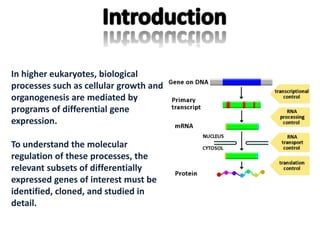
In higher eukaryotes, biological
processes such as cellular growth and
organogenesis are mediated by
programs of differential gene
expression.
To understand the molecular
regulation of these processes, the
relevant subsets of differentially
expressed genes of interest must be
identified, cloned, and studied in
detail.
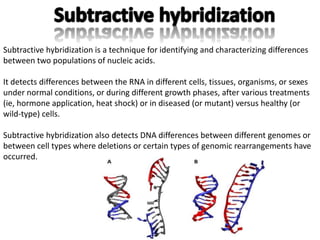
Subtractive hybridization is a technique for identifying and characterizing differences
between two populations of nucleic acids.
It detects differences between the RNA in different cells, tissues, organisms, or sexes
under normal conditions, or during different growth phases, after various treatments
(ie, hormone application, heat shock) or in diseased (or mutant) versus healthy (or
wild-type) cells.
Subtractive hybridization also detects DNA differences between different genomes or
between cell types where deletions or certain types of genomic rearrangements have
occurred.
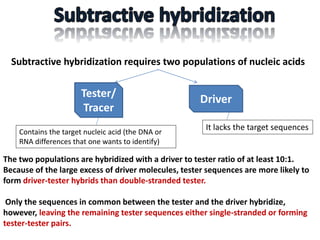
Subtractive hybridization requires two populations of nucleic acids
Tester/
Tracer
Driver
Contains the target nucleic acid (the DNA or
RNA differences that one wants to identify)
It lacks the target sequences
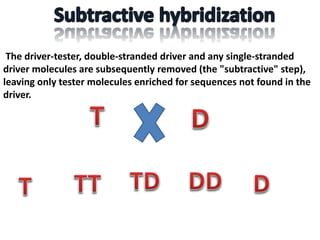
The two populations are hybridized with a driver to tester ratio of at least 10:1.
Because of the large excess of driver molecules, tester sequences are more likely to
form driver-tester hybrids than double-stranded tester.
Only the sequences in common between the tester and the driver hybridize,
however, leaving the remaining tester sequences either single-stranded or forming
tester-tester pairs.
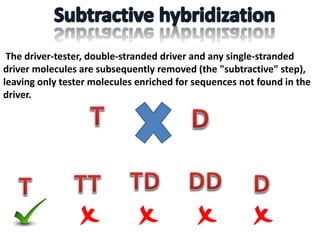
The driver-tester, double-stranded driver and any single-stranded
driver molecules are subsequently removed (the "subtractive" step),
leaving only tester molecules enriched for sequences not found in the
driver.
The driver-tester, double-stranded driver and any single-stranded
driver molecules are subsequently removed (the "subtractive" step),
leaving only tester molecules enriched for sequences not found in the
driver.
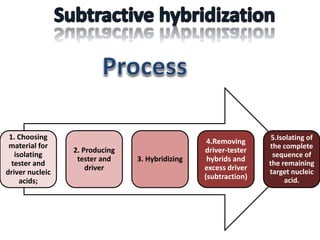
1. Choosing
material for
isolating
tester and
driver nucleic
acids;
2. Producing
tester and
driver
3. Hybridizing
4.Removing
driver-tester
hybrids and
excess driver
(subtraction)
5.Isolating of
the complete
sequence of
the remaining
target nucleic
acid.
In principle, both tester and driver samples can be either DNA or RNA, but it is
often most practical for the tester to be DNA (because the tester is present in a
low concentration, and DNA is more stable than RNA),
and for the driver to be RNA (after hybridization, excess driver RNA can be
eliminated enzymatically or by alkali degradation).
RNA from the tester source is reverse transcribed into complementary DNA
(cDNA) and hybridized to poly A+ driver RNA. The tester-driver hybrids are
removed, excess fresh driver is added, and the hybridization is repeated once.
The remaining "target" cDNA is either cloned or used to make a probe. This
basic procedure is useful if the starting material is not very complex and is easy
to isolate.
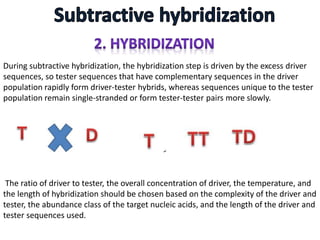
During subtractive hybridization, the hybridization step is driven by the excess driver
sequences, so tester sequences that have complementary sequences in the driver
population rapidly form driver-tester hybrids, whereas sequences unique to the tester
population remain single-stranded or form tester-tester pairs more slowly.
The ratio of driver to tester, the overall concentration of driver, the temperature, and
the length of hybridization should be chosen based on the complexity of the driver and
tester, the abundance class of the target nucleic acids, and the length of the driver and
tester sequences used.
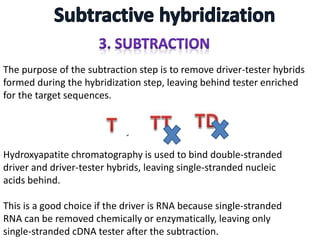
The purpose of the subtraction step is to remove driver-tester hybrids
formed during the hybridization step, leaving behind tester enriched
for the target sequences.
Hydroxyapatite chromatography is used to bind double-stranded
driver and driver-tester hybrids, leaving single-stranded nucleic
acids behind.
This is a good choice if the driver is RNA because single-stranded
RNA can be removed chemically or enzymatically, leaving only
single-stranded cDNA tester after the subtraction.
After one or more hybridization and subtraction steps, the resulting
tester nucleic acids should be greatly enriched for target sequences.
The remaining tester sequences are isolated and analyzed in a
variety of ways.
Tester can be made into an enriched library and probed with driver
and tester sequences to look for tester-specific clones, or the tester
is labeled and used to probe tester and driver libraries and to
isolate full-length clones.
Further analysis of isolated tester sequences can be done by
Northern blotting, in situ hybridization or PCR methods to determine
whether the sequences are truly tester-specific
subtractive hybridization

subtractive hybridization

  • 1.
  • 2.
    In higher eukaryotes,biological processes such as cellular growth and organogenesis are mediated by programs of differential gene expression. To understand the molecular regulation of these processes, the relevant subsets of differentially expressed genes of interest must be identified, cloned, and studied in detail.
  • 3.
    Subtractive hybridization isa technique for identifying and characterizing differences between two populations of nucleic acids. It detects differences between the RNA in different cells, tissues, organisms, or sexes under normal conditions, or during different growth phases, after various treatments (ie, hormone application, heat shock) or in diseased (or mutant) versus healthy (or wild-type) cells. Subtractive hybridization also detects DNA differences between different genomes or between cell types where deletions or certain types of genomic rearrangements have occurred.
  • 4.
    Subtractive hybridization requirestwo populations of nucleic acids Tester/ Tracer Driver Contains the target nucleic acid (the DNA or RNA differences that one wants to identify) It lacks the target sequences The two populations are hybridized with a driver to tester ratio of at least 10:1. Because of the large excess of driver molecules, tester sequences are more likely to form driver-tester hybrids than double-stranded tester. Only the sequences in common between the tester and the driver hybridize, however, leaving the remaining tester sequences either single-stranded or forming tester-tester pairs.
  • 5.
    The driver-tester, double-strandeddriver and any single-stranded driver molecules are subsequently removed (the "subtractive" step), leaving only tester molecules enriched for sequences not found in the driver.
  • 6.
    The driver-tester, double-strandeddriver and any single-stranded driver molecules are subsequently removed (the "subtractive" step), leaving only tester molecules enriched for sequences not found in the driver.
  • 7.
    1. Choosing material for isolating testerand driver nucleic acids; 2. Producing tester and driver 3. Hybridizing 4.Removing driver-tester hybrids and excess driver (subtraction) 5.Isolating of the complete sequence of the remaining target nucleic acid.
  • 8.
    In principle, bothtester and driver samples can be either DNA or RNA, but it is often most practical for the tester to be DNA (because the tester is present in a low concentration, and DNA is more stable than RNA), and for the driver to be RNA (after hybridization, excess driver RNA can be eliminated enzymatically or by alkali degradation). RNA from the tester source is reverse transcribed into complementary DNA (cDNA) and hybridized to poly A+ driver RNA. The tester-driver hybrids are removed, excess fresh driver is added, and the hybridization is repeated once. The remaining "target" cDNA is either cloned or used to make a probe. This basic procedure is useful if the starting material is not very complex and is easy to isolate.
  • 9.
    During subtractive hybridization,the hybridization step is driven by the excess driver sequences, so tester sequences that have complementary sequences in the driver population rapidly form driver-tester hybrids, whereas sequences unique to the tester population remain single-stranded or form tester-tester pairs more slowly. The ratio of driver to tester, the overall concentration of driver, the temperature, and the length of hybridization should be chosen based on the complexity of the driver and tester, the abundance class of the target nucleic acids, and the length of the driver and tester sequences used.
  • 10.
    The purpose ofthe subtraction step is to remove driver-tester hybrids formed during the hybridization step, leaving behind tester enriched for the target sequences. Hydroxyapatite chromatography is used to bind double-stranded driver and driver-tester hybrids, leaving single-stranded nucleic acids behind. This is a good choice if the driver is RNA because single-stranded RNA can be removed chemically or enzymatically, leaving only single-stranded cDNA tester after the subtraction.
  • 11.
    After one ormore hybridization and subtraction steps, the resulting tester nucleic acids should be greatly enriched for target sequences. The remaining tester sequences are isolated and analyzed in a variety of ways. Tester can be made into an enriched library and probed with driver and tester sequences to look for tester-specific clones, or the tester is labeled and used to probe tester and driver libraries and to isolate full-length clones.
  • 12.
    Further analysis ofisolated tester sequences can be done by Northern blotting, in situ hybridization or PCR methods to determine whether the sequences are truly tester-specific