MASS SPECTROSCOPY
 Mass spectrometry is an analytical technique in which
samples are ionized into charged molecules and ratio
of their mass-to-charge (m/z) can be measured.
 Determines relative molecular mass
High resolution, precision, & sensitivity
 Requires charged gaseous molecules for its analysis
Types
 AMS (Accelerator Mass Spectrometry)
 Gas Chromatography-MS
 Liquid Chromatography-MS
 ICP-MS (Inductively Coupled Plasma-
Mass spectrometry )
 IRMS (Isotope Ratio Mass Spectrometry)
 Ion Mobility Spectrometry-MS
 MALDI-TOF
 SELDI-TOF
MADI-TOF
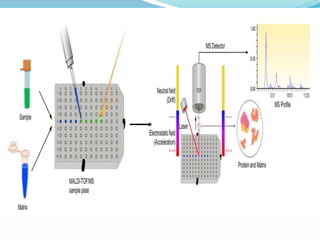
 In MALDI-TOF mass spectrometry, the Ion source is
matrix-assisted laser desorption/ionization (MALDI),
and the mass analyzer is time-of-flight (TOF) analyzer.
 Matrix-assisted laser desorption/ionization
 Soft ionization technique used in mass spectrometry
 Analysis of bio molecules and large organic
 molecules
 The ionization is triggered by a laser beam
Principle
 The analyte is embedded in a very large excess of a matrix
compound deposited on a solid surface called a target, usually
made of a conducting metal and having spots for several
different samples to be applied.
 After a very brief laser pulse, the irradiated spot is rapidly heated
and becomes vibrationally excited.
 The matrix molecules energetically ablated from the surface of
the sample, absorb the laser energy and carry the analyte
molecules into the gas phase as well.
 During the ablation process, the analyte molecules are usually
ionized by being protonated or deprotonated with the nearby
matrix molecules.
 The most common MALDI ionization format is for analyte
molecules to carry a single positive charge.
 It is believed that the first function of the matrix
essentially is to dilute and isolate analyte molecules
from each other.
 This occurs during solvent evaporation and
concomitant formation of a solid solution.
 Then, upon laser irradiation, it functions as a mediator
for energy absorption.
 The choice of the right matrix is key to the success in
MALDI. In general, highly polar analytes work better
with highly polar matrices, and nonpolar analytes are
preferably combined with nonpolar matrices.
Types of laser commonly used in
MALDI
 MALDI techniques typically employ the use of UV
lasers such as nitrogen lasers (337 nm) and
frequency-tripled and quadrupled. YAG lasers
(355 nm and 266 nm respectively).
 Infrared lasers are used due to their softer mode of
ionization.
 IR-MALDI also has the advantage of greater material
removal (useful for biological samples), low mass
interferences, and compatibility with other
matrix-free laser desorption mass spectrometry
methods.
MALDI is a two step process:
 First, Desorption is triggered by a UV laser
beam. Matrix material heavily absorbs UV
laser light leading to the ablation of the upper
layer of the matrix material. Hot plume gets
produced during ablation.
 Second, the analyte molecules are ionized in the hot
plume. Ablated species may
participate in the ionization of analyte .
 Matrix:
 Matrix consists of crystallised molecules of
which the most commonly used matrix are follows,
Nicotinic acid NA Peptides, proteins
Picolinic acid PA Oligonucleotides, DNA
3-Hydroxypicolinic acid HPA, 3-HPA Oligonucleotides, DNA
3-Aminopicolinic acid 3-APA Oligonucleotides, DNA
6-Aza-2-thiothymine ATT Oligonucleotides, DNA
2,5-Dihydroxybenzoic
acid
DHB
Proteins,
oligosaccharides
DHB-based mixtures DHB/XY and super-DHB
Proteins,
oligosaccharides
3-Aminoquinoline 3-AQ Oligosaccharides
α-Cyano-4-
hydroxycinnamic acid
α-CHC, α-CHCA, 4-
HCCA, CHCA
Peptides, smaller
proteins, triacylglycerols,
numerous other
compounds
2,4,6-
Trihydroxyacetophenone
THAP
Solid-supported
oligonucleotides
 The Matrix solution is mixed with the analyte
Eg: Protein sample.
 A mixture of water and organic solvent allows
both hydrophobic and water soluble
molecules to dissolve into the solution.
 This solution is spotted into a MALDI plate.
 The solvents vaporized , leaving only recrystallised
matrix, but now with analyte
molecules embedded into MALDI crystals.
 The matrix and analyte are said to be cocrystallised.
 Co-crystallization is a key issue in selecting a
 proper matrix
The mechanism of MALDI
 Done in three steps,
(i) Formation of a Solid Solution
(ii) Matrix Excitation
(iii) Analyte Ionization
 (i)Formation of a 'Solid Solution':
 It is essential for the matrix to be in access thus
leading to the analyte molecules being completely
isolated from each other.
 This eases the formation of the homogenous solid
solution' required to produce a stable desorption of
the analyte.
(ii) Matrix Excitation:
 The laser beam is focussed onto the surface of the
matrix-analyte solid solution.
 The chromophore of the matrix couples with the laser
frequency causing rapid vibrational excitation,
bringing about localised disintegration of the solid
solution.
 The clusters ejected from the surface consists of
analyte molecules surrounded by matrix and salt ions.
 The matrix molecules evaporate away from the
clusters to leave the free analyte in the gas-phase.
(iii) Analyte Ionisation:
The photo-excited matrix molecules are stabilised
through proton transfer to the analyte.
 Cation attachment to the analyte is also encouraged
during this process. analyte ions are formed.
 These ionisation reactions take place in the desorbed
matrix-analyte cloud just above the surface.
 The ions are then extracted into the mass
spectroscopy for analysis
 Applications of mass spectrometry in proteomics -
Characterization of proteins and protein complexes,
sequencing of peptides, and identification of
posttranslational modifications.
 Applications of mass spectrometry in metabolomics -
Cancer screening and diagnosis, global metabolic
fingerprinting analysis, biomarker discovery and profiling,
biofuels generation and use, lipidomics studies, and
metabolic disorder profiling.
 Applications of mass spectrometry in environmental
analysis - Drinking water testing, pesticide screening and
quantitation, soil contamination assessment, carbon
dioxide and pollution monitoring, and trace elemental
analysis of heavy metals leaching.
 Applications of mass spectrometry in pharmaceutical
analysis - Drug discovery and absorption, distribution,
metabolism, and elimination (ADME) studies, pharmacokinetic
and pharmacodynamic analyses, metabolite screening, and
preclinical development.
 Applications of mass spectrometry in forensic analysis -
Analysis of trace evidence (e.g., fibers in carpet, polymers in
paint), arson investigation (e.g., fire accelerant), confirmation of
drug abuse, and identification of explosive residues (bombing
investigation).
 Clinical applications of mass spectrometry - Clinical drug
development, Phase 0 studies, clinical tests, disease screening,
drug therapy monitoring, analysis of peptides used for diagnostic
testing, and identification of infectious agents for targeted
therapies.

Maldi tof

  • 2.
    MASS SPECTROSCOPY  Massspectrometry is an analytical technique in which samples are ionized into charged molecules and ratio of their mass-to-charge (m/z) can be measured.  Determines relative molecular mass High resolution, precision, & sensitivity  Requires charged gaseous molecules for its analysis
  • 3.
    Types  AMS (AcceleratorMass Spectrometry)  Gas Chromatography-MS  Liquid Chromatography-MS  ICP-MS (Inductively Coupled Plasma- Mass spectrometry )  IRMS (Isotope Ratio Mass Spectrometry)  Ion Mobility Spectrometry-MS  MALDI-TOF  SELDI-TOF
  • 4.
    MADI-TOF  In MALDI-TOFmass spectrometry, the Ion source is matrix-assisted laser desorption/ionization (MALDI), and the mass analyzer is time-of-flight (TOF) analyzer.  Matrix-assisted laser desorption/ionization  Soft ionization technique used in mass spectrometry  Analysis of bio molecules and large organic  molecules  The ionization is triggered by a laser beam
  • 5.
    Principle  The analyteis embedded in a very large excess of a matrix compound deposited on a solid surface called a target, usually made of a conducting metal and having spots for several different samples to be applied.  After a very brief laser pulse, the irradiated spot is rapidly heated and becomes vibrationally excited.  The matrix molecules energetically ablated from the surface of the sample, absorb the laser energy and carry the analyte molecules into the gas phase as well.  During the ablation process, the analyte molecules are usually ionized by being protonated or deprotonated with the nearby matrix molecules.  The most common MALDI ionization format is for analyte molecules to carry a single positive charge.
  • 6.
     It isbelieved that the first function of the matrix essentially is to dilute and isolate analyte molecules from each other.  This occurs during solvent evaporation and concomitant formation of a solid solution.  Then, upon laser irradiation, it functions as a mediator for energy absorption.  The choice of the right matrix is key to the success in MALDI. In general, highly polar analytes work better with highly polar matrices, and nonpolar analytes are preferably combined with nonpolar matrices.
  • 8.
    Types of lasercommonly used in MALDI  MALDI techniques typically employ the use of UV lasers such as nitrogen lasers (337 nm) and frequency-tripled and quadrupled. YAG lasers (355 nm and 266 nm respectively).  Infrared lasers are used due to their softer mode of ionization.  IR-MALDI also has the advantage of greater material removal (useful for biological samples), low mass interferences, and compatibility with other matrix-free laser desorption mass spectrometry methods.
  • 9.
    MALDI is atwo step process:  First, Desorption is triggered by a UV laser beam. Matrix material heavily absorbs UV laser light leading to the ablation of the upper layer of the matrix material. Hot plume gets produced during ablation.  Second, the analyte molecules are ionized in the hot plume. Ablated species may participate in the ionization of analyte .
  • 10.
     Matrix:  Matrixconsists of crystallised molecules of which the most commonly used matrix are follows,
  • 11.
    Nicotinic acid NAPeptides, proteins Picolinic acid PA Oligonucleotides, DNA 3-Hydroxypicolinic acid HPA, 3-HPA Oligonucleotides, DNA 3-Aminopicolinic acid 3-APA Oligonucleotides, DNA 6-Aza-2-thiothymine ATT Oligonucleotides, DNA 2,5-Dihydroxybenzoic acid DHB Proteins, oligosaccharides DHB-based mixtures DHB/XY and super-DHB Proteins, oligosaccharides 3-Aminoquinoline 3-AQ Oligosaccharides α-Cyano-4- hydroxycinnamic acid α-CHC, α-CHCA, 4- HCCA, CHCA Peptides, smaller proteins, triacylglycerols, numerous other compounds 2,4,6- Trihydroxyacetophenone THAP Solid-supported oligonucleotides
  • 13.
     The Matrixsolution is mixed with the analyte Eg: Protein sample.  A mixture of water and organic solvent allows both hydrophobic and water soluble molecules to dissolve into the solution.  This solution is spotted into a MALDI plate.  The solvents vaporized , leaving only recrystallised matrix, but now with analyte molecules embedded into MALDI crystals.  The matrix and analyte are said to be cocrystallised.  Co-crystallization is a key issue in selecting a  proper matrix
  • 14.
    The mechanism ofMALDI  Done in three steps, (i) Formation of a Solid Solution (ii) Matrix Excitation (iii) Analyte Ionization
  • 15.
     (i)Formation ofa 'Solid Solution':  It is essential for the matrix to be in access thus leading to the analyte molecules being completely isolated from each other.  This eases the formation of the homogenous solid solution' required to produce a stable desorption of the analyte.
  • 16.
    (ii) Matrix Excitation: The laser beam is focussed onto the surface of the matrix-analyte solid solution.  The chromophore of the matrix couples with the laser frequency causing rapid vibrational excitation, bringing about localised disintegration of the solid solution.  The clusters ejected from the surface consists of analyte molecules surrounded by matrix and salt ions.  The matrix molecules evaporate away from the clusters to leave the free analyte in the gas-phase.
  • 17.
    (iii) Analyte Ionisation: Thephoto-excited matrix molecules are stabilised through proton transfer to the analyte.  Cation attachment to the analyte is also encouraged during this process. analyte ions are formed.  These ionisation reactions take place in the desorbed matrix-analyte cloud just above the surface.  The ions are then extracted into the mass spectroscopy for analysis
  • 18.
     Applications ofmass spectrometry in proteomics - Characterization of proteins and protein complexes, sequencing of peptides, and identification of posttranslational modifications.  Applications of mass spectrometry in metabolomics - Cancer screening and diagnosis, global metabolic fingerprinting analysis, biomarker discovery and profiling, biofuels generation and use, lipidomics studies, and metabolic disorder profiling.  Applications of mass spectrometry in environmental analysis - Drinking water testing, pesticide screening and quantitation, soil contamination assessment, carbon dioxide and pollution monitoring, and trace elemental analysis of heavy metals leaching.
  • 19.
     Applications ofmass spectrometry in pharmaceutical analysis - Drug discovery and absorption, distribution, metabolism, and elimination (ADME) studies, pharmacokinetic and pharmacodynamic analyses, metabolite screening, and preclinical development.  Applications of mass spectrometry in forensic analysis - Analysis of trace evidence (e.g., fibers in carpet, polymers in paint), arson investigation (e.g., fire accelerant), confirmation of drug abuse, and identification of explosive residues (bombing investigation).  Clinical applications of mass spectrometry - Clinical drug development, Phase 0 studies, clinical tests, disease screening, drug therapy monitoring, analysis of peptides used for diagnostic testing, and identification of infectious agents for targeted therapies.