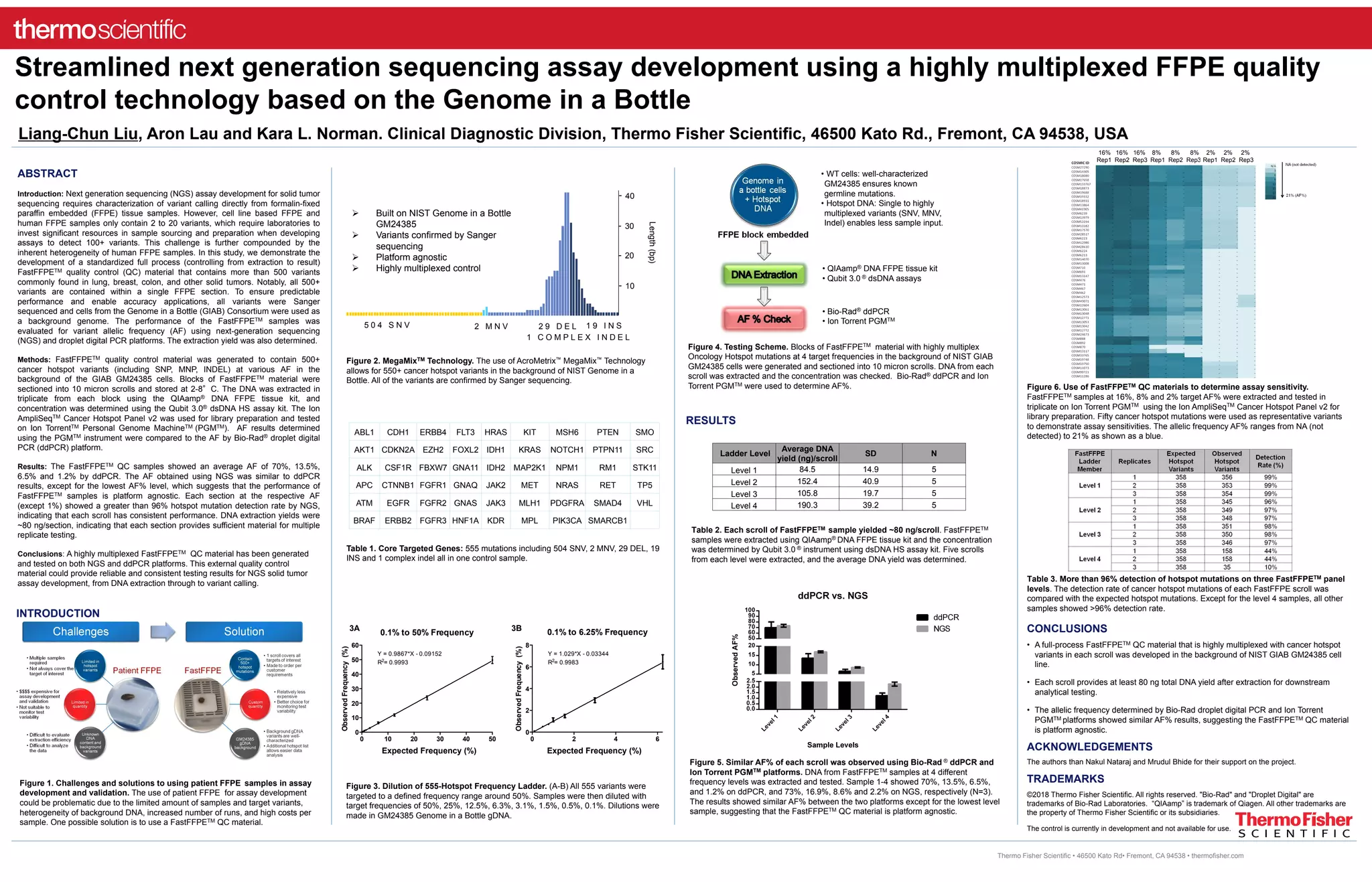
Liang-Chun Liu, Aron Lau and Kara L. Norman. Clinical Diagnostic Division, Thermo Fisher Scientific, 46500 Kato Rd., Fremont, CA 94538, USA
Figure 5. Similar AF% of each scroll was observed using Bio-Rad ® ddPCR and
Ion Torrent PGMTM platforms. DNA from FastFFPETM samples at 4 different
frequency levels was extracted and tested. Sample 1-4 showed 70%, 13.5%, 6.5%,
and 1.2% on ddPCR, and 73%, 16.9%, 8.6% and 2.2% on NGS, respectively (N=3).
The results showed similar AF% between the two platforms except for the lowest level
sample, suggesting that the FastFFPETM QC material is platform agnostic.
ABSTRACT
Introduction: Next generation sequencing (NGS) assay development for solid tumor
sequencing requires characterization of variant calling directly from formalin-fixed
paraffin embedded (FFPE) tissue samples. However, cell line based FFPE and
human FFPE samples only contain 2 to 20 variants, which require laboratories to
invest significant resources in sample sourcing and preparation when developing
assays to detect 100+ variants. This challenge is further compounded by the
inherent heterogeneity of human FFPE samples. In this study, we demonstrate the
development of a standardized full process (controlling from extraction to result)
FastFFPETM quality control (QC) material that contains more than 500 variants
commonly found in lung, breast, colon, and other solid tumors. Notably, all 500+
variants are contained within a single FFPE section. To ensure predictable
performance and enable accuracy applications, all variants were Sanger
sequenced and cells from the Genome in a Bottle (GIAB) Consortium were used as
a background genome. The performance of the FastFFPETM samples was
evaluated for variant allelic frequency (AF) using next-generation sequencing
(NGS) and droplet digital PCR platforms. The extraction yield was also determined.
Methods: FastFFPETM quality control material was generated to contain 500+
cancer hotspot variants (including SNP, MNP, INDEL) at various AF in the
background of the GIAB GM24385 cells. Blocks of FastFFPETM material were
sectioned into 10 micron scrolls and stored at 2-8°C. The DNA was extracted in
triplicate from each block using the QIAamp® DNA FFPE tissue kit, and
concentration was determined using the Qubit 3.0® dsDNA HS assay kit. The Ion
AmpliSeqTM Cancer Hotspot Panel v2 was used for library preparation and tested
on Ion TorrentTM Personal Genome MachineTM (PGMTM). AF results determined
using the PGMTM instrument were compared to the AF by Bio-Rad® droplet digital
PCR (ddPCR) platform.
Results: The FastFFPETM QC samples showed an average AF of 70%, 13.5%,
6.5% and 1.2% by ddPCR. The AF obtained using NGS was similar to ddPCR
results, except for the lowest AF% level, which suggests that the performance of
FastFFPETM samples is platform agnostic. Each section at the respective AF
(except 1%) showed a greater than 96% hotspot mutation detection rate by NGS,
indicating that each scroll has consistent performance. DNA extraction yields were
~80 ng/section, indicating that each section provides sufficient material for multiple
replicate testing.
Conclusions: A highly multiplexed FastFFPETM QC material has been generated
and tested on both NGS and ddPCR platforms. This external quality control
material could provide reliable and consistent testing results for NGS solid tumor
assay development, from DNA extraction through to variant calling.
CONCLUSIONS
• A full-process FastFFPETM QC material that is highly multiplexed with cancer hotspot
variants in each scroll was developed in the background of NIST GIAB GM24385 cell
line.
• Each scroll provides at least 80 ng total DNA yield after extraction for downstream
analytical testing.
• The allelic frequency determined by Bio-Rad droplet digital PCR and Ion Torrent
PGMTM platforms showed similar AF% results, suggesting the FastFFPETM QC material
is platform agnostic.
ACKNOWLEDGEMENTS
The authors than Nakul Nataraj and Mrudul Bhide for their support on the project.
TRADEMARKS
©2018 Thermo Fisher Scientific. All rights reserved. "Bio-Rad" and "Droplet Digital" are
trademarks of Bio-Rad Laboratories. “QIAamp” is trademark of Qiagen. All other trademarks are
the property of Thermo Fisher Scientific or its subsidiaries.
The control is currently in development and not available for use.
Streamlined next generation sequencing assay development using a highly multiplexed FFPE quality
control technology based on the Genome in a Bottle
Thermo Fisher Scientific • 46500 Kato Rd• Fremont, CA 94538 • thermofisher.com
Figure 2. MegaMixTM Technology. The use of AcroMetrix™ MegaMix™ Technology
allows for 550+ cancer hotspot variants in the background of NIST Genome in a
Bottle. All of the variants are confirmed by Sanger sequencing.
Table 2. Each scroll of FastFFPETM sample yielded ~80 ng/scroll. FastFFPETM
samples were extracted using QIAamp® DNA FFPE tissue kit and the concentration
was determined by Qubit 3.0 ® instrument using dsDNA HS assay kit. Five scrolls
from each level were extracted, and the average DNA yield was determined.
RESULTS
Figure 1. Challenges and solutions to using patient FFPE samples in assay
development and validation. The use of patient FFPE for assay development
could be problematic due to the limited amount of samples and target variants,
heterogeneity of background DNA, increased number of runs, and high costs per
sample. One possible solution is to use a FastFFPETM QC material.
INTRODUCTION
0
10
20
30
40
1 C O M P L E X I N D E L
5 0 4 S N V 2 M N V 2 9 D E L 1 9 I N S
10
Length(bp)
20
30
40
 Built on NIST Genome in a Bottle
GM24385
 Variants confirmed by Sanger
sequencing
 Platform agnostic
 Highly multiplexed control
Figure 3. Dilution of 555-Hotspot Frequency Ladder. (A-B) All 555 variants were
targeted to a defined frequency range around 50%. Samples were then diluted with
target frequencies of 50%, 25%, 12.5%, 6.3%, 3.1%, 1.5%, 0.5%, 0.1%. Dilutions were
made in GM24385 Genome in a Bottle gDNA.
0.1% to 50% Frequency
0 10 20 30 40 50
0
10
20
30
40
50
60
ObservedFrequency(%)
Expected Frequncy (%)
Y = 0.9867*X - 0.09152
R2
= 0.9993
0.1% to 6.25% Frequency
0 2 4 6
0
2
4
6
8
Expected Frequncy (%)
ObservedFrequency(%)
Y = 1.029*X - 0.03344
R2
= 0.9983
Expected Frequency (%) Expected Frequency (%)
3A 3B
Figure 6. Use of FastFFPETM QC materials to determine assay sensitivity.
FastFFPETM samples at 16%, 8% and 2% target AF% were extracted and tested in
triplicate on Ion Torrent PGMTM using the Ion AmpliSeqTM Cancer Hotspot Panel v2 for
library preparation. Fifty cancer hotspot mutations were used as representative variants
to demonstrate assay sensitivities. The allelic frequency AF% ranges from NA (not
detected) to 21% as shown as a blue.
Table 1. Core Targeted Genes: 555 mutations including 504 SNV, 2 MNV, 29 DEL, 19
INS and 1 complex indel all in one control sample.
ABL1 CDH1 ERBB4 FLT3 HRAS KIT MSH6 PTEN SMO
AKT1 CDKN2A EZH2 FOXL2 IDH1 KRAS NOTCH1 PTPN11 SRC
ALK CSF1R FBXW7 GNA11 IDH2 MAP2K1 NPM1 RM1 STK11
APC CTNNB1 FGFR1 GNAQ JAK2 MET NRAS RET TP5
ATM EGFR FGFR2 GNAS JAK3 MLH1 PDGFRA SMAD4 VHL
BRAF ERBB2 FGFR3 HNF1A KDR MPL PIK3CA SMARCB1
Figure 4. Testing Scheme. Blocks of FastFFPETM material with highly multiplex
Oncology Hotspot mutations at 4 target frequencies in the background of NIST GIAB
GM24385 cells were generated and sectioned into 10 micron scrolls. DNA from each
scroll was extracted and the concentration was checked. Bio-Rad® ddPCR and Ion
Torrent PGMTM were used to determine AF%.
• QIAamp® DNA FFPE tissue kit
• Qubit 3.0 ® dsDNA assays
• Bio-Rad® ddPCR
• Ion Torrent PGMTM
• WT cells: well-characterized
GM24385 ensures known
germline mutations.
• Hotspot DNA: Single to highly
multiplexed variants (SNV, MNV,
Indel) enables less sample input.
Ladder Level
Average DNA
yield (ng)/scroll
SD N
Level 1 84.5 14.9 5
Level 2 152.4 40.9 5
Level 3 105.8 19.7 5
Level 4 190.3 39.2 5
Table 3. More than 96% detection of hotspot mutations on three FastFFPETM panel
levels. The detection rate of cancer hotspot mutations of each FastFFPE scroll was
compared with the expected hotspot mutations. Except for the level 4 samples, all other
samples showed >96% detection rate.
16% 16% 16%
Rep1 Rep2 Rep3
8% 8% 8%
Rep1 Rep2 Rep3
2% 2% 2%
Rep1 Rep2 Rep3

Streamlined next generation sequencing assay development using a highly multiplexed FFPE quality control technology based on the Genome in a Bottle

  • 1.
    Liang-Chun Liu, AronLau and Kara L. Norman. Clinical Diagnostic Division, Thermo Fisher Scientific, 46500 Kato Rd., Fremont, CA 94538, USA Figure 5. Similar AF% of each scroll was observed using Bio-Rad ® ddPCR and Ion Torrent PGMTM platforms. DNA from FastFFPETM samples at 4 different frequency levels was extracted and tested. Sample 1-4 showed 70%, 13.5%, 6.5%, and 1.2% on ddPCR, and 73%, 16.9%, 8.6% and 2.2% on NGS, respectively (N=3). The results showed similar AF% between the two platforms except for the lowest level sample, suggesting that the FastFFPETM QC material is platform agnostic. ABSTRACT Introduction: Next generation sequencing (NGS) assay development for solid tumor sequencing requires characterization of variant calling directly from formalin-fixed paraffin embedded (FFPE) tissue samples. However, cell line based FFPE and human FFPE samples only contain 2 to 20 variants, which require laboratories to invest significant resources in sample sourcing and preparation when developing assays to detect 100+ variants. This challenge is further compounded by the inherent heterogeneity of human FFPE samples. In this study, we demonstrate the development of a standardized full process (controlling from extraction to result) FastFFPETM quality control (QC) material that contains more than 500 variants commonly found in lung, breast, colon, and other solid tumors. Notably, all 500+ variants are contained within a single FFPE section. To ensure predictable performance and enable accuracy applications, all variants were Sanger sequenced and cells from the Genome in a Bottle (GIAB) Consortium were used as a background genome. The performance of the FastFFPETM samples was evaluated for variant allelic frequency (AF) using next-generation sequencing (NGS) and droplet digital PCR platforms. The extraction yield was also determined. Methods: FastFFPETM quality control material was generated to contain 500+ cancer hotspot variants (including SNP, MNP, INDEL) at various AF in the background of the GIAB GM24385 cells. Blocks of FastFFPETM material were sectioned into 10 micron scrolls and stored at 2-8°C. The DNA was extracted in triplicate from each block using the QIAamp® DNA FFPE tissue kit, and concentration was determined using the Qubit 3.0® dsDNA HS assay kit. The Ion AmpliSeqTM Cancer Hotspot Panel v2 was used for library preparation and tested on Ion TorrentTM Personal Genome MachineTM (PGMTM). AF results determined using the PGMTM instrument were compared to the AF by Bio-Rad® droplet digital PCR (ddPCR) platform. Results: The FastFFPETM QC samples showed an average AF of 70%, 13.5%, 6.5% and 1.2% by ddPCR. The AF obtained using NGS was similar to ddPCR results, except for the lowest AF% level, which suggests that the performance of FastFFPETM samples is platform agnostic. Each section at the respective AF (except 1%) showed a greater than 96% hotspot mutation detection rate by NGS, indicating that each scroll has consistent performance. DNA extraction yields were ~80 ng/section, indicating that each section provides sufficient material for multiple replicate testing. Conclusions: A highly multiplexed FastFFPETM QC material has been generated and tested on both NGS and ddPCR platforms. This external quality control material could provide reliable and consistent testing results for NGS solid tumor assay development, from DNA extraction through to variant calling. CONCLUSIONS • A full-process FastFFPETM QC material that is highly multiplexed with cancer hotspot variants in each scroll was developed in the background of NIST GIAB GM24385 cell line. • Each scroll provides at least 80 ng total DNA yield after extraction for downstream analytical testing. • The allelic frequency determined by Bio-Rad droplet digital PCR and Ion Torrent PGMTM platforms showed similar AF% results, suggesting the FastFFPETM QC material is platform agnostic. ACKNOWLEDGEMENTS The authors than Nakul Nataraj and Mrudul Bhide for their support on the project. TRADEMARKS ©2018 Thermo Fisher Scientific. All rights reserved. "Bio-Rad" and "Droplet Digital" are trademarks of Bio-Rad Laboratories. “QIAamp” is trademark of Qiagen. All other trademarks are the property of Thermo Fisher Scientific or its subsidiaries. The control is currently in development and not available for use. Streamlined next generation sequencing assay development using a highly multiplexed FFPE quality control technology based on the Genome in a Bottle Thermo Fisher Scientific • 46500 Kato Rd• Fremont, CA 94538 • thermofisher.com Figure 2. MegaMixTM Technology. The use of AcroMetrix™ MegaMix™ Technology allows for 550+ cancer hotspot variants in the background of NIST Genome in a Bottle. All of the variants are confirmed by Sanger sequencing. Table 2. Each scroll of FastFFPETM sample yielded ~80 ng/scroll. FastFFPETM samples were extracted using QIAamp® DNA FFPE tissue kit and the concentration was determined by Qubit 3.0 ® instrument using dsDNA HS assay kit. Five scrolls from each level were extracted, and the average DNA yield was determined. RESULTS Figure 1. Challenges and solutions to using patient FFPE samples in assay development and validation. The use of patient FFPE for assay development could be problematic due to the limited amount of samples and target variants, heterogeneity of background DNA, increased number of runs, and high costs per sample. One possible solution is to use a FastFFPETM QC material. INTRODUCTION 0 10 20 30 40 1 C O M P L E X I N D E L 5 0 4 S N V 2 M N V 2 9 D E L 1 9 I N S 10 Length(bp) 20 30 40  Built on NIST Genome in a Bottle GM24385  Variants confirmed by Sanger sequencing  Platform agnostic  Highly multiplexed control Figure 3. Dilution of 555-Hotspot Frequency Ladder. (A-B) All 555 variants were targeted to a defined frequency range around 50%. Samples were then diluted with target frequencies of 50%, 25%, 12.5%, 6.3%, 3.1%, 1.5%, 0.5%, 0.1%. Dilutions were made in GM24385 Genome in a Bottle gDNA. 0.1% to 50% Frequency 0 10 20 30 40 50 0 10 20 30 40 50 60 ObservedFrequency(%) Expected Frequncy (%) Y = 0.9867*X - 0.09152 R2 = 0.9993 0.1% to 6.25% Frequency 0 2 4 6 0 2 4 6 8 Expected Frequncy (%) ObservedFrequency(%) Y = 1.029*X - 0.03344 R2 = 0.9983 Expected Frequency (%) Expected Frequency (%) 3A 3B Figure 6. Use of FastFFPETM QC materials to determine assay sensitivity. FastFFPETM samples at 16%, 8% and 2% target AF% were extracted and tested in triplicate on Ion Torrent PGMTM using the Ion AmpliSeqTM Cancer Hotspot Panel v2 for library preparation. Fifty cancer hotspot mutations were used as representative variants to demonstrate assay sensitivities. The allelic frequency AF% ranges from NA (not detected) to 21% as shown as a blue. Table 1. Core Targeted Genes: 555 mutations including 504 SNV, 2 MNV, 29 DEL, 19 INS and 1 complex indel all in one control sample. ABL1 CDH1 ERBB4 FLT3 HRAS KIT MSH6 PTEN SMO AKT1 CDKN2A EZH2 FOXL2 IDH1 KRAS NOTCH1 PTPN11 SRC ALK CSF1R FBXW7 GNA11 IDH2 MAP2K1 NPM1 RM1 STK11 APC CTNNB1 FGFR1 GNAQ JAK2 MET NRAS RET TP5 ATM EGFR FGFR2 GNAS JAK3 MLH1 PDGFRA SMAD4 VHL BRAF ERBB2 FGFR3 HNF1A KDR MPL PIK3CA SMARCB1 Figure 4. Testing Scheme. Blocks of FastFFPETM material with highly multiplex Oncology Hotspot mutations at 4 target frequencies in the background of NIST GIAB GM24385 cells were generated and sectioned into 10 micron scrolls. DNA from each scroll was extracted and the concentration was checked. Bio-Rad® ddPCR and Ion Torrent PGMTM were used to determine AF%. • QIAamp® DNA FFPE tissue kit • Qubit 3.0 ® dsDNA assays • Bio-Rad® ddPCR • Ion Torrent PGMTM • WT cells: well-characterized GM24385 ensures known germline mutations. • Hotspot DNA: Single to highly multiplexed variants (SNV, MNV, Indel) enables less sample input. Ladder Level Average DNA yield (ng)/scroll SD N Level 1 84.5 14.9 5 Level 2 152.4 40.9 5 Level 3 105.8 19.7 5 Level 4 190.3 39.2 5 Table 3. More than 96% detection of hotspot mutations on three FastFFPETM panel levels. The detection rate of cancer hotspot mutations of each FastFFPE scroll was compared with the expected hotspot mutations. Except for the level 4 samples, all other samples showed >96% detection rate. 16% 16% 16% Rep1 Rep2 Rep3 8% 8% 8% Rep1 Rep2 Rep3 2% 2% 2% Rep1 Rep2 Rep3