

SYSTEMIC LUPUS
ERYTHEMATOUS
By Rodnishwar Prasad
Group 23
WHAT IS LUPUS?
 Systemic Lupus Erythematous (SLE) is a complex autoimmune disease
The immune system attacks the body’s cells and tissue, resulting in inflammation
and tissue damage.
SLE can affect any part of the body, but most often harms the heart, joints, skin ,
lungs , blood vessels , liver, kidneys, and nervous system.
Over 40 different genes predispose to SLE
Characterized by remissions and exacerbations
PREVALENCE
90% of cases are of women
Prevalence rate is between 15 and 65 years of age
Symptoms occur between 15 and 25 years
Prevalence in general population is 1 in 1000
ETIOLOGY
The cause of SLE is currently unknown but there may be environmental and genetic
factors to it.
Environmental Factors:
UV lights, certain chemicals(hydrazine), drugs, infections and smoking.
B Cell Activation:
Results in autoantibody(IgG) production to a variety of antigen.
Impaired T cell regulation of immune system
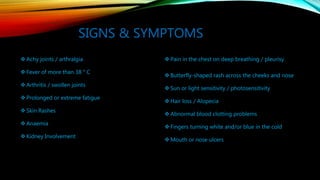
SIGNS & SYMPTOMS
 Achy joints / arthralgia
 Fever of more than 38 ° C
 Arthritis / swollen joints
 Prolonged or extreme fatigue
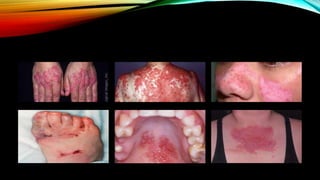
 Skin Rashes
 Anaemia
 Kidney Involvement
 Pain in the chest on deep breathing / pleurisy
 Butterfly-shaped rash across the cheeks and nose
 Sun or light sensitivity / photosensitivity
 Hair loss / Alopecia
 Abnormal blood clotting problems
 Fingers turning white and/or blue in the cold
 Mouth or nose ulcers
PATHOPHYSIOLOGY
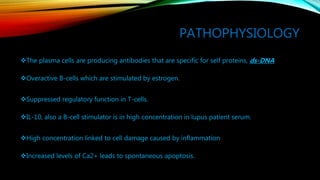
The plasma cells are producing antibodies that are specific for self proteins, ds-DNA
Overactive B-cells which are stimulated by estrogen.
Suppressed regulatory function in T-cells.
IL-10, also a B-cell stimulator is in high concentration in lupus patient serum.
High concentration linked to cell damage caused by inflammation
Increased levels of Ca2+ leads to spontaneous apoptosis.
PATHOPHYSIOLOGY
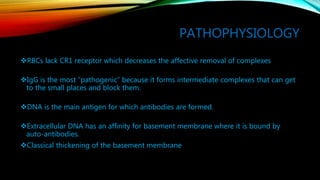
RBCs lack CR1 receptor which decreases the affective removal of complexes
IgG is the most “pathogenic” because it forms intermediate complexes that can get
to the small places and block them.
DNA is the main antigen for which antibodies are formed.
Extracellular DNA has an affinity for basement membrane where it is bound by
auto-antibodies.
Classical thickening of the basement membrane
DIAGNOSIS
Complete blood count(CBC)
Erythrocyte sedimentation rate
Creatine phosphokinase – usually elevated in SLE myositis.
Renal biopsy – indicates of lupus nephritis.
Serology – antinuclear antibody (ANA) test. Positive confirms SLE
TREATMENT
Treatment goals
Use of drugs with:
-least side effects
-lowest dosage to control disease
-long term damage control
Mild case : avoid use of steroids
Severe case : aggressive treatment
DRUGS TO USE
Non Steroidal Anti Inflammatory Drugs (NSAIDS) :
• NSAIDS have analgesic, antipyretic, and anti-inflammatory properties.
• Drugs include:
-ibuprofen
-naproxen
Antimalarial :
• Hydroxychloroquine used as an adjunct to corticosteroid therapy.
• Plaquenil can be used alone or with other drugs.
Corticosteroids suppress the immune system and reduce inflammation caused
by lupus.
-prednisone
DRUGS TO USE
Immunosuppressive drugs for patients whose kidneys and CNS is affected by lupus.
• Cytoxan – restrain the overactive immune system by blocking the production of immune
cells.
Other therapies include:
• Plasma exchange
• Intravenous immunoglobin
• Stem cell transplantation
• Immune therapy
PROGNOSIS
Usually chronic, relapsing, and unpredictable. Remissions may last for years.
If initial acute phase is controlled, even if very severe ( with cerebral thrombosis or
severe nephritis), the long-term prognosis is usually good.
The 10-yr survival in most developed countries is 95%. Improved prognosis is in part
due to earlier diagnosis and more effective therapies.
More severe disease requires more toxic therapies, which increase risk of mortality.
PATIENT EDUCATION
Minimize appearance of lesions.
Alleviate discomfort
Minimize fatigue.
 Maintain weight at optimal range
Teach the patient to recognize fever
and signs and symptoms of infection.
Maintain joint function and increase
muscle strength.
Recognize anaemia and develop a plan
of care
Minimize episodes of bleeding.
Minimize incidence of infection.
Educate the patient about
immunizations
Educate patient nutritional status.
REFERENCE
1. Kim, JM. (2014). Simultaneous presentation of acute disseminated encephalomyelitis
(ADEM) and systemic lupus erythematosus (SLE) after enteroviral infection: can ADEM
present as the first manifestation of SLE. Available:
http://www.ncbi.nlm.nih.gov/pubmed/25488421. Last accessed 16th Dec 2014.
2. Klinik für Kinder und Jugendmedizin. (2014). Pathogenesis and new therapeutic
approaches for systemic lupus erythematosus. Available:
http://www.ncbi.nlm.nih.gov/pubmed/25479933. Last accessed 16th Dec 2014.
3. Leal, GN. (2014). Subclinical right ventricle systolic dysfunction in childhood-onset systemic
lupus erythematosus: insights from two-dimensional speckle-tracking echocardiography.
Available: http://www.ncbi.nlm.nih.gov/pubmed/25492941. Last accessed 16th Dec 2014.
THANK YOU!!!

Systemic lupus erythematous

  • 1.
  • 2.
    WHAT IS LUPUS? Systemic Lupus Erythematous (SLE) is a complex autoimmune disease The immune system attacks the body’s cells and tissue, resulting in inflammation and tissue damage. SLE can affect any part of the body, but most often harms the heart, joints, skin , lungs , blood vessels , liver, kidneys, and nervous system. Over 40 different genes predispose to SLE Characterized by remissions and exacerbations
  • 3.
    PREVALENCE 90% of casesare of women Prevalence rate is between 15 and 65 years of age Symptoms occur between 15 and 25 years Prevalence in general population is 1 in 1000
  • 4.
    ETIOLOGY The cause ofSLE is currently unknown but there may be environmental and genetic factors to it. Environmental Factors: UV lights, certain chemicals(hydrazine), drugs, infections and smoking. B Cell Activation: Results in autoantibody(IgG) production to a variety of antigen. Impaired T cell regulation of immune system
  • 5.
    SIGNS & SYMPTOMS Achy joints / arthralgia  Fever of more than 38 ° C  Arthritis / swollen joints  Prolonged or extreme fatigue  Skin Rashes  Anaemia  Kidney Involvement  Pain in the chest on deep breathing / pleurisy  Butterfly-shaped rash across the cheeks and nose  Sun or light sensitivity / photosensitivity  Hair loss / Alopecia  Abnormal blood clotting problems  Fingers turning white and/or blue in the cold  Mouth or nose ulcers
  • 7.
    PATHOPHYSIOLOGY The plasma cellsare producing antibodies that are specific for self proteins, ds-DNA Overactive B-cells which are stimulated by estrogen. Suppressed regulatory function in T-cells. IL-10, also a B-cell stimulator is in high concentration in lupus patient serum. High concentration linked to cell damage caused by inflammation Increased levels of Ca2+ leads to spontaneous apoptosis.
  • 8.
    PATHOPHYSIOLOGY RBCs lack CR1receptor which decreases the affective removal of complexes IgG is the most “pathogenic” because it forms intermediate complexes that can get to the small places and block them. DNA is the main antigen for which antibodies are formed. Extracellular DNA has an affinity for basement membrane where it is bound by auto-antibodies. Classical thickening of the basement membrane
  • 9.
    DIAGNOSIS Complete blood count(CBC) Erythrocytesedimentation rate Creatine phosphokinase – usually elevated in SLE myositis. Renal biopsy – indicates of lupus nephritis. Serology – antinuclear antibody (ANA) test. Positive confirms SLE
  • 10.
    TREATMENT Treatment goals Use ofdrugs with: -least side effects -lowest dosage to control disease -long term damage control Mild case : avoid use of steroids Severe case : aggressive treatment
  • 11.
    DRUGS TO USE NonSteroidal Anti Inflammatory Drugs (NSAIDS) : • NSAIDS have analgesic, antipyretic, and anti-inflammatory properties. • Drugs include: -ibuprofen -naproxen Antimalarial : • Hydroxychloroquine used as an adjunct to corticosteroid therapy. • Plaquenil can be used alone or with other drugs. Corticosteroids suppress the immune system and reduce inflammation caused by lupus. -prednisone
  • 12.
    DRUGS TO USE Immunosuppressivedrugs for patients whose kidneys and CNS is affected by lupus. • Cytoxan – restrain the overactive immune system by blocking the production of immune cells. Other therapies include: • Plasma exchange • Intravenous immunoglobin • Stem cell transplantation • Immune therapy
  • 13.
    PROGNOSIS Usually chronic, relapsing,and unpredictable. Remissions may last for years. If initial acute phase is controlled, even if very severe ( with cerebral thrombosis or severe nephritis), the long-term prognosis is usually good. The 10-yr survival in most developed countries is 95%. Improved prognosis is in part due to earlier diagnosis and more effective therapies. More severe disease requires more toxic therapies, which increase risk of mortality.
  • 14.
    PATIENT EDUCATION Minimize appearanceof lesions. Alleviate discomfort Minimize fatigue.  Maintain weight at optimal range Teach the patient to recognize fever and signs and symptoms of infection. Maintain joint function and increase muscle strength. Recognize anaemia and develop a plan of care Minimize episodes of bleeding. Minimize incidence of infection. Educate the patient about immunizations Educate patient nutritional status.
  • 15.
    REFERENCE 1. Kim, JM.(2014). Simultaneous presentation of acute disseminated encephalomyelitis (ADEM) and systemic lupus erythematosus (SLE) after enteroviral infection: can ADEM present as the first manifestation of SLE. Available: http://www.ncbi.nlm.nih.gov/pubmed/25488421. Last accessed 16th Dec 2014. 2. Klinik für Kinder und Jugendmedizin. (2014). Pathogenesis and new therapeutic approaches for systemic lupus erythematosus. Available: http://www.ncbi.nlm.nih.gov/pubmed/25479933. Last accessed 16th Dec 2014. 3. Leal, GN. (2014). Subclinical right ventricle systolic dysfunction in childhood-onset systemic lupus erythematosus: insights from two-dimensional speckle-tracking echocardiography. Available: http://www.ncbi.nlm.nih.gov/pubmed/25492941. Last accessed 16th Dec 2014.
  • 16.