
HEMORRHAGIC DIATHESIS I
(BLEEDING DISORDERS)
Dr. S. Vaidya,
Dept. of Pathology
OBJECTIVES
1. list of common basic screening tests in bleeding
disorders & its significance.
2. list of common bleeding disorders
3. aetiopathogenesis and laboratory diagnosis of
immune thrombocytopenic purpura (ITP).
HEMORRHAGIC DIATHESIS (BLEEDING
DISORDERS)
• are a group of disorders characterized clinically by
abnormal bleeding, which can be either spontaneous
or become evident after some inciting event
(trauma, surgery)
NORMAL HEMOSTASIS
• normal hemostasis is a consequence of tightly regulated
processes that maintain blood in a fluid state in normal
vessels, yet also permit the rapid formation of a
hemostatic clot at the site of a vascular injury
• normal hemostasis depends upon normal function of:
1. endothelium (blood vessel)
2. platelets
3. coagulation factors
SCREENING TESTS FOR HAEMOSTASIS
1. Bleeding time (BT):
• measures the time taken for a standardized skin
puncture to stop bleeding.
• normal range: 2 - 9 minutes
• prolonged BT indicates a defect in platelet numbers
or function.
2. Platelet count:
• are obtained using anticoagulated blood
a. manually
b. electronic particle counter
• normal range: 150 to 450x103/µl.
• associated disorders :
a. thrombocytopenia
b. thrombocytosis
3. Prothrombin time (PT):
• this assay tests the extrinsic & common coagulation
pathways.
• normal range: 10 - 14 seconds.
⮚ prolonged PT: due to deficiency or dysfunction of
factors V, VII, factor X, prothrombin (II), or fibrinogen
(I).
4. Partial thromboplastin time(PTT):
• this assay tests the intrinsic and common
coagulation pathways.
• normal range: 30 - 40 seconds.
⮚ Prolonged PTT: due to deficiency or dysfunction of
factors V, VIII, IX, X, XI, or XII, prothrombin (II), or
fibrinogen (I).
• other specialized tests available are:
1. levels of specific clotting factors
2. fibrinogen
3. fibrin split products
4. presence of circulating anticoagulants.
5. platelet adhesion tests
6. platelet aggregation tests
BLEEDING DISORDERS
• the causes of bleeding disorders maybe broadly
divided into:
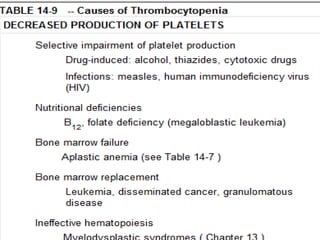
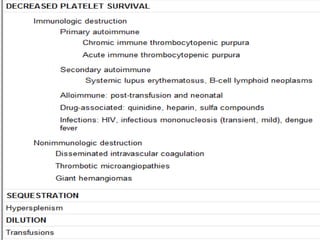
1. bleeding disorders due to vascular abnormalities
2. bleeding disorders due to platelet abnormalities
3. disorders of coagulation factors
4. combination of all of the above (Disseminated
Intravascular Coagulation / DIC)
LIST OF COMMON BLEEDING DISORDERS
1. immune thrombocytopenic purpura (ITP)
2. hemophilia A
3. hemophilia B
4. von Willebrand disease
5. disseminated intravascular coagulation (DIC)
IMMUNE THROMBOCYTOPENIC PURPURA
(ITP)
• immune thrombocytopenic purpura (ITP) is
characterized by immunologic destruction of
platelets and normal or increased megakaryocytes in
the bone marrow.
• on the basis of duration of illness, ITP is classified
into:
1. acute ITP
1. chronic ITP
CHRONIC ITP
• occurs more commonly in adults, particularly in
women of child-bearing age.
• age: 40,
• M:F ratio = 1:3
• it can be:
1. primary: absence of any known risk factors
2. secondary: occur in variety of predisposing
conditions and exposures
PATHOGENESIS
• also caused by autoantibodies to platelets.
⮚ autoantibodies, most often directed against platelet
membrane glycoproteins IIb-IIIa or Ib-IX
CLINICAL FEATURES
1. petechial haemorrhages
2. easy bruising
3. mucosal bleeding: menorrhagia in women, nasal
bleeding, bleeding from gum, melaena and
haematuria.
4. intracranial haemorrhage (rare)
5. hepatomegaly
6. splenomegaly (uncommon)
ACUTE ITP
• self-limited disorder, seen most frequently in children
following recovery from viral infection or upper
respiratory infection.
⮚ caused by antiplatelet antibodies
• onset of acute ITP is sudden & severe thrombocytopenia
but recovery occurs within a few weeks to 6 months.
⮚ in about 20% of children have a childhood form of
chronic ITP that follows a course similar to the adult
disease.
LABORATORY FINDINGS
1. platelet count: markedly reduced.
2. blood film: shows occasional platelets.
3. bone marrow: shows increased number of
megakaryocytes.
4. anti-platelet IgG antibody: can be demostrated in
the serum of patients.
5. platelet survival studies: markedly reduced platelet
lifespan (normal 7-10 days).
TREATMENT
• spontaneous recovery in 90% cases of acute ITP.
• corticosteroid therapy
• splenectomy:
⮚ thrombocytopenia is improved by splenectomy,
indicating that the spleen is the major site of
removal of platelets.
THANK YOU

Hemorrhagic diathesis i (bleeding disorders)

  • 1.
    HEMORRHAGIC DIATHESIS I (BLEEDINGDISORDERS) Dr. S. Vaidya, Dept. of Pathology
  • 2.
    OBJECTIVES 1. list ofcommon basic screening tests in bleeding disorders & its significance. 2. list of common bleeding disorders 3. aetiopathogenesis and laboratory diagnosis of immune thrombocytopenic purpura (ITP).
  • 3.
    HEMORRHAGIC DIATHESIS (BLEEDING DISORDERS) •are a group of disorders characterized clinically by abnormal bleeding, which can be either spontaneous or become evident after some inciting event (trauma, surgery)
  • 4.
    NORMAL HEMOSTASIS • normalhemostasis is a consequence of tightly regulated processes that maintain blood in a fluid state in normal vessels, yet also permit the rapid formation of a hemostatic clot at the site of a vascular injury • normal hemostasis depends upon normal function of: 1. endothelium (blood vessel) 2. platelets 3. coagulation factors
  • 5.
    SCREENING TESTS FORHAEMOSTASIS 1. Bleeding time (BT): • measures the time taken for a standardized skin puncture to stop bleeding. • normal range: 2 - 9 minutes • prolonged BT indicates a defect in platelet numbers or function.
  • 6.
    2. Platelet count: •are obtained using anticoagulated blood a. manually b. electronic particle counter • normal range: 150 to 450x103/µl. • associated disorders : a. thrombocytopenia b. thrombocytosis
  • 8.
    3. Prothrombin time(PT): • this assay tests the extrinsic & common coagulation pathways. • normal range: 10 - 14 seconds. ⮚ prolonged PT: due to deficiency or dysfunction of factors V, VII, factor X, prothrombin (II), or fibrinogen (I).
  • 9.
    4. Partial thromboplastintime(PTT): • this assay tests the intrinsic and common coagulation pathways. • normal range: 30 - 40 seconds. ⮚ Prolonged PTT: due to deficiency or dysfunction of factors V, VIII, IX, X, XI, or XII, prothrombin (II), or fibrinogen (I).
  • 10.
    • other specializedtests available are: 1. levels of specific clotting factors 2. fibrinogen 3. fibrin split products 4. presence of circulating anticoagulants. 5. platelet adhesion tests 6. platelet aggregation tests
  • 11.
    BLEEDING DISORDERS • thecauses of bleeding disorders maybe broadly divided into: 1. bleeding disorders due to vascular abnormalities 2. bleeding disorders due to platelet abnormalities 3. disorders of coagulation factors 4. combination of all of the above (Disseminated Intravascular Coagulation / DIC)
  • 12.
    LIST OF COMMONBLEEDING DISORDERS 1. immune thrombocytopenic purpura (ITP) 2. hemophilia A 3. hemophilia B 4. von Willebrand disease 5. disseminated intravascular coagulation (DIC)
  • 13.
    IMMUNE THROMBOCYTOPENIC PURPURA (ITP) •immune thrombocytopenic purpura (ITP) is characterized by immunologic destruction of platelets and normal or increased megakaryocytes in the bone marrow.
  • 16.
    • on thebasis of duration of illness, ITP is classified into: 1. acute ITP 1. chronic ITP
  • 17.
    CHRONIC ITP • occursmore commonly in adults, particularly in women of child-bearing age. • age: 40, • M:F ratio = 1:3 • it can be: 1. primary: absence of any known risk factors 2. secondary: occur in variety of predisposing conditions and exposures
  • 18.
    PATHOGENESIS • also causedby autoantibodies to platelets. ⮚ autoantibodies, most often directed against platelet membrane glycoproteins IIb-IIIa or Ib-IX
  • 19.
    CLINICAL FEATURES 1. petechialhaemorrhages 2. easy bruising 3. mucosal bleeding: menorrhagia in women, nasal bleeding, bleeding from gum, melaena and haematuria. 4. intracranial haemorrhage (rare) 5. hepatomegaly 6. splenomegaly (uncommon)
  • 20.
    ACUTE ITP • self-limiteddisorder, seen most frequently in children following recovery from viral infection or upper respiratory infection. ⮚ caused by antiplatelet antibodies • onset of acute ITP is sudden & severe thrombocytopenia but recovery occurs within a few weeks to 6 months. ⮚ in about 20% of children have a childhood form of chronic ITP that follows a course similar to the adult disease.
  • 21.
    LABORATORY FINDINGS 1. plateletcount: markedly reduced. 2. blood film: shows occasional platelets. 3. bone marrow: shows increased number of megakaryocytes. 4. anti-platelet IgG antibody: can be demostrated in the serum of patients. 5. platelet survival studies: markedly reduced platelet lifespan (normal 7-10 days).
  • 22.
    TREATMENT • spontaneous recoveryin 90% cases of acute ITP. • corticosteroid therapy • splenectomy: ⮚ thrombocytopenia is improved by splenectomy, indicating that the spleen is the major site of removal of platelets.
  • 23.