
HEART FAILURE IN
ELDERLY
ROD PRASAD
GROUP 3A
INTRODUCTION
 HF a complex clinical syndrome that can result from any structural or
functional cardiac disorder that impairs the ability of the ventricle to fill
with or eject blood.
 Over 80% of all heart failure patients are 65 years and older.
 HF is a geriatric syndrome as most heart failure patients are older adults.
 HF in the setting of preserved systolic function, disproportionately afflicts
older individuals and results in significant morbidity, mortality, and health
care costs.
 The diagnosis and management of HF in the elderly can be complicated by
multiple co-morbidities and polypharmacy.
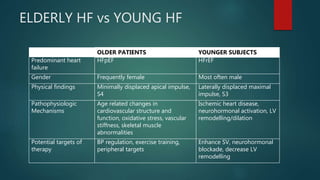
ELDERLY HF vs YOUNG HF
OLDER PATIENTS YOUNGER SUBJECTS
Predominant heart
failure
HFpEF HFrEF
Gender Frequently female Most often male
Physical findings Minimally displaced apical impulse,
S4
Laterally displaced maximal
impulse, S3
Pathophysiologic
Mechanisms
Age related changes in
cardiovascular structure and
function, oxidative stress, vascular
stiffness, skeletal muscle
abnormalities
Ischemic heart disease,
neurohormonal activation, LV
remodelling/dilation
Potential targets of
therapy
BP regulation, exercise training,
peripheral targets
Enhance SV, neurohormonal
blockade, decrease LV
remodelling
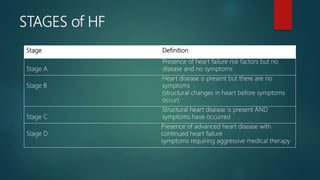
STAGES of HF
Stage Definition
Stage A
Presence of heart failure risk factors but no
disease and no symptoms
Stage B
Heart disease is present but there are no
symptoms
(structural changes in heart before symptoms
occur)
Stage C
Structural heart disease is present AND
symptoms have occurred
Stage D
Presence of advanced heart disease with
continued heart failure
symptoms requiring aggressive medical therapy
CLASSIFICATION (NYHA)
Functional Capacity Objective Assessment
Class I No limitation of physical activity. Ordinary
physical activity does not cause undue fatigue,
palpitation, or dyspnea.
Class II Slight limitation of physical activity. Comfortable
at rest, but ordinary physical activity results in
fatigue, palpitation, or dyspnea.
Class III Marked limitation of physical activity.
Comfortable at rest, but less than ordinary
activity causes fatigue, palpitation, or dyspnea.
Class IV Unable to carry out any physical activity without
discomfort. Symptoms of cardiac insufficiency at
rest. If any physical activity is undertaken,
discomfort is increased.
CLASSIFICATION
SYSTOLIC HF
 Systolic heart failure is clinical heart
failure with left ventricular ejection
fraction <45%.
 Systolic heart failure is characterized
by a large but weak left ventricle that
is unable to eject enough blood to
produce a normal stroke volume and
cardiac output.
DIASTOLIC HF
 Diastolic heart failure is defined as clinical
heart failure with normal or near normal left
ventricular ejection fraction, generally 55%
or greater.
 Diastolic heart failure is characterized by a
strong but small ventricle that is stiff and
cannot relax fully to fill up the ventricle
during diastole and thus does not have
enough blood to pump to produce a
normal stroke volume and cardiac output.
► The most clinically relevant classification of clinical heart failure into systolic and
diastolic heart failure is based on LVEF.
SYSTOLIC vs DIASTOLIC
 Despite differences in systolic and diastolic function between systolic and
diastolic heart failure, both have low cardiac output, the hallmark of heart
failure and very similar clinical presentation.
 A transthoracic 2D echocardiography with or without Doppler imaging is
usually the preferred test to assess LVEF.
ETIOLOGY OF HF IN ELDERLY
 CAD and hypertension are the 2 most common risk factors, and can often
be identified during history and physical examination.
CORMOBIDITIES OF HF
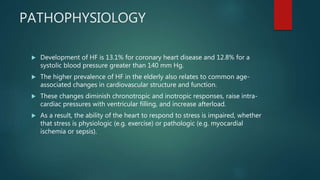
PATHOPHYSIOLOGY
 Development of HF is 13.1% for coronary heart disease and 12.8% for a
systolic blood pressure greater than 140 mm Hg.
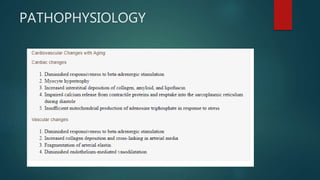
 The higher prevalence of HF in the elderly also relates to common age-
associated changes in cardiovascular structure and function.
 These changes diminish chronotropic and inotropic responses, raise intra-
cardiac pressures with ventricular filling, and increase afterload.
 As a result, the ability of the heart to respond to stress is impaired, whether
that stress is physiologic (e.g. exercise) or pathologic (e.g. myocardial
ischemia or sepsis).
PATHOPHYSIOLOGY
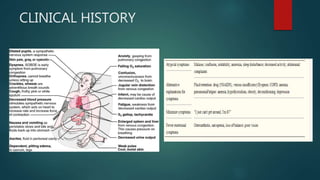
CLINICAL HISTORY
LEFT SIDE HF vs RIGHT SIDE HF
LEFT SIDE HF
 Left-sided heart failure may result in
either pulmonary congestion, or
hypoperfusion, or both, and may
result in left-sided symptoms such as:
 dyspnea,
 cough, wheezing,
 fatigue,
 hypotension, tachycardia,
 confusion, syncope, delirium,
 oliguria,
 pulmonary râles, and left-sided third
heart sound.
RIGHT SIDE HF
 Right-sided heart failure, on the other hand,
may lead to right-sided symptoms and signs
such as:
 dyspnea,
 fatigue,
 leg swelling,
 nausea, vomiting, epigastic and upper
abdominal pain,
 elevated jugular venous pressure,
 hepatojugular reflux,
 hepatomegaly,
 right-sided third heart sound,
 prominent pulmonic component of the
second heart sound,
 and dependent edema.
CLINICAL CRITERIA FOR HF
INVESTIGATIONS
 ECG
 not specific, is usually abnormal, showing a negative predictive value of about
90%.
 It can display rhythm disturbances, bundle branch blocks, cardiac chamber
overload as well as signs of myocardial ischemia.
 Chest radiography
 The finding of cardiomegaly favours the diagnosis of HF, especially if associated
with pulmonary congestion and pulmonary hypertension with reversal of the
vascular pattern, presence of Kerley lines and pleural effusions.
 In the elderly, chest deformities, a feature of the aging process, make difficult
the interpretation of the cardiac area.
INVESTIGATIONS
 Doppler echocardiography
 It is crucial for the diagnosis of heart diseases through its capacity to quantify
valvular lesions, pressure gradients, diameter of cardiac cavities, wall thickness,
myocardial contractility, ventricular ejection fraction and ventricular
complaisance and relaxation.
 The 6-minute-walk test
 good choice for the functional evaluation of patients with HF
 The distances below 300 meters are of poor prognosis, while the ones at 450
meters are correlated with lower rates of mortality and hospitalization.
INVESTIGATIONS
 The β-type natriuretic peptide (BNP)
 hormone produced mainly by ventricular cardiomyocytes, whose secretion is
associated with the stretching of myocardial fibers.
 Elevated plasma concentrations of BNP have 97% sensitivity and a specificity of
84% for the diagnosis of HF due to systolic dysfunction.
 Laboratory tests
 are performed in order to identify associated diseases and to evaluate blood
glucose, electrolyte disturbances and renal function.
 Other tests should be performed with specific clinical indications, such as
evaluation of thyroid, respiratory and liver function.
TREATMENT
 Non-pharmacological
 Non-pharmacologic measures include appropriate diet, cessation of smoking,
increased physical activity, and immunization.
 The measures also include dietary sodium restriction, alcohol and net weight
reduction in obese patients and nutritional care in patients with cachexia, an
important predictor of longer life expectancy.
 The stable, functional class II-III, should perform physical activity through well
planned physical conditioning programs resulting in an increased tolerance to
stress.
 The use of certain medications should be avoided, including anti-inflammatory
steroids, tricyclic antidepressants, corticosteroids, lithium, class I antiarrhythmic
agents, among others.
TREATMENT
 Pharmacotherapy
 The treatment of HF in the elderly is similar to that of younger cohorts, having
to respect some peculiarities of this age group.
 The normal doses of drugs are, in general, less well tolerated and it is necessary
to be careful with the maximum doses.
 Treatment of HF can be summarized into two broader groups: symptom-
relieving therapy and life-prolonging therapy.
 Because symptoms of HF are similar in systolic and diastolic HF, therapy to
relieve symptoms and prevent hospitalization because of worsening HF is also
rather similar.
 This therapy is primarily based on judicial use of diuretics and digoxin. Most HF
patients with symptoms need loop diuretics to stay euvolemic.
TREATMENT
PHARMACOTHERAPY
 Diuretics
 These medications act more quickly in controlling symptoms of HF when fluid retention is
present in the form of edema and pulmonary congestion. Their use results in rapid control of
dyspnea and improves physical exercise tolerance.
 The elderly are more prone to adverse reactions, therefore the treatment should be started
with low doses.
 Digitalis
 Some studies show that digitalis related compounds are effective in controlling symptoms and
improving physical exercise tolerance in patients with HF.
 Digoxin is a first line drug for treating atrial fibrillation associated with HF.
 The elderly are less responsive to the effects of digitalis and experience higher toxic effects due
to lower muscle mass, associating itself with the highest myocardial concentration for the same
dose.
PHARMACOTHERAPY
 ACE inhibitors
 ACE inhibitors should be given to all patients with HF and systolic left ventricular
dysfunction after myocardial infarction, unless there is contraindication.
 ACE inhibitors are contraindicated when serum potassium is above 5.5 mEq/L in the
presence of bilateral renal artery stenosis, symptomatic hypotension, renal failure
and previous history of angioedema with their use.
 Low doses should be started in the elderly with gradual increases until the
recommended dose
 ARBs
 ARBs are more appropriate when there is intolerance to ACE inhibitors or in
association to these drugs for a limited time.
 ARBs are mainly indicated in patients with chronic HF and systolic ventricular
dysfunction who have intolerance to ACE inhibitors.
PHARMACOTHERAPY
 Beta-blockers
 The combination of a beta-blocker and conventional therapy with diuretics,
ACE inhibitors and digitalis leads to an improvement of symptoms, functional
class and left ventricular function.
 Beta blockers are contraindicated in the presence of bradycardia, advance
atrioventricular block (AVB), hypotension with blood pressure below 90 mmHg,
bronchospastic disease and in decompensated HF.
 Side effects are more common in the elderly, mainly asthenia, fatigue, sleep
disturbance, peripheral vascular disorder, bradycardia and AVB.
 Anticoagulants
 Anticoagulants are indicated in patients with atrial fibrillation, a history of
thromboembolic events and left ventricular aneurysm.
PHARMACOTHERAPY
 Direct vasodilators
 The combination of isosorbide dinitrate and hydralazine for the treatment of HF
is recommended for patients on digitalis, diuretics and beta-blockers, that
cannot tolerate ACE inhibitors or ARBs, or in presence of renal failure,
hyperkalemia (K > 5.5 mEq/L) or worsening of glomerular filtration rate with
serum creatinine > 2.5 mg/dl.
PHARMACOTHERAPY
DEFEAT
Diagnosis, Etiology, Fluid, Ejection frAcion, and Treatment
1. The process begins with a clinical Diagnosis, which must be established, before
ordering an echocardiogram as nearly half of all geriatric heart failure patients have
normal left ventricular ejection fraction.
2. Because heart failure is a syndrome and not a disease, an underlying Etiology must
be sought and determined.
3. Determination of the Fluid volume status by careful examination of the external
jugular veins in the neck is vital to achieve euvolemia.
4. An echocardiography should be ordered to obtain left ventricular Ejection frAction
to assess prognosis and guide
5. Therapy, if left ventricular ejection fraction cannot be determined, all geriatric heart
failure patients should be treated as if they have low ejection fraction, and should be
prescribed an ACE inhibitor and a beta-blocker. Diuretic and digoxin should be
prescribed for all symptomatic patients with heart failure.
REFERENCE
 https://ncbi.nlm.nih.gov/pmc/articles/PMC2914573/#S10title
 https://ncbi.nlm.nih.gov/pmc/articles/PMC3418897/#s3title
 https://ncbi.nlm.nih.gov/pmc/articles/PMC3756933/
 https://ncbi.nlm.nih.gov/pmc/articles/PMC5391148/
 Ahmed A. Clinical manifestations, diagnostic assessment, and etiology of
heart failure in older adults. Clin Geriatr Med. 2007
THANK YOU!!!

Heart failure in elderly

  • 1.
  • 2.
    INTRODUCTION  HF acomplex clinical syndrome that can result from any structural or functional cardiac disorder that impairs the ability of the ventricle to fill with or eject blood.  Over 80% of all heart failure patients are 65 years and older.  HF is a geriatric syndrome as most heart failure patients are older adults.  HF in the setting of preserved systolic function, disproportionately afflicts older individuals and results in significant morbidity, mortality, and health care costs.  The diagnosis and management of HF in the elderly can be complicated by multiple co-morbidities and polypharmacy.
  • 3.
    ELDERLY HF vsYOUNG HF OLDER PATIENTS YOUNGER SUBJECTS Predominant heart failure HFpEF HFrEF Gender Frequently female Most often male Physical findings Minimally displaced apical impulse, S4 Laterally displaced maximal impulse, S3 Pathophysiologic Mechanisms Age related changes in cardiovascular structure and function, oxidative stress, vascular stiffness, skeletal muscle abnormalities Ischemic heart disease, neurohormonal activation, LV remodelling/dilation Potential targets of therapy BP regulation, exercise training, peripheral targets Enhance SV, neurohormonal blockade, decrease LV remodelling
  • 4.
    STAGES of HF StageDefinition Stage A Presence of heart failure risk factors but no disease and no symptoms Stage B Heart disease is present but there are no symptoms (structural changes in heart before symptoms occur) Stage C Structural heart disease is present AND symptoms have occurred Stage D Presence of advanced heart disease with continued heart failure symptoms requiring aggressive medical therapy
  • 5.
    CLASSIFICATION (NYHA) Functional CapacityObjective Assessment Class I No limitation of physical activity. Ordinary physical activity does not cause undue fatigue, palpitation, or dyspnea. Class II Slight limitation of physical activity. Comfortable at rest, but ordinary physical activity results in fatigue, palpitation, or dyspnea. Class III Marked limitation of physical activity. Comfortable at rest, but less than ordinary activity causes fatigue, palpitation, or dyspnea. Class IV Unable to carry out any physical activity without discomfort. Symptoms of cardiac insufficiency at rest. If any physical activity is undertaken, discomfort is increased.
  • 6.
    CLASSIFICATION SYSTOLIC HF  Systolicheart failure is clinical heart failure with left ventricular ejection fraction <45%.  Systolic heart failure is characterized by a large but weak left ventricle that is unable to eject enough blood to produce a normal stroke volume and cardiac output. DIASTOLIC HF  Diastolic heart failure is defined as clinical heart failure with normal or near normal left ventricular ejection fraction, generally 55% or greater.  Diastolic heart failure is characterized by a strong but small ventricle that is stiff and cannot relax fully to fill up the ventricle during diastole and thus does not have enough blood to pump to produce a normal stroke volume and cardiac output. ► The most clinically relevant classification of clinical heart failure into systolic and diastolic heart failure is based on LVEF.
  • 7.
    SYSTOLIC vs DIASTOLIC Despite differences in systolic and diastolic function between systolic and diastolic heart failure, both have low cardiac output, the hallmark of heart failure and very similar clinical presentation.  A transthoracic 2D echocardiography with or without Doppler imaging is usually the preferred test to assess LVEF.
  • 8.
    ETIOLOGY OF HFIN ELDERLY  CAD and hypertension are the 2 most common risk factors, and can often be identified during history and physical examination.
  • 9.
  • 10.
    PATHOPHYSIOLOGY  Development ofHF is 13.1% for coronary heart disease and 12.8% for a systolic blood pressure greater than 140 mm Hg.  The higher prevalence of HF in the elderly also relates to common age- associated changes in cardiovascular structure and function.  These changes diminish chronotropic and inotropic responses, raise intra- cardiac pressures with ventricular filling, and increase afterload.  As a result, the ability of the heart to respond to stress is impaired, whether that stress is physiologic (e.g. exercise) or pathologic (e.g. myocardial ischemia or sepsis).
  • 11.
  • 12.
  • 13.
    LEFT SIDE HFvs RIGHT SIDE HF LEFT SIDE HF  Left-sided heart failure may result in either pulmonary congestion, or hypoperfusion, or both, and may result in left-sided symptoms such as:  dyspnea,  cough, wheezing,  fatigue,  hypotension, tachycardia,  confusion, syncope, delirium,  oliguria,  pulmonary râles, and left-sided third heart sound. RIGHT SIDE HF  Right-sided heart failure, on the other hand, may lead to right-sided symptoms and signs such as:  dyspnea,  fatigue,  leg swelling,  nausea, vomiting, epigastic and upper abdominal pain,  elevated jugular venous pressure,  hepatojugular reflux,  hepatomegaly,  right-sided third heart sound,  prominent pulmonic component of the second heart sound,  and dependent edema.
  • 14.
  • 15.
    INVESTIGATIONS  ECG  notspecific, is usually abnormal, showing a negative predictive value of about 90%.  It can display rhythm disturbances, bundle branch blocks, cardiac chamber overload as well as signs of myocardial ischemia.  Chest radiography  The finding of cardiomegaly favours the diagnosis of HF, especially if associated with pulmonary congestion and pulmonary hypertension with reversal of the vascular pattern, presence of Kerley lines and pleural effusions.  In the elderly, chest deformities, a feature of the aging process, make difficult the interpretation of the cardiac area.
  • 16.
    INVESTIGATIONS  Doppler echocardiography It is crucial for the diagnosis of heart diseases through its capacity to quantify valvular lesions, pressure gradients, diameter of cardiac cavities, wall thickness, myocardial contractility, ventricular ejection fraction and ventricular complaisance and relaxation.  The 6-minute-walk test  good choice for the functional evaluation of patients with HF  The distances below 300 meters are of poor prognosis, while the ones at 450 meters are correlated with lower rates of mortality and hospitalization.
  • 17.
    INVESTIGATIONS  The β-typenatriuretic peptide (BNP)  hormone produced mainly by ventricular cardiomyocytes, whose secretion is associated with the stretching of myocardial fibers.  Elevated plasma concentrations of BNP have 97% sensitivity and a specificity of 84% for the diagnosis of HF due to systolic dysfunction.  Laboratory tests  are performed in order to identify associated diseases and to evaluate blood glucose, electrolyte disturbances and renal function.  Other tests should be performed with specific clinical indications, such as evaluation of thyroid, respiratory and liver function.
  • 18.
    TREATMENT  Non-pharmacological  Non-pharmacologicmeasures include appropriate diet, cessation of smoking, increased physical activity, and immunization.  The measures also include dietary sodium restriction, alcohol and net weight reduction in obese patients and nutritional care in patients with cachexia, an important predictor of longer life expectancy.  The stable, functional class II-III, should perform physical activity through well planned physical conditioning programs resulting in an increased tolerance to stress.  The use of certain medications should be avoided, including anti-inflammatory steroids, tricyclic antidepressants, corticosteroids, lithium, class I antiarrhythmic agents, among others.
  • 19.
    TREATMENT  Pharmacotherapy  Thetreatment of HF in the elderly is similar to that of younger cohorts, having to respect some peculiarities of this age group.  The normal doses of drugs are, in general, less well tolerated and it is necessary to be careful with the maximum doses.  Treatment of HF can be summarized into two broader groups: symptom- relieving therapy and life-prolonging therapy.  Because symptoms of HF are similar in systolic and diastolic HF, therapy to relieve symptoms and prevent hospitalization because of worsening HF is also rather similar.  This therapy is primarily based on judicial use of diuretics and digoxin. Most HF patients with symptoms need loop diuretics to stay euvolemic.
  • 20.
  • 21.
    PHARMACOTHERAPY  Diuretics  Thesemedications act more quickly in controlling symptoms of HF when fluid retention is present in the form of edema and pulmonary congestion. Their use results in rapid control of dyspnea and improves physical exercise tolerance.  The elderly are more prone to adverse reactions, therefore the treatment should be started with low doses.  Digitalis  Some studies show that digitalis related compounds are effective in controlling symptoms and improving physical exercise tolerance in patients with HF.  Digoxin is a first line drug for treating atrial fibrillation associated with HF.  The elderly are less responsive to the effects of digitalis and experience higher toxic effects due to lower muscle mass, associating itself with the highest myocardial concentration for the same dose.
  • 22.
    PHARMACOTHERAPY  ACE inhibitors ACE inhibitors should be given to all patients with HF and systolic left ventricular dysfunction after myocardial infarction, unless there is contraindication.  ACE inhibitors are contraindicated when serum potassium is above 5.5 mEq/L in the presence of bilateral renal artery stenosis, symptomatic hypotension, renal failure and previous history of angioedema with their use.  Low doses should be started in the elderly with gradual increases until the recommended dose  ARBs  ARBs are more appropriate when there is intolerance to ACE inhibitors or in association to these drugs for a limited time.  ARBs are mainly indicated in patients with chronic HF and systolic ventricular dysfunction who have intolerance to ACE inhibitors.
  • 23.
    PHARMACOTHERAPY  Beta-blockers  Thecombination of a beta-blocker and conventional therapy with diuretics, ACE inhibitors and digitalis leads to an improvement of symptoms, functional class and left ventricular function.  Beta blockers are contraindicated in the presence of bradycardia, advance atrioventricular block (AVB), hypotension with blood pressure below 90 mmHg, bronchospastic disease and in decompensated HF.  Side effects are more common in the elderly, mainly asthenia, fatigue, sleep disturbance, peripheral vascular disorder, bradycardia and AVB.  Anticoagulants  Anticoagulants are indicated in patients with atrial fibrillation, a history of thromboembolic events and left ventricular aneurysm.
  • 24.
    PHARMACOTHERAPY  Direct vasodilators The combination of isosorbide dinitrate and hydralazine for the treatment of HF is recommended for patients on digitalis, diuretics and beta-blockers, that cannot tolerate ACE inhibitors or ARBs, or in presence of renal failure, hyperkalemia (K > 5.5 mEq/L) or worsening of glomerular filtration rate with serum creatinine > 2.5 mg/dl.
  • 25.
  • 26.
    DEFEAT Diagnosis, Etiology, Fluid,Ejection frAcion, and Treatment 1. The process begins with a clinical Diagnosis, which must be established, before ordering an echocardiogram as nearly half of all geriatric heart failure patients have normal left ventricular ejection fraction. 2. Because heart failure is a syndrome and not a disease, an underlying Etiology must be sought and determined. 3. Determination of the Fluid volume status by careful examination of the external jugular veins in the neck is vital to achieve euvolemia. 4. An echocardiography should be ordered to obtain left ventricular Ejection frAction to assess prognosis and guide 5. Therapy, if left ventricular ejection fraction cannot be determined, all geriatric heart failure patients should be treated as if they have low ejection fraction, and should be prescribed an ACE inhibitor and a beta-blocker. Diuretic and digoxin should be prescribed for all symptomatic patients with heart failure.
  • 27.
    REFERENCE  https://ncbi.nlm.nih.gov/pmc/articles/PMC2914573/#S10title  https://ncbi.nlm.nih.gov/pmc/articles/PMC3418897/#s3title https://ncbi.nlm.nih.gov/pmc/articles/PMC3756933/  https://ncbi.nlm.nih.gov/pmc/articles/PMC5391148/  Ahmed A. Clinical manifestations, diagnostic assessment, and etiology of heart failure in older adults. Clin Geriatr Med. 2007
  • 28.