SYSTEMIC LUPUS
ERYTHEMATOSIS
AUTOIMMUNE DISEASES:
 ‘Immune reactions against self-antigens’
Autoimmunity- an important cause of certain
disease in humans
 Constitute 1-2% of population
 Pathologic autoimmunity
defined as:
1. Presence of autoimmune reaction
2. Not secondary to tissue damage
3. Absence of other cause of disease
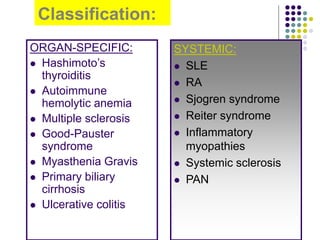
Classification:
ORGAN-SPECIFIC:
 Hashimoto’s
thyroiditis
 Autoimmune
hemolytic anemia
 Multiple sclerosis
 Good-Pauster
syndrome
 Myasthenia Gravis
 Primary biliary
cirrhosis
 Ulcerative colitis
SYSTEMIC:
 SLE
 RA
 Sjogren syndrome
 Reiter syndrome
 Inflammatory
myopathies
 Systemic sclerosis
 PAN
IMMUNE TOLERANCE
 Immune tolerance is prevention of Immune
response to a specific antigen
 Self tolerance:::: is No immunological
response towards self antigens
 Self tolerance is necessary to avoid
Autoimmunity
 Reduced self tolerance Autoimmune
diseases
 Mechanism of immune tolerance is central
and peripheral tolerance of B or T cells
MECHANISM OF AUTOIMMUNITY
 Failure of Tolerance
 Genetic factors – AIRE gene (Autoimmune
regulator gene)
 Infections
Systemic Lupus Erythematosis:
 “Multisystem disease of autoimmune origin,
characterized by a bewildering array of
autoantibodies, particularly antinuclear antibodies
(ANA’s)”.
 Chronic, remitting and relapsing, often febrile illness
characterized principally by injury to skin, joints,
kidney and serosal membranes.
 Predominantly disease of women, M:F=1:9
Etiology and Pathogenesis:
 ANTI-NUCLEAR ANTIBODIES (ANA’s)
 APLA (Antiphospholipid antibody syndrome)
 Genetic Factors: HLA- association
 Environmental factors: UV rays, Drugs, hormones .
 Immunological factors: DNA-anti-DNA complexes: LE
cell phenomenon.
 Hence, complex disorder of multifactorial origin
resulting from interactions among genetic, hormonal
and environmental factors acting in concern to cause
activation of helper T and B cells.
GENETICALLY SUSCEPTIBLE
INDIVIDUAL:
MHC CLASS II
COMPLIMENT
ADDITIONAL UNIDENTIFIED GENES
ENVIRONMENTAL TRIGGERS NUCLEOSOMAL PROTIENS,
OTHER SELF ANTIGENS
ACTIVATION OF HELPER T AND B CELLS
(SPECIFIC FOR SELF ANTIGEN)
IgG AUTOANTIBODY PRODUCTION
IMMUNE COMPLEX AND AUTOANTIBODY MEDIATED
TISSUE INJURY: CLINICAL MANIFASTATIONS
criteria for SLE:
1. Renal disorder
2. Malar rash
3. Discoid rash
4. Serositis
5. Oral ulcer
6. Arthritis
7. Photosensitivity
8. Hematologic
disorders
9. Immunology: Anti-
ds DNA, Anti-Sm,
Antiphospholipid
10. Neurological
disease
11. Antinuclear
antibody.
Presence of 4 or more out of these 11 criteria  SLE
ANTINUCLEAR ANTIBODIES
 Directed against nuclear antigens
 4 Categories:
 Anti DNA,
 Anti Histones,
 Antibodies to non histone proteins,
 Antibodies to Nucleolar antigens
 Method of detection is Indirect
Immunoflourescence
 Pattern of nuclear florescence suggests
the type of Ab
AUTOIMMUNE DISEASE SPECIFIC ANTIBODY
Systemic Lupus Erythematosus 1. Anti Ds DNA
2. Anti Sm
Drug induced SLE Anti Histone
Systemic Sclerosis Anti DNA Topoisomerase I (Scl 70)
Limited Scleroderma Anti Centromere
Sjogren Syndrome Anti SS-A (Ro)
Anti SS-B (La)
Inflammatory Myopathies Anti Jo1
ANA
 ANA is positive in most of the Autoimmune
disease
 In SLE detection of ANA is a sensitive test
but not specific
 APLA are seen in 40 to 50% of patients with
SLE. These are Lupus anticoagulant & Anti
cardiolipin Ab
PATTERNS OF
IMMUNOFLORESCENCE
Homogenous or Diffuse Antibodies to Chromatin, Histones,
Ds DNA
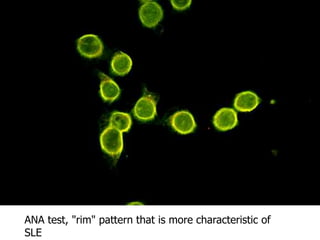
Rim or Peripheral staining Anti Ds DNA
Speckled pattern Anti Sm, Ro, La (RNP)
Nucleolar pattern Systemic sclerosis patients (Anti
DNA Topo)
"speckled" pattern of staining which is more characteristic of the
presence of autoantibodies to extractable nuclear antigens,
particularly ribonucleoprotein.
ANA test, "rim" pattern that is more characteristic of
SLE
PATHOGENESIS OF SLE
 Genetic factors
- Association with HLA genes (HLA- DQ)
 Non genetic factors
- Procainamide, Hydralazine
- estrogens, UV rays
 With Susceptible genetic factors, with
environmental triggers… CD4 T cells become
reactive to self antigens.
 Most organ damage is by Immune complex
mediated (Type III Hypersensitivity)
 Type II phenomenon (Antibody mediated) is
also seen; causes Hemolytic anemia,
Thrombocytopenia in SLE.
 Antibodies binding with Nuclear antigens cause
Hematoxylin bodies (LE phenomenon)
SLE MORPHOLOGY
 Morphology depends on nature of antibody,
tissue involved, course, duration of disease
 Deposition of immune complex **
 Acute necrotizing vasculitis
 Skin: Erythematous, Maculopapular eruption
over malar eminence-Classical feature.
 Microscopy: Skin: Degeneration of basal layer of
epidermis, edema, mononuclear infiltrates, Ig
deposits
 Joint: shows erosion of articular cartilage,
swelling, inflammation
 CNS: focal neurological deficits,
Neuropsychiatric symptoms. Multifocal
cerebral infarct.
 Spleen: is enlarged
 Pericarditis, Pleuritis
 Heart: “Libman sacks endocarditis”.
RENAL LESIONS IN SLE
 Most important
 Most common cause of death due to renal
failure
 More of glomerular lesions are seen.. Also
Tubules & Blood vessels in kidney
 Deposition of Immune complexes in
Glomeruli
 25 to 30% of SLE kidneys appear normal on
LM but 100% involved when seen on IF, EM
WHO CLASSIFICATION OF
RENAL LESIONS IN SLE
 Class I: Normal by LM, IF, EM
 Class II: Mesangial Glomerulonephritis
 Class III: Focal glomerulonephritis
 Class IV: Diffuse proliferative
Glomerulonephritis
 Class V: Membranous Glomerulonephritis
CLINICAL MANIFESTATIONS
 Young woman
 Butterfly rash, fever, arthritis, Pleuritic chest
pain, Photosensitivity
 Hematuria
 Renal failure
 Remissions & relapses
 Renal failure, infections, CNS involvement
are cause of death
Kidney, SLE, glomerulus with immune complexes
shown by immunofluorescence
Lungs with chronic pleuritis, interstitial
pneumonitis, and fibrosis in SLE
NON-BACTERIAL VERRUCOUS ENDOCARDITIS:
Libman-Sacks.
Effect of Thrombosis:
 Recurrent venous and arterial thrombosis–
cardiac valvular vegetations,
 deep venous ulcers, pulmonary
thromboembolism, pulmonary HT,
 stroke, bowel infarction,
 fetal loss
Therapeutic Approaches of
Autoimmune Diseases
 Plasmapheresis
 remove circulating
antibodies
 short term
 Immunosuppression
 Steroids
 Cyclosporine A
 Organ specific
 Insulin in DM
 Acetylcholine esterase
inhibitor in Myasthenia
gravis
 In a pregnant patient with APLA, which of the
following should be prioritized for preventive
therapy
 Renal Damage
 Thrombosis
 Hepatic dysfunction
 Athralgia
 Which of the following is the best screening
test to evaluate a patient for pssible SLE
 Anti-Ro antibody test
 Antiphopholipid antibody test
 Serum complements levels
 Fluresencent test for ANA
 Lupus is an infection
 True
 False
 Men are more affected by lupus than women
 True
 False
 As seen in many patients with lupus the
hallmark butterfly rash appears
 Back and chest
 Across the nose and cheeks
 Legs and hands
 All over the body
 SLE is a --------------- type of hypersensitive
reaction
 Type I
 Type II
 Type III
 Type IV
 Which of the following can be used as a
confirmatory test
 Antinuclear antibody
 Anti dsDNA antibody
 Anti histone antibody
Thank you

-immunopathology-2.ppt

  • 1.
  • 2.
    AUTOIMMUNE DISEASES:  ‘Immunereactions against self-antigens’ Autoimmunity- an important cause of certain disease in humans  Constitute 1-2% of population  Pathologic autoimmunity defined as: 1. Presence of autoimmune reaction 2. Not secondary to tissue damage 3. Absence of other cause of disease
  • 3.
    Classification: ORGAN-SPECIFIC:  Hashimoto’s thyroiditis  Autoimmune hemolyticanemia  Multiple sclerosis  Good-Pauster syndrome  Myasthenia Gravis  Primary biliary cirrhosis  Ulcerative colitis SYSTEMIC:  SLE  RA  Sjogren syndrome  Reiter syndrome  Inflammatory myopathies  Systemic sclerosis  PAN
  • 4.
    IMMUNE TOLERANCE  Immunetolerance is prevention of Immune response to a specific antigen  Self tolerance:::: is No immunological response towards self antigens  Self tolerance is necessary to avoid Autoimmunity  Reduced self tolerance Autoimmune diseases  Mechanism of immune tolerance is central and peripheral tolerance of B or T cells
  • 5.
    MECHANISM OF AUTOIMMUNITY Failure of Tolerance  Genetic factors – AIRE gene (Autoimmune regulator gene)  Infections
  • 8.
    Systemic Lupus Erythematosis: “Multisystem disease of autoimmune origin, characterized by a bewildering array of autoantibodies, particularly antinuclear antibodies (ANA’s)”.  Chronic, remitting and relapsing, often febrile illness characterized principally by injury to skin, joints, kidney and serosal membranes.  Predominantly disease of women, M:F=1:9
  • 9.
    Etiology and Pathogenesis: ANTI-NUCLEAR ANTIBODIES (ANA’s)  APLA (Antiphospholipid antibody syndrome)  Genetic Factors: HLA- association  Environmental factors: UV rays, Drugs, hormones .  Immunological factors: DNA-anti-DNA complexes: LE cell phenomenon.  Hence, complex disorder of multifactorial origin resulting from interactions among genetic, hormonal and environmental factors acting in concern to cause activation of helper T and B cells.
  • 10.
    GENETICALLY SUSCEPTIBLE INDIVIDUAL: MHC CLASSII COMPLIMENT ADDITIONAL UNIDENTIFIED GENES ENVIRONMENTAL TRIGGERS NUCLEOSOMAL PROTIENS, OTHER SELF ANTIGENS ACTIVATION OF HELPER T AND B CELLS (SPECIFIC FOR SELF ANTIGEN) IgG AUTOANTIBODY PRODUCTION IMMUNE COMPLEX AND AUTOANTIBODY MEDIATED TISSUE INJURY: CLINICAL MANIFASTATIONS
  • 11.
    criteria for SLE: 1.Renal disorder 2. Malar rash 3. Discoid rash 4. Serositis 5. Oral ulcer 6. Arthritis 7. Photosensitivity 8. Hematologic disorders 9. Immunology: Anti- ds DNA, Anti-Sm, Antiphospholipid 10. Neurological disease 11. Antinuclear antibody. Presence of 4 or more out of these 11 criteria  SLE
  • 13.
    ANTINUCLEAR ANTIBODIES  Directedagainst nuclear antigens  4 Categories:  Anti DNA,  Anti Histones,  Antibodies to non histone proteins,  Antibodies to Nucleolar antigens  Method of detection is Indirect Immunoflourescence  Pattern of nuclear florescence suggests the type of Ab
  • 15.
    AUTOIMMUNE DISEASE SPECIFICANTIBODY Systemic Lupus Erythematosus 1. Anti Ds DNA 2. Anti Sm Drug induced SLE Anti Histone Systemic Sclerosis Anti DNA Topoisomerase I (Scl 70) Limited Scleroderma Anti Centromere Sjogren Syndrome Anti SS-A (Ro) Anti SS-B (La) Inflammatory Myopathies Anti Jo1
  • 16.
    ANA  ANA ispositive in most of the Autoimmune disease  In SLE detection of ANA is a sensitive test but not specific  APLA are seen in 40 to 50% of patients with SLE. These are Lupus anticoagulant & Anti cardiolipin Ab
  • 17.
    PATTERNS OF IMMUNOFLORESCENCE Homogenous orDiffuse Antibodies to Chromatin, Histones, Ds DNA Rim or Peripheral staining Anti Ds DNA Speckled pattern Anti Sm, Ro, La (RNP) Nucleolar pattern Systemic sclerosis patients (Anti DNA Topo)
  • 18.
    "speckled" pattern ofstaining which is more characteristic of the presence of autoantibodies to extractable nuclear antigens, particularly ribonucleoprotein.
  • 19.
    ANA test, "rim"pattern that is more characteristic of SLE
  • 20.
    PATHOGENESIS OF SLE Genetic factors - Association with HLA genes (HLA- DQ)  Non genetic factors - Procainamide, Hydralazine - estrogens, UV rays
  • 21.
     With Susceptiblegenetic factors, with environmental triggers… CD4 T cells become reactive to self antigens.  Most organ damage is by Immune complex mediated (Type III Hypersensitivity)  Type II phenomenon (Antibody mediated) is also seen; causes Hemolytic anemia, Thrombocytopenia in SLE.  Antibodies binding with Nuclear antigens cause Hematoxylin bodies (LE phenomenon)
  • 22.
    SLE MORPHOLOGY  Morphologydepends on nature of antibody, tissue involved, course, duration of disease  Deposition of immune complex **  Acute necrotizing vasculitis  Skin: Erythematous, Maculopapular eruption over malar eminence-Classical feature.  Microscopy: Skin: Degeneration of basal layer of epidermis, edema, mononuclear infiltrates, Ig deposits
  • 23.
     Joint: showserosion of articular cartilage, swelling, inflammation  CNS: focal neurological deficits, Neuropsychiatric symptoms. Multifocal cerebral infarct.  Spleen: is enlarged  Pericarditis, Pleuritis  Heart: “Libman sacks endocarditis”.
  • 24.
    RENAL LESIONS INSLE  Most important  Most common cause of death due to renal failure  More of glomerular lesions are seen.. Also Tubules & Blood vessels in kidney  Deposition of Immune complexes in Glomeruli  25 to 30% of SLE kidneys appear normal on LM but 100% involved when seen on IF, EM
  • 25.
    WHO CLASSIFICATION OF RENALLESIONS IN SLE  Class I: Normal by LM, IF, EM  Class II: Mesangial Glomerulonephritis  Class III: Focal glomerulonephritis  Class IV: Diffuse proliferative Glomerulonephritis  Class V: Membranous Glomerulonephritis
  • 26.
    CLINICAL MANIFESTATIONS  Youngwoman  Butterfly rash, fever, arthritis, Pleuritic chest pain, Photosensitivity  Hematuria  Renal failure  Remissions & relapses  Renal failure, infections, CNS involvement are cause of death
  • 27.
    Kidney, SLE, glomeruluswith immune complexes shown by immunofluorescence
  • 28.
    Lungs with chronicpleuritis, interstitial pneumonitis, and fibrosis in SLE
  • 29.
  • 30.
    Effect of Thrombosis: Recurrent venous and arterial thrombosis– cardiac valvular vegetations,  deep venous ulcers, pulmonary thromboembolism, pulmonary HT,  stroke, bowel infarction,  fetal loss
  • 31.
    Therapeutic Approaches of AutoimmuneDiseases  Plasmapheresis  remove circulating antibodies  short term  Immunosuppression  Steroids  Cyclosporine A  Organ specific  Insulin in DM  Acetylcholine esterase inhibitor in Myasthenia gravis
  • 32.
     In apregnant patient with APLA, which of the following should be prioritized for preventive therapy  Renal Damage  Thrombosis  Hepatic dysfunction  Athralgia
  • 33.
     Which ofthe following is the best screening test to evaluate a patient for pssible SLE  Anti-Ro antibody test  Antiphopholipid antibody test  Serum complements levels  Fluresencent test for ANA
  • 34.
     Lupus isan infection  True  False
  • 35.
     Men aremore affected by lupus than women  True  False
  • 36.
     As seenin many patients with lupus the hallmark butterfly rash appears  Back and chest  Across the nose and cheeks  Legs and hands  All over the body
  • 37.
     SLE isa --------------- type of hypersensitive reaction  Type I  Type II  Type III  Type IV
  • 38.
     Which ofthe following can be used as a confirmatory test  Antinuclear antibody  Anti dsDNA antibody  Anti histone antibody
  • 39.