ATYPICAL PNEUMONIA
Marwa Mahmoud Khalifa
Internal Medicine &
Hematology Specialist
WHAT IS ATYPICAL PNEUMONIA?
 bacterial infection of lower respiratory
tract caused by Mycoplasma pneumoniae,
Chlamydia pneumoniae, Chlamydia psittaci, and
Legionella pneumophila.
 The types of bacteria that cause it tend to create
less severe symptoms than those in typical
pneumonia.
 Cases of atypical pneumonia do not usually
require hospitalization, and a person with it is
unlikely to be significantly ill. This is why it is
often called walking pneumonia.
WHAT IS ATYPICAL PNEUMONIA?
 People with atypical pneumonia will also have certain
symptoms that others with typical pneumonia will often
not have. These might include a prominent headache, a
low-grade fever, an earache, and a sore throat.
 Symptoms of atypical pneumonia tend to be milder and
more persistent than those of typical pneumonia, which
appear suddenly, and cause a more serious illness.
 Atypical pneumonia requires different antibiotics than
typical pneumonia, which is commonly caused by the
bacteria Streptococcus pneumonia.
WHAT IS ATYPICAL PNEUMONIA?
 quite common.
 2 million cases of mycoplasma pneumonia occur in
the US each year.
 8,000-18,000 patients are hospitalized for
Legionnaires’ disease in the US each year.
CHLAMYDIA PNEUMONIAE INFECTION
 one cause of community-acquired pneumonia
 The bacteria cause illness by damaging the lining of
the respiratory tract including the throat, windpipe,
and lungs.
 Some people may become infected and have mild
or no symptoms.
 spread by coughing or sneezing, which creates
small respiratory droplets
 long incubation periods 3-4 weeks
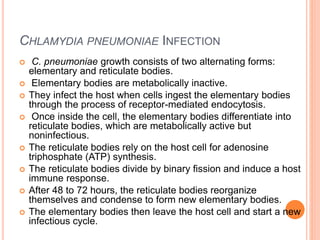
CHLAMYDIA PNEUMONIAE INFECTION
 C. pneumoniae growth consists of two alternating forms:
elementary and reticulate bodies.
 Elementary bodies are metabolically inactive.
 They infect the host when cells ingest the elementary bodies
through the process of receptor-mediated endocytosis.
 Once inside the cell, the elementary bodies differentiate into
reticulate bodies, which are metabolically active but
noninfectious.
 The reticulate bodies rely on the host cell for adenosine
triphosphate (ATP) synthesis.
 The reticulate bodies divide by binary fission and induce a host
immune response.
 After 48 to 72 hours, the reticulate bodies reorganize
themselves and condense to form new elementary bodies.
 The elementary bodies then leave the host cell and start a new
infectious cycle.
CHLAMYDIA PNEUMONIAE INFECTION
 all ages can get infection
 People at increased risk include those who live or work
in crowded places where outbreaks most commonly
occur8, such as:
 Schools
 College residence halls
 Military barracks
 Nursing homes
 Hospitals
 Prisons
 Older adults are at increased risk for severe disease
CHLAMYDIA PNEUMONIAE INFECTION
SIGNS AND SYMPTOMS
 chlamydia pneumoniae infection is a mild illness that
most commonly causes an upper respiratory tract
infection. :
 Runny or stuffy nose
 Fatigue (feeling tired)
 Low-grade fever
 Hoarseness or loss of voice
 Sore throat
 Slowly worsening cough that can last for weeks or months
 Headache
 C. pneumoniae can also cause lower respiratory tract
infections like bronchitis and pneumonia.
 Symptoms can continue for several weeks
CHLAMYDIA PNEUMONIAE INFECTION
COMPLICATIONS
 Encephalitis
 Myocarditis
 might contribute to chronic conditions, such as
asthma, arthritis, and atherosclerosis
CHLAMYDIA PNEUMONIAE INFECTION
DIAGNOSIS
types of specimens
 NP swabs
 OP (throat) swabs
 NP aspirates
 Sputum
 Tissue
 Bronchial lavage (BAL) fluid
 Bronchial washings
 Cerebral spinal fluid (CSF)
CHLAMYDIA PNEUMONIAE INFECTION
DIAGNOSIS
1- Molecular real-time PCR (preferred method for the
diagnosis of an acute infection
o available , high sensitivity and specificity, expensive
2- Serology enzyme immunoassay
o available , lacks specificity, not standardized, ,not optimal
for treatment decisions
3- Culture
genotyping and antimicrobial susceptibilities testing, Time-
consuming , low sensitivity and specificity, Positive results
should be confirmed by PCR
CHLAMYDIA PNEUMONIAE INFECTION
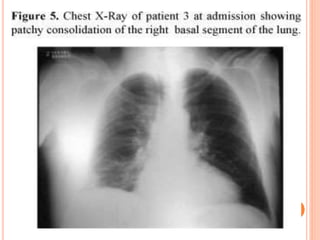
DIAGNOSIS IMAGING
 unilateral pattern of alveolar infiltrates or
bronchopneumonia predominates then progress bilateral
 Findings are usually confined to a single lobe with lower
lobe involvement more frequent than middle or upper
lobe involvement Up to a quarter of patients may
demonstrate a
 small to moderate-size pleural effusion.
 Hilar or mediastinal lymphadenopathy is an uncommon.
CHLAMYDIA PNEUMONIAE INFECTION
TREATMENT
 Illness caused by Chlamydia pneumoniae is usually
self-limiting and patients may not seek care.
Because C pneumoniae is an obligate intracellular
microbe, antibiotics must achieve intracellular
penetration to achieve efficacy
 Macrolides (azithromycin) — first-line therapy
 Tetracyclines (tetracycline and doxycycline)
 Fluoroquionolones
LEGIONELLOSIS (LEGIONNAIRES' DISEASE
AND PONTIAC FEVER)
 60 different species of Legionella; most are considered
pathogenic,
 but most disease is caused by Legionella pneumophila,
particularly serogroup 1.
 Legionella is transmitted via inhalation of aerosolized water
containing the bacteria.
 Legionnaires’ disease is likely underdiagnosed, More than
6,000 cases were reported in US 2015.
 Legionnaires’ disease is hard to distinguish from
pneumonia caused by other pathogens because it
presents similar clinical symptoms; however, presence of
diarrhea and elevated creatinine kinase levels can be
indicators
LEGIONELLOSIS
RISK FACTORS
 Age ≥50 years
 Smoking (current or historical)
 Chronic lung disease (such as emphysema or COPD)
 Immune system disorders due to disease or medication
 Systemic malignancy
 Underlying illness such as diabetes, renal failure, or
hepatic failure
 Recent travel
 Exposure to hot tubs
LEGIONELLOSIS
PATHOGENESIS
 In water, Legionella grows and multiplies within
amoebae and ciliated protozoa (providing nutrients for
replicating and growing Legionella, & shelter that
protects Legionella from adverse environmental
conditions, such as extreme temperatures and
chemicals like chlorine).
 Human alveolar macrophages look very similar to
protozoa. When in human lungs, Legionella invades
and grows within alveolar macrophages, mistaking
them for their natural host and causing disease.
LEGIONELLOSIS
CLINICAL FEATURES
Legionella infections are manifested mainly in 2
forms:
1. Legionnaires’ disease, which is a severe form of
pneumonia due to infection with Legionella. Legionnaires’
disease can manifest as a multisystem disease most
commonly involving the
lungs and gastrointestinal tract and is associated
with significant mortality.
2. Pontiac fever, which is a mild and self-resolving
flu-like disease.
LEGIONELLOSIS
CLINICAL FEATURES
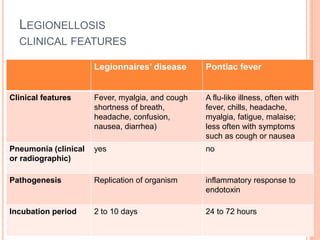
Pontiac feverLegionnaires’ disease
A flu-like illness, often with
fever, chills, headache,
myalgia, fatigue, malaise;
less often with symptoms
such as cough or nausea
Fever, myalgia, and cough
shortness of breath,
headache, confusion,
nausea, diarrhea)
Clinical features
noyesPneumonia (clinical
or radiographic)
inflammatory response to
endotoxin
Replication of organismPathogenesis
24 to 72 hours2 to 10 daysIncubation period
LEGIONELLOSIS
CLINICAL FEATURES
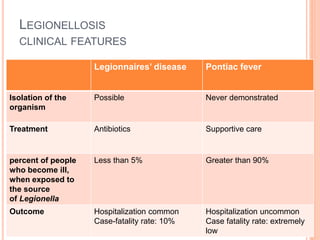
Pontiac feverLegionnaires’ disease
Never demonstratedPossibleIsolation of the
organism
Supportive careAntibioticsTreatment
Greater than 90%Less than 5%percent of people
who become ill,
when exposed to
the source
of Legionella
Hospitalization uncommon
Case fatality rate: extremely
low
Hospitalization common
Case-fatality rate: 10%
Outcome
LEGIONELLOSIS
DIAGNOSIS
 The preferred diagnostic tests for Legionnaires’
disease are culture of lower respiratory secretions
(e.g., sputum, bronchoalveolar lavage) on selective
media
 Serological assays can be nonspecific and are not
recommended
 Legionella urinary antigen test most commonly
used, remain positive for a few weeks after
infection, even with antibiotic treatment.
LEGIONELLOSIS
DIAGNOSIS
Indications that warrant testing include:
 Patients who have failed outpatient antibiotic therapy for
community-acquired pneumonia
 Patients with severe pneumonia, in particular those
requiring intensive care
 Immunocompromised patients with pneumonia*
 Patients with a travel history (patients who have traveled
away from their home within 10 days before the onset of
illness)
 All patients with pneumonia in the setting of a
Legionnaires’ disease outbreak
 Patients at risk for Legionnaires’ disease with
healthcare-associated pneumonia
LEGIONELLOSIS
TREATMENT
Antibiotics are the first-line therapy for Legionella
pneumonia. choice of antibiotic depends not only on its in
vitro bactericidal or bacteriostatic activity but
also on its ability to penetrate the cell membrane of host
tissues
 Fluoroquinolone,
 azithromycin
 Clarithromycin
 Doxycyline
The usual duration of therapy for most of the antibiotics
is 5 to 10 days, up to 3 weeks may be considered in
immunocompromised patients
LEGIONELLOSIS
PREVENTION
 The key to preventing Legionnaires’ disease is
maintenance of the water systems in which
Legionella may grow.
 maintaining water temperature outside the optimal
temperature for Legionella growth, preventing
stagnation, superheat-and-flush or point-of-use
filters, UV irradiation, and chemical disinfection
MYCOPLASMA PNEUMONIAE INFECTIONS
MICROBIOLOGY
 The cell volume of M. pneumoniae is less than 5% of the cell
volume of a typical bacillus.
 t can pass through filters typically used to remove bacteria.
 Light microscopy cannot detect it.
 It does not produce visible turbidity in liquid growth media. In
order to get a visual confirmation of growth, M.
pneumoniae cultures use specialized media.
 M. pneumoniae lacks a rigid cell wall, allowing it to alter its size
and shape to suit its surrounding conditions.
 It is also intrinsically resistant to antimicrobials, like beta-
lactams, that work by targeting the cell wall.
 Due to its lack of a cell wall, M. pneumoniae is extremely
susceptible to desiccation. Thus bacterial transmission from
person to person by airborne droplets only occurs through
close contact.
MYCOPLASMA PNEUMONIAE INFECTIONS
PATHOGENESIS
 spread through airborne droplets from person to person and is
exclusively a human pathogen.
 primarily an extracellular pathogen that has evolved a
specialized attachment organelle for close association with
host cells.
 This attachment is critical to the bacteria’s survival and ability
to infect. The close association between M. pneumoniae and
the host cells prevents the host’s mucociliary clearance
mechanisms from removing the bacterium.
 The bacterium attaches to and damages the respiratory
epithelial cells at the base of cilia. This activates the innate
immune response and produces local cytotoxic effects.
MYCOPLASMA PNEUMONIAE INFECTIONS
PATHOGENESIS
 produces a unique virulence factor known as Community
Acquired Respiratory Distress Syndrome (CARDS) toxin.
 The CARDS toxin most likely aids in the colonization and
pathogenic pathways of M. pneumoniae, leading to
inflammation and airway dysfunction.
 M. pneumoniae primarily lives on the surface of the respiratory
epithelial cells, but can invade tissues and replicate
intracellularly.
 The endocytosis of M. pneumoniae by the host cells could:
 Aid in the establishment of a latent or chronic disease state
 Facilitate the bacterium in evading an immune response
 Interfere with the efficacy of certain drug therapies
MYCOPLASMA PNEUMONIAE INFECTIONS
CLINICAL FEATURES
 Mycoplasma pneumoniae infections can occur in the
upper or lower respiratory tract.
 The bacterium can also cause a wide array of
extrapulmonary manifestations without obvious
respiratory disease.
 The incubation period is generally between 1 to 4 weeks
 Infection most commonly results in:
 Tracheobronchitis
 Pharyngitis
 Malaise
 Fever
 Cough
 Headache
MYCOPLASMA PNEUMONIAE INFECTIONS
CLINICAL FEATURES
 Illness onset can be gradual and subacute, slowly
progressing to a higher fever and a persistent cough.
 While the disease can persist for weeks or months, it is
frequently mild and self-resolving.
 The organism may persist for several weeks in the
oropharynx despite completion of recommended
antimicrobial therapy and resolution of clinical
symptoms.
MYCOPLASMA PNEUMONIAE INFECTIONS
CLINICAL COMPLICATIONS
Severe complications are uncommon, but can result
in hospitalization and sometimes death.
 Severe pneumonia
 Exacerbation of asthma
 Encephalitis
 Hemolytic anemia
 Renal dysfunction
 Gastrointestinal complaints
 Erythema multiforme, Stevens-Johnson syndrome,
or toxic epidermal necrolysis
MYCOPLASMA PNEUMONIAE INFECTIONS
DIAGNOSTIC METHODS
Specimen : NP, OP, sputum or sera
Molecular real-time PCR :available ,High sensitivity and
specificity, Rapid, expensive, not standardized
Serology: available, low specificity
Culture genotyping and antimicrobial susceptibilities
testing, 100% specificity , Time-consuming
MYCOPLASMA PNEUMONIAE INFECTIONS
TREATMENT
 All mycoplasmas lack a cell wall and, therefore, all
are inherently resistant to beta-lactam antibiotics
(e.g., penicillin).
 Macrolides (e.g., azithromycin): Children and adults
 Fluoroquinolones: Adults
 Tetracyclines (e.g., doxycycline): Older children and
adults
PSITTACOSIS
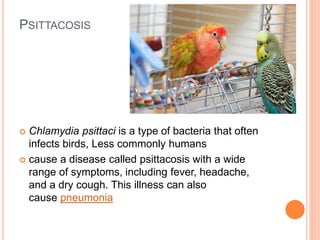
 Chlamydia psittaci is a type of bacteria that often
infects birds, Less commonly humans
 cause a disease called psittacosis with a wide
range of symptoms, including fever, headache,
and a dry cough. This illness can also
cause pneumonia
PSITTACOSIS
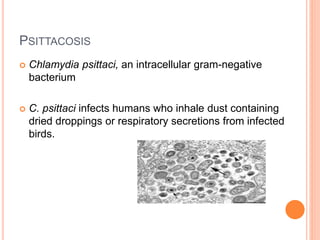
 Chlamydia psittaci, an intracellular gram-negative
bacterium
 C. psittaci infects humans who inhale dust containing
dried droppings or respiratory secretions from infected
birds.
PSITTACOSIS
CLINICAL FEATURES
 vary widely from no evidence of infection to severe systemic disease
accompanied by pneumonia.
 The predominant presentation is upper respiratory tract infection with
constitutional symptoms.
 Abrupt onset of fever and chills
 Headache
 Muscle aches
 Nonproductive cough
 Patients may present with pulse-temperature dissociation (fever
without increased pulse rate), splenomegaly, and rash, though less
frequently.
 The incubation period is typically 5 to 14 days.
 Pneumonia is evident often on chest x-ray. Radiographic findings may
include lobar or interstitial infiltrates
PSITTACOSIS
CLINICAL COMPLICATIONS
 Severe pneumonia requiring intensive-care support
 Respiratory failure
 Endocarditis
 Myocarditis
 Hepatitis
 Arthritis
 Encephalitis
 Sepsis
 Death occurs in less than 1%
PSITTACOSIS
DIAGNOSIS
 sputum specimens or swabs of the nasopharynx and
oropharynx or serum
• Real-time polymerase chain reaction (PCR), Rapid
,Sensitive and specific
• Serologic test (e.g., complement fixation,
microimmunofluorescent antibody test): available, Cross-
reactivity
• Culture: genotyping, antimicrobial susceptibility testing,
Time-consuming, Technically difficult
PSITTACOSIS
TREATMENT
 Chlamydia psittaci are sensitive to both macrolides
and tetracyclines. However, tetracyclines are the
drugs of choice, unless contraindicated as they are
in children, due to reported macrolide failures.
TAKE HOME MESSAGE
 CAP due to Legionella, Chlamydophyla, or Mycoplasma
continues to be a diagnostic challenge due to the
nonspecific clinical and radiographic presentations.
 The vague clinical presentations of atypical CAP
contribute to its underdiagnosis and under-reporting.
 Advancements in diagnostic techniques bring hope to
rapid and accurate diagnosis of atypical CAP.
 Macrolides and respiratory fluoroquinolones are
currently the antibiotics of choice
Atypical pneumonia

Atypical pneumonia

  • 1.
    ATYPICAL PNEUMONIA Marwa MahmoudKhalifa Internal Medicine & Hematology Specialist
  • 2.
    WHAT IS ATYPICALPNEUMONIA?  bacterial infection of lower respiratory tract caused by Mycoplasma pneumoniae, Chlamydia pneumoniae, Chlamydia psittaci, and Legionella pneumophila.  The types of bacteria that cause it tend to create less severe symptoms than those in typical pneumonia.  Cases of atypical pneumonia do not usually require hospitalization, and a person with it is unlikely to be significantly ill. This is why it is often called walking pneumonia.
  • 3.
    WHAT IS ATYPICALPNEUMONIA?  People with atypical pneumonia will also have certain symptoms that others with typical pneumonia will often not have. These might include a prominent headache, a low-grade fever, an earache, and a sore throat.  Symptoms of atypical pneumonia tend to be milder and more persistent than those of typical pneumonia, which appear suddenly, and cause a more serious illness.  Atypical pneumonia requires different antibiotics than typical pneumonia, which is commonly caused by the bacteria Streptococcus pneumonia.
  • 4.
    WHAT IS ATYPICALPNEUMONIA?  quite common.  2 million cases of mycoplasma pneumonia occur in the US each year.  8,000-18,000 patients are hospitalized for Legionnaires’ disease in the US each year.
  • 5.
    CHLAMYDIA PNEUMONIAE INFECTION one cause of community-acquired pneumonia  The bacteria cause illness by damaging the lining of the respiratory tract including the throat, windpipe, and lungs.  Some people may become infected and have mild or no symptoms.  spread by coughing or sneezing, which creates small respiratory droplets  long incubation periods 3-4 weeks
  • 6.
    CHLAMYDIA PNEUMONIAE INFECTION C. pneumoniae growth consists of two alternating forms: elementary and reticulate bodies.  Elementary bodies are metabolically inactive.  They infect the host when cells ingest the elementary bodies through the process of receptor-mediated endocytosis.  Once inside the cell, the elementary bodies differentiate into reticulate bodies, which are metabolically active but noninfectious.  The reticulate bodies rely on the host cell for adenosine triphosphate (ATP) synthesis.  The reticulate bodies divide by binary fission and induce a host immune response.  After 48 to 72 hours, the reticulate bodies reorganize themselves and condense to form new elementary bodies.  The elementary bodies then leave the host cell and start a new infectious cycle.
  • 7.
    CHLAMYDIA PNEUMONIAE INFECTION all ages can get infection  People at increased risk include those who live or work in crowded places where outbreaks most commonly occur8, such as:  Schools  College residence halls  Military barracks  Nursing homes  Hospitals  Prisons  Older adults are at increased risk for severe disease
  • 8.
    CHLAMYDIA PNEUMONIAE INFECTION SIGNSAND SYMPTOMS  chlamydia pneumoniae infection is a mild illness that most commonly causes an upper respiratory tract infection. :  Runny or stuffy nose  Fatigue (feeling tired)  Low-grade fever  Hoarseness or loss of voice  Sore throat  Slowly worsening cough that can last for weeks or months  Headache  C. pneumoniae can also cause lower respiratory tract infections like bronchitis and pneumonia.  Symptoms can continue for several weeks
  • 9.
    CHLAMYDIA PNEUMONIAE INFECTION COMPLICATIONS Encephalitis  Myocarditis  might contribute to chronic conditions, such as asthma, arthritis, and atherosclerosis
  • 10.
    CHLAMYDIA PNEUMONIAE INFECTION DIAGNOSIS typesof specimens  NP swabs  OP (throat) swabs  NP aspirates  Sputum  Tissue  Bronchial lavage (BAL) fluid  Bronchial washings  Cerebral spinal fluid (CSF)
  • 11.
    CHLAMYDIA PNEUMONIAE INFECTION DIAGNOSIS 1-Molecular real-time PCR (preferred method for the diagnosis of an acute infection o available , high sensitivity and specificity, expensive 2- Serology enzyme immunoassay o available , lacks specificity, not standardized, ,not optimal for treatment decisions 3- Culture genotyping and antimicrobial susceptibilities testing, Time- consuming , low sensitivity and specificity, Positive results should be confirmed by PCR
  • 12.
    CHLAMYDIA PNEUMONIAE INFECTION DIAGNOSISIMAGING  unilateral pattern of alveolar infiltrates or bronchopneumonia predominates then progress bilateral  Findings are usually confined to a single lobe with lower lobe involvement more frequent than middle or upper lobe involvement Up to a quarter of patients may demonstrate a  small to moderate-size pleural effusion.  Hilar or mediastinal lymphadenopathy is an uncommon.
  • 14.
    CHLAMYDIA PNEUMONIAE INFECTION TREATMENT Illness caused by Chlamydia pneumoniae is usually self-limiting and patients may not seek care. Because C pneumoniae is an obligate intracellular microbe, antibiotics must achieve intracellular penetration to achieve efficacy  Macrolides (azithromycin) — first-line therapy  Tetracyclines (tetracycline and doxycycline)  Fluoroquionolones
  • 15.
    LEGIONELLOSIS (LEGIONNAIRES' DISEASE ANDPONTIAC FEVER)  60 different species of Legionella; most are considered pathogenic,  but most disease is caused by Legionella pneumophila, particularly serogroup 1.  Legionella is transmitted via inhalation of aerosolized water containing the bacteria.  Legionnaires’ disease is likely underdiagnosed, More than 6,000 cases were reported in US 2015.  Legionnaires’ disease is hard to distinguish from pneumonia caused by other pathogens because it presents similar clinical symptoms; however, presence of diarrhea and elevated creatinine kinase levels can be indicators
  • 16.
    LEGIONELLOSIS RISK FACTORS  Age≥50 years  Smoking (current or historical)  Chronic lung disease (such as emphysema or COPD)  Immune system disorders due to disease or medication  Systemic malignancy  Underlying illness such as diabetes, renal failure, or hepatic failure  Recent travel  Exposure to hot tubs
  • 17.
    LEGIONELLOSIS PATHOGENESIS  In water,Legionella grows and multiplies within amoebae and ciliated protozoa (providing nutrients for replicating and growing Legionella, & shelter that protects Legionella from adverse environmental conditions, such as extreme temperatures and chemicals like chlorine).  Human alveolar macrophages look very similar to protozoa. When in human lungs, Legionella invades and grows within alveolar macrophages, mistaking them for their natural host and causing disease.
  • 18.
    LEGIONELLOSIS CLINICAL FEATURES Legionella infectionsare manifested mainly in 2 forms: 1. Legionnaires’ disease, which is a severe form of pneumonia due to infection with Legionella. Legionnaires’ disease can manifest as a multisystem disease most commonly involving the lungs and gastrointestinal tract and is associated with significant mortality. 2. Pontiac fever, which is a mild and self-resolving flu-like disease.
  • 19.
    LEGIONELLOSIS CLINICAL FEATURES Pontiac feverLegionnaires’disease A flu-like illness, often with fever, chills, headache, myalgia, fatigue, malaise; less often with symptoms such as cough or nausea Fever, myalgia, and cough shortness of breath, headache, confusion, nausea, diarrhea) Clinical features noyesPneumonia (clinical or radiographic) inflammatory response to endotoxin Replication of organismPathogenesis 24 to 72 hours2 to 10 daysIncubation period
  • 20.
    LEGIONELLOSIS CLINICAL FEATURES Pontiac feverLegionnaires’disease Never demonstratedPossibleIsolation of the organism Supportive careAntibioticsTreatment Greater than 90%Less than 5%percent of people who become ill, when exposed to the source of Legionella Hospitalization uncommon Case fatality rate: extremely low Hospitalization common Case-fatality rate: 10% Outcome
  • 21.
    LEGIONELLOSIS DIAGNOSIS  The preferreddiagnostic tests for Legionnaires’ disease are culture of lower respiratory secretions (e.g., sputum, bronchoalveolar lavage) on selective media  Serological assays can be nonspecific and are not recommended  Legionella urinary antigen test most commonly used, remain positive for a few weeks after infection, even with antibiotic treatment.
  • 22.
    LEGIONELLOSIS DIAGNOSIS Indications that warranttesting include:  Patients who have failed outpatient antibiotic therapy for community-acquired pneumonia  Patients with severe pneumonia, in particular those requiring intensive care  Immunocompromised patients with pneumonia*  Patients with a travel history (patients who have traveled away from their home within 10 days before the onset of illness)  All patients with pneumonia in the setting of a Legionnaires’ disease outbreak  Patients at risk for Legionnaires’ disease with healthcare-associated pneumonia
  • 23.
    LEGIONELLOSIS TREATMENT Antibiotics are thefirst-line therapy for Legionella pneumonia. choice of antibiotic depends not only on its in vitro bactericidal or bacteriostatic activity but also on its ability to penetrate the cell membrane of host tissues  Fluoroquinolone,  azithromycin  Clarithromycin  Doxycyline The usual duration of therapy for most of the antibiotics is 5 to 10 days, up to 3 weeks may be considered in immunocompromised patients
  • 24.
    LEGIONELLOSIS PREVENTION  The keyto preventing Legionnaires’ disease is maintenance of the water systems in which Legionella may grow.  maintaining water temperature outside the optimal temperature for Legionella growth, preventing stagnation, superheat-and-flush or point-of-use filters, UV irradiation, and chemical disinfection
  • 25.
    MYCOPLASMA PNEUMONIAE INFECTIONS MICROBIOLOGY The cell volume of M. pneumoniae is less than 5% of the cell volume of a typical bacillus.  t can pass through filters typically used to remove bacteria.  Light microscopy cannot detect it.  It does not produce visible turbidity in liquid growth media. In order to get a visual confirmation of growth, M. pneumoniae cultures use specialized media.  M. pneumoniae lacks a rigid cell wall, allowing it to alter its size and shape to suit its surrounding conditions.  It is also intrinsically resistant to antimicrobials, like beta- lactams, that work by targeting the cell wall.  Due to its lack of a cell wall, M. pneumoniae is extremely susceptible to desiccation. Thus bacterial transmission from person to person by airborne droplets only occurs through close contact.
  • 26.
    MYCOPLASMA PNEUMONIAE INFECTIONS PATHOGENESIS spread through airborne droplets from person to person and is exclusively a human pathogen.  primarily an extracellular pathogen that has evolved a specialized attachment organelle for close association with host cells.  This attachment is critical to the bacteria’s survival and ability to infect. The close association between M. pneumoniae and the host cells prevents the host’s mucociliary clearance mechanisms from removing the bacterium.  The bacterium attaches to and damages the respiratory epithelial cells at the base of cilia. This activates the innate immune response and produces local cytotoxic effects.
  • 27.
    MYCOPLASMA PNEUMONIAE INFECTIONS PATHOGENESIS produces a unique virulence factor known as Community Acquired Respiratory Distress Syndrome (CARDS) toxin.  The CARDS toxin most likely aids in the colonization and pathogenic pathways of M. pneumoniae, leading to inflammation and airway dysfunction.  M. pneumoniae primarily lives on the surface of the respiratory epithelial cells, but can invade tissues and replicate intracellularly.  The endocytosis of M. pneumoniae by the host cells could:  Aid in the establishment of a latent or chronic disease state  Facilitate the bacterium in evading an immune response  Interfere with the efficacy of certain drug therapies
  • 28.
    MYCOPLASMA PNEUMONIAE INFECTIONS CLINICALFEATURES  Mycoplasma pneumoniae infections can occur in the upper or lower respiratory tract.  The bacterium can also cause a wide array of extrapulmonary manifestations without obvious respiratory disease.  The incubation period is generally between 1 to 4 weeks  Infection most commonly results in:  Tracheobronchitis  Pharyngitis  Malaise  Fever  Cough  Headache
  • 29.
    MYCOPLASMA PNEUMONIAE INFECTIONS CLINICALFEATURES  Illness onset can be gradual and subacute, slowly progressing to a higher fever and a persistent cough.  While the disease can persist for weeks or months, it is frequently mild and self-resolving.  The organism may persist for several weeks in the oropharynx despite completion of recommended antimicrobial therapy and resolution of clinical symptoms.
  • 30.
    MYCOPLASMA PNEUMONIAE INFECTIONS CLINICALCOMPLICATIONS Severe complications are uncommon, but can result in hospitalization and sometimes death.  Severe pneumonia  Exacerbation of asthma  Encephalitis  Hemolytic anemia  Renal dysfunction  Gastrointestinal complaints  Erythema multiforme, Stevens-Johnson syndrome, or toxic epidermal necrolysis
  • 31.
    MYCOPLASMA PNEUMONIAE INFECTIONS DIAGNOSTICMETHODS Specimen : NP, OP, sputum or sera Molecular real-time PCR :available ,High sensitivity and specificity, Rapid, expensive, not standardized Serology: available, low specificity Culture genotyping and antimicrobial susceptibilities testing, 100% specificity , Time-consuming
  • 32.
    MYCOPLASMA PNEUMONIAE INFECTIONS TREATMENT All mycoplasmas lack a cell wall and, therefore, all are inherently resistant to beta-lactam antibiotics (e.g., penicillin).  Macrolides (e.g., azithromycin): Children and adults  Fluoroquinolones: Adults  Tetracyclines (e.g., doxycycline): Older children and adults
  • 33.
    PSITTACOSIS  Chlamydia psittaciis a type of bacteria that often infects birds, Less commonly humans  cause a disease called psittacosis with a wide range of symptoms, including fever, headache, and a dry cough. This illness can also cause pneumonia
  • 34.
    PSITTACOSIS  Chlamydia psittaci,an intracellular gram-negative bacterium  C. psittaci infects humans who inhale dust containing dried droppings or respiratory secretions from infected birds.
  • 35.
    PSITTACOSIS CLINICAL FEATURES  varywidely from no evidence of infection to severe systemic disease accompanied by pneumonia.  The predominant presentation is upper respiratory tract infection with constitutional symptoms.  Abrupt onset of fever and chills  Headache  Muscle aches  Nonproductive cough  Patients may present with pulse-temperature dissociation (fever without increased pulse rate), splenomegaly, and rash, though less frequently.  The incubation period is typically 5 to 14 days.  Pneumonia is evident often on chest x-ray. Radiographic findings may include lobar or interstitial infiltrates
  • 36.
    PSITTACOSIS CLINICAL COMPLICATIONS  Severepneumonia requiring intensive-care support  Respiratory failure  Endocarditis  Myocarditis  Hepatitis  Arthritis  Encephalitis  Sepsis  Death occurs in less than 1%
  • 37.
    PSITTACOSIS DIAGNOSIS  sputum specimensor swabs of the nasopharynx and oropharynx or serum • Real-time polymerase chain reaction (PCR), Rapid ,Sensitive and specific • Serologic test (e.g., complement fixation, microimmunofluorescent antibody test): available, Cross- reactivity • Culture: genotyping, antimicrobial susceptibility testing, Time-consuming, Technically difficult
  • 38.
    PSITTACOSIS TREATMENT  Chlamydia psittaciare sensitive to both macrolides and tetracyclines. However, tetracyclines are the drugs of choice, unless contraindicated as they are in children, due to reported macrolide failures.
  • 39.
    TAKE HOME MESSAGE CAP due to Legionella, Chlamydophyla, or Mycoplasma continues to be a diagnostic challenge due to the nonspecific clinical and radiographic presentations.  The vague clinical presentations of atypical CAP contribute to its underdiagnosis and under-reporting.  Advancements in diagnostic techniques bring hope to rapid and accurate diagnosis of atypical CAP.  Macrolides and respiratory fluoroquinolones are currently the antibiotics of choice