by Dr. Shalom
Nwachukwu
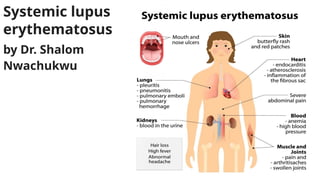
Systemic lupus
erythematosus
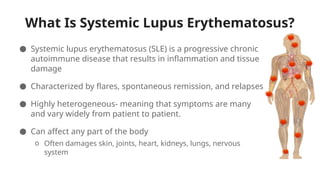
What Is Systemic Lupus Erythematosus?
● Systemic lupus erythematosus (SLE) is a progressive chronic
autoimmune disease that results in inflammation and tissue
damage
● Characterized by flares, spontaneous remission, and relapses
● Highly heterogeneous- meaning that symptoms are many
and vary widely from patient to patient.
● Can affect any part of the body
o Often damages skin, joints, heart, kidneys, lungs, nervous
system
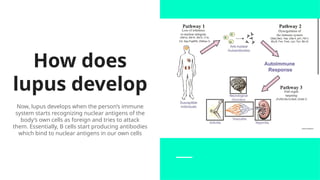
How does
lupus develop
Now, lupus develops when the person’s immune
system starts recognizing nuclear antigens of the
body’s own cells as foreign and tries to attack
them. Essentially, B cells start producing antibodies
which bind to nuclear antigens in our own cells
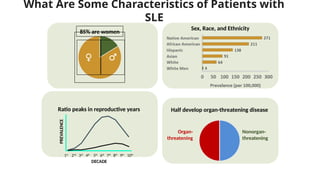
What Are Some Characteristics of Patients with
SLE
♀ ♂
85% are women
DECADE
1st
2nd
3rd
4th
5th
6th
7th
8th
9th
10th
PREVALENCE
Ratio peaks in reproductive years Half develop organ-threatening disease
Nonorgan-
threatening
Organ-
threatening
Sex, Race, and Ethnicity
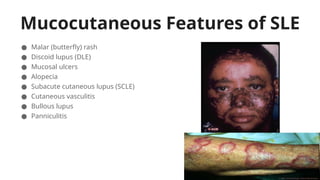
Mucocutaneous Features of SLE
● Malar (butterfly) rash
● Discoid lupus (DLE)
● Mucosal ulcers
● Alopecia
● Subacute cutaneous lupus (SCLE)
● Cutaneous vasculitis
● Bullous lupus
● Panniculitis
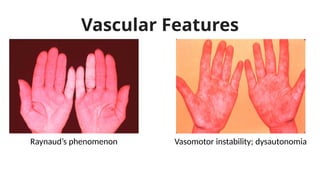
Vascular Features
Vasomotor instability; dysautonomia
Raynaud’s phenomenon
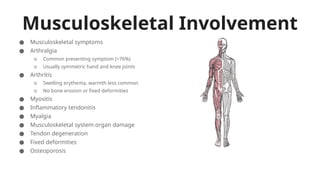
Musculoskeletal Involvement
● Musculoskeletal symptoms
● Arthralgia
o Common presenting symptom (>76%)
o Usually symmetric hand and knee joints
● Arthritis
o Swelling erythema, warmth less common
o No bone erosion or fixed deformities
● Myositis
● Inflammatory tendonitis
● Myalgia
● Musculoskeletal system organ damage
● Tendon degeneration
● Fixed deformities
● Osteoporosis
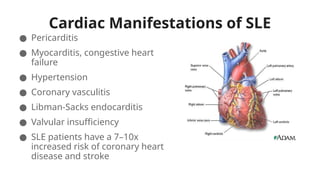
Cardiac Manifestations of SLE
● Pericarditis
● Myocarditis, congestive heart
failure
● Hypertension
● Coronary vasculitis
● Libman-Sacks endocarditis
● Valvular insufficiency
● SLE patients have a 7–10x
increased risk of coronary heart
disease and stroke
Blood Abnormalities
● Anemia
o Decreased red blood cells due to immune
destruction/hemolysis
● Thrombocytopenia
o Platelets < 100k
● Lymphopenia/neutropenia
o Decreased white blood cells < 4k, particularly lymphocytes <
1.5k
● Exclude other reasons
o Medications
o Blood loss
o Infection
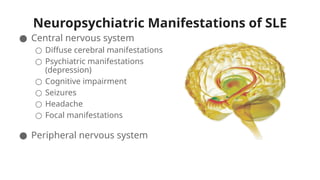
Neuropsychiatric Manifestations of SLE
● Central nervous system
○ Diffuse cerebral manifestations
○ Psychiatric manifestations
(depression)
○ Cognitive impairment
○ Seizures
○ Headache
○ Focal manifestations
● Peripheral nervous system
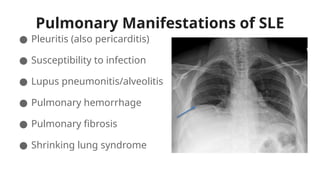
Pulmonary Manifestations of SLE
● Pleuritis (also pericarditis)
● Susceptibility to infection
● Lupus pneumonitis/alveolitis
● Pulmonary hemorrhage
● Pulmonary fibrosis
● Shrinking lung syndrome
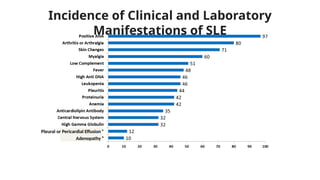
Incidence of Clinical and Laboratory
Manifestations of SLE
Pleural or Pericardial Effusion
Adenopathy
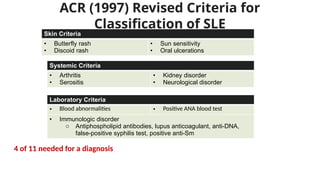
ACR (1997) Revised Criteria for
Classification of SLE
Skin Criteria
• Butterfly rash
• Discoid rash
• Sun sensitivity
• Oral ulcerations
Systemic Criteria
• Arthritis
• Serositis
• Kidney disorder
• Neurological disorder
Laboratory Criteria
• Blood abnormalities • Positive ANA blood test
• Immunologic disorder
o Antiphospholipid antibodies, lupus anticoagulant, anti-DNA,
false-positive syphilis test, positive anti-Sm
4 of 11 needed for a diagnosis
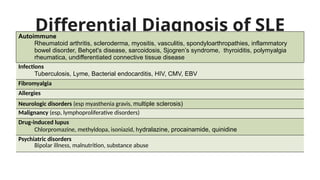
Differential Diagnosis of SLE
Autoimmune
Rheumatoid arthritis, scleroderma, myositis, vasculitis, spondyloarthropathies, inflammatory
bowel disorder, Behçet's disease, sarcoidosis, Sjogren’s syndrome, thyroiditis, polymyalgia
rheumatica, undifferentiated connective tissue disease
Infections
Tuberculosis, Lyme, Bacterial endocarditis, HIV, CMV, EBV
Fibromyalgia
Allergies
Neurologic disorders (esp myasthenia gravis, multiple sclerosis)
Malignancy (esp, lymphoproliferative disorders)
Drug-induced lupus
Chlorpromazine, methyldopa, isoniazid, hydralazine, procainamide, quinidine
Psychiatric disorders
Bipolar illness, malnutrition, substance abuse
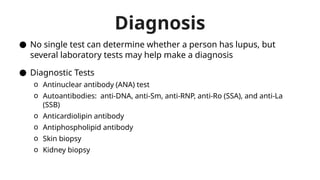
Diagnosis
● No single test can determine whether a person has lupus, but
several laboratory tests may help make a diagnosis
● Diagnostic Tests
o Antinuclear antibody (ANA) test
o Autoantibodies: anti-DNA, anti-Sm, anti-RNP, anti-Ro (SSA), and anti-La
(SSB)
o Anticardiolipin antibody
o Antiphospholipid antibody
o Skin biopsy
o Kidney biopsy
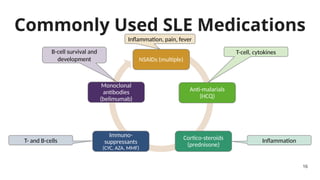
Commonly Used SLE Medications
16
NSAIDs (multiple)
Anti-malarials
(HCQ)
Cortico-steroids
(prednisone)
Immuno-
suppressants
(CYC, AZA, MMF)
Monoclonal
antibodies
(belimumab)
Inflammation, pain, fever
T-cell, cytokines
Inflammation
T- and B-cells
B-cell survival and
development
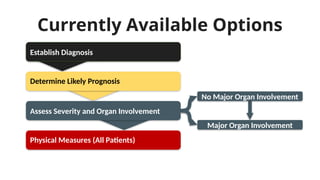
Currently Available Options
Physical Measures (All Patients)
Establish Diagnosis
Determine Likely Prognosis
Assess Severity and Organ Involvement
No Major Organ Involvement
Major Organ Involvement
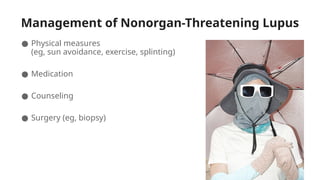
Management of Nonorgan-Threatening Lupus
● Physical measures
(eg, sun avoidance, exercise, splinting)
● Medication
● Counseling
● Surgery (eg, biopsy)
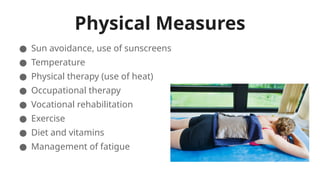
Physical Measures
● Sun avoidance, use of sunscreens
● Temperature
● Physical therapy (use of heat)
● Occupational therapy
● Vocational rehabilitation
● Exercise
● Diet and vitamins
● Management of fatigue
Proactive and Preventive Strategies in SLE
● Patient education programs
● Eliminate patient nonadherence
● Specialist access
● Exercise, PT, OT, ergonomic work stations
● Cognitive therapy (lupus fog), biofeedback (Raynaud’s)
● Aggressive vigilance for hypertension, hyperglycemia, hyperlipidemia, obesity,
smoking cessation
● Yearly bone densitometry and use of bisphosphonates
● Annual EKG, chest X-ray, duplex scanning, stress tests, 2-D echo for pulmonary
pressures in high-risk patients
● Prompt evaluation of all fevers
● Antiphospholipid antibody screening and prophylaxis
Key Points
● Diagnosis by rheumatology is the gold standard
● Screen early for organ-threatening disease
● Early treatment
o NSAIDs should be considered
o Steroids may be useful in early, active disease, if used with caution
o Patients should receive an antimalarial
● Adherence is critical at all disease stages
o Patient education, disease monitoring, and adherence assessment
● Even mild disease should be overseen by a lupus care specialist at least
annually or by phone consultation
o Flares happen and can be subtle

systemic lupus erythematous presentation .pptx

  • 1.
  • 2.
    What Is SystemicLupus Erythematosus? ● Systemic lupus erythematosus (SLE) is a progressive chronic autoimmune disease that results in inflammation and tissue damage ● Characterized by flares, spontaneous remission, and relapses ● Highly heterogeneous- meaning that symptoms are many and vary widely from patient to patient. ● Can affect any part of the body o Often damages skin, joints, heart, kidneys, lungs, nervous system
  • 3.
    How does lupus develop Now,lupus develops when the person’s immune system starts recognizing nuclear antigens of the body’s own cells as foreign and tries to attack them. Essentially, B cells start producing antibodies which bind to nuclear antigens in our own cells
  • 4.
    What Are SomeCharacteristics of Patients with SLE ♀ ♂ 85% are women DECADE 1st 2nd 3rd 4th 5th 6th 7th 8th 9th 10th PREVALENCE Ratio peaks in reproductive years Half develop organ-threatening disease Nonorgan- threatening Organ- threatening Sex, Race, and Ethnicity
  • 5.
    Mucocutaneous Features ofSLE ● Malar (butterfly) rash ● Discoid lupus (DLE) ● Mucosal ulcers ● Alopecia ● Subacute cutaneous lupus (SCLE) ● Cutaneous vasculitis ● Bullous lupus ● Panniculitis
  • 6.
    Vascular Features Vasomotor instability;dysautonomia Raynaud’s phenomenon
  • 7.
    Musculoskeletal Involvement ● Musculoskeletalsymptoms ● Arthralgia o Common presenting symptom (>76%) o Usually symmetric hand and knee joints ● Arthritis o Swelling erythema, warmth less common o No bone erosion or fixed deformities ● Myositis ● Inflammatory tendonitis ● Myalgia ● Musculoskeletal system organ damage ● Tendon degeneration ● Fixed deformities ● Osteoporosis
  • 8.
    Cardiac Manifestations ofSLE ● Pericarditis ● Myocarditis, congestive heart failure ● Hypertension ● Coronary vasculitis ● Libman-Sacks endocarditis ● Valvular insufficiency ● SLE patients have a 7–10x increased risk of coronary heart disease and stroke
  • 9.
    Blood Abnormalities ● Anemia oDecreased red blood cells due to immune destruction/hemolysis ● Thrombocytopenia o Platelets < 100k ● Lymphopenia/neutropenia o Decreased white blood cells < 4k, particularly lymphocytes < 1.5k ● Exclude other reasons o Medications o Blood loss o Infection
  • 10.
    Neuropsychiatric Manifestations ofSLE ● Central nervous system ○ Diffuse cerebral manifestations ○ Psychiatric manifestations (depression) ○ Cognitive impairment ○ Seizures ○ Headache ○ Focal manifestations ● Peripheral nervous system
  • 11.
    Pulmonary Manifestations ofSLE ● Pleuritis (also pericarditis) ● Susceptibility to infection ● Lupus pneumonitis/alveolitis ● Pulmonary hemorrhage ● Pulmonary fibrosis ● Shrinking lung syndrome
  • 12.
    Incidence of Clinicaland Laboratory Manifestations of SLE Pleural or Pericardial Effusion Adenopathy
  • 13.
    ACR (1997) RevisedCriteria for Classification of SLE Skin Criteria • Butterfly rash • Discoid rash • Sun sensitivity • Oral ulcerations Systemic Criteria • Arthritis • Serositis • Kidney disorder • Neurological disorder Laboratory Criteria • Blood abnormalities • Positive ANA blood test • Immunologic disorder o Antiphospholipid antibodies, lupus anticoagulant, anti-DNA, false-positive syphilis test, positive anti-Sm 4 of 11 needed for a diagnosis
  • 14.
    Differential Diagnosis ofSLE Autoimmune Rheumatoid arthritis, scleroderma, myositis, vasculitis, spondyloarthropathies, inflammatory bowel disorder, Behçet's disease, sarcoidosis, Sjogren’s syndrome, thyroiditis, polymyalgia rheumatica, undifferentiated connective tissue disease Infections Tuberculosis, Lyme, Bacterial endocarditis, HIV, CMV, EBV Fibromyalgia Allergies Neurologic disorders (esp myasthenia gravis, multiple sclerosis) Malignancy (esp, lymphoproliferative disorders) Drug-induced lupus Chlorpromazine, methyldopa, isoniazid, hydralazine, procainamide, quinidine Psychiatric disorders Bipolar illness, malnutrition, substance abuse
  • 15.
    Diagnosis ● No singletest can determine whether a person has lupus, but several laboratory tests may help make a diagnosis ● Diagnostic Tests o Antinuclear antibody (ANA) test o Autoantibodies: anti-DNA, anti-Sm, anti-RNP, anti-Ro (SSA), and anti-La (SSB) o Anticardiolipin antibody o Antiphospholipid antibody o Skin biopsy o Kidney biopsy
  • 16.
    Commonly Used SLEMedications 16 NSAIDs (multiple) Anti-malarials (HCQ) Cortico-steroids (prednisone) Immuno- suppressants (CYC, AZA, MMF) Monoclonal antibodies (belimumab) Inflammation, pain, fever T-cell, cytokines Inflammation T- and B-cells B-cell survival and development
  • 17.
    Currently Available Options PhysicalMeasures (All Patients) Establish Diagnosis Determine Likely Prognosis Assess Severity and Organ Involvement No Major Organ Involvement Major Organ Involvement
  • 18.
    Management of Nonorgan-ThreateningLupus ● Physical measures (eg, sun avoidance, exercise, splinting) ● Medication ● Counseling ● Surgery (eg, biopsy)
  • 19.
    Physical Measures ● Sunavoidance, use of sunscreens ● Temperature ● Physical therapy (use of heat) ● Occupational therapy ● Vocational rehabilitation ● Exercise ● Diet and vitamins ● Management of fatigue
  • 20.
    Proactive and PreventiveStrategies in SLE ● Patient education programs ● Eliminate patient nonadherence ● Specialist access ● Exercise, PT, OT, ergonomic work stations ● Cognitive therapy (lupus fog), biofeedback (Raynaud’s) ● Aggressive vigilance for hypertension, hyperglycemia, hyperlipidemia, obesity, smoking cessation ● Yearly bone densitometry and use of bisphosphonates ● Annual EKG, chest X-ray, duplex scanning, stress tests, 2-D echo for pulmonary pressures in high-risk patients ● Prompt evaluation of all fevers ● Antiphospholipid antibody screening and prophylaxis
  • 21.
    Key Points ● Diagnosisby rheumatology is the gold standard ● Screen early for organ-threatening disease ● Early treatment o NSAIDs should be considered o Steroids may be useful in early, active disease, if used with caution o Patients should receive an antimalarial ● Adherence is critical at all disease stages o Patient education, disease monitoring, and adherence assessment ● Even mild disease should be overseen by a lupus care specialist at least annually or by phone consultation o Flares happen and can be subtle

Editor's Notes

  • #2 CC
  • #4 38:47 (check my edit)
  • #5 CC
  • #7 CC Wallace CNS: Cognitive impairment rates have been reported as high as 66% of patients.1 Patients may be impaired despite disease activity.2 One report revealed 85% of patients with active disease also had cognitive impairment, and of these patients, 85% also had neurologic abnormalities.3 Other neurologic symptoms associated with SLE are less common, such as delirium (7%) and dementia (5%).3 The frequency of stroke is unknown but stroke increases the risk of future strokes and the risk of seizures.4 Musculoskeletal: In the musculoskeletal system, signs and symptoms of SLE disease activity include arthritis, myositis, inflammatory tendonitis, arthralgia, and myalgia.5 SLE-related end-organ damage in the musculoskeletal system includes tendon degeneration, fixed deformities, and osteoporosis. End-organ damage may be treatment related (eg, osteoporosis associated with glucocorticoid use).5 1Denburg et al. Neurology. 1987;37:464-467. 2Carbotte RM, et al. J Rheumatol. 199522;863-867. 3Miguel ED, et al. Medicine. 1994;73:224-234. 4Futrell N, et al. Neurology. 1992;42:1649-1657. 5Egol KA, et al. Bull Hosp Jt Dis. 2001;60(1):29-34.
  • #8 CC
  • #10 CC
  • #11 CC
  • #13 Hochberg MC, Arthritis and Rheumatism, 1996