Polytechnic University of the Philippines
Graduate Studies - College of Education
Sta. Mesa, Manila
FINAL EXAMINATION
A Take Home Exam Submitted to
DR. NILO L. ROSAS
Faculty Member of Polytechnic University of the Philippines
Graduate Studies - College of Education
Sta. Mesa, Manila
In Partial fulfilment of the Requirements for the Subject
Systems Analysis Applied to Education
(DEM 734)
KATHLEEN C. ABAJA
DEM Student
Directions: Please answer each question in not more than two hundred words. Cite
authorities.
1. In what ways can Systems Analysis be applied to the study or investigation of
education? Give illustration or examples of how it can be used to analyze
education as a social system, a cultural system, an economic system, and a
political system.
Answer:
Systems Analysis applied to Education aims to establish and maintain
complete, adequate, and integrated system of education relevant to the goals of
educational development. In essence, relevant, adequate, complete, and
functional could refer to the contribution of the school system to the social,
cultural, economic, political, and technological subsystems of the society, the
society influences the school in return in the same aspects.
To determine the contribution of the school system to the various systems
of society, we have to identify the needs of the society that the school is
supposed to satisfy. These needs are: social, cultural, economic, political and
technological.
In the social aspect, the school must consider the socio-economic mobility
of the graduates, that is, they would be able to move to a higher status, learn
from the social problems in the community, and minimize social and
discriminating social stratifications in the community.
In the cultural aspect, national security, national identity, solidarity,
Filipinism, have to be strengthened in the school curriculum.
In the economic realm, the manpower needs of the community must be
determined in relation to curriculum offerings. There ought to be a linkage
between the schools, and business, and industry in order to ensure the
employability of the graduates. Briefly, there should be a balance between the
quantity of educational output and the market demand for labor.
In the political arena, the school must develop among the students and the
community, a critical, logical, analytic, and rational mind, especially in the choice
of leaders in the local, regional, and national levels. Political consciousness and
awareness must be developed among the students in appropriate subject areas.
In the technological aspect, the advances in science and technology call
for curriculum enrichment, revision, and modification and re-training of teachers
in these areas.
2. Describe/Analyze the Flow Model of the School System in Rev. Paul P.
Zwaenepoel’s “Education Systems Analysis” or Philip H. Coomb’s “The World
Educational Crisis”, Using this model, do an analysis of your own school
college/university using the input, process, output and feedback interaction.
Answer:
THE FLOW MODEL OF THE SCHOOL SYSTEM IN PHILIP H. COOMB’S “THE
WORLD EDUCATIONAL CRISIS”
Coombs used Systems Analysis to examine the world crisis in education.
His work was done at macro level, and the systems analysis that he used does
not entail the mathematical expression and measurement of all that is involved.
Rather, he used the functions of the school system as a wide-angled lens trained
on an organism (the school system), so that is can be seen in its entirety,
including the relationships among its past, and between the organism of the
school system and its environment (the society). His concept model is the ‘input-
output’ model in which he defined aims, students, faculty, and finances as input
of society into the school system producing the outputs (the educated individuals)
which flow back into society. These outputs have to satisfy society in order to
maintain the school system, since the school system receives support from
society. The outputs or outcomes of the school system on society can also be
regarded as the functionality of the school system with reference to society. The
evaluation of outputs is very necessary and will be useful as feedback to the
school system which takes the feedback into consideration for adjusting the
school system.
Educational systems analysis is a method of examining an educational
system, not by piecemeal wherever element or subsystem stands alone, but as a
system – a system with interacting parts that produce their own indicators so as
to know whether the interaction is balanced.
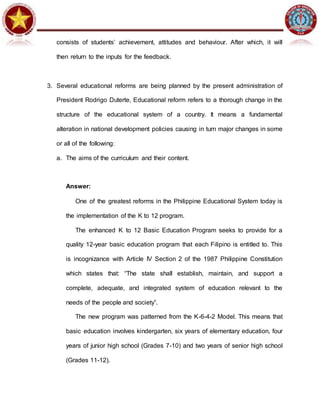
FLOW MODEL OF PRES. DIOSDADO MACAPAGAL HIGH SCHOOL
The flow model consists of the first frame of Inputs which include facilities,
characteristics of students (prior learning), and Teachers (past experience). The
second frame of Process include Teacher Style and Technique, Administrator’s
Style and Technique, and Program Operation. The third frame of Outputs
INPUTS
Facilities
Characteristics of
Students (Prior Learning)
Teachers (Past
Experience)
PROCESS
Teacher Style and
Technique
Administrator’s Style and
Technique
Program Operation
OUTPUTS
Student:
Achievement
Attitudes
Behavior
FEEDBACK
consists of students’ achievement, attitudes and behaviour. After which, it will
then return to the inputs for the feedback.
3. Several educational reforms are being planned by the present administration of
President Rodrigo Duterte, Educational reform refers to a thorough change in the
structure of the educational system of a country. It means a fundamental
alteration in national development policies causing in turn major changes in some
or all of the following:
a. The aims of the curriculum and their content.
Answer:
One of the greatest reforms in the Philippine Educational System today is
the implementation of the K to 12 program.
The enhanced K to 12 Basic Education Program seeks to provide for a
quality 12-year basic education program that each Filipino is entitled to. This
is incognizance with Article IV Section 2 of the 1987 Philippine Constitution
which states that: “The state shall establish, maintain, and support a
complete, adequate, and integrated system of education relevant to the
needs of the people and society”.
The new program was patterned from the K-6-4-2 Model. This means that
basic education involves kindergarten, six years of elementary education, four
years of junior high school (Grades 7-10) and two years of senior high school
(Grades 11-12).
Those who go through the 12-year program will get an elementary
diploma (6 years), a junior high school diploma (4 years) and a senior high
school diploma (2 years). A full 12 year of basic education will eventually be
required for entry into tertiary level education. Universal kindergarten was
offered starting school year 2011-2012. This school year, 2012-2013, the new
curriculum will be offered to incoming Grade I as well as to incoming junior
high school students (Grade 7 of High School year I).
The goals of the enhanced K to 12 Basic Education Program is to create a
functional basic education system that will produce productive and
responsible citizens equipped with the essential competencies and skills for
both life – long learning and employment. The program will enhance the basic
education system to full functionality to fulfil the basic learning needs of
students. In order to achieve these goals, the program has the following twin
– objectives:
1. To give every student an opportunity to receive quality education
based on an enhanced and decongested curriculum that is
internationally recognized and comparable;
2. To change public perception that high school education is just a
preparation for college; rather than, it should allow one to take
advantage of opportunities for gainful career or employment and/or
self-employment in a rapidly changing and increasingly globalized
environment.
The benefits of the K to 12 program far outweigh the additional costs that will
be incurred by both government and families.
To individual and families:
1. An enhanced curriculum will decongest academic workload, giving
students more time to master competencies and skills as well as time
for other learning opportunities beyond the classroom, thus allowing for
a more holistic development.
2. Graduate will possess competencies and skills relevant to the job
market. The program was designed to adjust and meet the fast
changing demands of society to prepare graduates with skills essential
for the world of work.
3. Graduates will be prepared for higher education. Due to an enhanced
curriculum that will provide relevant content and attuned with the
changing needs of time, basic education will ensure sufficient mastery
of core subjects to its graduates much that graduates may opt to
pursue higher education if they choose to.
4. Graduates will be able to earn higher wages and/or better prepared to
start their own business. There is a strong correlation between
educational attainment and wage structure and studies specific to the
Philippine setting show that an additional year of schooling increases
earnings by 7.5%. This should also allow greater access to higher
education for self-supporting students.
5. Graduates could now be recognized abroad, Filipino graduates eg.
Engineers, architects, doctors, etc., could now be recognized as
professionals in other countries. Those who intend to study abroad will
meet the entrance requirements of foreign schools.
For the Society and the Economy:
1. The economy will experience accelerated growth in the long run. The
objective of the K to 12 program is to improve quality basic education.
Several studies have shown that the improvements in the quality of
education will increase GDP growth by as much as 2%. Studies in the
UK, India and US show that additional years of schooling also have
positive overall impact on society.
2. The Philippine education system will be at par with international
standards. K to 12 will facilitate mutual recognition of Filipino graduates
and professionals following the Washington Accord and the Bologna
Accord.
o Washington Accord prescribes 12 years basic education as an
entry to recognition of engineering professionals.
o Bologna Accord requires 12 years of education for university
admission and practice of profession in European countries.
3. A better educated society provides a sound foundation for long-term
socio-economic development.
The enhanced K to 12 Basic Education System will contribute to the
development of emotionally and intellectually mature individuals capable of
pursuing productive employment and entrepreneurship or higher education
disciplines.
In the near future, the smooth transition from the existing 10-year
education cycle to the K to 12 basic education cycle will produce holistically
developed Filipino learners with 21st century skills, which they can use to
become productive and responsible citizens of the country.
b. The national allocation of resources to education.
Answer:
The Department of Budget and Management recently submitted President
Rodrigo Duterte's proposed P3.35-trillion 2017 national budget.
Among individual agencies the Department of Education received the
highest budget at $12.22 billion (P567.5 billion), a 31 per cent increase over
its budget this year of $9.34 billion (P433.3 billion). Included in the total is a
$60.37 million (P2.8 billion) allocation to the miscellaneous personnel benefits
(MPB) fund for the hiring of 53,831 new teachers, the construction of 47,000
classrooms, and to assist 2.7 million students who will be diverted to private
schools as part of the Philippines K-12 programme (See: Weighing The
Benefits of The Philippines K-12Programme).
c. The allocation of resources within the existing educational system to other
levels of the system.
Answer:
To ensure that the Department of Education budget is responsive to the
needs of basic education and is also reflective of the goals of the Duterte
administration, Dr. Leonor Magtolis Briones, DepEd Secretary, is leading the
preparation of the department’s budget for 2017.
Briones said that foremost in the objective is to ensure that resources are
converted and translated into actual goods and services. To do this,
processes and procedures must be efficient and that financing must be
prudent and economical. “At the end of the day, our goal is to provide our
public school system with sufficient teachers, school buildings, computer kits,
textbooks and school supplies,” she added.
While reconfiguring the DepEd budget, Briones noted that “a big chunk will
go to infrastructure” such as “building more learning centers and identify
areas that need ALS schools” and provision of “alternative learning methods
or modes especially in remote or far-flung areas.” The use of IT, she added,
will also be “very important.”
d. The percentage of students from different social strata or the percentage of
female students that complete different levels of the educational system.
Answer:
Percentage of female students that complete different levels of the
educational system
According to the Philippine Education for All 2015 Review Report, in 2011,
more female children aged 0 to 5 years old were availing themselves of day
care services. Among children aged 0-3 years old, 44.4 percent were males
and 55.4 percent were females; and among children aged 3 to 5 years old,
46.9 percent were male, 47.5 percent were females. Among children beyond
five years old, there were more male than female children provided with day
care services.
In SY 2012-2013, there were more females (96.3 percent in elementary
and 70 percent in secondary NER) than males (94.2 percent in elementary
and 59.9 percent in secondary) that had access to basic education. Moreover,
more females (78.2 percent elementary and 79.9 percent secondary) than
males (69.6 percent elementary and 69.8 percent secondary) completed their
basic education.
Females performed better than males in the National Achievement Test
(NAT). Females got a mean percentage score (MPS) of 70.6 for elementary
and 53.5 for secondary while MPS of males was 67.1 for elementary and 49.0
for secondary in SY 2012-2013.
On the other hand, more males were availing themselves of and
completing the ALS programs of DepEd. In 2013, there were 51.7 percent
male enrolees compared to 48.3 percent female enrolees in ALS. Among the
completers, 55.0 percent were males while only 45.0 percent were females.
In terms of technical-vocational (tech-voc) education at the secondary
level, females outnumbered males in three out of four programs (ICT, Arts
and Trade, and Fisheries).
In TESDA’s TVET, 52 percent of both total enrolees and total graudates
were females.
e. Giving top priority to Alternative Learning System.
Answer:
Briones also puts a premium on using the DepEd budget for strengthening
Alternative Learning System (ALS). “Bro. Luistro and I share the same dream
to reach those who are outside the formal school system. I would want more
resources to go to ALS kasi hindi maiiwasan na may maiiwan talaga,” she
said.
“We would like to put ALS at par with the regular reform programs of
DepEd such as SHS [because] we do not know how many Filipinos out there
don’t know how to read and write,” Briones said.
Briones said that the strengthened ALS under her term will aim to reach
“left learners” across the globe. “You don’t only have uneducated, unreached
children in the Philippines but also outside – especially those who are not
registered,” she explained. (www.mb.com.ph/deped)
4. What is the basic relationship between education and society and to what extent
can its effect be manipulated in the transformation of social, economic and
political system of our country?
Answer:
The extent, to which the schools have contributed to the growth and
development of society toward advancement, can be determined through the
individual student – knowledge he has acquired, skills, values, and attitudes
developed, are indicators which can signify observable changes and benefits for
the student himself, his family, or the society in general. The individual as
members of the society might have contributed to the society through his field of
specialization. His contribution will apparently indicate the functionality of the
school system to society. In the system approach, the changes of individuals as
individual or individuals as members of society would then become the variable
to be analysed. Similarly, the benefits accruing to the individuals and to society
are often termed the external productivity of an educational program.
For example, the following are some indicators which measure the
contribution of the school system to the economic system of society.
a. Distribution of labor force by occupation
b. Supply of output of graduates into the labor market.
c. Amount of on-the-job training given annually to the labor force by
occupation, formal education, and industry.
5. In what ways does an education population contribute to the socio-economic
development of the Philippines and also contribute to the well-being of individuals
within the society?
Answer:
Education is a basic factor in socio-economic development. It has become
one of the clearest indicators of life outcomes such as employment, income and
social status, and is a strong predictor of attitudes and wellbeing. In the case of
the Philippines the previous Poverty Assessment (World Bank 2001) showed
clearly that the educational attainment of the head of the household was “ the
single most important contributor to the observed variation in household welfare.”
The research project Identity, Socioeconomic Status and Wellbeing, which
is funded by the ESRC’s Secondary Data Analysis Initiative, has investigated the
psychological effect of differences in education.
This study is the first to compare the strength and stability of the
‘education effect’ on a wide range of outcomes over time.
The researchers analysed data from the British Social Attitudes Survey,
the British Household Panel Survey and the International Social Survey
Programme. Findings indicated a clear association between education and
wellbeing.
Key findings
 Higher levels of education are associated with a wide range of positive
outcomes - including better health and wellbeing, higher social trust, greater
political interest, lower political cynicism, and less hostile attitudes towards
immigrants.
 Level of education is the strongest predictor of outcomes (compared to age,
gender, income, employment status, and marital status) in all models, except
for the outcomes of wellbeing and health.
 This ‘education effect’ is both robust and relatively stable over time, with little
variation in the surveyed population across a range of 25 years. The effect is
particularly marked for the outcome of social trust, becoming stronger within
the same people as they age.
 Across all education levels – low or high – people who report that they are
satisfied with their education level and have incorporated education as part of
their identity are benefitting psychologically.
These information has been taken from The wellbeing effect of education
report published on the ESRC website.
6. Illustrate the ways by which the education of women and the indigenous people
(Ips) in the Philippines contribute to social development and a rise in the quality
of life of the Filipino people?
Answer:
Women’s Education
Women’s education increases the income of women and leads to growth
in GDP. Other effects are related to social development. Educating girls leads to
a number of social benefits, including many related to women’s empowerment.
According to Harry Patrinos, lead education economist at the World Bank, “the
profitability of education, according to estimates of private rate of return, is
indisputable, universal, and global”. The principle holds particularly for women,
who can expect a 1.2% higher return than men on the resources they invest in
education. Providing one extra year of education to girls increases their wages by
10-20%.
In addition to total economic growth, women’s education also increases
the equitability of the distribution of wealth in a society. Increased women’s
education is important for achieving this as it targets the impoverished women, a
particularly disadvantaged group. There is also evidence that lower gender
disparity in educational attainment for a developing country correlates with lower
overall income disparity within society.
Women's education leads to significant social development. Some of the
most notable social benefits include decreased fertility rates and lower infant
mortality rates, and lower maternal mortality rates. Closing the gender gap in
education also increases gender equality, which is considered important both in
itself and because it ensures equal rights and opportunities for people regardless
of gender. Women's education has cognitive benefits for women as well.
Improved cognitive abilities increase the quality of life for women and also lead to
other benefits. One example of this is the fact that educated women are better
able to make decisions related to health, both for themselves and their children.
Cognitive abilities also translate to increased political participation among
women. Educated women are more likely to engage in civic participation and
attend political meetings, and there are several instances in which educated
women in the developing world were able to secure benefits for themselves
through political movements. Evidence also points to an increased likelihood of
democratic governance in countries with well-educated women.
There are also benefits relating to the woman’s role in the household.
Educated women have been found to experience less domestic violence,
regardless of other social status indicators like employment status. Women with
an education are also more involved in the decision-making process of the family
and report making more decisions over a given time period. In particular, these
benefits extend to economic decisions. Besides the intrinsic value of increasing a
woman's agency, having women play a more active role in the family also brings
about social benefits for family members. In a household where the mother is
educated, children and especially girls are more likely to attend school. In
households where a mother is not educated, adult literacy programs can
indirectly help to teach mothers the value of education and encourage them to
send their children to school. There are also a number of other benefits for
children associated with having an educated mother over an educated father,
including higher survival rates and better nutrition.
Indigenous People (IP) and Education
In recognition of the right of indigenous peoples to culturally rooted and
responsive basic education, the Department of Education (DepEd) adopted the
Indigenous Peoples Education Curriculum Framework (DepEd Order No. 32, s.
2015) which aims to provide guidance to schools and other education programs
as they engage with indigenous communities in contextualizing the K to 12
Curriculum based on their respective educational and social contexts.
The development and implementation of IP education in consultation and
cooperation with IPs concerned in order to address and incorporate their special
needs, histories, identities, languages, knowledge, and other aspects of their
culture, as well as their social, economic, and cultural priorities and aspirations
will ensure the following:
a. Provision of universal and equitable access of all IPs to quality and
relevant basic education services towards functional literacy for all.
b. Adoption of appropriate basic education pedagogy, content, and
assessment through the integration of Indigenous Knowledge System
and Practices (IKSPs) in all learning areas and processes.
c. Provision of adequate and culturally-appropriate learning resources
and environment to IP learners.
d. Strengthening of hiring, deployment, and continuous development of
teachers and learning facilitators in the implementation of its IP
Education Program.
e. Strengthening and expansion of institutional and civil society linkages
to ensure proper coordination, knowledge-sharing, and sustainability of
the IP Education Program.
f. Implementation of stronger affirmative action to eradicate all forms of
discrimination against IPs in the entire Philippine educational system.
7. The K-12 is one of the 10-point education agenda of the former Aquino
administration. Are you in favour of the strategy to improve the educational
system of our country? Why or why not? Explain your position.
Answer:
I am in favour of the strategy to improve the educational system of our
country with the implementation of the K to 12 program in the basic education. To
prove that K to 12 scheme is more than just adding two more years to high
school, below are three of the many practical benefits of schooling under a 13-
year education cycle:
a. Preparedness for tertiary learning – With adaptation of K to 12
scheme, students are expected to graduate at age a bit older than past
graduates. This is an advantage, according to DepEd, as graduates
will be considered young adults. Hence, they will be more equipped to
deal with much higher level of learning as they enter college education.
b. Readiness to join the workforce – Unlike the old system, K to 12 does
not compel each student to take college after completing Senior High
School (SHS). In fact, this scheme empowers students to make a
choice on their own. They may not pursue college education especially
if they have chosen a track other than academic track. The good thing
is SHS graduates will be equipped with skills (through electives) that
will make them good at certain field(s).
c. Skill competency in the global market – K to 12 system aims to
improve Filipino students’ mathematical, scientific, and linguistic
competence. With the new curriculum, DepEd promised to offer higher
quality education through tracks. Each track will give students enough
time to master a field and enhance their skills. In the end, K to 12
graduates will become globally competitive and are set to obtain spot
in the stiff labor market.
8. Is education a great equalizer and an instrument for upward social mobility?
Answer:
I firmly believe that education is a great equalizer. It opens doors of
opportunity for all. It balances out differences between classes, race etc. It puts
people on an equal footing.
Education is also an instrument for upward social mobility. According to
Crossman, social mobility is the movement of individuals, families, or groups
through a system of social hierarchy or stratification. This is to say, it refers to the
movement of individuals or groups to social positions (i.e. occupation, profession,
family, hobby, etc.) over time.
Education is regarded as the primary channel of mobility as:
o High educational achievement is the aspirations of most people. At the
same time, it is a sufficient but not a necessary condition for upward
mobility.
o Few would question someone professional qualifications when he has
high academic qualification.
o Education is highly correlated with income and occupation. The higher the
educational level, the more prestigious the occupation, leading to higher
annual income.
This in turn is associated with property, prestige, social status and power.
Education can support the movement of persons into upper social strata.
Hence, formal training and higher education have become a necessary
foundation for many established professions such as doctors, lawyers,
accountants, teachers, engineers and so forth.
9. From Philip Coomb’s book “The World Educational Crises, A Systems Analysis”,
he recommended strategic educational development strategy (pp. 162-183) that
is firmly founded in a broad consensus which embraces diverse political, social
and educational interests and enjoys the authentic enthusiasm and loyalty of
numerous leaders of various nations to help solve the educational crises
confronting both the developed and developing nations. What are some of
Coombs’ recommended strategies?
Answer:
A. Modernization of educational management
To modernize management, these steps should be taken:
 Recruitment of managers and specialists should be concentrated mainly in
the ranks of teachers and professors. Educational management is best
served by those who have had teaching experience and who show talent
for administrative tasks. Good managers can sometimes be found in other
professions, but they must be carefully retrained for educational tasks.
 For the training of managerial talent, each country should have an
administrative staff college or its equivalent, able to offer both pre-service
and in-service programs. Universities in the developing as well as the
industrialized countries should examine ways in which they can help to
nurture this precious managerial talent.
 A central task of management is planning. UNESCO has attached a high
priority to this activity, and even wider use of the International Institute for
Educational Planning should be made.
 Management and planning take place through educational structures.
Good management must go hand in hand with structures designed to
perform the specialized tasks that education now faces. Structures must
always respond to functions; as the functions of education diversify in
response to changing needs, structures must be kept flexible to receive
new curricular changes, new levels of education, and pressing specialized
tasks in agriculture, science, or technology.
 The university, as the capstone of the educational system, must be
particularly responsive to the needs of the whole system. But it cannot
innovate if it is too closely controlled by the central ministry; it cannot be
useful if it is not prepared to turn out the highly trained manpower that the
society so badly needs; and it cannot modernize itself without strong
administrative direction.
B. Modernization of Teachers
 The recruitment of good teachers is a top priority on the education lists
of all countries. The best teachers should receive salaries equal to
those of the best paid professionals in the country.
But to justify these salaries, good teachers must operate at the
highest level of productivity. This means that for a good teacher old
notions of a fixed student-teacher ratio must be changed and that new
criteria for salary levels will have to be established, based on performance
and productivity rather than tenure.
Good teachers should be expected to play an important role
outside the classroom. They must become a major force for social
development, participating in important efforts to improve the communities
in which they work. Both the teachers and the classroom must become an
integral part of the social process that is transforming their society. This
mission cannot be ignored in either the industrialized or the developing
nations.
 The proper preparation of teachers who are operating at new
professional levels will require a new definition of institutions for
teacher training. These institutions must be deeply involved in research
and experimentation and be themselves influential centers of
innovation. They must be prepared to disseminate the tested results of
research and to encourage their practical application.
 Obviously, this new style of teacher is one whose high level of
productivity will in most cases require the use of new technology.
Programmed instruction, team teaching, film, radio, and television will
be increasingly the tools of the trade. Technology must never become
the master of the teacher, but this can only be assured if the teacher
takes a positive attitude toward using technology for his own needs.
C. Modernization of the Learning Process
 The curriculum must contain subject matter that can be used by the
student in the life he faces when he graduates. In a predominantly
agricultural economy, it is obviously important that the student be
exposed to a curriculum that will prepare him for his most probable
future vocation. If the educational system is content to give him a
traditional classical education, it will only prepare him for the ranks of
the unemployed. On an urban society it is equally important that the
student have some exposure to problems of the industrial world,
because he will be immersed in it soon enough. In all societies as the
mature, the needs for special training increase, and the standard
classical curriculum has to be modified to include more specialized
programs.
 Content and technique are two closely related matters; each affects
the other. New techniques are bound to be introduced as the new tools
of technology become available to the educational process.
Demonstration schools should be considered a means of making
visible the ways in which the new technology can be applied in a
complete school system. Special training programs for those who will
operate at the interface between curriculum and technology will be
needed.
 These developments highlight the importance of research in the whole
spectrum of requirements. Education can no longer afford the luxury of
being one of the last of the handicraft industries. But the price of
successful innovation will be increased research. It has been said that
education is the only enterprise that throws away its own experience.
This experience must be examined and made available on an
international basis so that those successful in breaking open old
bottlenecks can put their experience to the use of others.
D. Strengthening of Educational Finance
 A large increase in resources for education.
 Private sources of funds for the direct support of education should be
largely tapped. Tax laws must be re-examined to encourage the flow of
private funds for educational purposes. Employer taxes might be levied
to support technical training and youth programs; educational fees
might be used as a transitional measure, coupled with scholarships for
the needy. Such sources are important not only for the additional funds
but for the balance that private support can provide to offset too much
control by the state.
 Resources that are already available must be used wisely and
effectively. Much can be done with limited funds and unlimited
imagination. Starter funds from central governments can provide
incentives to produce new schools. Energy and expertise now locked
up in homes, factories, and perhaps even jails could be applied to
educational needs at relatively little cost. A multiplicity of small
institutions might be consolidated into a few good institutions at
substantial savings. Technology must be made available that can
alleviate the necessity of reproducing expensive libraries and perhaps
even laboratories.
E. International Cooperation
 The parties rendering and receiving such assistance must jointly
formulate a careful strategy and set of priorities for the use of such
assistance.
 There must be a system for regular evaluation of the various projects
that entail the use of external aid in order to arrive at guidelines for the
future.
 Assistance from numerous sources must be better harmonized.
The recipient country must have a well-conceived plan of educational
development.

System Analysis in Education

  • 1.
    Polytechnic University ofthe Philippines Graduate Studies - College of Education Sta. Mesa, Manila FINAL EXAMINATION A Take Home Exam Submitted to DR. NILO L. ROSAS Faculty Member of Polytechnic University of the Philippines Graduate Studies - College of Education Sta. Mesa, Manila In Partial fulfilment of the Requirements for the Subject Systems Analysis Applied to Education (DEM 734) KATHLEEN C. ABAJA DEM Student
  • 2.
    Directions: Please answereach question in not more than two hundred words. Cite authorities. 1. In what ways can Systems Analysis be applied to the study or investigation of education? Give illustration or examples of how it can be used to analyze education as a social system, a cultural system, an economic system, and a political system. Answer: Systems Analysis applied to Education aims to establish and maintain complete, adequate, and integrated system of education relevant to the goals of educational development. In essence, relevant, adequate, complete, and functional could refer to the contribution of the school system to the social, cultural, economic, political, and technological subsystems of the society, the society influences the school in return in the same aspects. To determine the contribution of the school system to the various systems of society, we have to identify the needs of the society that the school is supposed to satisfy. These needs are: social, cultural, economic, political and technological. In the social aspect, the school must consider the socio-economic mobility of the graduates, that is, they would be able to move to a higher status, learn from the social problems in the community, and minimize social and discriminating social stratifications in the community.
  • 3.
    In the culturalaspect, national security, national identity, solidarity, Filipinism, have to be strengthened in the school curriculum. In the economic realm, the manpower needs of the community must be determined in relation to curriculum offerings. There ought to be a linkage between the schools, and business, and industry in order to ensure the employability of the graduates. Briefly, there should be a balance between the quantity of educational output and the market demand for labor. In the political arena, the school must develop among the students and the community, a critical, logical, analytic, and rational mind, especially in the choice of leaders in the local, regional, and national levels. Political consciousness and awareness must be developed among the students in appropriate subject areas. In the technological aspect, the advances in science and technology call for curriculum enrichment, revision, and modification and re-training of teachers in these areas. 2. Describe/Analyze the Flow Model of the School System in Rev. Paul P. Zwaenepoel’s “Education Systems Analysis” or Philip H. Coomb’s “The World Educational Crisis”, Using this model, do an analysis of your own school college/university using the input, process, output and feedback interaction.
  • 4.
    Answer: THE FLOW MODELOF THE SCHOOL SYSTEM IN PHILIP H. COOMB’S “THE WORLD EDUCATIONAL CRISIS” Coombs used Systems Analysis to examine the world crisis in education. His work was done at macro level, and the systems analysis that he used does not entail the mathematical expression and measurement of all that is involved. Rather, he used the functions of the school system as a wide-angled lens trained on an organism (the school system), so that is can be seen in its entirety, including the relationships among its past, and between the organism of the school system and its environment (the society). His concept model is the ‘input- output’ model in which he defined aims, students, faculty, and finances as input of society into the school system producing the outputs (the educated individuals) which flow back into society. These outputs have to satisfy society in order to maintain the school system, since the school system receives support from society. The outputs or outcomes of the school system on society can also be
  • 5.
    regarded as thefunctionality of the school system with reference to society. The evaluation of outputs is very necessary and will be useful as feedback to the school system which takes the feedback into consideration for adjusting the school system. Educational systems analysis is a method of examining an educational system, not by piecemeal wherever element or subsystem stands alone, but as a system – a system with interacting parts that produce their own indicators so as to know whether the interaction is balanced. FLOW MODEL OF PRES. DIOSDADO MACAPAGAL HIGH SCHOOL The flow model consists of the first frame of Inputs which include facilities, characteristics of students (prior learning), and Teachers (past experience). The second frame of Process include Teacher Style and Technique, Administrator’s Style and Technique, and Program Operation. The third frame of Outputs INPUTS Facilities Characteristics of Students (Prior Learning) Teachers (Past Experience) PROCESS Teacher Style and Technique Administrator’s Style and Technique Program Operation OUTPUTS Student: Achievement Attitudes Behavior FEEDBACK
  • 6.
    consists of students’achievement, attitudes and behaviour. After which, it will then return to the inputs for the feedback. 3. Several educational reforms are being planned by the present administration of President Rodrigo Duterte, Educational reform refers to a thorough change in the structure of the educational system of a country. It means a fundamental alteration in national development policies causing in turn major changes in some or all of the following: a. The aims of the curriculum and their content. Answer: One of the greatest reforms in the Philippine Educational System today is the implementation of the K to 12 program. The enhanced K to 12 Basic Education Program seeks to provide for a quality 12-year basic education program that each Filipino is entitled to. This is incognizance with Article IV Section 2 of the 1987 Philippine Constitution which states that: “The state shall establish, maintain, and support a complete, adequate, and integrated system of education relevant to the needs of the people and society”. The new program was patterned from the K-6-4-2 Model. This means that basic education involves kindergarten, six years of elementary education, four years of junior high school (Grades 7-10) and two years of senior high school (Grades 11-12).
  • 7.
    Those who gothrough the 12-year program will get an elementary diploma (6 years), a junior high school diploma (4 years) and a senior high school diploma (2 years). A full 12 year of basic education will eventually be required for entry into tertiary level education. Universal kindergarten was offered starting school year 2011-2012. This school year, 2012-2013, the new curriculum will be offered to incoming Grade I as well as to incoming junior high school students (Grade 7 of High School year I). The goals of the enhanced K to 12 Basic Education Program is to create a functional basic education system that will produce productive and responsible citizens equipped with the essential competencies and skills for both life – long learning and employment. The program will enhance the basic education system to full functionality to fulfil the basic learning needs of students. In order to achieve these goals, the program has the following twin – objectives: 1. To give every student an opportunity to receive quality education based on an enhanced and decongested curriculum that is internationally recognized and comparable; 2. To change public perception that high school education is just a preparation for college; rather than, it should allow one to take advantage of opportunities for gainful career or employment and/or self-employment in a rapidly changing and increasingly globalized environment.
  • 8.
    The benefits ofthe K to 12 program far outweigh the additional costs that will be incurred by both government and families. To individual and families: 1. An enhanced curriculum will decongest academic workload, giving students more time to master competencies and skills as well as time for other learning opportunities beyond the classroom, thus allowing for a more holistic development. 2. Graduate will possess competencies and skills relevant to the job market. The program was designed to adjust and meet the fast changing demands of society to prepare graduates with skills essential for the world of work. 3. Graduates will be prepared for higher education. Due to an enhanced curriculum that will provide relevant content and attuned with the changing needs of time, basic education will ensure sufficient mastery of core subjects to its graduates much that graduates may opt to pursue higher education if they choose to. 4. Graduates will be able to earn higher wages and/or better prepared to start their own business. There is a strong correlation between educational attainment and wage structure and studies specific to the Philippine setting show that an additional year of schooling increases earnings by 7.5%. This should also allow greater access to higher education for self-supporting students.
  • 9.
    5. Graduates couldnow be recognized abroad, Filipino graduates eg. Engineers, architects, doctors, etc., could now be recognized as professionals in other countries. Those who intend to study abroad will meet the entrance requirements of foreign schools. For the Society and the Economy: 1. The economy will experience accelerated growth in the long run. The objective of the K to 12 program is to improve quality basic education. Several studies have shown that the improvements in the quality of education will increase GDP growth by as much as 2%. Studies in the UK, India and US show that additional years of schooling also have positive overall impact on society. 2. The Philippine education system will be at par with international standards. K to 12 will facilitate mutual recognition of Filipino graduates and professionals following the Washington Accord and the Bologna Accord. o Washington Accord prescribes 12 years basic education as an entry to recognition of engineering professionals. o Bologna Accord requires 12 years of education for university admission and practice of profession in European countries. 3. A better educated society provides a sound foundation for long-term socio-economic development.
  • 10.
    The enhanced Kto 12 Basic Education System will contribute to the development of emotionally and intellectually mature individuals capable of pursuing productive employment and entrepreneurship or higher education disciplines. In the near future, the smooth transition from the existing 10-year education cycle to the K to 12 basic education cycle will produce holistically developed Filipino learners with 21st century skills, which they can use to become productive and responsible citizens of the country. b. The national allocation of resources to education. Answer: The Department of Budget and Management recently submitted President Rodrigo Duterte's proposed P3.35-trillion 2017 national budget.
  • 11.
    Among individual agenciesthe Department of Education received the highest budget at $12.22 billion (P567.5 billion), a 31 per cent increase over its budget this year of $9.34 billion (P433.3 billion). Included in the total is a $60.37 million (P2.8 billion) allocation to the miscellaneous personnel benefits (MPB) fund for the hiring of 53,831 new teachers, the construction of 47,000 classrooms, and to assist 2.7 million students who will be diverted to private schools as part of the Philippines K-12 programme (See: Weighing The Benefits of The Philippines K-12Programme). c. The allocation of resources within the existing educational system to other levels of the system. Answer: To ensure that the Department of Education budget is responsive to the needs of basic education and is also reflective of the goals of the Duterte administration, Dr. Leonor Magtolis Briones, DepEd Secretary, is leading the preparation of the department’s budget for 2017. Briones said that foremost in the objective is to ensure that resources are converted and translated into actual goods and services. To do this, processes and procedures must be efficient and that financing must be prudent and economical. “At the end of the day, our goal is to provide our public school system with sufficient teachers, school buildings, computer kits, textbooks and school supplies,” she added.
  • 12.
    While reconfiguring theDepEd budget, Briones noted that “a big chunk will go to infrastructure” such as “building more learning centers and identify areas that need ALS schools” and provision of “alternative learning methods or modes especially in remote or far-flung areas.” The use of IT, she added, will also be “very important.” d. The percentage of students from different social strata or the percentage of female students that complete different levels of the educational system. Answer: Percentage of female students that complete different levels of the educational system According to the Philippine Education for All 2015 Review Report, in 2011, more female children aged 0 to 5 years old were availing themselves of day care services. Among children aged 0-3 years old, 44.4 percent were males and 55.4 percent were females; and among children aged 3 to 5 years old, 46.9 percent were male, 47.5 percent were females. Among children beyond five years old, there were more male than female children provided with day care services. In SY 2012-2013, there were more females (96.3 percent in elementary and 70 percent in secondary NER) than males (94.2 percent in elementary and 59.9 percent in secondary) that had access to basic education. Moreover, more females (78.2 percent elementary and 79.9 percent secondary) than
  • 13.
    males (69.6 percentelementary and 69.8 percent secondary) completed their basic education. Females performed better than males in the National Achievement Test (NAT). Females got a mean percentage score (MPS) of 70.6 for elementary and 53.5 for secondary while MPS of males was 67.1 for elementary and 49.0 for secondary in SY 2012-2013. On the other hand, more males were availing themselves of and completing the ALS programs of DepEd. In 2013, there were 51.7 percent male enrolees compared to 48.3 percent female enrolees in ALS. Among the completers, 55.0 percent were males while only 45.0 percent were females. In terms of technical-vocational (tech-voc) education at the secondary level, females outnumbered males in three out of four programs (ICT, Arts and Trade, and Fisheries). In TESDA’s TVET, 52 percent of both total enrolees and total graudates were females. e. Giving top priority to Alternative Learning System. Answer: Briones also puts a premium on using the DepEd budget for strengthening Alternative Learning System (ALS). “Bro. Luistro and I share the same dream to reach those who are outside the formal school system. I would want more
  • 14.
    resources to goto ALS kasi hindi maiiwasan na may maiiwan talaga,” she said. “We would like to put ALS at par with the regular reform programs of DepEd such as SHS [because] we do not know how many Filipinos out there don’t know how to read and write,” Briones said. Briones said that the strengthened ALS under her term will aim to reach “left learners” across the globe. “You don’t only have uneducated, unreached children in the Philippines but also outside – especially those who are not registered,” she explained. (www.mb.com.ph/deped) 4. What is the basic relationship between education and society and to what extent can its effect be manipulated in the transformation of social, economic and political system of our country? Answer: The extent, to which the schools have contributed to the growth and development of society toward advancement, can be determined through the individual student – knowledge he has acquired, skills, values, and attitudes developed, are indicators which can signify observable changes and benefits for the student himself, his family, or the society in general. The individual as members of the society might have contributed to the society through his field of specialization. His contribution will apparently indicate the functionality of the school system to society. In the system approach, the changes of individuals as
  • 15.
    individual or individualsas members of society would then become the variable to be analysed. Similarly, the benefits accruing to the individuals and to society are often termed the external productivity of an educational program. For example, the following are some indicators which measure the contribution of the school system to the economic system of society. a. Distribution of labor force by occupation b. Supply of output of graduates into the labor market. c. Amount of on-the-job training given annually to the labor force by occupation, formal education, and industry. 5. In what ways does an education population contribute to the socio-economic development of the Philippines and also contribute to the well-being of individuals within the society? Answer: Education is a basic factor in socio-economic development. It has become one of the clearest indicators of life outcomes such as employment, income and social status, and is a strong predictor of attitudes and wellbeing. In the case of the Philippines the previous Poverty Assessment (World Bank 2001) showed clearly that the educational attainment of the head of the household was “ the single most important contributor to the observed variation in household welfare.”
  • 16.
    The research projectIdentity, Socioeconomic Status and Wellbeing, which is funded by the ESRC’s Secondary Data Analysis Initiative, has investigated the psychological effect of differences in education. This study is the first to compare the strength and stability of the ‘education effect’ on a wide range of outcomes over time. The researchers analysed data from the British Social Attitudes Survey, the British Household Panel Survey and the International Social Survey Programme. Findings indicated a clear association between education and wellbeing. Key findings  Higher levels of education are associated with a wide range of positive outcomes - including better health and wellbeing, higher social trust, greater political interest, lower political cynicism, and less hostile attitudes towards immigrants.  Level of education is the strongest predictor of outcomes (compared to age, gender, income, employment status, and marital status) in all models, except for the outcomes of wellbeing and health.  This ‘education effect’ is both robust and relatively stable over time, with little variation in the surveyed population across a range of 25 years. The effect is particularly marked for the outcome of social trust, becoming stronger within the same people as they age.
  • 17.
     Across alleducation levels – low or high – people who report that they are satisfied with their education level and have incorporated education as part of their identity are benefitting psychologically. These information has been taken from The wellbeing effect of education report published on the ESRC website. 6. Illustrate the ways by which the education of women and the indigenous people (Ips) in the Philippines contribute to social development and a rise in the quality of life of the Filipino people? Answer: Women’s Education Women’s education increases the income of women and leads to growth in GDP. Other effects are related to social development. Educating girls leads to a number of social benefits, including many related to women’s empowerment. According to Harry Patrinos, lead education economist at the World Bank, “the profitability of education, according to estimates of private rate of return, is indisputable, universal, and global”. The principle holds particularly for women, who can expect a 1.2% higher return than men on the resources they invest in education. Providing one extra year of education to girls increases their wages by 10-20%. In addition to total economic growth, women’s education also increases the equitability of the distribution of wealth in a society. Increased women’s
  • 18.
    education is importantfor achieving this as it targets the impoverished women, a particularly disadvantaged group. There is also evidence that lower gender disparity in educational attainment for a developing country correlates with lower overall income disparity within society. Women's education leads to significant social development. Some of the most notable social benefits include decreased fertility rates and lower infant mortality rates, and lower maternal mortality rates. Closing the gender gap in education also increases gender equality, which is considered important both in itself and because it ensures equal rights and opportunities for people regardless of gender. Women's education has cognitive benefits for women as well. Improved cognitive abilities increase the quality of life for women and also lead to other benefits. One example of this is the fact that educated women are better able to make decisions related to health, both for themselves and their children. Cognitive abilities also translate to increased political participation among women. Educated women are more likely to engage in civic participation and attend political meetings, and there are several instances in which educated women in the developing world were able to secure benefits for themselves through political movements. Evidence also points to an increased likelihood of democratic governance in countries with well-educated women. There are also benefits relating to the woman’s role in the household. Educated women have been found to experience less domestic violence, regardless of other social status indicators like employment status. Women with an education are also more involved in the decision-making process of the family
  • 19.
    and report makingmore decisions over a given time period. In particular, these benefits extend to economic decisions. Besides the intrinsic value of increasing a woman's agency, having women play a more active role in the family also brings about social benefits for family members. In a household where the mother is educated, children and especially girls are more likely to attend school. In households where a mother is not educated, adult literacy programs can indirectly help to teach mothers the value of education and encourage them to send their children to school. There are also a number of other benefits for children associated with having an educated mother over an educated father, including higher survival rates and better nutrition. Indigenous People (IP) and Education In recognition of the right of indigenous peoples to culturally rooted and responsive basic education, the Department of Education (DepEd) adopted the Indigenous Peoples Education Curriculum Framework (DepEd Order No. 32, s. 2015) which aims to provide guidance to schools and other education programs as they engage with indigenous communities in contextualizing the K to 12 Curriculum based on their respective educational and social contexts. The development and implementation of IP education in consultation and cooperation with IPs concerned in order to address and incorporate their special needs, histories, identities, languages, knowledge, and other aspects of their culture, as well as their social, economic, and cultural priorities and aspirations will ensure the following:
  • 20.
    a. Provision ofuniversal and equitable access of all IPs to quality and relevant basic education services towards functional literacy for all. b. Adoption of appropriate basic education pedagogy, content, and assessment through the integration of Indigenous Knowledge System and Practices (IKSPs) in all learning areas and processes. c. Provision of adequate and culturally-appropriate learning resources and environment to IP learners. d. Strengthening of hiring, deployment, and continuous development of teachers and learning facilitators in the implementation of its IP Education Program. e. Strengthening and expansion of institutional and civil society linkages to ensure proper coordination, knowledge-sharing, and sustainability of the IP Education Program. f. Implementation of stronger affirmative action to eradicate all forms of discrimination against IPs in the entire Philippine educational system. 7. The K-12 is one of the 10-point education agenda of the former Aquino administration. Are you in favour of the strategy to improve the educational system of our country? Why or why not? Explain your position. Answer: I am in favour of the strategy to improve the educational system of our country with the implementation of the K to 12 program in the basic education. To
  • 21.
    prove that Kto 12 scheme is more than just adding two more years to high school, below are three of the many practical benefits of schooling under a 13- year education cycle: a. Preparedness for tertiary learning – With adaptation of K to 12 scheme, students are expected to graduate at age a bit older than past graduates. This is an advantage, according to DepEd, as graduates will be considered young adults. Hence, they will be more equipped to deal with much higher level of learning as they enter college education. b. Readiness to join the workforce – Unlike the old system, K to 12 does not compel each student to take college after completing Senior High School (SHS). In fact, this scheme empowers students to make a choice on their own. They may not pursue college education especially if they have chosen a track other than academic track. The good thing is SHS graduates will be equipped with skills (through electives) that will make them good at certain field(s). c. Skill competency in the global market – K to 12 system aims to improve Filipino students’ mathematical, scientific, and linguistic competence. With the new curriculum, DepEd promised to offer higher quality education through tracks. Each track will give students enough time to master a field and enhance their skills. In the end, K to 12 graduates will become globally competitive and are set to obtain spot in the stiff labor market.
  • 22.
    8. Is educationa great equalizer and an instrument for upward social mobility? Answer: I firmly believe that education is a great equalizer. It opens doors of opportunity for all. It balances out differences between classes, race etc. It puts people on an equal footing. Education is also an instrument for upward social mobility. According to Crossman, social mobility is the movement of individuals, families, or groups through a system of social hierarchy or stratification. This is to say, it refers to the movement of individuals or groups to social positions (i.e. occupation, profession, family, hobby, etc.) over time. Education is regarded as the primary channel of mobility as: o High educational achievement is the aspirations of most people. At the same time, it is a sufficient but not a necessary condition for upward mobility. o Few would question someone professional qualifications when he has high academic qualification. o Education is highly correlated with income and occupation. The higher the educational level, the more prestigious the occupation, leading to higher annual income. This in turn is associated with property, prestige, social status and power. Education can support the movement of persons into upper social strata.
  • 23.
    Hence, formal trainingand higher education have become a necessary foundation for many established professions such as doctors, lawyers, accountants, teachers, engineers and so forth. 9. From Philip Coomb’s book “The World Educational Crises, A Systems Analysis”, he recommended strategic educational development strategy (pp. 162-183) that is firmly founded in a broad consensus which embraces diverse political, social and educational interests and enjoys the authentic enthusiasm and loyalty of numerous leaders of various nations to help solve the educational crises confronting both the developed and developing nations. What are some of Coombs’ recommended strategies? Answer: A. Modernization of educational management To modernize management, these steps should be taken:  Recruitment of managers and specialists should be concentrated mainly in the ranks of teachers and professors. Educational management is best served by those who have had teaching experience and who show talent for administrative tasks. Good managers can sometimes be found in other professions, but they must be carefully retrained for educational tasks.  For the training of managerial talent, each country should have an administrative staff college or its equivalent, able to offer both pre-service and in-service programs. Universities in the developing as well as the
  • 24.
    industrialized countries shouldexamine ways in which they can help to nurture this precious managerial talent.  A central task of management is planning. UNESCO has attached a high priority to this activity, and even wider use of the International Institute for Educational Planning should be made.  Management and planning take place through educational structures. Good management must go hand in hand with structures designed to perform the specialized tasks that education now faces. Structures must always respond to functions; as the functions of education diversify in response to changing needs, structures must be kept flexible to receive new curricular changes, new levels of education, and pressing specialized tasks in agriculture, science, or technology.  The university, as the capstone of the educational system, must be particularly responsive to the needs of the whole system. But it cannot innovate if it is too closely controlled by the central ministry; it cannot be useful if it is not prepared to turn out the highly trained manpower that the society so badly needs; and it cannot modernize itself without strong administrative direction. B. Modernization of Teachers  The recruitment of good teachers is a top priority on the education lists of all countries. The best teachers should receive salaries equal to those of the best paid professionals in the country.
  • 25.
    But to justifythese salaries, good teachers must operate at the highest level of productivity. This means that for a good teacher old notions of a fixed student-teacher ratio must be changed and that new criteria for salary levels will have to be established, based on performance and productivity rather than tenure. Good teachers should be expected to play an important role outside the classroom. They must become a major force for social development, participating in important efforts to improve the communities in which they work. Both the teachers and the classroom must become an integral part of the social process that is transforming their society. This mission cannot be ignored in either the industrialized or the developing nations.  The proper preparation of teachers who are operating at new professional levels will require a new definition of institutions for teacher training. These institutions must be deeply involved in research and experimentation and be themselves influential centers of innovation. They must be prepared to disseminate the tested results of research and to encourage their practical application.  Obviously, this new style of teacher is one whose high level of productivity will in most cases require the use of new technology. Programmed instruction, team teaching, film, radio, and television will be increasingly the tools of the trade. Technology must never become
  • 26.
    the master ofthe teacher, but this can only be assured if the teacher takes a positive attitude toward using technology for his own needs. C. Modernization of the Learning Process  The curriculum must contain subject matter that can be used by the student in the life he faces when he graduates. In a predominantly agricultural economy, it is obviously important that the student be exposed to a curriculum that will prepare him for his most probable future vocation. If the educational system is content to give him a traditional classical education, it will only prepare him for the ranks of the unemployed. On an urban society it is equally important that the student have some exposure to problems of the industrial world, because he will be immersed in it soon enough. In all societies as the mature, the needs for special training increase, and the standard classical curriculum has to be modified to include more specialized programs.  Content and technique are two closely related matters; each affects the other. New techniques are bound to be introduced as the new tools of technology become available to the educational process. Demonstration schools should be considered a means of making visible the ways in which the new technology can be applied in a complete school system. Special training programs for those who will
  • 27.
    operate at theinterface between curriculum and technology will be needed.  These developments highlight the importance of research in the whole spectrum of requirements. Education can no longer afford the luxury of being one of the last of the handicraft industries. But the price of successful innovation will be increased research. It has been said that education is the only enterprise that throws away its own experience. This experience must be examined and made available on an international basis so that those successful in breaking open old bottlenecks can put their experience to the use of others. D. Strengthening of Educational Finance  A large increase in resources for education.  Private sources of funds for the direct support of education should be largely tapped. Tax laws must be re-examined to encourage the flow of private funds for educational purposes. Employer taxes might be levied to support technical training and youth programs; educational fees might be used as a transitional measure, coupled with scholarships for the needy. Such sources are important not only for the additional funds but for the balance that private support can provide to offset too much control by the state.  Resources that are already available must be used wisely and effectively. Much can be done with limited funds and unlimited imagination. Starter funds from central governments can provide
  • 28.
    incentives to producenew schools. Energy and expertise now locked up in homes, factories, and perhaps even jails could be applied to educational needs at relatively little cost. A multiplicity of small institutions might be consolidated into a few good institutions at substantial savings. Technology must be made available that can alleviate the necessity of reproducing expensive libraries and perhaps even laboratories. E. International Cooperation  The parties rendering and receiving such assistance must jointly formulate a careful strategy and set of priorities for the use of such assistance.  There must be a system for regular evaluation of the various projects that entail the use of external aid in order to arrive at guidelines for the future.  Assistance from numerous sources must be better harmonized. The recipient country must have a well-conceived plan of educational development.