K-12 Basic Education
Program
Department
of Education
Chronic underachievement of students
Insufficient mastery of basic
competencies
due to congested curriculum
High school graduates (<16 year-old
graduates lack basic competencies
and maturity)
Other countries view the 10 – year
education cycle as insufficient
The Philippines is the only remaining
country in Asia with a 10 – year basic
education program
K-12 Basic Education
Program
Historical Background
• K+12 is not NEW…
• studies have been made since
1925
• need to be more competitive
• lack of political will
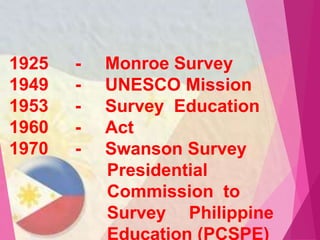
1925 -
1949 -
1953 -
1960 -
1970 -
Monroe Survey
UNESCO Mission
Survey Education
Act
Swanson Survey
Presidential
Commission to
Survey Philippine
Education (PCSPE)
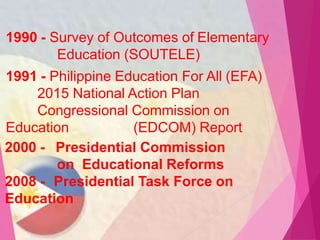
1990 - Survey of Outcomes of Elementary
Education (SOUTELE)
1991 - Philippine Education For All (EFA)
2015 National Action Plan
Congressional Commission on
Education (EDCOM) Report
2000 - Presidential Commission
on Educational Reforms
2008 - Presidential Task Force on
Education
OVERALL GOAL:
FUNCTIONAL LITERACY
FOR
ALL FILIPINOS
DepED IS GLOBALLY
RECOGNIZED FOR THE
DEVELOPMENT OF
FUNCTIONALLY LITERATE AND
GOD- LOVING FILIPINOS WHO
HELP ATTAIN THE NATIONAL
GOALS OF SOCIAL JUSTICE,
UNITY, FREEDOM AND
PROSPERITY
DepEd’s VISION
VISION
•grounded on human
development
•achieved through an
enhanced curriculum
•with socio-economic
relevance
PROVIDE QUALITY BASIC
EDUCATION THAT IS EQUITABLY
ACCESSIBLE TO ALL AND LAY
THE FOUNDATION FOR
LIFELONG LEARNING AND SELF-
ACTULIZATION NEEDED FOR
EFFECTIVE CITIZENSHIP AT THE
LOCAL, NATIONAL AND
GLOBAL MILIEU
DepEd’s MISSION
SUB-GOALS
•To give every learner an
opportunity to receive
quality education based
on an enhanced and
decongested curriculum
that is internationally
recognized and
comparable.
• To change public perception that
high school education is just a
preparation for college
Rather, it should allow one to take
advantage of opportunities for gainful
career or employment and/or self-
employment in a rapidly changing and
increasing globalized environment.
RATIONALE
1.Enhancing the quality of basic
education in the Philippines is
urgent and critical
2.The poor quality of basic
education is reflected in the low
achievement scores of Filipino
students.
3. The congested curriculum partly
explains the present state of education
4. This quality of education is reflected in the
inadequate preparation of high school
graduates for the world of work or
entrepreneurship or higher education
5. Further, most graduates are too young to
enter the labor force.
6.The current system also reinforces the
misperception that basic education is just a
preparation for higher education.
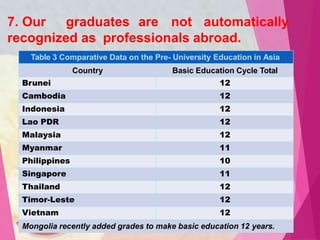
7. Our graduates are not automatically
recognized as professionals abroad.
Table 3 Comparative Data on the Pre- University Education in Asia
Country Basic Education Cycle Total
Brunei 12
Cambodia 12
Indonesia 12
Lao PDR 12
Malaysia 12
Myanmar 11
Philippines 10
Singapore 11
Thailand 12
Timor-Leste 12
Vietnam 12
Mongolia recently added grades to make basic education 12 years.
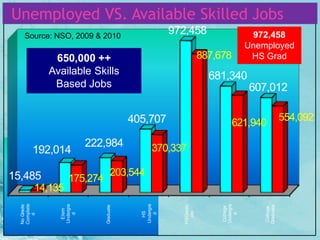
No
Grade
Complete
d
Elem
Undergra
d
Graduate
HS
Undergra
d
HSGradu
ate
College
Undergra
d
College
Graduate
192,014
222,984
405,707
972,458
681,340
607,012
15,485
14,135
175,274
203,544
370,337
887,678
621,940
554,092
972,458
Unemployed
HS Grad
650,000 ++
Available Skills
Based Jobs
Source: NSO, 2009 & 2010
Unemployed VS. Available Skilled Jobs
8.More importantly, the short basic
education program affects the
human development of the Filipino
children.
9.Cognizant of this urgent and
critical concern and in line with the
priorities of the Aquino
Administration, the Department of
Education is taking bold steps to
enhanced the basic education
curriculum.
10. K-12 means
Kindergarten and the
12 years of elementary
and secondary
education.
BENEFITS OF ENHANCED
BASIC EDUCATION PROGRAM
1.The Enhanced K-12 Basic
Education Program will be
instrumental in achieving the
nation’s vision of high school
graduates. The benefits of
the
K-12 proposal far outweigh the
additional costs that will be
incurred by both government
and families.
2. An enhanced curriculum
will decongest academic
workload.
To Individuals and Families
4. Graduates will be prepared for
higher education.
5. Graduates could now be
recognized abroad.
3. Graduates will possess
competencies and skills
relevant to the job market.
6. The economy will experience
accelerated growth in the long run.
7.The Philippine education system
will be at par with international
standards.
8.A better educated society provides
a sound foundation for long-term
socio-economic development.
For the Society and the Economy
WHY ADD TWO YEARS?
Decongest and
enhance the basic
education curriculum
Better quality
education for all
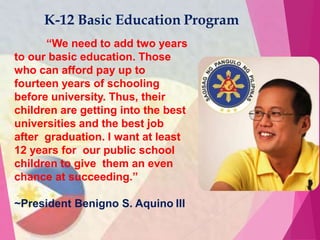
“We need to add two years
to our basic education. Those
who can afford pay up to
fourteen years of schooling
before university. Thus, their
children are getting into the best
universities and the best job
after graduation. I want at least
12 years for our public school
children to give them an even
chance at succeeding.”
~President Benigno S. Aquino III
K-12 Basic Education Program
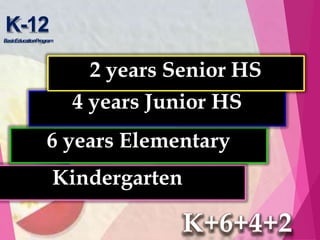
K-12
BasicEducationProgram
2 years Senior HS
4 years Junior HS
6 years Elementary
Kindergarten
K+6+4+2
What will each graduate get?
K-12
BasicEducationProgram
Grade VI
Junior HS
Senior HS
Batang K-12, HandasaTrabaho o Kolehiyo, HandasaMundo
Alignment of curriculum
to the business and
industry needs (Key
Employment Drivers for
2011-2020)
DOLE Project Job
Fit 2020 vision
Industry Prospects
Growth of Philippine economy will be driven by:
1. High-value foreign direct investment (FDI) led
agribusiness
2. Infrastructure (roads and
highways, logistics, physical infrastructure
projects
3. Tourism (diving edge)
4. Medical Tourism
5. Retirement Estates (Subic, NCR, and cities of
Tagaytay, Cebu, and Dumaguete)
Industry Prospects
6.BPOs (35% annual growth, $13 billion in
revenues in 2010)
7.Investment in ICT
8.Real estate (BPOs investing in office space,
growth in domestic and international
tourism0;
9.Shipbuilding (exports of ships to the US,
Mexico, and Norway); and
10. Long term demand for OFWs
Key
Employment
Generators
(KEG)
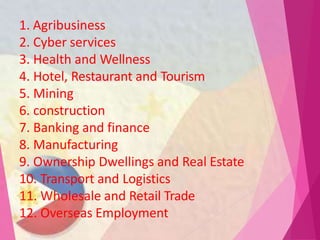
1. Agribusiness
2. Cyber services
3. Health and Wellness
4. Hotel, Restaurant and Tourism
5. Mining
6. construction
7. Banking and finance
8. Manufacturing
9. Ownership Dwellings and Real Estate
10. Transport and Logistics
11. Wholesale and Retail Trade
12. Overseas Employment
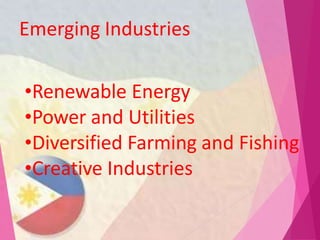
Emerging Industries
•Renewable Energy
•Power and Utilities
•Diversified Farming and Fishing
•Creative Industries
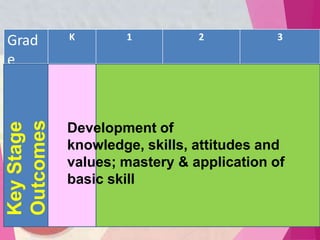
Grad
e
Leve
l
K 1 2 3
Key
Stage
Outcomes
Development of
knowledge, skills, attitudes and
values; mastery & application of
basic skill
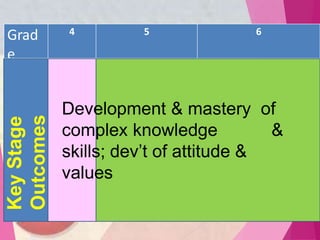
Grad
e
Leve
l
4 5 6
Key
Stage
Outcomes
Development & mastery of
complex knowledge &
skills; dev’t of attitude &
values
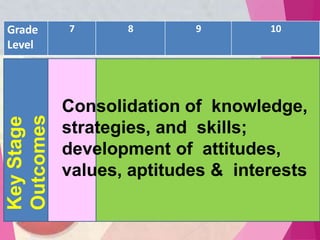
Grade
Level
7 8 9 10
Key
Stage
Outcomes
Consolidation of knowledge,
strategies, and skills;
development of attitudes,
values, aptitudes & interests
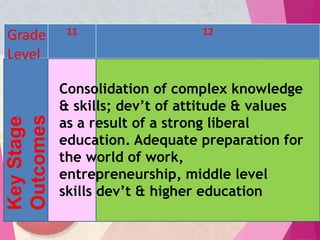
Grade
Level
 Consolidation of complex knowledge & skills;
dev’t of attitude & values as a result of a strong
liberal education.
 Adequate preparation for the world of work,
entrepreneurship, middle level skills dev’t &
higher education
11 12
Key
Stage
Outcomes
Consolidation of complex knowledge
& skills; dev’t of attitude & values
as a result of a strong liberal
education. Adequate preparation for
the world of work,
entrepreneurship, middle level
skills dev’t & higher education
Current
Curricular
Innovations
included in the
K-12 BEP
1. Thematic Approach in
Kindergarten
• Domains: Values Education, Physical
Health and Motor Development, Social
and Emotional Development, Cognitive
Development, Creative Arts, Language and
Readiness for Reading and Writing &
Language, Literacy and Communication
• Themes: Myself, My Family, My School,
My Community & More things Around Us
2. Mother tongue-Based
Multilingual Education
• Mother tongue taught as learning area
and used as language of instruction from
Kindergarten to Grade 3
• Bridging or transition to Filipino and
English as language of instruction
introduced in Grade 3
3. Madrasah Curriculum: ALIVE
• Curriculum for Muslim learners
• ALIVE- Arabic language and
Islamic values education as
subjects to be taught in the
elementary and secondary
levels
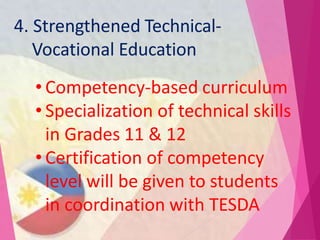
4. Strengthened Technical-
Vocational Education
• Competency-based curriculum
• Specialization of technical skills
in Grades 11 & 12
• Certification of competency
level will be given to students
in coordination with TESDA
K-12
BasicEducationProgram
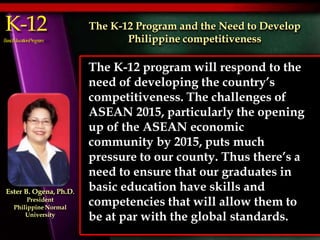
The K-12 program will respond to the
need of developing the country’s
competitiveness. The challenges of
ASEAN 2015, particularly the opening
up of the ASEAN economic
community by 2015, puts much
pressure to our county. Thus there’s a
need to ensure that our graduates in
basic education have skills and
competencies that will allow them to
be at par with the global standards.
The K-12 Program and the Need to Develop
Philippine competitiveness
Ester B. Ogena, Ph.D.
President
Philippine Normal
University
K-12
BasicEducationProgram
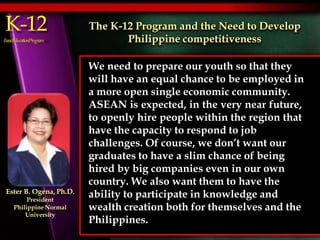
We need to prepare our youth so that they
will have an equal chance to be employed in
a more open single economic community.
ASEAN is expected, in the very near future,
to openly hire people within the region that
have the capacity to respond to job
challenges. Of course, we don’t want our
graduates to have a slim chance of being
hired by big companies even in our own
country. We also want them to have the
ability to participate in knowledge and
wealth creation both for themselves and the
Philippines.
The K-12 Program and the Need to Develop
Philippine competitiveness
Ester B. Ogena, Ph.D.
President
Philippine Normal
University
14. Tailoring co-curricular
activities and community
involvement program to
student and community needs
15. Assessment for and of
learning based on standards
16. Attitudes of teachers towards
K-12
If education could be
the only best option
to secure the future
of our youth, all of us
are here to support
this option.
The Future
Of
Education
Welcome To The Future Of Education:
Things That Will Change
1.Diverse time and place.
2.Personalized learning.
3.Free choice.
4.Project based.
5.Field experience.
6.Data interpretation.
7.Exams will change completely.
8.Student ownership.
9.Mentoring will become more important.
10. Technology is providing a way
for learning models to become
increasingly personalized.
11. Expect technology to present
some philosophical shifts in
education, as well
12. Even with technology being
used in more and more
classrooms, teachers will be as
important as ever.
13. Artificial intelligence is
poised to play an integral role as
well.
K-12 Basic Education.pptx

K-12 Basic Education.pptx

  • 1.
  • 2.
    Chronic underachievement ofstudents Insufficient mastery of basic competencies due to congested curriculum High school graduates (<16 year-old graduates lack basic competencies and maturity) Other countries view the 10 – year education cycle as insufficient The Philippines is the only remaining country in Asia with a 10 – year basic education program
  • 3.
    K-12 Basic Education Program HistoricalBackground • K+12 is not NEW… • studies have been made since 1925 • need to be more competitive • lack of political will
  • 4.
    1925 - 1949 - 1953- 1960 - 1970 - Monroe Survey UNESCO Mission Survey Education Act Swanson Survey Presidential Commission to Survey Philippine Education (PCSPE)
  • 5.
    1990 - Surveyof Outcomes of Elementary Education (SOUTELE) 1991 - Philippine Education For All (EFA) 2015 National Action Plan Congressional Commission on Education (EDCOM) Report 2000 - Presidential Commission on Educational Reforms 2008 - Presidential Task Force on Education
  • 6.
  • 7.
    DepED IS GLOBALLY RECOGNIZEDFOR THE DEVELOPMENT OF FUNCTIONALLY LITERATE AND GOD- LOVING FILIPINOS WHO HELP ATTAIN THE NATIONAL GOALS OF SOCIAL JUSTICE, UNITY, FREEDOM AND PROSPERITY DepEd’s VISION
  • 8.
    VISION •grounded on human development •achievedthrough an enhanced curriculum •with socio-economic relevance
  • 9.
    PROVIDE QUALITY BASIC EDUCATIONTHAT IS EQUITABLY ACCESSIBLE TO ALL AND LAY THE FOUNDATION FOR LIFELONG LEARNING AND SELF- ACTULIZATION NEEDED FOR EFFECTIVE CITIZENSHIP AT THE LOCAL, NATIONAL AND GLOBAL MILIEU DepEd’s MISSION
  • 10.
    SUB-GOALS •To give everylearner an opportunity to receive quality education based on an enhanced and decongested curriculum that is internationally recognized and comparable.
  • 11.
    • To changepublic perception that high school education is just a preparation for college Rather, it should allow one to take advantage of opportunities for gainful career or employment and/or self- employment in a rapidly changing and increasing globalized environment.
  • 12.
    RATIONALE 1.Enhancing the qualityof basic education in the Philippines is urgent and critical 2.The poor quality of basic education is reflected in the low achievement scores of Filipino students.
  • 13.
    3. The congestedcurriculum partly explains the present state of education 4. This quality of education is reflected in the inadequate preparation of high school graduates for the world of work or entrepreneurship or higher education 5. Further, most graduates are too young to enter the labor force. 6.The current system also reinforces the misperception that basic education is just a preparation for higher education.
  • 14.
    7. Our graduatesare not automatically recognized as professionals abroad. Table 3 Comparative Data on the Pre- University Education in Asia Country Basic Education Cycle Total Brunei 12 Cambodia 12 Indonesia 12 Lao PDR 12 Malaysia 12 Myanmar 11 Philippines 10 Singapore 11 Thailand 12 Timor-Leste 12 Vietnam 12 Mongolia recently added grades to make basic education 12 years.
  • 15.
  • 16.
    8.More importantly, theshort basic education program affects the human development of the Filipino children. 9.Cognizant of this urgent and critical concern and in line with the priorities of the Aquino Administration, the Department of Education is taking bold steps to enhanced the basic education curriculum.
  • 17.
    10. K-12 means Kindergartenand the 12 years of elementary and secondary education.
  • 18.
    BENEFITS OF ENHANCED BASICEDUCATION PROGRAM 1.The Enhanced K-12 Basic Education Program will be instrumental in achieving the nation’s vision of high school graduates. The benefits of the K-12 proposal far outweigh the additional costs that will be incurred by both government and families.
  • 19.
    2. An enhancedcurriculum will decongest academic workload. To Individuals and Families
  • 20.
    4. Graduates willbe prepared for higher education. 5. Graduates could now be recognized abroad. 3. Graduates will possess competencies and skills relevant to the job market.
  • 21.
    6. The economywill experience accelerated growth in the long run. 7.The Philippine education system will be at par with international standards. 8.A better educated society provides a sound foundation for long-term socio-economic development. For the Society and the Economy
  • 22.
    WHY ADD TWOYEARS? Decongest and enhance the basic education curriculum Better quality education for all
  • 23.
    “We need toadd two years to our basic education. Those who can afford pay up to fourteen years of schooling before university. Thus, their children are getting into the best universities and the best job after graduation. I want at least 12 years for our public school children to give them an even chance at succeeding.” ~President Benigno S. Aquino III K-12 Basic Education Program
  • 24.
    K-12 BasicEducationProgram 2 years SeniorHS 4 years Junior HS 6 years Elementary Kindergarten K+6+4+2
  • 25.
    What will eachgraduate get? K-12 BasicEducationProgram Grade VI Junior HS Senior HS Batang K-12, HandasaTrabaho o Kolehiyo, HandasaMundo
  • 26.
    Alignment of curriculum tothe business and industry needs (Key Employment Drivers for 2011-2020) DOLE Project Job Fit 2020 vision
  • 27.
    Industry Prospects Growth ofPhilippine economy will be driven by: 1. High-value foreign direct investment (FDI) led agribusiness 2. Infrastructure (roads and highways, logistics, physical infrastructure projects 3. Tourism (diving edge) 4. Medical Tourism 5. Retirement Estates (Subic, NCR, and cities of Tagaytay, Cebu, and Dumaguete)
  • 28.
    Industry Prospects 6.BPOs (35%annual growth, $13 billion in revenues in 2010) 7.Investment in ICT 8.Real estate (BPOs investing in office space, growth in domestic and international tourism0; 9.Shipbuilding (exports of ships to the US, Mexico, and Norway); and 10. Long term demand for OFWs
  • 29.
  • 30.
    1. Agribusiness 2. Cyberservices 3. Health and Wellness 4. Hotel, Restaurant and Tourism 5. Mining 6. construction 7. Banking and finance 8. Manufacturing 9. Ownership Dwellings and Real Estate 10. Transport and Logistics 11. Wholesale and Retail Trade 12. Overseas Employment
  • 31.
    Emerging Industries •Renewable Energy •Powerand Utilities •Diversified Farming and Fishing •Creative Industries
  • 32.
    Grad e Leve l K 1 23 Key Stage Outcomes Development of knowledge, skills, attitudes and values; mastery & application of basic skill
  • 33.
    Grad e Leve l 4 5 6 Key Stage Outcomes Development& mastery of complex knowledge & skills; dev’t of attitude & values
  • 34.
    Grade Level 7 8 910 Key Stage Outcomes Consolidation of knowledge, strategies, and skills; development of attitudes, values, aptitudes & interests
  • 35.
    Grade Level  Consolidation ofcomplex knowledge & skills; dev’t of attitude & values as a result of a strong liberal education.  Adequate preparation for the world of work, entrepreneurship, middle level skills dev’t & higher education 11 12 Key Stage Outcomes Consolidation of complex knowledge & skills; dev’t of attitude & values as a result of a strong liberal education. Adequate preparation for the world of work, entrepreneurship, middle level skills dev’t & higher education
  • 36.
  • 37.
    1. Thematic Approachin Kindergarten • Domains: Values Education, Physical Health and Motor Development, Social and Emotional Development, Cognitive Development, Creative Arts, Language and Readiness for Reading and Writing & Language, Literacy and Communication • Themes: Myself, My Family, My School, My Community & More things Around Us
  • 38.
    2. Mother tongue-Based MultilingualEducation • Mother tongue taught as learning area and used as language of instruction from Kindergarten to Grade 3 • Bridging or transition to Filipino and English as language of instruction introduced in Grade 3
  • 39.
    3. Madrasah Curriculum:ALIVE • Curriculum for Muslim learners • ALIVE- Arabic language and Islamic values education as subjects to be taught in the elementary and secondary levels
  • 40.
    4. Strengthened Technical- VocationalEducation • Competency-based curriculum • Specialization of technical skills in Grades 11 & 12 • Certification of competency level will be given to students in coordination with TESDA
  • 41.
    K-12 BasicEducationProgram The K-12 programwill respond to the need of developing the country’s competitiveness. The challenges of ASEAN 2015, particularly the opening up of the ASEAN economic community by 2015, puts much pressure to our county. Thus there’s a need to ensure that our graduates in basic education have skills and competencies that will allow them to be at par with the global standards. The K-12 Program and the Need to Develop Philippine competitiveness Ester B. Ogena, Ph.D. President Philippine Normal University
  • 42.
    K-12 BasicEducationProgram We need toprepare our youth so that they will have an equal chance to be employed in a more open single economic community. ASEAN is expected, in the very near future, to openly hire people within the region that have the capacity to respond to job challenges. Of course, we don’t want our graduates to have a slim chance of being hired by big companies even in our own country. We also want them to have the ability to participate in knowledge and wealth creation both for themselves and the Philippines. The K-12 Program and the Need to Develop Philippine competitiveness Ester B. Ogena, Ph.D. President Philippine Normal University
  • 46.
    14. Tailoring co-curricular activitiesand community involvement program to student and community needs 15. Assessment for and of learning based on standards 16. Attitudes of teachers towards K-12
  • 47.
    If education couldbe the only best option to secure the future of our youth, all of us are here to support this option.
  • 48.
  • 49.
    Welcome To TheFuture Of Education: Things That Will Change 1.Diverse time and place. 2.Personalized learning. 3.Free choice. 4.Project based. 5.Field experience. 6.Data interpretation. 7.Exams will change completely. 8.Student ownership. 9.Mentoring will become more important.
  • 50.
    10. Technology isproviding a way for learning models to become increasingly personalized. 11. Expect technology to present some philosophical shifts in education, as well 12. Even with technology being used in more and more classrooms, teachers will be as important as ever. 13. Artificial intelligence is poised to play an integral role as well.