IMPORTANCE OF
EDUCATIONAL FACILITIES
BASIC PRINCIPLES ON
 EDUCATIONAL FACILITIES

1. The primary function of educational facilities is to
   provide the proper school environment that is
   most conducive to effective teaching and
   learning.

2. Functional and effective educational facilities are
    developed, operated and managed on the
    basis of a comprehensive plan of action of the
    school, prepared by all stakeholders in
    education in the community.
BASIC PRINCIPLES ON
 EDUCATIONAL FACILITIES

3. It shall include sound educational facility planning
and design process principles to:

a.Maximize collaboration in school planning design.

a.Build a proactive facility management program.

c. Plan schools as neighborhood-scaled community
learning centers considering the following steps:
BASIC PRINCIPLES ON EDUCATIONAL
               FACILITIES
c.1 Locate the school in a well-defined neighborhood
as this will provide opportunities for children and parents
to walk to the school and provide an identity for that
community;

c.2 Provide a variety of services at flexible schedules
and make the same accessible to end-users of different
backgrounds especially during calamities/disasters
wherein the school buildings are being used as
evacuation centers and temporary shelters to affected
community members;
BASIC PRINCIPLES ON EDUCATIONAL
               FACILITIES
c.3 Create an environment that draws the community to
the school and that increases interaction in compliance
with the principles of the Schools First Initiative (SFI)
and the School-Based Management (SBM);

c.4 The school shall provide facilities accessible to the
entire community, creating an increased involvement
and awareness of the educational process; and

c.5 School facilities that act as true community centers
to serve the broader society goals of providing the setting
for meaningful civic participation and engagement at the
local level.
BASIC PRINCIPLES ON EDUCATIONAL
               FACILITIES
       A variety of social and economic factors have
created an environment which educators can tap as a
learning resource be these in urban, suburban or rural
settings.
       This will establish partnership with museums,
zoos, other public institutions as well as local business or
industrial workplace settings in compliance with Republic
Act No. 8525 otherwise known as the “Adopt-A-School
Program”, involving external stakeholders in education.
SCHOOL MAPPING
School Mapping is a dynamic process of planning the
distribution, size and spacing of schools and physical
facilities requirements for optimum utilization and benefit.

It is a process of identifying current inadequacies in
distribution and of providing appropriate types and
patterns of school plant.

 It is a continuous process involving the uninterrupted
recording of basic information required for analysis of the
school map at any given point in time.
1. SCHOOL MAPPING PROCESS

a. Specific Areas for Expansion
The process of school mapping covers the following specific
areas for expansion and improvement of facilities

(1)Rationalization of existing facilities by:
• locating existing schools and determining its vulnerability to
various geological and hydro meteorological hazards;

• new schools must be located outside areas already
identified to be within hazard zones (Niño Relox, PAGASA);

• shifting, closure, or amalgamation/ integration of
institutions; and

• optimum utilization of buildings, equipments, furniture, etc.
1. SCHOOL MAPPING PROCESS

a. (2) provision of new or additional facilities by:
• opening of new schools or upgrading existing ones;

• providing additional teaching and non-teaching staff; and

• providing new or additional buildings, furniture and
equipment in institutions, etc.

      Before starting the exercise of school mapping, it is
essential that the norms and standards for provision
and maintenance of educational services are clearly laid
down by the higher authorities.
1. SCHOOL MAPPING PROCESS

b. Initial Steps in School Mapping
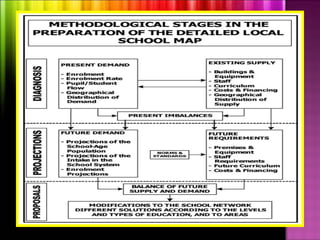
(1) Diagnosis of the Existing Situation
        The initial step in school mapping is to make a survey
of the existing situation in order to obtain all information
about the network of schools and their physical resources
and means considering the following factors:

• Environmental/geographic factors include both natural
(rivers, mountains, etc.) and man-made (source of
electricity, roads, railways, communication network, etc.)
features.
1. SCHOOL MAPPING PROCESS

• Demographic factors pertain to such characteristics of
population as size, growth, density, social structure,
migratory trends, school drop-outs and retention rates, etc.

• Economic factors refer to per capita income, commercial
establishments, mass media, size of schools/
classes, etc.

• Educational factors include the number of study hours
per week and their distribution by subjects, the number of
pupils/students per class, normal length of time for which
premises shall be used and the possibility of introducing
double shift, teachers’ working hours, etc.
1. SCHOOL MAPPING PROCESS

• Political factors cover those political and policy priorities
and constraints, which usually, dictate the
creation or expansion of specific types of educational
institutions.

• Manpower factors refer to the present and future
structures of employment which generally affect the
relative weights in educational contents and diversification.
1. SCHOOL MAPPING PROCESS

(2) Projection of future requirements
       After a comprehensive diagnosis, it is necessary to
make projections to identify the potential demands.
Simultaneously, it is necessary to draw up perspective
school maps involving the following steps:

• Estimating the number of children to be enrolled; and

• Determining the capacity of existing schools and defining
their catchment areas.

 Catchment area refers to a specific territory, which is
served by a school based on the environmental,
demographic and economic factors. These areas together
with their respective schools are plotted on a map.
1. SCHOOL MAPPING PROCESS

(3) Drawing up of perspective school map

        The school map produced shall not be regarded as
final unless it has been considered and discussed by
central administrators, local authorities, teachers, parents,
etc.
2. BASIC DATA NEEDED FOR SCHOOL MAPPING
a. Education Data
(1) Annual Statistical Report
(2) Geographical distribution of schools
(3) Site and catchment area conditions
(4) Size of the existing school plant

For individual schools
(1) exact location or verbal description of location
(2) nature of catchment area (relief/land
elevation, barriers to movement, predominant
economic activity,
area of immigration or population decline)
(3) number of student spaces available in each
year, indication of the state of buildings
2. BASIC DATA NEEDED FOR SCHOOL MAPPING

b. Population Data (analysis of the census)

c. Other Planning Data
(1)general rural and urban development policies

(2) social facilities (school health, recreational
centers, etc.) to encourage nucleation of
population at the central points.
3. EXPECTED RESULTS
         OF SCHOOL MAPPING

(1) School buildings requiring repairs
(2) Schools requiring additional
classrooms
(3) Opening of New Schools
(4) Phasing out of existing schools
(5) Resource allocation
(6) Environmental Mapping
5. SPECIFIC OUTPUTS OF SCHOOL MAPPING

           a. Prioritization of schools based on defined
               set of criteria, e.g. selection of place to open
               a school taking note of available resources,
               as well as vulnerability of location to both
               natural and man-made hazards (PAGASA).

           b. Identifying the location of new schools
                based on a defined radial distance from
                existing schools or barangays (attention in
                range, i.e. walking distance from nearest
                schooling facilities)

           c. Grouping of entries based on a defined set of
               attributes. (e.g. availability of land, local
               contributions)
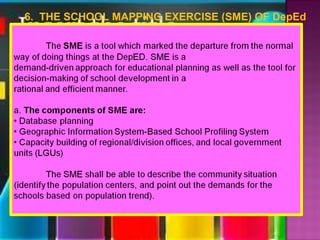
6. THE SCHOOL MAPPING EXERCISE (SME) OF DepEd
MODE OF ACQUISITION OF SCHOOL SITES
           A school site may be acquired
           through any of the following
           methods:

           1.Purchase
           2.Donation
           3.Contract of Usufruct
           4.Expropriation
           5.Barter
           6.Presidential Proclamation
           7.Gratuitous Conveyance
MODE OF ACQUISITION OF SCHOOL SITES

Purchase. This is the most reliable, stable and non-
controversial mode of acquisition. A school site may be
acquired by direct purchase from the legal owner who
voluntarily sells it on an agreed price.

Donation. May either be simple, conditional, inter vivos or
mortis causa.

Contract of Usufruct. In case the property is registered in
the name of an individual, province, city, municipality or
barangay, but is not allowed to be donated, but
DepED/school is allowed full use or perpetual right of use
through gratuitous act (without consideration).
MODE OF ACQUISITION OF SCHOOL SITES


Expropriation. Private land desired for school purposes
may be acquired through expropriation proceedings.

Presidential Proclamation. Public lands declared as
reservation areas (including ancestral lands) through
Presidential Proclamation are sometimes targeted as sites

for educational purposes.

Gratuitous Conveyance. Real property belonging to the
government, when needed for school purposes, may be
conveyed by way of gift, sale, lease, exchange.
SCHOOLS IN URBAN
AREAS
ST. ANNE COLLEGLUCENA INC.
MARYHILL COLLEGE
ENVERGA UNIVERSITY (MSEUF)
UNIVERSIDAD DE MANILA
UNIVERSITY OF THE
PHILIPPINES (Cebu)
SILIMAN UNIVERSITY
UNIVERSITY OF THE
   PHILIPPINES
ATENEO DE ZAMBOANGA UNIVERSITY
UNIVERSITY OF MAKATI
SCHOOLS IN URBAN
AREAS
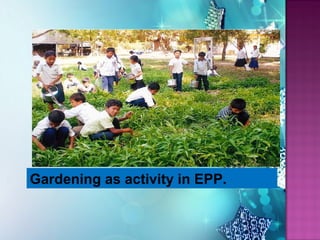
Gardening as activity in EPP.
Reading and Writing Activities
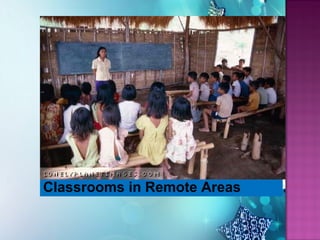
Classrooms in Remote Areas
REFERENCES
http://deped
pfsed.wikispaces.com/School+Mapping
https://docs.google.com/present/view?
fs=true&revision=_latest&start=0&theme=blank&ski
pauth=true&pli=1&id=dc7zd2pv_2fqmq58cs
http://www.oppapers.com/subjects/lack-of-school-
facilities-in-the-philippines-page1.html
http://www.rccdm.net/index.php?
option=com_docman&task=doc_view&Itemid=215&
gid=79
Ms. Jennif er L.
Magboo (MaEd- Mgt. )
EducationalFacilities and Mapping

EducationalFacilities and Mapping

  • 6.
  • 7.
    BASIC PRINCIPLES ON EDUCATIONAL FACILITIES 1. The primary function of educational facilities is to provide the proper school environment that is most conducive to effective teaching and learning. 2. Functional and effective educational facilities are developed, operated and managed on the basis of a comprehensive plan of action of the school, prepared by all stakeholders in education in the community.
  • 8.
    BASIC PRINCIPLES ON EDUCATIONAL FACILITIES 3. It shall include sound educational facility planning and design process principles to: a.Maximize collaboration in school planning design. a.Build a proactive facility management program. c. Plan schools as neighborhood-scaled community learning centers considering the following steps:
  • 9.
    BASIC PRINCIPLES ONEDUCATIONAL FACILITIES c.1 Locate the school in a well-defined neighborhood as this will provide opportunities for children and parents to walk to the school and provide an identity for that community; c.2 Provide a variety of services at flexible schedules and make the same accessible to end-users of different backgrounds especially during calamities/disasters wherein the school buildings are being used as evacuation centers and temporary shelters to affected community members;
  • 10.
    BASIC PRINCIPLES ONEDUCATIONAL FACILITIES c.3 Create an environment that draws the community to the school and that increases interaction in compliance with the principles of the Schools First Initiative (SFI) and the School-Based Management (SBM); c.4 The school shall provide facilities accessible to the entire community, creating an increased involvement and awareness of the educational process; and c.5 School facilities that act as true community centers to serve the broader society goals of providing the setting for meaningful civic participation and engagement at the local level.
  • 11.
    BASIC PRINCIPLES ONEDUCATIONAL FACILITIES A variety of social and economic factors have created an environment which educators can tap as a learning resource be these in urban, suburban or rural settings. This will establish partnership with museums, zoos, other public institutions as well as local business or industrial workplace settings in compliance with Republic Act No. 8525 otherwise known as the “Adopt-A-School Program”, involving external stakeholders in education.
  • 15.
    SCHOOL MAPPING School Mappingis a dynamic process of planning the distribution, size and spacing of schools and physical facilities requirements for optimum utilization and benefit. It is a process of identifying current inadequacies in distribution and of providing appropriate types and patterns of school plant.  It is a continuous process involving the uninterrupted recording of basic information required for analysis of the school map at any given point in time.
  • 16.
    1. SCHOOL MAPPINGPROCESS a. Specific Areas for Expansion The process of school mapping covers the following specific areas for expansion and improvement of facilities (1)Rationalization of existing facilities by: • locating existing schools and determining its vulnerability to various geological and hydro meteorological hazards; • new schools must be located outside areas already identified to be within hazard zones (Niño Relox, PAGASA); • shifting, closure, or amalgamation/ integration of institutions; and • optimum utilization of buildings, equipments, furniture, etc.
  • 17.
    1. SCHOOL MAPPINGPROCESS a. (2) provision of new or additional facilities by: • opening of new schools or upgrading existing ones; • providing additional teaching and non-teaching staff; and • providing new or additional buildings, furniture and equipment in institutions, etc. Before starting the exercise of school mapping, it is essential that the norms and standards for provision and maintenance of educational services are clearly laid down by the higher authorities.
  • 18.
    1. SCHOOL MAPPINGPROCESS b. Initial Steps in School Mapping (1) Diagnosis of the Existing Situation The initial step in school mapping is to make a survey of the existing situation in order to obtain all information about the network of schools and their physical resources and means considering the following factors: • Environmental/geographic factors include both natural (rivers, mountains, etc.) and man-made (source of electricity, roads, railways, communication network, etc.) features.
  • 19.
    1. SCHOOL MAPPINGPROCESS • Demographic factors pertain to such characteristics of population as size, growth, density, social structure, migratory trends, school drop-outs and retention rates, etc. • Economic factors refer to per capita income, commercial establishments, mass media, size of schools/ classes, etc. • Educational factors include the number of study hours per week and their distribution by subjects, the number of pupils/students per class, normal length of time for which premises shall be used and the possibility of introducing double shift, teachers’ working hours, etc.
  • 20.
    1. SCHOOL MAPPINGPROCESS • Political factors cover those political and policy priorities and constraints, which usually, dictate the creation or expansion of specific types of educational institutions. • Manpower factors refer to the present and future structures of employment which generally affect the relative weights in educational contents and diversification.
  • 21.
    1. SCHOOL MAPPINGPROCESS (2) Projection of future requirements After a comprehensive diagnosis, it is necessary to make projections to identify the potential demands. Simultaneously, it is necessary to draw up perspective school maps involving the following steps: • Estimating the number of children to be enrolled; and • Determining the capacity of existing schools and defining their catchment areas. Catchment area refers to a specific territory, which is served by a school based on the environmental, demographic and economic factors. These areas together with their respective schools are plotted on a map.
  • 22.
    1. SCHOOL MAPPINGPROCESS (3) Drawing up of perspective school map The school map produced shall not be regarded as final unless it has been considered and discussed by central administrators, local authorities, teachers, parents, etc.
  • 23.
    2. BASIC DATANEEDED FOR SCHOOL MAPPING a. Education Data (1) Annual Statistical Report (2) Geographical distribution of schools (3) Site and catchment area conditions (4) Size of the existing school plant For individual schools (1) exact location or verbal description of location (2) nature of catchment area (relief/land elevation, barriers to movement, predominant economic activity, area of immigration or population decline) (3) number of student spaces available in each year, indication of the state of buildings
  • 24.
    2. BASIC DATANEEDED FOR SCHOOL MAPPING b. Population Data (analysis of the census) c. Other Planning Data (1)general rural and urban development policies (2) social facilities (school health, recreational centers, etc.) to encourage nucleation of population at the central points.
  • 25.
    3. EXPECTED RESULTS OF SCHOOL MAPPING (1) School buildings requiring repairs (2) Schools requiring additional classrooms (3) Opening of New Schools (4) Phasing out of existing schools (5) Resource allocation (6) Environmental Mapping
  • 27.
    5. SPECIFIC OUTPUTSOF SCHOOL MAPPING a. Prioritization of schools based on defined set of criteria, e.g. selection of place to open a school taking note of available resources, as well as vulnerability of location to both natural and man-made hazards (PAGASA). b. Identifying the location of new schools based on a defined radial distance from existing schools or barangays (attention in range, i.e. walking distance from nearest schooling facilities) c. Grouping of entries based on a defined set of attributes. (e.g. availability of land, local contributions)
  • 28.
    6. THE SCHOOLMAPPING EXERCISE (SME) OF DepEd
  • 29.
    MODE OF ACQUISITIONOF SCHOOL SITES A school site may be acquired through any of the following methods: 1.Purchase 2.Donation 3.Contract of Usufruct 4.Expropriation 5.Barter 6.Presidential Proclamation 7.Gratuitous Conveyance
  • 30.
    MODE OF ACQUISITIONOF SCHOOL SITES Purchase. This is the most reliable, stable and non- controversial mode of acquisition. A school site may be acquired by direct purchase from the legal owner who voluntarily sells it on an agreed price. Donation. May either be simple, conditional, inter vivos or mortis causa. Contract of Usufruct. In case the property is registered in the name of an individual, province, city, municipality or barangay, but is not allowed to be donated, but DepED/school is allowed full use or perpetual right of use through gratuitous act (without consideration).
  • 31.
    MODE OF ACQUISITIONOF SCHOOL SITES Expropriation. Private land desired for school purposes may be acquired through expropriation proceedings. Presidential Proclamation. Public lands declared as reservation areas (including ancestral lands) through Presidential Proclamation are sometimes targeted as sites for educational purposes. Gratuitous Conveyance. Real property belonging to the government, when needed for school purposes, may be conveyed by way of gift, sale, lease, exchange.



  • 32.
  • 33.
  • 34.
  • 35.
  • 36.
  • 37.
  • 38.
  • 39.
    UNIVERSITY OF THE PHILIPPINES
  • 40.
  • 41.
  • 42.
  • 43.
  • 44.
  • 45.
  • 46.
  • 47.
    Ms. Jennif erL. Magboo (MaEd- Mgt. )