Understanding the K-12
Basic Education Program
“Education is the key to the long-term
problems of the country. If we fix basic
education, we fix the long-term problems
of the country. And if we fix the country’s
problems, we will build a truly strong
society. . .”
-Pres. Benigno Simeon C. Aquino III
10-Point Basic Education Agenda
1. 12-Year Basic Education Cycle
2. Universal Kindergarten
3. Madaris Education
4. Technical-Vocational Education
5. Every Child a Reader by Grade One
6. Science and Math Proficiency
7. GASTPE (Gov. Assistance to Student and
Teachers to Private Education)
8. Medium of Instruction
9. Quality Textbooks
10. Covenant with LGUs
The Philippines is the only remaining
country in Asia with a 10-year pre-
university program.
Our graduates are being
disadvantaged by their youth and
inadequate preparation. . .
 The majority who do not go to college are
too young to enter the labor force. Thus,
they would either be unemployed or be
vulnerable to exploitative labor practices.
 Those who may be interested to set up
businesses cannot legally enter into
contracts.
Our graduates are being
disadvantaged by their youth and
inadequate preparation. . .
 The few, (only 23%) who would proceed
to tertiary education, usually have to
undergo remedial and high school level
classes in colleges and universities.
 Those who graduate (17%) may not be
recognized as professionals abroad.
Our graduates are being
disadvantaged by their youth and
inadequate preparation. . .
 The Washington Accord prescribes 12
years of basic education as an entry to
recognition of engineering professionals.
 The Bologna Accord requires 12 years of
education for university admission and
practice of profession in European
countries.
“We need to add two years to our basic
education. Those who can afford pay up
to fourteen years of schooling before
university. Thus, their children are getting
into the best universities and the best
jobs after graduation. I want at least 12
years for our public school children to give
them an even chance at succeeding.”
-Pres. Benigno Simeon C. Aquino III
K-6-4-2 System
2
years
4
years
6
years
1
year
• Senior High School
• Junior High School
• Elementary
• Kindergarten
Key Features of K to 12
 Enhancement of the basic education
curriculum is the central focus of K to 12.
 The enhanced curriculum will offer areas
of specialization or electives such as
science and technology, arts, sports,
journalism, tech-voc, foreign language,
entreperneurship, and subjects for
advanced placement.
New Features of the K-12 Basic
Education Curriculum
 Vertical continuum and horizontal
articulation of competencies
 Mother Tongue as a learning area and
medium of instruction
 Spiral progression in Science and Math
 MAPEH (Music, Arts, Physical Education,
and Health) begins in Grade 1
Learning Areas for Grades 1 to 1o
 Mother Tongue 1-3
English 1(2nd sem)-6
Filipino 1-6
Mathematics 1-6
Araling Panlipunan 1-6
Edukasyon sa
Pagpapakatao 1-6
Science 3-6
MAPEH 1-6
EPP 4-5
TLE 6
Grades 1 to 6 Grades 7 -10
Learning Areas Grade Levels
SAMPLE CLASS PROGRAMMING
Grade 1
Time Learning Areas Number of Minutes
7:00-7:15
7:15-7:25
Pambansang Awit
Homeroom
7:25-7:55 Edukasyon sa Pagpapakatao 30
7:55-8:45 Mother Tongue 50
8:45-9:15 Filipino 30
9:15-9:35 RECESS
9:35-10:15 Araling Panlipunan 40
10:15-10:45 English (Oral Fluency)
2nd Semester
30
10:45-11:35 Mathematics 50
1:00-1:30 Remediation, Reinforcement,
Enrichment Activities or
Optional Religious Instruction
1:30-2:10 MAPEH 40
TOTAL 240/270
Time Allotment
NOMENCLATURE/
LEARNING AREA
Grades 1 to 6
(No. of Minutes Daily)
Grades 7
to 10
(Weekly)G 1 G 2 G 3 G 4 G 5 G 6
1st
Sem.
2nd
Sem.
Language Arts
Mother Tongue 50 50 50 50 - - - -
Filipino 30 30 50 50 50 50 50 4 hrs
English - 30 50 50 50 50 50 4 hrs
Science - - - 50 50 50 50 4 hrs
Mathematics 50 50 50 50 50 50 50 4 hrs
Araling Panlipunan 40 40 40 40 40 40 40 3 hrs
EPP/TLE - - - - 50 50 50 4 hrs
MAPEH 40 40 40 40 40 40 40 4 hrs
EsP 30 30 30 30 30 30 30 2 hrs
Total 240 270 310 360 360 360 360 29 hrs
Grades 7-12
Core Curriculum and Career Paths
Premises
 Filipino learners, in order to be globally
competitive, need to develop 21st century core
skills( digital age literacy, inventive thinking,
effective communication, and high productivity)
and be functionally literate.
 Aside from the development of 21st century core
skills, the extended high school program should
be packaged for the preparation of students for
career and higher education. This is because
secondary education is designed primarily to
provide the transition from school to work and
from school to further learning.
Premises
 The curriculum shall be designed to
provide a blended career and college
preparatory program. Putting the two on
the same level and blending them will
enhance the seamless relationship
between career and higher education and
give them equal social and economic
value.
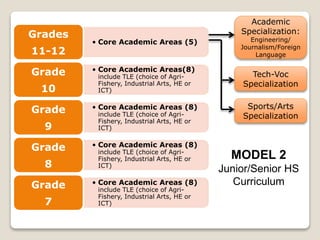
Academic
Specialization:
Engineering/
Journalism/Foreign
Language
Tech-Voc
Specialization
Sports/Arts
Specialization
MODEL 2
Junior/Senior HS
Curriculum
• Core Academic Areas (5)
Grades
11-12
• Core Academic Areas(8)
include TLE (choice of Agri-
Fishery, Industrial Arts, HE or
ICT)
Grade
10
• Core Academic Areas (8)
include TLE (choice of Agri-
Fishery, Industrial Arts, HE or
ICT)
Grade
9
• Core Academic Areas (8)
include TLE (choice of Agri-
Fishery, Industrial Arts, HE or
ICT)
Grade
8
• Core Academic Areas (8)
include TLE (choice of Agri-
Fishery, Industrial Arts, HE or
ICT)
Grade
7
Implementation of Junior HS
SY
2015-
2016
SY
2014-
2015
SY
2013-
2014
SY
2012-
2013
• Grade 10
• Grade 9
• Grade 8
• Grade 7
Implementation of Senior HS
SY
2017-
2018
SY
2016-
2017
• Grade 12
• Grade 11
Learning Areas for Grades 11 and 12
Learning Areas Grade 11 Grade 12
Language* English
Filipino
English
Filipino
Literature* Philippine Literature (1st Sem)
World Literature (2nd Sem)
Mathematics* Math Math
Science* Life Sciences Physical Science
Social Sciences
and Philosophy*
Contemporary Issues
Philosophy (Local)
Contemporary Issues (Global)
Career Pathways
(Track-dependent)
Entrepreneurship,
Tech-
Voc**
Others (Arts, Sports,
Security, Journalism,
Science, etc)
Entrepreneurship, Tech-
Voc**
Others (Arts, Sports, Security,
Journalism, Science, etc)
Others National Service
Training Program
National Service Training
Program
•Anchored on the College Readiness Standards of CHED
•** Based on TESDA Training Regulations
Senior High School benefits different
students in different ways.
Students who
finish high
school then work
• Better income
opportunities;
higher income
streams
• Cost due to
delayed
employment
offset by higher
income streams
Students who
complete 2 years
of college or
post-secondary
• Reduction in
cost of schooling
with additional 2
years of “free”
education
Students who
complete college
• Reduction in
college years
offsets additional
years of
schooling
• Higher
productivity
(about 9%
income premium)
• Higher college
completion rates
Completion of K to 12 education
shall be compulsory for those who
will go to college/university.
 A full 12 years of basic education will be
required for entry into tertiary level
education by SY 2018-2019.
Vision
Graduates of K to 12 Basic Education
Program are envisaged to be better
prepared for life as they are expected to
 possess sufficient mastery of 21st century
core skills;
 be emotionally developed and competent
to live a meaningful life;
 be socially aware, pro-active and involved
in public and civic affairs;
Vision
 be adequately prepared for the world of
work or entrepreneurship or higher
education;
 be legally employable; and
 be globally competitive.
Benefits of K to 12 to Individuals
and Families
 An enhanced curriculum will decongest
academic workload, giving students more
time to master competencies and time for
extra-curricular activities, thus, allowing
for their more holistic development.
 Graduates will possess competencies and
skills relevant to the job market.
 Graduates will be better prepared for
higher education.
Benefits of K to 12 to Individuals
and Families
 Graduates will be able to earn higher
wages and/or better prepared to start
their own business. Studies in the
Philippines have shown that an additional
year of schooling increases earnings by
7.5%.
 Filipino graduates could be recognized
abroad.
Benefits of K to 12 to Society and
the Economy
 K to 12 will contribute to economic
growth. Several studies have shown that
the improvements in the quality of
education will increase GDP growth by as
much as 2%.
 A better educated society provides a
sound foundation for long-term socio-
economic development.
Who will cover the cost of the
additional two years in high
school?
 Free for those in public schools
 Subsidized by the Government for those
in the ESC program
MORE POWER AND GOOD DAY EVERYONE!!!

Understanding the k 12 basic education program updated

  • 1.
  • 2.
    “Education is thekey to the long-term problems of the country. If we fix basic education, we fix the long-term problems of the country. And if we fix the country’s problems, we will build a truly strong society. . .” -Pres. Benigno Simeon C. Aquino III
  • 3.
    10-Point Basic EducationAgenda 1. 12-Year Basic Education Cycle 2. Universal Kindergarten 3. Madaris Education 4. Technical-Vocational Education 5. Every Child a Reader by Grade One 6. Science and Math Proficiency 7. GASTPE (Gov. Assistance to Student and Teachers to Private Education) 8. Medium of Instruction 9. Quality Textbooks 10. Covenant with LGUs
  • 4.
    The Philippines isthe only remaining country in Asia with a 10-year pre- university program.
  • 5.
    Our graduates arebeing disadvantaged by their youth and inadequate preparation. . .  The majority who do not go to college are too young to enter the labor force. Thus, they would either be unemployed or be vulnerable to exploitative labor practices.  Those who may be interested to set up businesses cannot legally enter into contracts.
  • 6.
    Our graduates arebeing disadvantaged by their youth and inadequate preparation. . .  The few, (only 23%) who would proceed to tertiary education, usually have to undergo remedial and high school level classes in colleges and universities.  Those who graduate (17%) may not be recognized as professionals abroad.
  • 7.
    Our graduates arebeing disadvantaged by their youth and inadequate preparation. . .  The Washington Accord prescribes 12 years of basic education as an entry to recognition of engineering professionals.  The Bologna Accord requires 12 years of education for university admission and practice of profession in European countries.
  • 8.
    “We need toadd two years to our basic education. Those who can afford pay up to fourteen years of schooling before university. Thus, their children are getting into the best universities and the best jobs after graduation. I want at least 12 years for our public school children to give them an even chance at succeeding.” -Pres. Benigno Simeon C. Aquino III
  • 9.
    K-6-4-2 System 2 years 4 years 6 years 1 year • SeniorHigh School • Junior High School • Elementary • Kindergarten
  • 10.
    Key Features ofK to 12  Enhancement of the basic education curriculum is the central focus of K to 12.  The enhanced curriculum will offer areas of specialization or electives such as science and technology, arts, sports, journalism, tech-voc, foreign language, entreperneurship, and subjects for advanced placement.
  • 11.
    New Features ofthe K-12 Basic Education Curriculum  Vertical continuum and horizontal articulation of competencies  Mother Tongue as a learning area and medium of instruction  Spiral progression in Science and Math  MAPEH (Music, Arts, Physical Education, and Health) begins in Grade 1
  • 12.
    Learning Areas forGrades 1 to 1o  Mother Tongue 1-3 English 1(2nd sem)-6 Filipino 1-6 Mathematics 1-6 Araling Panlipunan 1-6 Edukasyon sa Pagpapakatao 1-6 Science 3-6 MAPEH 1-6 EPP 4-5 TLE 6 Grades 1 to 6 Grades 7 -10 Learning Areas Grade Levels
  • 13.
    SAMPLE CLASS PROGRAMMING Grade1 Time Learning Areas Number of Minutes 7:00-7:15 7:15-7:25 Pambansang Awit Homeroom 7:25-7:55 Edukasyon sa Pagpapakatao 30 7:55-8:45 Mother Tongue 50 8:45-9:15 Filipino 30 9:15-9:35 RECESS 9:35-10:15 Araling Panlipunan 40 10:15-10:45 English (Oral Fluency) 2nd Semester 30 10:45-11:35 Mathematics 50 1:00-1:30 Remediation, Reinforcement, Enrichment Activities or Optional Religious Instruction 1:30-2:10 MAPEH 40 TOTAL 240/270
  • 14.
    Time Allotment NOMENCLATURE/ LEARNING AREA Grades1 to 6 (No. of Minutes Daily) Grades 7 to 10 (Weekly)G 1 G 2 G 3 G 4 G 5 G 6 1st Sem. 2nd Sem. Language Arts Mother Tongue 50 50 50 50 - - - - Filipino 30 30 50 50 50 50 50 4 hrs English - 30 50 50 50 50 50 4 hrs Science - - - 50 50 50 50 4 hrs Mathematics 50 50 50 50 50 50 50 4 hrs Araling Panlipunan 40 40 40 40 40 40 40 3 hrs EPP/TLE - - - - 50 50 50 4 hrs MAPEH 40 40 40 40 40 40 40 4 hrs EsP 30 30 30 30 30 30 30 2 hrs Total 240 270 310 360 360 360 360 29 hrs
  • 15.
  • 16.
    Premises  Filipino learners,in order to be globally competitive, need to develop 21st century core skills( digital age literacy, inventive thinking, effective communication, and high productivity) and be functionally literate.  Aside from the development of 21st century core skills, the extended high school program should be packaged for the preparation of students for career and higher education. This is because secondary education is designed primarily to provide the transition from school to work and from school to further learning.
  • 17.
    Premises  The curriculumshall be designed to provide a blended career and college preparatory program. Putting the two on the same level and blending them will enhance the seamless relationship between career and higher education and give them equal social and economic value.
  • 18.
    Academic Specialization: Engineering/ Journalism/Foreign Language Tech-Voc Specialization Sports/Arts Specialization MODEL 2 Junior/Senior HS Curriculum •Core Academic Areas (5) Grades 11-12 • Core Academic Areas(8) include TLE (choice of Agri- Fishery, Industrial Arts, HE or ICT) Grade 10 • Core Academic Areas (8) include TLE (choice of Agri- Fishery, Industrial Arts, HE or ICT) Grade 9 • Core Academic Areas (8) include TLE (choice of Agri- Fishery, Industrial Arts, HE or ICT) Grade 8 • Core Academic Areas (8) include TLE (choice of Agri- Fishery, Industrial Arts, HE or ICT) Grade 7
  • 19.
    Implementation of JuniorHS SY 2015- 2016 SY 2014- 2015 SY 2013- 2014 SY 2012- 2013 • Grade 10 • Grade 9 • Grade 8 • Grade 7
  • 20.
    Implementation of SeniorHS SY 2017- 2018 SY 2016- 2017 • Grade 12 • Grade 11
  • 21.
    Learning Areas forGrades 11 and 12 Learning Areas Grade 11 Grade 12 Language* English Filipino English Filipino Literature* Philippine Literature (1st Sem) World Literature (2nd Sem) Mathematics* Math Math Science* Life Sciences Physical Science Social Sciences and Philosophy* Contemporary Issues Philosophy (Local) Contemporary Issues (Global) Career Pathways (Track-dependent) Entrepreneurship, Tech- Voc** Others (Arts, Sports, Security, Journalism, Science, etc) Entrepreneurship, Tech- Voc** Others (Arts, Sports, Security, Journalism, Science, etc) Others National Service Training Program National Service Training Program •Anchored on the College Readiness Standards of CHED •** Based on TESDA Training Regulations
  • 22.
    Senior High Schoolbenefits different students in different ways. Students who finish high school then work • Better income opportunities; higher income streams • Cost due to delayed employment offset by higher income streams Students who complete 2 years of college or post-secondary • Reduction in cost of schooling with additional 2 years of “free” education Students who complete college • Reduction in college years offsets additional years of schooling • Higher productivity (about 9% income premium) • Higher college completion rates
  • 23.
    Completion of Kto 12 education shall be compulsory for those who will go to college/university.  A full 12 years of basic education will be required for entry into tertiary level education by SY 2018-2019.
  • 24.
    Vision Graduates of Kto 12 Basic Education Program are envisaged to be better prepared for life as they are expected to  possess sufficient mastery of 21st century core skills;  be emotionally developed and competent to live a meaningful life;  be socially aware, pro-active and involved in public and civic affairs;
  • 25.
    Vision  be adequatelyprepared for the world of work or entrepreneurship or higher education;  be legally employable; and  be globally competitive.
  • 26.
    Benefits of Kto 12 to Individuals and Families  An enhanced curriculum will decongest academic workload, giving students more time to master competencies and time for extra-curricular activities, thus, allowing for their more holistic development.  Graduates will possess competencies and skills relevant to the job market.  Graduates will be better prepared for higher education.
  • 27.
    Benefits of Kto 12 to Individuals and Families  Graduates will be able to earn higher wages and/or better prepared to start their own business. Studies in the Philippines have shown that an additional year of schooling increases earnings by 7.5%.  Filipino graduates could be recognized abroad.
  • 28.
    Benefits of Kto 12 to Society and the Economy  K to 12 will contribute to economic growth. Several studies have shown that the improvements in the quality of education will increase GDP growth by as much as 2%.  A better educated society provides a sound foundation for long-term socio- economic development.
  • 29.
    Who will coverthe cost of the additional two years in high school?  Free for those in public schools  Subsidized by the Government for those in the ESC program
  • 30.
    MORE POWER ANDGOOD DAY EVERYONE!!!