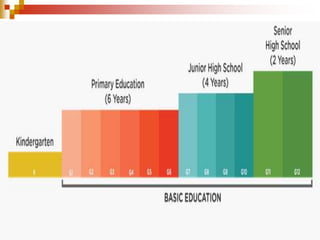
The K to 12 Program covers Kindergarten 
and 12 years of basic education (six 
years of primary education, four years 
of Junior High School, and two years of 
Senior High School [SHS]) to provide 
sufficient time for mastery of concepts and 
skills, develop lifelong learners, and 
prepare graduates for tertiary education, 
middle-level skills development, 
employment, and entrepreneurship.
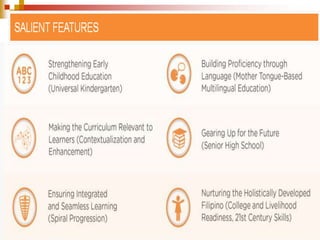
 Every Filipino child now has access to 
early childhood education through 
Universal Kindergarten. At 5 years old, 
children start schooling and are given the 
means to slowly adjust to formal 
education.
 Research shows that children who 
underwent Kindergarten have better 
completion rates than those who did not. 
Children who complete a standards-based 
Kindergarten program are better prepared, 
for primary education.
 Education for children in the early years 
lays the foundation for lifelong learning 
and for the total development of a child. 
The early years of a human being, from 0 
to 6 years, are the most critical period 
when the brain grows to at least 60-70 
percent of adult size..[Ref: K to 12 Toolkit]
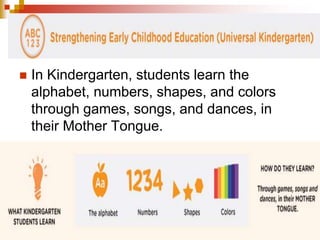
 In Kindergarten, students learn the 
alphabet, numbers, shapes, and colors 
through games, songs, and dances, in 
their Mother Tongue.
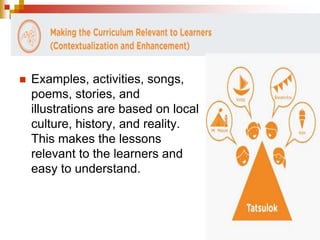
 Examples, activities, songs, 
poems, stories, and 
illustrations are based on local 
culture, history, and reality. 
This makes the lessons 
relevant to the learners and 
easy to understand.
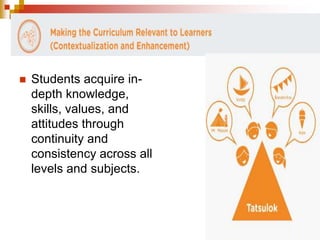
 Students acquire in-depth 
knowledge, 
skills, values, and 
attitudes through 
continuity and 
consistency across all 
levels and subjects.
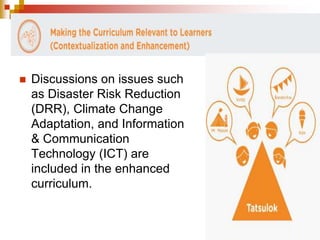
 Discussions on issues such 
as Disaster Risk Reduction 
(DRR), Climate Change 
Adaptation, and Information 
& Communication 
Technology (ICT) are 
included in the enhanced 
curriculum.
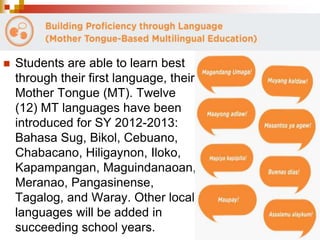
 Students are able to learn best 
through their first language, their 
Mother Tongue (MT). Twelve 
(12) MT languages have been 
introduced for SY 2012-2013: 
Bahasa Sug, Bikol, Cebuano, 
Chabacano, Hiligaynon, Iloko, 
Kapampangan, Maguindanaoan, 
Meranao, Pangasinense, 
Tagalog, and Waray. Other local 
languages will be added in 
succeeding school years.
 Aside from the Mother Tongue, 
English and Filipino are taught 
as subjects starting Grade 1, 
with a focus on oral fluency. 
From Grades 4 to 6, English 
and Filipino are gradually 
introduced as languages of 
instruction. Both will become 
primary languages of 
instruction in Junior High 
School (JHS) and Senior High 
School (SHS).
 After Grade 1, every 
student can read in his 
or her Mother Tongue. 
Learning in Mother 
Tongue also serves as 
the foundation for 
students to learn Filipino 
and English easily.
 Subjects are taught from the simplest concepts to 
more complicated concepts through grade levels in 
spiral progression. As early as elementary, students 
gain knowledge in areas such as Biology, Geometry, 
Earth Science, Chemistry, and Algebra. This ensures 
a mastery of knowledge and skills after each level. 
 For example, currently in High School, Biology is 
taught in 2nd Year, Chemistry in 3rd Year, and 
Physics in 4th Year. In K to 12, these subjects are 
connected and integrated from Grades 7 to 10. This 
same method is used in other Learning Areas like 
Math.
 Senior High School is two years of 
specialized upper secondary education; 
students may choose a specialization 
based on aptitude, interests, and school 
capacity. The choice of career track will 
define the content of the subjects a 
student will take in Grades 11 and 12. 
SHS subjects fall under either the Core 
Curriculum or specific Tracks.
Core Curriculum 
 There are seven Learning Areas under the 
Core Curriculum. These are Languages, 
Literature, Communication, Mathematics, 
Philosophy, Natural Sciences, and Social 
Sciences. Current content from some 
General Education subjects are embedded 
in the SHS curriculum.
Tracks 
 Each student in Senior High School can choose 
among three tracks: Academic; Technical- 
Vocational-Livelihood; and Sports and Arts. The 
Academic track includes three strands: Business, 
Accountancy, Management (BAM); Humanities, 
Education, Social Sciences (HESS); and Science, 
Technology, Engineering, Mathematics (STEM). 
 Students undergo immersion, which may include 
earn-while-you-learn opportunities, to provide them 
relevant exposure and actual experience in their 
chosen track.
TVET (Technical Vocational Education & 
Training) National Certificate 
 After finishing Grade 10, a student can obtain 
Certificates of Competency (COC) or a National 
Certificate Level I (NC I). After finishing a Technical- 
Vocational-Livelihood track in Grade 12, a student 
may obtain a National Certificate Level II (NC II), 
provided he/she passes the competency-based 
assessment of the Technical Education and Skills 
Development Authority (TESDA). 
 NC I and NC II improves employability of graduates 
in fields like Agriculture, Electronics, and Trade.
Modeling Best Practices for Senior High 
School 
 In SY 2012-2013, there are 33 public high schools, 
public technical-vocational high schools, and higher 
education institutions (HEIs) that have implemented 
Grade 11. This is a Research and Design (R&D) 
program to simulate different aspects of Senior High 
School in preparation for full nationwide 
implementation in SY 2016-2017. Modeling programs 
offered by these schools are based on students’ 
interests, community needs, and their respective 
capacities.
Nurturing the Holistically Developed Filipino 
(College and Livelihood Readiness, 21st Century 
Skills) 
 After going through Kindergarten, the enhanced Elementary 
and Junior High curriculum, and a specialized Senior High 
program, every K to 12 graduate will be ready to go into 
different paths – may it be further education, employment, or 
entrepreneurship. 
 Every graduate will be equipped with: 
 Information, media and technology skills, 
 Learning and innovation skills, 
 Effective communication skills, and 
 Life and career skills.
 Program implementation in public schools 
is being done in phases starting SY 2012– 
2013. Grade 1 entrants in SY 2012–2013 
are the first batch to fully undergo the 
program, and current 1st year Junior High 
School students (or Grade 7) are the first 
to undergo the enhanced secondary 
education program. To facilitate the 
transition from the existing 10-year basic 
education to 12 years, DepEd is also 
implementing the SHS and SHS Modeling.
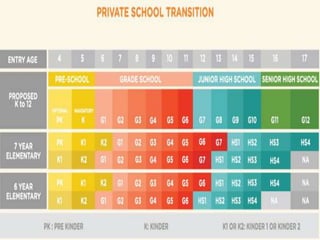
 Private schools craft their transition plans 
based on: 
(1) current/previous entry ages for Grade 1 
and final year of Kinder 
(2) duration of program , and most 
importantly 
(3) content of curriculum offered.
K to 12 Concerns 
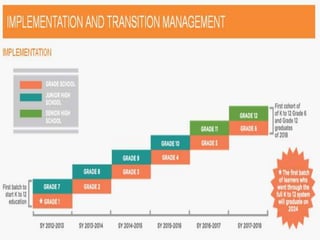
 Universal Kindergarten began in SY 2011–2012. 
 The enhanced curriculum for Grade 1 and Grade 7 
(1st Year Junior High School) was rolled out this 
SY 2012–2013, and will be progressively 
introduced in the other grade levels in succeeding 
school years. 
 Grade 11 will be introduced in SY 2016–2017 and 
Grade 12 in SY 2017–2018. 
 The first batch of high school students to go 
through K to 12 will graduate in March 2018.
Where will the additional two years be 
added? 
 The two years will be added after the four-year 
high school program. This will be 
called Senior High School.
Why are we implementing 12 years of basic 
education and not 11 years? 
 A 12-year program is found to be the adequate 
period for learning under basic education. It is also a 
standard for recognition of students and/or 
professionals abroad 
 Other countries like Singapore have 11 years of 
compulsory education, but have 12 to 14 years of 
pre-university education, depending on the track. 
 The Philippines is the last country in Asia and one of 
only three countries worldwide (the other two being 
Angola and Djibouti) with a 10-year pre-university 
cycle.
How will K to 12 help in ensuring employment for our 
graduates? 
 The K to 12 Basic Education Curriculum will be sufficient to 
prepare students for work. 
 The curriculum will enable students to acquire Certificates of 
Competency (COCs) and National Certifications (NCs). This 
will be in accordance with TESDA Training Regulations. This 
will allow graduates to have middle-level skills and will offer 
them better opportunities to be gainfully employed or become 
entrepreneurs. 
 There will be a school–industry partnership for technical– 
vocational courses to allow students to gain work experience 
while studying and offer the opportunity to be absorbed by the 
companies.
What would be the assurance that K to 12 graduates will 
be employed? 
 DepEd has entered into an agreement with business 
organizations, local and foreign chambers of commerce, 
and industries to ensure that graduates of K to 12 will be 
considered for employment. 
 There will be a matching of competency requirements and 
standards so that 12-year basic education graduates will 
have the necessary skills needed to join the workforce and 
to match the College Readiness Standards for further 
education and future employment. 
 Entrepreneurship will also be fostered in the enhanced 
curriculum, ensuring graduates can venture into other 
opportunities beyond employment.
How will the K to 12 Program help working students (college 
level)? 
 DepEd is in collaboration with the Commission on Higher Education (CHED) 
to provide more opportunities for working students to attend classes. 
 DepEd is working with the Department of Labor and Employment (DOLE) to 
ensure that jobs will be available to K to 12 graduates and that consideration 
will be given to working students. 
How will the K to 12 Program help students intending to 
pursue higher education? 
 The K to 12 Basic Education Curriculum is in accordance with the College 
Readiness Standards of CHED, which sets the skills and competencies 
required of K to 12 graduates who intend to pursue higher education.
What will happen to colleges and universities during the 
initial nationwide implementation of Senior High 
School in SY 2016–2017 and SY 2017–2018? 
 To manage the initial implementation of the K to 12 Program and 
mitigate the expected multi-year low enrolment turnout for colleges, 
universities, and Technical-Vocational Institutions (TVI) starting SY 
2016-2017, DepEd shall engage in partnerships with them to use their 
existing facilities and teaching staff. This ensures that during the 
transition period, the reduction in enrollment in these colleges and 
universities may be offset. 
Where will Senior High School be implemented? 
 Existing public schools may implement Senior High School. DepEd 
will be in partnerships with CHED, TESDA, and private schools to use 
their facilities, especially for the transition years. In addition, new 
standalone Senior High Schools will be built.
How will DepEd recruit enough teachers for SY 2016- 
2017 onwards? 
 With the continuous increase of the DepEd budget, more 
teachers are being hired to fill all necessary gaps in 
schools. 
 To aid transition, hiring of (1) graduates of Science, 
Mathematics, Statistics, Engineering, and other specialists 
in subjects with a shortage of qualified Licensure 
Examination for Teachers (LET) applicants, (2) graduates 
of Technical-Vocational courses, (3) Higher Education 
Institution faculty, and (4) Practitioners will be allowed.
 How will K to 12 affect the college 
curriculum? 
 The college General Education Curriculum 
is being revised. It will have fewer units 
with the removal of unnecessary 
remediation as K to 12 graduates adhere 
to the College Readiness Standards. With 
K to 12, the college curriculum will 
comprise of a year’s worth of General 
Education subjects and at least two years 
of major subjects.
Philippines k12 education

Philippines k12 education

  • 2.
    The K to12 Program covers Kindergarten and 12 years of basic education (six years of primary education, four years of Junior High School, and two years of Senior High School [SHS]) to provide sufficient time for mastery of concepts and skills, develop lifelong learners, and prepare graduates for tertiary education, middle-level skills development, employment, and entrepreneurship.
  • 5.
     Every Filipinochild now has access to early childhood education through Universal Kindergarten. At 5 years old, children start schooling and are given the means to slowly adjust to formal education.
  • 6.
     Research showsthat children who underwent Kindergarten have better completion rates than those who did not. Children who complete a standards-based Kindergarten program are better prepared, for primary education.
  • 7.
     Education forchildren in the early years lays the foundation for lifelong learning and for the total development of a child. The early years of a human being, from 0 to 6 years, are the most critical period when the brain grows to at least 60-70 percent of adult size..[Ref: K to 12 Toolkit]
  • 8.
     In Kindergarten,students learn the alphabet, numbers, shapes, and colors through games, songs, and dances, in their Mother Tongue.
  • 9.
     Examples, activities,songs, poems, stories, and illustrations are based on local culture, history, and reality. This makes the lessons relevant to the learners and easy to understand.
  • 10.
     Students acquirein-depth knowledge, skills, values, and attitudes through continuity and consistency across all levels and subjects.
  • 11.
     Discussions onissues such as Disaster Risk Reduction (DRR), Climate Change Adaptation, and Information & Communication Technology (ICT) are included in the enhanced curriculum.
  • 12.
     Students areable to learn best through their first language, their Mother Tongue (MT). Twelve (12) MT languages have been introduced for SY 2012-2013: Bahasa Sug, Bikol, Cebuano, Chabacano, Hiligaynon, Iloko, Kapampangan, Maguindanaoan, Meranao, Pangasinense, Tagalog, and Waray. Other local languages will be added in succeeding school years.
  • 13.
     Aside fromthe Mother Tongue, English and Filipino are taught as subjects starting Grade 1, with a focus on oral fluency. From Grades 4 to 6, English and Filipino are gradually introduced as languages of instruction. Both will become primary languages of instruction in Junior High School (JHS) and Senior High School (SHS).
  • 14.
     After Grade1, every student can read in his or her Mother Tongue. Learning in Mother Tongue also serves as the foundation for students to learn Filipino and English easily.
  • 15.
     Subjects aretaught from the simplest concepts to more complicated concepts through grade levels in spiral progression. As early as elementary, students gain knowledge in areas such as Biology, Geometry, Earth Science, Chemistry, and Algebra. This ensures a mastery of knowledge and skills after each level.  For example, currently in High School, Biology is taught in 2nd Year, Chemistry in 3rd Year, and Physics in 4th Year. In K to 12, these subjects are connected and integrated from Grades 7 to 10. This same method is used in other Learning Areas like Math.
  • 16.
     Senior HighSchool is two years of specialized upper secondary education; students may choose a specialization based on aptitude, interests, and school capacity. The choice of career track will define the content of the subjects a student will take in Grades 11 and 12. SHS subjects fall under either the Core Curriculum or specific Tracks.
  • 17.
    Core Curriculum There are seven Learning Areas under the Core Curriculum. These are Languages, Literature, Communication, Mathematics, Philosophy, Natural Sciences, and Social Sciences. Current content from some General Education subjects are embedded in the SHS curriculum.
  • 18.
    Tracks  Eachstudent in Senior High School can choose among three tracks: Academic; Technical- Vocational-Livelihood; and Sports and Arts. The Academic track includes three strands: Business, Accountancy, Management (BAM); Humanities, Education, Social Sciences (HESS); and Science, Technology, Engineering, Mathematics (STEM).  Students undergo immersion, which may include earn-while-you-learn opportunities, to provide them relevant exposure and actual experience in their chosen track.
  • 19.
    TVET (Technical VocationalEducation & Training) National Certificate  After finishing Grade 10, a student can obtain Certificates of Competency (COC) or a National Certificate Level I (NC I). After finishing a Technical- Vocational-Livelihood track in Grade 12, a student may obtain a National Certificate Level II (NC II), provided he/she passes the competency-based assessment of the Technical Education and Skills Development Authority (TESDA).  NC I and NC II improves employability of graduates in fields like Agriculture, Electronics, and Trade.
  • 20.
    Modeling Best Practicesfor Senior High School  In SY 2012-2013, there are 33 public high schools, public technical-vocational high schools, and higher education institutions (HEIs) that have implemented Grade 11. This is a Research and Design (R&D) program to simulate different aspects of Senior High School in preparation for full nationwide implementation in SY 2016-2017. Modeling programs offered by these schools are based on students’ interests, community needs, and their respective capacities.
  • 21.
    Nurturing the HolisticallyDeveloped Filipino (College and Livelihood Readiness, 21st Century Skills)  After going through Kindergarten, the enhanced Elementary and Junior High curriculum, and a specialized Senior High program, every K to 12 graduate will be ready to go into different paths – may it be further education, employment, or entrepreneurship.  Every graduate will be equipped with:  Information, media and technology skills,  Learning and innovation skills,  Effective communication skills, and  Life and career skills.
  • 23.
     Program implementationin public schools is being done in phases starting SY 2012– 2013. Grade 1 entrants in SY 2012–2013 are the first batch to fully undergo the program, and current 1st year Junior High School students (or Grade 7) are the first to undergo the enhanced secondary education program. To facilitate the transition from the existing 10-year basic education to 12 years, DepEd is also implementing the SHS and SHS Modeling.
  • 25.
     Private schoolscraft their transition plans based on: (1) current/previous entry ages for Grade 1 and final year of Kinder (2) duration of program , and most importantly (3) content of curriculum offered.
  • 27.
    K to 12Concerns  Universal Kindergarten began in SY 2011–2012.  The enhanced curriculum for Grade 1 and Grade 7 (1st Year Junior High School) was rolled out this SY 2012–2013, and will be progressively introduced in the other grade levels in succeeding school years.  Grade 11 will be introduced in SY 2016–2017 and Grade 12 in SY 2017–2018.  The first batch of high school students to go through K to 12 will graduate in March 2018.
  • 28.
    Where will theadditional two years be added?  The two years will be added after the four-year high school program. This will be called Senior High School.
  • 29.
    Why are weimplementing 12 years of basic education and not 11 years?  A 12-year program is found to be the adequate period for learning under basic education. It is also a standard for recognition of students and/or professionals abroad  Other countries like Singapore have 11 years of compulsory education, but have 12 to 14 years of pre-university education, depending on the track.  The Philippines is the last country in Asia and one of only three countries worldwide (the other two being Angola and Djibouti) with a 10-year pre-university cycle.
  • 30.
    How will Kto 12 help in ensuring employment for our graduates?  The K to 12 Basic Education Curriculum will be sufficient to prepare students for work.  The curriculum will enable students to acquire Certificates of Competency (COCs) and National Certifications (NCs). This will be in accordance with TESDA Training Regulations. This will allow graduates to have middle-level skills and will offer them better opportunities to be gainfully employed or become entrepreneurs.  There will be a school–industry partnership for technical– vocational courses to allow students to gain work experience while studying and offer the opportunity to be absorbed by the companies.
  • 31.
    What would bethe assurance that K to 12 graduates will be employed?  DepEd has entered into an agreement with business organizations, local and foreign chambers of commerce, and industries to ensure that graduates of K to 12 will be considered for employment.  There will be a matching of competency requirements and standards so that 12-year basic education graduates will have the necessary skills needed to join the workforce and to match the College Readiness Standards for further education and future employment.  Entrepreneurship will also be fostered in the enhanced curriculum, ensuring graduates can venture into other opportunities beyond employment.
  • 32.
    How will theK to 12 Program help working students (college level)?  DepEd is in collaboration with the Commission on Higher Education (CHED) to provide more opportunities for working students to attend classes.  DepEd is working with the Department of Labor and Employment (DOLE) to ensure that jobs will be available to K to 12 graduates and that consideration will be given to working students. How will the K to 12 Program help students intending to pursue higher education?  The K to 12 Basic Education Curriculum is in accordance with the College Readiness Standards of CHED, which sets the skills and competencies required of K to 12 graduates who intend to pursue higher education.
  • 33.
    What will happento colleges and universities during the initial nationwide implementation of Senior High School in SY 2016–2017 and SY 2017–2018?  To manage the initial implementation of the K to 12 Program and mitigate the expected multi-year low enrolment turnout for colleges, universities, and Technical-Vocational Institutions (TVI) starting SY 2016-2017, DepEd shall engage in partnerships with them to use their existing facilities and teaching staff. This ensures that during the transition period, the reduction in enrollment in these colleges and universities may be offset. Where will Senior High School be implemented?  Existing public schools may implement Senior High School. DepEd will be in partnerships with CHED, TESDA, and private schools to use their facilities, especially for the transition years. In addition, new standalone Senior High Schools will be built.
  • 34.
    How will DepEdrecruit enough teachers for SY 2016- 2017 onwards?  With the continuous increase of the DepEd budget, more teachers are being hired to fill all necessary gaps in schools.  To aid transition, hiring of (1) graduates of Science, Mathematics, Statistics, Engineering, and other specialists in subjects with a shortage of qualified Licensure Examination for Teachers (LET) applicants, (2) graduates of Technical-Vocational courses, (3) Higher Education Institution faculty, and (4) Practitioners will be allowed.
  • 35.
     How willK to 12 affect the college curriculum?  The college General Education Curriculum is being revised. It will have fewer units with the removal of unnecessary remediation as K to 12 graduates adhere to the College Readiness Standards. With K to 12, the college curriculum will comprise of a year’s worth of General Education subjects and at least two years of major subjects.