Teacher : Pupil Ratio
Comparison
COUNTRY ELEMENTARY LOWER SECONDARY
Indonesia 24:1 17.6:1
Japan 23.1 17 : 1
Laos 20:1 17 : 1
Malaysia 21 : 1
45 : 1
27 : 1
Philippines
South Korea
Thailand 21.5 : 1 21.5 : 1
Vietnam 30.1 : 1 30.1 : 1
Selected Asian Country Comparison, Teacher : Pupil
Ratio
Shortages...
Shortages….
Shortages
2001-2002 2002-2003 2003-2004 2004-2005 2005-2006
Classrooms 8,443 12,470 44,716 51,947 57,930
Seats 2,108,173 1,886,499 4.87M 4.56M 3.48M
Textbook --- --- 24.22M 34.7M ---
Teachers 37,932 35,818 46,356 38,535 49,699
Classrooms, Seats , Textbooks, and Teachers
Shortages
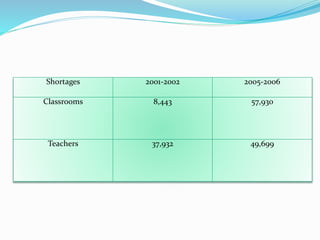
Shortages 2001-2002 2005-2006
Classrooms 8,443 57,930
Teachers 37,932 49,699
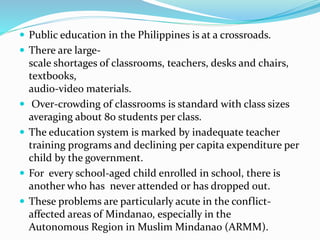
 Public education in the Philippines is at a crossroads.
 There are large-
scale shortages of classrooms, teachers, desks and chairs,
textbooks,
audio-video materials.
 Over-crowding of classrooms is standard with class sizes
averaging about 80 students per class.
 The education system is marked by inadequate teacher
training programs and declining per capita expenditure per
child by the government.
 For every school-aged child enrolled in school, there is
another who has never attended or has dropped out.
 These problems are particularly acute in the conflict-
affected areas of Mindanao, especially in the
Autonomous Region in Muslim Mindanao (ARMM).
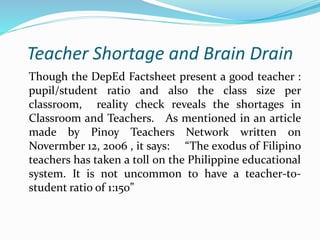
Teacher Shortage and Brain Drain
Though the DepEd Factsheet present a good teacher :
pupil/student ratio and also the class size per
classroom, reality check reveals the shortages in
Classroom and Teachers. As mentioned in an article
made by Pinoy Teachers Network written on
Novermber 12, 2006 , it says: “The exodus of Filipino
teachers has taken a toll on the Philippine educational
system. It is not uncommon to have a teacher-to-
student ratio of 1:150”
Living Salary Gap
Entry Level Salary of Philippine Teachers.
Year
SALARY
Level : Teacher 1
Cost of Living Living Salary Gap
1998 P8,605 P13,438.80 P4,833.80
1999 P8,605 P13,825.50 P5,220.50
2000 P9,466 P14,825.50 P6,359.10
2001 P9,939 P15,174.30 P5,235.30
2002 P9,939 P15,975.90 P6,036.90
2004 P9,939 P18,069.30 P8,130.30
Family Living Salary
1st Quarter 2006
P19,950 ()
P16,3344 (National)
(P665/day; P544.80/day – IBON Facts and Figures)
Teacher Exodus
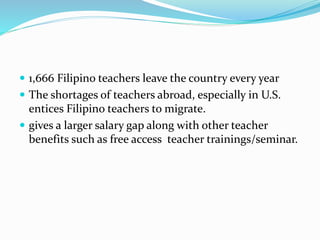
 1,666 Filipino teachers leave the country every year
 The shortages of teachers abroad, especially in U.S.
entices Filipino teachers to migrate.
 gives a larger salary gap along with other teacher
benefits such as free access teacher trainings/seminar.
COUNTRY Average
Net Income in US$
Weekly Hours
Work Requirement
United States $ 4,055 36.6
United Kingdom $ 3,568 32.5
Australia $ 2,742 39.1
Canada $ 2,236 31.1
Japan $ 2,961 No data
South Korea $ 2,096 39.7
Thailand $ 388 38.0
Philippines $ 237 40.0
2005 Teacher’s Income Comparison with Selected
Countries
Rapid Population Growth
 Philippines official population count as of 2012
is 103,775,002.
 More than 30% of the population is found at NCR,
CALABARZON, and Central Luzon.
 If we are to continue our present teacher : pupil ratio
which is 1 : 45, the government should strictly
consider addressing the present shortages in
classroom and teachers with due additional buffer for
the 1.81 Million new students annually (1.81Million is
the actual new borns per year).
National Toilet Bowl to Pupil
Ratio
 Toilet, as a basic facility is a must have for all
establishments be they public or private in nature.
 Quoted below is the article written in Inquirer, a top
Media Corporation in the country.
“The national toilet bowl to pupil ratio stands at 1:51 in
primary schools and 1:102 in secondary schools. In the
ARMM, it’s 1:171 in the elementary level and 1:250 in the
secondary level while in NCR, it’s 1:114 and 1:143,
respectively…..…. … Take the case of Silangan Elementary
School (Annex) in Taguig, Metro Manila. Last year, all
2,031 students enrolled in that school were provided
with one toilet bowl. That’s a toilet bowl to pupil ratio of
1:2,031.”
School Violence
 What parents can do? – pay attention to subtle and
overt changes in their children
 What teachers can do? – talk to parents, enforcing
school policies, bring concerns to guidance
councilors
 What students can do? – refuse to succumb to
negative peer preasure
Ten Ways to Prevent School Violence
 Take responsibility
 Don’t allow prejudice or stereotypes
 Listen to idle chatter
 Get involved with students
 Educate oneself on danger signs
 Discuss violence prevention
 Encourage them to talk
 Teach conflict resolution
 Get parents involved
 Take part in school wide initiatives
Alarming Increase of Drop-out and
Out of School Youth
Education Level AY 2002-2003 AY 2006-2007
Elementary 90.29% 83.22%
High School 59.00% 58.59%
Participation Rate
Education Level AY 2002-2003 AY 2006-2007
Elementary 71.55% 71.72%
High School 74.81% 72.14%
Completion Rate
Drop-out
 There were 75 million children who are not still
enrolled in primary school, over a third of children
dropped out before completing primary school.
Determinants
 Home Environment
 School Environment
 Social Environment
Prevention
o Organizational measures
o Pedagogical measures
o Incentives
o Community participation
o Non-formal education
Out of School Youth
Reasons
Incapable government
Poverty
Unsupportable parents
Bad peer pressure
Bad vices
Distant parents
Child labor
Bad environment
Tescher factor
Laziness
OPPORTUNITY COST OF
SCHOOLING
 parents face a trade-ff between household
consumption now and children's expected
future income
Gender and Equity Issues
Cultural and Religious Attitudes
School Effectiveness
K to 12
Pros
 “Enhancing the quality of basic education in the Philippines is
urgent and critical.”
 “The congested curriculum partly explains the present state of
education.”
 “This quality of education is reflected in the inadequate
preparation of high school graduates for the world of work or
entrepreneurship or higher education.”
 “Most graduates are too young to enter the labor force.”
 “The current system also reinforces the misperception that basic
education is just a preparatory step for higher education.”
 “The short duration of the basic education program also puts the
millions of overseas Filipino workers , at a disadvantage.
 “The short basic education program affects the human
development of the Filipino children.”
Cons
 Parents have to shell out more money .
 The government does not have the money to pay for two more
years of free education, since it does not even have the money to
fully support today’s ten years.
 We can do in ten years what everyone else in the world takes 12
years to do.
 As far as the curriculum is concerned, DepEd should fix the
current subjects instead of adding new ones.
 A high school diploma will not get anybody anywhere, because
business firms will not hire fresh high school graduates.
 Every family dreams of having a child graduate from college.
 While students are stuck in Grades 11 and 12, colleges and
universities will have no freshmen for two years.
 The drop-out rate will increase because of the two extra years.

Issues and Problems in the Philippine Basic Education

  • 2.
    Teacher : PupilRatio Comparison
  • 3.
    COUNTRY ELEMENTARY LOWERSECONDARY Indonesia 24:1 17.6:1 Japan 23.1 17 : 1 Laos 20:1 17 : 1 Malaysia 21 : 1 45 : 1 27 : 1 Philippines South Korea Thailand 21.5 : 1 21.5 : 1 Vietnam 30.1 : 1 30.1 : 1 Selected Asian Country Comparison, Teacher : Pupil Ratio
  • 4.
  • 5.
    Shortages 2001-2002 2002-2003 2003-20042004-2005 2005-2006 Classrooms 8,443 12,470 44,716 51,947 57,930 Seats 2,108,173 1,886,499 4.87M 4.56M 3.48M Textbook --- --- 24.22M 34.7M --- Teachers 37,932 35,818 46,356 38,535 49,699 Classrooms, Seats , Textbooks, and Teachers Shortages
  • 6.
    Shortages 2001-2002 2005-2006 Classrooms8,443 57,930 Teachers 37,932 49,699
  • 7.
     Public educationin the Philippines is at a crossroads.  There are large- scale shortages of classrooms, teachers, desks and chairs, textbooks, audio-video materials.  Over-crowding of classrooms is standard with class sizes averaging about 80 students per class.  The education system is marked by inadequate teacher training programs and declining per capita expenditure per child by the government.  For every school-aged child enrolled in school, there is another who has never attended or has dropped out.  These problems are particularly acute in the conflict- affected areas of Mindanao, especially in the Autonomous Region in Muslim Mindanao (ARMM).
  • 8.
    Teacher Shortage andBrain Drain Though the DepEd Factsheet present a good teacher : pupil/student ratio and also the class size per classroom, reality check reveals the shortages in Classroom and Teachers. As mentioned in an article made by Pinoy Teachers Network written on Novermber 12, 2006 , it says: “The exodus of Filipino teachers has taken a toll on the Philippine educational system. It is not uncommon to have a teacher-to- student ratio of 1:150”
  • 9.
  • 10.
    Entry Level Salaryof Philippine Teachers. Year SALARY Level : Teacher 1 Cost of Living Living Salary Gap 1998 P8,605 P13,438.80 P4,833.80 1999 P8,605 P13,825.50 P5,220.50 2000 P9,466 P14,825.50 P6,359.10 2001 P9,939 P15,174.30 P5,235.30 2002 P9,939 P15,975.90 P6,036.90 2004 P9,939 P18,069.30 P8,130.30
  • 11.
    Family Living Salary 1stQuarter 2006 P19,950 () P16,3344 (National) (P665/day; P544.80/day – IBON Facts and Figures)
  • 12.
  • 13.
     1,666 Filipinoteachers leave the country every year  The shortages of teachers abroad, especially in U.S. entices Filipino teachers to migrate.  gives a larger salary gap along with other teacher benefits such as free access teacher trainings/seminar.
  • 14.
    COUNTRY Average Net Incomein US$ Weekly Hours Work Requirement United States $ 4,055 36.6 United Kingdom $ 3,568 32.5 Australia $ 2,742 39.1 Canada $ 2,236 31.1 Japan $ 2,961 No data South Korea $ 2,096 39.7 Thailand $ 388 38.0 Philippines $ 237 40.0 2005 Teacher’s Income Comparison with Selected Countries
  • 15.
    Rapid Population Growth Philippines official population count as of 2012 is 103,775,002.  More than 30% of the population is found at NCR, CALABARZON, and Central Luzon.  If we are to continue our present teacher : pupil ratio which is 1 : 45, the government should strictly consider addressing the present shortages in classroom and teachers with due additional buffer for the 1.81 Million new students annually (1.81Million is the actual new borns per year).
  • 16.
    National Toilet Bowlto Pupil Ratio
  • 17.
     Toilet, asa basic facility is a must have for all establishments be they public or private in nature.  Quoted below is the article written in Inquirer, a top Media Corporation in the country. “The national toilet bowl to pupil ratio stands at 1:51 in primary schools and 1:102 in secondary schools. In the ARMM, it’s 1:171 in the elementary level and 1:250 in the secondary level while in NCR, it’s 1:114 and 1:143, respectively…..…. … Take the case of Silangan Elementary School (Annex) in Taguig, Metro Manila. Last year, all 2,031 students enrolled in that school were provided with one toilet bowl. That’s a toilet bowl to pupil ratio of 1:2,031.”
  • 18.
    School Violence  Whatparents can do? – pay attention to subtle and overt changes in their children  What teachers can do? – talk to parents, enforcing school policies, bring concerns to guidance councilors  What students can do? – refuse to succumb to negative peer preasure
  • 19.
    Ten Ways toPrevent School Violence  Take responsibility  Don’t allow prejudice or stereotypes  Listen to idle chatter  Get involved with students  Educate oneself on danger signs  Discuss violence prevention  Encourage them to talk  Teach conflict resolution  Get parents involved  Take part in school wide initiatives
  • 20.
    Alarming Increase ofDrop-out and Out of School Youth Education Level AY 2002-2003 AY 2006-2007 Elementary 90.29% 83.22% High School 59.00% 58.59% Participation Rate
  • 21.
    Education Level AY2002-2003 AY 2006-2007 Elementary 71.55% 71.72% High School 74.81% 72.14% Completion Rate
  • 22.
    Drop-out  There were75 million children who are not still enrolled in primary school, over a third of children dropped out before completing primary school.
  • 23.
    Determinants  Home Environment School Environment  Social Environment Prevention o Organizational measures o Pedagogical measures o Incentives o Community participation o Non-formal education
  • 24.
    Out of SchoolYouth Reasons Incapable government Poverty Unsupportable parents Bad peer pressure Bad vices Distant parents Child labor Bad environment Tescher factor Laziness
  • 25.
    OPPORTUNITY COST OF SCHOOLING parents face a trade-ff between household consumption now and children's expected future income
  • 26.
  • 27.
  • 28.
  • 29.
  • 30.
    Pros  “Enhancing thequality of basic education in the Philippines is urgent and critical.”  “The congested curriculum partly explains the present state of education.”  “This quality of education is reflected in the inadequate preparation of high school graduates for the world of work or entrepreneurship or higher education.”  “Most graduates are too young to enter the labor force.”  “The current system also reinforces the misperception that basic education is just a preparatory step for higher education.”  “The short duration of the basic education program also puts the millions of overseas Filipino workers , at a disadvantage.  “The short basic education program affects the human development of the Filipino children.”
  • 31.
    Cons  Parents haveto shell out more money .  The government does not have the money to pay for two more years of free education, since it does not even have the money to fully support today’s ten years.  We can do in ten years what everyone else in the world takes 12 years to do.  As far as the curriculum is concerned, DepEd should fix the current subjects instead of adding new ones.  A high school diploma will not get anybody anywhere, because business firms will not hire fresh high school graduates.  Every family dreams of having a child graduate from college.  While students are stuck in Grades 11 and 12, colleges and universities will have no freshmen for two years.  The drop-out rate will increase because of the two extra years.