Republic of the Philippines
Department of Education
Taguig and Pateros
PRES. DIOSDADO MACAPAGAL HIGH SCHOOL
Signal Village National High School-Annex
8th Stree, Barangay Katuparan, GHQ Village, Taguig City
UNDERSTANDING ORGANIZATIONAL
COMMITMENT AMONG TEACHERS
Kathleen C. Abaja
Faculty
Senior High School Department
SCOPE OF DISCUSSION
Definition of
Terms
commitmentcommitment
/k m tm( )nt/əˈ ɪ ə/k m tm( )nt/əˈ ɪ ə
mass nounmass noun The state or quality ofThe state or quality of
being dedicated to a cause, activity,being dedicated to a cause, activity,
etc.etc.
‘‘the company's commitment tothe company's commitment to
quality’quality’
https://en.oxforddictionaries.com/definition/commitment
TYPES OF
ORGANIZATION
AL
COMMITMENT
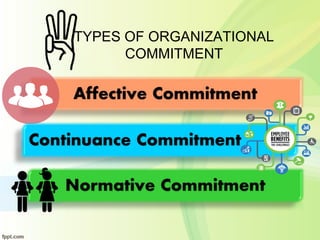
TYPES OF ORGANIZATIONAL
COMMITMENT
• A desire on the part of
a teacher to remain a
member of an
organization because
of an emotional
attachment to, or
involvement in, that
organization.
• I feel a strong sense of belonging to my school.
• I talk up this school to my friends as a great school
to work for.
• I would be very happy to spend the rest of my
career with this school.
• This school really ensures the very best in my way
of teaching.
• I am extremely glad that I chose this school to work
for.
AFFECTIVE COMMITMENT
• A desire on the part of
a teacher to remain a
member of an
organization because
of an awareness of the
costs associated with
leaving
•I have invested a great deal of effort/time so I
have to remain in my school.
•I have gained friends and established the
people's trust in this school.
•Much of my contribution is dedicated to this
school.
•I have fulfilled many of my accomplishments in
this school.
•I have devoted my life to this school.
• A desire on the part of a teacher to remain a
member of an organization because of a
feeling of obligation
• I am responsible on the students' conduct and discipline.
• I devote myself in putting a great deal of effort beyond what is
normally expected in order to help this school be successful.
• I am in-charge of developing the student's content knowledge
and academic skills to attain their full potentials.
• I am accountable on my students' welfare and on shaping
their future.
• I carry the load of inculcating the minds of my students how
to be responsible citizens of the society.
IMPORTANCE OF COMMITMENT
PDMHS VisionPDMHS Vision
To produce high schoolTo produce high school
graduates who are God-graduates who are God-
fearing, morally upright,fearing, morally upright,
socially responsible, creativesocially responsible, creative
thinker, civic-spirited and lifethinker, civic-spirited and life
skilled - a product of holisticskilled - a product of holistic
and innovative learning.and innovative learning.
KEY
STRATEGIES TO
INCREASE
ORGANIZATION
AL
COMMITMENT
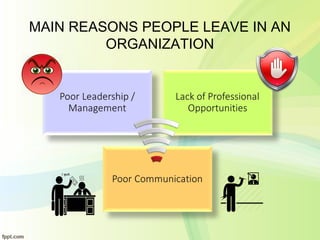
MAIN REASONS PEOPLE LEAVE IN AN
ORGANIZATION
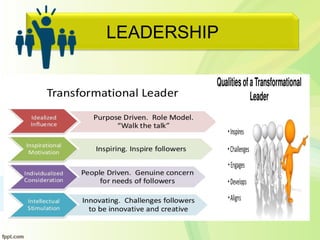
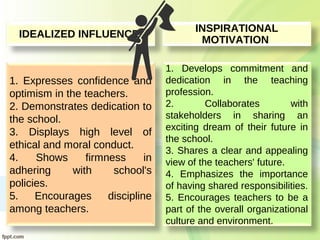
LEADERSHIP
1. Expresses confidence and
optimism in the teachers.
2. Demonstrates dedication to
the school.
3. Displays high level of
ethical and moral conduct.
4. Shows firmness in
adhering with school's
policies.
5. Encourages discipline
among teachers.
IDEALIZED INFLUENCE
1. Develops commitment and
dedication in the teaching
profession.
2. Collaborates with
stakeholders in sharing an
exciting dream of their future in
the school.
3. Shares a clear and appealing
view of the teachers' future.
4. Emphasizes the importance
of having shared responsibilities.
5. Encourages teachers to be a
part of the overall organizational
culture and environment.
INSPIRATIONAL
MOTIVATION
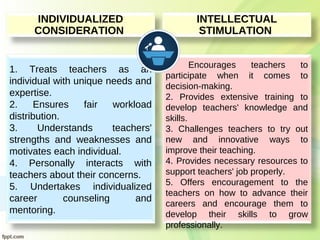
1. Treats teachers as an
individual with unique needs and
expertise.
2. Ensures fair workload
distribution.
3. Understands teachers'
strengths and weaknesses and
motivates each individual.
4. Personally interacts with
teachers about their concerns.
5. Undertakes individualized
career counseling and
mentoring.
INDIVIDUALIZED
CONSIDERATION
1. Encourages teachers to
participate when it comes to
decision-making.
2. Provides extensive training to
develop teachers' knowledge and
skills.
3. Challenges teachers to try out
new and innovative ways to
improve their teaching.
4. Provides necessary resources to
support teachers' job properly.
5. Offers encouragement to the
teachers on how to advance their
careers and encourage them to
develop their skills to grow
professionally.
INTELLECTUAL
STIMULATION
CONTINUING PROFESSIONAL TEACHER
DEVELOPMENT
Professional development is defined as
activities that develop an individual’s
skills, knowledge, expertise and other
characteristics as a teacher.
CONTINUING PROFESSIONAL TEACHER
DEVELOPMENT
TEACHER PRIORITY
ACTIVITIES
These are the activities
chosen by teachers
themselves for their own
growth and improvement.
Example: Understanding
Organizational Commitment
Among Teachers
SCHOOL PRIORITY
ACTIVITIES
These are the activities
undertaken by the school that
focus on school development
for the improvement of the
student’s academic learning.
Example: The Learning
Resources Management and
Development System
(LRMDS)
The professional development activities are grouped into two
categories:
CONTINUING PROFESSIONAL TEACHER
DEVELOPMENT
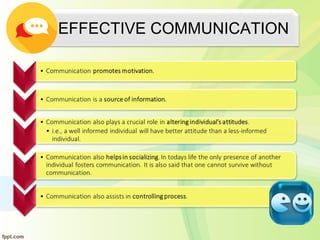
EFFECTIVE COMMUNICATION
UNDERSTANDING ORGANIZATIONAL COMMITMENT AMONG TEACHERS

UNDERSTANDING ORGANIZATIONAL COMMITMENT AMONG TEACHERS

  • 1.
    Republic of thePhilippines Department of Education Taguig and Pateros PRES. DIOSDADO MACAPAGAL HIGH SCHOOL Signal Village National High School-Annex 8th Stree, Barangay Katuparan, GHQ Village, Taguig City UNDERSTANDING ORGANIZATIONAL COMMITMENT AMONG TEACHERS Kathleen C. Abaja Faculty Senior High School Department
  • 2.
  • 3.
  • 6.
    commitmentcommitment /k m tm()nt/əˈ ɪ ə/k m tm( )nt/əˈ ɪ ə mass nounmass noun The state or quality ofThe state or quality of being dedicated to a cause, activity,being dedicated to a cause, activity, etc.etc. ‘‘the company's commitment tothe company's commitment to quality’quality’ https://en.oxforddictionaries.com/definition/commitment
  • 11.
  • 12.
  • 13.
    • A desireon the part of a teacher to remain a member of an organization because of an emotional attachment to, or involvement in, that organization.
  • 14.
    • I feela strong sense of belonging to my school. • I talk up this school to my friends as a great school to work for. • I would be very happy to spend the rest of my career with this school. • This school really ensures the very best in my way of teaching. • I am extremely glad that I chose this school to work for. AFFECTIVE COMMITMENT
  • 15.
    • A desireon the part of a teacher to remain a member of an organization because of an awareness of the costs associated with leaving
  • 16.
    •I have investeda great deal of effort/time so I have to remain in my school. •I have gained friends and established the people's trust in this school. •Much of my contribution is dedicated to this school. •I have fulfilled many of my accomplishments in this school. •I have devoted my life to this school.
  • 17.
    • A desireon the part of a teacher to remain a member of an organization because of a feeling of obligation
  • 18.
    • I amresponsible on the students' conduct and discipline. • I devote myself in putting a great deal of effort beyond what is normally expected in order to help this school be successful. • I am in-charge of developing the student's content knowledge and academic skills to attain their full potentials. • I am accountable on my students' welfare and on shaping their future. • I carry the load of inculcating the minds of my students how to be responsible citizens of the society.
  • 20.
  • 22.
    PDMHS VisionPDMHS Vision Toproduce high schoolTo produce high school graduates who are God-graduates who are God- fearing, morally upright,fearing, morally upright, socially responsible, creativesocially responsible, creative thinker, civic-spirited and lifethinker, civic-spirited and life skilled - a product of holisticskilled - a product of holistic and innovative learning.and innovative learning.
  • 25.
  • 26.
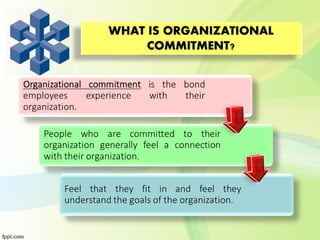
    MAIN REASONS PEOPLELEAVE IN AN ORGANIZATION
  • 27.
  • 28.
    1. Expresses confidenceand optimism in the teachers. 2. Demonstrates dedication to the school. 3. Displays high level of ethical and moral conduct. 4. Shows firmness in adhering with school's policies. 5. Encourages discipline among teachers. IDEALIZED INFLUENCE 1. Develops commitment and dedication in the teaching profession. 2. Collaborates with stakeholders in sharing an exciting dream of their future in the school. 3. Shares a clear and appealing view of the teachers' future. 4. Emphasizes the importance of having shared responsibilities. 5. Encourages teachers to be a part of the overall organizational culture and environment. INSPIRATIONAL MOTIVATION
  • 29.
    1. Treats teachersas an individual with unique needs and expertise. 2. Ensures fair workload distribution. 3. Understands teachers' strengths and weaknesses and motivates each individual. 4. Personally interacts with teachers about their concerns. 5. Undertakes individualized career counseling and mentoring. INDIVIDUALIZED CONSIDERATION 1. Encourages teachers to participate when it comes to decision-making. 2. Provides extensive training to develop teachers' knowledge and skills. 3. Challenges teachers to try out new and innovative ways to improve their teaching. 4. Provides necessary resources to support teachers' job properly. 5. Offers encouragement to the teachers on how to advance their careers and encourage them to develop their skills to grow professionally. INTELLECTUAL STIMULATION
  • 30.
    CONTINUING PROFESSIONAL TEACHER DEVELOPMENT Professionaldevelopment is defined as activities that develop an individual’s skills, knowledge, expertise and other characteristics as a teacher.
  • 31.
    CONTINUING PROFESSIONAL TEACHER DEVELOPMENT TEACHERPRIORITY ACTIVITIES These are the activities chosen by teachers themselves for their own growth and improvement. Example: Understanding Organizational Commitment Among Teachers SCHOOL PRIORITY ACTIVITIES These are the activities undertaken by the school that focus on school development for the improvement of the student’s academic learning. Example: The Learning Resources Management and Development System (LRMDS) The professional development activities are grouped into two categories:
  • 32.
  • 33.