TWO LEVEL VOLTAGE SOURCE CONVERTER
Presented By
FA13-R09-005 Muqadsa Iftikhar
FA13-R09-013 Zunaib Ali
FA13-R09-024 Madiha Naeem
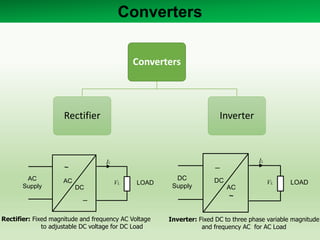
Converters
Converters
Rectifier Inverter
LOAD
AC
Supply
VL
IL
~
AC
DC
_
LOAD
DC
Supply
VL
IL
~
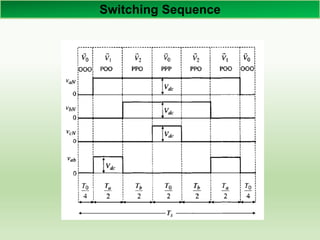
DC
AC
_
Inverter: Fixed DC to three phase variable magnitude
and frequency AC for AC Load
Rectifier: Fixed magnitude and frequency AC Voltage
to adjustable DC voltage for DC Load
Converters
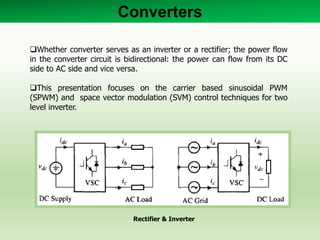
Whether converter serves as an inverter or a rectifier; the power flow
in the converter circuit is bidirectional: the power can flow from its DC
side to AC side and vice versa.
This presentation focuses on the carrier based sinusoidal PWM
(SPWM) and space vector modulation (SVM) control techniques for two
level inverter.
Rectifier & Inverter
Two Level VSC
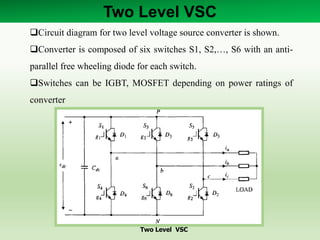
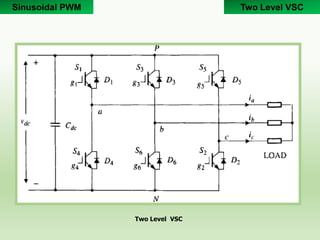
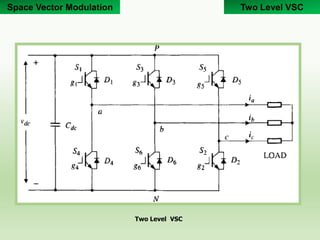
Circuit diagram for two level voltage source converter is shown.
Converter is composed of six switches S1, S2,…, S6 with an anti-
parallel free wheeling diode for each switch.
Switches can be IGBT, MOSFET depending on power ratings of
converter
Two Level VSC
Sinusoidal PWM
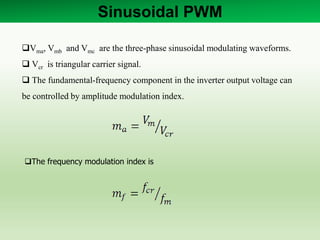
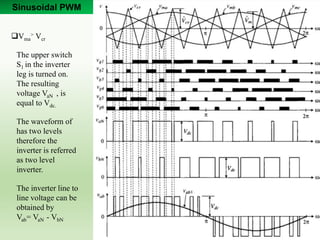
Vma, Vmb and Vmc are the three-phase sinusoidal modulating waveforms.
 Vcr is triangular carrier signal.
 The fundamental-frequency component in the inverter output voltage can
be controlled by amplitude modulation index.
The frequency modulation index is
Two Level VSC
Two Level VSC
Sinusoidal PWM
Sinusoidal PWM
Vma
> Vcr
The upper switch
S1 in the inverter
leg is turned on.
The resulting
voltage VaN , is
equal to Vdc.
The waveform of
has two levels
therefore the
inverter is referred
as two level
inverter.
The inverter line to
line voltage can be
obtained by
Vab= VaN - VbN
Sinusoidal PWM
Dead Time
To avoid possible short circuiting of upper and lower devices in an inverter leg a dead
time or blanking time should be implemented during which both the switches must be
turned off.
The switching frequency of the active switches in the two level inverter can be
found from fsw = fcr = fm * mf
The magnitude and frequency of fundamental component Vab1 can be independently
controlled by ma and fm
Sinusoidal PWM
Synchronous PWM
 Carrier frequency is varied in accordance with the modulating wave frequency (mf is
an integer)
 Can obtain desired number of pulses and also the optimum pulse width by varying
carrier frequency with modulating frequency, hence harmonics can easily be removed
Need digital circuits for implementation.
Asynchronous PWM
 Carrier frequency is fixed and independent of modulating wave frequency.
No control on number of pulses and also the pulse width as carrier frequency is fixed
hence harmonics are more.
Easily implemented using analogue circuits.
Space Vector Modulation
Space vector modulation is one of real time modulation techniques
Widely used in digital control of Voltage source converter
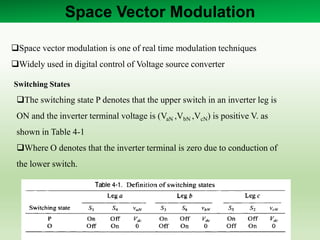
Switching States
The switching state P denotes that the upper switch in an inverter leg is
ON and the inverter terminal voltage is (VaN ,VbN ,VcN) is positive V. as
shown in Table 4-1
Where O denotes that the inverter terminal is zero due to conduction of
the lower switch.
Two Level VSC
Two Level VSC
Space Vector Modulation
Space Vector Relation with switching states
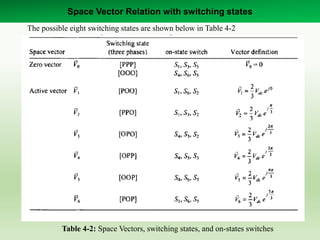
Table 4-2: Space Vectors, switching states, and on-states switches
The possible eight switching states are shown below in Table 4-2
Space Vector
Space Vectors
Among the eight switching
states, [PPP] and [OOO] are
zero states and the others are
called active states.
The active and zero
switching states can be
represented by active and zero
vectors, respectively.
Space vector diagram for
two-level inverter is shown
Six vectors V1 to V6 form
hexagon with six equal sectors
and zero vector V0 lies in
center of hexagon
Space Vector
Space Vectors
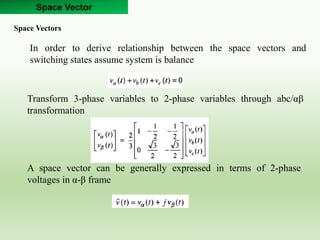
In order to derive relationship between the space vectors and
switching states assume system is balance
Transform 3-phase variables to 2-phase variables through abc/αβ
transformation
A space vector can be generally expressed in terms of 2-phase
voltages in α-β frame
Space Vector
For active switching state POO
Following the same procedure all the remaining 6 vectors can be
derived
Vref Will rotates in the space with the angular velocity
R
R R
N
Vdc
3
2
Vdc
3
1
Vdc
3
1
Space Vector
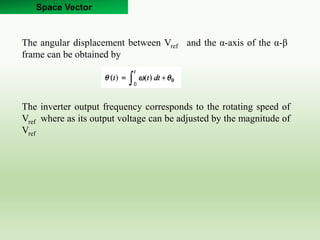
The inverter output frequency corresponds to the rotating speed of
Vref where as its output voltage can be adjusted by the magnitude of
Vref
The angular displacement between Vref and the α-axis of the α-β
frame can be obtained by
Space Vector
+
VDC
-
Vb
Va
Vc
S1 S3 S5
S4 S6 S2
N
R
R R
N
Vdc
3
2
Vdc
3
1
Vdc
3
1
For [POO] the Equivalent Circuit
Dwell Time Calculation
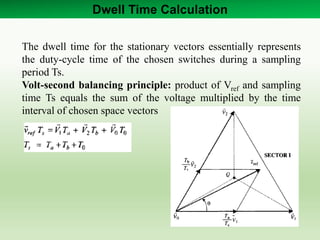
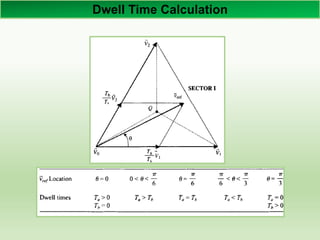
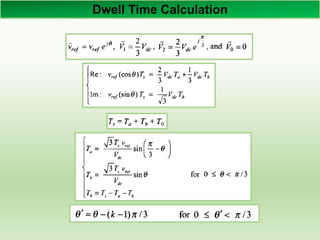
The dwell time for the stationary vectors essentially represents
the duty-cycle time of the chosen switches during a sampling
period Ts.
Volt-second balancing principle: product of Vref and sampling
time Ts equals the sum of the voltage multiplied by the time
interval of chosen space vectors
Dwell Time Calculation
Modulation Index
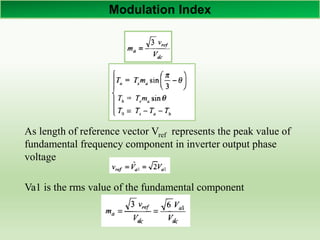
As length of reference vector Vref represents the peak value of
fundamental frequency component in inverter output phase
voltage
Va1 is the rms value of the fundamental component
Modulation Index
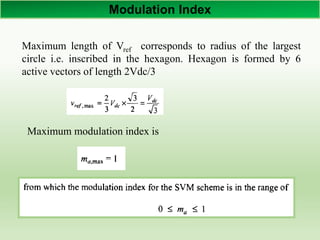
Maximum length of Vref corresponds to radius of the largest
circle i.e. inscribed in the hexagon. Hexagon is formed by 6
active vectors of length 2Vdc/3
Maximum modulation index is
Switching Sequence
The switching sequence for given Vref is not unique, but it
should satisfy the following two requirements for minimizing
the device switching frequency.
 the transition from one switching state to the next involves
only two switches in the same inverter leg, one being switched
on and other switched off
 the transition from Vref moving from one sector in the space
vector diagram to the next requires no or a minimum number of
switching.
Switching Sequence
Switching Sequence
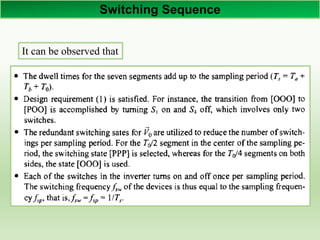
It can be observed that
Sinusoidal PWM and Space Vector Modulation For Two Level Voltage Source Converter

Sinusoidal PWM and Space Vector Modulation For Two Level Voltage Source Converter

  • 1.
    TWO LEVEL VOLTAGESOURCE CONVERTER Presented By FA13-R09-005 Muqadsa Iftikhar FA13-R09-013 Zunaib Ali FA13-R09-024 Madiha Naeem
  • 2.
    Converters Converters Rectifier Inverter LOAD AC Supply VL IL ~ AC DC _ LOAD DC Supply VL IL ~ DC AC _ Inverter: FixedDC to three phase variable magnitude and frequency AC for AC Load Rectifier: Fixed magnitude and frequency AC Voltage to adjustable DC voltage for DC Load
  • 3.
    Converters Whether converter servesas an inverter or a rectifier; the power flow in the converter circuit is bidirectional: the power can flow from its DC side to AC side and vice versa. This presentation focuses on the carrier based sinusoidal PWM (SPWM) and space vector modulation (SVM) control techniques for two level inverter. Rectifier & Inverter
  • 4.
    Two Level VSC Circuitdiagram for two level voltage source converter is shown. Converter is composed of six switches S1, S2,…, S6 with an anti- parallel free wheeling diode for each switch. Switches can be IGBT, MOSFET depending on power ratings of converter Two Level VSC
  • 5.
    Sinusoidal PWM Vma, Vmband Vmc are the three-phase sinusoidal modulating waveforms.  Vcr is triangular carrier signal.  The fundamental-frequency component in the inverter output voltage can be controlled by amplitude modulation index. The frequency modulation index is
  • 6.
    Two Level VSC TwoLevel VSC Sinusoidal PWM
  • 7.
    Sinusoidal PWM Vma > Vcr Theupper switch S1 in the inverter leg is turned on. The resulting voltage VaN , is equal to Vdc. The waveform of has two levels therefore the inverter is referred as two level inverter. The inverter line to line voltage can be obtained by Vab= VaN - VbN
  • 8.
    Sinusoidal PWM Dead Time Toavoid possible short circuiting of upper and lower devices in an inverter leg a dead time or blanking time should be implemented during which both the switches must be turned off. The switching frequency of the active switches in the two level inverter can be found from fsw = fcr = fm * mf The magnitude and frequency of fundamental component Vab1 can be independently controlled by ma and fm
  • 9.
    Sinusoidal PWM Synchronous PWM Carrier frequency is varied in accordance with the modulating wave frequency (mf is an integer)  Can obtain desired number of pulses and also the optimum pulse width by varying carrier frequency with modulating frequency, hence harmonics can easily be removed Need digital circuits for implementation. Asynchronous PWM  Carrier frequency is fixed and independent of modulating wave frequency. No control on number of pulses and also the pulse width as carrier frequency is fixed hence harmonics are more. Easily implemented using analogue circuits.
  • 10.
    Space Vector Modulation Spacevector modulation is one of real time modulation techniques Widely used in digital control of Voltage source converter Switching States The switching state P denotes that the upper switch in an inverter leg is ON and the inverter terminal voltage is (VaN ,VbN ,VcN) is positive V. as shown in Table 4-1 Where O denotes that the inverter terminal is zero due to conduction of the lower switch.
  • 11.
    Two Level VSC TwoLevel VSC Space Vector Modulation
  • 12.
    Space Vector Relationwith switching states Table 4-2: Space Vectors, switching states, and on-states switches The possible eight switching states are shown below in Table 4-2
  • 13.
    Space Vector Space Vectors Amongthe eight switching states, [PPP] and [OOO] are zero states and the others are called active states. The active and zero switching states can be represented by active and zero vectors, respectively. Space vector diagram for two-level inverter is shown Six vectors V1 to V6 form hexagon with six equal sectors and zero vector V0 lies in center of hexagon
  • 14.
    Space Vector Space Vectors Inorder to derive relationship between the space vectors and switching states assume system is balance Transform 3-phase variables to 2-phase variables through abc/αβ transformation A space vector can be generally expressed in terms of 2-phase voltages in α-β frame
  • 15.
    Space Vector For activeswitching state POO Following the same procedure all the remaining 6 vectors can be derived Vref Will rotates in the space with the angular velocity R R R N Vdc 3 2 Vdc 3 1 Vdc 3 1
  • 16.
    Space Vector The inverteroutput frequency corresponds to the rotating speed of Vref where as its output voltage can be adjusted by the magnitude of Vref The angular displacement between Vref and the α-axis of the α-β frame can be obtained by
  • 17.
    Space Vector + VDC - Vb Va Vc S1 S3S5 S4 S6 S2 N R R R N Vdc 3 2 Vdc 3 1 Vdc 3 1 For [POO] the Equivalent Circuit
  • 18.
    Dwell Time Calculation Thedwell time for the stationary vectors essentially represents the duty-cycle time of the chosen switches during a sampling period Ts. Volt-second balancing principle: product of Vref and sampling time Ts equals the sum of the voltage multiplied by the time interval of chosen space vectors
  • 19.
  • 20.
  • 21.
    Modulation Index As lengthof reference vector Vref represents the peak value of fundamental frequency component in inverter output phase voltage Va1 is the rms value of the fundamental component
  • 22.
    Modulation Index Maximum lengthof Vref corresponds to radius of the largest circle i.e. inscribed in the hexagon. Hexagon is formed by 6 active vectors of length 2Vdc/3 Maximum modulation index is
  • 23.
    Switching Sequence The switchingsequence for given Vref is not unique, but it should satisfy the following two requirements for minimizing the device switching frequency.  the transition from one switching state to the next involves only two switches in the same inverter leg, one being switched on and other switched off  the transition from Vref moving from one sector in the space vector diagram to the next requires no or a minimum number of switching.
  • 24.
  • 25.
    Switching Sequence It canbe observed that