
SUSTAINABLE
DEVELOPMENTITS GENESIS AND IMPLICATIONS
Dr. Varadraj Bapat
Faculty in Accounting and Finance,
Indian Institute of Technology,
Mumbai
varadraj@som.iitb.ac.in
20th April, 2016.
Introduction
3
 Sustainability is a multifaceted term with no concise meaning and
definition. The precise meaning of sustainability varies considerably
depending upon who is using it and in what context (Bell and Morse,
2000).
 Brundtland commission report, defined sustainability as
 Meeting the needs of the present generation without compromising the ability
of future generations to meet their own need
 Sustainable development has become the watchword for international aid
agencies, the jargon of development planners, the theme of conferences
and the slogan of developmental and environmental activists (Lele, 1991).
Sustainability - historical developments (modern)
4
 1972 Conference on the Human Environment (Stockholm)
 1973 United Nations Environment Programme (UNEP)
 1983 World Commission on Environment and Development (WCED)
 1987 Brundtland Report
 1988 Intergovernmental Panel on Climate Change (IPCC)
 1992 UN Conference on Sustainable Development (Rio ‘Earth Summit’)
 1997 Kyoto Protocol – Kyoto (Japan)
 2000 UN Millennium Declaration - Millennium Development Goals (MDGs)
 2002 World Summit on Sustainable Development
 2006 Stern Review (UK)
 2007 Garnaut Climate Change Review (Australia)
 2009 Copenhagen Summit
 2012 Introduction of the Carbon Tax (Australia)
Initiatives in Sustainable Development arena
5
Initiatives in Sustainable Development arena
6
Initiatives in Sustainable Development arena
7
Initiatives in Sustainable Development arena
8
Measuring Sustainability
9
 Snow (1999) suggest that Sustainability is not achieved if programs do not
meet the needs of the people they are designed to help.
 Also, sustainability must be viewed not as a final outcome, but a pursued
goal.
 Pelt et al., (1990) point out that sustainability refers to the long term availability of
the means required for the long term achievement of goals.
 The reductionism approach is commonly used to measure the concept of
sustainability. It breaks down the complex ‘sustainability’ concept into
relatively few simple measures.
Development Vs.
Ecology
 Was it always so ?
11/4/2016Dr. Varadraj Bapat, IIT Mumbai 10
Lynn White’s 1967 article
 In 1967, medieval historian Lynn White Jr.
published an article called 'The Historical Roots
of our Ecologic Crisis'. This provocative article
has become the most cited piece of writing
within theological debate about the
environment.
11/4/2016Dr. Varadraj Bapat, IIT Mumbai 11
Lynn White’s 1967 article
 White argued that the Western Christian
worldview supports and encourages humanity’s
aggressive project to dominate and exploit
nature. Previously, people had believed that
spirits lived in objects such as trees and
so thought that nature was sacred. Christianity
swept away these older views and replaced
them with the idea that all things were made for
humanity's 'benefit and rule'. Humanity came to
be seen as uniquely made in the image of God
and as having ‘dominion’ or control over all the
creatures of the earth (Genesis 1.26-30).
11/4/2016Dr. Varadraj Bapat, IIT Mumbai 12
Lynn White’s 1967 article
 He says:
 ...[Christianity] not only established a dualism of
man and nature but also insisted that it is God’s
will that man exploit nature for his proper
ends… Man’s effective monopoly…was confirmed
and the old inhibitions to the exploitation of
nature crumbled… Christianity made it possible
to exploit nature in a mood of indifference to the
feelings of natural objects.1
11/4/2016Dr. Varadraj Bapat, IIT Mumbai 13
Lynn White’s 1967 article
 He says:
 White argued that '[Western] Christianity is the
most anthropocentric religion the world has
seen'.2 He concludes that the modern
technological conquest of nature that has led to
our environmental crisis has in large part been
made possible by the dominance in the West of
this Christian world-view. Christianity therefore
'bears a huge burden of guilt'.3
 However, White does not think that secularism
is the answer to our environmental problems
11/4/2016Dr. Varadraj Bapat, IIT Mumbai 14
15
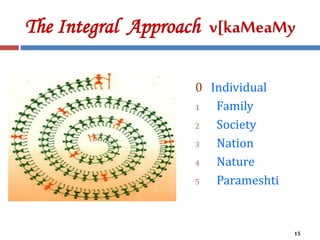
The Integral Approach v[kaMeaMy
0 Individual
1 Family
2 Society
3 Nation
4 Nature
5 Parameshti
19
ordinary water
The Power Of Words
Dr. Masaru Emoto, a Japanese scientist’s experiment
Molecular structure
water after the prayer
20
Heavy Metal music.
Classical music
Folk music..
21
Hate Love
Just imagine the impact of our
Thoughts & Feelings on our others
& on ourselves
Cycle of Sustenance /keZpØ
Vyashti
Samashti
Smaller Entity
Larger Entity
Yogakshem
Karma
Yajna
Karmafala
Indian Cultural Heritage and
Environmental Conservation through
Traditional Knowledge
Sunday 8 June 2008, by Bharti
Chhibber
 http://www.mainstreamweekly.net/article746.h
tml
11/4/2016Dr. Varadraj Bapat, IIT Mumbai 24
 We, as Indians, take pride in our strong cultural
heritage. Dharma protects and nurtures nature.
If we take a look at Hinduism, we worship the
sun, wind, land, trees, plants, and water which is
the very base of human survival. Likewise,
respect and conservation of wildlife—garuda,
lion, peacock, and snake—are part of our
cultural ethos from time immemorial.
11/4/2016Dr. Varadraj Bapat, IIT Mumbai 25
 Further, ancient texts written in Sanskrit, Pali or
other languages can provide significant details.
For instance, the scripture Vishnu Samhitâ in
Sanskrit language contains some direct
instructions dealing with biodiversity
conservation.
11/4/2016Dr. Varadraj Bapat, IIT Mumbai 26
Indian Cultural
 TRADITIONAL knowledge had always contributed to modern medicine and health care.
Further for centuries, indigenous communities were used to surviving and adjusting
their agriculture, fishing and hunting in the event of changes in climate. It is ironical that
now when the threat of climate change is so imminent we are looking for solutions
outside. However, there is another threat looming large, that is, of losing these
communities to outright annihilation or due to their amalgamation in the mainstream.
Moreover, with the commercialisation of even natural resources, traditional knowledge
that managed to maintain sustainable levels of harvest has been sidelined. Issues of
privatisation, alienation and ‘bio-piracy’ are major areas of concern. With globalisation
these pressures are stronger than ever. The existing policy and legal mechanisms to
protect traditional knowledge usually does not involve these communities themselves.
Hence they do little to safeguard local community needs, values and customary laws
relating to traditional knowledge and genetic resources of indigenous and local
communities. We have to preserve this aspect of culture and amalgamate it with modern
methods to work towards environmental conservation.
 By analysing the ethnic communities we can understand this aspect of inherited
knowledge. I shall substantiate this point further by highlighting some instances very
briefly.
 In the first instance, we have two success stories in two different eco-cultural
landscapes, that is, Demazong (the Buddhist eco-cultural landscape in Sikkim
Himalayas) and the Apatani eco-cultural landscape in Arunachal Pradesh, which
illustrate the utility value of traditional ecological knowledge in sustainable natural
resource management.1
11/4/2016Dr. Varadraj Bapat, IIT Mumbai 27
Indian Cultural
 Another example is that of natural resource conservation at the village of Mendha in
Gadhchiroli district of Maharashtra. In 1987, the villagers renewed their efforts at
biodiversity conservation. It was decided that no commercial exploitation of the forests,
except for Non-Timber Forest Produce, would be allowed. Further, villagers would
themselves regulate the amount of resources they could extract from the forests and
undertake measures to tackle soil erosion. Forests would not be set on fire.
Encroachment would not be allowed. The important aspect of this community is that the
villagers decide for themselves, yet they are open to information from the outside world.
 A third case study is that of the North-Eastern region of India which is home to diverse
tribal and other ethnic groups. These communities meet a substantial proportion of
their resource requirements from a relatively small catchment area in which they have
been living for a long time. They live in complete harmony with nature. For example, the
Meetei communities in the States of Manipur and Assam. Sacred groves, or Umang Lais,
as they are called in the Meetei language, form an integral part of the Manipuri tradition
of nature worship. Several species of plants are protected in these groves, which also
offer protection to birds and animals. These include teak, several fruit trees like lemon,
plants of medicinal value such as ginger, eucalyptus and bamboo. Fishes, waterfowl and
other aquatic animals like snails and insects are very common items in the diet of the
Meetei. However, many of these animals are not eaten during certain periods, probably
with the motive of sustainable harvesting and conservation.2 Thus, in this case certain
religious beliefs and practices help in the conservation of nature and its biodiversity.
11/4/2016Dr. Varadraj Bapat, IIT Mumbai 28
Indian Cultural
 Similarly, the indigenous inherited knowledge provided by the
fishermen of Greater Mumbai and Sindhudurg districts of Maharashtra
was found to be rich, varied with potential technical know-how
associated with the management of bag net, shore-seine, gill net, long
line and traditional trawl fishery.3
 In another case study, ethno-botanical surveys were conducted during
1998 and 1999 in villages of Bhadra Wild Life Sanctuary area, situated
in the Western Ghats region of Karnataka. The utilisation of leaves of
Centella Asiatica, and roots of Ichnocarpus Frutescens in the treatment
of jaundice, diabetes were found to be noteworthy.4 It is ironical that
at a time when the West is seeking solace in our traditional practices
be it medicine, meditation or Yoga, we, despite having a rich herbal
wealth, have a share in the world herbal market that is not even 1.5
per cent.
 Another example is that of medicinal expertise of Yanadi tribals in
Chittoor, Andhra Pradesh. The alienation of the Yanadi from forest
resources and the resultant loss of Yanadi traditional knowledge is a
serious issue.
11/4/2016Dr. Varadraj Bapat, IIT Mumbai 29
CULTURAL TRADITIONS OF NATURE
CONSERVATION IN INDIA
S.M. Nair
 http://ccrtindia.gov.in/readingroom/nscd/ch/c
h11.php
11/4/2016Dr. Varadraj Bapat, IIT Mumbai 30
Living in harmony with Nature has been an
integral part of Indian culture. This has
been abundantly reflected in a variety of
traditional practices, religious beliefs,
rituals, folklore, arts and crafts, and in the
daily lives of the Indian people from time
immemorial.
 CULTURAL TRADITIONS
11/4/2016Dr. Varadraj Bapat, IIT Mumbai 31
How do Indian Traditions and Culture
protect our environment?
Dr. M. P. Mishra 2/07/2010
Ecosensorium Knowhow
 http://www.ecosensorium.org/2010/02/how-
do-indian-traditions-and-culture.html
11/4/2016Dr. Varadraj Bapat, IIT Mumbai 32
 Indian traditions and cultures have been
protecting our trees, ponds and other water
bodies, wild animals etc. In modern times some of
these cultures have been encroached by the greed
of development while others are doing farely well
in conserving resources. The need of the time is to
protect all of our traditions and culture that in any
way protect our environment.Here are examples of
some important Indian traditions, customs and
cultures that were and still are in practice in
different parts in India.
11/4/2016Dr. Varadraj Bapat, IIT Mumbai 33
Culture & religion for a sustainable
future
 http://www.unesco.org/education/tlsf/mods/theme_c/
mod10.html
 Module on Indigenous Knowledge and Sustainability
explores the importance of indigenous values and
spirituality in providing guidance for sustainable living.
Such principles and values encourage a spirit of
harmony between people, their natural environments
and their spiritual identities.
 The principles for living sustainably that flow from
these and other cultural and religious beliefs vary
between groups and countries. They have also changed
over time as circumstances demand. Despite this
diversity, many principles for living sustainably are
shared, not only among indigenous peoples, but also
between different religious traditions.
11/4/2016Dr. Varadraj Bapat, IIT Mumbai 34
Hindu Dharma: beliefs about care of
the planet
 http://www.bbc.co.uk/schools/gcsebitesize/rs/
environment/histewardshiprev1.shtml
 Hinduism is very concerned with the
relationship between humanity and the
environment. Karma teaches that resources in
the world become scarce because people use
them for their own ends. People should use the
world unselfishly in order to maintain the
natural balance and to repay God for the gifts
he has given:
11/4/2016Dr. Varadraj Bapat, IIT Mumbai 35
Hinduism: beliefs about care of the
planet
 Bhagavad Gita 3:12
 Trees are treated with great respect because it
is the most important type of plant life and, like
all living things, has an atman (soul).
 If there is but one tree of flowers and fruit
within a village, that place is worthy of your
respect.
11/4/2016Dr. Varadraj Bapat, IIT Mumbai 36
Sacred Earth: Faith for Conservation
 Many of the most important conservation places in
the world are sacred. Sites like the Amazon, South
Dakota’s Black Hills, and the Mekong River are
deeply rooted in local spiritual and cultural
traditions. These places also face overwhelming
threats, including deforestation, pollution,
unsustainable extraction, melting glaciers and rising
sea levels. Such threats not only endanger the
integrity of ecosystems but also leave the people
who live there impoverished and vulnerable.
 http://www.worldwildlife.org/initiatives/sacred-
earth-faiths-for-conservation
11/4/2016Dr. Varadraj Bapat, IIT Mumbai 37
SPIRITUAL YOUTH TAKE A STAND FOR
THE ENVIRONMENT
Disha Bhanot, Ph.D Viva Voce presentation. 38
 WWF extends a call to faith-motivated youth of
America to be the voice for wildlife and wild
places that have no voice of their own. Being an
advocate means leading by example—such as
recycling your bottles, buying sustainably-
produced food and riding your bike to school
instead of driving. It may also mean speaking out
in your local community about the
environmental issues you care about.
 http://www.worldwildlife.org/
Understanding Sustainability:
39
 What are the sustainability objectives ?
 What is to be sustained? And for how long?
 What are the criteria for sustainability?
 How would be know a sustainable system if we saw one?
 What causes unsustainability to occur ?
 Therefore, what are the recipes for moving towards sustainability ?
Sustainability Criteria and Indicators
40
 Sustainability Criteria are conditions used to evaluate whether
a system is sustainable or not. They are derived logically from
the definition of sustainability.
 Sustainability Indicators have been regarded as the core
element in operationalizing sustainability.
 Meadows (1998) states that Indicators arise from values (we measure
what we care about), and they create values (we care about what we
measure).
 Both criteria and indicators aid in monitoring the progress
towards or distance from sustainability
1. Sustainable use of water
2. Water Quality
3. Equity
4. People’s Participation
1.1 Trend of average ground water table
level
1.2 Are stream perennial or ephemeral?
2.1 Extent of water borne diseases over a
period of time
2.2 Extent of Salinity
3.1 Is the water available distributed
among legitimate users? (per capita and
per hectare)
4.1 Users contribution (Finance and
Human resources)
4.2 Extent of functional people’s
institutions 41
Criteria Indicators
Criteria and Indicators of Sustainable Rural
Development: Example of Water
Need for Sustainable Livelihoods for India
42
 Agriculture sector is the principal source of livelihood for
more than 54.6 per cent of India's population, yet the sector
accounts for merely 15.79 per cent of the country’s GDP
(Planning Commission, 2014).
 There is urgent need to address rural poverty and
vulnerability, in the context of agriculture and rural
investments in India.
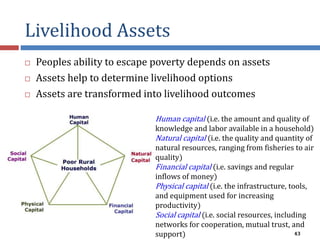
Livelihood Assets
43
 Peoples ability to escape poverty depends on assets
 Assets help to determine livelihood options
 Assets are transformed into livelihood outcomes
Human capital (i.e. the amount and quality of
knowledge and labor available in a household)
Natural capital (i.e. the quality and quantity of
natural resources, ranging from fisheries to air
quality)
Financial capital (i.e. savings and regular
inflows of money)
Physical capital (i.e. the infrastructure, tools,
and equipment used for increasing
productivity)
Social capital (i.e. social resources, including
networks for cooperation, mutual trust, and
support)
Case of a Landless Female Agriculture Labour
44
= An extremely reduced livelihood pentagon !
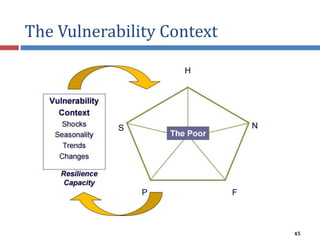
The Vulnerability Context
45
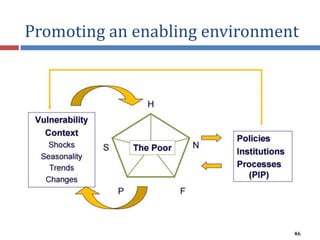
Promoting an enabling environment
46
The Sustainable Livelihoods Framework
47
 The SLF seeks to gain a realistic understanding of people’s
strengths (assets) and how they endeavour to convert
these into positive livelihood outcomes.
Source: Scoones (1988)
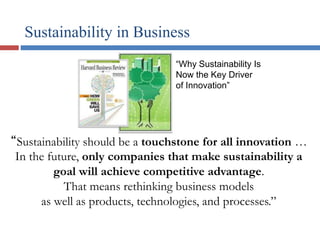
Sustainable Development
“Sustainability should be a touchstone for all innovation …
In the future, only companies that make sustainability a
goal will achieve competitive advantage.
That means rethinking business models
as well as products, technologies, and processes.”
“Why Sustainability Is
Now the Key Driver
of Innovation”
Sustainability in Business
50%
69%
72%
88%
93%
96%
… embedded in supply chains
… acted upon by boards
Sustainability should be …
fully embedded in
strategies and operations
2010 2007
UN Global Compact and Accenture study, survey of 766 worldwide CEOs, June 2010
CEO Mindset is Shifting
CEOs’ Sustainability Drivers
UN Global Compact and Accenture study, survey of 766 worldwide CEOs, June 2010
MIT Sloan and the Boston Consulting, “2011 Sustainability & Innovation Global Executive Study
and Research Project,” Jan. 2012. Surveyed 4,000 managers from 113 countries.
• 70% say that sustainability was
on the management agenda in
2011, and will stay there
permanently.
Sustainability at Tipping Point ?
• 67% said that sustainability-
related strategies are
necessary to stay competitive.
• 24% are “Embracers”
… the Tipping Point?
Businesses employing Sustainable Management and
Strategy
52
 Hindustan Lever (HLL) pioneered Project Shakti, that was an ambitious
plan to stimulate new demand at the lower end of the market by creating a
self-sustaining cycle of “business growth through people growth”
 Unilever (Anglo-Dutch multinational) first engaged with India in 1930s, by
1990s HLL was the sole representative of Unilever’s business in India.
 HLL’s growth strategy was to ask SHGs to operate as “rural direct-to-
home” teams of saleswoman
 Operation Streamline, HLL’s growth engine initiative had been lauched in
1997. Goods were distributed from HLL agents to re-distributors who
them passed them to “Star-Sellers” in local communities.
 Win-win partnership with rural Self-Help-Groups by helping them access
micro-credit, buy HLL Products and sell them in their villages.
53
Traditional Micro-credit Model Modified Micro credit Model
Project Shakti
Sustainability issues and impacts in Business
54
a. What are the
sustainability issues
and impacts in XYZ
industry ?
b. What are the
relevant sustainability
skills required?
c. What are the current
and emerging practices
in relation to
sustainability within
XYZ industry?See Story of Stuff at: https://www.youtube.com/watch?v=9GorqroigqM
55

Sustainable development 2016

  • 1.
    SUSTAINABLE DEVELOPMENTITS GENESIS ANDIMPLICATIONS Dr. Varadraj Bapat Faculty in Accounting and Finance, Indian Institute of Technology, Mumbai varadraj@som.iitb.ac.in 20th April, 2016.
  • 3.
    Introduction 3  Sustainability isa multifaceted term with no concise meaning and definition. The precise meaning of sustainability varies considerably depending upon who is using it and in what context (Bell and Morse, 2000).  Brundtland commission report, defined sustainability as  Meeting the needs of the present generation without compromising the ability of future generations to meet their own need  Sustainable development has become the watchword for international aid agencies, the jargon of development planners, the theme of conferences and the slogan of developmental and environmental activists (Lele, 1991).
  • 4.
    Sustainability - historicaldevelopments (modern) 4  1972 Conference on the Human Environment (Stockholm)  1973 United Nations Environment Programme (UNEP)  1983 World Commission on Environment and Development (WCED)  1987 Brundtland Report  1988 Intergovernmental Panel on Climate Change (IPCC)  1992 UN Conference on Sustainable Development (Rio ‘Earth Summit’)  1997 Kyoto Protocol – Kyoto (Japan)  2000 UN Millennium Declaration - Millennium Development Goals (MDGs)  2002 World Summit on Sustainable Development  2006 Stern Review (UK)  2007 Garnaut Climate Change Review (Australia)  2009 Copenhagen Summit  2012 Introduction of the Carbon Tax (Australia)
  • 5.
    Initiatives in SustainableDevelopment arena 5
  • 6.
    Initiatives in SustainableDevelopment arena 6
  • 7.
    Initiatives in SustainableDevelopment arena 7
  • 8.
    Initiatives in SustainableDevelopment arena 8
  • 9.
    Measuring Sustainability 9  Snow(1999) suggest that Sustainability is not achieved if programs do not meet the needs of the people they are designed to help.  Also, sustainability must be viewed not as a final outcome, but a pursued goal.  Pelt et al., (1990) point out that sustainability refers to the long term availability of the means required for the long term achievement of goals.  The reductionism approach is commonly used to measure the concept of sustainability. It breaks down the complex ‘sustainability’ concept into relatively few simple measures.
  • 10.
    Development Vs. Ecology  Wasit always so ? 11/4/2016Dr. Varadraj Bapat, IIT Mumbai 10
  • 11.
    Lynn White’s 1967article  In 1967, medieval historian Lynn White Jr. published an article called 'The Historical Roots of our Ecologic Crisis'. This provocative article has become the most cited piece of writing within theological debate about the environment. 11/4/2016Dr. Varadraj Bapat, IIT Mumbai 11
  • 12.
    Lynn White’s 1967article  White argued that the Western Christian worldview supports and encourages humanity’s aggressive project to dominate and exploit nature. Previously, people had believed that spirits lived in objects such as trees and so thought that nature was sacred. Christianity swept away these older views and replaced them with the idea that all things were made for humanity's 'benefit and rule'. Humanity came to be seen as uniquely made in the image of God and as having ‘dominion’ or control over all the creatures of the earth (Genesis 1.26-30). 11/4/2016Dr. Varadraj Bapat, IIT Mumbai 12
  • 13.
    Lynn White’s 1967article  He says:  ...[Christianity] not only established a dualism of man and nature but also insisted that it is God’s will that man exploit nature for his proper ends… Man’s effective monopoly…was confirmed and the old inhibitions to the exploitation of nature crumbled… Christianity made it possible to exploit nature in a mood of indifference to the feelings of natural objects.1 11/4/2016Dr. Varadraj Bapat, IIT Mumbai 13
  • 14.
    Lynn White’s 1967article  He says:  White argued that '[Western] Christianity is the most anthropocentric religion the world has seen'.2 He concludes that the modern technological conquest of nature that has led to our environmental crisis has in large part been made possible by the dominance in the West of this Christian world-view. Christianity therefore 'bears a huge burden of guilt'.3  However, White does not think that secularism is the answer to our environmental problems 11/4/2016Dr. Varadraj Bapat, IIT Mumbai 14
  • 15.
    15 The Integral Approachv[kaMeaMy 0 Individual 1 Family 2 Society 3 Nation 4 Nature 5 Parameshti
  • 19.
    19 ordinary water The PowerOf Words Dr. Masaru Emoto, a Japanese scientist’s experiment Molecular structure water after the prayer
  • 20.
  • 21.
    21 Hate Love Just imaginethe impact of our Thoughts & Feelings on our others & on ourselves
  • 22.
    Cycle of Sustenance/keZpØ Vyashti Samashti Smaller Entity Larger Entity Yogakshem Karma Yajna Karmafala
  • 24.
    Indian Cultural Heritageand Environmental Conservation through Traditional Knowledge Sunday 8 June 2008, by Bharti Chhibber  http://www.mainstreamweekly.net/article746.h tml 11/4/2016Dr. Varadraj Bapat, IIT Mumbai 24
  • 25.
     We, asIndians, take pride in our strong cultural heritage. Dharma protects and nurtures nature. If we take a look at Hinduism, we worship the sun, wind, land, trees, plants, and water which is the very base of human survival. Likewise, respect and conservation of wildlife—garuda, lion, peacock, and snake—are part of our cultural ethos from time immemorial. 11/4/2016Dr. Varadraj Bapat, IIT Mumbai 25
  • 26.
     Further, ancienttexts written in Sanskrit, Pali or other languages can provide significant details. For instance, the scripture Vishnu Samhitâ in Sanskrit language contains some direct instructions dealing with biodiversity conservation. 11/4/2016Dr. Varadraj Bapat, IIT Mumbai 26
  • 27.
    Indian Cultural  TRADITIONALknowledge had always contributed to modern medicine and health care. Further for centuries, indigenous communities were used to surviving and adjusting their agriculture, fishing and hunting in the event of changes in climate. It is ironical that now when the threat of climate change is so imminent we are looking for solutions outside. However, there is another threat looming large, that is, of losing these communities to outright annihilation or due to their amalgamation in the mainstream. Moreover, with the commercialisation of even natural resources, traditional knowledge that managed to maintain sustainable levels of harvest has been sidelined. Issues of privatisation, alienation and ‘bio-piracy’ are major areas of concern. With globalisation these pressures are stronger than ever. The existing policy and legal mechanisms to protect traditional knowledge usually does not involve these communities themselves. Hence they do little to safeguard local community needs, values and customary laws relating to traditional knowledge and genetic resources of indigenous and local communities. We have to preserve this aspect of culture and amalgamate it with modern methods to work towards environmental conservation.  By analysing the ethnic communities we can understand this aspect of inherited knowledge. I shall substantiate this point further by highlighting some instances very briefly.  In the first instance, we have two success stories in two different eco-cultural landscapes, that is, Demazong (the Buddhist eco-cultural landscape in Sikkim Himalayas) and the Apatani eco-cultural landscape in Arunachal Pradesh, which illustrate the utility value of traditional ecological knowledge in sustainable natural resource management.1 11/4/2016Dr. Varadraj Bapat, IIT Mumbai 27
  • 28.
    Indian Cultural  Anotherexample is that of natural resource conservation at the village of Mendha in Gadhchiroli district of Maharashtra. In 1987, the villagers renewed their efforts at biodiversity conservation. It was decided that no commercial exploitation of the forests, except for Non-Timber Forest Produce, would be allowed. Further, villagers would themselves regulate the amount of resources they could extract from the forests and undertake measures to tackle soil erosion. Forests would not be set on fire. Encroachment would not be allowed. The important aspect of this community is that the villagers decide for themselves, yet they are open to information from the outside world.  A third case study is that of the North-Eastern region of India which is home to diverse tribal and other ethnic groups. These communities meet a substantial proportion of their resource requirements from a relatively small catchment area in which they have been living for a long time. They live in complete harmony with nature. For example, the Meetei communities in the States of Manipur and Assam. Sacred groves, or Umang Lais, as they are called in the Meetei language, form an integral part of the Manipuri tradition of nature worship. Several species of plants are protected in these groves, which also offer protection to birds and animals. These include teak, several fruit trees like lemon, plants of medicinal value such as ginger, eucalyptus and bamboo. Fishes, waterfowl and other aquatic animals like snails and insects are very common items in the diet of the Meetei. However, many of these animals are not eaten during certain periods, probably with the motive of sustainable harvesting and conservation.2 Thus, in this case certain religious beliefs and practices help in the conservation of nature and its biodiversity. 11/4/2016Dr. Varadraj Bapat, IIT Mumbai 28
  • 29.
    Indian Cultural  Similarly,the indigenous inherited knowledge provided by the fishermen of Greater Mumbai and Sindhudurg districts of Maharashtra was found to be rich, varied with potential technical know-how associated with the management of bag net, shore-seine, gill net, long line and traditional trawl fishery.3  In another case study, ethno-botanical surveys were conducted during 1998 and 1999 in villages of Bhadra Wild Life Sanctuary area, situated in the Western Ghats region of Karnataka. The utilisation of leaves of Centella Asiatica, and roots of Ichnocarpus Frutescens in the treatment of jaundice, diabetes were found to be noteworthy.4 It is ironical that at a time when the West is seeking solace in our traditional practices be it medicine, meditation or Yoga, we, despite having a rich herbal wealth, have a share in the world herbal market that is not even 1.5 per cent.  Another example is that of medicinal expertise of Yanadi tribals in Chittoor, Andhra Pradesh. The alienation of the Yanadi from forest resources and the resultant loss of Yanadi traditional knowledge is a serious issue. 11/4/2016Dr. Varadraj Bapat, IIT Mumbai 29
  • 30.
    CULTURAL TRADITIONS OFNATURE CONSERVATION IN INDIA S.M. Nair  http://ccrtindia.gov.in/readingroom/nscd/ch/c h11.php 11/4/2016Dr. Varadraj Bapat, IIT Mumbai 30
  • 31.
    Living in harmonywith Nature has been an integral part of Indian culture. This has been abundantly reflected in a variety of traditional practices, religious beliefs, rituals, folklore, arts and crafts, and in the daily lives of the Indian people from time immemorial.  CULTURAL TRADITIONS 11/4/2016Dr. Varadraj Bapat, IIT Mumbai 31
  • 32.
    How do IndianTraditions and Culture protect our environment? Dr. M. P. Mishra 2/07/2010 Ecosensorium Knowhow  http://www.ecosensorium.org/2010/02/how- do-indian-traditions-and-culture.html 11/4/2016Dr. Varadraj Bapat, IIT Mumbai 32
  • 33.
     Indian traditionsand cultures have been protecting our trees, ponds and other water bodies, wild animals etc. In modern times some of these cultures have been encroached by the greed of development while others are doing farely well in conserving resources. The need of the time is to protect all of our traditions and culture that in any way protect our environment.Here are examples of some important Indian traditions, customs and cultures that were and still are in practice in different parts in India. 11/4/2016Dr. Varadraj Bapat, IIT Mumbai 33
  • 34.
    Culture & religionfor a sustainable future  http://www.unesco.org/education/tlsf/mods/theme_c/ mod10.html  Module on Indigenous Knowledge and Sustainability explores the importance of indigenous values and spirituality in providing guidance for sustainable living. Such principles and values encourage a spirit of harmony between people, their natural environments and their spiritual identities.  The principles for living sustainably that flow from these and other cultural and religious beliefs vary between groups and countries. They have also changed over time as circumstances demand. Despite this diversity, many principles for living sustainably are shared, not only among indigenous peoples, but also between different religious traditions. 11/4/2016Dr. Varadraj Bapat, IIT Mumbai 34
  • 35.
    Hindu Dharma: beliefsabout care of the planet  http://www.bbc.co.uk/schools/gcsebitesize/rs/ environment/histewardshiprev1.shtml  Hinduism is very concerned with the relationship between humanity and the environment. Karma teaches that resources in the world become scarce because people use them for their own ends. People should use the world unselfishly in order to maintain the natural balance and to repay God for the gifts he has given: 11/4/2016Dr. Varadraj Bapat, IIT Mumbai 35
  • 36.
    Hinduism: beliefs aboutcare of the planet  Bhagavad Gita 3:12  Trees are treated with great respect because it is the most important type of plant life and, like all living things, has an atman (soul).  If there is but one tree of flowers and fruit within a village, that place is worthy of your respect. 11/4/2016Dr. Varadraj Bapat, IIT Mumbai 36
  • 37.
    Sacred Earth: Faithfor Conservation  Many of the most important conservation places in the world are sacred. Sites like the Amazon, South Dakota’s Black Hills, and the Mekong River are deeply rooted in local spiritual and cultural traditions. These places also face overwhelming threats, including deforestation, pollution, unsustainable extraction, melting glaciers and rising sea levels. Such threats not only endanger the integrity of ecosystems but also leave the people who live there impoverished and vulnerable.  http://www.worldwildlife.org/initiatives/sacred- earth-faiths-for-conservation 11/4/2016Dr. Varadraj Bapat, IIT Mumbai 37
  • 38.
    SPIRITUAL YOUTH TAKEA STAND FOR THE ENVIRONMENT Disha Bhanot, Ph.D Viva Voce presentation. 38  WWF extends a call to faith-motivated youth of America to be the voice for wildlife and wild places that have no voice of their own. Being an advocate means leading by example—such as recycling your bottles, buying sustainably- produced food and riding your bike to school instead of driving. It may also mean speaking out in your local community about the environmental issues you care about.  http://www.worldwildlife.org/
  • 39.
    Understanding Sustainability: 39  Whatare the sustainability objectives ?  What is to be sustained? And for how long?  What are the criteria for sustainability?  How would be know a sustainable system if we saw one?  What causes unsustainability to occur ?  Therefore, what are the recipes for moving towards sustainability ?
  • 40.
    Sustainability Criteria andIndicators 40  Sustainability Criteria are conditions used to evaluate whether a system is sustainable or not. They are derived logically from the definition of sustainability.  Sustainability Indicators have been regarded as the core element in operationalizing sustainability.  Meadows (1998) states that Indicators arise from values (we measure what we care about), and they create values (we care about what we measure).  Both criteria and indicators aid in monitoring the progress towards or distance from sustainability
  • 41.
    1. Sustainable useof water 2. Water Quality 3. Equity 4. People’s Participation 1.1 Trend of average ground water table level 1.2 Are stream perennial or ephemeral? 2.1 Extent of water borne diseases over a period of time 2.2 Extent of Salinity 3.1 Is the water available distributed among legitimate users? (per capita and per hectare) 4.1 Users contribution (Finance and Human resources) 4.2 Extent of functional people’s institutions 41 Criteria Indicators Criteria and Indicators of Sustainable Rural Development: Example of Water
  • 42.
    Need for SustainableLivelihoods for India 42  Agriculture sector is the principal source of livelihood for more than 54.6 per cent of India's population, yet the sector accounts for merely 15.79 per cent of the country’s GDP (Planning Commission, 2014).  There is urgent need to address rural poverty and vulnerability, in the context of agriculture and rural investments in India.
  • 43.
    Livelihood Assets 43  Peoplesability to escape poverty depends on assets  Assets help to determine livelihood options  Assets are transformed into livelihood outcomes Human capital (i.e. the amount and quality of knowledge and labor available in a household) Natural capital (i.e. the quality and quantity of natural resources, ranging from fisheries to air quality) Financial capital (i.e. savings and regular inflows of money) Physical capital (i.e. the infrastructure, tools, and equipment used for increasing productivity) Social capital (i.e. social resources, including networks for cooperation, mutual trust, and support)
  • 44.
    Case of aLandless Female Agriculture Labour 44 = An extremely reduced livelihood pentagon !
  • 45.
  • 46.
    Promoting an enablingenvironment 46
  • 47.
    The Sustainable LivelihoodsFramework 47  The SLF seeks to gain a realistic understanding of people’s strengths (assets) and how they endeavour to convert these into positive livelihood outcomes. Source: Scoones (1988) Sustainable Development
  • 48.
    “Sustainability should bea touchstone for all innovation … In the future, only companies that make sustainability a goal will achieve competitive advantage. That means rethinking business models as well as products, technologies, and processes.” “Why Sustainability Is Now the Key Driver of Innovation” Sustainability in Business
  • 49.
    50% 69% 72% 88% 93% 96% … embedded insupply chains … acted upon by boards Sustainability should be … fully embedded in strategies and operations 2010 2007 UN Global Compact and Accenture study, survey of 766 worldwide CEOs, June 2010 CEO Mindset is Shifting
  • 50.
    CEOs’ Sustainability Drivers UNGlobal Compact and Accenture study, survey of 766 worldwide CEOs, June 2010
  • 51.
    MIT Sloan andthe Boston Consulting, “2011 Sustainability & Innovation Global Executive Study and Research Project,” Jan. 2012. Surveyed 4,000 managers from 113 countries. • 70% say that sustainability was on the management agenda in 2011, and will stay there permanently. Sustainability at Tipping Point ? • 67% said that sustainability- related strategies are necessary to stay competitive. • 24% are “Embracers” … the Tipping Point?
  • 52.
    Businesses employing SustainableManagement and Strategy 52  Hindustan Lever (HLL) pioneered Project Shakti, that was an ambitious plan to stimulate new demand at the lower end of the market by creating a self-sustaining cycle of “business growth through people growth”  Unilever (Anglo-Dutch multinational) first engaged with India in 1930s, by 1990s HLL was the sole representative of Unilever’s business in India.  HLL’s growth strategy was to ask SHGs to operate as “rural direct-to- home” teams of saleswoman  Operation Streamline, HLL’s growth engine initiative had been lauched in 1997. Goods were distributed from HLL agents to re-distributors who them passed them to “Star-Sellers” in local communities.  Win-win partnership with rural Self-Help-Groups by helping them access micro-credit, buy HLL Products and sell them in their villages.
  • 53.
    53 Traditional Micro-credit ModelModified Micro credit Model Project Shakti
  • 54.
    Sustainability issues andimpacts in Business 54 a. What are the sustainability issues and impacts in XYZ industry ? b. What are the relevant sustainability skills required? c. What are the current and emerging practices in relation to sustainability within XYZ industry?See Story of Stuff at: https://www.youtube.com/watch?v=9GorqroigqM
  • 55.