Authored by: Gurinder Aujla
Prepared on: July-2016
Email: gugs.aujla@gmail.com
Phone: 1-416-903-9696
All rights reserved by Gurinder Aujla.
Sustainable Development:
India’s Approach
Sustainable Development
• Calls for cooperation amongst developing and developed nations.
• Need for equity as emissions/capita much higher in developed world.
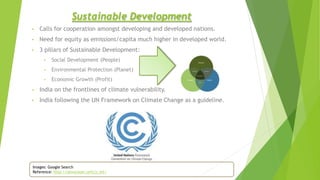
• 3 pillars of Sustainable Development:
• Social Development (People)
• Environmental Protection (Planet)
• Economic Growth (Profit)
• India on the frontlines of climate vulnerability.
• India following the UN Framework on Climate Change as a guideline.
Images: Google Search
Reference: http://newsroom.unfccc.int/
Government of India Initiative
• Established Ministry of Environment, Forest and Climate Change – 1985
Images: Google Search
Reference: http://www.moef.nic.in/
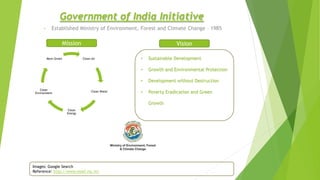
Clean Air
Clean Water
Clean
Energy
Clean
Environment
More Green
Mission
• Sustainable Development
• Growth and Environmental Protection
• Development without Destruction
• Poverty Eradication and Green
Growth
Vision
India’s Sustainable Growth Initiative
• Journey started in 1980’s-90’s with the economic reform policies.
• Industrialization, FDI’s in various sectors.
• Earth Summit in Rio – 1992.
• Laid the groundwork for climate change action initiatives.
• 2009 – State of the Environment Report by Ministry of Environment and
Forests – Government of India:
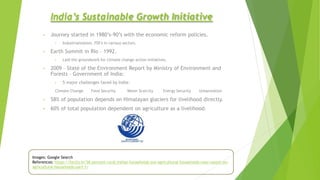
• 5 major challenges faced by India:
Climate Change Food Security Water Scarcity Energy Security Urbanization
• 58% of population depends on Himalayan glaciers for livelihood directly.
• 60% of total population dependent on agriculture as a livelihood.
Images: Google Search
References: https://factly.in/58-percent-rural-indian-households-are-agricultural-households-nsso-report-on-
agricultural-households-part-1/
India’s Sustainable Growth Act
• 1st few nation to sign the Biological Diversity Act in 2002:
• Regulations of preceding global act of 1992 to be protected.
• Advise the Government on conservation of biodiversity.
• Advise the Government on selection of biological heritage sites.
• Take appropriate action to oppose grant of IP rights in foreign countries, arising from the use of
biological resources or associated traditional knowledge.
• Benefit Sharing:
Joint ownership of IP rights Transfer of Technology Location of production, R&D units
Payment of Monetary and non-monetary compensation Setting up VC fund for claimers
• Penalties:
• 5 year jail term; fine of Rs.10 Lakh; any offence is non-bailable and cognizable.
• Reality - Jail terms are rare: rules are flouted regularly.
Reference: https://en.wikipedia.org/wiki/Biological_Diversity_Act,_2002
Reference: https://en.wikipedia.org/wiki/Convention_on_Biological_Diversity
India’s Sustainable Growth – Flora & Fauna
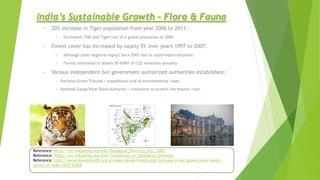
• 20% increase in Tiger population from year 2006 to 2011:
• Estimated 1700 wild Tigers out of a global population of 3000.
• Forest cover has increased by nearly 5% over years 1997 to 2007:
• Although some negative impact since 2007 due to rapid industrialization.
• Forests estimated to absorb 50-60MT of CO2 emissions annually.
• Various independent but government authorized authorities established:
• National Green Tribunal > expeditious trial of environmental cases.
• National Ganga River Basin Authority > innovation to protect the historic river.
Reference: https://en.wikipedia.org/wiki/Biological_Diversity_Act,_2002
Reference: https://en.wikipedia.org/wiki/Convention_on_Biological_Diversity
Reference: http://www.downtoearth.org.in/news/dense-forests-lost-increase-in-net-green-cover-forest-
survey-of-india-2015-52028
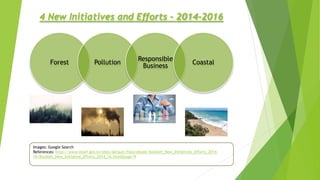
4 New Initiatives and Efforts – 2014-2016
Images: Google Search
References: http://www.moef.gov.in/sites/default/files/ebook/booklet_New_Initiatives_Efforts_2014-
16/Booklet_New_Initiative_Efforts_2014_16.html#page/9
Forest Pollution
Responsible
Business
Coastal
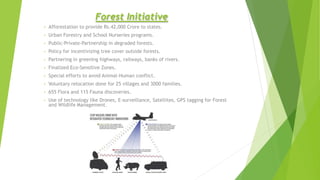
Forest Initiative
• Afforestation to provide Rs.42,000 Crore to states.
• Urban Forestry and School Nurseries programs.
• Public-Private-Partnership in degraded forests.
• Policy for incentivizing tree cover outside forests.
• Partnering in greening highways, railways, banks of rivers.
• Finalized Eco-Sensitive Zones.
• Special efforts to avoid Animal-Human conflict.
• Voluntary relocation done for 25 villages and 3000 families.
• 655 Flora and 115 Fauna discoveries.
• Use of technology like Drones, E-surveillance, Satellites, GPS tagging for Forest
and Wildlife Management.
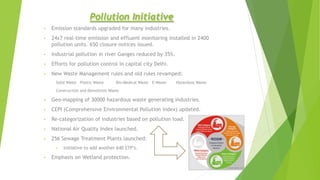
Pollution Initiative
• Emission standards upgraded for many industries.
• 24x7 real-time emission and effluent monitoring installed in 2400
pollution units. 650 closure notices issued.
• Industrial pollution in river Ganges reduced by 35%.
• Efforts for pollution control in capital city Delhi.
• New Waste Management rules and old rules revamped:
Solid Waste Plastic Waste Bio-Medical Waste E-Waste Hazardous Waste
Construction and Demolition Waste
• Geo-mapping of 30000 hazardous waste generating industries.
• CEPI (Comprehensive Environmental Pollution Index) updated.
• Re-categorization of industries based on pollution load.
• National Air Quality Index launched.
• 256 Sewage Treatment Plants launched:
• Initiative to add another 640 STP’s.
• Emphasis on Wetland protection.
Business Initiative
• Prior to May-2014, Environmental clearances biggest challenge to
businesses.
• Real estate environmental guidelines standardized.
• Environmental clearance standardized with validity increased from 5 to 7
years.
• Online application processes.
• Decentralization:
• Forest approval below 40 hectares through regional offices.
• Linear projects like roads/rails/drinking water/canal/irrigation/transmission etc.
Policy
Changes
Ease of doing
business
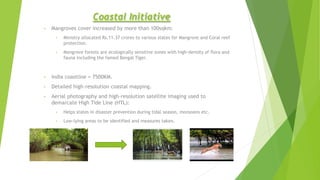
Coastal Initiative
• Mangroves cover increased by more than 100sqkm:
• Ministry allocated Rs.11.37 crores to various states for Mangrove and Coral reef
protection.
• Mangrove forests are ecologically sensitive zones with high-density of flora and
fauna including the famed Bengal Tiger.
• India coastline = 7500KM.
• Detailed high-resolution coastal mapping.
• Aerial photography and high-resolution satellite imaging used to
demarcate High Tide Line (HTL):
• Helps states in disaster prevention during tidal season, monsoons etc.
• Low-lying areas to be identified and measures taken.
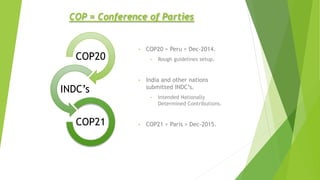
COP = Conference of Parties
• COP20 > Peru > Dec-2014.
• Rough guidelines setup.
• India and other nations
submitted INDC’s.
• Intended Nationally
Determined Contributions.
• COP21 > Paris > Dec-2015.
COP20
INDC’s
COP21
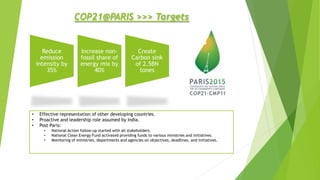
COP21@PARIS >>> Targets
Reduce
emission
intensity by
35%
Increase non-
fossil share of
energy mix by
40%
Create
Carbon sink
of 2.5BN
tones
• Effective representation of other developing countries.
• Proactive and leadership role assumed by India.
• Post Paris:
• National Action follow-up started with all stakeholders.
• National Clean Energy Fund activated providing funds to various ministries and initiatives.
• Monitoring of ministries, departments and agencies on objectives, deadlines, and initiatives.
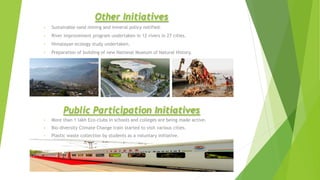
Other Initiatives
• Sustainable sand mining and mineral policy notified.
• River improvement program undertaken in 12 rivers in 27 cities.
• Himalayan ecology study undertaken.
• Preparation of building of new National Museum of Natural History.
Public Participation Initiatives
• More than 1 lakh Eco-clubs in schools and colleges are being made active.
• Bio-diversity Climate Change train started to visit various cities.
• Plastic waste collection by students as a voluntary initiative.
Argument with Developed Countries
 Kyoto Protocol:
 USA still not a signatory.
 Canada criticized India’s contribution.
 Canada itself backed out of Kyoto.
 Global emission contributions:
 China 17%
 US 16%
 EU 11%
 India 5%
 Per capita emissions in Tones:
 US 24.1
 Canada 23.2
 China 5.8
 India 2.1
 UN proposes replacing Millennium
Development Goals with
Sustainable Development Goals.
 SDG’s target reducing emission per
unit of GDP, to meet the following
by 2030.
 Preserve bio-diversity.
 Provide quality education.
 Ensure food & clean drinking
water.
 Gender equality.
 India’s position:
 Socio-economic conditions differ.
Challenges and Concerns
Replacing MDGS with SDG’s
Sustainable development   india's approach

Sustainable development india's approach

  • 1.
    Authored by: GurinderAujla Prepared on: July-2016 Email: gugs.aujla@gmail.com Phone: 1-416-903-9696 All rights reserved by Gurinder Aujla. Sustainable Development: India’s Approach
  • 2.
    Sustainable Development • Callsfor cooperation amongst developing and developed nations. • Need for equity as emissions/capita much higher in developed world. • 3 pillars of Sustainable Development: • Social Development (People) • Environmental Protection (Planet) • Economic Growth (Profit) • India on the frontlines of climate vulnerability. • India following the UN Framework on Climate Change as a guideline. Images: Google Search Reference: http://newsroom.unfccc.int/
  • 3.
    Government of IndiaInitiative • Established Ministry of Environment, Forest and Climate Change – 1985 Images: Google Search Reference: http://www.moef.nic.in/ Clean Air Clean Water Clean Energy Clean Environment More Green Mission • Sustainable Development • Growth and Environmental Protection • Development without Destruction • Poverty Eradication and Green Growth Vision
  • 4.
    India’s Sustainable GrowthInitiative • Journey started in 1980’s-90’s with the economic reform policies. • Industrialization, FDI’s in various sectors. • Earth Summit in Rio – 1992. • Laid the groundwork for climate change action initiatives. • 2009 – State of the Environment Report by Ministry of Environment and Forests – Government of India: • 5 major challenges faced by India: Climate Change Food Security Water Scarcity Energy Security Urbanization • 58% of population depends on Himalayan glaciers for livelihood directly. • 60% of total population dependent on agriculture as a livelihood. Images: Google Search References: https://factly.in/58-percent-rural-indian-households-are-agricultural-households-nsso-report-on- agricultural-households-part-1/
  • 5.
    India’s Sustainable GrowthAct • 1st few nation to sign the Biological Diversity Act in 2002: • Regulations of preceding global act of 1992 to be protected. • Advise the Government on conservation of biodiversity. • Advise the Government on selection of biological heritage sites. • Take appropriate action to oppose grant of IP rights in foreign countries, arising from the use of biological resources or associated traditional knowledge. • Benefit Sharing: Joint ownership of IP rights Transfer of Technology Location of production, R&D units Payment of Monetary and non-monetary compensation Setting up VC fund for claimers • Penalties: • 5 year jail term; fine of Rs.10 Lakh; any offence is non-bailable and cognizable. • Reality - Jail terms are rare: rules are flouted regularly. Reference: https://en.wikipedia.org/wiki/Biological_Diversity_Act,_2002 Reference: https://en.wikipedia.org/wiki/Convention_on_Biological_Diversity
  • 6.
    India’s Sustainable Growth– Flora & Fauna • 20% increase in Tiger population from year 2006 to 2011: • Estimated 1700 wild Tigers out of a global population of 3000. • Forest cover has increased by nearly 5% over years 1997 to 2007: • Although some negative impact since 2007 due to rapid industrialization. • Forests estimated to absorb 50-60MT of CO2 emissions annually. • Various independent but government authorized authorities established: • National Green Tribunal > expeditious trial of environmental cases. • National Ganga River Basin Authority > innovation to protect the historic river. Reference: https://en.wikipedia.org/wiki/Biological_Diversity_Act,_2002 Reference: https://en.wikipedia.org/wiki/Convention_on_Biological_Diversity Reference: http://www.downtoearth.org.in/news/dense-forests-lost-increase-in-net-green-cover-forest- survey-of-india-2015-52028
  • 7.
    4 New Initiativesand Efforts – 2014-2016 Images: Google Search References: http://www.moef.gov.in/sites/default/files/ebook/booklet_New_Initiatives_Efforts_2014- 16/Booklet_New_Initiative_Efforts_2014_16.html#page/9 Forest Pollution Responsible Business Coastal
  • 8.
    Forest Initiative • Afforestationto provide Rs.42,000 Crore to states. • Urban Forestry and School Nurseries programs. • Public-Private-Partnership in degraded forests. • Policy for incentivizing tree cover outside forests. • Partnering in greening highways, railways, banks of rivers. • Finalized Eco-Sensitive Zones. • Special efforts to avoid Animal-Human conflict. • Voluntary relocation done for 25 villages and 3000 families. • 655 Flora and 115 Fauna discoveries. • Use of technology like Drones, E-surveillance, Satellites, GPS tagging for Forest and Wildlife Management.
  • 9.
    Pollution Initiative • Emissionstandards upgraded for many industries. • 24x7 real-time emission and effluent monitoring installed in 2400 pollution units. 650 closure notices issued. • Industrial pollution in river Ganges reduced by 35%. • Efforts for pollution control in capital city Delhi. • New Waste Management rules and old rules revamped: Solid Waste Plastic Waste Bio-Medical Waste E-Waste Hazardous Waste Construction and Demolition Waste • Geo-mapping of 30000 hazardous waste generating industries. • CEPI (Comprehensive Environmental Pollution Index) updated. • Re-categorization of industries based on pollution load. • National Air Quality Index launched. • 256 Sewage Treatment Plants launched: • Initiative to add another 640 STP’s. • Emphasis on Wetland protection.
  • 10.
    Business Initiative • Priorto May-2014, Environmental clearances biggest challenge to businesses. • Real estate environmental guidelines standardized. • Environmental clearance standardized with validity increased from 5 to 7 years. • Online application processes. • Decentralization: • Forest approval below 40 hectares through regional offices. • Linear projects like roads/rails/drinking water/canal/irrigation/transmission etc. Policy Changes Ease of doing business
  • 11.
    Coastal Initiative • Mangrovescover increased by more than 100sqkm: • Ministry allocated Rs.11.37 crores to various states for Mangrove and Coral reef protection. • Mangrove forests are ecologically sensitive zones with high-density of flora and fauna including the famed Bengal Tiger. • India coastline = 7500KM. • Detailed high-resolution coastal mapping. • Aerial photography and high-resolution satellite imaging used to demarcate High Tide Line (HTL): • Helps states in disaster prevention during tidal season, monsoons etc. • Low-lying areas to be identified and measures taken.
  • 12.
    COP = Conferenceof Parties • COP20 > Peru > Dec-2014. • Rough guidelines setup. • India and other nations submitted INDC’s. • Intended Nationally Determined Contributions. • COP21 > Paris > Dec-2015. COP20 INDC’s COP21
  • 13.
    COP21@PARIS >>> Targets Reduce emission intensityby 35% Increase non- fossil share of energy mix by 40% Create Carbon sink of 2.5BN tones • Effective representation of other developing countries. • Proactive and leadership role assumed by India. • Post Paris: • National Action follow-up started with all stakeholders. • National Clean Energy Fund activated providing funds to various ministries and initiatives. • Monitoring of ministries, departments and agencies on objectives, deadlines, and initiatives.
  • 14.
    Other Initiatives • Sustainablesand mining and mineral policy notified. • River improvement program undertaken in 12 rivers in 27 cities. • Himalayan ecology study undertaken. • Preparation of building of new National Museum of Natural History. Public Participation Initiatives • More than 1 lakh Eco-clubs in schools and colleges are being made active. • Bio-diversity Climate Change train started to visit various cities. • Plastic waste collection by students as a voluntary initiative.
  • 15.
    Argument with DevelopedCountries  Kyoto Protocol:  USA still not a signatory.  Canada criticized India’s contribution.  Canada itself backed out of Kyoto.  Global emission contributions:  China 17%  US 16%  EU 11%  India 5%  Per capita emissions in Tones:  US 24.1  Canada 23.2  China 5.8  India 2.1  UN proposes replacing Millennium Development Goals with Sustainable Development Goals.  SDG’s target reducing emission per unit of GDP, to meet the following by 2030.  Preserve bio-diversity.  Provide quality education.  Ensure food & clean drinking water.  Gender equality.  India’s position:  Socio-economic conditions differ. Challenges and Concerns Replacing MDGS with SDG’s