1
SKILLS BEYOND
CA
Dr. Varadraj Bapat
Faculty in Accounting and Finance,
Indian Institute of Technology,
Mumbai
varadraj@som.iitb.ac.in
9869083118/ 9892413119
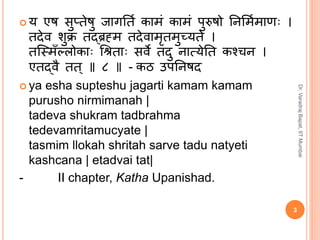
 य एष सुप्तेषु जागर्ति कामं कामं पुरुषो र्िर्मिमाणः ।
तदेव शुक्रं तद्ब्रह्म तदेवामृतमुच्यते ।
तस्मिँल्लोकाः श्रिताः सवे तदु िात्येर्त कन ि ।
एतद्ब्वै तत ् ॥ ८ ॥ - कठ उपर्िषद
 ya esha supteshu jagarti kamam kamam
purusho nirmimanah |
tadeva shukram tadbrahma
tedevamritamucyate |
tasmim llokah shritah sarve tadu natyeti
kashcana | etadvai tat|
- II chapter, Katha Upanishad.
3
Dr.VaradrajBapat,IITMumbai
In common parlance the verse is
interpreted as, ‘Chartered accountants
are always awake and vigilant and
diligent in their duties’.
The Katha Upanishad presents its
philosophy through a curious story of
Nachiket, son of Rishi Vajashravasa
and Yam the god of death.
http://heritagebharat.blogspot.in/2014/04
/ya-esha-supteshu-jagarti.html 4
Dr.VaradrajBapat,IITMumbai
Nachiket ask profound and metaphysical
questions to Yam and the verse is an
answer given by Yam to Nachiket.
As per the celebrated Vedanta philosophy
there are three states of existence the
Jagrit avasta, supta avasta and shesh or
nidra avasta. These can be identified as
the waking, the dream and the deep sleep
state respectively.
http://heritagebharat.blogspot.in/2014/04/ya-esha-supteshu-jagarti.html
5
Dr.VaradrajBapat,IITMumbai
This may be explained from the point of view of
Vedanta philosophy as:
 In dream state we experience various types of
emotions during our dreams similar to those
that we experience during our waking state.
 A sense of reality is attached to these dream
objects and unless we wake up from the dream
we continue to be under prejudice. We live the
dream until we realize its reality.
 Vedanta philosophy puts this dream state and
our waking worldly phenomenon on a same
platform.
 Even our own body is constantly changing as
old cells die and are replaced by new, yet we
have the feeling of a continuous existence.
6
Dr.VaradrajBapat,IITMumbai
 The second line of the Verse states that Brahma
is the ultimate truth, the ultimate reality.
 Mind attaches our ego to these perceptions &
we have the feeling of “I” in relation to the
objects.
 Our mind full of ideas, thoughts, emotions &
perceptions creates an illusion of reality & we
remain ignorant of our true nature.
 In deep meditation the person witnesses the
end of mental processes, end of all thoughts,
time & space halts & there is only the
consciousness of existence that remain, the
Brahma.
Thus, the verse states that Brahma is amrut, i.e.
the immortal, permanent, attribute less Brahma.
7
Dr.VaradrajBapat,IITMumbai
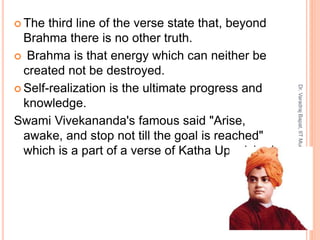
 The third line of the verse state that, beyond
Brahma there is no other truth.
 Brahma is that energy which can neither be
created not be destroyed.
 Self-realization is the ultimate progress and
knowledge.
Swami Vivekananda's famous said "Arise,
awake, and stop not till the goal is reached"
which is a part of a verse of Katha Upanishad
8
Dr.VaradrajBapat,IITMumbai
 The profession we are in and the
profession we are progressing towards,
is of a doctor.. people know that doctors
take care of people’s health, reduce their
pains and suffering, heal the diseased.
But, very few people know that it is
the chartered accountants that take
care of the societal health..! Financial
and moral.
10/13/2016
9
Dr.VaradrajBapat,IITMumbai
 CA is a profession in the society that
has the onus as well as the capacity to
save this entire economy and keep it
growing..!
A chartered accountant’s role should be
such that he knows that he is not
working just making finacial statements,
but is playing an important role in making
the economic/ ethical structure of the
nation..!
10/13/2016
10
Dr.VaradrajBapat,IITMumbai
11
SELF MANAGEMENT
्वयं व्यव्थापि
12
WHAT IS SELF/ I ?
WHAT IS
MANAGEMENT?
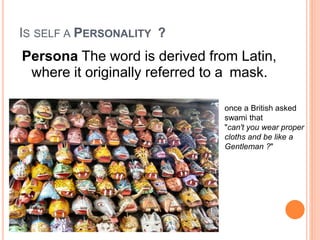
IS SELF A PERSONALITY ?
Persona The word is derived from Latin,
where it originally referred to a mask.
once a British asked
swami that
"can't you wear proper
cloths and be like a
Gentleman ?"
 Once a British asked Swami
"can't you wear proper cloths and be
like a Gentleman ?“
 Swami Vivekananda, “In your
country clothes makes a
gentleman, in my country
character does“
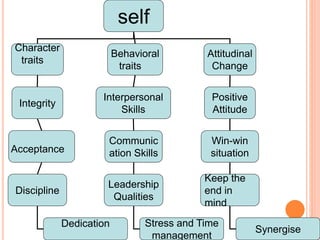
 Self is much deeper than personality
or public image.
 Self is the totality of the person and not
merely external looks, but character,
behavioral traits and attitude towards life.
 Self management can be achieved by the
improvement of behavioral traits such as
communication skills, interpersonal
relationships, attitude towards life and
restoring our ethics.
SELF -
HEALTHY MIND AND A HEALTHY
BODY
GOOD SELF
Attributes of a person with “Good self”?
Good physique
Pleasing manners
Personal and Professional integrity
Trustworthiness and reliability
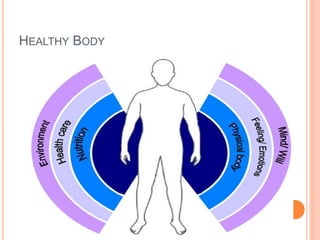
HEALTHY BODY
HEALTHY BODY
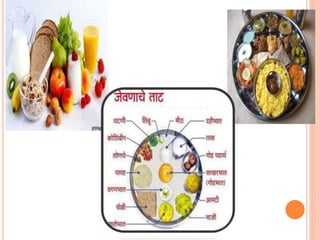
Nutrition
Personal Hygiene
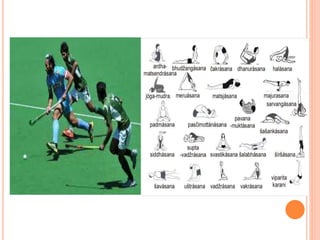
Exercising
Yoga, Pranayam etc
Gym, aerobics, etc.
Playing and jogging
Disciplining of daily routines is a must!
Mind control is essential for a healthy
body.
No junk food!
WHEN IS MIND UNHEALTHY?
Agitated mind is unhealthy
What agitates human mind?
Not getting what one desires
Getting what one dislikes
Uncontrolled emotions in the mind
Continuous accumulation of such likes and
dislikes stresses the mind out.
Stress agitates the mind
 Stressed mind is unhealthy
HEALTHY MIND
Stress-free mind is healthy and calm
Such calm mind can be controlled more
easily
 De-stressing the mind is needed:
Prevention of accumulation of day-to-day
complexes
Clearing the stockpile of stored complexes
HOW?
CULTIVATING A HEALTHY MIND
Documented human experience of the past:
Non-reactive observation of oneself mitigates
the strength of these complexes
Continuous awareness makes this a
continuous process: results in clearing the
stockpile
Different paths for removal of accumulated
complexes:
Path of service
Path of intellectual analysis
Path of devotion
Path of meditation
SUMMARY
Good self arises from a healthy body and
healthy mind
Healthy body needs a healthy mind
Healthy mind can be achieved by preventing
accumulation of complexes in mind
Non-reactive self-observation de-stresses the
mind
This is possible through several paths: paths of
service, intellectual analysis, devotion or
meditation
self
Character
traits
Behavioral
traits
Attitudinal
Change
Integrity
Interpersonal
Skills
Positive
Attitude
Acceptance
Communic
ation Skills
Win-win
situation
Discipline
Leadership
Qualities
Keep the
end in
mind
Dedication Stress and Time
management
Synergise
26
Self: Bharatiya Sanskruti
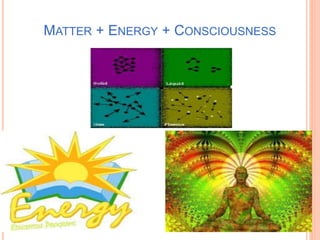
MATTER + ENERGY + CONSCIOUSNESS
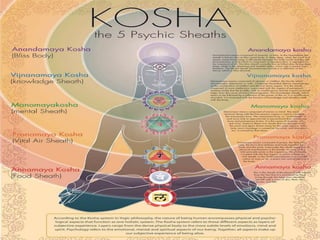
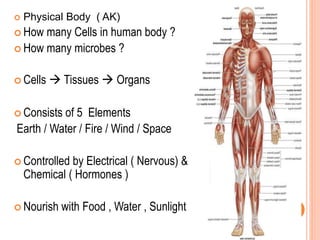
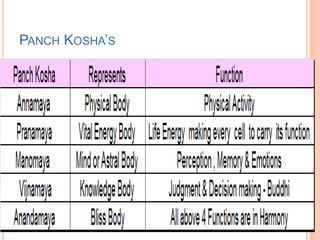
 Physical Body ( AK)
 How many Cells in human body ?
 How many microbes ?
 Cells  Tissues  Organs
 Consists of 5 Elements
Earth / Water / Fire / Wind / Space
 Controlled by Electrical ( Nervous) &
Chemical ( Hormones )
 Nourish with Food , Water , Sunlight
अन्नमय कोश
्थूल रूप में इसे शारीररक ववकास कहेंगे। शारीररक
ववकास के आयाम इस प्रकार हैं .
- शरीर के सभी अंगउपांगों की समुश्र त वृद्ब्श्रि
और ववकास होिा;
- शरीर्वा््य अथाित र्िरामयता प्राप्त होिा;
- शरीर में बल और लो आिा;
- शरीर के अंगों और उपांगों को अपिे अपिे
र्ियत कायि करिे की कु शलता प्राप्त होिा;
- शरीर सहिशील बििा।
अन्नमय कोश
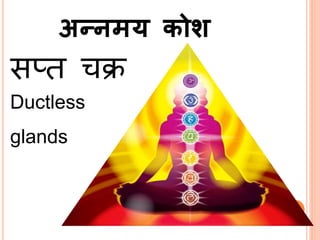
सप्त क्र
Ductless
glands
 यह सब प्राप्त होिे के र्लये आहार, ववहार, व्यायाम,
र्िद्रा, कृ र्तशीलता, िमकायि आदद कारक तत्त्वों के रूप
में काम करते हैं । ्वाभाववक है कक पररवार और
ववद्ब्यालय र्मलकर ही शारीररक र्शक्षा की समुश्र त
व्यव्था कर सकते हैं।
 शरीर का महत्त्व दो कारणों से है।
पंडितजी दो शा्रव ि उद्ब्िृत करते हैं । एक है
‘िायमात्मा बलहीिेि लभ्य:’। अथाित आत्मतत्त्व का
साक्षात्कार दुबिल शरीरवालों को िहीं होता। दूसरा है
‘शरीरमाद्ब्यं खलु िमिसाििम ्’। अथाित ककसी भी प्रकार
का पुरुषाथि, ककसी भी प्रकार की र्सद्ब्श्रि, ककसी भी
प्रकार का पराक्रम दुबिल शरीर से सम्भव िहीं होता।
अत: ववकर्सत शरीरशसतत र्शक्षा का प्रारसम्भक उद्ब्देनय
है।
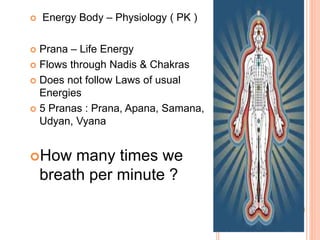
 Energy Body – Physiology ( PK )
 Prana – Life Energy
 Flows through Nadis & Chakras
 Does not follow Laws of usual
Energies
 5 Pranas : Prana, Apana, Samana,
Udyan, Vyana
How many times we
breath per minute ?
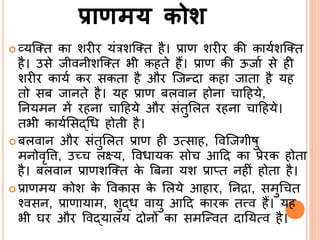
प्राणमय कोश
 व्यसतत का शरीर यंरशसतत है। प्राण शरीर की कायिशसतत
है। उसे जीविीशसतत भी कहते हैं। प्राण की ऊजाि से ही
शरीर कायि कर सकता है और सजन्दा कहा जाता है यह
तो सब जािते है। यह प्राण बलवाि होिा ादहये,
र्ियमि में रहिा ादहये और संतुर्लत रहिा ादहये।
तभी कायिर्सद्ब्श्रि होती है।
 बलवाि और संतुर्लत प्राण ही उत्साह, ववसजगीषु
मिोवृवि, उच् लक्ष्य, वविायक सो आदद का प्रेरक होता
है। बलवाि प्राणशसतत के बबिा यश प्राप्त िहीं होता है।
 प्राणमय कोश के ववकास के र्लये आहार, र्िद्रा, समुश्र त
नवसि, प्राणायाम, शुद्ब्ि वायु आदद कारक तत्त्व हैं। यह
भी घर और ववद्ब्यालय दोिों का समसन्वत दार्यत्व है।
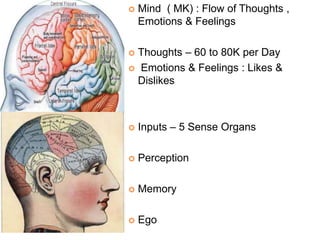
 Mind ( MK) : Flow of Thoughts ,
Emotions & Feelings
 Thoughts – 60 to 80K per Day
 Emotions & Feelings : Likes &
Dislikes
 Inputs – 5 Sense Organs
 Perception
 Memory
 Ego
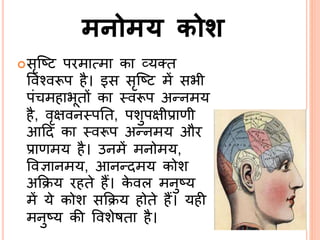
मनोमय कोश
सृसटि परमात्मा का व्यतत
ववनवरूप है। इस सृसटि में सभी
पं महाभूतों का ्वरूप अन्िमय
है, वृक्षवि्पर्त, पशुपक्षीप्राणी
आदद का ्वरूप अन्िमय और
प्राणमय है। उिमें मिोमय,
ववज्ञािमय, आिन्दमय कोश
अकक्रय रहते हैं। के वल मिुटय
में ये कोश सकक्रय होते हैं। यही
मिुटय की ववशेषता है।
मि के ववकास का ्वरूप समझिे से पहले मि का
्वरूप समझिा ादहये।
- मि ं ल और अस्थर है। मि हमेशा भिकता
रहता है। मि की भिकिे की गर्त वायु से भी अश्रिक
है। मि रजोगुणी है।
- मि र्िरन्तर उिेजिाग्र्त रहता है। हषिशोक,
रागद्ब्वेष, काम, क्रोि, लोभ, मोह, मद, मत्सर आदद से
ग्र्त रहता है।
- मि द्ब्वन्द्ब्वात्मक है। वह संकल्पववकल्प करता
रहता है। हमेशा अर्िणाियक रहता है। सुखदु:ख, माि
अपमाि, रुश्र अरुश्र आदद द्ब्वन्द्ब्व मि के ववषय हैं।
- मि कमेसन्द्रयों और ज्ञािेसन्द्रयों का ्वामी है।
उसे ग्यारहवीं इसन्द्रय कहा गया है।
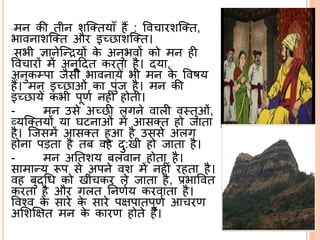
-मि की तीि शसततयािँ हैं : वव ारशसतत,
भाविाशसतत और इच्छाशसतत।
-सभी ज्ञािेसन्द्रयों के अिुभवों को मि ही
वव ारों में अिूददत करता है। दया,
अिुकम्पा जैसी भाविायेँ भी मि के ववषय
हैं। मि इच्छाओं का पुंज है। मि की
इच्छायेँ कभी पूणि िहीं होती।
- मि उसे अच्छी लगिे वाली व्तुओं,
व्यसततयों या घििाओं में आसतत हो जाता
है। सजसमें आसतत हुआ है उससे अलग
होिा पड़ता है तब वह दु:खी हो जाता है।
- मि अर्तशय बलवाि होता है।
सामान्य रूप से अपिे वश में िहीं रहता है।
वह बुद्ब्श्रि को खीं कर ले जाता है, प्रभाववत
करता है और गलत र्िणिय करवाता है।
ववनव के सारे के सारे पक्षपातपूणि आ रण
अर्शक्षक्षत मि के कारण होते हैं।
मि के ववकास का ्वरूप
- ं ल मि को स्थर
और एकाग्र बिािा;
- उिेजिापूणि मि को
शान्त बिािा;
- आसतत मि को
अिासतत बिािा;
- सद्ब्गुण एवं सदा ार
को प्राप्त करवािा ही मि के
ववकास का ्वरूप है।
 भारत के सभी र्शक्षाशास्रयों िे मि की र्शक्षा को
अहम मािा है। दुभािग्य से वतिमाि र्शक्षा में मि की
र्शक्षा की बहुत उपेक्षा हुई है। अब अिेक मिीषी,
अिेक सां्कृ र्तक संगठि और र्शक्षाशा्री मूल्यर्शक्षा
की जो बात करते हैं वह वा्तव में मि की र्शक्षा ही
है। व्यापक अथि में सजसे िमिर्शक्षा कहते हैं वह भी
मि की र्शक्षा है।
 प्रत्याहार और िारणा समेत ध्याि, सासत्त्वक आहार,
सत्संग, सेवाकायि, सद्ब्ग्रंथों का ्वाध्याय, र्ियमपालि,
आज्ञापालि, संयम आदद मि के ववकास के कारक
तत्त्व हैं। इि सबका ववद्ब्यालयीि गर्तववश्रियों में
समावेश करिे से ही मि की र्शक्षा और मि का
ववकास सम्भव है।
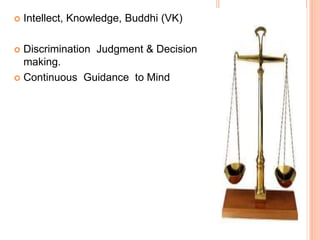
 Intellect, Knowledge, Buddhi (VK)
 Discrimination Judgment & Decision
making.
 Continuous Guidance to Mind
विज्ञानमय कोश
लौककक भाषा में इसे बुद्ब्श्रि के रूप में समझ सकते हैं।
ज्ञाि के क्षेर में इसका बड़ा महत्त्व है। इसके सम्बन्ि में
इस प्रकार वव ार ककया जा सकता है।
- बुद्ब्श्रि जािती है, समझती है, आकलि करती है,
ग्रहण करती है, िारण करती है ।
- बुद्ब्श्रि वववेक करती है, र्िणिय करती है।
- मि संकल्पववकल्प करता है, संशय करता है,
बुद्ब्श्रि र्िन यासत्मका होती है।
- र्िरीक्षण, परीक्षण, अिुमाि, तकि , तुलिा,
ववनलेषण, संनलेषण बुद्ब्श्रि के सािि हैं सजससे वह
र्िणिय तक पहुिँ ती है।
बुद्ब्श्रि के ववकास के कारक तत्त्व इस
प्रकार हैं...
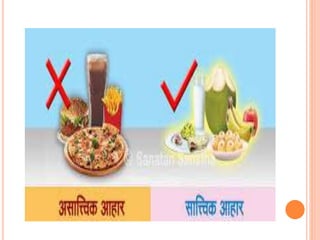
- बुद्ब्श्रि सत्त्वगुणी है। आहार का सासत्त्वक अंश बुद्ब्श्रि
में पररणत होता है। इसर्लए सासत्त्वक आहार बुद्ब्श्रिववकास
के र्लए आवनयक है।
- मि का संयम बुद्ब्श्रिववकास के र्लये अर्िवायि है।
मि की र्शक्षा सम्यक रूप से िहीं होती है तो बुद्ब्श्रि का
ववकास सम्भव िहीं है।
- र्िरीक्षण, परीक्षण आदद के र्लये पयािप्त अवसर
र्मलिा आवनयक होता है। ववद्ब्यालयों की पाठि पद्ब्िर्त
पर यह मुख्य रूप से अवलसम्बत है।
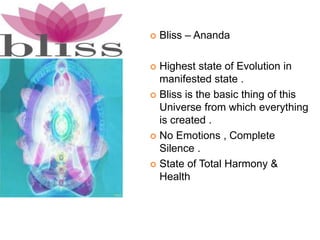
 Bliss – Ananda
 Highest state of Evolution in
manifested state .
 Bliss is the basic thing of this
Universe from which everything
is created .
 No Emotions , Complete
Silence .
 State of Total Harmony &
Health
आनन्दमय कोश
 आत्मा, अहंकार, बुद्ब्श्रि जैसी ववर्भन्ि संज्ञाओं से इसे
पह ािा जाता है, परंतु पं कोश की पररभाषा में इसे
श्र ि कहिा अश्रिक उपयुतत होगा। यह सं्कारों का
क्षेर है। सं्कार यह ववववि प्रकार के अिुभवों की
श्र ि पर पड़िे वाली छाप (imprints) को कहते हैं ।
इंदद्रयों के , मि के और बुद्ब्श्रि के कायों और अिुभवों
के सं्कार श्र ि पर होते हैं।
 इि सं्कारों से ्मृर्त बिती है। सजि अिुभवों के
सं्कार गहरे होते हैं उिकी ्मृर्त भी तीव्र होती है,
अन्यथा उि अिुभवों का वव्मरण हो जाता है। अत:
ज्ञाि के क्षेर में ककसी भी अिुभव का सं्कार में
पररणत होिा आवनयक होता है।
 आिन्द, प्रेम, अभय, सृजि, ्वतन्रता ये
श्र ि के क्षेर हैं।
 श्र िशुद्ब्श्रि होिा यह श्र ि का ववकास है।
ध्याि यह उसके र्लये प्रमुख उपाय है। सासत्त्वक
आहार इसके र्लये उपकारक है। मि की र्शक्षा
इसके र्लये अर्िवायि उपाय है। मि की र्शक्षा के
सत्संग, सेवा, ्वाध्याय श्र िशुद्ब्श्रि के र्लये बहुत
कारगर उपाय हैं।
 पसडित दीिदयाल उपाध्याय जब मिुटय के
व्यसततत्व को शरीर, मि, बुद्ब्श्रि और आत्मा के
समुच् य के रूप में र्िरूवपत करते हैं तब र्शक्षा
के द्ब्वारा उसके ववकास का यह ्वरूप बिता है।
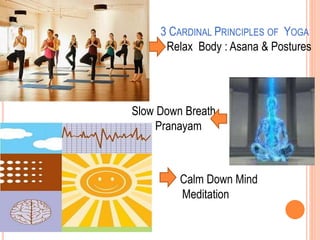
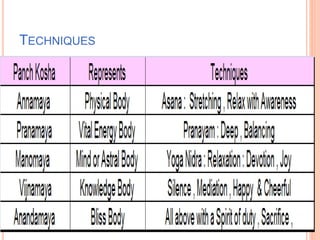
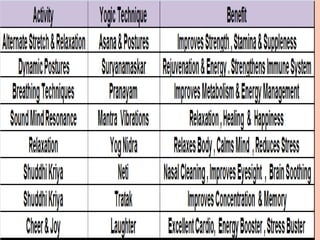
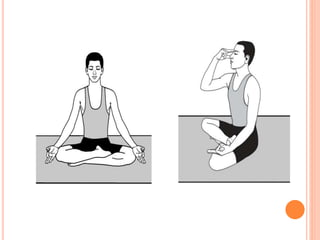
3 CARDINAL PRINCIPLES OF YOGA
Relax Body : Asana & Postures
Slow Down Breath
Pranayam
Calm Down Mind
Meditation
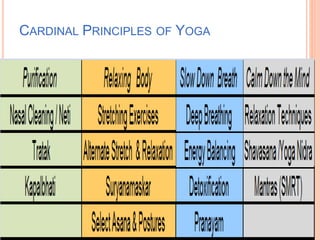
CARDINAL PRINCIPLES OF YOGA
3 CARDINAL PRINCIPLES OF YOGA
PANCH KOSHA’S
TECHNIQUES
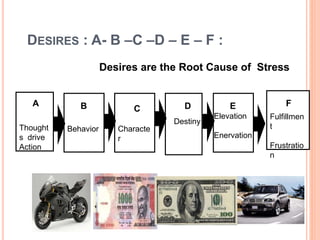
DESIRES : A- B –C –D – E – F :
Thought
s drive
Action
r
Behavior Characte
r
Fulfillmen
t
Frustratio
n
Destiny
Elevation
Enervation
Desires are the Root Cause of Stress
A B C D E F
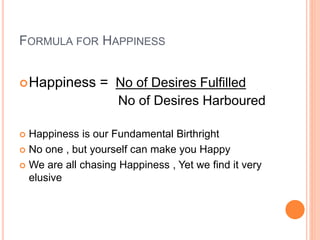
FORMULA FOR HAPPINESS
Happiness = No of Desires Fulfilled
No of Desires Harboured
 Happiness is our Fundamental Birthright
 No one , but yourself can make you Happy
 We are all chasing Happiness , Yet we find it very
elusive
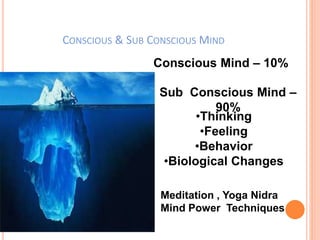
CONSCIOUS & SUB CONSCIOUS MIND
Conscious Mind – 10%
•Thinking
•Feeling
•Behavior
•Biological Changes
Sub Conscious Mind –
90%
Meditation , Yoga Nidra
Mind Power Techniques
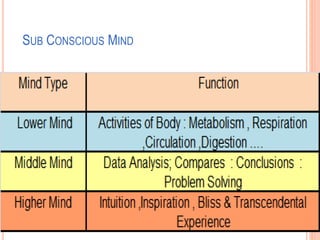
SUB CONSCIOUS MIND
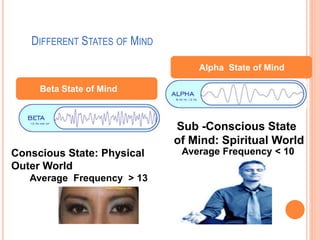
DIFFERENT STATES OF MIND
Beta State of Mind
Alpha State of Mind
Average Frequency > 13
Average Frequency < 10Conscious State: Physical
Outer World
Sub -Conscious State
of Mind: Spiritual World
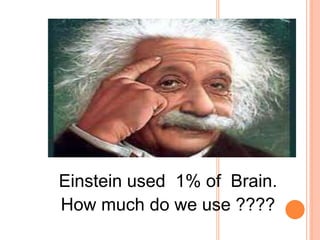
Einstein used 1% of Brain.
How much do we use ????
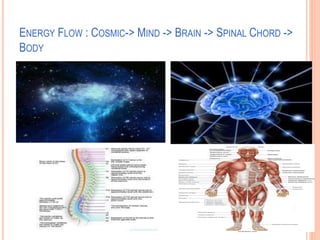
ENERGY FLOW : COSMIC-> MIND -> BRAIN -> SPINAL CHORD ->
BODY
 Mind
 Spinal Chord
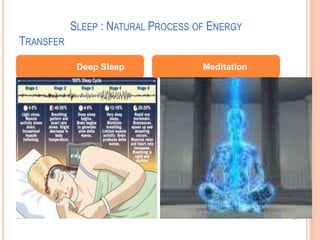
SLEEP : NATURAL PROCESS OF ENERGY
TRANSFER
Deep Sleep Meditation
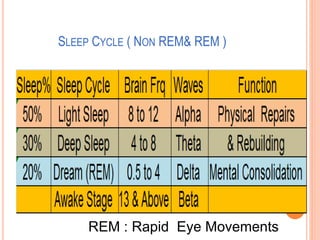
SLEEP CYCLE ( NON REM& REM )
REM : Rapid Eye Movements
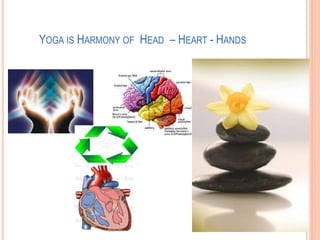
YOGA IS HARMONY OF HEAD – HEART - HANDS
ASANAS – POSTURES CONNECT
BODY - MIND
 Link between Physical Exercise & Health Body is Well established.
 Yoga : Health connected with Nervous System
 Yoga Asana : Not only Physical but cleans & purifies Body & Mind for
Higher Practices .
 Awareness is Integration of Physical practices with the Nervous
System .
YOGA ON MAT VS YOGA 24X7X52
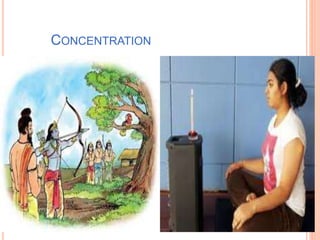
CONCENTRATION
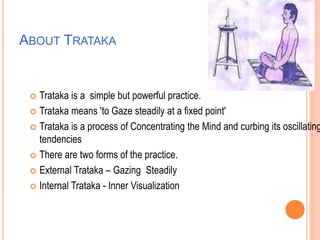
ABOUT TRATAKA
 Trataka is a simple but powerful practice.
 Trataka means 'to Gaze steadily at a fixed point'
 Trataka is a process of Concentrating the Mind and curbing its oscillating
tendencies
 There are two forms of the practice.
 External Trataka – Gazing Steadily
 Internal Trataka - Inner Visualization
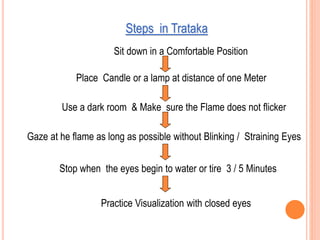
Steps in Trataka
Use a dark room & Make sure the Flame does not flicker
Gaze at he flame as long as possible without Blinking / Straining Eyes
Stop when the eyes begin to water or tire 3 / 5 Minutes
Sit down in a Comfortable Position
Place Candle or a lamp at distance of one Meter
Practice Visualization with closed eyes
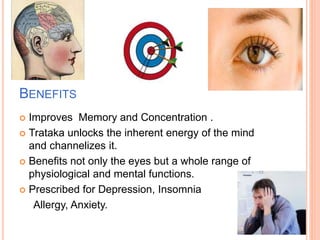
BENEFITS
 Improves Memory and Concentration .
 Trataka unlocks the inherent energy of the mind
and channelizes it.
 Benefits not only the eyes but a whole range of
physiological and mental functions.
 Prescribed for Depression, Insomnia
Allergy, Anxiety.
CONTINUED …
 Capacities such as Telepathy, Psychic Healing, are
developed.
 Single Pointedness of Mind & Strong Willpower.
 Physiologically, Trataka relieves eye ailments such as Eye
strain and Headache, myopia.
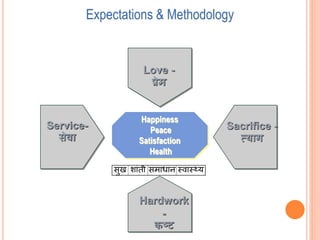
Hardwork
-
कष्ट
Sacrifice -
त्याग
Service-
सेिा
Expectations & Methodology
Happiness
Peace
Satisfaction
Health
Love -
प्रेम
सुख शांती समािाि ्वा््य
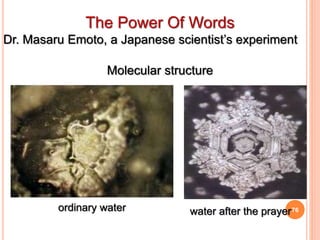
76ordinary water
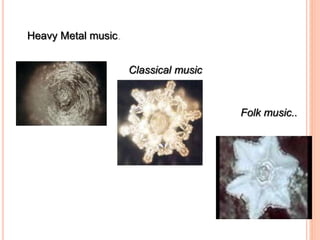
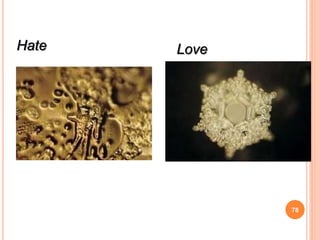
The Power Of Words
Dr. Masaru Emoto, a Japanese scientist’s experiment
Molecular structure
water after the prayer
77
Heavy Metal music.
Classical music
Folk music..
78
Hate Love
Just imagine the impact of our
Thoughts & Feelings on our others
& on ourselves
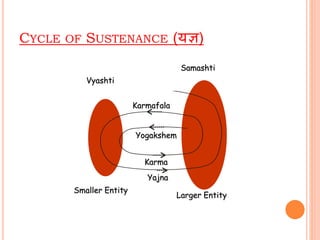
CYCLE OF SUSTENANCE (यज्ञ)
Vyashti
Samashti
Smaller Entity
Larger Entity
Yogakshem
Karma
Yajna
Karmafala
TO GET INTO ACT
82
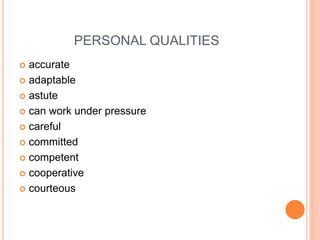
PERSONAL QUALITIES
 accurate
 adaptable
 astute
 can work under pressure
 careful
 committed
 competent
 cooperative
 courteous
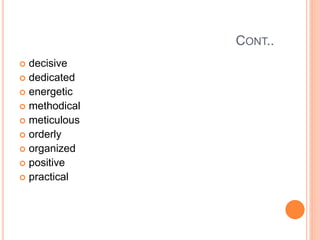
CONT..
 decisive
 dedicated
 energetic
 methodical
 meticulous
 orderly
 organized
 positive
 practical
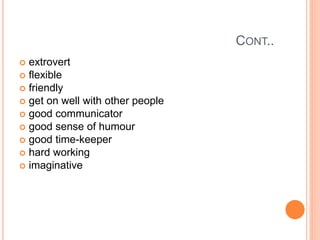
CONT..
 extrovert
 flexible
 friendly
 get on well with other people
 good communicator
 good sense of humour
 good time-keeper
 hard working
 imaginative
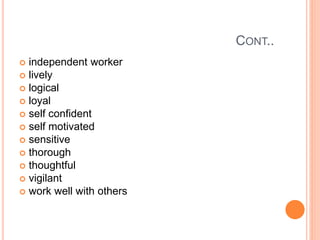
CONT..
 independent worker
 lively
 logical
 loyal
 self confident
 self motivated
 sensitive
 thorough
 thoughtful
 vigilant
 work well with others
87
SELF DEVELOPMENT -LEADERSHIP
Leadership denotes taking action
and getting results.
88
LEADERSHIP
 Dynamic leadership influences the attitudes of the
people being led!
 Leaders must be charismatic, inspirational,
respectful, and stimulating when leading!
89
LEADERSHIP
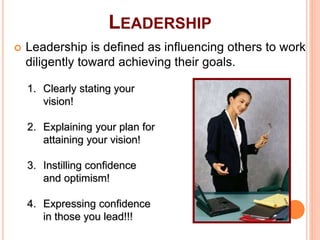
 Leadership is defined as influencing others to work
diligently toward achieving their goals.
1. Clearly stating your
vision!
2. Explaining your plan for
attaining your vision!
3. Instilling confidence
and optimism!
4. Expressing confidence
in those you lead!!!
90
CONTROL THE NEGATIVE SELF-TALK...
. . . Quiet the voice in the head that says,
“I can’t do it!”
91
SPEAK POSSIBILITY . . .
. . . Recognize the downward
spiral . . .
92
SHINING EYES...
. . . Look for “shining eyes” in others.
93
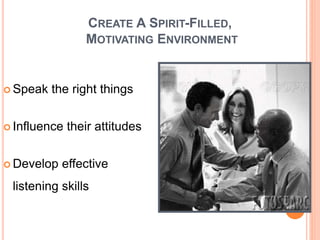
CREATE A SPIRIT-FILLED,
MOTIVATING ENVIRONMENT
 Speak the right things
 Influence their attitudes
 Develop effective
listening skills
94
DEFINITION OF CHARACTER
The word “character” comes to us from a Greek verb that means
making a furrow, cutting a groove, or putting a scratch on
something as a mark. In the light of its origin, we may think of
character as that which puts its mark on a human being.
Character is what makes you “what you are” as distinct from
other persons. The individual is little more than a “bundle of
feelings” unless there is some central loyalty within creating
order out of the “chaos of the soul.” Character signifies the
organization of life and behavior around a central loyalty, which
has ethical worth and validity.
INTERPERSONAL EFFECTIVENESS
Interpersonal effectiveness is the capability of an individual
to do this, influence others, competently.
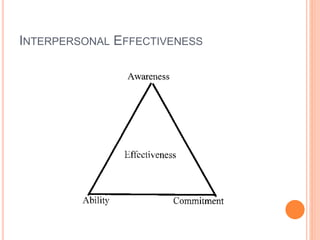
Leadership is a direct function of three elements of
interpersonal effectiveness
 Awareness
 Ability
 Commitment
INTERPERSONAL EFFECTIVENESS
AWARENESS
Awareness is a state of consciousness.
It is the ability to recognize yourself, others, events and
situations in real time.
It is the ability to assess the impact of actions on situations
and others, and be critically self-reflective.
It is a development process that is a function of experience,
communication, self discovery and feedback.
ABILITY
Ability to learn and understand technical issues is
the basis of our careers.
Ability to lead is a function of influence:
 Ability to communicate
 Ability to resolve conflicts
 Ability to solve problems and make decisions
As a member of a team, we influence others in a
collaborative effort to find better ideas or solve
problems.
COMMITMENT
For leaders, the “one thing” that leads to maturity is the fully
aware recognition that one’s decisions make a difference,
both positively and negatively, in the lives of others, and
that any attempt to solve a problem might have a decided
negative impact on some, while helping others.
In no-win scenarios, one must still make a hard decision.
PERSONALITY INDICATORS
 Are you energized around people? Do you like to
meet people and seek opportunities to do so? Do
you think out loud? Do you talk to plants and
discuss problems with animals? This is Extrovert
behavior.
 Alternatively, do you find you would rather work
alone, without interruption. Does meeting too
many people tend to tire you out? Would you
sooner not answer the phone - let the answering
machine do it for you. Would you rather have a
problem written down for you than stated
verbally? This is typical Introvert behavior.
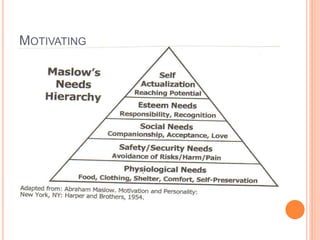
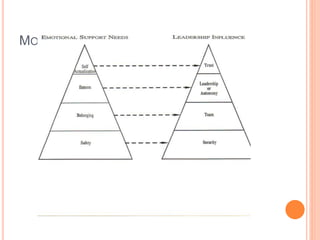
MOTIVATING
MOTIVATING
BUILDING A TEAM
Why would someone want to become part of a
team?
An effective team helps one feel they are:
 Doing something worthwhile for themselves and
the organization
 Enjoying a more satisfying work life
 More in control of their jobs
 Making contributions which are well used
 Learning new skills
 Recognized and respected
BUILDING A TEAM
When a team is operating well the leader and the
members:
 Are clear on team goals and are committed to
them
 Feel ownership for problems rather than blaming
them on others
 Share ideas
 Listen to and show respect for others
 Talk more about “we” and less about “I” and “me”
BUILDING A TEAM
 Understand and use each others know-how
 Know about each other’s personal lives
 Give each other help and support
 Show appreciation for help received
 Recognize and deal with differences and
disagreements
 Encourage development of other team members
 Are loyal to the group, its members, the leader
and the organization
BUILDING A TEAM
 Make decisions based on facts not on emotion or
personalities
 Play a variety of roles – serve as leader, teacher or coach

Skills Beyond CA - Self Management 2016

  • 1.
    1 SKILLS BEYOND CA Dr. VaradrajBapat Faculty in Accounting and Finance, Indian Institute of Technology, Mumbai varadraj@som.iitb.ac.in 9869083118/ 9892413119
  • 3.
     य एषसुप्तेषु जागर्ति कामं कामं पुरुषो र्िर्मिमाणः । तदेव शुक्रं तद्ब्रह्म तदेवामृतमुच्यते । तस्मिँल्लोकाः श्रिताः सवे तदु िात्येर्त कन ि । एतद्ब्वै तत ् ॥ ८ ॥ - कठ उपर्िषद  ya esha supteshu jagarti kamam kamam purusho nirmimanah | tadeva shukram tadbrahma tedevamritamucyate | tasmim llokah shritah sarve tadu natyeti kashcana | etadvai tat| - II chapter, Katha Upanishad. 3 Dr.VaradrajBapat,IITMumbai
  • 4.
    In common parlancethe verse is interpreted as, ‘Chartered accountants are always awake and vigilant and diligent in their duties’. The Katha Upanishad presents its philosophy through a curious story of Nachiket, son of Rishi Vajashravasa and Yam the god of death. http://heritagebharat.blogspot.in/2014/04 /ya-esha-supteshu-jagarti.html 4 Dr.VaradrajBapat,IITMumbai
  • 5.
    Nachiket ask profoundand metaphysical questions to Yam and the verse is an answer given by Yam to Nachiket. As per the celebrated Vedanta philosophy there are three states of existence the Jagrit avasta, supta avasta and shesh or nidra avasta. These can be identified as the waking, the dream and the deep sleep state respectively. http://heritagebharat.blogspot.in/2014/04/ya-esha-supteshu-jagarti.html 5 Dr.VaradrajBapat,IITMumbai
  • 6.
    This may beexplained from the point of view of Vedanta philosophy as:  In dream state we experience various types of emotions during our dreams similar to those that we experience during our waking state.  A sense of reality is attached to these dream objects and unless we wake up from the dream we continue to be under prejudice. We live the dream until we realize its reality.  Vedanta philosophy puts this dream state and our waking worldly phenomenon on a same platform.  Even our own body is constantly changing as old cells die and are replaced by new, yet we have the feeling of a continuous existence. 6 Dr.VaradrajBapat,IITMumbai
  • 7.
     The secondline of the Verse states that Brahma is the ultimate truth, the ultimate reality.  Mind attaches our ego to these perceptions & we have the feeling of “I” in relation to the objects.  Our mind full of ideas, thoughts, emotions & perceptions creates an illusion of reality & we remain ignorant of our true nature.  In deep meditation the person witnesses the end of mental processes, end of all thoughts, time & space halts & there is only the consciousness of existence that remain, the Brahma. Thus, the verse states that Brahma is amrut, i.e. the immortal, permanent, attribute less Brahma. 7 Dr.VaradrajBapat,IITMumbai
  • 8.
     The thirdline of the verse state that, beyond Brahma there is no other truth.  Brahma is that energy which can neither be created not be destroyed.  Self-realization is the ultimate progress and knowledge. Swami Vivekananda's famous said "Arise, awake, and stop not till the goal is reached" which is a part of a verse of Katha Upanishad 8 Dr.VaradrajBapat,IITMumbai
  • 9.
     The professionwe are in and the profession we are progressing towards, is of a doctor.. people know that doctors take care of people’s health, reduce their pains and suffering, heal the diseased. But, very few people know that it is the chartered accountants that take care of the societal health..! Financial and moral. 10/13/2016 9 Dr.VaradrajBapat,IITMumbai
  • 10.
     CA isa profession in the society that has the onus as well as the capacity to save this entire economy and keep it growing..! A chartered accountant’s role should be such that he knows that he is not working just making finacial statements, but is playing an important role in making the economic/ ethical structure of the nation..! 10/13/2016 10 Dr.VaradrajBapat,IITMumbai
  • 11.
  • 12.
    12 WHAT IS SELF/I ? WHAT IS MANAGEMENT?
  • 13.
    IS SELF APERSONALITY ? Persona The word is derived from Latin, where it originally referred to a mask. once a British asked swami that "can't you wear proper cloths and be like a Gentleman ?"
  • 14.
     Once aBritish asked Swami "can't you wear proper cloths and be like a Gentleman ?“  Swami Vivekananda, “In your country clothes makes a gentleman, in my country character does“  Self is much deeper than personality or public image.
  • 15.
     Self isthe totality of the person and not merely external looks, but character, behavioral traits and attitude towards life.  Self management can be achieved by the improvement of behavioral traits such as communication skills, interpersonal relationships, attitude towards life and restoring our ethics.
  • 16.
    SELF - HEALTHY MINDAND A HEALTHY BODY
  • 17.
    GOOD SELF Attributes ofa person with “Good self”? Good physique Pleasing manners Personal and Professional integrity Trustworthiness and reliability
  • 18.
  • 20.
    HEALTHY BODY Nutrition Personal Hygiene Exercising Yoga,Pranayam etc Gym, aerobics, etc. Playing and jogging Disciplining of daily routines is a must! Mind control is essential for a healthy body. No junk food!
  • 21.
    WHEN IS MINDUNHEALTHY? Agitated mind is unhealthy What agitates human mind? Not getting what one desires Getting what one dislikes Uncontrolled emotions in the mind Continuous accumulation of such likes and dislikes stresses the mind out. Stress agitates the mind  Stressed mind is unhealthy
  • 22.
    HEALTHY MIND Stress-free mindis healthy and calm Such calm mind can be controlled more easily  De-stressing the mind is needed: Prevention of accumulation of day-to-day complexes Clearing the stockpile of stored complexes HOW?
  • 23.
    CULTIVATING A HEALTHYMIND Documented human experience of the past: Non-reactive observation of oneself mitigates the strength of these complexes Continuous awareness makes this a continuous process: results in clearing the stockpile Different paths for removal of accumulated complexes: Path of service Path of intellectual analysis Path of devotion Path of meditation
  • 24.
    SUMMARY Good self arisesfrom a healthy body and healthy mind Healthy body needs a healthy mind Healthy mind can be achieved by preventing accumulation of complexes in mind Non-reactive self-observation de-stresses the mind This is possible through several paths: paths of service, intellectual analysis, devotion or meditation
  • 25.
  • 26.
  • 27.
    MATTER + ENERGY+ CONSCIOUSNESS
  • 29.
     Physical Body( AK)  How many Cells in human body ?  How many microbes ?  Cells  Tissues  Organs  Consists of 5 Elements Earth / Water / Fire / Wind / Space  Controlled by Electrical ( Nervous) & Chemical ( Hormones )  Nourish with Food , Water , Sunlight
  • 30.
    अन्नमय कोश ्थूल रूपमें इसे शारीररक ववकास कहेंगे। शारीररक ववकास के आयाम इस प्रकार हैं . - शरीर के सभी अंगउपांगों की समुश्र त वृद्ब्श्रि और ववकास होिा; - शरीर्वा््य अथाित र्िरामयता प्राप्त होिा; - शरीर में बल और लो आिा; - शरीर के अंगों और उपांगों को अपिे अपिे र्ियत कायि करिे की कु शलता प्राप्त होिा; - शरीर सहिशील बििा।
  • 31.
  • 32.
     यह सबप्राप्त होिे के र्लये आहार, ववहार, व्यायाम, र्िद्रा, कृ र्तशीलता, िमकायि आदद कारक तत्त्वों के रूप में काम करते हैं । ्वाभाववक है कक पररवार और ववद्ब्यालय र्मलकर ही शारीररक र्शक्षा की समुश्र त व्यव्था कर सकते हैं।  शरीर का महत्त्व दो कारणों से है। पंडितजी दो शा्रव ि उद्ब्िृत करते हैं । एक है ‘िायमात्मा बलहीिेि लभ्य:’। अथाित आत्मतत्त्व का साक्षात्कार दुबिल शरीरवालों को िहीं होता। दूसरा है ‘शरीरमाद्ब्यं खलु िमिसाििम ्’। अथाित ककसी भी प्रकार का पुरुषाथि, ककसी भी प्रकार की र्सद्ब्श्रि, ककसी भी प्रकार का पराक्रम दुबिल शरीर से सम्भव िहीं होता। अत: ववकर्सत शरीरशसतत र्शक्षा का प्रारसम्भक उद्ब्देनय है।
  • 36.
     Energy Body– Physiology ( PK )  Prana – Life Energy  Flows through Nadis & Chakras  Does not follow Laws of usual Energies  5 Pranas : Prana, Apana, Samana, Udyan, Vyana How many times we breath per minute ?
  • 37.
    प्राणमय कोश  व्यसततका शरीर यंरशसतत है। प्राण शरीर की कायिशसतत है। उसे जीविीशसतत भी कहते हैं। प्राण की ऊजाि से ही शरीर कायि कर सकता है और सजन्दा कहा जाता है यह तो सब जािते है। यह प्राण बलवाि होिा ादहये, र्ियमि में रहिा ादहये और संतुर्लत रहिा ादहये। तभी कायिर्सद्ब्श्रि होती है।  बलवाि और संतुर्लत प्राण ही उत्साह, ववसजगीषु मिोवृवि, उच् लक्ष्य, वविायक सो आदद का प्रेरक होता है। बलवाि प्राणशसतत के बबिा यश प्राप्त िहीं होता है।  प्राणमय कोश के ववकास के र्लये आहार, र्िद्रा, समुश्र त नवसि, प्राणायाम, शुद्ब्ि वायु आदद कारक तत्त्व हैं। यह भी घर और ववद्ब्यालय दोिों का समसन्वत दार्यत्व है।
  • 39.
     Mind (MK) : Flow of Thoughts , Emotions & Feelings  Thoughts – 60 to 80K per Day  Emotions & Feelings : Likes & Dislikes  Inputs – 5 Sense Organs  Perception  Memory  Ego
  • 40.
    मनोमय कोश सृसटि परमात्माका व्यतत ववनवरूप है। इस सृसटि में सभी पं महाभूतों का ्वरूप अन्िमय है, वृक्षवि्पर्त, पशुपक्षीप्राणी आदद का ्वरूप अन्िमय और प्राणमय है। उिमें मिोमय, ववज्ञािमय, आिन्दमय कोश अकक्रय रहते हैं। के वल मिुटय में ये कोश सकक्रय होते हैं। यही मिुटय की ववशेषता है।
  • 41.
    मि के ववकासका ्वरूप समझिे से पहले मि का ्वरूप समझिा ादहये। - मि ं ल और अस्थर है। मि हमेशा भिकता रहता है। मि की भिकिे की गर्त वायु से भी अश्रिक है। मि रजोगुणी है। - मि र्िरन्तर उिेजिाग्र्त रहता है। हषिशोक, रागद्ब्वेष, काम, क्रोि, लोभ, मोह, मद, मत्सर आदद से ग्र्त रहता है। - मि द्ब्वन्द्ब्वात्मक है। वह संकल्पववकल्प करता रहता है। हमेशा अर्िणाियक रहता है। सुखदु:ख, माि अपमाि, रुश्र अरुश्र आदद द्ब्वन्द्ब्व मि के ववषय हैं। - मि कमेसन्द्रयों और ज्ञािेसन्द्रयों का ्वामी है। उसे ग्यारहवीं इसन्द्रय कहा गया है।
  • 42.
    -मि की तीिशसततयािँ हैं : वव ारशसतत, भाविाशसतत और इच्छाशसतत। -सभी ज्ञािेसन्द्रयों के अिुभवों को मि ही वव ारों में अिूददत करता है। दया, अिुकम्पा जैसी भाविायेँ भी मि के ववषय हैं। मि इच्छाओं का पुंज है। मि की इच्छायेँ कभी पूणि िहीं होती। - मि उसे अच्छी लगिे वाली व्तुओं, व्यसततयों या घििाओं में आसतत हो जाता है। सजसमें आसतत हुआ है उससे अलग होिा पड़ता है तब वह दु:खी हो जाता है। - मि अर्तशय बलवाि होता है। सामान्य रूप से अपिे वश में िहीं रहता है। वह बुद्ब्श्रि को खीं कर ले जाता है, प्रभाववत करता है और गलत र्िणिय करवाता है। ववनव के सारे के सारे पक्षपातपूणि आ रण अर्शक्षक्षत मि के कारण होते हैं।
  • 43.
    मि के ववकासका ्वरूप - ं ल मि को स्थर और एकाग्र बिािा; - उिेजिापूणि मि को शान्त बिािा; - आसतत मि को अिासतत बिािा; - सद्ब्गुण एवं सदा ार को प्राप्त करवािा ही मि के ववकास का ्वरूप है।
  • 44.
     भारत केसभी र्शक्षाशास्रयों िे मि की र्शक्षा को अहम मािा है। दुभािग्य से वतिमाि र्शक्षा में मि की र्शक्षा की बहुत उपेक्षा हुई है। अब अिेक मिीषी, अिेक सां्कृ र्तक संगठि और र्शक्षाशा्री मूल्यर्शक्षा की जो बात करते हैं वह वा्तव में मि की र्शक्षा ही है। व्यापक अथि में सजसे िमिर्शक्षा कहते हैं वह भी मि की र्शक्षा है।  प्रत्याहार और िारणा समेत ध्याि, सासत्त्वक आहार, सत्संग, सेवाकायि, सद्ब्ग्रंथों का ्वाध्याय, र्ियमपालि, आज्ञापालि, संयम आदद मि के ववकास के कारक तत्त्व हैं। इि सबका ववद्ब्यालयीि गर्तववश्रियों में समावेश करिे से ही मि की र्शक्षा और मि का ववकास सम्भव है।
  • 45.
     Intellect, Knowledge,Buddhi (VK)  Discrimination Judgment & Decision making.  Continuous Guidance to Mind
  • 46.
    विज्ञानमय कोश लौककक भाषामें इसे बुद्ब्श्रि के रूप में समझ सकते हैं। ज्ञाि के क्षेर में इसका बड़ा महत्त्व है। इसके सम्बन्ि में इस प्रकार वव ार ककया जा सकता है। - बुद्ब्श्रि जािती है, समझती है, आकलि करती है, ग्रहण करती है, िारण करती है । - बुद्ब्श्रि वववेक करती है, र्िणिय करती है। - मि संकल्पववकल्प करता है, संशय करता है, बुद्ब्श्रि र्िन यासत्मका होती है। - र्िरीक्षण, परीक्षण, अिुमाि, तकि , तुलिा, ववनलेषण, संनलेषण बुद्ब्श्रि के सािि हैं सजससे वह र्िणिय तक पहुिँ ती है।
  • 47.
    बुद्ब्श्रि के ववकासके कारक तत्त्व इस प्रकार हैं... - बुद्ब्श्रि सत्त्वगुणी है। आहार का सासत्त्वक अंश बुद्ब्श्रि में पररणत होता है। इसर्लए सासत्त्वक आहार बुद्ब्श्रिववकास के र्लए आवनयक है। - मि का संयम बुद्ब्श्रिववकास के र्लये अर्िवायि है। मि की र्शक्षा सम्यक रूप से िहीं होती है तो बुद्ब्श्रि का ववकास सम्भव िहीं है। - र्िरीक्षण, परीक्षण आदद के र्लये पयािप्त अवसर र्मलिा आवनयक होता है। ववद्ब्यालयों की पाठि पद्ब्िर्त पर यह मुख्य रूप से अवलसम्बत है।
  • 49.
     Bliss –Ananda  Highest state of Evolution in manifested state .  Bliss is the basic thing of this Universe from which everything is created .  No Emotions , Complete Silence .  State of Total Harmony & Health
  • 50.
    आनन्दमय कोश  आत्मा,अहंकार, बुद्ब्श्रि जैसी ववर्भन्ि संज्ञाओं से इसे पह ािा जाता है, परंतु पं कोश की पररभाषा में इसे श्र ि कहिा अश्रिक उपयुतत होगा। यह सं्कारों का क्षेर है। सं्कार यह ववववि प्रकार के अिुभवों की श्र ि पर पड़िे वाली छाप (imprints) को कहते हैं । इंदद्रयों के , मि के और बुद्ब्श्रि के कायों और अिुभवों के सं्कार श्र ि पर होते हैं।  इि सं्कारों से ्मृर्त बिती है। सजि अिुभवों के सं्कार गहरे होते हैं उिकी ्मृर्त भी तीव्र होती है, अन्यथा उि अिुभवों का वव्मरण हो जाता है। अत: ज्ञाि के क्षेर में ककसी भी अिुभव का सं्कार में पररणत होिा आवनयक होता है।
  • 51.
     आिन्द, प्रेम,अभय, सृजि, ्वतन्रता ये श्र ि के क्षेर हैं।  श्र िशुद्ब्श्रि होिा यह श्र ि का ववकास है। ध्याि यह उसके र्लये प्रमुख उपाय है। सासत्त्वक आहार इसके र्लये उपकारक है। मि की र्शक्षा इसके र्लये अर्िवायि उपाय है। मि की र्शक्षा के सत्संग, सेवा, ्वाध्याय श्र िशुद्ब्श्रि के र्लये बहुत कारगर उपाय हैं।  पसडित दीिदयाल उपाध्याय जब मिुटय के व्यसततत्व को शरीर, मि, बुद्ब्श्रि और आत्मा के समुच् य के रूप में र्िरूवपत करते हैं तब र्शक्षा के द्ब्वारा उसके ववकास का यह ्वरूप बिता है।
  • 52.
    3 CARDINAL PRINCIPLESOF YOGA Relax Body : Asana & Postures Slow Down Breath Pranayam Calm Down Mind Meditation
  • 53.
  • 54.
  • 55.
  • 56.
  • 58.
    DESIRES : A-B –C –D – E – F : Thought s drive Action r Behavior Characte r Fulfillmen t Frustratio n Destiny Elevation Enervation Desires are the Root Cause of Stress A B C D E F
  • 59.
    FORMULA FOR HAPPINESS Happiness= No of Desires Fulfilled No of Desires Harboured  Happiness is our Fundamental Birthright  No one , but yourself can make you Happy  We are all chasing Happiness , Yet we find it very elusive
  • 60.
    CONSCIOUS & SUBCONSCIOUS MIND Conscious Mind – 10% •Thinking •Feeling •Behavior •Biological Changes Sub Conscious Mind – 90% Meditation , Yoga Nidra Mind Power Techniques
  • 61.
  • 62.
    DIFFERENT STATES OFMIND Beta State of Mind Alpha State of Mind Average Frequency > 13 Average Frequency < 10Conscious State: Physical Outer World Sub -Conscious State of Mind: Spiritual World
  • 63.
    Einstein used 1%of Brain. How much do we use ????
  • 64.
    ENERGY FLOW :COSMIC-> MIND -> BRAIN -> SPINAL CHORD -> BODY  Mind  Spinal Chord
  • 65.
    SLEEP : NATURALPROCESS OF ENERGY TRANSFER Deep Sleep Meditation
  • 66.
    SLEEP CYCLE (NON REM& REM ) REM : Rapid Eye Movements
  • 67.
    YOGA IS HARMONYOF HEAD – HEART - HANDS
  • 68.
    ASANAS – POSTURESCONNECT BODY - MIND  Link between Physical Exercise & Health Body is Well established.  Yoga : Health connected with Nervous System  Yoga Asana : Not only Physical but cleans & purifies Body & Mind for Higher Practices .  Awareness is Integration of Physical practices with the Nervous System .
  • 69.
    YOGA ON MATVS YOGA 24X7X52
  • 70.
  • 71.
    ABOUT TRATAKA  Tratakais a simple but powerful practice.  Trataka means 'to Gaze steadily at a fixed point'  Trataka is a process of Concentrating the Mind and curbing its oscillating tendencies  There are two forms of the practice.  External Trataka – Gazing Steadily  Internal Trataka - Inner Visualization
  • 72.
    Steps in Trataka Usea dark room & Make sure the Flame does not flicker Gaze at he flame as long as possible without Blinking / Straining Eyes Stop when the eyes begin to water or tire 3 / 5 Minutes Sit down in a Comfortable Position Place Candle or a lamp at distance of one Meter Practice Visualization with closed eyes
  • 73.
    BENEFITS  Improves Memoryand Concentration .  Trataka unlocks the inherent energy of the mind and channelizes it.  Benefits not only the eyes but a whole range of physiological and mental functions.  Prescribed for Depression, Insomnia Allergy, Anxiety.
  • 74.
    CONTINUED …  Capacitiessuch as Telepathy, Psychic Healing, are developed.  Single Pointedness of Mind & Strong Willpower.  Physiologically, Trataka relieves eye ailments such as Eye strain and Headache, myopia.
  • 75.
    Hardwork - कष्ट Sacrifice - त्याग Service- सेिा Expectations &Methodology Happiness Peace Satisfaction Health Love - प्रेम सुख शांती समािाि ्वा््य
  • 76.
    76ordinary water The PowerOf Words Dr. Masaru Emoto, a Japanese scientist’s experiment Molecular structure water after the prayer
  • 77.
  • 78.
    78 Hate Love Just imaginethe impact of our Thoughts & Feelings on our others & on ourselves
  • 79.
    CYCLE OF SUSTENANCE(यज्ञ) Vyashti Samashti Smaller Entity Larger Entity Yogakshem Karma Yajna Karmafala
  • 81.
  • 82.
  • 83.
    PERSONAL QUALITIES  accurate adaptable  astute  can work under pressure  careful  committed  competent  cooperative  courteous
  • 84.
    CONT..  decisive  dedicated energetic  methodical  meticulous  orderly  organized  positive  practical
  • 85.
    CONT..  extrovert  flexible friendly  get on well with other people  good communicator  good sense of humour  good time-keeper  hard working  imaginative
  • 86.
    CONT..  independent worker lively  logical  loyal  self confident  self motivated  sensitive  thorough  thoughtful  vigilant  work well with others
  • 87.
    87 SELF DEVELOPMENT -LEADERSHIP Leadershipdenotes taking action and getting results.
  • 88.
    88 LEADERSHIP  Dynamic leadershipinfluences the attitudes of the people being led!  Leaders must be charismatic, inspirational, respectful, and stimulating when leading!
  • 89.
    89 LEADERSHIP  Leadership isdefined as influencing others to work diligently toward achieving their goals. 1. Clearly stating your vision! 2. Explaining your plan for attaining your vision! 3. Instilling confidence and optimism! 4. Expressing confidence in those you lead!!!
  • 90.
    90 CONTROL THE NEGATIVESELF-TALK... . . . Quiet the voice in the head that says, “I can’t do it!”
  • 91.
    91 SPEAK POSSIBILITY .. . . . . Recognize the downward spiral . . .
  • 92.
    92 SHINING EYES... . .. Look for “shining eyes” in others.
  • 93.
    93 CREATE A SPIRIT-FILLED, MOTIVATINGENVIRONMENT  Speak the right things  Influence their attitudes  Develop effective listening skills
  • 94.
    94 DEFINITION OF CHARACTER Theword “character” comes to us from a Greek verb that means making a furrow, cutting a groove, or putting a scratch on something as a mark. In the light of its origin, we may think of character as that which puts its mark on a human being. Character is what makes you “what you are” as distinct from other persons. The individual is little more than a “bundle of feelings” unless there is some central loyalty within creating order out of the “chaos of the soul.” Character signifies the organization of life and behavior around a central loyalty, which has ethical worth and validity.
  • 95.
    INTERPERSONAL EFFECTIVENESS Interpersonal effectivenessis the capability of an individual to do this, influence others, competently. Leadership is a direct function of three elements of interpersonal effectiveness  Awareness  Ability  Commitment
  • 96.
  • 97.
    AWARENESS Awareness is astate of consciousness. It is the ability to recognize yourself, others, events and situations in real time. It is the ability to assess the impact of actions on situations and others, and be critically self-reflective. It is a development process that is a function of experience, communication, self discovery and feedback.
  • 98.
    ABILITY Ability to learnand understand technical issues is the basis of our careers. Ability to lead is a function of influence:  Ability to communicate  Ability to resolve conflicts  Ability to solve problems and make decisions As a member of a team, we influence others in a collaborative effort to find better ideas or solve problems.
  • 99.
    COMMITMENT For leaders, the“one thing” that leads to maturity is the fully aware recognition that one’s decisions make a difference, both positively and negatively, in the lives of others, and that any attempt to solve a problem might have a decided negative impact on some, while helping others. In no-win scenarios, one must still make a hard decision.
  • 100.
    PERSONALITY INDICATORS  Areyou energized around people? Do you like to meet people and seek opportunities to do so? Do you think out loud? Do you talk to plants and discuss problems with animals? This is Extrovert behavior.  Alternatively, do you find you would rather work alone, without interruption. Does meeting too many people tend to tire you out? Would you sooner not answer the phone - let the answering machine do it for you. Would you rather have a problem written down for you than stated verbally? This is typical Introvert behavior.
  • 101.
  • 102.
  • 103.
    BUILDING A TEAM Whywould someone want to become part of a team? An effective team helps one feel they are:  Doing something worthwhile for themselves and the organization  Enjoying a more satisfying work life  More in control of their jobs  Making contributions which are well used  Learning new skills  Recognized and respected
  • 104.
    BUILDING A TEAM Whena team is operating well the leader and the members:  Are clear on team goals and are committed to them  Feel ownership for problems rather than blaming them on others  Share ideas  Listen to and show respect for others  Talk more about “we” and less about “I” and “me”
  • 105.
    BUILDING A TEAM Understand and use each others know-how  Know about each other’s personal lives  Give each other help and support  Show appreciation for help received  Recognize and deal with differences and disagreements  Encourage development of other team members  Are loyal to the group, its members, the leader and the organization
  • 106.
    BUILDING A TEAM Make decisions based on facts not on emotion or personalities  Play a variety of roles – serve as leader, teacher or coach