Natural Resource Management in
India
Part-I
Rajeev Kumar
MSW (TISS, Mumbai)
M.Phil (CIP, Ranchi)
Doctoral Fellow, IIT Kharagpur
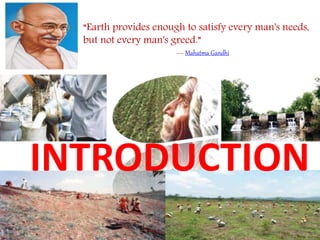
INTRODUCTION
3
ā€œEarth provides enough to satisfy every man's needs,
but not every man's greed.ā€
― Mahatma Gandhi
What are natural resources?
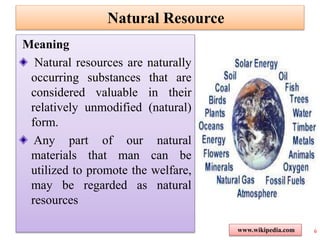
Natural Resource
Meaning
Natural resources are naturally
occurring substances that are
considered valuable in their
relatively unmodified (natural)
form.
Any part of our natural
materials that man can be
utilized to promote the welfare,
may be regarded as natural
resources
6www.wikipedia.com
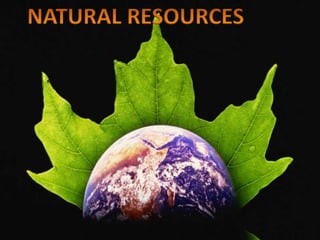
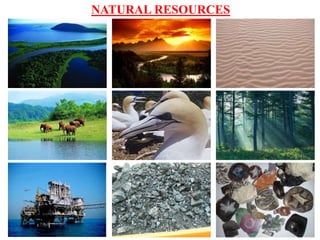
NATURAL RESOURCES
8
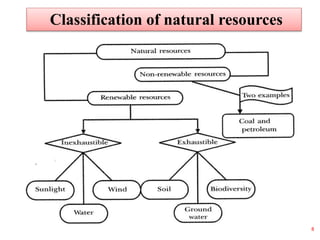
Classification of natural resources
Natural Resource Management
The management of natural resources such
as land, water, soil, plants and animals, with a particular focus on how
management affects the quality of life for both present and future
generations
Natural resource management approaches can be categorised
according to the kind and right of stakeholders
1. Private property regime :- Individual owned
2. Common property regime :- Government owned
3. Non-property regime :- Lake fishery
4. State property regime :- National forest, National park
9
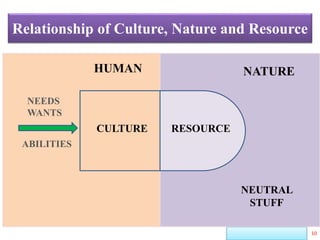
Relationship of Culture, Nature and Resource
10
HUMAN NATURE
NEUTRAL
STUFF
NEEDS
WANTS
ABILITIES
CULTURE RESOURCE
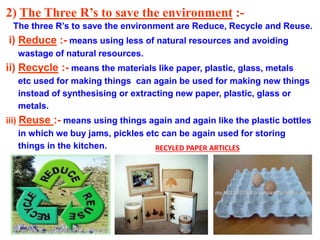
2) The Three R’s to save the environment :-
The three R’s to save the environment are Reduce, Recycle and Reuse.
i) Reduce :- means using less of natural resources and avoiding
wastage of natural resources.
ii) Recycle :- means the materials like paper, plastic, glass, metals
etc used for making things can again be used for making new things
instead of synthesising or extracting new paper, plastic, glass or
metals.
iii) Reuse :- means using things again and again like the plastic bottles
in which we buy jams, pickles etc can be again used for storing
things in the kitchen. RECYLED PAPER ARTICLES
4) Forests :-
a) Importance of forests :-
i) Forests help to preserve biodiversity.
ii) Forests are natural habitats of plants and animals.
iii) Forests provide timber, wood, fuel, medicines, fodder, etc.
iv) Forests help to maintain ecological balance.
v) Forests help to control climate and rainfall.
vi) Forests help to prevent soil erosion and controls floods.
vii) Forests help to maintain the oxygen–carbon dioxide balance in
nature.
Forests are ā€˜biodiversity hot spots’
Biodiversity measure by – Number of species found there.
- range of different life forms present.
Conservation means- preserve the biodiversity we have inherited
Loss of diversity may lead to loss of ecological stability.
b) Stake holders of forests :-
People who are associated with forests directly or
indirectly are :-
i) People living in and around forests depend on forests for
their livelihood.
ii) Industrialists who use the raw materials from forests for
manufacturing paper, medicines, furniture etc.
iii) Forest Department of the Government who owns the
forests and controls the resources from the forests.
iv) Nature and wild life organisations who want to conserve
and preserve forests.
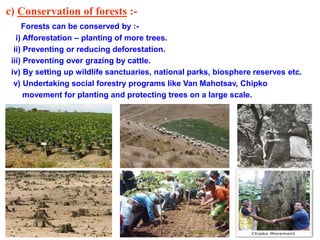
c) Conservation of forests :-
Forests can be conserved by :-
i) Afforestation – planting of more trees.
ii) Preventing or reducing deforestation.
iii) Preventing over grazing by cattle.
iv) By setting up wildlife sanctuaries, national parks, biosphere reserves etc.
v) Undertaking social forestry programs like Van Mahotsav, Chipko
movement for planting and protecting trees on a large scale.
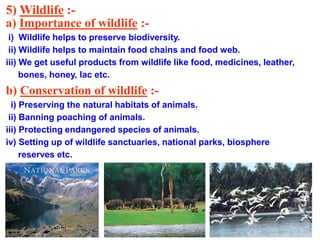
5) Wildlife :-
a) Importance of wildlife :-
i) Wildlife helps to preserve biodiversity.
ii) Wildlife helps to maintain food chains and food web.
iii) We get useful products from wildlife like food, medicines, leather,
bones, honey, lac etc.
b) Conservation of wildlife :-
i) Preserving the natural habitats of animals.
ii) Banning poaching of animals.
iii) Protecting endangered species of animals.
iv) Setting up of wildlife sanctuaries, national parks, biosphere
reserves etc.
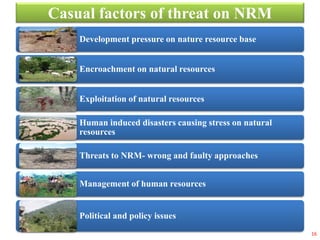
Casual factors of threat on NRM
Development pressure on nature resource base
Encroachment on natural resources
Exploitation of natural resources
Human induced disasters causing stress on natural
resources
Threats to NRM- wrong and faulty approaches
Management of human resources
Political and policy issues
16
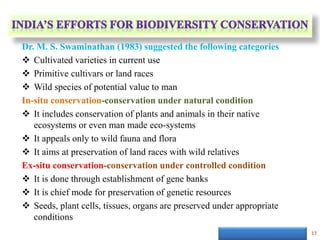
Dr. M. S. Swaminathan (1983) suggested the following categories
 Cultivated varieties in current use
 Primitive cultivars or land races
 Wild species of potential value to man
In-situ conservation-conservation under natural condition
 It includes conservation of plants and animals in their native
ecosystems or even man made eco-systems
 It appeals only to wild fauna and flora
 It aims at preservation of land races with wild relatives
Ex-situ conservation-conservation under controlled condition
 It is done through establishment of gene banks
 It is chief mode for preservation of genetic resources
 Seeds, plant cells, tissues, organs are preserved under appropriate
conditions
17
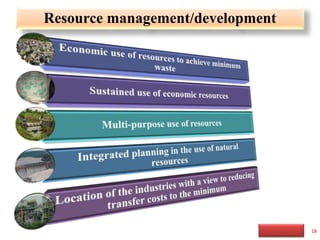
Resource management/development
18
19
Human dimensions in natural resource
management
What are ā€œ Human Dimensionsā€ā€¦..???
 Human dimensions are the peoples’ values, beliefs, attitudes,
social norms and motivations
 They use social science concepts to formulate studies that
capture and explain human values, beliefs, etc. as they apply to
natural resources
 Knowledge gained from these studies gives the public a voice
in natural resource management decisions
20
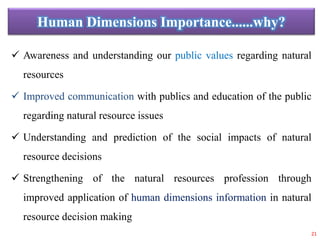
Human Dimensions Importance......why?
 Awareness and understanding our public values regarding natural
resources
 Improved communication with publics and education of the public
regarding natural resource issues
 Understanding and prediction of the social impacts of natural
resource decisions
 Strengthening of the natural resources profession through
improved application of human dimensions information in natural
resource decision making
21
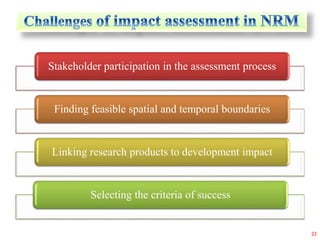
Stakeholder participation in the assessment process
Finding feasible spatial and temporal boundaries
Linking research products to development impact
Selecting the criteria of success
22
Agricultural Extension Approaches
 General agriculture extension approach
 Commodity specialized approach
 Training and visiting approach
 Participatory approach
 Project approach
 Farming system development approach
 Cost sharing approach
 Education institute approach
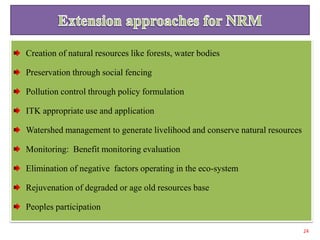
Creation of natural resources like forests, water bodies
Preservation through social fencing
Pollution control through policy formulation
ITK appropriate use and application
Watershed management to generate livelihood and conserve natural resources
Monitoring: Benefit monitoring evaluation
Elimination of negative factors operating in the eco-system
Rejuvenation of degraded or age old resources base
Peoples participation
24
Thanks

9.cl 14 15 natural resource management

  • 1.
    Natural Resource Managementin India Part-I Rajeev Kumar MSW (TISS, Mumbai) M.Phil (CIP, Ranchi) Doctoral Fellow, IIT Kharagpur
  • 3.
    INTRODUCTION 3 ā€œEarth provides enoughto satisfy every man's needs, but not every man's greed.ā€ ― Mahatma Gandhi
  • 4.
    What are naturalresources?
  • 6.
    Natural Resource Meaning Natural resourcesare naturally occurring substances that are considered valuable in their relatively unmodified (natural) form. Any part of our natural materials that man can be utilized to promote the welfare, may be regarded as natural resources 6www.wikipedia.com
  • 7.
  • 8.
  • 9.
    Natural Resource Management Themanagement of natural resources such as land, water, soil, plants and animals, with a particular focus on how management affects the quality of life for both present and future generations Natural resource management approaches can be categorised according to the kind and right of stakeholders 1. Private property regime :- Individual owned 2. Common property regime :- Government owned 3. Non-property regime :- Lake fishery 4. State property regime :- National forest, National park 9
  • 10.
    Relationship of Culture,Nature and Resource 10 HUMAN NATURE NEUTRAL STUFF NEEDS WANTS ABILITIES CULTURE RESOURCE
  • 11.
    2) The ThreeR’s to save the environment :- The three R’s to save the environment are Reduce, Recycle and Reuse. i) Reduce :- means using less of natural resources and avoiding wastage of natural resources. ii) Recycle :- means the materials like paper, plastic, glass, metals etc used for making things can again be used for making new things instead of synthesising or extracting new paper, plastic, glass or metals. iii) Reuse :- means using things again and again like the plastic bottles in which we buy jams, pickles etc can be again used for storing things in the kitchen. RECYLED PAPER ARTICLES
  • 12.
    4) Forests :- a)Importance of forests :- i) Forests help to preserve biodiversity. ii) Forests are natural habitats of plants and animals. iii) Forests provide timber, wood, fuel, medicines, fodder, etc. iv) Forests help to maintain ecological balance. v) Forests help to control climate and rainfall. vi) Forests help to prevent soil erosion and controls floods. vii) Forests help to maintain the oxygen–carbon dioxide balance in nature. Forests are ā€˜biodiversity hot spots’ Biodiversity measure by – Number of species found there. - range of different life forms present. Conservation means- preserve the biodiversity we have inherited Loss of diversity may lead to loss of ecological stability.
  • 13.
    b) Stake holdersof forests :- People who are associated with forests directly or indirectly are :- i) People living in and around forests depend on forests for their livelihood. ii) Industrialists who use the raw materials from forests for manufacturing paper, medicines, furniture etc. iii) Forest Department of the Government who owns the forests and controls the resources from the forests. iv) Nature and wild life organisations who want to conserve and preserve forests.
  • 14.
    c) Conservation offorests :- Forests can be conserved by :- i) Afforestation – planting of more trees. ii) Preventing or reducing deforestation. iii) Preventing over grazing by cattle. iv) By setting up wildlife sanctuaries, national parks, biosphere reserves etc. v) Undertaking social forestry programs like Van Mahotsav, Chipko movement for planting and protecting trees on a large scale.
  • 15.
    5) Wildlife :- a)Importance of wildlife :- i) Wildlife helps to preserve biodiversity. ii) Wildlife helps to maintain food chains and food web. iii) We get useful products from wildlife like food, medicines, leather, bones, honey, lac etc. b) Conservation of wildlife :- i) Preserving the natural habitats of animals. ii) Banning poaching of animals. iii) Protecting endangered species of animals. iv) Setting up of wildlife sanctuaries, national parks, biosphere reserves etc.
  • 16.
    Casual factors ofthreat on NRM Development pressure on nature resource base Encroachment on natural resources Exploitation of natural resources Human induced disasters causing stress on natural resources Threats to NRM- wrong and faulty approaches Management of human resources Political and policy issues 16
  • 17.
    Dr. M. S.Swaminathan (1983) suggested the following categories  Cultivated varieties in current use  Primitive cultivars or land races  Wild species of potential value to man In-situ conservation-conservation under natural condition  It includes conservation of plants and animals in their native ecosystems or even man made eco-systems  It appeals only to wild fauna and flora  It aims at preservation of land races with wild relatives Ex-situ conservation-conservation under controlled condition  It is done through establishment of gene banks  It is chief mode for preservation of genetic resources  Seeds, plant cells, tissues, organs are preserved under appropriate conditions 17
  • 18.
  • 19.
  • 20.
    Human dimensions innatural resource management What are ā€œ Human Dimensionsā€ā€¦..???  Human dimensions are the peoples’ values, beliefs, attitudes, social norms and motivations  They use social science concepts to formulate studies that capture and explain human values, beliefs, etc. as they apply to natural resources  Knowledge gained from these studies gives the public a voice in natural resource management decisions 20
  • 21.
    Human Dimensions Importance......why? Awareness and understanding our public values regarding natural resources  Improved communication with publics and education of the public regarding natural resource issues  Understanding and prediction of the social impacts of natural resource decisions  Strengthening of the natural resources profession through improved application of human dimensions information in natural resource decision making 21
  • 22.
    Stakeholder participation inthe assessment process Finding feasible spatial and temporal boundaries Linking research products to development impact Selecting the criteria of success 22
  • 23.
    Agricultural Extension Approaches General agriculture extension approach  Commodity specialized approach  Training and visiting approach  Participatory approach  Project approach  Farming system development approach  Cost sharing approach  Education institute approach
  • 24.
    Creation of naturalresources like forests, water bodies Preservation through social fencing Pollution control through policy formulation ITK appropriate use and application Watershed management to generate livelihood and conserve natural resources Monitoring: Benefit monitoring evaluation Elimination of negative factors operating in the eco-system Rejuvenation of degraded or age old resources base Peoples participation 24
  • 25.