WATER CONFLICTS IN
INDIA
Presented By:
Gunjan
Gupta
Manar
Ramadan
Sharanya
Joshi
Shivani
AGENDA
1. Overview and Growing importance of water in India
2. What is a conflict ?
3. What are Water rights ?
4. Domestic conflicts
5. International conflicts
6. Success story
7. Conclusion
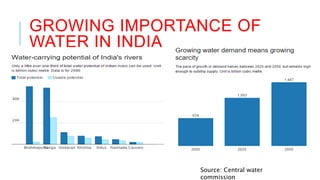
GROWING IMPORTANCE OF
WATER IN INDIA
Source: Central water
commission
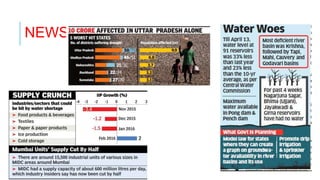
NEWS
WHAT IS A CONFLICT?
 Conflict refers to confrontations between groups or categories of
people regarding a resource activity and its management. It may be
positioned on a continuum ranging from mild tension to outright
violence.(Bavinck, Sowman and Menon, 2014);
“ a serious disagreement or argument, typically a protracted one”
(Oxford Dictionary 2013)
Conflicting interests may or may not lead to confrontations (Bavinck,
Mostert and Pellegrini 2014). Conflicts of interests could persist on
account of unequal power relations. (Forced Cooperation)
WATER RIGHT – WHOSE
RIGHTS?
Theory of absolute territorial sovereignty- irrespective of the consequences
in other countries and without the duty to consult, every nation can utilise
the waters of an international river flowing on its territory, as it likes.
Theory of absolute territorial integrity- the lower riparian of an international
river has the right to a full flow of water of natural quality and intrusion with
the natural flow by the upstream state require the consent of the
downstream riparian.
Theory of limited territorial sovereignty- This theory states that every state
may and is free to enjoy the use of water flowing through their territory as
long as such utilization does not disturb the rights and interest of co-
riparian.
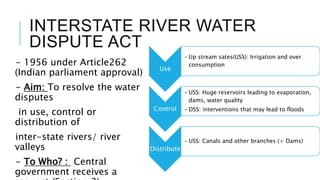
INTERSTATE RIVER WATER
DISPUTE ACT
- 1956 under Article262
(Indian parliament approval)
- Aim: To resolve the water
disputes
in use, control or
distribution of
inter-state rivers/ river
valleys
- To Who? : Central
government receives a
Use
• Up stream sates(USS): Irrigation and over
consumption
Control
• USS: Huge reservoirs leading to evaporation,
dams, water quality
• DSS: interventions that may lead to floods
Distribute
• USS: Canals and other branches (+ Dams)
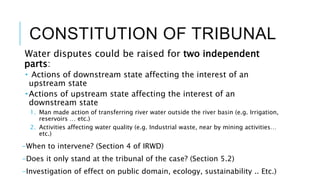
CONSTITUTION OF TRIBUNAL
Water disputes could be raised for two independent
parts:
 Actions of downstream state affecting the interest of an
upstream state
 Actions of upstream state affecting the interest of an
downstream state
1. Man made action of transferring river water outside the river basin (e.g. Irrigation,
reservoirs … etc.)
2. Activities affecting water quality (e.g. Industrial waste, near by mining activities…
etc.)
-When to intervene? (Section 4 of IRWD)
-Does it only stand at the tribunal of the case? (Section 5.2)
-Investigation of effect on public domain, ecology, sustainability .. Etc.)
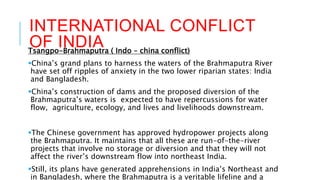
INTERNATIONAL CONFLICT
OF INDIATsangpo-Brahmaputra ( Indo – china conflict)
China’s grand plans to harness the waters of the Brahmaputra River
have set off ripples of anxiety in the two lower riparian states: India
and Bangladesh.
China’s construction of dams and the proposed diversion of the
Brahmaputra’s waters is expected to have repercussions for water
flow, agriculture, ecology, and lives and livelihoods downstream.
The Chinese government has approved hydropower projects along
the Brahmaputra. It maintains that all these are run-of-the-river
projects that involve no storage or diversion and that they will not
affect the river’s downstream flow into northeast India.
Still, its plans have generated apprehensions in India’s Northeast and
in Bangladesh, where the Brahmaputra is a veritable lifeline and a
CONTI…
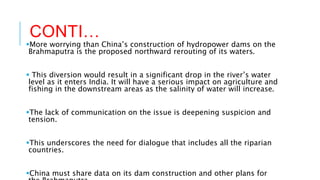
More worrying than China’s construction of hydropower dams on the
Brahmaputra is the proposed northward rerouting of its waters.
 This diversion would result in a significant drop in the river’s water
level as it enters India. It will have a serious impact on agriculture and
fishing in the downstream areas as the salinity of water will increase.
The lack of communication on the issue is deepening suspicion and
tension.
This underscores the need for dialogue that includes all the riparian
countries.
China must share data on its dam construction and other plans for
CONTI…
Mahakali River treaty ( Indo- Nepal)
The Territorial disputes of India and Nepal include Kalapani 400
km2 and Susta 140 km2 . Nepal claims that the river to the west of
Kalapani is the main Kali river, hence it belongs to Nepal.
India insists that the river to the east of Kalapani is the main Kali
river, and therefore claim the Kalapani area belongs to India. The river
borders the Nepalese zone of Mahakali and the Indian state of
Uttarakhand.
The Kali River runs through an area that includes a disputed area of
about 400 km² around the source of the river.
The dispute intensified in 1997 as the Nepali parliament considered a
treaty on hydro-electric development of the river.
The Mahakali Treaty basically aims at an integrated development of
water resources in the Mahakali River and has been finalized on the
basis of equal partnership.
SUCCESS STORY
Indus Waters Treaty (Indo- Pak)
The Indus river has its source in Indian Kashmir and flows through
Pakistan. It is the primary freshwater source for Pakistan. Agriculture
being the mainstay of the economy in both countries, their
dependence on the Indus and its tributaries is implicit.
From the Indian point of view, there was nothing that Pakistan could
do to prevent India from any of the schemes to divert the flow of
water in the rivers. Pakistan’s position was dismal and India could do
whatever it wanted.
Pakistani fear that since the source rivers of the Indus basin were
in India, it could potentially create droughts and famines in Pakistan
led to The Indus Waters Treaty, brokered by the World Bank. The
treaty was signed in Karachi on September 19, 1960.
CONTI..
According to this agreement, control over Beas, Ravi and Sutlej was
given to India and the Indus, Chenab and Jhelum to Pakistan.
Since Pakistan's rivers flow through India first, the treaty allowed
India to use them for irrigation, transport and power generation,
while laying down precise do's and don'ts for Indian building projects
along the way.
The treaty is considered to be one of the most successful
watersharing endeavours in the world today. Since the ratification of
the treaty in 1960, India and Pakistan have not engaged in any water
wars.
CONCLUSION
Conflicts over water are not necessarily over water, or triggered by
scarcity.
They are a reflection of social and power relations.
They are socially embedded.
They can be multi-layered, have a historical dimension.
They are enmeshed in local struggles for supremacy and power.
REFERENCES
Gujja, Biksham, , K J Joy, and Suhas Paranjape. "Babhli Water Conflict:
Less Water, More Politics". Economic & Political Weekly vol xlv.no 31
(2010): 12-15.
Gyawali, Dipak. "Institutional Forces Behind Water Conflict In The
Ganga Plains". GeoJournal Vol. 47.No. 3, (1999): 443-452.
Singh, Prabhat. "Opinion". http://www.livemint.com/. N.p., 2015.
Web. 23 Apr. 2016.
Sudha Ramachandran, The Diplomat. "Water Wars: China, India And
The Great Dam Rush". The Diplomat. N.p., 2016. Web. 23 Apr. 2016.
Stephen Groves, The Diplomat. "India And Nepal Tackle Border
Disputes". The Diplomat. N.p., 2016. Web. 23 Apr. 2016.
"Indus Water: Treaty And Conflicts".
http://www.hindustantimes.com/. N.p., 2014. Web. 23 Apr. 2016.
"Kaveri River Water Dispute". Wikipedia. N.p., 2016. Web. 23 Apr.
2016.
THANK YOU

Water conflicts in India

  • 1.
    WATER CONFLICTS IN INDIA PresentedBy: Gunjan Gupta Manar Ramadan Sharanya Joshi Shivani
  • 2.
    AGENDA 1. Overview andGrowing importance of water in India 2. What is a conflict ? 3. What are Water rights ? 4. Domestic conflicts 5. International conflicts 6. Success story 7. Conclusion
  • 3.
    GROWING IMPORTANCE OF WATERIN INDIA Source: Central water commission
  • 4.
  • 5.
    WHAT IS ACONFLICT?  Conflict refers to confrontations between groups or categories of people regarding a resource activity and its management. It may be positioned on a continuum ranging from mild tension to outright violence.(Bavinck, Sowman and Menon, 2014); “ a serious disagreement or argument, typically a protracted one” (Oxford Dictionary 2013) Conflicting interests may or may not lead to confrontations (Bavinck, Mostert and Pellegrini 2014). Conflicts of interests could persist on account of unequal power relations. (Forced Cooperation)
  • 6.
    WATER RIGHT –WHOSE RIGHTS? Theory of absolute territorial sovereignty- irrespective of the consequences in other countries and without the duty to consult, every nation can utilise the waters of an international river flowing on its territory, as it likes. Theory of absolute territorial integrity- the lower riparian of an international river has the right to a full flow of water of natural quality and intrusion with the natural flow by the upstream state require the consent of the downstream riparian. Theory of limited territorial sovereignty- This theory states that every state may and is free to enjoy the use of water flowing through their territory as long as such utilization does not disturb the rights and interest of co- riparian.
  • 13.
    INTERSTATE RIVER WATER DISPUTEACT - 1956 under Article262 (Indian parliament approval) - Aim: To resolve the water disputes in use, control or distribution of inter-state rivers/ river valleys - To Who? : Central government receives a Use • Up stream sates(USS): Irrigation and over consumption Control • USS: Huge reservoirs leading to evaporation, dams, water quality • DSS: interventions that may lead to floods Distribute • USS: Canals and other branches (+ Dams)
  • 14.
    CONSTITUTION OF TRIBUNAL Waterdisputes could be raised for two independent parts:  Actions of downstream state affecting the interest of an upstream state  Actions of upstream state affecting the interest of an downstream state 1. Man made action of transferring river water outside the river basin (e.g. Irrigation, reservoirs … etc.) 2. Activities affecting water quality (e.g. Industrial waste, near by mining activities… etc.) -When to intervene? (Section 4 of IRWD) -Does it only stand at the tribunal of the case? (Section 5.2) -Investigation of effect on public domain, ecology, sustainability .. Etc.)
  • 15.
    INTERNATIONAL CONFLICT OF INDIATsangpo-Brahmaputra( Indo – china conflict) China’s grand plans to harness the waters of the Brahmaputra River have set off ripples of anxiety in the two lower riparian states: India and Bangladesh. China’s construction of dams and the proposed diversion of the Brahmaputra’s waters is expected to have repercussions for water flow, agriculture, ecology, and lives and livelihoods downstream. The Chinese government has approved hydropower projects along the Brahmaputra. It maintains that all these are run-of-the-river projects that involve no storage or diversion and that they will not affect the river’s downstream flow into northeast India. Still, its plans have generated apprehensions in India’s Northeast and in Bangladesh, where the Brahmaputra is a veritable lifeline and a
  • 16.
    CONTI… More worrying thanChina’s construction of hydropower dams on the Brahmaputra is the proposed northward rerouting of its waters.  This diversion would result in a significant drop in the river’s water level as it enters India. It will have a serious impact on agriculture and fishing in the downstream areas as the salinity of water will increase. The lack of communication on the issue is deepening suspicion and tension. This underscores the need for dialogue that includes all the riparian countries. China must share data on its dam construction and other plans for
  • 17.
    CONTI… Mahakali River treaty( Indo- Nepal) The Territorial disputes of India and Nepal include Kalapani 400 km2 and Susta 140 km2 . Nepal claims that the river to the west of Kalapani is the main Kali river, hence it belongs to Nepal. India insists that the river to the east of Kalapani is the main Kali river, and therefore claim the Kalapani area belongs to India. The river borders the Nepalese zone of Mahakali and the Indian state of Uttarakhand. The Kali River runs through an area that includes a disputed area of about 400 km² around the source of the river. The dispute intensified in 1997 as the Nepali parliament considered a treaty on hydro-electric development of the river. The Mahakali Treaty basically aims at an integrated development of water resources in the Mahakali River and has been finalized on the basis of equal partnership.
  • 18.
    SUCCESS STORY Indus WatersTreaty (Indo- Pak) The Indus river has its source in Indian Kashmir and flows through Pakistan. It is the primary freshwater source for Pakistan. Agriculture being the mainstay of the economy in both countries, their dependence on the Indus and its tributaries is implicit. From the Indian point of view, there was nothing that Pakistan could do to prevent India from any of the schemes to divert the flow of water in the rivers. Pakistan’s position was dismal and India could do whatever it wanted. Pakistani fear that since the source rivers of the Indus basin were in India, it could potentially create droughts and famines in Pakistan led to The Indus Waters Treaty, brokered by the World Bank. The treaty was signed in Karachi on September 19, 1960.
  • 19.
    CONTI.. According to thisagreement, control over Beas, Ravi and Sutlej was given to India and the Indus, Chenab and Jhelum to Pakistan. Since Pakistan's rivers flow through India first, the treaty allowed India to use them for irrigation, transport and power generation, while laying down precise do's and don'ts for Indian building projects along the way. The treaty is considered to be one of the most successful watersharing endeavours in the world today. Since the ratification of the treaty in 1960, India and Pakistan have not engaged in any water wars.
  • 20.
    CONCLUSION Conflicts over waterare not necessarily over water, or triggered by scarcity. They are a reflection of social and power relations. They are socially embedded. They can be multi-layered, have a historical dimension. They are enmeshed in local struggles for supremacy and power.
  • 21.
    REFERENCES Gujja, Biksham, ,K J Joy, and Suhas Paranjape. "Babhli Water Conflict: Less Water, More Politics". Economic & Political Weekly vol xlv.no 31 (2010): 12-15. Gyawali, Dipak. "Institutional Forces Behind Water Conflict In The Ganga Plains". GeoJournal Vol. 47.No. 3, (1999): 443-452. Singh, Prabhat. "Opinion". http://www.livemint.com/. N.p., 2015. Web. 23 Apr. 2016. Sudha Ramachandran, The Diplomat. "Water Wars: China, India And The Great Dam Rush". The Diplomat. N.p., 2016. Web. 23 Apr. 2016. Stephen Groves, The Diplomat. "India And Nepal Tackle Border Disputes". The Diplomat. N.p., 2016. Web. 23 Apr. 2016. "Indus Water: Treaty And Conflicts". http://www.hindustantimes.com/. N.p., 2014. Web. 23 Apr. 2016. "Kaveri River Water Dispute". Wikipedia. N.p., 2016. Web. 23 Apr. 2016.
  • 22.

Editor's Notes

  • #14 This happens mainly in one case, if downstream state is building a dam near to state boudaries and will lead to floods o the territories of an upstream states on permanent or temporary basis. When upstream state implements any intervention that would affect down stream state. As for example: 1. Low cost dams in floods seasons leads to waste of water in evaporation and alters the river ecology .. Its flaura and fauna – threat of its failure on downstream states.
  • #15 - When riparian state could not reach an applicable agreement that both sides agree on regarding the use of interstate river waters No. Doesn’t stand at judgment, but also investigating matters reffered to by central gov. of each state and delivering a report of the facts and findings. Public domain (water pollution and quality, flood control, environmental flow)