Sustainable Development:
Practices Adopted in Various
Industry Sectors in India
Management Project
Pankaj Gaurav
ID: 12A1HP035
Introduction
▪ Sustainable Development (SD) implies
economic growth together with the
protection of environmental quality, each
reinforcing the other
▪ Sustainable
development
in
India
encompasses a variety of development
schemes in social, cleantech (clean
energy, clean water and sustainable
agriculture) and human resources
segments, having caught the attention of
both Central and State governments and
also public and private sectors.

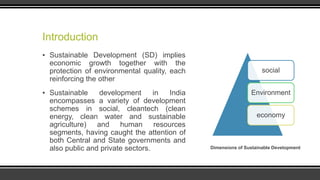
social
Environment
economy

Dimensions of Sustainable Development
Project Objective
To do study on the sustainable development practices prevailing in various
industry sectors ( Power & Energy, Mining, Petroleum and Refinery,
Agribusiness ) in India and coordination of their strategic programs
To analyze the role of government, companies and other stakeholders in
achieving desirable standards in sustainable development
To Study the efficacy of Sustainability Index (SI) as an effective tool for
measuring sustainable development
Project Scope

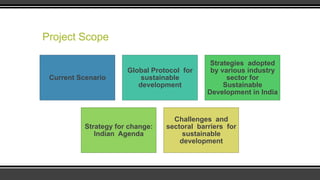
Current Scenario

Global Protocol for
sustainable
development

Strategy for change:
Indian Agenda

Strategies adopted
by various industry
sector for
Sustainable
Development in India

Challenges and
sectoral barriers for
sustainable
development
Literature Review
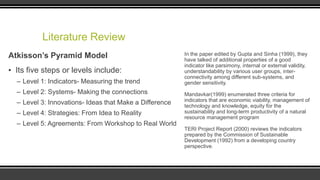
Atkisson’s Pyramid Model

▪ Its five steps or levels include:
– Level 1: Indicators- Measuring the trend
– Level 2: Systems- Making the connections
– Level 3: Innovations- Ideas that Make a Difference
– Level 4: Strategies: From Idea to Reality
– Level 5: Agreements: From Workshop to Real World

In the paper edited by Gupta and Sinha (1999), they
have talked of additional properties of a good
indicator like parsimony, internal or external validity,
understandability by various user groups, interconnectivity among different sub-systems, and
gender sensitivity.
Mandavkar(1999) enumerated three criteria for
indicators that are economic viability, management of
technology and knowledge, equity for the
sustainability and long-term productivity of a natural
resource management program
TERI Project Report (2000) reviews the indicators
prepared by the Commission of Sustainable
Development (1992) from a developing country
perspective.
Project Methodology
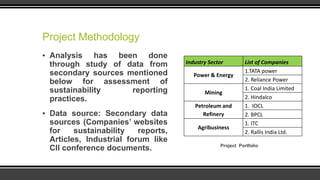
▪ Analysis has been done
through study of data from
secondary sources mentioned
below for assessment of
sustainability
reporting
practices.
▪ Data source: Secondary data
sources (Companies’ websites
for
sustainability
reports,
Articles, Industrial forum like
CII conference documents.

Industry Sector
Power & Energy
Mining
Petroleum and
Refinery
Agribusiness

List of Companies
1.TATA power
2. Reliance Power
1. Coal India Limited
2. Hindalco
1. IOCL
2. BPCL
1. ITC
2. Rallis India Ltd.

Project Portfolio
Data Analysis
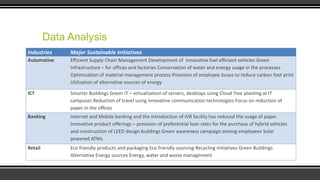
Industries

Major Sustainable Initiatives

Automotive

Efficient Supply Chain Management Development of innovative fuel efficient vehicles Green
Infrastructure – for offices and factories Conservation of water and energy usage in the processes
Optimization of material management process Provision of employee buses to reduce carbon foot print
Utilization of alternative sources of energy

ICT

Smarter Buildings Green IT – virtualization of servers, desktops using Cloud Tree planting at IT
campuses Reduction of travel using innovative communication technologies Focus on reduction of
paper in the offices

Banking

Internet and Mobile banking and the introduction of IVR facility has reduced the usage of paper
Innovative product offerings – provision of preferential loan rates for the purchase of hybrid vehicles
and construction of LEED design buildings Green awareness campaign among employees Solar
powered ATMs

Retail

Eco friendly products and packaging Eco friendly sourcing Recycling initiatives Green Buildings
Alternative Energy sources Energy, water and waste management
Power & Energy Sector: TATA Power
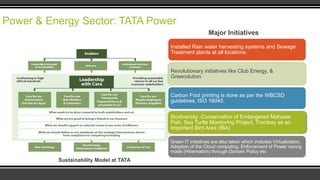
Major Initiatives
Installed Rain water harvesting systems and Sewage
Treatment plants at all locations.

Revolutionary initiatives like Club Energy, &
Greenolution

Carbon Foot printing is done as per the WBCSD
guidelines, ISO 16040.

Biodiversity :Conservation of Endangered Mahseer
Fish, Sea Turtle Monitoring Project, Trombay as an
Important Bird Area (IBA)
Green IT initiatives are also taken which includes Virtualization,
Adoption of the Cloud computing, Enforcement of Power saving
mode (Hibernation) through Domain Policy etc

Sustainability Model at TATA
Power & Energy Sector: Reliance Power
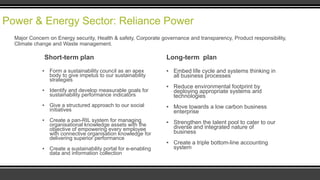
Major Concern on Energy security, Health & safety, Corporate governance and transparency, Product responsibility,
Climate change and Waste management.

Short-term plan

Long-term plan

▪ Form a sustainability council as an apex
body to give impetus to our sustainability
strategies

▪ Embed life cycle and systems thinking in
all business processes

▪ Identify and develop measurable goals for
sustainability performance indicators

▪ Reduce environmental footprint by
deploying appropriate systems and
technologies

▪ Give a structured approach to our social
initiatives

▪ Move towards a low carbon business
enterprise

▪ Create a pan-RIL system for managing
organisational knowledge assets with the
objective of empowering every employee
with connective organisation knowledge for
delivering superior performance

▪ Strengthen the talent pool to cater to our
diverse and integrated nature of
business

▪ Create a sustainability portal for e-enabling
data and information collection

▪ Create a triple bottom-line accounting
system
Power & Energy Sector: Reliance Power
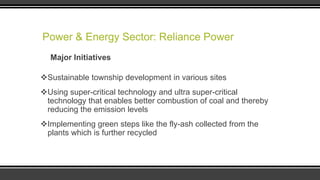
Major Initiatives
Sustainable township development in various sites
Using super-critical technology and ultra super-critical
technology that enables better combustion of coal and thereby
reducing the emission levels
Implementing green steps like the fly-ash collected from the
plants which is further recycled
Mining Sector: Major Issues
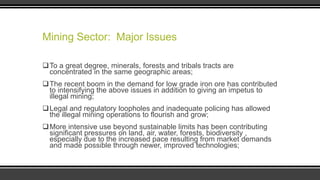
To a great degree, minerals, forests and tribals tracts are
concentrated in the same geographic areas;
The recent boom in the demand for low grade iron ore has contributed
to intensifying the above issues in addition to giving an impetus to
illegal mining;

Legal and regulatory loopholes and inadequate policing has allowed
the illegal mining operations to flourish and grow;
More intensive use beyond sustainable limits has been contributing
significant pressures on land, air, water, forests, biodiversity ,
especially due to the increased pace resulting from market demands
and made possible through newer, improved technologies;
Mining Sector: Coal India
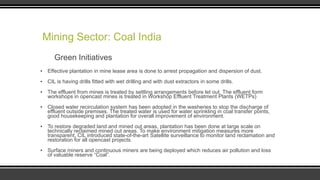
Green Initiatives
▪ Effective plantation in mine lease area is done to arrest propagation and dispersion of dust.
▪ CIL is having drills fitted with wet drilling and with dust extractors in some drills.
▪ The effluent from mines is treated by settling arrangements before let out. The effluent form
workshops in opencast mines is treated in Workshop Effluent Treatment Plants (WETPs)

▪ Closed water recirculation system has been adopted in the washeries to stop the discharge of
effluent outside premises. The treated water is used for water sprinkling in coal transfer points,
good housekeeping and plantation for overall improvement of environment.
▪ To restore degraded land and mined out areas, plantation has been done at large scale on
technically reclaimed mined out areas. To make environment mitigation measures more
transparent, CIL introduced state-of-the-art Satellite surveillance to monitor land reclamation and
restoration for all opencast projects.
▪ Surface miners and continuous miners are being deployed which reduces air pollution and loss
of valuable reserve “Coal”.
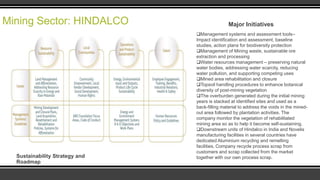
Mining Sector: HINDALCO

Sustainability Strategy and
Roadmap

Major Initiatives
Management systems and assessment tools–
Impact identification and assessment, baseline
studies, action plans for biodiversity protection
Management of Mining waste, sustainable ore
extraction and processing
Water resources management – preserving natural
water bodies, addressing water scarcity, reducing
water pollution, and supporting competing uses
Mined area rehabilitation and closure
Topsoil handling procedures to enhance botanical
diversity of post-mining vegetation
The overburden generated during the initial mining
years is stacked at identified sites and used as a
back-filling material to address the voids in the minedout area followed by plantation activities. The
company monitor the vegetation of rehabilitated
mining area so as to help it become self-sustaining.
Downstream units of Hindalco in India and Novelis
manufacturing facilities in several countries have
dedicated Aluminium recycling and remelting
facilities. Company recycle process scrap from
customers and scrap collected from the market
together with our own process scrap.
Petroleum and Refinery Industry : IOCL
Adoption of the “3-R” (reduce, reuse, and recycle)
Key Initiatives
Footprinting exercise for measuring GHG emissions, water consumption, and
waste generation across all business units of IOCL
Rainwater harvesting
All major events in IOCL are made carbon neutral by calculating the carbon
emissions resulting from the event and planting of requisite number of trees to
offset them
Awareness generation workshops on sustainability
Retail outlet/KSK Solarisation by installation of SPV modules to provide solar
energy in lieu of power from diesel gensets during power outage.
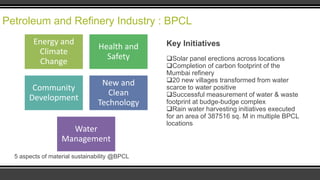
Petroleum and Refinery Industry : BPCL
Energy and
Climate
Change

Health and
Safety

Community
Development

New and
Clean
Technology

Water
Management
5 aspects of material sustainability @BPCL

Key Initiatives
Solar panel erections across locations
Completion of carbon footprint of the
Mumbai refinery
20 new villages transformed from water
scarce to water positive
Successful measurement of water & waste
footprint at budge-budge complex
Rain water harvesting initiatives executed
for an area of 387516 sq. M in multiple BPCL
locations
Agribusiness Sector : ITC
Key Initiatives
 ITC e-Choupal system has co-created with farmers an efficient Agri-value
chain.
 ITC‟s Integrated Watershed Development programme
 Adopting a low-carbon growth path through reduction in specific energy
consumption and enhancing use of renewable energy sources
 Enlarging its carbon positive footprint through increased carbon
sequestration by expanding forestry projects in wastelands
 Working towards minimising waste generation, maximising reuse & recycling
and using external post-consumer waste as raw material in its units
 Life Cycle Assessment studies have been carried out for different products to
understand the impact across the value chain.
Agribusiness Sector : Rallis India Ltd.
Key Initiatives
▪ The investor survey, customer satisfaction survey, employee satisfaction
survey and community need analysis are undertaken periodically and the
inputs from these are used to prepare the Annual Business Plan.
▪ The Company is in the process to identify usage (re-sue) of certain ecofriendly wastes generated elsewhere within the Company as alternate fuel.
▪ Various energy conservation initiatives were rolled out across all the
manufacturing units and tangible reductions achieved mainly in electrical
consumption.
▪ Environment impact assessment has been done by the development
authority before declaring the industrial zones whereby protection of biodiversity is taken care in the planning stage itself
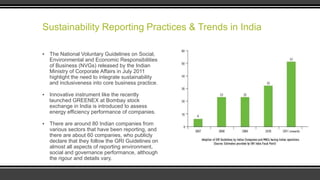
Sustainability Reporting Practices & Trends in India
▪ The National Voluntary Guidelines on Social,
Environmental and Economic Responsibilities
of Business (NVGs) released by the Indian
Ministry of Corporate Affairs in July 2011
highlight the need to integrate sustainability
and inclusiveness into core business practice.
▪ Innovative instrument like the recently
launched GREENEX at Bombay stock
exchange in India is introduced to assess
energy efficiency performance of companies.
▪ There are around 80 Indian companies from
various sectors that have been reporting, and
there are about 60 companies, who publicly
declare that they follow the GRI Guidelines on
almost all aspects of reporting environment,
social and governance performance, although
the rigour and details vary.
Proposed Initiatives in adoption of Sustainability
Reporting norms
▪ Recognitions of sustainable development initiatives through Award functions
will enhance public image of companies and motivate them to do more in this
regard
▪ Thought leadership papers published and sustainability reporting workshops
organized by industry bodies like CII and TERI plays a role in reducing the
ignorance about the subject and encourage more participation. There are
also industry conferences that provide a platform for partnership or innovative
thoughts.
▪ Analytics combined with IT solutions facilitate easy measurement and
monitoring of sustainability initiatives, making it easier for management to
track and realize the benefits.
▪ Initiatives to inform businesses on the advantages of earning additional
revenue from carbon credit trading will help increase the number of
businesses running sustainable operations.
Conclusion
▪ Its long way to go for Indian companies to adopt sustainable development
practices as per global norms.
▪ Companies like Tata, Reliance, ITC and Infosys have adopted these
practices at a larger scale and paved a path for other businesses to follow
▪ As per GRI‟s year in review 2009/10, 78% of GRI sustainability reports from
India contain complete information relevant to the reporting organization.
▪ The initiatives adopted by the industry organizations and the government are
bound to provide an impetus to the trend of adopting business sustainability
as a competitive advantage.
References
Articles & Papers:
▪

Gupta, A. and R, Sinha. (1999), “Criteria and Indicators of Sustainability in Rural Development: A Natural Perspective

▪

Proops, L.R.J., Atkinson, G., Schlotheim, B.F. and Simon, S. (1999) “International Trade and the Sustainability Footprint: Practical
criterion for its assessment”. Ecological Economics

▪

Gupta Surendra and Chaturvedi Bhartendu, “Strategies for Sustainable Development in India”

▪

Kumar Praduman and Mittal Surabhi, “Agricultural Productivity Trends in India: Sustainability Issues”, Agricultural Economics Research
Review, Vol. 19 (Conference No.) 2006, 71-88

Reports:
▪

Brundtland Report (1987) „Our Common Future‟

▪

IUCN (The World Conservation Union), 1991

▪

TERI Project Report (2000)

▪

Sustainable Measures: Indicators of Sustainability; (1998-2000) -Traditional vs. Sustainability indicators

▪

BT Sustainable Development Index India Report 2008

▪

Sustainably Reporting: Practices and trends in India 2012, GIZ, GmBH

▪

Sustainable Development: Emerging Issues in India‟s Mineral Sector, Planning Commission, Government of India, 2012
References
Web pages
▪ www.sustainablemeasures.com/indicators
▪ http://www.rallis.co.in
▪ http://www.itcportal.com
▪ http://ccl.gov.in
▪ http://www.hindalco.com
▪ http://www.iocl.com

▪ www.bharatpetroleum.com
▪ http://www.reliancepower.co.in
▪ http://www.tatapower.com
▪ http://www.cxotoday.com/story/the-sustainability-factor-in-indian-businesses

▪ http://www.ibef.org/india/SustainableDevelopment.aspx
▪ http://www.financialexpress.com/news/mapping-how-corporate-india-is-converting-climate-change-risksinto-biz-opportunities/401247/

Sustainable Development: Practices Adopted in Various Industry Sectors in India

  • 1.
    Sustainable Development: Practices Adoptedin Various Industry Sectors in India Management Project Pankaj Gaurav ID: 12A1HP035
  • 2.
    Introduction ▪ Sustainable Development(SD) implies economic growth together with the protection of environmental quality, each reinforcing the other ▪ Sustainable development in India encompasses a variety of development schemes in social, cleantech (clean energy, clean water and sustainable agriculture) and human resources segments, having caught the attention of both Central and State governments and also public and private sectors. social Environment economy Dimensions of Sustainable Development
  • 3.
    Project Objective To dostudy on the sustainable development practices prevailing in various industry sectors ( Power & Energy, Mining, Petroleum and Refinery, Agribusiness ) in India and coordination of their strategic programs To analyze the role of government, companies and other stakeholders in achieving desirable standards in sustainable development To Study the efficacy of Sustainability Index (SI) as an effective tool for measuring sustainable development
  • 4.
    Project Scope Current Scenario GlobalProtocol for sustainable development Strategy for change: Indian Agenda Strategies adopted by various industry sector for Sustainable Development in India Challenges and sectoral barriers for sustainable development
  • 5.
    Literature Review Atkisson’s PyramidModel ▪ Its five steps or levels include: – Level 1: Indicators- Measuring the trend – Level 2: Systems- Making the connections – Level 3: Innovations- Ideas that Make a Difference – Level 4: Strategies: From Idea to Reality – Level 5: Agreements: From Workshop to Real World In the paper edited by Gupta and Sinha (1999), they have talked of additional properties of a good indicator like parsimony, internal or external validity, understandability by various user groups, interconnectivity among different sub-systems, and gender sensitivity. Mandavkar(1999) enumerated three criteria for indicators that are economic viability, management of technology and knowledge, equity for the sustainability and long-term productivity of a natural resource management program TERI Project Report (2000) reviews the indicators prepared by the Commission of Sustainable Development (1992) from a developing country perspective.
  • 6.
    Project Methodology ▪ Analysishas been done through study of data from secondary sources mentioned below for assessment of sustainability reporting practices. ▪ Data source: Secondary data sources (Companies’ websites for sustainability reports, Articles, Industrial forum like CII conference documents. Industry Sector Power & Energy Mining Petroleum and Refinery Agribusiness List of Companies 1.TATA power 2. Reliance Power 1. Coal India Limited 2. Hindalco 1. IOCL 2. BPCL 1. ITC 2. Rallis India Ltd. Project Portfolio
  • 7.
    Data Analysis Industries Major SustainableInitiatives Automotive Efficient Supply Chain Management Development of innovative fuel efficient vehicles Green Infrastructure – for offices and factories Conservation of water and energy usage in the processes Optimization of material management process Provision of employee buses to reduce carbon foot print Utilization of alternative sources of energy ICT Smarter Buildings Green IT – virtualization of servers, desktops using Cloud Tree planting at IT campuses Reduction of travel using innovative communication technologies Focus on reduction of paper in the offices Banking Internet and Mobile banking and the introduction of IVR facility has reduced the usage of paper Innovative product offerings – provision of preferential loan rates for the purchase of hybrid vehicles and construction of LEED design buildings Green awareness campaign among employees Solar powered ATMs Retail Eco friendly products and packaging Eco friendly sourcing Recycling initiatives Green Buildings Alternative Energy sources Energy, water and waste management
  • 8.
    Power & EnergySector: TATA Power Major Initiatives Installed Rain water harvesting systems and Sewage Treatment plants at all locations. Revolutionary initiatives like Club Energy, & Greenolution Carbon Foot printing is done as per the WBCSD guidelines, ISO 16040. Biodiversity :Conservation of Endangered Mahseer Fish, Sea Turtle Monitoring Project, Trombay as an Important Bird Area (IBA) Green IT initiatives are also taken which includes Virtualization, Adoption of the Cloud computing, Enforcement of Power saving mode (Hibernation) through Domain Policy etc Sustainability Model at TATA
  • 9.
    Power & EnergySector: Reliance Power Major Concern on Energy security, Health & safety, Corporate governance and transparency, Product responsibility, Climate change and Waste management. Short-term plan Long-term plan ▪ Form a sustainability council as an apex body to give impetus to our sustainability strategies ▪ Embed life cycle and systems thinking in all business processes ▪ Identify and develop measurable goals for sustainability performance indicators ▪ Reduce environmental footprint by deploying appropriate systems and technologies ▪ Give a structured approach to our social initiatives ▪ Move towards a low carbon business enterprise ▪ Create a pan-RIL system for managing organisational knowledge assets with the objective of empowering every employee with connective organisation knowledge for delivering superior performance ▪ Strengthen the talent pool to cater to our diverse and integrated nature of business ▪ Create a sustainability portal for e-enabling data and information collection ▪ Create a triple bottom-line accounting system
  • 10.
    Power & EnergySector: Reliance Power Major Initiatives Sustainable township development in various sites Using super-critical technology and ultra super-critical technology that enables better combustion of coal and thereby reducing the emission levels Implementing green steps like the fly-ash collected from the plants which is further recycled
  • 11.
    Mining Sector: MajorIssues To a great degree, minerals, forests and tribals tracts are concentrated in the same geographic areas; The recent boom in the demand for low grade iron ore has contributed to intensifying the above issues in addition to giving an impetus to illegal mining; Legal and regulatory loopholes and inadequate policing has allowed the illegal mining operations to flourish and grow; More intensive use beyond sustainable limits has been contributing significant pressures on land, air, water, forests, biodiversity , especially due to the increased pace resulting from market demands and made possible through newer, improved technologies;
  • 12.
    Mining Sector: CoalIndia Green Initiatives ▪ Effective plantation in mine lease area is done to arrest propagation and dispersion of dust. ▪ CIL is having drills fitted with wet drilling and with dust extractors in some drills. ▪ The effluent from mines is treated by settling arrangements before let out. The effluent form workshops in opencast mines is treated in Workshop Effluent Treatment Plants (WETPs) ▪ Closed water recirculation system has been adopted in the washeries to stop the discharge of effluent outside premises. The treated water is used for water sprinkling in coal transfer points, good housekeeping and plantation for overall improvement of environment. ▪ To restore degraded land and mined out areas, plantation has been done at large scale on technically reclaimed mined out areas. To make environment mitigation measures more transparent, CIL introduced state-of-the-art Satellite surveillance to monitor land reclamation and restoration for all opencast projects. ▪ Surface miners and continuous miners are being deployed which reduces air pollution and loss of valuable reserve “Coal”.
  • 13.
    Mining Sector: HINDALCO SustainabilityStrategy and Roadmap Major Initiatives Management systems and assessment tools– Impact identification and assessment, baseline studies, action plans for biodiversity protection Management of Mining waste, sustainable ore extraction and processing Water resources management – preserving natural water bodies, addressing water scarcity, reducing water pollution, and supporting competing uses Mined area rehabilitation and closure Topsoil handling procedures to enhance botanical diversity of post-mining vegetation The overburden generated during the initial mining years is stacked at identified sites and used as a back-filling material to address the voids in the minedout area followed by plantation activities. The company monitor the vegetation of rehabilitated mining area so as to help it become self-sustaining. Downstream units of Hindalco in India and Novelis manufacturing facilities in several countries have dedicated Aluminium recycling and remelting facilities. Company recycle process scrap from customers and scrap collected from the market together with our own process scrap.
  • 14.
    Petroleum and RefineryIndustry : IOCL Adoption of the “3-R” (reduce, reuse, and recycle) Key Initiatives Footprinting exercise for measuring GHG emissions, water consumption, and waste generation across all business units of IOCL Rainwater harvesting All major events in IOCL are made carbon neutral by calculating the carbon emissions resulting from the event and planting of requisite number of trees to offset them Awareness generation workshops on sustainability Retail outlet/KSK Solarisation by installation of SPV modules to provide solar energy in lieu of power from diesel gensets during power outage.
  • 15.
    Petroleum and RefineryIndustry : BPCL Energy and Climate Change Health and Safety Community Development New and Clean Technology Water Management 5 aspects of material sustainability @BPCL Key Initiatives Solar panel erections across locations Completion of carbon footprint of the Mumbai refinery 20 new villages transformed from water scarce to water positive Successful measurement of water & waste footprint at budge-budge complex Rain water harvesting initiatives executed for an area of 387516 sq. M in multiple BPCL locations
  • 16.
    Agribusiness Sector :ITC Key Initiatives  ITC e-Choupal system has co-created with farmers an efficient Agri-value chain.  ITC‟s Integrated Watershed Development programme  Adopting a low-carbon growth path through reduction in specific energy consumption and enhancing use of renewable energy sources  Enlarging its carbon positive footprint through increased carbon sequestration by expanding forestry projects in wastelands  Working towards minimising waste generation, maximising reuse & recycling and using external post-consumer waste as raw material in its units  Life Cycle Assessment studies have been carried out for different products to understand the impact across the value chain.
  • 17.
    Agribusiness Sector :Rallis India Ltd. Key Initiatives ▪ The investor survey, customer satisfaction survey, employee satisfaction survey and community need analysis are undertaken periodically and the inputs from these are used to prepare the Annual Business Plan. ▪ The Company is in the process to identify usage (re-sue) of certain ecofriendly wastes generated elsewhere within the Company as alternate fuel. ▪ Various energy conservation initiatives were rolled out across all the manufacturing units and tangible reductions achieved mainly in electrical consumption. ▪ Environment impact assessment has been done by the development authority before declaring the industrial zones whereby protection of biodiversity is taken care in the planning stage itself
  • 18.
    Sustainability Reporting Practices& Trends in India ▪ The National Voluntary Guidelines on Social, Environmental and Economic Responsibilities of Business (NVGs) released by the Indian Ministry of Corporate Affairs in July 2011 highlight the need to integrate sustainability and inclusiveness into core business practice. ▪ Innovative instrument like the recently launched GREENEX at Bombay stock exchange in India is introduced to assess energy efficiency performance of companies. ▪ There are around 80 Indian companies from various sectors that have been reporting, and there are about 60 companies, who publicly declare that they follow the GRI Guidelines on almost all aspects of reporting environment, social and governance performance, although the rigour and details vary.
  • 19.
    Proposed Initiatives inadoption of Sustainability Reporting norms ▪ Recognitions of sustainable development initiatives through Award functions will enhance public image of companies and motivate them to do more in this regard ▪ Thought leadership papers published and sustainability reporting workshops organized by industry bodies like CII and TERI plays a role in reducing the ignorance about the subject and encourage more participation. There are also industry conferences that provide a platform for partnership or innovative thoughts. ▪ Analytics combined with IT solutions facilitate easy measurement and monitoring of sustainability initiatives, making it easier for management to track and realize the benefits. ▪ Initiatives to inform businesses on the advantages of earning additional revenue from carbon credit trading will help increase the number of businesses running sustainable operations.
  • 20.
    Conclusion ▪ Its longway to go for Indian companies to adopt sustainable development practices as per global norms. ▪ Companies like Tata, Reliance, ITC and Infosys have adopted these practices at a larger scale and paved a path for other businesses to follow ▪ As per GRI‟s year in review 2009/10, 78% of GRI sustainability reports from India contain complete information relevant to the reporting organization. ▪ The initiatives adopted by the industry organizations and the government are bound to provide an impetus to the trend of adopting business sustainability as a competitive advantage.
  • 21.
    References Articles & Papers: ▪ Gupta,A. and R, Sinha. (1999), “Criteria and Indicators of Sustainability in Rural Development: A Natural Perspective ▪ Proops, L.R.J., Atkinson, G., Schlotheim, B.F. and Simon, S. (1999) “International Trade and the Sustainability Footprint: Practical criterion for its assessment”. Ecological Economics ▪ Gupta Surendra and Chaturvedi Bhartendu, “Strategies for Sustainable Development in India” ▪ Kumar Praduman and Mittal Surabhi, “Agricultural Productivity Trends in India: Sustainability Issues”, Agricultural Economics Research Review, Vol. 19 (Conference No.) 2006, 71-88 Reports: ▪ Brundtland Report (1987) „Our Common Future‟ ▪ IUCN (The World Conservation Union), 1991 ▪ TERI Project Report (2000) ▪ Sustainable Measures: Indicators of Sustainability; (1998-2000) -Traditional vs. Sustainability indicators ▪ BT Sustainable Development Index India Report 2008 ▪ Sustainably Reporting: Practices and trends in India 2012, GIZ, GmBH ▪ Sustainable Development: Emerging Issues in India‟s Mineral Sector, Planning Commission, Government of India, 2012
  • 22.
    References Web pages ▪ www.sustainablemeasures.com/indicators ▪http://www.rallis.co.in ▪ http://www.itcportal.com ▪ http://ccl.gov.in ▪ http://www.hindalco.com ▪ http://www.iocl.com ▪ www.bharatpetroleum.com ▪ http://www.reliancepower.co.in ▪ http://www.tatapower.com ▪ http://www.cxotoday.com/story/the-sustainability-factor-in-indian-businesses ▪ http://www.ibef.org/india/SustainableDevelopment.aspx ▪ http://www.financialexpress.com/news/mapping-how-corporate-india-is-converting-climate-change-risksinto-biz-opportunities/401247/