International e-
Commerce Platform
汇报人:文小库 2024-05-30
目录
• Introduction
• International e-Commerce Market Analysis
• Platform Architecture and Technology
• Product Management and Cataloguing
• Payment and Logistics Solutions
• Marketing and Promotion Strategies
• Legal and Regulatory Considerations
• Conclusion and Future Outlook
01
Introduction
Definition and scope
International e-commerce refers to the buying and selling of goods and services
across national borders using electronic means, such as the internet.
Growth and evolution
The rise of the internet, mobile technology, and cross-border trade agreements
have fueled the rapid expansion of international e-commerce.

Types of international e-commerce
B2B (Business-to-Business), B2C (Business-to-Consumer), and C2C (Consumer-
to-Consumer) are the primary types, each with its own set of characteristics and
challenges.
Overview of International e-Commerce
Market expansion
01
An international e-commerce platform enables businesses to
tap into new markets, increasing their customer base and
revenue potential.
Convenience and accessibility
02
Such platforms provide consumers with access to a wider range
of products and services from around the globe, enhancing
shopping convenience.
Cost reduction
03
By streamlining supply chains and reducing intermediary costs,
international e-commerce platforms can help businesses achieve
greater cost efficiencies.
Importance of International e-Commerce Platform
User-friendly interface
A clean, intuitive, and responsive user interface is crucial for
attracting and retaining customers.
Secure payment system
Ensuring safe and secure transactions is paramount in building
trust with users and facilitating smooth financial flows.
Robust logistics and fulfillment
Efficient order processing, shipping, and returns management are
essential for delivering a positive customer experience.
Key Components of a Successful Platform
Data analytics and personalization
Leveraging data to understand customer behavior and preferences enables platforms to offer personalized
recommendations and enhance overall user satisfaction.
Key Components of a Successful Platform
02
International e-
Commerce Market
Analysis
The global e-commerce market
has experienced explosive growth
in recent years, driven by the
widespread adoption of the
internet and mobile devices.
From traditional e-commerce
platforms to social media
shopping and live streaming, the
industry is constantly evolving,
providing more convenient and
immersive shopping experiences
for consumers.
The increasing globalization of
trade and the removal of barriers
to international transactions have
facilitated the growth of cross-
border e-commerce, allowing
businesses to tap into new
markets and expand their
customer base.
Rapid Growth of
Online Shopping
Evolution of E-
commerce Models
Cross-Border E-
commerce
Global Market Trends and Developments
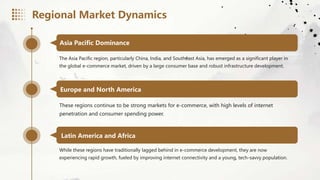
Asia Pacific Dominance
The Asia Pacific region, particularly China, India, and Southeast Asia, has emerged as a significant player in
the global e-commerce market, driven by a large consumer base and robust infrastructure development.
Europe and North America
These regions continue to be strong markets for e-commerce, with high levels of internet
penetration and consumer spending power.
Latin America and Africa
While these regions have traditionally lagged behind in e-commerce development, they are now
experiencing rapid growth, fueled by improving internet connectivity and a young, tech-savvy population.
Regional Market Dynamics
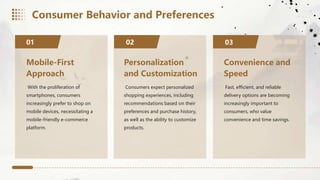
Mobile-First
Approach
With the proliferation of
smartphones, consumers
increasingly prefer to shop on
mobile devices, necessitating a
mobile-friendly e-commerce
platform.
01 02
Personalization
and Customization
Consumers expect personalized
shopping experiences, including
recommendations based on their
preferences and purchase history,
as well as the ability to customize
products.
Convenience and
Speed
Fast, efficient, and reliable
delivery options are becoming
increasingly important to
consumers, who value
convenience and time savings.
03
Consumer Behavior and Preferences
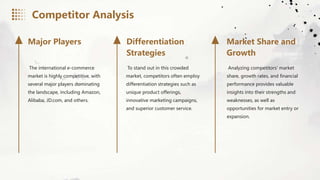
The international e-commerce
market is highly competitive, with
several major players dominating
the landscape, including Amazon,
Alibaba, JD.com, and others.
To stand out in this crowded
market, competitors often employ
differentiation strategies such as
unique product offerings,
innovative marketing campaigns,
and superior customer service.
Analyzing competitors' market
share, growth rates, and financial
performance provides valuable
insights into their strengths and
weaknesses, as well as
opportunities for market entry or
expansion.
Major Players Differentiation
Strategies
Market Share and
Growth
Competitor Analysis
03
Platform Architecture
and Technology
Overview of Platform Architecture
Leverages the power of cloud computing to ensure global availability, elasticity, and cost-
effectiveness.
Cloud-based deployment
Designed to handle high volumes of traffic and transactions, supporting seamless scalability
to meet growing demand.
Scalable and flexible infrastructure
Enables efficient development, deployment, and management of individual components,
improving overall system reliability and performance.
Microservices architecture
01
02
03
Responsive and intuitive user interface
Delivers a seamless shopping experience across
various devices, including desktops, mobile phones,
and tablets.
Personalized recommendations
Utilizes advanced algorithms to provide
personalized product recommendations based on
user preferences and past behaviors.
Interactive features
Incorporates elements like live chat, product
reviews, and social media integration to enhance
customer engagement.
Front-end Design and User Experience
Robust APIs and integration capabilities
Facilitates seamless connectivity with various payment gateways, logistics
providers, and other third-party services.
Order management system
Handles order processing, inventory management, and fulfillment, ensuring
efficient and timely delivery of products.
Advanced search and filtering
Enables users to easily find and filter products based on specific criteria,
improving the overall shopping experience.
Back-end Development and Integration
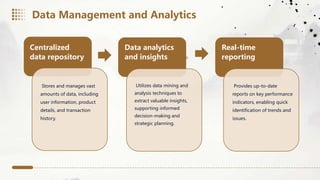
Centralized
data repository
Stores and manages vast
amounts of data, including
user information, product
details, and transaction
history.
Utilizes data mining and
analysis techniques to
extract valuable insights,
supporting informed
decision-making and
strategic planning.
Provides up-to-date
reports on key performance
indicators, enabling quick
identification of trends and
issues.
Data analytics
and insights
Real-time
reporting
Data Management and Analytics
Robust security framework
Implements multiple layers of security to protect sensitive data and prevent unauthorized access.
Encryption and secure transactions
Ensures the security of user data and transaction information through encryption technologies.
Compliance with privacy regulations
Adheres to international privacy regulations, ensuring the proper handling and protection of
personal information.
Security and Privacy Measures
04
Product Management
and Cataloguing
Clear and logical
product taxonomy
Establish a robust product
categorization system that
organizes products into logical
groups, making it easy for
customers to navigate and find
what they're looking for.
Detailed product
attributes
Define specific attributes for each
product category, such as size,
color, material, and brand, to
enable precise filtering and search
capabilities.
Hierarchical
category structure
Create a hierarchical structure for
product categories, allowing
customers to narrow down their
search gradually and discover
related products.
Product Categorization and Classification
Comprehensive
product information
Provide detailed product
descriptions, specifications,
features, and high-quality images
to give customers a clear
understanding of the product.
User-friendly layout
Design an intuitive and visually
appealing product detail page
layout that highlights key
information and facilitates a
smooth user experience.
Customer reviews
and ratings
Integrate customer reviews and
ratings to build trust and provide
valuable feedback to potential
buyers.
Product Detail Page Design
Advanced search
capabilities
Implement a powerful search
engine that supports keyword
search, synonym search, and
search suggestions to help
customers quickly find
relevant products.
Filtering options
Offer faceted filtering options
that allow customers to refine
their search results based on
specific criteria, such as price
range, brand, or product
features.
Sorting
functionality
Enable customers to sort
search results based on
relevance, popularity, price, or
other preferred criteria.
Product Search and Filtering Functionality
Utilize data analytics and
machine learning algorithms to
provide personalized product
recommendations based on
customers' browsing history,
purchase behavior, and
preferences.
Display related products on the
product detail page to encourage
additional purchases and increase
average order value.
Implement strategies to suggest
higher-end products or
complementary items to
customers based on their current
selections, enhancing the
shopping experience and driving
sales.
Personalized
product
recommendations
Related products Upselling and
cross-selling
Product Recommendations and Personalization
05
Payment and Logistics
Solutions
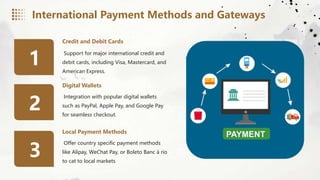
1
2
3
Support for major international credit and
debit cards, including Visa, Mastercard, and
American Express.
Credit and Debit Cards
Integration with popular digital wallets
such as PayPal, Apple Pay, and Google Pay
for seamless checkout.
Digital Wallets
Offer country specific payment methods
like Alipay, WeChat Pay, or Boleto Banc á rio
to cat to local markets
Local Payment Methods
International Payment Methods and Gateways
Real-time
Currency
Conversion
Provide up-to-date currency
conversion rates to allow
customers to view prices in their
preferred currency.
Exchange Rate
Calculators
Integrate tools that calculate
exchange rates automatically,
providing transparency and
convenience for international
shoppers.
Hedging
Strategies
Implement strategies to minimize
currency exchange risks for both
the platform and the customers.
01 02 03
Currency Conversion and Exchange Rates
International Courier Services
01
Partner with established international courier services like DHL,
FedEx, and UPS for reliable and tracked shipping.
Local Delivery Partners
02
Collaborate with local delivery partners in each country to
ensure efficient last-mile delivery.
Customs-friendly Shipping
03
Offer shipping methods that minimize customs delays and
provide clear information on required documentation.
Cross-border Shipping and Delivery Options
Automated
Customs
Clearance
Utilize technology to automate
customs clearance processes,
reducing delays and improving
efficiency.
01 02
Duties and Taxes
Calculator
Provide a tool that estimates
duties and taxes for customers
upfront, enhancing transparency
and reducing surprises at
checkout.
Compliance with
Local Regulations
Ensure compliance with local
import and export regulations to
avoid any legal issues or delays.
03
Customs Clearance and Duties Management
06
Marketing and
Promotion Strategies
Social Media Marketing
Leverage platforms like Facebook, Instagram, and Twitter to engage with customers, build brand awareness, and drive
traffic to the e-commerce platform.
Content Marketing
Create high-quality, relevant content such as blog posts, videos, and infographics to educate and inform customers about
products and services.
Email Marketing
Develop targeted email campaigns to reach customers with personalized offers, updates, and promotional messages.
Digital Marketing Channels and Tactics
Search Engine Optimization (SEO)
Optimize the platform's website and content to
improve search engine ranking and increase organic
traffic
Digital Marketing Channels and Tactics
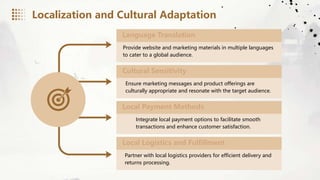
Localization and Cultural Adaptation
Language Translation
Provide website and marketing materials in multiple languages
to cater to a global audience.
Cultural Sensitivity
Ensure marketing messages and product offerings are
culturally appropriate and resonate with the target audience.
Local Payment Methods
Integrate local payment options to facilitate smooth
transactions and enhance customer satisfaction.
Local Logistics and Fulfillment
Partner with local logistics providers for efficient delivery and
returns processing.
Customer Profiling
Create detailed customer profiles to
understand their preferences, buying
behavior, and pain points.
Loyalty Programs
Develop loyalty programs that reward
customers for their repeat purchases and
referrals, fostering brand advocacy.
Customer Service
Provide exceptional customer service
through multiple channels, including live
chat, phone support, and social media, to
address inquiries and resolve issues
promptly.
Personalized Offers
Tailor product recommendations and offers
based on customers' past purchases,
browsing history, and other relevant data
points.
Customer Acquisition and Retention Strategies
Sales Promotions and Discounting Policies
Flash Sales and Limited-Time Offers
Host flash sales and limited-time promotions to create urgency
and drive impulse purchases.
Discount Codes and Coupons
Offer discount codes and coupons to encourage customers to
make a purchase, increase order value, or refer friends.
Bundled Offers and Packages
Create bundled offers and packages that combine
complementary products at attractive prices.
Seasonal Sales and Holiday Promotions
Align sales promotions with seasonal events and holidays to
capitalize on increased shopping activity.
07
Legal and Regulatory
Considerations
World Trade Organization (WTO) agreements
Complying with WTO rules and regulations, including those related to tariffs,
quotas, and other trade barriers.
Regional trade agreements
Understanding and adapting to regional trade agreements such as the European
Union's (EU) single market rules or the North American Free Trade Agreement
(NAFTA)
Cross-border trade facilitation
Implementing measures to simplify cross-border transactions, including
harmonized customs procedures, electronic data interchange, and mutual
recognition agreements.
International Trade Laws and Agreements
Taxation Policies and Compliance Issues
Utilizing tax treaties to minimize double taxation and ensure compliance with relevant tax
laws.
Tax treaties and double taxation avoidance
Complying with value-added tax (VAT) and sales tax requirements in various jurisdictions,
including understanding tax rates, exemptions, and reporting obligations.
VAT and sales tax
Managing income tax implications for international e-commerce transactions, including
withholding taxes, transfer pricing, and permanent establishment rules.
Income tax
01
02
03
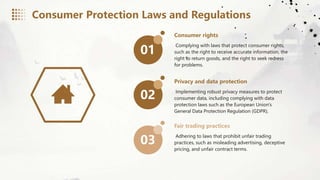
Consumer rights
Complying with laws that protect consumer rights,
such as the right to receive accurate information, the
right to return goods, and the right to seek redress
for problems.
Privacy and data protection
Implementing robust privacy measures to protect
consumer data, including complying with data
protection laws such as the European Union's
General Data Protection Regulation (GDPR).
Fair trading practices
Adhering to laws that prohibit unfair trading
practices, such as misleading advertising, deceptive
pricing, and unfair contract terms.
Consumer Protection Laws and Regulations
Trademarks and branding
Protecting trademarks and branding elements by registering them in relevant jurisdictions and
enforcing intellectual property rights against infringers.
Copyright protection
Ensuring that content on the e-commerce platform, such as product descriptions, images, and
videos, is protected by copyright and taking appropriate action against copyright infringement.
Patents and industrial designs
Protecting innovative products and technologies by obtaining patents and enforcing patent
rights, as well as protecting unique industrial designs through design registrations.
Intellectual Property Rights Protection
08
Conclusion and Future
Outlook
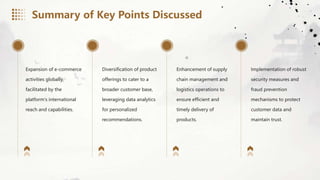
Expansion of e-commerce
activities globally,
facilitated by the
platform's international
reach and capabilities.
Diversification of product
offerings to cater to a
broader customer base,
leveraging data analytics
for personalized
recommendations.
Enhancement of supply
chain management and
logistics operations to
ensure efficient and
timely delivery of
products.
Implementation of robust
security measures and
fraud prevention
mechanisms to protect
customer data and
maintain trust.
Summary of Key Points Discussed
• Intensified competition in the international e-commerce market, requiring continuous innovation and
differentiation.
• Evolving customer expectations and preferences, necessitating flexible and adaptable business models.
• Potential disruptions in global trade and economic environments, posing risks to supply chain stability.
• Emergence of new technologies and trends, such as augmented reality and artificial intelligence, presenting
opportunities for enhanced customer experiences and operational efficiencies.
Challenges and Opportunities Ahead
输入
标题
02
01
04
03
Strategies for Sustained Growth and Success
Investing in advanced analytics and market
research to identify new growth opportunities
and customer segments.
Staying at the forefront of technological
advancements to maintain a competitive edge
and meet evolving customer needs.
Prioritizing customer satisfaction and loyalty
through exceptional service and continuous
improvement of the platform's user experience.
Fostering strategic partnerships and
collaborations to expand market reach and
access to diverse product offerings.
感谢您的观看
THANKS

International+e-Commerce+Platform-www.cfye-commerce.shop

  • 1.
  • 2.
    目录 • Introduction • Internationale-Commerce Market Analysis • Platform Architecture and Technology • Product Management and Cataloguing • Payment and Logistics Solutions • Marketing and Promotion Strategies • Legal and Regulatory Considerations • Conclusion and Future Outlook
  • 3.
  • 4.
    Definition and scope Internationale-commerce refers to the buying and selling of goods and services across national borders using electronic means, such as the internet. Growth and evolution The rise of the internet, mobile technology, and cross-border trade agreements have fueled the rapid expansion of international e-commerce. Types of international e-commerce B2B (Business-to-Business), B2C (Business-to-Consumer), and C2C (Consumer- to-Consumer) are the primary types, each with its own set of characteristics and challenges. Overview of International e-Commerce
  • 5.
    Market expansion 01 An internationale-commerce platform enables businesses to tap into new markets, increasing their customer base and revenue potential. Convenience and accessibility 02 Such platforms provide consumers with access to a wider range of products and services from around the globe, enhancing shopping convenience. Cost reduction 03 By streamlining supply chains and reducing intermediary costs, international e-commerce platforms can help businesses achieve greater cost efficiencies. Importance of International e-Commerce Platform
  • 6.
    User-friendly interface A clean,intuitive, and responsive user interface is crucial for attracting and retaining customers. Secure payment system Ensuring safe and secure transactions is paramount in building trust with users and facilitating smooth financial flows. Robust logistics and fulfillment Efficient order processing, shipping, and returns management are essential for delivering a positive customer experience. Key Components of a Successful Platform
  • 7.
    Data analytics andpersonalization Leveraging data to understand customer behavior and preferences enables platforms to offer personalized recommendations and enhance overall user satisfaction. Key Components of a Successful Platform
  • 8.
  • 9.
    The global e-commercemarket has experienced explosive growth in recent years, driven by the widespread adoption of the internet and mobile devices. From traditional e-commerce platforms to social media shopping and live streaming, the industry is constantly evolving, providing more convenient and immersive shopping experiences for consumers. The increasing globalization of trade and the removal of barriers to international transactions have facilitated the growth of cross- border e-commerce, allowing businesses to tap into new markets and expand their customer base. Rapid Growth of Online Shopping Evolution of E- commerce Models Cross-Border E- commerce Global Market Trends and Developments
  • 10.
    Asia Pacific Dominance TheAsia Pacific region, particularly China, India, and Southeast Asia, has emerged as a significant player in the global e-commerce market, driven by a large consumer base and robust infrastructure development. Europe and North America These regions continue to be strong markets for e-commerce, with high levels of internet penetration and consumer spending power. Latin America and Africa While these regions have traditionally lagged behind in e-commerce development, they are now experiencing rapid growth, fueled by improving internet connectivity and a young, tech-savvy population. Regional Market Dynamics
  • 11.
    Mobile-First Approach With the proliferationof smartphones, consumers increasingly prefer to shop on mobile devices, necessitating a mobile-friendly e-commerce platform. 01 02 Personalization and Customization Consumers expect personalized shopping experiences, including recommendations based on their preferences and purchase history, as well as the ability to customize products. Convenience and Speed Fast, efficient, and reliable delivery options are becoming increasingly important to consumers, who value convenience and time savings. 03 Consumer Behavior and Preferences
  • 12.
    The international e-commerce marketis highly competitive, with several major players dominating the landscape, including Amazon, Alibaba, JD.com, and others. To stand out in this crowded market, competitors often employ differentiation strategies such as unique product offerings, innovative marketing campaigns, and superior customer service. Analyzing competitors' market share, growth rates, and financial performance provides valuable insights into their strengths and weaknesses, as well as opportunities for market entry or expansion. Major Players Differentiation Strategies Market Share and Growth Competitor Analysis
  • 13.
  • 14.
    Overview of PlatformArchitecture Leverages the power of cloud computing to ensure global availability, elasticity, and cost- effectiveness. Cloud-based deployment Designed to handle high volumes of traffic and transactions, supporting seamless scalability to meet growing demand. Scalable and flexible infrastructure Enables efficient development, deployment, and management of individual components, improving overall system reliability and performance. Microservices architecture
  • 15.
    01 02 03 Responsive and intuitiveuser interface Delivers a seamless shopping experience across various devices, including desktops, mobile phones, and tablets. Personalized recommendations Utilizes advanced algorithms to provide personalized product recommendations based on user preferences and past behaviors. Interactive features Incorporates elements like live chat, product reviews, and social media integration to enhance customer engagement. Front-end Design and User Experience
  • 16.
    Robust APIs andintegration capabilities Facilitates seamless connectivity with various payment gateways, logistics providers, and other third-party services. Order management system Handles order processing, inventory management, and fulfillment, ensuring efficient and timely delivery of products. Advanced search and filtering Enables users to easily find and filter products based on specific criteria, improving the overall shopping experience. Back-end Development and Integration
  • 17.
    Centralized data repository Stores andmanages vast amounts of data, including user information, product details, and transaction history. Utilizes data mining and analysis techniques to extract valuable insights, supporting informed decision-making and strategic planning. Provides up-to-date reports on key performance indicators, enabling quick identification of trends and issues. Data analytics and insights Real-time reporting Data Management and Analytics
  • 18.
    Robust security framework Implementsmultiple layers of security to protect sensitive data and prevent unauthorized access. Encryption and secure transactions Ensures the security of user data and transaction information through encryption technologies. Compliance with privacy regulations Adheres to international privacy regulations, ensuring the proper handling and protection of personal information. Security and Privacy Measures
  • 19.
  • 20.
    Clear and logical producttaxonomy Establish a robust product categorization system that organizes products into logical groups, making it easy for customers to navigate and find what they're looking for. Detailed product attributes Define specific attributes for each product category, such as size, color, material, and brand, to enable precise filtering and search capabilities. Hierarchical category structure Create a hierarchical structure for product categories, allowing customers to narrow down their search gradually and discover related products. Product Categorization and Classification
  • 21.
    Comprehensive product information Provide detailedproduct descriptions, specifications, features, and high-quality images to give customers a clear understanding of the product. User-friendly layout Design an intuitive and visually appealing product detail page layout that highlights key information and facilitates a smooth user experience. Customer reviews and ratings Integrate customer reviews and ratings to build trust and provide valuable feedback to potential buyers. Product Detail Page Design
  • 22.
    Advanced search capabilities Implement apowerful search engine that supports keyword search, synonym search, and search suggestions to help customers quickly find relevant products. Filtering options Offer faceted filtering options that allow customers to refine their search results based on specific criteria, such as price range, brand, or product features. Sorting functionality Enable customers to sort search results based on relevance, popularity, price, or other preferred criteria. Product Search and Filtering Functionality
  • 23.
    Utilize data analyticsand machine learning algorithms to provide personalized product recommendations based on customers' browsing history, purchase behavior, and preferences. Display related products on the product detail page to encourage additional purchases and increase average order value. Implement strategies to suggest higher-end products or complementary items to customers based on their current selections, enhancing the shopping experience and driving sales. Personalized product recommendations Related products Upselling and cross-selling Product Recommendations and Personalization
  • 24.
  • 25.
    1 2 3 Support for majorinternational credit and debit cards, including Visa, Mastercard, and American Express. Credit and Debit Cards Integration with popular digital wallets such as PayPal, Apple Pay, and Google Pay for seamless checkout. Digital Wallets Offer country specific payment methods like Alipay, WeChat Pay, or Boleto Banc á rio to cat to local markets Local Payment Methods International Payment Methods and Gateways
  • 26.
    Real-time Currency Conversion Provide up-to-date currency conversionrates to allow customers to view prices in their preferred currency. Exchange Rate Calculators Integrate tools that calculate exchange rates automatically, providing transparency and convenience for international shoppers. Hedging Strategies Implement strategies to minimize currency exchange risks for both the platform and the customers. 01 02 03 Currency Conversion and Exchange Rates
  • 27.
    International Courier Services 01 Partnerwith established international courier services like DHL, FedEx, and UPS for reliable and tracked shipping. Local Delivery Partners 02 Collaborate with local delivery partners in each country to ensure efficient last-mile delivery. Customs-friendly Shipping 03 Offer shipping methods that minimize customs delays and provide clear information on required documentation. Cross-border Shipping and Delivery Options
  • 28.
    Automated Customs Clearance Utilize technology toautomate customs clearance processes, reducing delays and improving efficiency. 01 02 Duties and Taxes Calculator Provide a tool that estimates duties and taxes for customers upfront, enhancing transparency and reducing surprises at checkout. Compliance with Local Regulations Ensure compliance with local import and export regulations to avoid any legal issues or delays. 03 Customs Clearance and Duties Management
  • 29.
  • 30.
    Social Media Marketing Leverageplatforms like Facebook, Instagram, and Twitter to engage with customers, build brand awareness, and drive traffic to the e-commerce platform. Content Marketing Create high-quality, relevant content such as blog posts, videos, and infographics to educate and inform customers about products and services. Email Marketing Develop targeted email campaigns to reach customers with personalized offers, updates, and promotional messages. Digital Marketing Channels and Tactics
  • 31.
    Search Engine Optimization(SEO) Optimize the platform's website and content to improve search engine ranking and increase organic traffic Digital Marketing Channels and Tactics
  • 32.
    Localization and CulturalAdaptation Language Translation Provide website and marketing materials in multiple languages to cater to a global audience. Cultural Sensitivity Ensure marketing messages and product offerings are culturally appropriate and resonate with the target audience. Local Payment Methods Integrate local payment options to facilitate smooth transactions and enhance customer satisfaction. Local Logistics and Fulfillment Partner with local logistics providers for efficient delivery and returns processing.
  • 33.
    Customer Profiling Create detailedcustomer profiles to understand their preferences, buying behavior, and pain points. Loyalty Programs Develop loyalty programs that reward customers for their repeat purchases and referrals, fostering brand advocacy. Customer Service Provide exceptional customer service through multiple channels, including live chat, phone support, and social media, to address inquiries and resolve issues promptly. Personalized Offers Tailor product recommendations and offers based on customers' past purchases, browsing history, and other relevant data points. Customer Acquisition and Retention Strategies
  • 34.
    Sales Promotions andDiscounting Policies Flash Sales and Limited-Time Offers Host flash sales and limited-time promotions to create urgency and drive impulse purchases. Discount Codes and Coupons Offer discount codes and coupons to encourage customers to make a purchase, increase order value, or refer friends. Bundled Offers and Packages Create bundled offers and packages that combine complementary products at attractive prices. Seasonal Sales and Holiday Promotions Align sales promotions with seasonal events and holidays to capitalize on increased shopping activity.
  • 35.
  • 36.
    World Trade Organization(WTO) agreements Complying with WTO rules and regulations, including those related to tariffs, quotas, and other trade barriers. Regional trade agreements Understanding and adapting to regional trade agreements such as the European Union's (EU) single market rules or the North American Free Trade Agreement (NAFTA) Cross-border trade facilitation Implementing measures to simplify cross-border transactions, including harmonized customs procedures, electronic data interchange, and mutual recognition agreements. International Trade Laws and Agreements
  • 37.
    Taxation Policies andCompliance Issues Utilizing tax treaties to minimize double taxation and ensure compliance with relevant tax laws. Tax treaties and double taxation avoidance Complying with value-added tax (VAT) and sales tax requirements in various jurisdictions, including understanding tax rates, exemptions, and reporting obligations. VAT and sales tax Managing income tax implications for international e-commerce transactions, including withholding taxes, transfer pricing, and permanent establishment rules. Income tax
  • 38.
    01 02 03 Consumer rights Complying withlaws that protect consumer rights, such as the right to receive accurate information, the right to return goods, and the right to seek redress for problems. Privacy and data protection Implementing robust privacy measures to protect consumer data, including complying with data protection laws such as the European Union's General Data Protection Regulation (GDPR). Fair trading practices Adhering to laws that prohibit unfair trading practices, such as misleading advertising, deceptive pricing, and unfair contract terms. Consumer Protection Laws and Regulations
  • 39.
    Trademarks and branding Protectingtrademarks and branding elements by registering them in relevant jurisdictions and enforcing intellectual property rights against infringers. Copyright protection Ensuring that content on the e-commerce platform, such as product descriptions, images, and videos, is protected by copyright and taking appropriate action against copyright infringement. Patents and industrial designs Protecting innovative products and technologies by obtaining patents and enforcing patent rights, as well as protecting unique industrial designs through design registrations. Intellectual Property Rights Protection
  • 40.
  • 41.
    Expansion of e-commerce activitiesglobally, facilitated by the platform's international reach and capabilities. Diversification of product offerings to cater to a broader customer base, leveraging data analytics for personalized recommendations. Enhancement of supply chain management and logistics operations to ensure efficient and timely delivery of products. Implementation of robust security measures and fraud prevention mechanisms to protect customer data and maintain trust. Summary of Key Points Discussed
  • 42.
    • Intensified competitionin the international e-commerce market, requiring continuous innovation and differentiation. • Evolving customer expectations and preferences, necessitating flexible and adaptable business models. • Potential disruptions in global trade and economic environments, posing risks to supply chain stability. • Emergence of new technologies and trends, such as augmented reality and artificial intelligence, presenting opportunities for enhanced customer experiences and operational efficiencies. Challenges and Opportunities Ahead
  • 43.
    输入 标题 02 01 04 03 Strategies for SustainedGrowth and Success Investing in advanced analytics and market research to identify new growth opportunities and customer segments. Staying at the forefront of technological advancements to maintain a competitive edge and meet evolving customer needs. Prioritizing customer satisfaction and loyalty through exceptional service and continuous improvement of the platform's user experience. Fostering strategic partnerships and collaborations to expand market reach and access to diverse product offerings.
  • 44.