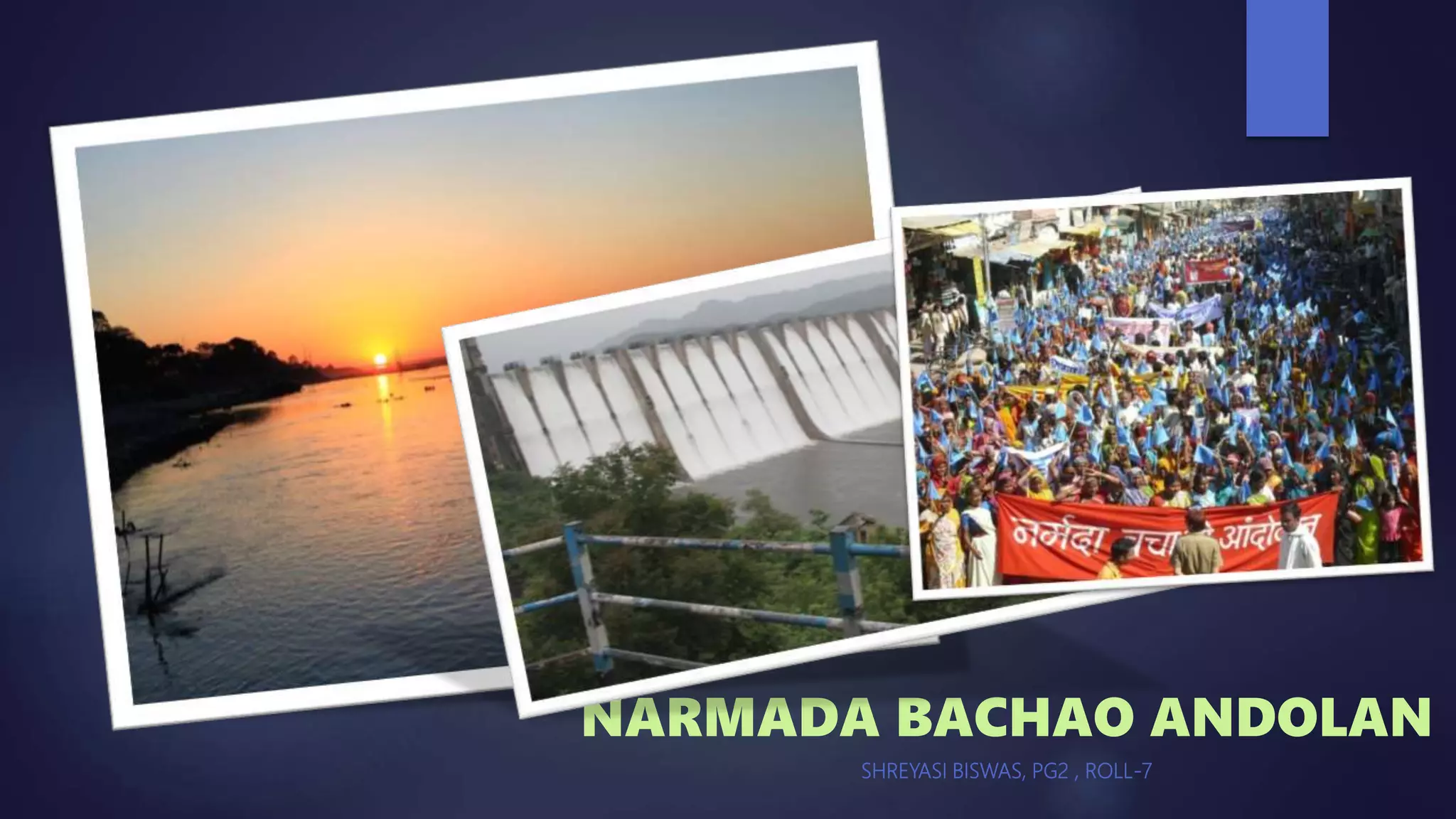
NARMADA BACHAO ANDOLAN
SHREYASI BISWAS, PG2 , ROLL-7
 Narmada Bachao Andolan (NBA) is a social movement consisting of Adivasis, farmers,
environmentalists and human rights activists against a number of large dams being built
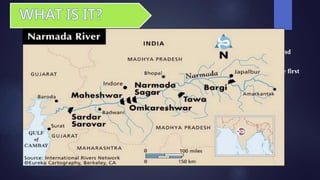
across the Narmada River, which flows through the states of Gujarat, Madhya Pradesh and
Maharashtra, all in India.
 Sardar Sarovar Dam in Gujarat is one of the biggest dams on the river and was one of the first
focal points of the movement.
Narmada is the largest westward flowing river in india
It is home to over a million people, mainly tribal, adivasis , wage laborers , local
farmers, fishermen live along the river and rely on it for their livelihood.
River is used for irrigation, drinking, and considered to have spiritual benefits.
ORIGIN
saving the trees and the fauna, rehabilitation of the poor people living around
the area.
Movement started in 1986 when the World Bank lent India $450
million for the Sardar Sarovar project. The project preparation and
organization took a span of four years from identification in the year
1979 to pre- appraisal in 1983. It was completed by Narmada
Planning group with assistance from the United Nation Development
Program (UNDP).
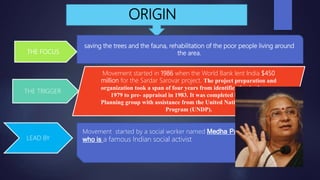
Movement started by a social worker named Medha Patkar
who is a famous Indian social activist
THE FOCUS
THE TRIGGER
LEAD BY
Sardar Sarovar project
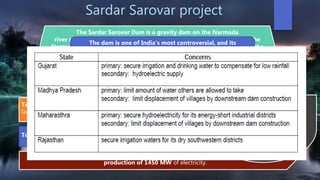
The Sardar Sarovar Dam is a gravity dam on the Narmada
river near Navagam, Gujarat in India. It is the largest dam and part of the
Narmada Valley Project, a large hydraulic engineering project involving the
construction of a series of large irrigation and hydroelectric multi-purpose dams
on the Narmada river. The project took form in 1979 as part of a development
scheme to increase irrigation and produce hydroelectricity.
The dam is one of India's most controversial, and its
environmental impact and net costs and benefits are widely
debated.
GOALS
To provide supply drinking water to the towns and cities of Gujarat, to irrigate the dry parts of
Gujarat. Providing potable water to over 8,000 Gujarati villages and 135 urban centers
To raise agricultural growth rates to high levels over the next decade.
Provide valuable peak electric power in an area with high unmet power demand. The expected
production of 1450 MW of electricity.
Considerable revenue for government
Sardar Sarovar dam alone would irrigate almost 1.8 million
hectares of land in Gujarat and an additional 73,000 hectares in the
dry neighboring state of Rajasthan
It will also provide flood protection.
More pure water to meet
the needs of about 40
million people or so from
about 1000s of villages
and towns.
The Narmada Water Disputes Tribunal (ā€˜ā€˜Narmada Tribunal’’) was set up in 1969
to resolve the river water sharing dispute between Madhya Pradesh, Gujarat, and
Maharashtra. Additionally, the Narmada Tribunal aimed to set out conditions
regarding the resettlement and rehabilitation of those displaced by the dams.
Chaired by then-sitting Supreme Court Justice V. Ramaswami, the Tribunal was
assisted by technical experts. Notably absent from this team of experts were any
sociologists, anthropologists or environmental engineers. In 1978, the Narmada
Tribunal approved the Narmada Project and final planning and work commenced.
With regard to the treatment of the displaced population, the Narmada Tribunal
mandated that the state.
The problem started when The World Bank began working on the
Narmada Project after it got clearance from the Narmada Water
Disputes Tribunal.[The bank sent a team for the assessment of the
project in economic and technical terms. This team didn't focus on
the social or environmental issues.
• As result 2,50,000 people were Displaced from their land in three states
• Rehabilitation and resettlement of people
• Loss of agricultural land and forest(approx. 37,000 hectares)
• Destruction of flora and fauna
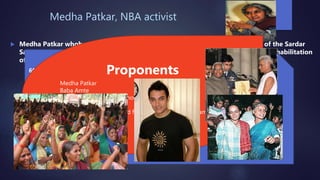
Medha Patkar, NBA activist
 Medha Patkar whohas been spearheading the movement against the building of the Sardar
Sarovar Dam on the Narmada river in Gujarat, giving particular attention to the rehabilitation
of the poor who are being displaced by the project.
60,000 people rally against destructive development Jan 1990
• 5,000 people marched on the Narmada Valley Development authority offices forcing them
to close
• March 1990 – 10,000 protesters blocked the highway from Bombay for two days May 1990
– 2,000 people staged a sit-in outside the prime ministers house in Delhi
• Media campaigns
• Christmas Day 1990 – Long March – 3,000 people walked, 100km, which took a week to the
dam site, once they got there Medha Patkar and 6 others went on a hunger strike
demanding the government suspend work on the dam and hold an independent review. It
lasted 22 days until they broke fast – this made Narmada an international issue.
• garnering support of celebrities from the art and the film world and other such methods
Proponents
Medha Patkar
Baba Amte
Dalits and Adivasi (indigenous people).
Arundhati Roy
Contributions from art and film world ( to mention Aamir
Khan)
Opponents
Indian Government
The World Bank (gave $450 million.) until they withdrew project after an
independent review confirmed social and environmental impacts were increasing.
The Supreme Court of India has ruled on the Sardar Sarovar Dam. In 1995 they
suspended work on the dam because the height exceeded the amount originally
planned, 75m. In 1999 they ordered work to continue up to the height of 85m.
Then in Oct 18, 2000 they ruled in favor of building the Sardar Sarovar despite
global protests.
Decision of Indian govt.
The Indian Government found other sources of funding and re-started the project
• The height of the main reservoir was now raised by 80-85 m.
• NBA challenged the govt. again leading to a court battle in the Supreme Court
2001 judgment was a stunning blow to NBA
Supreme Court’s Decision
Patkar led Narmada Bachao Andolan had filed a written petition with the Supreme Court of India,
the nation's apex court, seeking stoppage of construction on the Sardar Sarovar dam. The court
initially ruled the decision in the Andolan's favor thereby effecting an immediate stoppage of work
at the dam and directing the concerned states to first complete the rehabilitation and replacement
process.
The Supreme Court also deliberated on this issue further for several years but finally upheld the Tribunal
Award and allowed the construction to proceed, subject to conditions. The court introduced a mechanism to
monitor the progress of resettlement pari passu with the raising of the height of the dam through the
Grievance Redressal Authorities (GRA) in each of the party states. The court’s decision referred in this
document, given in the year 2000 after seven years of deliberations, has paved the way for completing the
project to attain full envisaged benefits. The court's final line of the order states, "Every endeavor shall be
made to see that the project is completed as expeditiously as possible
Criticism
 The Narmada dam's benefits include provision of drinking water, power
generation and irrigation facilities. However, the campaign led by the NBA
activists has held up the project's completion, and the NBA supporters have
indulged in physical attacks on local people who accepted compensation
for moving.
 Others have argued that the Narmada Dam protesters are little more than
environmental extremists who use pseudoscientific agitprop to scuttle the
development of the region, and that the dam will provide agricultural
benefits to millions of poor in India.
Narmada bachao andolan

Narmada bachao andolan

  • 1.
    NARMADA BACHAO ANDOLAN SHREYASIBISWAS, PG2 , ROLL-7
  • 2.
     Narmada BachaoAndolan (NBA) is a social movement consisting of Adivasis, farmers, environmentalists and human rights activists against a number of large dams being built across the Narmada River, which flows through the states of Gujarat, Madhya Pradesh and Maharashtra, all in India.  Sardar Sarovar Dam in Gujarat is one of the biggest dams on the river and was one of the first focal points of the movement. Narmada is the largest westward flowing river in india It is home to over a million people, mainly tribal, adivasis , wage laborers , local farmers, fishermen live along the river and rely on it for their livelihood. River is used for irrigation, drinking, and considered to have spiritual benefits.
  • 3.
    ORIGIN saving the treesand the fauna, rehabilitation of the poor people living around the area. Movement started in 1986 when the World Bank lent India $450 million for the Sardar Sarovar project. The project preparation and organization took a span of four years from identification in the year 1979 to pre- appraisal in 1983. It was completed by Narmada Planning group with assistance from the United Nation Development Program (UNDP). Movement started by a social worker named Medha Patkar who is a famous Indian social activist THE FOCUS THE TRIGGER LEAD BY
  • 4.
    Sardar Sarovar project TheSardar Sarovar Dam is a gravity dam on the Narmada river near Navagam, Gujarat in India. It is the largest dam and part of the Narmada Valley Project, a large hydraulic engineering project involving the construction of a series of large irrigation and hydroelectric multi-purpose dams on the Narmada river. The project took form in 1979 as part of a development scheme to increase irrigation and produce hydroelectricity. The dam is one of India's most controversial, and its environmental impact and net costs and benefits are widely debated. GOALS To provide supply drinking water to the towns and cities of Gujarat, to irrigate the dry parts of Gujarat. Providing potable water to over 8,000 Gujarati villages and 135 urban centers To raise agricultural growth rates to high levels over the next decade. Provide valuable peak electric power in an area with high unmet power demand. The expected production of 1450 MW of electricity. Considerable revenue for government Sardar Sarovar dam alone would irrigate almost 1.8 million hectares of land in Gujarat and an additional 73,000 hectares in the dry neighboring state of Rajasthan It will also provide flood protection. More pure water to meet the needs of about 40 million people or so from about 1000s of villages and towns.
  • 5.
    The Narmada WaterDisputes Tribunal (ā€˜ā€˜Narmada Tribunal’’) was set up in 1969 to resolve the river water sharing dispute between Madhya Pradesh, Gujarat, and Maharashtra. Additionally, the Narmada Tribunal aimed to set out conditions regarding the resettlement and rehabilitation of those displaced by the dams. Chaired by then-sitting Supreme Court Justice V. Ramaswami, the Tribunal was assisted by technical experts. Notably absent from this team of experts were any sociologists, anthropologists or environmental engineers. In 1978, the Narmada Tribunal approved the Narmada Project and final planning and work commenced. With regard to the treatment of the displaced population, the Narmada Tribunal mandated that the state. The problem started when The World Bank began working on the Narmada Project after it got clearance from the Narmada Water Disputes Tribunal.[The bank sent a team for the assessment of the project in economic and technical terms. This team didn't focus on the social or environmental issues. • As result 2,50,000 people were Displaced from their land in three states • Rehabilitation and resettlement of people • Loss of agricultural land and forest(approx. 37,000 hectares) • Destruction of flora and fauna
  • 6.
    Medha Patkar, NBAactivist  Medha Patkar whohas been spearheading the movement against the building of the Sardar Sarovar Dam on the Narmada river in Gujarat, giving particular attention to the rehabilitation of the poor who are being displaced by the project. 60,000 people rally against destructive development Jan 1990 • 5,000 people marched on the Narmada Valley Development authority offices forcing them to close • March 1990 – 10,000 protesters blocked the highway from Bombay for two days May 1990 – 2,000 people staged a sit-in outside the prime ministers house in Delhi • Media campaigns • Christmas Day 1990 – Long March – 3,000 people walked, 100km, which took a week to the dam site, once they got there Medha Patkar and 6 others went on a hunger strike demanding the government suspend work on the dam and hold an independent review. It lasted 22 days until they broke fast – this made Narmada an international issue. • garnering support of celebrities from the art and the film world and other such methods Proponents Medha Patkar Baba Amte Dalits and Adivasi (indigenous people). Arundhati Roy Contributions from art and film world ( to mention Aamir Khan)
  • 7.
    Opponents Indian Government The WorldBank (gave $450 million.) until they withdrew project after an independent review confirmed social and environmental impacts were increasing. The Supreme Court of India has ruled on the Sardar Sarovar Dam. In 1995 they suspended work on the dam because the height exceeded the amount originally planned, 75m. In 1999 they ordered work to continue up to the height of 85m. Then in Oct 18, 2000 they ruled in favor of building the Sardar Sarovar despite global protests.
  • 8.
    Decision of Indiangovt. The Indian Government found other sources of funding and re-started the project • The height of the main reservoir was now raised by 80-85 m. • NBA challenged the govt. again leading to a court battle in the Supreme Court 2001 judgment was a stunning blow to NBA Supreme Court’s Decision Patkar led Narmada Bachao Andolan had filed a written petition with the Supreme Court of India, the nation's apex court, seeking stoppage of construction on the Sardar Sarovar dam. The court initially ruled the decision in the Andolan's favor thereby effecting an immediate stoppage of work at the dam and directing the concerned states to first complete the rehabilitation and replacement process. The Supreme Court also deliberated on this issue further for several years but finally upheld the Tribunal Award and allowed the construction to proceed, subject to conditions. The court introduced a mechanism to monitor the progress of resettlement pari passu with the raising of the height of the dam through the Grievance Redressal Authorities (GRA) in each of the party states. The court’s decision referred in this document, given in the year 2000 after seven years of deliberations, has paved the way for completing the project to attain full envisaged benefits. The court's final line of the order states, "Every endeavor shall be made to see that the project is completed as expeditiously as possible
  • 9.
    Criticism  The Narmadadam's benefits include provision of drinking water, power generation and irrigation facilities. However, the campaign led by the NBA activists has held up the project's completion, and the NBA supporters have indulged in physical attacks on local people who accepted compensation for moving.  Others have argued that the Narmada Dam protesters are little more than environmental extremists who use pseudoscientific agitprop to scuttle the development of the region, and that the dam will provide agricultural benefits to millions of poor in India.