SURVEY METHOD
1Medhavi Gugnani
DEFINITION
• Survey Research may be defined as a technique
whereby the researcher studies the whole population
with respect to certain sociological and psychological
variables.
• E.g., If the researcher wants to study the factors
affecting the interest of the students in mathematics..
(questionnaire, students from diff schools)
• Survey Research is a new technique for Social Science
Research.
• It is used to study opinions, attitudes and social facts.
2Medhavi Gugnani
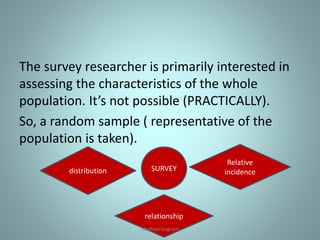
The survey researcher is primarily interested in
assessing the characteristics of the whole
population. It’s not possible (PRACTICALLY).
So, a random sample ( representative of the
population is taken).
SURVEY
Relative
incidence
relationship
distribution
3Medhavi Gugnani
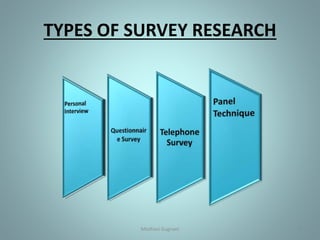
TYPES OF SURVEY RESEARCH
4Medhavi Gugnani
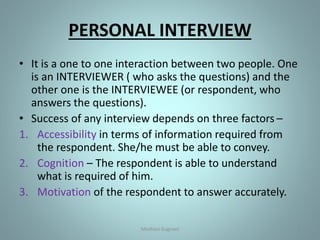
PERSONAL INTERVIEW
• It is a one to one interaction between two people. One
is an INTERVIEWER ( who asks the questions) and the
other one is the INTERVIEWEE (or respondent, who
answers the questions).
• Success of any interview depends on three factors –
1. Accessibility in terms of information required from
the respondent. She/he must be able to convey.
2. Cognition – The respondent is able to understand
what is required of him.
3. Motivation of the respondent to answer accurately.
5Medhavi Gugnani
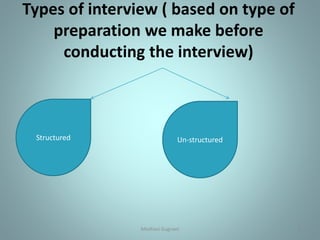
Types of interview ( based on type of
preparation we make before
conducting the interview)
Structured Un-structured
6Medhavi Gugnani
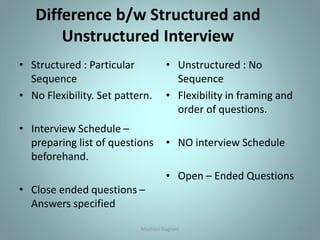
Difference b/w Structured and
Unstructured Interview
• Structured : Particular
Sequence
• No Flexibility. Set pattern.
• Interview Schedule –
preparing list of questions
beforehand.
• Close ended questions –
Answers specified
• Unstructured : No
Sequence
• Flexibility in framing and
order of questions.
• NO interview Schedule
• Open – Ended Questions
7Medhavi Gugnani
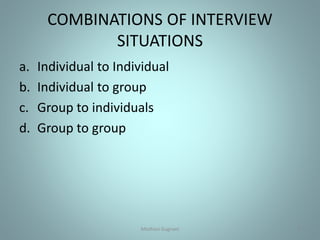
COMBINATIONS OF INTERVIEW
SITUATIONS
a. Individual to Individual
b. Individual to group
c. Group to individuals
d. Group to group
8Medhavi Gugnani
QUESTIONNAIRE
• It’s one of the most simple, versatile and low cost self
reporting method.
• Consists of pre-determined set of questions
• In other words, these are HIGHLY STRUCTURED
INTERVIEWS.
• Questionnaire is used for collecting demographic info,
attitudes, knowledge etc.
• Types of questions used in a survey :
1. Open Ended : E.g. What is friendship to you?
2. Close Ended : E.g. Friendship is a) Love b)Family
3. Rating method : From most preferred to the least.
9Medhavi Gugnani
TELEPHONE SURVEY
• E.g., TV Programmes asking you to send your
views through sms.
• ADVANTAGES : Time saving.
• DISADVANTAGES : Reluctance
Uncooperativeness
Superficial Answers
10Medhavi Gugnani
PANEL TECHNIQUE
• Successive interview of the same sample.
• Purpose is wide and expensive.
• ADVANTAGE:
1. Helps the investigator to know the various
factors leading to the change
2. More Accuracy and consistency.
• DISADVANTAGE:
1. 1.Loss of sample : Urgent work, death,
relocation, Migration.
2. 2. Social Desirability.
11Medhavi Gugnani
Survey Research depends upon 3
important factors :
1) Direct contact with the sample
2) Success of survey research depends upon the
willingness and co-operativeness of the
sample selected for study.
3) Researcher must be a trained personnel.
• Social Intelligence
• Manipulative skill
• Research insight
12Medhavi Gugnani
Advantages of survey research
1. Wide Scope, Great deal of information can be
obtained.
2. Inter- disciplinary value.
3. Can study topics like – Attitude, Beliefs,
values etc.
4. Maximal Accuracy at Economical rate.
13Medhavi Gugnani
Disadvantages
• Research remains at the survey. ( Not In-
depth)
• Practical Problems- Time Consuming
• Prone to sampling errors: Minor fluctuations
of chance.
• Survey research demands- Expertise,
Knowledge on part of the Researcher to
conduct a survey, Technical know how.
14Medhavi Gugnani

Survey method.

  • 1.
  • 2.
    DEFINITION • Survey Researchmay be defined as a technique whereby the researcher studies the whole population with respect to certain sociological and psychological variables. • E.g., If the researcher wants to study the factors affecting the interest of the students in mathematics.. (questionnaire, students from diff schools) • Survey Research is a new technique for Social Science Research. • It is used to study opinions, attitudes and social facts. 2Medhavi Gugnani
  • 3.
    The survey researcheris primarily interested in assessing the characteristics of the whole population. It’s not possible (PRACTICALLY). So, a random sample ( representative of the population is taken). SURVEY Relative incidence relationship distribution 3Medhavi Gugnani
  • 4.
    TYPES OF SURVEYRESEARCH 4Medhavi Gugnani
  • 5.
    PERSONAL INTERVIEW • Itis a one to one interaction between two people. One is an INTERVIEWER ( who asks the questions) and the other one is the INTERVIEWEE (or respondent, who answers the questions). • Success of any interview depends on three factors – 1. Accessibility in terms of information required from the respondent. She/he must be able to convey. 2. Cognition – The respondent is able to understand what is required of him. 3. Motivation of the respondent to answer accurately. 5Medhavi Gugnani
  • 6.
    Types of interview( based on type of preparation we make before conducting the interview) Structured Un-structured 6Medhavi Gugnani
  • 7.
    Difference b/w Structuredand Unstructured Interview • Structured : Particular Sequence • No Flexibility. Set pattern. • Interview Schedule – preparing list of questions beforehand. • Close ended questions – Answers specified • Unstructured : No Sequence • Flexibility in framing and order of questions. • NO interview Schedule • Open – Ended Questions 7Medhavi Gugnani
  • 8.
    COMBINATIONS OF INTERVIEW SITUATIONS a.Individual to Individual b. Individual to group c. Group to individuals d. Group to group 8Medhavi Gugnani
  • 9.
    QUESTIONNAIRE • It’s oneof the most simple, versatile and low cost self reporting method. • Consists of pre-determined set of questions • In other words, these are HIGHLY STRUCTURED INTERVIEWS. • Questionnaire is used for collecting demographic info, attitudes, knowledge etc. • Types of questions used in a survey : 1. Open Ended : E.g. What is friendship to you? 2. Close Ended : E.g. Friendship is a) Love b)Family 3. Rating method : From most preferred to the least. 9Medhavi Gugnani
  • 10.
    TELEPHONE SURVEY • E.g.,TV Programmes asking you to send your views through sms. • ADVANTAGES : Time saving. • DISADVANTAGES : Reluctance Uncooperativeness Superficial Answers 10Medhavi Gugnani
  • 11.
    PANEL TECHNIQUE • Successiveinterview of the same sample. • Purpose is wide and expensive. • ADVANTAGE: 1. Helps the investigator to know the various factors leading to the change 2. More Accuracy and consistency. • DISADVANTAGE: 1. 1.Loss of sample : Urgent work, death, relocation, Migration. 2. 2. Social Desirability. 11Medhavi Gugnani
  • 12.
    Survey Research dependsupon 3 important factors : 1) Direct contact with the sample 2) Success of survey research depends upon the willingness and co-operativeness of the sample selected for study. 3) Researcher must be a trained personnel. • Social Intelligence • Manipulative skill • Research insight 12Medhavi Gugnani
  • 13.
    Advantages of surveyresearch 1. Wide Scope, Great deal of information can be obtained. 2. Inter- disciplinary value. 3. Can study topics like – Attitude, Beliefs, values etc. 4. Maximal Accuracy at Economical rate. 13Medhavi Gugnani
  • 14.
    Disadvantages • Research remainsat the survey. ( Not In- depth) • Practical Problems- Time Consuming • Prone to sampling errors: Minor fluctuations of chance. • Survey research demands- Expertise, Knowledge on part of the Researcher to conduct a survey, Technical know how. 14Medhavi Gugnani