SOCIAL SURVEY METHODS
Presenters
Lintu Mathew
Bikash Debbarma
Moderator
Prof T. Gambhir Singh
Outline
• What
• When - History
• Some Main Forms of Social Surveys
• How- Social survey methods
• Summary
WHAT
Duncan Mitchell’s
“Dictionary of Sociology”’ defines social survey
this way: “The social survey is a systematic
collection of facts about people living in a
specific geographic, cultural, or administrative
area”
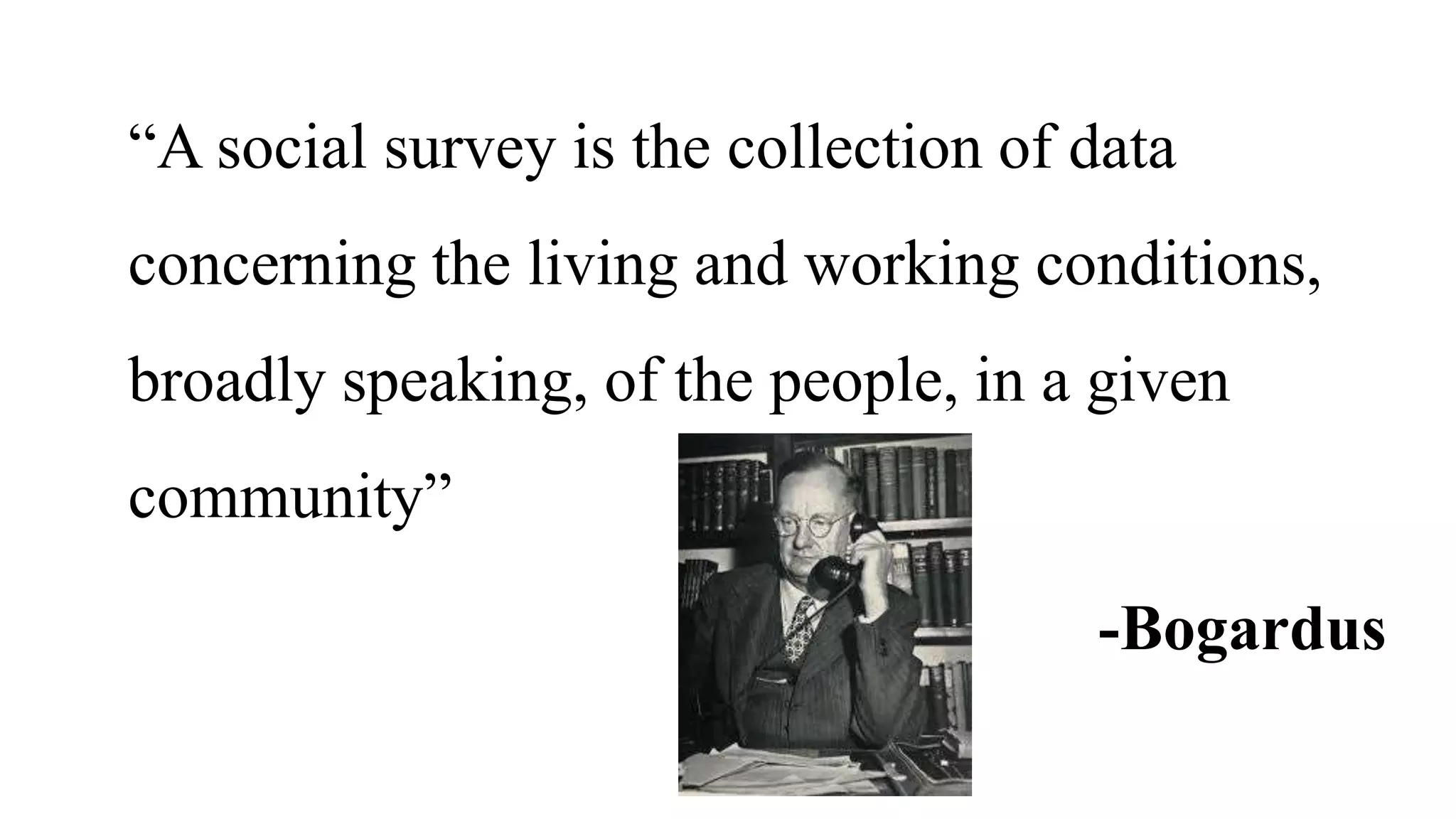
“A social survey is the collection of data
concerning the living and working conditions,
broadly speaking, of the people, in a given
community”
-Bogardus
“A social survey of a community is the scientific
study of its conditions and needs for the purpose
of presenting a constructive programme of social
advance”
-E.W. Burgess
Social Survey vs Social Research
“the social surveyor is interested in fact-finding in order
to improve the current social conditions of a specific
locality, the social researcher seeks to build a body of
tested general knowledge of mankind, a body of
knowledge timeless, space-less — which may lead to
formulation of theories and general laws”
Robert Staughton Lynd
The social surveys are concerned with specific
persons, specific places, specific problems, and
situations, whereas the social researchers are
inclined to make the more general and abstract
problems as their principal concern
History of Social Survey
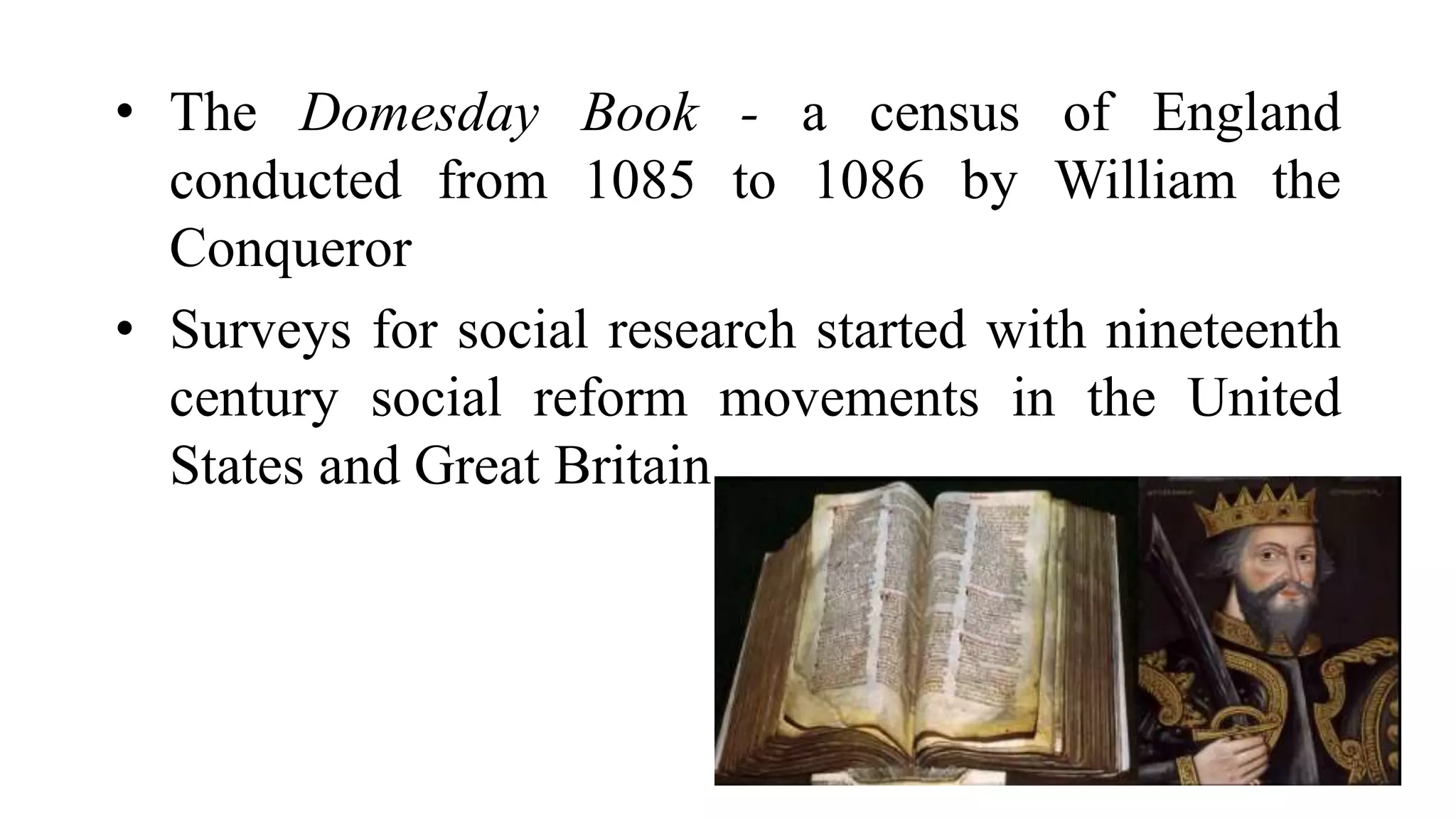
• The Domesday Book - a census of England
conducted from 1085 to 1086 by William the
Conqueror
• Surveys for social research started with nineteenth
century social reform movements in the United
States and Great Britain
• Early surveys were descriptive and did not use
scientific sampling or statistical analyses
• Henry Mayhew published the 4 volume (1851 -
1864) London Labour and the London Poor based
on conversations with street people and
observations of daily life
• Charles Booth’s 17-volume (1889–1902) Labour and
Life of the People of London and B. Seebohm
Rowntree’s Poverty (1906) documented urban poverty
in England
• The Hull House Maps and Papers of 1895 and W. E. B.
DuBois’s Philadelphia Negro (1899) documented urban
conditions in the United States
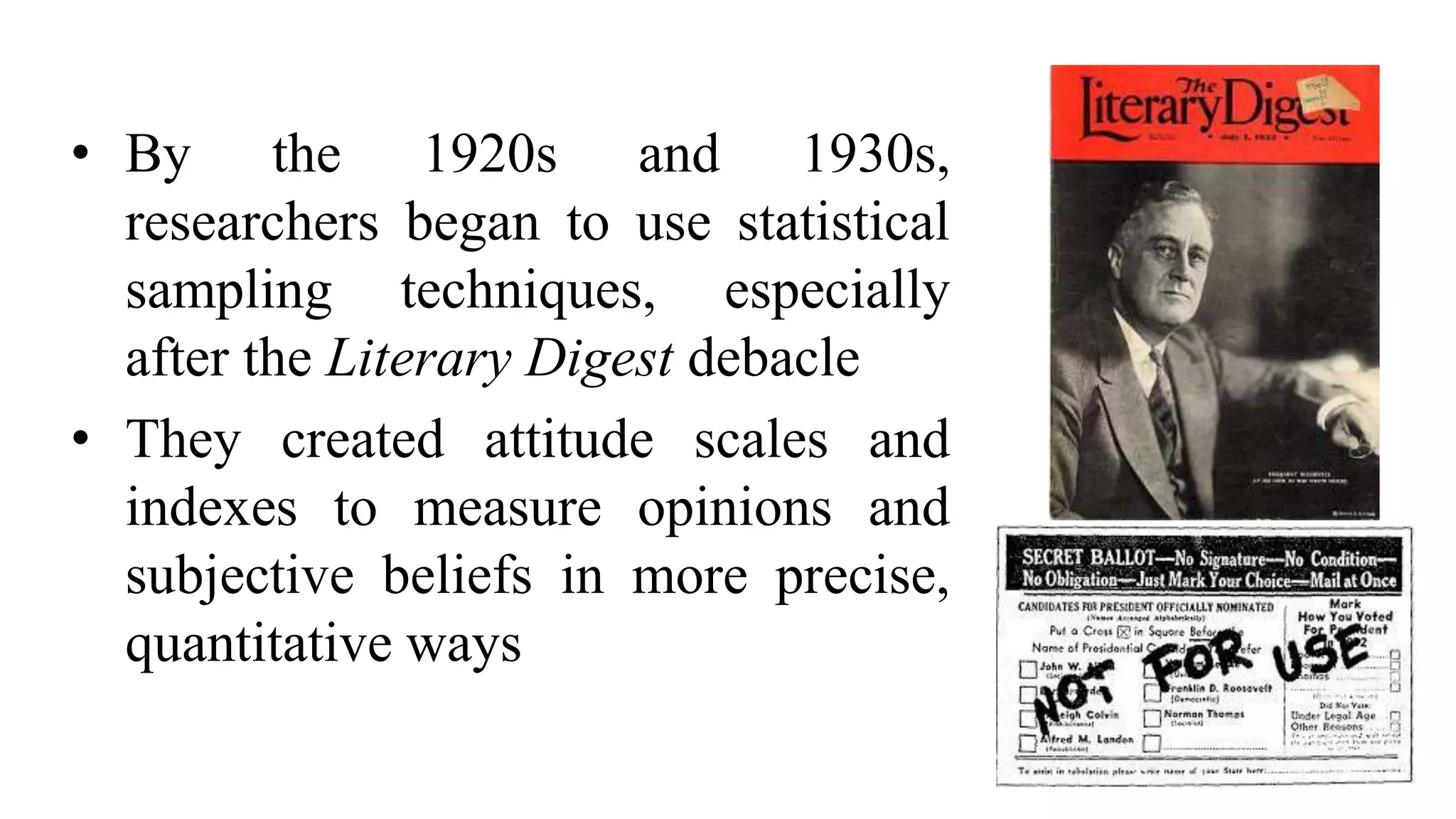
• By the 1920s and 1930s,
researchers began to use statistical
sampling techniques, especially
after the Literary Digest debacle
• They created attitude scales and
indexes to measure opinions and
subjective beliefs in more precise,
quantitative ways
• Professional researchers displacing the social reformers
• Creation of several survey research centers: the Office
of Public Opinion Research at Princeton University, the
Division of Program Surveys in the U.S. Department of
Agriculture under Rensis Likert etc
• Survey research dramatically expanded during World
War II
• Publications including survey research accelerated in the
1950s to 1960s
• During the 1970s, computers first became
available; they provided the statistical analysis of
large-scale quantitative datasets
• Since the 1970s, quantitative survey research has
become huge in private industry, government,
and in many academic fields
In India
• Census conducted 15 times, as of 2011- every 10 years
• First complete census -1881, under British Viceroy
Lord Mayo
• Post 1949, it has been conducted by the Registrar
General and Census Commissioner of India under
the Ministry of Home Affairs, Government of India
• The National Family Health Survey
(NFHS) is a large-scale survey
conducted in a representative sample
of households throughout India
• Four rounds of the survey have been
conducted since the first survey in
1992-93
Some Main Forms of Social Surveys
• Official, Semi-official or Private surveys,
• Census survey or Sample surveys,
• General or Specialised surveys;
• Public or Confidential surveys;
• Regional or Adhoc surveys, etc
Census Survey & Sample Surveys:
• In census type of survey all the units of the
research universe are contacted for collection of
data
• In sample surveys, some representative units are
selected for collection of data
• Sample surveys saves time and money when
compare to census survey if the samples are truly
represent the population
General and Specific Surveys:
• General surveys - collecting information about
population, institutions or phenomena without any
specific objective or hypothesis
• Usually taken up by the government for providing
regular data on socio – economic problems e.g.
Census
• Specific surveys data collection based on certain
specified objectives or hypothesis
Primary and Secondary Surveys:
• Primary surveys are undertaken afresh and
the field workers collect data directly from the
field
• On the contrary, in the secondary surveys, the
surveyor only examines the facts which are
already available
Official, Semi-Official and Private Surveys
• Official survey is sponsored by the government
• Semi-official survey is the survey conducted by
universities, district boards, municipalities and
other similar semi-official institutions
• Private survey is a survey attempted by an
individual, institutions etc which are non
governmental agencies
Regular and Ad-Hoc Surveys:
• The regular surveys are conducted at regular
intervals without any discontinuity
• Ad-hoc surveys are conducted once for all
with some specific purpose without
regularity
Public and Confidential Surveys:
• The data of public surveys are of general
type and no secrecy is maintained in
collecting data or in publishing the findings
• Confidential surveys the data required are of
highly personal nature needing
confidentiality
Advantages of Social Survey
• Greater Objectivity
• Useful for Administrators & Policy Makers
• Social Change & Development
Disadvantages of Social Survey
• Specific Training is required
• Time Consuming
• More Costly
• Sampling Errors
Positivism
• Positivists see society as shaping the
individual and believe that ‘social facts’ shape
individual action
• Prefer quantitative methods such as social
surveys, structured questionnaires and official
statistics because these have good reliability
and representativeness
Interpretivism
• Interpretivists, or anti-positivists argue that
individuals are not just puppets who react to
external social forces
• An Interpretivist approach to social research
would be much more qualitative, using
methods such as unstructured interviews or
participant observation
SOCIAL SURVEY METHODS
Methods of Social Survey
1. Questionnaire Survey
2. Interview Survey
3. Mixed method
QUESTIONNAIRE SURVEY
• Invented by Sir Francis Galton, 1870
• Research instrument consisting set of questions
• Capture responses from respondents
• Questionnaire may be structured or unstructured
Structured questionnaire
• The questions are
asked exactly as they
are written, in the
sequence, using the
same style, for all
interviews
• Mostly closed ended
Un-structured
questionnaire
• Mostly open ended
• Not necessary to arrange
in sequence
• Can probe
• Responses are not
predetermined in
advance
Types of questionnaire survey
1. Self-administered mail survey
2. Group-administered survey
3. Household drop-off survey
4. Online or web survey
Self-administered mail survey
Same questionnaire mailed to a large number
of people
Willing respondents can complete
Return it in postage-prepaid envelopes
Advantages
Unobtrusive, cheap,
coverage large sample,
needed low resources
Disadvantages
Low response, delay
returning, clarification
is impossible
Group-administered questionnaire survey
Respondents are brought together at a common
place and time
Each respondent asked to complete the survey
questionnaire
Enter their responses independently
 Easy to conduct (convenient for surveyor)
 High response rate can assured
 Clarification is possible of any question
Drop-off/Pick up Survey Method
Researcher drops off questionnaires for
respondents to complete in their own time
The completed forms are mailed back or
picked up again at some later date
Benefits over mail or interview survey
Increase response rate
By hand (Street) Questionnaire Method
• A set of question is
distributed among willing
respondents and ask to
response within a given
time (usually in
street/roads)
• Street intercept survey
Online or web survey
Respondents receive an e-mail request for
participation in the survey with a link
Survey questionnaire may be sent into email,
after completion can return via e-mail
Advantages
Inexpensive
Instant record
Easy to modified
Disadvantages
Computing the response
Internet inaccessibility
Computer unavailability
Sampling bias
INTERVIEW SURVEY
Personalized form of data collecting method
Conducted by trained interviewers
Used structured questionnaire (standardized set
of questions) but not seen by respondents
Opportunity to clarify or probing
But time consuming, resource intensive, require
skills to take interview
Different Types of Interview Method
Personal / Face to Face interview
Telephonic interview
Focus group interview
Computer assisted interview
(CASI, ACASI, CATI, CAPI)
Personal / Face to face Interview
Most commonly used method
Interviewer works directly with the respondent
to ask questions and record responses
Conducted at respondent’s home or office
Some respondents feel uncomfortable in
allowing stranger in their homes
Telephone Interview
Interviewer contact potential
respondents over the phone
Respondents are selected randomly from
a telephonic directory
Ask a standard set of survey questions
Issues: Network, illiterate, non-response,
time
Computer-Assisted Telephone Interviewing
• A computerized ques. is
administered over the telephone
• The interviewer sits in front of a
computer screen
• When contact is made, the
interviewer reads the questions
posed on the computer screen and
records the answers directly into
the computer
Computer-Assisted Personal Interviewing
An interviewing technique in
which the respondent or
interviewer uses an electronic
device to answer the questions
Computer Assisted Self-Interviewing
•The respondent uses a computer to
complete the survey questionnaire
without an interviewer administering
it to the respondent
•Pre-recorded audio is played back for
the respondent one question at a time
(audio computer assisted self-
interviewing - ACASI)
Role of
Interviewer
Clarify any
confusion /
concerns
Observe
quality of
responses
Motivate
respondents
Locate & enlist
cooperation of
respondents
Conduct a
good
interview
Open and friendly people, yet polite
and sensitive enough to encourage,
honest, well dress and demeanour
Interviewer’s Kit
• Kit should be carried easily
• Kit includes:
 A professional looking notebook with logo
 Map
 Sufficient copies of survey instrument with pen
 Official identification with photo
 A cover letter from Sponsor/Principal Investigator
 Mobile phone with list of contact numbers
Interview
• Process of an interview
1. Opening remarks
2. Asking questions
3. Recording the responses
4. Concluding the interview
Asking Questions
• Use questionnaire
carefully, but informally
• Ask questions exactly as
written
• Follow the order given
• Ask every question
• Don’t finish sentences
• Probe (if require)
Opening Remarks
• Gaining entry
• Doorstep technique
• Introduction
• Explaining the study
Recording the response
• Record responses
immediately
• Include all probe
• Use abbreviations
3
2
1
Concluding the Interview
• Thank the respondent
• Tell them when you expect to sent results
• Don’t be hasty
• Immediately after leaving – write down any
notes about how the interview went
Mixed Method
• Questionnaires can provide evidence of
patterns amongst large populations, interview
data often gather more in-depth insights on
participant attitudes, thoughts, and actions
• Allow cross-checking of information collected
in different ways
Steps of
Composing a
Questionnaire
What information
should be collected
Edited & finalized
Revised/pretested
/pilot study
First draft of the
questionnaire
How to collect
information
1
2
3
4
5
Constructing the Survey Method
Numerous decisions must be made
Types of survey questions
Question content
Wording
Response format
Question sequencing
Constructing the Survey Method
- Structured/unstructured
- Open/closed ended
- Nominal/ordinal/dichotomous
- Filter or contingency question
Types of
questions
Constructing the Survey Method
- Is the question necessary/useful?
- Are several questions needed?
- Do respondent have the needed information?
- Does the question need to be more specific?
- Is question sufficient general?
- Is question biased/loaded?
- Will respondent answer truthfully?
Question
content
Constructing the Survey Method
- Can the question be mis-understood?
- What assumptions does the question
make?
- Is the time frame specified?
- Is the wording too direct?
- Is the wording clear?
- Is the wording loaded or slanted?
Question
wording
Questions (Content & Wording)
Should be …….
• Easy to asked
• Easy to understand
• Quick to answer
• Quick to code
• Avoid negative manner
Constructing the Survey Method
Fill-in-the-blank
Male Female
Or, Name
Response format
Tick the correct
N. Modi
D. Trump
Your preference
1. Com. Med.
2. Surgery
3. Microbiology
Check answer, mark “X”
ORAL IV IM
Circle the answer
Agree Neutral Disagree
Question Sequencing (Rules – of – thumb)
 Start with easy, non-threating questions that can be
easily recalled
 Never start with open-ended question
 For historical events, follow chronological order
 Ask about one topic at a time
 When switching topics, use a transition
 Reduce response set
 For filter or contingency questions, make a flowchart
The Golden Rule
Do unto your respondents as you
would have them do unto you!
Respect their time,
trust, attention, and
confidentiality
Use practical
terms
Be alert for any
sign of
uncomfortable
Assure that you
will share a copy
of the final result
Thank your
respondents
Keep your
survey as short
as possible
Questionnaire Fatigue
 Becoming tired and uninterested
 Due to: Too long, too difficult, contain irrelevant
 Leads to poor and incomplete quality data
 Some tips to prevent questionnaire fatigue:
Don’t survey too often, manage expectations,
make your questions relevant, eliminate
unsuitable questions, test your surveys
Issues of selecting the survey method?
- Can the population be enumerated?
- Is the population literate?
- Are there language issues?
- Will the population cooperate?
- What are the geographic restrictions?
Population
Issues
Issues of selecting the survey method?
-What data is available?
-Can respondents be found?
-Who is the respondent?
-Can all members of the population be
sampled?
-Are response rates likely to be a problem?
Sampling
Issues
Issues of selecting the survey method?
- What types of questions can be asked?
- How complex will the question be?
- Will screening questions be needed?
- Can question sequence be maintained?
- Will lengthy questions be asked?
- Will long response scales be used?
Question
Issues
Issues of selecting the survey method?
–Can the respondents be expected
to know about the issue?
–Will respondent need to consult
records?
Content
Issues
Issues of selecting the survey method?
Bias
Issues
– Can social desirability be avoided?
– Can interviewer distortion and
subversion be controlled?
– Can false respondents be avoided?
Issues of selecting the survey method?
- Costs
- Facilities
- Time
- Personnel
Administrative
Issues
PLUSES & MINUSES OF SURVEY METHODS
Issue
Group
Ques…
Mail
Ques
Drop-Off
Ques
Online
Ques
Personal
Interview
Phone
Interview
Online
Video
Interview
Visual Presentations ✅ ✅ ✅ ✅ ✅ ❌ ✅
Long Response Categories ✅ ✅ ✅ ✅ ❓ ❌ ✅
Is Privacy? ❌ ✅ ❌ ✅ ✅ ❓ ❓
Flexible? ❌ ❌ ❌ ✅ ✅ ✅ ✅
Explain in Person? ✅ ❌ ✅ ❌ ✅ ❓ ✅
Reading & Writing Needed? ❓ ✅ ✅ ✅ ❌ ❌ ✅
Judge Quality ✅ ❌ ❓ ✅ ✅ ❓ ✅
High Response ✅ ❌ ✅ ❓ ✅ ❌ ❓
PLUSES & MINUSES OF SURVEY METHODS
Issue
Group
Ques…
Mail
Ques
Drop-Off
Ques
Online
Ques
Personal
Interview
Phone
Interview
Online
Video
Interview
Does It Give Access to Dispersed
Samples?
❌ ✅ ❌ ✅ ❌ ❌ ✅
Have Time to Formulate Answers ❌ ✅ ✅ ✅ ❌ ❌ ❌
Personal Contact ✅ ❌ ✅ ❌ ✅ ❌ ✅
Long Survey Feasible ❌ ❌ ❌ ✅ ✅ ❌ ✅
Quick Turnaround ❌ ✅ ❌ ✅ ❌ ✅ ✅
Low Cost ✅ ✅ ❌ ✅ ❌ ❌ ❌
Low Resources Needs ✅ ✅ ❌ ✅ ❌ ❌ ❌
SUMMARY
• The purpose of social survey is to gather information
in large scale from people on their social facts for
welfare of the society.
• Organizing social survey is a complex business
primarily because it involves engaging with a public or
society.
• Social surveys are a quantitative in nature, positivist
research method conducted through structured
questionnaire and interviews.
THANK YOU
If you select a method that isn’t appropriate or
doesn’t fit the context, you can doom a survey
before you even begin designing the
instruments or questions themselves

Social Survey Methods

  • 1.
    SOCIAL SURVEY METHODS Presenters LintuMathew Bikash Debbarma Moderator Prof T. Gambhir Singh
  • 2.
    Outline • What • When- History • Some Main Forms of Social Surveys • How- Social survey methods • Summary
  • 3.
  • 4.
    Duncan Mitchell’s “Dictionary ofSociology”’ defines social survey this way: “The social survey is a systematic collection of facts about people living in a specific geographic, cultural, or administrative area”
  • 5.
    “A social surveyis the collection of data concerning the living and working conditions, broadly speaking, of the people, in a given community” -Bogardus
  • 6.
    “A social surveyof a community is the scientific study of its conditions and needs for the purpose of presenting a constructive programme of social advance” -E.W. Burgess
  • 7.
    Social Survey vsSocial Research “the social surveyor is interested in fact-finding in order to improve the current social conditions of a specific locality, the social researcher seeks to build a body of tested general knowledge of mankind, a body of knowledge timeless, space-less — which may lead to formulation of theories and general laws” Robert Staughton Lynd
  • 8.
    The social surveysare concerned with specific persons, specific places, specific problems, and situations, whereas the social researchers are inclined to make the more general and abstract problems as their principal concern
  • 9.
  • 10.
    • The DomesdayBook - a census of England conducted from 1085 to 1086 by William the Conqueror • Surveys for social research started with nineteenth century social reform movements in the United States and Great Britain
  • 11.
    • Early surveyswere descriptive and did not use scientific sampling or statistical analyses • Henry Mayhew published the 4 volume (1851 - 1864) London Labour and the London Poor based on conversations with street people and observations of daily life
  • 12.
    • Charles Booth’s17-volume (1889–1902) Labour and Life of the People of London and B. Seebohm Rowntree’s Poverty (1906) documented urban poverty in England • The Hull House Maps and Papers of 1895 and W. E. B. DuBois’s Philadelphia Negro (1899) documented urban conditions in the United States
  • 13.
    • By the1920s and 1930s, researchers began to use statistical sampling techniques, especially after the Literary Digest debacle • They created attitude scales and indexes to measure opinions and subjective beliefs in more precise, quantitative ways
  • 14.
    • Professional researchersdisplacing the social reformers • Creation of several survey research centers: the Office of Public Opinion Research at Princeton University, the Division of Program Surveys in the U.S. Department of Agriculture under Rensis Likert etc • Survey research dramatically expanded during World War II • Publications including survey research accelerated in the 1950s to 1960s
  • 15.
    • During the1970s, computers first became available; they provided the statistical analysis of large-scale quantitative datasets • Since the 1970s, quantitative survey research has become huge in private industry, government, and in many academic fields
  • 16.
    In India • Censusconducted 15 times, as of 2011- every 10 years • First complete census -1881, under British Viceroy Lord Mayo • Post 1949, it has been conducted by the Registrar General and Census Commissioner of India under the Ministry of Home Affairs, Government of India
  • 17.
    • The NationalFamily Health Survey (NFHS) is a large-scale survey conducted in a representative sample of households throughout India • Four rounds of the survey have been conducted since the first survey in 1992-93
  • 18.
    Some Main Formsof Social Surveys • Official, Semi-official or Private surveys, • Census survey or Sample surveys, • General or Specialised surveys; • Public or Confidential surveys; • Regional or Adhoc surveys, etc
  • 19.
    Census Survey &Sample Surveys: • In census type of survey all the units of the research universe are contacted for collection of data • In sample surveys, some representative units are selected for collection of data • Sample surveys saves time and money when compare to census survey if the samples are truly represent the population
  • 20.
    General and SpecificSurveys: • General surveys - collecting information about population, institutions or phenomena without any specific objective or hypothesis • Usually taken up by the government for providing regular data on socio – economic problems e.g. Census • Specific surveys data collection based on certain specified objectives or hypothesis
  • 21.
    Primary and SecondarySurveys: • Primary surveys are undertaken afresh and the field workers collect data directly from the field • On the contrary, in the secondary surveys, the surveyor only examines the facts which are already available
  • 22.
    Official, Semi-Official andPrivate Surveys • Official survey is sponsored by the government • Semi-official survey is the survey conducted by universities, district boards, municipalities and other similar semi-official institutions • Private survey is a survey attempted by an individual, institutions etc which are non governmental agencies
  • 23.
    Regular and Ad-HocSurveys: • The regular surveys are conducted at regular intervals without any discontinuity • Ad-hoc surveys are conducted once for all with some specific purpose without regularity
  • 24.
    Public and ConfidentialSurveys: • The data of public surveys are of general type and no secrecy is maintained in collecting data or in publishing the findings • Confidential surveys the data required are of highly personal nature needing confidentiality
  • 25.
    Advantages of SocialSurvey • Greater Objectivity • Useful for Administrators & Policy Makers • Social Change & Development
  • 26.
    Disadvantages of SocialSurvey • Specific Training is required • Time Consuming • More Costly • Sampling Errors
  • 27.
    Positivism • Positivists seesociety as shaping the individual and believe that ‘social facts’ shape individual action • Prefer quantitative methods such as social surveys, structured questionnaires and official statistics because these have good reliability and representativeness
  • 28.
    Interpretivism • Interpretivists, oranti-positivists argue that individuals are not just puppets who react to external social forces • An Interpretivist approach to social research would be much more qualitative, using methods such as unstructured interviews or participant observation
  • 30.
  • 31.
    Methods of SocialSurvey 1. Questionnaire Survey 2. Interview Survey 3. Mixed method
  • 32.
    QUESTIONNAIRE SURVEY • Inventedby Sir Francis Galton, 1870 • Research instrument consisting set of questions • Capture responses from respondents • Questionnaire may be structured or unstructured
  • 33.
    Structured questionnaire • Thequestions are asked exactly as they are written, in the sequence, using the same style, for all interviews • Mostly closed ended Un-structured questionnaire • Mostly open ended • Not necessary to arrange in sequence • Can probe • Responses are not predetermined in advance
  • 34.
    Types of questionnairesurvey 1. Self-administered mail survey 2. Group-administered survey 3. Household drop-off survey 4. Online or web survey
  • 35.
    Self-administered mail survey Samequestionnaire mailed to a large number of people Willing respondents can complete Return it in postage-prepaid envelopes Advantages Unobtrusive, cheap, coverage large sample, needed low resources Disadvantages Low response, delay returning, clarification is impossible
  • 36.
    Group-administered questionnaire survey Respondentsare brought together at a common place and time Each respondent asked to complete the survey questionnaire Enter their responses independently  Easy to conduct (convenient for surveyor)  High response rate can assured  Clarification is possible of any question
  • 37.
    Drop-off/Pick up SurveyMethod Researcher drops off questionnaires for respondents to complete in their own time The completed forms are mailed back or picked up again at some later date Benefits over mail or interview survey Increase response rate
  • 38.
    By hand (Street)Questionnaire Method • A set of question is distributed among willing respondents and ask to response within a given time (usually in street/roads) • Street intercept survey
  • 39.
    Online or websurvey Respondents receive an e-mail request for participation in the survey with a link Survey questionnaire may be sent into email, after completion can return via e-mail Advantages Inexpensive Instant record Easy to modified Disadvantages Computing the response Internet inaccessibility Computer unavailability Sampling bias
  • 40.
    INTERVIEW SURVEY Personalized formof data collecting method Conducted by trained interviewers Used structured questionnaire (standardized set of questions) but not seen by respondents Opportunity to clarify or probing But time consuming, resource intensive, require skills to take interview
  • 41.
    Different Types ofInterview Method Personal / Face to Face interview Telephonic interview Focus group interview Computer assisted interview (CASI, ACASI, CATI, CAPI)
  • 42.
    Personal / Faceto face Interview Most commonly used method Interviewer works directly with the respondent to ask questions and record responses Conducted at respondent’s home or office Some respondents feel uncomfortable in allowing stranger in their homes
  • 43.
    Telephone Interview Interviewer contactpotential respondents over the phone Respondents are selected randomly from a telephonic directory Ask a standard set of survey questions Issues: Network, illiterate, non-response, time
  • 44.
    Computer-Assisted Telephone Interviewing •A computerized ques. is administered over the telephone • The interviewer sits in front of a computer screen • When contact is made, the interviewer reads the questions posed on the computer screen and records the answers directly into the computer
  • 45.
    Computer-Assisted Personal Interviewing Aninterviewing technique in which the respondent or interviewer uses an electronic device to answer the questions
  • 46.
    Computer Assisted Self-Interviewing •Therespondent uses a computer to complete the survey questionnaire without an interviewer administering it to the respondent •Pre-recorded audio is played back for the respondent one question at a time (audio computer assisted self- interviewing - ACASI)
  • 47.
    Role of Interviewer Clarify any confusion/ concerns Observe quality of responses Motivate respondents Locate & enlist cooperation of respondents Conduct a good interview Open and friendly people, yet polite and sensitive enough to encourage, honest, well dress and demeanour
  • 48.
    Interviewer’s Kit • Kitshould be carried easily • Kit includes:  A professional looking notebook with logo  Map  Sufficient copies of survey instrument with pen  Official identification with photo  A cover letter from Sponsor/Principal Investigator  Mobile phone with list of contact numbers
  • 49.
    Interview • Process ofan interview 1. Opening remarks 2. Asking questions 3. Recording the responses 4. Concluding the interview
  • 50.
    Asking Questions • Usequestionnaire carefully, but informally • Ask questions exactly as written • Follow the order given • Ask every question • Don’t finish sentences • Probe (if require) Opening Remarks • Gaining entry • Doorstep technique • Introduction • Explaining the study Recording the response • Record responses immediately • Include all probe • Use abbreviations 3 2 1
  • 51.
    Concluding the Interview •Thank the respondent • Tell them when you expect to sent results • Don’t be hasty • Immediately after leaving – write down any notes about how the interview went
  • 52.
    Mixed Method • Questionnairescan provide evidence of patterns amongst large populations, interview data often gather more in-depth insights on participant attitudes, thoughts, and actions • Allow cross-checking of information collected in different ways
  • 53.
    Steps of Composing a Questionnaire Whatinformation should be collected Edited & finalized Revised/pretested /pilot study First draft of the questionnaire How to collect information 1 2 3 4 5
  • 54.
    Constructing the SurveyMethod Numerous decisions must be made Types of survey questions Question content Wording Response format Question sequencing
  • 55.
    Constructing the SurveyMethod - Structured/unstructured - Open/closed ended - Nominal/ordinal/dichotomous - Filter or contingency question Types of questions
  • 56.
    Constructing the SurveyMethod - Is the question necessary/useful? - Are several questions needed? - Do respondent have the needed information? - Does the question need to be more specific? - Is question sufficient general? - Is question biased/loaded? - Will respondent answer truthfully? Question content
  • 57.
    Constructing the SurveyMethod - Can the question be mis-understood? - What assumptions does the question make? - Is the time frame specified? - Is the wording too direct? - Is the wording clear? - Is the wording loaded or slanted? Question wording
  • 58.
    Questions (Content &Wording) Should be ……. • Easy to asked • Easy to understand • Quick to answer • Quick to code • Avoid negative manner
  • 59.
    Constructing the SurveyMethod Fill-in-the-blank Male Female Or, Name Response format Tick the correct N. Modi D. Trump Your preference 1. Com. Med. 2. Surgery 3. Microbiology Check answer, mark “X” ORAL IV IM Circle the answer Agree Neutral Disagree
  • 60.
    Question Sequencing (Rules– of – thumb)  Start with easy, non-threating questions that can be easily recalled  Never start with open-ended question  For historical events, follow chronological order  Ask about one topic at a time  When switching topics, use a transition  Reduce response set  For filter or contingency questions, make a flowchart
  • 61.
    The Golden Rule Dounto your respondents as you would have them do unto you! Respect their time, trust, attention, and confidentiality Use practical terms Be alert for any sign of uncomfortable Assure that you will share a copy of the final result Thank your respondents Keep your survey as short as possible
  • 62.
    Questionnaire Fatigue  Becomingtired and uninterested  Due to: Too long, too difficult, contain irrelevant  Leads to poor and incomplete quality data  Some tips to prevent questionnaire fatigue: Don’t survey too often, manage expectations, make your questions relevant, eliminate unsuitable questions, test your surveys
  • 63.
    Issues of selectingthe survey method? - Can the population be enumerated? - Is the population literate? - Are there language issues? - Will the population cooperate? - What are the geographic restrictions? Population Issues
  • 64.
    Issues of selectingthe survey method? -What data is available? -Can respondents be found? -Who is the respondent? -Can all members of the population be sampled? -Are response rates likely to be a problem? Sampling Issues
  • 65.
    Issues of selectingthe survey method? - What types of questions can be asked? - How complex will the question be? - Will screening questions be needed? - Can question sequence be maintained? - Will lengthy questions be asked? - Will long response scales be used? Question Issues
  • 66.
    Issues of selectingthe survey method? –Can the respondents be expected to know about the issue? –Will respondent need to consult records? Content Issues
  • 67.
    Issues of selectingthe survey method? Bias Issues – Can social desirability be avoided? – Can interviewer distortion and subversion be controlled? – Can false respondents be avoided?
  • 68.
    Issues of selectingthe survey method? - Costs - Facilities - Time - Personnel Administrative Issues
  • 69.
    PLUSES & MINUSESOF SURVEY METHODS Issue Group Ques… Mail Ques Drop-Off Ques Online Ques Personal Interview Phone Interview Online Video Interview Visual Presentations ✅ ✅ ✅ ✅ ✅ ❌ ✅ Long Response Categories ✅ ✅ ✅ ✅ ❓ ❌ ✅ Is Privacy? ❌ ✅ ❌ ✅ ✅ ❓ ❓ Flexible? ❌ ❌ ❌ ✅ ✅ ✅ ✅ Explain in Person? ✅ ❌ ✅ ❌ ✅ ❓ ✅ Reading & Writing Needed? ❓ ✅ ✅ ✅ ❌ ❌ ✅ Judge Quality ✅ ❌ ❓ ✅ ✅ ❓ ✅ High Response ✅ ❌ ✅ ❓ ✅ ❌ ❓
  • 70.
    PLUSES & MINUSESOF SURVEY METHODS Issue Group Ques… Mail Ques Drop-Off Ques Online Ques Personal Interview Phone Interview Online Video Interview Does It Give Access to Dispersed Samples? ❌ ✅ ❌ ✅ ❌ ❌ ✅ Have Time to Formulate Answers ❌ ✅ ✅ ✅ ❌ ❌ ❌ Personal Contact ✅ ❌ ✅ ❌ ✅ ❌ ✅ Long Survey Feasible ❌ ❌ ❌ ✅ ✅ ❌ ✅ Quick Turnaround ❌ ✅ ❌ ✅ ❌ ✅ ✅ Low Cost ✅ ✅ ❌ ✅ ❌ ❌ ❌ Low Resources Needs ✅ ✅ ❌ ✅ ❌ ❌ ❌
  • 71.
    SUMMARY • The purposeof social survey is to gather information in large scale from people on their social facts for welfare of the society. • Organizing social survey is a complex business primarily because it involves engaging with a public or society. • Social surveys are a quantitative in nature, positivist research method conducted through structured questionnaire and interviews.
  • 72.
    THANK YOU If youselect a method that isn’t appropriate or doesn’t fit the context, you can doom a survey before you even begin designing the instruments or questions themselves

Editor's Notes

  • #5 Dr Duncan Mitchell is a Professorial Fellow of the School of Nursing and Institute for Health and Social Care Research at the University of Salford, UK,
  • #6 Emory S. Bogardus was a prominent figure in the history of American sociology. Bogardus founded one of the first sociology departments at an American university, at the University of Southern California in 1915
  • #7 Ernest Watson Burgess (May 16, 1886 – December 27, 1966) was a Canadian-American urban sociologist born in Tilbury, Ontario. He was educated at Kingfisher College in Oklahoma and continued graduate studies in sociology at the University of Chicago. In 1916, he returned to the University of Chicago, as a faculty member.
  • #11 The early census assessed property for taxation or young men for military service. After representative democracy developed, officials used the census to assign elected representatives based on the population in a district and to allocate funds for public improvements
  • #13 Charles booth and poverty map -An early example of social cartography, each street is coloured to indicate the income and social class of its inhabitants. The early social surveys provide impressive pictures of daily community life in the early twentieth century. For example, the six-volume Pittsburgh Survey published in 1914 includes data from face-to-face interviews, statistics on health, crime, and industrial injury, and direct observations. The Literary Digest was an influential American general interest weekly magazine published by Funk & Wagnalls. Founded by Isaac Kaufmann Funk in 1890, it eventually merged with two similar weekly magazines, Public Opinion and Current Opinion.
  • #15 social reformers who had used the survey to document local social problems Survey researchers received generous funding and government support to study civilian and soldier morale,consumer demand,production capacity,enemy propaganda,and the effectiveness of bombing. After World War II, officials quickly dismantled the large government survey establishment. This was done to cut costs and because political conservatives feared that reformers might use survey methods to document social problems. They feared such information about ill treatment and poor conditions could be used to advance policies that conservatives opposed,such as helping unemployed workers or promoting racial equality for African Americans in the segregated southern states
  • #17 All the censuses since 1951 were conducted under the 1948 Census of India Act The last census was held in 2011, whilst the next will be held in 2021
  • #18 The survey provides state and national information for India on fertility, infant and child mortality, the practice of family planning, maternal and child health, reproductive health, nutrition, anaemia, utilization and quality of health and family planning services The International Institute for Population Sciences (IIPS) Mumbai, as the nodal agency provides coordination and technical guidance for the survey. The survey is conducted through three questionnaires: Household Questionnaire Woman’s Questionnaire Village Questionnaire (for rural areas alone) The NFHS-3 added men age 15-54 and never married women age 15-49, as well as ever-married women in its survey population unlike the previous surveys.
  • #20 If the research universe is constituted by homogeneous units, sample survey is preferred because it spends less time, energy and money. But if the research universe is of heterogeneous nature, census survey is found to be more suitable. In Census, each and every unit of the population is studied. but only few units of the population studied is studied in Sampling. Census refers to periodic collection of information about the populace from the entire population It is more suitable to use Census Method if population is heterogeneous in nature. and It is more suitable to use Sampling Method if population is homogeneous in nature. Census survey is much bigger in proportion than sample survey Census survey takes more time and money than sample  However, there is margin for error in sample survey while census survey is more accurate.
  • #21 specialized survey attempts on unearthing some particular aspects of the community such as unemployment, child labour, problems of the slum, hygienic attitude etc. These kind of surveys taken up by any institution specific to their problem, or individual surveys for their academic work
  • #22 In primary surveys the surveyor has got the liberty to set the goals for procuring the relevant facts.
  • #23 Among these, official survey has the greatest probability of success because it is not hampered by a dearth of finances or trained personnel. Semiofficial survey is not only less economic but also more difficult. In the private survey, the problem of expenditure, time and trained personnel is even more acute. But, in spite of the fundamental difficulties, some semi-official and private surveys have yielded better results than some government surveys
  • #24 Regular surveys- economic surveys
  • #26 Since there is close contact of the surveyor with people and observe the situation himself, therefore greater objectivity is achieved in this method Social survey method is very useful for administrators and policy makers. In many countries, legislation was done to remove the causes of problems like child labour, women labour etc. administrators and policy when a social survey is conducted Due to Social survey we find out the trends towards social change and factors resisting in its way. Thus, if these trends are developed and controlled the resisting factors, then social change and development is occurring.
  • #27 It is difficult to provide specific training to the researcher as a result, a layman cannot conduct survey because specific training is required for him to study the situation deeply. Social survey method is more time consuming. The researcher have no interest in collection of data due to more time taking and the respondents are not ready to answer because they have no time
  • #48 Interviewer: like salesman or jack of all trades
  • #54 Six steps can be employed to construct a questionnaire that will produce reliable and valid results.
  • #55 It is an art, numerous decision must be made ab
  • #62 golden rule” of survey research (and, I hope, for the rest of your life as well!) You are imposing in the life of your respondent. You are asking for their time, their attention, their trust, and often, for personal information. Therefore, you should always keep in mind the “golden rule” of survey research (and, I hope, for the rest of your life as well!):