Surveys
Learn: Characteristics of Surveys
It is a way of gathering information from individuals by having them respond to questions
that may tap matters of fact, attitudes, feelings, beliefs or opinions, or future expectations
about specific issues (Monette, Sullivan, & DeJong, 1998).
● Surveys typically involve collecting data from large samples of people, which make it
ideal for obtaining representative data from large populations that may be difficult to
deal with by other methods.
● Surveys describes people’s attitudes, feelings, beliefs or opinions.
● All surveys involve presenting respondents with a set of predetermined questions to
be answered.
● Oral or written responses to these questions constitute the principal data obtained in a
survey.
● Surveys use same phrasing and ordering of questions.
Surveys
Learn: Uses of Surveys
● The respondents of a survey can be individuals, households or any other unit.
● The collected data are mainly quantitative.
Uses of surveys:
● Survey research is designed to explore directly the nature of people’s attitudes, feelings,
beliefs or opinions.
● Surveys are a widely used method for answering research questions that are mainly
descriptive, such as: How many rural households have access to ‘safe’drinking water?
● It’s objective is to generalize findings of sample to the ‘target population’.
Surveys
Learn: Uses of Surveys
● Surveys are used in research by social scientists (i.e., political scientists,
psychologists, sociologists). (to investigate the causes of divorce, rural debt and
investment, radio listening, holiday spending, job vacancies (USA).
● Surveys are used to meet the pragmatic needs of political candidates, public health
officials, professional organizations, and advertising and marketing directors.
● Surveys are useful in designing public education strategies.
Surveys
Learn: Types of Surveys
Survey research can be of the following types:
(a) Ex post facto studies (retrospective studies of relationships and effects of socio-psychological
variables occurring in natural settings, e.g. a study on the background of our liberation
movement of 1971; background of student movement in 2024);
(b) Status studies (study on the status quo of variables and phenomena, e.g. information on the
health and demographic status of the people of Bangladesh collected by the MOHFW of GOB
after every three years through the Bangladesh Demographic and Health Survey or BDHS);
(c) Correlational studies (relationships of variables occurring in natural setting, e.g. illiteracy &
family size, supervisory style & employee productivity, etc.).
Surveys
Learn: Survey Methods
● In social science, most techniques of data collection rely on asking people to report their
behavior, or views, or knowledge.
● Thus, surveys employ questionnaires or interviews as the two basic ways of collecting
data (Monette et al., 1998).
● A questionnaire contains written questions that people respond to directly on the
questionnaire form itself.
-- It can be handed directly to a respondent, or it can be mailed to the members of a
sample, who then fill it out on their own.
● An interview involves an interviewer reading questions to respondents and recording
their answers.
-- interviews can be conducted in person or over the telephone .
Surveys
Learn: Types of Surveys
Survey research can be of the following types:
(a) Ex post facto studies (retrospective studies of relationships and effects of socio-psychological
variables occurring in natural settings, e.g. a study on the background of our liberation
movement of 1971; background of student movement in 2024);
(b) Status studies (study on the status quo of variables and phenomena, e.g. information on the
health and demographic status of the people of Bangladesh collected by the MOHFW of GOB
after every three years through the Bangladesh Demographic and Health Survey or BDHS);
(c) Correlational studies (relationships of variables occurring in natural setting, e.g. illiteracy &
family size, supervisory style & employee productivity, etc.).
Questionnaire Survey
Learn: Survey Methods
● In social sciences, data collection rely on asking peoples to report their behavior, or
views, or knowledge.
● Thus, survey employs questionnaire or interviews for collecting data.
Questionnaire:
● A questionnaire contains written questions that people respond to directly on the
questionnaire form itself.
● It can be handed either directly to a respondent or it can be mailed to the members of a
sample.
● Respondents, then, fill it out on their own.
Questionnaire Survey
Learn: Survey Methods
Advantages:
● It can keep the confidentiality.
Disadvantages:
● No opportunity for clarification.
● It requires literate people as respondents.
● Respondent has to negotiate format. e.g. may ‘skip’ from one question to another.
Mail Survey
Learn: Survey Methods
● Self-administered questionnaires are distributed via post or mail to the respondents to
be fill out on their own.
Advantages:
● It can be completed relatively quickly.
● It can anomalously collect information on highly personal and embarrassing topics.
● It can avoid the problems due to interviewer bias.
Disadvantages:
● The respondents will not be able to ask questions if any items of the questionnaire need
to explain further.
● Response bias – not all respondents complete the survey.
● Low Response rate.
● Respondents don’t follow the same order in answering the questions.
Personal Interview (face-to-face)
Learn: Survey Methods
● In personal interview respondents are usually contacted in their homes or in a.
shopping
mall and trained interviewers administer the questionnaire or conduct the interview.
● It allows greater flexibility in asking questions.
Advantages:
● Respondents can obtain clarification when questions are unclear.
● Interviewer can follow up incomplete or ambiguous answers.
● Interviewer can controls the sequencing and order of questions.
Disadvantages:
● Growing fear of Urban crime and no one home during the day have reduced the P. Int.
● Relatively costly.
Telephone Interview
Learn: Survey Methods
● An interview involves an interviewer reading questions to respondents and recording
their answers.
● Interviews can be conducted in person or over the telephone.
Telephone Interview (when contacts are made by phone):
● The expensive cost of personal interview and difficulties supervising interviewers have
led to researchers to telephone interviews.
● By 1979, 95% households had telephones that made the telephone interview possible.
Advantages:
● fast, cheap.
● It can access to dangerous neighborhoods, locked buildings.
Disadvantages:
● Telephone ownership is not universal, and varies with important variables.
● There might be “eves-dropper” effect.
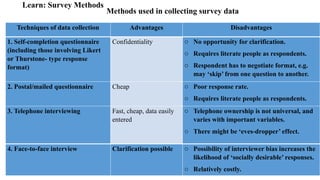
Methods used in collecting survey data
Learn: Survey Methods
Techniques of data collection Advantages Disadvantages
1. Self-completion questionnaire
(including those involving Likert
or Thurstone- type response
format)
Confidentiality o No opportunity for clarification.
o Requires literate people as respondents.
o Respondent has to negotiate format, e.g.
may ‘skip’ from one question to another.
2. Postal/mailed questionnaire Cheap o Poor response rate.
o Requires literate people as respondents.
3. Telephone interviewing Fast, cheap, data easily
entered
o Telephone ownership is not universal, and
varies with important variables.
o There might be ‘eves-dropper’ effect.
4. Face-to-face interview Clarification possible o Possibility of interviewer bias increases the
likelihood of ‘socially desirable’ responses.
o Relatively costly.
Survey Research Design
Learn: Survey-Research Design
● It’s the overall plan or structure according to which the entire study is carried out.
● According to Shaughnessy and Zechmeister (1997), there are three general types of survey
research designs: (a) the cross-sectional design,
(b) the successive independent samples design, and
(c) the longitudinal design.
Cross-Sectional Design
Learn: Survey-Research Design
● In a cross-sectional design, one or more samples are drawn randomly from some given
population at one point in time.
● The collected data are mainly quantitative.
Uses of cross-sectional design:
● The focus of a cross-sectional study is on description – describing the characteristics of a
population or the differences among two or more populations.
● Cross-sectional designs can also be used to assess interrelationships among variables within a population.
Limitations
● It can’t assess changes in attitudes or behavior over time and determine the effect of some
naturally occurring event.
Successive Independent Samples Design
Learn: Survey-Research Design
● It’s a series of cross-sectional surveys in which the same questions are asked of each
succeeding sample of different respondents.
For example, asking male and female samples of 4th
Year Honors students about their ‘career goals’ at a
particular point in time (say, in 1999), and then ten years later (in 2009) asking different samples of 4th
Year
Honors students the same questions.
Uses of cross-sectional design:
● It’s used to describe changes over time in the attitudes or behaviors of members of a population.
Limitations
● We cannot determine in the successive independent samples design who has changed or by how much.
● Successive samples are not representative of the same population.
For example, the 1999 sample might have been comprised of more affluents, whereas the 2009 sample
might have been comprised of more of the poor people.
Longitudinal Design
Learn: Survey-Research Design
● In the longitudinal design, the same sample of respondents is interviewed more than once.
For example, to assess people’s opinions about ‘ways to administer welfare programs’ by administering a
questionnaire to a sample of individuals at the beginning of a national election campaign and then administering
the same questionnaire to the same individuals following the election.
Uses of longitudinal design:
● Longitudinal design can perfectly describe the changes in attitudes or opinions over time.
● It can determine the direction and extent of change for individual respondents.
● It can assess the effect of some naturally occurring event. For example - Measuring people’s attitudes
before and after a national election’.
Longitudinal Design
Learn: Survey-Research Design
Limitations:
(a) It can be difficult to obtain a sample of respondents who will agree to participate in a longitudinal
study, which often means a long-term study.
(b) Unless all the respondents in the original sample complete all phases of a longitudinal design, there is
a possible problem due to respondent mortality.
(c) Because the same respondents are interviewed more than once, one problem with this design is that
respondents might strive heroically to be consistent across interviews. This can be
particularly troublesome if the study is designed to assess changes in respondents’ attitudes.
(d) Initial interview may sensitize respondents to the issue under investigation (e.g., assessing
the effectiveness of TV advertisement, and people are interviewed prior to the broadcast of the
advertisement).

Quantitative and Qualitative data Collection Method

  • 1.
    Surveys Learn: Characteristics ofSurveys It is a way of gathering information from individuals by having them respond to questions that may tap matters of fact, attitudes, feelings, beliefs or opinions, or future expectations about specific issues (Monette, Sullivan, & DeJong, 1998). ● Surveys typically involve collecting data from large samples of people, which make it ideal for obtaining representative data from large populations that may be difficult to deal with by other methods. ● Surveys describes people’s attitudes, feelings, beliefs or opinions. ● All surveys involve presenting respondents with a set of predetermined questions to be answered. ● Oral or written responses to these questions constitute the principal data obtained in a survey. ● Surveys use same phrasing and ordering of questions.
  • 2.
    Surveys Learn: Uses ofSurveys ● The respondents of a survey can be individuals, households or any other unit. ● The collected data are mainly quantitative. Uses of surveys: ● Survey research is designed to explore directly the nature of people’s attitudes, feelings, beliefs or opinions. ● Surveys are a widely used method for answering research questions that are mainly descriptive, such as: How many rural households have access to ‘safe’drinking water? ● It’s objective is to generalize findings of sample to the ‘target population’.
  • 3.
    Surveys Learn: Uses ofSurveys ● Surveys are used in research by social scientists (i.e., political scientists, psychologists, sociologists). (to investigate the causes of divorce, rural debt and investment, radio listening, holiday spending, job vacancies (USA). ● Surveys are used to meet the pragmatic needs of political candidates, public health officials, professional organizations, and advertising and marketing directors. ● Surveys are useful in designing public education strategies.
  • 4.
    Surveys Learn: Types ofSurveys Survey research can be of the following types: (a) Ex post facto studies (retrospective studies of relationships and effects of socio-psychological variables occurring in natural settings, e.g. a study on the background of our liberation movement of 1971; background of student movement in 2024); (b) Status studies (study on the status quo of variables and phenomena, e.g. information on the health and demographic status of the people of Bangladesh collected by the MOHFW of GOB after every three years through the Bangladesh Demographic and Health Survey or BDHS); (c) Correlational studies (relationships of variables occurring in natural setting, e.g. illiteracy & family size, supervisory style & employee productivity, etc.).
  • 5.
    Surveys Learn: Survey Methods ●In social science, most techniques of data collection rely on asking people to report their behavior, or views, or knowledge. ● Thus, surveys employ questionnaires or interviews as the two basic ways of collecting data (Monette et al., 1998). ● A questionnaire contains written questions that people respond to directly on the questionnaire form itself. -- It can be handed directly to a respondent, or it can be mailed to the members of a sample, who then fill it out on their own. ● An interview involves an interviewer reading questions to respondents and recording their answers. -- interviews can be conducted in person or over the telephone .
  • 6.
    Surveys Learn: Types ofSurveys Survey research can be of the following types: (a) Ex post facto studies (retrospective studies of relationships and effects of socio-psychological variables occurring in natural settings, e.g. a study on the background of our liberation movement of 1971; background of student movement in 2024); (b) Status studies (study on the status quo of variables and phenomena, e.g. information on the health and demographic status of the people of Bangladesh collected by the MOHFW of GOB after every three years through the Bangladesh Demographic and Health Survey or BDHS); (c) Correlational studies (relationships of variables occurring in natural setting, e.g. illiteracy & family size, supervisory style & employee productivity, etc.).
  • 7.
    Questionnaire Survey Learn: SurveyMethods ● In social sciences, data collection rely on asking peoples to report their behavior, or views, or knowledge. ● Thus, survey employs questionnaire or interviews for collecting data. Questionnaire: ● A questionnaire contains written questions that people respond to directly on the questionnaire form itself. ● It can be handed either directly to a respondent or it can be mailed to the members of a sample. ● Respondents, then, fill it out on their own.
  • 8.
    Questionnaire Survey Learn: SurveyMethods Advantages: ● It can keep the confidentiality. Disadvantages: ● No opportunity for clarification. ● It requires literate people as respondents. ● Respondent has to negotiate format. e.g. may ‘skip’ from one question to another.
  • 9.
    Mail Survey Learn: SurveyMethods ● Self-administered questionnaires are distributed via post or mail to the respondents to be fill out on their own. Advantages: ● It can be completed relatively quickly. ● It can anomalously collect information on highly personal and embarrassing topics. ● It can avoid the problems due to interviewer bias. Disadvantages: ● The respondents will not be able to ask questions if any items of the questionnaire need to explain further. ● Response bias – not all respondents complete the survey. ● Low Response rate. ● Respondents don’t follow the same order in answering the questions.
  • 10.
    Personal Interview (face-to-face) Learn:Survey Methods ● In personal interview respondents are usually contacted in their homes or in a. shopping mall and trained interviewers administer the questionnaire or conduct the interview. ● It allows greater flexibility in asking questions. Advantages: ● Respondents can obtain clarification when questions are unclear. ● Interviewer can follow up incomplete or ambiguous answers. ● Interviewer can controls the sequencing and order of questions. Disadvantages: ● Growing fear of Urban crime and no one home during the day have reduced the P. Int. ● Relatively costly.
  • 11.
    Telephone Interview Learn: SurveyMethods ● An interview involves an interviewer reading questions to respondents and recording their answers. ● Interviews can be conducted in person or over the telephone. Telephone Interview (when contacts are made by phone): ● The expensive cost of personal interview and difficulties supervising interviewers have led to researchers to telephone interviews. ● By 1979, 95% households had telephones that made the telephone interview possible. Advantages: ● fast, cheap. ● It can access to dangerous neighborhoods, locked buildings. Disadvantages: ● Telephone ownership is not universal, and varies with important variables. ● There might be “eves-dropper” effect.
  • 12.
    Methods used incollecting survey data Learn: Survey Methods Techniques of data collection Advantages Disadvantages 1. Self-completion questionnaire (including those involving Likert or Thurstone- type response format) Confidentiality o No opportunity for clarification. o Requires literate people as respondents. o Respondent has to negotiate format, e.g. may ‘skip’ from one question to another. 2. Postal/mailed questionnaire Cheap o Poor response rate. o Requires literate people as respondents. 3. Telephone interviewing Fast, cheap, data easily entered o Telephone ownership is not universal, and varies with important variables. o There might be ‘eves-dropper’ effect. 4. Face-to-face interview Clarification possible o Possibility of interviewer bias increases the likelihood of ‘socially desirable’ responses. o Relatively costly.
  • 13.
    Survey Research Design Learn:Survey-Research Design ● It’s the overall plan or structure according to which the entire study is carried out. ● According to Shaughnessy and Zechmeister (1997), there are three general types of survey research designs: (a) the cross-sectional design, (b) the successive independent samples design, and (c) the longitudinal design.
  • 14.
    Cross-Sectional Design Learn: Survey-ResearchDesign ● In a cross-sectional design, one or more samples are drawn randomly from some given population at one point in time. ● The collected data are mainly quantitative. Uses of cross-sectional design: ● The focus of a cross-sectional study is on description – describing the characteristics of a population or the differences among two or more populations. ● Cross-sectional designs can also be used to assess interrelationships among variables within a population. Limitations ● It can’t assess changes in attitudes or behavior over time and determine the effect of some naturally occurring event.
  • 15.
    Successive Independent SamplesDesign Learn: Survey-Research Design ● It’s a series of cross-sectional surveys in which the same questions are asked of each succeeding sample of different respondents. For example, asking male and female samples of 4th Year Honors students about their ‘career goals’ at a particular point in time (say, in 1999), and then ten years later (in 2009) asking different samples of 4th Year Honors students the same questions. Uses of cross-sectional design: ● It’s used to describe changes over time in the attitudes or behaviors of members of a population. Limitations ● We cannot determine in the successive independent samples design who has changed or by how much. ● Successive samples are not representative of the same population. For example, the 1999 sample might have been comprised of more affluents, whereas the 2009 sample might have been comprised of more of the poor people.
  • 16.
    Longitudinal Design Learn: Survey-ResearchDesign ● In the longitudinal design, the same sample of respondents is interviewed more than once. For example, to assess people’s opinions about ‘ways to administer welfare programs’ by administering a questionnaire to a sample of individuals at the beginning of a national election campaign and then administering the same questionnaire to the same individuals following the election. Uses of longitudinal design: ● Longitudinal design can perfectly describe the changes in attitudes or opinions over time. ● It can determine the direction and extent of change for individual respondents. ● It can assess the effect of some naturally occurring event. For example - Measuring people’s attitudes before and after a national election’.
  • 17.
    Longitudinal Design Learn: Survey-ResearchDesign Limitations: (a) It can be difficult to obtain a sample of respondents who will agree to participate in a longitudinal study, which often means a long-term study. (b) Unless all the respondents in the original sample complete all phases of a longitudinal design, there is a possible problem due to respondent mortality. (c) Because the same respondents are interviewed more than once, one problem with this design is that respondents might strive heroically to be consistent across interviews. This can be particularly troublesome if the study is designed to assess changes in respondents’ attitudes. (d) Initial interview may sensitize respondents to the issue under investigation (e.g., assessing the effectiveness of TV advertisement, and people are interviewed prior to the broadcast of the advertisement).