

•In-depth interview
Zulfiqar Ali Behan
PhD course
Presentation
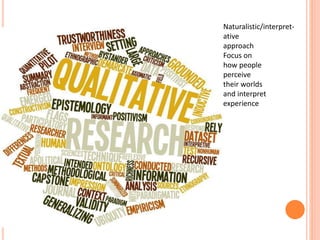
Naturalistic/interpret-
ative
approach
Focus on
how people
perceive
their worlds
and interpret
experience
A tool to direct or guide a conversation between 2 or more
people towards a particular outcome.
Frey and Oishi (1995:01) define Interview as “a
purposeful
conversation in which one person asks prepared
questions
(interviewer) and another answers them (respondent).”
Examples:
• Journalistic
• Clinical
• Research
• Occupational
Interview is the verbal
conversation between two people
with the objective of collecting
relevant information for the purpose
of research.
DEFINITION
According to McNamara, 1999
Interviews are particularly useful for getting the story
behind a participant’s experiences.
The interviewer can pursue in-depth information
around the topic.
Interviews may be useful as follow-up to certain
respondents.
In- depth Interview
in-depth interview is nondirective in nature
where
the respondent is given freedom to answer
within
the boundaries of the topic of interest.
In-Depth Interview
• One-On-One Basis,
Two Individuals---
Interviewer and Respondent
• Purpose:
Data Collection, Detailed Discussion
on Research Topic, Theme
• Data: Personal Experiences, Accounts, Words,
Opinions, Views, Ideas, Perceptions (Own
Words)
In-Depth Interview
• One View: Unstructured in Format
• Researcher Introduces Topic
• No Extensive List---Predetermined, Focused,
Short Questions
• Awareness of Main Theme(s)
• Think Through Relevant Questions
In-Depth Interview
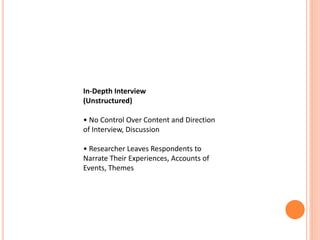
(Unstructured)
• No Control Over Content and Direction
of Interview, Discussion
• Researcher Leaves Respondents to
Narrate Their Experiences, Accounts of
Events, Themes
In-Depth Interview
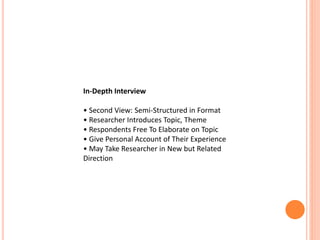
• Second View: Semi-Structured in Format
• Researcher Introduces Topic, Theme
• Respondents Free To Elaborate on Topic
• Give Personal Account of Their Experience
• May Take Researcher in New but Related
Direction
In-Depth Interview
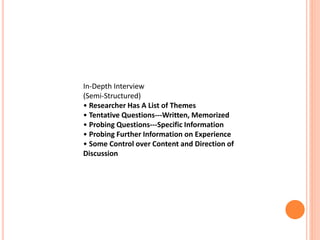
(Semi-Structured)
• Researcher Has A List of Themes
• Tentative Questions---Written, Memorized
• Probing Questions---Specific Information
• Probing Further Information on Experience
• Some Control over Content and Direction of
Discussion
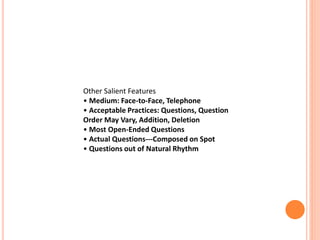
Other Salient Features
• Medium: Face-to-Face, Telephone
• Acceptable Practices: Questions, Question
Order May Vary, Addition, Deletion
• Most Open-Ended Questions
• Actual Questions---Composed on Spot
• Questions out of Natural Rhythm
Methods of conducting an
Personal Interview
A personal interview involves a lot
of preparation. Generally an
personal interview should go
through the following five/5 stages
they are as under.
Five/5 stages
a. Rapport Building
b. Introduction
c. Probing
d. Recording
e. Closing
a. Rapport Building
1. Interviewer should increase the
receptiveness of the respondent,
2. by making him believe that his
opinions are very useful to the
research, and is going to be a
pleasure rather than an ordeal(trial).
b. Introduction
An introduction involves the interviewer
identifying himself by giving him his name,
purpose and sponsorship if any.
An introductory letter goes a long way in
conveying the study’s legitimacy.
c. Probing
Probing is the technique of encouraging the
respondents to answer
completely,
freely
relevantly.
d. Recording
The interviewer can either write the
response at
the time of interview or after the interview.
In certain cases, where the respondent
allows
for it, audio or visual aids can be used to
record
answers.
e. Closing
After the interview, interviewer should
thank the respondent and once again assure
him about the worth of his answers
And also the confidentiality of the same.
TYPES OF INTERVIEW
1. Personal Interview
2. Telephone Interview
3. Focus Group Interview
4. Depth Interview
5. Projective Techniques
1.Personal Interview
Personal Interview is a face to face two way
communication between the interviewer and the
respondents.
Generally the personal interview is carried out in a planned
manner and is referred to as ‘structured interview’.
This can be done in many forms e.g. door to door or as a
planned formal executive meeting.
2. Telephone
Interview
Telephone interview the information is
collected from the respondent by asking
him questions on the phone is called as
telephone interview.
The combination of telephone and
computer has made this method even more
popular.
It has certain advantages and disadvantages.
3. Focus Group Interview
Focus group interview is an unstructured
interview which involves a moderator
leading a discussion between a small group
of respondents on a specific topic.
5. Projective Techniques
Projective Techniques involve the presentation of
an ambiguous, unstructured object, activity or
person that a respondent is asked to interpret and
explain.
Respondents asked to interpret the colours of dress.
In Projective Techniques, the respondents are
asked to interpret the behaviour of others/objects
and this way they indirectly reveal their own
behaviour in the same situation. Some of these
techniques are discussed below.
Other types
Informal, conversational interview - no predetermined
questions are asked, in order to remain as open and adaptable as
possible to the interviewee’s nature and priorities; during the
interview the interviewer “goes with the flow”.
General interview guide approach - intended to ensure that
the same general areas of information are collected from each
interviewee; this provides more focus than the conversational
approach, but still allows a degree of freedom and adaptability in
getting the information from the interviewee
Standardized, open-ended interview - the
same
open-ended questions are asked to all
interviewees;
this approach facilitates faster interviews that
can be
more easily analyzed and compared.
Closed, fixed-response interview - all
interviewees
are asked the same questions and asked to
choose
answers from among the same set of
alternatives. This
format is useful for those not practiced in
interviewing.
Advantages of Interview Method
1. Opportunity for Feedback – Interviewer can
provide direct
feedback to the respondent, give clarifications
.
2. Probing Complex Answers – Interviewers
can investigate if
the respondent’s answer is too brief or unclear.
This gives
interviewers some flexibility in dealing with
unstructured
questions
is especially suited for handling complex
questions.
3. Length of Interview – If the questionnaire is
very
lengthy, the personal interview is the best
technique for
getting respondents to cooperate, without
overtaxing
their patience
4. Complete Questionnaires – Respondent will
answer all
questions asked, unlike in telephone interview
where the
respondent may hang up or in mail
questionnaire where
some questions may go unanswered.
5. Props & Visual Aids – Interviewers have the
opportunity of showing respondents items
such as
sample products, graphs ands sketches, which
can aid in
their answers.
Respondents can show the encyclopedia,
indexing
periodical while asking questions on them.
6. High Participation – Interviewing
respondents
personally can increase the likelihood of their
participation, many people participate directly.
Disadvantages of Interview Method
1. Cost – Personal interviews are usually more expensive than
mail, telephone and internet surveys.
Factors influencing the cost of the interview include the
respondents’ geographic proximity, the length and complexity of
the questionnaire, and the number of non-respondents
2. Lack of Anonymity – Respondents are not anonymous in a
personal (face-to-face) interview and may be unwilling to
disclose certain information to the interviewer.
3. Necessity for Callbacks – When a person selected for
interview cannot be reached the first time, a callback has to be
scheduled which result in extra cost and time spent.
4.Variance Effects – It has been shown that the demographic
characteristics of the interviewer can influence the answers of the
respondents. In one study, male interviewers had a much larger variance
of answers than female interviewers in a sample of most female
individuals
5. Dishonesty – Interviewers cheat to make their life easier and save time
and effort
6. Personal Style – The interviewers individual questioning
style, techniques, approach and demeanor may influence the
respondents’ answers.
7. Global Considerations – Cultural aspects may influence peoples’
willingness to participate in an interview (e.g. Brutal Middle Eastern
cultures discourage females from being questioned by male interviewers)
Criteria for the Interviewer
Knowledgeable -being familiar with the topic.
Structuring -outline the procedure of the interview.
Clear -simple, easy and short questions which are spoken distinctly and
understandably.
Gentle -being tolerant, sensitive and patient to provocative and unconventional
opinions.
Steering -to control the course of the interview to avoid digressions from the topic.
Critical -to test the reliability and validity of what the interviewee tells.
Remembering -retaining the subject information from the interviewee.
Interpreting -provide interpretation of what is said by the interviewee.
After the Interview
Verify if the tape recorder, if
used, worked throughout the
interview.
Make any notes on your
written notes.
Write down any observations
made during the interview.
Interview Guidelines
• Check-List of Themes, No Reliance on
Memory
• Taking Notes: Backbone of Data Collection
• Recording---Written, Audio-Taping
(Reactivity
Problem)
• Jotting on Spot, Casual Jotting (Memory
Sparkers)
Interview Guidelines
• Short Notes, Not Long
• Elaborate Notes—
• Separate Notes---Different Categories
• Labels with Basic Information: Name, Code,
Demographics (Age, Gender, Race, etc.),
Location in Social Network, Time and Place of
Interview
Components of an Interview
• Opening/building rapport
• Language (word choices) and tone
• Body language
• Empathy
• Questions that will elicit deep response
Conclusion
So we can use the interview technique as
one of the data collection methods for the
research.
It makes the researcher to feel that the data
what he collected is true and honest and
original by nature because of the face to face
interaction.
Thanks

what is In depth interview

  • 1.
    •In-depth interview Zulfiqar AliBehan PhD course Presentation
  • 2.
  • 3.
    A tool todirect or guide a conversation between 2 or more people towards a particular outcome. Frey and Oishi (1995:01) define Interview as “a purposeful conversation in which one person asks prepared questions (interviewer) and another answers them (respondent).” Examples: • Journalistic • Clinical • Research • Occupational
  • 4.
    Interview is theverbal conversation between two people with the objective of collecting relevant information for the purpose of research. DEFINITION According to McNamara, 1999 Interviews are particularly useful for getting the story behind a participant’s experiences. The interviewer can pursue in-depth information around the topic. Interviews may be useful as follow-up to certain respondents.
  • 5.
    In- depth Interview in-depthinterview is nondirective in nature where the respondent is given freedom to answer within the boundaries of the topic of interest.
  • 6.
    In-Depth Interview • One-On-OneBasis, Two Individuals--- Interviewer and Respondent • Purpose: Data Collection, Detailed Discussion on Research Topic, Theme • Data: Personal Experiences, Accounts, Words, Opinions, Views, Ideas, Perceptions (Own Words)
  • 7.
    In-Depth Interview • OneView: Unstructured in Format • Researcher Introduces Topic • No Extensive List---Predetermined, Focused, Short Questions • Awareness of Main Theme(s) • Think Through Relevant Questions
  • 8.
    In-Depth Interview (Unstructured) • NoControl Over Content and Direction of Interview, Discussion • Researcher Leaves Respondents to Narrate Their Experiences, Accounts of Events, Themes
  • 9.
    In-Depth Interview • SecondView: Semi-Structured in Format • Researcher Introduces Topic, Theme • Respondents Free To Elaborate on Topic • Give Personal Account of Their Experience • May Take Researcher in New but Related Direction
  • 10.
    In-Depth Interview (Semi-Structured) • ResearcherHas A List of Themes • Tentative Questions---Written, Memorized • Probing Questions---Specific Information • Probing Further Information on Experience • Some Control over Content and Direction of Discussion
  • 11.
    Other Salient Features •Medium: Face-to-Face, Telephone • Acceptable Practices: Questions, Question Order May Vary, Addition, Deletion • Most Open-Ended Questions • Actual Questions---Composed on Spot • Questions out of Natural Rhythm
  • 12.
    Methods of conductingan Personal Interview A personal interview involves a lot of preparation. Generally an personal interview should go through the following five/5 stages they are as under.
  • 13.
    Five/5 stages a. RapportBuilding b. Introduction c. Probing d. Recording e. Closing
  • 14.
    a. Rapport Building 1.Interviewer should increase the receptiveness of the respondent, 2. by making him believe that his opinions are very useful to the research, and is going to be a pleasure rather than an ordeal(trial).
  • 15.
    b. Introduction An introductioninvolves the interviewer identifying himself by giving him his name, purpose and sponsorship if any. An introductory letter goes a long way in conveying the study’s legitimacy.
  • 16.
    c. Probing Probing isthe technique of encouraging the respondents to answer completely, freely relevantly.
  • 17.
    d. Recording The interviewercan either write the response at the time of interview or after the interview. In certain cases, where the respondent allows for it, audio or visual aids can be used to record answers.
  • 18.
    e. Closing After theinterview, interviewer should thank the respondent and once again assure him about the worth of his answers And also the confidentiality of the same.
  • 19.
    TYPES OF INTERVIEW 1.Personal Interview 2. Telephone Interview 3. Focus Group Interview 4. Depth Interview 5. Projective Techniques
  • 20.
    1.Personal Interview Personal Interviewis a face to face two way communication between the interviewer and the respondents. Generally the personal interview is carried out in a planned manner and is referred to as ‘structured interview’. This can be done in many forms e.g. door to door or as a planned formal executive meeting.
  • 21.
    2. Telephone Interview Telephone interviewthe information is collected from the respondent by asking him questions on the phone is called as telephone interview. The combination of telephone and computer has made this method even more popular. It has certain advantages and disadvantages.
  • 22.
    3. Focus GroupInterview Focus group interview is an unstructured interview which involves a moderator leading a discussion between a small group of respondents on a specific topic.
  • 24.
    5. Projective Techniques ProjectiveTechniques involve the presentation of an ambiguous, unstructured object, activity or person that a respondent is asked to interpret and explain. Respondents asked to interpret the colours of dress. In Projective Techniques, the respondents are asked to interpret the behaviour of others/objects and this way they indirectly reveal their own behaviour in the same situation. Some of these techniques are discussed below.
  • 25.
    Other types Informal, conversationalinterview - no predetermined questions are asked, in order to remain as open and adaptable as possible to the interviewee’s nature and priorities; during the interview the interviewer “goes with the flow”. General interview guide approach - intended to ensure that the same general areas of information are collected from each interviewee; this provides more focus than the conversational approach, but still allows a degree of freedom and adaptability in getting the information from the interviewee
  • 26.
    Standardized, open-ended interview- the same open-ended questions are asked to all interviewees; this approach facilitates faster interviews that can be more easily analyzed and compared. Closed, fixed-response interview - all interviewees are asked the same questions and asked to choose answers from among the same set of alternatives. This format is useful for those not practiced in interviewing.
  • 27.
    Advantages of InterviewMethod 1. Opportunity for Feedback – Interviewer can provide direct feedback to the respondent, give clarifications . 2. Probing Complex Answers – Interviewers can investigate if the respondent’s answer is too brief or unclear. This gives interviewers some flexibility in dealing with unstructured questions is especially suited for handling complex questions. 3. Length of Interview – If the questionnaire is very lengthy, the personal interview is the best technique for getting respondents to cooperate, without overtaxing their patience
  • 28.
    4. Complete Questionnaires– Respondent will answer all questions asked, unlike in telephone interview where the respondent may hang up or in mail questionnaire where some questions may go unanswered. 5. Props & Visual Aids – Interviewers have the opportunity of showing respondents items such as sample products, graphs ands sketches, which can aid in their answers. Respondents can show the encyclopedia, indexing periodical while asking questions on them. 6. High Participation – Interviewing respondents personally can increase the likelihood of their participation, many people participate directly.
  • 29.
    Disadvantages of InterviewMethod 1. Cost – Personal interviews are usually more expensive than mail, telephone and internet surveys. Factors influencing the cost of the interview include the respondents’ geographic proximity, the length and complexity of the questionnaire, and the number of non-respondents 2. Lack of Anonymity – Respondents are not anonymous in a personal (face-to-face) interview and may be unwilling to disclose certain information to the interviewer. 3. Necessity for Callbacks – When a person selected for interview cannot be reached the first time, a callback has to be scheduled which result in extra cost and time spent.
  • 30.
    4.Variance Effects –It has been shown that the demographic characteristics of the interviewer can influence the answers of the respondents. In one study, male interviewers had a much larger variance of answers than female interviewers in a sample of most female individuals 5. Dishonesty – Interviewers cheat to make their life easier and save time and effort 6. Personal Style – The interviewers individual questioning style, techniques, approach and demeanor may influence the respondents’ answers. 7. Global Considerations – Cultural aspects may influence peoples’ willingness to participate in an interview (e.g. Brutal Middle Eastern cultures discourage females from being questioned by male interviewers)
  • 31.
    Criteria for theInterviewer Knowledgeable -being familiar with the topic. Structuring -outline the procedure of the interview. Clear -simple, easy and short questions which are spoken distinctly and understandably. Gentle -being tolerant, sensitive and patient to provocative and unconventional opinions. Steering -to control the course of the interview to avoid digressions from the topic. Critical -to test the reliability and validity of what the interviewee tells. Remembering -retaining the subject information from the interviewee. Interpreting -provide interpretation of what is said by the interviewee.
  • 32.
    After the Interview Verifyif the tape recorder, if used, worked throughout the interview. Make any notes on your written notes. Write down any observations made during the interview.
  • 33.
    Interview Guidelines • Check-Listof Themes, No Reliance on Memory • Taking Notes: Backbone of Data Collection • Recording---Written, Audio-Taping (Reactivity Problem) • Jotting on Spot, Casual Jotting (Memory Sparkers)
  • 34.
    Interview Guidelines • ShortNotes, Not Long • Elaborate Notes— • Separate Notes---Different Categories • Labels with Basic Information: Name, Code, Demographics (Age, Gender, Race, etc.), Location in Social Network, Time and Place of Interview
  • 35.
    Components of anInterview • Opening/building rapport • Language (word choices) and tone • Body language • Empathy • Questions that will elicit deep response
  • 37.
    Conclusion So we canuse the interview technique as one of the data collection methods for the research. It makes the researcher to feel that the data what he collected is true and honest and original by nature because of the face to face interaction.
  • 38.