-Dr.Navya Teja
ANORECTAL ABSCESS
•MC organism – E.COLI
•Commonly occurs due to infection of anal glands
in relation to crypts-CRYPTOGLANDULAR
DISEASE (95%)
•Common in diabetics & immunocompromised
•Other causes-
o injury to anorectum
o Cutaneous infection ( boil)
o Blood born infections
PATHOPHYSIOLOGY
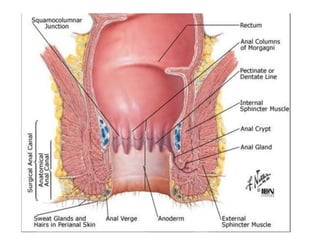
Originates from an infection arising in the
crypto glandular epithelium lining the anal
canal
The internal anal sphincter normally serves
as a barrier to infection passing from the gut
lumen to the deep perirectal tissues.
This barrier can be breached through the
crypts of Morgagni, which can penetrate
through the internal sphincter into the
intersphincteric space
PATHOPHYSIOLOGY
Once infection gains access to the
intersphincteric space, it has easy
access to the adjacent perirectal
spaces
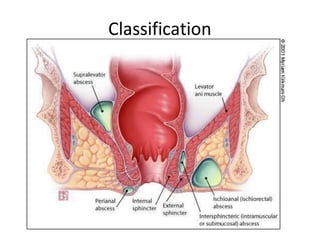
Extension of the infection can
involve the intersphincteric
space 2–5%, ischiorectal space
20-25% , or even the
supralevator space 2.5%.
DIFFERENTIAL DIAGNOSIS FOR
ANORECTAL ABSCESS
•PERIURETHRAL ABSCESS
•BARTHOLIN ABSCESS
•TUBERCULOUS ABSCESS
WORKUP/INVESTIGATIONS
• MRI – IOC
• PERINEAL & ANAL USG- also useful
• CBC may show leukocytosis
• Pus cultures
• Blood cultures
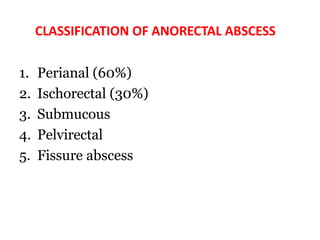
CLASSIFICATION OF ANORECTAL ABSCESS
1. Perianal (60%)
2. Ischorectal (30%)
3. Submucous
4. Pelvirectal
5. Fissure abscess
Classification
PERIANAL
ABSCESS
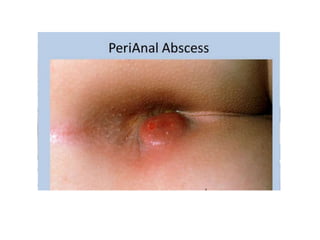
PERIANAL ABSCESS (60%)
•Lies in region of subcutaneous
portion of EXTERNAL SPINCTER
•Usually results from suppuration of
anal gland or thrombosed ext pile or
any infected perianal condition
PERIANAL ABSCESS-CLINICAL FEATURES
•SEVERE PAIN in perianal region
with difficulty to sit
•O/E- tender,smooth,soft ,swelling
in the region
PERIANAL ABSCESS-TREATMENT
•I & D
•SITZBATH +ANTIBIOTICS+ANALGESICS
+L/A of ANAESTHETIC
AGENTS+LAXATIVES
ISCHIORECTAL
ABSCESS ( 30%)
ISCHIORECTAL FOSSA
•PYRAMIDAL IN SHAPE
•5CM DEPTH,2 CM WIDTH
•Right & left communicate with each other
through posterior spincteric space- HORSE
SHOE abscess
ISCHIORECTAL FOSSA- BOUNDARIES
•LATERALLY-fascia covering OBTURATOR
INTERNUS
•MEDIALLY- LEVATOR ANI & EXTERNAL
SPINCTER
•POSTERIORLY- SACROTUBEROUS
LIGAMENT & GLUTEUS MAXIMUS
•ANTERIORLY- UROGENITAL DIAPHRAGM
•BELOW- BY SKIN
ETIOLOGY
•Commonly it is due to extension of
lower intermuscular anal abscess
laterally through ext spincter
•Fat in fossa is more prone to infection
coz its LEAST VASCULARISED
CLINICAL FEATURES
•Tender,indurated,brawny
swelling in the skin over
ischiorectal fossa with high fever
•Swelling – not localised
•Fluctuation - absent
TREATMENT
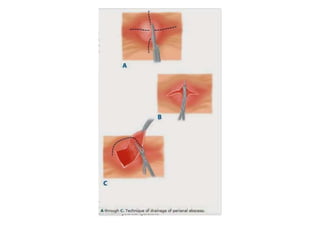
•In LITHOTOMY position,
CRUCIATE shaped incision,
Followed by DE ROOFING &
DRAINAGE of pus
•Presence of any internal opening
to rectum should be looked for
COMPLICATIONS
Fistula-in-Ano
Fournier’s Gangrene
Death
Fecal Incontinence
PROGNOSIS
Drainage alone results in cure for
50%.
50% will have recurrences and
develop an anal fistula.
PERIANAL ABSCESS & ISCHIORECTAL ABSCESS

PERIANAL ABSCESS & ISCHIORECTAL ABSCESS