DRAINS AND
DRAINAGE
SYSTEMS IN
SURGERY
OUTLINE
 Introduction
 Classification of drainage systems
 Types of drain materials
 Qualities of a good drain
 Choice of drain
 Principles of use of drains
 Indications/uses of drains
 Abuses of drains
 Examples of use
 Complications
 Conclusion
Introduction
 A drain is an appliance or piece of material that acts
as a conduit for the exit of various bodily fluids from a
cavity, wound or focus of suppuration.
 This may be for therapeutic, prophylactic, or
diagnostic purposes.
 The use of drains in surgery may be controversial
Introduction
 The routine use of drains for surgical
procedures is reducing.
 Better radiological investigations and
confidence in surgical technique have
reduced their neccesity.
 In certain situations, their use is
however unavoidable.
A Drainage system
comprises of the drain,
its mechanism of
drainage and collection
system
CLASSIFICATION OF
DRAINAGE SYTEMS
 Active/passive
 Open/Closed
 Internal/External
 Tube/Non-tube
ACTIVE DRAINAGE
SYSTEM
 Employ suction or negative pressure to
facilitate drainage.
 Intermittent/Continous suction.
 High/Low pressure.
 Re-usable/Disposable system.
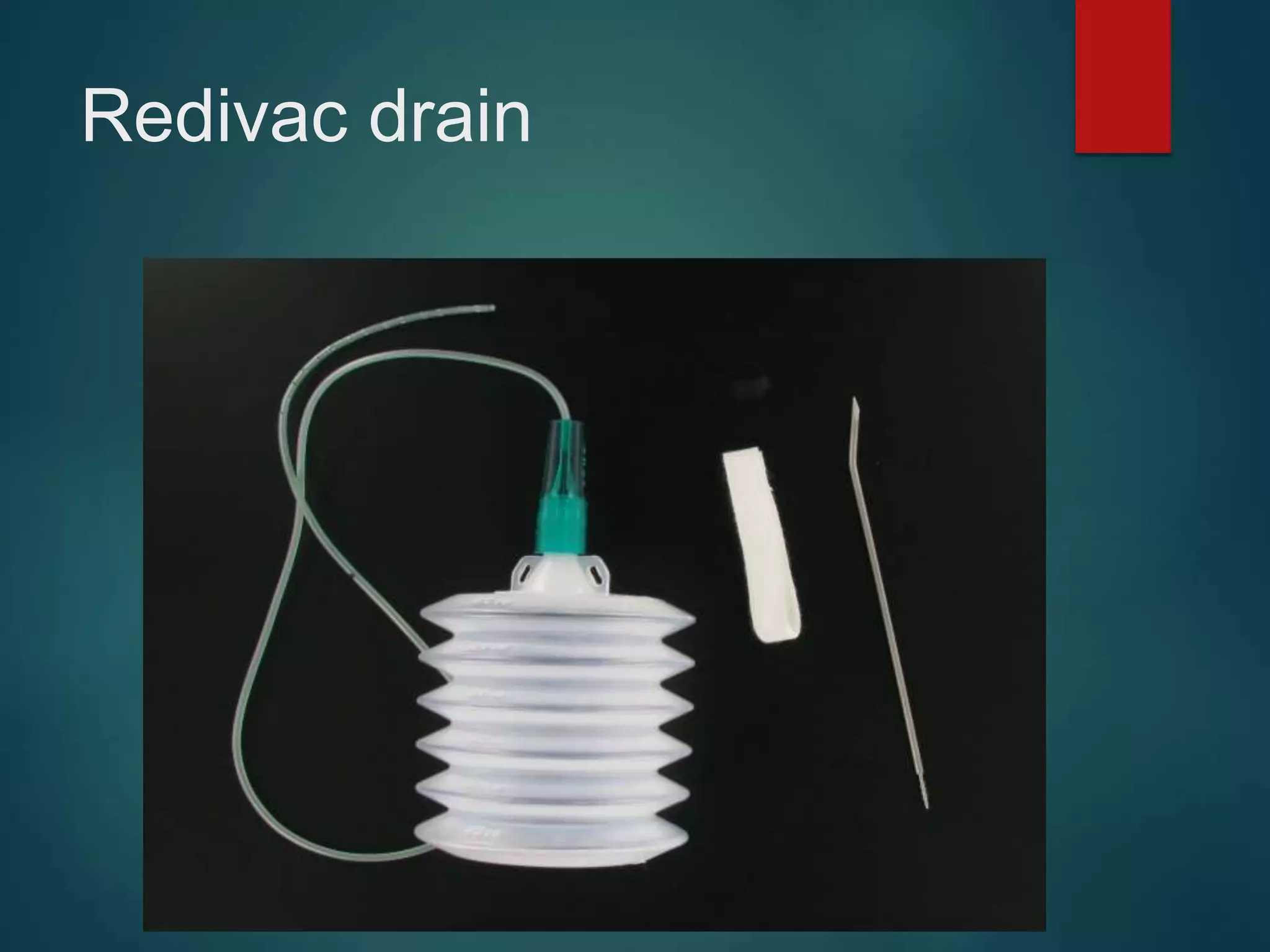
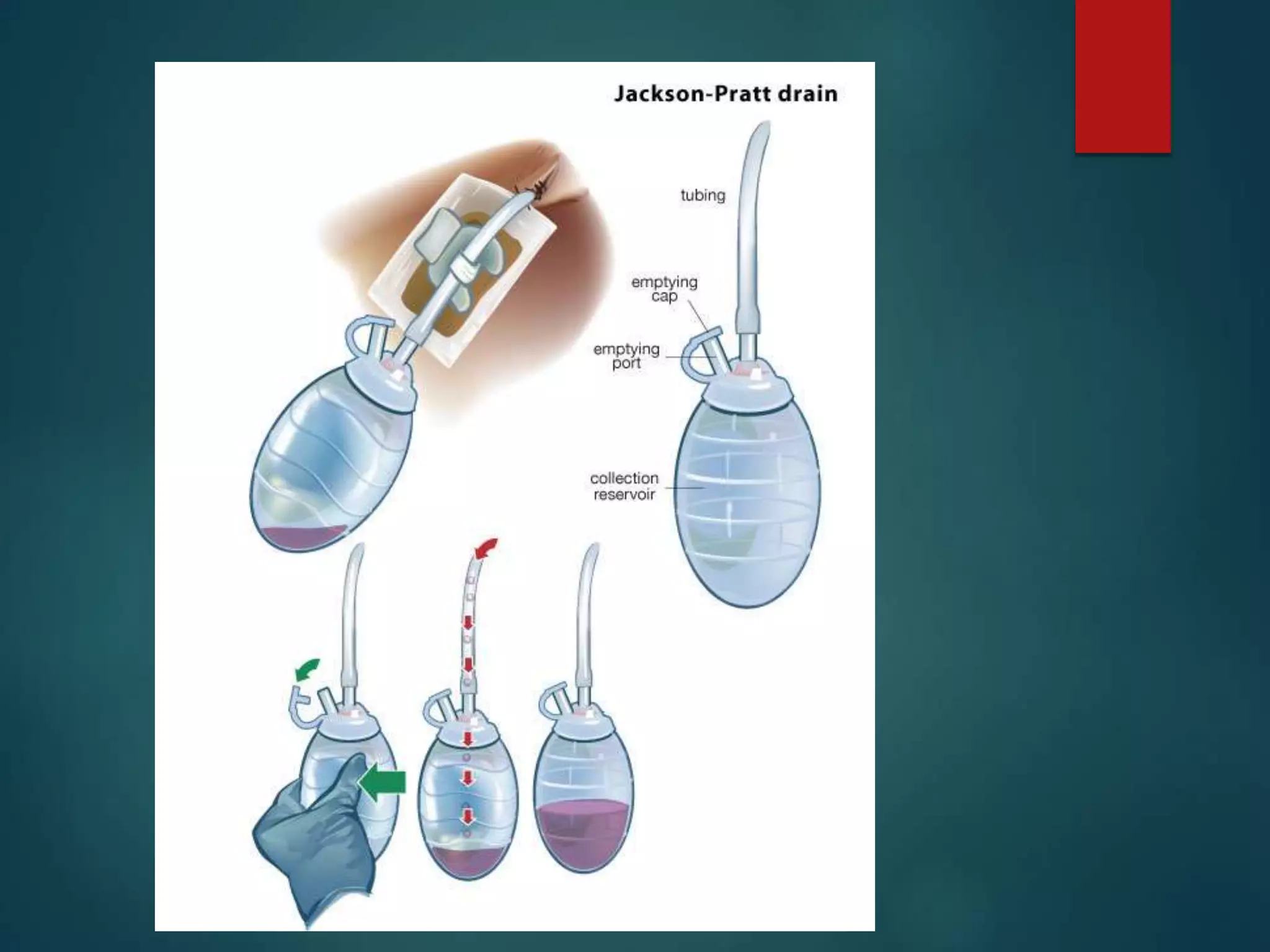
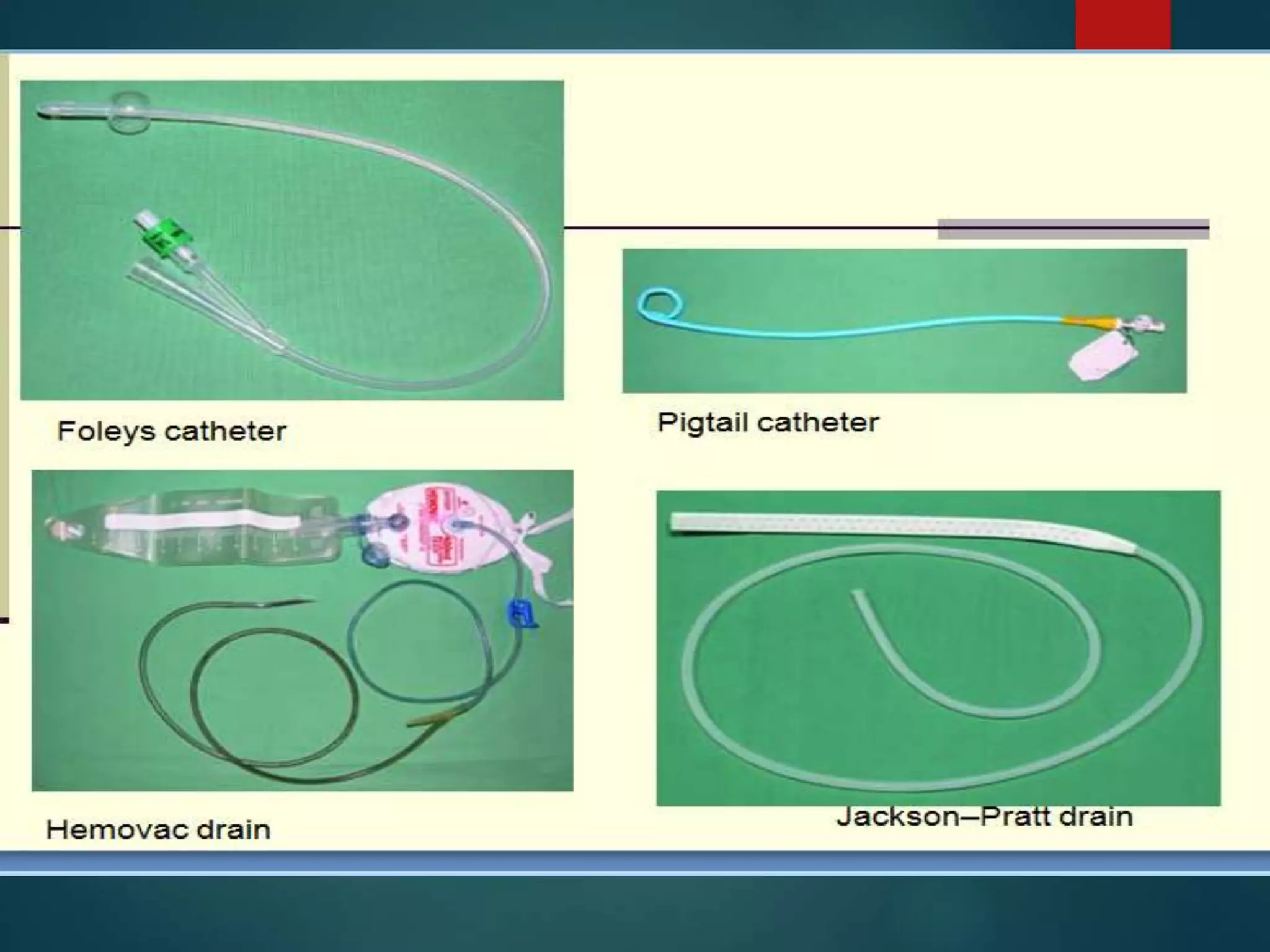
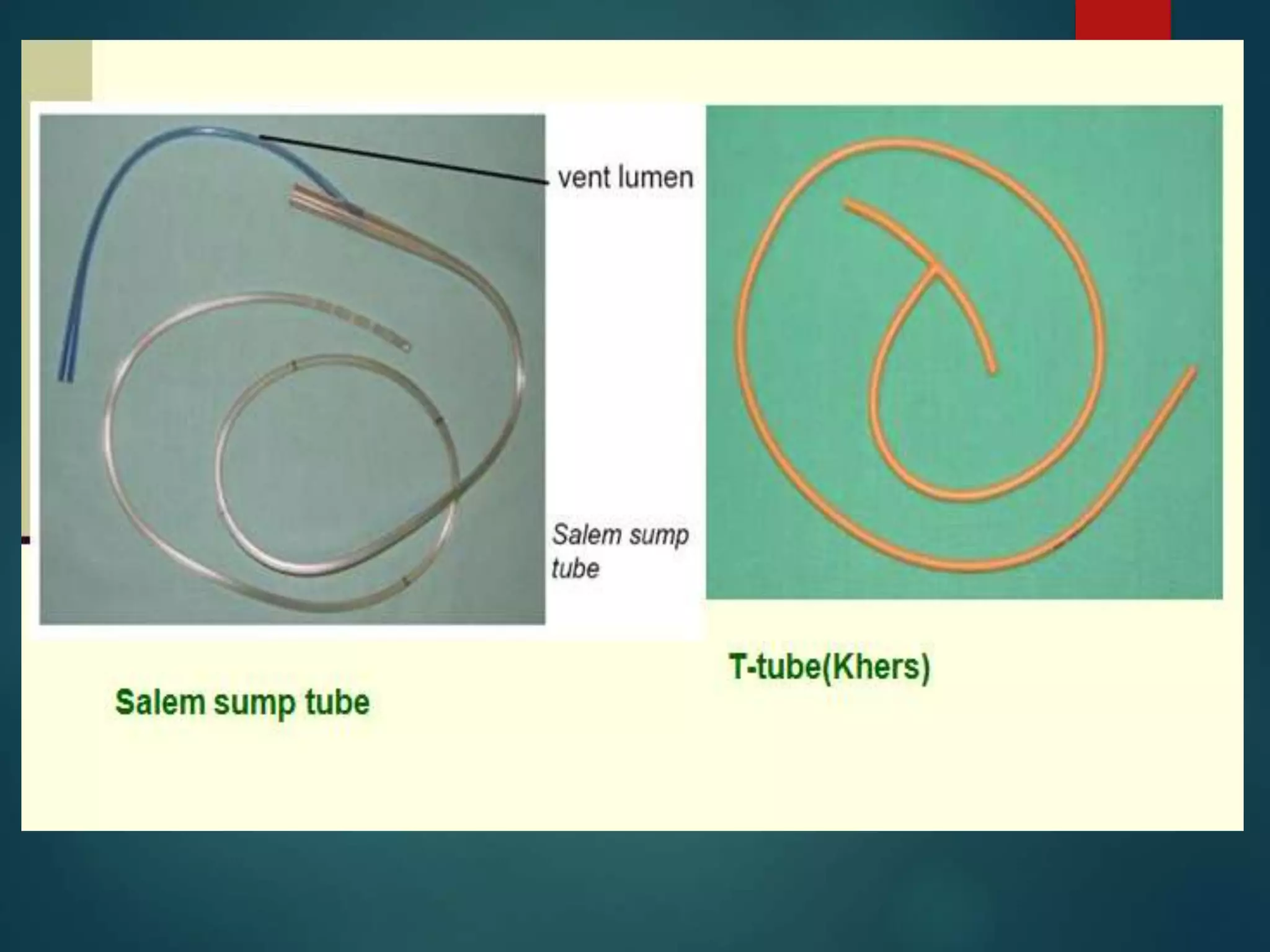
 E.g. Redivac drain, Sump drain,
Jackson-Prat drain
Redivac drain
PASSIVE DRAINAGE SYSTEM.
 Have no suction.
 Function by the differential pressure
between body cavities and the exterior
i.e. capillary action or gravity.
 E.g All open drains, closed drains
without suction.
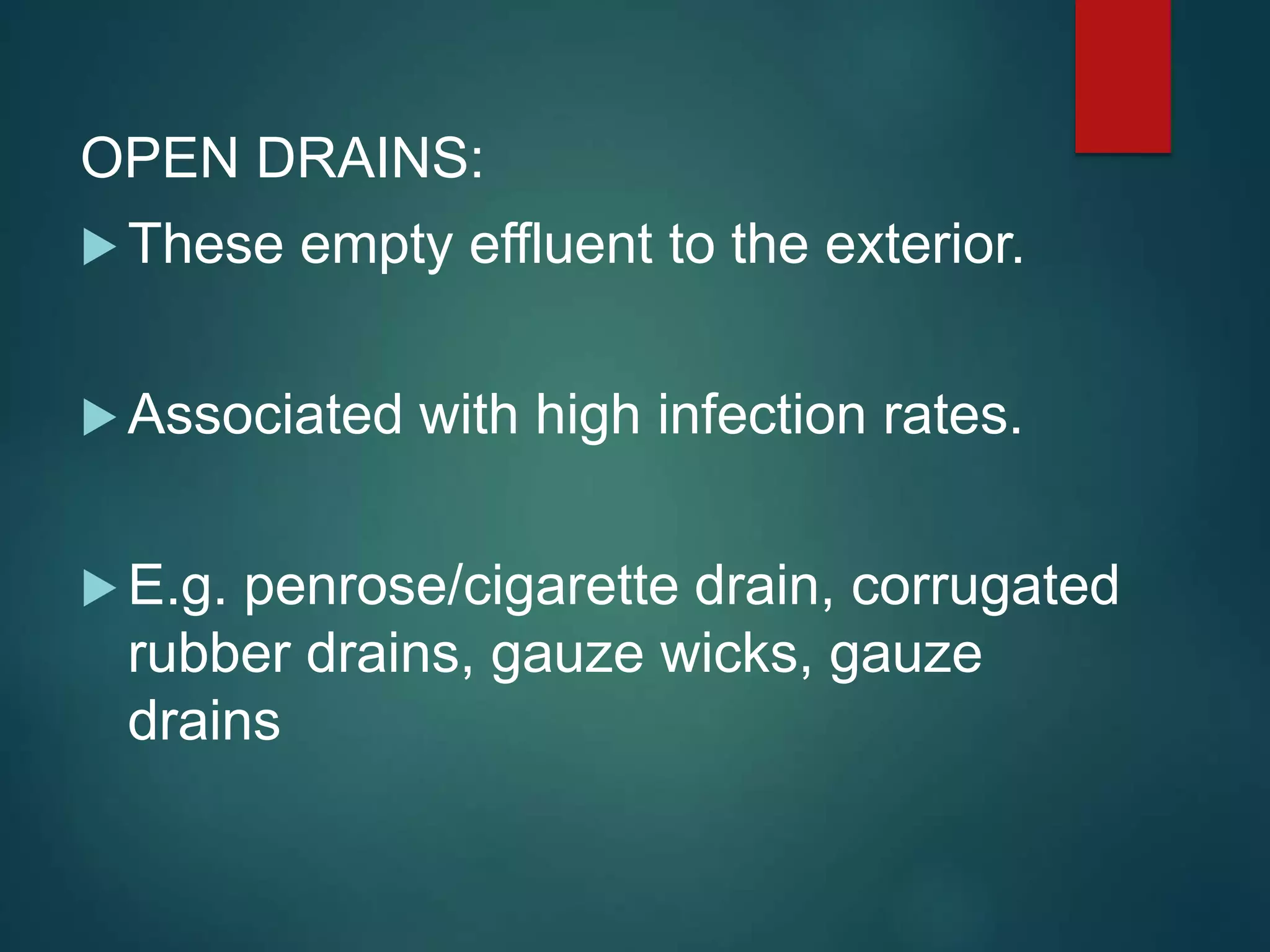
OPEN DRAINS:
 These empty effluent to the exterior.
 Associated with high infection rates.
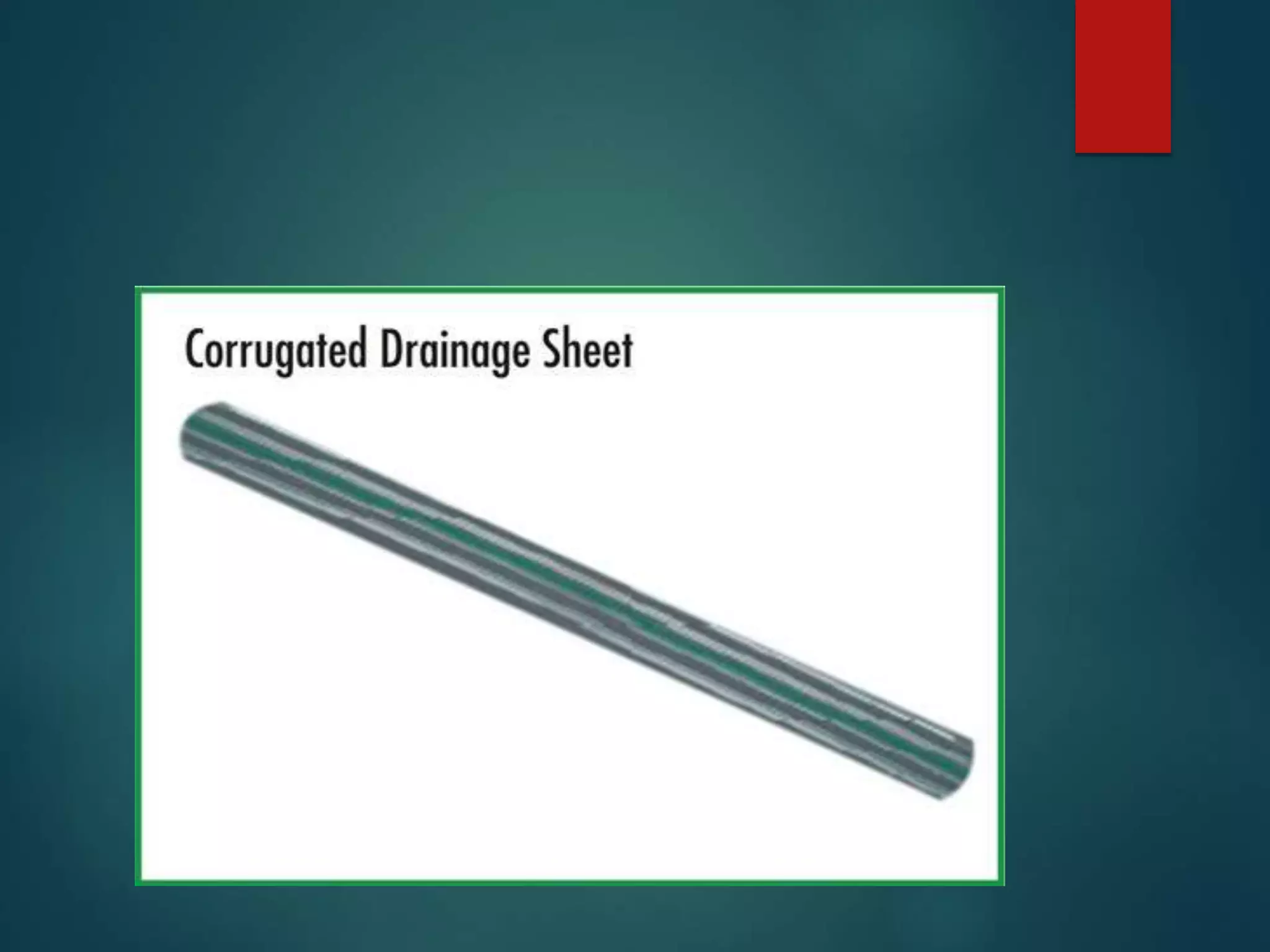
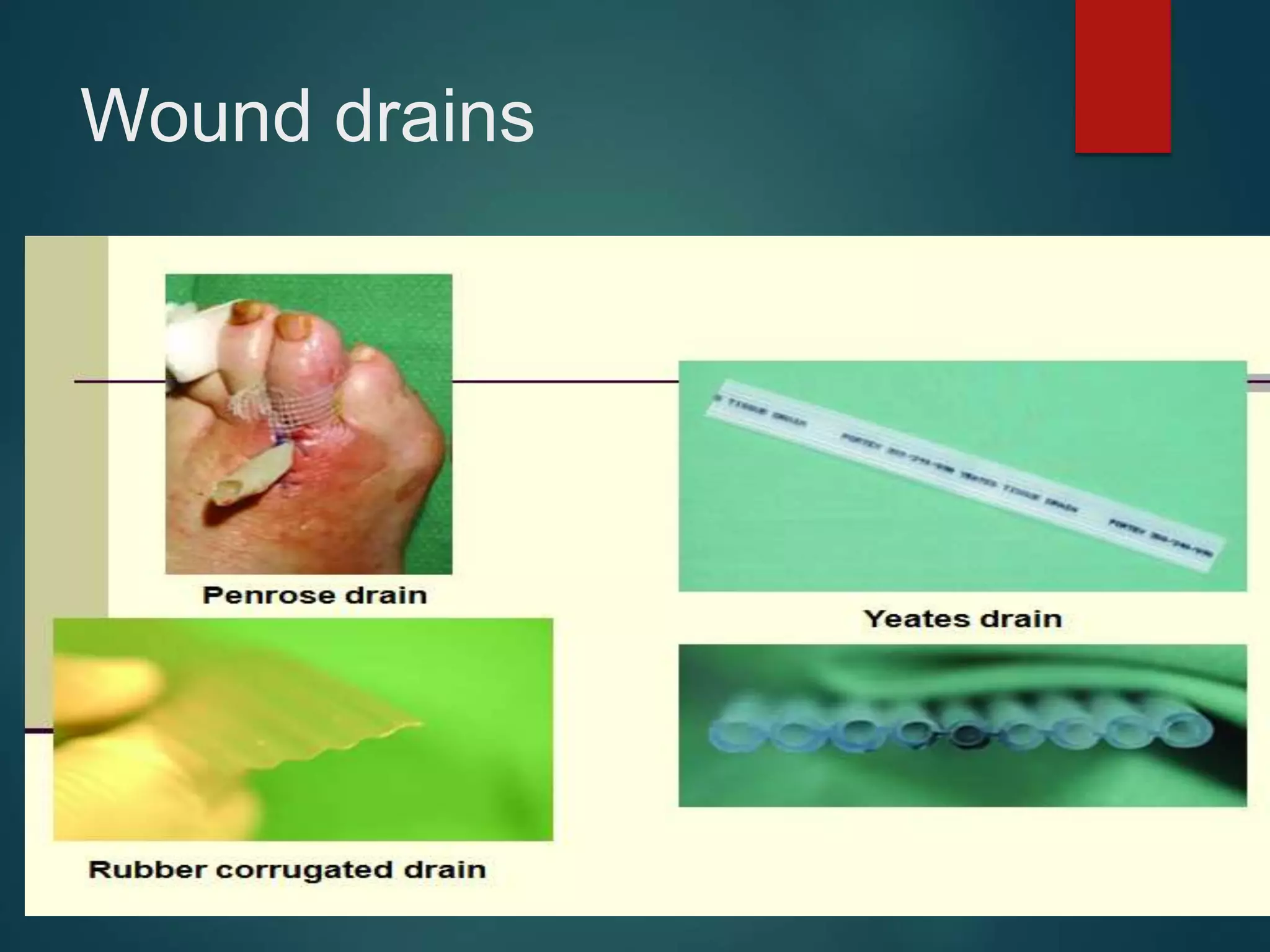
 E.g. penrose/cigarette drain, corrugated
rubber drains, gauze wicks, gauze
drains
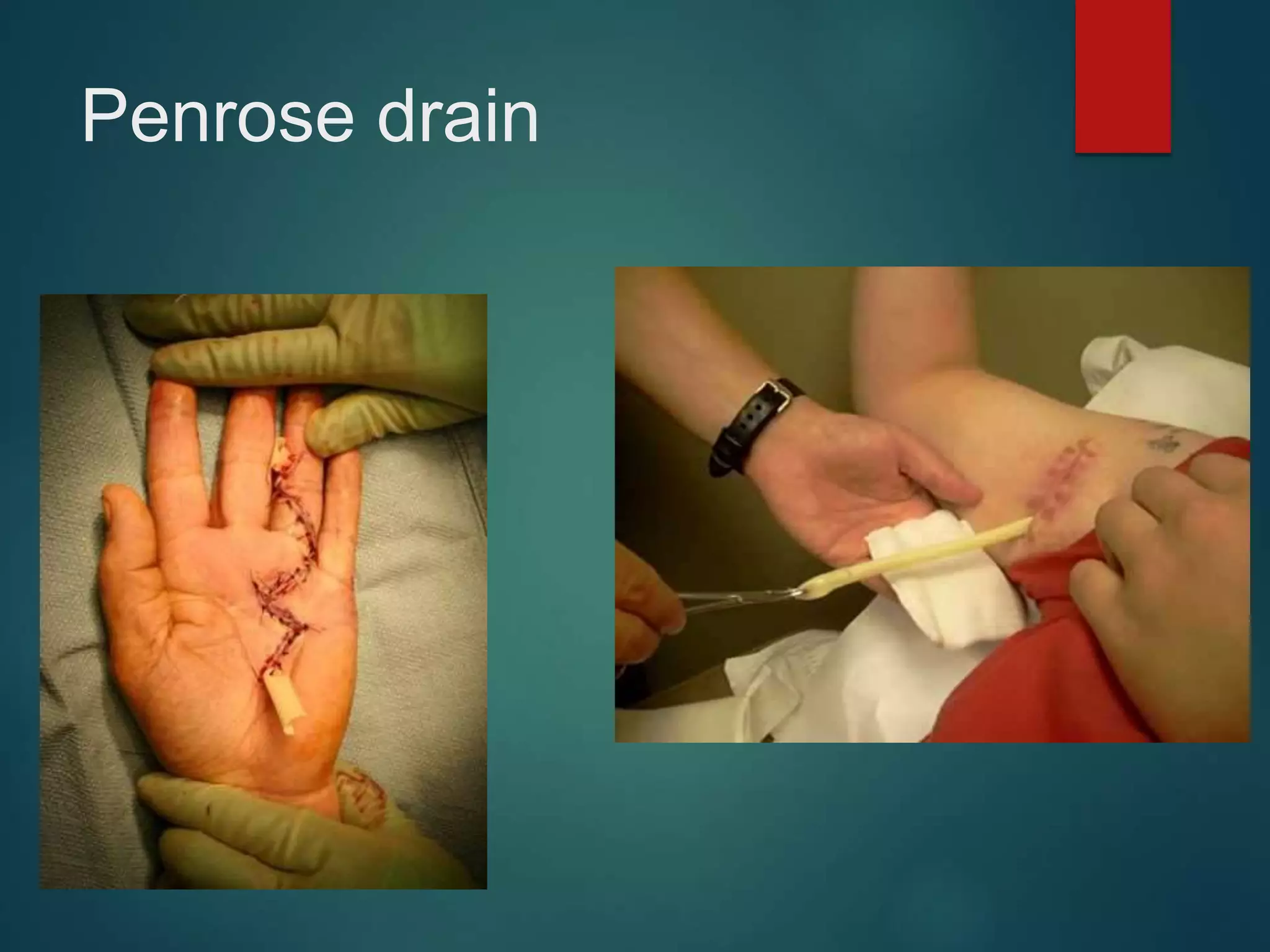
Penrose drain
CLOSED DRAINAGE SYSTEM:
 -No communication of the drainage system with the
exterior environment.
 -Accurate measurement of output.
 -Associated with reduced infection rates.
 Risk of reflux of contaminated reservoir.
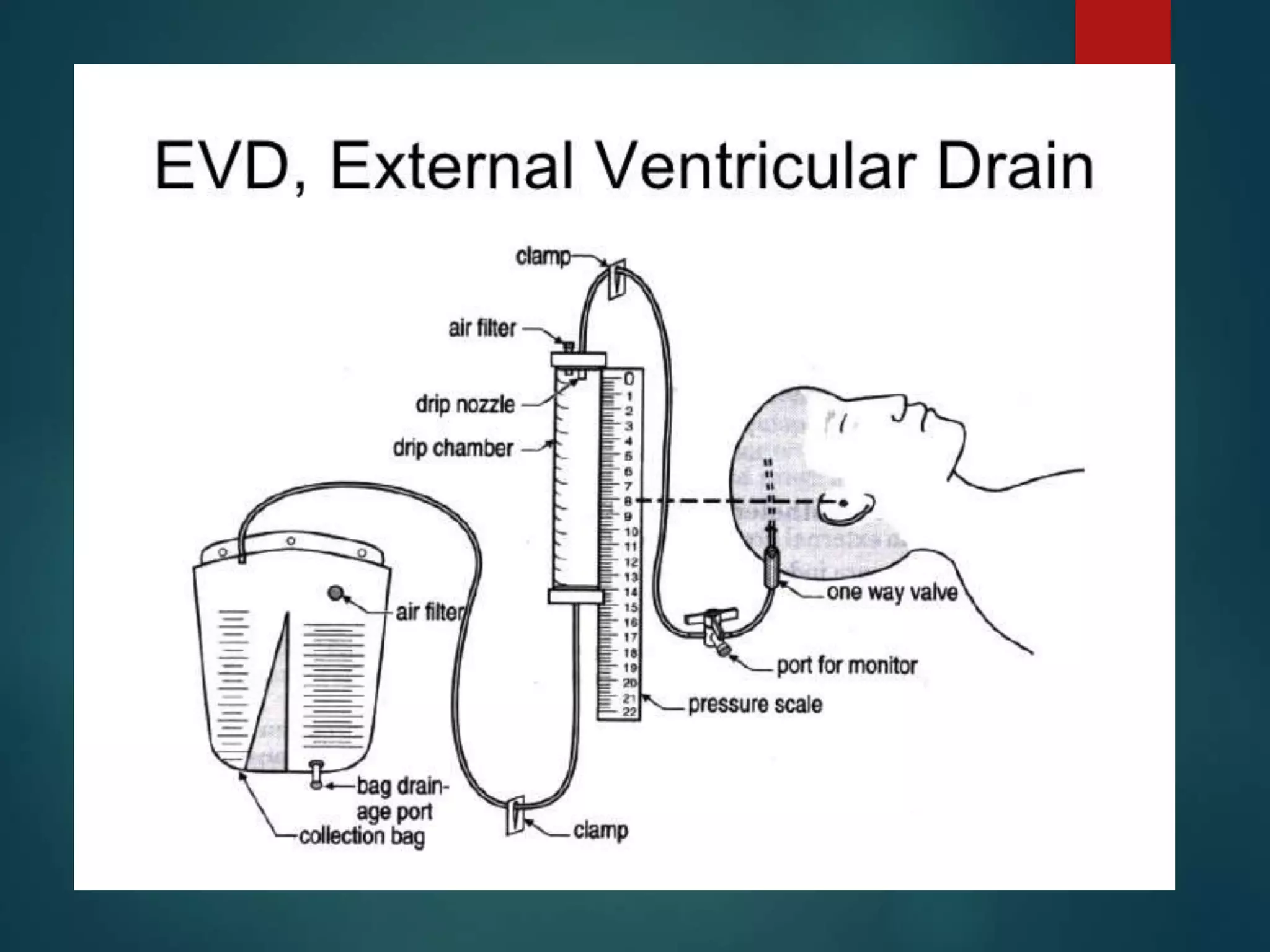
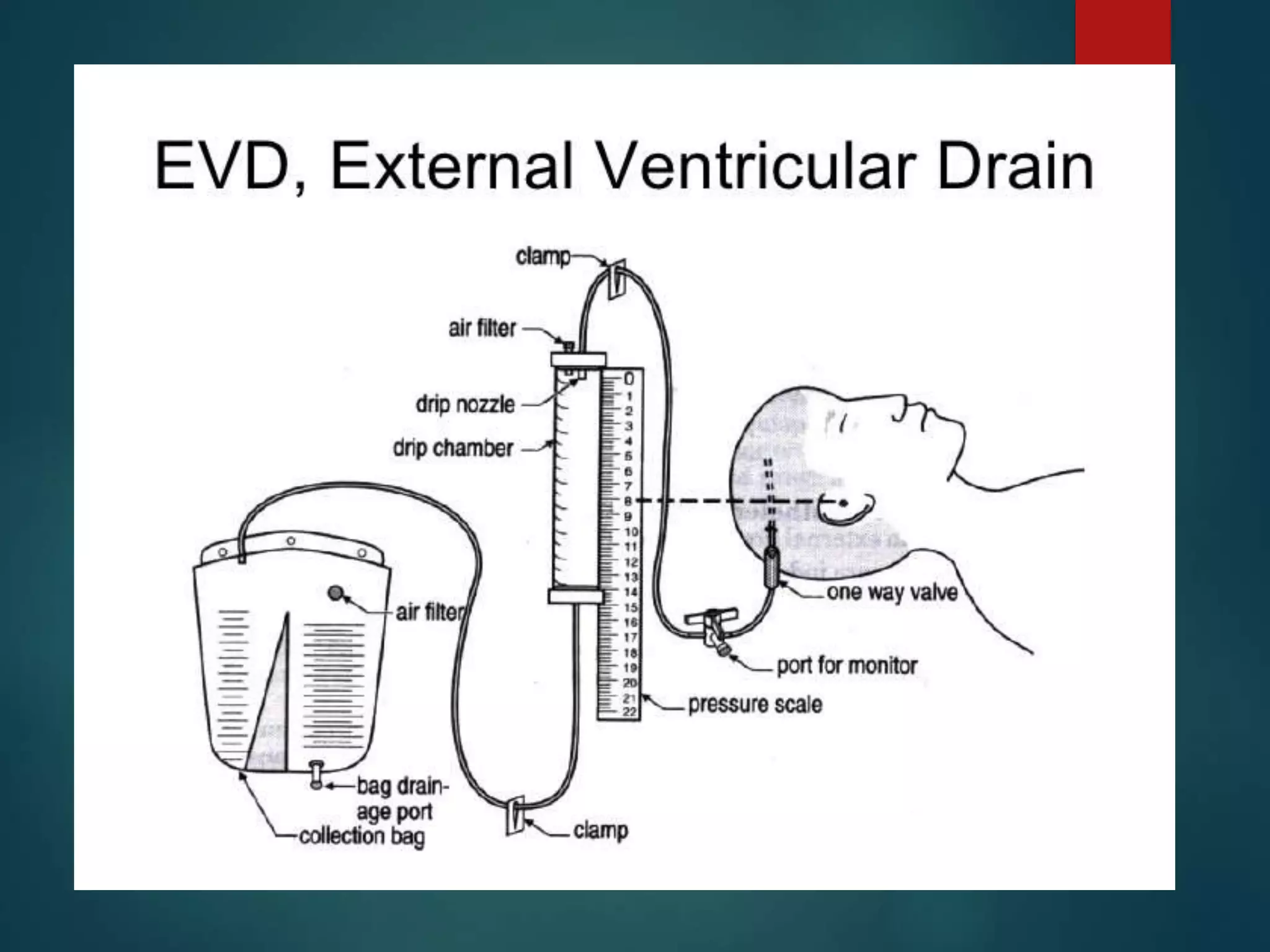
 E.g. Chest Tube thoracostomy drainage, External
ventriculostomy drainage, lumbar drain.
Chest tube thoracostomy
drainage
INTERNAL DRAINAGE SYSTEM :
 Divert retained fluid from one body cavity to another.
 Used in by-passing obstruction.
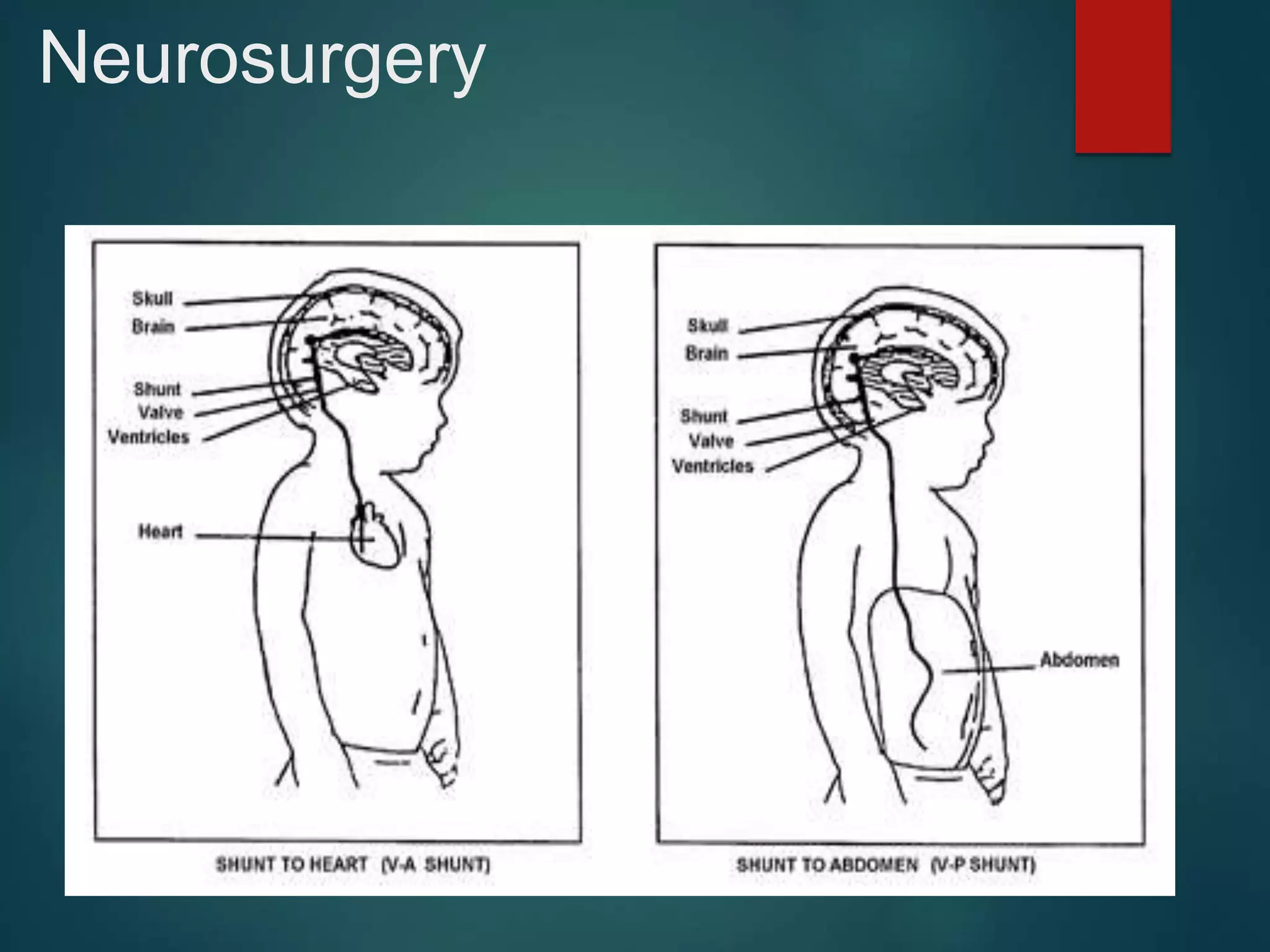
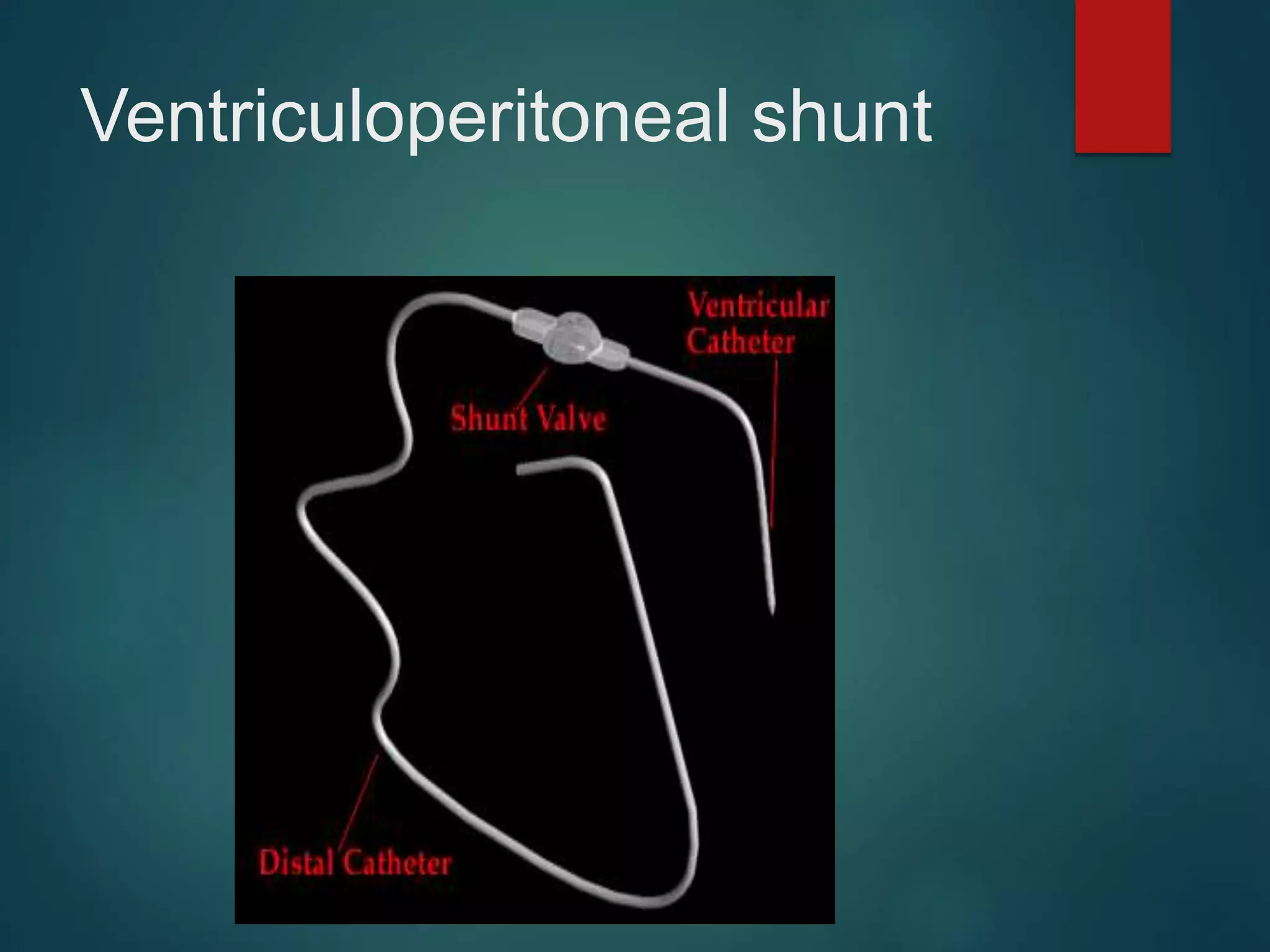
 Examples ventriculoperitoneal shunt and
Ventriculatrial shunt in hydrocephalus,
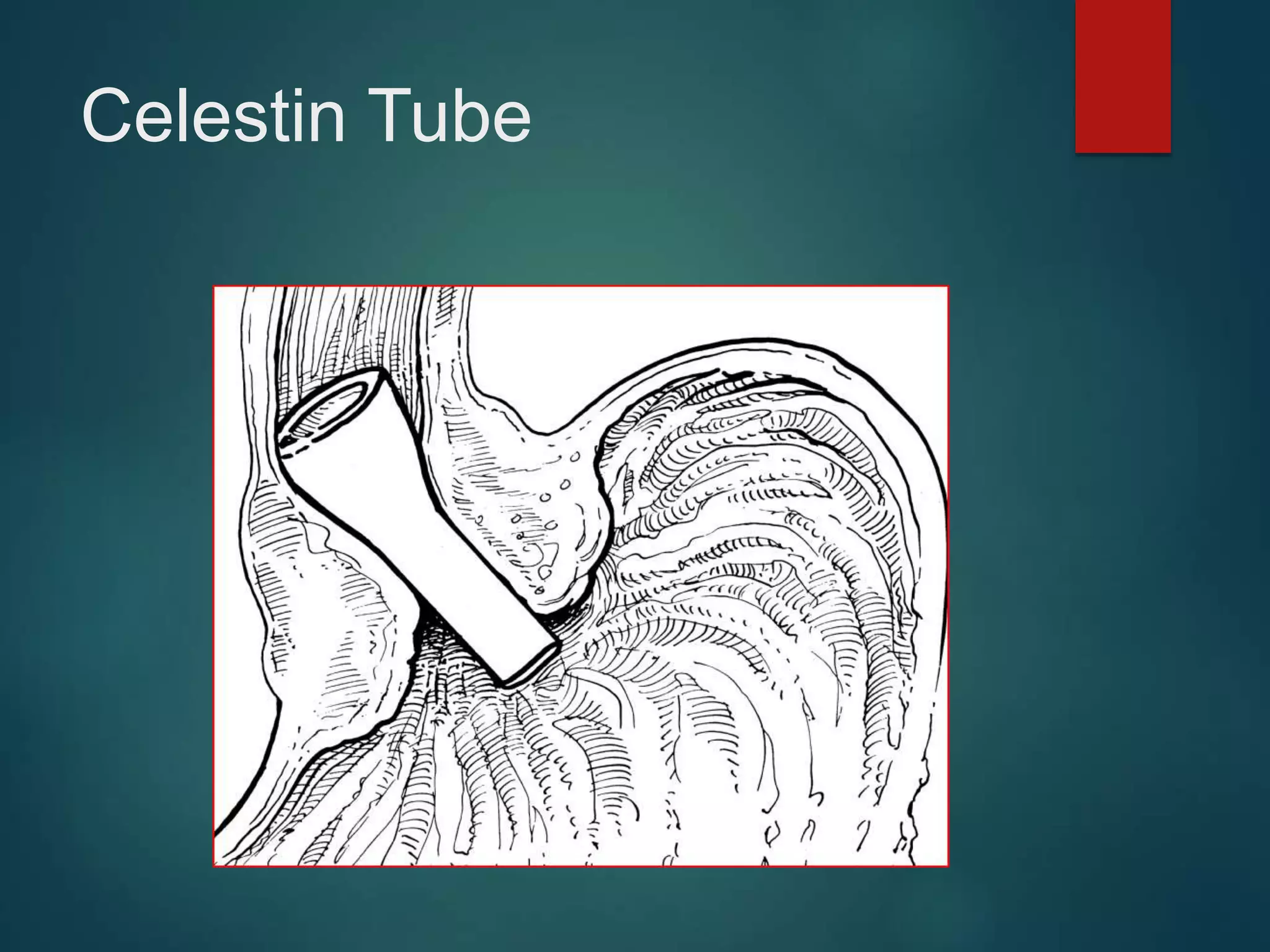
 Celestin tube in c/a Oesophagus.
Celestin Tube
Neurosurgery
Ventriculoperitoneal shunt
External drainage systems
 In this , internal contents are channeled to the
outside.
 It accounts for most of the drainages in surgery.
 Examples include:
 External ventriculostomy drainage
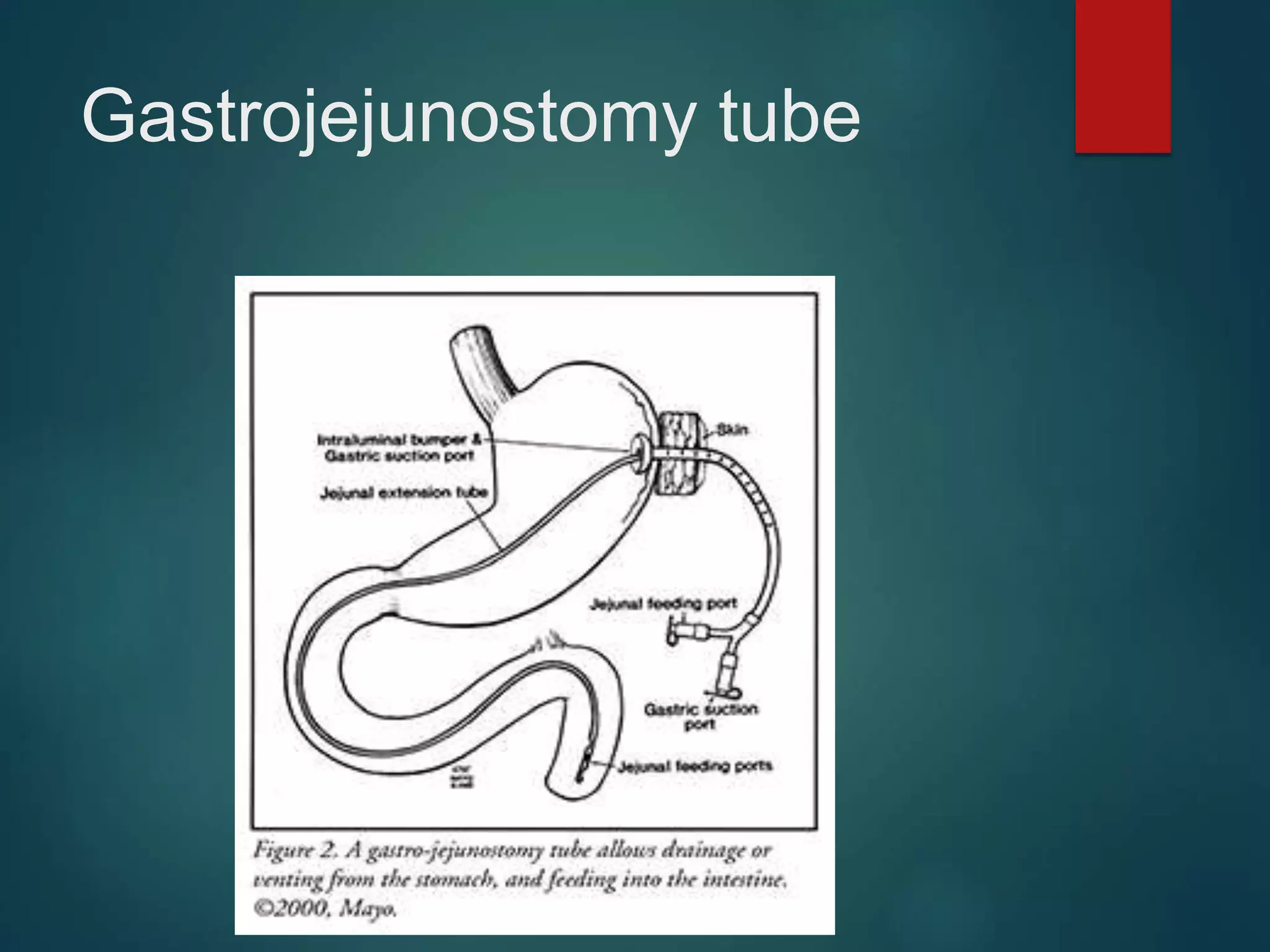
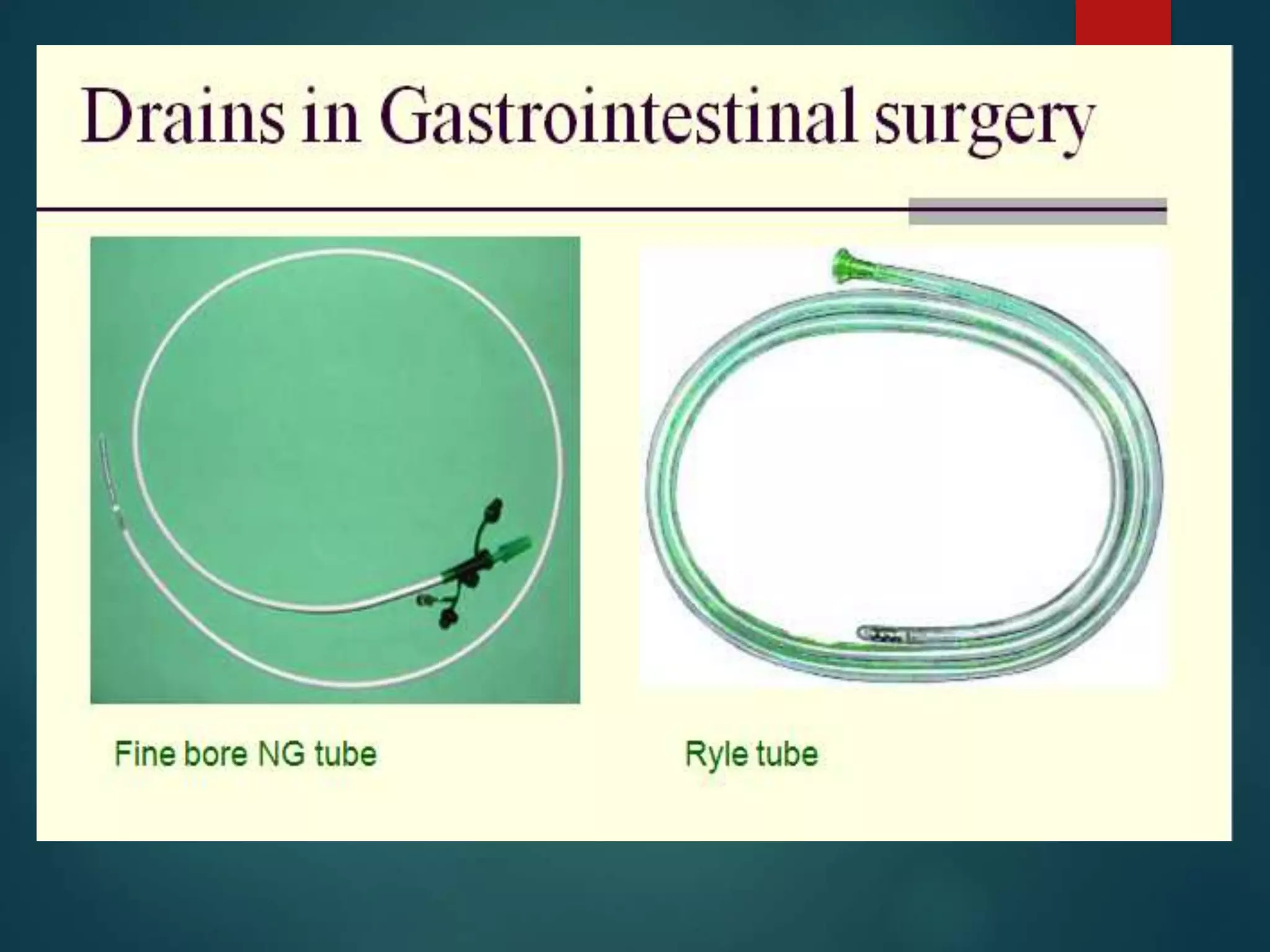
 Gastrojejunostomy tube
 Suprapubic cystostomy
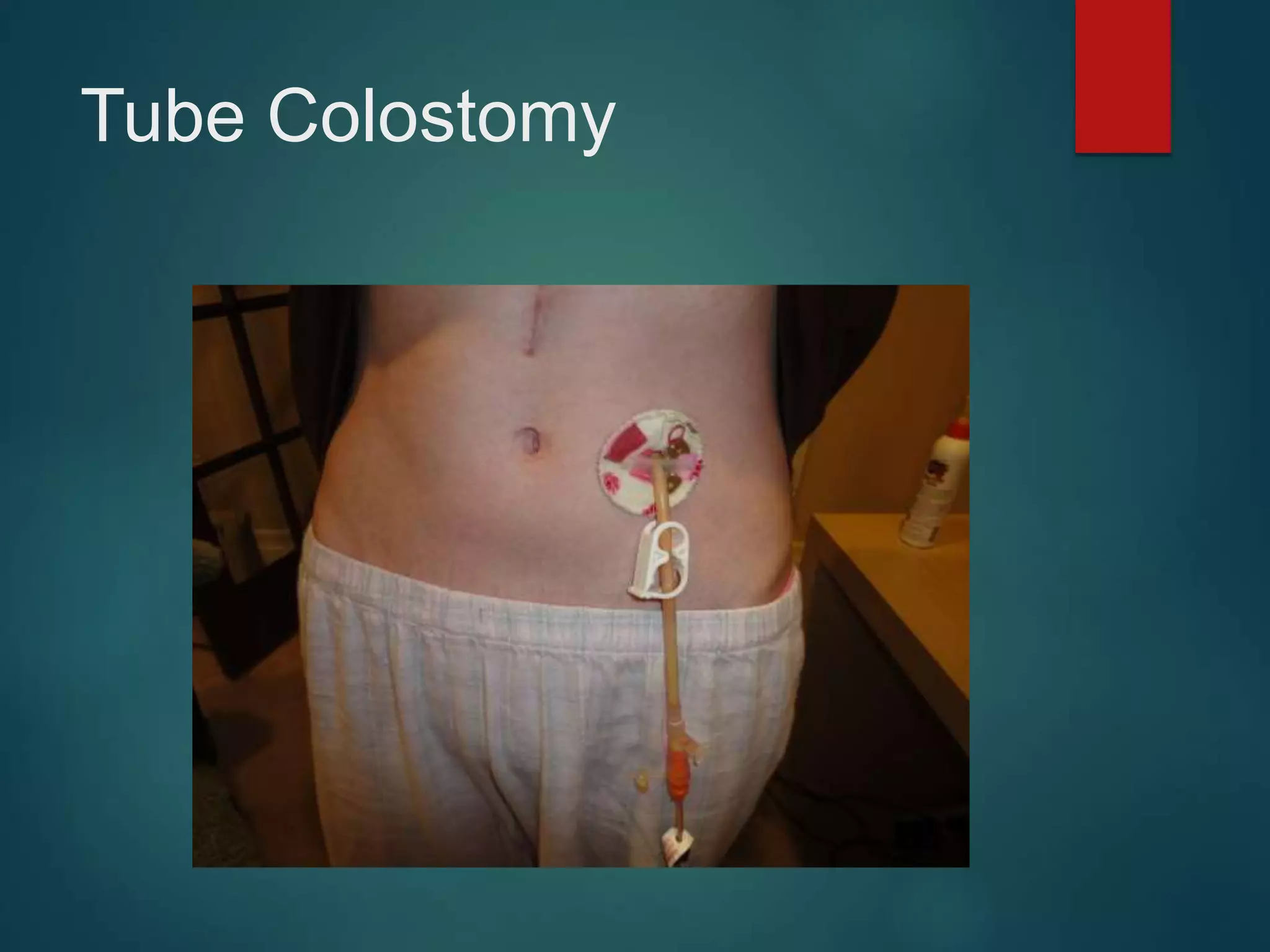
 Tube colostomy
 Urethral catheterization
 Wound drains e.g. gauze drains , penrose
drains
Gastrojejunostomy tube
Tube Colostomy
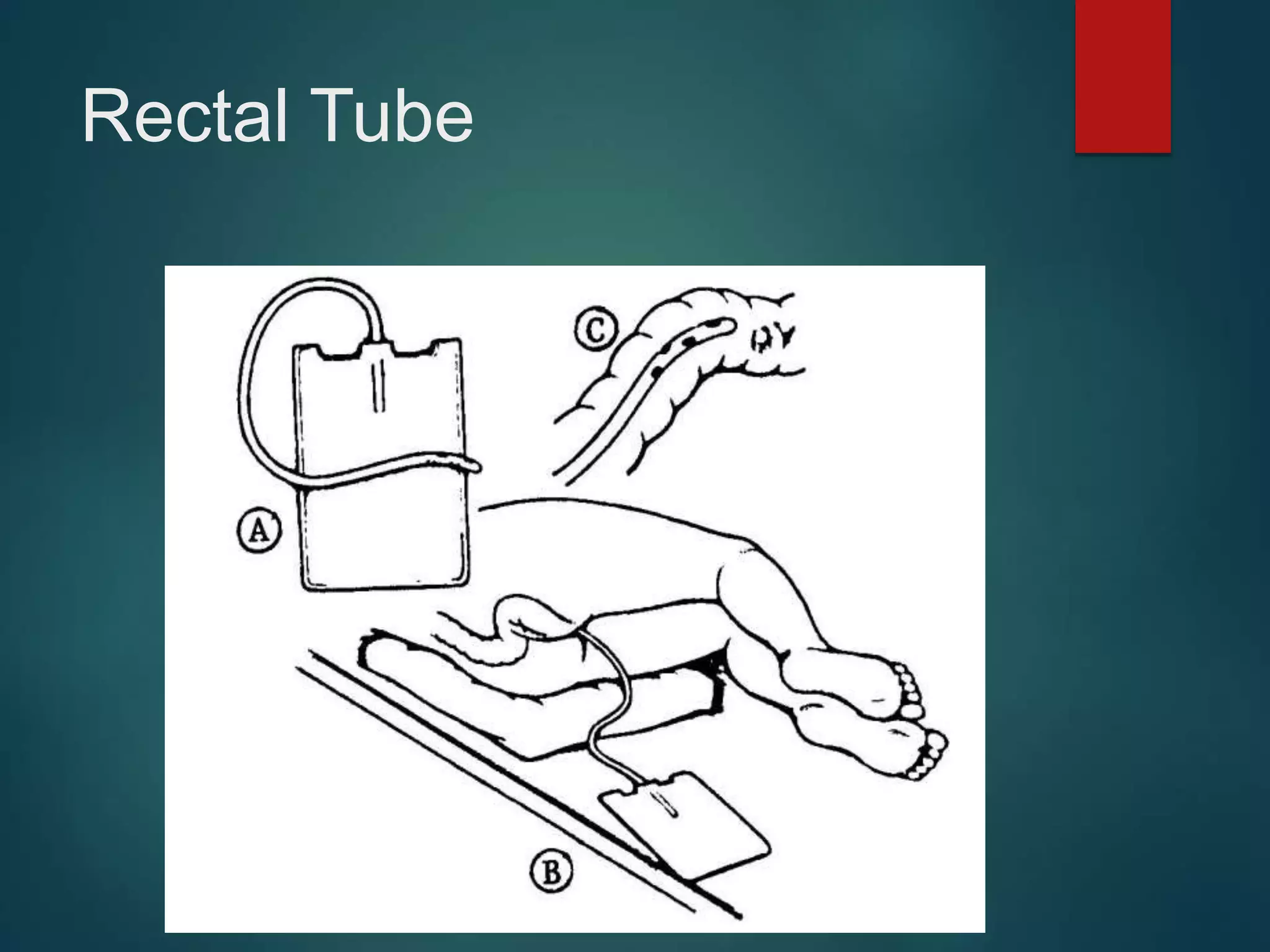
Rectal Tube
Wound drains
TYPES OF DRAIN
MATERIALS
*Latex rubber
*Nylon
*Polyurethrane
*Polyvinylchloride
*Silastic silicone elastomer.
 Cotton
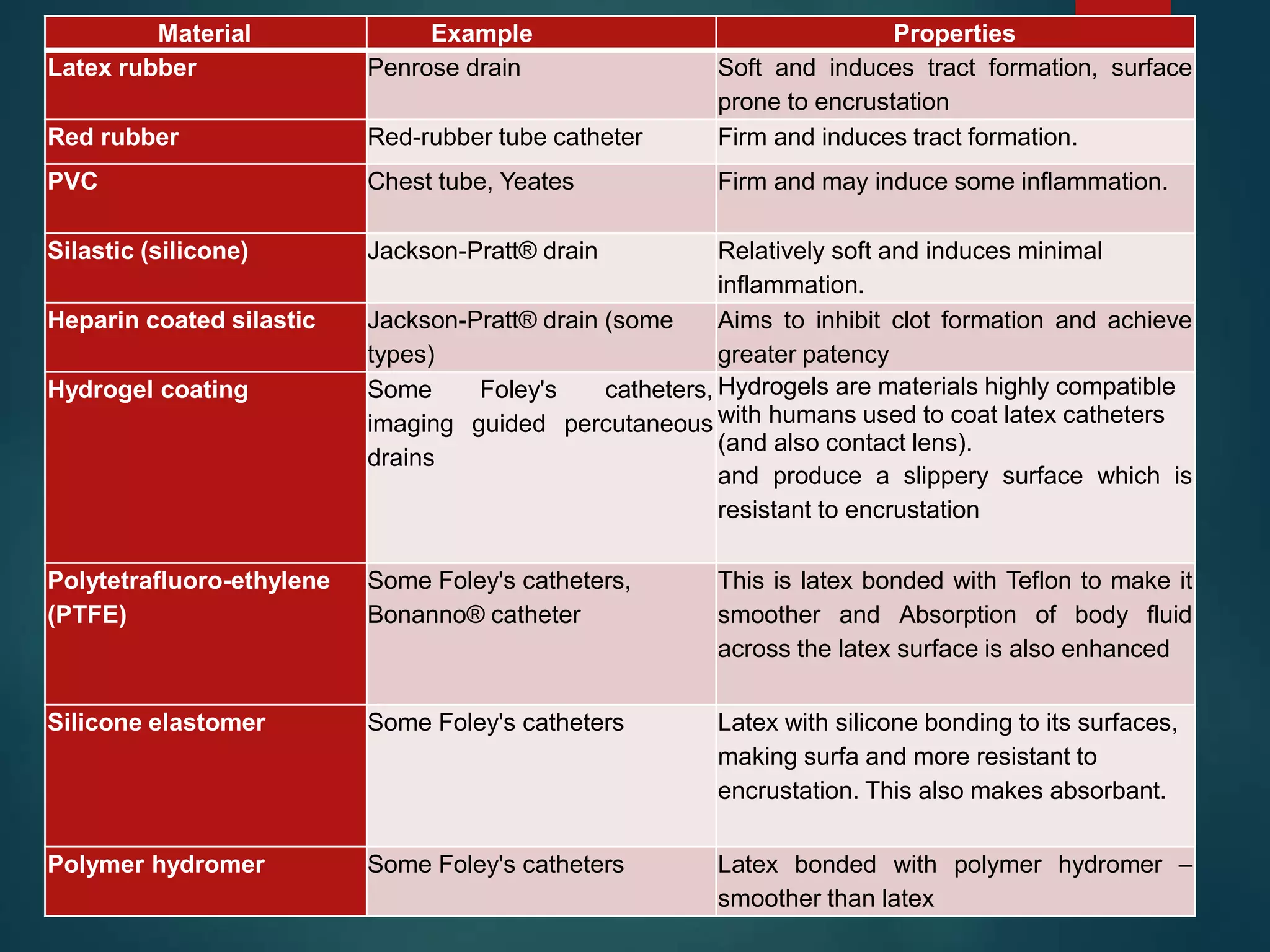
Material Example Properties
Latex rubber Penrose drain Soft and induces tract formation, surface
prone to encrustation
Red rubber Red-rubber tube catheter Firm and induces tract formation.
PVC Chest tube, Yeates Firm and may induce some inflammation.
Silastic (silicone) Jackson-Pratt® drain Relatively soft and induces minimal
inflammation.
Heparin coated silastic Jackson-Pratt® drain (some
types)
Aims to inhibit clot formation and achieve
greater patency
Hydrogel coating Some Foley's catheters,
imaging guided percutaneous
drains
Hydrogels are materials highly compatible
with humans used to coat latex catheters
(and also contact lens).
and produce a slippery surface which is
resistant to encrustation
Polytetrafluoro-ethylene
(PTFE)
Some Foley's catheters,
Bonanno® catheter
This is latex bonded with Teflon to make it
smoother and Absorption of body fluid
across the latex surface is also enhanced
Silicone elastomer Some Foley's catheters Latex with silicone bonding to its surfaces,
making surfa and more resistant to
encrustation. This also makes absorbant.
Polymer hydromer Some Foley's catheters Latex bonded with polymer hydromer –
smoother than latex
QUALITIES OF A GOOD
DRAIN
 It should be soft.
 It should be smooth.
 Should have a wide bore.
 It should be sterile.
 It should be stable i.e non toxic, non-
allergenic, non-irritant,
Non-degradable.
It should be simple.
Choice of drain
The 4 Ws of choosing drains:
 What is being drained?
 Highly viscous or thick materials may need larger
lumen drains to facilitate their passage and minimise
blockage. Suction drains may be more effective than
passive drains in removing thick secretions.
 Why is the drain needed?
 Where tract formation is desired upon drain removal, drains
made from materials that incite a strong inflammatory
response such as latex or red rubber should be used.
Choice of drain cont’d
 Where is the drain located?
 Drains situated near delicate or vital tissues (e.g. large
vessels) should be soft and incite minimal inflammation.
 Drains inserted into sterile environments (e.g. cerebral
ventricles) should be of the closed system.
 Drains inserted into the negative pressure environment of
the thoracic cavity require an underwater seal to prevent
entry of air which can otherwise lead to a pneumothorax.
Choice of drain cont’d
 'Waste bin' size?
High output drainage may require the use
of wall suction and the larger collection
device used with it. This lessens nursing
time required and minimizes the potential
for organisms to be introduced during
frequent changes of collection bags.
 Low outputs should allow use of
detachable collection bags to give
patients greater mobility.
Figure: Wall collection reservoir
PRINCIPLES OF USE OF
DRAINS
 1, A drain must not be considered a
substitute for haemostasis or a
replacement for good surgical
technique.
 2, Asepsis and meticulous technique
are important during insertion.
 3, They are best placed in the most
dependent part of the body to be
drained.
 4, They must be inserted away from
delicate structures.
 5, They must be appropriate for the
purpose.
 6, They are best brought out from a
separate stab wound rather than the main
wound.
 7,Anchored very well
 8, They are removed when they have
served their function e.g. N/G tube when
drainage is clear and <100-200mls/day, T-
tube 20-50mls(10th day), peritoneal drain-
5th day.
INDICATIONS FOR/USES
OF DRAINS
 1. THERAPEUTIC: when used to drain
already accumulated materials such as
air, blood, pus, seroma etc.
 2. PROPHYLACTIC: when used to
prevent accumulation of substances.
 3. DIAGNOSTIC: when used for
introducing contrast or for monitoring
effluent to provide warning.
THERAPEUTIC
 Ventriculoperitoneal shunt for
hydrocephalus.
 Underwater seal drainage for
pneumothorax, haemothorax,
empyema thoracis etc.
 Urethral catheterisation for relieving
acute urinary retention.
 Drainage of malignant ascites.
PROPHYLACTIC
 Head/Neck-post thyroidectomy.
 Chest-post-thoracotomy, mastectomy.
 GIT-post-gastrectomy, post-
choledochotomy.
 MSS-post ORIF.
 GUS-following urethral injury,
prostatectomy.
 DIAGNOSTIC
 Introduction of contrast for xray studies
E.g. MCUG, RUCG etc.
 Bile leak in biliary surgery.
 Bleeding in haemothorax >200mls/hr.
 Anastomotic leak in bowel surgery.
ABUSES OF DRAINS
 Substitute for haemostasis.
 Wrong indication.
 Prolonged use.
 Untimely removal.
 Wrong selection .
 Exit via the main surgical wound.
Complications from use of
drains
 Mechanical
 Trauma to tissues during insertion and removal
 Erosion of adjacent tissues – perforation or fistula
formation
 Herniation of viscera through drain tract
 Anastomotic leak – initiate or perpetuate through
physical trauma, local inflammatory response, or by
encouraging continuous flow
 Flap necrosis from ischaemia following kinking of
artery that is accidentally sucked into a suction drain
Complications from use of
drains cont’d
 Physiological
 Bacterial colonization and sepsis
 Loss of fluid and electrolytes
 Pain
 Pneumothorax/pneumoperitoneum
 Allowing entry of air during insertion or,
during normal use of open drains
 Restricted mobility especially with use of
wall suction
Complications from use of
drains cont’d
 Drain malfunction
 Migration
 Blockage
 Vacuum failure:
Partial withdrawal
Break in the drain – tubing system e.g
cracking, acidental penetration, or
disconnection
Loss of vacuum in the suction device
e.g failure to empty, open cap or
connector
Removal of drains
 Drains should be removed as soon as they are not needed
because the longer a drain stays in place, the higher the risk of
developing complications. Timing of removal is influenced by:
 Why it was inserted – drainage of abscess, prevent accumulation of
haematoma, drain bile leakage, prevent seroma collection
 How much comes out of the drain – when yield has decreased
sufficiently
 Drain problems – E.g. blocked drains
 Effluent from the drain
 How to remove drains – do not “yank it out”
 Eliminate suction
 Loosen drain
 Firm grasp of shortest length
 Steady gentle traction
 Drain ‘shortening’
Conclusion
 All drains are potentially dangerous, so
its use must be properly justified.
 In case of doubt, do not drain
 The principles of the use of drains must
be strictly adhered to prevent abuse and
complications
THANKS

DRAINS AND DRAINAGE SYSTEMS IN SURGERY PPT - Corrected.ppt

  • 1.
  • 2.
    OUTLINE  Introduction  Classificationof drainage systems  Types of drain materials  Qualities of a good drain  Choice of drain  Principles of use of drains  Indications/uses of drains  Abuses of drains  Examples of use  Complications  Conclusion
  • 3.
    Introduction  A drainis an appliance or piece of material that acts as a conduit for the exit of various bodily fluids from a cavity, wound or focus of suppuration.  This may be for therapeutic, prophylactic, or diagnostic purposes.  The use of drains in surgery may be controversial
  • 4.
    Introduction  The routineuse of drains for surgical procedures is reducing.  Better radiological investigations and confidence in surgical technique have reduced their neccesity.  In certain situations, their use is however unavoidable.
  • 5.
    A Drainage system comprisesof the drain, its mechanism of drainage and collection system
  • 6.
    CLASSIFICATION OF DRAINAGE SYTEMS Active/passive  Open/Closed  Internal/External  Tube/Non-tube
  • 7.
    ACTIVE DRAINAGE SYSTEM  Employsuction or negative pressure to facilitate drainage.  Intermittent/Continous suction.  High/Low pressure.  Re-usable/Disposable system.  E.g. Redivac drain, Sump drain, Jackson-Prat drain
  • 8.
  • 10.
    PASSIVE DRAINAGE SYSTEM. Have no suction.  Function by the differential pressure between body cavities and the exterior i.e. capillary action or gravity.  E.g All open drains, closed drains without suction.
  • 11.
    OPEN DRAINS:  Theseempty effluent to the exterior.  Associated with high infection rates.  E.g. penrose/cigarette drain, corrugated rubber drains, gauze wicks, gauze drains
  • 12.
  • 14.
    CLOSED DRAINAGE SYSTEM: -No communication of the drainage system with the exterior environment.  -Accurate measurement of output.  -Associated with reduced infection rates.  Risk of reflux of contaminated reservoir.  E.g. Chest Tube thoracostomy drainage, External ventriculostomy drainage, lumbar drain.
  • 15.
  • 17.
    INTERNAL DRAINAGE SYSTEM:  Divert retained fluid from one body cavity to another.  Used in by-passing obstruction.  Examples ventriculoperitoneal shunt and Ventriculatrial shunt in hydrocephalus,  Celestin tube in c/a Oesophagus.
  • 18.
  • 19.
  • 20.
  • 22.
    External drainage systems In this , internal contents are channeled to the outside.  It accounts for most of the drainages in surgery.  Examples include:  External ventriculostomy drainage  Gastrojejunostomy tube  Suprapubic cystostomy  Tube colostomy  Urethral catheterization  Wound drains e.g. gauze drains , penrose drains
  • 23.
  • 24.
  • 25.
  • 29.
  • 31.
    TYPES OF DRAIN MATERIALS *Latexrubber *Nylon *Polyurethrane *Polyvinylchloride *Silastic silicone elastomer.  Cotton
  • 32.
    Material Example Properties Latexrubber Penrose drain Soft and induces tract formation, surface prone to encrustation Red rubber Red-rubber tube catheter Firm and induces tract formation. PVC Chest tube, Yeates Firm and may induce some inflammation. Silastic (silicone) Jackson-Pratt® drain Relatively soft and induces minimal inflammation. Heparin coated silastic Jackson-Pratt® drain (some types) Aims to inhibit clot formation and achieve greater patency Hydrogel coating Some Foley's catheters, imaging guided percutaneous drains Hydrogels are materials highly compatible with humans used to coat latex catheters (and also contact lens). and produce a slippery surface which is resistant to encrustation Polytetrafluoro-ethylene (PTFE) Some Foley's catheters, Bonanno® catheter This is latex bonded with Teflon to make it smoother and Absorption of body fluid across the latex surface is also enhanced Silicone elastomer Some Foley's catheters Latex with silicone bonding to its surfaces, making surfa and more resistant to encrustation. This also makes absorbant. Polymer hydromer Some Foley's catheters Latex bonded with polymer hydromer – smoother than latex
  • 33.
    QUALITIES OF AGOOD DRAIN  It should be soft.  It should be smooth.  Should have a wide bore.  It should be sterile.  It should be stable i.e non toxic, non- allergenic, non-irritant, Non-degradable. It should be simple.
  • 34.
    Choice of drain The4 Ws of choosing drains:  What is being drained?  Highly viscous or thick materials may need larger lumen drains to facilitate their passage and minimise blockage. Suction drains may be more effective than passive drains in removing thick secretions.  Why is the drain needed?  Where tract formation is desired upon drain removal, drains made from materials that incite a strong inflammatory response such as latex or red rubber should be used.
  • 35.
    Choice of draincont’d  Where is the drain located?  Drains situated near delicate or vital tissues (e.g. large vessels) should be soft and incite minimal inflammation.  Drains inserted into sterile environments (e.g. cerebral ventricles) should be of the closed system.  Drains inserted into the negative pressure environment of the thoracic cavity require an underwater seal to prevent entry of air which can otherwise lead to a pneumothorax.
  • 36.
    Choice of draincont’d  'Waste bin' size? High output drainage may require the use of wall suction and the larger collection device used with it. This lessens nursing time required and minimizes the potential for organisms to be introduced during frequent changes of collection bags.  Low outputs should allow use of detachable collection bags to give patients greater mobility. Figure: Wall collection reservoir
  • 37.
    PRINCIPLES OF USEOF DRAINS  1, A drain must not be considered a substitute for haemostasis or a replacement for good surgical technique.  2, Asepsis and meticulous technique are important during insertion.  3, They are best placed in the most dependent part of the body to be drained.  4, They must be inserted away from delicate structures.
  • 38.
     5, Theymust be appropriate for the purpose.  6, They are best brought out from a separate stab wound rather than the main wound.  7,Anchored very well  8, They are removed when they have served their function e.g. N/G tube when drainage is clear and <100-200mls/day, T- tube 20-50mls(10th day), peritoneal drain- 5th day.
  • 39.
    INDICATIONS FOR/USES OF DRAINS 1. THERAPEUTIC: when used to drain already accumulated materials such as air, blood, pus, seroma etc.  2. PROPHYLACTIC: when used to prevent accumulation of substances.  3. DIAGNOSTIC: when used for introducing contrast or for monitoring effluent to provide warning.
  • 40.
    THERAPEUTIC  Ventriculoperitoneal shuntfor hydrocephalus.  Underwater seal drainage for pneumothorax, haemothorax, empyema thoracis etc.  Urethral catheterisation for relieving acute urinary retention.  Drainage of malignant ascites.
  • 41.
    PROPHYLACTIC  Head/Neck-post thyroidectomy. Chest-post-thoracotomy, mastectomy.  GIT-post-gastrectomy, post- choledochotomy.  MSS-post ORIF.  GUS-following urethral injury, prostatectomy.
  • 42.
     DIAGNOSTIC  Introductionof contrast for xray studies E.g. MCUG, RUCG etc.  Bile leak in biliary surgery.  Bleeding in haemothorax >200mls/hr.  Anastomotic leak in bowel surgery.
  • 43.
    ABUSES OF DRAINS Substitute for haemostasis.  Wrong indication.  Prolonged use.  Untimely removal.  Wrong selection .  Exit via the main surgical wound.
  • 44.
    Complications from useof drains  Mechanical  Trauma to tissues during insertion and removal  Erosion of adjacent tissues – perforation or fistula formation  Herniation of viscera through drain tract  Anastomotic leak – initiate or perpetuate through physical trauma, local inflammatory response, or by encouraging continuous flow  Flap necrosis from ischaemia following kinking of artery that is accidentally sucked into a suction drain
  • 45.
    Complications from useof drains cont’d  Physiological  Bacterial colonization and sepsis  Loss of fluid and electrolytes  Pain  Pneumothorax/pneumoperitoneum  Allowing entry of air during insertion or, during normal use of open drains  Restricted mobility especially with use of wall suction
  • 46.
    Complications from useof drains cont’d  Drain malfunction  Migration  Blockage  Vacuum failure: Partial withdrawal Break in the drain – tubing system e.g cracking, acidental penetration, or disconnection Loss of vacuum in the suction device e.g failure to empty, open cap or connector
  • 47.
    Removal of drains Drains should be removed as soon as they are not needed because the longer a drain stays in place, the higher the risk of developing complications. Timing of removal is influenced by:  Why it was inserted – drainage of abscess, prevent accumulation of haematoma, drain bile leakage, prevent seroma collection  How much comes out of the drain – when yield has decreased sufficiently  Drain problems – E.g. blocked drains  Effluent from the drain  How to remove drains – do not “yank it out”  Eliminate suction  Loosen drain  Firm grasp of shortest length  Steady gentle traction  Drain ‘shortening’
  • 48.
    Conclusion  All drainsare potentially dangerous, so its use must be properly justified.  In case of doubt, do not drain  The principles of the use of drains must be strictly adhered to prevent abuse and complications
  • 49.