COLOSTOMIES

By Odei-Ansong Francis
       kwame77k@yahoo.com
Outline
•   Introduction
•   Anatomy of large interstine with a small physiology
•   Indications
•   Preop preperations
•   Stoma sitting
•   Operative technigues
•   Post op. care
•   Ileostomy
•   Complications
•   Review article
•   Care of colostomy
•   Closure of colostomy
•   Prognosis
•   Summary.
Introduction
• An iatrogenic colo-cutaneous fistula used in
  situations in which diversion of, decompression
  of, or access to the bowel lumen is needed
• Stoma through laparotomy incision include the
  risk of wound infection, dehiscence, and
  evisceration.
• Whenever feasible, a primary stoma site, as well
  as alternative sites, be selected and marked
  before surgery
Introduction         history


• In 1710; Alexis Littre of paris first performed
  colostomy thru the anterior abdominal wall
• 1776; H. Pillore a surgeon from Rouen, also
  performed caecostomy on a px with ca rectum. Px
  died 28days after
• First successful colostomy was done by Duret of
  brest, on a 3day old child with imperforate anus and
  lived to 45yr
Introduction           history


• Amussat studied all 29 colostomies done since Pillore, 21
  being kids with imperforate anus. Noted that 20 died within
  a matter of days.
• Only 4 infants survived, all treated at Brest(remind Duret)
• Of 8 adults, 5 survived.
• concluded that their deaths were due to peritonitis and
  therefore blamed abdominal approach.
• Devised the lumbar approach which lasted for over 30yrs.
• With the introduction of ATB in the 1880s, it lost its
  popularity.
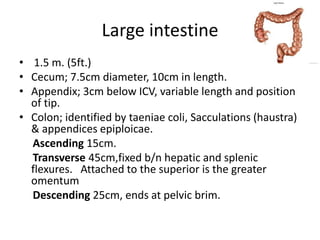
Large intestine
• 1.5 m. (5ft.)
• Cecum; 7.5cm diameter, 10cm in length.
• Appendix; 3cm below ICV, variable length and position
  of tip.
• Colon; identified by taeniae coli, Sacculations (haustra)
  & appendices epiploicae.
  Ascending 15cm.
  Transverse 45cm,fixed b/n hepatic and splenic
  flexures. Attached to the superior is the greater
  omentum
  Descending 25cm, ends at pelvic brim.
Large intestine+anal canal
• Sigmoid; 15 to 50 cm (average 38 cm) and is
  very mobile , has the narrowest diameter.
• Rectum; is 12 to 15 cm in length
     lacks teniae coli or appendices epiploicae.
    along with the sigmoid colon serves as a
     fecal reservoir.
• anal canal
Intestinal secretions
             Na+        Cl-        K+        HCO3 -     H+
Fluid
             mEq/L      mEq/L      mEq/L     mEq/L      mEq/L
Saliva         30-60      15-40       20        15-50      N/A
Gastric        60-100     90-140     10-20       N/A      30-100
Duodenal        140        80          5         50        N/A
Bile            140        100        5-10      40-50      N/A
Pancreatic      140        75         5-15       90        N/A
Jejunal         100        100        5-10      10-20      N/A
Ileal           130        110        10         30        N/A
Colonic         60         40         30         20        N/A
Diarrhea        130        30         90         N/A       N/A
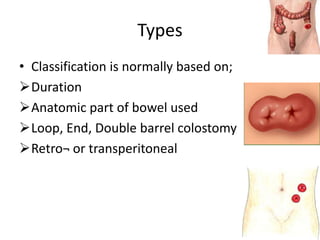
Types
• Classification is normally based on;
Duration
Anatomic part of bowel used
Loop, End, Double barrel colostomy
Retro¬ or transperitoneal
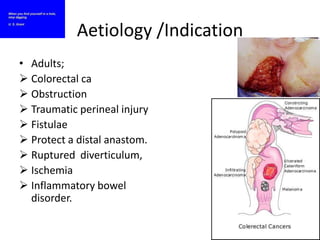
Aetiology /Indication
• Adults;
 Colorectal ca
 Obstruction
 Traumatic perineal injury
 Fistulae
 Protect a distal anastom.
 Ruptured diverticulum,
 Ischemia
 Inflammatory bowel
  disorder.
Aetiology /Indication
• Children

 Necrotizing enterocolitis
 Hirschsprung disease
 Meconium ileus
 Imperforate anus
 Complex hindgut anomalies
 Intestinal malrotation
 Intestinal volvulus
 Intestinal atresia, stenosis,
  and webs
 Trauma
Preoperative Preparation
• Hx
• Investigations; FBC, BUE&Cr,
    Urinalysis, appropriate X rays.
• correction of fluid and electrolyte imbalance
• blood volume deficits.
• Antibiotics .
Preoperative Preparation
• Enterostomal therapist
                                     offers preoperative education,
                                     mark site for stomal placement

• Consent after explaining procedure to px

• Bowel preparation;   low-residue diet for several days prior to surgery
                       A liquid diet for at least a day before surgery

• A nasogastric tube   NPO after midnight.
                       series of enemas and/or oral preparations (GoLytely
                       or Colyte) may be ordered to empty the bowel of
• A urinary catheter   stool.
                        Oral anti-infectives (neomycin, erythromycin, or
                       kanamycin sulfate) may be ordered to decrease
                       bacteria in the intestine and help prevent
                       postoperative infection.
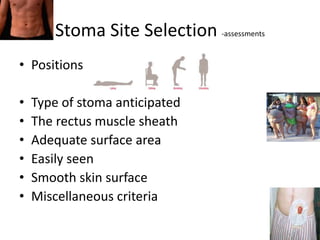
Stoma Site Selection -assessments
• Positions

•   Type of stoma anticipated
•   The rectus muscle sheath
•   Adequate surface area
•   Easily seen
•   Smooth skin surface
•   Miscellaneous criteria
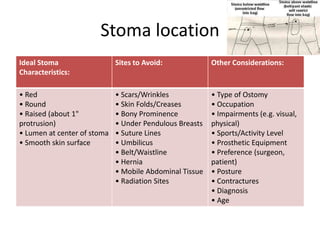
Stoma location
Ideal Stoma                  Sites to Avoid:             Other Considerations:
Characteristics:

• Red                        • Scars/Wrinkles            • Type of Ostomy
• Round                      • Skin Folds/Creases        • Occupation
• Raised (about 1"           • Bony Prominence           • Impairments (e.g. visual,
protrusion)                  • Under Pendulous Breasts   physical)
• Lumen at center of stoma   • Suture Lines              • Sports/Activity Level
• Smooth skin surface        • Umbilicus                 • Prosthetic Equipment
                             • Belt/Waistline            • Preference (surgeon,
                             • Hernia                    patient)
                             • Mobile Abdominal Tissue   • Posture
                             • Radiation Sites           • Contractures
                                                         • Diagnosis
                                                         • Age
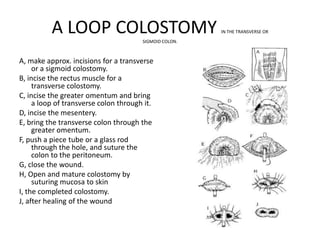
A LOOP COLOSTOMY             SIGMOID COLON.
                                                        IN THE TRANSVERSE OR


A, make approx. incisions for a transverse
     or a sigmoid colostomy.
B, incise the rectus muscle for a
     transverse colostomy.
C, incise the greater omentum and bring
     a loop of transverse colon through it.
D, incise the mesentery.
E, bring the transverse colon through the
     greater omentum.
F, push a piece tube or a glass rod
     through the hole, and suture the
     colon to the peritoneum.
G, close the wound.
H, Open and mature colostomy by
     suturing mucosa to skin
I, the completed colostomy.
J, after healing of the wound
End colostomy
• Make an appropriate incision in the abdominal wall
                     2.5cm disc incision to skin, cruciate to other layers of ant
                     abdomen. After close paracolic gutter.

• Insert a crushing clamp through it and draw out the end of
  his gut.
• put in a few catgut sutures between the seromuscular coat
  bowel and the peritoneum of the abdominal wall with 1.5
  cm of healthy gut protruding beyond the skin
• Close abdominal wound.
• cut off the crushing clamp to open the colostomy.
• Suture mucosa to skin all round with interrupted 2/0 or 3/0
  monofilament.
Postop care
• Vital signs monitoring
• Pain medication given as necessary
• Support of operative site during deep breathing
  and coughing
• Fluid intake and output measurement
• Intravenous antibiotics
• operative site observed for color and amount of
  wound drainage
• NG tube
• Add
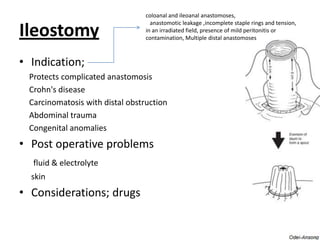
coloanal and ileoanal anastomoses,
                                   anastomotic leakage ,incomplete staple rings and tension,
Ileostomy                        in an irradiated field, presence of mild peritonitis or
                                 contamination, Multiple distal anastomoses


• Indication;
 Protects complicated anastomosis
 Crohn's disease
 Carcinomatosis with distal obstruction
 Abdominal trauma
 Congenital anomalies
• Post operative problems
  fluid & electrolyte
  skin
• Considerations; drugs
complications
Immediate
• Bleeding
• Ischaemia/necrosis: This is generally the result of technical
  failure and is usually if the stoma is formed under tension or
• a poor blood supply
 Early
• High output: Ileostomies may put out more fluid than
  expected (normal 500ml/day) with massive salt and water
  loss, which must be corrected
 • Obstruction
 • Retraction (especially loop colostomy)
 Late
 • Obstruction
 • Prolapse
 • Parastomal herniation
 • Fistula formation (especially with ileostomies)
 • Skin irritation (especially with ileostomies)
 • Psychological
Review article .                                       2005 Nov;7(6):582-7


•   Evaluation of the end colostomy complications and the risk factors influencing them in Iranian patients.
•   Mahjoubi B, Moghimi A, Mirzaei R, Bijari A.
•   Department of Surgery, Iran University of Medical Sciences and Health Care Services, Tehran, Iran.
    bahar1167@yahoo.com
•   Abstract
•   INTRODUCTION: The aim of this study was to assess the prevalence of end colostomy complications and the
    evaluation of factors influencing outcome.
•   PATIENTS AND METHODS: Three hundred and thirty patients with end colostomy were studied. All patient were
    recalled for examination for recent complications. Early complications included stoma site pain, early dermal
    irritation (during the first month after surgery), mucosal bleeding, stomal prolapse and psychosocial
    complications. Late complications included peristomal hernia, stomal stenosis, late dermal irritation (after the first
    month), stomal retraction, stomal necrosis and other stoma complications (perforation, fistula etc.). Probable
    underlying factors were studied. To evaluate risk factors affecting complications, univariable analysis and then
    multivariable analysis by binary logistic regression was performed.
•   RESULTS: One hundred and one (30.6%) patients had no complications and the remainder had at least one of
    early or late complications. Overall, psychosocial complications, 56.4%; mucosal bleeding, 34.5%; early dermal
    irritation, 23.5% were the most frequent complications. Peristomal hernia (11.2%) was the most common late
    complication. Those aged > 40 years had significant associations with psychosocial problem (OR = 2.77), mucosal
    haemorrhage (OR = 2.19), and early dermal irritation (OR = 3.14). The risks of peristomal hernia and early dermal
    irritation are greater in the patients with BMI > 25 kg/m2 (OR = 2.08 and 2.55, respectively).
•   CONCLUSION: The risk of most prevalent complications of colostomy construction increases in elder patients. The
    high prevalence of psychosocial and skin problems in patients with a colostomy, needs special attention especially
    from the viewpoint of education by trained stoma nurses and preparation of standard equipment.
Care of colostomy
•   Pouches
•   Peristomal skin protective pastes, membranes and powders
•   Odor reduction
•   Irrigation
•   When to call a doctor • severe cramps lasting more than 6 hours
                                  • severe dicharge lasting more than 6hrs
                                  • no output from the colostomy for 3 days
                                  • excessive bleeding from stoma
                                  • swelling of stoma to more than 1/2-inch
                                     larger than usual
                                  • severe skin irritation or deep ulcers
                                  • complication associated with stoma
Care of colostomy
• Irrigation ;
  People with ostomies of
  the sigmoid colon or descending
  colon may option for irrigation, and
  use a gauze cap over the stoma,
  and schedule irrigation for
  convenient times
Colostomies without
  irrigation or
  occasional.
  . Pouches
  . ileo-anal pouch

                                         Ged Galvin
ostomy pouching system(colostomy bag)
• Wafers/Baseplates
  5 parameters required for skin
  adhesion: 1) absorption 2) tack and
  adhesion, 3) flexibility, 4) erosion
  resistance and 5) ease of removal.
  wafer/baseplate last b/n 4 to 10 days


• Pouches
  a.Closed-end pouches must be
  removed and replaced with a
  new pouch.
  b.Open-end pouches have a
  resealable end that can be
  opened to drain the contents of
  the pouch into a toilet..
Colostomy closure
• Closure, around 2 wks, but delay of 6–8 wks
  allows stoma to mature and for peristomal
  plane to become better defined
• Contrast study of distal bowel
• Preoperative Preparation;
       low-residue diet, oral antibiotics,
       irrigations in both directions through the
       colostomy .
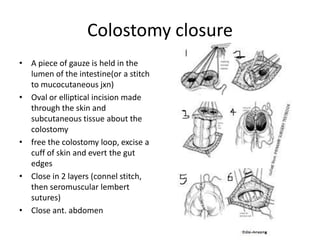
Colostomy closure
• A piece of gauze is held in the
  lumen of the intestine(or a stitch
  to mucocutaneous jxn)
• Oval or elliptical incision made
  through the skin and
  subcutaneous tissue about the
  colostomy
• free the colostomy loop, excise a
  cuff of skin and evert the gut
  edges
• Close in 2 layers (connel stitch,
  then seromuscular lembert
  sutures)
• Close ant. abdomen
Prognosis
• Depends on the underlying disorder
• The prognosis is good, but getting used to
  the colostomy bag can take up to a year.
• Mortality mostly related to the underlying
  condition


                          Rehabilitation must add life to years as well
                          as years to life. (Zeiter 1969
Summary
• A colostomy is a lifesaving surgery that
  enables a person to enjoy a full range of
  activities, including traveling, sports, family
  life and work,
• Colostomy is performed for many different
  diseases and conditions and therefore can be
  temporary or permanent.
• Proper education pre and post surgery, help
  improves clients quality of life.
THANKS FOR YOUR ATTENTION
References;
•   Postgraduate surgery-2nd ed
•   Farquharson’s textbook of operative general surgery-9th ed
•   Operative surgery vivas
•   Principle and practice of surgery in the tropics- 4th edition
•   Primary surgery textbook
•   Colostomy guide 2004
•   Sabiston Textbook of Surgery, 17th ed.
•   UPMC (colostomy care)2008
•   Emedicine article 2008
•   surgeryencyclopedia.com
•   Others not noted observed

Colostomy

  • 1.
  • 2.
    Outline • Introduction • Anatomy of large interstine with a small physiology • Indications • Preop preperations • Stoma sitting • Operative technigues • Post op. care • Ileostomy • Complications • Review article • Care of colostomy • Closure of colostomy • Prognosis • Summary.
  • 3.
    Introduction • An iatrogeniccolo-cutaneous fistula used in situations in which diversion of, decompression of, or access to the bowel lumen is needed • Stoma through laparotomy incision include the risk of wound infection, dehiscence, and evisceration. • Whenever feasible, a primary stoma site, as well as alternative sites, be selected and marked before surgery
  • 4.
    Introduction history • In 1710; Alexis Littre of paris first performed colostomy thru the anterior abdominal wall • 1776; H. Pillore a surgeon from Rouen, also performed caecostomy on a px with ca rectum. Px died 28days after • First successful colostomy was done by Duret of brest, on a 3day old child with imperforate anus and lived to 45yr
  • 5.
    Introduction history • Amussat studied all 29 colostomies done since Pillore, 21 being kids with imperforate anus. Noted that 20 died within a matter of days. • Only 4 infants survived, all treated at Brest(remind Duret) • Of 8 adults, 5 survived. • concluded that their deaths were due to peritonitis and therefore blamed abdominal approach. • Devised the lumbar approach which lasted for over 30yrs. • With the introduction of ATB in the 1880s, it lost its popularity.
  • 6.
    Large intestine • 1.5m. (5ft.) • Cecum; 7.5cm diameter, 10cm in length. • Appendix; 3cm below ICV, variable length and position of tip. • Colon; identified by taeniae coli, Sacculations (haustra) & appendices epiploicae. Ascending 15cm. Transverse 45cm,fixed b/n hepatic and splenic flexures. Attached to the superior is the greater omentum Descending 25cm, ends at pelvic brim.
  • 7.
    Large intestine+anal canal •Sigmoid; 15 to 50 cm (average 38 cm) and is very mobile , has the narrowest diameter. • Rectum; is 12 to 15 cm in length lacks teniae coli or appendices epiploicae. along with the sigmoid colon serves as a fecal reservoir. • anal canal
  • 8.
    Intestinal secretions Na+ Cl- K+ HCO3 - H+ Fluid mEq/L mEq/L mEq/L mEq/L mEq/L Saliva 30-60 15-40 20 15-50 N/A Gastric 60-100 90-140 10-20 N/A 30-100 Duodenal 140 80 5 50 N/A Bile 140 100 5-10 40-50 N/A Pancreatic 140 75 5-15 90 N/A Jejunal 100 100 5-10 10-20 N/A Ileal 130 110 10 30 N/A Colonic 60 40 30 20 N/A Diarrhea 130 30 90 N/A N/A
  • 9.
    Types • Classification isnormally based on; Duration Anatomic part of bowel used Loop, End, Double barrel colostomy Retro¬ or transperitoneal
  • 10.
    Aetiology /Indication • Adults; Colorectal ca  Obstruction  Traumatic perineal injury  Fistulae  Protect a distal anastom.  Ruptured diverticulum,  Ischemia  Inflammatory bowel disorder.
  • 11.
    Aetiology /Indication • Children Necrotizing enterocolitis  Hirschsprung disease  Meconium ileus  Imperforate anus  Complex hindgut anomalies  Intestinal malrotation  Intestinal volvulus  Intestinal atresia, stenosis, and webs  Trauma
  • 12.
    Preoperative Preparation • Hx •Investigations; FBC, BUE&Cr, Urinalysis, appropriate X rays. • correction of fluid and electrolyte imbalance • blood volume deficits. • Antibiotics .
  • 13.
    Preoperative Preparation • Enterostomaltherapist offers preoperative education, mark site for stomal placement • Consent after explaining procedure to px • Bowel preparation; low-residue diet for several days prior to surgery A liquid diet for at least a day before surgery • A nasogastric tube NPO after midnight. series of enemas and/or oral preparations (GoLytely or Colyte) may be ordered to empty the bowel of • A urinary catheter stool. Oral anti-infectives (neomycin, erythromycin, or kanamycin sulfate) may be ordered to decrease bacteria in the intestine and help prevent postoperative infection.
  • 14.
    Stoma Site Selection-assessments • Positions • Type of stoma anticipated • The rectus muscle sheath • Adequate surface area • Easily seen • Smooth skin surface • Miscellaneous criteria
  • 15.
    Stoma location Ideal Stoma Sites to Avoid: Other Considerations: Characteristics: • Red • Scars/Wrinkles • Type of Ostomy • Round • Skin Folds/Creases • Occupation • Raised (about 1" • Bony Prominence • Impairments (e.g. visual, protrusion) • Under Pendulous Breasts physical) • Lumen at center of stoma • Suture Lines • Sports/Activity Level • Smooth skin surface • Umbilicus • Prosthetic Equipment • Belt/Waistline • Preference (surgeon, • Hernia patient) • Mobile Abdominal Tissue • Posture • Radiation Sites • Contractures • Diagnosis • Age
  • 16.
    A LOOP COLOSTOMY SIGMOID COLON. IN THE TRANSVERSE OR A, make approx. incisions for a transverse or a sigmoid colostomy. B, incise the rectus muscle for a transverse colostomy. C, incise the greater omentum and bring a loop of transverse colon through it. D, incise the mesentery. E, bring the transverse colon through the greater omentum. F, push a piece tube or a glass rod through the hole, and suture the colon to the peritoneum. G, close the wound. H, Open and mature colostomy by suturing mucosa to skin I, the completed colostomy. J, after healing of the wound
  • 17.
    End colostomy • Makean appropriate incision in the abdominal wall 2.5cm disc incision to skin, cruciate to other layers of ant abdomen. After close paracolic gutter. • Insert a crushing clamp through it and draw out the end of his gut. • put in a few catgut sutures between the seromuscular coat bowel and the peritoneum of the abdominal wall with 1.5 cm of healthy gut protruding beyond the skin • Close abdominal wound. • cut off the crushing clamp to open the colostomy. • Suture mucosa to skin all round with interrupted 2/0 or 3/0 monofilament.
  • 18.
    Postop care • Vitalsigns monitoring • Pain medication given as necessary • Support of operative site during deep breathing and coughing • Fluid intake and output measurement • Intravenous antibiotics • operative site observed for color and amount of wound drainage • NG tube • Add
  • 19.
    coloanal and ileoanalanastomoses, anastomotic leakage ,incomplete staple rings and tension, Ileostomy in an irradiated field, presence of mild peritonitis or contamination, Multiple distal anastomoses • Indication; Protects complicated anastomosis Crohn's disease Carcinomatosis with distal obstruction Abdominal trauma Congenital anomalies • Post operative problems fluid & electrolyte skin • Considerations; drugs
  • 20.
    complications Immediate • Bleeding • Ischaemia/necrosis:This is generally the result of technical failure and is usually if the stoma is formed under tension or • a poor blood supply Early • High output: Ileostomies may put out more fluid than expected (normal 500ml/day) with massive salt and water loss, which must be corrected • Obstruction • Retraction (especially loop colostomy) Late • Obstruction • Prolapse • Parastomal herniation • Fistula formation (especially with ileostomies) • Skin irritation (especially with ileostomies) • Psychological
  • 21.
    Review article . 2005 Nov;7(6):582-7 • Evaluation of the end colostomy complications and the risk factors influencing them in Iranian patients. • Mahjoubi B, Moghimi A, Mirzaei R, Bijari A. • Department of Surgery, Iran University of Medical Sciences and Health Care Services, Tehran, Iran. bahar1167@yahoo.com • Abstract • INTRODUCTION: The aim of this study was to assess the prevalence of end colostomy complications and the evaluation of factors influencing outcome. • PATIENTS AND METHODS: Three hundred and thirty patients with end colostomy were studied. All patient were recalled for examination for recent complications. Early complications included stoma site pain, early dermal irritation (during the first month after surgery), mucosal bleeding, stomal prolapse and psychosocial complications. Late complications included peristomal hernia, stomal stenosis, late dermal irritation (after the first month), stomal retraction, stomal necrosis and other stoma complications (perforation, fistula etc.). Probable underlying factors were studied. To evaluate risk factors affecting complications, univariable analysis and then multivariable analysis by binary logistic regression was performed. • RESULTS: One hundred and one (30.6%) patients had no complications and the remainder had at least one of early or late complications. Overall, psychosocial complications, 56.4%; mucosal bleeding, 34.5%; early dermal irritation, 23.5% were the most frequent complications. Peristomal hernia (11.2%) was the most common late complication. Those aged > 40 years had significant associations with psychosocial problem (OR = 2.77), mucosal haemorrhage (OR = 2.19), and early dermal irritation (OR = 3.14). The risks of peristomal hernia and early dermal irritation are greater in the patients with BMI > 25 kg/m2 (OR = 2.08 and 2.55, respectively). • CONCLUSION: The risk of most prevalent complications of colostomy construction increases in elder patients. The high prevalence of psychosocial and skin problems in patients with a colostomy, needs special attention especially from the viewpoint of education by trained stoma nurses and preparation of standard equipment.
  • 22.
    Care of colostomy • Pouches • Peristomal skin protective pastes, membranes and powders • Odor reduction • Irrigation • When to call a doctor • severe cramps lasting more than 6 hours • severe dicharge lasting more than 6hrs • no output from the colostomy for 3 days • excessive bleeding from stoma • swelling of stoma to more than 1/2-inch larger than usual • severe skin irritation or deep ulcers • complication associated with stoma
  • 23.
    Care of colostomy •Irrigation ; People with ostomies of the sigmoid colon or descending colon may option for irrigation, and use a gauze cap over the stoma, and schedule irrigation for convenient times Colostomies without irrigation or occasional. . Pouches . ileo-anal pouch Ged Galvin
  • 24.
    ostomy pouching system(colostomybag) • Wafers/Baseplates 5 parameters required for skin adhesion: 1) absorption 2) tack and adhesion, 3) flexibility, 4) erosion resistance and 5) ease of removal. wafer/baseplate last b/n 4 to 10 days • Pouches a.Closed-end pouches must be removed and replaced with a new pouch. b.Open-end pouches have a resealable end that can be opened to drain the contents of the pouch into a toilet..
  • 25.
    Colostomy closure • Closure,around 2 wks, but delay of 6–8 wks allows stoma to mature and for peristomal plane to become better defined • Contrast study of distal bowel • Preoperative Preparation; low-residue diet, oral antibiotics, irrigations in both directions through the colostomy .
  • 26.
    Colostomy closure • Apiece of gauze is held in the lumen of the intestine(or a stitch to mucocutaneous jxn) • Oval or elliptical incision made through the skin and subcutaneous tissue about the colostomy • free the colostomy loop, excise a cuff of skin and evert the gut edges • Close in 2 layers (connel stitch, then seromuscular lembert sutures) • Close ant. abdomen
  • 27.
    Prognosis • Depends onthe underlying disorder • The prognosis is good, but getting used to the colostomy bag can take up to a year. • Mortality mostly related to the underlying condition Rehabilitation must add life to years as well as years to life. (Zeiter 1969
  • 28.
    Summary • A colostomyis a lifesaving surgery that enables a person to enjoy a full range of activities, including traveling, sports, family life and work, • Colostomy is performed for many different diseases and conditions and therefore can be temporary or permanent. • Proper education pre and post surgery, help improves clients quality of life.
  • 29.
    THANKS FOR YOURATTENTION
  • 30.
    References; • Postgraduate surgery-2nd ed • Farquharson’s textbook of operative general surgery-9th ed • Operative surgery vivas • Principle and practice of surgery in the tropics- 4th edition • Primary surgery textbook • Colostomy guide 2004 • Sabiston Textbook of Surgery, 17th ed. • UPMC (colostomy care)2008 • Emedicine article 2008 • surgeryencyclopedia.com • Others not noted observed