OPEN RIGHT
HEMICOLECTOMY
DR.B.Selvaraj MS; Mch; FICS;
“ Surgical Educator”
Malaysia
OPERATIVE SURGERY
OPEN RIGHT HEMICOLECTOMY
• INDICATIONS:
 Malignant tumors in Ileocecal region,
ascending colon and hepatic flexure
 Adenomatous polyps in Rt Colon
 Ileocecal TB, IBD, Cecal diverticulosis,
bleeding Vascular ectasia & Cecal volvulus
• ANESTHESIA:
 GA/ETT
• POSITION:
 Supine
• Diagnosis
 Confirmed by colonoscopic biopsy
 Staging by CECT
• Informed consent- risks of surgery:
 Anastomotic leak- 2%
 Hemorrhage- 1%
 Bowel obstruction- 2%
 Wound infection- 2 to 10%
 Injury to ureter and duodenum- 1%
• Pre-op preparation
 Adequate mechanical bowel preparation the day
before surgery with orthograde enema
 Prophylactic IV broad spectrum antibiotics
 VTE prophylaxis with LMWH and pneumatic
stockings
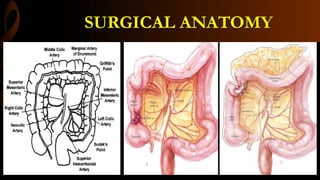
SURGICAL ANATOMY
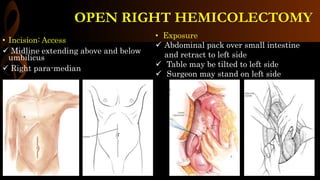
• Incision: Access
 Midline extending above and below
umbilicus
 Right para-median
• Exposure
 Abdominal pack over small intestine
and retract to left side
 Table may be tilted to left side
 Surgeon may stand on left side
OPEN RIGHT HEMICOLECTOMY
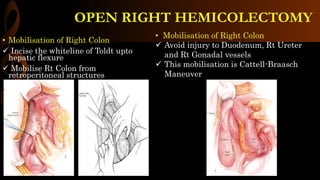
• Mobilisation of Right Colon
 Incise the whiteline of Toldt upto
hepatic flexure
 Mobilise Rt Colon from
retroperitoneal structures
• Mobilisation of Right Colon
 Avoid injury to Duodenum, Rt Ureter
and Rt Gonadal vessels
 This mobilisation is Cattell-Braasch
Maneuver
OPEN RIGHT HEMICOLECTOMY
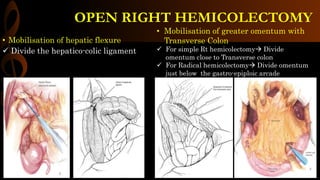
• Mobilisation of hepatic flexure
 Divide the hepatico-colic ligament
• Mobilisation of greater omentum with
Transverse Colon
 For simple Rt hemicolectomy Divide
omentum close to Transverse colon
 For Radical hemicolectomy Divide omentum
just below the gastro-epiploic arcade
OPEN RIGHT HEMICOLECTOMY
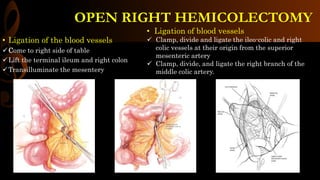
• Ligation of the blood vessels
Come to right side of table
Lift the terminal ileum and right colon
Transilluminate the mesentery
• Ligation of blood vessels
 Clamp, divide and ligate the ileo-colic and right
colic vessels at their origin from the superior
mesenteric artery
 Clamp, divide, and ligate the right branch of the
middle colic artery.
OPEN RIGHT HEMICOLECTOMY
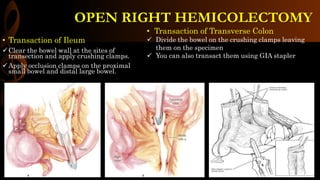
• Transaction of Ileum
Clear the bowel wall at the sites of
transection and apply crushing clamps.
Apply occlusion clamps on the proximal
small bowel and distal large bowel.
• Transaction of Transverse Colon
 Divide the bowel on the crushing clamps leaving
them on the specimen
 You can also transact them using GIA stapler
OPEN RIGHT HEMICOLECTOMY
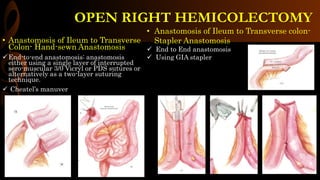
• Anastomosis of Ileum to Transverse
Colon- Hand-sewn Anastomosis
End-to-end anastomosis: anastomosis
either using a single layer of interrupted
sero-muscular 3/0 Vicryl or PDS sutures or
alternatively as a two-layer suturing
technique.
 Cheatel’s manuver
• Anastomosis of Ileum to Transverse colon-
Stapler Anastomosis
 End to End anastomosis
 Using GIA stapler
OPEN RIGHT HEMICOLECTOMY
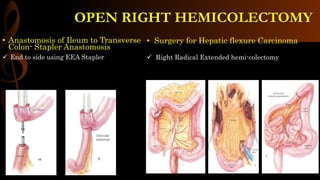
• Anastomosis of Ileum to Transverse
Colon- Stapler Anastomosis
 End to side using EEA Stapler
• Surgery for Hepatic flexure Carcinoma
 Right Radical Extended hemi-colectomy
OPEN RIGHT HEMICOLECTOMY
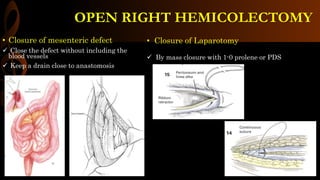
• Closure of mesenteric defect
 Close the defect without including the
blood vessels
 Keep a drain close to anastomosis
• Closure of Laparotomy
 By mass closure with 1-0 prolene or PDS
OPEN RIGHT HEMICOLECTOMY
Post-op Care
 No need to continue antibiotics postoperatively unless there is intraabdominal
infection.
Nasogastric tube is not routinely placed.
 Begin ambulating on postoperative day 1.
Foley catheter can usually be removed on postoperative day 1 or 2 unless an
epidural remains in place.
The patient can be started on a liquid diet. The diet can be advanced based on
clinical progress.
DVT prophylaxis should be continued until the time of discharge and can be
considered as an outpatient in certain subsets of patients.
 Patient should be counseled about the initial changes in bowel habits including
more frequent, loose stools and the possible appearance of blood clots in the first
few bowel movements.
OPEN RIGHT HEMICOLECTOMY
Pearls & Pitfalls
 Colon mobilization:The plane between the mesocolon and the retroperitoneum is an avascular embryologic
plane that should be dissected sharply. Excess blood loss during this dissection alerts the surgeon that the
incorrect plane was entered.
 Vascular dissection: -During dissection of the middle colic vessels, avulsion of the large collateral branch
that connects the inferior pancreaticoduodenal vein with the middle colic vein and superior mesenteric vein
can result in bleeding that is difficult to control because the vein retracts and cannot be isolated easily.
- Avoiding excess upward and medial traction of the right colon while mobilizing the hepatic flexure best
prevents this.
- Transillumination of the mesocolon and the mesentery of the terminal ileum can
help to identify vascular arcades to minimize iatrogenic injury in patients with thick
mesentery and can assure good blood supply to the anastomosis
 Anastomosis: A well-vascularized, tension-free anastomosis minimizes the risk of anastomotic breakdown
- If there is any doubt regarding the integrity of the anastomosis, the bowel segments should be further
resected to healthy, vascularized bowel.
- Blood supply to the anastomosis can also be further assessed with Doppler ultrasound if necessary.
OPEN RIGHT HEMICOLECTOMY
MINDMAP
THANK YOU

Open right hemicolectomy/ step by step/ operative surgery

  • 1.
    OPEN RIGHT HEMICOLECTOMY DR.B.Selvaraj MS;Mch; FICS; “ Surgical Educator” Malaysia OPERATIVE SURGERY
  • 2.
    OPEN RIGHT HEMICOLECTOMY •INDICATIONS:  Malignant tumors in Ileocecal region, ascending colon and hepatic flexure  Adenomatous polyps in Rt Colon  Ileocecal TB, IBD, Cecal diverticulosis, bleeding Vascular ectasia & Cecal volvulus • ANESTHESIA:  GA/ETT • POSITION:  Supine • Diagnosis  Confirmed by colonoscopic biopsy  Staging by CECT • Informed consent- risks of surgery:  Anastomotic leak- 2%  Hemorrhage- 1%  Bowel obstruction- 2%  Wound infection- 2 to 10%  Injury to ureter and duodenum- 1% • Pre-op preparation  Adequate mechanical bowel preparation the day before surgery with orthograde enema  Prophylactic IV broad spectrum antibiotics  VTE prophylaxis with LMWH and pneumatic stockings
  • 3.
  • 4.
    • Incision: Access Midline extending above and below umbilicus  Right para-median • Exposure  Abdominal pack over small intestine and retract to left side  Table may be tilted to left side  Surgeon may stand on left side OPEN RIGHT HEMICOLECTOMY
  • 5.
    • Mobilisation ofRight Colon  Incise the whiteline of Toldt upto hepatic flexure  Mobilise Rt Colon from retroperitoneal structures • Mobilisation of Right Colon  Avoid injury to Duodenum, Rt Ureter and Rt Gonadal vessels  This mobilisation is Cattell-Braasch Maneuver OPEN RIGHT HEMICOLECTOMY
  • 6.
    • Mobilisation ofhepatic flexure  Divide the hepatico-colic ligament • Mobilisation of greater omentum with Transverse Colon  For simple Rt hemicolectomy Divide omentum close to Transverse colon  For Radical hemicolectomy Divide omentum just below the gastro-epiploic arcade OPEN RIGHT HEMICOLECTOMY
  • 7.
    • Ligation ofthe blood vessels Come to right side of table Lift the terminal ileum and right colon Transilluminate the mesentery • Ligation of blood vessels  Clamp, divide and ligate the ileo-colic and right colic vessels at their origin from the superior mesenteric artery  Clamp, divide, and ligate the right branch of the middle colic artery. OPEN RIGHT HEMICOLECTOMY
  • 8.
    • Transaction ofIleum Clear the bowel wall at the sites of transection and apply crushing clamps. Apply occlusion clamps on the proximal small bowel and distal large bowel. • Transaction of Transverse Colon  Divide the bowel on the crushing clamps leaving them on the specimen  You can also transact them using GIA stapler OPEN RIGHT HEMICOLECTOMY
  • 9.
    • Anastomosis ofIleum to Transverse Colon- Hand-sewn Anastomosis End-to-end anastomosis: anastomosis either using a single layer of interrupted sero-muscular 3/0 Vicryl or PDS sutures or alternatively as a two-layer suturing technique.  Cheatel’s manuver • Anastomosis of Ileum to Transverse colon- Stapler Anastomosis  End to End anastomosis  Using GIA stapler OPEN RIGHT HEMICOLECTOMY
  • 10.
    • Anastomosis ofIleum to Transverse Colon- Stapler Anastomosis  End to side using EEA Stapler • Surgery for Hepatic flexure Carcinoma  Right Radical Extended hemi-colectomy OPEN RIGHT HEMICOLECTOMY
  • 11.
    • Closure ofmesenteric defect  Close the defect without including the blood vessels  Keep a drain close to anastomosis • Closure of Laparotomy  By mass closure with 1-0 prolene or PDS OPEN RIGHT HEMICOLECTOMY
  • 12.
    Post-op Care  Noneed to continue antibiotics postoperatively unless there is intraabdominal infection. Nasogastric tube is not routinely placed.  Begin ambulating on postoperative day 1. Foley catheter can usually be removed on postoperative day 1 or 2 unless an epidural remains in place. The patient can be started on a liquid diet. The diet can be advanced based on clinical progress. DVT prophylaxis should be continued until the time of discharge and can be considered as an outpatient in certain subsets of patients.  Patient should be counseled about the initial changes in bowel habits including more frequent, loose stools and the possible appearance of blood clots in the first few bowel movements. OPEN RIGHT HEMICOLECTOMY
  • 13.
    Pearls & Pitfalls Colon mobilization:The plane between the mesocolon and the retroperitoneum is an avascular embryologic plane that should be dissected sharply. Excess blood loss during this dissection alerts the surgeon that the incorrect plane was entered.  Vascular dissection: -During dissection of the middle colic vessels, avulsion of the large collateral branch that connects the inferior pancreaticoduodenal vein with the middle colic vein and superior mesenteric vein can result in bleeding that is difficult to control because the vein retracts and cannot be isolated easily. - Avoiding excess upward and medial traction of the right colon while mobilizing the hepatic flexure best prevents this. - Transillumination of the mesocolon and the mesentery of the terminal ileum can help to identify vascular arcades to minimize iatrogenic injury in patients with thick mesentery and can assure good blood supply to the anastomosis  Anastomosis: A well-vascularized, tension-free anastomosis minimizes the risk of anastomotic breakdown - If there is any doubt regarding the integrity of the anastomosis, the bowel segments should be further resected to healthy, vascularized bowel. - Blood supply to the anastomosis can also be further assessed with Doppler ultrasound if necessary. OPEN RIGHT HEMICOLECTOMY
  • 14.
  • 15.