Water Measurement
Water Measurement 
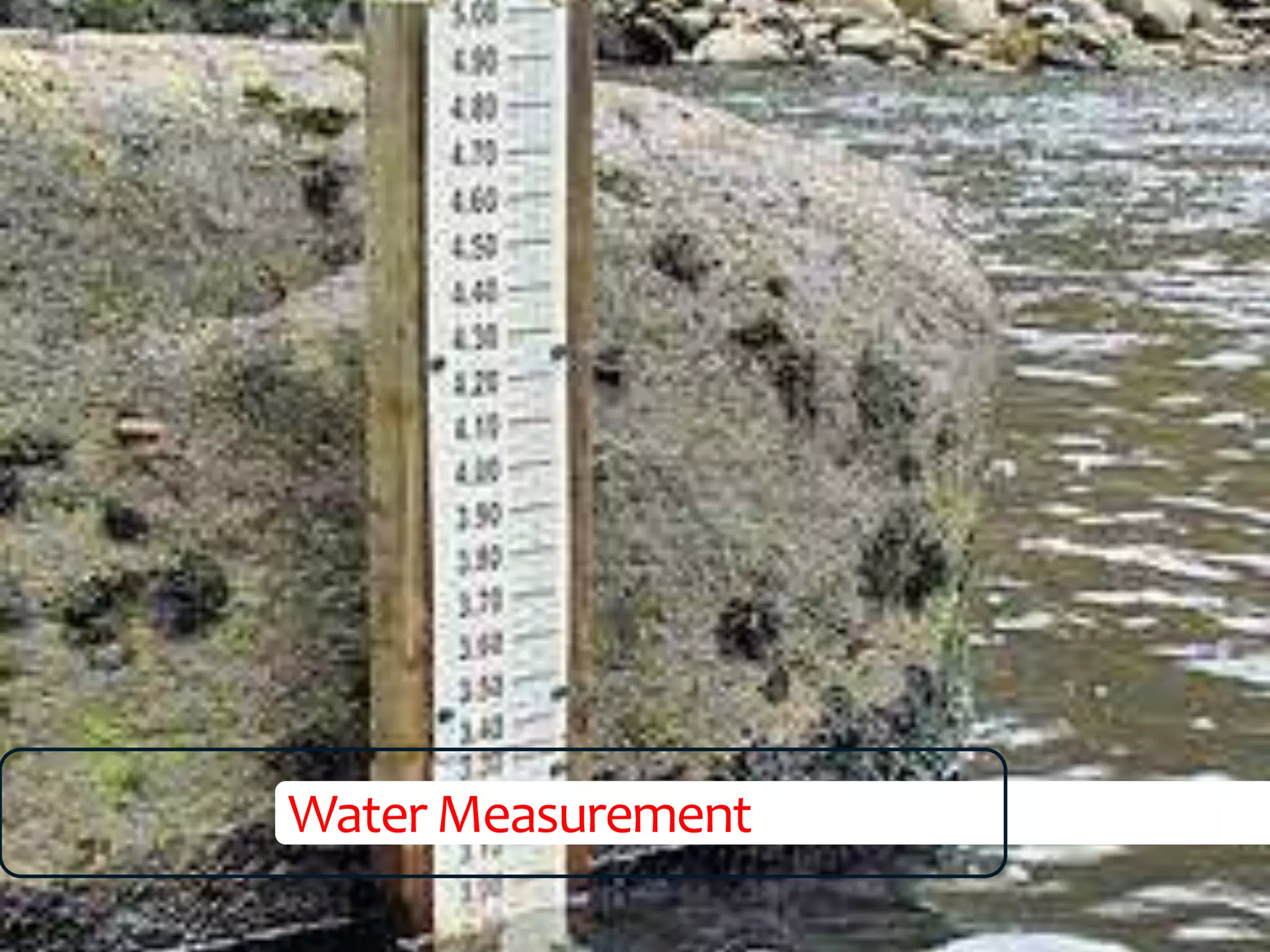
Water flow is measured to assess 
how much water is available for a 
supply and to check the quantity of 
water flowing through a system
Water Measurement 
Discharge is defined as the rate of flow or 
the volume of water that passes through a 
channel cross section in a specific period of 
time. 
Q = V A 
Measured in units of cubic feet per second, (ft3/s 
or cfs) or its metric equivalent of liters per second 
(Lps or m3/s)
Example 
If the width of the channel is ten feet, the 
depth is one foot, and the velocity is two 
feet per second, then 
A = 10 ft x 1 ft = 10 ft2 
Q = 2 ft/s x 10 ft2 = 20 cfs
Water Measurement 
Different sources of water require 
different methods of flow measurement 
and can be divided as follows: 
 Surface water 
 Springs 
Wells
Surface Water Sources 
Surface water flow is simply the continuous 
movement of water in runoff or open 
channels. 
The two most common methods of flow 
measurements of surface water are: 
 Velocity-Area Method 
 Overflow Weir Gauging
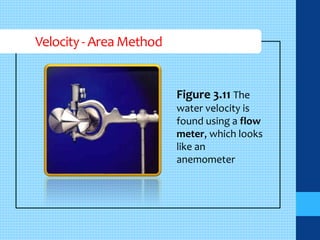
Velocity - Area Method 
Figure 3.11 The 
water velocity is 
found using a flow 
meter, which looks 
like an 
anemometer
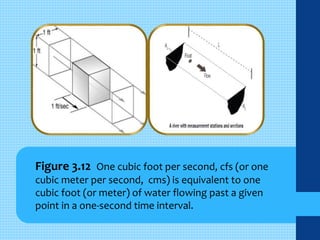
Figure 3.12 One cubic foot per second, cfs (or one 
cubic meter per second, cms) is equivalent to one 
cubic foot (or meter) of water flowing past a given 
point in a one-second time interval.
Gauging Weirs Method 
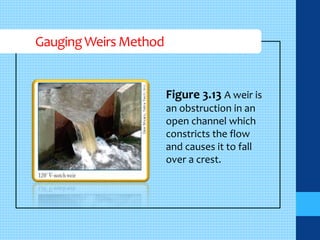
Figure 3.13 A weir is 
an obstruction in an 
open channel which 
constricts the flow 
and causes it to fall 
over a crest.
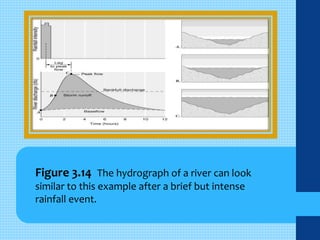
Figure 3.14 The hydrograph of a river can look 
similar to this example after a brief but intense 
rainfall event.
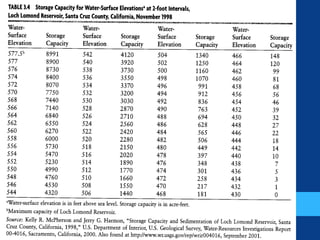
Stage 
Stage is the depth of flow (m or ft) which 
most commonly measured the elevation of 
the water surface relative to an arbitrary 
fixed point. 
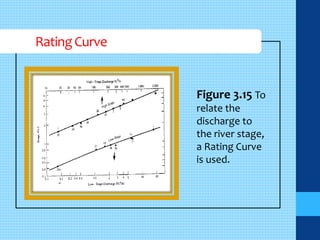
To relate the discharge to the river stage, a 
Rating Curve is used.
Rating Curve 
Figure 3.15 To 
relate the 
discharge to 
the river stage, 
a Rating Curve 
is used.
Flood Events
Flood Frequency 
Flood Frequency is the likelihood that a 
large flood will happen. 
Flood Frequency Analysis uses historical 
records of peak flows to produce 
guidance about the expected behavior of 
future flooding.
Flood Frequency Analysis 
Two primary applications of flood 
frequency analyses are: 
 To predict the possible flood magnitude 
over a certain time period 
 To estimate the frequency with which 
floods of a certain magnitude may 
occur.
Return Period 
Two primary applications of flood 
frequency analyses are: 
 To predict the possible flood magnitude 
over a certain time period 
 To estimate the frequency with which 
floods of a certain magnitude may 
occur.
Return Period 
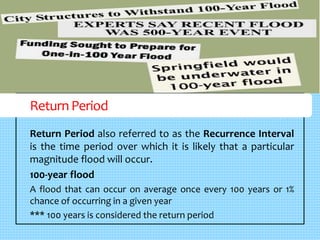
Return Period also referred to as the Recurrence Interval 
is the time period over which it is likely that a particular 
magnitude flood will occur. 
100-year flood 
A flood that can occur on average once every 100 years or 1% 
chance of occurring in a given year 
*** 100 years is considered the return period
Exceedance Probability 
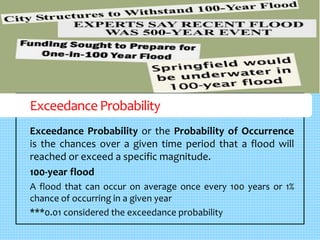
Exceedance Probability or the Probability of Occurrence 
is the chances over a given time period that a flood will 
reached or exceed a specific magnitude. 
100-year flood 
A flood that can occur on average once every 100 years or 1% 
chance of occurring in a given year 
***0.01 considered the exceedance probability
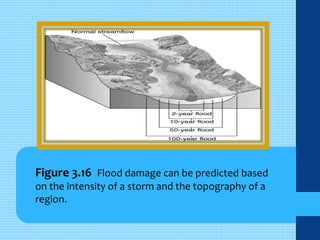
Figure 3.16 Flood damage can be predicted based 
on the intensity of a storm and the topography of a 
region.
• Probable Maximum Precipitation (PMP) 
• The most extreme rainfall possible 
• Used for estimating the effects of extreme 
weather 
• Probable Maximum Flood (PMF) 
• The most extreme flood possible 
• Used for estimating maximum extent of 
flooding 
Extreme Events
GIS Mapping 
Geographic Information Systems (GIS) is 
used to organize spatial information. These 
information are stored in the computer. 
Its GIS layers include topography, soils, 
hydrography, vegetation, land use, etc.

Surface Water Hydrology

  • 1.
  • 2.
    Water Measurement Waterflow is measured to assess how much water is available for a supply and to check the quantity of water flowing through a system
  • 3.
    Water Measurement Dischargeis defined as the rate of flow or the volume of water that passes through a channel cross section in a specific period of time. Q = V A Measured in units of cubic feet per second, (ft3/s or cfs) or its metric equivalent of liters per second (Lps or m3/s)
  • 4.
    Example If thewidth of the channel is ten feet, the depth is one foot, and the velocity is two feet per second, then A = 10 ft x 1 ft = 10 ft2 Q = 2 ft/s x 10 ft2 = 20 cfs
  • 5.
    Water Measurement Differentsources of water require different methods of flow measurement and can be divided as follows:  Surface water  Springs Wells
  • 6.
    Surface Water Sources Surface water flow is simply the continuous movement of water in runoff or open channels. The two most common methods of flow measurements of surface water are:  Velocity-Area Method  Overflow Weir Gauging
  • 7.
    Velocity - AreaMethod Figure 3.11 The water velocity is found using a flow meter, which looks like an anemometer
  • 8.
    Figure 3.12 Onecubic foot per second, cfs (or one cubic meter per second, cms) is equivalent to one cubic foot (or meter) of water flowing past a given point in a one-second time interval.
  • 9.
    Gauging Weirs Method Figure 3.13 A weir is an obstruction in an open channel which constricts the flow and causes it to fall over a crest.
  • 10.
    Figure 3.14 Thehydrograph of a river can look similar to this example after a brief but intense rainfall event.
  • 11.
    Stage Stage isthe depth of flow (m or ft) which most commonly measured the elevation of the water surface relative to an arbitrary fixed point. To relate the discharge to the river stage, a Rating Curve is used.
  • 12.
    Rating Curve Figure3.15 To relate the discharge to the river stage, a Rating Curve is used.
  • 14.
  • 15.
    Flood Frequency FloodFrequency is the likelihood that a large flood will happen. Flood Frequency Analysis uses historical records of peak flows to produce guidance about the expected behavior of future flooding.
  • 16.
    Flood Frequency Analysis Two primary applications of flood frequency analyses are:  To predict the possible flood magnitude over a certain time period  To estimate the frequency with which floods of a certain magnitude may occur.
  • 17.
    Return Period Twoprimary applications of flood frequency analyses are:  To predict the possible flood magnitude over a certain time period  To estimate the frequency with which floods of a certain magnitude may occur.
  • 18.
    Return Period ReturnPeriod also referred to as the Recurrence Interval is the time period over which it is likely that a particular magnitude flood will occur. 100-year flood A flood that can occur on average once every 100 years or 1% chance of occurring in a given year *** 100 years is considered the return period
  • 19.
    Exceedance Probability ExceedanceProbability or the Probability of Occurrence is the chances over a given time period that a flood will reached or exceed a specific magnitude. 100-year flood A flood that can occur on average once every 100 years or 1% chance of occurring in a given year ***0.01 considered the exceedance probability
  • 20.
    Figure 3.16 Flooddamage can be predicted based on the intensity of a storm and the topography of a region.
  • 21.
    • Probable MaximumPrecipitation (PMP) • The most extreme rainfall possible • Used for estimating the effects of extreme weather • Probable Maximum Flood (PMF) • The most extreme flood possible • Used for estimating maximum extent of flooding Extreme Events
  • 22.
    GIS Mapping GeographicInformation Systems (GIS) is used to organize spatial information. These information are stored in the computer. Its GIS layers include topography, soils, hydrography, vegetation, land use, etc.