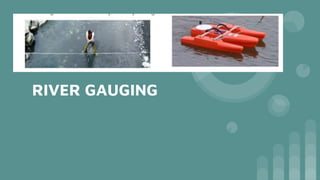
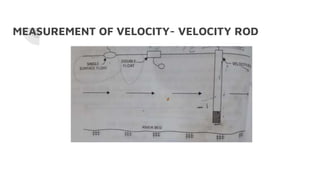
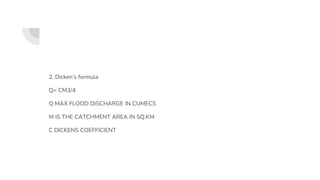
River gauging is the process of measuring river discharge and characteristics over time. It is important for distributing irrigation water, designing irrigation structures, flood warnings, and determining dependable water supplies. The ideal site for river gauging is on a straight river section at right angles to flow, without structures or risk of silting. Discharge can be measured directly using weirs and flumes, or indirectly using area-velocity methods where cross-sectional area and velocity are measured and multiplied. Velocity is typically measured using floats, velocity rods, or current meters. Empirical formulas can also estimate maximum flood discharge based on catchment area.











![09. Silt Theories [Kennedy's Theory].pdf](https://cdn.slidesharecdn.com/ss_thumbnails/09-230714062702-13879994-thumbnail.jpg?width=640&height=640&fit=bounds)


