Traffic Flow Fundamentals 
Introduction
TYPES OF FLOW 
Traffic flow is usually classified as 
either 
a. Uninterrupted Flow 
b. Interrupted Flow
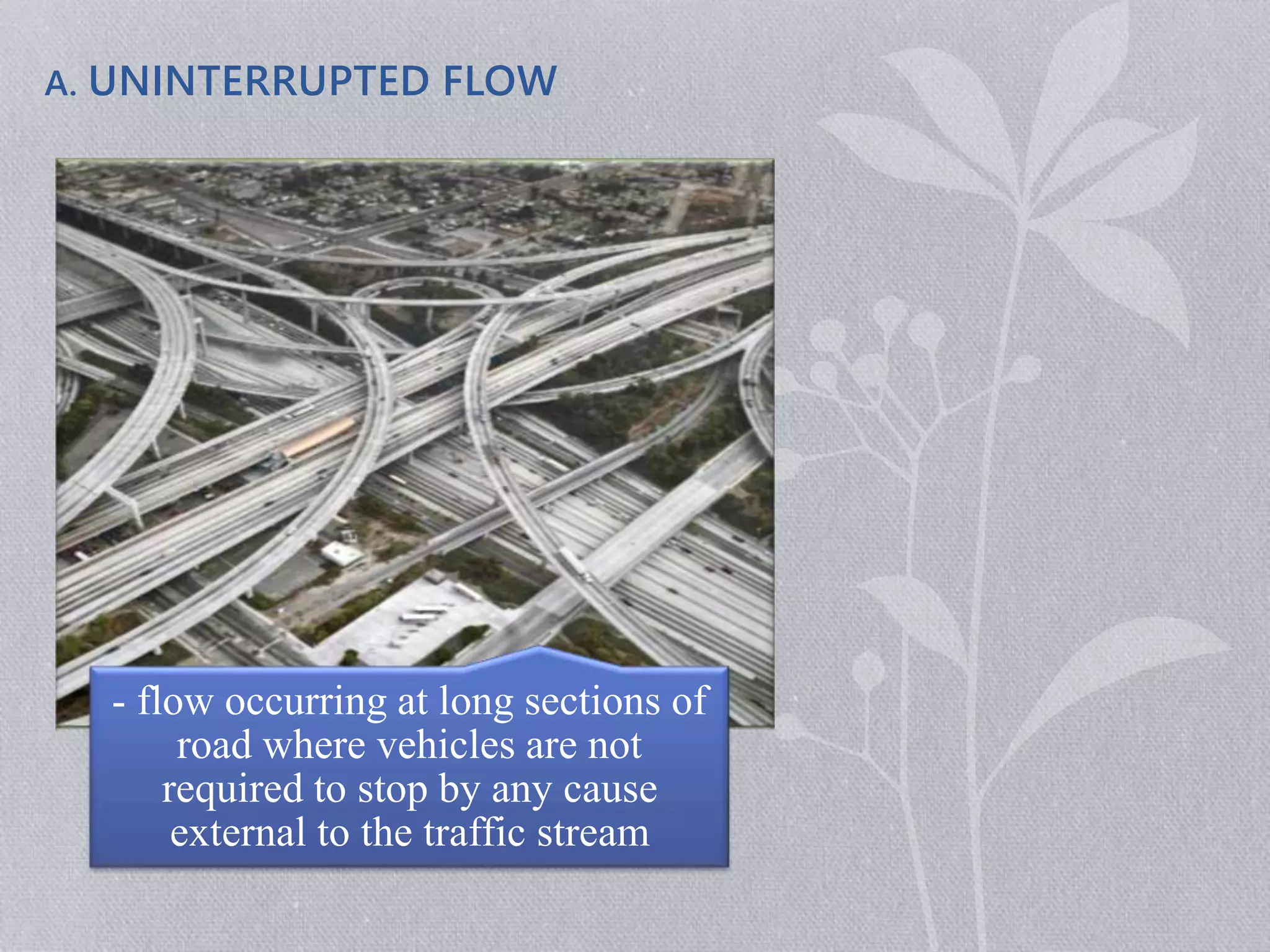
A. UNINTERRUPTED FLOW 
- flow occurring at long sections of 
road where vehicles are not 
required to stop by any cause 
external to the traffic stream
B. INTERRUPTED FLOW 
-flow occurring at long sections of road 
where vehicles are required to stop by 
any cause outside the traffic stream 
such as traffic signs, traffic signal lights
UNINTERRUPTED 
FLOW 
Uninterrupted Flow can be described 
using any of the following traffic 
variables: 
a. Flow rate or volume 
b. Speed 
c. Density or Concentration
A. FLOW RATE OR 
VOLUME 
- number of vehicles passing a point 
during a specified period of time 
- may be expressed as: 
푞 = 
푁 
푇 
where q=flow rate in vehicles/min or 
vehicles/day 
=volume in vehicles/hr 
N=no. of vehicles 
T=observation period
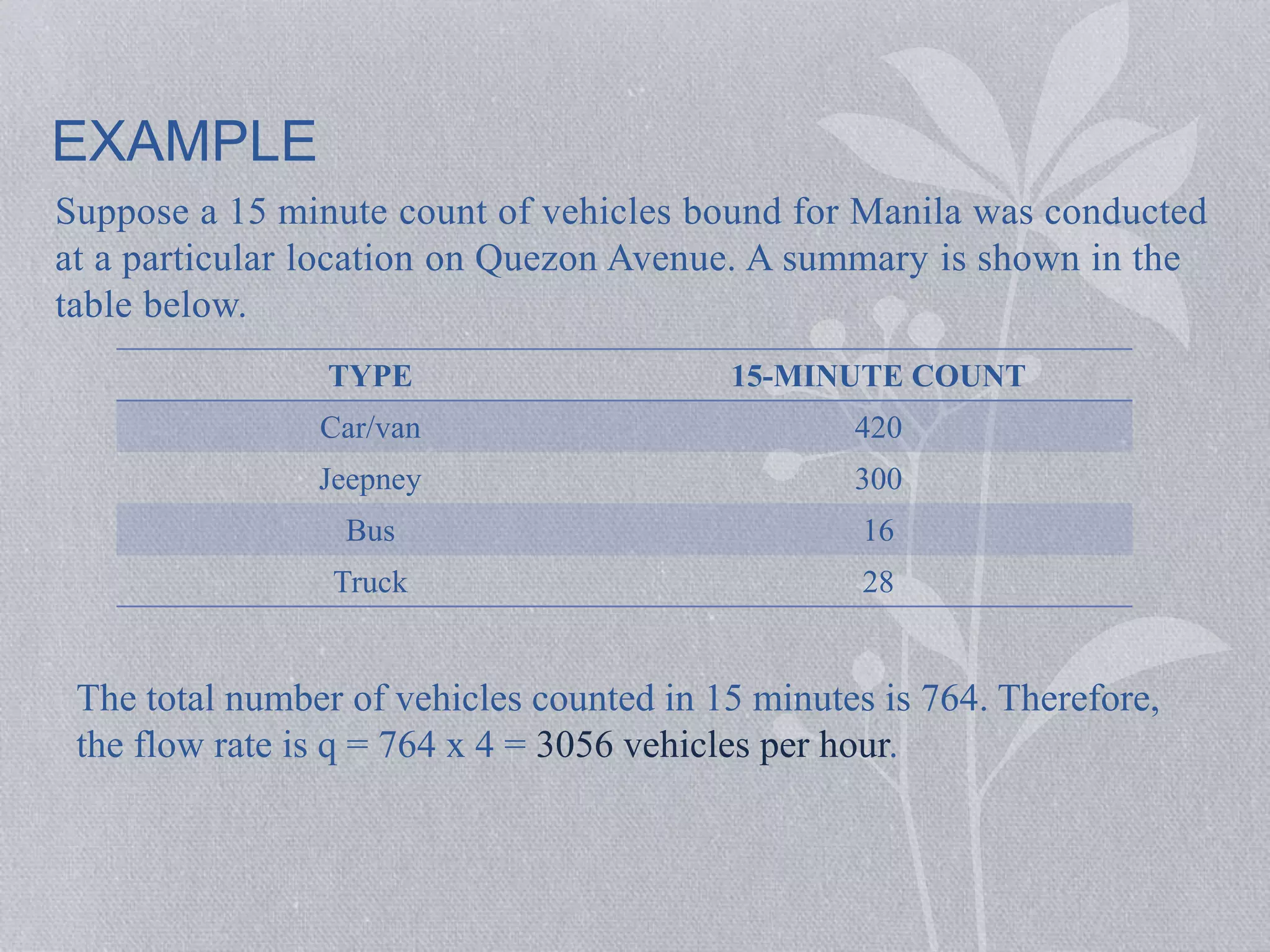
EXAMPLE 
Suppose a 15 minute count of vehicles bound for Manila was conducted 
at a particular location on Quezon Avenue. A summary is shown in the 
table below. 
TYPE 15-MINUTE COUNT 
Car/van 420 
Jeepney 300 
Bus 16 
Truck 28 
The total number of vehicles counted in 15 minutes is 764. Therefore, 
the flow rate is q = 764 x 4 = 3056 vehicles per hour.
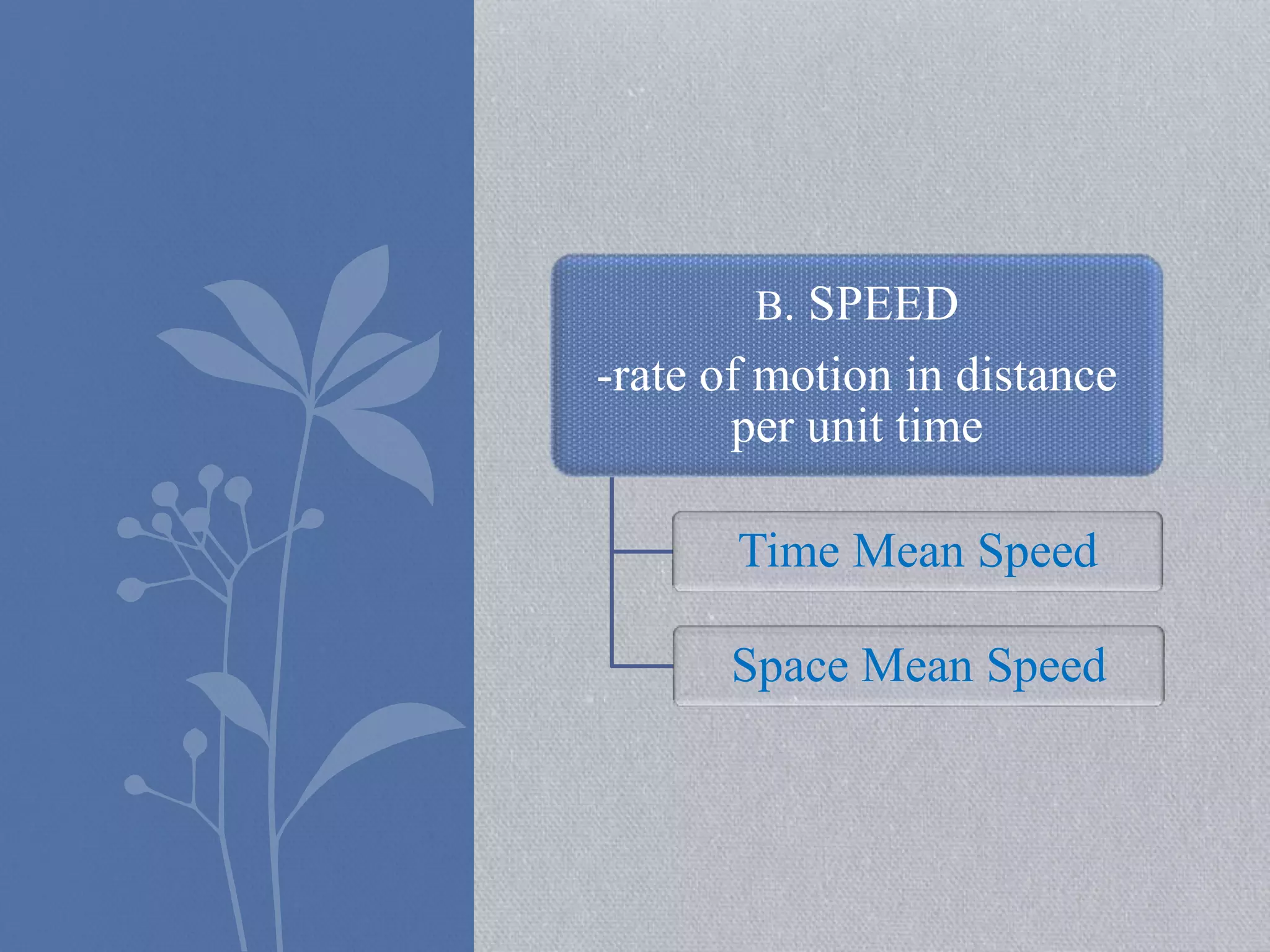
B. SPEED 
-rate of motion in distance 
per unit time 
Time Mean Speed 
Space Mean Speed
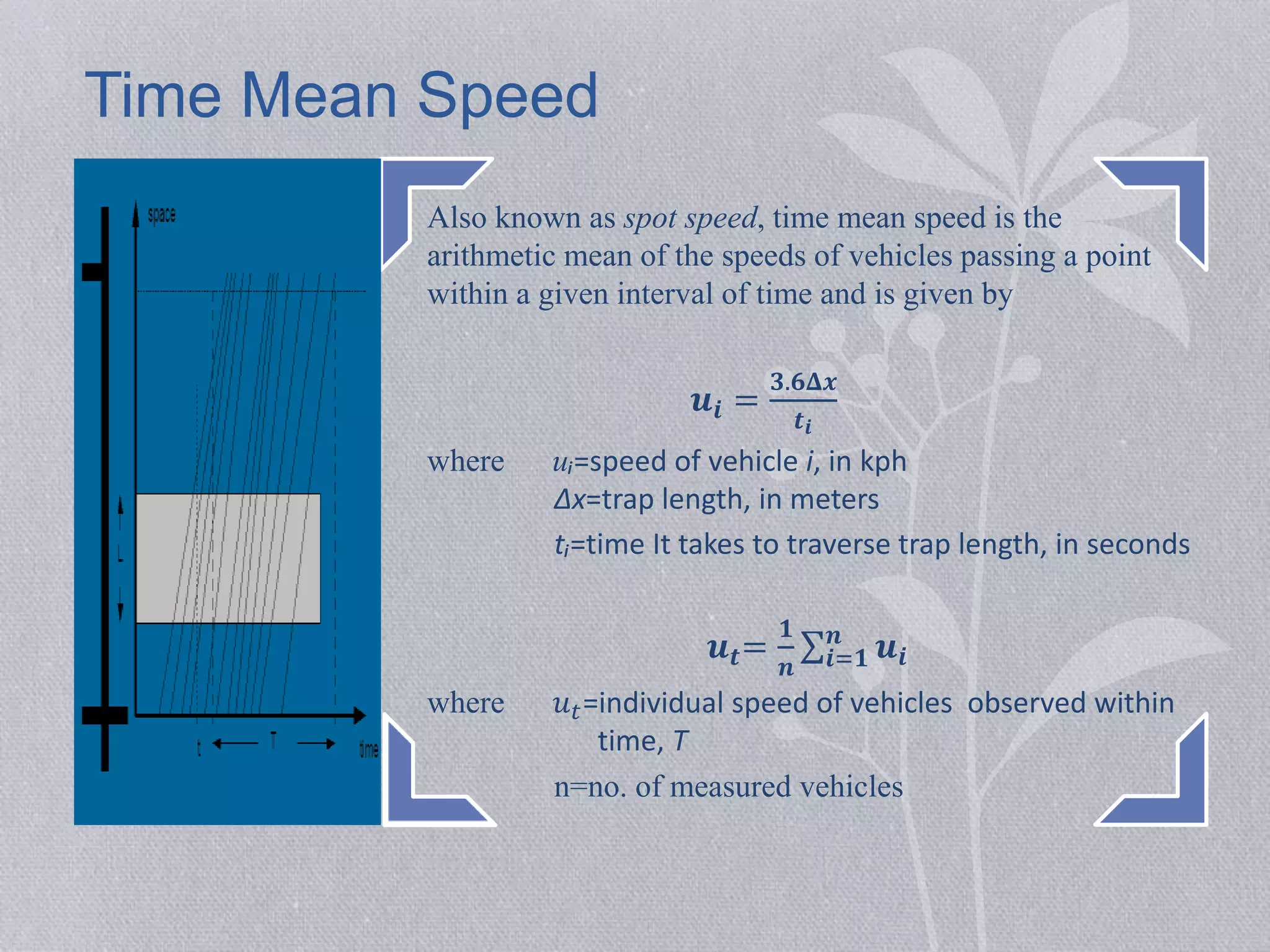
Time Mean Speed 
Also known as spot speed, time mean speed is the 
arithmetic mean of the speeds of vehicles passing a point 
within a given interval of time and is given by 
풖풊 = 
ퟑ.ퟔ횫풙 
풕풊 
where uᵢ=speed of vehicle i, in kph 
Δx=trap length, in meters 
tᵢ=time It takes to traverse trap length, in seconds 
풖풕= 
ퟏ 
풏 
풏 풖풊 
풊=ퟏ 
where 푢푡=individual speed of vehicles observed within 
time, T 
n=no. of measured vehicles
EXAMPLE 
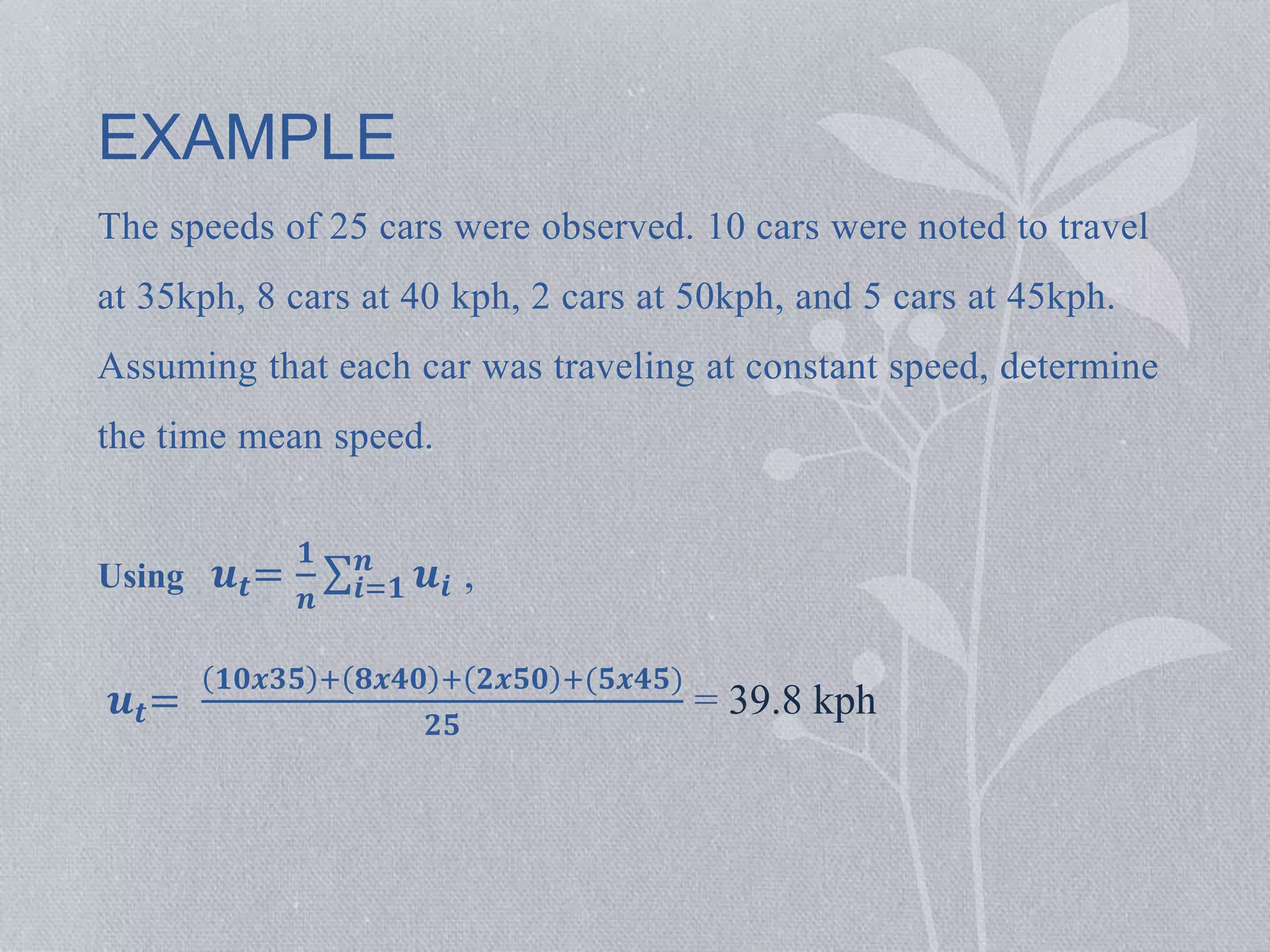
The speeds of 25 cars were observed. 10 cars were noted to travel 
at 35kph, 8 cars at 40 kph, 2 cars at 50kph, and 5 cars at 45kph. 
Assuming that each car was traveling at constant speed, determine 
the time mean speed. 
Using 풖풕= 
ퟏ 
풏 
풏 풖풊 , 
풊=ퟏ 
풖풕= 
ퟏퟎ풙ퟑퟓ + ퟖ풙ퟒퟎ + ퟐ풙ퟓퟎ +(ퟓ풙ퟒퟓ) 
ퟐퟓ 
= 39.8 kph
Space Mean Speed 
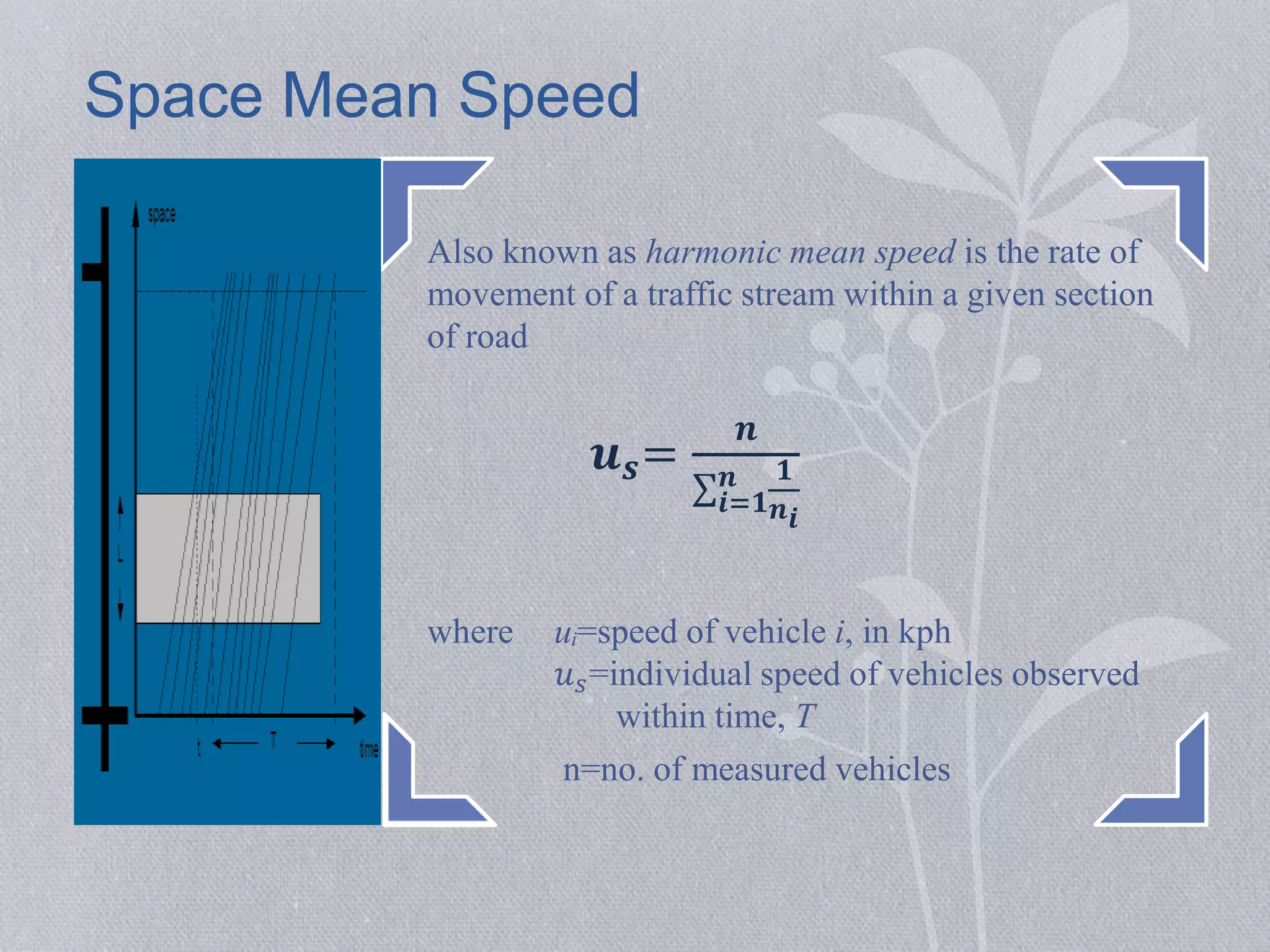
Also known as harmonic mean speed is the rate of 
movement of a traffic stream within a given section 
of road 
풖풔= 
풏 
풏 ퟏ 
풊=ퟏ 
풏풊 
where uᵢ=speed of vehicle i, in kph 
푢푠=individual speed of vehicles observed 
within time, T 
n=no. of measured vehicles
EXAMPLE 
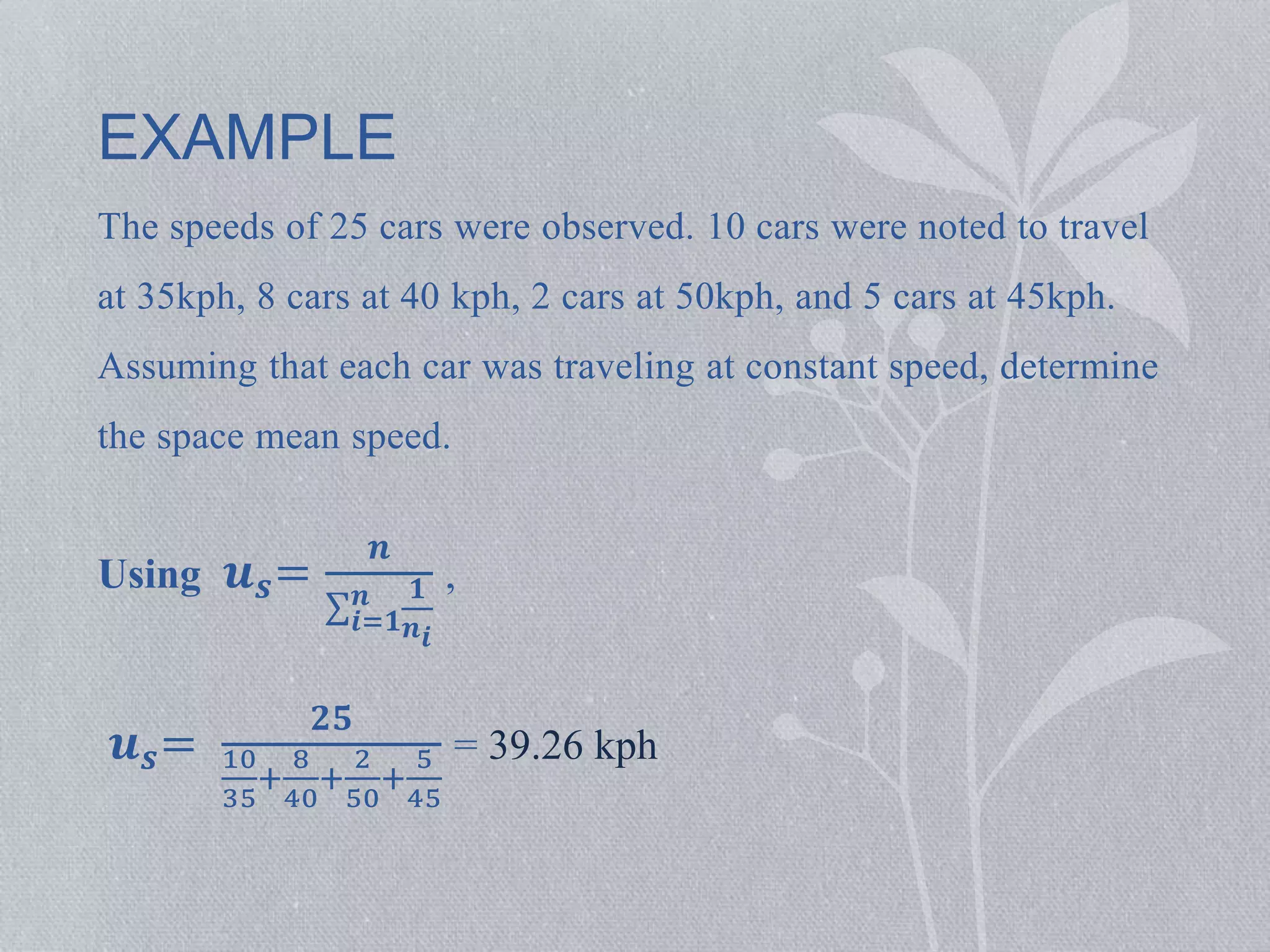
The speeds of 25 cars were observed. 10 cars were noted to travel 
at 35kph, 8 cars at 40 kph, 2 cars at 50kph, and 5 cars at 45kph. 
Assuming that each car was traveling at constant speed, determine 
the space mean speed. 
Using 풖풔= 
풏 
풏 ퟏ 
풊=ퟏ 
풏풊 
, 
풖풔= 
ퟐퟓ 
10 
35 
+ 
8 
40 
+ 
2 
50 
+ 
5 
45 
= 39.26 kph
C. DENSITY 
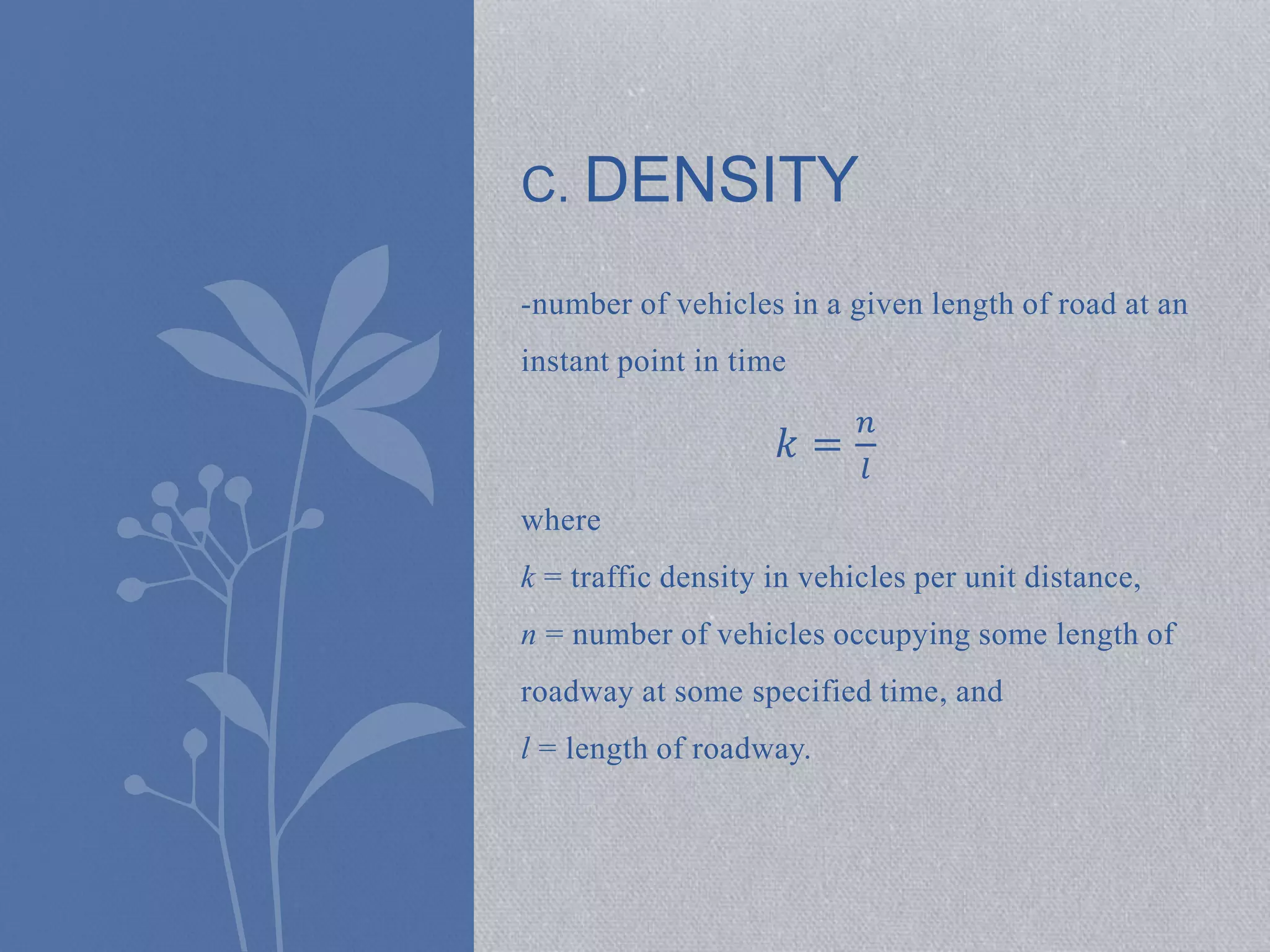
-number of vehicles in a given length of road at an 
instant point in time 
푘 = 
푛 
푙 
where 
k = traffic density in vehicles per unit distance, 
n = number of vehicles occupying some length of 
roadway at some specified time, and 
l = length of roadway.
OTHER TRAFFIC 
VARIABLES 
Other variables used to described traffic 
flow are simply variants of the previous 
variables. 
a. Time Headway 
b. Spacing 
c. Time Occupancy
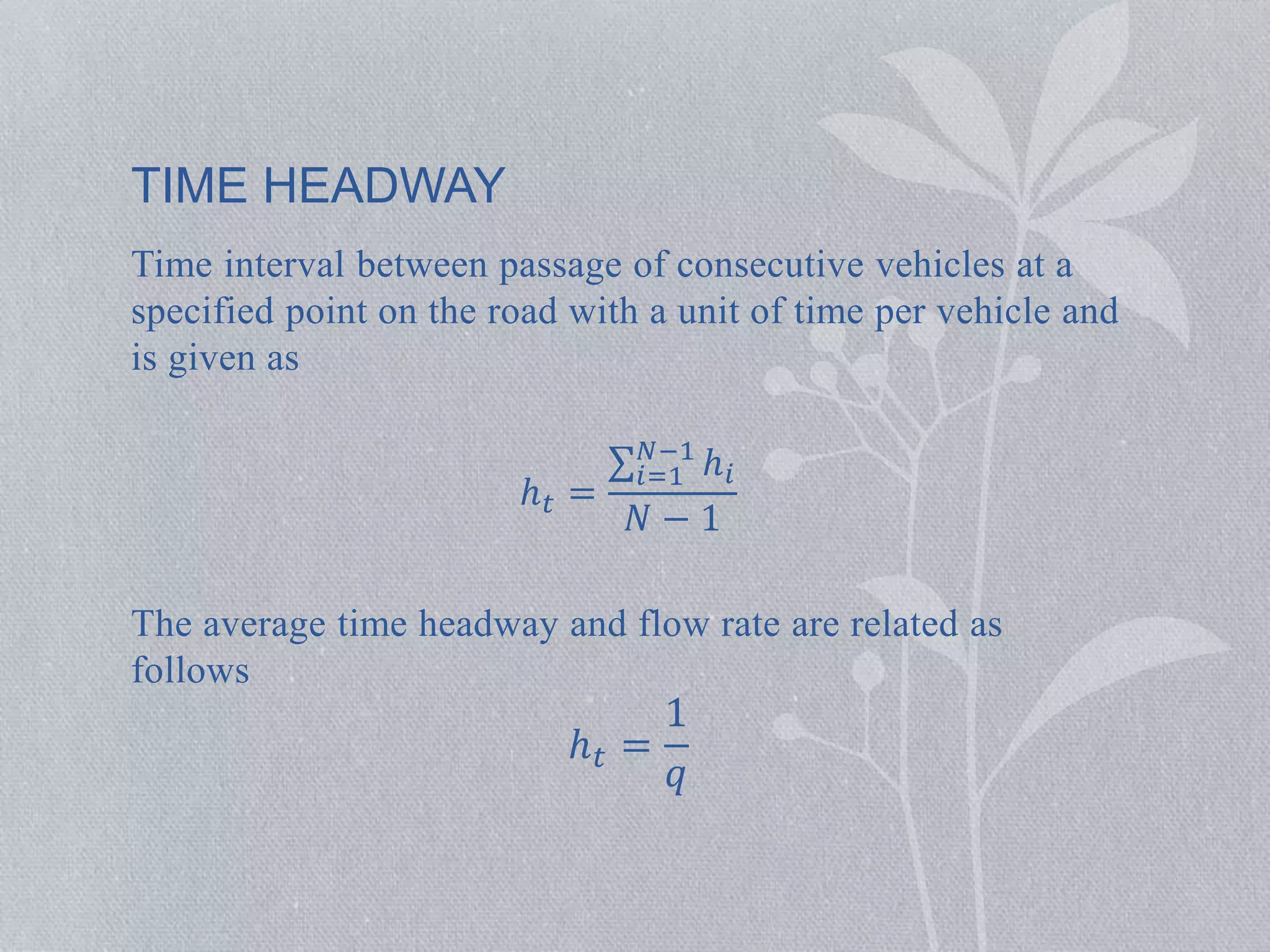
Time interval between passage of consecutive vehicles at a 
specified point on the road with a unit of time per vehicle and 
is given as 
ℎ푡 = 
푁−1 푖=1 
ℎ푖 
푁 − 1 
The average time headway and flow rate are related as 
follows 
ℎ푡 = 
1 
푞 
TIME HEADWAY
EXAMPLE 
During morning peak hour, the average headway of UP-Katipunan 
jeepneys is estimated at 5 minutes. If the passenger demand during 
the same period is 240, determine whether there is a need to increase 
he number of jeepney units (or shorten the headway) for this route. 
Assume that passenger demand is evenly distributed within that 
period and the average load/occupancy is 14 passengers per jeepney. 
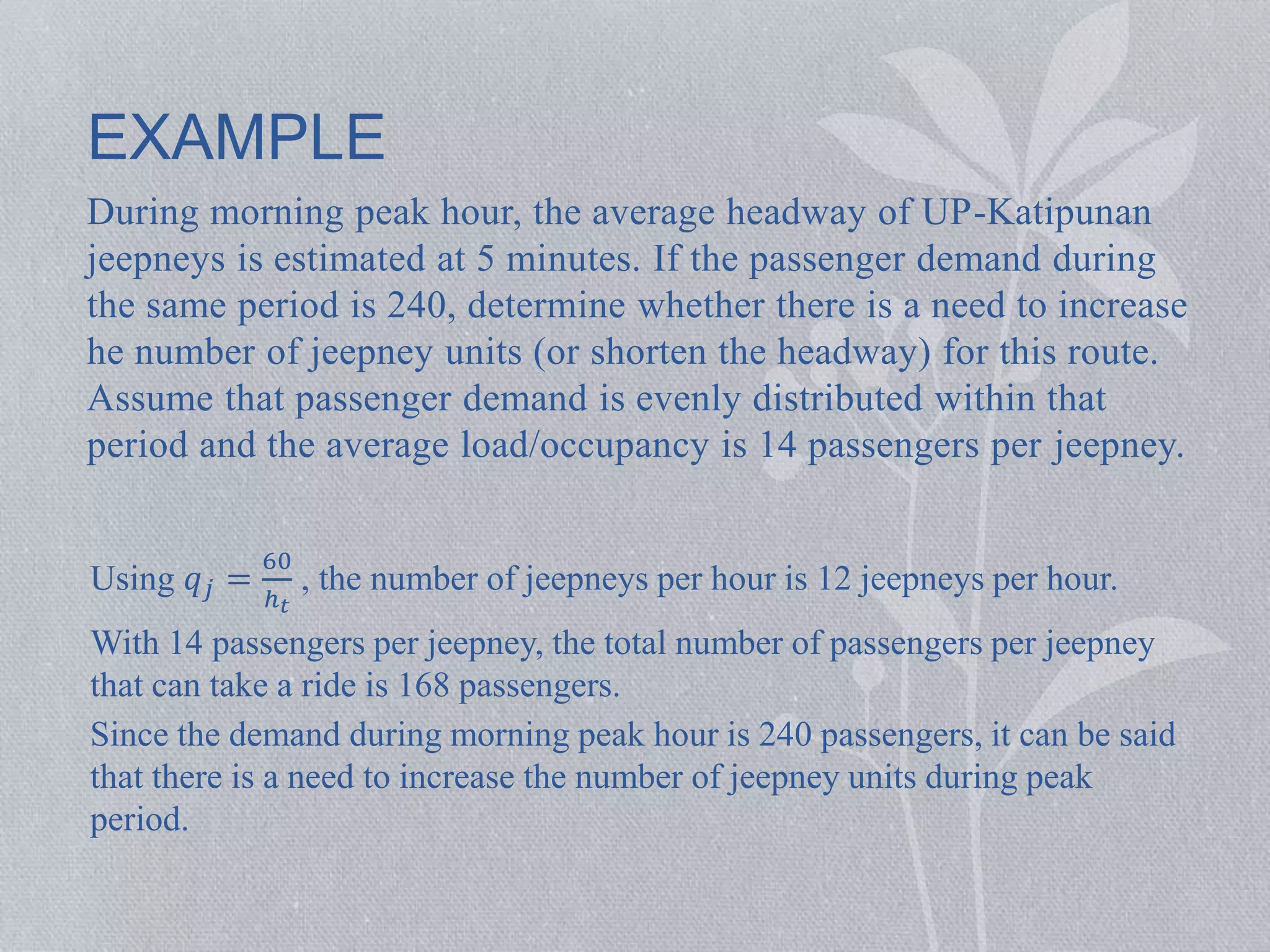
Using 푞푗 = 
60 
ℎ푡 
, the number of jeepneys per hour is 12 jeepneys per hour. 
With 14 passengers per jeepney, the total number of passengers per jeepney 
that can take a ride is 168 passengers. 
Since the demand during morning peak hour is 240 passengers, it can be said 
that there is a need to increase the number of jeepney units during peak 
period.
SPACING 
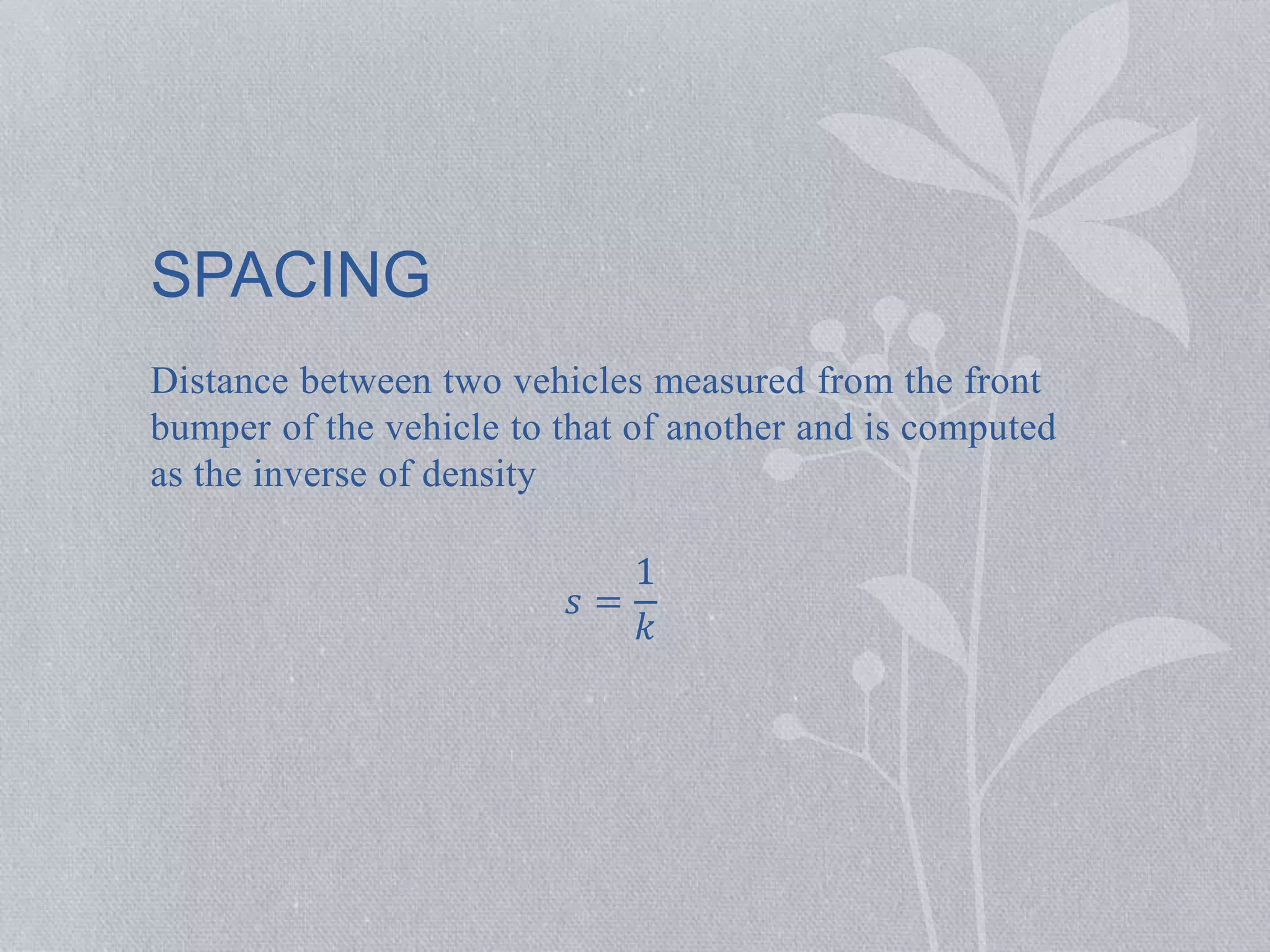
Distance between two vehicles measured from the front 
bumper of the vehicle to that of another and is computed 
as the inverse of density 
푠 = 
1 
푘
EXAMPLE 
During heavy traffic congestion, it was observed that the average 
spacing of vehicles in queue in the innermost lane in EDSA is 6.5m. 
Determine the jam density or density of stopped vehicles. 
Using 푠 = 
1 
푘 
, 
The jam density is 푘푗 = 
1000 
6.5 
= 153.85 vehicles/km
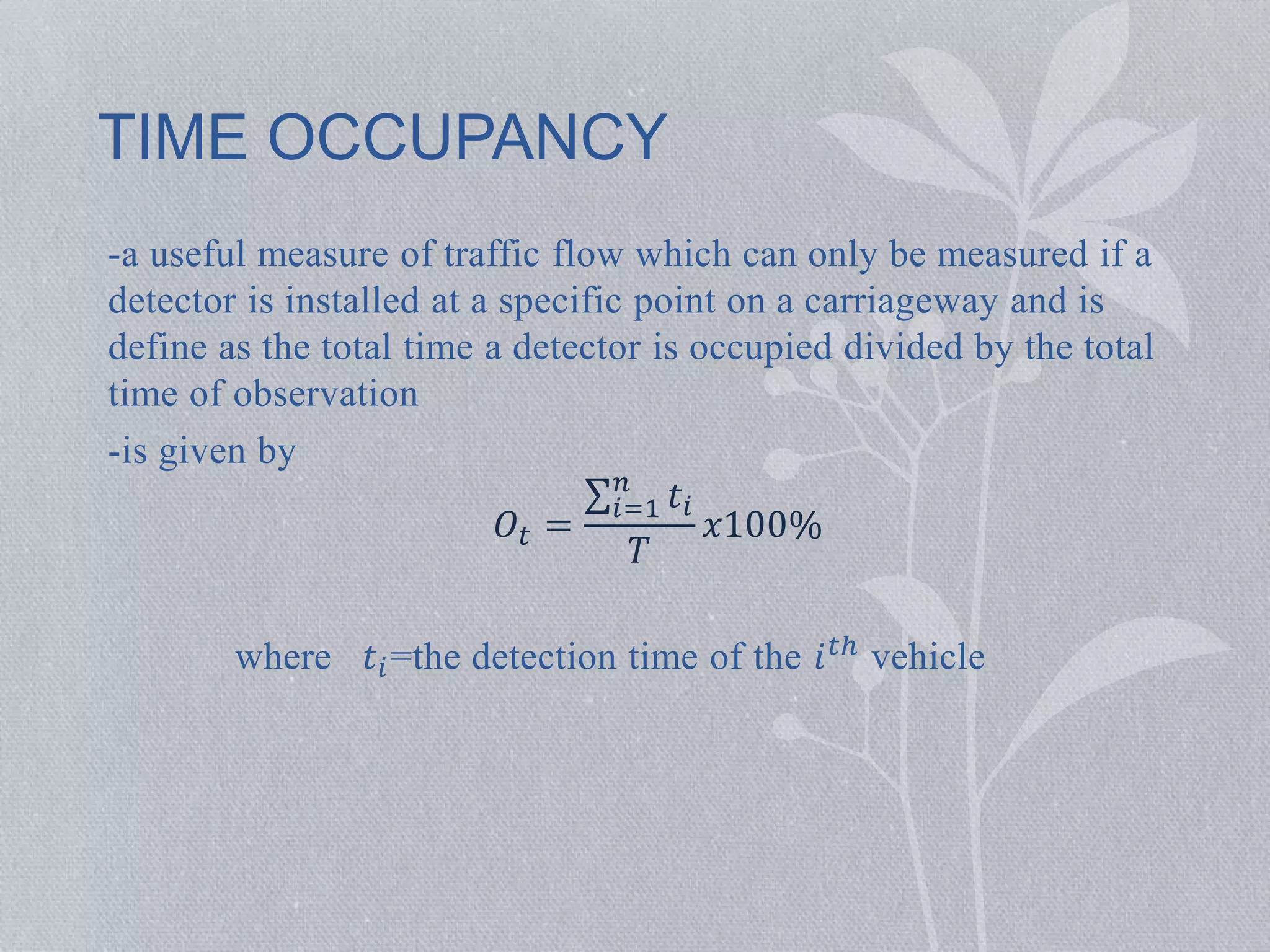
TIME OCCUPANCY 
-a useful measure of traffic flow which can only be measured if a 
detector is installed at a specific point on a carriageway and is 
define as the total time a detector is occupied divided by the total 
time of observation 
-is given by 
푂푡 = 
푛 푖=1 
푡푖 
푇 
푥100% 
where 푡푖=the detection time of the 푖푡ℎ vehicle
RELATIONSHIP OF 
FLOW, SPEED AND 
DENSITY 
A relationship exists among the three most 
important traffic variables: flow rate, space 
mean speed and density. 
a. Observed Relations 
b. Empirical Relations
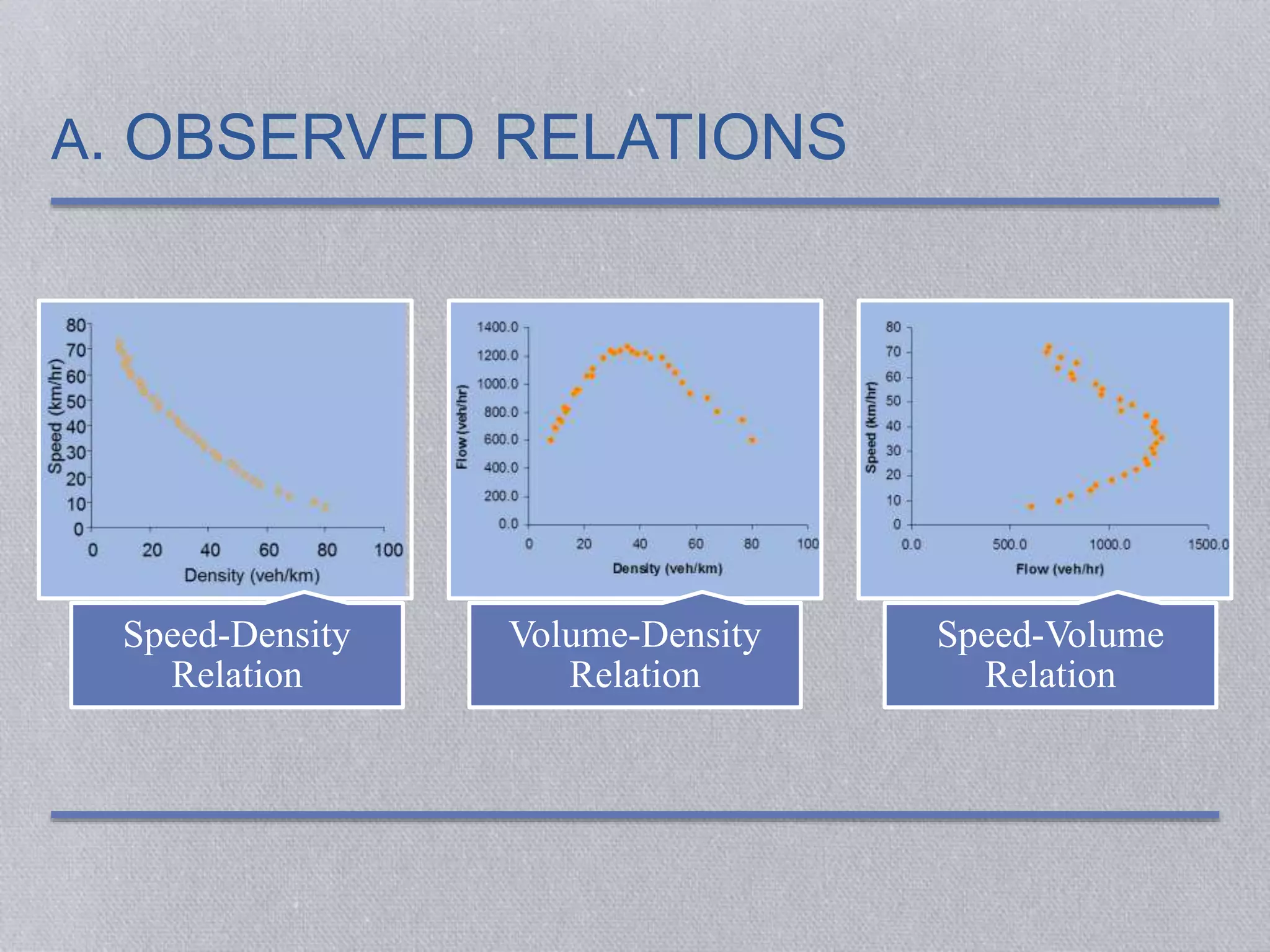
A. OBSERVED RELATIONS 
Speed-Density 
Relation 
Volume-Density 
Relation 
Speed-Volume 
Relation
B. EMPIRICAL 
RELATIONS 
Speed-density relation 
Volume-density relation 
Volume-speed relation
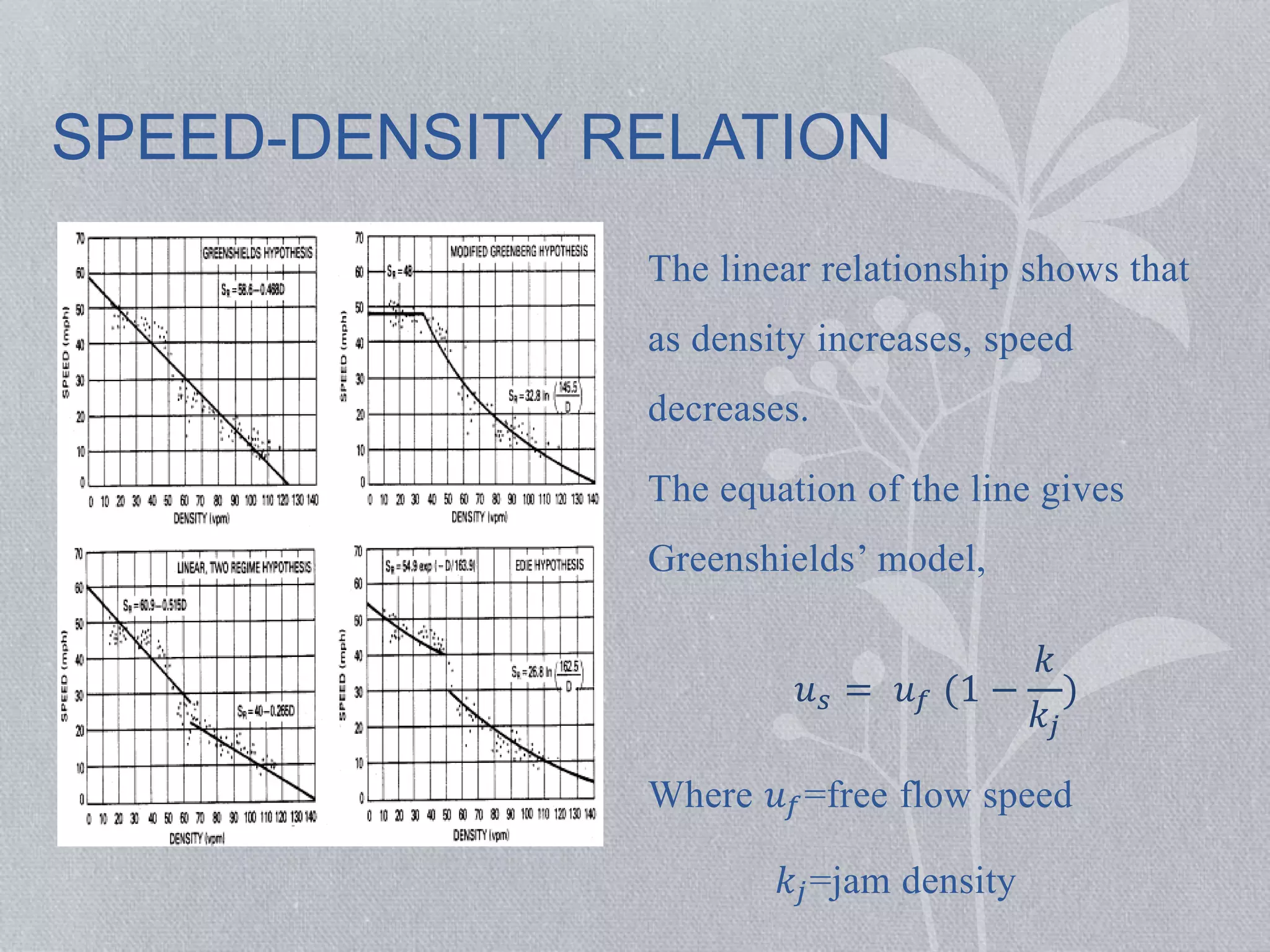
SPEED-DENSITY RELATION 
The linear relationship shows that 
as density increases, speed 
decreases. 
The equation of the line gives 
Greenshields’ model, 
푢푠 = 푢푓 (1 − 
푘 
푘푗 
) 
Where 푢푓=free flow speed 
푘푗=jam density
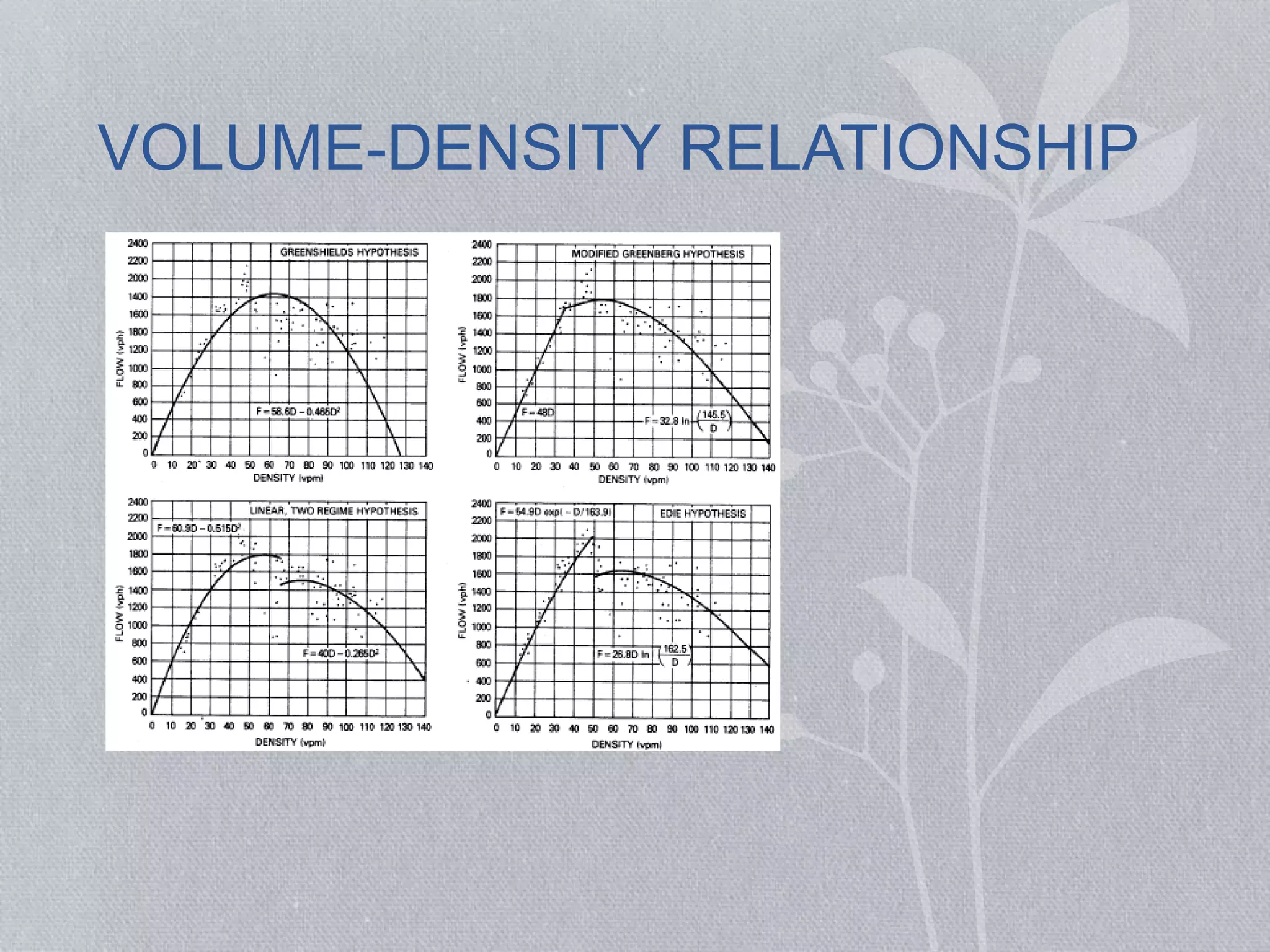
VOLUME-DENSITY RELATIONSHIP
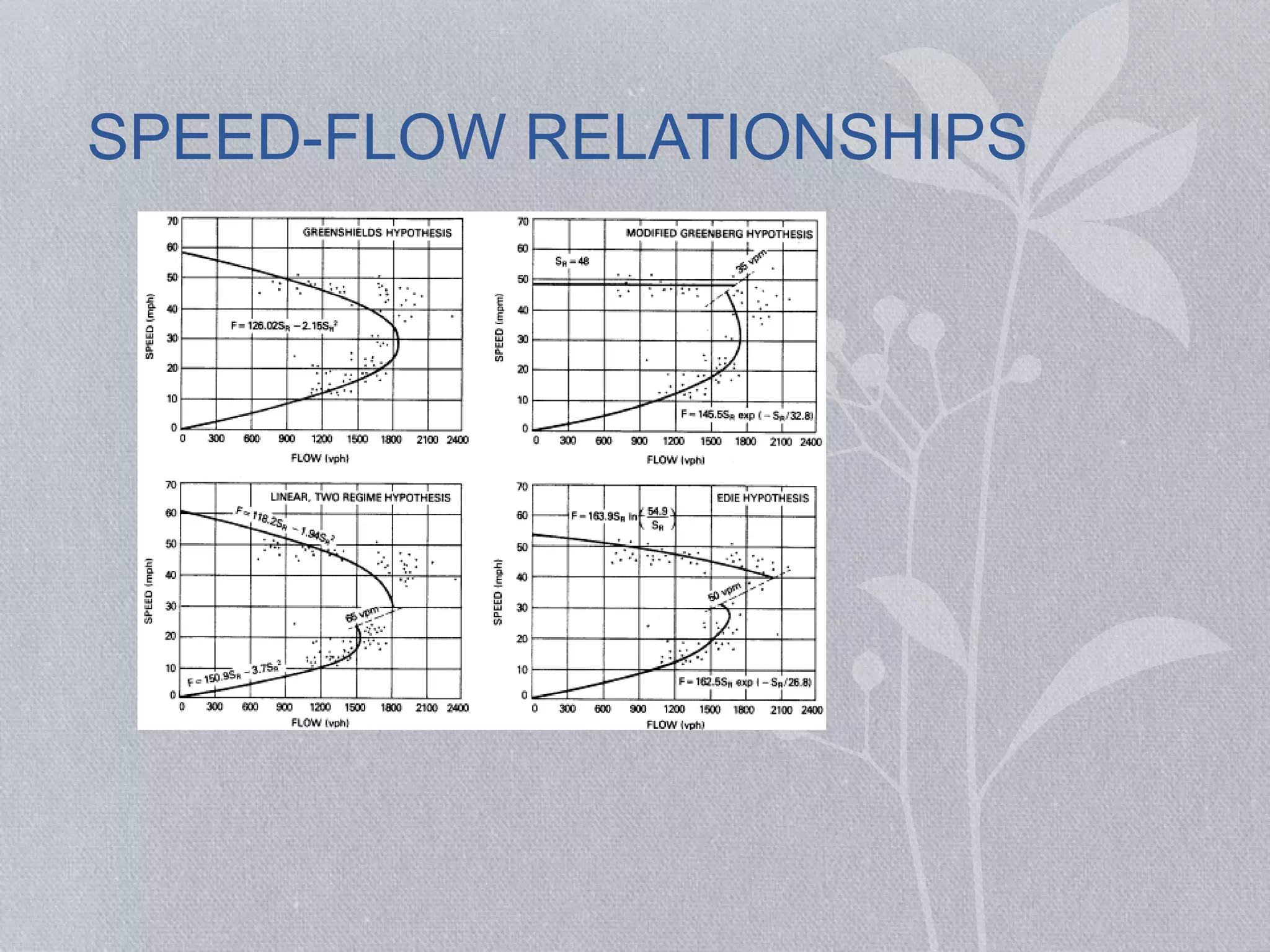
SPEED-FLOW RELATIONSHIPS

Traffic Flow Fundamentals

  • 1.
  • 2.
    TYPES OF FLOW Traffic flow is usually classified as either a. Uninterrupted Flow b. Interrupted Flow
  • 3.
    A. UNINTERRUPTED FLOW - flow occurring at long sections of road where vehicles are not required to stop by any cause external to the traffic stream
  • 4.
    B. INTERRUPTED FLOW -flow occurring at long sections of road where vehicles are required to stop by any cause outside the traffic stream such as traffic signs, traffic signal lights
  • 5.
    UNINTERRUPTED FLOW UninterruptedFlow can be described using any of the following traffic variables: a. Flow rate or volume b. Speed c. Density or Concentration
  • 6.
    A. FLOW RATEOR VOLUME - number of vehicles passing a point during a specified period of time - may be expressed as: 푞 = 푁 푇 where q=flow rate in vehicles/min or vehicles/day =volume in vehicles/hr N=no. of vehicles T=observation period
  • 7.
    EXAMPLE Suppose a15 minute count of vehicles bound for Manila was conducted at a particular location on Quezon Avenue. A summary is shown in the table below. TYPE 15-MINUTE COUNT Car/van 420 Jeepney 300 Bus 16 Truck 28 The total number of vehicles counted in 15 minutes is 764. Therefore, the flow rate is q = 764 x 4 = 3056 vehicles per hour.
  • 8.
    B. SPEED -rateof motion in distance per unit time Time Mean Speed Space Mean Speed
  • 9.
    Time Mean Speed Also known as spot speed, time mean speed is the arithmetic mean of the speeds of vehicles passing a point within a given interval of time and is given by 풖풊 = ퟑ.ퟔ횫풙 풕풊 where uᵢ=speed of vehicle i, in kph Δx=trap length, in meters tᵢ=time It takes to traverse trap length, in seconds 풖풕= ퟏ 풏 풏 풖풊 풊=ퟏ where 푢푡=individual speed of vehicles observed within time, T n=no. of measured vehicles
  • 10.
    EXAMPLE The speedsof 25 cars were observed. 10 cars were noted to travel at 35kph, 8 cars at 40 kph, 2 cars at 50kph, and 5 cars at 45kph. Assuming that each car was traveling at constant speed, determine the time mean speed. Using 풖풕= ퟏ 풏 풏 풖풊 , 풊=ퟏ 풖풕= ퟏퟎ풙ퟑퟓ + ퟖ풙ퟒퟎ + ퟐ풙ퟓퟎ +(ퟓ풙ퟒퟓ) ퟐퟓ = 39.8 kph
  • 11.
    Space Mean Speed Also known as harmonic mean speed is the rate of movement of a traffic stream within a given section of road 풖풔= 풏 풏 ퟏ 풊=ퟏ 풏풊 where uᵢ=speed of vehicle i, in kph 푢푠=individual speed of vehicles observed within time, T n=no. of measured vehicles
  • 12.
    EXAMPLE The speedsof 25 cars were observed. 10 cars were noted to travel at 35kph, 8 cars at 40 kph, 2 cars at 50kph, and 5 cars at 45kph. Assuming that each car was traveling at constant speed, determine the space mean speed. Using 풖풔= 풏 풏 ퟏ 풊=ퟏ 풏풊 , 풖풔= ퟐퟓ 10 35 + 8 40 + 2 50 + 5 45 = 39.26 kph
  • 13.
    C. DENSITY -numberof vehicles in a given length of road at an instant point in time 푘 = 푛 푙 where k = traffic density in vehicles per unit distance, n = number of vehicles occupying some length of roadway at some specified time, and l = length of roadway.
  • 14.
    OTHER TRAFFIC VARIABLES Other variables used to described traffic flow are simply variants of the previous variables. a. Time Headway b. Spacing c. Time Occupancy
  • 15.
    Time interval betweenpassage of consecutive vehicles at a specified point on the road with a unit of time per vehicle and is given as ℎ푡 = 푁−1 푖=1 ℎ푖 푁 − 1 The average time headway and flow rate are related as follows ℎ푡 = 1 푞 TIME HEADWAY
  • 16.
    EXAMPLE During morningpeak hour, the average headway of UP-Katipunan jeepneys is estimated at 5 minutes. If the passenger demand during the same period is 240, determine whether there is a need to increase he number of jeepney units (or shorten the headway) for this route. Assume that passenger demand is evenly distributed within that period and the average load/occupancy is 14 passengers per jeepney. Using 푞푗 = 60 ℎ푡 , the number of jeepneys per hour is 12 jeepneys per hour. With 14 passengers per jeepney, the total number of passengers per jeepney that can take a ride is 168 passengers. Since the demand during morning peak hour is 240 passengers, it can be said that there is a need to increase the number of jeepney units during peak period.
  • 17.
    SPACING Distance betweentwo vehicles measured from the front bumper of the vehicle to that of another and is computed as the inverse of density 푠 = 1 푘
  • 18.
    EXAMPLE During heavytraffic congestion, it was observed that the average spacing of vehicles in queue in the innermost lane in EDSA is 6.5m. Determine the jam density or density of stopped vehicles. Using 푠 = 1 푘 , The jam density is 푘푗 = 1000 6.5 = 153.85 vehicles/km
  • 19.
    TIME OCCUPANCY -auseful measure of traffic flow which can only be measured if a detector is installed at a specific point on a carriageway and is define as the total time a detector is occupied divided by the total time of observation -is given by 푂푡 = 푛 푖=1 푡푖 푇 푥100% where 푡푖=the detection time of the 푖푡ℎ vehicle
  • 20.
    RELATIONSHIP OF FLOW,SPEED AND DENSITY A relationship exists among the three most important traffic variables: flow rate, space mean speed and density. a. Observed Relations b. Empirical Relations
  • 21.
    A. OBSERVED RELATIONS Speed-Density Relation Volume-Density Relation Speed-Volume Relation
  • 22.
    B. EMPIRICAL RELATIONS Speed-density relation Volume-density relation Volume-speed relation
  • 23.
    SPEED-DENSITY RELATION Thelinear relationship shows that as density increases, speed decreases. The equation of the line gives Greenshields’ model, 푢푠 = 푢푓 (1 − 푘 푘푗 ) Where 푢푓=free flow speed 푘푗=jam density
  • 24.
  • 25.