Introduction:
 A flood is an unusually high stage in a river –
normally the level at which the river overflows its
banks and inundates the adjoining area. The
damages caused by floods in terms of loss of life,
property and economic loss due to disruption of
economic activity are very high. Flood peak
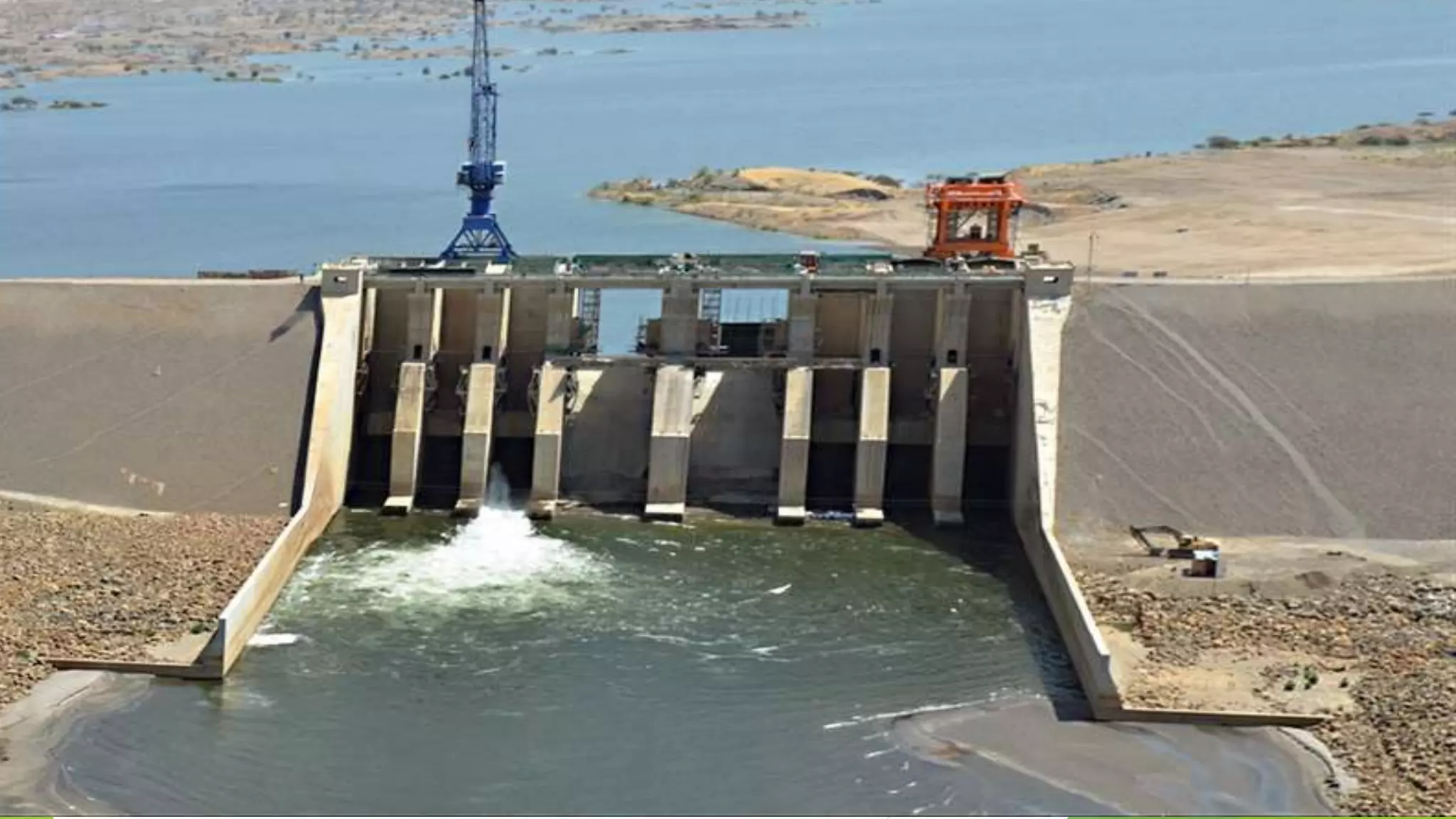
values are required in the design bridges, culvert
waterways, spillways for dams, and estimation
of scour at a hydraulic structure
Continu….
 At a given location in a stream, flood peaks
vary from year to year and their magnitude
constitutes a hydrologic series. To estimate the
magnitude of a flood peak the following
methods are adopted:
1. Rational method
2. Empirical equations
3. Flood frequency studies
4. Unit hydrograph technique
FLOOD ROUTING
 The flood hydrograph is in fact a wave. The stage
and discharge hydrographs represent the
passage of waves of stream depth and discharge
respectively. As this wave moves down, the shape
of the wave gets modified due to channel
storage, resistance, lateral addition or withdrawal
of flows etc. When a flood wave passes through a
reservoir its peak is attenuated and the time base
is enlarged due to effect of storage
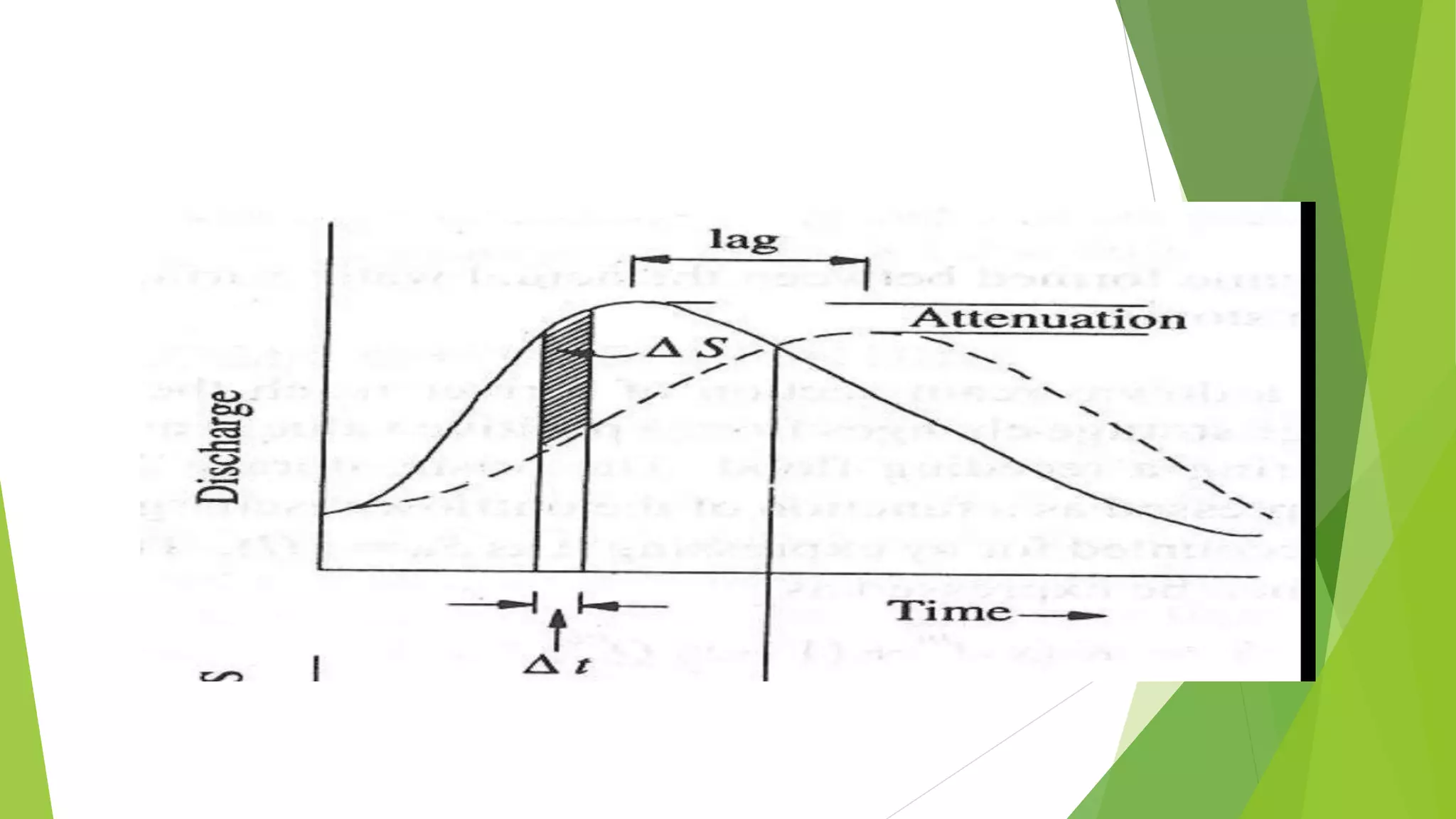
The reduction in the peak of the outflow hydrograph
due to storage effects is called attenuation. Further the
peak of outflow occurs after the peak of the inflow; the
time difference between the peaks of inflow and
outflow hydrographs is known as lag.
Continu……
 Modification in the hydrograph is studied through flood routing. Flood routing
is the technique of determining the flood
hydrograph at a section of a river by utilizing the data of
flood flow at one or more upstream sections.
Basic Equation for hydrologic routing:
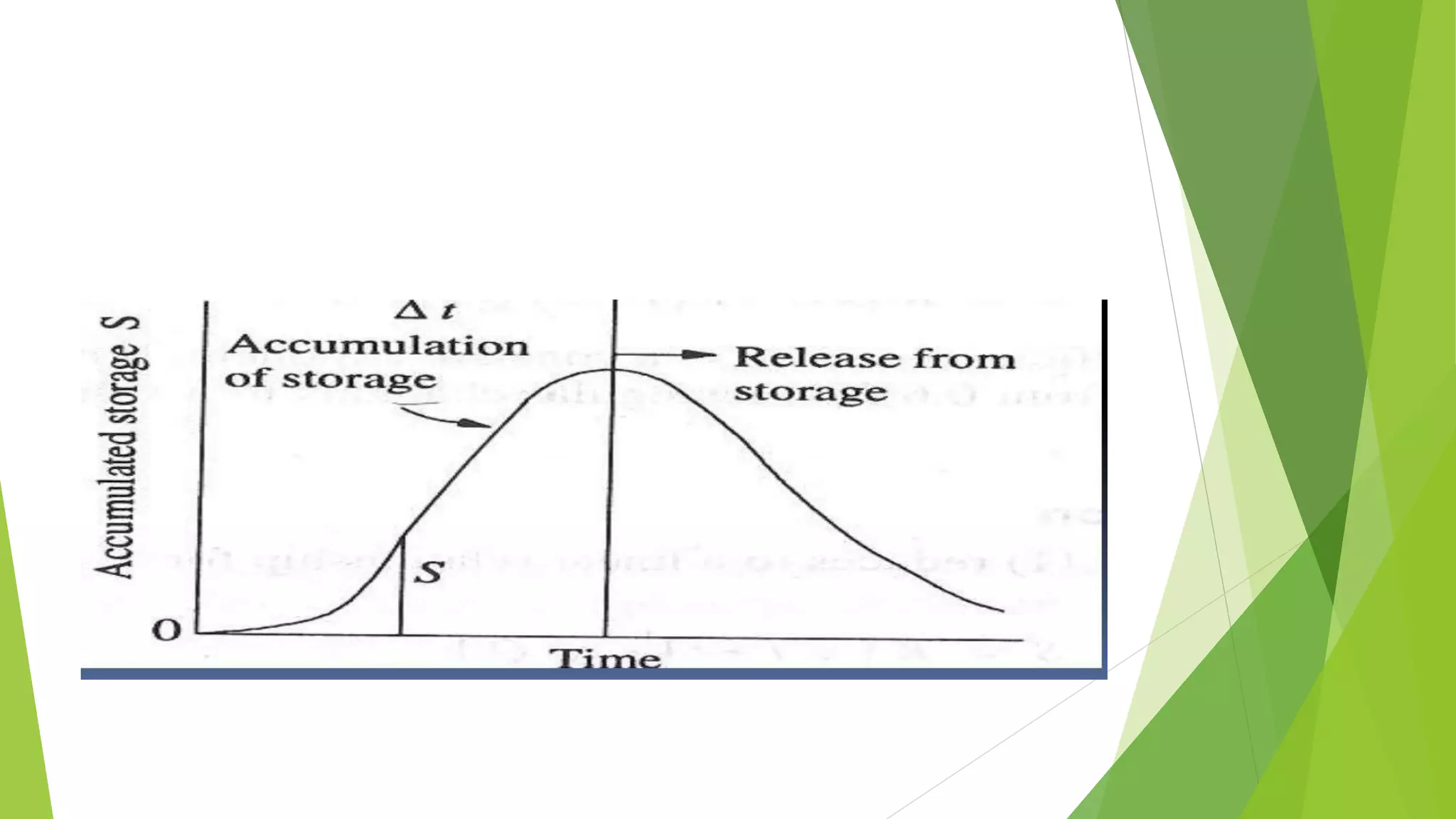
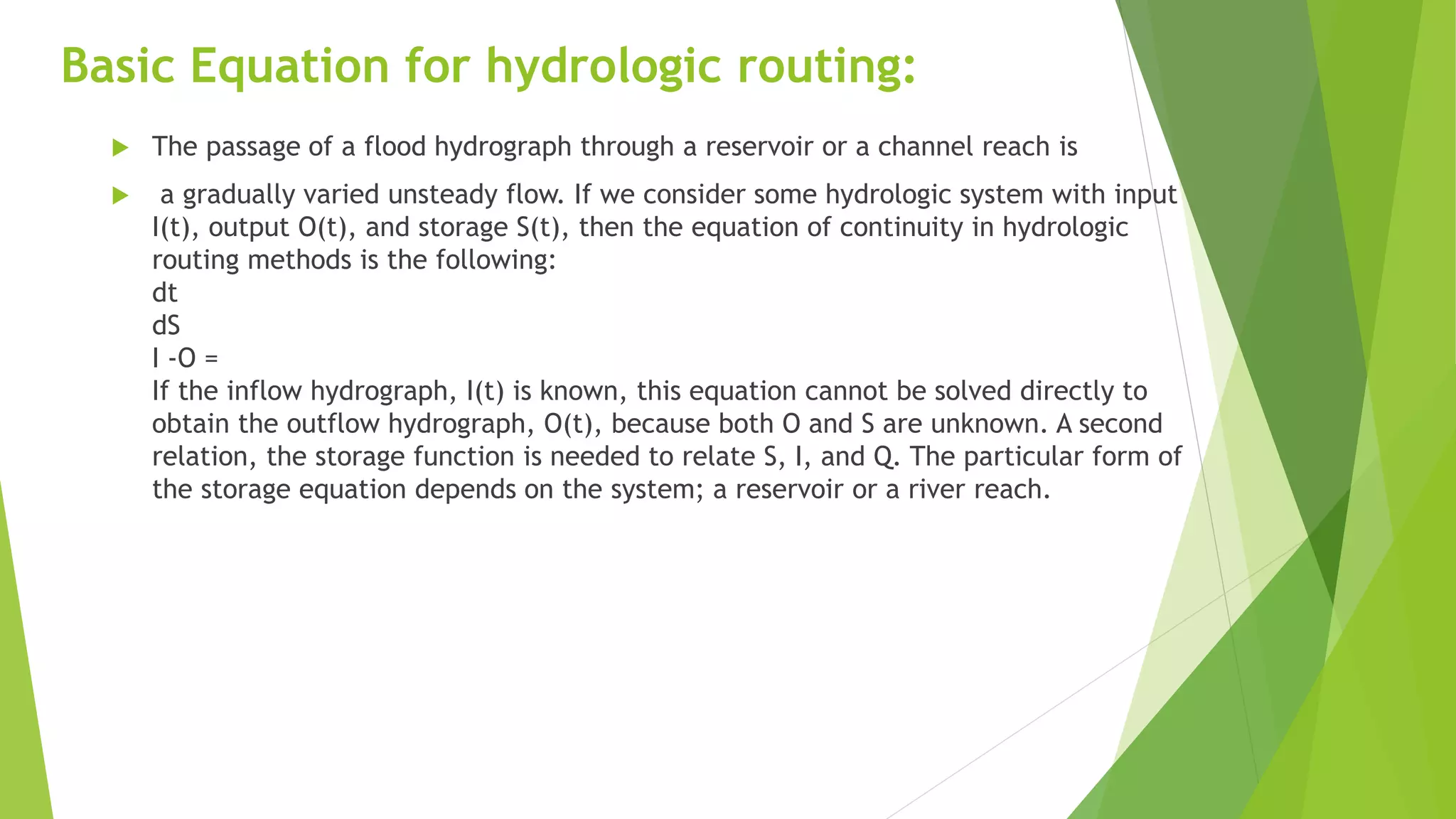
 The passage of a flood hydrograph through a reservoir or a channel reach is
 a gradually varied unsteady flow. If we consider some hydrologic system with input
I(t), output O(t), and storage S(t), then the equation of continuity in hydrologic
routing methods is the following:
dt
dS
I -O =
If the inflow hydrograph, I(t) is known, this equation cannot be solved directly to
obtain the outflow hydrograph, O(t), because both O and S are unknown. A second
relation, the storage function is needed to relate S, I, and Q. The particular form of
the storage equation depends on the system; a reservoir or a river reach.
Routing Methods:
 Modified Puls
 Kinematic Wave
 Muskingum
 Muskingum-Cunge
 Dynamic
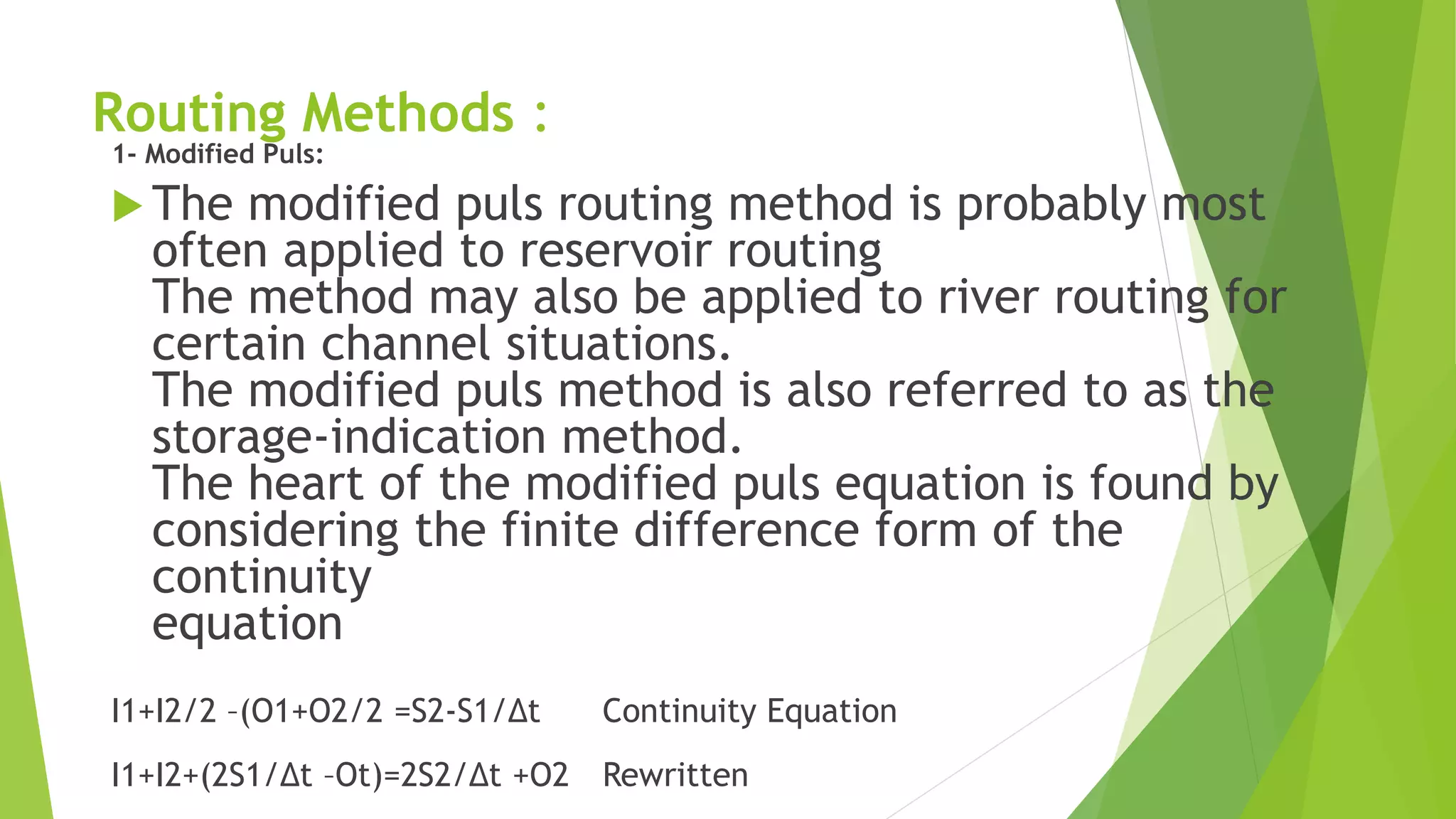
Routing Methods :
1- Modified Puls:
 The modified puls routing method is probably most
often applied to reservoir routing
The method may also be applied to river routing for
certain channel situations.
The modified puls method is also referred to as the
storage-indication method.
The heart of the modified puls equation is found by
considering the finite difference form of the
continuity
equation
I1+I2/2 –(O1+O2/2 =S2-S1/Δt Continuity Equation
I1+I2+(2S1/Δt –Ot)=2S2/Δt +O2 Rewritten
 Modified Puls:
 The solution to the modified puls method is
accomplished by developing a graph (or table) of O -vs-
[2S/Δt + O]. In order to do this, a stage-discharge storage relationship must be
known, assumed, or
derived.
 2-MUSKINGUM:
 The method assumes a single stage-discharge relationship.
•In other words, for any given discharge, Q, there can be only one
stage height.
•This assumption may not be entirely valid for certain flow
situations.
 For instance, the friction slope on the rising side of a hydrograph
for a given flow, Q, may be quite different than for the recession
side of the hydrograph for the same given flow, Q.
•This causes an effect known as hysteresis, which can introduce
errors into the storage assumptions of this method

Presentation aboout flood routing

  • 1.
    Introduction:  A floodis an unusually high stage in a river – normally the level at which the river overflows its banks and inundates the adjoining area. The damages caused by floods in terms of loss of life, property and economic loss due to disruption of economic activity are very high. Flood peak values are required in the design bridges, culvert waterways, spillways for dams, and estimation of scour at a hydraulic structure
  • 2.
    Continu….  At agiven location in a stream, flood peaks vary from year to year and their magnitude constitutes a hydrologic series. To estimate the magnitude of a flood peak the following methods are adopted: 1. Rational method 2. Empirical equations 3. Flood frequency studies 4. Unit hydrograph technique
  • 3.
    FLOOD ROUTING  Theflood hydrograph is in fact a wave. The stage and discharge hydrographs represent the passage of waves of stream depth and discharge respectively. As this wave moves down, the shape of the wave gets modified due to channel storage, resistance, lateral addition or withdrawal of flows etc. When a flood wave passes through a reservoir its peak is attenuated and the time base is enlarged due to effect of storage The reduction in the peak of the outflow hydrograph due to storage effects is called attenuation. Further the peak of outflow occurs after the peak of the inflow; the time difference between the peaks of inflow and outflow hydrographs is known as lag.
  • 4.
    Continu……  Modification inthe hydrograph is studied through flood routing. Flood routing is the technique of determining the flood hydrograph at a section of a river by utilizing the data of flood flow at one or more upstream sections.
  • 8.
    Basic Equation forhydrologic routing:  The passage of a flood hydrograph through a reservoir or a channel reach is  a gradually varied unsteady flow. If we consider some hydrologic system with input I(t), output O(t), and storage S(t), then the equation of continuity in hydrologic routing methods is the following: dt dS I -O = If the inflow hydrograph, I(t) is known, this equation cannot be solved directly to obtain the outflow hydrograph, O(t), because both O and S are unknown. A second relation, the storage function is needed to relate S, I, and Q. The particular form of the storage equation depends on the system; a reservoir or a river reach.
  • 9.
    Routing Methods:  ModifiedPuls  Kinematic Wave  Muskingum  Muskingum-Cunge  Dynamic
  • 10.
    Routing Methods : 1-Modified Puls:  The modified puls routing method is probably most often applied to reservoir routing The method may also be applied to river routing for certain channel situations. The modified puls method is also referred to as the storage-indication method. The heart of the modified puls equation is found by considering the finite difference form of the continuity equation I1+I2/2 –(O1+O2/2 =S2-S1/Δt Continuity Equation I1+I2+(2S1/Δt –Ot)=2S2/Δt +O2 Rewritten
  • 11.
     Modified Puls: The solution to the modified puls method is accomplished by developing a graph (or table) of O -vs- [2S/Δt + O]. In order to do this, a stage-discharge storage relationship must be known, assumed, or derived.  2-MUSKINGUM:  The method assumes a single stage-discharge relationship. •In other words, for any given discharge, Q, there can be only one stage height. •This assumption may not be entirely valid for certain flow situations.  For instance, the friction slope on the rising side of a hydrograph for a given flow, Q, may be quite different than for the recession side of the hydrograph for the same given flow, Q. •This causes an effect known as hysteresis, which can introduce errors into the storage assumptions of this method