GOVT.COLLEGE OF
ENGINEERIG
AURANGABAD.

Topic :- MESUREMENT OF PRECIPITATION

GUIDED BY:SUBMITED BY:-

PROF .K. A.PATIL

1) Nikhil Holsamudrkar (BE11F01F017)
2)Suresh Hatkar(BE11F01F015)
3) Swapnil Dhakane(BE11F01F013)
4) Mamta Ingole(BE11F01F018)
PRECIPITATION
Introduction
PRECIPITATION








All forms of water that reaches earth’s surface is
known as precipitation.
It is expressed in terms of depth to which rainfall
water would stand on an area if all the rain were
collected on it.
In case of snowfall equivalent depth of water is
considered as depth of precipitation.
Rain gauges are used for measurement of
precipitation.
PRECIPITATION




1.
2.
3.

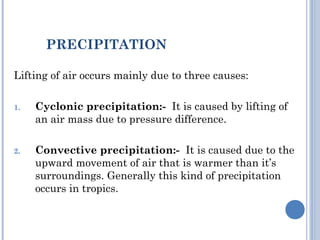
In India ‘Indian Meteorological Department (IMD)’ is
responsible for all weather and rainfall predictions.
It occurs due to:
Lifting of air mass
Cooling of warm air
Condensation
PRECIPITATION
Lifting of air occurs mainly due to three causes:
1.

Cyclonic precipitation:- It is caused by lifting of
an air mass due to pressure difference.

2.

Convective precipitation:- It is caused due to the
upward movement of air that is warmer than it’s
surroundings. Generally this kind of precipitation
occurs in tropics.
PRECIPITATION
3.

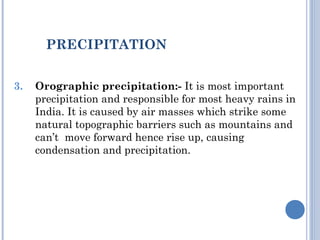
Orographic precipitation:- It is most important
precipitation and responsible for most heavy rains in
India. It is caused by air masses which strike some
natural topographic barriers such as mountains and
can’t move forward hence rise up, causing
condensation and precipitation.
RAINGAUGES
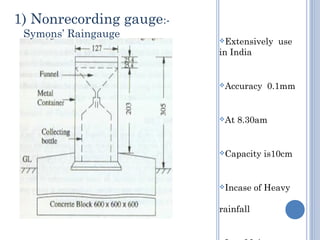
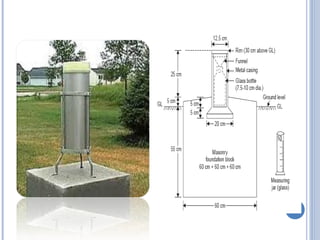
1. Recording type
2. Non recording type
 Most rain gauges used in India are recording
type i.e. Symon's raingauge.
 Recordings are taken at 8:30 am
 And if rainfall is more then intermediate
readings are taken at 5:30pm
PRECIPITATION
Measurement, Estimation and Probability
PRECIPITATION DATA


Necessary for various fields
 Municipal
 Industrial
 Agricultural
 Forestry
 Flood prevention
 Recreation
1) Nonrecording gauge:Symons’ Raingauge

Extensively

use

in India

Accuracy

At

0.1mm

8.30am

Capacity

Incase

rainfall

is10cm

of Heavy
2)RECORDING RAIN GAGES

Weighing

Tipping

bucket type

bucket type

Natural-syphons

type
TIPPING BUCKET TYPE
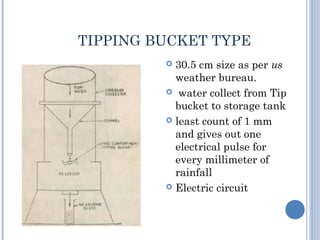
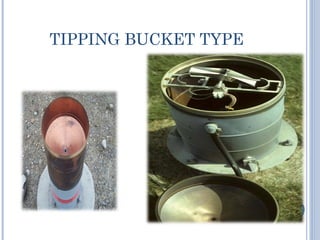
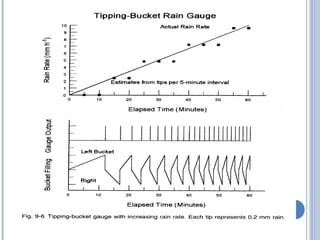
30.5 cm size as per us
weather bureau.
 water collect from Tip
bucket to storage tank
 least count of 1 mm
and gives out one
electrical pulse for
every millimeter of
rainfall
 Electric circuit

TIPPING BUCKET TYPE
WEIGHING BUCKET TYPE
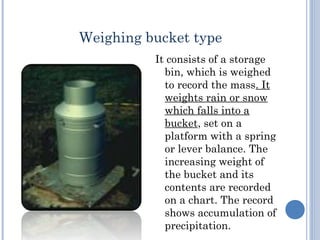
Weighing bucket type
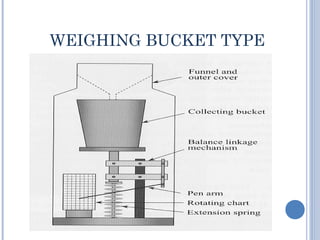
It consists of a storage
bin, which is weighed
to record the mass. It
weights rain or snow
which falls into a
bucket, set on a
platform with a spring
or lever balance. The
increasing weight of
the bucket and its
contents are recorded
on a chart. The record
shows accumulation of
precipitation.
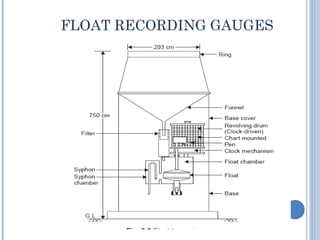
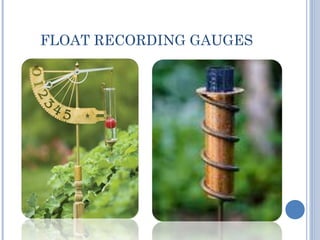
FLOAT RECORDING GAUGES
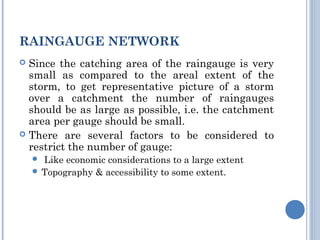
RAINGAUGE NETWORK
Since the catching area of the raingauge is very
small as compared to the areal extent of the
storm, to get representative picture of a storm
over a catchment the number of raingauges
should be as large as possible, i.e. the catchment
area per gauge should be small.
 There are several factors to be considered to
restrict the number of gauge:


Like economic considerations to a large extent
 Topography & accessibility to some extent.

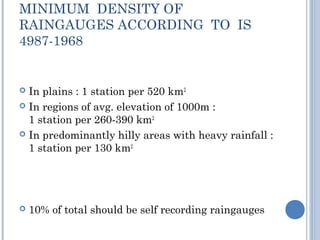
MINIMUM DENSITY OF
RAINGAUGES ACCORDING TO IS
4987-1968

In plains : 1 station per 520 km2
 In regions of avg. elevation of 1000m :
1 station per 260-390 km2
 In predominantly hilly areas with heavy rainfall :
1 station per 130 km2




10% of total should be self recording raingauges
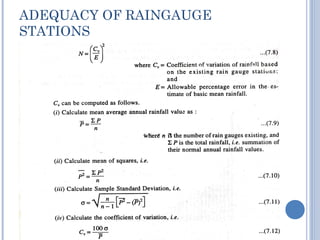
ADEQUACY OF RAINGAUGE
STATIONS
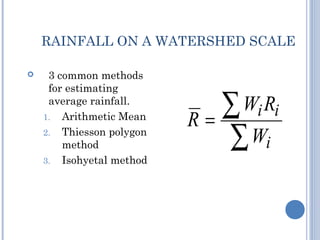
RAINFALL ON A WATERSHED SCALE


3 common methods
for estimating
average rainfall.
1. Arithmetic Mean
2. Thiesson polygon
method
3. Isohyetal method

∑ Wi Ri
R=
∑ Wi
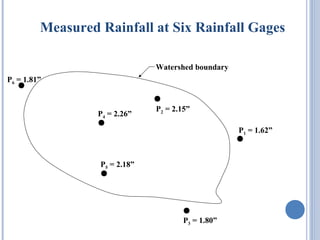
Measured Rainfall at Six Rainfall Gages
Watershed boundary
P6 = 1.81”

P4 = 2.26”

P2 = 2.15”
P1 = 1.62”

P5 = 2.18”

P3 = 1.80”
ARITHMETIC MEAN METHOD


Pavg = [Σ Wi x Pi ] / Σ Wi



All gages given equal weight

Weight = 1
Pavg = (1.82 + 2.15 + 2.26 + 2.18 + 1.62 + 1.8) / 6



Pavg = 1.97 in.


THIESSEN POLYGON METHOD



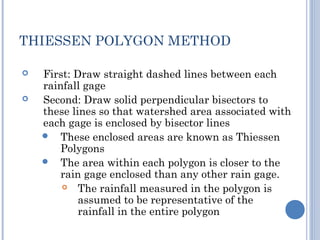
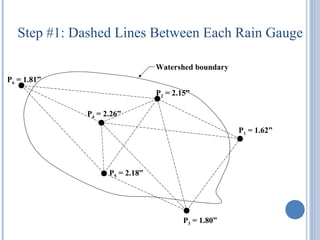
First: Draw straight dashed lines between each
rainfall gage
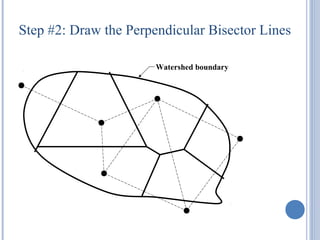
Second: Draw solid perpendicular bisectors to
these lines so that watershed area associated with
each gage is enclosed by bisector lines
 These enclosed areas are known as Thiessen
Polygons
 The area within each polygon is closer to the
rain gage enclosed than any other rain gage.

The rainfall measured in the polygon is
assumed to be representative of the
rainfall in the entire polygon
THIESSEN POLYGON METHOD


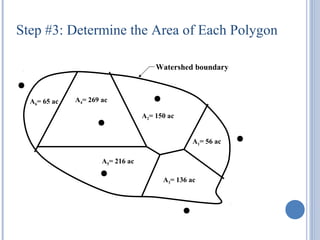
Third: Determine the area of each polygon




The rain gage weight is the area of the polygon it is located
in

Fourth: Calculate the average rainfall using:


Pavg = [Σ Wi x Pi ] / Σ Wi
Step #1: Dashed Lines Between Each Rain Gauge
Watershed boundary
P6 = 1.81”
P2 = 2.15”
P4 = 2.26”
P1 = 1.62”

P5 = 2.18”

P3 = 1.80”
Step #2: Draw the Perpendicular Bisector Lines
Watershed boundary
Step #3: Determine the Area of Each Polygon
Watershed boundary

A6= 65 ac

A4= 269 ac
A2= 150 ac
A1= 56 ac
A5= 216 ac
A3= 136 ac
STEP #4: CALCULATE THE AVERAGE
RAINFALL


Pavg = [Σ Wi x Pi ] / Σ Wi




Pavg = [(65x1.81)+(150x2.15)+(269x2.26)+
(216x2.18)+(56x1.62)+(136x1.8)] / [65+150+269+
216+56+136]
Pavg = 2.08 in.
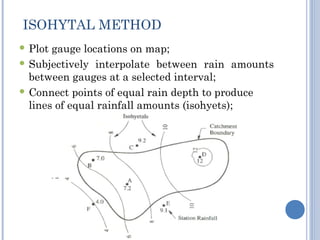
ISOHYTAL METHOD
 Plot

gauge locations on map;
 Subjectively interpolate between rain amounts
between gauges at a selected interval;
 Connect points of equal rain depth to produce
lines of equal rainfall amounts (isohyets);
 
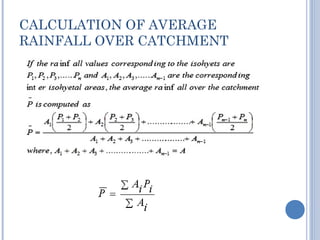
CALCULATION OF AVERAGE
RAINFALL OVER CATCHMENT
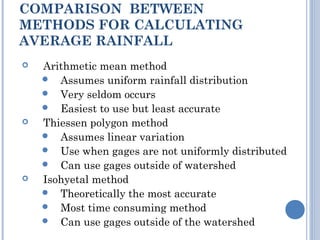
COMPARISON BETWEEN
METHODS FOR CALCULATING
AVERAGE RAINFALL






Arithmetic mean method
 Assumes uniform rainfall distribution
 Very seldom occurs
 Easiest to use but least accurate
Thiessen polygon method
 Assumes linear variation
 Use when gages are not uniformly distributed
 Can use gages outside of watershed
Isohyetal method
 Theoretically the most accurate
 Most time consuming method
 Can use gages outside of the watershed
DAD CURVES


DAD stands for Depth Area Duration curve.



DAD curves exhibit the depth and the area
covered by the rainfall with a particular
duration.






There is a definite relation among depth, area
and duration of rainfall.
The longer duration rainfall covers a wider area.
Short time rainfalls normally cover small areas.
Rainfall rarely occurs uniformly over a large
area.


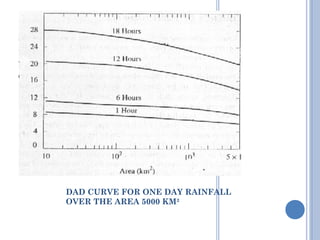
A depth-area-duration curve expresses graphically the
relation between progressively decreasing average
depth of rainfall over a progressively increasing area
from the center of the storm outward to its edges for a
given duration of rainfall.


Purpose of DAD analysis of a particular storm is to
determine the largest average depth of rainfall that
fell over various sizes of area during the standard
passage of time.



hydrologists and engineers require techniques
whereby point rainfall amounts can be transformed to
average rainfall amounts over a specified area
DAD CURVE FOR ONE DAY RAINFALL
OVER THE AREA 5000 KM2
FREQUENCY OF THE RAINFALL




the frequency of the rainfall is the number of
time that a given magnitude of the rainfall may
occur in a given period.
The study of the probability of the occurrence of a
particular extreme (such as 24-h maximum
rainfall ) is of extreme important to
determination of the design flood.
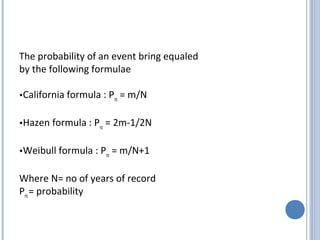
The probability of an event bring equaled
by the following formulae
•California
•Hazen

formula : Pro = m/N

formula : Pro = 2m-1/2N

•Weibull

formula : Pro = m/N+1

Where N= no of years of record
Pro = probability
REFERENCES
•

•

•

Introduction to Physical Hydrology, Martin R.
Hendricks
Hydrology and Floodplain Analysis, Bedient,
Huber and Vieux
National Geographic Magazine

Precipitation and rain gauges

  • 1.
    GOVT.COLLEGE OF ENGINEERIG AURANGABAD. Topic :-MESUREMENT OF PRECIPITATION GUIDED BY:SUBMITED BY:- PROF .K. A.PATIL 1) Nikhil Holsamudrkar (BE11F01F017) 2)Suresh Hatkar(BE11F01F015) 3) Swapnil Dhakane(BE11F01F013) 4) Mamta Ingole(BE11F01F018)
  • 2.
  • 3.
    PRECIPITATION     All forms ofwater that reaches earth’s surface is known as precipitation. It is expressed in terms of depth to which rainfall water would stand on an area if all the rain were collected on it. In case of snowfall equivalent depth of water is considered as depth of precipitation. Rain gauges are used for measurement of precipitation.
  • 4.
    PRECIPITATION   1. 2. 3. In India ‘IndianMeteorological Department (IMD)’ is responsible for all weather and rainfall predictions. It occurs due to: Lifting of air mass Cooling of warm air Condensation
  • 5.
    PRECIPITATION Lifting of airoccurs mainly due to three causes: 1. Cyclonic precipitation:- It is caused by lifting of an air mass due to pressure difference. 2. Convective precipitation:- It is caused due to the upward movement of air that is warmer than it’s surroundings. Generally this kind of precipitation occurs in tropics.
  • 6.
    PRECIPITATION 3. Orographic precipitation:- Itis most important precipitation and responsible for most heavy rains in India. It is caused by air masses which strike some natural topographic barriers such as mountains and can’t move forward hence rise up, causing condensation and precipitation.
  • 7.
    RAINGAUGES 1. Recording type 2.Non recording type  Most rain gauges used in India are recording type i.e. Symon's raingauge.  Recordings are taken at 8:30 am  And if rainfall is more then intermediate readings are taken at 5:30pm
  • 8.
  • 9.
    PRECIPITATION DATA  Necessary forvarious fields  Municipal  Industrial  Agricultural  Forestry  Flood prevention  Recreation
  • 10.
    1) Nonrecording gauge:Symons’Raingauge Extensively use in India Accuracy At 0.1mm 8.30am Capacity Incase rainfall is10cm of Heavy
  • 12.
    2)RECORDING RAIN GAGES Weighing Tipping buckettype bucket type Natural-syphons type
  • 13.
    TIPPING BUCKET TYPE 30.5cm size as per us weather bureau.  water collect from Tip bucket to storage tank  least count of 1 mm and gives out one electrical pulse for every millimeter of rainfall  Electric circuit 
  • 14.
  • 16.
  • 17.
    Weighing bucket type Itconsists of a storage bin, which is weighed to record the mass. It weights rain or snow which falls into a bucket, set on a platform with a spring or lever balance. The increasing weight of the bucket and its contents are recorded on a chart. The record shows accumulation of precipitation.
  • 18.
  • 19.
  • 21.
    RAINGAUGE NETWORK Since thecatching area of the raingauge is very small as compared to the areal extent of the storm, to get representative picture of a storm over a catchment the number of raingauges should be as large as possible, i.e. the catchment area per gauge should be small.  There are several factors to be considered to restrict the number of gauge:  Like economic considerations to a large extent  Topography & accessibility to some extent. 
  • 22.
    MINIMUM DENSITY OF RAINGAUGESACCORDING TO IS 4987-1968 In plains : 1 station per 520 km2  In regions of avg. elevation of 1000m : 1 station per 260-390 km2  In predominantly hilly areas with heavy rainfall : 1 station per 130 km2   10% of total should be self recording raingauges
  • 23.
  • 24.
    RAINFALL ON AWATERSHED SCALE  3 common methods for estimating average rainfall. 1. Arithmetic Mean 2. Thiesson polygon method 3. Isohyetal method ∑ Wi Ri R= ∑ Wi
  • 25.
    Measured Rainfall atSix Rainfall Gages Watershed boundary P6 = 1.81” P4 = 2.26” P2 = 2.15” P1 = 1.62” P5 = 2.18” P3 = 1.80”
  • 26.
    ARITHMETIC MEAN METHOD  Pavg= [Σ Wi x Pi ] / Σ Wi  All gages given equal weight  Weight = 1 Pavg = (1.82 + 2.15 + 2.26 + 2.18 + 1.62 + 1.8) / 6  Pavg = 1.97 in. 
  • 27.
    THIESSEN POLYGON METHOD   First:Draw straight dashed lines between each rainfall gage Second: Draw solid perpendicular bisectors to these lines so that watershed area associated with each gage is enclosed by bisector lines  These enclosed areas are known as Thiessen Polygons  The area within each polygon is closer to the rain gage enclosed than any other rain gage.  The rainfall measured in the polygon is assumed to be representative of the rainfall in the entire polygon
  • 28.
    THIESSEN POLYGON METHOD  Third:Determine the area of each polygon   The rain gage weight is the area of the polygon it is located in Fourth: Calculate the average rainfall using:  Pavg = [Σ Wi x Pi ] / Σ Wi
  • 29.
    Step #1: DashedLines Between Each Rain Gauge Watershed boundary P6 = 1.81” P2 = 2.15” P4 = 2.26” P1 = 1.62” P5 = 2.18” P3 = 1.80”
  • 30.
    Step #2: Drawthe Perpendicular Bisector Lines Watershed boundary
  • 31.
    Step #3: Determinethe Area of Each Polygon Watershed boundary A6= 65 ac A4= 269 ac A2= 150 ac A1= 56 ac A5= 216 ac A3= 136 ac
  • 32.
    STEP #4: CALCULATETHE AVERAGE RAINFALL  Pavg = [Σ Wi x Pi ] / Σ Wi   Pavg = [(65x1.81)+(150x2.15)+(269x2.26)+ (216x2.18)+(56x1.62)+(136x1.8)] / [65+150+269+ 216+56+136] Pavg = 2.08 in.
  • 33.
    ISOHYTAL METHOD  Plot gaugelocations on map;  Subjectively interpolate between rain amounts between gauges at a selected interval;  Connect points of equal rain depth to produce lines of equal rainfall amounts (isohyets);  
  • 34.
  • 36.
    COMPARISON BETWEEN METHODS FORCALCULATING AVERAGE RAINFALL    Arithmetic mean method  Assumes uniform rainfall distribution  Very seldom occurs  Easiest to use but least accurate Thiessen polygon method  Assumes linear variation  Use when gages are not uniformly distributed  Can use gages outside of watershed Isohyetal method  Theoretically the most accurate  Most time consuming method  Can use gages outside of the watershed
  • 37.
    DAD CURVES  DAD standsfor Depth Area Duration curve.  DAD curves exhibit the depth and the area covered by the rainfall with a particular duration.
  • 38.
       There is adefinite relation among depth, area and duration of rainfall. The longer duration rainfall covers a wider area. Short time rainfalls normally cover small areas. Rainfall rarely occurs uniformly over a large area.
  • 39.
     A depth-area-duration curveexpresses graphically the relation between progressively decreasing average depth of rainfall over a progressively increasing area from the center of the storm outward to its edges for a given duration of rainfall.
  • 40.
     Purpose of DADanalysis of a particular storm is to determine the largest average depth of rainfall that fell over various sizes of area during the standard passage of time.  hydrologists and engineers require techniques whereby point rainfall amounts can be transformed to average rainfall amounts over a specified area
  • 41.
    DAD CURVE FORONE DAY RAINFALL OVER THE AREA 5000 KM2
  • 42.
    FREQUENCY OF THERAINFALL   the frequency of the rainfall is the number of time that a given magnitude of the rainfall may occur in a given period. The study of the probability of the occurrence of a particular extreme (such as 24-h maximum rainfall ) is of extreme important to determination of the design flood.
  • 43.
    The probability ofan event bring equaled by the following formulae •California •Hazen formula : Pro = m/N formula : Pro = 2m-1/2N •Weibull formula : Pro = m/N+1 Where N= no of years of record Pro = probability
  • 44.
    REFERENCES • • • Introduction to PhysicalHydrology, Martin R. Hendricks Hydrology and Floodplain Analysis, Bedient, Huber and Vieux National Geographic Magazine